Verifying Spec# Delegates
Samuele Gantner
Master’s Thesis
Chair of Programming Methodology
Department of Computer Science
ETH Zurich
pm.inf.ethz.ch
March 2008 - September 2008
Supervised by:
Joseph N. Ruskiewicz Prof. Dr. Peter M¨uller
Abstract
Function objects allow to encode references to methods in invocable objects. In C#, the
delegate construct provides type safe function objects. A delegate instance encapsulates a reference to one or more methods. Showing the correctness of a delegate invocation is equivalent to showing that the pre-condition of the method pointed to by the delegate is satisfied before the invocation of the delegate.
Delegates are commonly used in C# programs for encapsulating and composing methods and implementing eventing patterns. However no verification framework for Spec# dele-gates has been implemented yet.
In this thesis we implement a verification methodology for singlecast delegates based on refinement of specification and delegates invariants. We then extend the methodology to multicast delegates: delegates pointing to multiple target methods. To ensure correctness, the pre-conditions of all targets must hold throughout the invocation of the multicast dele-gate; moreover the post-condition of the delegate must hold after the invocation of its last target. We formulate heap and parameters stability conditions, sufficient to ensure the cor-rectness of a multicast delegate invocation. In tightly coupled scenarios - where the contract of a target method depends on both the arguments and the target type - delegate invariants are insufficient to show refinement of specification. To solve this problem we introduce a new construct that allows to fix the type of the target.
We implemented the methodology in the Spec# programming system by extending the Spec# programming language to include pre-, post-, frame conditions, and invariants for delegates. Our extension allows to statically verify singlecast delegates, multicast delegates, and events. We further extended the language to verify delegates where the type of the target can be fixed during declaration. Where applicable, we also introduced runtime checks.
Acknowledgments
I would like to thank my supervisor, Joseph N. Ruskiewicz, for his support and feedback throughout this whole work; Prof. Peter M¨uller for the useful suggestions about various topics of this thesis, and especially frame conditions; J¨urg Billeter for the fruitful discussions, especially about tightly and loosely coupled delegates and all other PhD. student of the Programming Methodology group for their useful suggestions and feedback.
Particular thanks to Hans Dubach and Denise Spicher for their patience in solving all administrative issues during my master.
Thanks to Dario Poggiali for helping me finding a correct balance and finally special thanks to my family for their continuous support during my studies.
Contents
1 Introduction 11 1.1 Overview . . . 12 1.2 Notation Conventions . . . 13 2 Background 15 2.1 C# Delegates . . . 15 2.1.1 Delegates in .NET . . . 16 2.1.2 Multicast Delegates . . . 17 2.1.3 Immutability of Delegates . . . 19 2.1.4 Events . . . 192.2 The Spec# Programming System . . . 20
2.2.1 The Spec# Programming Language . . . 20
2.2.2 The Spec# Compiler . . . 22
2.2.3 Boogie . . . 22
2.2.4 BoogiePL . . . 22
2.3 Previous Work on Static Verification of Delegates . . . 26
2.3.1 Contracts For Delegates . . . 26
2.3.2 Delegates Invariants . . . 27
2.3.3 Delegate Subtyping . . . 29
2.3.4 Disabling Delegates . . . 29
3 Implementation of Static Verification for Singlecast Delegates 31 7
8 CONTENTS
3.1 Contracts and Subtyping . . . 31
3.1.1 Encoding and Definition of Contract Elements . . . 31
3.1.2 Delegate Instantiation in BoogiePL . . . 33
3.1.3 Delegate Invocation in BoogiePL . . . 36
3.1.4 Exposing an Object in BoogiePL . . . 37
3.1.5 Delegate Subtyping in BoogiePL . . . 39
3.2 Disabling Delegates . . . 39
3.2.1 Ownership Based Disabling . . . 39
3.2.2 Disabling Delegates with the Enabled Field . . . 40
3.2.3 Disabling Delegates in BoogiePL . . . 41
3.3 Frame Conditions . . . 43
3.3.1 Encapsulation . . . 43
3.3.2 The Type of the Target . . . 44
3.3.3 Subtyping . . . 45
3.3.4 Frame Conditions in BoogiePL . . . 46
4 Extensions 51 4.1 Delegates with Static Methods . . . 51
4.1.1 Instantiation of Delegates with Static Methods in BoogiePL . . . 52
4.2 Multicast Delegates . . . 53
4.2.1 Stability requirements . . . 53
4.2.2 Encoding Multicast Delegates . . . 54
4.2.3 Combining Delegates in BoogiePL . . . 58
4.2.4 Subtyping and Multicast Delegates . . . 60
4.3 Events . . . 61
4.3.1 Ownership and Events . . . 62
4.4 Closed Target Type Delegates . . . 63
4.4.1 Pre-, Post-Conditions and Invariants . . . 63
4.4.2 Tightly Coupled Delegates . . . 65
4.4.3 CTT Delegates and Subtyping . . . 65
4.4.4 CTT Delegates in BoogiePL . . . 65
5 Implementation and Runtime Checks 67 5.1 From SSC to CIL . . . 67
CONTENTS 9
5.1.1 Delegate Instantiation . . . 67
5.1.2 Contracts for delegates . . . 67
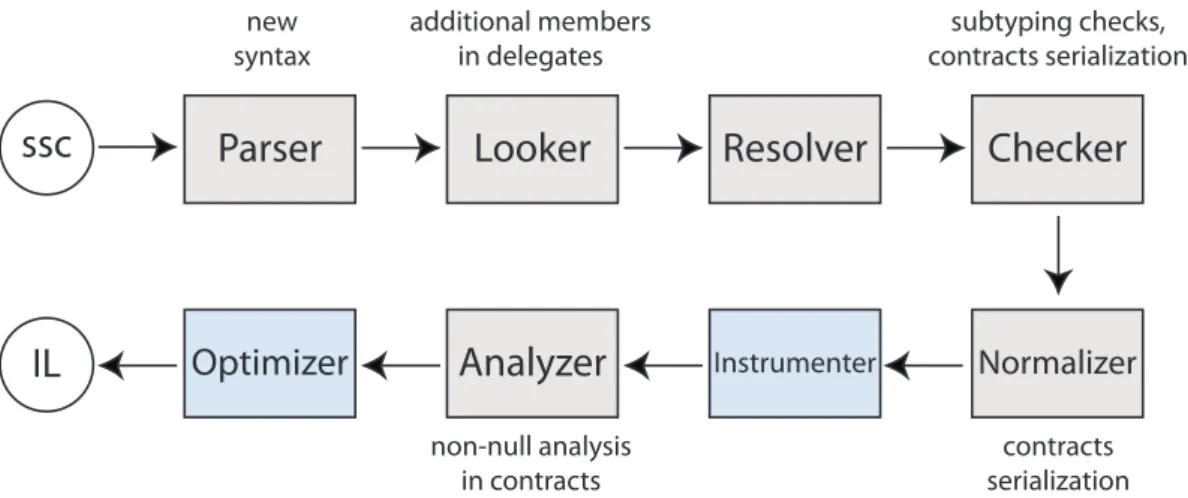
5.1.3 Delegate Subtyping . . . 68 5.1.4 Disabling Delegates . . . 70 5.1.5 Frame Conditions . . . 70 5.1.6 CTT Delegates . . . 71 5.1.7 Compiler Architecture . . . 71 5.2 Boogie . . . 72 5.3 Runtime Checks . . . 73 5.3.1 Building Blocks . . . 73
5.3.2 Implementing Runtime Checks . . . 74
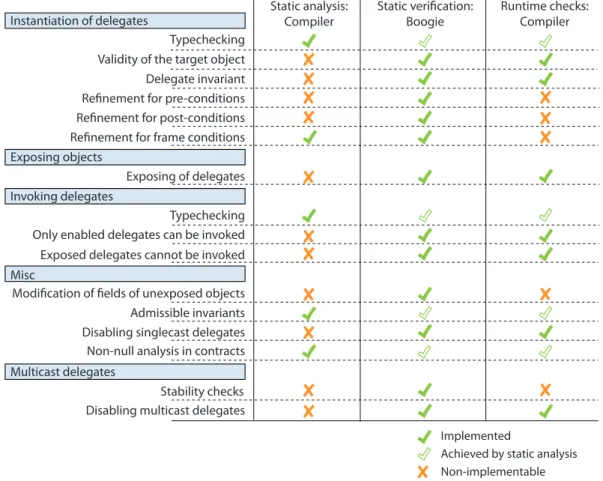
6 Conclusions 79 6.1 State of the Implementation . . . 79
6.2 Conclusions . . . 81
6.3 Future Work . . . 81
A Short User’s Manual 85 B Examples 89 B.1 Complete USBStick Example . . . 89
B.2 Events . . . 91
C SSC Syntactic Grammar 93 D Compiler Generated Methods 95 D.1 Compiler-Generated Delegate Classes . . . 95
D.2 Compiler-Generated Events Methods . . . 98
E Found Bugs 101 E.1 Generics . . . 101
E.2 Constructors in Contracts . . . 102
E.3 Array Initialization . . . 103
E.4 Structural Type Rules for Delegates . . . 104
E.5 Out of Band Contracts and Axioms Contradiction . . . 104
CHAPTER
1
Introduction
Function objects allow to encode references to methods, in objects that can be invoked. Function objects are present in many programming languages; they are represented in Eif-fel with agents, in Scala with function objects and in C# with delegates: object-oriented type safe function pointers. Function objects pose important challenges on current static verification frameworks. The verification methodology for Spec# delegates described in [15] allows to verify a subset of Spec# delegates and is implemented and extended in this work. The Spec# programming system allows to statically verify programs with respect to their specification and the semantics of the language. The system is composed by the Spec# programming language, a superset of C#, the Spec# compiler and a static program verifier based on weakest preconditions and first order logic named Boogie. Boogie translates a Spec# program in the intermediate BoogiePL language and then uses a theorem prover to verify it.
A C# delegate declaration includes the signature of possible target methods and is trans-lated during compilation in a class which includes a publicInvoke()method used to invoke the delegate. Delegates are instantiated like normal objects by providing to the constructor a target object and a target method. Delegates promote encapsulation: the client of a delegate does not have to be aware of the underlying implementation.
Listings 1.1 shows a Spec# program that uses delegates. TheLog()method of classClient
invokes a delegate passed as argument, but has no information about the target object and method oflogFile. In order to verify this program, we need to ensure that the pre-condition of every possible method pointed to by logFile holds when the delegate is invoked. If the delegate in the example points to methodStore()of some object of typeUSBStick, then the invocation might result in a pre-condition violation. This is because theIsLoaded condition of the target object might not hold.
In this thesis we implement a modular verification methodology for Spec# delegates based on refinement of specification and delegate invariants [15, 11]. The methodology is then extended to consider object functions pointing to static methods, multiple targets (known in C# as multicast delegates) and events. We further extend the Spec# language to include
12 1 Introduction
Listing 1.1: Introductory example, based on the example provided in [15]
class USBStick {
public bool IsLoaded;
public void Store(object p)
requires p != null;
requires this.IsLoaded; { /* Store p */ }
}
delegate void Archiver(object p);
class Client {
public static void Log(Archiver! logFile, string! s) { logFile(s); }
}
object functions where the target type is closed during the declaration of the delegate.
1.1
Overview
Chapter 1 introduces the problem this work addresses and the notation conventions needed for reading this document.
Chapter 2 introduces the background information needed to understand this document. The chapter is divided in three section. The first sections explains C# delegates and points out the situations where it is suitable to use them. The second section presents the Spec# programming system, composed by the Spec# programming language, the Spec# compiler and Boogie. The subset of BoogiePL needed for this thesis is also introduced. The third section explains the methodology described in [15]. Readers familiar with these topics can skip this chapter as it does not introduce new concepts.
Chapter 3 presents how the verification methodology for Spec# delegates can be imple-mented in the Spec# programming system. The first section explains how delegate contracts are encoded and translated in BoogiePL. The second section extends the technique for dis-abling delegates to make it implementable in Spec#. Finally the third sections explains how frame conditions for delegates can be handled.
Chapter 4 explains the extensions to the approach described in Chapter 3 that we imple-mented. The first section handles delegates instantiated with static methods. The second section explains how multicast delegates can be verified; in the first part the four conditions necessary for ensuring heap stability are described, while in the second part the problems of disabling multicast delegates is addressed. The third section explains how the verification of multicast delegates is extended to events. The fourth and last section introduces the new concept of closed target type delegates: delegates where the type of possible target objects is defined during the declaration of the delegate.
13 Chapter 5 covers the implementation in the Spec# compiler and Boogie. The first section explains how the specification information of a source program is encoded in a CIL assembly and also provides a high level overview of the changes done to the Spec# compiler. The second section provides information on how Boogie must be extended in order to accept and translate the new specification information. Finally, the last section introduces runtime checks and explains how they are implemented.
Chapter 6 summarizes the implementation state and concludes the thesis.
1.2
Notation Conventions
Spec# programs Spec# or C# programs are enclosed in horizontal lines and typeset in typewriter font, like in the following example:
public class Program {
public static void Main(string args[]) { } }
Please note that, in general, the examples are not complete: members not strictly relevant to the context are usually omitted.
Inline statements and expressions, such asConsole.WriteLine("Hello, World"), are shown in typewriter font.
BoogiePL code examples and translations BoogiePL examples and translations are typeset in typewriter font with numbered lines, like in the following example:
1 % this is a comment
2 assert Heap[d, System.Delegate._target] != null; 3 havoc m;
Sometimes we need to express pseudo-code instruction inside BoogiePL. Such instructions are typeset in italic font. The code example below means that Boogie will emit the assertion for each U which is a subtype ofT:
1 #f oreach U s.t. U <: T 2 assert InvU(pi)
Discussing code Often code contained in examples is discussed in paragraphs. In this case, code elements, such as Program.Main(), are typeset in italic font.
Formulas and concepts Formulas and concepts not directly expressed in Spec# or BoogiePL format, such as T <:U orP reD(i0), follow mathematical notation.
14 1 Introduction
IFunction 1
Subtyping
Aggregation (including cardinality)
Interface Implementation A owns B,A and C are peers A
B
C
Operators and functions We present here a short list of ambiguous or non-standard operators.
Symbol Language / Context Description
= Spec# assignment operator
== Spec# equality operator
:= BoogiePL assignment operator
= BoogiePL equality operator
= Mathematical equality operator
V
iC(i) Mathematical conjunction of clauseC(i) for alli
<: Spec#, BoogiePL, Math. reflexive subtyping operator: U <:T means that U is equal or is a subtype ofT
E[o/n] Spec#, BoogiePL, Math. substitution operator; every occurrence ofoin E is replaced byn.
CHAPTER
2
Background
In this chapter we provide the background information needed to understand this work. Starting with an explanation of C# delegates, we introduce the Spec# programming system including the Spec# programming language, the Spec# compiler and Boogie. Finally we present the verification methodology for Spec# delegates [15] on which this thesis is based.
2.1
C# Delegates
C# delegates are object-oriented type safe function pointers [9]. A delegate declaration defines a class derived from System.MulticastDelegate. Delegates allow to encapsulate a reference to one or more methods, known ascallable entities, inside a delegate object which can then be invoked. There are three steps in defining and using delegates: declaration, instantiation and invocation. The following example:
public delegate void MyDelegate(int i);
declares a delegate named MyDelegate with void return type and a single int argument. Delegates can be instantiated using the compiler generated constructor which takes the callable entity of the new delegate as argument. A callable entity is composed by a method only, in case the method is static, or by an instance and a method of that instance otherwise. We refer to the instance astarget object and to the method astarget method of a delegate. When a delegate is instantiated, the compiler checks that the signature of the delegate is the same as the method. A delegate can then be invoked like a normal method; arguments and return types are type-checked in order to ensure type safety.
The simple ”Hello, World!” of delegates of Listings 2.1 shows how the delegate declared above can be instantiated and used. MyDelegatecan point to any method withvoid return type and with one int argument. In method Main() a new instance of MyDelegate with target method MyMethod() is created. The new delegate is then invoked: this leads to a call of MyMethod.
16 2 Background
Listing 2.1: Hello, World!
public delegate void MyDelegate(int i);
class Program {
public static void MyMethod(int i) {
Console.WriteLine("Hello, World: " + i); }
public static void Main() {
MyDelegate del = new MyDelegate(MyMethod); del(1);
} }
Use of Delegates
According to MSDN delegate should be used when:
1. An eventing design pattern is used.
2. It is desirable to encapsulate a static method.
3. The caller has no need access other properties, methods, or interfaces on the object implementing the method.
4. Easy composition is desired.
5. A class may need more than one implementation of the method.
In general delegates promote encapsulation. The idea behind it is that the client of a delegate has no need to know the identities of the target object and the target method. As we will see in later chapters however, there are situations (like in scenario 5) where the client wants, potentially, full knowledge of the target object and method.
In the next section we will explain how delegates are implemented on .NET.
2.1.1
Delegates in .NET
Delegates are implemented in .NET with a combination of syntactic sugar, compiler gener-ated code and runtime handling. The general idea behind delegates is the following: for each delegate declaration, the compiler generates a new class which extends System.MulticastDelegate. The new class, whose is name is the same as the delegate, defines an Invoke() method which has the same signature as the delegate. An invocation of a delegate is translated to an invocation of its Invoke() method; Invoke() however does not define a body. It is the responsibility of the common language runtime (CLR) to handle the invocation of the target methods of the delegate. Listings 2.2 shows part of the compiler-generated code of the previous example,
As shown in the example the actual implementation of the constructor and the Invoke()
17
Listing 2.2: Disassembled version of a program using delegates
public class MyDelegate : System.MulticastDelegate { [MethodImpl(0, MethodCodeType=MethodCodeType.Runtime)]
public MyDelegate(object @object, IntPtr method);
[MethodImpl(0, MethodCodeType=MethodCodeType.Runtime)]
public void Invoke(int i); }
class Program { ...
public static void Main() {
MyDelegate del = new MyDelegate(null, (IntPtr)MyMethod); del.Invoke(1);
} }
the instantiation of an object (in fact it is an instantiation of an object), while the invocation is de-sugared to a invocation toInvoke().
When the callable entity of a delegate is a static method the target object is not specified, e.g. it is set to null.
Finally delegate calls obey dynamic dispatch. This means that if a delegated has a virtual method m for some object o of type T as callable entity, the invocation of the delegate results in a call to the most derived override of m defined in a typeU such that U <: T, whereU is the dynamic type ofo.
2.1.2
Multicast Delegates
After instantiation, a delegate has a single callable entity, namely the one specified in the constructor. We refer to delegates having a single callable entity as singlecast delegates. Delegates of the same type however can be combined to form a new delegate having multiple callable entities. We refer to delegates having more than one callable entity as multicast
delegates. The distinction however is only conceptual; in practice all delegate is a subtype ofMulticastDelegate and singlecast and multicast delegates are used in the same way. In the program of Listings 2.3,m is obtained by combining the singlecast delegates with a new singlecast delegate; s andm are both of typeMyDelegate. An invocation of s results in an invocation ofTarget(); an invocation ofm however will first invokeTarget()and then invoke AnotherTarget(). A multicast delegate is defined by its invocation list: an array of singlecast delegates which are invoked by the multicast delegate. This list is obtained through to theGetInvocationList()method defined inSystem.Delegate. Let us see how this works in more detail.
In the following we will only consider the invocation list returned by the public GetInvoca-tionListMethod(). Delegates also maintain a private invocation list which is different from the one returned by the method and that we will ignore as it is only part of the specific implementation. The invocation list of a singlecast delegate only contains the delegate it-self. MethodDelegate Delegate.Combine(Delegate, Delegate) returns a new delegate of the same type of the delegates passed as argument and with an invocation list obtained by
con-18 2 Background
Listing 2.3: Combining delegates
public delegate void MyDelegate();
class Program {
static void Target() { }
static void AnotherTarget() { }
public static void Main() {
MyDelegate s = new MyDelegate(Target); MyDelegate m = Delegate.Combine(
singlecast, new MyDelegate(AnotherTarget)); }
}
catenating the invocation lists of the two arguments1. It is also important to mention the
possibility of removing delegates from delegates. As for the case with combining delegates, the .NET library offers methods like Delegate Delegate.Remove(Delegate, Delegate) which effect is similar to Degate.Combine but with the difference that the invocation lists are subtracted instead of concatenated. C# offers some useful syntactic sugar for combining and removing delegates: the plus (+) operator is replaced byDelegate.Combine(Delegate, Delegate) while the minus (-) operator is replaced byDelegate.Remove(Delegate, Delegate). Moreover the plus-equal (+=) and minus-equal (-=) operators are also defined: d1 += d2is equivalent tod1 = d1 + d2, whiled1 -= d2is equivalent tod1 = d1 - d2
It is important to note that even though the resulting delegate ofDelegate.Combineis a new instance, the invocation list contains references to the delegates present in the invocation list of the two arguments; this means thatDelegate.Combine creates at most one additional delegate. The same also applies for Delegate.Remove. To make matters more complicated the invocation lists are flattened and the same instance of a delegate can be contained more than once in the invocation list. Consider the following example:
MyDelegate singlecast = new MyDelegate(Target);
MyDelegate multicast1 = Delegate.Combine(singlecast, singlecast); MyDelegate multicast2 = Delegate.Combine(multicast1, singlecast);
After the execution of the code above we have:
1. singlecast is a singlecast delegate; its invocation list contains a reference to itself; 2. multicast1 is a multicast delegate; its invocation list contains two references to
single-cast;
3. multicast2 is also a multicast delegate; its invocation list contains three references to
singlecast (not one reference to multicast1 and one reference tosinglecast).
Flattening the invocation list and returning a new delegate while combining, ensures that the effects of combining delegates are limited to the newly created delegate. When querying a multicast delegate for its target object and method, the result is equivalent to the target object and method of the last delegate in the invocation list.
1When one of the delegates is null, the other one is returned; this means thatDelegate.Combinereturns
19
Listing 2.4: Observer pattern implemented with events
public delegate void UpdateEventHandler(Observable o);
public class Observable {
public event UpdateEventHandler Changed;
protected void Notify() { if (Changed != null) Changed(this); } }
public class Observer {
public void Update(Observable o) { } }
public class Program {
public static void Main() {
Observable target = new Observable(); Observer observer = new Observer();
target.Changed += new UpdateEventHandler(observer.Update); }
}
2.1.3
Immutability of Delegates
From a client’s perspective a delegate is completely defined by its callable entities. This means that a singlecast delegate is defined by its target object and method, while a multicast delegate is defined by its invocation list.
Delegates override the equality operator. Two multicast delegatesa andbare equal if their invocation lists are equal, e.g. if all delegates in the invocation list are equal, the size of the invocation lists is the same and the order is preserved. Two singlecast delegates in the invocation list are equal if their target objects and target methods are the same [6]. Always from a client’s perspective, given a delegated,d.Target andd.Method cannot be changed. If we add this information to the fact that every operation that could modify the invocation list of a delegate, returns a new delegate, we can conclude that from the client’s point of view delegates are immutable.
2.1.4
Events
Anevent is a member that enables an object or class to provide notifications [9].
Listings 2.4 shows an example of the Observer pattern implemented with events. The
Changed event declared in Observable, is translated by the compiler in a private field of typeUpdateEventHandler and public methods used to add and remove delegates from this field. For an observer to register it is sufficient to instantiate a new delegate with an update method as target, and add it to Changed event using the+= operator which is translated by the compiler to an invocation of the method used to add delegates to the event. The disassembled version of the example above is shown in Listings 2.5.
20 2 Background
Listing 2.5: Decompiled version of the observer pattern implemented with events
public class Observable {
private UpdateEventHandler Changed;
[MethodImpl(MethodImplOptions.Synchronized)]
public void add_Changed(UpdateEventHandler modopt(NonNullType) value) {
this.Changed = (UpdateEventHandler) Delegate.Combine(this.Changed, value); }
[MethodImpl(MethodImplOptions.Synchronized)]
public void remove_Changed(UpdateEventHandler value) {
this.Changed = (UpdateEventHandler) Delegate.Remove(this.Changed, value); }
protected void Notify() {
if (this.Changed != null) {
this.Changed.Invoke(this); }
} }
2.2
The Spec# Programming System
The Spec# Programming System is composed by the Spec# programming language, the Spec# compiler and Boogie. With Spec#, a programmer includes specification information in the source code. The program correctness, with respect to its specification and the semantics of the language, is then verified by Boogie.
2.2.1
The Spec# Programming Language
The Spec# [5] programming language is a superset of C#. It allows specifying method contracts in the form of pre-, post- and frame conditions and type contracts in the form of invariants. The type system of C# is extended with non-null types and checked exceptions [5]. Specification information is expressed with a combination of additional syntax and attributes. The language also includesassert and assume statements and quantifications. With an object invariant it is possible to define the consistent state for that object. An object is said to be consistent if its invariant is known to hold. Consistency is defined with respect to a specific class frame. Consider an object o of typeX, where X <:Y <:Object; every class in the hierarchy can define some invariant. Object o is said to be valid (consistent) for T if the invariants for all typesU, such that T <:U, are satisfied; in the exampleois valid forY if the invariants defined inY andObject(trivially true) are satisfied. An object is fully valid, if it is valid for its dynamic type. In Spec# every object is given an addition fieldinv, which stores the most derived class frame for which the object is known to be valid [3]. The invariant for a class frame T can be temporarily violated if ¬o.inv <:T. Spec# provides a special block statement that allows to modify the inv field of an object: expose (o) { S }. Before entering the block, the inv field of o is set to the superclass ofT, the type ofo: the object is exposed. Inside the block the invariant defined inT can be violated, while at the end of the blockT’s invariant is checked ando.invis set toT. Theinvfield of an object can only be modified through an expose statement; this ensures that outside of
21 any expose block, an object is always fully valid. The following program invariant is then defined:
Program Invariant 1. Object invariants
P1 : (∀o, T·o.inv <:T ⇒InvT(o))
whereInvT is the invariant declared in classT. In order to handle invariants for aggregate
objects, Spec# employs the concept of ownership. An object is allowed to express invariants for all objects it owns. Ownership requires two additional fields2 given to every object;
o.ownerRef is a reference to the owner ofo, whileo.ownerF rameis the type of the owner [13]. The validity of an object is now conditional to the validity of all the objects it owns. This lead to the following programming invariant:
Program Invariant 2. Ownership P2 :(∀o, T·o.inv <:T ⇒
(∀p·p.ownerRef =o∧p.ownerF rame=T ⇒p.inv=typeof(p))
Program invariantP2 states that if an object is valid, then all object it owns must also be valid. With respect to invariants and ownership, we can define the following properties for objects:
Definition 2.1 (Validity). An objectois valid for class frameT iffo.inv <:T. Definition 2.2 (Full Validity). An objectois fully valid iffo.inv=typeof(o).
Definition 2.3 (Consistency). An objecto is consistent iffo is valid and either it has no owner or its owner is exposed, e.g. ifo.inv=typeof(o) and
o.ownerF rame=P eerGroupP laceholder∨ ¬o.ownerRef.inv <:o.ownerF rame P eerGroupP laceholder is used on the ownerF rame field to indicate that the object has no owner.
Definition 2.4 (Peer-Validity). An object o is peer-valid iff o and all its peers are valid, e.g. if
o.inv=typeof(o)∧(o.ownerF rame=P eerGroupP laceHolder ∨
(∀p · p.owner.Ref =o.ownerRef∧p.ownerF rame=o.ownerF rame ⇒p.inv=typeof(p)))
Definition 2.5 (Peer-Consistency). An object o is peer-consistent if it is peer-valid and either it has no owner or its owner is exposed, e.g. if
o.inv=typeof(o)∧(o.ownerF rame=P eerGroupP laceholder∨
(¬o.ownerRef.inv <:o.ownerF rame∧(∀p·p.owner.Ref =o.ownerRef∧ p.ownerF rame=o.ownerF rame⇒p.inv=typeof(p))))
Peer-consistency is an important requirement for arguments of methods. A method, receiv-ing an objectoas argument, needs to know thatois valid; moreover the method could also modify o. For this reason every non-pure methods has a default pre-condition requiring peer-consistency of all parameters. If an object is peer-consistent then it is also valid and its owner is known to be exposed, which allows the object to be changed.
2In the original publication an object is given a single additional owner field whose value is a pair
[object obj, type typ]. In our notation however we choose to remain closer to the actual BoogiePL encoding of ownership by providing two distinct fields.
22 2 Background
2.2.2
The Spec# Compiler
The Spec# compiler compiles Spec# source files in .NET intermediate language (CIL) and it is responsible for performing initial static checks including:
• Non-null analysis; • Checked exceptions;
• Side effects-free specifications; • Admissible specification.
The compiler’s type checker verifies the usage of non-null types and generates warnings in case of violations.3 Checked exceptions are verified to ensure that they are actually caught.
Side effects-free specification means that all expressions used for specification are not allowed to have side effects. This is accomplished by forbidding operators that can modify fields -like for example the assignment operator - and requiring all methods used in the specification to be pure. Moreover expressions used in specification must be admissible. As an example, every target of field access or method calls in invariants must be (recursively) owned by the object declaring the invariant. It is up to the compiler to check the admissibility of such expressions.
Additionally the compiler instruments the code for runtime checks. The body of methods is extended so that violations of pre- and post-conditions result in runtime exceptions. When entering an expose block an exception is thrown if the object is not exposable and when leaving it an exception is thrown if the invariant does not hold. Frame conditions are not checked at runtime because of performance reasons.
2.2.3
Boogie
Boogie is a static program verifier that takes as input the abstract syntax tree (AST) generated by the Spec# compiler or a compiled CIL library, translates the program in Boogie [1] programming language (BoogiePL) and finally feeds the translated program to a theorem prover. As a last step Boogie returns the list of failing conditions. Currently Boogie uses the Z3 theorem prover [7], but optionally Simplify can be used as well. The first step in the verification done by Boogie is to obtain the AST of the program to verify. This is either directly fed to Boogie by the Spec# compiler or is reconstructed from CIL. A BoogiePL program follows a certain number of transformations [4] which can be summa-rized in three steps: (1) cutting back edges to obtain a loop-free program, (2) transformation in passive form and finally (3) weakest-pre-condition computation to obtain the verification condition that is finally fed to the theorem prover. In this report we focus on the steps leading to the BoogiePL program and we take the later transformations as granted.
2.2.4
BoogiePL
BoogiePL [8] retains procedures, mutable variables and pre- and post-conditions. It intro-duces constants, function symbols, axioms and non-deterministic control-flow. A BoogiePL
3Non-null analysis is unsound: there are situations where a variable of a non-null type can be null without
the compiler emitting a warning or error. Please note that is is a bug of the current implementation of Spec#.
23 program consists of two parts. The first part is a theory used to encode the semantics of the source language consisting of type declarations, symbol declarations and axioms. The second is an imperative part used to encode the source program; it consists of global vari-able declarations, procedure headers and procedure implementations. A procedure header defines the signature of the procedure and its contract; it is used for verifying callers of the corresponding Spec# method or to express general modifications of the heap. A proce-dure implementation contains the translation in BoogiePL of the body of the corresponding Spec# method; it is used to verify that the implementation of a method respects its speci-fication.
Data Types BoogiePL has five built-in data types: integers (int), booleans (bool), refer-ences (ref), type and field names (name) and any (any). Boogie also supports arrays and user-defined data types. Arrays can be indexed by any type, not only byint.
Commands BoogiePL defines a number of commands; relevant to this report are: assert
andassume, indicating conditions to be checked or used; havoc, which assigns an arbitrary value to a variable and finally call, used to simulate a procedure call and whose effect is to assert the pre-condition of the procedure, havoc the heap and finally assume the post-condition.
Procedures Procedures support in and out parameters, this also allows to encode ref
and out Spec# parameters. Frame conditions are encoded as post-conditions. In Spec# frame conditions state what the method might change; in BoogiePL the opposite holds and frame conditions state what the method does not change.
Heap The heap is encoded in BoogiePL as a global, two-dimensional array indexed by a reference to an object and the name of a field of that object. The array is namedHeap and declared as: var Heap: [ref,<x>name]x. Instance fields access of the formo.f are translated inHeap[o, T.f ] whereT is the class wheref is declared andT.f is a constant of type name. Object allocation is encoded using the additionalallocated field.
Invariants The Spec#invfield is encoded in BoogiePL using two fields: inv is used for additive expose, whilelocalinv is used for normal expose.
Fields’ Axioms Properties of fields are encoded in BoogiePL using axioms. axiom In-cludeInMainFrameConditions(f )indicates that the field is part of the frame condition, while
IncludedInModifiesStar(f ) indicates that the field can be changed by amodifies o.* clause;
typeof(o) encodes the type of objecto.
Functions Some properties are encoded in BoogiePL using functions. Relevant to this work are BaseClass(T) which returns the base class of T; IsHeap(h) indicating whether array h is a well-formed heap and finally HeapSucc(oldHeap, newHeap) which indicates whether newHeapis a valid successor ofoldHeap.
Listings 2.7 shows the translation of the program of Listings 2.6 in BoogiePL. For simplicity reason the background theory and other parts of the program are omitted.
24 2 Background
Listing 2.6: A simple class representing a point
public class Point {
[SpecPublic] private int x, y;
invariant x >= 0 && y <= 0;
public void Add(Point! other)
requires other.x > 10; {
this.x += other.x; this.y += other.y; }
}
As the example shows, the BoogiePL program starts by defining constants and emitting axioms describing a theory for a Point. This part ends withPoint’s object invariant. In the second part the procedure headers and implementations are emitted. Spec# includes a large number of default pre- and post- conditions which are shown as comment in the header of Point.Add. Finally comes the actual body of the method. The pre-condition
other$in != null ensures that the assertionother != nullholds. Like in CIL, stack variables are extensively used in the implementation of procedures.
25
Listing 2.7: BoogiePL translation of Listings 2.6
const unique Point.x: <int>name; const unique Point.y: <int>name;
const unique Point: name; axiom Point <: Point;
axiom $BaseClass(Point) == System.Object &&
AsDirectSubClass(Point, $BaseClass(Point)) == Point; axiom !$IsImmutable(Point) && $AsMutable(Point) == Point;
axiom (forall $oi: ref, $h: [ref,<x>name]x :: && $h[$oi, $inv] <: Point ==> $h[$oi, Point.x] >= 0 && $h[$oi, Point.y] <= 0);
procedure Point.Add$Point$notnull(this: ref, other$in: ref where $IsNotNull(other$in, Point));
requires $Heap[other$in, Point.x] > 10; // target object is peer consistent (omitted) // other is peer consistent (omitted)
modifies $Heap, $ActivityIndicator; // frame condition
ensures (forall $o: ref, $f: name :: { $Heap[$o, $f] }
IncludeInMainFrameCondition($f) && ... ==> old($Heap)[$o, $f] == $Heap[$o, $f]); free ensures $HeapSucc(old($Heap), $Heap);
// inv/localinv change only in blocks (omitted)
implementation Point.Add$Point$notnull(this: ref, other$in: ref) {
var other: ref, stack0i: int, stack1i: int, temp0: exposeVersionType, temp1: exposeVersionType; entry: other := other$in; goto block2499; ... block2635:
assert this != null;
stack0i := $Heap[this, Point.x];
assert other != null;
stack1i := $Heap[other, Point.x]; stack0i := stack0i + stack1i;
assert this != null;
$Heap[this, Point.x] := stack0i;
assert this != null;
stack0i := $Heap[this, Point.y];
assert other != null;
stack1i := $Heap[other, Point.y]; stack0i := stack0i + stack1i;
assert this != null;
$Heap[this, Point.y] := stack0i;
assert !($Heap[this, $inv] <: Point && $Heap[this, $localinv] != $BaseClass(Point)) || $Heap[this, Point.x] >= 0;
assert !($Heap[this, $inv] <: Point && $Heap[this, $localinv] != $BaseClass(Point)) || $Heap[this, Point.y] <= 0;
assume IsHeap($Heap);
return; }
26 2 Background
2.3
Previous Work on Static Verification of Delegates
In this section we describe the methodology [15] which is the foundation of this work. We introduce one concept at the time, by first assuming a simplified situation and then gradually building up a complete solution.
The issue in the verification of programs using delegates, as we saw in the introduction, is re-lated to the specification of methods. Before invoking a method, the caller must ensure that the pre-condition of the method holds, moreover the caller can assume the post-condition of the callee to hold. It is up to the implementer of a method to make sure that the body of the method is correct, e.g. that its execution satisfies its post-condition given the assumption that the pre-condition holds. With delegates this is more difficult because, in principle, the target method is unknown. In this perspective it is useful to see delegates as methods exe-cuting a single operation, namely invoking their target. In order for a delegate invocation to be correct, the pre-condition of the target method must hold before invocation and the post-condition of the delegate must hold after invocation.
The idea for the verification of delegates is based on two steps: the first step consists in providing delegates with a specification similar to the one for methods; in the second step delegate instantiations are checked to verify that the delegate is arefinement of its target method:
Definition 2.6 (Refinement). The specification of a method m is a refinement of the specification of a methodn(or in shorter formmis a refinement ofn) if:
1. The pre-condition of m implies the pre-condition of n, for all possible parameters, heaps and
2. The conjunction of the pre-condition ofm with the post-condition of n implies the post-condition ofmfor all possible parameters, return values and pre-state and post-state heaps.
When the delegate is a refinement of its target method, we can be sure that if the pre-condition of the delegate holds, so will the pre-pre-condition of the target method, and conversely if the post-condition of the target method holds after invocation, so will the post-condition of the delegate.
2.3.1
Contracts For Delegates
Consider the example shown in Listings 2.8. We want to ensure that the delegate invocation
logFile()in theLog()method does not break the pre-condition of its target method. If this can be proven, then we can assume the call to be correct.
For the time being we ignore the second pre-condition of Store; to prove this program we can simply add a pre-condition requiring the parameter to be non null to the delegate:
delegate void Archiver(object p);
requires p != null;
This pre-condition can be seen as a usual method pre-condition; the caller must make sure that the pre-condition of the delegate holds before invoking it and, since this pre-condition is the same as the one defined in the target method (namely that the parameter is not null),
27
Listing 2.8: A simple USBStick
class USBStick {
public void Store(object p)
requires p != null;
requires IsPeerConsistent(this); { /* Store p */ }
}
delegate void Archiver(object p);
class Client {
public static void Log(Archiver! logFile, string! s)
requires IsPeerConsistent(logFile); { logFile(s); }
}
at this point we can assume the call to be correct4.
Delegates are provided with pre- and post-conditions as the ones defined for methods but with the exception that delegate pre- and post-conditions are not allowed to refer to the state of the target object. The limitation is due to the fact that the client of a delegate is not concerned with the identity of the object defining the target method which could also be statically unknown.
The Peer-Consistency Requirement
In the above example we ignored the second pre-condition of the Store method which requires its target to be peer-consistent. Given the fact that peer-consistency is required for all non-pure methods, delegates must provide a way to ensure peer-consistency of their target upon invocation with as less overhead as possible. For this reason delegates and their targets are set to be peers. The precondition for a delegate invocation requires the delegate to be peer-consistent; this ensures peer-consistency of the target as well. In the example, given program invariant P1 we know thatlogFile is a refinement of Store; moreover since
Log() already requireslogFile to be peer-consistent ands is non-null, the pre-condition of
logFileis established. By refinement this implies the pre-condition ofStore which allows us to conclude that the program is correct.
The following program invariant can be stated:
Program Invariant 3. A valid delegate is peer with its target
P3 : (∀o, d•d.target=o∧d.inv <:typeof(d)⇒d.owner=o.owner)
2.3.2
Delegates Invariants
Consider again our USBStick example shown in Listings 2.9, this time with the additional pre-condition in the Store requiring the stick to be loaded.
This pre-condition clearly depends on the state of the target, yet the client of the delegate,
28 2 Background
Listing 2.9: USBStick with pre-condition on the target object
class USBStick {
public bool IsLoaded;
public void Store(object! p)
requires this.IsLoaded; { /* Store p */ }
}
delegate void Archiver(object p);
class Client {
public static void Log(Archiver! logFile, string! s) { logFile(s); }
}
Log(), does not have any information about the target. The burden of verifying whether targets oflogFile of typeUSBStick are loaded should not fall on the client of the delegate; this prevents us from using a normal pre-condition5.
The solution lies in delegating the responsibility to check target-dependent pre-conditions to the method instantiating the delegate who, in general, is completely aware of the target ob-ject. The concept of invariant comes to mind. Delegates are allowed to define visibility based invariants depending on the state of the target object. Delegate invariants can be expressed with an invariant for T is E clause, whereT is a type andEan expression. Invariants for delegates are de-sugared in the form: invariant (target is T) ==> S[target/((T)Target). The declaration ofArchiver becomes:
delegate void Archiver(object! p);
invariant for USBStick is target.IsLoaded;
This invariant states that when the target of the delegate is of type USBStick, then the target must be loaded. All delegate invariants are checked during the instantiation of the delegate and as long as the delegate itself is valid, delegate invariants hold. Delegates in fact, like every other object, are enhanced with aninv field representing the validity of the object, hence program invariant P1holds for delegates as well.
When an object declaring a field mentioned in some delegate invariant is exposed, the invariant of the delegate could be violated. To ensures that program invariant P1 holds even in such situations, all objects declaring a field mentioned in a delegate invariant for some delegate D, are required to also declare a dependent clause on D. Thanks to this clause, when these objects are exposed it is possible to automatically expose all delegates they depend upon. This leads to the following program invariant
Program Invariant 4 (Dependency of classes).
P4 :(∀o, d, T, D·d.target=o∧d.inv <:D∧D∈dependents(T) ∧ typeof(o)<:T ⇒o.inv <:T)
5A possible pre-condition for the delegate would be of the form:
requires this.target is USBStick ==> ((USBStick)this.taget).IsLoaded.
29
2.3.3
Delegate Subtyping
Consider a situation where a program uses a delegate defined in a library and the target method has a pre-condition depending on the target object. It would be impossible to verify the delegate without modifying the library; this would break modularity. To ensure modularity in delegate invariants the definition of delegates is extended to allow sub-typing: a delegate is allowed to extend another delegate, provided that the signatures are the same. Delegate subtypes, like method overrides, are allowed to refine the specification of their base type: a delegate subtype is allowed to declare additional delegate invariants, provided that these are compatible with the contract of the base delegate. In the context of the above example, instead of adding an invariant to Archiver, it is possible to subtype Archiver as follows:
delegate void USBArchiver(object! p) : Archiver;
invariant for USBStick is target.IsLoaded;
The invariant forUSBStick is now defined in the delegate subtype. The instantiation of the delegate passed to the Log()method becomes:
USBStick stick = new USBStick();
Archiver logFile = new USBArchiver(stick.Store); Client.Log(logFile, "Hello, World!");
Since at instantiation refinement checks are performed, we can be sure that only US-BArchiver can be used withStore as target. The new delegate, being a subtype ofArchiver
can easily be stored in a variable of the latter type and this allows for complete trans-parency in the use of delegate subtype with the existing implementation. The new delegate can in fact be used by theLog()method which is not concerned with the actual type of the delegate.
Introducing additional invariants is possible because invariants are checked during instan-tiation and are ensured to hold as long as the delegate object is valid. This shows the dual role of delegate invariants. With respect to a delegate and its target objects, invariants can be seen as part of the pre-condition of the delegate; this is necessary to show that the delegate’s contract is a refinement of its target method contract. With respect to delegates related by a sub-typing relationship however, delegate invariants are not considered to be part of the pre-condition, for this reason new invariants can be added in subtypes without breaking the refinement principle.
2.3.4
Disabling Delegates
The scope of delegate invariants has yet to be explained: can they be broken? And if yes, how? To better understand the need for violating a delegate invariant, consider the scenario presented in Listings 2.10. In this example USBStick provides a method for ejecting itself, namelyEject(); this method violates the delegate invariant without reestablishing it at the end of the expose block.
As it is theEject()method cannot be verified, we show this with a counterexample. Suppose a delegate d of typeUSBArchiver has been instantiated with an instanceo of type USB-Stick as target object and an instance method ofUSBStick as target method, for example
Store. Also suppose thato.Eject() is called. As we know the implicit pre-condition for the invocation of Eject() is for its target objecto to be peer-consistent; we also know that o
30 2 Background
Listing 2.10: Breaking a delegate invariant.
class USBStick {
public void Eject()
requires this.IsLoaded;
ensures !this.IsLoaded; {
expose (this) {
/* Eject the stick */
this.IsLoaded = false; }
} }
delegate void USBArchiver(object! p);
invariant when { USBStick; target.IsLoaded };
valid ando’s owner is exposed. In order to violated’s invariant we would have to expose it. However all objects exposed in a method are un-exposed before leaving the method and this requires their invariants to be satisfied. This implies that even if we exposed d, we would not be able to satisfy its invariant before leavingEject().
Ownership Based Disabling
The main problem related to breaking a delegate invariant by changing the value of a field of an object o, is the existence of valid instances of delegates declaring that invariant and havingohas target. That said, breaking a delegate invariant is possible when we can ensure that no such instance of a delegate exists. The problem is solved by adding the following pre-condition to theEject() method:
requires (∀d•d.target=this⇒ ¬d.inv <:U SBArchiver);
This pre-condition states that the Eject() method can only be called when all instances
d of a delegate of type USBArchiver either have a target which is different from this, or are exposed. In order to be able to satisfy this condition, the methodology introduces a statement disable (D for o). This statement has the effect of disabling all delegates of typeD with target objecto: all such instances are exposed and un-owned. In other words the execution of the statement disables all delegates dsuch thatd.target=o∧d.inv <:D by setting their invariant to Objectand by un-owning them.
When a delegate is disabled, its invariant is no longer ensured to hold. A call to a disabled delegate could then violate a pre-condition of the target method. For this reason it must be ensured that a disabled delegate cannot be invoked. The approach described above, directly complies with this additional requirement. Given the fact that a disabled delegate is always exposed (e.g. not valid) and that one of the pre-condition for invoking the delegate is for the delegate to be peer-consistent (peer-consistency requires all objects in the peer-group to be valid), it is clear that a disabled delegate cannot be invoked.
CHAPTER
3
Implementation of Static Verification for Singlecast Delegates
3.1
Contracts and Subtyping
As described in [15] we provide delegates with pre- and post-conditions allowed to depend on the arguments of the delegate. By adding pre- and post-conditions to delegates, we are able to verify target methods which specification does not depend on the state of the target object. By introducing delegate invariants we are able to verify target methods having pre-conditions depending on the state of the target and pre- and post-pre-conditions depending on the arguments.
3.1.1
Encoding and Definition of Contract Elements
In Chapter 2 we mentioned that a delegate invocation is de-sugared in an invocation of its
Invoke() method. For the Spec# implementation of delegates we generate an additional method in the delegate class: SafeInvoke()1. This method as the same signature asInvoke(),
but additionally it includes specification information. The pre-, post- and frame conditions of a delegate are in fact copied to itsSafeInvoke()method. Given the fact thatSafeInvoke()
behaves like any other normal method, Boogie will automatically check the validity of its pre-condition before a call, and assume its post-condition after the call.
Delegate invariants are encoded as normal object invariant in the delegate class. In a way similar to [15], we define an admissible delegate invariant as follows:
Definition 3.1(Admissible Delegate Invariant). An invariant forT declared in or inherited by a delegate typeD is admissible if and only if: (i) its sub-expressions type-check under the assumption that target is of type T; (ii) each of the field-access expressions has the
1SafeInvoke()is introduced becauseInvoke()does not have a body in CIL (the invocation of the target
is performed by the CLR), but an actual executable body is needed for implementing runtime checks. At runtimeSafeInvoke()performs runtime checks and invokes theInvoke()method.
32 3 Implementation of Static Verification for Singlecast Delegates formtarget.f, wheref is a field transitively owned byT andf is not one of the pre-defined fields inv, ownerRef,ownerFrame, etc.; (iii) D is mentioned in the dependent attribute of all fields used in the invariant.
Syntax and Naming Conventions
In the original paper, each type having a field mentioned in an invariant of a delegate D
was required to declare a dependency to D. In our approach we follow the current Spec# implementation by requiring to add a Dependent attribute on fields mentioned in delegate invariants. The original dependency relationship can still be reconstructed: a type T is dependent on a delegateD ifT declares one or more fields with aDependent attribute on
D.
We express pre-, post- and frame conditions using the same syntax as for methods. A delegate invariant is expressed using a invariant when { T; E }, whereT is a type and
E is an expression. The identifiertarget is used inE to refer to a target object of typeT. The following example shows a delegate declaration with an invariant:
delegate void USBArchiver(string! s);
invariant when { USBStick; target.IsLoaded };
In CIL, the internal field storing a reference to the target object of a delegate, is named
target; in BoogiePL the field is namedSystem.Delegate. target. System.Delegate provides a public property Target for retrieving the target of a delegate. In CIL this is equivalent to a call to the get Target method. When translating a program to BoogiePL, we sub-stitute all occurrence of d.get Target withHeap[d, System.Delegate. target]. In the rest of this document, when we do not need to explicitly consider the heap, we refer to Heap[d, System.Delegate. target] as d. target.
So far, when discussing delegate contracts, we referred to pre-, post-, frame conditions and invariants as single elements. We now need to point out the difference between the theoretical and the practical approach. Consider the following example:
public void Divide(Point! p, Point! q)
requires q.x != 0;
requires q.y != 0;
The complete pre-condition of the methodDivide() isq.x6= 0∧q.y6= 0; this precondition however is encoded in two separate requires clauses. In order to be able to reason about concepts such as pre-condition, invariants, etc., we need to precisely define them.
Definition 3.2 (Partial Invariant of a Delegate). The partial invariant P artInvD of a
delegate of typeD is the conjunction of all conditionE for allinvariant when { T; E } clause defined inD.
Definition 3.3(Invariant of a Delegate). The invariantInvDof a delegate of typeDis the
conjunction of all conditionEfor allinvariant when { T; E }clause defined or inherited byD.
Definition 3.4(Precondition of a Delegate). The preconditionP reD of a delegate of type
Dis the conjunction of all conditionEfor allrequires Eclause defined or inherited byD. Definition 3.5 (Post-condition of a Delegate). The post-conditionP ostD of a delegate of
typeD is the conjunction of all conditionE for all ensures E clause defined or inherited byD.
33 The last two definitions also apply to P rem and P ostm, the pre- and post-condition of a
method m.
3.1.2
Delegate Instantiation in BoogiePL
We consider an instantiation of a delegate of the form: d = new D(o.m), where
• d is a variable of typeD;
• ois a possibly null reference to an object of typeT;
• m is the name of an instance method defined in a class U such thatT is a subtype ofU;
• the signature ofm is the same as the signature ofD.
We first present the pseudo code given in [15], and then discuss how the statement is encoded in BoogiePL.
1 assert o != null;
2 #f oreach T s.t. D∈dependents(T) 3 assert o.inv <: T;
4 d := new D;
5 d.target := o; d.owner := o.owner; 6 #f oreach E s.t. D <:E
7 assert InvE(d); 8 d.inv := D
9 assert (∀p, h·P reD(d, p, h)⇒P rem(o, p, h));
10 assert (∀p, r, h, h0·P reD(d, p, h)∧P ostm(o, p, r, h, h0)⇒P ostD(d, p, r, h, h0));
Line 1 The first part of a delegate instantiation in BoogiePL is analogous to the instan-tiation of any other object. In extended format, line 1 is generated as follows:
1 havoc m 2 havoc d;
3 assume !d.allocated && d != null && typeof(d) == D;
4 assume d.owner.ref = d && d.owner.frame = PeerGroupPlaceholder; 5 assert stack0o != null;
We havoc the target method of the delegate because, for the instantiation of the delegate, its identity is not relevant. The refinement checks explained later in fact ensure that the delegate is a refinement of the method.
Lines 2-3 At lines 2 and 3 we assert the invariant of all objects the delegate depends on. In order to achieve this we keep track of a list ofdependees for each delegate type; the list contains all types which are dependent on the delegate. The translation is the following:
1 #f oreach T s.t. D∈dependents(T)
34 3 Implementation of Static Verification for Singlecast Delegates Line 4 The actual call to the constructor at line 4 is also translated like a normal con-structor call, namely:
1 assert d != null;
2 call D..ctorSystem.ObjectSystem.IntPtr(d, o, m);
The assertion is necessary to ensure that the target object is indeed non-null. Note however that the constructor call could be omitted; it is maintained in the translation for clarity reasons only.
Line 5 At line 5 the target object and the owner are assigned. For the actual translation the owner is modified using theSetOwner procedure, which is already defined in BoogiePL:
1 d.target := o;
2 SetOwner(d, o.owner.ref, o.owner.frame);
Lines 6-7 At lines 6 and 7, the invariant of the delegate is asserted for all its type frames:
1 #f oreach E s.t. D <:E
2 assert P artInvE(d)[System.Delegate._target/o];
The assertion is obtained by replacingo toSystem.Delegate. target inP artInvD.
Line 8 At line 8 the new delegate is set to valid:
1 d.inv := D; d.localinv := typeof(d);
Line 9 The refinement check for the pre-condition must verify thatP reD∧InvD⇒P rem.
In order to accomplish this we must match the names of all parameters inP reD andP rem.
Moreover the name of the target object in P rem must match the target of InvD. In
refinement checks we refer to pre-state parameters of delegate and method as p0
0, p01, ..., p0n,
to the target object astand to the pre-state heap ash0. We define the pre-, post- conditions
and the invariant used for refinement checks as:
P reDSubstandInvDSubstare obtained fromP reD andInvDas follows:
1. Substitute all parameter name withp0
0, p01, ..., p0n while maintaining the correct order
2. Substitute all occurrence ofthis. target in the invariants witht; 3. Substitute all occurrence of the heap withh0.
P remSubst is obtained fromP rem as follows:
1. Substitute all parameter name withp00, p01, ..., p0n while maintaining the correct order;
2. Substitute all occurrence ofthis witht;
3. Transform each clauseCwheret is mentioned, in an implicationIsNotNull(t, T) ==> C
35 The refinement check at line 9 can now be expressed as:
1 assert (forall p00, p01, ..., p0n, t: ref, h0: [ref,<x>name]x :: 2 IsHeap(h0) &&
3 P reDSubst(t, p00, p01, ..., p0n, h0) &&
4 InvDSubst(d)
5 ==> P remSubst(t, p00, ..., pn0, h0));
Line 10 At line 10 post-condition refinement is checked. We must show that P reD∧
InvD∧P ostm ⇒ P ostD. In addition to the renaming introduced for pre-conditions, we
refer to post-state parameters of delegate and method as p1
0, p11, ..., p1n, to the result as r,
and to the post-state heap ash1. We define the post-conditions used for refinement checks
as follows:
P ostDSubst is obtained fromP ostD as follows:
1. Substitute all parameter name withp1
0, p11, ..., p1n while maintaining the correct order;
2. Substitute allold(...) such that:
• all occurrence of the heap is substituted withh0; • all parameter name is substituted with p0
0, p01, ..., p0n;
3. Substitute all occurrence ofthis witht; 4. Substitute all occurrence of the heap withh1;
5. Substitute all occurrence ofresult withr. P ostmSubstis obtained fromP ostM as follows:
1. Substitute all parameter name withp10, p11, ..., p1n while maintaining the correct order;
2. Substitute allold(...) such that:
• all occurrence of the heap is substituted withh0; • all parameter name is substituted with p00, p01, ..., p0n;
3. Substitute all occurrence ofthis witht;
4. Transform each clauseCwheret is mentioned, in an implicationIsNotNull(t, T) ==> C;
5. Substitute all occurrence of the heap withh1. 6. Substitute all occurrence ofresult withr. The refinement check at line 10 is translated as:
1 assert (forall p00, p01, ..., pn0, p10, p11, ..., p1n, t: ref, result, 2 h0: [ref,<x>name]x, h1: [ref,<x>name]x ::
3 IsHeap(h0) && IsHeap(h1) && 4 P reDSubst(t, p00, p01, ..., p0n, h0) &&
5 InvDSubst(d) &&
6 P ostmSubst(p00, p 0 1, ..., p 0 n, p 1 0, p 1 1, ..., p 1 n, t, r, h 0, h1) 7 ==> P ostDSubst(p00, p 0 1, ..., p 0 n, p10, p 1 1, ..., p 1 n, t, r, h0, h1));
36 3 Implementation of Static Verification for Singlecast Delegates
Listing 3.1: Refinement checks
public delegate int IncHandler(int a, int b);
requires a > 0;
requires b < 0;
invariant when { T; !target.K };
public class T {
[Dependent(typeof(IncHandler))]
public bool K;
public int Inc(int aa, int bb)
requires aa >= 0; requires bb <= 0; requires !this.K; ensures result > 0; { return 1; } }
public class Program {
static void Main(string![]! args) { T o = new T();
IncHandler d = new IncHandler(o.Inc); }
}
The following example shows how refinement checks look like for the simple delegate in-stantiation of Listings 3.1:
1 assert (forall p00: int, p10: int, t: ref, h0: [ref,<x>name]x :: 2 IsHeap(h0) && p00 > 0 && p01 < 0 && !h0[t, T.K]
3 ==> p00 >= 0 && p01 <= 0 && !h0[t, T.K]); 4
5 assert (forall p10: int, p11: int, p00: int, p01: int,
6 t: ref, h0: [ref,<x>name]x, h1: [ref,<x>name]x, r: int :: 7 IsHeap(h0) && IsHeap(h1) && HeapSucc(h0, h1) &&
8 p00 > 0 && p01 < 0 && !h0[t, T.K] && r > 0 9 ==> true);
3.1.3
Delegate Invocation in BoogiePL
The precondition of a delegate is directly checked by Boogie before the call to the SafeIn-voke() method. We consider an invocation of the form:
r = d(p_0, p_1, ..., p_n), where
• d is a possibly null delegate of typeD;
• p 0, p 1, ..., p nis the list of arguments for the invocation, the list typechecks correctly with respect to the signature ofD;
37 T[r = d(p 0, p 1, ..., p n)] =
1 assert d != null;
2 s := call D.SafeInvoke(d, p_0, p_1, ..., p_n);
First we check that the delegate is not equal to null, then the delegate is invoked and the return value is assigned to a stack variable s representing r. In case the return type of the delegate is void, the assignment to s does not take place. While processing the
call statement, Boogie will, as for all other methods invocation, assert the precondition of
SafeInvoke(), save a copy of the pre-state heap, executing an havoc of the heap and then assume the post-condition. In its extended form the invocation as the following format:
1 assert d != null;
2 assert P reD(d, p_0, p_1, ..., p_n, Heap);
3 h := Heap; 4 havoc Heap; 5 havoc s;
6 assume P ostD(d, p_0, p_1, ... p_n, Heap);
In this casep 0, p 1, ..., p n represent the actual parameters,result represents the return value and Heap the heap. Please note that in this case we are not performing substitu-tions for parameters, return value and heap (while in case of refinement checks we need substitutions to obtain a match between the specification of the delegate and the one of the method).
3.1.4
Exposing an Object in BoogiePL
When exposing an object, we have to make sure that all delegates having an invariant on the object are also exposed. We consider an expose of the form:
expose (o) { S }, where
• ois a reference to some object of typeT andT is a direct subclass ofU. • S is a block.
T[expose (o) { S }] =
1 assert o != null;
2 assert o.owner == null || !(o.owner.inv <: o.ownerframe); 3 #f oreach D s.t. D∈Dependents(T)
4 call UnpackDelegates(o, D); 5 o.localinv := U
6 S;
7 assert (forall p :: o.ownerRef == o && p.ownerFrame == T 8 ==> p.inv == typeof(p) && p.localinv == typeof(p); 9 assert InvT(o);
10 #f oreach D s.t. D∈Dependents(T)
11 assert (forall d :: IsNotNull(d, D) && d.Target == o && 12 d.inv == System.Object && d.localinv == typeof(d) 13 ==> InvD(d);
14 #f oreach D s.t. D∈Dependents(T) 15 call PackDelegates(o, D);
38 3 Implementation of Static Verification for Singlecast Delegates In the translation the additional instructions, with respect to the normal Spec# expose, are highlighted. Before exposing an object o,o is required to be non-null and either un-owned or consistent. After this is verified, we unpack (expose) all delegates having o as target and declaring an invariant for one or more fields ofo. At this the normal expose continues and the localinv of the object is set to its base class; the body is then executed. After the execution it is asserted that all objects owned byo are valid, the invariant ofo is asserted and we assert the invariant of all delegates that we previously exposed and we pack them. At this point the localinv field of the object is set to its type.
Note that even though the translation above refers to expose (o) { S }, the same prin-ciples are applied for expose (o as T) { S } and the additive versions
additive expose (o) { S } and additive expose (o as T) { S }. Unpacking and packing delegates was defined in [15] as:
1 #f oreach D s.t. D∈Dependents(T)
2 let DepD:=d | d.target=o∧d.inv=D;
3 f oreach d∈DepD { d.inv := object; }
4 ...
5 #f oreach D s.t. D∈Dependents(T) 6 f oreach d∈DepD { d.inv := D }
While translating these pseudo-code in BoogiePL, we realized that creating the set of line 2 and iterating over all its elements as done in lines 3 and 6 is not directly feasible. For this reason, we took a different approach and used two procedures. The advantage of using procedures is that we do not need to specify their body - the actual iteration - if we can specify a sufficiently meaningful post-condition. The idea for the first one,UnpackDelegates, is to specify in the post-condition that all enabled delegates havingoas target are exposed:
1 procedure PackDelegates(o: ref, D: name);
2 modifies Heap;
3 ensures (forall d: ref, F: name :: F != inv || !old(IsNotNull(d, D)) || 4 !old(Heap[d, System.Delegate._enabled]) ||
5 old(Heap[d, System.Delegate._target] != o) ||
6 !old(Heap[d, inv] == System.Object && Heap[d, localinv] == typeof(d)) 7 ==> old(Heap[d, F]) == Heap[d, F]);
8 ensures (forall d: ref :: old(IsNotNull(d, D)) && 9 old(Heap[d, System.Delegate._enabled]) && 10 old(Heap[d, System.Delegate._target] == o) && 11 old(Heap[d, inv] == System.Object &&
12 Heap[d, localinv] == typeof(d)) ==> Heap[d, inv] == typeof(d)); 13 free ensures HeapSucc(old(Heap), Heap);
At line 2 we specify that the procedure will modify the heap. We then ensure (3-7) that all delegates having a target object different fromo are not modified. We then ensure (8-12) that all delegates havingoas target are indeed exposed. Finally we ensure that the resulting heap is a well formed successor of the pre-state heap. The procedure used to pack back the delegates we previously unpacked, is defined as follows:
1 procedure UnpackDelegates(o: ref, D: name);
2 modifies Heap;
3 ensures (forall d: ref, F: name :: F != inv || !old(IsNotNull(d, D)) || 4 !old(Heap[d, System.Delegate._enabled]) ||
5 old(Heap[d, System.Delegate._target] != o) ||
6 !old(Heap[d, inv] == typeof(d) && Heap[d, localinv] == typeof(d)) 7 ==> old(Heap[d, F]) == Heap[d, F]);