NAVAL
POSTGRADUATE
SCHOOL
MONTEREY, CALIFORNIA
DISSERTATION
Approved for public release; distribution is unlimited. IMPROVING SOFTWARE QUALITY AND
MANAGEMENT THROUGH USE OF SERVICE LEVEL AGREEMENTS
by
Leonard T. Gaines March 2005
REPORT DOCUMENTATION PAGE Form Approved OMB No. 0704-0188 Public reporting burden for this collection of information is estimated to average 1 hour per response, including the time for reviewing instruction, searching existing data sources, gathering and maintaining the data needed, and completing and reviewing the collection of information. Send comments regarding this burden estimate or any other aspect of this collection of information, including suggestions for reducing this burden, to Washington headquarters Services, Directorate for Information Operations and Reports, 1215 Jefferson Davis Highway, Suite 1204, Arlington, VA 22202-4302, and to the Office of Management and Budget, Paperwork Reduction Project (0704-0188) Washington DC 20503.
1. AGENCY USE ONLY (Leave blank) 2. REPORT DATE March 2005
3. REPORT TYPE AND DATES COVERED
Dissertation
4. TITLE AND SUBTITLE: Improving Software Quality and Management Through Use of Service Level Agreements
6. AUTHOR: Leonard Troy Gaines
5. FUNDING NUMBERS
7. PERFORMING ORGANIZATION NAME(S) AND ADDRESS(ES)
Naval Postgraduate School Monterey, CA 93943-5000
8. PERFORMING
ORGANIZATION REPORT NUMBER
9. SPONSORING / MONITORING AGENCY NAME(S) AND ADDRESS(ES)
Naval Supply Systems Command Mechanicsburg, PA
10. SPONSORING / MONITORING AGENCY REPORT NUMBER
11. SUPPLEMENTARY NOTES The views expressed in this thesis are those of the author and do not reflect the official policy or position of the Department of Defense or the U.S. Government.
12a. DISTRIBUTION / AVAILABILITY STATEMENT Approved for public release; distribution is unlimited.
12b. DISTRIBUTION CODE
13. ABSTRACT (maximum 200 words)
In this dissertation we explore the use of service level agreements (SLAs) to improve the quality and management of software-intensive systems. SLAs are typically used in outsourcing contracts for post-production support. We propose that SLAs be used in software acquisition to support quality and process control throughout the lifecycle (requirements engineering through post-production support) of a software-intensive system. The hypothesis was tested using two methodologies. The first method explained how SLAs could be used throughout a system’s lifecycle to improve software quality. This concept was validated by a survey of IT professionals. The results of the survey indicated that practitioners in the IT field felt that SLAs could be used to improve overall quality in the development effort and in the end product. The second approach was to develop actual SLAs for a specific lifecycle phase (post-production) to illustrate the concepts of SLAs and to demonstrate their value as a quality control and management tool.
15. NUMBER OF PAGES:
434
14. SUBJECT TERMS Software Engineering, Software Metrics, Software Management, Software Acquisition, and Service Level Agreements
16. PRICE CODE 17. SECURITY CLASSIFICATION OF REPORT Unclassified 18. SECURITY CLASSIFICATION OF THIS PAGE Unclassified 19. SECURITY CLASSIFICATION OF ABSTRACT Unclassified 20. LIMITATION OF ABSTRACT UL
NSN 7540-01-280-5500 Standard Form 298 (Rev. 2-89)
Approved for public release; distribution is unlimited.
IMPROVING SOFTWARE QUALITY AND MANAGEMENT THROUGH THE USE OF SERVICE LEVEL AGREEMENTS
Leonard T. Gaines
Commander, United States Navy B.S., University of Nevada, 1986 M.S., Naval Postgraduate School, 2000 M.S., Industrial College of the Armed Forces, 2004
Submitted in partial fulfillment of the requirements for the degree of
DOCTOR OF PHILOSOPHY IN SOFTWARE ENGINEERING
from the
NAVAL POSTGRADUATE SCHOOL March 2005
Author: __________________________________________________ Leonard T. Gaines
Approved by:
______________________ _______________________ Bret Michael Dan Boger
Professor of Computer Science Chairman of Information Sciences Dissertation Supervisor
Committee Chairman
______________________ _______________________ John Osmundson Man-Tak Shing
Professor of Information Sciences Professor of Computer Science
______________________ Rex Buddenberg
Senior Lecturer Information Sciences
Approved by: __________________________________________________ Peter Denning, Chairman, Department of Computer Science Approved by: __________________________________________________
ABSTRACT
In this dissertation we explore the use of service level agreements (SLAs) to improve the quality and management of software-intensive systems. SLAs are typically used in outsourcing contracts for post-production support. We propose that SLAs be used in software acquisition to support quality and process control throughout the lifecycle (requirements engineering through post-production support) of a software-intensive system. The hypothesis was tested using two methodologies. The first method explained how SLAs could be used throughout a system’s lifecycle to improve software quality. This concept was validated by a survey of IT professionals. The results of the survey indicated that practitioners in the IT field felt that SLAs could be used to improve overall quality in the development effort and in the end product. The second approach was to develop actual SLAs for a specific lifecycle phase (post-production) to illustrate the concepts of SLAs and to demonstrate their value as a quality control and management tool.
TABLE OF CONTENTS
I. INTRODUCTION...1 A. EXECUTIVE OVERVIEW ...1 1. Hypothesis...2 2. Methodology ...2 3. Results ...3 4. Original Contribution...35. Expanding the Body of Knowledge ...4
6. Outline of Dissertation...7
7. Deliverable ...8
B. IMPORTANCE OF INFORMATION TECHNOLOGY ...8
C. SOFTWARE QUALITY ...9
1. Product Quality...11
2. Project Quality ...12
3. Process Quality...13
4. Post-Production Quality...14
D. CHALLENGES IN OBTAINING QUALITY SOFTWARE ...15
E. QUALITY PROBLEMS IN THE DEPARTMENT OF DEFENSE ...18
1. Clinger-Cohen Act ...19
2. Difficulty Managing Technology ...20
3. Shortage of Information-Technology Personnel ...23
4. Outsourcing ...25
F. PERFORMANCED-BASED SERVICE ACQUISITION (PBSA) ...27
G. SUMMARY ...29
II. SERVICE LEVEL AGREEMENTS...31
A. DEFINITION ...31
B. BACKGROUND ...34
C. SLA FORMAT ...39
D. SLAS AS A FRAMEWORK...42
E. SUMMARY ...45
III. APPLYING SLAS...47
A. DEVELOPMENT ...47
1. Define the Problem ...47
2. Develop a Team ...50
3. Service-Level Management ...51
4. Review Current Services ...54
5. Determine Requirements...56 6. SLA Preparation ...60 7. Negotiation...63 8. Contract ...66 B. SUCCESSFUL SLAS ...68 C. POST-PRODUCTION SUPPORT...72 1. Background ...72 2. Post-Production Services...74
3. Developing the SOW and SLAs in Appendix (A) ...76
D. SUMMARY ...78
IV. SOFTWARE DEVELOPMENT MODELS ...81
A. TYPES OF PROCESS MODELS ...82
B. SELECTING APPROPRIATE PROCESS MODEL...85
C. PROCESS MODELS...87
1. Waterfall Model ...88
2. Spiral Model ...90
3. Evolutionary Prototyping Model...92
4. Commonality Among Models ...93
D. SLAs AND SOFTWARE PROCESS MODELS...95
E. SUMMARY ...97 V. REQUIREMENTS ENGINEERING...99 A. SYSTEM REQUIREMENTS ...99 B. REQUIREMENTS ELICITATION ...100 C. REQUIREMENTS ANALYSIS ...107 D. REQUIREMENTS SPECIFICATION...112
1. Vision and Scope Document...113
2. Business Rules ...114
3. Software Requirements Specification ...114
E. REQUIREMENTS VALIDATION...115
F. REQUIREMENTS MANAGEMENT ...118
G. SUMMARY ...121
VI. DESIGN ...123
A. ARCHITECTURE ANALYSIS...124
B. SOFTWARE QUALITY FACTORS EFFECT ON DESIGN...126
1. Maintainability...126 2. Security ...128 3. Performance ...131 C. DEVELOPMENT QUALITY...135 1. Schedule ...136 2. Process Quality...136 3. Defects ...137 D. TESTING...139 E. SUMMARY ...141
VII. SOFTWARE QUALITY FACTORS...143
A. DETERMINING QUALITY FACTORS ...143
B. CONFLICT RESOLUTION...146
C. RESPONSE TIME...147
D. AVAILABILITY...152
E. SUMMARY ...158
VIII. CONFIGURATION MANAGEMENT ...159
2. Change Management ...166 3. Notification ...167 4. Release Management ...168 C. CONFIGURATION ACCOUNTING ...169 D. CONFIGURATION AUDIT...170 E. ASSET MANAGEMENT...171 F. SUMMARY ...172
IX. PROGRAM MANAGEMENT ...175
A. RISK MANAGEMENT...175
1. Risk Management in Requirements Phase ...177
2. Performance Monitoring...181 3. Test Plan ...183 4. Post-Production Risk ...184 B. FINANCIAL MANAGEMENT...187 C. QUALITY CONTROL...189 D. MAINTENANCE...190 E. CONTRACT MANAGEMENT ...193 1. Contact Preparation ...195 2. Proposal Evaluation...200 3. Contract Oversight ...202
4. Contractor Performance Management...205
F. CUSTOMER SATISFACTION ...207
G. SUMMARY ...209
X. RESEARCH METHODOLOGY ...211
A. PHILOSOPHICAL APPROACHES ...211
B. APPLYING VARIOUS METHODOLOGIES ...212
C. DISSERTATION METHODOLOGY ...215
D. QUESTIONNAIRE...217
E. RESULTS ...219
F. INTERPRETATION OF RESULTS ...220
G. RESEARCH USING HOSTING SLAS ...222
H. WEAKNESSES ...225
I. SUMMARY ...226
XI. CONCLUSION ...227
A. REASON FOR STUDY...227
B. KEY POINTS ...228
C. FUTURE WORK ...230
1. Evaluation in Actual Contracting ...230
2. Quality Factors...231
3. Availability...232
4. End-to-End SLAs ...232
APPENDIX A: NAVSUP HOSTING REQUIREMENTS AND SERVICE LEVEL AGREEMENTS...233
A. ESSENTIAL PACKAGE SYSTEM SUPPORT AREAS ...234
a. Midrange Site Transition Services ...234
2. Systems Management ...236
a. System and Network Monitoring...237
b. Performance Management ...238
c. Capacity Management ...239
d. System Operations Automation ...240
3. Software Management...240
a. Configuration Management ...240
b. System Product Integration and Problem Resolution ...241
c. System Software Maintenance...241
d. Software Refresh ...242
4. Hardware Management...243
a. Hardware Configuration Management ...243
b. Hardware Support and Maintenance...243
c. Hardware Refresh Services ...244
5. Security Management...244
a. Security Management Services...245
b. Intrusion Detection Services...246
c. Vulnerability Assessment...247
d. Data Protection Software Services ...249
e. User Identification (ID) Maintenance and Password Issuance...249
6. Customer Support Services...250
a. Request Management...250
b. Continuous Hours Operational Support Coverage ...251
c. Change Management...251
d. Problem Management...252
7. Service-Level Management ...253
a. Standard Service-Level Management Reviews and Reporting ...253
8. Business Continuity ...254
a. Documented Recovery Action Plan...254
b. System Backup and Recovery ...254
c. Off-Site Tape Services...256
d. Disaster Recovery Test Service ...256
e. Recovery Site Requirements ...257
9. Facilities - General Requirements ...258
a. Electrical Power ...258
b. HVAC and Climate Controls ...258
c. Structural...259
d. WAN/BAN/LAN Connectivity ...260
e. Facility Physical Security ...260
10. Shared Services ...261
a. Shared Services – Disk...261
B. ENHANCED BASE PACKAGE SYSTEM SUPPORT AREAS ...263
1. Systems Management ...263
a. System DBMS Monitoring...263
b. Printer Definition and Queue Management ...264
2. Software Management...264
a. System Database (DBMS) Support Services ...264
3. Workload Management...265
a. Batch Scheduling Services...265
b. Batch Monitoring Services ...266
4. Application Security and Resource Controls ...266
5. Production Promotion ...267
6. Customer Support Services...267
a. Request Management – Multi-Site Coordination Services .267 7. Enhanced Service – Optional Service Upgrades ...268
a. Upgrade – Custom Product Support ...268
b. Upgrade – Local High-Availability Support ...268
c. Upgrade – Custom Service Level Reviews and Reporting...268
d. Enhanced Services – Optional Service Adjustments ...268
C. PREMIER BASE PACKAGE SYSTEM SUPPORT AREAS ...270
1. Systems Management ...270
a. Application Monitoring ...270
b. Web Site Monitoring ...270
2. Software Management...271
a. Custom Product Support...271
b. Local High-Availability Software Support...271
3. Hardware Configuration Management ...272
a. Local High-Availability Hardware Support...272
4. Customer Support Service ...272
a. Request Management – Global Coordination...273
b. Custom Service Reviews and Reporting...273
5. Premier Services – Optional Service Upgrades...273
a. Upgrade – Remote High-Availability Support Services...273
b. Premier Services – Optional Service Adjustments...274
6. Contract Termination...274
7. Acknowledgements ...275
D. NMCI CONTRACT (APPENDIX A): ...276
E. NAVSUP SERVICE LEVEL AGREEMENTS...279
APPENDIX B ...353
A. PURPOSE OF QUESTIONNAIRE ...353
B. INSTRUCTIONS ...353
C. INTRODUCTION...353
D. CHALLENGES IN OBTAINING QUALITY SOFTWARE ...353
E. SLAS: WHAT THEY ARE AND HOW THEY ARE USED ...355
F. SLA FORMAT ...356
G. CASE STUDY ...357
H. SAMPLE SLA ...358
APPENDIX C ...367
A. EFFECTIVENESS OF SLAS IN SOFTWARE ACQUISITION ...384
B. USEFULNESS OF THE SLA FORMAT ...385
C. SLAS CONTRIBUTION TO SOFTWARE QUALITY ...386
D. SLAS CONTRIBUTION TO POST-PRODUCTION SUPPORT ...387
E. SLAS CONTRIBUTION TO LIFECYCLE MANAGEMENT ...388
LIST OF REFERENCES ...389
LIST OF FIGURES
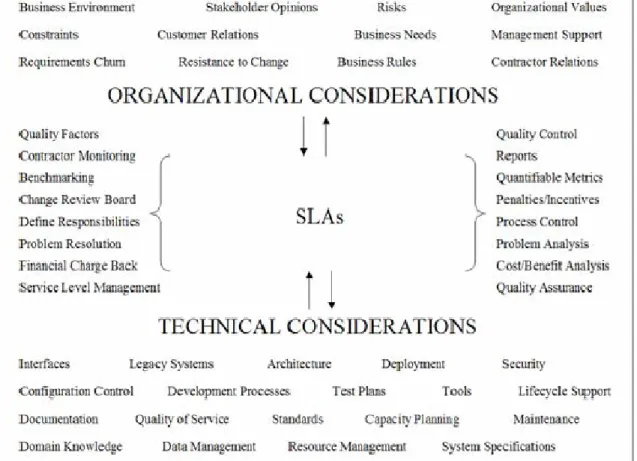
Figure 1. SLA Framework...44
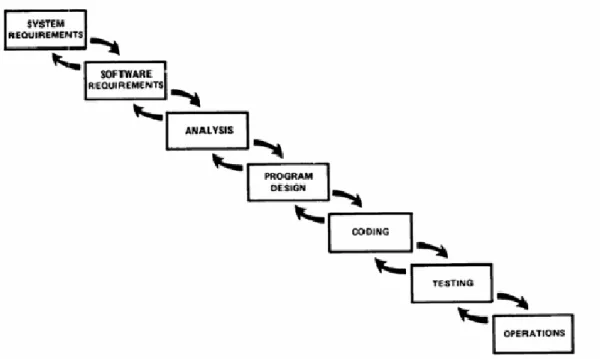
Figure 2. Waterfall Model ...89
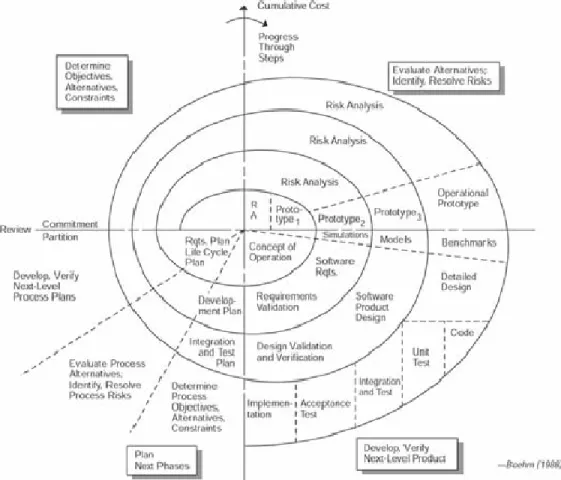
Figure 3. Spiral Model...91
ACKNOWLEDGMENTS
I would like to thank my family, friends, and co-workers who supported me in this effort. I would especially like to thank Dr. Bret Michael for his encouragement, hard work and help in bringing this dissertation to fruition. I appreciate the amount of time and effort it takes to review and provide comments on a dissertation of this size. Given their extremely busy schedules, I sincerely appreciate the efforts and dedication of Dr. Dan Boger, Dr. Man-Tak Shing, Dr. John Osmundson, and Professor Rex Buddenberg. The author would also like to acknowledge Scott Price and Joseph Vickery from EDS for their support with drafting the SOW in Appendix A. Finally, I would like to thank my wife, Sally, for her patience, support, and sacrifice.
EXECUTIVE SUMMARY
Management and end-users have become increasingly dependent upon intensive systems to support new ways of conducting business. These critical software-intensive systems are becoming more complex, and difficult to manage, yet the
performance and quality expectations from management and the end-users continue to increase. Unfortunately, despite software’s increased importance to organizations, the quality of software can be lacking.
The dissertation describes a new approach to software acquisition: application of service level agreements (SLAs) throughout a system’s lifecycle and at each major phase of software development and maintenance to improve the overall quality of the end product. The hypothesis is that the use of the SLAs in the software acquisition process can improve product, process, project, and post-production quality by identifying and defining relevant quality factors, quality metrics, quality thresholds, methods of measurement, and by establishing penalties for failure to meet quality requirements.
The basis for the hypothesis is our theory that the SLA development process aids requirements engineering by identifying software quality factors that support the critical business processes the software development or maintenance project supports. The quality factors that are addressed in the SLAs then drive architectural and design decisions about the critical system. If developers and maintainers of business-critical systems know which of the characteristics are most business-critical to project success, they can select – within the constraints of time and budget – among system architecture, design, and implementation alternatives that have a high likelihood of meeting the quality goals set forth by the stakeholders for the end product.
To test the hypothesis, we used two approaches. The first approach explained how SLAs could be used throughout a system’s lifecycle to improve software quality. This approach was validated by a survey of information technology (IT) professionals. The second approach was to develop actual SLAs for a specific lifecycle phase (post-production) to illustrate the concepts of SLAs and to demonstrate their value as a quality control and management tool.
I.
INTRODUCTION
A. EXECUTIVE OVERVIEW
In the past, the typical information system tended to be homogeneous and stovepiped, and was typically developed from scratch by a small number of vendors. In contrast, today’s typical information system is software-intensive and distributed,
composed of heterogeneous subsystems, supplied by numerous vendors. The subsystems themselves can consist of a mix of legacy and new-system development. Software is viewed by many as the means for making systems readily adaptable to change, as the environments in which the systems operate change. In this dissertation we treat the topic of service level agreements (SLA) in the context of their use in managing modern
information systems over their entire system lifecycle.
Many of the advances in the principles and mechanics of software engineering provide the software engineer with a means for improving the quality of
software-intensive information systems. However, actual practice does not always take advantage of these advances. This can be attributed to such factors as training problems, the rush-to-market mentality, and lack of proper quality control throughout the lifecycle of the information system. Although quality control is the responsibility of the program
manager, he or she may choose to defer addressing quality to later in the system lifecycle, focusing initially on realizing functional system requirements. As experience has shown, retrofitting quality—and non-functional requirements in general—into an information system can be difficult to do technically or even cost-prohibitive to achieve in some cases. In this dissertation, we argue that program managers must address software quality through the system lifecycle and that SLAs provide a means for managing the activities needed to build quality into software-intensive information systems.
A SLA is a contractual mechanism that defines quantifiable quality metrics, acceptable service levels, the method of measurement, responsibilities of the parties to the SLA, and incentives—both positive and negative reinforcements—for meeting agreed upon service levels. A SLA can be used for in-house development efforts and services as well as those that are outsourced. Further, a SLA can also be used in any stage of the
application’s lifecycle. Typically, a set—something akin to a portfolio—of SLAs are used in conjunction with the management of an information system, with each SLA representing a distinct quality attribute (e.g., reliability, maintainability) of the
information system or dimension of system development and maintenance (e.g., product quality, process quality, project quality, and quality in post-production maintenance and services).
1. Hypothesis
Service level agreements can improve the management and quality of software-intensive information systems throughout the system’s lifecycle. Embedded software and other specialized application of software are not within the scope of this paper.
2. Methodology
To test the hypothesis, we utilized two approaches. In the first approach we explained how SLAs could be used as a quality control tool in the various phases of software development to improve product, process, project and post-production quality. Our research identified areas within the development and post-production effort where SLAs could be effectively utilized, as well as provided examples of standards and quality models that could be incorporated into SLAs. We validated these concepts through a survey instrument administered to information technology (IT) professionals.
The questionnaire consisted of three sections. The first section provided the subject with a brief introduction to the topic of software quality, and a short discussion of how SLAs can contribute to software program management from conceptualization of an information system through post-production support. The second section was a case study illustrating a real-world scenario along with a SLA for availability. The last section consisted of a questionnaire comprised of twenty-nine questions and a comment section. Each statement had a corresponding Likert scale from one to five, with a one representing strong disagreement and a five indicating strong agreement. The survey was conducted from a web site.
The second approach was to develop SLAs for a specific phase of the software lifecycle to further illustrate how SLAs can be used as a quality control tool and to
developed apply to post-production support, a similar approach can be utilized to apply quality factors to other phases of development. The SLAs were also created to
demonstrated how SLAs could be used as a template for requirements elicitation and to show that they can and should be tailored to meet project specific needs.
3. Results
The survey supported the hypothesis that SLAs can improve the management and quality of IT intensive systems throughout their lifecycle. Twenty-two of the twenty-five statements had a statistically significant difference from the null hypothesis (mean equal to three on the Likert scale, which indicates a neutral feeling about the statement).
4. Original Contribution
This dissertation has three major original contributions to the field of software engineering. The first contribution is a unique approach to improving software quality from a software acquisition perspective. For numerous reasons software acquisition tends to concentrate on the functional aspects of an information-intensive system. Unfortunately, this approach often leads to poor software quality as software can be of poor design, but still meet functional requirements. In an effort to improve software quality this dissertation advocates the use of SLAs in software acquisition contracts to specify performance-based requirements relating to product, process, project and post-production quality. This dissertation demonstrates how SLAs can be applied to the entire lifecycle of a software-intensive system in an effort to improve the quality of the
management and development of the system. SLAs are not a new concept, however they are used primarily in post-production support. In this dissertation we take the concept of SLAs and demonstrate how they can be used as a quality control and management tool throughout the software development cycle (i.e., requirements, design, coding, testing, post-production support).
The dissertation introduces a unique format for the SLAs. The format forces the SLA development group to define in detail (e.g., in terms that all stakeholders
understand) the services to be performed, quantitative service levels, the method of measurement, and time frames or periodicity of measurements. The format helps to ensure that all parties understand the terms of the SLAs by stating the responsibilities of
the contractor and program manager, stating assumptions, deliverables, stating who will perform monitoring, and how monitoring will be performed. The format also ties the quality requirements to specific business needs and stakeholder concerns. Providing the rationale for measuring the service ensures the development team has considered whether the service and quality thresholds are relevant to business needs, that the quality
thresholds are realistic, and that metrics are meaningful and provide value.
Although SLAs are sometimes found in contracts with External Service Providers (ESPs) for post-production support they are often used more to set expectations rather than establish quality control measures. They are often poorly defined, they lack information concerning monitoring techniques, and they generally favor the ESP.
In this dissertation we have developed thirteen original post-production SLAs that are far more extensive than those found in the research conducted. The SLAs in
appendix (A) were developed to illustrate how SLAs can be used as a quality control tool, not just for post-production, but for the other phases of the software lifecycle as well. The SLAs in appendix (A) were used in actual source selection negotiations with very favorable results.
5. Expanding the Body of Knowledge
Although numerous software engineering disciplines are discussed, this dissertation has made contributions to the body of knowledge in the disciplines of software acquisition, requirements analysis, software quality and software project management.
There is currently a lack of theoretical basis or intellectual body of knowledge in the field of software acquisition. Although there is a great deal of research concerning software development methods and their affect on project success in terms of cost and schedule, similar research on contracting methodology for software development is lacking. This dissertation proposes a methodology for acquiring software that focuses on project, process, product and post-production quality. This approach goes beyond
traditional acquisition by applying a holistic view of quality throughout a system’s lifecycle. SLAs can be used as a quality control tool to enhance other software
CMM) (Software Engineering Institute Mar 2000), IEEE Recommended Practice for Software Acquisitions (IEEE Std. 1062) or Performance-Based Acquisition. (DoD USD (A&T) Utilizing SLAs in the acquisition process is an attempt to correct many of the software acquisition deficiencies sited in numerous articles, studies, and General Accounting Office (GAO) reports. Although this dissertation does not empirically demonstrate that SLAs will lead to project success and better quality, it does provide a foundation upon which future studies can be based.
The SLA development process supports and incorporates many of the theories proposed in the field of software requirements engineering such as Facilitated
Application Specification Technique (FAST) (Zahniser), Mizuno and Akao’s Quality Function Deployment (Zultner, Krogstie) as well as use cases and scenarios (Hickley, Sutcliffe). Many of the requirements elicitation techniques proposed by practitioners and academia can be incorporated in the SLA development process to generate quality
requirements. For example, the SLAs presented in appendix (A) can be utilized in scenario elicitation.
SLAs also enhance existing requirement engineering techniques or methods. SLAs concentrate on non-functional quality requirements, which are not always considered in other methods. Due to the nature of contracting for software services, SLAs introduce quality requirements early in the lifecycle where they are most effective. Quality software requires more than just identifying quality requirements. Monitoring and measuring the requirements is necessary to ensure the requirements are being met. The literature on software requirements almost always implies that just because
requirements are specified, that they are incorporated into the final product. This is rarely the case. SLAs enhance existing software requirement techniques by instituting a
measuring and monitoring philosophy (quality control) and enforcing requirements by use of penalties for non-compliance.
The SLA development process also enhances traditional software requirement techniques. The level of detail necessary to develop the SLAs requires an understanding of the business processes the system is supporting, it incorporates multiple perspectives, and it requires a prioritization of the quality factors chosen. The development effort will
not only generate discussion on which quality attributes are appropriate for the software system, but it will also identify whether resources, employee skill sets, and management support exist to properly support and enforce the SLAs. SLAs and specifically the format proposed in this dissertation will help to produce requirements that are quantifiable, measurable, meaningful, and support business processes.
This dissertation adds to work that has been conducted on software quality. While this dissertation does not introduce a new model for software quality, or a new measurement of quality, it does introduce the use of SLAs as a means to contract for software quality over the lifecycle of a product. SLAs are the practical implementation of many of the quality models that will be discussed later in the dissertation.
The SLA development effort also contributes to the discipline of software quality by incorporating quality (functional and non-functional) requirements in the requirements engineering process. The development effort evaluates many of the quality models and metrics proposed in literature. These metrics and models are then applied in part or in whole to measure or specify process, product, project, and post-production quality.
There is no single quality model that can extend through the entire lifecycle of a software product. SLAs are a means to incorporate many quality factors and models simultaneously to best support the system throughout its lifecycle. The SLA
development effort involves an analysis of the various quality factors and models to determine which best support the system given performance expectations, budget and time constraints, and the purpose of the system. Prioritizing the quality factors and resolving quality requirement conflict are an important part of the development process. It is very likely that multiple quality models will have to be incorporated to evaluate the deliverables at the various stages of the development cycle.
This dissertation has also added to the body of knowledge related to software project management. SLAs enhance many of the existing processes or models associated with software project management such as Performance-based Management (Plunkett), Software-Performance Engineering (Smith, C. 1988), and Capability Maturity Model Integration (CMMI) (Software Engineering Institute, Aug 2002) by instituting the
In addition to quality management and quality control, SLAs can assist program managers in many of the tasks identified in project management models as important to the success of the project. In the SLA development effort, the project is scoped, risks are identified and analyzed, resources are evaluated, quality factors are prioritized, specific business needs are identified, and success factors for those business needs are defined. SLAs also help the program manager in the areas of financial management, customer relations, configuration management, and especially contract management.
6. Outline of Dissertation
Chapter I outlines the importance of IT systems, and describes the difficulty that both public and private sectors have had in developing quality IT systems. The chapter also provides a detailed discussion on software quality. Chapter II defines SLAs, discusses how they are utilized, and describes a recommended format. Chapter III
outlines an 8-step process for developing SLAs and provides a case study describing how the SLAs in appendix (A) were developed. Chapter IV provides a detailed discussion on software development models, illustrating how SLAs can support various approaches. Chapter V describes how the SLA development process can support and enhance many of the recommended requirements engineering processes and techniques. Chapter VI discusses how the quality metrics and quality factors incorporated in the SLAs can influence the architecture and design of the system. Chapter VII illustrates the importance of selecting the appropriate software quality factors to incorporate in the SLAs. Chapter VIII describes how SLAs can be utilized as a quality control tool to assist the program manager in managing the configuration of the project. Chapter IX explains how SLAs can also assist the program manager with many aspects of program
management and oversight. Chapter X is a detailed discussion on the research methodology and results. Chapter XI contains the conclusion and makes
recommendations for future work. Appendix (A) is a statement of work (SOW) along with thirteen SLAs that were used in a proposal for post-production support. Appendix (B) contains the survey instrument. The final section is Appendix (C), which provides a breakdown of the results of the survey.
7. Deliverable
The concepts discussed in this dissertation were applied in the development of the SLAs and the SOW found in appendix (A). The SLAs and SOW in appendix (A) were developed for the post-production hosting services under CLIN 0029 of the Navy/Marine Corps Intranet (NMCI) contract. The SLAs and SOW were designed to allow program managers to select from three levels of services to support their programs. Programs needing more advanced services would be able to modify the CLIN to support their needs. The CLIN 0029 SOW and SLAs are currently still in contract negotiation.
B. IMPORTANCE OF INFORMATION TECHNOLOGY
IT has offered an unprecedented opportunity for organizations to improve the efficiency and effectiveness of its operation. The rapid growth of the Internet has lead to an ever increasing reliance by organizations on interconnected computer systems to provide critical operational services, from business processes to coordinating
decentralized command, control, computers, communications, intelligence, sensors and reconnaissance (C4ISR) systems.
One can argue that IT-based systems have become the most critical, multi-faceted strategic tool any business or organization possesses. (Info Tech) Organizations that have properly integrated IT into their overall business processes and have invested in the most current infrastructure have a significant advantage over any competition that has not taken advantage of IT.
The reliance on IT systems to provide strategic and tactical advantages has placed ever-increasing levels of pressure on the IT department to provide quality services and products than ever before. Interruptions to IT systems are having a far greater impact than before in terms of opportunity loss, revenue loss, customer dissatisfaction, and efficiency. As managers realize that their mission-critical processes are tied to IT services, they are demanding more control over the quality of the services provided.
Another factor bringing IT quality to the attention of senior management are the various third-party vendors, system integrators, or external service providers (ESP) that
is forcing IT organizations to reevaluate their relevancy to the organization. When top executives hear the sales pitches from ESPs, they expect similar or higher levels of service from their internal staffs. Competition has started to drive the levels of service higher and higher, especially when service performance is really the only differentiator the ESPs have with one another.
Information flow is the lifeblood of an organization allowing it to enable its personnel, respond to customers, and react to the external environment. An
organization’s ability to gather, manage, and use information will determine its success. (Gates) Leveraging information technology allows organizations to interconnect disparate processes and information that was separated logically, physically, and
chronologically. The rapid growth of technology along with the greater globalization of enterprises has brought IT management to “center stage”. However, as information systems become more complex and distributed, they also in general become increasingly difficult to manage, yet the performance expectations for the system, from management, and the end-users continue to increase.
All organizations want world-class quality levels, but achieving those quality levels requires a holistic view of quality that incorporates leadership support, repeatable and measurable quality processes and controls, resource planning, vision, customer support, and service-level management. Organizations must do more than identify and incorporate quality attributes in their requirements, they must also monitor quality
metrics to ensure those quality requirements are being met. Quality is not something that is inherent in the development process: it must be planned, monitored and incorporated as part of standard business practices.
C. SOFTWARE QUALITY
There are numerous definitions of quality. The ISO 9000 model defines quality as the degree to which a set of inherent characteristics fulfills requirements. (Tricker) ISO 9126, a refinement of the ISO 9000 model, which proposes a quality standard for software product evaluation, defines software quality as the totality of features and characteristics of a software product that bear on its ability to satisfy stated or implied
needs. (Hansen) Pressman states that software quality is conformance to explicitly stated functional and performance requirements, explicitly documented development standards, and implicit characteristics that are expected of all professionally developed software. (Pressman)
It is interesting that both ISO model definitions and Pressman’s definition are based on an assumption that all stakeholders have an input into the
requirements-specification process. An IT system may meet all of the program requirements and thus be viewed as being a quality product. However, the IT system will not be perceived as a quality product if the product does not perform according to the end-user’s perspective. Many believe that quality is based upon the perceptions of the stakeholders. This view is also supported by Garvin, who stated that quality is multifaceted and can be viewed by many perspectives. (Garvin) However, it is generally recognized that the consumer of the product is the ultimate judge of a product’s quality. (Glass, Tice, Briones, Weigers) The IEEE standard 610-1990 does incorporate user needs, by defining software quality as the degree to which a system, component, or process meets specified requirements and meets customer or user needs and expectations. (Schmidt)
Software quality can be broken down into four areas of focus. The first area, product quality, is concerned with the requirements and specifications of the product as it applies to the attributes or characteristics of the software product. This area could also be referred to as end-product quality. The second area, project quality, is concerned with the metrics and measurements associated with the software production effort. (Wheeler, Hilburn) The third area is process or management quality, which is concerned with the processes, planning and controls used to develop and manage the software product. The last area of focus is on post-production quality or deployed application management. Although there is some overlap with process quality, this last area is focused on software maintenance, IT system performance, and hosting services after the application has been placed into production. Software quality models have been developed in all of these areas in an attempt to evaluate and/or predict software quality.
1. Product Quality
Quality attributes are generally used to describe the degree to which software possesses certain characteristics. Quality can be viewed from numerous perspectives, and certain attributes are more preferable to others depending on the objective of the IT system. As such, numerous quality attributes have been identified. When referring to product quality, two perspectives are generally represented: those of the user and those of the developer.
In addition to the functional aspects of a system, the end user wants the product to exhibit specific qualities that will assist them in performing their task. From a user’s perspective, some of the common quality attributes used in the quality models include availability, usability, integrity, interoperability, and reliability. Personnel involved in the development of software or its maintenance may be more concerned with the software attributes such as portability, testability, maintainability, and reusability. (Wiegers)
Product quality models concerned with the developer’s perspective can be further broken down into three categories. The first category is concerned with those quality factors, or their associated quality metrics that involve attributes associated with the software code. A common quality metric for software code is defects per thousand lines-of-code (KLOC). The next category is concerned with quality metrics associated with the structure or architecture of the software. Structure quality metrics are concerned with the features, components and relationships among the components. Common structure quality metrics are quantitative counts of the sources (fan-in) and destinations (fan-out). The last group contains hybrid quality metrics, which combines code and architecture quality factors. An example would be evaluating complexity by analyzing or weighing against the lines-of-codes in the modules. (Kafura)
One of the first software quality models to address product quality was the McCall quality model, based on earlier work by Boehm (Boehm). McCall’s model consists of a number of questions and a subjective grading criterion based on a Lickert scale from 0 to 10. McCall defined quality in a hierarchical manner in which quality factors defined a key characteristic of the software, such as ‘maintainability’. Quality
factors consisted of quality criteria that represented an attribute of the quality factors, such as ‘understandability.’ Finally, quality metrics were used to assign quantitative measurements to the quality factors. (Pressman, Ward, Kafura)
There are numerous software product quality models that incorporate software quality factors or metrics in an effort to benchmark or measure software quality. Some of the better-known quality models include early work done by Halstead, who calculated complexity based on the number of operators and operands. (Ogasawara) The ISO 9126-1 quality model is also well known. The ISO 99126-126-9126-1 model incorporates the quality factors functionality, reliability, usability, efficiency, maintainability and portability. (Cross, Ward) The Hewlett-Packard FURPS model is also well known. (Pressman) There are also numerous software quality models that concentrate on specific quality factors such as complexity. (Ogasawara, McClure) In his book Software Complexity- Measures and Methods, Horst Zuse identifies over ninety models for describing the software attribute complexity. Other quality models are specific to object-oriented systems (Coppick, Pritchett), some are specific to a language (Pritchett) or
COTS components (Bertoa, Hansen), while others are only applicable at run-time. (Bass)
2. Project Quality
Project quality is concerned with metrics that allow an organization to manage, track, and improve the quality of the software-development effort. One of the most common quality factors involving project quality is project estimation. Project estimation models such as COCOMO II (Boehm), Albrecht’s Function Points (Albrecht, Jones), and Putnam’s Software Life-cycle Model (SLIM) (Putnam, Chulani) address the cost to produce software, errors or defects that can be expected, as well as the level of effort required to produce the software.
Some of the project quality metrics that Motorola used to measure their software-development projects included software-defect density, adherence to schedule, estimation accuracy, reliability, requirements tracking, and fault-type tracking. (Daskalantonakis)
Other project quality models such as DoD Std 7935 are concerned with the degree of formalism necessary to manage the project. (McConnell) Another metric used in
results in project failure. General risk areas are schedule risk, requirements risk, budget risks and personnel risk. (Padayachee) There are a number of risk assessment models including Gilb’s risk heuristics (Gilb), Boehm’s classification of risk (Boehm), Keil’s follow on identification of risk factors (Keil), the USAF AFCS/AFLC Pamphlet 800-45 which outlines software risk identification and abatement (Pressman), interpretivist approaches (Gemmer, Padayachee), risks associated with enterprise software projects (Charette, Sumner), and Noguiera’s risk assessment model. (Noguiera de Leon)
3. Process Quality
Quality metrics also apply to the processes and business practices used to manage software throughout its lifecycle. Quality in the context of software process management refers to an adherence with explicit process requirements and those implicit processes necessary to meet user requirements and produce quality software. Process metrics allow a holistic view of the activities that organizations are taking to ensure a quality software product. Processes provide a clear understanding of what an organization does and the quality controls it has in place to do those activities. (Tricker)
There are many who believe that the quality of the development process is the best predictor of software product quality. (Fenton) Repeatable software processes such as the Software Engineering Institutes Software Capability Maturity Model for software (SW-CMM), which lists five levels of organizational maturity levels, and the
International Standards Organization (ISO 9001:2000) are designed to improve software quality, productivity, predictability and time to market. (Paulk, McGuire) There is also some empirical evidence that there is a correlation between process maturity and software quality. (Harter, Diaz, Ferguson)
Other models of process quality include the new Capability Maturity Model Integration (CMMI) model. CMMI integrates 3 CMM models into one to eliminate problems with different architecture, semantics, and approaches. (SEI) Humphery developed the personal software process (PSP) to assist software engineers in producing quality software. (Humphrey) Other process models include cleanroom engineering that has shown reduced errors per KLOC for small projects (Fenton), and the quality
and ISO standards that provide processes on everything from software engineering product evaluation (ISO/IEC 14598) to selecting appropriate quality metrics (IEEE Std. 1061-1998).
4. Post-Production Quality
Quality control does not stop once a software product has been deployed. Quality factors still need to be applied to the application performance, maintenance efforts, and hosting services throughout its lifecycle. Monitoring the performance of the application once it is deployed is essential in quality control and maintaining customer satisfaction. Much of the application performance monitoring in the initial phases of deployment is used to validate product-quality factors identified in the initial requirements. However, in the post-production environment there is also an emphasis on monitoring system
performance in terms of resource utilization, system capacity, network utilization and quality of service, storage management, and security.
Many of the quality models involving deployed applications are concerned with software maintenance and the quality factors that make maintenance cheaper and more effective. Some of the maintenance-quality factors deal with ease of change (Royce), others deal with architectural design to promote maintenance (Hulse, Garlan), defect management (Kajko-Mattsson), organizational structure (Briand), complexity (Banker), and change management. (Bennett)
Quality factors with deployed software are also concerned with the IT system as a whole. Quality is not just concerned with the application itself: it is also concerned with the IT system as a whole, across distributed components. Part of that distributed system is the network. There are numerous quality metrics that can be applied to network quality of service. (Clark, Tanenbaum, Lee, Hochstetler, Packeteer) Quality metrics are also applied to the host server. Quality metrics such as application-resource utilization (Aries), bandwidth utilization (Eager), concurrent user management (Aweya), and server performance (Dalal, Gama) are also utilized to address system-level quality. Hosting services are another area that needs to be addressed when discussing the quality of production software. Traditional hosting metrics have centered on total cost of operation
(TCO) benchmarking, and help desk support metrics, but areas such as backups, storage, configuration management, and security also need to be addressed.
There are numerous software-quality models and metrics that can be incorporated into SLAs. The models or quality factors chosen will depend on those quality attributes that best support the underlying business process. Regardless of the software-quality models incorporated in the SLAs, the software metrics must be meaningful, quantitative, and measurable.
In this dissertation, the term quality is used loosely to describe the degree to which a system, component, or process meets specified requirements and meets customer or user needs and expectations. Quality thresholds or quality metrics are those
measurements that specify the quality factors or quality requirements.
D. CHALLENGES IN OBTAINING QUALITY SOFTWARE
The software program manager is responsible for evaluating the program
requirements and determining the methodology or process to deliver and maintain quality software. There have been a number of initiatives proposed to improve the quality of software through its lifecycle. Most approaches are based on the tenet that quality must be designed into a product. Approaches such as formalizing specifications (Berzins), use of development standards and models, and utilizing architecture for quality analysis support this approach. These approaches can be supplemented, for instance, by using programming languages such as Ada that are designed to prevent common design and coding errors, or utilizing rigorous testing and third-party debugging tools.
If there are numerous approaches to developing quality software, why are there still problems? Part of the answer lies with the lack of meaningful dialog between the developers, end-users and management. Unrealistic completion dates, requirements churn, poor requirements elicitation, and lack of proper resources all lead to development problems. Additionally, just because standards exist for developing software does not mean that they are being used. In many cases adherence to developmental standards
requires additional training, additional development time, additional funds and a commitment from upper level management that those standards will be inspected and enforced.
In his book “Decline and Fall of the American Programmer,” Yourdon estimates that eighty-five percent of US software organizations operated at level 1 of the SW-CMM. (Yourdon) This fact was reemphasized by Dietz who stated that most of the software companies that he evaluated were at level 1 of the CMM. (Dietz)
A study published by the Standish Group reveals that the number of software projects that fail has dropped from 40% in 1997 to 26% in 1999. However, the
percentage of projects with cost and schedule overruns rose from 33% in 1997 to 46% in 1999 (Noguiera) In another Standish study in 1999, a survey of 1,500 software projects found that 31% of the projects were canceled and of those projects that were delivered on average only 61% of the originally specified features were delivered. (Cross)
Despite software’s increased importance to organizations, software program managers have not improved the quality of software. (Anthes) There are numerous examples of software errors leading to major incidents, including the Denver airport baggage handling system, the Hershey Foods ERP implementation, the Toys-R-Us e-commerce site continuing to promise delivery of Christmas gifts after shipping cut-off dates, and the USS Yorktown Smart Ship system failure. (Slabodkin, Huckle)
In the article “Why Software is so Bad”, Mann offers a number of reasons why the quality of software tends to be poor. Mann states that software quality is actually getting worse rather than better, despite the advances in software engineering theory, processes, methodology and tools. Poor software quality can be attributed to the following:
• The perceived need to hurriedly develop and market a software-based product to be the first to market; such an approach can result in software artifacts that contain software flaws and are difficult to test and maintain. In a 60-day development cycle, which is not uncommon, programmers are not going to spend two weeks searching for a bug, despite risks associated with deploying a faulty product. (Blacharski)
• Software can be poorly designed. This is due in part to the poor training programmers have received, and the fact that as programmers bounce code off of the complier to fix errors, they often deviate from the original designs and end up with sloppy, poorly documented code.
• Testing software often requires a different skill set than programming. Often the testing personnel are not properly trained, or are not given the time to test properly. Too many organizations are relying on testing as the primary means to improve quality instead of designing the application with quality factors built into their initial requirements—the latter approach actually can improve our ability to test systems.
• Software is not designed for testing. The designers do not utilize good component level design or software architecture, the software’s modularity and corresponding
interconnectivity is not well defined, and the application is not internally coded to throw exceptions, or write faults to a log.
• Software fails to meet the customer’s expectations. The software developer must looks at requirements from the user’s perspective, the business’ perspective, and the programmer’s perspective. Too often the user is not a part of the requirement elicitation process.
• Requirements churn contributes to the poor reliability of software, as designs are altered, interfaces added, unplanned modules are glued together, with little consideration given to the additional resource demands.
• Post-production support plays a large role in the success of an application, but software developers do not normally address it in their planning.
• The application needs to be hosted in an environment that supports the application’s functionality. Software quality can be adversely affected by lack of resources within the server, and by network and bandwidth constraints.
• Maintaining software without proper documentation or configuration information is very difficult and expensive. Additionally, without proper documentation it is difficult to compare the original requirement specifications to the product throughout the
E. QUALITY PROBLEMS IN THE DEPARTMENT OF DEFENSE
The next three sections discuss some of the problems that the DoD has with the management of software-intensive information systems, recruiting and retaining competent IT personnel and outsourcing. Although these sections focus on the DoD, many of the same problems can be found in the commercial sector.
In the past, the DoD has not excelled at managing software-intensive information systems through their lifecycles. Managing information systems can be challenging. Utilizing the latest technology to exploit information requires highly developed
intellectual and managerial skills, which are rare attributes (Rocheleau). The difficulty in managing these systems has been demonstrated by the numerous system development and maintenance projects within the DoD that lacked sound planning, had poor controls, lacked measurements for success, and did not meet expectations.
From 1986 to 1996, the US Government spent 200 billion dollars on information technology that did not produce the results that were desired. (Deputy Assistant Secretary of Defense) One example is the Corporate Information Management (CIM) initiative. In October 1989, the DoD attempted to improve and consolidate almost 2,000 information systems relating to transportation, depot maintenance and material maintenance. By October 1993, the DoD determined that efforts to develop and complete these logistics systems would take too long to develop and would not produce the costs savings they initially anticipated. In response, the DoD standardized on its best logistics information systems—in terms of performance, maintainability, and other measures of
effectiveness—across all military services. This “migration strategy” as it was termed, was designed to quickly produce cost savings. By 1995, the DoD realized that its migration strategy for materiel management and depot maintenance consumed more resources than it had anticipated, took longer than expected, and did not produce the benefits expected. Over 700 million dollars was spent migrating material management systems before abandoning the project, having failed to produce a single operational system. (U.S. GAO OCG-99-4) The CIM and migration-strategy effort cost eighteen billion dollars without achieving its objective. The DoD abandoned its efforts at
standardizing the systems and opted instead to try to achieve interoperability between the different services’ information systems, and privatize some functions. (U.S. GAO AIMD-96-109)
Despite the failures of the CIM and the migration strategy, the US General Accounting Office (GAO) noted that the interoperability and privatization approach suffered from the same managerial problems that plagued the two prior attempts at system consolidation. The DoD did not even conduct a thorough cost-benefit study to determine if the new strategy would achieve a positive return on investment. The DoD failed to tie its efforts to its overall business objectives using strategic planning. It had also not adequately explored better commercial alternatives such as reengineering or outsourcing. (U.S. GAO AIMD-97-6, U.S. GAO 01-244)
1. Clinger-Cohen Act
On October 12, 1994, then Senator Cohen of Maine and a member of the Senate Governmental Affairs Committee released a report entitled “Computer Chaos: Billions Wasted Buying Federal Computer Systems.” The report was a summary of reports from the GAO and Inspector General (IG) that detailed problems with major
software-development projects that were in progress. The report concluded that antiquated systems were costing the government billions of dollars, government-planning efforts were inadequate, and the acquisition process forced the government to pay more for less. (Peckinpaugh)
The Information Technology Management Reform Act (ITMRA) of 1996 coupled with the Federal Acquisition Reform Act became known as the Clinger-Cohen Act. Congress’ intent in passing the Act was to solve some of the longstanding problems associated with the acquisition and maintenance of information systems by the DoD. Among those problems was inadequate attention to business processes, failure to improve processes before investing in information systems, investing in poorly planned and ineffective information systems, and outdated acquisition procedures that did not address the rapid evolution of information technology. (Deputy Assistant Secretary of Defense)
The Act mandates that federal agencies develop internal investment-control and performance-management processes to improve their acquisition, use, and management
of information systems. (U.S. GAO-00-179) The act established the positions of Chief Information Officer (CIO) for every major federal agency. The CIO became responsible for ensuring the provisions of the Clinger-Cohen Act are executed. Some of the
responsibilities of the CIO were as follows: encourage incremental phased development instead of grand projects, ensure that the information system supports the core mission— as articulated in doctrine and policy—of the agency, determine whether other agencies or contractors have information systems with similar functionality as the system being developed, and perform cost-benefit analyses and risk assessments prior to embarking on developing an information system. Another key provision in the Act is the requirement to ensure that measures of performance (functional and non-functional) are used to gauge the effectiveness of information systems in meeting system requirements.
Furthermore, the Act requires software-acquisition personnel to answer three questions before initiating an IT project. The first two-part question is what are the functions that the system will perform, and is it consistent with the organization’s mission? The second question is if we need to perform a particular function, can it be performed more efficiently and at a cheaper cost by the private sector? The third question is whether the function that is required can be reengineered or redesigned (i.e., are the processes it supports absolutely necessary)? All of these questions must be answered before an investment in new technology can go forward. (SecDef)
2. Difficulty Managing Technology
Despite the fact that the Clinger-Cohen Act requires the establishment of a process to identify, evaluate, and monitor risks and results from applying IT, the DoD is still having problems in both acquisition and management of information systems. (DoD IG D-2000-162) Since the Act was enacted, the DoD record on implementing its
provisions has been disappointing. (DoD IG Semiannual Report to Congress) Some continuing problems with software acquisition have been attributed to the DoD’s failure to adopt the provisions of the Act (DoD IG D-2000-162, DAWIA), and some was due to the DoD’s current organizational structure and culture, which makes departmental oversight very difficult. (U.S. GAO OCG-99-4) Moreover, the DoD has not been able to
implement practices conformant to the Clinger-Cohen Act that ensure prudent investment in information technology. (U.S. GAO AIMD-00-282)
Notwithstanding the improvements that the DoD has made in the management of information technology, including establishing guidance to reflect best practices, and updating policies, the DoD continues to be plagued by problems in managing its portfolio of investments in information systems. (U.S. GAO AIMD-00-316) Unless the provisions of the Act are fully understood by program managers, fully supported by the chain of command, and enforced, it is unlikely that the Act will have the effect that Congress had hoped for.
For example, in 1994, the Under Secretary of Defense for Acquisition, Technology and Logistics mandated the use of “open systems,” however, subsequent audits in 2000 revealed that fourteen of seventeen major weapon systems audited lacked open-system design objectives. Management either was not aware of the mandate, or they chose to ignore it. The DoD Inspector General (IG) identified management weakness along with poor analyses of requirements in twenty audits conducted between 1 April 2000 and 30 September 2000. (DoD IG Semiannual Report to Congress) The GAO has designated managing the investment in information technology as a major management challenge. (U.S. GAO HR-99-1, U.S. GAO HR-97-9, U.S. GAO 01-244, U.S. GAO OCG-99-4) The GAO identified a number of weaknesses in the DoD’s management of its approximately 5,800 mission-critical or mission-essential information systems. (DoD IG D-2000-162)
Technology will not solve management problems. Program managers and senior leadership need to understand and improve business processes before applying
technology. The GAO and the DoD IG have identified a number of systemic problems relating to the DoD’s management of information systems. Of the programs audited, one of the most common problems was the lack of adequate documentation and validation of system requirements. DoD program managers do not always develop well-defined project purpose and scope, and realistic and measurable expectations. Audits also report the failure to perform risk assessments and develop appropriate risk mitigation strategies. Nine of the DoD IG audits identified inaccurate analyses of costs associated with the
system life-cycle. (DoD IG D-2000-162) An additional area of concern was the perceived weakness of the DoD in conducting information technology investment-selection and management-control processes. (U.S. GAO 01-244) The DoD’s lack of centralized control over standards and architectures has also contributed to system failures. (DoD IG D-2001-121, U.S. GAO AIMD-00-282, U.S. GAO OCG-99-4) The DoD’s inadequate software development, cost estimating, and system acquisition
practices has greatly increased the risks associated with the information systems audited. (U.S. GAO AIMD-00-209R, U.S. GAO 01-244) The DoD has also shown significant computer security weaknesses in its programs. (U.S. GAO AIMD-00-295, U.S. GAO AIMD-00-188R)
Although the Clinger-Cohen Act established the position of CIO, the DoD needs to build an effective organization with the proper leadership. (DoD IG D-2000-162, U.S. GAO 01-244) Currently the DoD CIO and the CIOs in charge of the individual services do not control the budgets for IT. Individual programs procure their own IT systems and services to support their needs. As a result, CIOs often do not have the control or
visibility they need to determine whether programs are complying with IT directives. In its report to the Senate on adopted best practices for software development, the DoD stated that the responsibility for successful fielding of the software product was the responsibility of the contractor developing the system. However, in that report, the DoD could not state how it measures the success of a contractor’s efforts. The DoD could also not state what requirements existed for maintenance or support. The DoD did list some generic metrics such as maintenance costs and number of problems reported, but it did not have clear guidelines as to what was acceptable performance for each of the quality metrics. (U.S. GAO AIMD-00-209R) Both the review and evaluation of performance metrics is essential in the acquisition of information systems (U.S. GAO T-AIMD/GGD-00-179), but requires knowledgeable information specialists working for the government to accomplish this task.
Shortcomings in information technology, contracting, and acquisition are attributable in part to human-capital issues. (U.S. GAO T-AIMD/GGD-00-179, U.S.