Certification Authority
LIDONG ZHOU Microsoft Research and
FRED B. SCHNEIDER and ROBBERT VAN RENESSE Cornell University
COCA is a fault-tolerant and secure online certification authority that has been built and deployed both in a local area network and in the Internet. Extremely weak assumptions characterize en-vironments in which COCA’s protocols execute correctly: no assumption is made about execution speed and message delivery delays; channels are expected to exhibit only intermittent reliability; and with 3t+1 COCA servers up totmay be faulty or compromised. COCA is the first system to integrate a Byzantine quorum system (used to achieve availability) with proactive recovery (used to defend against mobile adversaries which attack, compromise, and control one replica for a limited period of time before moving on to another). In addition to tackling problems associated with combining fault-tolerance and security, new proactive recovery protocols had to be developed. Experimental results give a quantitative evaluation for the cost and effectiveness of the protocols. Categories and Subject Descriptors: C.2.0 [Computer-Communication Networks]: General— Security and protection; C.2.4 [Computer-Communication Networks]: Distributed Systems— Client/server; D.4.5 [Operating Systems]: Reliability—Fault-tolerance; D.4.6 [Operating Sys-tems]: Security and Protection—Authentication;cryptographic controls; E.3 [Data]: Data Encryp-tion—Public key cryptosystems
General Terms: Security, Reliability, Design, Performance, Measurement
Additional Key Words and Phrases: Certification authority, public key infrastructure, Byzantine quorum systems, threshold cryptography, proactive secret-sharing, denial of service
This work is supported in part by ARPA /RADC grant F30602-96-1-0317, AFOSR grant F49620-00-1-0198, Defense Advanced Research Projects Agency (DARPA) and Air Force Research Laboratory Air Force Material Command USAF under agreement number F30602-99-1-0533, National Sci-ence Foundation Grant 9703470, and a grant from Intel Corporation. The views and conclusions contained herein are those of the authors and should not be interpreted as necessarily representing the official policies or endorsements, either expressed or implied, of these organizations or the U.S. Government.
Authors’ addresses: L. Zhou, Microsoft Research at Silicon Valley, 1065 La Avenida, Mountain View, CA 94043; email: [email protected]; F. B. Schneider, R. Van Renesse, Department of Computer Science, Cornell University, Ithaca, NY 14853-7501; email: [email protected], [email protected]. Permission to make digital /hard copy of part or all of this work for personal or classroom use is granted without fee provided that the copies are not made or distributed for profit or commercial advantage, the copyright notice, the title of the publication, and its date appear, and notice is given that copying is by permission of the ACM, Inc. To copy otherwise, to republish, to post on servers, or to redistribute to lists, requires prior specific permission and/or a fee.
C
1. INTRODUCTION
In a public key infrastructure, acertificate[Kornfelder 1978] specifies a binding between a name and a public key or other attributes. Over time, public keys and attributes can change: a private key might be compromised, leading to se-lection of a new public key, for example. The old binding and any certificate that specifies that binding then becomeinvalid. Acertification authority(CA) attests to the validity of bindings by issuing digitally signed certificates that specify these bindings and by providing a means for clients to check the va-lidity of certificates. With an online CA, principals can check the vava-lidity of certificates just before using them. COCA (Cornell OnLine Certification Authority), the subject of this article, is such an online CA.
COCA employs replication to achieve availability and employs proactive re-covery with threshold cryptography for digitally signing certificates in a way that defends againstmobile adversaries[Ostrovsky and Yung 1991] which at-tack, compromise, and control one replica for a limited period of time before moving on to another. In that, the system is not novel. What distinguishes COCA is its qualitatively weaker assumptions about communication links and execu-tion timing. Many denial-of-service attacks succeed by invalidating stronger communication and execution-timing assumptions; in making weaker assump-tions, COCA is less vulnerable to these attacks.
New proactive recovery protocols had to be developed for execution in this relatively unconstrained and more realistic environment. Moreover, because implementing agreement is problematic in the absence of execution-timing assumptions [Fischer et al. 1985], COCA employs a Byzantine quorum sys-tem [Malkhi and Reiter 1998a] (rather than the state machine approach [Lamport 1978]) for managing replicated state. In so doing, COCA is the first to tackle the problems associated with integrating threshold cryptography and Byzantine quorum systems. Thus, beyond its intrinsic utility for public key infrastructures, COCA has pedagogical value as a vehicle for understand-ing how to combine mechanisms for supportunderstand-ing fault-tolerance and security properties.
Besides its weak assumptions, a variety of traditional means for combating denial-of-service attacks is used by COCA: (i) processing only those requests that satisfy authorization checks, (ii) grouping requests into classes and mul-tiplexing resources so that demands from one class cannot have an impact on processing of requests from another, have an impact on as well as (iii) caching results of expensive cryptographic operations. And although resource-clogging denial-of-service attacks certainly remain possible, experiments demonstrate that launching a successful attack against COCA is harder with these mech-anisms in place. In fact, simulated denial-of-service attacks have allowed us to measure the effectiveness of the various means COCA employs to re-sist denial-of-service attacks, so the work reported herein contributes much-needed experimental data on the performance of traditional denial-of-service defenses.
The article is organized as follows. Section 2 discusses assumptions about the environment in which COCA operates and describes the services COCA
provides. Protocols to coordinate COCA servers are the subject of Section 3. Section 4 elaborates on the mechanisms COCA incorporates to defend against denial-of-service attacks. Performance data for COCA deployments both in a local area network and in the Internet are summarized in Section 5, followed by a discussion of related work in Section 6. Section 7 contains concluding remarks.
2. SYSTEM MODEL AND SERVICES SUPPORTED
COCA is implemented by a set ofnservers, each running on a separate processor in a network. We intend COCA for use in an environment like the Internet. Thus COCA tolerates failures and defends against malicious attacks, subject to the following assumptions.
Servers. Servers are eithercorrectorcompromised, where a compromised server might stop executing, deviate arbitrarily from its specified protocols (i.e., Byzantine failure), and/or disclose information stored locally. System execution is viewed in terms of protocol-defined periods calledwindows of vulnerability; terms “correct” and “compromised” are relative to those periods. Specifically, a server is deemed correct in a window of vulnerability if and only if that server is not compromised throughout that period. We assume:
—at mostt of thenCOCA servers are ever compromised during each window of vulnerability, where 3t+1≤nholds;
—clients and servers can digitally sign messages using a scheme that is exis-tentially unforgeable under adaptively chosen message attacks;
—various cryptographic algorithms (e.g., public key cryptography and thresh-old cryptography) COCA employs are secure.
Fair Links. Afair linkis a communication channel that does not necessar-ily deliver all messages sent, but if a process sends infinitely many messages to a single destination then infinitely many of those messages are correctly delivered. In addition, messages in transit may be disclosed to or altered by adversaries.
The communications network is assumed to provide (only) fair links. (With-out some comparable assumption ab(With-out the network, an adversary could pre-vent servers from communicating with each other or with clients.)
Asynchrony. There is no bound on message delivery delay or server execu-tion speed.
These assumptions endow adversaries with considerable power. Adversaries can
—attack servers, provided fewer than 1/3 of the servers are compromised within a given window of vulnerability;
—launch eavesdropping, message insertion, corruption, deletion, reordering, and replay attacks, provided Fair Links is not violated; and
—conduct denial-of-service attacks that delay messages or slow servers by ar-bitrary finite amounts.
2.1 Operations Implemented by COCA
COCA supports one operation (Update) to create, update, and invalidate cer-tificates that specify bindings; a second operation (Query) retrieves certificates specifying those bindings. A client invokes an operation by issuing arequestand then awaiting aresponse. COCA expects each request to contain a nonce. Re-sponses from COCA are digitally signed using a COCA service key and include the client’s request, hence the nonce,1thereby enabling a client to check whether
a given response was produced by COCA for that client’s request.
A request is considered accepted by COCA once any correct COCA server receives the request or participates in processing the request; and a request is consideredcompletedonce some correct server has constructed the response. It might, at first, seem more natural to deem a request “completed” only when the client receives a response. However, such a definition would make a client action (receipt of a response) necessary for a request to be considered completed. In the absence of assumptions about clients, it then becomes problematic for COCA to implement the following.
Request Completion. Every request accepted is eventually completed. However, as will become clear, a correct client making a request will eventually receive a response from COCA.
Each COCA certificate ζ is a digitally signed attestation that specifies a binding between some namecidand some public key or other attributespubK. In addition, each certificateζalso contains a unique serial numberσ(ζ) assigned by COCA. The following semantics of COCA’sUpdateandQuerygive meaning to the natural ordering on these serial numbers, namely—that a certificate for
cidinvalidates certificates forcidhaving lower serial numbers.
Update. Given a certificateζ for a namecidand given a new bindingpubK0
forcid, anUpdaterequest returns an acknowledgment after COCA has created a certificateζ0forcidsuch thatζ0bindspubK0tocidandσ(ζ)< σ(ζ0) holds.
Query. Given a namecid, aQueryrequestQreturns a certificateζ forcid
such that:
(i) ζ was created by some Update request that was accepted before Q com-pleted;
(ii) for any certificateζ0for namecidcreated by anUpdaterequest that com-pleted beforeQwas accepted,σ(ζ0)≤σ(ζ) holds.
By assuming an initial default binding for every possible name, the operation to create a first binding for a given name can be implemented by Query (to retrieve the certificate for the default binding) followed by Update. And an operation to revoke a certificate forcidis easily built from anUpdatespecifying a new binding forcid.
Updatecreates and invalidates certificates, so its invocation should probably be restricted to certain clients. Consequently, COCA allows an authorization
1In the current implementation, requests contain sequence numbers that, along with the client’s
policy to be defined forUpdate. In principle, a CA could always process aQuery, becauseQuerydoes not affect any binding. In practice, that policy would create a vulnerability to denial-of-service attacks, so COCA adopts a more conservative approach discussed in Section 4.
The semantics ofUpdateassociates larger serial numbers with newer certifi-cates and, in the absence of concurrent execution, aQueryforcidreturns the certificate whose serial number is the largest of all certificates forcid. Certifi-cate serial numbers are actually consistent only with aservice-centriccausality relation: the transitive closure of relation→, whereζ→ζ0 holds if and only if
ζ0 is created by anUpdate having ζ as input. Two UpdaterequestsU andU0 submitted, for example, by the same client, serially, and where both input the same certificate, are not ordered by the→relation. So, our semantics forUpdate
allowsU to create a certificateζ,U0to create a certificateζ0, andσ(ζ0)< σ(ζ) to hold. This is consistent with the service-centric causality relation but the op-posite of what is required for serial numbers consistent with Lamport’s [1978] more useful potential causality relation (because execution ofU is potentially causal for execution ofU0).
COCA is forced to employ the service-centric causality relation because COCA has no way to obtain information it can trust about causality involv-ing operations it does not itself implement. Clients would have to provide COCA with that information, and compromised clients might provide bogus information.
Update andQuery are not indivisible and (as shown in Section 3) are not easily made so: COCA’sUpdateinvolves separate actions for the invalidation and for the creation of certificates. In implementingUpdate, we contemplated either possible ordering for these actions: execute invalidation first, and there is a period when no certificate is valid; execute invalidation last, and there is a period when multiple certificates are valid.
We wantedQueryalways to return a certificate, so avoiding periods with no valid certificate for a given name would have meant synchronizingQuerywith concurrentUpdaterequests. We rejected this because the synchronization cre-ates an execution-time cost and introduces a vulnerability to denial-of-service attacks—repeated requests by an attacker for one operation could now block requests for another operation. Our solution is to haveUpdatecreate the new certificate before invalidating the old one, but it too is not without unpleasant consequences. Both of the following cannot now hold.
1. A certificate forcidis valid if and only if it is the certificate forcidwith the largest serial number.
2. Query always returns a valid certificate.
COCA clients therefore must accommodate our more complicated semantics for
Queryand program their own synchronization.
2.2 Bounding the Window of Vulnerability
The duration of COCA’s window of vulnerability cannot be characterized in terms of real time due to our Asynchrony assumption, so its duration is defined
in terms of events marking the completion ofproactive recovery protocolsthat are executed periodically to:
—reload the code (thereby eliminating Trojan horses);
—reconstitute the state of each COCA server (which might have been corrupted during the previous window of vulnerability); and
—make obsolete any confidential information an attacker might have obtained by compromising servers.
Each window of vulnerability at a COCA server begins when that server starts executing the proactive recovery protocols and terminates when that server has again started and finished those protocols. Thus every execution of the proactive recovery protocols is part of two successive windows of vulner-ability. COCA is agnostic about when the proactive recovery protocols start. Currently, each COCA server attempts to run these protocols after a specified interval has elapsed on its local clock but (to avoid denial-of-service attacks) a server will refuse to participate in the protocols unless enough time has passed on its clock since they last executed.
In theory, using protocol events to delimit the window of vulnerability affords attackers leverage. Denial-of-service attacks that slow servers and/or increase message delivery delays expand the real-time duration for the window of vulner-ability, creating a longer period during which attackers can try to compromise more thantservers. But, in practice, we expect assumptions about timing can be made for those portions of the system that have not been compromised.2Given
such information about correct server execution speeds and message-delivery delays, real-time bounds on the window of vulnerability can be computed.
Limiting the Utility of Compromised Keys
Server Keys. Each COCA server maintains a private/public key pair, and the public key is known by all COCA servers. These public keys allow servers to authenticate the senders of messages they exchange with other servers.
In the absence of tamper-proof coprocessors, server keys must be refreshed as part of proactive recovery. One simple approach has trusted administrators for each server invent and propagate new public keys through secure channels implemented by having anadministrativepublic/private key pair. The adminis-trative public key is known to other administrators (and all servers); the admin-istrative private key, kept offline most of the time as a defense against online attacks, is used to sign notification messages for the new public server public key. Other rekeying schemes are discussed in Canetti and Herzberg [1994].
Public keys of COCA servers are not given to COCA clients so that clients need not be informed of changed server keys, which is attractive in a system with a large number of clients and where server keys are periodically refreshed.
Service Key. There is one service private/public key pair. It is used for signing responses and certificates. All clients and servers know the service public key.
2A server that violates these stronger execution timing assumptions might be considered
The service private key is held by no COCA server. Instead, different shares of the key are stored on each of the servers, and threshold cryptography [Desmedt and Frankel 1990, 1992; Desmedt 1994, 1998; Frankel and Yung 1998] is used to construct signatures on responses and certificates. To sign a message: 1. each COCA server generates apartial signaturefrom the message and that
server’s share of the service private key;
2. some COCA server combines these partial signatures and obtains the signed message.3
With (n,t+1) threshold cryptography, t+1 or more partial signatures are needed in order to generate a signature. An adversary must therefore com-promiset+1 servers in order to forge COCA signatures.
Proactive Secret-Sharing. A mobile adversary might compromise t+1 servers over a period of time and, in so doing, collect thet+1 shares of the service private key. Consequently, COCA employs a proactive secret-sharing protocol to refresh these shares, periodically generating a new set of shares for the service private key and deleting the old set. New shares cannot be combined with old shares to construct signatures. So periodic execution of this proactive secret-sharing protocol ensures that a mobile adversary can forge COCA sig-natures only by compromisingt +1 servers in the interval between protocol executions.
The proactive secret-sharing protocol that COCA employs makes no syn-chrony assumptions (which would be incompatible with the asynsyn-chrony as-sumption of Section 2), unlike prior work (e.g., Jarecki [1995], Herzberg et al. [1995, 1997], and Frankel et al. [1997a,b]); details are discussed in Zhou et al. [2002], and Zhou [2001]. For the discussion in this article, it suffices to regard the protocols simply as services that COCA invokes.
Server Code and State Recovery. Part of proactive recovery should include refreshing the states and reloading the code at COCA servers. The state of a COCA server involves a set of certificates. In theory, this state could be re-freshed by performing aQuery request for each name that could appear in a certificate, but the cost of such an enumeration would be prohibitive. So in-stead, during proactive recovery, a list with the name and serial number for every valid certificate stored by each COCA server is sent to every other server. Upon receiving this list, a server retrieves any certificates that appear to be missing. Certificates stored by COCA servers are signed (by COCA), so each certificate can be checked to make sure it is not bogus. The certificate serial numbers enable servers to determine which of their certificates have been in-validated (because a certificate for that same name but with a higher serial number exists).
3Having a client combine the partial signatures instead of having COCA do it introduces a
vulner-ability to denial-of-service attacks. Clients, lacking COCA server public keys, do not have a way to authenticate the origins of messages conveying the partial signatures. Therefore a client could be bombarded with bogus partial signatures, and only by actually trying to combine these fragments (an expensive enterprise) could the bona fide partial signatures be identified.
Server code should be reloaded from some read-only medium or other trusted source by proactive recovery in order to eliminate Trojan horses installed by attackers during the previous window of vulnerability. This functionality is not currently implemented in our prototype, however, since defending against such attacks is not the focus of our research; see Castro [2000] for an in-depth discussion of the issues.
There is one non-obvious point of interaction between proactive recovery and request processing. To satisfy Request Completion, an accepted request that has not been completed when a window of vulnerability ends must become an accepted request in the next window of vulnerability. Therefore such a request must be propagated to other servers as part of proactive recovery. So each correct server, when executing the proactive recovery protocol, resubmits to all servers any request that is then in progress and awaits acknowledgments from at least
t+1 servers. Some server that is correct in this next window of vulnerability necessarily receives that request, and that means this accepted request in the previous window of vulnerability also becomes an accepted request in the new window of vulnerability.
To avoid a spate of new requests from delaying termination of proactive re-covery (a potential denial-of-service attack), COCA servers could ignore such new requests.4In those rare cases where a restarted request has not finished
before a new proactive recovery is started, COCA could delay proactive re-covery until after the processing of restarted requests has been completed. In practice, windows of vulnerability will tend to be long (viz. days) relative to the time (5 seconds or less) required for processing aQueryorUpdaterequest. It is thus extremely unlikely that a request restarted in a subsequent win-dow of vulnerability would not be completed before proactive recovery is again commenced.
3. PROTOCOLS
In COCA, every client request is processed by multiple servers and every certifi-cate is replicertifi-cated on multiple servers. The replication is managed as a dissemi-nation Byzantine quorum system [Malkhi and Reiter 1998a], which is feasible because we have assumed 3t+1≤nholds. So servers are organized by COCA into sets, calledquorums, satisfying5the following.
Quorum Intersection. The intersection of any two quorums contains at least one correct server.
Quorum Availability. A quorum comprising only correct servers always exists.
And every client request is processed by all correct servers in some quorum.
4The time to execute proactive recovery tends to be short, and ignoring (a finite number of) messages
is permitted by the Fair Links assumption.
5Provided there are 3t+1 servers and at mosttof those servers may be compromised, the quorum
system{Q:|Q| =2t+1}constitutes a dissemination Byzantine quorum system. For simplicity, we assumen=3t+1 holds; the protocols are easily extended to cases wheren>3t+1 holds.
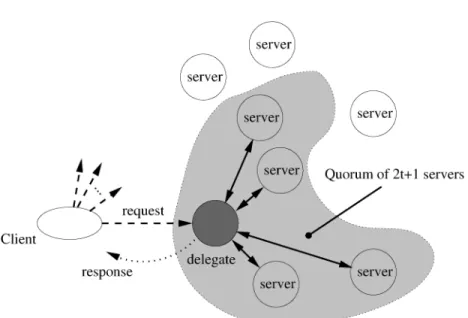
Fig. 1. Overview of client request processing.
Detailed protocols forQueryandUpdateappear as an Appendix; in this sec-tion, we explain the main ideas behind the design of these protocols. Technical challenges the protocols must address include the following.
—Because requests are processed by a quorum of servers but not necessarily by all correct COCA servers, different correct servers might process different
Updaterequests. Consequently, different certificates for a given namecidare stored by correct servers. Certificate serial numbers provide a solution to the problem of determining which of those certificates is the one to use.
—Because clients do not know COCA server public keys, a client making a request cannot authenticate messages from a COCA server and, therefore, cannot determine whether a quorum of servers has processed that request. The solution is for some COCA servers to becomedelegatesfor each request. A delegate presides over the processing of a client request and, being a COCA server, can authenticate server messages and assemble the needed partial signatures from other COCA servers. A client request is handled by t+1 delegates to ensure that at least one of these delegates is correct.
—Because communication is done using fair links, retransmission of messages may be necessary.
Figure 1 gives a high-level view of how COCA operates by depicting one of thet +1 delegates and the quorum of servers working with that delegate to handle a client request. The figure shows a client making its request by sending a signed message tot+1 COCA servers. Each server that receives this message assumes the role of delegate for the request. A delegate engages a quorum of servers to handle the request (by sending that request to all COCA servers) and constructs a response to the request based on the responses received from that quorum. The delegate then causes this response to be signed by the service;
this involves running a threshold signature protocol in cooperation withtother servers. Once signed, the response is sent by the delegate to the client. Upon receipt, the client checks that the response is correctly signed by the service and contains the client’s original request; if it isn’t or if no response has been received within a specified period of time, then the client simply again sends the original request tot+1 servers.
Protocol Details
Certificate Serial Numbers. The serial numberσ(ζ) for a COCA certificate
ζ is implemented as a pair hv(ζ),h(Rζ)i, wherev(ζ) is aversion numberand
h(Rζ) is a collision-resistant hash of theUpdaterequestRζ that led to creation ofζ. Version numbers encode the service-centric causality relation as follows. —The first certificate created to specify a binding for a name cid is assigned
version number 0.
—A certificateζ0produced by anUpdategiven certificateζ is assigned version numberv(ζ0)=v(ζ)+1.
Because different requests have different collision-resistant hashes, certificates created by different requests have different serial numbers. The usual lexico-graphic ordering on serial numbers yields the total ordering on serial numbers we seek—an ordering consistent with the transitive closure of the→relation. Note that, even with serial numbers on certificates, the same new certificate will be created by COCA if anUpdaterequest is resubmitted, andUpdate re-quests are thus idempotent. This is because the serial number of a certificate is entirely determined by the arguments in the request that creates the certificate.
Determining a Response for Query. It suffices to consider an abstract de-scription of COCA’s Update and Query protocols in order to characterize re-sponses satisfying Parts (i) and (ii) in the specification for Query. The actual protocols refine this abstract description.
COCA Update requests are processed by correct servers in some quorum and not necessarily by all correct COCA servers. Consequently, a correct COCA server pcan be ignorant of certificates having larger serial numbers than p
stores for a namecid. Part (ii) in the specification forQueryimplies that all com-pletedUpdate requests (hence, all certificates) must be taken into account in determining the response to aQueryrequestQ. Therefore, a quorum of servers must be engaged in processing Q. Responses from a quorum Q of servers is guaranteed if all COCA servers are contacted. Provided each server in Q re-sponds with the certificate (signed by COCA) it stores having the largest serial number among all certificates (forcid) known to the server, then the certificate
ζ having the largest serial number among the correctly signed certificates re-ceived in the responses from Qcan serve as the response toQ. That is,ζ will satisfy Parts (i) and (ii) in the specification forQuery, as we now show.
We first show that any certificateζ obtained by refining the protocol outlined above satisfies Part (i). Part (i) stipulates that a certificate returned forQueryis created by an acceptedUpdate; it is satisfied byζ if each certificate is signed by
COCA only after theUpdaterequest creating that certificate has been accepted. This is because the (n,t+1) threshold cryptography being employed for digital signatures requires cooperation (collusion) by more thant servers in order to sign a certificate. Given our assumption of at mostt compromised servers, we conclude that there are not enough compromised servers to create bogus signed certificates. Therefore, when a certificate is signed, a correct server must have participated in processing the request that created the certificate; the request creating the certificate had to have been accepted.
Part (ii) of the specification forQueryrequires that, for anyUpdaterequest
Unamingcidand completed beforeQis accepted,σ(ζ0)≤σ(ζ) must hold where
ζ0is the certificate created byU. This holds for implementations that refine the abstract description given above due to Quorum Intersection, because some cor-rect serverpinQmust also be in the quorum that processedU. Let certificate
ζp be p’s response for Q. Server palways chooses the certificate forcidwith the largest serial number, soσ(ζ0)≤ σ(ζp) holds. And becauseζ is the
certifi-cate that has the largest serial number among those from all servers in Q,
σ(ζp)≤σ(ζ) holds. Thereforeσ(ζ0)≤σ(ζ) holds.
The Role of Delegates. Every request is processed by all correct servers in some quorum; the client must be notified once that has occurred. Direct noti-fication by servers in the quorum is not possible because clients do not know the public keys for COCA servers and, therefore, have no way to authenti-cate messages from those servers. So, instead, a COCA server is employed to detect the completion of request processing and then to notify the client, as follows.
A delegate for a requestRis a COCA server that causesRto be processed by correct COCA servers in some quorum and then sends a response (signed by COCA) back to the initiating client. The processing needed to construct the response depends on the type of request being processed.
— To process aQueryrequestQfor namecid, the delegate obtains certificates from a quorum of servers, picks the certificateζhaving the largest serial num-ber, and uses the threshold signature protocol to produce a signed response containingζ:
1. Delegate forwardsQto all COCA servers.
2. Delegate awaits certificates forcidfrom a quorum of COCA servers. 3. Delegate picks the certificateζ having the largest serial number of those
received in Step 2.
4. Delegate invokes COCA’s threshold signature protocol to sign a response containingζ; that response is sent to the client.
— To process anUpdate request U for name cid, the delegate constructs the certificateζfor the given new binding (using the threshold signature protocol to have COCA digitally sign it) and then sendsζto all COCA servers. A server
preplaces the certificateζpcidforcidthat it stores byζif and only if the serial number inζ is larger than the serial number inζcid
p .
1. Delegate constructs a new certificateζ forcid, using the threshold signa-ture protocol to sign the certificate.
2. Delegate sendsζ to every COCA server.
3. Every server, upon receipt, replaces the certificate for cid it had been storing if the serial number inζ is larger. The server then sends an ac-knowledgment to the delegate.
4. Delegate awaits these acknowledgments from a quorum of COCA servers. 5. Delegate invokes COCA’s threshold signature protocol to sign a response;
that response is sent to the client.
Quorum Availability ensures that a quorum of servers is always available, so Step 2 in Query and Step 4 in Updateare guaranteed to terminate. Since at least t+1 of COCA’s 3t+1 servers are correct, compromised servers cannot prevent a delegate from using (n,t+1) threshold cryptography in constructing the COCA signature for a certificate or a response. Thus, Step 4 inQueryand Steps 1 and 5 inUpdate, which involve contacting all COCA servers, cannot be disrupted by compromised servers.
A compromised delegate might not follow the protocol just outlined for pro-cessing Query and Update requests. COCA ensures that such behavior does not disrupt the service by enlisting t +1 delegates (instead of just one) for each request. At least one of the t +1 delegates must be correct, and this delegate can be expected to follow theQueryandUpdateprotocols. So we stip-ulate that a (correct) client making a request to COCA submits that request to
t+1 COCA servers; each server then serves as a delegate for processing that request.6
Witht+1 delegates, a client might receive multiple responses to each request and each request might be processed repeatedly by some COCA servers. The du-plicate responses are not difficult for clients to deal with: a response is discarded if it is received by a client not waiting for a request to be processed. That each request might be processed repeatedly by some COCA servers is not a problem either, because COCA’sQueryandUpdateimplementations are idempotent.
But a compromised client might not follow the protocol and thus might not submit its request to t+1 delegates. A problem then occurs if the delegates receiving a requestRexecute the first step ofQueryorUpdateprocessing and then halt. Correct COCA servers now participated in the processing ofR, so (by definition)Ris accepted. Yet no (correct) delegate is responsible forR. Request
Ris never completed, and Request Completion is violated. The defense is straightforward.
— Messages related to the processing of a client requestRcontainR.
— Whenever a COCA server receives a message related to processing a client requestR, that server becomes a delegate forRif it is not already serving as one.
The existence of a correct delegate is now guaranteed for every request that is accepted.
6An optimization discussed in Section 5 makes it possible for clients, in normal circumstances, to
Self-Verifying Messages. Compromised delegates might also attempt to pro-duce an incorrect (but correctly signed) response to a client by sending erro-neous messages to COCA servers. For example, in processing aQueryrequest, a compromised delegate might construct a response containing a bogus or in-validated certificate and try to get other servers to sign that; in processing an Updaterequest, a compromised delegate might create a fictitious binding and try to get other servers to sign that; or when processing an Update re-quest, a compromised delegate might not disseminate the updated certificate to a quorum (causing the response to a laterQueryto contain an invalidated certificate).
COCA’s defense against erroneous messages from compromised servers is a form of monitoring and detection that we callself-verifying messages.7A
self-verifying message comprises:
— information the sender intends to convey, and
— evidence enabling the receiver to verify—without trusting the sender—that the information being conveyed by the message is consistent with some given protocol and also is not a replay.
In COCA, every message a delegate sends on behalf of a request contains a transcript of relevant messages previously sent and received in processing that request (including the original client request). Because messages contained in the transcript are signed by their senders, a compromised delegate cannot forge the transcript. And, because the members of the quorum participating in the protocol are known to all, the receiver of such a self-verifying message can independently establish whether messages sent by a delegate are consistent with the protocol and the messages received.8
Communicating Using Fair Links. The Fair Links assumption means that not all messages sent are delivered. To implement reliable communication in this environment, it suffices for a sender to resend each message until a signed acknowledgment is received from the intended recipient. In turn, the recipient returns a signed acknowledgment for every message it receives (including du-plicates, since the previous acknowledgments could have been lost). If both the sender and the receiver are correct then (due to Fair Links) this protocol ensures that the receiver eventually receives the message, the sender eventually re-ceives an acknowledgment from the receiver, and the sender exits the protocol. Each protocol in COCA is structured as a series of multicasts, with infor-mation piggybacked on the acknowledgments. A client starts by doing a mul-ticast to t+1 delegates; the signed response from a single delegate can be considered the acknowledgment part of that multicast. A delegate then inter-acts with COCA servers by performing multicasts and awaiting responses from
7Similar schemes can be found in Kihlstrom et al. [1997], Castro and Liskov [1999], Baldoni et al.
[2000], and Doudou et al. [2000].
8Gong and Syverson [1998] introduce the notion of afail-stop protocol, which is a protocol that halts
in response to certain attacks. One class of attacks is thus transformed into another, more benign, class. Our self-verifying messages can be seen as an instance of this approach, transforming certain Byzantine failures to more-benign failures.
servers. For the threshold signature protocol,t+1 correct responses suffice; for retrieving and for updating certificates, responses from a quorum of servers are needed. Thus, with at least 2t+1 correct servers, COCA’s multicasts al-ways terminate due to Quorum Availability since a delegate is now guaranteed to receive enough acknowledgments at every step and, therefore, eventually that delegate will stop retransmitting messages.
4. DEFENSE AGAINST DENIAL-OF-SERVICE ATTACKS
A large number of successful denial-of-service attacks work by exploiting an imbalance between the resources an attacker must expend to submit a request and the resources the service must expend to satisfy that request, as has been noted, for example, in Juels and Brainard [1999], and Meadows [1999, 2001]. If making a request is cheap but processing one is not, then attackers have a cost-effective way to disrupt a service: submit bogus requests to saturate server resources. A service, like COCA, where request processing involves expensive cryptographic operations and multiple rounds of communication is especially susceptible to such resource-clogging attacks.
COCA implements several classic defenses to blunt resource-clogging denial-of-service attacks.
1. An authorization mechanism identifies requests on which resources should not be expended.
2. Requests are grouped into classes, and resources are scheduled in a manner that prevents demands by one class from affecting requests in another class. 3. The results of expensive cryptographic operations are cached, and attackers
cannot destroy the locality that makes this cache effective.
The details for COCA’s realizations of these defenses constitute the bulk of this section.
Note that our Fair Links and Asynchrony assumptions are an important defense against denial-of-service attacks, too. An attacker stealing network bandwidth or cycles from processors that run COCA servers is not violating assumptions needed for COCA’s algorithms to work. Such a “weak assump-tions” defense is not without a price, however. Implementing real-time service guarantees on request processing requires a system model with stronger as-sumptions than we are making. Consequently, COCA can guarantee only that requests it receives are processed eventually. Those who equate availability with real-time guarantees (e.g., Gligor [1984], Yu and Gligor [1990], and Millen [1992, 1995]) would not be satisfied by an eventuality guarantee. But a sys-tem whose correctness depends only on “weak assumptions” is not precluded from satisfying real-time guarantees when the environment satisfies stronger assumptions, and COCA does just that.
Finally, COCA employs connectionless protocols for communication with clients and servers, so COCA is not susceptible to connection-depletion attacks such as the well-known TCP SYN flooding attack [Schuba et al. 1997]. But the proactive secret-sharing protocol in the current COCA implementation does use SSL (secure socket layer) [Freier et al. 1996] and is, therefore, subject to
certain denial-of-service attacks. This vulnerability could be eliminated by re-stricting the rate of SSL connection requests, reprogramming the proactive secret-sharing protocol, or adopting the mechanisms described in Juels and Brainard [1999].
4.1 Request-Processing Authorization
Each message received by a COCA server must be signed by the sender. The server rejects messages that
— do not pass certain sanity checks, — are not correctly signed, or
— are sent by clients or servers that, from messages received in the past, were deemed by this server to be compromised.
An invalid self-verifying message, for example, causes the receiverrto judge the sender scompromised, and the request-processing authorization mechanism at r thereafter will reject messages signed by s (until instructed otherwise, perhaps becauseshas been repaired).
Verifying a signature is considerably cheaper than executing anUpdate or
Queryrequest (which involve threshold cryptography and multiple rounds of message exchange). But verifying a signature is not free, and an attacker might still attempt to flood COCA with requests that are not correctly signed. Should this vulnerability ever become a concern, we would add a still-cheaper au-thorization check that requests must pass before signature verification is at-tempted. Cookies [Karn and Simpson 1997; Oppliger 1999], hash chains [Kent et al. 1996], and puzzles [Juels and Brainard 1999] are examples of such checks. Of course, any server-based mechanism for authorization will consume some server resources and thus could itself become the target of a resource-clogging attack, albeit an attack that is more expensive to launch by virtue of the addi-tional authorization mechanism. An ultimate solution is authorization mecha-nisms that also establish the origin of the request being checked, since fear of discovery and reprisal is an effective deterrent.
4.2 Resource Management
Because requests are signed, COCA servers are able to identify the client and/or server associated with each message received. This enables each COCA server to limit the impact that any compromised client or server can have. In particular, each COCA server stores messages it receives in one of a set ofinput queues
and employs a scheduler to service those queues. The queues and scheduler limit the fraction of a server’s cycles that can be co-opted by a given source of requests.9Others have also advocated similar approaches [Gligor 1984; Yu and
Gligor 1990; Millen 1992, 1995].
9Clearly, this offers no defense against distributed denial-of-service attacks [Richtel and Robinson
2000] in which an attacker, masquerading as many different clients, launches attacks from different locations. If the clients involved in such an attack can be detected, then their requests could be isolated using COCA’s queues and scheduler, but solving the difficult problem—determining which clients are involved in such an attack—is not helped by this COCA mechanism.
Our COCA prototype has a configurable number of input queues at each server. A round-robin scheduler services these queues. Client requests are stored on one or more queues, and messages from each COCA server are stored on a separate queue associated with that server. Duplicates of an element al-ready present on a queue are never added to that queue. Each server queue has sufficient capacity so replays of messages associated with a request currently being processed cannot cause the queue to overflow (since that would constitute a denial-of-service vulnerability).
In a production setting, we would expect to employ a more sophisticated scheduler and a rich method for partitioning client requests across multiple queues. Clients might be grouped into classes, with requests from all clients in the same administrative domain stored together on a single queue.
4.3 Caching
Replays of legitimate requests are not rejected by COCA’s authorization mecha-nism. Nor should they be, since Fair Links forces clients to resend each request until enough acknowledgments are received. But attackers now have an inex-pensive way to generate requests that will pass COCA’s authorization mech-anism, and COCA must somehow defend against such replay-based denial-of-service attacks.
There are actually two ways to redress an imbalance between the cost of making requests and the cost of satisfying them. One is to increase the cost of making a request, and that is what the signature checking in COCA’s au-thorization mechanism does. A second is to decrease the cost of processing a request. COCA also embraces this latter alternative. Each COCA server caches responses to client requests and caches the results of expensive cryptographic operations for requests that are in progress, as is also suggested in Oppliger [1999] and Castro [2000]. Servers use these cached responses instead of recal-culating them when processing replays.
The cache for client responses is managed differently than the cache for in-progress cryptographic results. We first discuss the client-response cache. With finite capacity caches, responses to clients cannot be cached indefinitely. If the server cache is to be effective against replays submitted by clients, we must minimize the chance of such replays causing cache misses (and concomitant costly computation by the server). The solution is to ensure that client replays are forced to exhibit a temporal locality consistent with the information being cached. In particular, by caching COCA’s response for each client’s most recent
No host-based defense can combat an attack that saturates incoming links. Still, COCA does enable some forms of what might be termed a distributed defense. First, distributed denial-of-service attacks directed at some region of a network (rather than targeting the COCA denial-of-service per se) can be tolerated when COCA servers have been deployed so widely that a significant number reside outside the region under attack. Second, the proactive recovery protocols in COCA could enable the service to migrate from one set of hosts to another, which then could allow the service to outrun a distributed denial-of-service attack (provided sufficient bandwidth remains available to execute proactive recovery).
request,10by restricting clients to making one request at a time, and by
hav-ing clients associate ascendhav-ing sequence numbers with their requests, older requests not stored in the cache can be rejected as bogus by COCA’s authoriza-tion mechanism.
Because requests are processed by only a quorum of COCA servers, a given server’s cache of client responses might not be current. A replay request signed by clientcto some serverscan have a sequence number that is larger than the sequence number for the last response cached atsforc. The larger sequence-numbered request would not be rejected bysand could not be satisfied from the cache; the request would have to be processed. But with quorums com-prising 2t+1 of the 3t+1 COCA servers, at most t such replays can lead to computation by COCA servers. COCA’s implementation further limits sus-ceptibility to these attacks. Whenever a COCA server sends a response to a client, that response is also sent to all other COCA servers. Each server is thus quite likely to have cached the most recent response for every client request.
An attacker not only can replay client requests for denial-of-service attacks, but can also replay messages that servers exchange. COCA’s defense here, too, is a cache. Servers cache results from all expensive operations, such as comput-ing one-way hashes11from shares for proactive secret-sharing and computing
partial signatures for in-progress requests. The cache at each server is suffi-ciently large to handle the maximum number of requests that all COCA servers could have in progress at any time. A total of 60 K bytes suffices for a cache to support one client request, when COCA certificates do not exceed 1,024 bytes (which seems reasonable given observed usage).
COCA limits the number of requests that can be in progress at any time by having each delegate limit the number of requests it initiates. Of course, a compromised delegate would not respect such a bound. But recall that COCA servers are notified when responses are sent, so a server can estimate the num-ber of concurrent requests that each server (delegate) has in progress. COCA servers can thus ignore messages from servers that initiate too many concur-rent requests.
5. PERFORMANCE OF COCA
Our COCA prototype is approximately 35 K lines of new C source; it employs threshold and proactive threshold RSA schemes (with 1,024-bit RSA keys), constructed using the protocol described in Zhou [2001] from building blocks given in Rabin [1998].12We implemented the protocols in OpenSSL [OpenSSL
Project]. COCA certificates have the same syntax as X.509 [CCITT 1988]
10In a system with a million clients, this client cache would be roughly 5 gigabytes because
approx-imately 5 K bytes are needed to store a client’s last request and COCA’s response.
11The one-way hash function involves expensive modular exponentiation and is needed to
imple-ment verifiable secret-sharing [Feldman 1987].
12The protocols [Zhou 2001] we use employ replication of shares and subshares in achieving fault
certificates, with a COCA certificate’s serial number embedded in the X.509 serial number.13
Much of the cost and complexity of COCA’s protocols is concerned with toler-ating failures and defending against attacks, even though failures and attacks are infrequent today. We normally expect the following.
N1: Servers will satisfy stronger assumptions about execution speed. N2: Messages sent will be delivered in a timely way.
Our COCA prototype is optimized for these normal circumstances. Wherever possible, redundant processing is delayed until there is evidence that assump-tions N1 and N2 no longer hold.
In particular, our prototype delays when COCA servers start serving as the additional delegates for client requests already in progress. This reduces the number of delegates when N1 and N2 hold, hence it reduces the cost of re-quest processing in normal circumstances. The refinements to the protocols of Section 3 are as follows.
— A client sends its request only to a single delegate at first. If this delegate does not respond within some timeout period, then the client sends its request to anothertdelegates, as required by the protocols in Section 3.
— A server that receives a message in connection with processing some client requestRand that is not already serving as a delegate forRdoes not become a delegate until some timeout period has elapsed.
— A delegate psends a response to all COCA servers, in addition to sending the response to the client initiating the request, after the request has been processed. After receiving such a response, a server that is not yet a delegate for this request will not become one in the future; a server that is serving as a delegate aborts that activity.
— A cached response is forwarded to a serverq wheneverqinstructspto par-ticipate in the processing of a request that has already been processed. Upon receiving the forwarded response, q immediately terminates serving as a delegate for that request.
Also, the threshold signature protocol COCA uses is designed to give better performance when N1 and N2 hold.
5.1 Local Area Network Deployment
The experiments reported in this subsection all involved a COCA prototype comprising four servers (i.e.,n=4 andt=1) communicating using a 100-Mbps Ethernet. The servers were Sun E420R Sparc systems running Solaris 2.6, each
13Although syntactically compatible with X.509 certificates, COCA certificates are not
interchange-able with the X.509 certificates in use by public key infrastructures today. First, COCA imposes an interpretation on the serial numbers embedded in certificates: a COCA certificate with a higher se-rial number invalidates one with a lower sese-rial number for the same client. Second, COCA, because it supportsQuery, has no need to and therefore does not provide the CRLs (certification revocation lists) usually associated with public key infrastructures that support X.509 certificates.
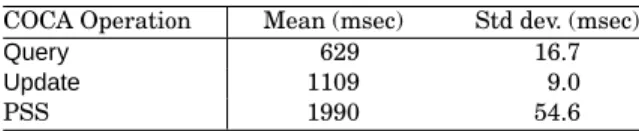
Table I. Execution Time in a LAN When N1 and N2 Hold COCA Operation Mean (msec) Std dev. (msec)
Query 629 16.7
Update 1109 9.0
PSS 1990 54.6
Table II. Cost Breakdown forQuery,Update, and Proactive Secret-Sharing (PSS) in LAN Deployment
Query(%) Update(%) PSS (%) Partial Signature 64 73 Message Signing 24 19 22 One-Way Function 51 SSL 10 Idle 7 2 15 Other 5 6 2
with four 450-MHz processors. The round trip delay for a UDP packet between any two servers on this Ethernet is usually under 300 microseconds.
Table I gives times for COCA operations executing in isolation when as-sumptions N1 and N2 hold. We report the delay forQuery, forUpdate, and for a round of proactive secret-sharing.14The reported sample means and sample
standard deviations are based on 100 executions. All samples were within 5% of the mean.
To better understand the origin of these delays, we report in Table II the (percentage) contribution that can be attributed to certain CPU-intensive cryp-tographic operations. ForQueryandUpdate, we measured the time spent gen-erating partial signatures and signing messages. For proactive secret sharing, we measured the delay associated with the one-way function, with message signing, and with computation involved in establishing an SSL connection to transmit confidential information between servers. Notice that improved hard-ware for performing cryptographic operations could have a considerable im-pact. Idle time, because servers sometimes wait for each other, is also listed in Table II. Only 2 to 6% of the total execution time is unaccounted. That time is being used for signature verification, message marshaling and unmarshaling, and task management.
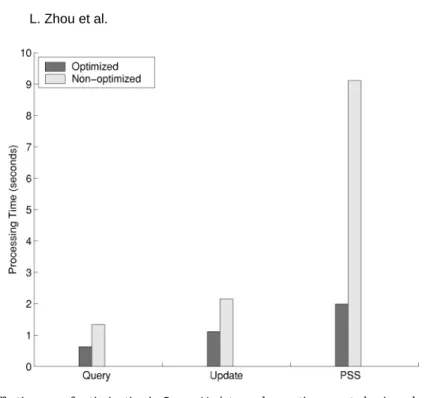
To evaluate the effectiveness of the optimizations outlined above for when assumptions N1 and N2 hold, Figure 2 compares performance with and without the optimizations. The results summarize 100 executions; very small sample standard deviations are observed here. The optimizations thus can be seen to be effective.
5.2 Internet Deployment
Communication delays in the Internet are higher than in a local area network; the variance of these delays is also higher. To understand the extent, if any, to
14Time spent checking certificates and performing other state recovery at each server is not included
Fig. 2. Effectiveness of optimization inQuery,Update, and proactive secret-sharing when assump-tions N1 and N2 hold.
which this affects performance, we deployed four COCA servers as follows. — University of Tromsφ(UIT), Tromsφ, Norway (300 MHz, Pentium II). — University of California at San Diego (UCSD), San Diego, CA (266 MHz,
Pentium II).
— Cornell University, Ithaca, NY (550 MHz, Pentium III). — Dartmouth College, Hanover, NH (450 MHz, Pentium II).
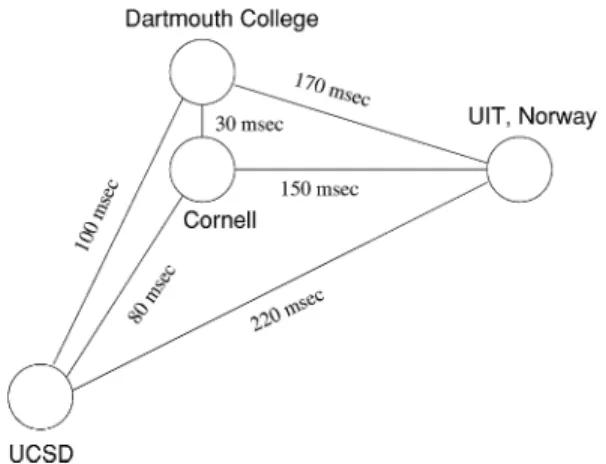
All ran Linux.15Figure 3 depicts the average message delivery delay (measured
usingping) between these servers. Delivery delays on the Internet vary consid-erably [Labovitz et al. 1997] but the values observed during the experiments we report did not differ significantly from those in Figure 3.
Table III gives measurements for the Cornell host in our four-site Internet deployment. In comparing Tables I and III, we see the impact of the Internet’s longer communication delays (which also lead to longer server idle times). The sample standard deviation is also higher for the Internet deployment, due to higher load variations on servers and due to the higher variance of delivery delays on the Internet; all samples are located within 25% of the mean. See Table IV for a breakdown of delays (analogous to Table II) for our Internet deployment of COCA.
15Beggars can’t be choosers. For making measurements, we would have preferred having the same
hardware at every site, although we have no reason to believe that our conclusions are affected by the modest differences in processor speeds. For a production COCA deployment, we would recommend having different hardware and different operating systems at each site so that common-mode vulnerabilities are reduced.
Fig. 3. Deployment of COCA over the Internet with message delays between servers. Table III. Performance of COCA Over the Interneta
COCA Operation Mean (msec) Std dev. (msec)
Query 2270 340
Update 3710 440
PSS 5200 620
aThe averages and sample standard deviations are from 100 repeated executions during a three-day period.
Table IV. Breakdown of Costs forQuery,Update, and Proactive Secret-Sharing (PSS) in Internet Deployment
Query(%) Update(%) PSS (%) Partial Signature 8.0 8.7 Message Signing 3.2 2.5 2.6 One-Way Function 7.8 SSL 1.6 Idle 88.0 87.7 87.4 Other 0.8 1.1 0.6
5.3 COCA Performance and Denial-of-Service Attacks
Any denial-of-service attack will ultimately involve attackers (i.e., some com-bination of compromised clients and/or servers) (i) sending new messages, (ii) replaying old messages, and (iii) delaying message delivery or processing. To evaluate how effective COCA’s defenses are against these, we simulated at-tacks and measured their impact. The results of those experiments for our local area network deployment of COCA are discussed in this subsection.
Message-Creation Defense. New messages sent by servers are not nearly as potent in denial-of-service attacks against COCA as new messages sent by clients. This is because messages from servers are rejected unless they self-verify. So such messages must contain a correctly signed client request as well as correctly signed messages from all servers involved in previous protocol steps; the collusion and compromise of more thantCOCA servers is thus required to get past COCA’s request-processing authorization mechanism. Moreover, once any message from a given server is found by a COCA server pto be invalid,
subsequent messages from that server will be ignored byp, considerably blunt-ing their effectiveness in a denial-of-service attack to saturate p.
In contrast, a barrage of requests from compromised clients, if correctly signed, cannot be rejected by COCA’s request-processing authorization mech-anism (unless the identities of these compromised clients are already known by the receiver). The impact of such a barrage should be mitigated by COCA’s resource management mechanism, which ensures that messages from a small set of senders do not monopolize server resources. How effective this mecha-nism is as a defense depends on the exact configuration of COCA’s resource management mechanism: the number of input queues on which various clients are grouped, and the scheduler used in servicing these input queues.
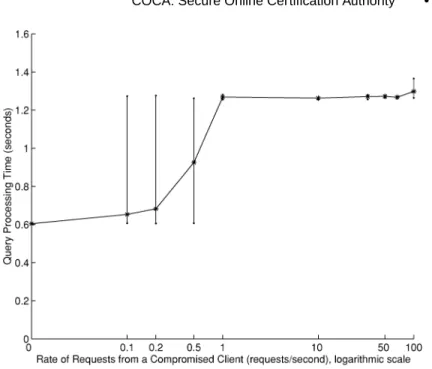
To measure this effectiveness, it suffices to investigate the simple case of two clients. Acompromised clientsends a barrage of new requests to the service at rates we control;16acorrect clientsends a request and then awaits a response or
a timeout.17Of interest is by how much the correct client’s requests become dela-yed due to requests the compromised client sends, since this information can th-en be used in predicting COCA’s behavior whth-en there are more than two clith-ents. Once a client’s request Ris appended to some input queue on a (correct) COCA server, two factors contribute to delay processingR. The first source of delay arises from multiplexing the server as it concurrently processes a number of requests. This number of requests is referred to as thelevel of concurrency. Assuming a modest load from correct clients, the delay due to sharing the pro-cessor with other, concurrent, requests is not affected by actions an attacker might take and thus is not of interest here; our experiments therefore assume servers process requests to completion serially (viz. the level of concurrency is 1). The second source of delay is affected by the compromised client’s barrage of new messages: requests in input queues whose processing will precede R. A mechanism to defend against a barrage of client requests must control this source of delay, and it is this delay that we measure.
Our first experiment adjusted the rate of requests from the compromised client while measuring the performance of requests from the correct client. To start, each server was configured to store all client requests on a single input queue. The capacity of this queue was 10 requests. We found that the correct client would get no service whenever the compromised client sent requests at a rate in excess of 10 requests per second. At 10 requests per second, requests from the compromised client fill the (fixed capacity) input queue virtually all the time; aQueryrequest from the correct client has a 9 in 10 chance of being discarded because it arrives when there is no room in the input queue, and an
Updaterequest has half that (due to the 1 and 2 seconds timeout, respectively). The denial-of-service attack is a success.
For the next experiment, each server was configured to have separate queues for the correct client and the compromised client. A round-robin scheduler
16Because the compromised client does not await responses before sending additional requests,
these experimental results apply directly to the case where a group of compromised clients all share the same input queue on each server.
Fig. 4. Performance ofQueryfor a correct client when a compromised client makes requests at varying rates.
serviced the two queues. Figures 4 and 5 show performance ofQueryandUpdate
requests from the correct client for various rates of requests from the compro-mised client. Every reported datapoint is the average processing time over 100 experiments; the error bars depict the range for 95% of the samples.
The curves forQueryandUpdatein Figures 4 and 5 comprise two segments. In the first segment, increases in the rate of requests that the compromised client sends cause increased delays for requests from the correct client. This is because as the rate of requests from the compromised client increases, so does the probability that COCA—with its round-robin servicing of input queues— will have to process one of those requestsRbefore processing a request from the correct client. The processing ofRthus increases the processing time for a request from the correct client. We see in this first segment almost identical wide ranges of samples for each rate measured. The worst case occurs when the request from the correct server arrives just after a request from the compro-mised client starts to get processed, and the best case occurs when the request from the correct server arrives when no request from the compromised client is being processed. Even though we see the same worst and best case, the means of samples increases as the rate of requests from the compromised client in-creases, reflecting an increasing probability that the request from the correct client has to wait for the processing of a request from the compromised client.
The second segment of the curves begins once the compromised client is sending requests at approximately the same rate as the normal client (i.e., approximately 1 request per second forQueryand 0.5 requests per second for
Update). Throughout this second segment, further increases in the request rate from the compromised client do not further degrade the processing of requests
Fig. 5. Performance ofUpdatefor a correct client when a compromised client makes requests at varying rates.
from the correct client. This is because requests from the two clients are being processed in alternation, and the delay for requests from the correct client remains at about double what is measured when there is no compromised client. Note that, as the rate of requests from the compromised client increases, more and more of those requests are discarded by servers; the fixed-capacity input queue for the compromised client is full when those requests arrive.
COCA’s request-processing authorization mechanism starts saturating at 100 requests per second, due to the time required for a server to perform sig-nature verification on each incoming message. With 100 requests per second, a server has diminished processing capacity to execute protocols forQueryand
Update. There was thus little point in exploring higher request rates in perfor-mance experiments, and we didn’t.
In an actual deployment, clients will be partitioned over a set of input queues. But the worst-case performance for this case is easy to bound in light of the above experiments for two clients. Suppose b queues are serving only com-promised clients, cqueues are serving only correct clients, andd queues are serving both kinds of clients. Requests from compromised clients will starve requests from correct clients that share the same input queue, because the first experiment above established that if the rate of requests to a single input queue from compromised clients exceeds 10 requests per second then requests from correct clients to that input queue are unlikely to succeed. And the sec-ond experiment established that COCA’s resource-management mechanisms will guarantee thatc/(b+c+d) of each server’s processing time and other re-sources are devoted to processing requests on the queues that serve only correct clients.
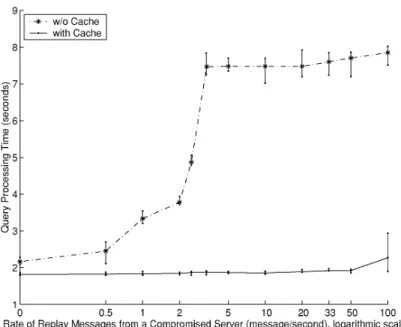
Fig. 6. Performance ofQueryprocessing under the simulated denial-of-service attack from a com-promised server: with cache versus without cache.
Message-Replay Defense. COCA employs caching to defend against denial-of-service attacks involving message replays. We need not consider replays of client requests in our experiments, because their impact is considerably smaller than the impact of processing new requests from a compromised client. Specif-ically, for new requests, COCA must expend resources in executing the proto-col for the operation being requested, but for replays of client requests, pro-cessing (by design) involves considerably fewer resources: the request is one that can be rejected because its sequence number is too small, one that can be be satisfied from the server’s cache, or one that can be ignored because it is already being processed. Assuming that the requests being replayed are from the same (compromised) client that launches the denial-of-service attacks in the experiments of Figures 4 and 5, those curves give the bounds we seek on the worst-case performance of COCA when client-request replays form the basis for a denial-of-service attack.
Replays of messages from servers in COCA are not immobilizing, because relatively expensive cryptographic computations are cached. To validate this, we simulated an attacker replaying server messages at varying rates to all other COCA servers. The message being replayed was designed to cause a defenses-disabled COCA server to compute partial signatures, which takes ap-proximately 200 milliseconds on a 450-MHz Sun E420 Sparc server, a relatively expensive operation and thus particularly effective in a denial-of-service attack. We measured the average delay for Query, Update, and proactive secret-sharing as a function of the rate of message replay sent by the compromised server. We compared the performance in the case where caching is enabled to that in the case where caching is disabled. This information appears in Figures 6 through 8.
Fig. 7. Performance ofUpdateprocessing under the simulated denial-of-service attack from a compromised server: with cache versus without cache.
Fig. 8. Performance of proactive secret-sharing under the simulated denial-of-service attack from a compromised server: with cache versus without cache.