THE RELATIONSHIP BETWEEN TEACHERS’
ORGANIZATIONAL COMMITMENT AND JOB
SATISFACTION AT NO. 2 BASIC EDUCATION HIGH SCHOOL,
LOIKAW, KAYAH STATE, MYANMAR
Kamaylar1
Yan Ye2
Dechachai Sripicharn3
Abstract: The main purpose of this study was to identify the levels of teachers’ organizational commitment and job satisfaction and to determine the relationship between teachers’ organizational commitment and job satisfaction at No.2 Basic Education High School, Loikaw, Kayah State, Myanmar in the academic year 2015-2016. A total of fifty-nine (59) full-time teachers from No.2 Basic Education High School, Loikaw, Kayah State were surveyed for this study. The main resource of data was the questionnaire that investigated the teachers’ level of organizational commitment and job satisfaction. The collected data were analyzed by using the Mean, Standard Deviation, and Pearson Product Moment Correlation Coefficient. The research found that the level of teachers’ organizational commitment was high in the school though the level of teachers’ job satisfaction was moderate. Meanwhile, the study found there was a moderate positive relationship between teachers’ organizational commitment and job satisfaction at No.2 Basic Education High School, Loikaw, Kayah State, Myanmar. To become more sustain school, administrators and leaders from No.2 Basic Education High School are recommended to innovation, develop and create more opportunity for all teachers to keep control teachers stability. Administrators and leaders are also recommended to provide personal growth program that emphasis on a vision of how to integrate technology in the school to build up teaching and learning. Leaders and administrators should arrange personal development training for their teachers in order to gain more skills to use effectively in the classroom. Teachers are recommended to establish a teacher’s group to regularly meet, open minded and be a good listener to accept others ideas. Teachers are recommended to share their ideas with others. This will help them to improve their personal growth. Teachers should pay more attention to student’s achievement by giving more help to students and let them learn effectively.
1 M.Ed. Candidate in Educational Administration, Graduate School of Human Sciences, Assumption University, Thailand.
2 Ph.D., Director of Educational Research, Statistics and Measurement Center, Graduate School of Human Sciences, Assumption University, Thailand.
Keywords: Teachers’ Organizational Commitment, Job Satisfaction, No.2 Basic Education High School.
Introduction
In every organization, there is a need to have satisfied teachers to lead the organization in achieving the organization’s long-term goals. Teachers are important for leading organizations, and developing and improving the performance of the students in the organization.
According to Awang, Ahmad and Zin (2010), teachers who are satisfied with his or her job will accomplish his or her work well and will commit to his job and organization. Therefore, it is very important for the school leader to see the basics that can influence the teachers’ job satisfaction in school. In this 21st century, schools cannot perform well without teachers who are committed to working successfully in groups. It’s great to have loyal teachers who carry out their work self-sufficiently; in any case, this is insufficient. Teachers these days need to cooperate in groups and need to demonstrate the merit of being a part of these organizations as Madi (2012) pointed.
Teachers are highly respected in the mainstream Buddhist tradition in Myanmar culture. According to Tin (2007), “Teachers have traditionally been regarded as one of the ‘five gems’ and measured on the same place as the Buddha, the Scriptures, Monks, and parents.” So, in Myanmar society, a teacher is highly regarded by all. It is widely accepted that after parents, teachers are the most important persons in the development and growth of students. Teachers are very important in the holistic development of students. Nowadays, students spend more hours with teachers in school than with their parents at home. Therefore, teachers are an indispensable person in any society (Tin, 2004).
According to Rowley (1997), a teacher is important to be an academic leader. Especially they are the first persons to be in touch with the students. They could be the first leaders for the students. Therefore, educations in Myanmar should develop their teachers to have satisfied in teaching. Particularly, teachers who teach in No.2 Basic Education High School in Myanmar, as the play crucial roles in Myanmar culture as coaches, mentors, and masters.
Hattie (2004) stated that teachers are expected to be a qualified format or mentor for students. A teacher is entrusted by the society with the task of overseeing intellectual, emotional, moral and social development of students. A teacher is expected not only to teach students how to read and write but also to assist them to pass examinations with flying colors. It is also a teacher’s duty to work closely with parents and teachers-parents’ association for the regular assessment and development of students.
On the other hand, it is occasionally hard to find suitable persons for specific places. So when a person is chosen, organizations will attempt to hold those teachers. Therefore, to meet the changing needs in the worldwide world, it is important to improve teachers’ organizational commitment and teachers’ job satisfaction. In this way, it is vital to keep organizational commitment into practice and build up the levels of teachers’ job satisfaction.
According to Price (1997), job satisfaction has been described as the amount of positive feeling that an employee may experience toward a particular job or organization. Therefore, teachers’ job satisfaction is one of the most important issues which have not been recognized enough in schools in the past. However, in the last ten years, considerable research has been carried out (Aung, 2014). In the past decades, most schools were not aware of the importance of job satisfaction. Nowadays, every successful school or organization monitors their teachers’ job satisfaction to maintain good quality teaching and high learning standards. Teachers feel a part of a caring organization and are motivated to produce good results. The schools benefit by becoming good examples to other schools and raising standards in education
Objectives
There are three objectives:
1. To identify the level of teachers’ organizational commitment at No. 2 Basic Education High School, Loikaw, Kayah State, Myanmar.
2. To identify the level of teachers’ job satisfaction at No. 2 Basic Education High School, Loikaw, Kayah State, Myanmar.
3. To determine the relationship between teachers’ organizational commitments and job satisfaction at No. 2 Basic Education High School, Loikaw, Kayah State, Myanmar.
Literature Review
This study was based on Meyer and Allen’s (1997) three-component model of organizational commitment including affective commitment, continuance commitment and normative commitment; and Herzberg’s Motivator-Hygiene Theory.
1. Three-Component Model of Organizational Commitment
Affective Commitment- This model was about responsibility based on enthusiastic relations the worker creates with the association fundamentally through positive work encounters.
Continuance Commitment- This model reflected about responsibility based on commitment towards the association, case in point established in the standards of correspondence.
Normative Commitment- This model reflected duty in light of the apparent expenses, both monetary and social, of leaving the association. This model has been utilized via scientists to foresee critical worker results, including turnover and citizenship practices, work implementation, absence, and lateness. Meyer and Allen (1997) gave an exhaustive diagram of the hypothetical ancestry of this model.
2. Herzberg’s Motivation- Hygiene Theory
In 1959, Frederick Herzberg’s came up with the two-factor theory called Herzberg’s motivation. This two-factor theory also called satisfied or dissatisfied people’s needs at work. The theory proposed that every worker had two sets of needs or requirements.
recognition, work itself and personal growth and advancement and hygiene factors are concerned with the motivation from of people from the outside such as interpersonal relations, salary and working conditions (Lunenburg & Ornstein, 2008). Herzberg’s Motivation-Hygiene Theory were used to examine job satisfaction in this study. The theory developed by Frederick Herzberg stated that work motivation and job satisfaction could provide valuable insights into an individual’s needs and factors that contribute to satisfaction or dissatisfaction (Su, 2004).
According to Cherry (2014), it is also suggested that people are more inspired when they are motivated from within. In the workplace, the efficacy and performance increases through motivation factors such as job recognition and remuneration but the actual quality of work performed are influenced by motivation factors. The satisfaction of people whose motivation comes from external sources. Hygiene factors are related to external influences such as rewards, recognition, and promotion. While offering rewards can increase motivation in some cases, it must be done responsibly as researchers have found it too much appreciation can make to a reduction in teachers’ motivation (Cherry, 2014).
Conceptual Framework
The researcher aimed to investigate the level of teachers’ organizational commitment and their job satisfaction and to determine the relationship between teachers’ organizational commitment and job satisfaction at No.2 Basic Education High School in Loikaw, Kayah State, Myanmar.
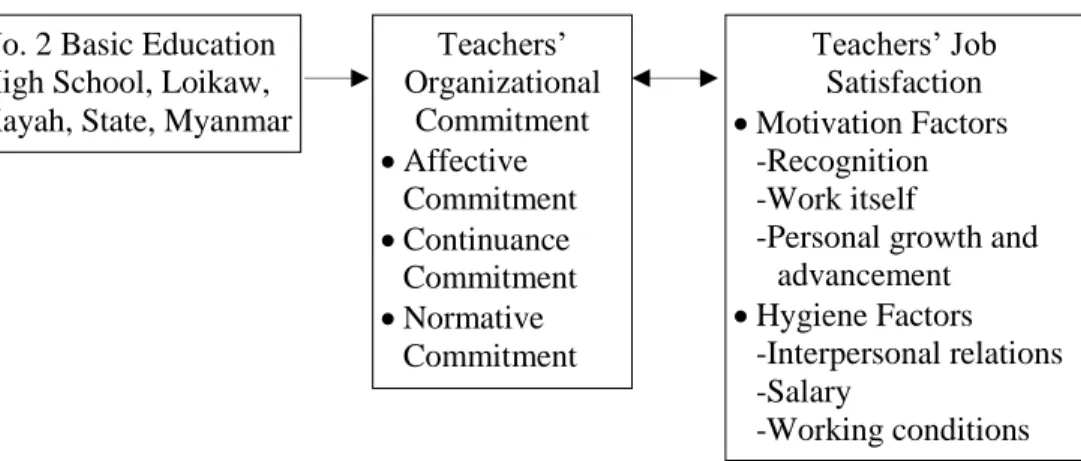
Figure 1 below showed the conceptual framework of this study. On the left side, variables were teachers’ organizational commitment which included which included 3 key components: affective commitment, continuance commitment, and normative commitment. On the right side, the variables were teachers’ job satisfaction which included recognition, work itself, personal growth and advancement, interpersonal relations, salary and working.
Teachers’ Organizational Commitment •Affective Commitment •Continuance Commitment •Normative Commitment Teachers’ Job Satisfaction •Motivation Factors -Recognition -Work itself
-Personal growth and advancement •Hygiene Factors
-Interpersonal relations -Salary
-Working conditions No. 2 Basic Education
High School, Loikaw, Kayah, State, Myanmar
Method/Procedure
This study attempted to determine the relationship between teachers’ organizational commitment and job satisfaction in the academic year of 2015-2016 at No.2 Basic Education High School, Loikaw, Kayah State, Myanmar.
This research was designed as a quantitative, relationship research and used a questionnaire consisted of two parts: Part 1: Teachers’ organizational commitment and Part 2: Teachers’ job Satisfaction to collect data from teachers at selected No.2 Basic Education High School, Loikaw, Kayah State, Myanmar.
The researcher used Means, and Standard Deviation to identify the level of teachers’ organizational commitment and teachers’ job satisfaction and Pearson Product Moment Correlation Coefficient to determine the relationship between the levels of teachers’ organizational commitment and teachers’ job satisfaction.
The research instrument employed in this study was composed of two parts. Part I was Organizational Commitment consist of 20 items to check the level of teachers’ commitment to the organization. The researcher used Ismail (2012) organizational commitment questionnaire for this study’s part I. This questionnaire surveys the level of teachers’ organizational commitment such as question No. 1, 2, 3,4,5,6 and 7 for affective commitment, question No.8, 9, 10, 11, 12, 13 and 14 for continuance commitment and question No. 15, 16, 17, 18, 19 and 20 for normative commitment.
Part II was Job Satisfaction including 22 items to determine the level of teachers’ job satisfaction. This questionnaire investigated the job satisfaction of the teachers including (1) Recognition question numbers 1, 2, 3 and 4, (2) Work itself question numbers 5, 6, 7, and 8, (3) Advancement and Personal Growth question numbers 9, 10, 11, and 12, (4) Interpersonal Relations question numbers 13, 14, 15, 16 and 17, (5) Salary question numbers 18, 19 and 20, and (6) Work Conditions question numbers 21 and 22. This part II used Mai’s (2013) questionnaire and there was 22 statements which described the job satisfaction of teachers.
Findings/Results
Research Objective One
Research Objective One was to identify the level of teachers’ organizational commitment at No.2 Basic Education High School in Loikaw, Kayah State, Myanmar. Table 1 showed the mean score and standard deviation for subscale of the level teachers’ organizational commitment among 59 teachers who are full-time teachers in No.2 Basic Education High School, Loikaw, Kayah State, Myanmar. It can be seen that teachers had the level of affective commitment, continuance commitment, and normative commitment are high but continuance commitment is still the lowest compared with affective commitment and normative commitment.
Table 1: Teachers’ Organizational Commitment
Organizational Commitment Mean S.D. Interpretation
Affective Commitment 3.80 .63 High
As Table 1 showed the overall total result of the mean score was 3.69 in the range scale of 3.51-4.50. It meant that the level of teachers’ organizational commitment from No.2 Basic Education High School was “high” as Table 12 implied.
Research Objective Two
Research Objective Two was to identify the level of teachers’ job satisfaction at No.2 Basic Education High School in Loikaw, Kayah State, Myanmar.
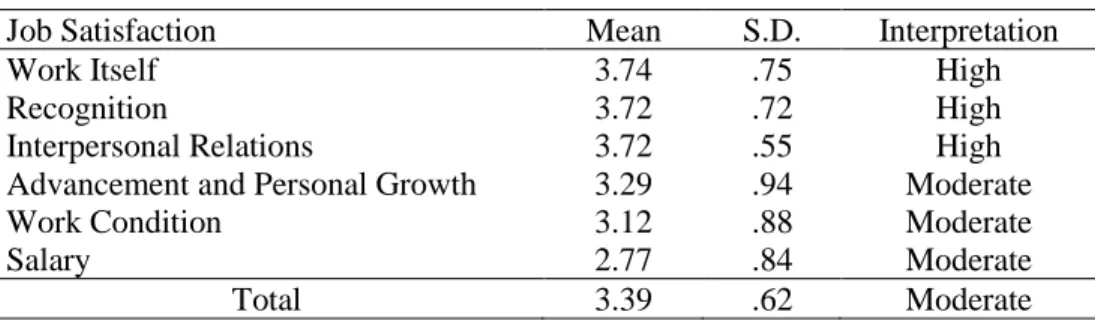
Table 2 showed that the Mean score and Standard Deviation for subscale of teachers’ job satisfaction among 59 teachers who are full-time teachers in No.2 Basic Education High School, Loikaw, Kayah State, Myanmar. It can be seen that the level of teachers’ job satisfaction toward work itself, recognition and interpersonal relations were high. The level of teachers’ job satisfaction toward advancement and personal growth, salary and work conditions were moderate.
Table 2: Teachers’ Job Satisfaction
Job Satisfaction Mean S.D. Interpretation
Work Itself 3.74 .75 High
Recognition 3.72 .72 High
Interpersonal Relations 3.72 .55 High
Advancement and Personal Growth 3.29 .94 Moderate
Work Condition 3.12 .88 Moderate
Salary 2.77 .84 Moderate
Total 3.39 .62 Moderate
The above Table 2 showed that the overall total result of the mean score was 3.39 in the range scale of 2.51-3.50. It meant that the level of teachers’ job satisfaction from No.2 Basic Education High School was “moderate”. It was indicated that teachers were more satisfied with motivation factors than their hygiene factors on teachers’ job satisfaction, as their motivation factors were regarded as “high”, but their hygiene factors were only “moderate” as Table 19 implied.
Research Objective Three
Research objective three was to determine the relationship between teachers’ organizational commitment and job satisfaction at No.2 Basic Education High School in Loikaw, Kayah State, Myanmar.
Table 3: Pearson’s Product-Moment Correlation between the Level of Teachers’ Organizational Commitment and Job Satisfaction
Teachers’ Job Satisfaction Conclusion Teachers’ Organizational Commitment Pearson Correlation Sig. (2-tailed) .540 .000 There is a significant relationship. ** Correlation is significant at the 0.01 level (2-tailed).
Since Pearson correlation r was .540 and Sig. was .000, which was smaller than .05 (even .01). Therefore, the researcher accepted research hypothesis:there was a significant relationship between teachers’ organizational commitment and job satisfaction at No.2 Basic Education High School, Loikaw, Kayah State, Myanmar, which mean the relationship between teachers’ organizational commitment and job satisfaction were moderately positive.
Discussion
1. Teachers’ organizational commitment
The total mean score of teachers’ organizational commitment at No.2 Basic Education High School, Loikaw, Kayah State, Myanmar, was 3.69 in the range scale of 3.51-4.50. This indicated that the level of teachers’ organizational commitment in No. 2 Basic Education High School was high.
As the study found that the mean score of teachers’ affective commitment was 3.80, teachers’ continuance commitment was 3.49, and the mean score of teachers’ normative commitment was 3.77, all mean scores are stated as high. In this situation, teachers’ organizational commitment in No.2 Basic Education High School, Loikaw, Kayah State is interpreted as a high level. This is a good indicator that the respondents are committed to their organization.
However, continuance commitment should be a concern to a management of the schools since its mean is the third highest after affective commitment and normative commitment. Teachers’ continuance commitment was the lowest score in this study. This showed that most of the teachers in the teaching profession are not interested in continuing with their teaching profession due to the influence of both internal and external factors in the teachers’ job satisfaction. Teachers’ has no equipment and necessary material to use their skill and knowledge in practice in the school.
According to Lunchak, Pohler and Gellatly (2008), teachers who are emotionally connected to their organization are expected to remain with organization past the age that would benefit them the most by retiring. This shows that some teachers value a sense of belonging to the organization.
Celep (2000) found that the teacher who has committed themselves to the school exerts great efforts for their school, were proud of their school and willing to have responsibilities for the achievement of the school.
According to Ahmad and Shah, (2010) employees having greater organizational commitment perform well and employees having a good attitude towards work are highly satisfied as compared to employees who are less inclined towards their work. Therefore, school administrators must especially think of ways to improve the effective commitment of their teachers.
2. Teachers’ Job Satisfaction
The total mean score of teachers’ job satisfaction at No.2 Basic Education High School, Loikaw, Kayah State, Myanmar, was 3.39 in the range scale of 2.51-3.50. This indicated that the job satisfaction level of teachers in No.2 Basic Education High
In the depth analysis of motivation factors, the teachers scored the highest on they were satisfied with the attitude they had for their job in school and the lowest on the interest and concern that their management showed for their work performance. Therefore, various tasks should be arranged for teachers in this school because teachers’ interests can be improved with their job.
For hygiene factors, the teachers scored the highest on the relationship with their fellow worker in the school. However, the teachers were not satisfied with their pay. Salary is a source of dissatisfaction when it is perceived to be unfairly low, but maintained that high pay can serve not only as hygiene factors but also as a means of providing recognition to the teachers. Therefore, higher salary also effective means of keeping the good teachers in a school. According to Ahuja and Shukla (2007), when incentives are offered for meeting specific goals, the employee is likely to expend more energy and effort into the job and thereafter the incentive will be given to the employees as a reward when the goal is met.
The teachers from No.2 Basic Education High School scored the lowest on the location of the school, teacher lounge, and technical facilities for the work in the school. According to the researcher’s personal experience and observation, the school environment is not fully satisfactory to enhance teachers’ job satisfaction, because No.2 Basic Education High School lacks necessary school facilities and equipment’s due to budget problems. Therefore, poor work conditions in the school could block the teachers’ access to various works that support the teaching-learning process.
Another possible factor is related to the unfavorable working condition for teachers because the school has no internet service, has no proper rental housing for the teachers, has no electricity, has no transportation availability and has an insufficient amount of pure drinking water for the teachers in the school. Robbins (2004), stated that working conditions possible impact on an employee’s job satisfaction because the employees prefer physical surroundings that are safe, clean, and comfortable for works.
In short, there were no previous studies about job satisfaction in No.2 Basic Education High School, Loikaw, Kayah State, Myanmar, however, there were so many international previous studies about teachers’ job satisfaction. Teacher’ job satisfaction in this school is just as important as others school around the world. As teachers play a key role in the education and also student’s life, every school should consider evaluating their teachers’ job satisfaction in order to achieve success. References
Ahmad, H., Ahmad, K. & Shah, A. I. (2010), Relationship between Job Satisfaction, Job Performance Attitude towards Work and Organizational Commitment.
European Journal of Social Sciences, Volume 18, Number 2 (2010).
Aung, N, K. (2014). A Comparative Study of Teachers’ Decision-Making Styles and Their Job Satisfaction in Four Selected Migrant High Schools in Mae Sot District, Tak Province, Thailand. Scholar, Vol 7, No 2 (2015), Pp. 95. Retrieved from http://www.assumptionjournal.au.edu/index.php/Scholar/article/view/1509/1302 Awang, Z., Ahmad, J. H. & Zin, N. M. (2010). Modeling Job Satisfaction and Work
Commitment among Lecturers: A Case of UiTM Kelantan. Journal of Statistical Modeling and Analytics, 1(2), 45-59.
Celep, C. (2000), Teachers' Organizational Commitment in Educational Organizations. National FORUM of Teacher Education Journal, v10E n3 1999-2000.
Cherry, K. (2014). Hierarchy of Needs. Retrieved from http://psychology.about.com /od/theoriesofpersonality/a/hierarchyneeds.htm
Hattie, J. (2004). Teachers make a difference’, in Steve Holden, Teachers Matter,
Professional Educator, vol. 3, no. 1, March, Australian College of Educators. Ismail, N. (2012). Organizational commitment and job satisfaction among staff of
higher learning education institutions in Kelantan. Master of human resource management University Utara in Malaysia.
Lunnenburg, F. C. & Ornstein, A. C. (2008). Educational administration: Concepts and practices (5th Ed.). Belmont, CA: Wadsworth.
Madi, M. (2012). Employees' Perception and Organizational Commitment: A Study on the Banking Sector in Gaza, Palestine. International Journal of Business and Social Science, Vol. 3 No. 16 (Special Issue – August 2012).
Mai, H, K. (2013). The Relationship between Teachers’ Job Satisfaction and
Teachers’ Teaching Performance in Three Basic High School, in Myitkyina, Kachin State, Myanmar. Published Master’s Thesis. Assumption University, Bangkok, Thailand.
Meyer, J. P. & Allen, N. J. (1991). A three-component conceptualization of organizational commitment. Human Resource Management Review, 1, 61-89. (1997). Commitment in the workplace, theory, research and application. California: Sage.
Meyer, J. & Allen, N. (1997). Commitment in the workplace: Theory, research and application. London: Sage.
Price, J. L. (1997). Handbook of organizational measurement. Department of Sociology, University of Iowa, Iowa City, Iowa, USA. International Journal of Manpower, Vol. 18 No. 4/5/6, 1997, pp. 305-558. © MCB University Press, 0143-7720. http://www.lichaoping.com/wp-content/Ijm9704305.pdf
Robbins, P.S. (2004), Decide and Conquer. Make Winning Decisions and Take Control Your Life. Upper Saddle River, New Jersey. Pearson Education, Inc. Su, M, K. (2004). Job Satisfaction of Faculty Members Teaching in Undergraduate
Levels at Assumption University of Thailand. Master’s Thesis. Assumption University of Thailand, Bangkok, Thailand.
Tin, H. (2004). Myanmar education: challenges, prospects and options. Dictatorship, disorder and decline in Myanmar. Australian National University, Canberra: Professor Han Tin.