How Internal Marketing Mediates the Relationship between Teachers'
Organizational Commitment and Job Satisfaction
Hsingkuang Chi
Associate Professor
Department of Business Administration
Nanhua University, Taiwan
Hueryren Yeh
Assistant Professor
Department of Marketing Management
Shih Chien University, Kaohsiung Campus, Taiwan
Jinchih Liou
Yuan Chang Junior High School, Yulin County, Taiwan
Department of Business Administration
Nanhua University, Taiwan
Abstract
In this study, special education teachers serving in junior high and elementary schools in Yunlin County were observed to examine the influences of organizational commitment, and job burnout, and internal marketing on job satisfaction. A questionnaire survey method was employed to collect data. A convenient sampling approach was adopted to administer 200 questionnaires, from which 152 valid questionnaires were retrieved effective response rate of 76%. Research findings revealed that (a) organizational commitment significantly and positively influenced job satisfaction, (b) organizational commitment significantly and positively influenced internal marketing, (c) internal marketing significantly and positively influenced job satisfaction, (d) job burnout significantly and negatively influenced job satisfaction, and (e) internal marketing mediated the relationship between organizational commitment and job satisfaction.
Keywords:
organizational commitment, job satisfaction, internal marketing, job burnout.1. Introduction
Special education teachers serve a group of “angel” students who are similar but also different to other students. The similarity is that they enjoy the same obligation and the same right to receive an education like other students. The difference is that they are quite different between individuals, and each has a different learning requirement. According to Article 19 of the Taiwan Special Education Law, special education curriculums, materials, teaching methods, and evaluation methods should maintain flexibility and adapt to the disabled students’ physical and psychological characteristics and requirements. That is, special education teachers must fine tune their curriculums, materials, teaching methods, etc., from time to time to integrate interesting contents into their teaching materials in order to increase students’ motivation.
Special education is a professional field that is rapidly progressing. Even teachers with a special education major often feel their expertise is inadequate. They usually need to advance their professional ability through participation in special education workshops typically held by the special education center of the County Education Bureau or a University so that they can have better competencies to improve the disabled students’ education. Workshops also provide a good communication channel for teachers’ to promote the field of special education. If a school can aggressively provide teachers' workshop information and encourage them to participate, they can understand the school is supporting them for further study so they can receive better professional knowledge and skill to take care of student affairs. Thus, a second aim of this study is to explore whether organizational commitment will influence internal marketing of special education teachers in junior high and elementary schools of Yunlin County.
Special education teachers are minority group in a school, but their requirements of resources and support are no less than those of regular teachers. Whether a school can give them powerful support, offer the necessary resources without occupying special education budgets, and provide a good communication channel to supervisors and homeroom teachers are all important promotional strategies for teachers. Therefore, the study intends to understand whether internal marketing, including education training and communication will influence special education teachers’ job satisfaction in junior high and elementary schools of Yunlin County. Additionally, the study also examines whether the impact of special education teachers’ organizational commitment on job satisfaction will be affected by a school’s internal marketing, that is, to treat internal marketing as a mediating variable to examine the foresaid influence.
Special education is not one-to-one education, although disabled students only occupy 2.3% of the student population in Taiwan (Wang & Huang, 2011). However, following the amendments of the Special Education Law and its sub-laws, the rules for special education teachers are increasing, causing an intangible pressure on them because their job contents become more complex and heavier. The future of each student relies heavily on the work of their teachers but the improvement in student progress is typically slow resulting in a sense of lack of achievement from the teachers’ perspective. In addition to teaching, special education teachers have to handle part time administrative duties on top of taking care of class affairs. The heavy workload from day to day could cause teachers’ to tire, if these pressures are accumulated and cannot find an exit to release. Moreover, when teachers put their noses to the grindstone for a long time, this may reduce their time to get along with others and become isolated with other colleagues. This could become barriers for job efficiency and burnout of teachers in a long period. Accordingly, the study takes a special education teacher job burnout as a moderating variable to examine its effects between organizational commitment and job satisfaction.
2. Literature Review
2.1 Organizational Commitment
Organizational commitment has been an interesting research topic to many management scholars for a long time. Organizational commitment has many concepts and definitions based on different researchers’ views and research purposes. Robbins (2013) considered organizational commitment is a kind of job attitude, which it is an extent to which employees agree organizational goals and hope to maintain a relationship with internal members in an organization. It is a relative degree of an individual’s feeling to attach and participate in an organization (Mowday, Steers, & Porter, 1979). Porter, Steers, Mowday, and Boulian (1974) thought that organizational commitment is a strength of an individual to recognize and make efforts in an organization. Mowday, Porter, and Steers (1982) believed that organizational commitment represents an individual’s loyalty and contribution to an organization. It not only influences an individual’s input strength but also signifies an attitude or an intention for an individual to connect with an organization. Such connection is important to an individual and even has valuable meaning to an organization and the whole society.
From the perspectives of Positive Psychology and Positive Organizational Behavior, Luthans and Youssef (2007) argued that psychological assets can explain the concepts of the psychological status of an individual’s inner heart. If a business organization wants to increase positive energy of employees’ inner heart, it can evaluate how much it is committed to its employees and then to make up the inadequate parts so as to reinforce employees’ satisfaction and avoid them from incurring job burnout. Nevertheless, a teachers’ value will influence their mission and goal definition. When value is different, mission and goal definition will be different and will not generate the same result as expected. When a teacher consolidates a school and an individual’s goal and value system, its fitness will be higher because the teachers’ value approves a school’s goals and values. The higher teachers’ positive value, and attitude and behavior are, the stronger the teachers’ identification to a school’s goal and commitment to jobs and duties is. Special education teachers are a member of a school, and their teaching objects comprise of only a small portion of students in the school. Thereby, special education teachers inherently need more support and commitments if one is to expect a special education teacher to commit to their field and school. Lack of teacher commitment may impact the ability of disabled students to enjoy their special education right and benefit from their study in terms of their future life and employment. The study proposes that teachers’ organizational commitment should consider the environmental characteristics of a school and divides it into three dimensions: (1) identification commitment which means that the teachers identify with the goals and values of a school and are willing to devote themselves to the current job, (2) effort commitment which refers to the teachers willingness to work hard to achieve organizational goals and values of a school, and (3) retention commitment which denotes that teachers hope to remain teaching job in the current service school.
2.2 Internal Marketing
Berry (1981) pinpointed that employees are just like customers. It is necessary to understand the employees’ requirements to make them satisfied with a working environment (physical and psychological environment), get along with colleagues, and obey a leaders’ supervision from work in order to provide a high quality service to customers. Grönroos (1984) proposed the Service Triangle and claimed that the service business should not only market to external customers but also need to market to internal employees, so they can provide good service through interactive marketing. The marketing target of internal marketing is called internal product, and its marketing object is internal customers (Hsaio, 1997). Kotler (1991) considered that internal marketing is successfully in applying employment, training and motivation methods to make employees concerned customers. An organization should emphasize internal marketing before external marketing. If an organization does not provide employees internal marketing, external marketing cannot perform smoothly.
The purpose of internal marketing is to facilitate an organization to build an efficient internal management environment and make employees work hard to accomplish its organizational goals (Wu & Huang, 2000; Chang & Chang, 2007). Considerable number of scholars believes the importance for an organization to identify its employees. An organization should treat employees as internal customers to give them organizational visions by applying marketing concepts and manage different types of exchange relationship through internal communication methods such as training, motivation, and evaluation to build an efficient internal management environment, so they will accept organizational missions and goals and increase satisfaction and loyalty to achieve the expected organizational goals (Berry, 1981; Rafiq & Ahmed, 2000; Johnson et al., 1986; George, 1990; Joseph, 1996; Cetin, 2006; Shen, Yang, & Kuo, 2006; Chang & Chang, 2007). Berry and Parasuraman (1991) asserted that there are several advantages for an organization to promote internal marketing: (1) to obtain and retain excellent people, (2) to provide common visions so that employees will feel their work have purposes and meanings, (3) to equip employees with good ability and knowledge for their job, (4) to make employees enjoy the results of teamwork, and (5) to engage in design work in accord with marketing research.
Communication means that a school builds a good communication channel through internal marketing so that the school can clearly transmit its missions and goals, and teachers can progress in communication though this channel to give responses and feedback. In the end, teachers will turn their teaching goals into a school’s teaching philosophy and transmit it to students and their parents.
2.3 Job Burnout
Freudenberger (1974) defined burnout as people presenting a kind of wearing out feeling to their job. It is a phenomenon that people experience emotional exhaustion and lose their initial motivation, commitment, and achievement when they encounter too much job pressure (Dworkin, 2001; Maslach & Jackson, 1984). Maslach (1982) found that job burnout often occurred in those environments where individuals feel emotional exhaustion and excessive pressure that lead them to lose job achievement. Maslach, Schaufeli, and Leiter (2001) pointed out that job burnout has two factors, contextual factors and individual factors. Contextual factors include job characteristics, vocational characteristics and organizational characteristics, and individual factors consist of demographic characteristics, personality characteristics, and job attitude.
Maslach et al. (2001) further indicated that contextual factors and organizational factors play a more important role in the job burnout than individual factors do. Moorhead and Griffin (1989) suggested that individuals had a high expectation and motivation toward many things but when they are confronted with organizational pressure and cannot satisfy their personal needs, their expectation and motivation will be frustrated. Furthermore, when individuals reduce their expectations and motivation, they lose their confidence, incur psychological withdrawal, and job burnout will occur accordingly (Cherniss, 1980; Jing, 2013). Atkinson (1988) mentioned that job burnout resulted from employees consistently receiving pressure in a working context for a long period, resulting in physical, emotional, and mental exhaustion.
Maslach, Jackson, and Leiter (1996) developed a measure scale called Maslach Burnout Inventory-General Survey (MBI-GS) which included three dimensions: (1) emotional exhaustion, which signifies that people feel exhausted and emotional helpless to their job so that they have no way to handle job requirement, (2) negative job attitude, which means when people think of their work, they will lack of interest, and (3) reducing vocational effectiveness, which implies that people lack confidence and achievement and feel negative to their job, so they do not have an expectation to work hard continuously. The MBI-GS scale focuses on the exploration of the relationship between employees and their job, which applies to all walks of life. The higher the score is, the more serious job burnout is. Based on the discrepancy theory, Smith, Kendall, and Hulin (1969) promoted discrepancy research on the gap between the reward expected to be received and the reward actually received to understand job satisfaction. When the difference is small, employees’ job satisfaction will be higher but when the discrepancy is large, employees’ job satisfaction will be lower. Friedman (2000) purported that the discrepancy model of teachers’ professional effectiveness to understand the difference between teachers’ individual expectation and the actual contexture of a school’s organization that may lead to teachers’ job burnout in teaching careers.
A school organization has the education responsibility to take care teachers’ physical and psychological health of a teacher will affect their mindset and effectiveness to perform education jobs, which will directly or indirectly impact education receivers. Teaching is a high pressure job that can cause job burnout (Näring, Briët, & Brouwers, 2006; Johnson, et al., 2005; Brouwers & Tomic, 2000). Although disabled students count for only about 2.3% of the total student population in Taiwan (Wang & Huang, 2010), the amendments of the Taiwan Special Education Law and its sub-laws, cause an intangible pressure on special education teachers because their job contents become more complex and heavier. In addition to teaching, special education teachers have to handle the administrative job part time and take care of class affairs. The heavy workload implies teachers’ do not have much time to get along with others and become isolated with other colleagues.
2.4 Job Satisfaction
Since Hoppock (1935) posed the concepts of job satisfaction, much research on job satisfaction followed. Vroom (1964) reckoned that job satisfaction reflects whether an individual’s physical requirement is satisfied, if it is satisfied, job satisfaction will be raised. Considerable researchers adopted multi-dimensional views to measure the dimension of job satisfaction. For example, the Minnesota Satisfaction Questionnaire divided job satisfaction into internal satisfaction and external satisfaction (Karsh, Booske, & Sainfort, 2005). Some researchers used a discrepancy view and deemed job satisfaction as the difference between reward expected to be received and reward actually received (Porter & Steers, 1973; Robbins, 2001). This view evaluates the reward from individuals’ internal heart feeling to evaluate their satisfaction of the environment, i.e., an individuals’ subjective response to the work situation of an organization. Job satisfaction is an enjoyment and aggressive emotion condition after individuals assess their own job and job experiences. Just like that individuals hold emotional inclination, when they possess positive inclination their job satisfaction will be high. On the contrary, when they possess a negative inclination, their job satisfaction will be low. However, no matter how scholars explain this concept, job satisfaction encompasses an individuals’ affective or emotional reaction to the overall work or facets (Kreitner & Kinichi, 2007). Job satisfaction means employees’ attitude to their working environment from an overall viewpoint (Weiss, Davis, England, & Lofquist, 1967).
Different researchers will propose a different theory on job satisfaction, which can be divided into two categories: One is internal satisfaction and second is external satisfaction. Nevertheless, a school is an organization composed of teachers. They have energetic resources to implement organizational goals. The morale resources of a schools’ organization are from the overall teachers’ attitude, and job satisfaction is the sum of overall teachers’ attitude. Accordingly, the relationship between a school organization and its teachers is closely connected. A high teachers’ job satisfaction will advance the overall school organization morale, and a high morale can further promote job satisfaction.
The study denotes teachers’ job satisfaction as (1) internal satisfaction means that special education teachers can accept school’s goals and obtain job achievement and a supervisors’ acclamation. That is, teachers feel that reward if they received more than the energy they paid or if they can fully exert their knowledge under a supervisors’ support to acquire job satisfaction, and (2) external satisfaction denotes that special education teachers perceive satisfaction from their work atmosphere, work environment, and relative facilitates and instruments when they engage in special education teaching.
2.5 The Relationship between Each Dimension
High commitment employees have a higher job satisfaction and job motivation and are more willing to cooperate with the organization and have a better job performance (Lee, 2013). By synthetic analysis of organizational commitment, job satisfaction and turnover intention, Mathieu and Zajac (1990), Tett and Meyer (1993) found that organizational commitment and job satisfaction significantly affect turnover intention. Moreover, job satisfaction influences more on turnover intention, and organizational commitment and job satisfaction demonstrate a high degree of mutual dependence relationship. A higher organizational commitment will help employee entrenchment, and a higher job position can receive more benefits and have a better job satisfaction (Huang & Hsiao, 2007). Karsh et al. (2005) suggested that a good work and organizational environment will positively impact a worker’s commitment and satisfaction. Notwithstanding, organizational commitment has a variety of definitions because each scholar will have a different opinion to a different application. A school organization and a company are quite different. Under a high social ethics standard, most school organizations often discuss a teacher’s willingness to pay high effort in teaching from a normality psychology perspective. Studies revealed that organizational commitment, job satisfaction and teaching effectiveness are positively related (Zeinabadi, 2010; Lin & Lin, 2012; Chi, Yeh, & Choum, 2013).
Conduit and Mavondo (2001), Chen and Hsieh (2009) affirmed that it requires organizational motivation and human resource management support such as educational training, a managers’ support and human resource activities to perform internal marketing in order to build key factors for maintaining a good relationship between internal customers and external customers. Kotler and Scheff (1998) identified that an effective selection method, training and motivation for employees can give customers the best service quality. Many empirical studies on internal marketing and organization commitment confirmed that internal marketing will positively affect organizational commitment (Wu & Jaw, 2001; Benett & Bakensjo, 2005; Shen et al., 2006; Chang & Chang, 2007; Wu & Tian, 2008; Huang & Huang, 2009; Yeh & Hong, 2012; Caruana & Calleva, 1998; Jaworski & Kohli, 1993; Naudé, Desai, & Murphy, 2003). In other words, when employees perceive that an organization performs more aggressively on internal marketing, organizational commitment will be higher. Tansuhaj, Randall, and McCullough (1991) found that the implementation of internal marketing concepts can actually stimulate employees’ positive job attitude, including organizational commitment, job involvement, job motivation, and job satisfaction. Internal marketing orientation can raise a teacher’s organizational commitment and job satisfaction to further improve a school’s effectiveness (Chang, 2006). A school organization should develop internal marketing activities through internal marketing concepts to motivate, influence and create internal customers’ (teachers) satisfaction so teachers will build customer service orientation senses to identify the organization, intensify organizational commitment and advance teaching performance to further increase the competiveness of the school management team (Hung, 2012; Chi, et al., 2013).
Some scholars believed that job burnout would cause a reduction in job satisfaction when exploring the influence of job burnout on job satisfaction (Iwanicki, 1983; Jayarante, Chess, & Kunkel, 1986; Burke, Greenglass, & Schwarzer, 1996) and some scholars considered that the reduction of job satisfaction would incur job burnout (Stout & Williams, 1983; Dolan, 1987). However, Wolpin, Burke and Greenglass (1991) indicated that job satisfaction and job burnout have an interactive relationship. Brewer and Clippard (2002), Chang (1983) pinpointed that job satisfaction will affect job burnout, i.e., individuals’ job satisfaction or dissatisfaction will trigger job burnout. The perceptions of an individuals’ job satisfaction will have a relative influence relationship to the occurrence of job burnout. Lee and Chen (2006) suggested that the more a teachers’ job pressure perceptions and effort involvements are, the stronger the teachers’ job burnout is. In their research of college teachers in China, Zhang and Zhu (2008) alleged that teachers’ job pressure will negatively affect job satisfaction and job burnout. Meanwhile, the primary influence of job pressure in a work contexture is to incur job burnout (Wang & Chang, 2004; Wu & Chen, 2001; Huang, Hung, & Chang, 1994; Brewer & McMahan, 2003; Ray, 1991; Ray & Miller, 1991). It is to say that the higher job pressure individuals undertake, the higher job burnout is. Job burnout will change following the high or the low of individuals’ job pressure (Carter, 1994; Farber, 1991; Hipps & Halpin, 1991). Additionally, Lee and Ashforth (1993, 1996) discovered that job satisfaction and job burnout are significantly related. Chang (1996) and Huang (2009) esteemed that job pressure has a positive impact on job burnout, but if there is a satisfaction during the work process, job burnout will be reduced. Obliviously, the above literature reviews show that job satisfaction is an important factor to influence job burnout. When individuals perceive higher job satisfaction, they can undertake more job pressure. Otherwise, they will be affected by job pressure and create negative effect, i.e., job burnout. When teachers are involved in job pressure for a long time, it will not only influence their emotion and health but also generate job burnout so their job satisfaction and job motivation will be reduced and subsequently also impact teaching quality (Chang & Su, 2013).
3. Research Methodology
3.1 Research Framework
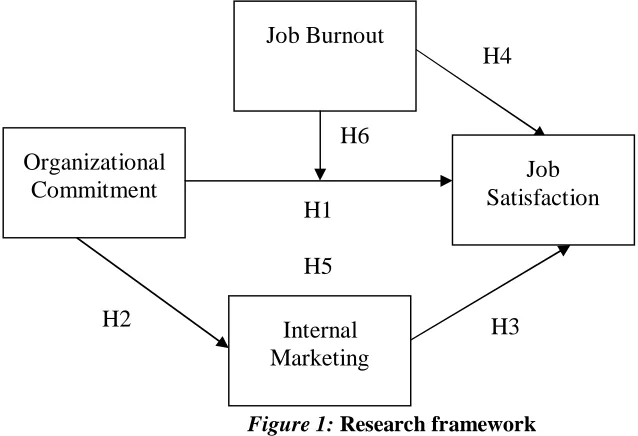
This study builds a research framework as shown in Figure 1, according to the study motivations and purposes and the analyses of the literature. The study aims to explore the relationships among organizational commitment, internal marketing, job burnout and job satisfaction by treating organizational commitment, internal marketing, and job burnout as the dependent variables, and job satisfaction as the independent variable. In addition, internal marketing is the mediating variable, and job burnout is the moderating variable.
3.2 Research Hypotheses
According to research purposes and research questions, the study proposes research hypotheses as follows: H1: Organizational commitment will significantly and positively affect job satisfaction.
H2: Organizational commitment will significantly and positively affect internal marketing. H3: Internal marketing will significantly and positively affect job satisfaction.
H4: Job burnout will significantly and negatively affect job satisfaction.
H5: Internal marketing has a mediating effect between organizational commitment and job satisfaction. H6: Job burnout has a moderating effect between organizational commitment and job satisfaction.
Figure 1: Research framework 3.3 Research Design
The study developed a questionnaire to measure variables derived from research hypotheses after a review of the literature. The questionnaire adopted a 7- point Likert scale (1-very strong disagree/7-very strongly agree) to test research hypotheses, including five parts, personal information, organizational commitment, internal marketing, job burnout and job satisfaction. The study used SPSS17.0 to perform data analysis. The study distributed 50 copies of questionnaires for pretest and 46 of them were collected. The total valid questionnaire is 46 copies, and the effective response rate is 92%. The results showed Cronbach’s α values are 0.940, 0.853, 0.924 and 0.882 respectively. All of the values are above 0.7. Therefore, the results demonstrate that the measurement scale of each dimension has good reliability and the formal questionnaire can be launched.
The Research subjects of the study were special education teachers in junior high and elementary schools in Yunlin County. Sample scope followed the compulsory education statistic data from the Special Education Transit Net of K-12 Education Administration, Ministry of Education in Taiwan (MOE, 2015). The data show that the disabled student class placement status of junior high and elementary schools in Yunlin County is as follows: self-contained special education class, 37 classes, resource room programs, 96 classes, and itinerant resources programs, 10 classes. Totally, there are 143 classes and 286 special education teachers. The study conducted convenient sampling to collect data. The questionnaire was distributed at a regular supervisory meeting by full-time counseling teachers of each school during May 2015 where 200 copies were distributed, and 176 copies were returned.
H1
H2
H3
H4
H5
Internal
Marketing
Organizational
Commitment
H6
The return rate was 88%. Excluding 24 invalid questionnaires, the total number of valid questionnaires was 152 copies. The effective response rate was 76%. Cronbach’s α for organizational commitment, internal marketing, job burnout, and job satisfaction is 0.943, 0.941, 0.920, and 0.891, respectively. Cronbach’s α of each dimension is higher than 0.7, indicating a high reliability.
4. Research Results
4.1 The Analysis of the Relationships between Variables
The study performed regression analysis of organizational commitment, internal marketing, job burnout, and job satisfaction to verify the interactive influence between two dimensions. The results are as shown in Table 1. Organizational commitment positively and significantly affects job satisfaction (β = 0.695, p <= .000). Organizational commitment positively and significantly affects internal marketing (β= 0.807, p <= .000). Internal marketing positively and significantly affects job satisfaction (β= 0.674, p <= .000). Job burnout negatively and significantly affects job satisfaction (β=- 0.238, p <= .003). Therefore, H1, H2, H3 and H4 are supported.
Table 1: Regression Analysis
β R2 Adj.R2 t F p
OCJS 0.695*** 0.484 0.480 11.850 140.417 0.000 OCIM 0.807*** 0.652 0.649 16.753 280.650 0.000 IMJS 0.674*** 0.454 0.450 11.160 124.548 0.000 JTJS -0.238** 0.057 0.050 -3.000 9.002 0.003
Notes.1.*:p<0.05 **, p<0.01 ***, p<0.001, β= Standardized Coefficient. 2. OC: Organizational Commitment, IM: Internal Marketing, JB: Job Burnout, JS: Job Satisfaction.
4.2 Mediating Test of Internal Marketing
The study followed Baron and Kenny’s (1986) suggestions to examine the mediating effects. Model 1, organizational commitment significantly and positively affects internal marketing (β = 0.807, p=0.000<0.001). It signifies that the independent variable is significantly affected to mediating variable. Model 2, the result shows internal marketing significantly and positively affects job satisfaction (β=0.674, p=0.000<0.001). Model 3, the result reveals that organizational commitment significantly and positively affects to job satisfaction (β=0.695, p
=0.000<0.001). Model 4, the study inserts internal marketing into the regression analysis of organizational commitment with job satisfaction. The result is significant (β=0.435, p=0.000<0.001), and the coefficient value reduces from 0.695 to 0.435, indicating a partial mediating effect (see Table 2). Therefore, H5 is supported that organizational commitment will affect job satisfaction through the mediating effect of internal marketing.
Table 2: Regression Analysis of Mediating Test
Variables IM JS
Model 1 Model 2 Model 3 Model 4
OC 0.807*** -- 0.695*** 0.435***
IM -- 0.674*** -- 0.322***
R 0.807 0.674 0.695 0.721
R2 0.652 0.454 0.484 0.520
Adj. R2 0.649 0.450 0.480 0.513
F 280.650 124.548 140.417 80.594
Notes.1. * :p<0.05, **: p<0.01, ***: p<0.0012, β= Standardized coefficient; 2. OC: Organizational Commitment, IM: Internal Marketing, JB: Job Burnout, JS: Job Satisfaction.
Table 3: Regression analysis of the indirect effect between internal market and job satisfaction
Direct effects and total effect
β SE t p
IV DV 0.757 0.0639 11.850 0.000
IV MV 0.842 0.0677 16.753 0.000
MV DV, DV is controlled 0.2497 0.0746 3.3484 0.001 IVDV, MV is controlled 0.4704 0.1048 4.5426 0.000 Indirect effect and significance using the normal distribution
Value SE LL95% CI UL95% CI z p
Sobel 0.2832 0.0864 0.1138 0.4525 3.2778 0.001 Bootstrap results for indirect effect
Value SE LL95% CI UL95% CI Mean
Effect 0.2832 0.0922 0.0943 0.4616 0.2802
Note. 1. IV: Independent Variable (Organizational Commitment), DV: Dependent variable (Job Satisfaction), MV: Mediating Variable (Internal Marketing); 2. N = 152, Number of Bootstrap Resamples = 5000, LL = Lower Limit, CI = Confidence Interval, UL = Upper Limit; 3.β= Unstandardized Coefficient.
4.3 Moderating Effect Test
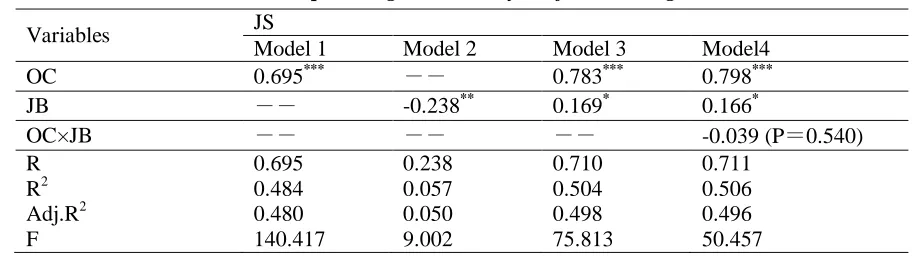
The study adopted Baron and Kenny’s (1986) procedures and the hierarchy regression analysis to explore the influence of moderating effect between organizational commitment and job burnout on job satisfaction (see Table 4). The results are as follows. Model 1 indicates that organizational commitment significantly and positively affects job satisfaction (β=0.695, p=0.000<0.001). Model 2 shows that job burnout significantly and positively affects job satisfaction (β=0.238, p=0.003<0.01). Model 3 displays organizational commitment and job burnout positively and significantly affect job satisfaction (β=0.783, p=0.000<0.001; β=0.169, p=0.013< 0.05). Model 4 exhibits the interactive effect of organizational commitment and job burnout is not significantly affected to job satisfaction (β=-0.033, p=0.450). As a result, H6 is not supported.
Table 4: Stepwise regression analysis of Moderating Test
Variables JS
Model 1 Model 2 Model 3 Model4
OC 0.695*** -- 0.783*** 0.798***
JB -- -0.238** 0.169* 0.166*
OC×JB -- -- -- -0.039 (P=0.540)
R 0.695 0.238 0.710 0.711
R2 0.484 0.057 0.504 0.506
Adj.R2 0.480 0.050 0.498 0.496
F 140.417 9.002 75.813 50.457
Notes. * :p<0.05, ** :p<0.01, *** :p<0.001, β= Standardized Coefficient; 2. OC: Organizational Commitment, JB: Job Burnout, JS: Job Satisfaction.
5. Conclusions and Suggestions
5.1 Conclusions
Teachers have obligations to share the administrative job of the school. Relatively, school administrative units should take the responsibility to counsel and offer support. Schools should not only require special education teachers to cooperate with administration work on one hand and yet discharge all the problems of disabled students’ on their teachers on the other hand. If so their teachers will not have the time to adjust their emotion duly. This will make teachers lose their interest in people, things, and objects around them and result in negative emotions which are then transmitted into their work environment and increase job dissatisfaction.
From the results of the mediating test, in order to improve special education teachers’ organizational commitment, the study suggests that a school should utilize internal marketing to increase special education teachers’ professional knowledge, ability and special education development so they can practically perform special education goals, identify with the school and devote themselves to the school and students. In the meantime, a school needs to build internal marketing and provide a complete communication channel in order to provide the school, teachers, and parents with good communication and assist them in understanding the learning and growth process of special education students. Consequently, special education teachers will identify with the school and are willing to strive for the school’s goals so their retention intention will increase and they will obtain job accomplishment. Both the school and students can receive the biggest benefits. Thus, teachers’ organizational commitment will affect job satisfaction through a school’s internal marketing.
From the moderating test, the results are not supported. Special education teachers can develop visions and goals under a supportive work environment. In order to attain their teaching goals, they will devote themselves to a school with their work spirit, patience, love and faith, and will never easily give up even though they encounter difficulties and accumulate job pressure. Additionally, under the expectation of the society and their visions and goals, even if they feel job burnout, they will still work hard for special education students. Therefore, job burnout does not appear to have an interactive effect with organizational commitment and affect special education teachers’ job satisfaction.
5.2 Suggestions
A school should emphasize internal marketing to build better communication, connect different resources of each administrative unit, and intensify special education teachers’ knowledge and ability to increase their expertise and promote special education development. A school can also assist special education teachers by helping to handle students’ affair in placing regular class students so that they can concentrate on the task of teaching disabled students’ utilizing their fundamental ability at the same time. Thus, a school needs to stress team cooperation to make special education teachers feel more belonging and more willingness to make an effort to benefit the school, their disabled students and their parents.
Due to the small fraction of special education teachers in the system (2% to 5%), special education teacher knowledge and ability can easily be neglected. Their special education knowledge should be concerned and be respected. Moreover, special education includes a variety of contents, which require adequate resources and communication from a school in order to provide a friendly campus to facilitate special education implementation. The primary purposes of study are to explore special education teachers’ organizational commitment and internal marketing and their influences on job burnout and job satisfaction. The study suggests that future research can consider other variables such as teaching methods and interaction with parents, which may also cause impacts on special education teachers’ job satisfaction. In addition, special education teachers’ teaching effectiveness, emotional intelligence quotient, supervisors’ leadership behavior, and job involvement all deserve to be examined further.
References
Atkinson, J. M. (1988). Copying with stress at work. Welling borought: Thorsons Publisher Limited.
Badini, S., & Lee, L. S. (2012). Predictors of vocational high school principal’s affective organizational commitment in Taiwan. World Transactions on Engineering and Technology Education (WTE&TE), 10(4), 263-268.
Baron, R. M., & Kenny, D. A. (1986). The moderator-mediator variable distinction in social psychological research: Conceptual, strategic, and statistical considerations. Journal of Personality and Social Psychology, 51(6), 1173-1182.
A. (2008).Voluntary or involuntary? Control over overtime and rewards for overtime in relation to fatigue and work satisfaction. Work & Stress, 22(1), 33-5.
Bennett, R., & Barkensjo, A. (2005). Internal marketing, negative experiences, and volunteers’ commitment to providing high quality service in a UK helping and caring charitable organization. International Journal of Voluntary and Nonprofit Organizations, 16(3), 251273
Berry, L. L. (1981). The employee as a customer. Retail Banking, 3, 25-28.
Berry, L. L. & Parasuraman, A. (1991). Marketing services: Competing through quality. New York: The Free Press.
Brewer, E. W., & McMahan, J. (2003). Job stress and burnout among industrial and technical teacher educators. Journal of Vocational Education Research, 28(2), 125-140.
Brewer, E. W., & Clippard, L. F. (2002). Burnout and job satisfaction among student support services personnel. Human Resource Development Quarterly, 13(2), 169-186.
Brouwers, A., & Tomic, W. ( 2000). A longitudinal study of teacher burnout and perceived self-efficacy in classroom management. Teaching and Teacher Education, 16, 239-253.
Burke, R. J., Greenglass, E. R., & Schwarzer, R. (1996). Predicting teacher burnout over time: Effects of work stress, social support, and self-doubt on burnout and its consequences. Anxiety, Stress, and Coping, 9, 261-275.
Carter, S. (1994). Teacher stress and burnout: Organizing systems to support competent social behavior in children and youth. Office of special education and rehabilitative service (Ed.), Washington, DC.
Caruana, A.& Calleva, P. (1998). The effect of internal marketing on organizational commitment among retail bank managers. The International Journal of Banking Marketing, 16, 108.
Cetin, M. O. (2006). The relationship between job satisfaction, occupational and organizational commitment of academics. Journal of American academy of Business Cambridge, 8 (1), 78-88.
Chang, C. H. (1996). Education Psychology. Taipei:Tonghua.
Chang, C. S., & Chang, H. H. (2007). Effects of internal marketing on nurse job satisfaction and organizational commitment: Example of medical centers in southern Taiwan. The Journal of Nursing Research, 15(4), 265-274
Chang, H. C. (1983). Professional workers’ burnout: Take social workers as example. Thought and Words, 21, 1-2.
Chang, Y. N. (2006). The core ideas of internal marketing (IM) and the role of IM in the implementation of change management in higher education institutions: Initiating teachers’ performance evaluation program as example. Bulletin of Educational Entrepreneurship and Management, 2, 97-123.
Chang, Y. N., & Su, S. E. (2013). The study on the public elementary school teachers’ perception of teacher professional development evaluation and the job stress in Tainan city. Journal of Tainan University of Technology, 38(2), 93-112.
Chen, Y. K., & Hsieh, T. F. (2009). Study on relationship among internal customer orientation, market orientation and organizational performance of theme restaurants. The Journal of International Management Studies, 4(2), 165-174.
Cherniss, C. (1980). Staff burnout: Job stress in the human services. Beverly Hills, CA: Sage.
Chi, H.K.,Yeh, H. R., & Chium, S.M. (2013). The organizational commitment, personality traits and teaching efficacy of junior high school teachers: The meditating effect of job involvement. The Journal of Human Resource and Adult Learning, 9(2), 131-142.
Conduit, J. & Mavondo, F. T. (2001). How critical is internal customer orientation to market orientation? Journal of Business Research, 51(1), 11-24.
Dolan, N. (1987). The relationship between burnout and job satisfaction in nurses. Journal of Advanced Nursing, 12, 3-12.
Dworkin, A.G. (2001). Perspectives on teacher burnout and school reform. International Education Journal, 2 (2), 69-78.
Farber, B. A. (1991). Crisis in education-stress and burnout in the American teacher. New York: Jossey-Bass Publisher.
Freudenberger, H.J. (1974). Staff -burnout. Journal of Social Issues, 30(1), 159–165.
George, W. R. (1977). The retailing of services: A challenging future. Journal of Retailing, 91, 85-98.
George, W. R. (1990). Internal marketing and organizational behavior: A partnership in developing customer-conscious employees at every level. Journal of Business Research, 20, 63-70.
Geurts, S. A. E., & Sonnentag, S. (2006). Recovery as an explanatory mechanism in the relation between acute stress reactions and chronic health impairment. Scandinavian Journal of Work, Environment & Health, 32(6), 482-492.
Grönroos, C. (1984). A service quality model and its marketing implications. European Journal of Marketing, 18(4), 36–44.
Hipps, E. S., & Halpin, G. (1991). Job stress, stress related to performance-based satisfaction and burnout in teachers and principals. Paper presented at the Annual meeting of the Mid-South Educational Research Association, Lexington, KY.
Hoppock, R. (1935). Job satisfaction. New York: Harper.
Hsaio, F. F. (1997). Internal marketing. Taipei: Yuan-Liou Publishing. Hsu, C, Y. (1986). Stratification and social mobility. Taipie: Sanming.
Huang, B. Y. (2009). Impact of job stress on job satisfaction and burnout: A meta-analysis. Bulletin of Educational Psychology, 40(3), 439-461.
Huang, T. C., & Hsiao, W. J. (2007). The causal relationship between job satisfaction and organization commitment. Social Behavior and Personality, 35(9), 1265-1276.
Huang, T. S., Huang, H. F., & Chang, S. J. (1994). The literature review of job burnout. Civil Service and Civil Servant Insurance Monthly, 3, 12-23.
Huang, W. C. & Huang, T.C. (2009). The effects of internal marketing and organizational
Commitment: As a hospital nurses in northern Taiwan for example. T.S.M.H. Medical Nursing Journal, 15 (4), 211-224.
Hung, C. L. Internal Marketing, teacher job satisfaction, and effectiveness of central Taiwan primary schools. Social Behavior and Personality, 40(9), 1435-1450
Iwanicki, R. F. (1983). Toward understanding and alleviating teacher burnout. Theory Into Practice, 22, 27-31.
Jayarante, S., Chess, W., & Kunkel, D. (1986). Burnout: Its impact on child welfare workers and their spouses. Social Work, 31, 53-59.
Jaworski, B. J., & Kohli, A. K. (1993). Market-orientation: Antecedents and consequences. Journal of Marketing, 57(3), pp. 53-70.
Jing, M. J. (2013). Teachers’ vocational attitude, job pressure, and school organizational atmosphere. Academic Journal of Kang-Ning, 15, 1-16.
Johnson, S., Cooper, C., Cartwright, S., Donald, I., Taylor, P., & Millet, C. (2005). The experience of work related stress across occupations. Journal of Managerial Psychology, 20, 178-187.
Joseph, W. B. (1996). Internal marketing builds service quality. Journal of Health Care Marketing, 16 (1), 54-59. Karsh, B., Booske, B. C., & Sainfort, F. (2005). Job and organizational determinants of nursing home employee
commitment, job satisfaction and intent to turnover. Ergonomics, 48(10), 1260-1281.
Kotler, P. (1991). Marketing management: analysis, planning, implementation and control (7th ed.). Upper Saddle River, NJ: Prentice-Hall.
Kotler, P., & Scheff, J. (1997). Standing room only: Strategies for marketing the performing arts. Boston: Harvard Business School Press.
Kreitner, R., & Kinicki, A. (2007). Organizational behavior. (7th ed). Boston, MA: McGraw-Hill Irwin.
Lee, I. C. (2013). The influences of school supervisors’ leadership styles upon organizational effectiveness: Using organizational commitment and organizational change as mediators. The Journal of Human Resource and Adult Learning, 9(2), 105-123.
Lee, H. M., & Chen, M. T. (2006). The relationship among practical intelligence, Yuarn-Feng beliefs, mental health and job performance for the preschool teachers. Chinese Journal of Psychology, 48(2), 183-202 Lee, R. T., & Ashforth, B. E. (1993). A longitudinal study of burnout among supervisors and managers:
Comparisons between the Leiter and Maslach (1988) and Golembiewski et al. (1986) Models. Organizational Behavior and Human Decision Processes, 54, 369-398.
Lin, C. Y. (2009). Characteristics of subjective social status and class identification among elementary and secondary school teachers in Taiwan. Formosan Education and Society, 19, 43-81.
Lin, C. Y. (2010). Job satisfaction, organization commitment and turnover intention: A comparison among elementary-secondary school teachers and other occupations. Journal of Education Practice and Research, 23(1), 1-30.
Lin, J. H., & Hwang, Y. J. (2008). Objective class position, cultural capital, and subjective class identification for elementary and junior high school teachers in Taiwan: Compared with other occupations. Bulletin of Educational Research, 54(3), 99-136.
Lin, T, Y, & Lin C. C. (2012). The relationships of primary school teachers’ organizational commitment, self- efficacy, and knowledge sharing. Tunghai Educational Review, 8, 74-101.
Luthans, F., & Youssef, C. M. (2007). Emerging positive organizational behavior. Journal of Management, 33, 321-349.
Maslach, C. (1982). Understanding burnout: Definitional issues in analyzing a complex phenomenon. In W. S. Pine (Ed.), Job stress and burnout (pp.29-40). Beverly Hill, CA:Sage.
Maslach, C. & Jackson, S. E. (1984). Burnout in organizational settings. Applied Psychological Annual, 5, 133-153.
Maslach, C., Jackson, S. E. & Leiter, M. (1996). Maslach burnout inventory: Manual (3rd ed.). Palo Alto, CA: Consulting Psychologists Press.
Maslach, C., Schaufeli, W. B., & Leiter, M. P. (2001). Job burnout. Annual Review of Psychology, 52, 397–422. Mathieu, J., & Zajac, D. (1990). A review of meta-analysis of the antecedents, correlates and consequences of
organizational commitment. Psychological Bulletin, 108(2),171-94.
Ministry of Education (MOE). (2015). The special education transit net. K-12 Education Administration, Ministry of Education. Retrieved January 10th, 2015, from http://www.set.edu.tw
Moorhead, G. & Griffin, R.W. (1989). Organizational behavior. Boston: Houghton Mifflin Company.
Mowday, R., Porter, L., & Steers, R. (1982). Employee: Organization linkages. In P. Warr (Ed.), Organizational and occupational psychology (pp. 219-229). New York: Academic Press.
Mowday, R. T., Steers, R. M., & Porter, L. W. (1979). The measurement of organizational commitment. Journal of Vocational Behavior, 14 (2), 224-247. Palo Alto, CA: Consulting Psychologists Press
Näring, G., Briët, M., & Brouwers A. (2006). Beyond demand-control: Emotional labour and symptoms of burnout in teachers. Work & Stress, 20(4), 303-315.
Naudé, P., Desai, J. & Murphy, J. (2003). Identifying the determinants of internal marketing orientation. European Journal of Marketing, 37(9), 1205-1278.
Porter, L. W., & Steers, R. M. (1973). Organizational, work, and personal factors in employee turner and absenteeism. Psychological Bulletin, 88, 151-176.
Porter, L., Steers, R. M., Mowday, R., T., & Boulian, P. V. (1974). Organizational commitment, job satisfaction, and turnover among psychiatric technicians. Journal of Applied Psychology, 59, 603-609.
Preacher, K. J., & Hayes, A. F. (2004). SPSS and SAS procedures for estimating indirect effects in simple mediation models. Behavior Research Methods, Instruments, and Computers, 36, 717-731.
Rafiq, M., & Ahmed, K. (2000). Advances in the internal marketing concept: definition, synthesis and extension, Journal of Services Marketing, 14 (6), 449-462.
Ray, E. B. (1991). The relationship among communication network roles, job stress , and burnout in educational organizations. Communication Quarterly, 39(1), 91-102.
Ray, E. B., & Miller, K. I. (1991). The influence of communication structure and social support on job Stress and Burnout. Management Communication Quarterly, 4(4), 506-527.
Reyes. P., & Pounder, D.G. (1990). Teachers commitment, job satisfaction, and school value orientation: A study of public and private schools. University of Wisconsin, Madison.
Robbins, S. P. (2001), Organizational behavior: Concepts, controversies, and applications ( 9th ed). NJ : Prentice-Hall.
Robbins, S. P., & Judge T. A. (2013). Organizational behavior: Concepts, controversies, and application (15th ed.). NJ: Prentice-Hall.
Smith, P. C., Kendall, L. M., & Hulin, C. L. (1969). Measurement of satisfaction in work and retirement. Chicago: Rand-McNally.
Stout, J.K., & Williams, J.M.(1983). Comparison of two measures of burnout. Psychological Report, 53, 283-289. Tansuhaj, P., Randall, D., & McCullough, J. (1991). Applying the internal marketing concept within large
organizations: As applied to a credit union. Journal of Professional Services Marketing, 6(2), 193-202. Tian, Y, K. (2007). A study on relationships between teachers' emotional labor and
organizational commitment of elementary schools. Education Research Journal of Hsinchu County, 7, 33-76. Tett, R. P., & Meyer, J. P. (1993). Job satisfaction, organizational commitment, turnover intention, and turnover:
Path analyses based on meta-analytic findings. Personnel Psychology, 46, 259-293
Tsai. K. H. (2000). Relationships among organization commitment, job satisfaction, and turnover intention: A Meta-Analysis. Web Journal of Chinese Management Review, 3(4), 33-49.
Vroom, V. H. (1964). Work and motivation. New York: Wiley.
Wang, S. F., & Chang, Y. P. (2004). A comparative study of Taipei and Kaohsiung teachers of gifted and talented education: Professional Competency, Job-Related Stress, Coping Strategies and Occupation Burnout. Journal of Gifted Education, 4(2), 105-132.
Wang, T. M. & Huang, J. Z. (2011). Indicator-based evaluation of special education practices for students with disabilities in Taiwan. Journal of Educational Practice and Research, 24 (1), 107-134.
Weiss, D. J, Davis, R. V, England. G. W, & Lofquist, L. H. (1967). Manual for the Minnesota satisfaction questionnaire. Minneapolis: University of Minnesota.
Wolpin, J., Burke, R. J., & Greenglass, E. R. (1991). Is job satisfaction an antecedent or a consequence of psychology burnout? Human Relations, 44(2), 193–209.
Wu, C. L., & Tian, Y, K. (2008). A Study of relationships between internal marketing practice and teachers' organizational commitment of elementary schools. Education Research Journal of Hsinchu County, 8, 113-150. ,
Wu, J, W., & Chen, H. S. (2001). Employee job satisfaction and turnover intention: Take the National Health Insurance Administration of Health and Welfare of Pingtung branch office as example. Review of Public-Owned Enterprises, 2(3), 91-114.
Wu, S. G.., & Jaw, B. S. (2002). The relationship between internal marketing and customer oriented behavior: The evidence from Kaohsiung Municipal Hospital. Journal of Human Resource Management, 2 (1), 99-117.
Wu, S. J., & Huang, J. Y. (2000). Internal marketing concepts and human resource management comparison. Taiwan Business Bank Journal, 23 (3), 125-133.
Yeh, H. R. , & Hong, D. C. (2012). The mediating effect of organizational commitment on leadership type and job performance. The Journal of Human Resource and Adult Learning, 8(2), 50-59.
Zeinabadi, H. (2010). Job satisfaction and organizational commitment as antecedents of Organizational Citizenship Behavior (OCB) of teachers. Procedia-Social and Behavioral Sciences, 5, 998-1003.