Softwarization of Large-Scale IoT-based Disasters
Management Systems
Carla Mouradian
A Thesis
In
The Concordia Institute
For
Information Systems Engineering
Presented in Partial Fulfillment of the Requirements
For the Degree of
Doctor of Philosophy (Information and Systems Engineering) at
Concordia University
Montreal, Quebec, Canada
October 2018
iii
ABSTRACT
Softwarization of Large-scale IoT-based Disasters Management Systems Carla Mouradian, Ph.D.
Concordia University, 2018
The Internet of Things (IoT) enables objects to interact and cooperate with each other for reaching common objectives. It is very useful in large-scale disaster management systems where humans are likely to fail when they attempt to perform search and rescue operations in high-risk sites. IoT can indeed play a critical role in all phases of large-scale disasters (i.e. preparedness, relief, and recovery). Network softwarization aims at designing, architecting, deploying, and managing network components primarily based on software programmability properties. It relies on key technologies, such as cloud computing, Network Functions Virtualization (NFV), and Software Defined Networking (SDN). The key benefits are agility and cost efficiency. This thesis proposes softwarization approaches to tackle the key challenges related to large-scale IoT based disaster management systems.
A first challenge faced by large-scale IoT disaster management systems is the dynamic formation of an optimal coalition of IoT devices for the tasks at hand. Meeting this challenge is critical for cost efficiency. A second challenge is an interoperability. IoT environments remain highly heterogeneous. However, the IoT devices need to interact. Yet another challenge is Quality of Service (QoS). Disaster management applications are known to be very QoS sensitive, especially when it comes to delay.
To tackle the first challenge, we propose a cloud-based architecture that enables the formation of efficient coalitions of IoT devices for search and rescue tasks. The proposed architecture enables the publication and discovery of IoT devices belonging to different cloud providers. It also comes with a coalition formation algorithm. For the second challenge, we propose an NFV and SDN based - architecture for on-the-fly IoT gateway provisioning. The gateway functions are provisioned as Virtual Network Functions (VNFs) that are chained on-the-fly in the IoT domain
iv
using SDN. When it comes to the third challenge, we rely on fog computing to meet the QoS and propose algorithms that provision IoT applications components in hybrid NFV based - cloud/fogs. Both stationary and mobile fog nodes are considered. In the case of mobile fog nodes, a Tabu Search-based heuristic is proposed. It finds a near-optimal solution and we numerically show that it is faster than the Integer Linear Programming (ILP) solution by several orders of magnitude.
v
Acknowledgements
A dissertation is not the outcome of the efforts of entirely one individual. Many people have contributed to its development. At this time, I take the opportunity to acknowledge those who have made some impact on my doctoral journey and accomplishment.
Firstly, I would like to express my sincere gratitude to my supervisor Prof. Roch Glitho for the continuous support of my Ph.D. study and related research, for his patience, motivation, and immense knowledge. His constructive feedback and guidance helped me in all the time of research and writing of this thesis. Beside my supervisor, I would like to thank the rest of my thesis committee: Prof. Chadi Assi, Prof. Rachida Dessouli, Prof. Yann-Gaël Guéhéneuc, and Prof. Alberto Leon-Garcia, for their insightful comments and encouragements, but also for the questions which incented me to widen my research from various perspectives.
I thank my colleagues for their help, cooperation, and encouragement. Special thanks to Mohammad Abu Lebdeh and Abbas Soltanian for the stimulating discussions, for the days we were working together before deadlines, and for all the fun we have had in the last few years.
My very special thanks to Elaheh Narjes Tahghigh, my best friend. You were always there with me through the toughest moments. Your friendly advice, your soothing words, and your big heart helped me face all the obstacles and continue with my work. I am truly lucky to count you amongst my friends.
I owe a special thanks to my brother and sister, my father Hrayr, and my mother Ani who helped me throughout my life during this study and have provided me through moral and emotional support. Words cannot express how grateful I am to my mother for all of the sacrifices that she has made on my behalf.
vi
At last, I do not know how to begin with saying thank you to my dearest husband and my best friend, George Zabounian. I love you for being so understanding and for putting up with me through the toughest moments of my life. Thanks for being extremely supportive throughout this entire process and for the countless sacrifices you have made to help me get to this point. I dedicate this Ph.D. thesis to my two lovely children, Lila and Sevag who are the pride and joy of my life. I love you more than anything and I appreciate all your patience and support during mommy’s Ph.D. studies. Thanks for always cheering me up.
vii
Contents
List of Figures ... xi
List of Tables ... xiii
List of Acronyms ... xiv
1. Chapter 1: Introduction ... 1
1.1. Overview ... 1
1.2. Challenges and Thesis Contributions ... 2
1.2.1. Cloud-based System for Disaster Management Applications ... 4
1.2.2. An Architecture for IoT Gateway based on NFV and SDN ... 4
1.2.3. Application Component Placement Algorithm over Hybrid Cloud/Fog NFVI ... 5
1.3. Background Information ... 5
1.3.1. Internet of Things ... 6
1.3.2. Disaster Management System ... 7
1.3.3. Network Softwarization ... 8
1.3.4. Fog Computing ... 11
1.4. Thesis Outline ... 12
2. Chapter2:Related Work ... 13
2.1. Motivating Scenario ... 13
2.2. Requirements ... 16
2.2.1. Architectural Requirements ... 16
2.2.2. Algorithmic Requirements ... 18
2.3. Related Work... 20
viii
2.3.2. Algorithmic Related Works ... 24
2.4. Conclusion ... 27
3. Chapter 3: Cloud-based Architecture for IoT Applications Provisioning ... 29
3.1. Introduction ... 29
3.2. Overall Architecture for IaaS for Robots ... 30
3.2.1. Business Model ... 31
3.2.2. Architectural Principles ... 31
3.2.3. Proposed Architecture for IaaS for Robots ... 32
3.2.4. Standard Description of Robots ... 35
3.2.5. Publication/Discovery Engine ... 36
3.3. Performance Evaluation ... 37
3.3.1. Implementation Alternatives ... 38
3.3.2. Proof of Concept Prototype ... 39
3.3.3. Experimentation Setup ... 40
3.3.4. Measurements and Results ... 41
3.4. Conclusion ... 42
4. Chapter 4: NFV-based Centralized Architecture for IoT Gateway ... 43
4.1. Introduction ... 43
4.2. Overall Architecture for Virtualized WSAN Gateway ... 44
4.2.1. Architectural Principles ... 45
4.2.2. Proposed Architecture for NFV-based Virtualized WSAN Gateway ... 45
4.2.3. VNF Migration and Scalability Issues ... 47
4.2.4. Control Plane ... 48
4.2.5. Illustrative Scenario ... 49
ix
4.3.1. Proof of Concept Prototype ... 51
4.3.2. Experimentation Setup ... 52
4.3.3. Measurements and Results ... 53
4.4. Conclusions ... 57
5. Chapter 5:NFV and SDN - based Distributed Architecture for IoT Gateway ... 58
5.1. Introduction ... 58
5.2. Overall Architecture for a Distributed IoT Gateway ... 59
5.2.1. Business Model ... 59
5.2.2. Architectural Principles ... 60
5.2.3. High-level Description of the Architecture ... 61
5.2.4. Detailed Description of the Control Plane ... 62
5.2.5. Detailed Description of the Forwarding Plane ... 67
5.2.6. Illustrative Sequence Diagrams ... 68
5.3. Performance Evaluation ... 71
5.3.1. Proof of Concept Prototype ... 73
5.3.2. Experimentation Setup ... 74
5.3.3. Measurements and Results ... 74
5.4. Conclusions ... 79
6. Chapter 6:A Coalition Formation Algorithm for Multi-Robot Task Allocation ... 80
6.1. Introduction ... 80
6.2. Problem Formulation... 81
6.3. Coalition Formation Algorithm for Multi-Robot System ... 83
6.4. Algorithm Evaluation ... 86
6.4.1. Performance Metrics ... 87
x
6.5. Conclusion ... 92
7. Chapter 7: Application Component Placement in NFV-based Hybrid Cloud/Fog Systems with Mobile Fog Nodes ... 93
7.1. Introduction ... 93
7.2. System Model ... 95
7.3. Cloud/Fog Node Location Analysis and Optimization Formulation ... 98
7.3.1. Cloud/Fog Node Location Analysis... 98
7.3.2. Optimization Formulation ... 100
7.4. Tabu Search-based Component Placement ... 106
7.5. Performance evaluation ... 108
7.5.1. Experimental Setup ... 109
7.5.2. Evaluation Results ... 111
7.6. Conclusion ... 116
8. Chapter 8: Conclusion and Future Work ... 118
8.1. Future Work ... 119
8.1.1. Node-level Virtualization... 120
8.1.2. Resource Allocation Algorithms... 120
8.1.3. Application Component Placement ... 120
8.1.4. Architecture for Hybrid Cloud/Fog System ... 121
xi
List of Figures
Figure 1.1 A high-level architecture of NFV ... 8
Figure 1.2 A high-level architecture of SDN ... 9
Figure 1.3 The fog system ... 11
Figure 3.1 The proposed business model ... 31
Figure 3.2 The proposed IaaS for Robots architecture ... 32
Figure 3.3 Extended SenML for unified robots description model ... 34
Figure 3.4 Presence technology-based architecture for Publication/Discovery ... 36
Figure 3.5 Illustrative sequence diagram for end to end scenario ... 38
Figure 3.6 Prototype architecture ... 39
Figure 3.7 Idle Robot Discovery Delay (IRDD) ... 41
Figure 3.8 Task Assignment Delay (TAD) ... 41
Figure 4.1 The proposed NFV-based IoT Gateway ... 46
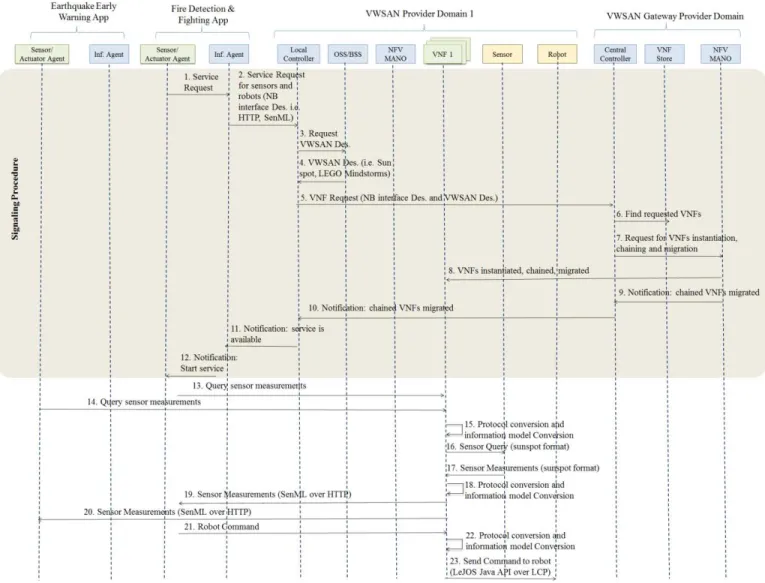
Figure 4.2 Sequence diagram for an end to end scenario ... 50
Figure 4.3 Prototype architecture ... 51
Figure 4.4 Results of service provisioning ... 54
Figure 4.5 End to end delay (virtualized gateway vs. non-virtualized gateway) ... 55
Figure 4.6 Response time for scalability... 56
Figure 5.1 The proposed business model ... 60
Figure 5.2 The proposed NFV and SDN-based distributed IoT Gateway architecture .... 61
Figure 5.3 Sequence diagram for the Gateway Deployment and Chaining ... 69
Figure 5.4 Prototype architecture ... 72
Figure 5.5 IoT Gateway orchestration plan ... 73
Figure 5.6 Gateway provisioning latency ... 75
Figure 5.7 Orchestration latency of the proposed gateway ... 76
Figure 5.8 E2E latency of the proposed gateway ... 77
Figure 6.1 Non-dominated fronts obtained at different iteration for problem size 5000 and population size 200 ... 90
xii
Figure 6.3 The effect of feasibility check on average repository updating time ... 91 Figure 6.4The time needed for the filtering function ... 92 Figure 7.1 Earthquake early warning and recovery application components ... 94 Figure 7.2 Resources usage percentage when varying 𝛼 considering 50 VNF-FG requests111 Figure 7.3 Resources usage percentage when varying the number of VNFs communicating with IoT/end-users ... 111
Figure 7.4 Total cost (a), makespan, (b) and aggregated weighted function of cost and makespan (c) for Optimal, TSCP, Greedy, and TSCP (Random Explore), together with the gap from optimality for TSCP, TSCP (Random Explore), and Greedy for 10 nodes and up to 15 VNF-FG requests with α = 0.5... 112 Figure 7.5 Total cost (a), makespan, (b) and aggregated weighted function of cost and makespan (c) for Optimal, TSCP, Greedy, and TSCP (Random Explore) for 20 nodes and 50 VNF-FG requests with α = 0.5... 113
Figure 7.6 Total cost (a), makespan, (b) and aggregated weighted function of cost and makespan (c) for optimal, TSCP, Greedy, and TSCP (Random Explore) for 10 nodes and 15 VNF-FG requests with α = 0.5, considering three scenarios: only cloud, only fog, cloud/fog system ... 114
xiii
List of Tables
Table 2.1 Architectural related work evaluation... 23
Table 2.2 Algorithmic related work evaluation ... 28
Table 3.1 Static characteristics representation using extended SenML ... 34
Table 3.2 Examples of the API operations on the publication interface ... 36
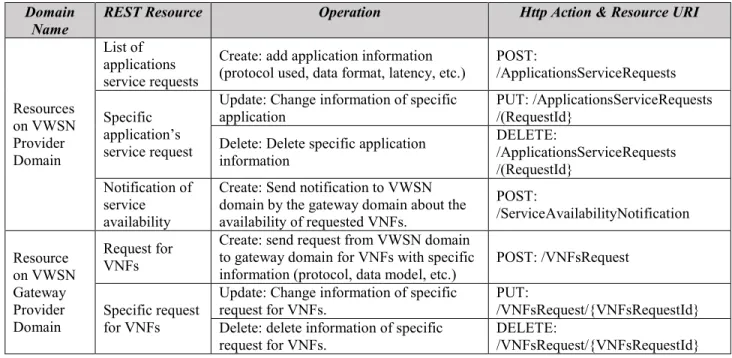
Table 4.1 Resources on the VWSAN Provider Domain and VWSAN Gateway Provider Domain ... 47
Table 5.1 Example of the API operations exposed by the Gateway Orchestrator to the VNF Agent (i.e., Int E.) ... 65
Table 5.2 Application-level flow tables ... 70
Table 5.3 Prospective chains based on application-level requirements ... 71
Table 6.1 Algorithm evaluation parameters... 87
Table 6.2 Error Ratio, Set Coverage and Spacing (10 Robots, Population size=200) ... 88
Table 6.3 Error Rate & Set Coverage (Population Size=100) ... 88
Table 6.4 Spacing (Population Size=100) ... 89
Table 7.1 Summary of key notations and decision variables ... 96
Table 7.2 The cost and the makespan estimation for 𝑆𝑖 ∈ {𝑠𝑒𝑞, 𝑝𝑎𝑟, 𝑠𝑒𝑙, 𝑙𝑜𝑜𝑝} ... 102
Table 7.3 Summary of simulation parameters ... 109
xiv
List of Acronyms
API Application Programming Interface
BS Base Station
CPU Central Processing Unit
CRASAR Center for Robot Assisted Search and Rescue
CSP Constraints Satisfaction Problem
EMS Element Management System
ETSI European Telecommunications Standards Institute
FIFO First in First out
GA Genetic Algorithm
GAE Google App Engine
GPS Global Positioning System
GUI Graphical User Interface
HTTP Hypertext Markup Language
IaaS Infrastructure as a Service
ILP Integer Programming Language
IoT Internet of Things
LAN Local Area Network
MANET Mobile Ad-hoc Network
MANO Management and Orchestration
MEC Mobile Edge Computing
MR-MT Multi-Robot Multi-Task
NAT Network Address Translation
NFV Network Functions Virtualization
NFVI Network Functions Virtualization Infrastructure NFVO Network Functions Virtualization Orchestrator NIST National Institute of Standards and Technology
NP Nondeterministic Polynomial time
xv
O&M Orchestration and Management
OCFA Optimal Coalition Formation Algorithm
OSS/BSS Operational Support System/Business Support System
PaaS Platform as a Service
PDF Probability Distribution Function
PSO Particle Swarm Optimization
PTCFA Polynomial Time Coalition Formation Algorithm QMOPSO Quantum Multi-Objective Particle Swarm Optimization
QoS Quality of Service
REST REpresentational State Transfer
RFID Radio-Frequency IDentification
RWP Random Waypoint
SaaS Software as a Service
SBC Session Border Controller
SDN Software Defined Networking
SenML Sensor Markup Language
SLA Service Level Agreement
SOA Service Oriented Architecture
SPEA Strength Pareto Evolutionary Algorithm
UAV Unmanned Aerial Vehicles
URI Uniform Resource Identifier
VIM Virtualized Infrastructure Manager
VM Virtual Machine
VNF Virtualized Network Function
VNF-FG VNF Forwarding Graph
VNFM Virtualized Network Function Manager
WAN Wide Area Network
WSAN Wireless Sensor and Actuator Network
1
Chapter 1
1.
Introduction
1.1.
Overview
Internet of Things (IoT) is considered as part of the Internet of the future. IoT enables physical objects to interact with each other to share information and to coordinate decisions. Radio-Frequency IDentification (RFID) tags, sensors, and robots are examples of IoT devices. IoT can play a remarkable role and improve the quality of our lives in various domains. Examples of IoT applications include transportation, healthcare, and large-scale natural disasters where human decision making is difficult [1].
Many large-scale disaster management applications rely on IoT, for example in fire detection and fighting, and earthquake early warning and recovery. IoT cannot stop disasters from happening but it can be very useful for disaster preparedness (e.g., prediction) and disaster recovery (e.g., search and rescue tasks). For instance, sensors can withstand a harsh environment and contribute in disaster predictions. They may be distributed throughout a forest to monitor the environmental conditions or measure earth movements before and during earthquakes. On the other hand, robots can operate in dangerous environments and handle search and rescue tasks. In such tasks, the primary goal is to find victims as quickly as possible and to rescue them with utmost care.
2
Conventional methods employ human rescuers and dogs. However, the rescue teams often cannot reach the disaster sites in time due to collapsed building and destroyed roads. Robots can move quickly and find victims more accurately than their human counterparts. They can, for instance, penetrate rubbles to find people beneath them. The use of robots for search and rescue mission was first noticed during the rescue operations at World Trade Center in New York City on September 2001, where CRASAR (Center for Robot-Assisted Search And Rescue) rescue robots were used [2]. These make IoT a potential tool for large-scale disaster management applications. Hence, a number of different sensor and robot platforms have been designed for such applications.
Network softwarization emerged as a concept that drastically changes the way the network services are designed and operated, enabling network operators to deliver network services and applications with greater agility, flexibility, and cost efficiency. It relies on key technologies, such as cloud computing, Network Functions Virtualization (NFV), and Software Defined Networking (SDN). Cloud computing is an emerging paradigm with inherent benefits such as cost efficiency, rapid elasticity, and resource pooling. NFV is an emerging paradigm to decouple the network functions from the underlying hardware. SDN enables the dynamic orchestration and chaining of VNFs to provide a flexible management of the forwarding behavior of the VNFs.
1.2.
Challenges and Thesis Contributions
Network softwarization can facilitate the provisioning of large-scale IoT-based disaster management systems by tackling several challenges. Some examples are as below:
Dynamic formation of an optimal coalition of IoT devices: search and rescue tasks of disaster management applications typically involve IoT devices (i.e., robots) in the order of thousands to accomplish a task [3]. These robots have different capabilities and characteristics, and a certain task may need a coalition of robots to perform it. Forming dynamically an optimal coalition of robots with the required number and the required set of capabilities for search and rescue tasks is very challenging. In addition, finding the appropriate robots in a single business entity is not always possible. A single business entity may not provide all the capabilities and the number of robots required to perform a search and rescue task, and there may be need to use robots belonging to several business entities. Moreover, some tasks may require that the combination of a
3
given sensor and actuator should reside on the same robots or on different robots. Furthermore, describing these robots independently from their brands, technical constraints, and infrastructure provider is not straightforward. Meeting these challenges is critical for the cost efficiency of IoT-based disaster management applications.
Heterogeneity of IoT devices: different types of IoT devices are used in such large-scale disasters. These IoT devices are usually heterogeneous, each with its own communication protocol and/or data formats. To enable interoperability across IoT devices and applications, gateways are needed to bridge the traditional communication networks and IoT devices domain. Such gateways are generally centralized and thus not practically feasible in the Mobile Ad-hoc Networks (MANET) setting of large-scale disasters where there is no centralized or fixed infrastructure. In addition, their capabilities do not scale when the number of applications and the corresponding workload of IoT devices changes dynamically. Moreover, they lack dynamicity and flexibility. For instance, when a new brand of IoT devices is added to the infrastructure the gateway needs to be upgraded on-the-fly such that it can serve the newly added IoT devices. In addition, when several applications use IoT devices with the same protocols and/or information models, the same gateway could be reused by these applications. Upgrading and reusing existing gateways is very difficult and expensive. Therefore, the IoT gateways architectures need to be rethought.
QoS of disaster management applications: disaster management applications are known to be very QoS sensitive, especially when it comes to delay. Many service providers use cloud computing to deploy their applications. However, the fundamental limitation is the connectivity between the cloud and the IoT devices. Such connectivity is set over the Internet and is not suitable for latency-sensitive applications such as disaster management applications. Furthermore, cloud-based applications are often distributed and made up of multiple components. Consequently, it is not uncommon to sometimes deploy application components separately over multiple clouds (e.g., [4] and [5]). This worsens the latency due to the overhead induced by inter-cloud communications. The location of application components has a significant impact on the overall application execution cost and makespan. Thus, there is a need for efficient algorithms for application component placement.
4
Unfortunately, the solutions proposed so far do not address all these challenges. This Ph.D. thesis proposes softwarization approaches to tackle the architectural and the algorithmic challenges related to large-scale IoT-based disaster management systems. It makes three main contributions which are presented as follows. Each of our contributions corresponds to a challenge addressed by this thesis.
1.2.1. Cloud-based System for Disaster Management Applications [6], [7]
In the first contribution, we tackle the architectural and the algorithmic challenges for cost-efficient IoT-based disaster management applications provisioning. At the architectural level, we propose a cloud-based solution that allows selecting the most efficient group of robots for the search and rescue tasks of disaster management applications. In addition, the architecture allows publishing and discovering robots belonging to different infrastructures. A well-defined language to describe robot capabilities based on existing standards is also considered. This is important when considering robots with different platforms (e.g., different capabilities, sizes, and shapes).In addition, a proof of concept prototype to validate the feasibility of the approach is also developed. The new architecture enables flexible, elastic, and cost-efficient use of robots, benefiting the cloud advantages such as virtualization and scalability.
At the algorithmic level, the goal is to ensure that the optimal coalition of robots is selected dynamically with the required capabilities for resource efficiency. In addition, location constraints regarding the capability distribution of the robots are taken into consideration. This is necessary in order to ensure proper execution of the sub-tasks belonging to the search and rescue task. Extensive simulation experiments are also conducted, and the proposed algorithm is compared with other existing algorithms. The simulation results demonstrate that the proposed algorithm cannot only improve the solution but can also significantly reduce the processing times.
1.2.2. An Architecture for IoT Gateway based on NFV and SDN [8], [9], [10]
The second contribution is an architecture for IoT gateway based on NFV and SDN. Both centralized and distributed approaches are considered. For the centralized approach, the elastic scalability of the architecture is considered, which is crucial to adapt to the accelerated growth of the number of applications using the IoT devices. The architecture relies on a simple dynamic resource allocation algorithms to meet the growing demand of applications. Existing algorithms such as [11] and [12] are used as a basis. For the distributed approach, the proposed architecture
5
considers co-locating the gateway functions with the IoT devices and reusing already deployed gateways. It also considers handling the traffic and chaining between the gateway functions dynamically. For both approaches, a high-level description of the proposed architecture that is composed of two planes is provided, and a detailed description of each plane with their corresponding interfaces and procedures is presented. The proposed architectures are implemented as a proof of concepts in order to evaluate their viability and performance level. The performances results show advantages of using on-the-fly provisioning of IoT gateways and the possibility of reusing and updating a pre-existing gateway.
1.2.3. Application Component Placement Algorithm over Hybrid Cloud/Fog NFVI [13], [14], [15]
The third contribution is an application component placement algorithm over hybrid NFVI-based cloud/fogs. Our critical review of the existing cloud/fog systems [13] shows the need for a component placement algorithm for IoT applications over hybrid cloud/fog infrastructures. Fog computing helps in meeting the QoS. We consider both stationary and mobile fog nodes. The applications are considered as sets of interacting components that can be executed in sequence, in parallel, or by using more complex constructs such as selection and loops. The mobility of fog nodes is modeled using the Random Waypoint (RWP) model [16]. Based on the stationary
distribution fog nodes’ location, the expected makespan and cost for the constructs of sequence, parallel, selection, and loop are calculated. Next, the constructs’ calculations are aggregated to
obtain the application’s makespan and execution cost. The problem is formulated as an Integer Linear Programming (ILP) problem and, regarding the complexity, Tabu Search-based heuristic is proposed to find the sub-optimal solution. The performance results show that the proposed algorithm reaches the optimality in several scenarios and reduce the execution time significantly compared to the ILP by many orders of magnitude.
1.3.
Background Information
This subsection presents the background information that is relevant to our research domain. The background information covers four topics: Internet of Things, disaster management systems, network softwarization, and fog computing.
6
1.3.1. Internet of Things
The Internet of Thing (IoT) is considered as part of the Internet of the future. It is a novel paradigm that is gaining the attention of modern wireless telecommunications. It is present around us of a variety of things or objects such as Radio-Frequency IDentification (RFID) tags, sensors, actuators, mobile phones, etc. which are able to interact with each other and cooperate with their neighbors to achieve common goals [17].
IoT concept can be realized by several enabling technologies. One example is identification, sensing, and communication technologies such as RFID tags that are characterized by a unique identifier and sensor networks composed of several nodes communicating in a wireless fashion, etc. Another example is the middleware which is a software layer positioned between the technological and the application levels. IoT middleware’s architectures proposed in the last years often follow the Service Oriented Architecture (SOA) approach. It simplifies the development of new services and the integration of legacy technologies with the new ones. It has five layers:
Applications layer on top of the architecture, it exploits the functionalities of the other layers and provides it to the end-user.
Service composition layer which provides the functionalities of the composition of different services by the objects to build specific applications.
Service management layer provides functionalities such as object discovery, status monitoring, and service configuration. It enables the remote deployment of new services during run-time to meet the application requirements.
Object abstraction which provides an abstraction of the heterogeneous objects by harmonizing the access to the different objects. This is done by offering common languages and procedures.
Trust, privacy, and security management layer which provides functionalities related to the security and the privacy of the exchanged data.
IoT can be present in a variety of fields such as domotics, assisted living, e-health, enhanced learning, automation and industrial manufacturing, logistics, business management, and large-scale disaster management - to name few. Moreover, many standardization efforts are being carried for the IoT paradigm. For instance, IETF introduced the IPV6 over Low-Power Wireless
7
Personal Area Networks (6LoW-PAN) which defines a set of protocols that can be used to integrate sensors nodes into IPV6 networks.
1.3.2. Disaster Management System
Natural disasters such as earthquakes, wildfires, flooding, etc., happen daily worldwide and represent an important factor that affects human life and development. Such disasters, manmade and natural, are a cause of great economic and human losses each year throughout the world [18]. One example is the large-scale earthquake that hit Kobe, Japan, on January 17, 1995. Measuring 6.9 magnitudes, it was the deadliest to hit Japan in 47 years, with more than 5000 dead and more than 13,000 injured. It smashed more than 103,521 buildings, leaving a large number of bodies under debris. Damage from Kobe earthquake cost around $100 billion. An important issue that needs to be solved when a disaster occurs, is to preserve human lives. In this context, the first 72 hours after the disaster hit are the most critical [19]. This means that the search and rescue operations must be completed quickly and efficiently. The IoT can be very useful for disaster preparedness (e.g., prediction) and disaster recovery, in particular, it can participate in the following three phases of disaster management [19]:
Pre-disaster preparedness: this phase is concerned with surveying-related events that precede the disaster. For instance, processing data of environmental conditions collected from different sensors, e.g., acceleration of physical objects, seismic waves, and threshold sensing, and setting up early warning systems.
Disaster assessment: this phase provides situational awareness during the disaster in real-time and completes damage studies for logistical planning. For instance, damage-assessment maps are produced in this phase that allow responders to serve areas that experienced more damage first. In addition, the affected areas are monitored through drones to detect locations of possible human being presence under the ruins
Disaster response and recovery: in this phase, the communications backbone is formed, and search and rescue strategies are implemented. These strategies are implemented according to the area size and conditions. Accordingly, whether to send first responders,rescue robots, or both to assist in recovery procedures is decided.
8
1.3.3. Network Softwarization
Traditionally, network operators deploy physical proprietary devices and equipment for each function that is part of a given service [20] hence they lack dynamicity and flexibility. In addition, it is difficult and expensive to upgrade or reuse existing functions or services. Network softwarization, in contrast, enables flexibility, adaptability, and reconfiguration of a network on the fly based on timely requirements [21]. It is the concept of designing, architecting, deploying, and managing network components, primarily based on software programmability properties. Network softwarization has shown huge potential in revolutionizing the way the network services are designed and operated enabling network services and applications with greater agility and cost efficiency. The network softwarization term was first introduced at the academic conference NetSoft 2015, the first IEEE conference on Network Softwarization. The main goal was to include a broader interest in NFV, SDN, and cloud computing.
NFV [20], by leveraging virtualization technology, offers a new way to design, deploy, and manage network service. It decouples the network functions from underlying hardware to run them as software instances (i.e., Virtual Network Functions [VNFs]) on general purpose hardware. The decoupling reduces operational expenditures by leveraging efficiencies that derive from virtualization in cloud computing such as elastic scalability, flexibility, and customization. The
9
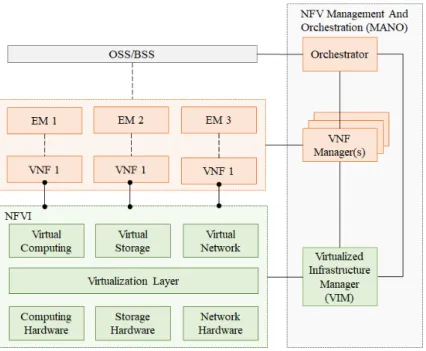
European Telecommunications Standards Institute (ETSI) has defined a reference architectural framework for NFV [22]. It is made up of a set of three main components as shown in Figure 1.1: VNFs, NFV Infrastructure (NFVI), and an NFV Management and Orchestration (MANO) framework. VNFs are the software implementation of given network functions. The NFVI provides hardware and software resources, including the computation, storage, and networking needed to deploy, manage, and execute VNFs. The NFV MANO framework enables the automated management of the VNFs by managing the NFVI and orchestrating the allocation of resources needed by the VNFs. It consists of three functional blocks: NFV Orchestrator (NFVO), VNF Manager (VNFM) and Virtualized Infrastructure Manager (VIM). The NFVO is responsible for the orchestration of the NFVI resources and the lifecycle management of the network services. The VNFM manages the lifecycle of the VNFs. The VIM is responsible for managing and controlling the NFVI. In NFV, an end-to-end network service is realized by an ordered set of VNFs that are deployed in the network and chained. This chain is called VNF Forwarding Graph (VNF-FG).
SDN [23] aims at splitting the control plane and the data plane in the network elements to provide a flexible management of the forwarding behavior of those elements. It can enable the easy on-the-fly chaining of these network functions. It also enables faster innovation, leading to
10
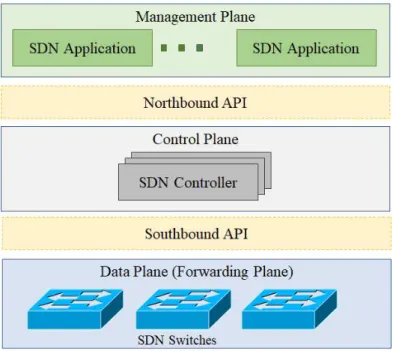
greater responsiveness and cost-effectiveness. The architecture of SDN contains three planes as shown in Figure 1.2: a management plane, a control plane, and a forwarding plane. The SDN application resides at the management plane. Its role is to communicate its requirements (e.g., the desired network behavior) to the control plane. This is done by defining a set of application policies and injecting them into the control plane. The control plane contains the SDN controller, whose responsibility is to translate the requirements of the SDN application to the forwarding plane. To that end, the SDN controller programs the forwarding plane by populating the SDN switches with well-defined flow entries (forwarding rules). The forwarding plane consists of forwarding elements such as switches and routers that allow traffic forwarding based on the flow entries that
reflect the application’s policies. SDN is highly complementary to NFV. Both are closely related
technologies and are mutually beneficial (but not dependent). By using SDN, the network routers and switches can be dynamically programmed to steer the traffic through a set of VNFs.
Cloud computing has emerged as a viable delivery model for IT resources. It leverages virtualization technology to enable on-demand network access to a shared pool of configurable resources (e.g., networks, servers, storage, applications, and services). It has brought new business models and enormous benefits to enterprises. It comes with several inherent capabilities such as scalability, on-demand resource allocation, reduced management efforts, flexible pricing model, and easy applications and services provisioning [24]. Virtualization is a key enabling technology for cloud computing, allowing the abstraction of actual physical computing resources into logical units and enabling their efficient usage by multiple independent users. Virtualization can be performed at both node- and network- levels. Robot node-level virtualization is defined as the mechanisms that enable multiple applications to reside in and run concurrently on a single robot [25]. And, robot network-level virtualization is the dynamic formation of subsets of robot nodes, with each subset dedicated to a certain application at a given time [25].
Currently, the network operators are transforming their infrastructure to NFV and SDN enabled cloud infrastructures. NFV, SDN, and cloud together are driving the softwarization of networks toward a paradigm where software controls the treatment of flows in the network and deliver customized characteristics that meet the needs of each application. This allows reinventing future network architectures and facilitates infrastructure management.
11
1.3.4. Fog Computing
Fog is an extension of cloud computing paradigm from the core to the edge of the network. It is not a completely new concept. Cyber foraging, cloudlet, and Mobile Edge Computing (MEC) were introduced before the fog to bring computing closer to end devices [13].
Fog enables computing at the edge of the network, closer to IoT devices. It also supports virtualization. Fog is tightly linked to the existence of a cloud, i.e., it cannot operate in a standalone mode. This has driven a particular attention on the interactions between the cloud and the fog [26]. Moreover, fog extends the three-tier hierarchy of cloudlet to an n-tier one, offering more flexibility to the system [27][28]. Fog also provides life-cycle management of applications distributed over the n-tier hierarchy, through the “Fog Service Orchestration Layer” [27].
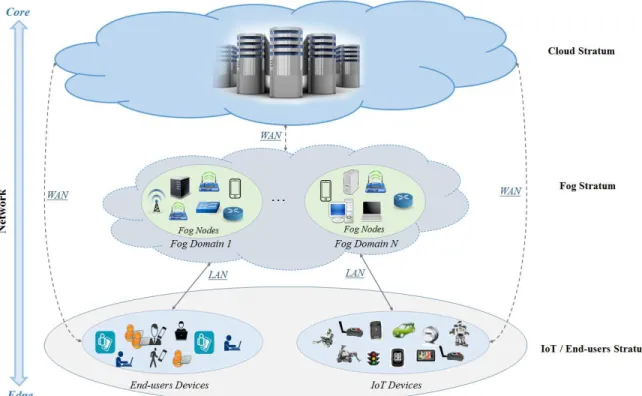
Figure 1.3 shows a fog system with a three-tier architecture. It has three strata: The cloud stratum, the fog stratum, and the IoT/end-users stratum. The fog stratum can be formed by one or more fog domains, controlled by the same or different providers. Each of these fog domains is formed by the fog nodes that can include edge routers, switches, gateways, access points, PCs, smartphones, set-top boxes, etc. The communication between the IoT devices and the fog nodes is
12
done through Local Area Network (LAN). Instead, the communication between the IoT devices and the cloud nodes requires connection over the Wide Area Network (WAN), through the fog or not.
1.4.
Thesis Outline
The rest of the thesis is organized as follows. Chapter 2 discusses the motivating scenario, requirements, and provides a critical review of the state-of-the-art. We organize the thesis into architectural contributions and algorithmic contributions. Accordingly, for the architectural contribution, Chapter 3 presents a cloud-based architecture for cost-efficient IoT-based disaster management application provisioning, Chapter 4 presents the proposed NFV-based centralized architecture for IoT gateway, and Chapter 5 presents an NFV and SDN –based distributed architecture for IoT gateway. For the algorithmic contributions, in Chapter 6 we present a coalition formation algorithm for multi-robot task allocation and in Chapter 7 we discuss the application component placement problem over hybrid cloud/fog NFVIs and present the proposed ILP model and the heuristic for that. Finally, we conclude this manuscript in Chapter 8 and provide future directions for this research work.
13
Chapter 2
2.
Related Work
In this chapter, we first present a motivating scenario. Then, we present a set of requirements derived from the scenario. Finally, we survey and review the related work in light of these requirements.
2.1.
Motivating Scenario
An earthquake early warning and recovery application can illustrate the motivation behind our work. The application is considered that consists of two phases: an early warning phase and a recovery phase. In the first phase, the application monitors the environmental conditions by collecting environmental data such as the acceleration of physical objects, wind speed, etc. In the second phase, the application monitors the affected areas and performs search and rescue tasks.
In the early warning phase, the monitoring of the disaster can be facilitated by the use of IoT devices. Data can be acquired by real-time GPS sensors, accelerometer sensors hosted in homes, business or schools [29]. In addition, the monitoring can be performed by using unmanned aerial vehicles (UAV) such as drones. Drones have several benefits such as small size, exposure to dangerous environments, and low cost of operation. Drones are usually equipped with camera
14
sensors which can capture images. The collected images are processed later to produce damage-assessment maps to allow responders to service areas that experienced more damage first.
In the recovery phase, after the disaster occurs, emergency rescue teams are created immediately, and troops are sent to assist the search and rescue operations. However, these teams have a hard time reaching the quake site because of the lack of information about the quake sites and blocked roads. To successfully complete this search and rescue operation is even beyond human capacity when the scale of a disaster is too large. IoT devices can be an alternative. Robots, for instance, have a wide range of capabilities. They could make a noticeable contribution in such large-scale scenarios. Some can be equipped with sound sensors to detect voices or other sounds of possible human presence through the ruins. They use specialized arms to sift through debris. Others carry thermal sensors to detect body heat. Some robots with hexapod legs can walk over the debris – where humans cannot – and pass a camera rod into the debris to assist in the search. With these possibilities, they outdo their human counterparts in of crisis situations on site. Moreover, drones can make finding the earthquake survivors faster and easier. They can fly and capture images to identify possible human presence under the ruins and inform rescue agencies to send first responders or rescue robots, or both in some cases.
This earthquake early warning and recovery application can be made up of several components, such as:
Early Warner and Analyzer (EW) – process data of environmental conditions such as
acceleration of the physical objects, images, seismic waves, etc., and accordingly detect prospective disaster.
Warning Alert Issuer (WA) – warns the community with smartphones of imminent hazard
(similar to Zizmos [30]), also it can be connected to television networks and broadcasting media to alert the citizens (similar to Grillo [31]).
Map Producer (MP) – processes the data relevant to the earthquake to determine the
earthquake epicenter location and direction of seismic waves and provides damage-assessment maps allowing responders to service areas that experienced more damage first.
Victim Detector (VD) – monitors the affected areas and detect locations of possible human
15
Rescue Strategies (RS) – implements rescuing strategies according to the area size and
conditions and decides whether to send first responders (First Responders (FR)), rescue robots
(Robots Dispatcher (RD)), or both (Human-Robot Team (HR)) to assist in recovery
procedures.
Historical Storage (HS) – collects historical information gathered about a particular seismic
event.
Some of these components can be very latency sensitive such as Early Warner & Analyzer and Victim Detector, while others can be computationally intensive and delay tolerant such as Historical Storage. The following interactions can happen between the different components:
1- The Early Warner & Analyzer analyses and processes the data received by different sensors
such as seismic sensors and camera sensors. For instance, it processes the images and the seismic waves automatically and identifies events of interest, such as potential disasters.
2- The Early Warner & Analyzeralsosends the selected data to Historical Storage for long-term
storage and analysis.
3- When the Early Warner & Analyzer detects a potential earthquake, it sends the information to
the Warning Alter Issuer to alert the public.
4- It also sends the information (images, seismic data) to the Map Producer to find the epicenter location and produce assessment maps.
5- The produced maps are sent to Warning Alter Issuer so the latter can send it to different departments (e.g., fire department, public transportation, etc.).
6- The produced maps are also sent to Historical Storage for further analyses.
7- The Map Producer sends the information of the earthquake to Victim Detector to find victims.
8- The Victim Detector monitors different areas to detect locations of possible human being
presence using camera sensors. When it finds victims, it sends the relevant images to the
Rescue Strategies.
9- The Rescue Strategiestake an immediate life-saving decision and start the rescue mission. It
instructs either First Responders (FR), Robots Dispatcher (RD), or Human-Robot Team
(HR) to start the rescue operations.
Different IoT platforms have been designed for such large-scale disaster applications that typically involve IoT devices in the order of thousands to accomplish a mission. These IoT devices
16
might belong to different business entities. They can be provisioned through several infrastructures owned by different business entities. Each entity hosts IoT devices with different capabilities. In addition, the earthquake early warning and recovery application may have its own constraints in terms of communication protocols, data formats, etc. and the IoT devices may use different communication protocols and data formats. Moreover, after an earthquake, there is an increasing possibility of fire. For instance, the earthquakes in San Francisco in 1906, in Northridge in 1994, in Kesennuma City in Miyagi, Japan in 2011 were followed by devastating fires that lasted for several days. In such cases, a fire detection and fighting application might consider adding new types of sensors with different capabilities, communication protocols, and/or data formats to the infrastructure. These sensors allow the application to collect temperature, humidity, and CO2 data in order to evaluate the contour and the intensity of any fire it detects and to dispatch firefighter robots accordingly.
2.2.
Requirements
According to the motivating scenario, the following requirements are derived. We categorize the requirements into architectural requirements and algorithmic requirements.
2.2.1. Architectural Requirements
In this subsection, we divide the requirements into general architectural requirements, requirements specific to the cloud-based architectures for IoT applications provisioning, and requirements specific to the IoT gateway.
A) General ArchitecturalRequirements
The following requirements are identified as general requirements on the architectures.
1) Elastic Scalability: the architecture should function well and be scalable in terms of the number of IoT devices and number of applications. Accordingly, the system should scale down and up in an elastic manner.
17
2) Extensible Architecture: the solution should take future growth into consideration; extensibility can be through adding new architectural modules such as fault management which may enhance the performance of the system, or through modification of existing modules. The extensibility can also be through the support of future scenarios and new application domains. 3) Heterogeneity: the heterogeneity should be considered in terms of IoT devices. For instance,
because of the diversity of IoT devices’ vendors, one system may contain IoT devices
belonging to different providers with each having its own interface and programming language. This means the overall solution should be applicable to a wide variety of heterogeneous IoT devices.
4) Interoperability: the proposed architecture should have an appropriate signaling and control interfaces, as well as appropriate data interfaces to enable interoperability at the level of providers and architectural modules (e.g., between the IaaS and the PaaS, between the IoT gateway and the application).
B) Requirements Specific to Cloud-based Architecture for IoT Applications Provisioning
The following requirements are considered to be important for cloud-based architecture for IoT applications provisioning.
1) Network-level Virtualization: the architecture should support network-level virtualization for the robots since we are dealing with dynamic environments. Also, some tasks that cannot be solved individually or can be solved more efficiently as a group may need collaboration between several robots.
2) Task Delegations: the architecture should be able to delegate tasks to robots that belong to other infrastructures. This is very important in some cases, such as when the capabilities or the number of the robots belonging to one infrastructure may not be sufficient for a given task which may result in incompletion of a task or completing it in a non-efficient manner.
3) Publication/Discovery: the architecture should support the possibility to publish and discover idle robots with their characteristics (static, dynamic, etc.). This should be speedy and ahead of time if possible due to the dynamic nature of tasks.
18
C) Requirements Specific to IoT Gateway
The following requirements are considered to be important for designing IoT gateways. 1) Distributed: due to the ad-hoc nature of disaster scenarios where there is no centralized or
fixed infrastructure, the gateway should be deployed in a distributed manner.
2) On-the-fly Upgradability: the gateway should be upgraded on-the-fly when new IoT devices are deployed. For instance, in case of fire, new sensors should be added to the infrastructure to send data to the fire detection and fighting application. This leads to the need to upgrade the gateway such that it can serve the newly added IoT devices.
3) Reusability: several applications should be able to use the same gateway. This may be required when, for instance, the sensors used by the fire detection and fighting application use the same protocol as the sensors used by the earthquake early warning and recovery application.
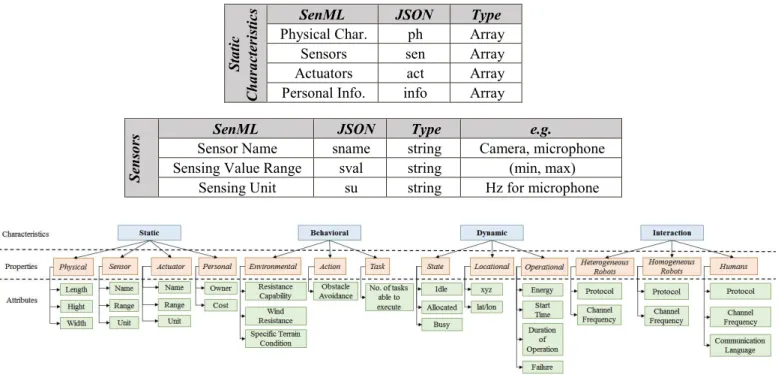
Standard Northbound and Proprietary Southbound Interface: the gateway should support standard northbound and proprietary southbound interfaces. For the standard northbound interface, an example could be the widely used Sensor Markup Language (SenML) [32] carried over HTTP. It is designed to encode sensor measurements and device parameters, and its extension could be used as a standard interface for robots. For instance, in [33], SenML is extended as a unified robots description model while in [34] SenML capabilities is extended to provide a uniform representation of sensors and robots and to control robots. On the other hand, having a proprietary southbound interface is necessary since devices can be vendor lock-in or because standard interfaces do not support the device’s functionality.
4) Provide Key Gateway Functionalities: the architecture should provide at least some key gateway functions, such as protocol conversion, information model conversion, data aggregation, and metadata adaptation.
5) Performance: the architecture must ensure that the execution of gateway modules achieves performance similar to when they are executed in a traditional gateway. In particular, the performance metrics thatrequire significant attention are latency and overhead.
2.2.2. Algorithmic Requirements
For the algorithmic requirements, we consider that a given system will meet a given requirement if the algorithm either has the requirement as the main objective or the requirement is part of the set of constraints the algorithm should satisfy. Or, if the requirement is factored in the
19
models and operations of the algorithms. We further discuss these aspects as we present each requirement.
A) General Algorithmic Requirements
The following requirements are identified as general requirements on the algorithms.
1) Heterogeneity: the heterogeneity should be taken into account in terms of IoT devices, fog nodes, and cloud nodes. Algorithms need to take this heterogeneity into account. The limitations of specific nodes need to be factored in the models and operations of the algorithms. 2) QoS: meeting the QoS requirements, such as delay, jitter, and throughput, is critical in disaster
management systems. This thesis focuses on the delay requirements of disaster management applications. The algorithms should be able to minimize the time needed to perform the search and rescue tasks of disaster management applications and the total application execution time. 3) Cost: the algorithm should be able to minimize the cost which is a budget for resources
consumption, including robot deployment cost, application component deployment cost, cloud/fog nodes cost, and bandwidth cost.
B) Requirements Specific to Coalition Formation of Robots
We defined the following requirements for coalition formation algorithms for robots.
1) Resource Optimization: the algorithm should be able to minimize the number of robots in a coalition performing a search and rescue task/sub-tasks in order to make robots available for other tasks/sub-tasks of the disaster management application.
2) Capability Distribution of Robots: some tasks can be tied by locational constraints regarding the capability distribution of the robots, while others may be executed without any locational constraints. For instance, a combination of sensors and actuators should reside on the same robot, or on different robots. The algorithm should ensure this in order for the proper execution of the search and rescue tasks/sub-tasks.
C) Requirements Specific to Application Component Placement over Hybrid Cloud/Fog
The following requirements are considered to be important for designing efficient application component placement algorithms. They should be factored in the model and operations of the algorithm.
20
1) Non-deterministic Applications Graphs: the algorithm should consider non-deterministic application graphs, with sub-structures as selections and loops, when making the placement decision.
2) Mobility: fog nodes can be mobile. Accordingly, the algorithm should be able to handle this mobility. An efficient algorithm should consider such mobility during the placement decision to avoid high cost or a long makespan as a result of assuming stationary nodes with predefined locations.
2.3.
Related Work
In this section, first, the architectural related works are reviewed, then the algorithmic related works are reviewed.
2.3.1. Architectural Related Works
This subsection first, presents the related work for cloud-based architectures for IoT applications provisioning, and then, review the architectures for IoT gateways.
A) Cloud-based Architectures for IoT Applications Provisioning
We review the related work in this subsection of two areas. First, we discuss the use of robots in large-scale disasters. Second, we review architectures for robotic applications in the clouds.
1) Robots in Large-Scale Disasters
Kitano et al. [3] present a detailed analysis of search and rescue domains in large-scale disasters. They identify several research issues in search and rescue strategy, such as real-time planning and multi-agent planning, which may involve over 10,000 agents including humans and robots. As their main focus, they analyze the large-scale search and rescue domain and introduce the RoboCup-Rescue Simulation project. Among others who approach this topic, Messina et al. [35] propose a robot ontology for search and rescue domains. Chatterjee et al. [36] identify the needs for and benefits of developing a standard description and ontologies for rescue robot features and disaster scenarios. However, ontologies add overhead in developing and maintaining new components.
21 2) Robotic Applications in Cloud
In [25], the authors propose an architecture for robotic applications as cloud computing services. The proposed architecture provides support for heterogeneous robots and delegates tasks to robots belonging to other IaaSs. However, it does not perform network-level virtualization; neither does it consider large-scale disaster applications. Chen et al. in [37] propose an architecture
that decouples robots’ sensing and actuating capabilities to offer them as SOAP-based services. However, they provide a solution for one robot they designed; yet, supporting heterogeneous robots is not addressed. Du et al. [38] have improved the architecture presented in [37] by adding support for network-level virtualization. However, a mechanism to delegate tasks to robots belonging to other clouds is another important characteristic to take into account. Turnbull et al. [39] propose a cloud infrastructure for robots. Their robotic cloud receives images from a vision acquisition and performs some computation, and finally implements an algorithm to control the robot behavior. However, they do not consider heterogeneous robots as their solution applies only to one type of robot hardware (i.e., iRobot). In [40], Liu et al. present a cloud-enabled robotics system where robots offload their computationally intensive tasks to the cloud. Robot Operating System (ROS), a robotic middleware to develop robot software, is used as the robot platform. However, the authors do not discuss how to discover and publish robots.
In [41], the authors propose a Robot as-a-Service platform that provides easy access to heterogeneous robots. The proposed design consists of an OCCI extension that models cloud robotics as-a-Service. It also includes a gateway for hosting mobile robot resources. The proposed platform allows users to have a unified view of all robots. However, architectural modules that perform network-level virtualization are not discussed. Mohanarajah et al. in [42], the authors propose Rapyuta, an open source PaaS framework for robotic applications. Rapyuta computing environment allows robots to easily access the RobotEarth knowledge repository. The latter enables robots to benefit from the experience of other robots. Rapyuta allows robots to offload heavy computation to the cloud. It dynamically provides secure computing environments for the robots. These computing environments are tightly interconnected, allowing robots to share their services and information with other robots. However, creating teams of robots or coalitions is not discussed.
22
B) Architectures for IoT Gateway
In this subsection, we review the state-of-the-art for both traditional architectures for IoT gateways and NFV/SDN-based architectures.
1) Traditional Architectures for IoT Gateways
Several works have proposed IoT gateway architecture. Some designed their architecture without considering the use of NFV/SDN technology. For instance, Datta et al. [43] propose a smart M2M gateway architecture to manage the huge volume of M2M devices and endpoints. They extended the capabilities of CoRE Link to add additional resource types for SenML units. In [44], an architecture for an in-home IoT gateway is proposed. It consists of three subsystems: sensor node, gateway, and application platform. The architecture does not support standard or proprietary interfaces. A configurable, multifunctional and cost-effective architecture for smart IoT gateways is proposed in [45]. It is extensible since modules with different communication protocols can be plugged into the architecture. It also provides protocol conversion by granting a common frame structure for data communication. However, scalability in terms of the number of applications is not discussed. In addition, these gateways cannot be upgraded on-the-fly when introducing new types of IoT devices or new applications.
2) NFV and/or SDN-based IoT Gateway Architectures
Other works have investigated using NFV and/or SDN technology when designing IoT gateways. For instance, Li et al. [46] propose an IoT architecture based on SDN. Their proposed gateway allows introducing new applications through open programmable interfaces. It supports standard data formats using JSON and provides protocol conversion functionality as one of the gateway’s key functionalities. However, the proposed gateway cannot be deployed over a MANET, as it does not have a distributed nature. In addition, it does not enable the same gateway to be used by more than one application. Ojo et al. [47] propose an SDN-IoT architecture coupled with NFV. Their goal is to address the scalability and the mobility issues in IoT networks. They replace traditional gateways with SDN gateways and implement the functionalities of the gateways as VNFs. The VNFs are SDN-enabled. This work supports heterogeneous IoT devices and provides key gateway functions. Also, the programmability feature of SDN allows the gateway to be updated dynamically. However, a drawback of is that the proposed architecture cannot be deployed over ad-hoc networks since it does not have a distributed architecture.
23
Table 2.1 Architectural related work evaluation
Salman et al. [48] propose a global IoT architecture leveraged with SDN. The proposed architecture inherits management and programmability capabilities from SDN and mobility capabilities from the fog. The gateways in the proposed architecture are SDF gateways that ensure interoperability between different communication protocols and heterogeneous networks, thereby providing key gateway functions. Their architecture also supports a standard northbound interface i.e., REST, and its programmability feature allows dynamically updating the gateway. However, the SDF-gateway does not have a distributed architecture, and so it cannot be deployed over an IoT MANET. Requirements Related Works Architectural Requirements General Architectural Requirements Requirements for Cloud-based Architectures Requirements for IoT Gateway Ela stic S ca la b il ity Ex te n sib il it y H ete ro g en eity Inter o p er a b il it y Ne two rk -lev el Vir tu a li za ti o n Ta sk De leg a ti o n Pu b li ca ti o n /Disc o v er y Distr ib u te d Upg ra d a b il it y Re u sa b il ity S ta n d a rd NB a n d Pro p rieta ry S B Inter fa ce s K ey G a te wa y Fu n ctio n a li ties Per fo rm a n ce Clo u d -b a se d Ar ch itec tu re fo r Io T App li ca ti o n s Mouradian et al.[25] x ✓ ✓ ✓ x ✓ x Chen et al. [37] x ✓ x ✓ x x ✓ Du et al.[38] x ✓ ✓ ✓ ✓ x ✓ Turnbull et al.[39] x x x x x x x Liu et al.[40] x ✓ x ✓ x x x Merle et al.[41] x ✓ ✓ ✓ x x x Mohanarajah et al.[42] x ✓ ✓ ✓ x x ✓ Ar ch itec tu re s fo r Io T G a te wa y Tr a d iti o n a l Io T G a te wa y
s Datta et al.[43] x ✓ ✓ ✓ x x x ✓ ✓ N/A
Zhu et al.[44] x ✓ ✓ x x x x x ✓ N/A
Guoqiang et al.[45] x ✓ ✓ x x x x x ✓ N/A
NFV a n d /o r S DN -b a se d Io T G a te wa y s Li et al.[46] x ✓ ✓ ✓ x ✓ x ✓ ✓ x Ojo et al.[47] ✓ ✓ ✓ x x ✓ x ✓ ✓ x Salman et al.[48] x ✓ ✓ x x ✓ x ✓ ✓ x
24
2.3.2. Algorithmic Related Works
This subsection first, presents the related work for coalition formation algorithms for robots and then, review the algorithms proposed for application components placement over hybrid cloud/fog NFVIs.
A) Coalition Formation Algorithms for Robots
Liu and Chen [49] propose an algorithm based on Genetic Algorithm (GA) to form the best coalition of robots. Authors in [50] propose a modified version of Shehory and Kraus’s algorithm. The major drawback of these works is that they optimize only one objective that is the overall utility and the coalition value respectively. However, there are other important objectives that need to be optimized, such as the time needed by robots to perform a given task. Agarwal et al. [51] propose an algorithm to form coalitions of robots for a set of tasks. The proposed algorithm tries to maximize the number of tasks completed and the system efficiency. Two multi-objective evolutionary optimization algorithms are introduced to solve this problem: A Non-Dominated Sorting Genetic Algorithm (NSGA-II) and a Strength Pareto Evolutionary Algorithm (SPEA-II). Unfortunately, factors such as the minimizing the number of robots in a coalition is not considered. Service et al. [52] propose a simultaneous descending auction-based approach to the task allocation that allows task preemption and does not exhibit any unnecessary task reassignment. However, their proposed algorithm does not take the capability distribution of the robots into consideration.
In [53], authors assign Unmanned Aerial Vehicles (UAVs) to search and prosecute missions. Their objective is to minimize the coalition size and accomplish the tasks in minimum time. However, the cost of UAV deployment is not considered. In [54], authors propose an ant-colony based algorithm. They consider fix number of robots for each task. However, it is not efficient to fix the number of robots required for each task since robots have different capabilities and different capability distribution. Authors in [55], propose an algorithm based on dynamic ANT coalition technique. Minimizing the number of robots in a coalition is not considered. In [56], Rauniyar and Muhuri modify the standard GA. They proposed an adaptive Random Immigrants Genetic Algorithm (aRIGA) and adaptive Elitism-based Immigrants Genetic Algorithm (aEIGA). However, they do not consider minimizing the time needed to perform a task.
25
B) Application Component Placement over Hybrid Cloud/Fog NFVI
In this subsection, we review the relevant literature on application component placement over hybrid cloud/fog NFVIs. In the first subsection, we review the proposed solutions for application component placement in hybrid cloud/fog systems where these components are not placed as VNFs. We then review the works to date on VNF-FG embedding that do not focus on hybrid cloud/fog systems. To the best of our knowledge, our works (i.e., [14] and [15]) are the only one that investigates the placement of application components as VNFs in hybrid cloud/fog NFVIs.
1) Application Component Placement in Hybrid Cloud/Fog Systems
Most of the proposed solutions for application component placement over hybrid cloud/fog systems consider stationary fog nodes, such as IP video cameras, access points, roadside units, etc. Few works have considered the mobility of fog nodes, such as their being located in a moving vehicle. In this subsection, we first review the proposed solutions that consider stationary fog nodes, and then we describe the proposed mechanisms that consider the mobility of the fog nodes.
a. Application Component Placement Considering Stationary Fog Nodes
Several different objectives have been considered in the literature for application component placement over cloud/fog infrastructures. Mahmud et al. [57] consider placing application