World Deveopw_t Rqpow Office rI the Vice Prosident Development Economics
The World Bank August 1988
WPS 36
Background Paper for the 1988 World Development Report
Social Security Finance in
Developing Countries
Douglas J. Puffert
Social security systems in developing countries can provide a pool of investment capital to spur economic growth. But many systems now showing surpluses may become insolvent because of poor management.
Tho Pdicy. Planng, and Reearch Conplex distnbutca PPR We irg Papspe todisminate the findinsg of wak in proges and to encounge the exhange of ideas among Bank staff and all othem inteted in development ies. These papeas cay the name o the authors. rclect only their views, and should be used and cited accordingly. The indings. interpetations, ad concluhions seethe autor own. Tey rhould not be attribuLed to the Wodd Bank. its Board of Dimsctor its managemnat, or any f iimmanber ecntie.
Public Disclosure Authorized
Public Disclosure Authorized
Public Disclosure Authorized
World Devehopnwnt Report
Social security systems usually cover less than the risk of the social security system's 10 percent of the population of developing coun- insolvency.
tries. Yet in a number of countries, these
systems make up a large proportion of public Governments facing fiscal difficulties find it sector revenues and expenditures. tempting to expand the money supply and drive
up inflation. This cuts government obligations Most social security systems in developing to social security reserve funds by reducing the nations are nnning substantial surpluses. If the real value of the investments in government systems are to meet future obligations, reserve bonds.
funds and surpluses should be invested in safe
assets with real positive rates of retum. There is also conrsant pressure for many govenmments to increase benefits without
But many countries lack well-developed increasing contributions. Although such actioi financial markets and good domestic opportuni- is expeaient, it often proves unsustainable. A ties for productive investment. The government govenmment's ability to resist such pressure thus usually controls social sec'nrity systems - and has a direct bearing on the long-term success of
often uses the surpluses to finance government the system. deficits.
One system that stands out as sound, with Economists are divided over how social wisely invested reserves, is the regulated private security systems affect pri-,ate saving and capital social security system in Chile.
accumulation, which leads to long-term growth.
They also disagree on the inefficiencies which This is a background paper for the 1988 social security systems introduce into labor mar- World Development ReporL Copies are
avail-kets. able free from the World Bank, 1818 H Street
NW, Washington, DC 20433. Please contact It is clear, however, that investing social Rhoda Blade-Charest, room S13-060, extension security funds in government securities increases 33754.
The PPR Working Paper Series disseminates the findings of work under way in the Bank's Policy, Planning, and Research Complex. An objective of the series is to get these fmdings out quickly, even if presentations aie less than fully polished. The findings, interpretations, and conclusions in these papers do not necessarily represent official policy of the Bank.
by
Douglas J. Puffert
1.Introduction ... . ... 1
Origin and Spread of Social Security ... 3
Types of Benefits ... . ... * 4
Principles of Benefits and Finance ... 4
Reserve Funds, Generosity of Benefits, and Long-run Financial Solvency ... . ... 7
2.Benefits and Finance in a Sample of Countries ... 9
Types, Principles, and Level of Benefits ... 9
Extent of Coverage in the Populat ion ... 12
The Financial Size of Social Security Systems ... 14
Sources of Revenue for Social Security Systems ... 16
Relative Size of Benefit Programs ... 17
3.The Consequence of Social Security Systems for Public-Sector Finance ... . ... 19
4.The Consequences of Social Security Systems for Economic Growth ... 24
5.Conclusions ... .... . 28
Notes ... . ... 30
References ... .. . .... 36
1. Introdudtion
Most developing covntries have social
security
systems
-publicly administered sets of programs which provide for people
in the event of lose of income (due to retirement, disability,
death of a breadwinner, illness, maternity, work-related injury,
or unemployment) and often in the event of need for medical care
or the expense of raising children. Usually - but not always
-the programs are not as extensive as programs in industrial
countries. They usually cover only a small part of the popula-tion (often well under ten percent) and benefits are typically
less generous than those in the industrial countries.
Still, social security systems make up a large proportion of
public sector revenues and expenditures .in a number of developing
countries. This fact may be hidden, for in most countries,
systems are managed by autonomous public bodies whose financial
flows are only partially reported in central government
statis-tics. Social security systems have major implications for public
finance for two further reasons. First, systems in most
developing countries have growing reserve funds which finance
much of their governments' deficits and also, sometimes, provide
a pool of investment capital which furthers economic
develop-ment. Second, social security systems pose special financial
dangers for central governments. Unless systems are managed
effectively with a view to covering future liabilities, they can
require majbr allocations of central-government revenues.
This paper presents a survey of the financial nature of
social security systems in developing countries and their
implications for public-sector finance as a whole and for the
process of economic development. It gives only brief
considera-tion to the needs which give rise to social security systems and
the adequacy of various countries' systems for meeting these
needs, 1 It also passes over various issues in the
administra-tion of social security: for example, the great multiplicity of
programs and occasional failure to collect taxes, keep proper
records, or distribute earned benefits in some La'in American
countries (Mesa-Lago, 1986).
The remainder of this chapter will discuss wiL. social
security is and in what various ways it is implemented in
developing countries. Chapter 2 will consider in more detail the
specific provisions and financing of social security programs in
a sample of 41 developing countries. Chapter 3 will discuss the
implications, including potential dangers, of social security
systems for public-sector finance generally, aad Chapter 4 will
consider the effects of social security systems on capital and
labor markets, and thus on the process of economic development.
A final chapter will sum up the implications of this analysis for
public policy in developing countries and for the research agenda
Origin and4pread of social security
The need for social security is often seen to arise in the transition from a traditional social and economic order to a modern urban society and industzial economy. The loosening of family, kinship, and community ties and the rise of wage labor add new elements to the age-old problem of providing for those who lack an income or have medical needs. Central governments have assumed responsibility for making this provision. 2
To be sure, government has long (if not generally) been involved in providing for the poor. Modern social security, however, dates from the late nineteenth century when Germany and Denmark instituted public pension schemes for the greater part of their working populations. As Table 1.1 suggests, most European
countries, as well as some of the more industrialized countries
of North and South America, adopted pension schemes and other
social security programs in the early decades of this century. Most remaining countries (and most colonial administrations)
instituted various programs in the twenty years follow'ng the Second World War. Most of the world's smaller countries (i.e., those with populations below one million), however, have adopted
such programs only since 1965.
We note in Table 1.2 that countries with higher incomes now, which for the most part have had substantial modern economic
sectors for a longer time, tend to have adopted social security programs earlier. Still, as of 1985 at least 24 out of 37
work-related injury and provide pensions for those retired due to age or disability and, usually, for dependent survivors.
Types of Benefits
Tables 1.1 and 1.2 also show the typical progressive institution of programs for different types of benefits.
Usually, work-injury benefits (earnings replacement and medical expense) are the first provision to be instituted. 3 After pensions for old age, disability, and death of a family's bread-winner, the most common benefits are replacement of
earnings (cash benefits) in the event of sickness and maternity, and medical care (provided directly) or else (rarely)
hospital-ization insurance. 4 Family allowances - benefits for raising
children - are quite common in the industrial countries,
middle-income European countries, countries in Africa which have a French colonial heritage, and much of South (but not Central) America. Partial replacement of earnings during periods of
involuntary unemployment is universal in the industrial market countries but not common in developing countries.
Principles of Benefits and Finance
Social security programs are intended to provide adequately for their beneficiaries, whether this adequacy is viewed as partial replacement of previous earnings or as providing a minimum or
standard level of benefit to all. Usually a pragmatic balance is reached between a concept of social equity, which involves
redistribution from those better off to those worse off, 5 and individual equity, which involves providing people wit benefits equal in (expected, discounted) value to their contributions or taxes. In nearly all cases both workers and their employers are
deemed responsible to c ribute to the funding of social
security benefits throug.. 'axes on wage or sa-ary earnings.
Additional funding may come from general state revenues or ear-ma;ked taxes.
Five alternative principles are commonly employed for deter-mining levels of social security benefits and financing them. The panels in Table 2 show the application of these principles in
countries with different levels of income per capita.
The principle most often applies is that of social insur-ance. Social insurance schemes are funded principally by the earnings-related contributions of workers and/or their
employ-ers. 6 Earnings-replacing benefits under social insurance vary
positively with a covered worker's earnings.
Universal benefits are of uniform amount and apply to all residents who experience a given contingency. Some pension schemes (chiefly in the industrial countries) combine a uniform benefit with an earnings-related component. Medical care,
hospitalization insurance, and family allowances are generally provided on a universal basis; Table 2 (and Table 3 below)
reports these benefits as "social insurance," however, in cases where such schemes are financed from employer and worker
A third principle, social assistance or means-testing,
directs benefits specifically to those in greatest apparent
need. It is applied either alone or in conjunction with other
principles, but it is now rarely used.
Employer liability, which is often applied in conjunction
with mandatory private insurance, is used by some countries to
accomplish the goals of social security without involving the
public sector in its provision. Table 2 gives counts for these
programs but does not include them in totals for social security
programs. 7
Finally, provident funds collect contributions from workers
and employers into personal accounts from which workers (or their
survivors) can draw in the events of old age, disability, death,
and in scme cases .ther contingencies. Benefits are paid as lump
sums in the amount of accumulated contributions plus interest.
They are, effectively, forced savings schemes. Some provident
funds originated as regulated private schemes in British colonies
which were nationalized and expanded after independence. Others
were instituted as public schemes from the outset. In a few
cases provident funds have been converted into social insurance
schemes. Provident funds are sometimes favored for their
administative simplicity and for their accumulation of sizeable
reserves which may be applied to capital accumulation or the
Reserve funds, generosity of benefits, and long-run financial solvency
Provident funds, by definition, maintain reserve funds equal in value to their liabilities for future benefit payments, and they return to their participants an amount equal in expected present value to their (and their employers') contributions. Early social-insurance pension schemes, both in Europe and in Latin America, also had these characteristics; thus they operated on the same principles as the private insurance which had often previously been offered by mutual-aid societies and similar
institutions - except that coverage was made mandatory and
extended to larger groups of workers.
Naturally, it was realized that by drawing down the reserve funds benefits can, for.a time, be raised above levels that
simply provide a fair return on contributions. Thus all the early social insurance pension schemes moved towards the princi-ple of "pay-as-you-go" financing, under which current
contribu-tions pay for current benefits. 8 9 Some of these systems, both
in Europe and in Latin America, have required special ear-marked taxes or special allocations from general revenues to remain
solvent.
The younger social-security pension schemes in developing countries have had much less in the way of previous private
systems to build upon. For the most part they never intended to
maintain full-funding - today only Kuwait's scheme, Chile's new
fully-funded - but they do operate on the basis of partial-reserve
financing, with a view to "asuring solvency over a horizon of a
few decades into the future. Many of them, in fact, are accumu-lating substantial surpluses (sometimes over half their revenues) into reserve funds. This accumulation is largely for the reason
that the pension schemes h4ve not yet "matured" - they do not yet
have a full complement of pensioners eligible for full benefits.
Chapter 3 considers at greater length the financial
diffi-cuVies of some Latin American schemes and the prospect or the
continued financial solvency of the younger schemes in developing
2. Den*fitv and rinance in a sample of Countries
We now turn from these general consideratiens to an examina-tion of the structure of social security in a sample of 41
developing countries drawn from every major region of the world. Our sample also considers three industrial market countries (not especially typical) in order to enable some comparison with them.
Types, Principles, and Level of Benefits
Table 3 presents the range of benefits provided by the social security systems in our sample, the principles by wh'ch these benefits are financed, and a partial account of how
retirement pensions are determined. Within each regional section countries are ordered from the lowest per-capita income to the highest. As in Tables 1 and 2 above, we note that the fullest
range of benefits are provided in Latin America and in Europe,
the Middle East, and North Africa. Soe-ial insurance is the most
common principle of provision, provident funds are common in Sub-saharan Africa and Asia (nearly always in former British colonies), and employer liability is occasionally invoked
(especially in Africa) for cash sickness and maternity benefits, some medical care, unemployment (severance) benefits, and most often for work-injury insurance. China, notably, charges its collectives and other employers with responsibility for the full range of benefits provided 1 (Wallich 1986). Several countries have programs which operate under a combination of principles,
adding soctal assistance, universal benefits, or employer
liability to social insurance or provident funds.
Since 1981 Chile has largely privatized its social security system. Previously the country (like many Latin American nations
still) had a number of social insurance systems covering
differ-ent sets of workers. Those systems (now partially unified) are
still in effect for reptrees a.sd the 40 percent of the active
labor.force who have not switched to the new system. Several private commpanies have been organized to operate under state supervision, providing pensions, on a fully-funded basis, as well as cash sickness and maternity benefits and medical insurance
(Lacey 1987).
Under the heading "medical care" we note, by the letter "M", countries in which a public medical system operates separately from the social security system. Possibly not all such systems are noted, however.
Another substantial omission is that of the ccmmon, but non-legislated, provision of private pensions and private insurance, often through employers, in several countries. This practice is much more common, however, in the industrial market countries -most notably in the United States.
The last three columns of Table 3 present a very summary account of who is eligible for old-age pensions and how substan-tial are the benefits provided. The normal retirement age is the age at which covered workers (sometimes with exceptions for
full benefit.. In many cases reduced benefits are available at a lower age, and sometimes higher benefits are given to those who delay retirement until after the normal age. We see in the table that normal retirement ages are 60 to 65 for men, and usually lower for women, in most of the industrial market countries,
Latin America, and Europe, the Middle East, and North Africa. In Sub-saharan Africa and Asia, which for the most part have lower life expectancies, normal retirement ages are usually 55 or 60 for men and sometimes lower for women. Most provident funds
permit withdrawal from one's account at age 55, often without any requirement for actual retirement. Under social insurance
programs rules for actual retirement vary widely.
Levels of benefits nearly always depend on both the number
of years of contributions and the level on one's earnings (or of
one's contributions) over either the last several years of one's working life or else all of one's covered working life. The
rules which govern benefits are often quite complex, so that the figures in the last two columns of Table 3 are hardly complete in the information they convey. In most cases the specified number of years of required contributions makes one eligible for the minimum specified earnings replacement rate, while additional years of contributions makes one eligible for a higher replace-ment rate. Sometimes, however, higher raplacereplace-ment rates are for those with lower average earnings (i.e., the benefit formula is progressive). Often the legislated formulae for levels of
in the table indicates that benefits vary with total contribu-tions or covered earnings. "B" in this column designates that there is a "base" Ievel of benefits to which are added benefits which vary with contributions or earnings. Provident funds,
indicated by "PI', pay a lump-sum benefit in the amount of
accumulated contributions plus interest.
We see that, for the most part, pension benefits replace between one third and four fifths of one's pre-retirement
earnings - with benefits closer to-the higher figure for long
periods of coverage. There is little general difference in replacement rates among regions, or for that matter between countries of different income levels within a region.
Extent of Coverage in the Population
In most of the developing world social security applies
mainly to urban wage labor - usually a small part of the
popula-tion. Only in the middle-income countries of Europe, in several countries in Latin America, and in a few other countries such as Israel, Mauritius, and Singapore is the majority of the labor force and population covered. In most other countries it seems likely, based on categories of covered workers, that less than ten percent of the population is covered. As Mesa-Lago (1986) notes for the Latin American countries, "In general the extension of risk coverage has been much faster than that of population coverage.... [O]ften a minority of the population is covered against all risks, but the majority is not protected against any
risks at alj.,* 2
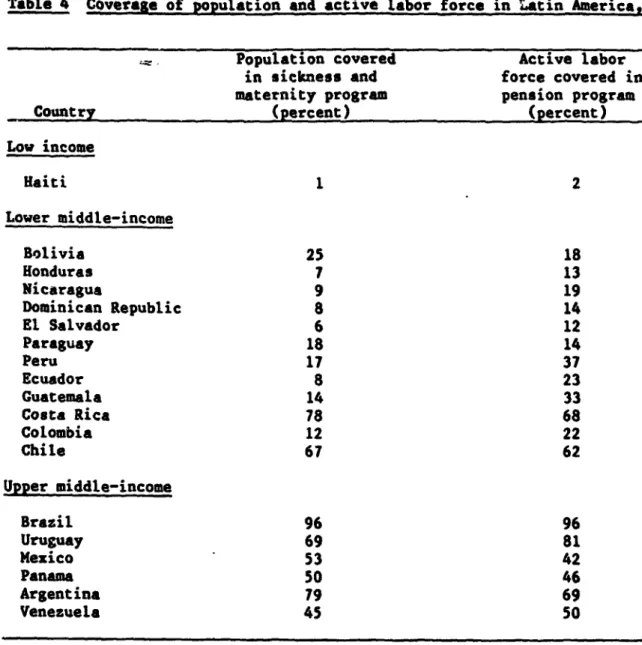
Table 4 presents the results of Mesa-Lago's (1986) study of social security coverage in Latin America. 3 For the most part extent of coverage varies directly with per-capita income, although the countries of northern South America and Central America have lower coverage than countries of comparable income further south. Several higher-income countries provide more extensive coverage for sickness and maternity benefits than for pensions. Among the lower-income countries sickness and
maternity benefits are available less widely than pensions. Unfortunately there are (apparently) no comparable studies for other developing countries. Brief, sometimes imprecise
descriptions of the covered population are, however, provided in the United States Social Security Administration's biennial
report Social Security Programs Throughout the World. These descriptions make it clear that there are substantial restric-tions even on the extent of coverage of urban wage labor in
(among our sample of developing countries) Ghana, Nigeria, India, Pakistan, Indonesia, Thailand, Korea, and Singapore. 4 In these cases only larger employers or a limited range of industries are covered. In many other of our sample countries, social security does not apply to domestic workers or casual workers. Family
workers - usually a substantial portion of urban (as well as
rural) workers - are seldom covered. The urban self-employed are
covered in Egypt, Cyprus, Israel, Portugal, and Yugoslavia; they are also covered voluntarily or in a limited range of occupations
in Mauritius, Hungary, China, Indonesia, the Philippines, and Singapore. It is often not clear in these descriptions to what extent rural employees or the rural self-employed are covered. There is certainly coverage for at least some rural workers in Zambia, Cameroon, Morocco, Israel, Hungary, Portugal, Yugoslavia, Sri Lanka, and China. 5
Mesa-Lago (1986) points out that in Latin America, "coverage tendr to be positively correlated with income, the degree of
skill at work and the power of pressure groups." Similarly, in the rest of the developing world it is the urban elites who
receive the most protection under social security while needier groups are not covered. 6 This becomes a matter of particular
concern to the extent that social security is paid for out of general revenues or will later become a burden upon the central
government. In these cases - arguably rare outside of Latin
America - socal security systems may constitute a mechanism for a
perverse redistribution from the worse- to the better-off.
The financial size of social security systems
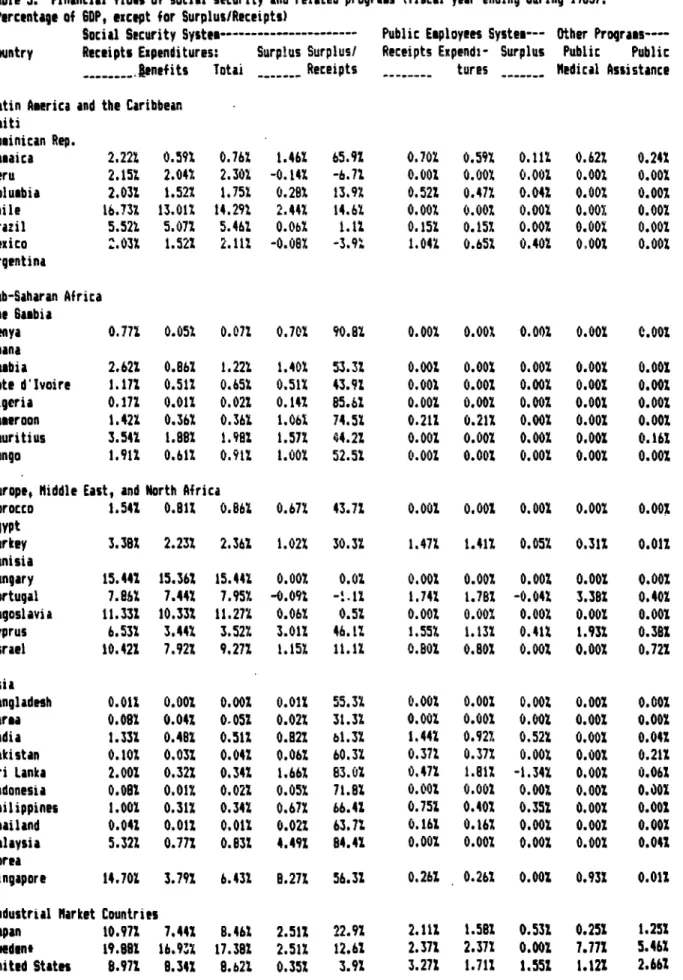
While it is difficult to determine the extent of social security coverage in the population, information on financial flows is accessible for most countries. Tables 5 through 8
present information collected by the International Labour Office for its triennial survey, Cost of Social Security. 7 Table 5, in particular, presents the size of social security finances
Product. 8-_
The table presents information not only on social security
programs for the public as a whole but also on programs which
apply only to public employees and programs apart form social security which provide public health care and public (or social) assistance. These programs fall under the International Labour Office's definition of social security programs, and they may be categprized as social security in government financial
statis-ti-.s, but they are not considered in the present paper apart from
this table. 9 We note that systems for public employees are
sometimes larger than broader social security programs. Where no flows are reported for public-employee systems, it is either the case that public employees are covered only under the general system or that the finances for such systems are not reported to the I.L.O.
As we focus on the first four columns of Table 5 we see that social security systems involve the largest share of an economy's product in Chile, 10 the higher-income European and
Middle-Eastern countries, Singapore, and the industrial market countries. Social security involves a very small portion of the
economy - less than 0.2 percent - in Nigeria, Bangladesh, Burma,
Pakistan, Indonesia, and Thailand. Other figures for receipts and expenditures vary widely, with some tendency for richer
countries to distribute a larger portion of their product through the social security system.
sample - Peru, Mexico, and Portugal - have deficits, of about seven percent, four percent, and one percent of revenue respec-tively. A substantial number of countries, especially in Asia
and Sub-saharan Africa, have high surpluses - often more than 50
percent of revenues. 11
Sources of Revenue for Social Security Systems
Table 7 presents information on sources of revenue for social security systems. In the first two columns it lists the sta&utory contribution rates which are applied to workers' wage and balary earnings (or, from employers' point of view, to
payroll). The remaining columns present the percentage of total revenues supplied by contributions, special taxes and general state revenues, income from investment of reserve funds, and miscellaneous sources.
In nearly half of the countries sampled, contribution rates for insured workers and their employers total between 10 and 20 percent. Most of the remaining countries have contribution rates between 20 and 30 percent. Argentina and Portugal have combined rates well in excess of 30 percent, while Singapore's rate is 50
percent - 25 percent each from insured workers and employers. 12
The lowest contribution rates, well below 10 percent, are found in Burma, Thailand, and the Republic of Korea, the only countries listed which do not have pension coverage.
Except in Chile and Yugoslavia employers are charged (taxed) a higher contribution rate than workers. 13 In part this is
because the portions of the contribution which finance work-injury insurance and family allowances are nearly always charged entirely to the employer.
Special taxes and general revenues constitute no more than a small part of revenues in most developing countries, while their
reserve funds provide a substantial investment income (at least
in the nominal, i.e. non-inflation-adjusted, terms reported). 14 In industrial market countries, by contrast, the state often supplies a substantial part of revenues while reserve funds are too small to provide much revenue. State participation in Chile has become particularly high in the past several years in order to provide benefits for current beneficiaries while the youngest cohorts' contributions are directed into the private system. 15
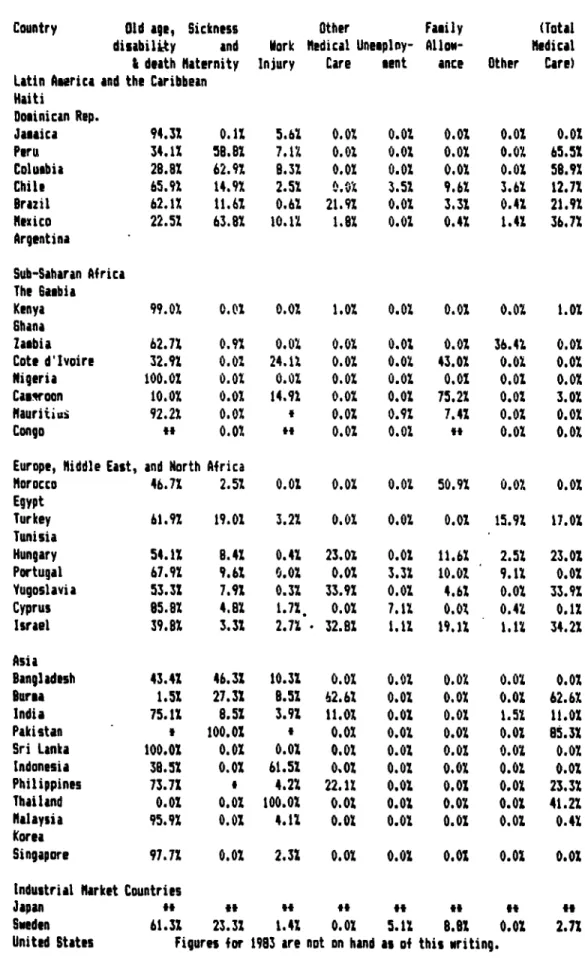
Relative size of benefit programs
Programs for old age, disability, and survivors' pensions receive the largest portion of revenue in most countries' social security systems but, due to the immaturity of most such programs in developing countries, they expend a somewhat smaller share of benefits than they receive as a share of revenues. The surpluses we examined above are almost solely for the purpose of providing for future increases in pension expenditures. Thus the relative shares of benefits which we now examine in Table 8 give an
incomplete picture of the relative importance of different types of benefits.
Colombia, Maxico, Bangladesh, Burma, and Pakistan - place greater weight on sickness and maternity insurance and on medical care
than on pensions. These benefits are also relatively high throughout Latin America, in Europe (including Turkey), and in Israel, but they are low or zero in Sub-saharan Africa and much of East Asia. Family allowances make up large proportions of benefits in the African countries once colonized by France (the proportions are as high as they are, obviously, due to the
immaturity of pension programs in these countries) and are also
offered, as we noted above, in Europe and parts of South
America. Work-injury coverage looms large in the finances of the Cote d'Ivoire, Cameroon, Indonesia (where coverage for work
injury is much broader than that for the provident fund), and Thailand (where work-injury insurance is the only coverage
provided). Countries with provident funds usually provide little in benefits for contingencies other than old age, disability, and death.
3. The Conibquences of Social Security Systems for Public-Sector
Yinance
The institution of a social security system - and
particu-larly of a pension scheme - obligates a government to pay
increasing levels of benefits as the scheme matures (that is, as successive cohorts of new beneficiaries have been covered longer and are eligible for increased benefits) and as life expectancy improves. This growing financial obligation can prove quite burdensome to a government under some financial arrangements for social security systems.
We have seen that most social security systems in developing countries are not yet mature, are running substantial surpluses, and are financed without resort to substantial sums in special taxes or general state revenues. Some, indeed, reap substantial
revenues from investment of their surpluses.
Usually these systems are managed by decentralized public agencies, and their surpluses are usually kept nominally separate from funds of the central government. The surpluses, however,
are often used to purchase the central government's debt - that
is, 1z finance its deficits. This raises a question, at least, as to how real are the reserve funds of social security systems, or how independent are these systems from the central government
and its policies.
A government which grows accustomed to using the substantial surpluses of a social security system to finance its deficits may have sufficient difficulty funding its operations once the social
security system matuxen and peapes to run surpluses that it will not be able to redeem the bonds held in the social security
reserve fund. A more subtle, and more common, means by which a government escapes its obligation to its social security reserve fund is through high inflation, which erodes the value of
nominally fixed assets such as government bonds. High inflation has periodically eroded the reserve funds of Latin American
systems.
Administrators of social security systems are not always required to invest their assets in government bonds. High
inflation can still greatly reduce the value of reserve funds eld
in private assets - as it did in Turkey in the late 1970's and
early 1980's. Moreover, due to a lack of developed local financial markets, however, (and in a desire to invest
domestically rather than abroad) they may lack good opportunities for investment. Thus it is the considered opinion of staff
workers in social security at the International Labour Office that while most social security systems of Africa, Asia, and the Caribbean are actuarially sound, they may yet experience finan-cial difficulties due to the lack of good investment opportuni-ties. 1
The actuarial soundness of social security finance can be altered ty a variety of demographic, economic, and political factors. An unexpected rise in life expectancy, decline in the birth rate, or increase in emigration raises the "dependency
worker - and thus worsens the financial picture. Economic growth increases the base upon which contributions are paid, and thus increases revenues, while prolonged stagnation reduces financial surpluses. Political pressures may lead to benefit increases which, though temporarily expedient, are unsustainable in the long run without increased revenues. It is difficult,
political-ly, later to reduce benefits. If it is also politically
diffi-cult or economically harmful to raise contribution rates, special taxes or general revenues must be resorted to in order to pay for
benefits.
Mesa-Lago (1986, pp. 143-4) confirms this analysis in his list of factors which threaten the financial stability of "the oldest and most highly developed systems" in Latin America. In addition to normal and foreseeable factors such as those relating to the maturation of systamd, he mentions "quite liberal
legisla-tion on benefits, ... an increasing number of pensioners who are
living longer than was expected both in the original legislation and in older actuarial estimates, thus receiving their pensions and health benefits for longer periods" and the facts that "the contribution burden of social security is excessive and it is very difficult, politically and economically, to increase either social security contributions or taxes" and that "the yield .on pension funds has turned out to be very low, and even negative in the high-inflation countries...." He also adds some factors
ET]herb is a high level of evasion and delay, particularly in the countries which have high and sustained inflation
(where delaying payment means a reduction in one's real
contribution); ... the State - under pressure to meet multiple
and demanding requirements - fails to comply with its
financial obligations, thus leading to the accumulation of very large debts;...and...the transfers (or "loans") from
the pension funds to cover the deficits of health programmes (the cost of which have escalated due to "a capital-inten-sive system of remedial medicine"] are difficult to reim-burse in practice, which has contributed to the de-capitali-sation of the funds, at a time it is necessary to use the accumulated technical reserves to meet the current pension payments.
Two additional factors which have had a notable effect on the financial solvency of social security in Uruguay are low
retirement age (60 for men, 55 for women - but retirement at
substantially younger ages for unemployed persons was permitted, and often accepted, until 1981), high life expectancy (72 at birth 2 but of course higher for those who survive until
retirement age), and a high rate of emigration among the young. Together, these factors lead to a very high dependency ratio of
.82 pensioners per contributor in 1983 (Mesa-Lago, 1985, cited in World Bank, 1986, pp. 80) and contributed to a deficit fully 60
percent as great as revenues in 1980 (Mesa-Lago 1986), requiring a subsidy from the central government of over four percent of GDP in 1983 (World Bank, 1986, p. 83). 3 4
It was partly Chile's experience with the need to use
general revenues to maintain the solvency of its social security system that led it to institute its privatized system. A
noteworthy feature of this system is that it maintains its
(apart frow a state-guArantebd minimum benefit linked to the
minimum wage) of the expected value of one's benefits to one's
contributions plus interest. The state is thus protected in the
long run from any need to maintain the solvency of the system,
although now in the absence of the contributions of those who
switched to the privatized system it must make substantial
contributions to pay benefits for current retirees. Thus far the
average real rate of return on fund investments has been an
astounding 16.8 percent and fund investments have risen to 50
percent of total term deposits in the financial system (Lacey
1987).
The financial difficulties of the older Latin American
schemes may or may not be repeated in the younger schemes in
Latin America or in the rest of the developing world. Whether it
is depends on the abilities of governments to withstand political
pressures either to raise benefits (and thus give substantial
tr'ansfers to current beneficiaries and those soon to retire)
without providingj for their financing or else to maintain
contribution rates or relatively low retirement ages in the face
of the need to raise one or the other due to increasing life
expectancy (see Mesa-Lago (1986), pp. 145-6). It also depends,
as we have seen, on the ability of social security administrators
to place their reserve funds in safe assets with a positive real
4. The Consqu.nces of Social security Systems for Economic
Growth
Due to the magnitudes of their financial flows, social security systems can have substantial impacts on the economy
through both the capital market and the labor market. The nature and degree of some of these impacts are matters of significant
dis'ute among economists. While studies have focused primarily on the industrial market countries, their insights or assertions can be applied to developing countties as well.
The impact of social security systems on capital market
comprises both the direct effect arising through the accumulation of reserves and the behavioral response of covered individuals to the prospect of their future pension benefits. Reserves may be
invested (domestically) either in government bonds or (either directly or through financial instruments) in capital goods. The effect of investment in government bonds may be either to enable
increased government spending, to reduce taxes, to reduce foreign borrowing, or to free other savings for capital investment.
Unfortunately information is not readily available concern-ing how, or to what extent, reserves are used to finance capital accumulation. One very interesting use for which information is available is the use of Singapore's provident fund to finance housing (Wallich 1987). Not only are public housing projects
financed this way, but individuals may borrow against their accounts to purchase homes. The provident fund holds mortgages and receives regular payments on these loans; any balances
outstanding when covered workers receive their lump-sum benefits are deducted from these benefits. Nearly half the participants in provident funds have used them to finance purchases of homes.
People's behavioral response to their prospective pension benefits, or "social security wealth," is a matter of substantial dispute. The basic issue is this: to what extent do people
reduce private saving because their expected pensions replace that which they need to save? If the reduction is of a substan-tial magnitude, as argued by Feldstein (1974, 1982), then, unless
reserves are used to replace these savings in the generation of capital, a social security system will reduce a nation's total savings and capital stock. Barro (1974) has argued, to the contrary, that private inter-generational transfers offset the effects of public transfers even in a pay-as-you-go system, so
that saving is unaffected. For & more extensive survey of the
theoreti-al issues and empirical evidence see Wallich (1983), Shome and Squire (1983), or Munnell (1986).
A further argument is sometimes made about savings and
capital accumulation in developing countries in particular. Many people in these countries have no prior experience with financial institutions. Social security programs give them such experience and therefore, it is said, encourage a "habit of saving." Thus they stimulate financial savings in addition to those generated through the programs' reserves.
Social security systems affect the labor market both by inducing earlier retirement and by introducing distortionary
marginal taxes on wage payments. The first effect is important
and undisputed.1 The second effect hinges on two disputed
questions: (1) what is the incidence of the payroll taxes, or contributions, of both insured workers and employers, and (2) does an insured worker view contributions as a tax or as deferred compensation. The answers to these quustions determine the
extent to which contributions function as taxes which raise employers' cost of labor above workers' wages, bringing
inefficiencies2 to the labor market while tending to reduce
employment.3
Many economists hold, on the bases of a marginal-product
theory of wage determination, that employers' contributions are effectively paid by workers. The International Labour Office
(1984) argues virtually the opposite: that workers are able to bargain for wage increases to offset increases in their contribu-tions. Some economists argue that part of the incidence of the tax is passes on in the price of products. See Brittain (1972)
for an evaluation of these and related arguments.
Whether a worker views contributions (including those of the employer) as a tax or as deferred compensation depends on large part on the perceived marginal linkage between these
contribu-tions and expected benefits. Under a provident fun-d or a system,
like the new privatized pension scheme in Chile, which operate on the basis of private insurance principles, expected benefits rise on a one-to-one basis with contributions, provided that one's
In many sywtems benefits are provided on a progressive basis, so that while one's total expected benefits may exceed one's
contributions, the marginal linkage is often less than unity and workers can rightly view part of their contribution as a tax. Some countries use only the several last or highest-earnings years to determine the level of ones benefits; in such cases most of one's contributions have no marginal linkage to
bene-fits.. Of course, covered individuals may not be able to evaluate the implications of the more complicated formulae used to
determine benefits. Still, they do develop attitudes about whether they will get a sufficient return for the contributions they make, and these attitudes affect their choices in the labor market.
In view of the substantial consequences of social security systems for the integrity of government finance, for economic
ef-ficiency and growth, and for equity, what guidelines should govern the structure and operation of such systems?
First, systems must be managed in a way that assures their long-term financial viability. Benefits must be limited to what is sustainable from revenues over a horizon of several decades.
Systems must be made effectively -- not just formally --
autono-mous from the central government, and they must be given both the
right and the accountable responsibility to invest trust funds in
a range of effective investments. If they are required to pur-chase government bonds (for a limited portion of their portfolios only), these bonds must be credibly indexed for inflation.
Second, it is highly important both that there be an explicit
linkage between one's contributions and one's benefits and also
that one's benefits be based on one's entire stream of contribu-tions. This will not only enable households to plan their futures with some confidence, but will also increase efficiency in labor markets (and in other markets affected by labor markets). To these same ends it is important as well that participants be able to have confidence in the adequacy of record-keeping, in the
prompt payment of earned benefits, and in the continuing financial viability of the system.
Third, reserve funds for pension programs should be used for the formation of capital. While it is unclear whether the
exist-ence of such programs recduces private saving for investment,
pub-lic programs can further a country's development if invested well. This may prove difficult, however, in some countries.
Fourth, systems must be equitable. Care muet be taken in this especially where it is impossible to extend effective cover-age beyond an already privileged segment of the population.
Privileged classes should not receive benefits greatly exceeding their contributions. Systems should be financed only from the
contributions of those who will benefit -- not from aeneral
reve-nues (except, perhaps, for benefits which are universal). Because
the burden of payroll taxes may be born partly by consumers who do not benefit from the system, the scale of the system should be kept relatively limited.
All of these considerations commend systems that are
rela-tively straightforward in structure, simple to administer, and
based on sound actuarial principles. Among such systems are the various provident funds and the regulated privatized system of
Chile. These particular models need not be taken as normative, but system structures which depart far from the guidelines here
can easily give rise to financial pitfalls, slower growth, o.L hLars
Notes to Chapter 1
1. For information on these matters the reader is directed to various publications of the International Labour Office, parti-cularly Introduction to Social Security (third edition, 1984). 2.In developing countries particularly, financial markets are usually insufficiently developed to offer on a private basis the insurance and annuity coverage of social security systems.
3. This is usually done initially through provisions in the labor code which make employers liable to furnish or arrange private insurance for such benefits. Statistics are not readily avail-able to indicate when public administration of such benefits began in various countries. Hence, Tables 1.1 and 1.2 count employer-liability programs for work-injury coverage, although they do not count employer-liability programs for other types of
'-Jn AO J -a.
4. In this chapter's tables, the figures for medical care include only those countries in which such care is provided through the social security system. Countries which provide free or low-cost medical care under other administrative arrangements are not
counted here, although some of them are tallied below in Table 3. 5. In actual operation a social security system may perversely give a positive transfer to some who are well off. This is
documerted for the United States' Old Age and Survivors Insurance in Boskin, Kotlikoff, Puffert, and Shoven (1987).
S. Government may contribute also, out of general revenues or through ear-marked taxes.
7. See note 3 above concerning the inclusion of employer-liabili-ty work-injury programs in Table 1.
8. For an analysis of how this possibility became politically-expedient policy in Latin America see Mesa-Lago (1986), p. 143. Also, in several cases pay-as-you-go financing has resulted from the loss of reserve funds, either through their effective
confiscation f'or other governmental expenditures or through high
inflation and financial crisis. The latter happened, notably, to the original social-insurance pension scheme, that of Germany, in Germany's hyper-inflation of 1923 and in the financial crisis which, in the Federal Republic of Germany, followed World War II. The related experience of Latin American and other
develop-ing countries is discussed below in chapter 3.
9. If population and real wages grow fast enough, benefits can be raised above the value of contributions indefinitely without the maintainance of any reserve fund. If growth is slower,
beneficiaries (apart from the initial generation, which receives
a windfall) receive loss than the value of their contributions.
Theso conditions are discussed by Wallich (1983) and Samuelson
(1958). In fact, due to recent declines in both fertility and
economic growth, younger generations in many countries can expect to receive less than a fair-insurance return on their (and their employers') contributions. This has been most extensively
documented for the United States (see Boskin, Kotlikoff, Puffert, and Shoven (1987)) but is evident for most industrial countries and at least some middle-income countries. Apparently there has been little research on this matter for developing countries generally.
Notes to Chapter 2
1. These benefits are funded on a pay-as-you-go basis, which will prove particularly burdensome for collectives with an older than average work force.
2. Outside Latin America, we may note in several tables, few developing countries have protection against all risks.
3. See lIesa-Lago's study for a discussion of the inherent defects
in making these sorts of estimates.
4. Still, 80 percent of Singapore's labor force is covered (Asher 1985).
5. These descriptions could ba used together with data on the proportion of the labor force in various sectors of the economy to develop very rough estimates of the extent of coverage in the population. Alternatively, imprecise estimates could be derived from legislated contribution rLtes together with data on revenues of social security systems. Of more direct relevance for the present study, however, is the information presented below on the size of social security receipts, expenditures, and surpluses relative to the economy as a whole.
6. It is usually much easier to provide coverage to urban wage laborers than to others.
7. The most recent edition, the Twelfth International Inquiry, is forthcoming in 1988. The data as we have them are provisional. As of the writing of the present version of the present paper information is lacking for several countries in our sample. Space is left in Tables 5 through 8 to accomodate this informa-tion if and when it becomes available. Note that these tables delete those countries in Table 3 which have no public social security system.
8. It would also be worthwhile to view these financial flows as
proportions of public-sector financial flows as a whole. This exercise awaits the development of the latter figures by the
staff of the World Development Report - 1988.
9. Another category of benefits reported by the I.L.O. is that of benefits to war victims. In the present sample only Israel,
Japan, Sweden, and the United States provide such benefits. 10. [Argentina and Uruguay should be added to this list if data becomes available for a later draft.]
11. (Here insert data on surpluses in Egypt if it becomes available from the I.L.O.]
12. Singapore's combined contribution rate is 40 percent of the
employer's wage bill - for the wage bill including the employer's
contribution is 125 percent of nominal wages.
13. But see the discussion in chapter 3 of the incidence of this tax.
14. See Chapter 3 concerning the real erosion of reserve funds due to inflation. Such erosion would not be reported in the
figures here.
15. There is little explicit information to account for the other non-zero figures in the last three columns. One suspects that the high figure for "other" revenue for Indonesia largely
Notes to Chapter 3
1. This point was made in a telephone conversation with an
analyst at the I.L.O. The I.L.O. has worked with many of these systems to establish their actuarial soundness.
2. Source: World Development Indicators - 1987.
3. Uruguay is now undertaking a substantial reform of its social security system, with some assistance from the World Bank.
4. [Substitute information from I.L.O. to avoid citing unavailable source and to use 1983 as a comon year.]
Notes to Clapter 4
1. The prospect of earlier retirement tends to raise rates of
saving, tending to offset the reduction in saving which social
security otherwise induces. See Munnell (1986).
2. These inefficiencies, or "dead-weight losses," vary roughly with the square of the total tax rate (including the rate for other income taxes) applied to payroll or to wage income. 3. The impact of payroll tax rates on the cost of labor as a factor of production, affecting the labor-intensity of produc-tion, has been of particular concern in the European market
economies. In an effort to reduce unemployment, several of these countries have reduced the role of contributions based on labor earnings in financing social security.
4 The expected value of benefits is actually even areater when one considers the insurance value of "contingent assets" for risk-averse individuals.
Ref erences
Ahmed, Sadiq. 1984. "Public Finance in Egypt: Its Structure and Trends." Washington: Staff Working Papers No. 639, World Bank.
Asher, Mukul G. 1985. "Forced Saving to Finance Merit Goods: An Economic Analysis of the Central Provident Fund Scheme of
Singapore." Canberra, Australia: Occasional paper no. 36, Centre for Research on Federal Financial Relations, Australian National University.
Barro, Robert. 1974. "Are Government Bonds Net Wealth?" Journal of Political Economy 82,6:1095-1117.
Boskin, Michael J., Laurence J. Kotlikoff, Douglas J. Puffert, and John B. Shoven. 1987. "Social Security: A Financial
Appraimal Across and Within Generations," National Tax Journal 40,1:19-34.
Brittain, John A. 1972. The Payroll Tax for Social Security. Washington: Brookings Institution.
Feldstein, Martin. 1974. "Social Security, Induced Retirement, and Aggregate Capital Formation." Journal of Political Economy 82,5:905-26.
Feldstein, Martin. 1982. "Social Secur:,ty and Private Saving:
Reply." Journal of Political Economy 90,3:630-42.
International Labour Office. 1984. Introduction to Social Security. Third edition. Geneva: I.L.C.
International Labour Office. 1988 (forthcoming). Cost of Social Security: Twelfth international inauiry. 1981-1983: Basic tables. Geneva: I.L.O. Provisional data.
Lacey, Robert. 1987. "The Privatization of the Social Security System in Chile." Washington: World Bank. Processed.
Meea-Lago, Carmelo. 1985. El Desarollo de la Seauridad Social en America Latina. Santiago de Chile: ECLA, Estudios y
informes No. 43.
Mesa-Lago, Carmelo. 1986. "Comparative Study of the Develop-ment of Social Security in Latin America." International Social Security Review 39,2:127-152.
Munnell, Alicia H. 1986. "The Impact of Public and Private
Pension Schemes on Saving and Capital Formation." Internation-al SociInternation-al Security Review 39,3:243-257.
Samuelson, Paul. 1958. "An Exact Consumption Loan Model With or Without the Social Contrivance of Money." Journal of Political Econmn 66,6:467-82.
Shome, Parthasarathi and Lyn Squire. 1983. "Alternative Mechan-isms for Financing Social Security." Washington: Staff Working Papers No. 625, World Bank.
Turan, Kamil. 1985. The Turkish Social Security System. (Consultant's report for World Bank Sector Review Mission.) Ankara: processed.
United States. Social Security Administration. 1986. Social Security Proarams.Throughout the World. Washington: Research Report No. 60, Social Security Administration.
Wallich, Christine. 1983. "Savings Mobilization Through Social Security: The Experience of Chile During 1916-77." Washing-ton: Staff Working Papers No. 553, World Bank.
Wallich, Christine. 1987. "Social Security in China" in
forth-coming annex to: World Bank. 1987. Finance and Investment
Report No. 6445-CHA. Washington: World Bank.
World Bank. 1986. Country Economic Memorandum on Uruauay (Appendix A: "Social Security: Present Situation and Pros-pects"). Washington: Report no. 6054-UR, World Bank.
,inur of economies with programs
t tio Asrlca sod tim Caribbean (21 of 21 repod sm sagan as
of 1905) hiddle-mncoms Er and Sfout Africa (I of I reWted som prog
aso of I965)
TYPe of benf It 1925 194f5 1965
195 Typ of benefit 1925
145S 1965 1965
Old *9, disability, or death 2 11 19 21
Old ag, disability, or death 2 7 7
1 Sickness or sternity 2 it Is 20 Sicknes or maternity 5 7 7 7 wr IlnJuy 12 18 21 21 Work inJury 7 7 I 7 Unloyment 0 2 3 unemloymnt 0 4 5 Faily Allownce, 0 3 6 FamilyAl Iottnce 0 3 I I
Seb-Slmrem AtrIa (s33 of 35 reorted sam progr a of 19)
Asia (14 out of 19 repote so. progi m as of 1965)
7. o beft 'I5 1945 1965
1965 TIn of beneIt 1925
194 5 196 190 5
Old o, disabillty, or doett 0 0 19 27
Old op, dlsbiIlty, or death 0 0 7 10
Sickes or mtwenIty 0 .0 15 16 Sickess or maternity 0 0 5 5 Worklijurwy 21 30 32 Work Injury 3 8 14 14 Ummplment 0 0 0-1 3 U-I.loymUIt 0 0 0 1 w FealtyAliow'an 0 0 is 15 Family Alow 0 0 0 0 OD
Niddilo Ent md Nor Afrlca 15 of 19 reported son .pgr as of 1965I2/
VSal " o° s s (25 ot 34 reported
pra as of 195) /
Type ot benfit 1925 1945 1965
'965 Ty" of benfit 1925
1945 1965 1965
Old *9e, disability, or death 0 0 12
14 Old o*p dIsbillity, or death
2 4 a 25 Sickres or maternity 0 1 10 10 Sickness or aternity 1 2 4 15 Work Injury 2 9 13 14 Work InJury 4 10 16 20 tnemploymnt 0 0 1 3 Unmloymnt I 1-2 3-4 5 Family Allowance 0 4 6 6 Fmily Allow 0 0 3 4
1/ low-inao econom , middle-income eco nos, and high-incom oIl
exporters lIsted in World
D9Veloipmnt Indicators, plus small-population co fnoies.
6ab.n has be moved out of the
list Of sall-population c mes becaus Its population should exceed the
threshold by
1966.
2/ Includes Trkey.
3/ U.N. and World Sank meai countries with populations below one IIIIon. Includes
Luxeourg, Icelaond, and several high-incom oil euporters.
Source: U.S. Social Security Adeinistrotion (1966), Social Security Programs Throughout
the
I I ^. incame cateoires: World Devlopment Report 1967,
Table 1.2 Adaption of social security progress
(Number of economies with programs In selected years)
Lo*-noome economies (31 out of 37 reported som program as of 1965)
Type of benefit 1925 1945 1965 1985
Old age, disability, or death 0 0 17 24
Sickness or maternity 0 0 14 14
Work injury 4 17 30 31
Unemployment 0 0 0 1
Family Allowance 0 0 10 10
Lower middle-income economies (33 out of 36 reported sowa program as of 1985)
Type of benefit 1925 1945 1965 1985
Old age, diubility. or death 1 5 25 30
Sickness or maternity 1 7 22 23
Work Injury 8 25 30 32
Unemployment 0 1 3 6
Family Allowance 0 4 10 11
Upper middle-income economies (23 out of 24 reported some program as of 1965)
Type of benefits 1925 1945 1965 1985
Old age, disability, or death 3 13 20 22
Sickness or maternity 6 12 18 19
Work InJury 13 21 23 23
Unevployment 0 4 5 8
Family Allowance 0 6 14 14
Industrial market economies (19 out of 19 reported some program as of 1985)
Type of benefits 1925 1945 1965 1985
Old age, disability, or death 13 17 19 19
Sickness or maternity 12 16 17 18
Work Injury 18 19 19 19
Vnemploymcnt 12 18 19 19
Family Allowance 0 11 17 19
Note: Gabon has been added to the upper middle-income countries. See note I to Table 1.1. Sources: Program Information: U.S. Social Security Administration (1986), Social Security Programs Throughout the World 1985, Washington, D.C. Incom categorles: World Development Report 1987, World Development Indicators, Table 1, World Sank, Washington,
D.C.-!_ara of sco_Inl.s 19651
tow-lem ecomies
U MEr *Iddil.-icoma ecomonles
Un IVrBl
Universal
befit
bese I t
Social or socia Provident Eployer Soalo or sorial ProwIdent Eiolyr
T O f beneit Total lnsursc aslstafce
2
Fund Liabilt, yf Tit btei Total
t
/ Insurance assIstanc
2
' Fund Liability
Old q, disabillty, or dath 24 16 0 a I Old ae, disability. or dueth 22 le 2 2 0
Sicknss 5 4 0 I Sickness to 18 M1)' 0 I watanlty 13 13 0 0 10 fternIlty 1 I 9g 0 0 2 lbtiral e w Y 6 6 0 0 10 fWdli cal c / 21 17 3 1 0 Work lnJury 19 19 0 0 12 Work Injury Is t 0 0 f Ummloymeat I 0 0 I 2 U_ ewoamnt 8 4 4 0 3 Fmilya ttliaua 10 10 0 0 1 FilIl *lIeu 14 12 2 0 0
tuar mlddle-lacome eco Inoes
Univwrsal
Univral
be"; It
besf It
Social or Soial Prowidnt fplow r
Social or sowial Providnt Etowr
T f bnffit Total insurae assistance2 Fund LiabilIty Ti* Of banf it Total
1
' Insuranwe assistae
2
' Fwd iabillty
Old p, dIs1bility or dath 10 27 (1) 3 0 Old ap, diasblity, or death 19 16
31.5) 0 0 Sickens 19 19 0 0 2 Slcklass is 16 2 0 0 WNteraity 23 23 0 0 4* at erity 17 16 1 0 0 dilcal cr a3/ 19 16 1 0 2
lIdicel cae Is. 11 7 0 0
lWorkilJuy 25 25 0 0 7Vornjry
Is IS 1 l) 0 4
l iaplot 0 3 2 t 6
1na qloy_it 19 17 2(+41 0 0
Fmi I,el llmc 11 10 I 0 0 FilVall
1 19 5 13i.1} 0 0
I/ Teotl oeclda sployr-llability progr.
2/ Pwra"s Indicate nwers of prgr&a for which tha principle Is "pield In conjunction
ultt ottwr prieciples.
3/ WaIcal cre lncludes hoWitatizatIon Insurance.
Source: Pr_om lfortlon: U.S. Social Sacurity Ainlstratlon (1966), Social ScUriwty
Progam Throuhot te world 1965. Washinn D.C. Inem ctegories: World Deelopment PeArt 19t7, World Odealenm t Indicators, Table 1. World Wn, Wshington, D.C.
.ih.~~~~~~~~~~~~~~~~~~~~SI - IIIII
i
*… ... 4444 -2 - -4----.. - --- -- i ~ ~~ ~ ~ ~~~~~~~~~~~ ., .S_._- ~ - - - -_ - - IL -g L I' IL . - -- i| ' irnI~~~~~~~~~~~~~~~~~L
1W . 44W .--.. *_--- ... * , ... _ Ij8 , _ ,,_ I . }4I tS l | j t! ' iQ !!' j | '' l | i 1 ;; 4 4.,444I4 M _Table 4 Coverage of population and active labor force in Latin America, 1980
Population covered Active labor in sickness and force covered in maternity program pension program
Country (percent) (percent)
Low income Haiti 1 2 Lower middle-income Bolivia 25 18 Honduras 7 13 Nicaragua 9 19 Dominican Republic 8 14 El Salvador 6 12 Paraguay 18 14 Peru 17 37 Ecuador 8 23 Cuatemala 14 33 Costa Rica 78 68 Colombia 12 22 Chile 67 62 Upper middle-income Brazil 96 96 Uruguay 69 81 Mexico 53 42 Panama 50 46 Argentina 79 69 Venezuela 45 50
Source: Carmelo Mesa-Lago (1986), "Comparative Study of the Development of Social Security in Latin America", International Social Security Review 39, 2: 127-152, Tables 1 and 3.
Table 5. Financial flows of social security and related prograes (fiscal year ending during 1983). (Percentage of GOP, except or Surplus/Receipts)
Social Security System - ---- Public Employees System--- Other Prograss----Country Receipts Expenditures: Surplus Surplus/ Receipts Expend:- Surplus Public Public
… b----aenefits Totai Receipts tures Medical Assistance
Latin America and the Caribbean Haiti Dominican Rep. Jamaica 2.222 0.597 0.767 1.46X 65.9Z 0.70X 0.59X 0.112 0.62% 0.24X Peru 2.15X 2.047 2.30d -0.14% -6.71 0.00 0.007. 0.002 0.00 0.002 Coluabia 2.03Z 1.52X 1.75X 0.298 13.97 0.52Z 0.477 0.04X 0.007 0.007 Chile 16.732 13.01X 14.297 2.44UX 14.67 0.007 0.001 0.002 0.00 0.00 Brazil 5.52X 5.071 5.461 O.Ob% 1.17 0.152 0.15% 0.00 0.00 0.002 Mexico ".03X 1.521 2.11% -0.0OX -3.9t. 1.04% 0.657 0.407 0.007 0.002. Argentina Sub-Saharan Africa The Gambia Kenya 0.777 0.052 0.072 0.70Q 90.8X 0.00 0.00O 0.002 0.002 0.002 Ghana Zambia 2.62X 0.86Z 1.22X 1.407 53.32 0.00 0.002 0.00 0.00 0.00 Cote d lvoire 1.17Z 0.51Z 0.65X 0.51X 43.91 0.002 0.00% 0.00 0.007. 0.0OX Nigeria 0.17X 0.012 0.02Z 0.14. 85.67 0.002 0.002 0.00% 0.007 0.00
Cameroon 1.427 0.367 0.367 1.06I 74.5X 0.211 0.217 0.007. 0.001 0.001 Mauritius 3.54X 1.989 1.989 1.57J 44.2Z 0.00O 0.00 0.00 0.00 0.162 Congo 1.91X 0.61% 0.917 1.007 52.57 0.007. 0.00. 0.00 0.00 0.007.
Europe, Middle East, and North Africa
Morocco 1.54X 0.91B 0.86X 0.67X 43.77 0.002 0.001 0.007 0.007 0.001 Egypt Turkey 3.39% 2.237 2.367 1.02X 30.37 1.47X 1.417 0.05X 0.31X 0.01Z Tunisia Hungary 15.44UZ 15.362 15.447 0.007. 0.07. 0.007 0.007. 0.00. 0.00 0.00 Portugal 7.eb7 7.447 7.95X -0.09X -1.17 1.747 1.787 -0.04X 3.387 0.40Z Yugoslavia 11.337 10.332 11.272 0.067 0.57 0.00. 0.007. 0.00. 0.00. 0.00 Cyprus 6.537 3.447 3.52X 3.017 46.17 1.55X 1.13X 0.41X 1.937 0.387 Israel 10.427 7.921 9.27X 1.15X 11.17. 0.9. 0.807 0.002 0.00 0.72X Asia Bangladesh 0.017 0.007. 0.00 0.012 55.3X 0.00 0.002 0.002 0.00 0.00O Bursa 0.089 0.047 0.057 0.02X 31.37 0.007. 0.00 0.00 0.007. 0.007 India 1.33X 0.497 0.517 0.82I bl.3 1.44X 0.927. 0.52X 0.007 0.047. Pakistan 0.107 0.037 0.047 0.067 60.37 0.377 0.377 0.007. 0.00 0.217 Sri Lanka 2.00X 0.327 0.347 1.667 83.07 0.477 1.81% -1.34X 0.007 0.067 Indonesia 0.09% 0.017 0.027 0.057 71.87 0.007 0.00 0.007. 0.007. 0.00 Philippines 1.002 0.31X 0.342 0.67X 66.47 0.757 0.40X 0.357 0.007 0.002 Thailand 0.047 0.017 0.012 0.027 63.77 0.161 0.16. 0.007. 0.00. 0.00 Malaysia 5.321 0.77X 0.83Z 4.49X 84.4Z 0.00 0.00 0.00 0.00 0.04N Korea Singapore 14.707 3.797 6.431 B.277 56.37 0.26X 0.267 0.007 0.93Z 0.017
Industrial Market Countries
Japan 10.977 7.447 9.461 2.517 22.97 2.11Z 1.581 0.53Z 0.25I 1.25X
Sweden# 19.898 16.9'7X 17.389 2.51X 12.67 2.377 2.37X 0.002 7.771 5.46UX United States n .97Z 9.347 9.t2Z 0.35X 3.97 3.272 1.71% 1.552 1.127 2.661
Table 7. Sources of Revenue for Social Security Systems
Statutory Contribution Rates: Percentage Distribution of Revenue-Country (percent of vages or payroll) Contributions--- Other
Invest-Inmred Insured Taxes sent
Person Employer Person Eeployer u State) Income Other Latin America and the Caribbean
Haiti 2 -6X 4 - 12S Oominican Rep. 2.5 9.5 Jamaica 2.5* 2.5* 24.32 29.71 7.42 3B.5% 0.12 Peru 3 7 - 18.2 89.5 (both) 0.0 10.2Z 1.2X Columbia 15.5 18 - 24 23.72 *55.ez 0.0 9.0X 11.42 Chile 24.6-26.5s*t 4.2 - 4.6 31.12 2.1Z 48.9% 15.91 2.0X Brazil 8.5 - 10 14.7-16.9 15.6X 74.02 8.22 0.0 2.2X "eex4co 3.75 11.31# 19.7% 61.92 12.32 5.2Z 0.8X Argentina 14 24 Sub-Saharan Africa The 6ambia . 5 10 Kenya 5 5 25.32 25.32 49.32 0.02 0.02 Ghana 5 12.5 Zambia 5 5 38.52 29.51 0.02 32.82 0.2Z Cote d lvoire 1.2 9.3-12.3 61.92 17.72 0.0 20.42 0.02 Nigeria 6 6 28.22 20.22 0.02 51.41 0.32 Cameroon 2.8 13-16.2 12.8X 64.42 0.02 22.92 0.02 Mauritius 3 6 tO.62 21.22 52.32 14.32 1.62 Congo 2.6 15.88 12.1l 80.2X 0.02 7.52 0.22 Europe, Middle East, and North Africa
Morocco 1.9 13.8 8.42 78.42 0.02 13.21 0.02 Egypt 11 24 Turkey 14 20.54' 36.92 39.92 5.12 17.62 0.5X Tunisia 6.25 18.5-26.5 Hungary 3 - 15 10 - 24 14.92 47.1X 38.02 0.02 0.02 Portugal 11.5 25 28.12 64.12 7.82 0.02 0.02 Yugoslavia 23.2+ Varies 66.72 24.52 7.32 0.92 0.62 Cyprus 6 6 35.1 35.32 20.62 8.2% 0.72 Israel 3.6 8.2t* 23.22 39.32 27.22 10.62 0.72 Asia
Bangladesh (Not reported) 19.42 43.42 4.3;. 32.92 0.02
Bursa 1 3 19.92 59.82 17.89 1.9X 0.52 India 9.75-10.5 11.6-13.4 29.72 33.72 1.12 32.72 2.82 Pakistan 0 12 0.02 72.32 0.12 26.92 0.52 Sri Lanka 8 13-19.5 28.72 29.92 0.02 41.42 0.02 Indonesia 3 7+ 16.52 49.42 0.02 O.OX 35.12 Philippines 2.85-4.55 7.75-9.45 20.02 31.4X 0.02 48.12 0.52 Thailand 0 0.2 - 4.5 0.02 64.02 3.72 32.31 0.0O Malaysia 9.5 12.75 62.82 2.22 0.02 34.42 0.62 Korea 1.5 - 4 3.24 Singapore 25 25 39.62 42.02 0.02 17.92 0.52
Industrial uarket Countries
Japant#it 10.05 10.9-23.3 31.82 29.69 21.62 11.62 6.31
Sweden O 30.45 1.89 b4M92 - 16.7X 16.72 0.02 United Staten 7.05 12'. 34.92 45.12 17.62 2.32 0.11