Program Evaluation Report
As Required by the Government Evaluation Act
(3 MRSA § 955)
Submitted to the
Joint Standing Committee on
Insurance and Financial Services
And
Joint Standing Committee on Labor, Commerce,
Research and Economic Development
DEPARTMENT OF PROFESSIONAL AND FINANCIAL REGULATION
Program Evaluation Report
Table of Contents
Department Overview 1
Administration Services Division 3 Bureau of Financial Institutions 7 Bureau of Consumer Credit Protection 16
Bureau of Insurance 22
Office of Securities 46
Office of Professional and Occupational Regulation 58
Attachment A (Administrative Services Division) 74
Attachment B (Bureau of Financial Institutions) 76
Attachment C (Bureau of Consumer Credit Protection) 78
Attachment D (Bureau of Insurance) 85
Attachment E (Office of Securities) 93
1 DEPARTMENT OF PROFESSIONAL AND FINANCIAL REGULATION
Department Overview
The Department of Professional and Financial Regulation serves and protects the public through a broad range of statutorily-authorized responsibilities, such as examining and overseeing state-chartered financial institutions and bank holding companies; regulating insurance companies, agencies and producers; administering and enforcing the Maine Uniform Securities Act; regulating grantors of consumer credit; and by licensing and regulating numerous professions and occupations.
The Department protects Maine consumers through its licensing, examining and auditing activities. It conducts programs aimed at increasing voluntary compliance with State laws, investigates possible violations of law and undertakes enforcement actions. The Department responds to consumer complaints and requests for information. Staff also conducts educational outreach programs to make consumers aware of their rights under Maine laws. The Department continuously strives to enhance the resources made available to the public through online applications and public forums.
Mission Statement
The mission of the Department of Professional and Financial Regulation is to encourage sound, ethical business practices through high quality, impartial and efficient regulation of insurers, financial institutions, investment advisers, creditors and numerous
professions and occupations for the purpose of protecting the citizens of Maine.
History and Organization
The Department of Business Regulation was created in October 1973 as part of a State government reorganization designed to consolidate related agencies along functional lines and strengthen executive direction. Some of the agencies originally placed under the jurisdiction of the Department were the Bureau of Banking, the Bureau of Insurance, and the Real Estate Commission.
The Special Session of the 106th Legislature established the Bureau of Consumer Credit Protection to enforce the Maine Consumer Credit Code, which became effective January 1, 1975. In 1987 the name of the Department was changed to Professional and Financial Regulation.
The Special Session of the 107th Legislature established a central licensing division, now called the Office of Professional and Occupational Regulation (OPOR).
Currently, the Department consists of a centralized Administrative Services Division, which includes the Commissioner’s Office, and five agencies: the Bureau of Financial
2 Institutions; the Bureau of Consumer Credit Protection, the Bureau of Insurance, the Office of Securities, and the Office of Professional and Occupational Regulation. In addition, six professional licensing boards are affiliated with the Department: the Board of Licensure in Medicine, the Maine State Board of Nursing, the Board of Dental Examiners, the Board of Registration for Professional Engineers, the Maine State Board of Optometry and the Board of Osteopathic Licensure. These “affiliated” boards are scheduled for review under the provisions of the Government Evaluation Act by the Joint Standing Committee on Labor, Commerce, Research and Economic Development in 2019.
Staffing and Composition
With a position count of 184 employees,the Department is relatively small compared to other cabinet-level agencies. Due to the complex nature of its regulatory activity, the Department employs professional and technical employees, including CPAs, actuaries, attorneys and licensed inspectors.
The Department emphasizes continuing professional development, training and
education. The staff is highly motivated and dedicated to quality regulation and public service.
Department Funding Source
The Department is funded entirely through dedicated revenue sources. As a result, each organizational unit within the Department is funded by a combination of licensing, examination, assessment, volume and filing fees paid by the regulated individuals or entities.
The Department contributes significantly to the General Fund through the Office of Securities’ registration and licensing fees, as well as fines collected from other Department agencies and periodic transfers of Other Special Revenue funds.
3
DEPARTMENT OF PROFESSIONAL AND FINANCIAL REGULATION
ADMINISTRATIVE SERVICES DIVISION
A. Enabling or Authorizing Law
The Administrative Service Division is authorized through 10 MRSA §8003.
B. Description of Programs
The Administrative Services Division coordinates administrative and legislative support for all bureaus, offices, boards and commissions within the Department. It also procures and facilitates the Department’s information technology services. The Division’s
centralized support covers such functions as budget development, contract review, purchases, cash receipts, computer services, legislative support, public communications, reception and facility management.
The Division provides the services described above for the entire Department. Additionally, the Division is responsible for ordering and arranging for the services provided to all units by outside staff agencies, including the Department of
Administrative and Financial Services – Service Centers, the building owner and by private parties and vendors.
The Division manages the development and administration of the Department's
centralized licensing database. Technical support for all Department computer services is provided by or procured through the Office of Information Technology.
The Commissioner is the administrative head of the Department. In this capacity, the Commissioner provides centralized budgeting coordination, initiates and monitors all policy implementation and strategic planning, and directs the day-to-day management of the Department. The Commissioner develops the Department's legislative program and coordinates it within the Department and with the Administration.
The Commissioner is responsible for reviewing the policy and operation of agencies within the Department to insure that each complies with its statutory and public service responsibilities. The Commissioner may not interfere with the exercise of discretionary regulatory or licensing authority vested by statute directly in the bureaus, offices, boards and commissions of the Department.
In the case of affiliated boards, the Commissioner acts as a liaison with the Governor and with other units of state government. Affiliated boards submit their budgets through the Department.
4
C. Organizational Structure
The Administrative Services Division is headed by the Commissioner and presently has 7 authorized positions.
There are distinct functional units within the Administrative Services Division. The Office of Commissioner serves as the central point of leadership within the Department. The Commissioner’s Office coordinates Department-wide strategic planning and policy development; serves as the primary contact for the Governor’s Office, the Legislature and other governmental agencies; facilitates communications with the public and media; and ensures intra-agency cooperation and collaboration.
The Administrative Unit provides centralized fiscal and facility management for the Department, while the Information Systems Support Services Unit coordinates automation and electronic communication objectives.
A Divisional organizational chart is found in Attachment A. It outlines the Division’s personnel structure and relationship to the Department.
D. Repealed, P.L. 2013 c. 307
E. Financial Summary
The Division’s financial summary is found in Attachment A.
F. Repealed, P.L. 2013, c. 307
G. Areas of Coordination with Other State and Federal Agencies
The Division is the primary liaison to the State Budget Office, the Controller’s Office, the Department of Audit, the Legislature and the Governor’s Office.
The Division also works closely with the Administrative and Information Technology Service Centers within the Department of Administrative and Financial Services (DAFS) to coordinate support for the agencies and boards within the Department.
H. Constituencies
The Division primarily serves to support the agencies within and the boards affiliated with the Department.
5
I. Alternative Delivery Systems
In coordination with the Office of Information Technology, the Division has made
aggressive use of information technology to assist agencies within the Department. In the past ten years, this cooperative effort has resulted in the addition of online initial
licensing, online license renewal services, many downloadable forms, online licensee search features and many other electronic processes.
J. Emerging Issues
Not applicable to the Administrative Services Division.
K. Information Specifically Requested by Committee
None requested.
L. Comparison of Related Federal Laws and Regulations
Not applicable to the Administrative Services Division.
M. Collecting, Managing and Using Personal Information
Agencies within the Department of Professional and Financial Regulation collect personal information in a variety of ways. For purposes of this policy, "personal
information" includes but is not limited to address, telephone number, and financial and medical information. Social Security Numbers and personal information are collected on license applications and during complaint investigations and compliance examinations. The Department’s policy is intended to raise awareness of employees about the proper use of Social Security Numbers and personal information; to prevent the indiscriminate release of such personal information; and to establish a procedure to assure that public and Freedom of Access (FOAA) requests are made and responded to in accordance with the law.
Several factors make such awareness important. First, State law provides that information in the State's possession is generally available to the public unless it is deemed confidential by statute. Second, the Department is taking steps to provide more and more information to the public via its Internet websites. Third, at the state and national levels, increased attention and concern are focused on issues of privacy and access to sensitive, personal information.
Department of Professional and Financial Regulation Policy
1. PFR employees should not disclose or release Social Security Numbers contained in agency files. PFR employees receive frequent requests for copies of license
6 applications and lists of licensees. Employees should redact all Social Security Numbers before sending out documents responsive to these requests.
2. Each agency should designate an attorney or manager responsible for processing and responding to requests for personal information, including FOAA requests. If a PFR employee receives a request from the public to review or copy documents containing personal information, the employee shall ask that the request be in writing. In addition, all responses to such requests shall be reviewed by the designated attorney or manager.
3. In processing a public or FOAA request, each agency should redact information protected by statute. In addition, the agency should determine whether the request can be responded to without supplying other personal information. Each agency may have specific information which is protected by law or regulation.
4. When posting information on PFR's website, agencies should not post personal information, such as home addresses and telephone numbers. An exception to this rule would be in cases in which such information is directly applicable to a
licensee's business, such as when a home address is also a business address or a home telephone number is also a business telephone number. Under no
circumstances should Social Security Numbers be posted.
5. Each agency should use its best efforts when collecting information to provide notice regarding whether the information will be treated as public or confidential information.
N. List of Reports, Applications and Other Paperwork
The Division coordinates all financial and budgetary reporting, including annual report submissions, biennial budgets, annual work programs, GAAP closing, SEFA reporting, audit statements and various others required by the Department of Administrative and Financial Services.
O. List of Reports Required by the Legislature
None required.
P. List of Organizational Units and Programs
See Attachment A
Q. Statutory Provisions Requiring Legislative Review
7
DEPARTMENT OF PROFESSIONAL AND FINANCIAL REGULATION
BUREAU OF FINANCIAL INSTITUTIONS
A. Enabling or Authorizing Law
The Bureau of Financial Institutions is authorized through 9-B MRSA §111 and §121; and 9-A MRSA §1-301(2).
B. Description of Programs
The Bureau of Financial Institutions supervises all state-chartered financial institutions including banks, credit unions, and non-depository trust companies. The mission of the Bureau is to maintain and promote safe and sound financial practices; ensure the strength, stability, and efficiency of all financial institutions; ensure reasonable and orderly
competition, thereby encouraging the development and expansion of financial services advantageous to the public welfare; and to maintain close cooperation with other supervisory authorities.
In cases in which a financial institution is a creditor, the Bureau is the administrator of the Maine Consumer Credit Code. Pursuant to this authority, the Bureau supervises financial institutions in such a way as to protect consumers against unfair practices by financial institutions that provide consumer credit, to provide consumer education and to encourage the development of economically sound credit practices.
The following programs are administered by the Bureau with equal priority:
• Safety and soundness examination of Maine financial institutions (state-chartered banks, credit unions and non-depository trust companies). Exam teams visit Maine financial institutions to analyze and rate capital, asset quality,
management, earnings and liquidity. Examinations also include evaluation of anti-money laundering (Bank Secrecy Act) efforts and information technology.
• Compliance examination of Maine financial institutions, including evaluation of compliance with the Maine Consumer Credit Code and Maine's Truth-in-Lending Act. The Bureau also reviews advertising credit reporting; deposit account disclosures; third party broker arrangements; funds availability policies, and privacy of consumer information.
• Application review, including review of applications for financial institution charters, corporate changes, expansions, mergers, acquisitions, conversions, branches, and modifications to credit union field of membership.
• Consumer dispute mediation, education and outreach, including investigation of complaints involving improper financial institution conduct. The Bureau’s Consumer Outreach Program has a designated Consumer Outreach Specialist available to answer questions related to the business of financial institutions, mediate complaints, and engage in off-site training programs. Additionally, the Bureau has educational materials available on its website covering financial laws
8 and regulations, ID theft, credit reports, consumer scams, and foreclosure
assistance and counseling.
• Administration of the Maine Banking Code, including industry support and guidance on application of Code, issuance of advisory opinions, and efforts to modernize and streamline law and regulations. Activities also include in-office financial data collection and research and analysis of the condition and activities of Maine financial institutions. The Bureau also participates in the legislative process, either with its own initiatives, or in response to requests for information by legislative committees on other initiatives related to financial institutions, consumer lending, or data breaches.
• Enforcement activities including issuance of cease and desist orders due to unsafe or unsound practices, violations of laws or breach of other conditions imposed on financial institutions by the Superintendent.
The Bureau measures its performance through the completion of its responsibilities within the statutory timelines required for examinations and application processing. Pursuant to § 221 of the Banking Code, the Superintendent must examine each financial institution organized under Maine law at least once every 36 months or more frequently as the Superintendent deems necessary. These examinations are often scheduled in conjunction with federal regulators in order to maximize regulatory resources and minimize industry disruption. In the past five years the Bureau has completed 83 safety and soundness examinations and 223 special examinations (e.g. compliance, trust & IT). The Bureau has met its examination and application review responsibilities and has processed consumer complaints generally within 1-4 days.
C. Organizational Structure
The Bureau is headed by a Superintendent and presently has 19 authorized positions. The Bureau is divided into two functional groups: an Examination and Supervision Division and a Research, Administration and Legal Affairs Division. The Bureau’s organizational chart is found in Attachment B.
D. Repealed, P.L. 2013, c. 307
E. Financial Summary
The Bureau’s financial summary is found in Attachment B.
9
G. Areas of Coordination with Other State and Federal Agencies
Department of the Secretary of State
The Bureau provides notice to the Department of the Secretary of State when approving new bank charters, mergers, or acquisitions. The Bureau works with applicants to ensure that related corporate filings are complete and filed in a timely manner. The Bureau also coordinates with the Department of the Secretary of State to ensure compliance with “restricted terms” provisions of the Banking Code. In order for entities to use certain terms, such as “bank,” “savings,” “trust,” and derivatives thereof in corporate documents, prior approval from the Bureau is required unless the applicant is a chartered financial institution.
Office of the State Treasurer
The Bureau works closely with the Abandoned Property Division of the Office of the State Treasurer to administer Maine law requiring that unclaimed property (including financial institution deposit accounts) remaining inactive for three years be escheated to the State. The Bureau performs periodic on-site examinations of state-chartered financial institutions to ensure compliance.
Office of the Attorney General
The Office of the Attorney General represents the Bureau of Financial Institutions in administrative hearings or other litigation proceedings. The Office of the Attorney General also assists the Bureau in drafting and reviewing enforcement actions and rules. The Bureau may refer complaints of suspected criminal activities, fraud, and unlicensed activity to the Office of the Attorney General and work in cooperation with assistant attorneys general during the investigative phases of these matters and in matters related to consumer complaints.
Federal Agencies and National Associations
The Bureau coordinates policy, examination, applications, and safety and soundness issues with the Federal Deposit Insurance Corporation, the Office of the Comptroller of the Currency, the Federal Reserve Bank of Boston, the Federal Reserve Board, and the National Credit Union Administration. The Bureau has recently entered into a
Memorandum of Understanding with the Consumer Financial Protection Bureau to share information relating to complaints made to the Bureau regarding nationally-chartered financial institutions. Utilizing a new regulator interface, the Bureau tracks complaints as they progress through federal agencies to further assist consumers during this process.
10
H. Constituencies
The Bureau’s primary constituencies are Maine’s consumers and the 43 state-chartered financial institutions (19 banks, 12 credit unions, 11 trust companies and 1 merchant bank) with assets totaling approximately $17.3 billion. Due to interstate
banking/branching, the universal bank charter and “niche” banks, bank assets under supervision continue to evolve. Recently, the Bureau has received and considered several applications to form financial institution mutual holding companies and new
non-depository trust companies, and has approved branching activities for a loan production office.
I. Alternative Delivery Systems
The Bureau has implemented the initiatives outlined below in an effort to enhance cost- effective regulation of state-chartered financial institutions:
• Divided examination programs--alternating on-site examinations with the appropriate federal agency;
• Continued use of joint examinations--alternating on-site examinations with two or more regulatory agencies, producing one report;
• Continued use of an off-site component--initial preparatory and/or analytical work of an examination is conducted off-site (usually Bureau headquarters), saving the financial institution the expense of examiner travel and disruption by the
examination team conducting on-site exams;
• Scheduling of examinations based upon asset size and condition--financial institutions under $500 million in assets and with an examination rating of 1 or 2 may have examination frequency expanded to once every 18 months.
The Bureau has also entered into cooperative examination and information-sharing agreements with other state and federal regulatory agencies. This provides for comprehensive oversight of banks with minimum expenditure of state resources, and enhances the delivery of quality services to Maine people and businesses.
Regarding services for consumers, the Bureau employs a full range of delivery methods. The Bureau’s website (www.maine.gov/pfr/financialinstitutions/) provides access to consumer protection services and hosts educational materials relating to financial management, security, and fraud prevention. The Bureau also employs a Consumer Outreach Specialist to help resolve consumer complaints, answer questions, and conduct educational outreach seminars.
The Bureau requires a well-trained staff of specialized bank examiners and other professional personnel to fulfill its statutory duties. The agency provides continuing education for staff so that members stay well-informed of a challenging and
ever-changing regulatory landscape. The Bureau continues to experiment with on-site training and education in an effort to save on educational costs by utilizing online training
11
J. Emerging Issues
Residential Real Estate Loans and Foreclosures
The Bureau conducts a quarterly survey of state-chartered banks and credit unions regarding foreclosure activity on first-lien residential real estate mortgages in Maine. The survey also compiles information on residential real estate loan originations, sales, and delinquencies. The data collected is limited to the 31 banks and credit unions that have been state-chartered since year-end 2006, and does not include data from entities not regulated by the Bureau, such as federally-chartered banks, federally-chartered credit unions, and mortgage companies licensed to do business in Maine.
Following the nationwide financial crisis of 2008, foreclosure activity levels in Maine rose to some of the highest levels in the country. However, due to changes in federal and state law, enhanced consumer protections, and general economic improvement, the State’s foreclosure inventory has begun to level off. At year-end 2014, initiated
foreclosures at state-chartered financial institutions in Maine fell to the lowest number of quarterly filings since 2008, the state’s foreclosure inventory returned to near
pre-recession levels, and the total number of mortgage loan delinquencies declined. Cyber Security and Data Breaches
Recent high-profile data breaches and cyber-attacks on nationally-chartered financial institutions, credit card companies, federal government agencies, and large retailers have prompted federal and state banking regulators to address these emerging issues with new guidance on how to protect sensitive information.
In the summer of 2014, the Federal Financial Institutions Examination Council (FFIEC) introduced its Cybersecurity Assessment program to assist banks and credit unions prepare for cyber-attacks. The program identifies security best practices and urges board-level involvement in cyber security. Also, the Financial Services Information Sharing and Analysis Center (FS-ISAC) has brought together governmental agencies to share best practices on how to combat cyber threats. Members of FS-ISAC help identify threats and share recommended counter measures.
The Dodd-Frank Amendments and creation of the Consumer Financial Protection Bureau
Representing the biggest overhaul of the American financial services industry since the Great Depression of the 1930s, the federal Dodd-Frank Wall Street Reform and
Consumer Protection Act (Dodd-Frank Act) contains numerous provisions designed to protect consumers and ensure the integrity of the financial industry.
The Dodd-Frank Act, which was passed as a direct response to the subprime mortgage crisis of 2008, created a new federal government agency known as the Consumer Financial Protection Bureau (CFPB). The Dodd-Frank Act gave the CFPB primary
12 responsibility over most federal consumer protection laws, including the
Truth-in-Lending Act, and required the new agency to promulgate a number of consumer
protection regulations. These include anti-predatory lending provisions now adopted by reference as part of Maine’s Truth-in-Lending Act. The highlights of the new law include provisions created to prevent foreclosures, including restrictions on high-cost loans and a requirement that lenders demonstrate that borrowers have the ability to repay a mortgage loan.
The Bureau of Financial Institutions has a memorandum of understanding with the CFPB that coordinates how the two agencies handle consumer complaints. When consumers contact the Bureau with complaints against institutions that are not regulated by the Bureau (federally-chartered banks), the Bureau’s Consumer Outreach Specialist refers the complaints to the CFPB through a regulator interface program. This program allows the Bureau to track complaints on behalf of Maine consumers as they are processed by federal regulators.
In partnership with the Maine Council for Elder Abuse Prevention, the Maine Office of Securities, Legal Services for the Elderly, the Department of Health and Human Services, the Maine Bankers Association and the Maine Credit Union League, the Bureau helped launch the Senior$afe statewide training initiative. The team trained over 200 front-facing bank and credit union employees to identify the warning signs of elder abuse and elder financial exploitation. The training is part of a continuing effort to help financial institutions identify scams against the elderly and direct victims to appropriate resources.
K. Information Specifically Requested by Committee
None requested.
L. Comparison of Related Federal Laws and Regulations
In an effort to maintain competitive equality and an even playing field between state and federally-chartered institutions, there are numerous state banking laws that are similar to federal banking laws. For example, in 2011 Maine passed the Act to Amend the Maine Consumer Credit Code to Conform with Federal Law. This Act aligned Maine Truth-in-Lending provisions with significant new consumer protections enacted under federal law as part of the Dodd-Frank Act. Maine has taken significant steps to prevent predatory lending since the 2008 Recession and continues to maintain consumer protection provisions that exceed federal standards.
M. Collecting, Managing and Using Personal Information
The Bureau receives personal information via two of the programs it administers: investigating complaints and considering applications. All personal information the Bureau receives is confidential, pursuant to § 226 of the Maine Banking Code, and violation of this confidentiality provision may result in criminal penalties. The only
13 personal information the Bureau receives is provided either voluntarily by the
complainant or by persons applying for a charter or change of ownership.
The Bureau’s staff uses encrypted e-mail whenever messages are sent through the State system. Additionally, those consumers submitting personal information to the Bureau via the Internet have the choice of doing so via encrypted e-mail to ensure confidentiality. Furthermore, the exchange of other bank information with federal regulators is via secure systems.
The Bureau complies with state retention policies and destroys records accordingly. Further, all documents discarded by Department employees, including those within the Bureau, are shredded.
The Bureau has adopted policies and procedures designed to enhance the security of electronic messaging and electronic data in its possession. All laptop computers have encrypted hard-drives. The Bureau has implemented an “Examination Information and Laptop Security Policy” designed primarily for field examiners, but applies to all Bureau employees assigned a laptop computer. This policy provides for the technical security of information stored on laptops, the physical security of laptops, and other measures, including the retention of data on laptop computers and security incident reporting. The Bureau follows Security Incident Reporting procedures in the event a laptop
computer, media device, or non-electronic information is lost or stolen. If data is lost, the affected examiner notifies the Deputy Superintendent of Examination and Supervision of the loss, alerts local law enforcement if theft is suspected, and later provides the Deputy with a summary of the incident.
N. List of Reports, Applications and Other Paperwork
Bureau of Financial Institutions’ Reports (as of November 1, 2015): Report Statutory
Requirement
Date Adopted Frequency Number Filed Number Filings Anticipated Reduction Planned Assessment 9-B MRSA §214 Included in 1975 recodification. Quarterly 41 43 None. Condition and Income Report 9-B MRSA §222(3) Included in 1975 recodification. Quarterly 42 43 None. Maine Interstate Report 9-B MRSA §222(1)
1985 (Est.) Quarterly 7 7 None.
Initial Notification 9-A MRSA §6-202 1996 Upon commencement of business activity in Maine. 5 5 None. Annual Notification 9-A MRSA §6-202 1996 Annually 110 110 None. Officer’s Questionnaire 9-B MRSA §222(3)
1978 (Est.) Annually 30 31 None.
Changes in Capital
9-B MRSA §222(3)
14 Restricted Terms Filing 9-B MRSA §241(9) Included in 1975 recodification. Upon commencement of business activity in Maine. 18 20 None.
Bureau of Financial Institutions’ Applications: All application requirements are reviewed periodically to minimize burden on regulated entities and for consistency with federal filing requirements. Many applications have been reduced to notification if applicant meets certain criteria.
Applications * Statute #A #E
Establish new bank Chapters 31, 32 1 1
Establish, relocate, close branch Chapter 33 17 15
Federal to state charter conversion Chapter 34 0 0
Convert mutual to stock Chapter 34 0 0
Merge with another FI Chapter 35 1 0
Establish subsidiary Chapter 44 1 2
Holding company acquisition Chapter 101 0 0
Change in ownership Chapter 101 1 1
Mutual holding company reorg Chapter 105 3 2
Credit Unions
Establish credit union Chapter 81 0 1
Establish, relocate, close branch Chapter 82 3 5
Federal to state charter conversion Chapter 87 0 1
Merge with another CU Chapter 87 0 2
* Applications are only filed when an institution initiates the proposed activity #A applications filed between 7/1/13 and 6/30/15
#E applications anticipated between 7/1/15 and 6/30/17
O. List of Reports Required by the Legislature
The Bureau of Financial Institutions, pursuant to §217 of the Maine Banking Code, is required to file annually with the Joint Standing Committee on Insurance and Financial Services the Annual Report from the Superintendent of the Bureau of Financial
Institutions to the Maine Legislature. This report is due on January 15th of each year, and includes detailed information on the number, types, and legal structures of all regulated financial institutions in the State, the locations of all offices, and total deposits held by these institutions.
P. List of Organizational Units and Programs
See Attachment B for the Organizational Chart and see program list reiterated in Bureau of Financial Institutions Section B above.
15
Q. Statutory Provisions Requiring Legislative Review
In the case where a financial institution is a creditor, the Bureau is the administrator of Title 9-A, the Maine Consumer Credit Code. Under that Title, the agency is charged with enforcing Article 8-A, the Maine Truth-in-Lending (“TILA”) statute, which both
incorporates by reference federal TILA standards and provides the administrator
rulemaking authority to create regulations substantially similar to or more protective than federal TILA regulations. At this time, adequate rulemaking authority exists in statute to allow the Bureau to stay current with federal truth-in-lending laws.
16
DEPARTMENT OF PROFESSIONAL AND FINANCIAL REGULATION
BUREAU OF CONSUMER CREDIT PROTECTION
A. Enabling or Authorizing Law
The Bureau of Consumer Credit Protection (BCCP) is authorized through Title 9-A, § 6-103. The agency administers or co-administers the following provisions of Maine law: 9-A MRS § 1-101 et seq. Maine Consumer Credit Code
32 MRS § 11001 et seq. Maine Fair Debt Collection Practices Act 10 MRS § 1306 et seq. Fair Credit Reporting Act
5 MRS § 4595 et seq. Fair Credit Extension Section, Maine Human Rights Act 10 MRS § 363(8) MELA student loan disclosures
10 MRS § 1121 et seq. Plain Contract Language Law
10 MRS § 1271 et seq. Protection of Social Security Numbers 10 MRS § 1395 et seq. Regulation of Exchange Facilitators
10 MRS § 1400-A et seq. Regulation of Residential Real Estate Settlement Agencies 10 MRS § 1495 Payroll Processors
14 MRS §§ 6111 - 6112 Statewide Foreclosure Outreach and Homeowner Counseling Referral Program
17 MRS § 701 et seq. Budget Planning Business 30-A MRS § 3960 et seq. Pawnbrokers
32 MRS § 6101 et seq. Money Transmitters Act
32 MRS § 6131 et seq. Check Cashing and Foreign Currency Exchange Act 32 MRS § 6151 et seq. Non-bank Cash-Dispensing Machines (ATMs) 32 MRS § 6171 et seq. Debt Management Services Act
33 MRS § 521 et seq. Funded Settlement Act
B. Description of Programs
The BCCP was established to protect the citizens of Maine from unfair and deceptive practices with respect to consumer credit. The primary responsibility of the agency is to protect Maine consumers through implementation of the Maine Consumer Credit Code. The Code requires the agency to promote the development of equitable consumer credit practices; encourage competition among credit grantors; and ensure that the regulation of consumer credit transactions in Maine conforms to the policies of the federal Truth-in-Lending Act and the Real Estate Settlement Procedures Act (RESPA).
Additionally, the agency is responsible for administration of consumer-related state laws concerning retail creditors, mortgage companies, collection agencies, "plain language" consumer loan contracts, credit reporting agencies, loan brokers, mortgage loan officers, rent-to-own companies, pawnbrokers, personal finance companies, money order issuers, check cashers, foreign currency exchangers, non-bank ATM operators, debt management and debt settlement companies, repossession companies, “like-kind” exchange
17 contracts, litigation funding providers, real estate settlement agencies, and residential real estate property preservation companies.
The mission and priorities of the BCCP focus on consumer protection and consumer assistance. Other regulatory activities of the agency, such as licensing and registration, conducting compliance examinations, providing consumer education, and participating in legislative activities, relate directly to the goal of providing financial protection to the consumer public.
On average, 1,000 formal, written complaints are received each year by the BCCP, which has established strict performance targets to best ensure prompt resolution of those complaints. At the present time, more than 90% of those complaints are resolved within 90 days. If a consumer complaint results in the need to impose administrative sanctions on a company, the investigation and development of that administrative enforcement action takes additional staff time and involvement.
On average, the BCCP issues more than 25 enforcement orders and consent agreements each year, with many such disciplinary proceedings requiring the involvement of the Office of the Attorney General. Efforts of the BCCP have resulted in credits or refunds to Maine consumers averaging $145,000 per year over the past five years.
The BCCP measures its performance through the resolution of consumer complaints received by the agency; by the numbers and results of enforcement actions; and by the promptness of the issuance of licenses and registrations to the thousands of regulated companies—located both within the State of Maine, as well as across the country and internationally.
The BCCP also measures its efficiency through the completion of compliance examinations. During the past five years, the agency has conducted 533 compliance examinations, with each examination requiring a written report to the regulated company clarifying what must be done to bring its activities into regulatory compliance.
To the extent permitted by resources, the BCCP provides educational speakers to schools, organizations that advocate on behalf of seniors, and other consumer groups. Bureau staff makes more than 20 presentations each year.
C. Organizational Structure
The BCCP is headed by a Superintendent and presently has 14 authorized positions. The Bureau is divided into three functional groups: Examination, Licensing and Consumer Complaint Resolution. The Bureau’s organizational chart is found in Attachment C.
18
E. Financial Summary
The BCCP financial summary is found in Attachment C.
F. Repealed, P.L. 2013, c. 307
G. Areas of Coordination with Other State and Federal Agencies
Department of the Secretary of State, Bureau of Motor Vehicles
The BCCP works with the Bureau of Motor Vehicles to ensure lien holders of record (auto dealers that sell on credit) are registered with the BCCP in accordance with the numerical standards set forth in Title 9-A, Sections 1-301 (13) and (17).
FinCEN and IRS
The BCCP entered into Memoranda of Understanding with the Office of Foreign Assets Control and the Financial Crimes Enforcement Network and with the IRS, to ensure seamless communications on money transmitter enforcement issues.
Office of the Comptroller of the Currency (OCC), Consumer Financial Protection Bureau (CFPB) and Federal Trade Commission (FTC)
The BCCP has established formal and informal communications with the OCC, the CFPB and the FTC to ensure that Maine customers of nationally-regulated entities receive satisfactory responses to their complaints. Written confidentiality sharing agreements were entered into with the OCC and the CFPB to permit the sharing of specific consumer complaint data.
Office of Maine’s Attorney General
When litigation is necessary to effect compliance, the Office of the Attorney General represents the BCCP in administering hearings and pursuing litigation, and assists in drafting and reviewing enforcement documents and rules. In addition, on a daily basis the AG’s Office refers consumer complaints to the BCCP that involve companies subject to BCCP’s jurisdiction, while the BCCP refers matters involving non-credit related violations of the Unfair Trade Practices laws to the AG’s Office.
H. Constituencies
The Bureau of Consumer Credit Protection’s primary constituency is Maine consumers. Secondary constituencies include the various business entities that are required to obtain licenses or to register with the agency, and that are subject to compliance examinations and other enforcement actions to ensure consistency with Maine laws. These businesses
19 include non-bank mortgage companies, retail creditors, collection agencies, credit
reporting agencies, loan brokers, mortgage loan officers, rent-to-own companies, pawnbrokers, personal finance companies, money order issuers, check cashers, foreign currency exchangers, non-bank ATM operators, debt management and debt settlement companies, repossession companies, payroll processors, of credit contracts, litigation funding providers and consumer arbitration providers.
Both consumer and business constituencies have been served, not only through the prompt responses to consumer complaints and prompt decisions on applications for licenses and registrations, but also by the development of a comprehensive website, to provide methods of electronic access to the agency and to forms and applications. Additional constituencies include the Administration and the Legislature, which request input from BCCP on areas within the agency’s knowledge or jurisdiction.
I. Alternative Delivery Systems
The Bureau of Consumer Credit Protection has made significant strides in offering alternative delivery systems to its constituencies. Consumers can download complaint forms from the BCCP homepage, to be completed and submitted by mail. In addition, consumers can submit electronic-only complaints, for those categories of complaints that do not require supplementation by copies of mortgage deeds or other documents.
Companies and individuals regulated by the BCCP make extensive use of the Bureau’s online resources. All application forms, frequently asked questions and other licensing and registration materials are available online. The BCCP offers an increasing number of internet-only features. Mortgage companies and loan brokers, for example, have
registered more than 2,500 individual mortgage loan originators utilizing the NMLS (Nationwide Mortgage Licensing System) internet-based centralized computer program managed by the Conference of State Bank Supervisors. Mortgage companies and mortgage loan brokers obtain professional licenses through the NLMS. The BCCP also permits money transmitters to obtain Maine licenses using the NMLS.
Strides have also been made to provide non-invasive compliance examinations for those companies located a substantial distance from Maine or that have a limited volume of Maine business. For several years, the proportion of compliance examinations conducted at the BCCP in Gardiner, as opposed to those conducted in the offices of the creditor, has increased steadily. Since creditors must reimburse the State for all costs of travel, this move to in-office compliance examination represents great savings and efficiencies for companies regulated by the agency. Currently, more than 50% of all compliance exams are conducted at the Bureau’s offices, as opposed to personally at the creditors’ locations. The BCCP continues to increase its offerings of electronically-based accommodations, both for consumers and for companies wishing to comply with registration and licensing requirements.
20
J. Emerging Issues
To reduce or eliminate overlapping, inconsistent compliance standards, the Legislature has approved BCCP’s requests to incorporate federal law and regulation into State standards wherever possible, especially in the areas of Truth-in-Lending and Fair Credit Reporting. This benefits regulated companies and the public.
The Bureau’s homeowner assistance hotline and foreclosure counselor referral program has operated efficiently for the past four years, helping hundreds of Maine families avoid foreclosure or navigate their way through the litigation process.
Following several instances of negligent activity by “property preservation” companies that enter homes in foreclosure, winterize those properties and dispose of the contents of the residences, the Legislature enacted provisions in 2013 calling on BCCP to establish a licensing system to ensure accountability of the industry.
The federal Consumer Financial Protection Bureau (CFPB) is beginning to regulate business activity historically within the jurisdiction of BCCP and regulators in other states, but state and federal regulators are working together to coordinate enforcement and compliance examination procedures to ensure consistency and efficiency.
K. Information Specifically Requested by Committee
None requested.
L. Comparison of Related Federal Laws and Regulations
A principal component of the Maine Consumer Credit Code is the Truth-in Lending requirements found in Article 8. These requirements—including treatment of high-rate, high-fee mortgage loans—mirror and supplement rules at the federal level. The federal government does not offer personalized, local enforcement authority in this area, so assistance and enforcement offered by BCCP are vital elements of effective compliance and consumer protection.
Maine’s Fair Debt Collection Practices Act mirrors the federal law, but provides the important additional elements of state-level licensing and enforcement. The Federal Trade Commission (FTC) and the Consumer Financial Protection Bureau (CFPB), responsible for federal enforcement, cannot provide practical consumer assistance. That assistance for Maine consumers is provided by the BCCP.
Maine’s Fair Credit Reporting Act mirrors, and supplements, the similar federal law, and adds valuable requirements for registration and compliance examination. Also regulated at the federal level by the FTC and the CFPB, credit reporting complaints are addressed on an effective, day-to-day consumer assistance level only by the BCCP, with respect to Maine consumers.
21 The Bureau also provides practical enforcement authority with respect to other federal laws, including the Real Estate Settlement Procedures Act (RESPA) and the Gramm-Leach-Bliley financial information privacy laws.
M. Collecting, Managing and Using Personal Information
The Bureau of Consumer Credit Protection receives personal information via two of the programs it administers: investigating consumer complaints and processing business license applications. All personal information that the BCCP receives is confidential, pursuant to section 6-116 of the Maine Consumer Credit Code (Title 9-A, Maine Revised Statutes), and violation of this confidentiality provision may result in criminal penalties. To the extent these capabilities are provided by Maine’s Office of Information
Technology (OIT), the BCCP utilizes secure e-mail whenever sending data out through the State system. Additionally, consumers submitting personal information via the internet can do so utilizing secure e-mail to ensure that confidentiality is not compromised.
The BCCP complies with State retention policies and destroys records accordingly. Further, all documents discarded by BCCP employees are shredded.
N. List of Reports, Applications and Other Paperwork
The Bureau of Consumer Credit Protection’s list of reports and applications is found in Attachment C.
O. List of Reports to the Legislature
The Bureau of Consumer Credit Protection’s list of reports to the Legislature is found in Attachment C.
P. List of Organizational Units and Programs
This information is found in Attachment C.
Q. Statutory Provisions Requiring Legislative Review
22
DEPARTMENT OF PROFESSIONAL AND FINANCIAL REGULATION
BUREAU OF INSURANCE
A. Enabling or Authorizing Law
The Superintendent of Insurance enforces the provisions of, and executes the duties of the Superintendent as set forth in the Maine Insurance Code (24-A M.R.S.A.) and has such additional duties and rights as set forth in other Titles, including in particular Title 24 (oversight of nonprofit health plans) and Title 39-A (oversight of individual and group workers’ compensation self-insurers).
The primary responsibility of the Bureau of Insurance (BOI) is to regulate insurance companies and insurance professionals in the public interest. To carry out that
responsibility, the BOI has the authority to license the following entities to operate in the State of Maine:
• Insurance companies
• Nonprofit hospital and medical service plans
• Nonprofit health care plans
• Health maintenance organizations (HMOs)
• Medical utilization review entities
• Third party administrators (TPAs)
• Workers’ compensation self-insurers
• Advisory organizations
• Reinsurance intermediaries
• Special purpose reinsurance vehicles
• Insurance producers, agencies, adjusters, and consultants
• Continuing care retirement communities (CCRCs)
• Multiple employer welfare arrangements (MEWAs)
• Captive insurers
• Viatical and life settlement companies
• Certified reinsurers
The BOI also registers the following entities:
• Preferred provider arrangements
• Risk purchasing groups
• Foreign risk retention groups
• Managing general agents
• Pharmacy benefits managers
• Portable electronic device insurance vendors
• Service contract providers/administrators
23 Other duties and responsibilities include the examination of insurers domiciled in Maine and some degree of oversight of foreign and alien insurers, the approval of all policies and contract forms used by insurers in the State, and the review of “qualified health plans” (QHPs) offered in Maine under federal law.
Legislative History
The first Maine State Bank and Insurance Examiner was appointed in 1868 and charged with examining both banks and insurance companies annually. In 1870, the two offices were made independent of each other and the Office of the Insurance Commissioner was established. The Office of the Insurance Commissioner became the Department of Insurance in 1959. When state government was substantially reorganized in 1973, the Insurance Department became the Bureau of Insurance and was placed within the Department of Professional and Financial Regulation.
Federal Mandates
The Violent Crime Control and Law Enforcement Act of 1994 requires state insurance regulators to consider requests for waivers of the federal prohibition against employment within the insurance industry in any capacity of persons convicted of felonies involving dishonesty or breach of trust (18 U.S. Code §1033).
The Gramm-Leach-Bliley Act (GLBA) requires the states to establish uniform and/or reciprocal licensing standards with respect to licensing of insurance producers. The Health Insurance Portability and Availability Act (HIPAA) establishes requirements for the states with respect to guaranteed renewability of health insurance, guaranteed issue for small groups, portability, and some mandated benefits. The Affordable Care Act (ACA) expanded the requirements established by HIPAA and established a framework for the sale and oversight of qualified health plans (QHPs). Federal law imposes a specific regulatory scheme for Medicare supplement insurance policies upon the states, and also imposes standards for long-term care policies, in particular those offered through the Long-Term Care Partnership program. The Dodd-Frank Act establishes uniform federal standards in areas relating to reinsurance, nonadmitted insurance and premium taxation, and annuity suitability.
B. Description of Programs
The principal programs administered by the BOI are described below in terms of activities carried out by each work unit.
Financial Examination
The Financial Examination Work Unit conducts detailed risk-focused financial examinations of insurers domiciled in the State of Maine every three to five years. Examinations of multi-state insurance groups are coordinated with other state insurance departments to gain efficiencies. The work unit also occasionally conducts examinations
24 of other entities, such as guarantee associations. The work unit consists of a Director, two Examiners-in-Charge, three Senior Examiners, and four Examiners. Personnel are divided into two examination teams in order to conduct exams concurrently. Exam reports issued for domestic insurers can be found on the Bureau website at
www.maine.gov/insuranceunder Bureau Reports. Financial statements for Maine-licensed HMOs may also be accessed on the website from the same link.
Recent exams conducted by the Financial Examination work unit:
Company Report Issued
Medical Mutual Insurance Co of Maine Maine Self-Insurance Guarantee Association Maine Insurance Guaranty Association Maine Employers Mutual Insurance Co Patriot Insurance Co
Unum Life Insurance Co of America (limited scope) Anthem Health Plans of Maine, Inc.
North East Insurance Co York, Insurance Co of Maine
Aetna Health Inc. (a Maine corporation)
April 4, 2013 December 19, 2013 February 4, 2014 May 22, 2014 June 12, 2014 June 17, 2015 June 29, 2015 August 5, 2015 August 5,2015 October 30, 2015
The schedule of financial examinations in 2015:
Company Financial Period Ending Great Falls Insurance Company December 31, 2014
Maine Dental Service Corporation December 31, 2014 Martins Point Generations, LLC
Patrons Oxford Insurance Co Maine Community Health Options
December 31, 2014 December 31, 2014 December 31, 2015
Financial Analysis Division
The Financial Analysis Division is responsible for monitoring the financial solvency of insurers transacting business in Maine. Insurance companies seeking licensure submit financial and operational information for review. Analysts review the information and make recommendations for insurance authority based on the financial strength of the company.
For new applicants, a full analysis of the financial statements is completed. Once the BOI grants authority, the level of ongoing financial review is predicated on the entity’s status as an insurance company. The level of review is further determined by whether the company is a Maine domestic or a foreign insurer. Maine domestics are reviewed in detail on a quarterly basis; foreign insurers are prioritized based on select financial ratios. The Financial Analysis Division is also responsible for reviewing the following
25 groups, risk purchasing groups, managing general agents, reinsurance intermediaries, accredited reinsurers, workers compensation reinsurers, fraternal benefit societies, and third party administrators.
26 Number of Insurance Companies Licensed in Maine:
Company Type 2014 2013 2012 2011 2010 Property and Casualty Companies 693 687 668 653 640 Life & Health and HMOs 346 349 358 358 353
Fraternal Companies 13 13 13 13 14
Surplus Lines Companies 157 152 145 141 131 Private Purchasing Alliance 1 1 2 2 2 Multiple Employer Welfare Arrangement
(MEWA) 2 2 2 2 2
Captive Insurers 3 3 3 2 1
Risk Retention Groups 73 72 77 72 70
Reinsurers 0 0 0 0 1
Non-Profits 2 2 1 1 1
Fire Assessment Companies 4 4 4 5 5
Total 1294 1285 1273 1249 1220
Domestic Insurance Companies (Domiciled in Maine) 2014
Maine Domestics 12/31/14 Premium1 12/31/14 Assets Aetna Health Inc. (a Maine corporation) $105,168,193 $27,908,162 Allied-Augusta Mutual Insurance Co $0 $7,228 Anthem Health Plans of Maine, Inc. $1,009,403,696 $386,331,134 Beacon Harbor Mutual Risk Retention Group $3,633 $1,002,497 Casco Indemnity Co. $10,033,168 $26,752,257 Great Falls Insurance Company $7,848,945 $7,487,604 Maine Community Health Options $172,752,545 $76,930,390 Maine Dental Service Corp. $58,655,212 $48,389,523 Maine Employers’ Mutual Insurance Co. $144,647,146 $830,432,532 Martin’s Point Generations, LLC $231,553,922 $62,838,375 Medical Mutual Insurance Co. of Maine $42,531,187 $264,165,068 MMG Insurance Co. $160,332,451 $233,827,582 North East Insurance Co. $4,534,422 $62,525,401 Patriot Insurance Co. $49,285,054 $101,822,901 Patrons Oxford Insurance Co. $42,969,684 $16,820,796
Select Care of Maine $0 $1,525,426
State Mutual Insurance Co. $1,601,156 $2,407,326 The Paul Revere Variable Annuity Insurance Co. $15,476,597 $53,659,453 UNUM Life Insurance Co. of America $4,085,026,438 $19,692,440,419 York Insurance Co. of Maine $30,479,841 $47,350,462
Total $6,172,299,657 $21,943,614,811
27 Non-Maine Health Maintenance Organizations 2014 (Maine only premiums)
HMOs (State of Domicile) 12/31/14 Premium 12/31/14 Assets Arcadian Health Plan Inc. (WA) $47,214,267 $69,112,690 Harvard Pilgrim Health Care, Inc. (MA). $140,589,331 $921,573,766 Meridian Health Plan of Michigan, Inc. (MI) $0 $324,504,653
Total $187,803,598 $1,315,191,109
New Company Licenses Issued in 2014 (34 Total)
Alternative Risk Markets
The Alternative Risk Markets Unit reviews and evaluates initial applications for the following lines of authority:
•workers’ compensation self-insurance •captive insurance companies
•continuing care retirement communities
Life and Health Insurance Companies Accordia Life and Annuity Co Lifecare Assurance Co
All Savers Insurance Co Meridian Health Plan of Michigan, Inc.
American Family Life Insurance Co Mid-West National Life Insurance Co of Tennessee
Landmark Life Insurance Co UnitedHealthcare Life Insurance Co Property and Casualty Insurance Companies
Allied Eastern Indemnity Co Main Street America Protection Insurance Co ALPS Property & Casualty Insurance Co PartnerRe America Insurance Co
Amalgamated Casualty Insurance Co Permanent General Assurance Corporation American Millennium Insurance Co Pilgrim Insurance Co
American Modern Property & Casualty
Insurance Co Producers Agriculture Insurance Co Eastern Advantage Assurance Co Redwood Fire and Casualty Insurance Co Eastern Alliance Insurance Co Southern Insurance Co
First Financial Insurance Co Triumphe Casualty Co Eligible Surplus Lines Insurance Companies American National Lloyds Insurance Co Maxum Indemnity Co Burlington Insurance Company – The Reliamax Surety Co
Centennial Casualty Co Scottsdale Surplus Lines Insurance Co Knight Specialty Insurance Co Valiant Specialty Insurance Co
Risk Retention Groups
MMIC Risk Retention Group, Inc. The Doctors Co Risk Retention Group – A Reciprocal Exchange
28 •multiple employer welfare arrangements
Initial applicants submit financial and operational information. Analysts review the information and make authorization recommendations based on financial strength and other considerations.
The work unit performs detailed annual reviews of renewing individual self-insurers and group self-insurers. Self-insurance authority is renewed annually, based upon annual review results. Nonrenewal, although infrequent, is usually based upon deteriorated financial condition.
Alternative Risk Entities 2014 2013 2012 2011 2010 Individual Workers’ Comp Self-Insurers 61 59 60 59 58 Group Workers’ Comp Self Insurers 19 19 19 19 19
Captives 3 3 3 2 1
Multiple Employer Welfare Arrangements 2 2 2 2 2 Continuing Care Retirement Communities 3 3 3 3 3
Producer Licensing
The Producer Licensing Work Unit is responsible for review and approval of applications to license individual insurance producers (agents and brokers), consultants, adjusters and business entities, and to register structured settlement transferees. This includes
determining if eligibility requirements have been met and verifying that no statutory preclusions exist. Unit responsibilities also include approval of continuing education courses submitted by education providers and monitoring completion of the education requirement of roughly 8,160 insurance professionals. Maine law requires resident producers and resident consultants to complete 24 hours of continuing education every 2 years. Nonresident producers must meet continuing education requirements in their resident state. Electronic processing of producer appointments, appointment
terminations, and non-resident license applications, as well as participation in the national producer database, has made the licensing process more efficient, timely and uniform.
29 Producer Licensing Statistics:
PriorYears Totals: 2013- 12,868 2012 - 10,240 2011 – 8,120
The Support Unit
The Support Work Unit provides administrative support for all functions within the Bureau of Insurance. Included in the administrative work are the following tasks: legislation tracking and records management, as well as invoice tracking and processing.
30 The Consumer Health Care Division
The Consumer Health Care Division (CHCD) offers services to consumers related to health, life, long-term care and disability insurance and annuities. Staff provides
information about plan options; help enrollees understand their rights and responsibilities under insurance plans; assist enrollees with complaints related to their plans; and promote coordination between the Bureau and other organizations that aid consumers.
The CHCD is also responsible for review and approval of annuity, life, long-term care, health and disability insurance policy forms to ensure plan compliance with Maine law. In recent years, the staff has participated in numerous outreach programs to inform Maine citizens that the Bureau is available to help them, and to assist them in understanding their rights and responsibilities in relation to recent federal health care reform. Outreach also provides citizens with an opportunity to speak to staff on a one-to-one basis
regarding insurance-related questions or problems they may have. Staff attends different types of events, from public fairs to senior expos, continuing education sessions and conferences. In 2013, CHCD staff and the Superintendent attended nearly 40 additional events statewide, specifically to address questions related to federal health care reform – the Affordable Care Act (ACA) – and its impact on Maine residents.
The CHCD has been proactive in implementing the National Association of Insurance Commissioners (NAIC) speed to market initiative. Electronic filings are submitted via the System for Electronic Rate and Form Filings (SERFF), which is a nationwide system developed by the NAIC with input from states and the insurance industry. Adoption of SERFF has decreased the review and approval time for submitted forms.
The CHCD focuses much of its efforts on analyzing the underlying issues that often give rise to consumer complaints. Identification of possible deficiencies in insurer processes provide an opportunity for the Bureau to work with health plans to prevent reoccurrence of identified problems. The CHCD investigates complex complaints and speaks regularly with health care providers and the insurance carriers’ staff.
The Consumer Health Care Division also processes independent external reviews. This is a dispute resolution mechanism that is available to consumers after the insurance carrier’s internal appeals process has been completed. To qualify for an independent external review the denial of benefits must be related to a health issue and the consumer’s insurance plan must be a fully insured plan. (Self-funded employers and “multistate” Qualified Health Plans--QHPs--are subject to a separate external review program under federal guidelines.) This third level of review is arranged by the Bureau of Insurance and conducted by contracted independent review organizations.
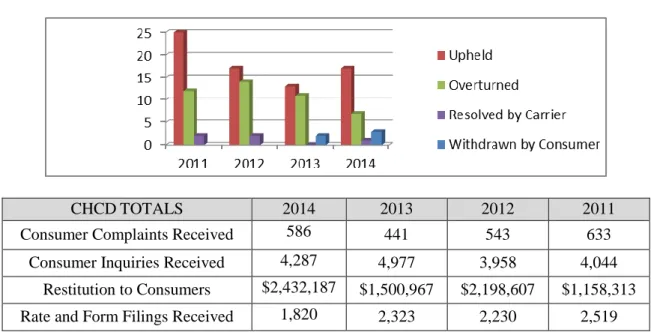
In 2014 the Bureau’s Consumer Health Care Division received 53 requests for external review: 1 was resolved by the insurance carrier before the external review and 18 were not completed because the consumers did not return the necessary signed releases to continue the process. Of the 34 remaining requests, 24 were completed by January 1,
31 2015, 3 were withdrawn by the consumer, and 1 was resolved by the company before hearing. Of the 24 requests completed within CY14, 17 (71%) upheld the carrier’s decision, 1 was partially overturned (4%) and 6 were overturned (25%).
Figure 2 illustrates the number of external reviews that were overturned, upheld, resolved by the carrier, or withdrawn by the consumer before the review, for the years 2011 through 2014.
External Review Outcomes by Year:
CHCDTOTALS 2014 2013 2012 2011
Consumer Complaints Received 586 441 543 633 Consumer Inquiries Received 4,287 4,977 3,958 4,044
Restitution to Consumers $2,432,187 $1,500,967 $2,198,607 $1,158,313 Rate and Form Filings Received 1,820 2,323 2,230 2,519
Life & Health Actuarial
The Life & Health Actuarial Work Unit provides actuarial and technical services to Bureau staff on questions relating to life and health insurance. Among its
responsibilities, the unit:
▪ Reviews and takes appropriate action on rate filings for regulated lines of insurance, primarily individual health, small group medical, credit life and health, group and individual Medicare supplement, and long-term care;
▪ Provides reserve analysis of life and health insurance companies as required by law; ▪ Offers technical assistance to insureds, consumers, state agencies, and others; ▪ Prepares annual reports on mandated benefits claims experience;
▪ Prepares “market snapshots” for the small group and individual health insurance markets;
▪ Maintains database of reports on small group and individual health insurance; ▪ Maintains database of claims paid by third-party administrators and by insurers
administering employers’ self-funded health plans;
32 ▪ Studies proposed mandated benefit legislation as requested by the Legislature to
determine the social impact, the financial impact, and the medical efficacy of the proposed mandate; and
▪ Estimates the impact on health insurance premiums of proposed expansions of health care services requiring a certificate of need (“CON”) from the Maine Department of Health and Human Services.
In accordance with Title 24-A M.R.S.A. §2837-A, §2840-A, and §2843, the Bureau is responsible for issuing an annual report to the Legislature regarding selectedMandated Benefits, specifically mental health, substance abuse, chiropractic, and mammography. This report compares the amount of claims paid for mandated benefits to the total amount of health claims paid. Bureau reports are available on the agency’s website at
www.maine.gov/insurance under Bureau Reports.
Property & Casualty and Workers Compensation
The Property & Casualty Work Unit reviews and approves rates, rating rules, and policy forms that property and casualty insurance companies and advisory organizations file for products they intend to write in Maine. Filings are reviewed to ensure compliance with applicable Maine law.
The unit also investigates complaints for all lines of property and casualty insurance. Often this includes conducting administrative hearings when a consumer’s automobile or homeowner’s policy is canceled or nonrenewed.
Property & Casualty Totals 2014 2013 2012 2011 Consumer Complaints Received 296 306 319 383 Consumer Complaints Closed 290 278 348 387 Consumer Inquiries Received 3,800 4022 4,760 4,901 Restitution to Consumers $963,110 $381,459 $ 943,685 $ 1,691,055 Rate and Form Filings Received 3,877 3,434 3,092 3,071
Hearings by Year:
When an insurance company issues a notice of cancellation or nonrenewal of a
homeowner or personal auto policy, or a notice of cancellation of a commercial policy, the company is required to advise the insured that a hearing may be requested to contest the action. The hearing provides a forum to dispute the reason(s) and requires the Bureau to rule whether the cancellation or nonrenewal was done in accordance with Maine law.