Kent Academic Repository
Full text document (pdf)
Copyright & reuse
Content in the Kent Academic Repository is made available for research purposes. Unless otherwise stated all content is protected by copyright and in the absence of an open licence (eg Creative Commons), permissions for further reuse of content should be sought from the publisher, author or other copyright holder.
Versions of research
The version in the Kent Academic Repository may differ from the final published version.
Users are advised to check http://kar.kent.ac.uk for the status of the paper. Users should always cite the published version of record.
Enquiries
For any further enquiries regarding the licence status of this document, please contact:
If you believe this document infringes copyright then please contact the KAR admin team with the take-down information provided at http://kar.kent.ac.uk/contact.html
Citation for published version
Li, Zengxi and Song, Yan and Dai, Li-Rong and McLoughlin, Ian Vince (2018) Source-Aware
Context Network for Single-Channel Multi-speaker Speech Separation. In: 2018 IEEE International
Conference on Acoustics, Speech and Signal Processing (ICASSP), 15–20 April 2018, Calgary,
Alberta, Canada. (In press)
DOI
Link to record in KAR
http://kar.kent.ac.uk/67161/
Document Version
SOURCE-AWARE CONTEXT NETWORK FOR SINGLE-CHANNEL MULTI-SPEAKER
SPEECH SEPARATION
Zeng-Xi Li
⋆Yan Song
⋆Li-Rong Dai
⋆Ian McLoughlin
†⋆
National Engineering Laboratory for Speech and Language Information Processing,
University of Science and Technology of China, Hefei, China.
†
School of Computing, University of Kent, Medway, UK.
ABSTRACT
Deep learning based approaches have achieved promising performance in speaker-dependent single-channel multi-speaker speech separation. However, partly due to the la-bel permutation problem, they may encounter difficulties in speaker-independent conditions. Recent methods address this problem by some assignment operations. Different from them, we propose a novel source-aware context network, which explicitly inputs speech sources as well as mixture sig-nal. By exploiting the temporal dependency and continuity of the same source signal, the permutation order of outputs can be easily determined without any additional post-processing. Furthermore, a Multi-time-step Prediction Training strat-egy is proposed to address the mismatch between training and inference stages. Experimental results on benchmark WSJ0-2mix dataset revealed that our network outperformed state-of-the-art methods in both closed-set and open-set con-ditions with similar or comparable experimental settings, in terms of Signal-to-Distortion Ratio (SDR) improvement.
Index Terms— Speech Separation, Deep Learning, Label Permutation Problem
1. INTRODUCTION
Multi-speaker single-channel speech separation is the task of estimating the individual sources from a monaural mixture of speech. It has important real-world applications including robust automatic speech recognition, multi-speaker meeting transcription and audio/video captioning. Unlike human lis-teners who can concentrate on separate sources in an acoustic mixture, automatic speech separation is still a challenging and unsolved problem [1].
Over the past few decades, significant efforts have been devoted to speech separation [2, 3, 4, 5, 6, 7]. Before the emergence of deep learning, the most popular separation tech-niques were based on Computational Auditory Scene Anal-ysis (CASA) [2, 3]. In CASA, segmentation and grouping
This work was supported in part by National key research and devel-opment program (Grant No. 2017YFB1002200), and by National Natural Science Foundation of China (Grant No. U1613211).
rules, which are typically hand-engineered or heuristic, are utilized to group Time-Frequency (T-F) units belonging to the same speaker. Another technique is Non-negative Matrix Fac-torization (NMF) [4]. In NMF, a mixture is decomposed into specific activations using a set of non-negative bases. How-ever, limited success has been achieved for multi-speaker sep-aration. Recently, some deep learning approaches have been proposed, casting speech separation as a multi-class regres-sion problem [5, 6, 7]. Despite their effectiveness at speaker-dependent separation, they often encounter difficulties with speaker-independent separation, partially in thelabel permu-tation problem[8], which will be detailed in Section 2.
More recently, several approaches have been proposed to address the label permutation problem, including the follow-ing: In [9, 10], instantaneous energy pattern or speaker infor-mation is used to determine speaker assignment. In [11, 8], Permutation Invariant Training (PIT) and utterance-level PIT determine the speaker order according to the lowest separa-tion error within all possible permutasepara-tions. In [12, 13], the Deep Clustering (DPCL) method performs label assignment using the clustering algorithm in a deep embedding space. In [14, 15], a Deep Attractor Network (DANet) creates at-tractor points in embedding space to determine the source as-signment. The main idea of these methods is to determine source assignment based on similarity measurements in em-bedding space, or in the original spectral space (e.g., distance of embedding vectors in DPCL and DANet, Mean Square Er-ror (MSE) between estimated and target magnitude spectra in PIT).
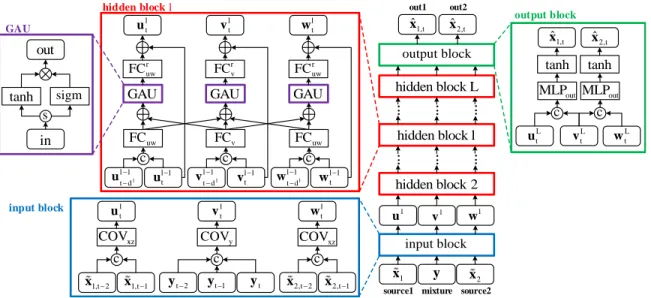
Unlike those methods, we propose a novel source-aware context network for single-channel multi-speaker speech sep-aration. As shown in Fig. 1, the proposed network explicitly inputs speech sources as well as mixture, and directly outputs estimated sources, which will be fed back as input sources for processing during the next time step. By exploiting depen-dency and continuity of the same source (important acoustic cues indicated by Auditory Scene Analysis (ASA) [2]), the permutation order of outputs can be easily determined with-out any additional operation. More details will be described in Section 3. A Multi-time-step Prediction Training (MPT)
source1 mixture source2 input block 1 w 1 u 1 v y hidden block 2
..
.
hidden block l hidden block L output block c c cGAU GAU GAU
r uw FC r uw FC r v FC uw FC FCv FCuw 1 l l t d v l1 t v 1 l l t d u l1 t u 1l l t d w l1 t w l t v l t u l t w in out tanh sigm s c c c xz
COV COVy COVxz
1 t y 2 t y yt 1 t u v1t 1 t w
..
.
..
.
L t w L t u L t v c c out MLP MLPout out1 out2 tanh tanh hidden block l GAU output block input block..
.
..
.
..
.
1, ˆ t x 1, ˆ t x 2, ˆ t x 2, ˆ t x 1 x x2 1,t2 x x1,t1 x2,t2 x2,t1Fig. 1. An overview of the networkGimplementing Eqn. (4) for a two-speaker separation task. GAU, FC, MLP, sigm, c,
s
,⊗and⊕represent Gated Activation Unit [16], full connection, multi layer perceptron, sigmoid activation, concatenation, equally slicing operation, element-wise multiplication and addition respectively.
strategy is further proposed to alleviate the mismatch between training and inference stages. Specifically, at each time step, network outputs are fed back as inputs for the next time step. This repeats across multiple time steps, generating a sequence of estimated sources in a recursive manner.
To evaluate the effectiveness of the proposed network, we conducted extensive experiments on the benchmark WSJ0-2mix dataset [12]. Results revealed that the MPT strategy allows our proposed network to outperform state-of-the-art methods in both closed-set and open-set conditions with simi-lar or comparable experimental settings [12, 13, 14, 15, 11, 8].
2. LABEL PERMUTATION PROBLEM
As mentioned, conventional deep learning based methods commonly cast multi-speaker separation as a multi-class re-gression problem. For ease of description, we will focus on two-speaker situations [11, 8]. Generally, the separation modelHcan be formulated as
ˆ
x1,t,xˆ2,t=H(yt+F, . . . ,yt−P) (1)
whereˆx1,t andxˆ2,t are the t-th estimated magnitude
spec-tra of two sources,yt is the observedt-th magnitude
spec-tra of the mixture, which is generated as a waveformyn = x1,n+x2,n, and the receptive field length of future and past
spectra are denoted asFandPrespectively. The modelHis used to estimate thet-th clean magnitude spectra of the cor-responding sources,i.e.,x1,tandx2,t.
During training, the error between targets [x1,t,x2,t]
and outputs [ˆx1,t,xˆ2,t] needs to be computed for
back-propagation. However, for conventional deep learning based
approaches, using only input y, it is unknown in advance
whether the outputs order is[ˆx1,t,ˆx2,t] or[ˆx2,t,xˆ1,t]. This
problem is referred to as thelabel permutation problem[8]. DPCL, DANet and PIT methods can all be represented by Eqn. (1). The difference is that the outputs order (and la-bel permutation) is determined by additional operations such as assignment according to the lowest separation error, or clustering in a deep embedding space.
3. SOURCE-AWARE CONTEXT NETWORK
Unlike existing methods, our proposed model simultaneously and recursively estimates two sources by modeling the con-ditional distribution of current sources’ spectra, given past sources’ spectra and mixture spectra,i.e.,
ˆ x1,t∼p(x1,t|x1,t−1, . . . ,x1,t−P;x2,t−1, . . . ,x2,t−P; yt, . . . ,yt−P) (2) ˆ x2,t∼p(x2,t|x2,t−1, . . . ,x2,t−P;x1,t−1, . . . ,x1,t−P; yt, . . . ,yt−P) (3) Therefore, according to Eqns. (2)(3), the regression modelG
can be defined as ˆ x1,t,xˆ2,t=G(˜x1,t−1, . . . ,x˜1,t−P; ˜x2,t−1, . . . ,x˜2,t−P; yt, . . . ,yt−P) (4) wherex˜k,t′ = ˆxk,t′, ∀k = {1,2}, t′ = t −P, . . . , t−1
during inference. As a result, without additional operations, the outputs order is determined in advance – just the same as input sources. It is worth noting thatGdoes not require future mixture spectra during inference, and Eqn. (4) can be easily extended to multiple speaker separation tasks.
3.1. Network Architecture
Inspired by WaveNet [17], the network G implementing Eqn. (4) is designed as shown in Fig. 1. Gconsists of three parts: an input block, several stacked hidden blocks and an output block, which will be described below.
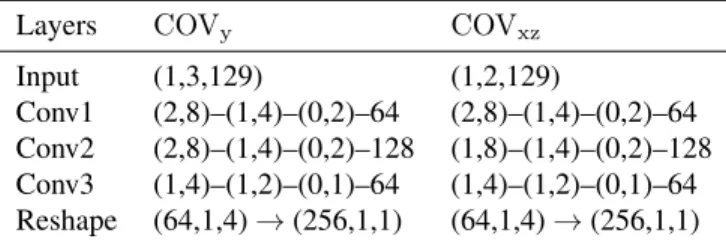
Input Block. In order to capture ASA acoustic cues like
proximity in frequency and time, harmonicity, onset and off-set [2], as shown with a blue rectangle in Fig. 1 and detailed in Table 1, the input block extracts local temporal and spectral features of neighboring spectra with 2D convolutional layers followed by PReLUs [18]. Experiments use an 8 kHz sample rate for all waveforms, from which µ-law companded [19] magnitude spectra of dimension129were computed at 32 ms frame length with 10 ms shift, resulting in a feature map width of129in the input layers.
Table 1. Input block details ofCOVy andCOVxz. Feature
map shapes in Input and Reshape layers are denoted in (chan-nel, height, width) format. Convolution settings are denoted in kernel–stride–pad–channel format.
Layers COVy COVxz Input (1,3,129) (1,2,129)
Conv1 (2,8)–(1,4)–(0,2)–64 (2,8)–(1,4)–(0,2)–64 Conv2 (2,8)–(1,4)–(0,2)–128 (1,8)–(1,4)–(0,2)–128 Conv3 (1,4)–(1,2)–(0,1)–64 (1,4)–(1,2)–(0,1)–64 Reshape (64,1,4)→(256,1,1) (64,1,4)→(256,1,1)
Hidden Blocksare shown with red rectangles in Fig. 1.
Hidden blocks are designed with the main consideration that the enhancement of the mixture will benefit from the estima-tion of clean sources, and vice versa. Using a condiestima-tioning method similar to [17],ult,vltandwtlcan be considered as
outputs given conditions vl∗−1, {ul∗−1,wl∗−1} andvl∗−1
re-spectively,i.e., ult=f(u l−1 t ,u l−1 t−dl|v l−1 t ,v l−1 t−dl) (5) wtl=f(w l−1 t ,w l−1 t−dl|v l−1 t ,v l−1 t−dl) (6) vlt=g(v l−1 t ,v l−1 t−dl|u l−1 t ,u l−1 t−dl,w l−1 t ,w l−1 t−dl) (7)
wheredlis the temporal dilation factor for hidden blockl. As
long asL anddl of all hidden blocks are known, receptive
field length can be determined byP = Σdl+ 2.
Output Block. As shown with a green rectangle in Fig.
1, outputsxˆ1,tandxˆ2,tare derived from{uLt,vLt}and{wtL,
vLt}of the last hidden blockLrespectively using a multi layer
perceptron structure equipped with a PReLU and atanh ac-tivation, which consists of a 512-unit hidden layer and a 129-dimension output layer.
It is worth mentioning that, with respect to sources x1 andx2, network parameters are all shared, and the structure is completely symmetric. This characteristic conforms to the
common sense that all positions of each source are equivalent and exchangeable. Moreover, this design avoids model size growth when source number increases.
3.2. Multi-time-step Prediction Training
Using a conventional training method such as [17], a mis-match problem would arise between training and inference stages. During training, source inputsx˜k,<t in Eqn.(4) are
clean spectra xk,<t, whereas in the inference stage, they
change to estimated spectraxˆk,<t. The error between the two
spectra leads to a mismatch, especially prevalent when both sources show similar patterns (e.g., energy, onset time and pitch trajectory).
To alleviate this problem, we adopt a Multi-time-step Pre-diction Training (MPT) strategy. At the first time stept′=t,
source inputs are all clean spectra. Then at each time step
t′, outputsxˆk,t′ are fed back as inputsx˜k,t′ to replace
orig-inal clean spectra xk,t′ for the next time step t′ + 1. This
procedure repeatsStimes recursively, generating a sequence of estimated source spectra ˆxk,t′, t′ = t, . . . , t+S −1.
Finally, network parameters are optimized to minimize the averaged MSE between targets and corresponding estimated source spectra across all time steps:
L= 1 F S SX−1 s=0 K X k=1 kxk,t+s−xˆk,t+sk22 (8)
whereS,KandF are step number, source number and fre-quency bin number respectively (in this paperK=2,F=129),
k · k2is theL2norm.
4. EXPERIMENTS 4.1. Experimental Setup
We evaluated our network on the WSJ0-2mix dataset, which was also used in [12, 14, 8]. WSJ0-2mix was introduced in [12] and is derived from the WSJ0 corpus [20]. A 30-hour training set and a10-hour validation set contained two-speaker mixtures generated by utterances randomly selected from the WSJ0 training setsi tr s, which were mixed at
various Signal-to-Noise Ratios (SNR) between0 dB and10 dB. A5-hour test set was similarly generated using utterances from 16 speakers in the WSJ0 development set si dt 05
and evaluation setsi et 05. The validation set and the test
set were used to evaluate separation performance for closed condition (CC) and open condition (OC) (unseen speaker) re-spectively.
The networkGevaluated had10hidden blocks with di-lation factors[d2, . . . , d11]=[1, 2, 4, 8, 16, 1, 2, 4, 8, 16] and dimensions ofu,v,w were set to256. As a result,Ghad
approximately7.2million parameters, and from Section 3.1, we can see thatP=64.
To accelerate training with MPT described in Section 3.2, a strategy was employed following curriculum learning [21]: The training starts from smallSin Eqn. (8), when validation loss converges,S increases to a larger value. In the experi-ments, this procedure repeats several times withSincreasing in the order of 1, 5, 10, 30, 60, 90 and 120, whereS=1 is equivalent to conventional training method. The network was optimized using the Adam algorithm [22] with learning rate 0.001 forS=1, 0.0002 for S=5, and 0.0001 for otherS set-tings. Meanwhile, dropout (p=0.2) was only applied in the input block whenS <60.
Considering Gis completely symmetric with respect to two sourcesx1andx2, during inference, source inputsx˜1,<t
andx˜2,<tcannot all be initialized to silent spectra, otherwise
two outputsˆx1andˆx2will always be the same. Instead, in the experimentsx˜1,<tare initialized toP−5 = 59frames of
silent spectra plus5frames of mixture spectray, whilex˜1,<t
are all initialized toP frames of silent spectra.
All experiments were implemented using MXNet [23], with the separated waveform reconstructed from the esti-mated sources’ magnitude spectra, using phase from the original mixed speech.
4.2. Experimental Results
Separation performance was evaluated in terms of averaged Signal-to-Distortion Ratio (SDR) [24] improvement between separated speech and mixture.
Evaluation of Multi-time-step Prediction Training.We
evaluate MPT with different step numberSfor closed condi-tion (CC) and open condicondi-tion (OC) respectively. The results are shown in Table 2.
We can see that conventional training methods (S=1) per-formed poorly, suggesting a large mismatch between training and inference. However, with MPT (S >1), SDR was sig-nificantly improved,e.g., 6.9 dB in OC whenS = 5. More-over, the best result (9.5 dB in OC) can be observed atS=60, which indicates that an appropriate ratio of clean and esti-mated source inputs may be essential for training. Finally, comparable or higher SDRs for OC compared to CC indicate that our network generalized well for unseen speakers.
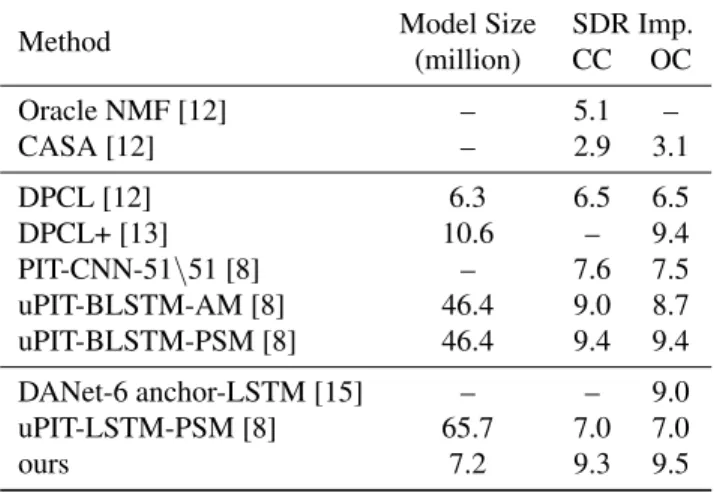
Comparison with other methods. Table 3 summarizes
SDR improvements and approximate model size (in terms of parameter number) for different methods with similar or com-parable experimental settings. It is worth noting that all deep learning based models needed future mixture as input during inference, except for the last three models. We can see that the proposed network achieved comparable or higher SDR than DPCL, DANet and PIT models in OC and CC conditions with competitive model size.
In [8, 15], there are significant performance gaps between BLSTM and LSTM. For example, in [15], DANet-6 anchor achieved 10.4 dB SDR, higher than DANet-6 anchor-LSTM (9.0 dB SDR). This is reasonable since BLSTM can exploit
Table 2. Closed-condition (CC) and open-condition (OC)
SDR improvements (dB) for different step numbers S in MPT.S=1 denotes conventional training method.
S SDR Improvement CC OC 1 -3.0 -2.4 5 6.7 6.9 10 7.1 7.4 30 8.8 9.0 60 9.3 9.5 90 9.2 9.2 120 9.0 9.0
Table 3. SDR improvements (dB) and approximate model
sizes (in terms of parameter number estimated according to the papers) of different methods for the same scenarios.
Method Model Size SDR Imp. (million) CC OC Oracle NMF [12] – 5.1 – CASA [12] – 2.9 3.1 DPCL [12] 6.3 6.5 6.5 DPCL+ [13] 10.6 – 9.4 PIT-CNN-51\51 [8] – 7.6 7.5 uPIT-BLSTM-AM [8] 46.4 9.0 8.7 uPIT-BLSTM-PSM [8] 46.4 9.4 9.4 DANet-6 anchor-LSTM [15] – – 9.0 uPIT-LSTM-PSM [8] 65.7 7.0 7.0 ours 7.2 9.3 9.5
future context information compared with LSTM. It is worth noting that our proposed network can be easily modified to incorporate future context as in BLSTM. In future we propose a detailed evaluation of parameter settings.
5. CONCLUSION
This paper proposed a novel source-aware context network and MPT strategy for single-channel multi-speaker speech separation. The network is designed to address the label permutation problem by exploiting temporal dependencies and continuity of the same speech source. During inference, no future mixture or post-processing is needed, making it more practical for on-line systems. The MPT strategy is further proposed to address the mismatch problem between training and inference stages. Experimental results on bench-mark WSJ0-2mix revealed that, equipped with MPT strategy, our network outperformed state-of-the-art methods in both closed-set and open-set conditions with similar or compara-ble experimental settings, in terms of SDR improvements.
6. REFERENCES
[1] M. Cooke, J. R. Hershey, and S. J. Rennie, “Monaural speech separation and recognition challenge,”Computer Speech & Language, vol. 24, no. 1, pp. 1–15, 2010. [2] G. J. Brown and M. Cooke, “Computational auditory
scene analysis,”Computer Speech & Language, vol. 8, no. 4, pp. 297–336, 1994.
[3] Y. Shao and D. Wang, “Model-based sequential orga-nization in cochannel speech,” IEEE Trans. on Audio, Speech, and Lang. Process., vol. 14, no. 1, pp. 289–298, 2006.
[4] M. N. Schmidt and R. K. Olsson, “Single-channel speech separation using sparse non-negative matrix fac-torization,” inINTERSPEECH, 2006.
[5] J. Du, Y. Tu, Y. Xu, L. Dai, and C.-H. Lee, “Speech separation of a target speaker based on deep neural net-works,” inInt. Conf. on Signal Process. IEEE, 2014, pp. 473–477.
[6] Y. Tu, J. Du, Y. Xu, L. Dai, and C.-H. Lee, “Speech sep-aration based on improved deep neural networks with dual outputs of speech features for both target and inter-fering speakers,” inInt. Symposium on Chinese Spoken Lang. Process. IEEE, 2014, pp. 250–254.
[7] P.-S. Huang, M. Kim, M. Hasegawa-Johnson, and P. Smaragdis, “Joint optimization of masks and deep recurrent neural networks for monaural source separa-tion,”IEEE Trans. on Audio, Speech and Lang. Process., vol. 23, no. 12, pp. 2136–2147, 2015.
[8] M. Kolbæk, D. Yu, Z.-H. Tan, and J. Jensen, “Mul-titalker speech separation with utterance-level permu-tation invariant training of deep recurrent neural net-works,”IEEE Trans. on Audio, Speech, and Lang. Pro-cess., vol. 25, no. 10, pp. 1901–1913, 2017.
[9] C. Weng, D. Yu, M. L. Seltzer, and J. Droppo, “Deep neural networks for single-channel multi-talker speech recognition,”IEEE Trans. on Audio, Speech and Lang. Process., vol. 23, no. 10, pp. 1670–1679, 2015.
[10] Y. Wang, J. Du, L.-R. Dai, and C.-H. Lee, “A gen-der mixture detection approach to unsupervised single-channel speech separation based on deep neural net-works,”IEEE Trans. on Audio, Speech, and Lang. Pro-cess., vol. 25, no. 7, pp. 1535–1546, 2017.
[11] D. Yu, M. Kolbæk, Z.-H. Tan, and J. Jensen, “Permu-tation invariant training of deep models for speaker-independent multi-talker speech separation,” in IEEE Int. Conf. on Acoust., Speech and Signal Process.
IEEE, 2017, pp. 241–245.
[12] J. R. Hershey, Z. Chen, J. Le Roux, and S. Watan-abe, “Deep clustering: Discriminative embeddings for segmentation and separation,” in IEEE Int. Conf. on Acoust., Speech and Signal Process. IEEE, 2016, pp. 31–35.
[13] Y. Isik, J. Le Roux, Z. Chen, S. Watanabe, and J. R. Her-shey, “Single-channel multi-speaker separation using deep clustering,”INTERSPEECH, pp. 545–549, 2016. [14] Z. Chen, Y. Luo, and N. Mesgarani, “Deep attractor
network for single-microphone speaker separation,” in
IEEE Int. Conf. on Acoust., Speech and Signal Process.
IEEE, 2017, pp. 246–250.
[15] ——, “Speaker-independent speech separation with deep attractor network,” arXiv preprint arXiv:1707.03634, 2017.
[16] A. van den Oord, N. Kalchbrenner, L. Espeholt, O. Vinyals, A. Graves et al., “Conditional image gen-eration with pixelcnn decoders,” inAdvances in Neural Inform. Process. Systems, 2016, pp. 4790–4798. [17] A. van den Oord, S. Dieleman, H. Zen, K. Simonyan,
O. Vinyals, A. Graves, N. Kalchbrenner, A. Senior, and K. Kavukcuoglu, “Wavenet: A generative model for raw audio,”CoRR abs/1609.03499, 2016.
[18] K. He, X. Zhang, S. Ren, and J. Sun, “Delving deep into rectifiers: Surpassing human-level performance on imagenet classification,” inProc. of the IEEE Int. Conf. on Comp. Vision, 2015, pp. 1026–1034.
[19] C. Recommendation, “Pulse code modulation (pcm) of voice frequencies,”ITU, 1988.
[20] J. Garofolo, D. Graff, D. Paul, and D. Pallett, “Csr-i (wsj0) complete ldc93s6a,”Philadelphia, USA: Linguis-tic Data Consortium, 1993.
[21] Y. Bengio, J. Louradour, R. Collobert, and J. Weston, “Curriculum learning,” inProc. of the 26th annual Int. Conf. on Machine Learning. ACM, 2009, pp. 41–48. [22] D. Kingma and J. Ba, “Adam: A method for stochastic
optimization,”arXiv preprint arXiv:1412.6980, 2014. [23] T. Chen, M. Li, Y. Li, M. Lin, N. Wang, M. Wang,
T. Xiao, B. Xu, C. Zhang, and Z. Zhang, “Mxnet: A flexible and efficient machine learning library for heterogeneous distributed systems,” arXiv preprint arXiv:1512.01274, 2015.
[24] E. Vincent, R. Gribonval, and C. F´evotte, “Performance measurement in blind audio source separation,” IEEE Trans. on Audio, speech, and Lang. Process., vol. 14, no. 4, pp. 1462–1469, 2006.