Draft (Do not quote)
Spatial Econometric Approaches to Estimating
Hedonic Property Value Models
Li Wang1 and Richard C. Ready2
Selected Paper prepared for presentation at the American Agricultural Economics Association Annual Meeting, Providence, Rhode Island,
July 24-27, 2005
Copyright 2005 by Li Wang and Richard C. Ready. All rights reserved. Readers may make verbatim copies of this document for non-commercial purposes by any means, provided that this copyright notice appears on such copies.
1
Graduate Student, the Pennsylvania State University, Department of Agricultural Economics and Rural Sociology, 312 Armsby Building, University Park, USA 16802,
Assistant Professor, the Pennsylvania State University, Department of Agricultural Economics and Rural Sociology, 112-A Armsby Building, University Park, USA 16802,
Spatial Econometric Approaches to Estimating Hedonic Property Value Models Li Wang and Richard C. Ready
Abstract: The inclusion of spatial correlation of house price in hedonic pricing model may produce better marginal implicit price estimate(s) of the environmental variable(s) of interest. Most applications where a spatial econometric model is applied to the estimation of a hedonic property value model have used either a spatial lag model or a spatial autoregressive (SAR) error model. Incorrect spatial specification may produce even worse estimate outcome than OLS. Three issues regarding the specification of a spatial hedonic pricing model are considered. First, we question the “convention” of row-standardizing the spatial weights matrix. Second, we argue that the spatial error components (SEC) model is more theoretically intuitive and appealing for modeling house price. Third, we explore whether the choice of spatial model is important, empirically, using a large house sale dataset that includes measures of proximity to landfills. With one exception, estimated marginal implicit prices are fairly robust across all models.
Keywords: row-standardization, spatial econometrics, SEC model, SAR error model, spatial lag model, hedonic pricing, landfill, house price
1. Introduction
In real estate economics, hedonic pricing models are commonly used to estimate the negative externalities generated by undesirable land uses such as landfills, toxic waste
sites, incinerators, etc, on house prices. These models rely on spatial variation in house price, and typically measure the gradient in house price as distance to the undesirable land use increases. However, spatial dependence of house prices is widely observed in real estate data (high-valued houses tend to cluster together as do low-valued houses). One prominent example follows the conventional “wisdom” among real estate professionals that the cheapest house on the block appreciates faster than more expensive neighbors. The spatial correlation of house price may result from a herd behavior around neighboring house prices where price expectations are formed based on neighboring values. The price setting process by using “comparables” (selling prices of neighboring houses) fits to this story. Price (amenity) externality also contributes to the spatial correlation as people receive positive utility from living close to nicer (high-valued) houses with the result that surrounding high-priced houses push your house price up. The herd effect and price externality lead to the spatial lag model where a spatially lagged dependent variable (spatially weighted neighboring prices) helps to explain the determination of house prices. Different from the intuitive interpretation, there are other two most cited “technical” sources of spatially correlated house prices: common omitted explanatory variable(s) and measurement error(s). An omitted variable or measurement error that affects nearby properties will result in spatially correlated errors in a similar way. Both of them lead to the specification of spatial error model.
The traditional hedonic model does not explicitly take the spatial dimension of housing price data into account, even though the OLS model is “spatial” in the sense that it measures characteristics that vary spatially, e.g., the distance to central business district
or distance to an undesirable land use. If house prices are spatially correlated, either in their levels or in the errors, then simple OLS regression can give spurious results. This is important since the significant marginal implicit price (MIP) estimate of, say, proximity to a landfill, may be due to spatial correlation of house price. Houses with correlated selling price could happen to locate near a landfill that has no significant externality. Without accounting for the spatial correlation of nearby house prices, its effect would be manifest through an erroneously significant MIP estimate of the landfill. Even if the landfill does depress nearby house prices, its negative effect spills across houses and may get entangled with the spatial correlation of nearby house prices, resulting in an imprecise MIP estimate. Spatial econometrics explicitly accounts for the influence of space in real estate, urban and regional models.
Recent years have seen many applications of spatial econometric approaches in hedonic pricing studies (Pace and Gilley 1997, Basu and Thibodeau 1998, Durbin, Pace and Thibodeau 1999, Paterson and Boyle 2002, Wilhelmsson 2002, Kim et al 2003, Goldsmith 2004, etc). The two most frequently used models in the spatial hedonic pricing literature are the spatial lag model and the spatial autoregressive (SAR) error model 1. One reason for their popularity is that computer packages, e.g., the Spatial Econometrics Toolbox for Matlab by LeSage and GeoDa by Anselin, contain programming to estimate these two models. While some authors have explored which of these two models might provide a better fit to a particular dataset, there has been less exploration of the sensitivity of externality estimates to the choice of spatial model, and even less reflection on which models might be theoretically more appropriate for hedonic models.
Another often ignored point in practice is the “conventional” use of row-standardized spatial weights matrices. Row-standardization is appealing in part because the associated spatial parameter has a clear interpretation as a measure of spatial dependence (autocorrelation). This makes the spatial parameter comparable between models. However, as Bell and Bockstael (2000) argue, row-standardization changes the assumed spatial structure of the sample data and so the intended “economic” relationship among observations.
This paper simultaneously explores both spatial model selection and row-standardization of the spatial weights matrix, as these two concerns are interdependent. We argue that, based on theoretical grounds, the spatial error components (SEC) model suggested by Kelijian and Robinson provides a better model for house price data than the spatial lag model and the SAR error model. We also claim that, for house price, a row-standardized spatial weights matrix is more appropriate for the spatial lag model and may better fit the SEC model than a non-standardized weights matrix; by contrast, there is no strong a priori reason to favor using a row-standardized spatial weights matrix in the SAR error model. To illustrate, we use the hedonic price model to estimate the impacts that three different landfills have on nearby house prices. We estimate the implicit price function using a spatial lag model, the SAR error model and the SEC model with both row-standardized and non-row-standardized weights matrices. Our claims are supported by the large-sample empirical evidence.
The remainder of this paper is organized as follows. In section 2, we first review several popular spatial model specifications with focus on their theoretical implications. In section 3, we briefly analyze the consequences of row-standardizing spatial weights matrices and relate it to different spatial models. In section 4, a review of protocols for spatial model selection is given, including the LM test, the Bayes factor method and a pseudo-R2 goodness-of-fit criterion. Section 5 describes the data, the landfills and the study area. In section 6, the estimation results and tests are presented and discussed in more detail, with emphasis on model selection. The comparisons of the estimation results including the OLS estimate are also given. Section 7 concludes the paper. More detail is available in technical appendices.
2. Review on spatial regression models: theoretical implications
In essence, each spatial model specifies a spatial process under which the observations are generated. Different beliefs on spatial relationship (spatial dependence and spatial heterogeneity) are established by selecting different spatial models. The applications of the spatial lag model, the SAR error model and the SEC model to house price represent three distinct spatial data generating processes (DGP) of house price. De Graaff et al (2001) list three reasons for handling spatial dependence and spatial heterogeneity jointly; we will just focus on spatial dependence of house price in our analysis.
2.1 Spatial lag model
Anselin (2002) discusses two main motivations for including spatial effects in regression models from a theory-driven as well as from a data-driven perspective. A theory-driven
framework follows from the formal specification of spatial interaction (interacting agents, social interaction) in an economic model, where an explicit interest in the spatial interaction of a particular variable prevails and a theoretical ground generates the model specification. In other words, dependence of spatial process of the particular variable is substantive, compared with the so-called “nuisance” correlation of spatial error processes.
If we believe that the selling price of a house at a location acts as a signal that guides the selling prices of its neighboring houses, or a herd behavior exists, spatial dependence of house prices can be modeled directly as including a spatially lagged dependent variable into the hedonic pricing model. This model captures the intuitive idea that a house surrounded by expensive houses is worth more than a house surrounded by inexpensive houses. Then, the neighboring house prices act as an explanatory variable of the house price at a particular location.
As a result, the spatial lag model takes the form
) , 0 ( ~ N 2In X Wy y σ ε ε β ρ + + = (1)
where y is a n×1vector of house prices, W is the pre-specified n×nmatrix of spatial weights, ρis a spatial autocorrelation coefficient (when Wis row-standardized), X is a matrix of explanatory variables including house structural characteristics, location characteristics and environmental attributes of interest,
k n×
βis a k×1vector of parameters to
necessary for ML estimation; however, the IV/2SLS estimation does not depend on it (Anselin, 1988, Chap 7).
Bell and Bockstael (2000) argue that there is less reason to expect a spatial lag structure for house price. It would occur only when the selling price reacts directly to selling prices of neighboring houses and not just to characteristics of neighboring houses. Furthermore, this relationship would only be one-way, namely, the first sold house would affect subsequent sales but not vice versa. This is an important observation as the observed spatial dependence (correlation) of house prices may not be the result of this “price-bidding” process; its existence could be purely statistical. Nevertheless, the one-way relationship is valid only if it is due to a herd effect. If the price externality is the main reason of spatial correlation, the price of sold house will also be affected by the (expected) prices of incoming houses in the neighborhood, resulting in interacted neighboring house prices. Therefore, the relationship between neighboring house prices needs not to be one-way.
We can rewrite the lag model asy =(I −ρW)−1Xβ +(I −ρW)−1ε . Conditioning onX ,
the covariance structure of takes the form of .
Since is a full matrix with
y σ2(I−ρW)−1(I −ρW')−1 1
)
(I−ρW − ρ ≠0, a first implication is that the house prices are globally correlated since each location is correlated with every other location in the system, although in a fashion that decays with order of neighbors. More importantly, it says that house price at one location depends on the characteristics (X ) of all other houses in the sample and the errors of all other observations, which does not make much
sense. This outcome can be easily seen when W is row-standardized. Footnote 8 of Kelijian and Prucha (1998) allows for the “Leontief expansion” of
... ) (I −ρW −1 = I+ρW +ρ2W2 +ρ3W3 + , then we have ε ρ ρ + ρ β ρ ρ ρ ...) ( ...) ( + + 2 2 + 3 3+ + + 2 2 + 3 3 + = I W W W X I W W W y = Xβ +ρWXβ+ρ2W2Xβ+...+ε +ρWε+ρ2W2ε +... (2)
The spatial lag specification of house price is justified under the real-estate appraisal process using comparable sale prices or by house price externality. This may not work. It is also the reason why more empirical studies favor the SAR error process over the lag structure.
2.2 SAR error model
The theory-driven perspective motivating spatial correlation in house prices is appealing. However, in practice, the motivation for applying a spatial econometric model is usually not driven by formal theoretical concerns, but a result of “peculiarities” of the available spatial data. This framework considers outcomes in neighboring places to be related to one another because of unobserved components that are spatially correlated. The interest is to obtain efficient coefficient estimates in hedonic model and make correct inference. Most spatial hedonic pricing models fall into this data-driven framework in the sense of the way to specifying the spatially correlated error structure in hedonic regression.
The spatial dependence among regression errors results from two sources: (erroneously) omitted spatially-correlated variable(s) and measurement error or misspecification of the
functional form. The location of a house influences its selling price and nearby houses will be affected by the same location factors. Since the inclusion of all relevant attributes is seldom fulfilled and the effects of all omitted variables are subsumed into the error term, if the omitted variables are spatially correlated, so are the regression errors. Measurement error may occur when the spatial unit of observation does not coincide with the spatial extent of the economic behavior, and then systematically relates to location. Durbin (1998) provides two main reasons to suspect that neighbor effects are measured with errors: use of proxy variable to some unobservable attributes, e.g., crime rate and socioeconomic characteristics of residents, and mismatch between neighborhood boundaries and the data gathering boundaries.
The error term can take different forms of spatial structure. The spatial autoregressive (SAR) process is the most popular one 2. It is similar to the counterpart in a time-series context, although more complex. The SAR error model takes the form
) , 0 ( ~ N 2In u u W X y σ ε λ ε ε β + = + = (3)
whereλis a spatial parameter similar to ρin (1) and all other notations are as previously defined.
This specification says that the error for house depends on the average of the errors in neighboring observations and its idiosyncratic component , implying that the unobserved errors
i
i
u
ε are entirely predictable from neighboring errorWε. Solving for ε
withλ ≠0. Thus, every house’s error is correlated with other house’s error in the system, showing the global correlation of errorε. Each error depends on the idiosyncratic errors of all other places including higher-order neighbors through a distance decay effect. This can also be seen by applying “Leontief expansion” to if W is row-standardized. As a result, a shock in the idiosyncratic error at any location will be transmitted to all other locations following a spatial multiplier . As in the spatial lag model, conditional on house characteristics, the house prices are globally correlated.
1 ) (I−λW − u 1 ) (I−λW −
2.3 Spatial error components (SEC) model
In both the lag model and the SAR error model, any error that affects one house’s price must also affect neighboring house prices. This is particularly problematic if we consider errors in the explanatory variables. Suppose, for example, that square footage is mis-measured for one house, and that recorded square footage is less than actual square footage (due, possibly, to an addition that was not reported to the assessor’s office). That house will sell for more than predicted by the hedonic model, and will have a positive estimated error. Obviously, the measurement error of square footage for one particular house is house-specific, the resulting positive estimated error will not spillover to its neighbors. However, both the spatial lag model and the SAR error model force neighboring house prices to adjust because of that positive estimated error. The SEC model, in contrast, does not.
The spatial error components model was originally proposed by Kelijian and Robinson (1993, 1995) to avoid the singularity problem associated with the SAR process of the
dependent variable/error term. The SEC model combines both a local error term and a spillover error term in the covariance structure for the error term in regression, taking the form u W X y + = + = φ ε ε β (4)
whereφis an vector of errors incorporating spillover effect across neighbors, uis a
vector of house-specific errors, each element in both 1
× n 1
×
n φand is assumed to be iid (or
weakly, uncorrelated and id) with mean zero; all other notations are as previously defined. u
Note carefully that the difference between this and the SAR error model. Now only one component of the composite error terms has spatial property. This is the spillover error termφ , which captures spatially correlated omitted variable(s). The location-specific errors ucapture idiosyncratic unobserved components that are specific to each house, whereasφcapture unobserved components that are correlated across nearby houses. This
idea is highlighted by the complete error variance-covariance matrix of ε , (5)
I WW E(εε')=σφ2 '+σu2
or E(εε')=σu2(I +θWW'), θ =σφ2/σu2,
where is the variance component associated with the spillover error and is the usual local variance term. As can be easily seen, the only nonzero covariance entries in the variance-covariance matrix are those corresponding nonzero entries inWW'. For first-orderW , consists of first and second order neighbors, no higher-order neighbors exist. As a result, as opposed to the spatial lag model and the SAR error model, which
2 φ σ 2 u σ ' WW
induce global spatial correlation, the SEC model yields zero covariance beyond the second-order neighbor and can be considered as a model for local spatial correlation 3.
We find that the SEC model better captures our intuition about the process that drives spatial correlation in house prices. A spatial moving average component captures the common unmeasured factors that affect neighboring house prices, while each house has a second error component that captures house-specific unobserved errors. The SEC model explicitly considers the two sources of the variation in house price given observed house characteristics. Some errors are “contagious” such that neighboring house prices are observed to be correlated. These errors spill over to neighboring houses via the spatial structure denoted by weights matrix. Some errors are purely local in the sense that they will not be transmitted and so have no influence on neighboring houses.
3. Row-standardization of spatial weights matrix
The spatial weights matrix (W) is used to relate an observation at one location to the observations in other spatial units in the system by specifying a neighborhood for each observation. There are two basic types of spatial weights matrices. The first type is called contiguity-based, which establishes a contiguity relationship based on shared borders or vertices of a lattice. The second type is called distance-based, which establishes a spatial relationship based on the distance between observations and is more pertinent to our house sale dataset, where locations of houses are specified as points in space.
When considering a weighted sum of neighboring observations on dependent variable ( ), we create a spatial lag term Wy weighted by neighbors’ proximities to each observation; when considering a weighted sum of neighboring errors (
y
ε), we create a proximity-weighted error termWε. If we model Wyas an explanatory variable ofyin addition to other explanatory variables (X ), a spatial lag model is resulted. If we try to model a spatial error process by including the weighted errorWε, we end up with a spatial error model. (For detailed descriptions, see section 3.) Then, the spatial weights matrix represents prior knowledge or beliefs about the underlying spatial structure of the variable of interest ( y ) or associated error term (ε ). If the specification is a good approximation to the reality, it would “correctly” describe the dependence among all neighbors of any given observation.
Spatial weights matrix is row-standardized to have row-sums of unity in most empirical studies, producing a spatially weighted average term Wyof dependent variable in spatial lag model or Wεin spatial error model. The spatial parameter associated then has an intuitive interpretation as spatial autocorrelation coefficient 4; it also facilitates the maximum likelihood (ML) estimation of spatial models. As a result, row-standardization has become a convention in practice without further exploration. However, it may not be appropriate in some situations.
3.1 Number effect and distance effect
As the number and density of neighbors for each spatial observation are generally not the same, row-standardization rescales each row of the weights matrix by different factors.
For a given observation, although not changing the relative dependence among all neighbors, row-standardization does change the total impact of neighbors across observations. It is equivalent to assuming that the total effect of neighbors keeps unchanged across all observations no matter how many neighbors an observation has. This is what we label the “number effect” of row-standardization.
For a contiguity-based weights matrix, where each neighbor is assigned the same weight of unity, the influence of any one neighbor for a given observation is inversely proportional to the number of total neighbors after row-standardization. While for a distance-based weights matrix, where the interdependence of spatial observations can be assumed to decline with distance, this practice rescales the weights based on the absolute distance to neighbors for each row. In the situation in which some spatial units have many close neighbors and others have no close neighbors or only remote ones, because row-standardization compels the total influence of neighbors across observations to be the same, remote neighbors will be given larger weights than close ones for different spatial observations (even though the close neighbors still get larger weights than remote ones for the same observation). In this case, Tobler’s first law of geography is violated: remote neighbors are more correlated than closer neighbors! This is what we call the “distance effect”. For both matrices, row-standardization tends to alter the assumed spatial structure; nevertheless, the “distortion” of distance effect is much worse for distanced-based weights matrix than contiguity-based one, since distance matters in the former case. A by-product of this practice is that the resulting spatial weights matrix is no longer symmetric, which may complicate the test procedure of spatial models.
Among others, Bell and Bockstael (2000) find far greater sensitivity of parameter estimates to the specification of the spatial weights matrix than the choice of estimation technique. They also point out that this sensitivity and the concern over the change in spatial structure by row-standardization are related each other. Consequently, more caution need to be paid when row-standardizing spatial weights matrix.
3.2 Row-standardization within spatial models
In this subsection, we try to answer the question of whether the spatial weights matrix should be row-standardized for different spatial models in section 2. We analyze the number effect and distance effect of row-standardization for each model. We’ll see that, although the distance effect is argued against row-standardization, the number effect is appreciated in some case but not favored in other cases. Our conclusion is made upon which effect dominates.
Given the spatial lag model for house price, non-standardization keeps the assumed spatial structure where house prices are positively correlated with declining distance (in most cases); however, it also implies that a house with more neighbors in the dataset will attract more of a price premium than one with fewer neighbors, even if all houses share the same structural and location characteristics. So the number of neighboring houses matters in determining house price. This does not make sense in housing markets. The positive impact of high-priced neighbors may increase with more neighbors as the number of signals increases, but there is some limit to this process. Further, the number of neighbors in a dataset is as much a result of when sales occur as it is a result of spatial
distribution of houses. In contrast, a spatial lag model with row-standardized spatial weights matrix is not plagued by this problem since the total effect of neighbors is normalized to be the same for each house (the number effect), although with the price of changing the assumed spatial structure. There exists a tradeoff between the two “bads”, 1) pseudo-importance of number of neighboring houses (for non-standardized weights matrix) and 2) over-importance of distant houses when few near neighbors exist (for row-standardized weights matrix). We view the negative impact of number of neighbors as a more serious problem and favor the number effect of row-standardization. Therefore, we keep the “conventional” use of row-standardized weights matrix in spatial lag model for house price.
Unlike the lag model in which a house attracts more of a price premium when surrounded by more (expensive) neighboring houses, in the SAR error model, each error could be positive or negative, more neighbors do not necessarily add to the magnitude of the error at a particular location. Furthermore, large number of neighboring errors may provide more information about what the error of my house price might be. There is not much reason to limit the total effect of neighboring errors on each error to be the same. We’ll not expect row-standardization to work well by its number effect and therefore do not have a strong a priori reason to favor using a row-standardized weights matrix.
Compared with the SAR error model, where the errorεfor each observation is a linear combination of all idiosyncratic errorsu, including its own, the spillover error component of the SEC model does not go beyond the second-order neighbors for first-orderW ,
resulting in a much more abrupt distance decay effect. The potential “bad” of changing the assumed spatial structure by row-standardization may not be that prominent. On the other hand, it is reasonable to assume that the total spillover effect on price is stable across all houses, which fits to the number effect of row-standardization. As a result, the row-standardized spatial weights matrix might be more suitable for the SEC model.
4. Spatial regression model selection
Test statistics based on the Lagrange Multiplier (LM) principle have been developed for detecting the existence of spatial dependence in the regression error and spatially lagged dependent variable (Anselin 1988, Anselin et al 1996, Anselin and Bera 1998, Anselin 2001). These LM tests are also helpful for spatial model selection. Anselin (2005, p198-200) provides a decision rule using the results of LM tests and their robust forms that can guide the choice between the spatial lag model and the SAR error model. The basic idea is as follows, if only one of the LM-Lag and LM-Error test statistics is significant, choose the model rejecting the null hypothesis of no spatial correlation; if both are significant, consider their robust forms. If only one robust LM statistic is significant, that model should be chosen; if both robust LM tests are highly significant, the model with the larger test statistic value is favored. This routine is followed by many empirical studies (e.g., Kim et al, 2003).
Strictly speaking, this decision rule is not theoretically justified, although it may have some power against the worst spatial regression specification. For LM tests where the null hypothesis is no spatial correlation of the OLS residuals, the model selection is made
between the OLS and spatial lag model/SAR error model. In their robust forms, the null hypotheses are H0 :ρ =0 in the local presence of λ for the spatial lag model and
0 : 0 λ=
H in the local presence ofρ for the SAR error model. Again, neither test is derived for the direct comparison between the lag model and the SAR error model, although they are robust to possible local misspecification of the alternative, and so more powerful than the non-robust counterparts. If we want to differentiate these two spatial models, the null hypothesis should be the lag model (SAR error model) and the corresponding alternative hypothesis is the SAR error model (lag model). Unfortunately, no such test has been developed 5.
Anselin and Moreno (2003) develop a LM test for the SEC model along with a GMM-based test and two variants of the Kelijian-Robinson test. The LM-SEC statistic performs well in terms of power against the null hypothesis of no spatial correlation in Monte Carlo experiments, even in the non-normality situations. There is no test to distinguish the SEC model from the lag model or the SAR error model.
As the LM test also depends on the specification of the spatial weights matrix, it may provide us a way to select between row-standardized and non-standardized weights matrices for a given spatial regression specification. The weights matrix with the (most) significant LM statistic is preferred.
Though used much less frequently, Bayesian methodology also provides statistics useful in spatial regression model selection. Hepple (2004) develops the formulae for
calculating Bayes factors for a family of spatial regression models including the spatial lag model, the SAR error model, the SMA error model, etc. By assuming equal prior probabilities to each model, we can compute the magnitude of the Bayes factor for any two spatial models to select the more probable model. Hepple provides a decision rule for choosing among models, illustrated in two small-sample examples ( and . However, in large sample cases, the Bayes factor method is subject to numerical problems, which will be discussed in section 6.3.
25 =
n n=49)
Finally, we propose a third approach to model selection, based on predictive goodness of fit. For each model, we calculate the predicted value for each observation in the dataset (as if the observation does not exist) by taking into account the specified spatial structure. The ratio of the sample variance of the squared predicted values divided by the sample variance of the dependent variable measures the goodness of fit for each model. We call this statistic the model’s pseudo-R2. It is necessary to be careful about how it is derived for each spatial model such that different spatial models are comparable (see appendix for technical details).
None of the model selection methods described above is decisive. Each may incur some sources of misspecifications, e.g., functional form, non-normality. We consider all three approaches to see if they provide consistent guidance.
5. Empirical Analysis: data description and variable selection
The empirical application is conducted using a dataset on house sales near three landfills. Whether and how a landfill depresses nearby property values is of interest for many reasons. Several studies have estimated empirical relationships between residential property values and proximity to a landfill or set of landfills using the hedonic pricing technique. Many of these studies have found the existence of a negative externality from a landfill on nearby house prices. Hite et al (2001) combine an urban location choice model with hedonic pricing model to incorporating some spatial effects of disamenity in estimating the impact of landfill on nearby property values. Ready and Abdalla (2005) estimate the house price impact from landfills, among other local disamenities. Although some of the spatial aspects have been included in their studies, the spatial correlation of house prices is not explicitly accounted for. Using the data from the same study area as in Ready and Abdalla, we estimate the implicit price functions for three landfills using the spatial lag model, SAR error model and SEC model with both row-standardized and non-standardized weights matrices and focus on model test and selection.
The data set under study consists of 7493 arm-length house sales between 1998 and 2002 in Berks County, Pennsylvania. Three landfills exist in the study area. Among the three landfills, Pioneer Crossing Landfill (PCL) is prominent on the landscape and directly visible from many nearby residential neighborhoods. Rolling Hills Landfill (RHL) is the largest and visible from at least some vantage points, although surrounding topology shields it from view from most directions. Western Berks Landfill (WBL) is the smallest and is physically isolated from residential areas and difficult to see from off property.
The small size and isolation of WBL may prevent it from affecting nearby house price, while the more prominent landfills are expected to have larger house price impacts. For more details on the data acquisition, variable definition and landfill description, see Ready (2004).
Houses included in the dataset are located within 10km of one of the three landfills. Data on sale price (natural log of real house price in 2002 real dollar), sale year, township, location and structural characteristics of the house are obtained. The structural characteristics of the house included in the spatial hedonic regressions are living area, living area squared, lot size, lot size squared, number of bedrooms, number of full bathrooms, number of half bathrooms, dummy variables for existence of a basement, stone exterior, brick exterior, masonry exterior, central air conditioning, whether the property is a single family detached house (as opposed to a duplex, etc), an index of physical condition, age of the structure at the time of sale, and age squared. The location-specific variables consist of distance to commuting waypoints to Allentown and Philadelphia, average slope within 100m of house, elevation, the difference between elevation at the house site and average elevation within 800m of house, average PSSA standardized school test scores, percentage of land within 400m of the house in industrial use, percentage of land between 400m and 800m from the house in industrial use.
To control for regional differences in the housing market, a dummy variable was defined for each landfill equal to 1 if the house is located within 10 km of the landfill, and 0
otherwise. Based on a preliminary analysis using dummy variables to identify con-central rings around each landfill by Ready (2004), three proximity indices are defined as,
⎩ ⎨ ⎧ = 2 PCLmi2 dPCL w o dPCL / 2 < , ⎩ ⎨ ⎧ = 2 WBLmi2 dWBL w o dWBL / 2 < and ⎩ ⎨ ⎧ = 3 RHLmi3 dRHL w o dRHL / 3 < ,
where , and are the distance measures (in miles) of the house from the PCL, WBL and RHL, respectively; the 2-mile represents the spatial limits of PCL’s and WBL’s impacts on nearby house prices, the 3-mile represents the spatial limit of RHL’s impact on nearby house prices. These limits were determined by running an auxiliary OLS regression of house price on three dummy variables of concentric rings of width 1 mile around each landfill (totally 9 such dummy variables) and finding the significant dummy “farthest away” from each landfill. This idea is also used to determine the spatial limit of any impact from industrial land use. By including a measure of industrial land use near the house, the impact of landfill on house price can be estimated separately from that of industrial land. If a landfill does depress nearby house prices, a significantly positive marginal implicit price of that landfill is expected by using these distance measures.
PCL
d dWBL dRHL
Four sale year dummy variables are therefore included to capture temporal variation. In addition, the township dummy variables are included to represent different levels of public service that would affect house price; they may also capture some spatial aspects of the data.
We want to evaluate people’s willingness to pay for living away from the landfills through their purchase decisions. Because of the existence of spatial dependence of house prices, the negative effect of landfills on house price may be hidden by the clusters of similar-valued houses. Alternatively, if similarly-valued houses are clustered near a landfill, a spurious coefficient on landfill proximity could be obtained in an OLS regression. Explicitly adding the spatial ingredient into hedonic model is expected to help recover people’s “true” evaluation on the effect of landfill on house price.
6. Empirical Analysis: model estimation, test and selection 6.1 Spatial weights matrix
For each residential parcel sold in the data set, the location of the house is determined as the centroid of the residential parcel with recorded x-coordinate and y-coordinate. A spatial weights matrix is constructed based on the distances between these centroids.
It is common to use inverse distance as weights. One consequence is that weights are nonzero even for very remote neighbor. We prefer to choose a distance cutoff beyond which the neighborhood effect is set to be zero 6. This practice facilitates the use of sparse matrix algorithms in Matlab 7 which provide a computationally efficient approach
to solving for estimates and test statistics in models involving a large number of observations. With a distance cutoff, the constructed spatial weights matrix would contain a large proportion of zeros, as most houses are excluded from the neighborhood.
The choice of boundary for the definition of a neighborhood is not clear –cut. Two distance cutoffs (400m and 1600m) are tested. A cutoff distance of 400m yields many “islands” or observations with no neighbors, making the analysis of spatial correlation irrelevant for those houses. A 1600m cutoff produces much more neighbors for each house (average 320 neighbors per house) and just one “island” which is dropped from the sample. Ready and Abadalla (2005) found that nearby land use impacted house prices out to 1600m. We use 1600m as the cutoff distance for construction of the spatial weights matrix, but recognize that this choice is somewhat ad hoc, and could have important implications.
Similar to the linear proximity index in Ready and Abadalla (2005, p317), the weights take the form 8
⎩ ⎨ ⎧ − = 0 / 1 d L Wij ij (6) j i L d L d ij ij = ≥ < &
wheredij is the distance between house and housei j , and L is the distance cutoff (1600m).
6.2 LM tests 9
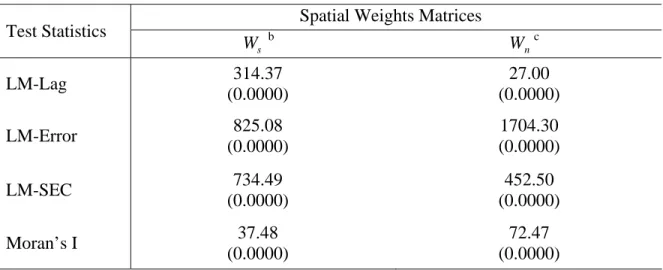
The procedure of using LM test statistics for the spatial lag model and the SAR error model follows the decision rule of Anselin (2005). Based on OLS regression errors, LM-Lag test statistics for a spatially lagged dependent variable and for SAR errors were calculated using both row-standardized and non-standardized weights matrices. All four tests show highly significant results and lead to reject the null hypothesis of no spatial correlation in each case (Table 1). The LM-SEC test for the SEC model is also highly significant for both weights matrices 10. For completeness, the Moran’s I test is also included.
Since both LM tests for lag and SAR error structures reject the null hypothesis, we need to consider their robust forms. Before proceeding to next step, a brief look at Table 1 shows LM-Lag LM-Lag and LM-Error LM-Error , which says that the lag structure with row-standardized weights matrix is more significant while the error structure with non-standardized weights matrix is more significant. These results are consistent with our previous claims that a row-standardized weights matrix is more appropriate for the lag model and a non-standardized weights matrix may be more suitable for the SAR error model. We also have LM-SEC LM-SEC , so for our data set, a row-standardized weights matrix appears to better represent the spatial error component structure. However, we cannot compare these test statistics from different spatial models to select the most “significant” one. For model comparison, we use robust LM statistics.
> ) (Ws (Wn) (Wn)> (Ws) > ) (Ws (Wn)
The robust LM test involves two weights matrices, one for the lag structure and the other for the SAR error. There exist four combinations of the two matrices. Referring to Table 2, all the eight robust test statistics are highly significant (some are much greater than the non-robust tests). Furthermore, we find Robust LM-Lag Robust LM-Lag and Robust LM-Lag Robust LM-Lag , which imply that, in the presence of possible locally misspecified SAR error structure, the lag structure with a row-standardized weights matrix is more significant than that with a non–standardized weights matrix. We also find that Robust LM-Error Robust LM-Error and Robust LM-Error Robust LM-Error , which imply that, in the presence of a possible locally misspecified lag structure, the SAR error structure with a non-standardized weights matrix is more significant than that with a row–standardized weights matrix. As in the non-robust tests, these robust LM tests support our previous claims that a row–standardized weights matrix better captures any lag structure, while a non-standardized weights matrix better captures any SAR error structure. > ) , (Ws Wn ) , (Wn Wn (Ws,Ws)> (Wn,Ws) > ) , (Wn Wn ) , (Wn Ws (Ws,Wn)> (Ws,Ws)
Next, we compare the Robust LM-Lag with the Robust LM-Error , with the favored weights matrices for each of the spatial structures. The latter (1556.50) is much greater than the former (166.56), indicating that, of these two models, the non-standardized SAR error model best models the spatial structure in our data. As the robust form of LM-SEC in the local misspecification of spatial lag structure is not available, we cannot compare the SEC model with the preferred SAR error model using a LM test.
) ,
6.3 Bayes factor method
Given the spatial models to be selected, we want to find the posterior probability of each model being the “true” model conditional on the data, and choose the model with the largest posterior probability. The extent to which the data support one model over another can be measured by the posterior odds of the one model against the other, i.e., the ratio of their posterior probabilities. Since posterior odds = Bayes factor×prior odds, if we assume equal prior probability for all candidate models, we only need to find the Bayes factor for any two candidate models, which is the ratio of their marginal likelihoods. Under the assumptions of normal regression error, non-informative and uniform priors forβandσ2, and a uniform distribution with the range
min max 1/ /
1 k k
D= − for the spatial parameter (where and are the largest and smallest eigenvalues of the spatial weights matrix), Hepple (2004) derives the marginal likelihoods for each of a family of spatial regression models, from which the Bayes factor can be computed for any pair of candidate models. Some decision rule, e.g., Jeffery’s “weight of evidence” or Raftery’s “grade of evidence”, is then used to decide whether the magnitudes of these Bayes factors provide evidence that a model is favored. One advantage of this method is that a comparison between row-standardized and non-standardized weights matrices can be made for a given spatial model, as the weights matrix is involved in determining the marginal likelihood. As the marginal likelihood for SEC model is not included in Hepple’s analysis, we derive that formula following the same procedure
max
k kmin
11
. Note that the derived marginal likelihood for each spatial model has two common terms, which can be omitted from the calculation of the Bayes factor.
As in the case of the LM statistics, the Bayes factors are very large for our large microlevel sample. Because numerical integration is involved in the calculation of marginal likelihood and the integrant over the whole integration range is close to zero, a numerical “problem” arises. Take the SAR error model for example, the marginal likelihood with the two common terms omitted is
∫
− = D n k SAR d s X X P D M data p λ 2 ) ( 2 2 1 * ' * ) *( | | | | 1 ) | ( (7)where P= I−λW , X* =P*X , y* =P*y, denotes determinant, is the residual sum of squares of the regression of on
2
s
*
y X*, is the sample size and is the number of explanatory variables (including the intercept term).
n k
For the row-standardized weights matrix, the integration interval is(−1,1), reaches its
maximum of 1 at
| |P 0
=
λ . |X*'X*|12is decreasing over(−1,1)and reaches its minimum of at
47 10 3643 .
3 × λ =1 . The minimum of s2 is 151.52, then min((s2)(n−k)2)→∞ with and . For the non-standardized weights matrix, the integration
interval is 12 7493 = n k =69 ) 0046 . 0 , 2602 . 0
(− , |P|reaches its maximum of 1 atλ=0. |X*'X*|12 reaches its minimum of 78 at 10 7317 . 6 × λ =0.0046 . As the minimum of 2 is 156.92, s ∞ → − ) )
min((s2 (n k)2 .In both cases, the values of integrants are really close to zero but one numerically dominates the other. The similar situation exists for the lag model and SEC model. As a result, the magnitudes of the calculated Bayes factors are extremely large and far beyond the “common” value 13, showing very strong evidence of favoring a model or one weight matrix.
For our purpose, first we derive the Bayes factors of both row-standardized and non-standardized weights matrices for the lag model and the SAR error model. All calculated Bayes factors are presented in Table 3. Following Raftery’s “grade of evidence” in which the Bayes factor greater than 150 for model 1 against model 2 indicates strong evidence in favor of model 1, the spatial lag model with row-standardized weights matrix is favored over the one with a non-standardized weights matrix as expected. But the SAR error model also favors a row-standardized weights matrix, the opposite result from the LM test.
Next we calculate the Bayes factor for the SAR error model against the lag model with the same row-standardized weights matrix, resulting in a strong preference for the SAR error model. Last, the comparison between the SEC model and the SAR error model with same row-standardized weights matrix is made, showing that the SEC model is strongly preferred.
6.4 Pseudo-R2 criterion
The third model selection criterion is the pseudo-R2 goodness-of-fit. Notice that the Bayes factor method is essentially a model selection criterion based on model goodness-of-fit, but adjusted according to some prior knowledge or information on the distributions of model parameters. As a contrast, the pseudo-R2 criterion only relies on information from the data. Table 4 shows the pseudo-R2 values of the SAR error model with types of weights matrices, the SEC model and lag model with row-standardized weights matrices only.
The pseudo-R2 of the spatial lag model with row-standardized weights matrix is calculated from formula (2). Since the “Leontief expansion” does not apply for where is non-standardized, an infeasibility of calculating the inverse of a
matrix makes the pseudo-R 1
)
(I−ρWn − Wn
7493
7493× 2
value unavailable for the non-standardized weights matrix. The SEC model and the SAR error model share the same dependent and explanatory variables (they only differ in the spatial error structure specification), their pseudo-R2 values are comparable. However, the explanatory variables of the lag model are (I −ρW)−1X orX,WX,W2X,..., so its pseudo-R2 value can not be compared with those of the SEC model and the SAR error models. The pseudo-R2 for the SEC model is about 6.5% greater than that of the SAR error model, showing that the SEC model outperforms the SAR error model at prediction.
6.5 Summary of spatial model selection results
Even though the Bayes factor method yields surprisingly large statistics, all three model selection criteria results support our favor of the SEC model over the lag model and SAR error model and the use of a row-standardized weights matrix for the lag model and the SEC model. Nevertheless, the choice of whether to use a non-standardized weights matrix for the SAR error model is ambiguous.
The LM tests and their robust forms are widely used in selecting among spatial models. The Bayes factor method, as an updated goodness-of-fit criterion, is potentially useful but suffers from numerical precision in dealing with large-sample problem. Advances in this direction, e.g., alternative prior specifications on model parameters, estimation of the
marginal likelihood by Markov Chain Monte Carlo (MCMC) technique, are expected. The pseudo-R-square criterion is more suitable for achieving a better spatial prediction and useful when spatial interpolation is needed to expand a (small) spatial sample.
6.6 OLS estimation
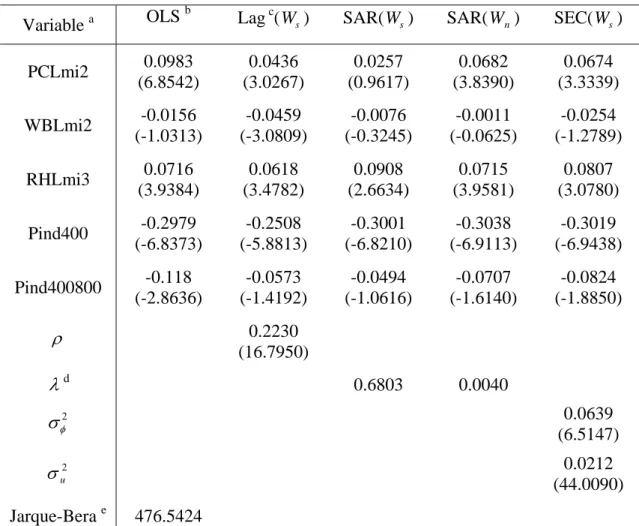
Without accounting for the spatial correlation of house price, the simple OLS regression still gives “reasonable” MIP estimates for all house structural and location characteristics and the five environmental variables of our interest (Table 5). For the externalities of landfill on nearby house prices, we find that property values are depressed within 2 miles and 3 miles of two prominent and visible landfills, but not affected by the less-prominent landfill. Further, the significantly negative MIP estimate of Pind400 and negative but insignificant MIP estimate of Pind400800 show that, house price declines with the percentage measure of industrial land use within 400m of the house, but that impact decreases with distance.
Even though the three landfill MIP estimates and two industrial land use MIP estimates are consistent with our expectation, the OLS estimates are biased if the spatial lag model is the “correct” specification or inefficient if a spatial error model is more appropriate. The LM tests and Moran’s I test showed that there is some sort of spatial structure to prices and/or errors. In the next section, we explore how robust the MIP estimates are to the choice of spatial model.
6.7 Spatial model estimation
Spatial regression models are not easy to estimate because large microlevel data and corresponding high-dimensional spatial weights matrix are often involved. The maximum likelihood (ML) estimation under the assumption of normal errors is popular in part because estimation routines such as LeSage’s are avaiable for the lag model and the SAR error model. These routines require a row-standardized weights matrix. Since we have strong evidence in favor of the row-standardized weights matrix in the spatial lag model, only the estimation result for row-standardized lag model is presented 14. To compare the row-standardized and non-standardized weights matrices for the SAR error model, we need an estimation method that accommodates both weights matrices. The generalized moments (GM) method suggested by Kelijian and Prucha (1999) is adopted to estimate the spatial parameter (λ), followed by a Cochran-Orcutt-type transformation to account for the estimated error structure for the SAR error model 15. For the SEC model, a generalized method of moments (GMM) estimator for the two variance components is first obtained 16, followed by the same feasible GLS procedure as the SAR error model through Cholesky factorization.
Table 5 shows the estimation results for the SAR error model with both types of weights matrix, and the SEC model and the spatial lag model with row-standardized weights matrix. For comparison, the OLS estimate is also included. Only the parameter estimates of three landfill proximity indices and two percentage measures of industrial land use of our interest are presented here. Estimated MIPs for all other house characteristics are similar across models.
Since the dependent variable is the natural log of house prices, the estimated MIP measures the percentage change of house price from a one-unit change in a house attribute, e.g., the parameter estimate of PCLmi2 represents the percentage increase of the expected selling price of a house if the house is 1 mile further away from PCL up to 2 miles. Note that, for the spatial lag model, the MIPs (marginal benefits) of house attributeifor all houses areβi(I−ρW)−1, which is different from that (βi) of a spatial
error model and traditional linear hedonic model because the lag model includes the induced effects of the characteristic change of all the houses (see Kim et al 2003, p35-36 for details). Theβgenerally underestimate the MIPs of the lag model. “True” MIP for the lag model needs to be derived.
Kim et al (2003) show that the “true” MIP of house attributei is ρ β − 1 i for
row-standardized weights matrix if a unit change were induced at every location. However, this story does not fit our situation so well. In their paper where the focus is on measuring the benefits of air quality improvement, a uniform change of air quality at all locations is possible. By contrast, such a uniform change of a landfill proximity index is impractical and is not of interest. Instead, we use an iterative method to find the average MIP estimate of the lag model. We first derive the predicted house prices that would occur if a landfill did not exist. Then we compute the difference between the predicted prices with the landfill and the predicted prices without the landfill. These differences are then regressed on distance to the landfill. The estimated slope serves as an estimate of the average MIP for the landfill (see technical appendices for details). For PCL, the MIP
estimate derived in this way is 0.05, which is greater thanβ)PCL(0.0436) but less than ρ β ) ) − 1 PCL
(0.0561). Note that this estimate is smaller than the estimated MIP from the
favored SEC model (0.0674), the non-standardized SAR error model (0.0682) and the simple OLS (0.0983). The same calculation procedure can be used to find the “true” MIP estimate for the RHL. For WBL, the lag model produces a significantly negative estimate, for which we don’t have a good explanation, indicating possible model misspecification.
The two estimates of for the SAR error model are not comparable because row-standardization changes the assumed spatial structure of original weights matrix. While the estimate ofλ (0.6803) for SAR error ( ) has an intuitive interpretation as the spatial correlation coefficient, it’s hard to give an interpretation to the estimate (0.0040) for non-standardized weights matrix. The same argument holds for the spatial parameter
s
W
ρof the
lag model. We see some differences in the parameter estimate in the SAR error model between the two weights matrices. For PCL, row-standardized weights matrix gives positive but insignificant estimate, while non-standardized weights matrix produces positive and significant estimate. For RHL, both weights matrices give positive and significant estimates, but the estimate from the non-standardized matrix is 21% smaller than that from row-standardized matrix.
The SEC model has similar estimate results (both in sign and in size) as the non-standardized SAR error model. They both show that PCL and RHL depress nearby house prices and WBL does not. This outcome is consistent with our expectation, as PCL and
RHL are prominent and visible while WBL is small and not perceptible by many nearby residents. Specifically, the significantly positive MIP estimates of PCL and RHL from the SEC model show that a house 1 mile further away will increase its expected selling price by 6.74% and 8.07% respectively, while the negative estimated MIP for WBL is not significant. For surrounding land use, the house price declines 3.02% with 1% industrial land use increase within 400m of the house, but the negative effect disappears out of this limit.
Interestingly, the naïve use of OLS regression provides parameter estimates that are same in sign for the three landfills and two industrial land use measures as the SEC model and the non-standardized SAR error models.
For the two percentage measures of industrial land use, all spatial models yield significantly negative estimates for Pind400, and negative but insignificant estimates for Pind400800. By contrast, the parameter estimates of three landfill proximity indices for different spatial models show a changing pattern. The underlying reason lies that houses close to industrial land are less spatially correlated than houses close to landfill. This less prominent spatial relationship makes the specification of spatial model not as critical in estimating the impact of industrial land on nearby house prices.
7. Summary and Conclusions
This paper examines some important problems of applying spatial econometrics to hedonic modeling of house price. Spatial autocorrelation of house prices may be partly
addressed in a traditional hedonic model by including some location and neighborhood variables, but it is far from enough and an explicit consideration of this spatial relationship is needed. In all cases, statistical tests reject OLS in favor of a model with spatial structure. The spatial lag model and the SAR error model are the most popular models used in spatial hedonic pricing estimation. We reflect on the theoretical implications of how house prices form and relate to one another under these two spatial specifications. Recognizing their inabilities in distinguishing two types of errors that contribute to the variation of house price differently, we prefer a spatial error components (SEC) model. We believe that the SEC model intuitively captures the process that drives spatial correlation of house prices by specifying two error sources of the variation, a spillover component for “contagious” error and a local component for “non-contagious” error.
We also question the “convention” of row-standardizing weights matrix in practice without furthering exploring its implication and consequence on model estimation and inference. By extending the arguments of Bell and Bockstael, we argue that spatial specification of the spatial weights matrix is as important as the choice of the spatial model. For our landfill dataset, a row-standardized weights matrix is more appropriate for the spatial lag model and fits to the SEC model, while a non-standardized weights matrix might be more appropriate for the SAR error model.
Although the simple OLS is believed to give spurious MIP estimates because it ignores the spatial correlation of house price, incorrect spatial specification may produce even
worse estimate outcomes than OLS. For the data in this study, where a spatial error model appears to be more appropriate than a lag model, the OLS estimates are consistent (although inefficient) and have the same signs and significance as those of the SEC model, which is the preferred spatial model.
Footnotes:
1. There are some differences in how these models are labeled, e.g., Lesage (1999) uses spatial autoregressive (SAR) model to label the spatial lag model and spatial error model (SEM) to label the SAR error model we employ here.
2. Another popular specification is spatial moving average (SMA) process. The model with SMA error sees rare applications although corresponding LM test has been developed. One reason lies that it introduces extra difficulties in ML estimation (Sneek and Rietveld, 1997) and no other widely accepted estimation method is proposed yet, to the best of our knowledge.
3. The model with SMA errorε =γWu+u is also considered as model for local spatial correlation. This can be seen from its error covariance structure
] ' ) ' ( [ ) ' ( 2 I W W 2WW
E εε =σu +γ + +γ , in which the spatial covariance is zero for
neighbors higher than second-order and so similar to the SEC model. Their subtle difference is that in SMA model, the location-specific error component is considered to be same as those that are spatially correlated. These two specifications are non-nested.
u
4. See Kelijian and Robinson (1995, p76-77) for discussion about this point.
5. An exception is the two LM tests suggested by Mur (1999) and Trivezg and Mur (2004) to differentiating SMA error process and SAR error process. The second test requires calculating the eigenvalues and eigenvectors of the spatial weights matrix, which is
difficult or impossible for very large sample size (also see Kelijian and Prucha, 1999, p513-14). The first LM test does not require calculating the eigenvalues (although they show up in the formula of test statistic) but involves highly computation-intensive manipulation of matrices. Neither of the two tests is feasible for large sample problem.
6. Goldsmith (2004) argues that a distance-based weights matrix is not feasible for rural studies as lot size may vary greatly in rural areas, resulting in an uneven number of neighbors from rural clusters or a small number of neighbors for larger lots. The area under our study is a mixture of rural and suburban areas, and the houses located on lots larger than 5 acres are excluded, showing a small variation in lot size, the distance-based weights matrix here therefore does not suffer from this problem.
7. LeSage (1999, p35-42) provides a good introduction and application of sparse matrix algorithm under the context of spatial econometrics.
8. This weight differs from the linear proximity index just by a factor . Another specification of bi-square weights produces similar estimation and test results for all spatial models considered. As have been shown in some studies, the estimation outcomes are not sensitive to the specification of weight function form.
ij
d
9. LeSage’s Spatial Econometrics Toolbox includes the routines of LM-Lag, LM-Error and Moran’s I tests for row-standardized weights matrix. However, these routines are not feasible (or at least inefficient) for large-sample problem, as in our case, in that they
require many manipulations of matrices, e.g., the inverse. Using Matlab, the authors develop own routines for all LM tests used in this section, which are feasible and efficient for large-sample problem. These routines are available from the authors upon request.
10. The very large test statistic values may come from the large sample size. It can be reasonably inferred that, if we split evenly our sample into 10 sub-samples and build corresponding weights matrix, the LM tests for both the lag and error structures are expected to be significant, say, at 5% level. Consider the way similar to the Bonferroni correction of multivariate analysis, then, the “joint” significance level for the whole sample would be approximately(0.05)10.
11. The theoretical integration interval for SEC model isθ ∈(0,∞) , which is not operational for our purpose. As we will not expect a very large ratio (θ) of spillover error variance over local error variance (θ) =3.014in our case) and it can be shown that the marginal likelihood of SEC model is increasing withθ , we just pickθmax =20 for calculation purpose. Largerθvalue will yield stronger evidence in favor of the SEC model.
12. This interval is derived the same way as the row-standardized weights matrix, where 0.0046 corresponds to1/kmax ( kmax =219.667 ) and -0.2602 corresponds to
( ). min / 1 k 844 . 3 min =− k
13. There are two possible reasons. One is the unavoidable rounding error in numerical integration; more importantly, the other one attributes the result to the large sample size, which is similar to our explanation of some very large LM test statistics.
14. The IV/2SLS estimation, in whichWX acts as an instrument for to avoid the introduced endogeneity problem, can be adopted for the lag model with both row-standardized and non-row-standardized weights matrices. For our landfill dataset, the ML estimates for the row-standardized lag model are very close to the IV/2SLS estimates. The IV/2SLS estimates of the non-standardized lag model are not favored as expected, i.e., the MIP estimate of PCLmi2 (0.1201) is much larger than those from other models. In addition, compared with the ML estimation, the IV/2SLS method allows for a 2SLS-robust estimation by correcting possible heteroskedasticity.
Wy
15. Of the five environmental variables of our interest, the ML estimates and GM estimates are different in sign for PCLmi2 and WBLmi2 for the row-standardized SAR error model.
Reference
Anselin L. 1988. Spatial Econometrics: Methods and Models. Dordretcht: Kluwer.
Anselin L. 2001. Rao’s score test in spatial econometrics. Journal of Statistical Planning and Inference, 97: 113-139.
Anselin L. 2002. Under the hood: Issue in the specification and interpretation of spatial regression models. Agricultural Economics, 17: 247-267.
Anselin, L. 2005. Exploring Spatial Data with GeoDa: A Workbook. in https://www.geoda.uiuc.edu/documentation.php#manuals
Anselin L. and Bera A.K. 1998. Spatial dependence in linear regression models with an introduction to spatial econometrics. in Ullah A. and Giles D. (eds.) Handbook of Applied Economic Statistics, Marcel Dekker, New York, NY, 237-289.
Anselin L. and Moreno R. 2003. Properties of tests for spatial error components. Regional Science and Urban Economics, 33: 595-618.
Anselin L., Bera A.K., Florax R.J.G.M. and Yoon M.J. 1996. Simple diagnostic tests for spatial dependence. Regional Science and Urban Economics, 26: 77-104.
Basu, S. and Thibodeau, T.G. 1998. Analysis of spatial autocorrelation in house prices. Journal of Real Estate Finance and Economics, 17: 61-86.
Bell K.P. and Bockstael N.E. 2000. Applying the generalized moments estimation approach to spatial problems involving microlevel data. The Review of Economics and Statistics, 82: 72-82.
Durbin R.A. 1998. Spatial autocorrelation: A Primer. Journal of Housing Economics, 7, 304-327
Durbin R.A., Pace R.K. and Thibodeau, T.G. 1999. Spatial autoregressive techniques for real estate data. Journal of Real Estate Literature, 7:79-95
Goldsmith P.D. 2004. Using spatial econometrics to access the impact of swine production on residential property values. A submission to the American Journal of Agricultural Economics, July 2004
Graaff T., Florax R.J.G.M. and Wijkamp P. 2001. A general misspecification test for spatial regression models: dependence, heterogeneity and nonlinearity. Journal of Regional Science, 41(2): 255-276
Hepple .L.W. 2004. Bayesian model choice in spatial econometrics, in Lesage, J.P. and Pace, R.K. (eds) Spatial and Spatiotemporal Econometrics, Advances in Spatial Econometrics, Vol.18. Elsevier, 101-126
Hite, D., Chern W., Hitzusen F., and Randall A. 2001. Property-Value Impacts of an Environmental Disamenity: The Case of Landfills. Journal of Real Estate Finance and Economics, 22(2/3), 185-202.
Kelejian H.H. and Prucha I.R. 1998. A generalized spatial two stage least squares procedure for estimating a spatial autoregressive model with autoregressive disturbances. Journal of Real Estate Finance and Economics, 17: 99-121.
Kelejian H.H. and Prucha I.R. 1999. A generalized moments estimator for the autoregressive parameter in a spatial model. International Economics Review, 40: 509-533.
Kelejian H.H. and Robinson D.P. 1993. A suggested method of estimation method for spatial interdependent model with autocorrelatted errors, and an application to a county expenditure model. Papers in Regional Science, 72: 297-312.
Kelijian and Robinson 1995. Spatial correlation: a suggested alternative to the autoregressive model. in Anselin L. and Florax R.J.G.M. (eds) New Directions in Spatial Econometrics, Spring-Verlag Germany, p75-96