Wide range of normality in deep tendon reflexes in
the normal population
Kheng Seang Lim, Yii Zhan Bong, Yaw Lim Chaw, Kean Teng Ho, Kwang Kwok
Lu, Chin Hwan Lim, Mei Ling Toh, Chong Tin Tan
Division of Neurology, Faculty of Medicine, University of Malaya, Malaysia
Abstract
Background and objective: Deep tendon reflexes are important physical signs in neurological examination. Despite being an established technique clinically, there is lack of normality data in the healthy population, especially among the elderly. This study aims to determine the range of normality in deep tendon reflexes among the adults. Methods: The study subjects consisted of 176 healthy volunteers. They were examined by trained assessors using standardized protocol. Results: Among the commonly elicited deep tendon reflexes, isolated absent reflexes were found in up to 34.4% (supinator) in the older group, and 12.5% (triceps) in the young adults, significantly higher in the older group. Symmetrical absent reflexes was seen in up to 26.3% of supinator in the older group. Absent reflexes of the entire limbs both sides were however, much less common particularly among young adults, with 6.3% of the older group having absent reflexes in the entire lower limbs, and 2.5% in the entire upper limbs. Isolated asymmetry in reflex was present in up to 17.0% (triceps). However, only 6.3% had asymmetrical reflexes in the contiguous anatomical region.
Conclusion: Isolated absent or asymmetry deep tendon reflexes were common particularly in the elderly.
Address correspondence to: Dr. Lim Kheng-Seang, Neurology laboratory, 5U, University of Malaya Medical Centre, 59100 Kuala Lumpur, Malaysia. Mobile: +60-12-2914214; Fax: +60-3-79494613; Email: [email protected]
INTRODUCTION
Reflexes is defined as a reflected action or movement; the sum total of any particular automatic response mediated by the nervous system.1 The reflex arc consists of its afferent fibre which forms the sensory limb, an efferent fibre that forms the motor limb as well as the effector.
Deep tendon reflexes are important physical signs in neurological examination. The reflexes are influenced by various factors; including age, sex, and examiner’s techniques.2-3 Asymmetry of reflexes can be due to techniques, related to the patient’s posture, position of the joint and technique of the examiner. The absence of deep tendon reflexes and asymmetry of deep tendon reflexes are widely used as guide to indicate pathology. Despite its widespread use, there are limited published studies on the normal range for deep tendon reflexes in both the elderly and the young. This is also true for other neurological examination.4 This study aims to help fill this gap, to serve as scientific basis for the daily clinical decision-making.
METHODS
One hundred and seventy six subjects consisting 96 young adults aged below 40 years and 80 older volunteers aged 40 and above were recruited. Those with neurological symptoms and abnormal signs (other than the deep tendon reflexes), known neurological disease or diabetes mellitus were excluded. The subjects were examined by trained assessors.
All assessors were clinical students who have undergone special training in the standardized examination method for the deep tendon reflexes. The assessors were required to pass an assessment test by the senior author (KSL) who is a neurologist. A preliminary study involving 144 subjects was also carried out to improve the technique of examination. The results were not included in this presentation. The subjects’ background biodata and grading of the reflexes were recorded in a standardized format. Informed consent was obtained from all subjects.
The examination was performed in a symmetric and relaxed position. Reflexes examined include pectoralis reflex5, biceps reflex, triceps reflex,
Neurology Asia June 2009 supinator reflex (brachioradialis reflex), finger
flexor reflex, adductor reflex6, knee reflex (patellar reflex), and ankle reflex (Achilles’ tendon reflex). All reflexes examination was performed 3 times and by 2 blinded assessors. The best response was documented. If the reflexes were absent, Jendrassik’s manoeuvre was performed by clenching of teeth in the upper limbs, or pulling of interlocking arms in the lower limbs. Grading for commonly elicited deep tendon reflexes: biceps, triceps, supinator, knee and ankle reflexes were: 0 = absent; + = present with Jendrassik’s manoeuvre; 1+ = trace (just present); 2+ = present (“normal”) and 3+ = brisk reflexes (strong muscle contraction). For the less commonly elicited reflexes: pectoralis, adductor and finger flexor reflexes, the grading was: 0 = absent and + = present.
Data was analyzed using Self-Propelled Semi-Submersible program. Chi squared (chi2) tests were used in the analysis of proportions, and two-tailed Student’s t test was used in the analysis of continuous variables. Statistical significance implied p<0.05 unless otherwise stated.
RESULTS
The mean age of the young subjects was 20 year. The mean age of the older subjects was 58 years, range 40 to 77 years. The male to female ratio was 1:1.
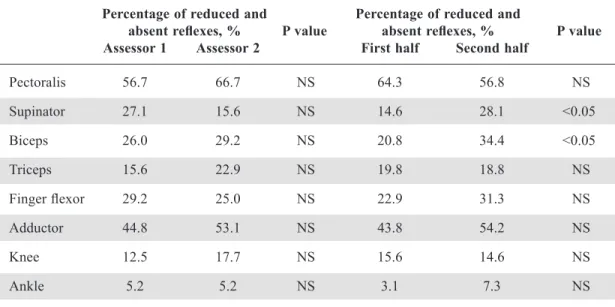
Inter-assessor and intra-assessor variability was analysed to ensure the reliability of the data. There was no statistical difference between the first and second assessor, and only slight variation in supinator and biceps in intra-assessor analysis, as shown in Table 1.
Distribution of deep tendon reflexes, comparison
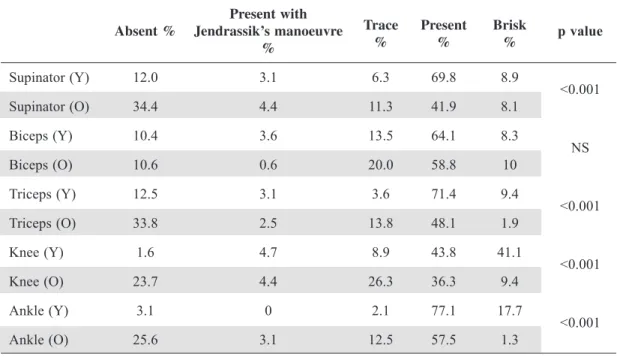
between the young adults and older age group Table 2 shows the distribution of the more commonly elicited deep tendon reflexes. As shown, absent reflexes in the young were found in triceps (12.5%), supinator (12.0%), biceps (10.4%), ankle (3.1%), and knee (1.6%). For the older group, absent reflexes were found in supinator (34.4%), triceps (33.8%), ankle (25.6%), knee (23.7%), and biceps (10.6%). The distribution of the less commonly practiced reflexes is shown in Table 3. As shown, absent reflexes were found in pectoralis (61.4%), adductor (49.0%), and finger flexor (27.1%) in the young, and pectoralis (79.5%), adductor (43.1%), and finger flexor (41.2%) in the older group. The frequencies of trace to absent deep tendon reflexes were significantly higher in the older age group in both upper and lower limbs except biceps and adductor reflexes (Table 2, 3). There was no significant difference between males and females.
Out of the 10 commonly elicited deep tendon reflexes, 46 (26.1%) subjects had 3 or more absent Table 1: Inter-assessor variability comparing the percentage of reduced and absent reflexes between the first and second assessor; and between the first and second half of the recruitment phases
Percentage of reduced and Percentage of reduced and
absent reflexes, % P value absent reflexes, % P value
Assessor 1 Assessor 2 First half Second half
Pectoralis 56.7 66.7 NS 64.3 56.8 NS Supinator 27.1 15.6 NS 14.6 28.1 <0.05 Biceps 26.0 29.2 NS 20.8 34.4 <0.05 Triceps 15.6 22.9 NS 19.8 18.8 NS Finger flexor 29.2 25.0 NS 22.9 31.3 NS Adductor 44.8 53.1 NS 43.8 54.2 NS Knee 12.5 17.7 NS 15.6 14.6 NS Ankle 5.2 5.2 NS 3.1 7.3 NS NS: not significant
deep tendon reflexes; with 11 (11.5%) of young subjects and 35 (43.8%) of the older group having 3 of more absent deep tendon reflexes. The total number of absent deep tendon reflexes per subject was significantly higher in the older age group, 2.5+2.4 versus 0.8+1.3 in the young (p<0.001). Symmetrical absent deep tendon reflexes occurred in less than 10% of 96 younger subjects, ranging from triceps (7.3%), supinator (5.2%), biceps (3.1%), knee (1.0%) to ankle (0%). None of the young adult had absent reflexes of the entire lower limbs or upper limbs. For the older age
group, symmetrical absent deep tendon reflexes were present in supinator (26.3%), biceps (7.5%), triceps (25.0%), knee (16.3%) and ankle (18.8%). There were 5 (6.3%) subjects with absent reflexes of the entire lower limbs, and 2 (2.5%) with absent reflexes of the entire upper limbs.
Table 4 shows the proportion of those with absent reflexes who were successful in using Jendrassik’s maneuver as reinforcement to induce deep tendon reflexes, ranging from 0% to 75.0% in the younger age group, versus 5.4% to 15.7% in the older age group. The greater success with Present with
Absent % Jendrassik’s manoeuvre Trace Present Brisk p value
% % % % Supinator (Y) 12.0 3.1 6.3 69.8 8.9 <0.001 Supinator (O) 34.4 4.4 11.3 41.9 8.1 Biceps (Y) 10.4 3.6 13.5 64.1 8.3 NS Biceps (O) 10.6 0.6 20.0 58.8 10 Triceps (Y) 12.5 3.1 3.6 71.4 9.4 <0.001 Triceps (O) 33.8 2.5 13.8 48.1 1.9 Knee (Y) 1.6 4.7 8.9 43.8 41.1 <0.001 Knee (O) 23.7 4.4 26.3 36.3 9.4 Ankle (Y) 3.1 0 2.1 77.1 17.7 <0.001 Ankle (O) 25.6 3.1 12.5 57.5 1.3
NS: not significant; Y: young group; O: Older group
Table 3: The comparison of the frequency of adductor reflex, finger flexor reflex and pectoralis reflex between young and older groups
Absent, % Present, % p value
Pectoralis (Y) 61.4 38.6 <0.05 Pectoralis (O) 79.5 20.5 Finger (Y) 27.1 72.9 <0.01 Finger (O) 41.2 58.8 Adductor (Y) 49.0 51.0 NS Adductor (O) 43.1 56.9
Neurology Asia June 2009
Jendrassik’s maneuver was generally better seen in the in the younger age group, but was statistically significant only in knee reflexes.
None of the subject tested had wasting or weakness of muscles.
Hyperreflexia was more common in the young population as compared to older age group especially in the lower limbs. i.e. 41.1% vs. 9.4% (p<0.001) in knee reflex and 7.7% vs. 1.3% (p<0.001) in ankle reflex.
Comparison between left and right
Reflexes were symmetrical in 69.3% to 83.5% of all reflexes and distributed in a normal distribution pattern. Asymmetry in reflex, as defined as 2 or more grades difference between the left and right, was present from triceps (17.0%), supinator (16.5%), biceps (14.2%), ankle (11.4%) to knee (9.7%). Thirty one (17.6%) subjects had 2 or more asymmetrical reflexes. However, only 6.3% had the asymmetrical reflexes in the same contiguous
Table 4: Percentage of successful reinforcement with Jendrassik’s manoeuvre Successful reinforcement with
Jendrassik’s manoeuvre p value Young age group, % Older age group, %
Biceps 25.9 5.4 NS Triceps 20.0 6.9 NS Supinator 20.7 11.3 NS Knee 75.0 15.7 <0.001 Ankle 0 10.8 NS NS: not significant
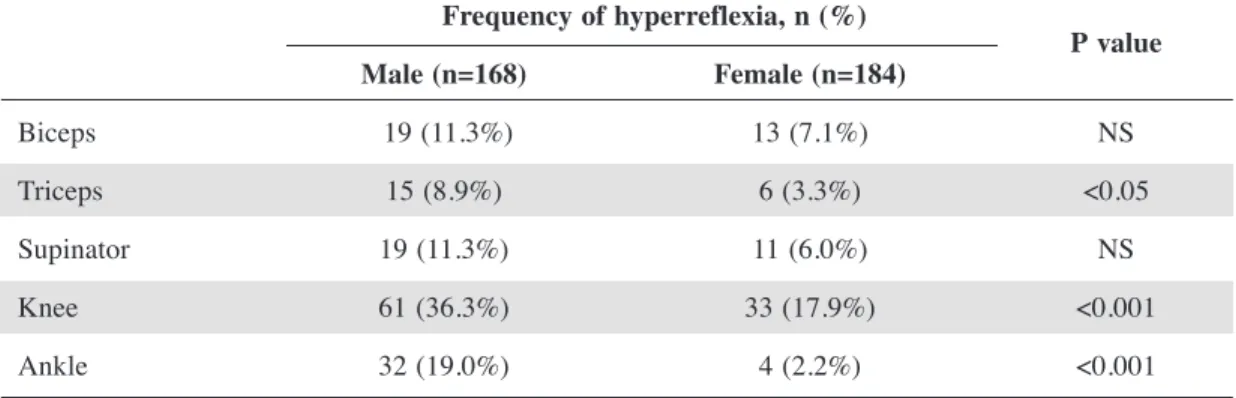
Table 5: Comparison of the frequency of hyperreflexia between male and female Frequency of hyperreflexia, n (%) P value Male (n=168) Female (n=184) Biceps 19 (11.3%) 13 (7.1%) NS Triceps 15 (8.9%) 6 (3.3%) <0.05 Supinator 19 (11.3%) 11 (6.0%) NS Knee 61 (36.3%) 33 (17.9%) <0.001 Ankle 32 (19.0%) 4 (2.2%) <0.001
anatomical region, i.e. upper or lower limb and none with both upper and lower limbs asymmetry. There was no statistical difference in asymmetry with age or between left and right.
Comparison between lower and upper limbs
Every grade of reflexes were given a score, namely 0=absent, 1=trace, 2=present and 3=brisk; present reflexes with Jendrassik’s manoeuvre were given a score of 0.5. Mean score was used for comparison and statistic analysis. Overall, lower limb’s mean score is higher than upper limb (1.78 vs. 1.56, p<0.001). Subanalysis in younger subjects showed similar discrepancy between upper and lower limbs (1.73 vs. 2.16, p<0.001). However, this pattern is not seen in older age group (1.35 vs. 1.32, in upper and lower limbs respectively). Thus, the reflexes were more brisk in the lower as compared to the upper limbs among the young.
Comparison between male and female
significant difference in the frequency of absent and reduced reflexes between male and female, or successful reinforcement with Jendrassik’s manoeuvre.
DISCUSSION
We belief that the assessors in this study have adequate techniques in deep tendon reflex examination. The assessors were clinical students. They were given intensive training, and passed an assessment by neurologist on the examination technique. The assessors also participated in a preliminary study to improve their examination techniques before proceeding to the actual study. The small inter-assessor and intra-assessor variability gives further credibility to their skills.
Our study shows that isolated absent reflexes were common in the healthy population particular in the older age group, found in 34.4% (supinator) to 10.6% (biceps) among the older group, and 12.5% (triceps) to 1.6% (knee) in the younger adults. Of the 10 commonly elicited deep tendon reflexes, the older subjects had 2.5+2.4 absent reflexes, versus 0.8+1.3 in the young adults. For the less commonly elicited reflexes, it was absent in up to 79.5% (pectoralis) in the older group, and 61.4% (pectoralis) in young adults. Symmetrical absent reflexes were also common in the older group, seen in 26.3% (supinator) to 7.5% (biceps), but less common in the young, all less than 10%. However, absent reflexes of the entire limbs both sides were much less common, with 6.3% of the older group having absent reflexes in the entire lower limbs, and 2.5% in the entire upper limbs. None of the young adult had absent reflexes of the entire lower limbs, nor the upper limbs. Therefore, absent reflexes involves the entire limbs, should be regarded as abnormal in the young.
Our study has also shown that asymmetry of deep tendon reflexes both sides to be common in healthy populations, from 17.0% (triceps) to 9.7% (knee), with no difference between young adults and the older age group. However, only 6.3% had asymmetrical reflexes in the same contiguous anatomical region and none for both upper and lower limbs. Therefore, asymmetry reflexes should be regarded as normal, unless it involves contiguous anatomical region, in the presence of other associatedphysical signs and symptoms or investigational abnormalities. Our study has confirmed the higher proportion of absent reflexes among the older age
reflex arc showed comparable results related to age. 7-9 However, the studies were only limited to ankle reflex.
Reduced reflexes with increasing age can be related to supraspinal or infraspinal mechanism. Studies on Jendrassik’s manoeuvre indicated a supraspinal influence on tendon reflex. Postulated mechanisms include reduction of tonic presynaptic inhibition. Age-related studies on reflexes were predominantly focused on reflex arc (infraspinal pathway). 7-9 In our study, the older group has less successful reinforcement with Jendrassik’s maneuver. This suggested a possible supraspinal influence on the increased prevalence of areflexia in the older group. However, little was known on the age effect of supraspinal influence on tendon reflex. Increase thyroid stimulating hormone and reduced tri-iodothyronine and thyroxin was observed in normal elderly.10 The role of thyroid hormone on the age variance of reflexes is unknown.
In conclusion, there is wide variability of deep tendon reflexes in healthy population. Isolated absent and asymmetry of deep tendon reflexes are common particularly among the elderly.
REFERENCES
1. Anderson DM. Dorland’s Illustrated Medical Dictionary. 30th ed. Philadelphia: Saunders; 2003. 2. Dick JP. The Deep Tendon and Abdominal Reflexes.
J Neurol Neurosurg Psychiatr 2003; 74(2):150-3.
3. Sinkjaer T, Toft E. Reflex examination: Neurophysiologic and biochemical status. Nordisk
medicin 1989;104(5):142-4.
4. Lim KS, Hew YC, Lau HK, Lim TS, Tan CT. Bulbar signs in normal population. Can J Neurol Sci 2009; 36(1):60-64.
5. Campbell WW. Dejong’s the neurologic examination. 6th ed. Philadelphia: Lippincott Williams & Wilkins 2005:474.
6. Campbell WW. Dejong’s the neurologic examination. 6th ed. Philadelphia: Lippincott Williams & Wilkins 2005:480.
7. Carel RS, Korczyn AD, et al. Age and Sex Dependency of the Archilles Tendon reflex. Am J Med Sci1979: 278:57-63.
8. Chung SG, Vav Rey EM, Bai Z, et. al. Aging-related neuromuscular changes characterized by tendon reflex system properties. Archives of Physical Medicine &
Rehabilitaion 2005; 86(2): 318-27.
9. Falco FJ, Hennessey WJ, Goldberg G, Braddom RL. H reflex latency in the healthy elderly. Muscle Nerve
1994;17(11):1350-1.
10. Khan MS, Khattak AM, Anwar W, Khan FS, Hussain I, Javed A. Pattern of thyroid profile in elderly persons. Gomal Journal of Medical Sciences 2007;5(1):2-4.