WVS
;XI9
POLICY RESEARCH WORKING
PAPER
218
9
Alternative Frameworks for
The behavior of actors infinancial systems depends
Providing Financial Services
crucialiy or the incentives thatmotivate them. The right
Stijn Claessens regulation, supervision, and
Daniela Klingebiel incentives - including the
scope of permissible activities, degree of contestability, and extent of the safety net - for
financial services can make the sector more resilient in the face of adverse shocks.
The World Bank
Financial Sector Strategy and Policy Group
U
September 1999
Public Disclosure Authorized
Public Disclosure Authorized
Public Disclosure Authorized
IJx: _marv &-rdings
Draw:viu on cont r experience. Claessens an-id Design of sae/ty net. The design of the safety net is
gIelr ei analvze alternative franevorks for providing important in the tradeoff between ensuring th-e safety
fr-1.n-lal services. and soundness of financial institutions and allocating
Scope of permiissible activities. The integrated banking resources efficiently. A well-functioning safety net
tolel AlL Kommercial iaŽnkingn fully integrated with other minimizes reguiatory forbearance and gives banks
i01ariclal services, including investment banking) benefits incenitives to act prudently. Owners of financial
h -r'nancial institutions and consumners. Potential costs, institutions behave more prudently if they have much at
suci. a exLendinag the satetv net to nondeposit financial risk, in the form of capital, future expected profits, or scr i ces, can be miuI-atec with safeg'ards and firewalis, their ow.n jcbs.
w7i ihequi"e regulatoir enforcement and monitoring. The wrong safety net, especially the wronig deposit ltre-nationaliv. coun-r.es are moving towsard the insurance, entails great moral hazard. Large deposit
*Lfr.graLed1 T-oib. Thc vwider scope of services appears to holders are more likely to provide market discipline if
105<05 e fienancial tcaliity and mitigate the nsk of a thev are not covered by deposit insurance (explicit or
bQa- ng crisisi iplicit). if disclosure is extensive, and if the accounting
£fcgrce of co^nipe5tv tit; ness and con/estabi!ity (openness frameNvork is adequate.
t, eonipetztioin. C(omperitiveness need not require many Supervision. Best international practice suggests that
fie 'aciai nstitutorons: a concentrated system can be supervision of the financial conglomerate should rave e if co-estable. Allow.ing he liberai entry of probably be consolidated in one agency. Supervisors ne<ori banks ios ers the -raenchise value of (domestic) should have incentives both to monitor and to take insti .etrons. but the cvidence suggests that on balance appropriate action. Supervisory salaries should be
loW 0"eietry provides importart benefits. Systems sufficient, relative to those in the private sector, to
s'oouzi ntC be 0 ercompeti:ive, however. They should attract and retain competent and motivated staff. al,i'w enough franchi'e va'ue that future profits give
isnLut.ons an uncen-i-o e to behave prudently.
i, paner a product or the Financial Sector Stratecy and Policy Group -- is part of a larger effort in the group to study
he~L! nir ).a of the financial sector framework for the stability, efficiency, and accessibility of financial services. Copies o i paperare aaiae tree fromr. the World Bank, 181i8 H Srree NAV, Washington, DC 20433. Please contact Rose Vo,
,PiC9-624 telephcei 202-473-3722, fax 202-522-2031, Internet address hvoltcxworldbank.org. Policy Research
' apers are an posted on the Web at bttp:/r,wwa\.worldbank. orgb-tml, dec/Publications/Worlrkpapers/home.html. Ir a ors 1- . hbe coent- cted at cclaessens(a. worldbank.org or dklingebie!Caworldbank.org. September 1 999. (49 pages)
o1r 'o it K-cv r orkiTdg Pap'r Steris doissenmia,c-s the hndorgs of work i, pri,iress to encourage the exchange of ideas about
t'sid'Op1i o us s 4,.hiecti ;'5. of ti series is ro get thre hfdindligs sout quickly, euirIf ti,e iesetaions are less than fully oolished. The
he os ap''.'i ul ' . )s a) of the auothors sold shoud he cited accordzegl}. The findings, i?teipretations. aiid conclusmons expressed in thris
1re evre eoy !i.ose oi the authors. 'The'. do not oeces,aril: represent the uiew of the W,orld Bank, its Executive Directors, or the Pe-oduced by the Policy Researca Disseiu;'a-ion Center
Alternative Frameworks for
Providing Financial Services
by
Stijn Claessens
Daniela Klingebiel
Financial Sector Strategy and Policy, World Bank. Valuable comments were received from Gerard Caprio, Michel Cardona, Patrick Honohan, Larry Promisel, and Thomas Rose.
I.
Executive Summary
The fratnework for financial services provision in a country includes laws governing financial institutions, the deposit insurance law (if an explicit deposit insurance scheme exists), securities markets' laws and regulations, and other regulations and agreements, including those of an international nature. Among others, these laws and regulations define the role and activities of deposit-taking financial institutions (banks) relative to non-bank financial institutions, influence the degree of competition in the financial system (through the setting of minimum capital requirements, and the definition of degrees and modes of permissible entry), define in a significant way the incentive framework under which financial intermnediation takes place, and provide for the necessary formal enforcement and exit rules. Ultimately, this framework and the way it is enforced determines to a large degree the structure, stability and efficiency of a country's financial system.
This paper reviews from an economic perspective, and relying on country experiences, alternative frarneworks for financial service provision. In particular, it analyzes the costs and benefits of different configurations of permissible activities for financial institutions, the effects of different degrees of competition, and contestability in the financial sector, the design of a proper safety net, and more generally lessons on the design of the framework for financial services provision.
Regarding the scope of permissible activities, the analysis suggests that the integrated banking model (i.e., full integration of commercial banking with other financial services, including securities markets) can offer important benefits to both financial institutions-through the potential of exploiting economies of scale and scope, diversification of revenue generation, informational advantages that increase the franchise value of financial institutions-and to consumers-through reduction of search and transaction costs, and lower cost of financial services. Potential costs of more integrated financial services provision-in particular the extension of the safety net to non-deposit financial services activities-can be mitigated, through appropriate safeguards and fire-walls, which do require enforcement of regulation and proper monitoring by the supervisory authority. Internationally, countries are already moving to more integrated financial services provision and most countries now allow banks to engage in securities underwriting, dealing, and brokering. Furthermore, in countries where banks have more latitude to choose which corporate structure to adopt (i.e., where to locate the securities unit), most banks choose to locate it in a department of the bank, thereby adopting the integrated bank model. There is also evidence that a wider scope of financial services provision enhances financial stability and mitigates the risks of a banking crisis.
The analysis further highlights that competition in the financial sector can not be analyzed in isolation. The optimal degree of competition requires balancing various concerns including franchise value, static and dynamic efficiency, ability to supervise a number of individual financial institutions, and the scope and institutional context for rent seeking in the country. Country experience, and theory more generally, suggests that competitiveness does not necessarily require many financial institutions as a concentrated system can be competitive if contestable (i.e., open to competition). The degree of contestable entry in the financial sector, together with competition from other forms of financial intermediation, has been an important determinant of the performance and efficiency of financial sectors. Openness to foreign banks is an important element in determining the degree of contestability. While liberal entry to foreign banks lowers the franchise value of (domestic) institutions, evidence suggests that on balance foreign entry provides important benefits to a country. A degree of foreign
participation in the financial sector tends to improve the functioning of domestic financial institutions, puts additional pressure on domestic firms to improve their productivity and services, can foster
innovation and X-efficiency and allows domestic financial institutions access to foreign technologies and know-how which help raise efficiency. Finally, cross-country experience does indicate that systems should not be "over" competitive, but should allow for adequate franchise value as the existence of future profits will provide incentives for financial institutions to behave in a prudent manner.
As theoretical and empirical analysis has long recognized, there is a tradeoff between assuring safety and soundness of financial institutions and fostering an efficient allocation of resources. The design of the overall safety net is the most important factor in this tradeoff. A well functioning safety net minimizes regulatory forbearance and provides incentives for banks to act prudently, thereby promoting systemic solvency. The scope of the safety net will be defined by a combination of elements, including among others, lender of last resort facilities, explicit or implicit deposit insurance schemes, the access of financial institutions to the payment system, the prevailing regulatory norms and their enforcement, and importantly, the rules for intervention in weak and the resolution process of failed financial institutions.
While some form of safety net is unavoidable, it can create large moral hazard, as many country experiences attest, particularly through explicit and implicit deposit insurance. Cross-country experience shows that the expectation of ex-post recapitalization using government resources has been an important element of safety nets inducing imprudent behavior. Arrangements to reduce these include most importantly a proper regulatory and enforcement framework, especially regarding the capital adequacy of financial institutions. To ensure proper supervision and regulation, the supervisory authority should be free from political pressure. These arrangements can also include an explicit deposit insurance scheme, but this needs to be complemented with specific actions, including clear exit rules and other design criteria (for example, risk sensitive premia).
There is less clarity on a preferred institutional design for the supervisory functions. Cross-country experience shows that countries have adopted different institutional structures depending on the objectives of regulations and the type of regulatory approach taken (single vs. multiple agency). Nevertheless, best international practice suggests that the supervision of the financial conglomerate should be performed on a consolidated basis.
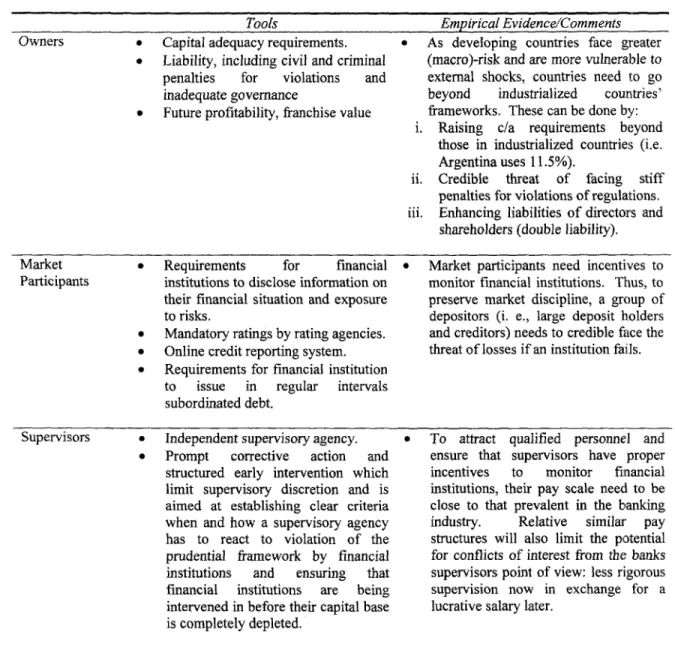
More generally, the costs of the safety net can be minimized and efficiency and robustness enhanced if financial institutions operate in an overall regulatory and incentive framework which is incentive compatible with prudent banking. This incentive framework includes the regulatory and supervisory framework, accounting rules and practices, disclosure requirements, and the existence of a deposit insurance scheme. Owners of financial institutions will behave more prudently if they have much at risk-in the form of capital, future expected profits, or their own jobs. In the same vein, large deposit holders tend to provide market discipline if they are not covered by any implicit or explicit deposit insurance scheme and if extensive disclosure requirements exist and the accounting framework is adequate. Finally, supervisors need to have the incentives both to monitor and to take actions based on this effort, which requires that pay and conditions for supervisors should be sufficient to attract and retain competent and motivated staff. In practice that means closing the gap that usually exists between the pay of regulators and that of private bankers.
iii
The paper is organized as follows. Section II examines alternative structures of financial services provision, often not determined by competition but rather by law and regulations. 'It discusses the advantages and disadvantages of integrated banking and other structures. Section III focuses on the role of competition in the financial sector, the instruments governments can use to manage competition and the level of franchise value in a banking system, and the tradeoffs between competition on the one hand and safety, soundness and innovations considerations on the other hand. Section IV analyzes the main motivations and components of the safety net, the tradeoff between the scope of a safety net on the one hand and the effects of financial sector efficiency on the other hand. It discusses alternative design features for the safety net, particularly regarding deposit insurance, and the essential pre-requisites for effective supervision. Beyond the basic infrastructure, the behaviors of the actors in the financial system depend crucially on the incentives they face. The concluding Section V therefore discusses some of the latest thinking on the design of an incentive compatible regulatory
I
II. Determining the Scope of Permissible Activities of Financial Institutions
* This section focuses, from an economic perspective, on the advantages and disadvantages ofintegrated banking and the various corporate structures under which banking can be conducted. It examines the following questions:
* How does the scope of permissible activities of financial institutions differ across countries? * What impact do different configuration of permissible activities have on financial institutions'
franchise value or what are the gains and risks from allowing broader banking powers? * What are the costs and benefits of allowing banks to engage in commercial and investment
banking, and to have ownership stake in non-financial institutions?
* What types of corporate structures are used for banking organizations and what are their respective benefits and costs?
* How do non-bank financial institutions relate to the rest of the financial system?
1. Introduction - the Structure of Financial Services Provision
In most countries, regulation rather than competition determines a bank's range of products and services it can offer, the types of assets and liabilities it can hold and issue, and the legal structure of its organization. Regulators in countries have allowed for different configurations of pennissible activities certain types of financial institutions can undertake and for different types of organizational structures. Two models at the opposite end of the spectrum are a separate financial system, where banks are not allowed to engage in any type of securities or other, non-credit financial service activity, and a completely integrated system, where banks can provide all types of financial services, either directly or indirectly through subsidiaries with involvement in management. The latter is often called " universal banking". As there are other aspects often associated with universal banking--such as the ownership of non-financial institutions (that will be discussed in the next section)-we rather use the term "integrated banking" to refer to a wide scope of financial services provision within a single institution.
Out of 51 industrialized and emerging countries surveyed by the Institute of International Bankers in 1998, only China has a "pure" separate banking system (in the sense that banks are not allowed to engage in any type of securities activities). The majority (36) of countries surveyed, including all EU-countries, allow integrated banking, i.e., banks are allowed to conduct both banking and securities business (including underwriting, dealing and brokering all kinds of securities) within the same banking organization. Finally, in 15 countries, financial institutions are allowed to engage in securities activities (to a varying degree), either through a bank parent (12) or a bank-holding company structure (3). The US is the most prominent country with a bank holding company structure which also has quite restrictive regulations on securities businesses which can be undertaken by comrnmercial banks (see further Annex Table 1 and 2).1
Historically, that is before the late 19th century/early 20th century, the range of products and
services individual financial institutions have offered (i.e., the scope of their financial services provision) has in many countries been determined by market forces. Competition, comparative
1
According to Section 20 of the U.S. Bank Holding Company Act, revenues that commercial banks derive from their securities subsidiary (underwriting and dealing activities) are restricted to less than 25 percent of their overall profits. Moreover, commercial banks are not allowed to hold an equity stake in non-financial firms (except for trading purposes).advantage, relative supply of skilled professionals, and other factors determined whether banks would provide a broad or narrow range of financial services. Choices made by financial institutions most often had no adverse consequences on either financial stability, efficiency or access to financial services. Over time, however, countries introduced restrictions on the type of activities of different financial institutions.2 The motives for the restrictions, however, not necessarily economic or financial, but often came into play for political reasons. From an economic analysis point of view, it would thus be most natural to first ask the question whether there is a case for restrictions to begin with and then analyze what the consequent opportunity costs are of a particular restriction. Since most countries have restrictions, however, we rather analyze the gains from removing (some of) these restrictions and the risks which need to be taken into account when doing so.
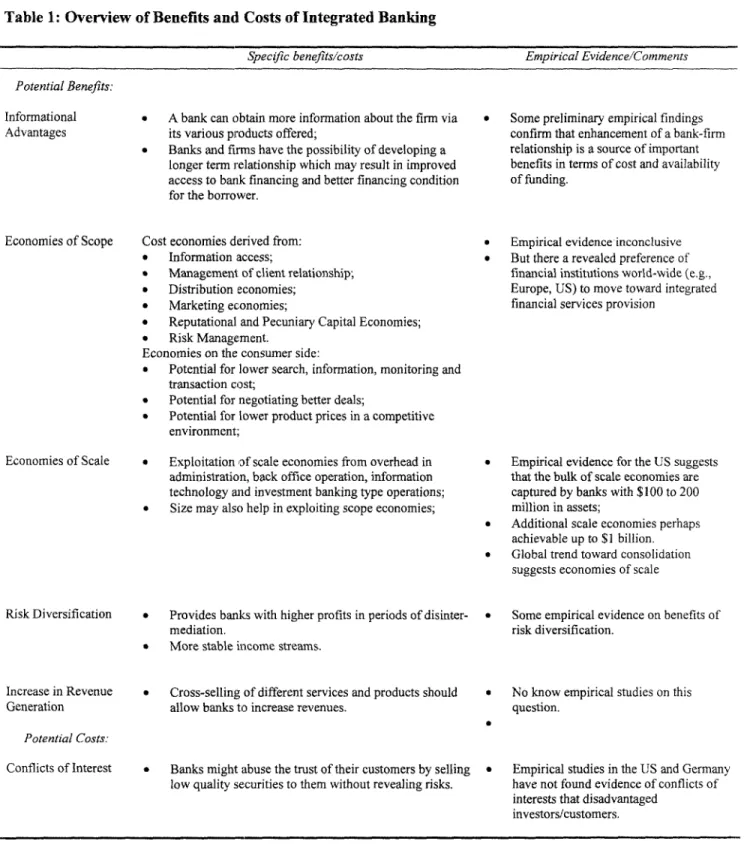
The rationales for not allowing financial institutions full freedom in choosing the scope of their activities have been twofold : (i) potential conflicts of interest, and (ii) risks of financial instability.3 Benefits from allowing a wider scope of financial services provision which have been identified include economies of scale and scope, and risk diversification. We discuss these benefits and costs in the next two sections (the costs and benefits of integrated banking are summarized in Table 1). Important background to this discussion is the global trend of increased substitutability between various types of financial instruments in terms of providing similar kind of services. Bank deposits, for example, compete now in many countries with other liabilities of financial intermediaries, such as money market funds, in the provision of liquidity and payment services. This has implied, on one hand, that the demarcation lines between different types of financial intermediaries have become increasingly blurred from the consumer and producer point of view. On the other hand, the economic costs of maintaining regulatory barriers have risen as these barriers have become less effective, but still impose costs on individual financial institutions.
2. Benefits of a Wider Scope of Financial Services Provision
Three reasons have been identified why allowing for a wide scope of financial services provision ("fully integrated banking") can increase the franchise value and market value of banks: it allows for the use of informational advanta es, it increases profits (through economies of scale and scope), and it reduces the variability of profits.
2 It is useful to compare in this respect the American banking system prior to World War I to that of Germany, a period for both countries of large-scale industrialization (see further Calomiris, 1996). German commercial banks provided then (and largely still do) an unrestricted range of services, including lending, underwriting, trusts services and deposit taking. The American banking system. traditionally heavily regulated, was importantly shaped by restrictions on branching and consolidation dating from the I9'h century and focussed on financing commerce, rather than industrial firms (the latter became financed by investment banks). The Great Depression in the US further added to restrictions. The motives for the restrictions in the US were, however, not necessarily based on economic or financial problems. Rather, these restrictions emerged on fears of excessive concentration of power, desire to keep savings locally, and concerns to protect individual states' rights.
3 Another concern has been the concentratio;n of economic power that may come along with commercial banks having a wider scope of activities, including owning non-financial institutions. This has been a highly charged, political economy issue, and some countries care more about 'excessive' concentration than others. This issue relates probably more to the concentration of economic power in general,
including that of non-financial institutions, and the degree of competition, rather than to the particular banking model adopted.
4 The question of scope of financial services is related to the costs and benefits of bank-based versus capital market-based systems, which in turn may have implications on firms' access and cost of capital and economic growth. For an overview of this literature, see Stulz, 1999.
3
Informational Advantages
In establishing a relationship with a firm, a bank incurs costs in gathering information about the firm and its investment opportunity before making lending decisions. The longer the expected duration of the bank-firm relationship, the more willing the bank will be to invest in gatlhering firm-specific informnation, which in turn can increase the financing to valuable investment projects.5 Integrated banks have some advantages over specialized banks in this respect as they can offer a broader set of financial products than specialized banks. This allows an integrated bank to learn more about its borrowers and to lower infonnation and monitoring costs. Information derived, for example, from managing a basic bank account can be used in the supply of other financial services. As if the banks holds an equity ownership, it may have a representation on the board of directors and thus gain infornation which can be useful for its lending activities. A broader set of services also allows an integrated bank to design financing contracts better suited to the borrower and have more leverage over firms' managerial discretion. Finally, as a firm switches from bank financing to raising money on the capital markets, the firm can continue to be a customer of the same bank if the bank provides both lending and securities underwriting services.
Empirical research on the importance of these benefits is still in its early stages. Preliminary findings, however, seem to confirm that the close bank-firm relationship associated with integrated banking can be a source of important benefits to firms in terms of cost and availability of funding (Berger and Udell 1995; Petersen and Rajan 1994; Vander Vennet 1999). Essentially, informational advantages associated with integrated banking can turn advantages for banks into advantages for
customers as they get better (and cheaper) services. The degree to which these inforrnational advantages can be realized and passed on depends of course on the degree of informational asymmetries: in economies where information is generally poor, close bank-firm relationships could in principle be very useful. At the same time, weak information on financial institutions may mean that close bank-firm relationship suffer from poor resource allocation due to the weak monitoring of banks themselves. The balance between these two effects will, among others, be influenced by the degree of competition in the financial sector (see further section III).
Economies of Scope and Scale
Economies of scope may arise both from the production of financial services and from their consumption. On the production side, economies of scope exist when the cost of orne institution producing several products is less than the costs of several specialized firms producing the same bundle of products. Potential economies of scope arise whenever a significant fixed cost (information acquisition, staff, reputation, distribution facilities) can be shared across products and services (Baumol, Panzar and Willig 1981). Economies of scope on the product side arise from various factors related to inforrnational access, distribution economies (Llewellyn 1996), and access to funding.
Several forms of cost advantages have been identified (Saunders 1996):
5 Firms generally have information about their own creditworthiness and about relevant features of their investment projects that is not
readily available to outsiders and/or can not credibly be conveyed to outsiders. The information gap can in part be corrected by contracting with an independent agent (rating agency, accounting firm, consulting firm) that can credibly convey relevant information to outsiders. Not all firms are able to reduce the information gap completely, however, and not all information can be credibly conveyed by third parties. The production of information may be too costly, for example, or it may require a continuous and extensive relationship with third parties. Financial intermediaries, especially banks, may be able to fill some of this gap.
* Information access and managing the client relationship. Instead of assessing a corporation on a separate basis for each finiancial transaction, an integrated financial institution incurs such information cost only once. If fixed costs in managing the client relationship (technology, information bases, etc) can be shared between services, economies may be derived by offering various financial products.
* Distribution and marketing economies. Technology and delivery channels established by the bank can be used to supply a wide range of services. Given the fixed costs of delivery systems, there is potential for scope economies. Several services can be marketed simultaneously, and the bank may gain both a marketing advantage and a reputational advantage in offering a wide range of services.
* Reputational and pecuniary capital. As long as there are spillovers in reputation, an integrated bank can use the reputation acquired in one business to enhance another. To the extent that it is easier to gain a reputation in some businesses than in others, and to the extent that there are fixed costs in gathering reputation, there may be advantages for integrated banks.
* Risk management. To the extent that risks on alternative products or services are not perfectly correlated, economies in risk management can be secured within a diversified portfolio of services and products (see further below). Moreover, an integrated bank that combines asset-intensive, lending business and fee-generating, securities business may be able to fund itself more easily than specialized banks that focus on one or the other.
On the consumption side, economies of scope may derive from lower search costs and lower product prices. These can include the following (Saunders 1996):
D Potential for lower search, information, monitoring and transaction costs. The consumer may feel more secure dealing with an institution with which it has already an ongoing relationship through the provision of another financial services.
* Potential for negotiating better deals. A wider relationship with a bank may strengthen a customer's position towards the bank and may enable him/her to negotiate better deals, either for individual or for services.
* Potential for lower product prices in a competitive environment. If a bank secures economies of scope through diversification, competitive markets should lead to a sharing of these benefits between the bank and the consumer.
Empirical work on economies of scale and scope has been hampered in that separating inputs from outputs for financial institutions is difficult and the "noise" in a bank's reported costs and revenues may be considerable. In terms of economies of scale, most empirical studies have found that the bulk of scale economies are captured, but not fully exhausted, by the time a bank has $2 to $10 billion in assets. Early studies for US banks found that economies of scale were exhausted at relatively small output levels (see Clark 1988 for a review). More recently, studies including larger banks have found evidence of scale economies up to the $ 2-10 billion asset range (Noulas, Ray and Miller 1990, Hunter, Timme and Yang 1990). Other empirical evidence for US banks actually suggests that
economies of scale may start to decline for asset sizes between $10 to $25 billion (Berger, Hunter, and Timme 1993). The few tests which have been conducted for other countries largely confirn these results. In a study based on non-US data, Saunders and Walter (1994), and Vander Vennet (1994) find economies of scale in loans of up to $ 25 million. Lang and Wetzel (1995, 1996) find scale economies among German universal banks up to a size of $ 5 billion. Evidence for emerging countries is limited.
5
While there is some evidence on economies of scale, as of yet, there is little empirical evidence of scope economies, possibly because financial institutions can not or do not choose their optimal institutional structure. The bulk of studies for US banks concludes that economies of scope in banking, if at all present, are exhausted at very low levels of output (Berger, Hanweck and Humphrey 1987; Berger, Hunter and Timme 1993). Empirical studies on European banks have been inconclusive. For example, Lang and Welzel (1995, 1996) report the absence of scope economies in Germran universal banks, but find such economies in small cooperative banks. Vander Vennet (1999) finds that universal banks are characterized by significant higher levels of operational efficiency relative to specialized banks and are also more profit efficient. Evidence for G-10 countries by Barth, Nolle and Rice (1997) suggests that loosening restrictions on banking activities might enhance bank performance-as statistically the return of equity is higher for banks in countries with no restrictions on securities and banking activities-thus suggesting some economies of scope.6
Increased Diversification and Lower Risk
An integrated bank may be more stable than a specialized bank because of diversification benefits. These benefits can arise from two sources. First, dis-intermediation-when firms bypass banks and raise money directly from public markets-will affect integrated banks less, because the decline in their lending business will be offset by an increase in their underwriting and placing business. This in turn may reduce banks' incentives to engage in riskier lending to maintain profits when faced with dis-intermediaton. Secondly, if profits from different financial services are not highly correlated, then the total profits of an integrated bank will be more stable than that of banks specialized in a single product.
A recent cross-country study found that countries where banks were restricted in their securities and other non-credit activities, had a higher likelihood of experiencing a banking crisis (Barth, Caprio, Levine 1998). A recent study for the US found that, while banking organizations' securities subsidiaries tend to be riskier (higher volatility of profits) than banking affiliates, securities subsidiaries provided diversification benefits to the bank holding company because of the low return correlation between bank and securities subsidiaries (Kwan 1997).
3. Potential Risks Associated with Integrated Banking
Integrated banking can have risks due to too close links between banks and enterprises (John, John and Saunders 1994; Berlin and Saunders 1993). These risks include conflicts of interest, increased financial risks, and greater difficulty in monitoring integrated banks.7
Conflicts of Interest
Conflicts of interest are one of the major potential costs of permitting commercial banks to conduct securities business.8 As a consequence of the often long-term lending relationship between a
6 For a further overview of the different empirical studies see Vander Vennet (1995).
7An integrated banking system may also lead to greater market concentration and thus has the potential to reduce competition. This will be discussed in Section 111.
bank and a client firm, the bank is better informed than the public investor about a firm's soundness and prospects. This informational advantage may, however, be a double-edged sword. On the positive side, an integrated bank might be better positioned than an specialized investment bank to certify credibly the value of a security offered by the firm. On the negative side, an integrated banks might have a greater incentive and greater ability to take advantage of investors. Banks might abuse the trust of their customers and sell low quality securities to them without revealing risks, or raise lending rates to the same borrowers. Conflicts of interest concerns are important in the context of the banks' proprietary activities (i. e. when the bank acts on its own account), they are of less importance when the bank acts as an agent.
Empirical studies for the German (universal) banking system and for the US (pre- Glass-Steagall) have not found any evidence of abusive practices by commercial banks. Two extensive studies commissioned by the Germnan government in the 1970s (Bueschgen 1970, Gessler Commission 1979) did not find substantial empirical support that banks were using their informational advantage on firms to the disadvantage of securities investors. For the US (pre-Glass-Steagall), if commercial banks had abused their informational advantages and sold low quality securities to investors than one would expect securities underwritten by comnmercial banks to have performed worse ex-post than similar securities underwritten by investment banks. This is, however, not the case. A study found that securities underwritten by commercial banks performed better than similar securities underwritten by investment banks (Kroszner and Rajan 1994). Their findings confirmed results of Ang and Richardson (1994) and Puri (1994).
Safety and Soundness and the Safety Net
A combination of securities and commercial banking activities can increase the risk of bank failure (for a more extensive discussion of these issues, see Saunders 1994). While this has at times happened in emerging markets as well as developed countries (e.g., Barings), empirical evidence does not confirm this possibility as a general proposition. An empirical analysis of bank failures in the 1920s in the US for example found that banks undertaking securities activities were no more likely to fail than banks with no connection to the securities business (White 1986). More generally, there is no strong evidence that the combination of financial activities increases risk, and they might well reduce risks. For example, Wall and Eisenbeis (1984), using accounting data at the industry level, find that there was a negative correlation between bank earnings and securities broker/dealer earnings over the
1970 to 1980s period.9
Nevertheless, safeguards can be necessary to avoid the transfer of explicit and implicit deposit insurance subsidies from the banking part of the institution to the securities part (Kane (1996) and Schwartz (1992) discuss in details how these transfers can occur). These safe-guards can take the form of market value accounting, timely monitoring and disclosure, more risk-sensitive capital requirements, firewalls between different type of operations, strong prompt corrective action procedures, including the closure of insolvent banks, and risk-based pricing of deposit insurance.
7
Monitoring and Supervision
Supervision of commercial banks and securities entities aims at different objectives. Supervision of commercial banks is aimed at systemic stability by protecting the net worth of the entity (and thus the rights of creditors, particularly depositors) as primary the bank will be intermediating third party money. In securities finns, regulators' objective is aimed at consumer protection. Regulations are geared to safeguard the investment made by investors through these firms: as long as investors can recover the assets they have invested in, insolvency of a securities firms does not need to present a systemic risk. Therefore, from a systemic stability point of view, supervisors would want to monitor the risks that arise from integrated banking as they relate to the safety net (above).
The combination of securities and commercial banking activities can make supervision and monitoring by the market of integrated banks more difficult as the securities business might have an impact on the banking business while the two activities can not easily be monitored separately.
Table 1: Overview of Benefits and Costs of Integrated Banking
Specific benefits/costs Empirical Evidence/Comments Potential Benefits:
Informational * A bank can obtain more information about the firm via * Some preliminary empirical findings
Advantages its various products offered; confirm that enhancement of a bank-firm
* Banks and firms have the possibility of developing a relationship is a source of important longer term relationship which may result in improved benefits in terms of cost and availability access to bank financing and better financing condition of funding.
for the borrower.
Economies of Scope Cost economies derived from: * Empirical evidence inconclusive
* Information access; * But there a revealed preference of
* Management of client relationship; financial institutions world-wide (e.g.,
* Distribution economies; Europe, US) to move toward integrated
* Marketing economies; financial services provision
* Reputational and Pecuniary Capital Economies; * Risk Management.
Economies on the consumer side:
* Potential for lower search, information, monitoring and transaction cost;
* Potential for negotiating better deals;
* Potential for lower product prices in a competitive environment;
Economies of Scale * Exploitation of scale economies from overhead in * Empirical evidence for the US suggests administration, back office operation, information that the bulk of scale economies are technology anid investment banking type operations; captured by banks with $100 to 200 * Size may also help in exploiting scope economies; million in assets;
* Additional scale economies perhaps achievable up to $1 billion. * Global trend toward consolidation
suggests economies of scale
Risk Diversification * Provides banks with higher profits in periods of disinter- * Some empirical evidence on benefits of
mediation. risk diversification.
* More stable income streams.
Increase in Revenue * Cross-selling of different services and products should * No know empirical studies on this
Generation allow banks to increase revenues. question.
.
Potential Costs:
Conflicts of Interest * Banks might abuse the trust of their customers by selling * Empirical studies in the US and Germany low quality securities to them without revealing risks. have not found evidence of conflicts of
interests that disadvantaged investors/customers.
9
Specific benefits/costs Empirical Evidence,Comments Potential Costs:
Reduction in * Integrated banking may reduce the scope for * There may be a trade-off between safety
Competition competition; and soundness considerations (higher
franchise value of integrated banks) and a reduction in competition. A liberal entry policy may be able to counterweigh this disadvantage to a certain degree. Yet from a political economy point of view, it may be difficult to sustain a liberal entry policy if economic power (i. e. the banking system) is concentrated.
Concentration of * Integrated banking may more likely lead to a * No specific evidence. Economic and concentration of economic and hence political power.
Political Power
Monitoring * More difficult to supervise. * Some theoretical literature suggests more
* More difficult for the market to monitor. difficulty to supervise and worse
corporate governance of integrated financial institutions.
Expansion of Safety * Safety net of deposit taking institutions may be extended * Can be limited with policy-measures such
Net to investment banking activities of banks. as market value accounting, risk sensitive
insurance premia, and capital requirements and by adopting prompt corrective action procedures.
4. The Corporate Structure of Banking Organizationsio
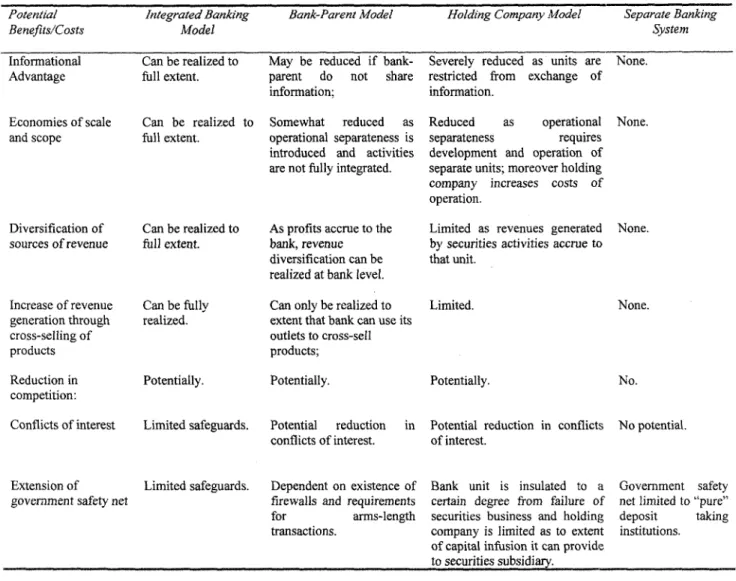
The extent to which the potential benefits of integrated banking can be realized depends largely on the organizational model banks are pernitted to adopt for their commercial banking and securities activities. Three models can be distinguished: (i) the fully-integrated banking model; (ii) the bank-parent model; and (iii) the holding company model. A fourth corporate structure is one that forces the complete institutional separation between commercial and investment banking, the separate banking system model.
Integrated Banking Model
In countries where banks have the latitude to choose which corporate structure to adopt, most banks choose to locate the securities unit in a department of the bank, thereby adopting the integrated bank model (see also Annex Table 1). l Under the integrated banking model both commercial banking
'° See for a more extensive discussion: Santos (1997).
l There are, however, exceptions. In the UK, for example, securities markets' business is permitted in banks, but usually conducted through subsidiaries. Moreover, it should be noted that separation between legal entities can be overcome in practice: a separate legal entity can be set up to work actually as a department of the bank (with cost sharing for information technology or support functions for instances). Finally, consolidation of accounts of separate entities can achieve the same level of risk diversification berLefits and increase the sources of revenues. Many banks in the US for example avail themselves of these options as they face legal linmits to integration.
and securities activities are conducted within a single corporate entity. As a result, the integration of activities can be achieved at the lowest cost and resources can be shared among the organization's various departments with maximum flexibility allowing the bank to realize informational advantages and economies of scope and scale. Moreover, it increases banks' ability to diversify its sources of revenue. At the same time, safeguards for limiting conflicts of interest and extending the safety net are limited (Santos 1997; Saunders 1994).12
The Bank-Parent Company Model
In the bank-parent model, the securities business is undertaken by a subsidiary of the bank. As there is a legal separation between the bank and the securities unit, integration of the two activities can only partially be achieved and thus compared to the integrated banking model the potential for economies of scope is reduced. However, this model still allows for risk diversification, and the potential for higher revenues through cross-selling of financial services. The bank-parent model can reduce the potential for conflicts of interest and the extension of the safety net to the securities operations of the bank-provided regulations require firewalls between bank and its subsidiaries and prescribe arms-length transactions.
The Holding Company Model
In this model a holding company owns both the bank and the securities subsidiary, with legal separation between the two units, which limits the integration of commercial banking with securities activities. Different products are offered by separately capitalized and incorporated units of the conglomerate with each unit having its own management team, its own accounting record, and its own capital. This generally limits the exchange of information, personnel, or other inputs among the conglomerate's various units, thus reducing economies of scale and scope and weakening the bank's ability to exploit informational advantages synergies. At the same time, the holding company can act as a source of financial strength to the bank subsidiary. Finally, the holding company structure can limit risk diversification potential (as revenues generated by securities activities accrue to that unit and then to the holding company).'3
An advantage of the bank holding company structure is that the potential for conflicts of interest is reduced. A further plus is that the extension of the safety net to the securities unit may be limited. The critical difference between the integrated bank and holding company models is that in the latter the securities subsidiary's capital is owned by the holding company, while in the former it is owned by the bank itself. The bank unit is thus insulated to a certain degree from the failure of securities business under arms-length transactions and firewalls as the holding company's liability is (theoretically) limited to its investment (capital) (see further Santos 1997).
These choices do, however, impose costs on the financial institution as these corporate structures may not necessarily coincide with the individual bank's preferred choice of corporate structure.
12 Helfer (1997), Greenspan (1997), and Whalen (1996) discuss in detail the existence of a safety net subsidy through integrated banking. '3 Here the diversification gains are achieved at the holding company level and the holding company can also act as a source of strength to the bank subsidiary.
I1
Table 2: Potential Benefits and Costs of Integrated Banking Can Be Realized throughl Various Corporate Structures
Potential integrated Ban king Bank-Parent Model Haoldng Company Model Separate Banking
Benefits/Costs Model System
Informational Can be realized to May be reduced if bank- Severely reduced as units are None.
Advantage full extent. parent do not share restricted from exchange of
information; infornation.
Economies of scale Can be realized to Somewhat reduced as Reduced as operational None.
and scope full extent. operational separateness is separateness requires
introduced and activities development and operation of are not fully integrated. separate units; moreover holding company increases costs of operation.
Diversification of Can be realized to As profits accrue to the Limited as revenues generated None.
sources of revenue full extent. bank, revenue by securities activities accrue to
diversification can be that unit. realized at bank level.
Increase of revenue Can be fully Can only be realized to Limited. None.
generation through realized. extent that bank can use its
cross-selling of outlets to cross-sell
products products;
Reduction in Potentially. Potentially. Potentially. No.
competition:
Conflicts of interest Limited safeguards. Potential reduction in Potential reduction in conflicts No potential. conflicts of interest. of interest.
Extension of Limited safeguards. Dependent on existence of Bank unit is insulated to a Govemnment safety govemment safety net firewalls and requirements certain degree from failure of net limited to "pure" for arms-length securities business and holding deposit taking transactions. company is limited as to extent institutions.
of capital infusion it can provide
to securities subsidiary.__________
5. The Role of Non-Bank Financial Institutions
Most corporations engage in some financial activities. These can involve trade financing, provisions of working capital, consumer finance, and other forms of financing. Most countries do not
subject these types of financial activities to prudential regulation and supervision as long as the corporation does not take any deposit from the general public, but rather funds itself in wholesale and other markets where there are well-qualified and informed investors. Leasing companies, for example, are generally not regulated from a prudential point of view. Nor are corporations extending credit to their customers supervised. This can work satisfactorily, provided that financial information is abundant and properly disclosed, and the corporations engaging in the provision of financial services are properly governed and monitored. However, most countries do regulate some of the activities of these companies from a consumer protection and market-integrity point of view. Leasing companies and credit card corporations, for example, will typically have to satisfy certain disclosure rules to the consumer on each lease or credit.
There is a legitimate role for non-regulated, non-bank financial institutions, including finance companies. Most governments exert less oversight over non-bank financial intermediaries since these organizations do not directly participate in the payments system or are covered by deposit insurance. Nevertheless, there have been cases were failures of non-bank banking organization have led to an extension of the official safety net because authorities were concerned about systemic repercussions. Moreover, banks may engage in regulatory arbitrage (if non-banks deposit- or deposit substitute institutions face less stringent capital to asset regulations) and conduct their "riskier" business through these entities.14 Several financial crises, such as in East Asia and Japan, begun outside the commercial banking sector, but then spread to banks. Thus, some regulation and supervision of non-banks can be important. But, is important to distinguish different causes for concern.
Concerns often arise from the difficulty in distinguishing the functions of normal commercial banks from those performed by the type of bank financial institutions; in many countries, non-bank financial institutions emerged as a response to regulatory restrictions on commercial non-banks or banking activities. As a result the distinction between deposit-taking banks and these types of non-bank financial institutions may have become blurred in the eyes of the public and the authorities may consequently feel compelled to extend the safety net in case of financial uncertainty. Since the general motivation for the safety net is based on systemic consequences and degree of vulnerability to runs, it should be limited to deposit taking financial institutions. This in turn requires that there is a clear legal separation between deposit-taking financial institutions and other type of non-banking, non-deposit-taking financial institutions ancd that any deposit-non-deposit-taking financial institution is subject to the same prudential regulation and supervision as banking institutions. Regardless, "non-bank" financial institutions that take any type of deposits or deposit substitutes and make loans should be either subjected to banking regulation or forced to drop one of these activities, such as by converting to mutual fund status. Non-banks may be active in securities markets, in which case they will be covered by securities market legislation. or by the industry standards or regulations given the function they performn (e.g., insurance, contractual savings, etc.).
III. Competition/Contestability
The following subsection focuses on the role of competition in the financial sector and the tradeoffs between competition on one hand and safety, soundness and innovations considerations on the other hand. In particular it focused on the following questions:
* What is the preferred degree of competition in the financial sector? * What instruments can be used to manage the degree of competition?
* What will the current process of consolidation in the financial sector globally mean for competitiveness and efficiency?
* What are the specific benefits and costs of foreign entry?
* What is the best framework for licensing new financial institutions?
14 Thailand is one recent experience where non-banks, i.e., finance companies, engage in riskier activities as they faced higher funding cost against the background of lower capital requirements.
13
1. Introduction
The issue of competition in the financial sector can not be looked upon in isolation, different perhaps from other sectors where unfettered competition is often the first best from efficiency, stability and growth perspectives. In the financial sector, the degree of competition requires balancing, among others, the following concerns: (i) franchise value, (ii) static and dynamic efficiency, (iii) ability to supervise a number of individual financial institutions, and (iv) rent-seeking.1s
2. Instruments to Manage Competition and Influence the Level of Franchise Value
Cross-country experiences and theory show that there is a tradeoff between competition and safety and soundness considerations. Systems should not be "over"-competitive, that is, there needs to be adequate profitability for financial institutions, that is franchise value, in the system as the existence of future profits will help induce financial institutions to act prudently now. It has been found, for example, that the Mexican banking system after the large-scale privatization of 1991-2 was over-competitive (Gruben and McComb, 1996). Marginal costs exceeded marginal revenue during the 1992-1994, thus weakening capital positions and increasing incentives for risk-taking of banks, and thereby contributing to the financial instability resulting in the 1994/5 crisis.
Cross-country experience, and theory more generally, suggests that entry policies (not actual entry) matter most in determining the level of competition in a banking system (Vives, 1998). Next important is the degree of competition from all forms of financial intermediation (banking and non-banking) and through other forms of external finance. A competitive financial system thus does not necessarily require many financial institutions. A concentrated system can be competitive if contestable (it should be noted that contestability alone is not necessarily sufficient to achieve competition).'6 Many European, the Canadian and other countries financial systems are considered quite competitive, yet they have a limited number of banks. But, competition from other financial institutions and through other forms of financial intermediation is strong in these markets. Moreover, financial institutions in these markets are faced with a credible threat of new entry as entry is allowed, subject to certain conditions, and the licensing process is a transparent one.
While entry policies are one important instrument to achieve the desired level of franchise value/competition and assure other safety and soundness objectives, using entry barriers alone to manage the level of competition can have important negative drawbacks (see Hon.ohan and Stiglitz 1999). Specifically, limited entry may come with: (i) large rent-seeking; (ii) limited iincentives for cost reduction and other efficiency improvements; and (iii) limited incentives for technological and other innovations. Moreover, entry has to be considered in relationship to exit. Inside ancd outside investors need to face the loss of their investment, and they and their managers need to see the possibility of bank failure, or exit from the industry, to encourage efficient and prudent behavior. Bank exit should
15 In many market-oriented economies, government restrictions upon economic activities give rise to rents (i. e., extra profits) of a variety of forms and often people are willing to compete for the rents. The term rent seeking describes the fact that economic agents are willing to put efforts into securing a monopoly or other government restrictions on market activities (as, for example, minimum or maximum prices). This rent seeking behavior absorbs large resources, redistributes wealth and imposes social costs. Ceilings on lending interest rates and consequent credit rationing lead to competitions for loans and/or high-cost banking operations. Some kinds of interest groups are more readily organized than others and these will be in a more advantageous position to see their interests protected and monopolies or other impediments to competition maintained.
16 Stiglitz (1987) has shown that potential competition may not be sufficient to discipline firms in an industry in the existence of sunk costs (costs that once expended cannot be recovered).
not be discouraged, especially not in the expansionary phase of the business cycle: not only will exit then not have systemic implications, but it will also serve to remind others that mistakes will be
punished. Weak banks need to be resolved-which should include liquidating non-viable
institutions-not only to quickly restore financial intermediation, but also to preserve incentives for prudent and efficient banking (see Section V).
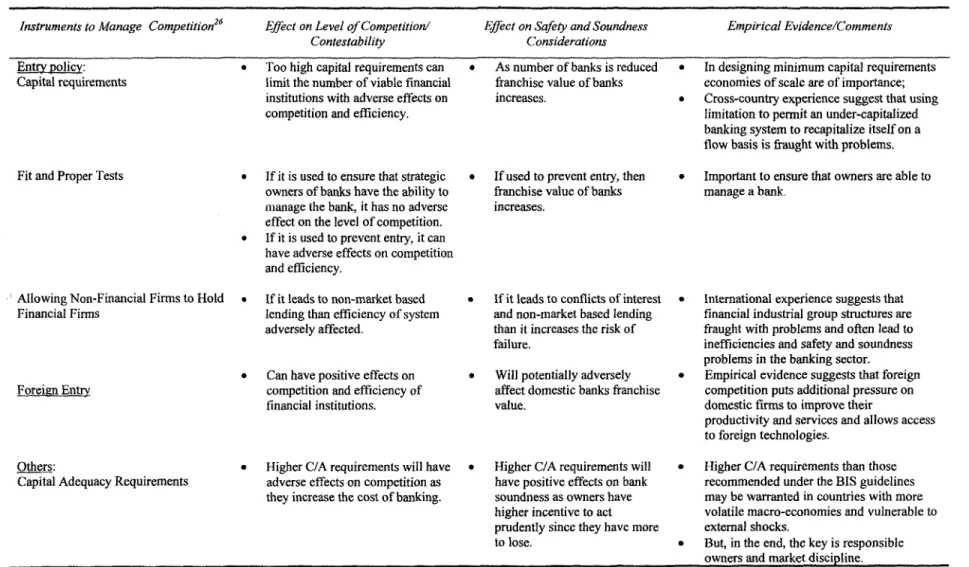
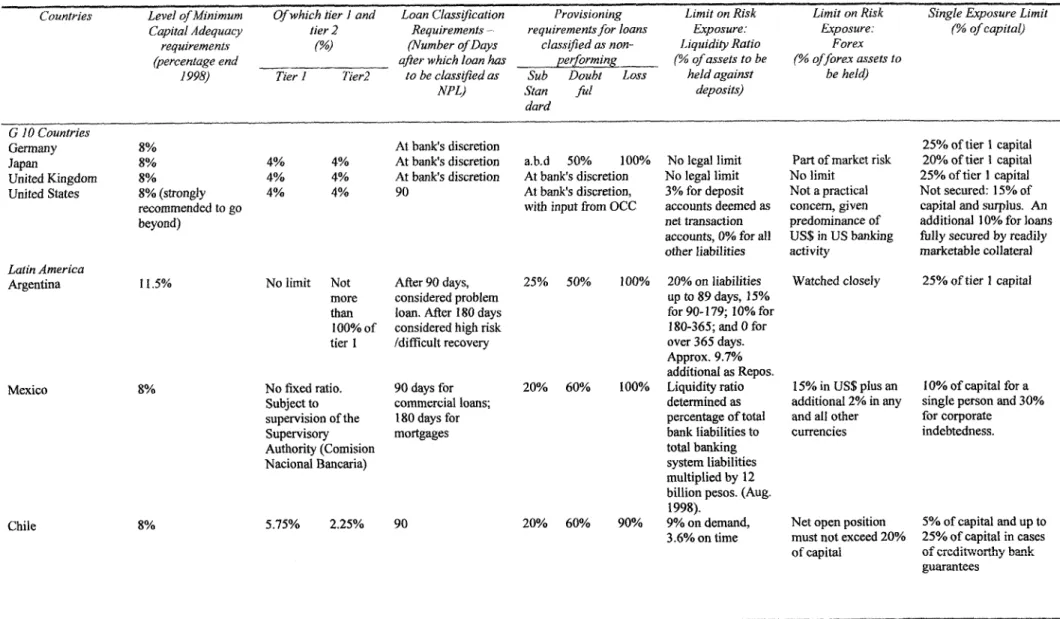
Other instruments that countries have employed to manage competition and franchise value are: (i) minimum capital requirements for existing and new financial institutions, (ii) capital adequacy requirements (as a fraction of risk-weighted assets); (iii) ceilings on deposit rates; and (iv) limits on portfolio composition or lending activities. Each of these instruments has its own side effects, including rent-seeking, dis-intenrmediation, monitoring costs, etc. Most countries have used a combination of different tools at different times. The preferred combination depends on country circumstances, important among which are the quality of financial information and supervision, the complexity of the financial system, and the degree of recent structural change, including financial liberalization. Country experience suggests that simple tools, such as limits on risk exposures or total asset growth, may be preferable if the quality of financial information is weak, the capacity of the supervisory authority stretched, and the risk management capacity of banks limited. To be sure, limits will only be effective if penalties are enforced in case of violation.
Country experience also suggests limiting entry to allow an undercapitalized (domestic) banking system to recapitalize itself on a flow basis is fraught with many risks. In general, if banks are protected from depositor withdrawals (under an unlimited deposit guarantee) and their capital is close to zero, they will have incentives to gamble by investing in high risk assets as any losses will be covered (ultimately) by the taxpayer while the bank will get the upside. In a closed environment, these incentives to gamble can be greater as depositors have less choice to invest their savings and banks do not feel pressure from other banks.17 More generally, it risks perpetuating a closed financial system, with associated costs.18 While entry needs can not be free-and all countries maintain some limits-it would be best to set a firm time-table on opening up the system, made binding through domestic laws and regulations and possibly backed up through the WTO process for foreign banks. This would create a credible threat of entry for the existing banks in the system and leave no room for political wrangling.
3. Evidence on Competitiveness and Effects of Consolidation
Competition in the financial sector matters for static and dynamic efficiency. Empirical evidence indicates that x-inefficiencies (that is, inefficiencies due to poor use of inputs) in banking institutions are large (and actually dominate concerns over too large or too small financial institutions from an economies of scale point of view). This indicates that measures which induce financial institutions to
17 Moreover, a flow solution can only work if bank spreads can be increased to such an extent that banks have a good chance of regaining
positive economic solvency in a relatively short period of time. But allowing spreads to widen runs the risk of increasing real lending
rates to a level where even good borrowers begin to fail. If instead the burden is passed on primarily to depositors, in the form of lower
negative deposit rates, there is danger of systemic disintermediation. Worse, overall bank efficiency can suffer where high spreads are
allowed, since the rent from high spreads can easily be consumed through higher operating costs instead of being used to charge off bad debts and build up capital
18 If the economy indeed recovers, profitability for existing banks will rise and pressures will arise not to open up. If a quick economic recovery cannot be achieved, banks that have relied on the government safety net to stay afloat will strongly argue against entry as that may adversely affect their profitability and solvency. Either way, existing banks will resist opening up, which, given the often prevailing political economy, is likely successful.
15
act efficiently from a cost point of view are essential, important among which is the threat of competition.
In the US, allowing interstate branching enhanced competition, lowered costs and increased stability (Jayanathe and Strahan 1998). Studies on the effect of the European Union Single-Market Program (SMP - which harmonized entry and other regulations) on competition, shovved that the SMP led to greater competition, both within the banking system, and through greater competition from other financial services providers, inside and outside the country (Gardener, et al., 1999). Financial innovation increased throughout EU-countries.
Increased competition and greater consolidation need not be inconsistent. Empirical evidence for the US, where a great number of bank mergers took place in the last decade, suggests that consolidation in the banking industry does not necessarily result in a reduction in comapetition (Berger, Demsetz, Strahan 1999). Studies indicate that the general trend towards consolidation in the US banking system in the last decade has been associated with improvements in profit efficiency, and diversification of risk (but so far little or no cost efficiency improvements; see Berger, et al 1999). The US evidence might be considered less relevant for other countries as the US banking system was
characterized by many small banks (largely due to regulations) and a different institutional environment.
Evidence for some other countries confirms these results, however. The ELU SMP saw both considerable consolidation within countries as well as increased competition. The SMP acted to enhance domestic financial reform efforts and was associated with both liberalization and re-regulation efforts (see Gardener 1999 and Vives 1999). The latter took the form of tighter capital adequacy and other prudential requirements, and more emphasis on supervision.
Reduced access to services as a result of consolidation has been another concern. Empirical work on the effects of bank consolidation on lending to small business is still in its early stages. Strahan and Weston (1998) find that given the existing pattern of mergers (i.e., mergers of the smallest banks), on average small business lending rises after a merger. Peek and Rosengreen (1998) find that the effect of a merger on lending may depend on the relative proportions of small business lending at the constituent banks which are combining. Berger et al. (1997) find that the static effects of consolidation which reduce small business lending are mostly offset by the reactions of other banks in the market, and in some cases also by refocusing efforts of the consolidating institutions themselves. It is not clear whether these results apply to emerging market economies as their institutional setting, laws and regulations differ considerably from those of developed economies.
Countries Concentration Minimum Capital Economic Needs Test Openness to Openness to Share of number qf Share of Foreign Ratio Requirement Jor New License Foreign Foreign Foreign Banks to Banks'assets as (Share of 3 largest (Convenience and needs Competition Competition in total Banking percentage of total
banks in banking of community test) (WT0)1 9 Practice20 System (end 1997) Banking System assets (end 1997)
G 10 Countries
Germany 35.2% Universal banks: No 0.6 NA 30.3% 17.5%
US $ 5.6 million (Euro 5 million)
Japan 16.0% US$ 8.7 million Yes 0.8 NA 1.8% 0.4%
(Yen I billion)
United Kingdom 34.9% US $ 5.6 million No 0.6 NA 35.1% 13.0%
(Euro 5 million)
United States 19.7% NA Yes 0.6 NA 9.0% 3.1%
Latin America
Argentina 30.9% US $ 15 million NA 0.8 NA 25.3% 19.4%
Chile 27.8% US $ 23.5 million NA 0.2 NA 35.3% 12.3%
Mexico 37.8% US $ 16 million NA 0.4 NA 21.2% 6.9%
(Ps 160 million) Asia & Pacific
Hong Kong 55.2% US $ 19.5 million NA 0.6 4.58 29.5% 48.1%
(HK $ 150 million)
India 38.0% Universal banks: No 0 2.18 17.2% 3.5%
US $ 23.5 million (Rp I billion)
Indonesia 35.2% NA 0.6 3.10 42.9% 23.3%
Korea 16.3% US $ 85 million Yes 0.4 1.90 10.4% 11.7%
(Won 100 billion)
Malaysia 27.6% NA 0.6 2.45 18.0% 23.0%
Philippines 33.4% Universal banks: NA 0.2 2.88 17.5% 36.8%
US$ 115 million (P 4.5 billion)21
Thailand 46.8% US $ 270 million NA 0.2 2.43 22.2% 10.6%
(Baht I billion) Source: World Bank data, unless otherwise indicated.
'9 Source: Qian, Ying (1999). Scale: 0 to I with I most open.
20 Scale: I most closed, 5 most open. Index is average of banking and securities indices of degree of openness, in practice. 21 Under discussion.
17
4. The Specific Benefits and Costs of Foreign Entry
Openness to foreign entry is an important element in determining the degree of contestability in the financial system (Levine 1996 and Claessens and Glaessner, 1998). Entry policies for foreign financial institutions are determined by a variety of domestic regulations, some of which can be bound in international agreements such as the WTO Financial Services Agreement of December 1997. Table 3 presents a comparison of the degree to which some key countries have committed themselves under the Financial Services Agreement to permitting foreign commercial presence in the banking system and insurance sector (see further Qian, 1999). On this index (ranging from closed, 0, to 1, completely open), Japan and Argentina score the highest, 0.8, followed by Germany, US, and the UK. At the lower end of the spectrum are Chile, the Philippines and Thailand with a score of 0.2.
While liberal entry to foreign banks potentially lowers the franchise value of (domestic) banking institutions, empirical evidence suggests that foreign entry can provide important benefits to the domestic banking system. A study of 2,000 banks (of which 500 foreign) in 80 countries shows that larger ownership share of the banking system is associated with reduced profitability and lower overall expenses of domestically-owned banks (Claessens, Demirguc-Kunt, Huizinga 1998). These results suggest that foreign bank entry improve the fimctioning of national banking markets, with positive welfare implications for banking customers. Openness to foreign competition also puts additional pressure on domestic firms to improve their productivity and services, and allows firms access to foreign technologies and ideas to help them raise efficiency.2 2 Argentina, Colombia, Hungary, Spain, Ireland, Portugal, and others both opened up internationally and deregulated rapidly domestically, and reaped substantial gains.23
Moreover, cross-country experience indicates that increased foreign entry can bolster the framework for financial services provision: entry creates a constituency for improved regulation and supervision, better disclosure rules, and improvements in the framework for the provision of financial services. Openness also adds to the credibility of rules. EU-acceding countries, for example, consolidated their reform efforts and quickly aligned their regulatory regimes with those of the EU and other international best practice, while opening up to foreign entry (see Pastor, 1999 for the case of Spain).
Opening up to foreign competition need not imply that foreign banks will dominate. In the EU after the opening up of the systems to foreign competition, cross-border banking mergers and acquisitions were limited and the share of assets held by foreign-owned banks has not exceeded more than 15%-20% in many countries (Gardener et al. 1999.) And opening to foreign competition need not be complete to reap some of the benefits of foreign competition. Empirical work shows that it is the number of entrants which matters rather than their market share. This indicates that foreign banks affect local bank competition upon entry rather than after they have gained substantial market share.
Finally, from a stability point of view, it would be prudent to assure that there is sufficient diversity among foreign financial institutions in terms of their country of origin to avoid the risks
22 However, it should also be noted that there have also been cases of "bad" foreign bank entry, for example, the Bank of Credit and Commerce International, and Meridian banks.
23 For reviews of the Argentine, Colombian, Greece and Portugal country experiences: see respectively Clarke, Cull, D'Amato (1999); Honahan (1999); and Steiner, Barajas, Salazar (1999).