Capital Facilities Element
G
oal:
To provide adequate public facilities which:
• Address past deficiencies and anticipate growth needs; • Achieve acceptable levels of service;
• Use fiscal resources efficiently; and • Meet realistic timelines.
o
verview
One of the more challenging aspects in managing growth is ensuring that needed public facilities are available when growth occurs.
The implementation of a
well-defined capital facilities
plan will help realize the
community’s vision of a
well-managed city. The
ultimate full development of the Land Use Plan is contingent on the development of needed infrastructure in a timely and orderly fashion.
The purpose of this element is to demonstrate that all capital facilities serving Bellevue have been addressed and that capital facility planning has been, and continues to be, conducted for all capital facilities. This element contains the following information:
• An inventory of existing capital facilities owned by public entities; • A forecast of future needs;
• The location of new capital facilities;
• A financing plan and sources of funding; and,
• A process by which to achieve balance among needed facilities, appropriate
levels of service, and financial capability.
This element acts as a reference to all the various capital facility plans,
comprehensive plans, capital improvement and investment programs, inventories,
and studies that together represent the planning and financing mechanisms required
to serve the capital facility needs of Bellevue. These resources are referenced in Table CF.2: Additional Resources – Functional Plans.
A number of city functions will be consolidated at the New City Hall Downtown.
Bellevue owns and manages a number of capital facilities including its roads, parks,
water and sewer lines, police and fire facilities, administrative buildings, and training
and maintenance facilities. In addition to facilities owned and managed by Bellevue, there are a number of publicly-owned capital facilities managed by other entities
which provide for some of Bellevue’s public capital facility needs. These include, but
are not limited to: schools and libraries, water supply and sewage treatment, public transit, and high-occupancy vehicle and park-and-ride facilities.
Planning decisions made regarding these facilities are made by the responsible governing bodies. These decisions include the
construction of new facilities, improvements to existing facilities, the levels of service provided by those facilities, and the sources of revenues and
financing of needed facilities.
Such decisions also recognize the evolving and adaptive role of technology in the provision of capital facilities.
Despite the fact that Bellevue
doesn’t manage all capital
facilities in the city, the city
does have a significant influence on capital facilities planning and development by its authority to regulate land uses and the requirement to adopt a comprehensive plan. In addition, the state, through the Growth Management Act (GMA), requires Bellevue to
demonstrate that all capital facilities serving Bellevue have been considered and that planning is done in a coordinated and comprehensive fashion.
This element is divided into seven sections: Capital Facilities Inventory, Capital Facilities Needs, Level of Service, Financing Mechanisms and Revenue Sources,
Reassessment of Land Use Element, and Essential Public Facilities (EPF). EPF
policies are placed in the Capital Facilities Element for convenience and are not intended to be subject to any of the general capital facilities policies or discussions. EPF policies contained here are expressly responding to a separate GMA mandate to identify and site essential public facilities.
Transportation facilities are referred to in this element as part of the inventory of capital facilities. However, greater detail including an inventory of streets, nonmotorized facilities (sidewalks, trails, and bike lanes), and public transit facilities, is contained in the Transportation Element of the Comprehensive Plan.
Capital facilities belonging to privately owned utilities serving Bellevue (electrical,
natural gas, liquid or other gas pipelines and telecommunication) are addressed in the
Utilities Element of the Plan.
This new roadway will help ease traffic congestion and remove traffic from nearby neighborhoods, while providing improved pedestrian and bicycle access.
�����������������������������������������
������������������� ������������� � �������������������������������������������������������������������������������������� ������������������������������������������������� � ������������������������������������������������������������������������������������������ �������������������������������������������������������������������������������������������������� ������������� � ������������������������������������������������������������������������������������������ ����������������������������������������������������������������������������������������������� ���������������������������������������������� ���������������� ����������������������������������������� ��������������������������������������� ������������������������������������������������������ ������������������������������������������������ ������������������������������������������������� ���������������� ������������������������������������������� ��������������������������������������� ������������ ��������������� ����������������� ����������������������������������������������������������������� ������������������������������������������������������������������ ������������������������������������������������������������������ ����������������������������������������������������������������� ���������������������� ���������������������������� �������������������������������� ��������������������������������� ����������������������� ����������������� ������������������������������������������ � ��������������������������� �������������������������������������� ���������������������� ������������������������������������������������ ���������������������� �������������������������������������� ������������������������� � ������������������������������������� ������������������������������������������������ ��������������������������������������� Figure CF.1Capital Facilities Inventory
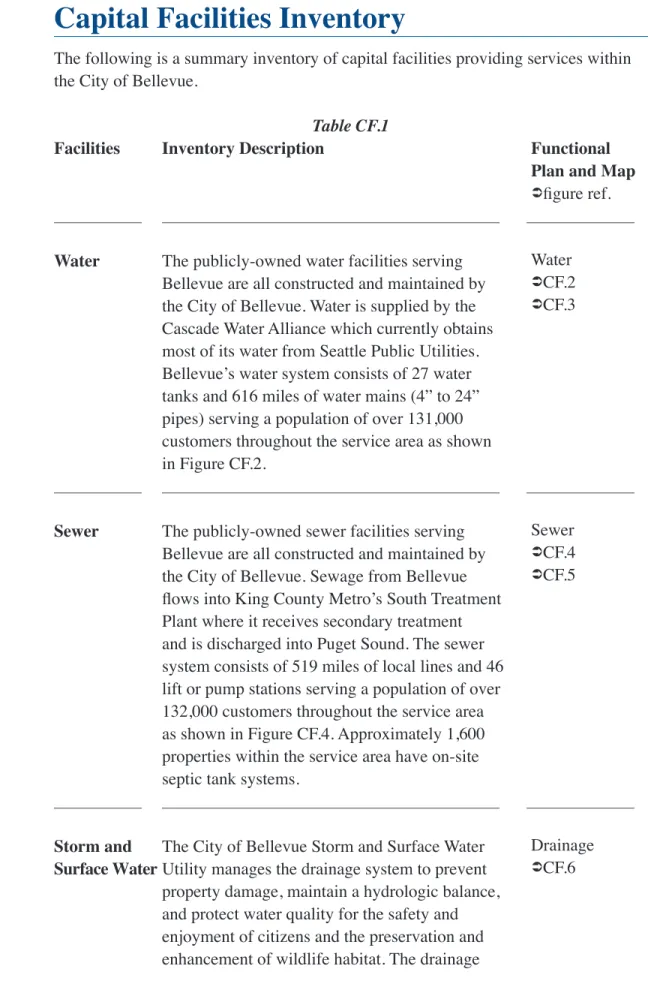
The following is a summary inventory of capital facilities providing services within the City of Bellevue.
Table CF.1
Facilities Inventory Description Functional
Plan and Map
‹figure ref.
_____________ __________________________________________________ ________________ Water The publicly-owned water facilities serving
Bellevue are all constructed and maintained by the City of Bellevue. Water is supplied by the Cascade Water Alliance which currently obtains most of its water from Seattle Public Utilities.
Bellevue’s water system consists of 27 water
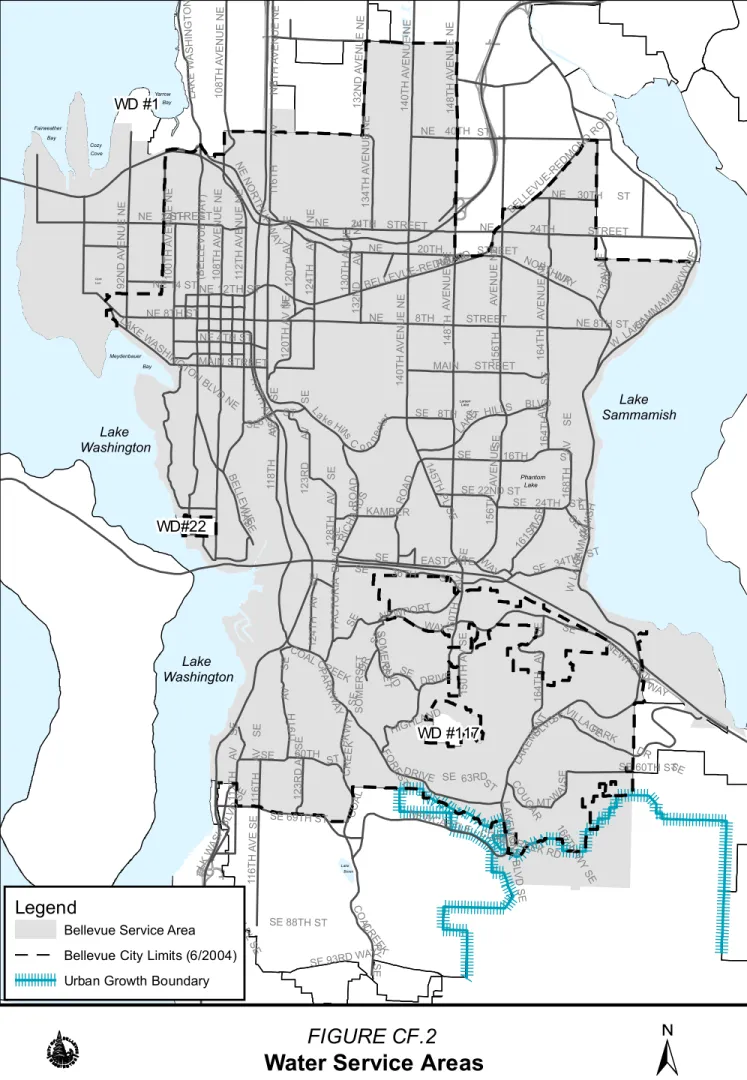
tanks and 616 miles of water mains (4” to 24” pipes) serving a population of over 131,000 customers throughout the service area as shown in Figure CF.2.
_____________ __________________________________________________ ________________
Sewer The publicly-owned sewer facilities serving
Bellevue are all constructed and maintained by the City of Bellevue. Sewage from Bellevue
flows into King County Metro’s South Treatment
Plant where it receives secondary treatment and is discharged into Puget Sound. The sewer system consists of 519 miles of local lines and 46 lift or pump stations serving a population of over 132,000 customers throughout the service area as shown in Figure CF.4. Approximately 1,600 properties within the service area have on-site septic tank systems.
_____________ __________________________________________________ ________________
Storm and The City of Bellevue Storm and Surface Water
Surface Water Utility manages the drainage system to prevent
property damage, maintain a hydrologic balance,
and protect water quality for the safety and
enjoyment of citizens and the preservation and enhancement of wildlife habitat. The drainage
Water ‹CF.2 ‹CF.3 Sewer ‹CF.4 ‹CF.5 Drainage ‹CF.6
system consists of eleven regional flood control facilities, more than 300 neighborhood flood
control (detention) facilities, and over 60 miles of open streams. Approximately 30,200 parcels within the city are served by the drainage system managed by the utility. Over 800 acres of
wetlands are protected to preserve natural water
filtration.
_____________ __________________________________________________ ________________ Solid Waste Solid waste transfer facilities are constructed,
Transfer operated and managed by King County through
its Solid Waste Division. There is one transfer facility serving the disposal and recycling needs of Bellevue located north of I-90 in the Richards Valley Subarea. The solid waste which is collected at this facility is compacted and taken to the Cedar
Hills Landfill. The Factoria Transfer Station also
provides for the collection of recyclables and moderate risk waste from households and small businesses. The city currently contracts with private haulers for the collection of solid waste, yard waste, and recyclables from residential and business customers.
_____________ __________________________________________________ ________________
Parks and Parks and recreation facilities serving Bellevue
Recreation include city, county, and state facilities. The City of Bellevue maintains over 2,400 acres of park and open space land that offer active and passive recreational opportunities to residents, and preserve natural areas of the community. Facilities include eighty developed parks,
thirty-two athletic fields, two golf courses, two swimming pools, forty-five playgrounds,
thirty-eight tennis courts, three major community centers, and ninety-four miles of trails.
_____________ __________________________________________________ ________________ Fire and Fire and emergency medical services and capital
Emergency facilities are managed and maintained by the
Preparedness Bellevue Fire Department and consist of nine fire
stations and support apparatus including engine companies, light force companies, aid
King County Solid Waste Management Plan Parks and Open Space System Plan ‹CF.7 Fire, Police, and Emergency Preparedness Facilities ‹CF.8
units, medic units, an air unit, a mass casualty unit, a hazardous material unit and a number of other staff and specialty vehicles. Tenant improvements are also managed by the Fire
Department at three medic quarters in
non-city owned facilities. Emergency Preparedness facilities include the Emergency Preparedness
Division Office and an Emergency Operations
Center located at the Police Annex, as well as several departmental command centers located at various city buildings.
_____________ __________________________________________________ ________________
Police Police facilities consist of a central office located
at Bellevue City Hall, a firing range, classroom
facilities, an evidence room, Police Annex, 9-1-1 Communications Center located in the basement of Fire Station 3 and the two Police Substations at Crossroads and Factoria.
_____________ __________________________________________________ ________________ Transportation Transportation capital facilities serving
Bellevue consist of streets, transit facilities, high-occupancy vehicle (HOV) facilities, and park-and-ride lots. Streets include such facilities
as roads, street lights, traffic signals, guardrails,
sidewalks, and pedestrian and bike trails. A detailed inventory of capital transportation facilities, levels of service, facility needs, and
financing plans is found in the Transportation
Element of the Comprehensive Plan.
_____________ __________________________________________________ ________________
Public Most of Bellevue’s residents are served by the
Education Bellevue School District, though some are served by the Lake Washington School District,
the Issaquah School District and the Renton School District. Specific information on school
district facilities including, but not limited to, enrollment, classroom size, service standards,
and financing, is contained in each school district’s capital facilities plans.
_____________ __________________________________________________ ________________ Fire, Police, and Emergency Preparedness Facilities ‹CF.8 Transportation Element, TFPs (Volume 2) Public Schools and Libraries ‹CF.9 school district(s) capital facilities plans
Public Bellevue’s library needs are provided for by the
Libraries King County Library System (KCLS) which
has four branches located in Bellevue: the Bellevue Regional, Lake Hills, and Newport Way branches, as well as the Library Connection
@ Crossroads. However, due to KCLS’s
special services such as the Traveling Library Center (TLC), Bellevue residents have access to a greater service area (larger than the city
boundaries). KCLS consists of five library sizes:
small, medium, large, resource, and regional. At the large- and resource-sized libraries, containing from 120,000 to 198,000 items (Lake Hills and Newport Way Libraries), there are more specialized collection materials in addition to introductory information. The collections at the regional libraries, such as Bellevue Regional, generally containing more than 225,000 items, include more technical information in a large variety of subject areas, as well as general and
introductory information (King County Library
System, The Year 2000 Plan, September 1992).
_____________ __________________________________________________ ________________
Other City The City of Bellevue maintains and/or utilizes a
Facilities and number of other capital facilities and buildings in
Municipal order to perform the necessary administrative
Buildings functions of the city. These include Bellevue
City Hall consisting of several city departments,
Public Schools and Libraries ‹CF.9 Other municipal facilities ‹CF.10
Bellevue is home to the Bellevue Regional Library—the King County Library System’s flagship facility.
council chambers, and police headquarters; the Leavitt Building which houses the city’s
transportation and public utility departments; the Police Annex/Custody Facility which houses public safety operations; the Bellevue Service Center which houses maintenance services and operations services and the maintenance vehicle
fleet; Fire Stations and the Public Safety Training Center for fire, police, and emergency services
training activities; and Bellevue District Court
(King County) which provides prosecution and
probation services for adult misdemeanor cases. In late 2005 and early 2006 general city staff, police department administration, operations and custody facilities, 9-1-1 Communications Center,
fire department administration and a number of
other city functions will be consolidated in the newly renovated New City Hall in Downtown.
_____________ __________________________________________________ ________________
Capital Facilities [Future] Needs
The provision of capital facilities contributes to
our quality of life. Parks, utilities, fire stations and
other community and regional facilities are a
physical reflection of
community values. Bellevue is a highly-urbanized community with little vacant land. However, there is a full array of urban services to accommodate projected growth in households and jobs over the next 20 years. Therefore, needed capital facilities will focus on maintaining and improving levels of service as redevelopment occurs in these areas.
Investing in quality capital facilities provides benefits to the whole community.
20-year household and job targets established for individual cities under the
Countywide Planning Policies ensure that the region has sufficient capacity to
accommodate growth (the Land Use Element discusses this in more detail).
Bellevue’s targets for the 20-year planning period are 10,117 additional housing units
and 40,000 additional jobs. Identifying these targets as part of the Capital Facilities Element future needs discussion ensures that Bellevue plans for growth by identifying and paying for needed capital facilities. These facilities consistently implement
the Land Use Element, make more efficient use of urban land to avoid sprawl and
reduce service delivery cost, and implement the Urban Growth Goal of the GMA,
encouraging development in urban areas where adequate public facilities and services exist or can be provided in an efficient manner.
All capital facilities serving Bellevue use some form of measurement to evaluate
performance and needs. The quantity and quality of needed capital facilities are
measured by adopted levels of service, operating criteria or performance standards. These measurement tools are found in each capital facility functional plan.
A list of needed capital facilities in Bellevue are contained within the functional plans that are listed in Table CF.2. Some of these facilities include:
• The New City Hall Downtown which will consolidate general city staff, police
department administration & operations, the 9-1-1 Communications Center, fire
department administration and a number of other city functions;
• An additional fire station to serve the downtown community;
• Additional water storage and inlet capacity needs for the West Bellevue Operating Area and additional water distribution system capacity for enhanced
fireflow throughout the water system;
• Additional sewer trunk lines and a pump station upgrade serving Downtown and a sewer capacity improvement serving the [Redmond] Overlake area (to be funded by Redmond); and
• Additional storm drainage trunk capacity to alleviate urban flooding at various
locations throughout the city. Renewal and replacement of aging utility system components including pipelines, reservoirs and pump stations will increasingly
drive Utility capital investment. Regional requirements for restoring stream habitat and improving surface water quality will also require significant capital investment, as will state and federal drinking water quality mandates.
Additional facilities needed to address deficiencies and changes in level of service include park and recreation facilities such as acquisition and development
of waterfront property, mini-park and neighborhood park sites, open space for greenways and linkages, a community center site serving Downtown and additional
community parks. Many school sportsfields and play areas have been improved by the city for community use through partnerships with the Bellevue and Issaquah
used to augment citywide open space and recreation needs.
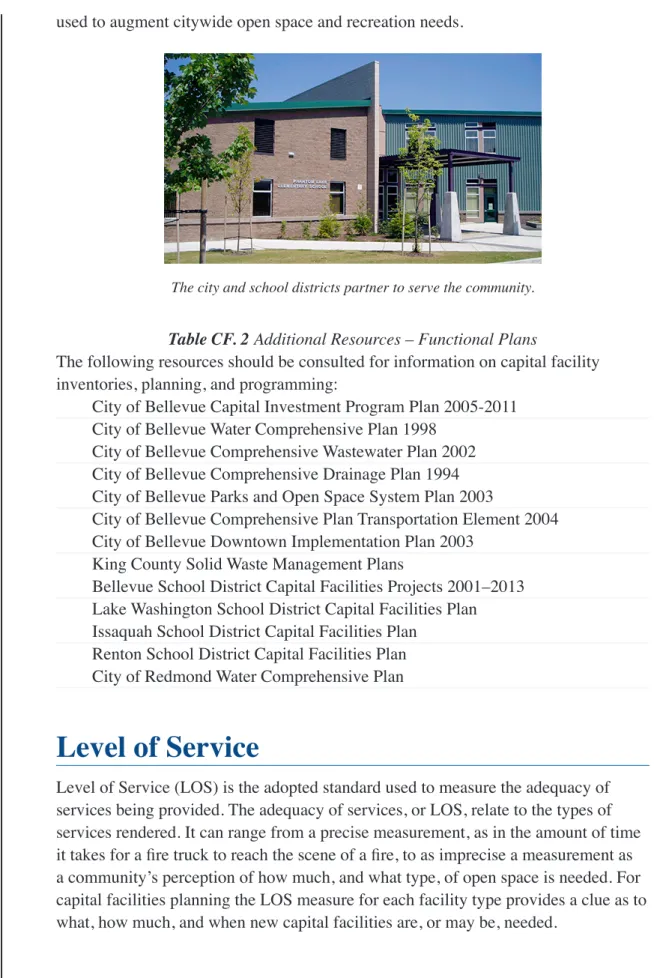
The city and school districts partner to serve the community.
Table CF. 2 Additional Resources – Functional Plans
The following resources should be consulted for information on capital facility inventories, planning, and programming:
City of Bellevue Capital Investment Program Plan 2005-2011 City of Bellevue Water Comprehensive Plan 1998
City of Bellevue Comprehensive Wastewater Plan 2002 City of Bellevue Comprehensive Drainage Plan 1994 City of Bellevue Parks and Open Space System Plan 2003
City of Bellevue Comprehensive Plan Transportation Element 2004 City of Bellevue Downtown Implementation Plan 2003
King County Solid Waste Management Plans
Bellevue School District Capital Facilities Projects 2001–2013 Lake Washington School District Capital Facilities Plan
Issaquah School District Capital Facilities Plan
Renton School District Capital Facilities Plan City of Redmond Water Comprehensive Plan
Level of Service
Level of Service (LOS) is the adopted standard used to measure the adequacy of services being provided. The adequacy of services, or LOS, relate to the types of
services rendered. It can range from a precise measurement, as in the amount of time
it takes for a fire truck to reach the scene of a fire, to as imprecise a measurement as a community’s perception of how much, and what type, of open space is needed. For
capital facilities planning the LOS measure for each facility type provides a clue as to what, how much, and when new capital facilities are, or may be, needed.
LOS standards are not created in a vacuum. They are a part of an on-going iterative
process that includes such factors as a community’s population and its economics and fiscal resources. Population tells who, how many, and where people need services,
and the economics determines the amount of funding available to meet those service needs.
Once an LOS standard has been established, the performance of a capital facility can be measured. A capital facility operating at or above the established LOS indicates no need for improvements or new facilities. A facility operating below the established LOS is an indication that there may be a need for improvements, or new facilities, or evaluation of the LOS. However, if funding is not available to bring the service back
to the established level, then the LOS is reexamined to determine if it is adequate.
Financing Mechanisms and Revenue Sources
The Capital Investment Program (CIP) is the city’s six-year financing and
implementation plan, biennially updated, in which needed capital improvements to
the city’s public facilities and infrastructure are identified, prioritized, and priced.
Funding from a variety of sources, including local taxes, is matched with the costs of these projects. After the City Council has reviewed and approved the program, these projects are implemented.
The objective of the CIP Plan is to identify capital facility needs and funding
mechanisms to finance the
construction, reconstruction,
and acquisition of needed
assets because of growth, aging, changing needs,
and Bellevue’s desire to improve the city’s capital
investments.
The CIP Plan utilizes numerous revenue sources to fund designated capital
investment projects identified in the program. Revenues come from various sources
including sales and B & O (business and occupation) taxes, utility rates as well as state revenues, bond issues, and state and federal grants. Another source of potential
revenue is impact fees and other specific revenues allowed under the Growth Management Act to fund the city’s capital investments and needed public facilities.1 Similar to city-managed capital facilities, non-city-managed capital facilities improvements are funded through bond issues and special assessments.
Public investment in infrastructure enhances the quality of life in Bellevue neighborhoods.
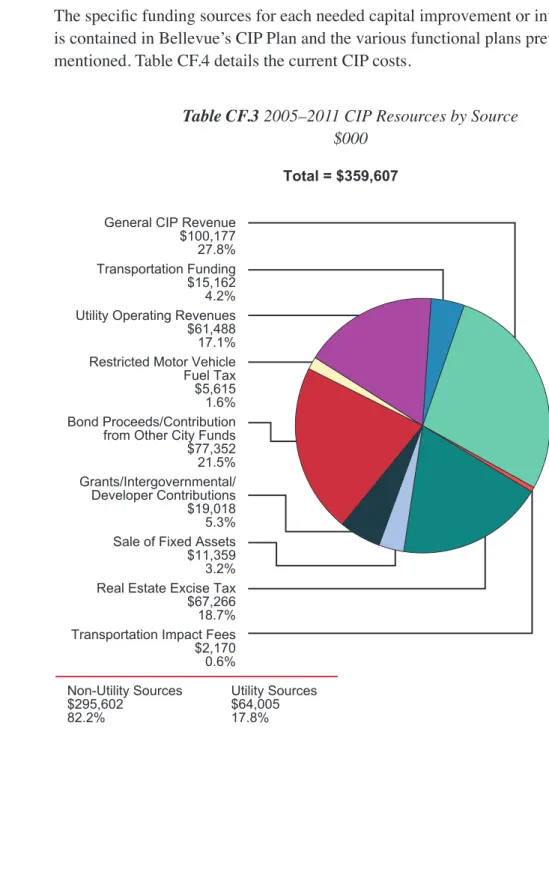
Table CF.3 lists the major categories of CIP revenue sources2 and the amount contributed by each source.
The specific funding sources for each needed capital improvement or investment is contained in Bellevue’s CIP Plan and the various functional plans previously
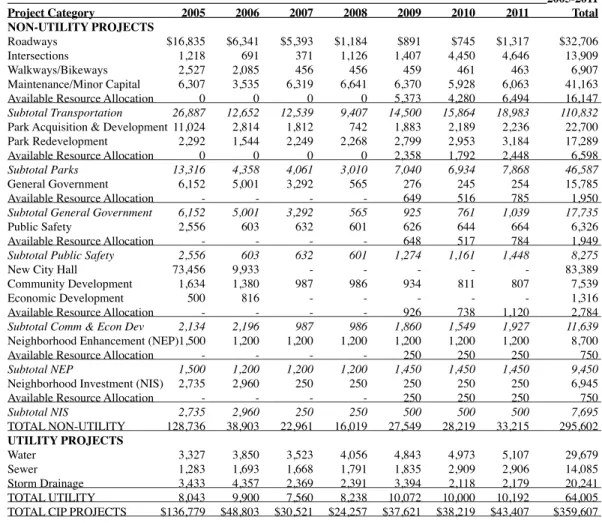
mentioned. Table CF.4 details the current CIP costs.
General CIP Revenue $100,177 27.8% Transportation Funding $15,162 4.2% Utility Operating Revenues $61,488 17.1% Restricted Motor Vehicle Fuel Tax $5,615 1.6% Bond Proceeds/Contribution from Other City Funds $77,352 21.5% Grants/Intergovernmental/ Developer Contributions $19,018 5.3% Sale of Fixed Assets $11,359 3.2% Real Estate Excise Tax $67,266 18.7% Transportation Impact Fees $2,170 0.6% Non-Utility Sources $295,602 82.2% Utility Sources $64,005 17.8% Total = $359,607
Table CF.3 2005–2011 CIP Resources by Source $000
Table CF.4 2005-2011 CIP Project Costs by Year and Project Category
($000’s)
This table displays the 2005-2011 budgets for the sixteen project categories and the years in which the expenditures are expected to occur. This table indicates that the CIP Plan is heavily weighted with projects during the early years of the Plan. This is especially true in the Transportation and Parks program areas where projects are a top priority and to the greatest extent possible, have been programmed in the early years of the CIP Plan.
2005-2011
Project Category 2005 2006 2007 2008 2009 2010 2011 Total NON-UTILITY PROJECTS
Roadways $16,835 $6,341 $5,393 $1,184 $891 $745 $1,317 $32,706
Intersections 1,218 691 371 1,126 1,407 4,450 4,646 13,909
Walkways/Bikeways 2,527 2,085 456 456 459 461 463 6,907
Maintenance/Minor Capital 6,307 3,535 6,319 6,641 6,370 5,928 6,063 41,163
Available Resource Allocation 0 0 0 0 5,373 4,280 6,494 16,147
Subtotal Transportation 26,887 12,652 12,539 9,407 14,500 15,864 18,983 110,832
Park Acquisition & Development 11,024 2,814 1,812 742 1,883 2,189 2,236 22,700
Park Redevelopment 2,292 1,544 2,249 2,268 2,799 2,953 3,184 17,289
Available Resource Allocation 0 0 0 0 2,358 1,792 2,448 6,598
Subtotal Parks 13,316 4,358 4,061 3,010 7,040 6,934 7,868 46,587
General Government 6,152 5,001 3,292 565 276 245 254 15,785
Available Resource Allocation - - - - 649 516 785 1,950
Subtotal General Government 6,152 5,001 3,292 565 925 761 1,039 17,735
Public Safety 2,556 603 632 601 626 644 664 6,326
Available Resource Allocation - - - - 648 517 784 1,949
Subtotal Public Safety 2,556 603 632 601 1,274 1,161 1,448 8,275
New City Hall 73,456 9,933 - - - 83,389
Community Development 1,634 1,380 987 986 934 811 807 7,539
Economic Development 500 816 - - - 1,316
Available Resource Allocation - - - - 926 738 1,120 2,784
Subtotal Comm & Econ Dev 2,134 2,196 987 986 1,860 1,549 1,927 11,639
Neighborhood Enhancement (NEP) 1,500 1,200 1,200 1,200 1,200 1,200 1,200 8,700
Available Resource Allocation - - - - 250 250 250 750
Subtotal NEP 1,500 1,200 1,200 1,200 1,450 1,450 1,450 9,450
Neighborhood Investment (NIS) 2,735 2,960 250 250 250 250 250 6,945
Available Resource Allocation - - - - 250 250 250 750
Subtotal NIS 2,735 2,960 250 250 500 500 500 7,695 TOTAL NON-UTILITY 128,736 38,903 22,961 16,019 27,549 28,219 33,215 295,602 UTILITY PROJECTS Water 3,327 3,850 3,523 4,056 4,843 4,973 5,107 29,679 Sewer 1,283 1,693 1,668 1,791 1,835 2,909 2,906 14,085 Storm Drainage 3,433 4,357 2,369 2,391 3,394 2,118 2,179 20,241 TOTAL UTILITY 8,043 9,900 7,560 8,238 10,072 10,000 10,192 64,005
Reassessment of Land Use Element
The Growth Management Act requires that provisions be made to reassess the Land
Use Element of the Comprehensive Plan periodically because a capital facilities plan
is an evolving document. The purpose of this requirement is to ensure that adequate
facilities will be made available at the time certain portions of the Land Use Element are implemented and needed facilities are called for. If the anticipated funding for
needed capital facilities falls short, the GMA requires a reassessment of the Land Use
Element to determine what changes, if any, need to be made.
The Bellevue Land Use Code establishes the procedure and criteria the city will use in reviewing the Land Use Element and all other elements of the Comprehensive Plan. Additionally, it establishes the responsibility of the city to monitor the status of development in the city in relation to the Plan and to review the Plan on a regular basis. Currently, facility planning and programming is keeping pace with development. Consistent with the GMA, Bellevue will evaluate land use plans and the CIP as well as
other jurisdictions’ facilities plans to ensure that facilities are available when needed.
Tools that are used to monitor and reassess include:
• The annual process to amend the Comprehensive Plan at LUC 20.35.150;
• Periodic GMA-level plan monitoring at five years (Buildable Lands), seven
years (Update) and ten years (Growth Targets); • The biennial CIP budget process;
• Annual CIP budget monitoring reports with quarterly updates; • The Reader’s Guide to the CIP;
• The biennial State of the Streets Report; • Transportation concurrency Snapshots; and • The Transportation Improvement Program (TIP)
P
oliciesPOLICY CF-1. Ensure that necessary capital facilities are provided within a
reasonable time of the occurrence of impacts resulting there from.
POLICY CF-2. Use the city’s Capital Investment Program to prioritize the financing
of capital facilities within projected funding capacities.
Discussion: Capital improvement (or investment) programs are integral to the budget
process of the organizations covered in this element. The lists of needed capital
are included in Bellevue’s CIP Plan, which is updated bi-annually, and in the various
capital facility plans which are updated by the responsible organizations periodically.
POLICY CF-3. Amend the “Capital Facilities Needs” and “Financing Mechanisms
and Revenue Sources” sections of this Element concurrently with adoption of the biennial Capital Investment Program (CIP).
POLICY CF-4. Base capital facilities needs on employment and population
projections developed by the city in conjunction with county and regional estimates.
POLICY CF-5. Use adopted LOS, operating criteria, or performance standards to
evaluate capital facilities needs.
POLICY CF-6. Encourage non-city-managed capital facilities providers to develop,
in cooperation with Bellevue, LOS, operating criteria, performance standards, or other forms of standardized measurement to evaluate its capital facilities needs and
ensure consistency with Bellevue’s Comprehensive Plan.
POLICY CF-7. Ensure that Bellevue’s Land Use Element and its Capital Facilities
Plan Element are internally consistent.
POLICY CF-8. Coordinate the review of non-city-managed capital facilities plans to
ensure that their plans are consistent with Bellevue’s Comprehensive Plan.
POLICY CF-9. Reassess Bellevue’s Land Use Plan periodically to ensure that
capital facilities needs, financing, and level of service are consistent.
POLICY CF-10. Coordinate the transfer of capital facility programming from the
county to the city prior to the annexation of new areas into the city.
POLICY CF-11. Consider levying impact fees on development in the portion of
Bellevue served by a school district upon the request of the district, presentation of
its adopted Capital Facilities Plan and demonstration that such facilities are needed to accommodate projected growth in the district.
POLICY CF-12. Adopt a City of Bellevue post-disaster Response and Recovery
Plan that will structure the city’s capability to provide services to facilitate recovery
and reconstruction in the event of a disaster.
Discussion: The Plan is organized into five functions: Damage Assessment and Re-Occupancy, Public Service Restoration, Community Sustainability, Social and Health Services and City-Wide Organization, with direction contained in each function for
Process for Identifying and Siting Essential
Public Facilities
The Growth Management Act (GMA) requires the Comprehensive Plan to include
a process for identifying and siting Essential Public Facilities (EPF). According to the GMA, no local comprehensive plan may preclude the siting of essential public facilities.
The GMA defines essential public facilities as those “that are typically difficult to
site, such as airports, state education facilities and state or regional transportation
facilities as defined in RCW 47.06.140, state and local correctional facilities, solid
waste handling facilities, and in-patient facilities including substance abuse facilities, mental health facilities, group homes, and secure community transition facilities as
defined in RCW 71.09.020.”
Establishing an EPF siting process is a mandate of the Growth Management Act.
Including a process for siting EPF in the Comprehensive Plan has benefits, including minimizing difficulties in the siting process and addressing local impacts equitably. This section contains Bellevue’s policies regarding a process for siting EPF. The
policies in this section are intended to guide the creation of provisions in the Land Use Code to site EPF that are not otherwise regulated by the LUC. EPF that are otherwise regulated by the LUC will continue to be regulated as set forth in the LUC without need to use the siting policies set forth in this section.
The siting process described in this section is intended as an interim process. The Growth Management Planning Council (GMPC), which is made up of the cities
in King County and the County, is required by the Countywide Planning Policies
(CPP) to establish a countywide process for siting essential public facilities (ref.
CPP FW-32). That process is to address EPF definitions, inventories, incentives,
public involvement, environmental protection and consideration of alternative siting strategies (ref. CPP S-1). When that process is established, Bellevue may modify this
process to reflect the GMPC recommendations.
Identifying Essential Public Facilities (EPF)
POLICY CF-13. Define essential public facilities, consistent with the GMA, as
facilities that are difficult to site or expand and that provide services to the public, or
are substantially funded by government, or are contracted for by government, or are provided by private entities subject to public service obligation.
POLICY CF-14. Require land use decisions on essential public facilities meeting
the following criteria to be made consistent with the process and criteria set forth in Policy CF-16 :
1. The facility meets the Growth Management Act definition of an essential public facility at RCW 36.70A.200(1) now and as amended; or
2. The facility is on the statewide list maintained by the Office of Financial Management, ref. RCW 36.70A.200(4) or on the countywide list of essential
public facilities; AND
3. The facility is not otherwise regulated by the Bellevue Land Use Code (LUC).
Siting Essential Public Facilities
POLICY CF-15. Participate in efforts to create an inter-jurisdictional approach to the siting of countywide or statewide essential public facilities with neighboring jurisdictions as encouraged by Countywide Planning Policies FW-32 (establish a countywide process for siting essential public facilities) and S-1 (consideration of alternative siting strategies). Through participation in this process, seek agreements
among jurisdictions to mitigate against the disproportionate financial burden which
may fall on the jurisdiction which becomes the site of a facility of a state-wide, regional or county-wide nature.
The essential public facility siting process set forth in Policy CF-16 is an interim process. If the CPP FW-32 siting process is adopted through the Growth Management Planning Council the city may modify this process to be consistent with the GMPC recommendations.
POLICY CF-16. Use this interim Siting Process to site the essential public facilities described in Policy CF-14 in Bellevue. Implement this process through appropriate procedures incorporated into the Land Use Code.
Interim EPF Siting Process
1. Use policies CF-13 and CF-14 to determine if a proposed essential public facility serves local, countywide or statewide public needs.
2. Site EPF through a separate multi-jurisdictional process, if one is available, if the city determines that a proposed essential public facility serves a countywide or statewide need.
3. Require an agency, special district or organization proposing an essential public facility to provide information about the difficulty of siting the essential public
facility, and about the alternative sites considered for location of the essential public facility proposed.
4. Process applications for siting essential public facilities through LUC Section 20.30B — Conditional Use Permit.
5. Address the following criteria in addition to the Conditional Use Permit decision criteria:
a. Consistency with the plan under which the proposing agency, special district or organization operates, if any such plan exists;
b. Include conditions or mitigation measures on approval that may be imposed
within the scope of the city’s authority to mitigate against any environmental,
compatibility, public safety or other impacts of the EPF, its location, design, use or operation; and
c. The EPF and its location, design, use and operation must be in compliance with any guidelines, regulations, rules or statutes governing the EPF as adopted by state law or by any other agency or jurisdiction with authority over the EPF.
6. Use the Process I review and appeal procedures described in the Land Use Code as the public participation component of the siting process.
POLICY CF-17. After a final siting decision has been made on an essential public
facility according to the process described in Policy CF-16, pursue any amenities or incentives offered by the operating agency or by state law or other rule or regulation to jurisdictions within which such EPF are located.
POLICY CF-18. For EPF having public safety impacts that cannot be mitigated
through the process described in Policy CF-16, the city should participate in any process available to provide comments and suggested conditions to mitigate those public safety impacts to the agency, special district or organization proposing the EPF. If no such process exists, the city should encourage consideration of such comments and conditions through coordination with the agency, special district or organization proposing the EPF. A mediation process may be the appropriate means of resolving any disagreement about the appropriateness of any mitigating condition
requested by the city as a result of the public safety impacts of a proposal.
POLICY CF-19. Locate essential public facilities equitably throughout the city,
county and state. No jurisdiction or area of the city should take a disproportionate
share of essential public facilities. This policy shall not be interpreted to require the
preclusion of an essential public facility from locations in the city.
POLICY CF-20. Locate Secure Community Transition Facilities, as defined by
RCW 71.09.020 now or as hereafter amended, outside of Single-family and
Multi-family Residential districts. Provide a separation between Secure Community Transition Facilities and residentially developed property in other land use districts.
Endnotes:
1. Section 82.02.090(3) of the RCW states that “impact fees” means a payment of money imposed upon development as a condition of development approval to pay for public facilities needed to serve new growth and development, and that is reasonably related to the new development that creates additional demand and need for public facilities, that is a proportionate share of the cost of the public facilities, and that is used for facilities that reasonably benefit the new development.
Section 82.02.090(7) of the RCW states that by “public facilities” it is meant capital facilities owned or operated by government entities: (a) Public streets and roads; (b) publicly owned parks, open space, and recreational facilities; (c) school facilities; and (d) fire protection facilities in jurisdictions that are not a part of a fire district.
2. General CIP revenue is defined as the annual revenue dedicated to CIP use derived from .5% of the city’s local optional sales tax, .03% of the city’s business and occupation tax, interest earnings on unexpended balances and any miscellaneous unrestricted revenues.
Lake Lake Bellevue Lake Larsen Lake Boren Phantom Yarrow Cozy Cove Bay Bay Bay Meydenbauer Fairweather Clyde Loch Swan Lake SammamishLake WashingtonLake Washington Lake B E LLE VU E 14 5TH PL SE 15 6T H NE 24THSTREET 14 0T H A V EN U E N E MAIN STREET 16 4T H A V E NU E N E A V E N U E N E A V E N U E NE NOR THUWAYP 10 8T H A V EN U E N E 13 4T H A V E N U E N E 13 2N D A VE N UE N E LA K E W A S H IN G T O N B 140T H AV E N U EN E 14 8T H A V E N U E N E SE 88TH ST 116T H A VE S E 11 0TH PL SE SE 69TH ST SE 93RD WAY SE 60TH ST LK WA SH BLV DS E CO UG AR COAL CR EEK PA R KW AY SE 22ND ST S E A VE N U E W LAK E BELL EVUE -RED MON DRO AD NE N O R TH UP W AY 10 0T H A V E NU E N E 92 N D A V E N U E NE LA KE WA SH INGTO N BLVD NE CR EEPYK S E C O AL 15 6T H 14 8TH SE 63RDST S O M E R S E T SE 150T H AV SE W AY EASTGATE SE 16 4T H A V S E RIC HA RD S 161S TS E NE 4TH ST MAIN STREET NE 8TH ST 10 8TH A V E NU E N E 11 2T H A V E N U E N E (B ELL E V U E WA Y ) 11 6T HA V E N U E N E S O M E RS E T ST NE 12TH ST 11 6T H A V N E NE 30TH ST NEW PO RT SE WAY 11 4TH AV SE LAK EM ON T BLVD SE 123R D A VS E PKW Y SE CO AL CR EE K SE MT WAY NE 24TH NE 20TH STREET NE 8TH STREET 118T H AV S E 8TH SE ST LAKE HILLS BLVD SE 8TH ST AV N E 12 0TH 12 4TH A V NE 130T HA V NE ROAD BELLEVU E-REDMO ND 13 2N D A V NE 16 4THA V SE 173R D N E AV 12 8T H A V S E LA K E M O N T B LV D S E SE W AY 12 0T H AV N E 24TH STREET SE 36TH ST NE 14 ST NE 8TH ST STREET NE R O A D 12 3R D A V S E RO AD KAMBER SE 16TH ST SE 24TH ST SA MM AM ISH P Y AV 16 8T H A V S E FO RE STDRIVE 124T H A V S E A V SE 11 2T H A V S E 11 6TH A V S E SE 60TH HIGHLA ND DRIVE VIL LAGE B LVDSE NEWPORT WAY DR SE 16 6TH W Y SE SE 26ST 11 9T H ST 40TH NE NEWCASTLE - C OAL CREEK RD FA C T O R IA B LV D S E PKW YNE WLA KESAMM AMIS H Lake Hills Co nnect or 15 0T H A V S E PARK DR SE SE 34TH ST Legend
Bellevue Service Area Bellevue City Limits (6/2004) Urban Growth Boundary
FIGURE CF.2
WD #1WD#22
Lake Lake Bellevue Lake Larsen Lake Boren Phantom Yarrow Cozy Cove Bay Bay Bay Meydenbauer Fairweather Clyde Loch Swan Lake SammamishLake WashingtonLake Washington Lake BE LLE VU E 14 5TH PL SE 15 6T H NE 24THSTREET 140T H A V E N U EN E MAIN STREET 16 4T H A V EN U E N E A V E N U E N E A V E N U E N E NORTHU P WAY 10 8T HA V E N U E N E 13 4T H A V E N U E N E 13 2N D AV E N UE N E LA K E W A S H IN G T O N B 140T H AV E N U EN E 14 8T H A V E N U E N E SE 88TH ST 11 6T H A V ES E 11 0TH PL SE SE 69TH ST SE 93RD WAY SE 60TH ST LK WA SH BLV DS E C OU G AR COA L CR EEK PAR KW AY SE 22ND ST S E A V E NU E W LA KE BELL EVUE -RED MON DRO AD NE NO R THU P W AY 10 0T H A V E N U E N E 92 N D A V E N U EN E LAKE WASH ING TON BLVD NE CR EEPK Y S E C O AL 15 6T H 14 8T H SE 63RDST S O M ER SE T SE 150T H AV SE W AY EASTGATE SE 16 4T H A V S E RIC HA RD S 161S TS E NE 4TH ST MAIN STREET NE 8TH ST 10 8T H A V E N UE N E 11 2T H A V E N U E N E (B E LLE V U E W A Y) 11 6T HA V E N U E N E S O M ER S E T ST NE 12TH ST 11 6T H A V N E NE 30TH ST NEW PO RT SE WAY 11 4TH AV SE LAK EM ON T BLVD SE 12 3R D A VS E PKW Y SE CO AL CR E EK S E MT WAY NE 24TH NE 20TH STREET NE 8TH STREET 11 8T H A V S E 8TH SE ST HILLS LAKE BLVD SE 8TH ST A V NE 12 0T H 124T H A V N E 13 0T H A VN E ROAD BELLEVU E-REDMO ND 13 2N D A V N E 16 4T HA V SE 173R D N E A V 12 8T H AV S E LAK E M O N T B LV D S E SE W AY 12 0T H A V N E 24TH STREET SE 36TH ST NE 14 ST NE 8TH ST STREET NE R O AD 12 3R D A V S E RO AD KAMBER SE 16TH ST SE 24TH ST SA MM AM ISH P Y AV 168T H A V S E FOR ES TDRIVE 12 4TH A V SE A V S E 112T H AV S E 116T H A V S E SE 60TH HIGHLA ND DRIVE VIL LAGE B LVDSE NEWPORT WAY DR SE 16 6TH W Y SE SE 26ST 11 9T H ST 40TH NE NEWCASTLE - C OAL CREEK RD FA C T O R IA B LV D S E PK WYN E WLA KESAMM AMIS H La ke Hills Co nnec tor 15 0T H A V S E PARK DR SE SE 34TH ST Legend Bellevue Reservoir Regional Supply Connection Bellevue City Limits (6/2004) Urban Growth Boundary
Major Water Facilities
FIGURE CF.3
Seattle Public Utilities operates water supply lines through Bellevue
Lake Lake Bellevue Lake Larsen Lake Boren Phantom Yarrow Cozy Cove Bay Bay Bay Meydenbauer Fairweather Clyde Loch Swan Lake Sammamish Lake Washington Lake WashingtonLake B E LLE V U E 14 5TH PL SE 15 6TH NE 24THSTREET 140T H A V E N U EN E MAIN STREET 16 4T H A V E N U E N E A V E N U E N E A V E N U E N E NOR THUWAYP 10 8T H A V EN U E N E 13 4T H A V E N U E N E 132N DA V EN U EN E LA K E W A S H IN G T O N B 14 0TH A VE N U EN E 14 8T H A V E N U E N E SE 88TH ST 11 6TH A V ES E 11 0TH P L SE SE 69TH ST SE 93RD WAY SE 60TH ST LK WA SH BLV DS E COUG AR COA L CR EEK PA R KW AY SE 22ND ST S E AV E N U E W LAK E BELL EVUE -RED MON DRO AD N E N O R TH U P W AY 10 0T H A V E N U E N E 92 N D AV E N U E N E LA KE WA SH INGTO N BLVD NE CR EEPK Y S E CO AL 156T H 14 8T H SE 63RDST S O M E R S ET SE 150T H AV SE W AY EASTGATE SE 164T H A V S E RIC HA RD S 161S TS E NE 4TH ST MAIN STREET NE 8TH ST 10 8TH A V E NU E N E 112T H A V E N U E N E (B E LL E V UE W A Y ) 11 6T H A V E N U E N E S O M E RS E T ST NE 12TH ST 11 6T H A V N E NE 30TH ST NEW PO RT SE WAY 11 4TH AV S E LAK EM ON T BLVD SE 12 3R DA V S E PKW Y SE CO AL CR EE K S E MT WAY NE 24TH NE 20TH STREET NE 8TH STREET 11 8TH A V S E 8TH SE ST LAKE HILLS BLVD SE 8TH ST A V NE 12 0TH 12 4T H A V N E 130T HA V NE ROAD BELLEVU E-REDMO ND 13 2N D A V NE 164T HA V S E 173R D NE A V 128T H A V S E LA K E M O N T B LVD SE SE W AY 12 0TH A V N E 24TH STREET SE 36TH ST NE 14 ST NE 8TH ST STREET NE R O A D 12 3R D A V S E RO AD KAMBER SE 16TH ST SE 24TH ST SA MM AM ISH P Y AV 16 8T H A V S E FO R ES TDRIVE 12 4T H A V S E A V S E 112T H AV S E 11 6T H A V SE SE 60TH HIGHLA ND DRIVE VIL LAGE B LVDSE NEWPORT WAY DR SE 16 6TH W Y SE SE 26ST 11 9T H ST 40TH NE NEWCA STLE - COAL CR EEK RD FA C T O R IA B LV D S E PK WYN E WLA KESAMM AMIS H La ke Hills C o n nec tor 15 0T H A V S E PARK DR SE SE 34TH ST Legend
Bellevue Service Area Bellevue City Limits (6/2004) Urban Growth Boundary
Lake Lake Bellevue Lake Larsen Lake Boren Phantom Yarrow Cozy Cove Bay Bay Bay Meydenbauer Fairweather Clyde Loch Swan Lake Sammamish Lake Washington Lake WashingtonLake BE LLE V UE 14 5TH PL SE 15 6TH NE 24THSTREET 14 0T H A V EN U E N E MAIN STREET 16 4T H A VE N U E N E A V E N U E N E A V E N U E N E NORTHU P WAY 10 8T H AV E N U E N E 13 4TH A V E N U E N E 132N DA V E NU EN E LA K E W A S H IN G T O N B 140T H AV E N U EN E 14 8T H A V E N U E N E SE 88TH ST 11 6T HA V E SE 11 0TH PL SE SE 69TH ST SE 93RD WAY SE 60TH ST LK WA SH BLV DS E CO UG AR COAL CR EEK PAR KW AY SE 22ND ST S E A V E N UE WLA KE BELL EVUE -RED MON DRO AD NE NO R THU P W AY 10 0T H A VE N U E N E 92 N D A V E N U E NE LA KE WASH INGTO N BLVD NE CR EEPK Y S E C O AL 15 6T H 148T H SE 63RDST S O M E R S E T SE 150T H AV SE W AY EASTGATE SE 16 4T H A V S E RIC HA RD S 161S TS E NE 4TH ST MAIN STREET NE 8TH ST 108T H A V EN U E N E 11 2T H A V E N U E N E (BE LL E V U EW A Y ) 11 6TH A V E N U E N E S O M E RS E T ST NE 12TH ST 11 6T H A V N E NE 30TH ST NEW PO RT SE WAY 11 4TH AV SE LAK EM ON T BLVD SE 12 3R DA V S E PKW Y SE CO AL CR EE K S E MT WAY NE 24TH NE 20TH STREET NE 8TH STREET 11 8TH A V S E 8TH SE ST HILLS LAKE BLVD SE 8TH ST A V N E 120T H 12 4T H A V N E 13 0TH A VN E ROAD BELLEVU E-REDMO ND 13 2N D A V N E 164T HA V S E 173R D N E A V 12 8T H A V S E LA K EM O N T B LV D S E SE W AY 120T H A V N E 24TH STREET SE 36TH ST NE 14 ST NE 8TH ST STREET NE R OA D 12 3R D A V S E RO AD KAMBER SE 16TH ST SE 24TH ST SA MM AM ISH P Y AV 16 8T H AV S E FOR ES TDRIVE 12 4TH A V S E AV SE 11 2T H A V S E 116T H AV S E SE 60TH HIGHLA ND DRIVE VIL LAGE B LVDSE NEWPORT WAY DR SE 16 6TH W Y SE SE 26ST 11 9T H ST 40TH NE NEWCA STLE - COAL CR EEK RD FA CT O R IA B LV D S E PK WYN E WLA KESAMM AMIS H La ke Hills Co nnect or 15 0T H A V S E PARK DR SE SE 34TH ST
Major Sewer Facilities
FIGURE CF.5
King County Metro operates sewer trunk lines through Bellevue. Legend
Bellevue Pump Stations Metro Pump Stations
Proposed Bellevue Pump Station Bellevue City Limits (6/2004) Urban Growth Boundary
Lake Lake Bellevue Lake Larsen Lake Boren Phantom Yarrow Cozy Cove Bay Bay Bay Meydenbauer Fairweather Clyde Loch Swan Lake Sammamish Lake Washington Lake Washington Lake BE LLE V U E 14 5TH PL SE 15 6TH NE 24THSTREET 14 0T H A V EN U E N E MAIN STREET 16 4T H A VE N U E N E A V E N U E N E A V EN U E N E NOR THUWAYP 10 8TH A V E N U E N E 13 4T H A VE N U E N E 132N DA V E NU E NE LA K E W A S H IN G T O N B 140T H AV E N U EN E 14 8T H A V E N U E N E SE 88TH ST 11 6TH A V ES E 11 0TH PL SE SE 69TH ST SE 93RD WAY SE 60TH ST LK WA SH BLV DS E COUG AR COAL CR EEK PA R KW AY SE 22ND ST S E A V E N UE WLA KE BELL EVUE -RED MON DRO AD N E N O R TH UP W AY 10 0TH A V E N U E N E 92 N D A V E N U EN E LA KE WA SH INGTO N BLVD NE CR EEP K Y S E C O AL 15 6T H 148T H SE 63RDST S O M E R S E T SE 150T H AV SE W AY EASTGATE SE 16 4T H AV S E RIC HA RD S 161S TS E NE 4TH ST MAIN STREET NE 8TH ST 10 8T H A VE N U E NE 11 2T H A V E N U E N E (B ELL E V U E WA Y ) 11 6T H AV E N U E N E S O M E R SE T ST NE 12TH ST 11 6T H A V N E NE 30TH ST NEW PO RT SE WAY 11 4TH AV SE LAK EM ON T BLVD SE 12 3R D A VS E PKW Y SE CO AL CR EE K S E MT WAY NE 24TH NE 20TH STREET NE 8TH STREET 118T H AV S E 8TH SE ST LAKE HILLS BLVD SE 8TH ST AV N E 120T H 12 4T H A V N E 130T HA V N E ROAD BELLEVU E-REDMO ND 13 2N D A V N E 16 4THA V SE 173R D NE A V 128T H A V S E LA K EM O N T B LV D S E SE W AY 12 0T H AV N E 24TH STREET SE 36TH ST NE 14 ST NE 8TH ST STREET NE R O A D 12 3R D A V S E RO AD KAMBER SE 16TH ST SE 24TH ST SA MM AM ISH P Y AV 16 8T H A V S E FO RE STDRIVE 12 4TH A V SE A V SE 112T H A V S E 11 6T H A V SE SE 60TH HIGHLA ND DRIVE VIL LAGE B LVDSE NEWPORT WAY DR SE 16 6T H W Y SE SE 26ST 11 9T H ST 40TH NE NEWCASTLE - C OAL CREEK RD FA C T O R IA B LV D S E PKW YNE WLA KESAMM AMIS H La ke Hills C o n nec tor 15 0T H A V S E PARK DR SE SE 34TH ST 0160 02 75 01 61 02 76 V A LLE Y CR E E K 0281 VA SA CR E EK K E LS E Y C R E E K 0273 02 76A COAL CR EEK 0162 D 0162K 0162 I O268D Legend
Bellevue City Limits (6/2004) Drainage Basin Boundary Urban Growth Boundary
Storm and Surface Water Facilities
FIGURE CF.6
A B C D E F G H I J A - Valley Creek B - Upper West Tributary C - Goff Creek D - Lower West Tributary E - Overlake F - Commissioner's Waterway G - Kelsey Creek H - Larsen Lake I - I-405 J - LakemontK - Coal Creek Sed Pond
Storm & Surface Water Regional Flood Control Facility
Bellevue Parks & Open Space
FIGURE CF.7
Lake Lake Bellevue Lake Larsen Lake Boren Phantom Yarrow Cozy Cove Bay Bay Bay Meydenbauer Fairweather Clyde Loch Swan Lake Sammamish Lake Washington Lake Washington Lake NE 8TH ST NE 24TH ST BELRED RD 14 0T HA V E N E 15 6T H A V E NE 14 8T H AV E N E 108T H A V ES E 11 2T H AV E N E 10 4T H A VE N E NE 20TH ST 16 4T H A V E N E NE 40TH ST NO RT HU PW AY SE 36TH ST 148T H A VE S E 10 0T H AV E N E 104T H AV ES E SE 16TH ST NE 4TH ST 124T H A V E N E 98 T H A VE N E 11 6T H A V ES E 84 T H A VE N E SE 60TH ST 13 4T H AV E N E 132N DA V E NE 15 0T H A V E S E SE 8TH ST NE 30TH ST 161S TA VE SE 76T H A V EN E 164T HA VE SE 124T HA VE SE 92 N D A VE N E SE NEW CASTLE-COAL CREEK 12 8T HA V E S E MAIN ST NE 60TH ST 14 0T HA V E S E 10 8TH A VE N E 140T HP LS E 168T HA VE SE SE 34TH ST 12 3R D A V E S E 11 4T H A V E N E 11 6TH A V E N E SE 72ND PL 101S TA VE SE POINTS DR 164T H WAY SE 168T HP LS E 123R DA VE SE 92N D A VE N E 10 8T HA V E N E 16 4T H A V E S E 12 8T H A V ES E MAIN ST MAIN ST SE 34TH STBellevue Parks System
Developed Park Sites Open Space/Undeveloped
Trails
Existing Planned
Public School Site / Library Private Park / School Other Public Parks
Bellevue City Limits (6/2004) Urban Growth Boundary
Lake Lake Bellevue Lake Larsen Lake Boren Phantom Yarrow Cozy Cove Bay Bay Bay Meydenbauer Fairweather Clyde Loch Swan Lake Sammamish Lake WashingtonLake WashingtonLake BE LLE VU E 14 5TH PL SE 15 6T H NE 24THSTREET 140T H A V E N U EN E MAIN STREET 16 4T H A V E N UE N E A V E N U E N E A VE N U E N E NOR THUWAYP 10 8T H AV E N U E N E 13 4T H A V E N U E N E 13 2N D AV E N UE N E LA K E W A S H IN G T O N 14 0T HA V E N UE N E 14 8T H A V E N U E N E SE 88TH ST 11 6TH A V ES E 11 0TH PL S E SE 69TH ST SE 93RD WAY SE 60TH ST LK WA SH BLV DS E COUG AR COA L CR EEK PA R K W AY SE 22ND ST S E A V E NU E WLA KE BELL EVUE -RED MON DRO AD NE N O R TH U P W AY 10 0T H A V E N U E N E 92N D A V E N U E N E LAKE WASH INGTO N BLVD NE CR EEPK Y S E C O AL 15 6T H 14 8T H SE 63RDST S O M E R S E T SE 150T H AV SE W AY EASTGATE SE 16 4T H A V S E RIC HAR DS 161S TS E NE 4TH ST MAIN STREET NE 8TH ST 108T H A V EN U E N E 11 2T H A V E N U E N E (B E LL E VU E W A Y ) 11 6T H A V EN U E N E S O M E RS E T ST NE 12TH ST 11 6T H A V N E NE 30TH ST NEW PO RT SE WAY 11 4TH AV SE LAK EM ON T BLVD SE 123R D A VS E PKW Y SE CO AL CR EE K S E MT WAY NE 24TH NE 20TH STREET NE 8TH STREET 11 8TH A V S E 8TH SE ST LAKE HILLS BLVD SE 8TH ST A V N E 120T H 12 4T H AV N E 130T HA V NE ROAD BELLEVU E-REDMO ND 13 2N D A V NE 16 4THA V SE 173R D N E A V 128T H A V S E LA K EM O N T B LV D S E SE W AY 12 0T H A VN E 24TH STREET SE 36TH ST NE 14 ST NE 8TH ST STREET NE R O A D 123R D A V S E RO AD KAMBER SE 16TH ST SE 24TH ST SA MM AM ISH P Y AV 16 8TH A V SE FO RE STDRIVE 124T H A V S E A V SE 112T H A V S E 11 6T H AV S E SE 60TH HIGHLA ND DRIVE VIL LAGE B LVDSE NEWPORT WAY DR SE 16 6TH W Y SE SE 26ST 11 9T H ST 40TH NE NEWCA STLE - COAL CR EEK RD FA C T O R IA B LV D S E PK WYN E WLA KESAMM AMIS H La ke Hills C onnec tor 15 0T H A V S E PARK DR SE SE 34TH ST Legend Fire Stations Police Stations
Emergency Preparedness Facilities Bellevue City Limits (6/2004) Urban Growth Boundary
Fire, Police, and Emergency
FIGURE CF.8Lake Lake Bellevue Lake Larsen Lake Boren Phantom Yarrow Cozy Cove Bay Bay Bay Meydenbauer Fairweather Clyde Loch Swan Lake Sammamish Lake WashingtonLake WashingtonLake BE LLE VU E 14 5TH P L S E 15 6T H NE 24THSTREET 14 0T H A V E NU E N E MAIN STREET 16 4T H A V E N UE N E A V E N U E N E A V E N U E N E NORTHU P WAY 108T H A V E N U EN E 13 4T H A V E N U E N E 132N DA V EN U EN E LA K E W A S H IN G T O N B 14 0TH A V E NU E N E 14 8T H A V E N U E N E SE 88TH ST 116T H A VE S E 11 0TH PL SE SE 69TH ST SE 93RD WAY SE 60TH ST LK WA SH BLV DS E COU G AR COAL CR EEK PA R KW AY SE 22ND ST SE A V E NU E WLA KE BELL EVUE -RED MON DRO AD N E N O R TH U P W AY 10 0T H A V E N U E NE 92 N D A VE N U E N E LA KE WA SH INGTO N BLVD NE CR EEPK Y S E C O AL 15 6T H 14 8T H SE 63RDST S O M E R S E T SE 150T H AV SE W AY EASTGATE SE 16 4T H A V S E RIC HA RD S 161S TS E NE 4TH ST MAIN STREET NE 8TH ST 10 8T HA V E N U EN E 11 2T H A V E N U E N E (B ELL E V U E WA Y ) 11 6T HA V E N U E N E S O M ER S E T ST NE 12TH ST 11 6T H A V N E NE 30TH ST NEW PO RT SE WAY 11 4T H AV SE LAK EM ON T BLVD SE 12 3R DA V S E PKW Y SE CO AL CR EE K S E MT WAY NE 24TH NE 20TH STREET NE 8TH STREET 11 8TH A V SE 8TH SE ST LAKE HILLS BLVD SE 8TH ST A V NE 12 0TH 12 4T H A V N E 130T HA V NE ROAD BELLEVU E-REDMO ND 13 2N D A V N E 16 4THA V SE 173R D N E A V 128T H A V S E LA K EM O N T B LV D S E SE W AY 12 0T HA V N E 24TH STREET SE 36TH ST NE 14 ST NE 8TH ST STREET NE R O A D 12 3R D A V SE RO AD KAMBER SE 16TH ST SE 24TH ST SA MM AM ISH P Y AV 16 8TH A V S E FO RE STDRIVE 12 4T H A V S E A V S E 11 2TH A V S E 116T H A V S E SE 60TH HIGHLA ND DRIVE VIL LAGE B LVDSE NEWPORT WAY DR SE 16 6TH W Y SE SE 26ST 11 9T H ST 40TH NE NEWCASTLE - C OAL CREEK RD FA C T O R IA B LV D S E PKW YNE WLA KESAMM AMIS H La ke Hills C o n nec tor 15 0T H A V S E PARK DR SE SE 34TH ST Legend Public School
Bellevue Community College Public Library
Bellevue City Limits Urban Growth Boundary
Public Schools and Libraries
FIGURE CF.9
(6/2004)Lake Lake Bellevue Lake Larsen Lake Boren Phantom Yarrow Cozy Cove Bay Bay Bay Meydenbauer Fairweather Clyde Loch Swan Lake SammamishLake WashingtonLake WashingtonLake B E LLE VU E 14 5TH PL SE 15 6TH NE 24THSTREET 14 0T H A V E N UE N E MAIN STREET 16 4T H A V E N U EN E A V E N U E N E A V E N UE N E NOR THUWAYP 108T H A V E N U EN E 13 4T H A V E N U E N E 13 2N D AV E N UE N E LA K E W A S H IN G T O N B 140T H A VE N U EN E 14 8T H A V E N U E N E SE 88TH ST 11 6TH A V E SE 11 0TH PL SE SE 69TH ST SE 93RD WAY SE 60TH ST LK WA SH BLV DS E COUG AR COA L CRPA EEK R K W AY SE 22ND ST S E A V E NU E WLA KE BELL EVUE -RED MON DRO AD N E N O R TH U P W AY 10 0T H A V E N U EN E 92 N D AVE N U E N E LAKE WA SH INGTO N BLVD NE CR EEPK Y S E C O AL 15 6T H 14 8T H SE 63RDST S O M E R S E T SE 150T H AV SE W AY EASTGATE SE 16 4T H A V S E RIC HA RD S 161S TS E NE 4TH ST MAIN STREET NE 8TH ST 10 8T HA V E N U EN E 11 2TH A V E N U E N E (B E LL EV U E W A Y) 116T H A V E N U EN E S O M E RS E T ST NE 12TH ST 11 6T H A V N E NE 30TH ST NEW PO RT SE WAY 11 4TH AV S E LAK EM ON T BLVD SE 12 3R DA V S E PKW Y SE CO AL CR EE K S E MT WAY NE 24TH NE 20TH STREET NE 8TH STREET 11 8TH A V SE 8TH SE ST HILLS LAKE BLVD SE 8TH ST A V N E 12 0TH 124T H A V N E 130T HA V NE ROAD BELLEVU E-REDMO ND 13 2N D A V NE 16 4T HA V SE 173R D N E AV 12 8TH A V S E LA K E M O N T B LV D SE SE W AY 12 0TH A V N E 24TH STREET SE 36TH ST NE 14 ST NE 8TH ST STREET NE R O A D 12 3R D A V SE RO AD KAMBER SE 16TH ST SE 24TH ST SA MM AM ISH P Y AV 16 8TH A V SE FO R ES TDRIVE 12 4T H AV S E A V S E 112T H AV S E 116T H A V S E SE 60TH HIGHLA ND DRIVE VIL LAGE B LVDSE NEWPORT WAY DR SE 16 6TH W Y SE SE 26ST 11 9T H ST 40TH NE NEWCASTLE - C OAL CREEK RD FA C T O R IA B LV D S E PK WYN E WLA KESAMM AMIS H La ke Hills Co nnect or 15 0T H A V S E PARK DR SE SE 34TH ST
Other Municipal Facilities
FIGURE CF.10
LegendExisting City Hall & Leavitt Building Bellevue Service Center
Bellevue District Court Public Safety Training Center
Urban Growth Boundary Crossroads Mini-City Hall New City Hall