Acceleration Methods of Managers’
Transversal Competences –
Results of Testing Process
EDYTA KULEJ-DUDEK, Ph.D.
PROF. ROBERT KUCĘBA
A
SSOCIATEP
ROFESSORP
ROFESSORC
ZESTOCHOWAU
NIVERSITY OFT
ECHNOLOGYC
ZESTOCHOWAU
NIVERSITY OFT
ECHNOLOGY e-mail: [email protected] e-mail: [email protected]PROF. WALDEMAR JĘDRZ
EJCZYK
P
ROFESSORC
ZESTOCHOWAU
NIVERSITY OFT
ECHNOLOGY e-mail: [email protected]SUMMARY
The underlying goal of the paper is to present the results of testing the reference model in the process of transversal competences development. The tested model is an element of the method that accelerated development of competences, which was developed within an international research project. In particular, the article outlines main stages of implementing the method referring to individual partial reports of the project – publicly available on the Internet. Three methods of practical training have been applied in the tested model: brainstorming, group work and problem lecture. The increase rate of the following four transversal competences has been evaluated: entrepreneurship, creativity, communicativeness and cooperation within a group.
Keywords: transversal competencies, entrepreneurship, creativity, communicativeness, group work Journal of Economic Literature (JEL) code: I23
DOI: http://dx.doi.org/10.18096/TMP.2019.01.05
I
NTRODUCTION AND
S
TUDY
B
ACKGROUND
Generally, at higher education institutions there are three levels of training students that are complementary to one another: formal, non-formal and informal ones. All these levels are relevant as they complement one another. This concerns in particular practical training aimed at knowledge acceleration as well as development and improvement of students’ practical competencies – expected on heterogeneous labour markets, which are no
longer constrained by territories (Poczmańska et al. 2015,
Rostkowski 2004, Sidor-Rządkowska 2006, Stankiewicz 2005). For entrepreneurs apart from practical competencies it is also important to develop the social capital, in particular such its elements as social networks,
organisational culture and trust (Bylok, Cichobłaziński
2016). Various methods are applied in formal training processes that facilitate acquisition of knowledge and particular skills and their future utilization in professional practice. Non-formal training in turn, at Polish universities is a formalized institutional form, similarly to formal training. However, it is carried out outside programmes that allow for gaining qualifications recognized in the legal system. The third level of training at Polish universities – informal training, is a form of training that functions outside the formal training system. Its nature is usually non-institutional, sometimes non-system. Informal training is dominated by non-formalized, horizontal relationships among the learners. Informal learning is chosen voluntarily, unlike the traditional educational system where it is compulsory. In the present paper the cognitive focus comprises most important transversal
competences (Jędrzejczyk 2013, Oleksyn 2006), such as
work and testing their growth in practical training processes (Komisja Europejska 2002, Parlament i Rada UE 2006). The portfolio of practical training methods in formal training includes: problem-solving methods, activating methods, demonstrating methods, programme methods and practical methods. The method that is also frequently applied in formal training is group work – in formalized groups of students.
In the analytic and empirical part of the present paper, its Authors attempt to present and justify the course of testing and verifying the reference model of transversal
competences development (Kiełtyka, Jędrzejczyk, Kucęba
2011) in the selected group of students. The measurable value of the paper is the empirical verification of the adopted reference model, in the growth context of the adopted and summarized above transversal competences. The summarized results reflect the research conducted by the Authors within the “ERASMUS+” project ”The acceleration method of development of transversal competences in the students’ practical training process”, comprising seven universities from four EU countries: Poland, Slovenia, Finland and Slovakia.
D
ATA AND
M
ETHODS
:
T
HE
B
ASIC
A
CTIVITIES WITHIN THE
P
ROJECT
Within the research procedure in the period from 01.10.2015 to 31.08.2018 employees of the Institute of Information Management System (the Faculty of Management of Czestochowa University of Technology) carried out an international research project ”The acceleration method of development of transversal competences in the students’ practical training process”.
The underlying goal of the project was to develop and implement an innovative method that accelerates development of students’ transversal competences through improved application of formal teaching.
One of the detailed goals of the project was developing a method that will effectively combine various elements of training (practical training and transversal competences development (Whiddett, Hollyforde 2003) in order to accelerate preparation of social sciences students to start employment, considering the needs of employers, in particular in the scope of transversal competences. Therefore, it was relevant in the intention of project participants to develop a method to trigger creativity and innovativeness in the process of training. The project was carried out within the Erasmus+ programme – the key action: Cooperation for innovation and good practice. The financing entity was the Foundation for the Development of the Education System (FDES) – the National Agency of the Erasmus+ programme. The project leader was Poznan University of Technology and the partners include: Czestochowa University of Technology (henceforth CUT, the affiliation of authors), Wroclaw University of Economy, Western Chamber of Industry and Commerce, in Gorzow Wielkopolski, Centria -
Ammattikorkeakoulu (Finland), JEDU Jokilaaksojen koulutuskuntayhtymä (Finland), Univerza v Mariboru (Slovenia) and Univerzita Mateja Bela v Banskej Bystrici (Slovakia).
Research works according to the accepted schedule and determined beforehand project goals comprised the following actions – in chronological grasp (The Project 2016):
1. Preparing a report on applied methods of transversal competences development and practical training methods at higher education level (primarily analysing secondary sources, benchmarking).
2. Recognizing the demand for transversal competences among entrepreneurs – agreeing on coherent terminology and research so as to consider the economic specificity of partner countries, preparing and evaluating research results (“Research methodology for recognizing the demand of employers for transversal competences in the project”, “Questionnaire to test the demand for transversal competences among entrepreneurs”).
3. Developing a matrix of practical training methods and transversal competences training dependencies – preparing proposals of practical training methods analysed as a tool for transversal competences training and their importance for employers, analysing data from partners in order to select data for the matrix, developing the final version of the matrix and its characteristics (Matrix of the dependencies between practical teaching methods and an increase in students’ transversal competences).
4. Preparing papers and developing a monograph summarizing research results in partner countries (The monograph summarizing the research results and analysis from partner countries).
5. Developing models of transversal competences development processes within practical training – selecting the training processes to be tested, preparing the specification and map of the process reference model, developing the documentation of the reference model process (“Developing the selection principles of practical training methods for the reference models of processes (taking into account the developed matrix in IO3) and summarizing the consultation of principles introduced together with the partners”, “Instruction for developing and testing models of transversal competences processes within practical training”, “Selection of groups for testing process models”). 6. Analysing and aggregating results of process models
testing – designing the testing process, preparing guidelines concerning various test groups and selecting the groups, process testing, studying the pace of competences level change, aggregating the test results in the form of database, evaluations, publications („Instruction for analyzing the results of testing proces X”, „Development of the results of testing process 5 (CUT), „Partial report concerning the results of testing processes in the ATC ERASMUS + project, Czestochowa University of Technology”).
7. Selecting the most effective training processes – the review of obtained results and developing the characteristics of training processes, which being applied most effectively develop transversal competences among students, identifying and analysing the influence of cultural factors and considering their impact on training, preparing the final version of the method, ready to be implemented both in partner countries and in other countries, developing the documentation of tested process reference models („Table to be filled in to evaluate factors that could have influenced the results of an increase in competences in the tested processes”, “Consolidated report with the results of process testing in the project ATC ERASMUS+”, „The most effective training processes”).
8. Developing the final documentation of the method for transversal competences training within practical training – developing additional instructions and guidelines for implementing entities, which will allow for implementing the method in any country, without the necessity of introducing significant modifications to the basic training process.
The tasks according to the adopted schedule were carried out simultaneously by all the partners participating in the project.
The following has been accomplished in the project
The acceleration method of development of transversal competences in the students’ practical training process: an overview of the existence and use of practical teaching methods in the students’ training process in selected EU
countries was performed and the issue of the degree of potential importance of transversal competences in enterprises was examined. The outcome of the work was summed up in two reports: A report concerning methods used to teach transversal skills and practical teaching methods (IO1) and A report on the research into the demand for transversal skills among entrepreneurs (IO2).
I
NFLUENCE OF
F
ACTORS
A
SSOCIATED WITH
T
RAINING
M
ETHODOLOGY
A
PPLIED AT
H
IGHER
E
DUCATION
I
NSTITUTIONS
FOR THE
R
ESULTS OF
E
DUCATIONAL
P
ROCESSES
Training processes results are highly influenced by applied training methodology. Project partners frequently pointed out the potential influence of the teaching methodology of subjects directly or indirectly associated with transversal competences on the results of testing the growth pace of transversal competences.
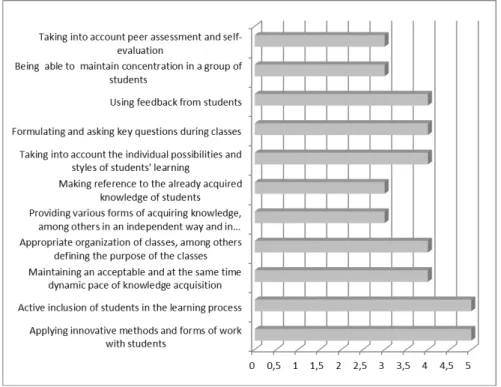
The group of experts of Czestochowa University of Technology evaluated the influence strength of this factor on the scale from 0 to 5, where 0 means no influence and 5 very strong influence. The evaluation has been presented
in Figure 1 (Kiełtyka, Kucęba, Jędrzejczyk, Kulej-Dudek 2018, Whiddett, Hollyforde 2003).
Source: own elaboration
Figure 1. Evaluation of factors associated with the training methodology applied at universities on the results of transversal competences growth pace testing
Source: Report IO7 Documentation of Intellectual Output 7 under the name „The most effective training processes”
Figure 2. Factors associated with teaching methodology and assessments of their impact on test results
The highest ranks were given to the following factors: Applying innovative methods and forms of work with students and Active inclusion of students in the learning process) (both factors were given the rank 5). Effective training depends on the ways of managing training, that is methods and forms of work with students. On the basis of the programme of studies and appropriately selected curriculum the teacher should plan training methods, ways of learning, didactic tools and programme content, that is establish a strategy of actions. It should be remembered that each of the applied methods may be effective if it suits specific needs of the recipient. Methods based on student’s active operation have impact on larger and better acquisition of knowledge than methods that do not inspire to activity or do it only to a small extent. Application of active methods in the training process may increase the effectiveness of training and learning, develop creativity and creative thinking and also the ability to cooperate and communicate within the group. Other important factors are also: Appropriate organization of classes, among others defining the purpose of the classes, Formulating and asking key questions during classes and Using feedback from students – 4 points each. Key questions should include the main issues of classes, be closely related to the goal of the classes, indicate a wider perspective of the discussed issue and result in student’s interest in the carried-out task. These questions lead to discussions and receiving feedback in the scope of search for answers, justifying views and way of thinking, as a result making the students involved. Less important is Reference to
already acquired knowledge and Being able to maintain concentration in a group of students – 3points. The Authors of the present paper believe that in case of university studies it is not a difficult thing. Concentration is the key to better memory, effective learning and work, and also achieving success in life. It is also an ability and as any other ability it can be developed through proper exercises.
It needs to be mentioned that each of the partners also evaluated these factors and aggregated evaluations as to the strength of this influence presented by teams from particular universities have been summarized in Figure 2.
While summarizing the results presented in Figure 2 it can be concluded that (The Project 2016, The Project 2018):
all the analysed factors have an above-average (on average 2,5) influence on the testing results,
close to “very strong influence” (4,8) impact has: active inclusion of students in the learning process
equal or close to „strong influence” impact on the testing results have: using feedback from students (4,2), formulating and asking key questions during classes(4,0), applying innovative methods and forms of work with students (4,0), appropriate organization of classes, among others defining the purpose of the classes (4,0).
The next sub-chapters of the present paper present the aggregated results of the measurement of competences pace growth results in the groups of tested students with the use of the tested model.
D
EVELOPMENT OF THE
R
ESULTS OF
T
ESTING
P
ROCESS AND
E
VALUATION OF
C
OMPETENCES
P
ACE
G
ROWTH
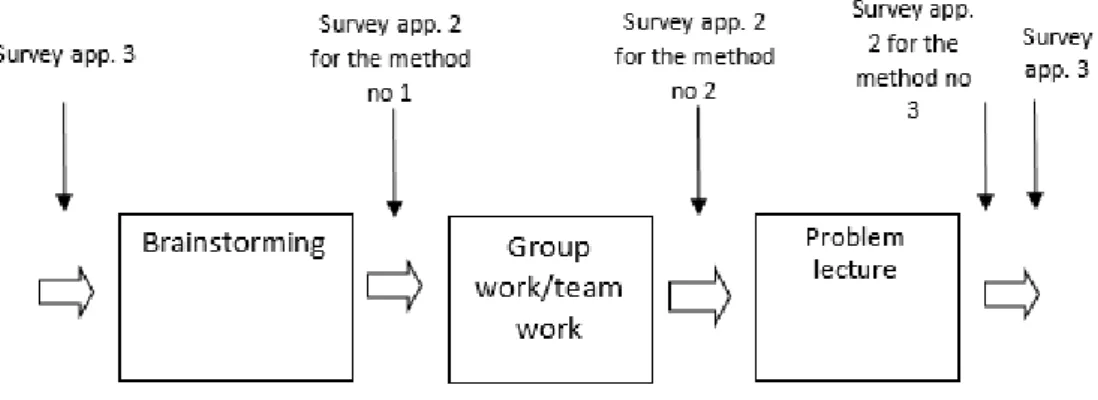
The Czestochowa University of Technology tested process 1, which includes 3 methods of practical teaching
selected for this process: brainstorming, group work/team work, problem lecture. Presented below is the presentation of the tested process at the Czestochowa University of Technology (Figure 3).
These methods was applied within the subject "Methods of Organization and Management" in the group of 1st degree students of full-time studies at the Management Faculty in the 4th semester. The subject is carried out within 30 hours of lectures and 15 hours of laboratory classes (Table 1).
Source: own elaboration
Figure 3. Application of practical teaching methods in process 5 – Czestochowa University of technology (CUT)
Table 1
Schedule of conducting process 1 testing (CUT)
Date Process stage Duration
Number of participants in classes
/ number of filled-in questionnaires 04.04.17 STAGE I OF METHOD I
Introduction to the project and process. Filling in the questionnaire concerning the level of transversal competences at the beginning of testing. Introduction to the
method I - Brainstorming
45 min 18/ NA
11.04.17 STAGE II OF METHOD I
Characteristics of method I - Brainstorming; dividing students into groups; presentation of problem tasks; running classes using
brainstorming.
45 min 16/16
25.04.17 STAGE III OF METHOD I
Summing up the results concerning solving problems; filling in the questionnaire concerning an increase in transversal competences after using method I brainstorming.
45 min 16/16
9.05.17 STAGE I OF METHOD II
Introduction to method II, discussing the idea
- group work/team work, presentation of
stages of group work in the classes, presentation of problem task, conducting classes using group work/team work.
23.05.17 STAGE II OF METHOD II
Discussion and summing up the results concerning solving problem using group
work/team work, filling
in the questionnaire concerning an increase in transversal competences using method II group work/team work
90 min 17/17
5.06.17 STAGE OF METHOD III – Characteristics
of method III – Problem lecture; conducting
classes using method III. Summing up the results; filling in the questionnaire concerning an increase in transversal competences after using method III problem lecture. Filling in the questionnaire concerning an increase in transversal competences after the entire testing process.
90 min
18/16
Source: The Report IO6 A set of results of processes' models testing 2018
The research comprised 18 students, out of whom 16 took part in the entire research process. All the questionnaires were filled in by 16 students. Data that was rejected was the one provided by students who did not participate in the entire research process, e.g. filled in questionnaire 2 and not 3, or they participated in one or two testing stages. Data analysis comprised results provided by 16 students, which is compliant with “Instruction for preparing and testing models of processes of developing transversal skills as part of practical training” where the minimum number of students is 15.
The evaluations that were analysed come from two questionnaires (The Project 2016, The Project 2018):
Questionnaire appendix 2 - to measure the dynamics of changes in the evolution of acquired transversal competences (degree of change) - the questionnaire, which allows to assess the rate of an increase in competences (the questionnaire filled in by students after each method used in the tested process);
Questionnaire appendix 3 - for assessment of the evolution of transversal skills level of the students in practical teaching process (the level of possessed skills) - the questionnaire, allowing for students’ self-assessment in relation to 4 transversal competences before and after the testing process.
In the questionnaires, students had to answer one question for each skill. In view of the fact that each transversal competence consists of a different number of skills, a differentiated number of questions was asked in relation to transversal competences in accordance with the list of questions in the questionnaires. For subsequent competences the number of questions was:
entrepreneurship - 6 skills (6 questions),
creativity - 3 skills (3 questions),
teamwork - 7 skills (7 questions),
communicativeness - 8 skills (8 questions).
The total number of evaluations made by each student is:
in the case of first questionnaire: 72 evaluations on a scale of 1-5 (24 evaluations after each of the three methods obtained from each tester),
in the case of second questionnaire: 48 evaluations on a scale of 1-5 (24 evaluations before and after testing the process obtained from each tester).
The total number of evaluations obtained before and after testing by one student is therefore 120. The basic self-assessment results are presented below.
E
VALUATION OF THE
R
ATE OF AN
I
NCREASE IN A
C
OMPETENCE
-A
NALYSIS OF
D
ATA FROM THE
Q
UESTIONNAIRE
(
THE
Q
UESTIONNAIRE
F
ILLED IN BY
S
TUDENTS AFTER EACH
M
ETHOD
U
SED IN THE
T
ESTED
P
ROCESS
)
The following results were developed based on the data collected in the IO6 task during process 5 testing (CUT). The full scope of results is available in the report from the IO6 task entitled Development of the results of testing process 5 (CUT).
Table 2
The average values of an increase in students' transversal competences for subsequent methods tested in process 5 (CUT)
Competences Methods in process 5 ΔU min ΔUmax ΔUWed
entrepreneurship
Brainstorming 3,88 4,13 3,99
Group work/ teamwork 3,63 4,13 3,95
Problem lecture 3,56 3,88 3,75
creativity
Brainstorming 3,56 4,19 3,90
Group work/ teamwork 3,63 3,94 3,81
Problem lecture 3,69 3,88 3,79
teamwork
Brainstorming 3,81 4,13 4,01
Group work/ team work 3,75 4,31 4,10
Problem lecture 3,69 4,14 3,93
communicativeness
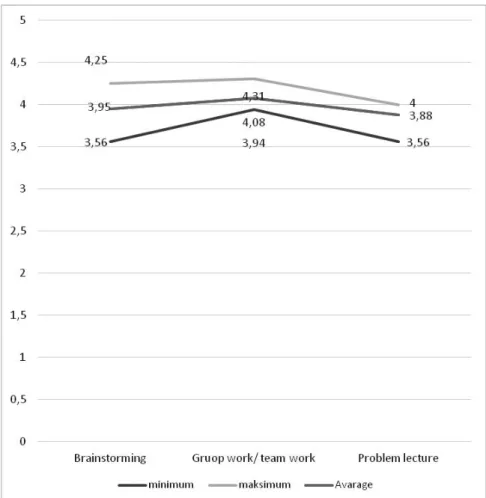
Brainstorming 3,56 4,25 3,95
Group work/ teamwork 3,94 4,31 4,08
Problem lecture 3,56 4,00 3,88
Source: „Partial report concerning the results of testing processes in the ATC ERASMUS + project, Czestochowa University of Technology (CUT)”
Source: Documentation of Intellectual Output 7 under the name „The most effective training processes”
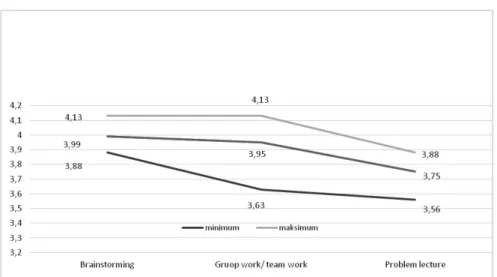
Figure 4. The minimum and maximum values of the rate of an increase in individual component skills of the transversal competence "entrepreneurship" and the value of the rate of an increase in all component skills of the transversal
competence "entrepreneurship" (averages of students' self-assessment - process 5 / CUT).
Table 2 summarizes all the results of students’ self-assessment. The analysis took into account the average evaluations of an increase in competences after each method for each of the students participating in the testing. The method of their calculation is presented in IO6 entitled Development of the results of testing process 5 (CUT).
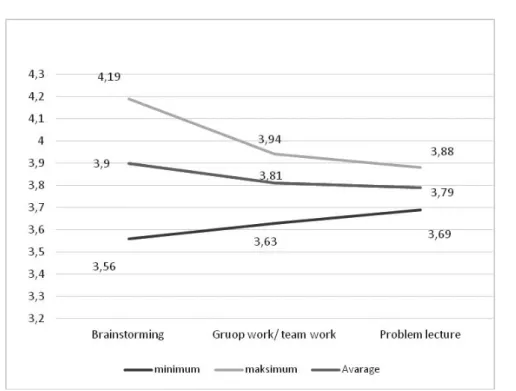
Figures 4-7 show the minimum, maximum and average values of an increase in the four competences tested after successive practical teaching methods in the tested process 5 (CUT).
Conclusions related to Figure 4:
1. The value of the rate of an increase in all component skills of the transversal competence "entrepreneurship" (measured as the average students' self-assessment) - is relatively high.
2. There is a large variation in the rate of an increase in individual component skills of the transversal competence "entrepreneurship" (measured by the interval between the maximum and minimum rate of an increase in individual component skills).
3. All average rates of an increase decrease with the use of consecutive methods.
Source: Documentation of Intellectual Output 7 under the name „The most effective training processes”
Figure 5. The minimum and maximum values of the rate of an increase in individual component skills of the transversal competence "creativity" and the value of the rate of an increase in all component skills of the transversal competence
"creativity" (averages of students' self-assessment - process 5 / CUT).
Source: Documentation of Intellectual Output 7 under the name „The most effective training processes”
Figure 6. The minimum and maximum values of the rate of an increase in individual component skills of the transversal competence "teamwork" and the value of the rate of an increase in all component skills of the transversal competence
Conclusions related to Figure 5:
1. The value of the rate of an increase in all component skills of the transversal competence "creativity" (measured as the average students' self-assessment) - is high.
2. There is a large variation in the rate of an increase in individual component skills of the transversal competence "creativity" (measured by the interval between the maximum and minimum rate of an increase in individual component skills).
3. All average rates of an increase decrease with the use of consecutive methods.
Conclusions related to Figure 6:
1. The value of the rate of an increase in all component skills of the transversal competence "team work" (measured as the average students' self-assessment) - is relatively high.
2. There is a large variation in the rate of an increase in individual component skills of the transversal competence "team work" (measured by the interval
between the maximum and minimum rate of an increase in individual component skills) after the first method. Greater variation in the rate of an increase occurs after the second method.
3. All average rates of an increase decrease after the second method.
Conclusions related to Figure 7:
1. The value of the rate of an increase in all component skills of the transversal competence "communicativeness" (measured as the average students' self-assessment) - is high.
2. There is a relatively low variation in the rate of an increase in individual component skills of the transversal competence "communicativeness" (measured by the interval between the maximum and minimum rate of an increase in individual component skills).
3. All average rates of an increase decrease after the second method.
Source: Documentation of Intellectual Output 7 under the name „The most effective training processes”
Figure 7. The minimum and maximum values of the rate of an increase in individual component skills of the transversal competence "communicativeness" and the value of the rate of an increase in all component skills of the transversal
Table 3
Average values of an increase in the level of students' transversal competences for subsequent transversal competences in process 5 (CUT)
Average values of an increase for the group testing the process for the selected competence
Method number in process 5 (CUT)
Minimum value (min) of the average of students' evaluations of
a given skill of the selected transversal
competence before testing
Maximum value (max) of the average of students' evaluations of a given skill of the selected transversal competence before testing Average values of students' evaluations for a given competence
entrepreneurship before 1,83 4,17 3,00
after 3,17 5,00 4,09
creativity before 1,67 4,33 3,00
after 3,00 5,00 4,00
teamwork before 2,43 4,29 3,36
after 3,29 4,86 4,08
communicativeness before 3,25 4,25 3,75
after 3,88 4,88 4,38
Source: „Partial report concerning the results of testing processes in the ATC ERASMUS + project, Czestochowa University of Technology”
The minimum (min)/maximum (max) value of the average of students’ evaluations of a given skill of a selected transversal competence before testing means that on the basis of the data the average value for the level of a competence was calculated before and after the entire process for each student. This value indicates the minimum/maximum average per student out of the entire group of students participating in testing (Table 3).
R
ESULTS
With reference to the obtained results summarized in the above tables, it can be stated that:
The tested students (in the self-evaluation process) evaluated the level of possessed skills too highly.
Students rated the level of their creativity as the lowest possessed competence and communicativeness as the highest.
The students (in the self-evaluation process) evaluated degree of change of possessed skills after using tested teaching methods too highly.
The highest dynamics of change was observed in the competence of teamwork and the smallest - in the creativity.
Problem lecture is comparatively the least effective method.
The students (in the self-evaluation process) evaluated degree of change of possessed abilities after using tested teaching methods highly.
The highest increase of one of the component competences after using all the methods is 4,17.
The lowest increase of one of the component competences after using all the methods is 3,67.
The students evaluated the level of possessed skills after the entire testing process highly – average level of skills 4.25.
Students rated the level of their communicativeness and teamwork as the highest possessed competences.
The highest increase of the competence was observed in the creativity and the lowest - in the communicativeness.
L
IMITATIONS OF THE
S
TUDY
The study has some limitations. First, the study has been limited to a selected dean group in the indicted course of studies. The selection was purposeful, with some assumptions. Each Partner specified in the application tested at least one process covering at least 3 practical teaching methods selected for particular processes. The duration of the process had to be longer than one full day (24 h). Each process was tested on at least 3 test groups. Each group was contained at least 5 students, which means that the process was tested at a minimum of 15 students. Object of research was transversal competences, such as entrepreneurship, creativity, communicativeness, teamwork.
Detailed discussion has been conducted that concerned the presented studies and obtained results. It has been concluded that in the years to come the most interesting direction of future studies will be carrying out the testing process at universities located in other regions of Poland.
C
ONCLUSIONS
The formulated conclusions, which are the result of the conducted research, confirm the underlying assumption in the project that considering the needs of European employers (particularly in the scope of transversal competences) it is vital to combine various forms of training (formal, non-formal, informal and practical ones)
and heterogeneous training methods. This is important in the context of preparing the students of scientific studies to start employment as well as making effective and optimum decisions in real conditions of their future professional work. This also confirms the necessity to diversify practical training methods and adjust curriculums to the needs of “professional practice”, not only in the local territorial space but also European and even global one.
REFERENCES
BYLOK F., CICHOBŁAZIŃSKI L. (2016), Role of Managers in Building Resources of Social Capital in an Enterprise
[in:] 12th European Conference on Management Leadership and Governance, Academic Conferences and Publishing International Limited, Reading.
JĘDRZEJCZYK W. (2013), Intuicja jako kompetencja menedżerska w teorii i praktyce zarządzania przedsiębiorstwem, Dom Organizatora, Toruń.
KOMISJA EUROPEJSKA (2002), Kompetencje kluczowe. Realizacja koncepcji na poziomie szkolnictwa
obowiązkowego. Europejskie Biuro Eurydice, Bruksela, tłum. Fundacja Rozwoju Systemu Edukacji, Warszawa 2005 KIEŁTYKA L., JĘDRZEJCZYK W., KUCĘBA R. (2011), Doskonalenie kompetencji menadżerskich kadr
kierowniczych w przedsiębiorstwach. [in:] Borowiecki R., Czekaj J. (ed.) Gospodarowanie zasobami informacyjnymi z perspektywy zarządzania kryzysowego. Wydawnictwo: Towarzystwo Naukowe Organizacji i Kierownictwa „Dom
Organizatora”, Toruń.
KIEŁTYKA L. KUCĘBA R., JĘDRZEJCZYK W., KULEJ-DUDEK E. (2018), Partial report concerning the results of testing processes in the ATC ERASMUS + project, Czestochowa University of Technology.
OLEKSYN T. (2006), Zarządzanie kompetencjami, Oficyna Ekonomiczna, Kraków.
PARLAMENT I RADA UNII EUROPEJSKIEJ (2006), Zalecenie Parlamentu Europejskiego i Rady z dnia 18 grudnia
2006 r. w sprawie kompetencji kluczowych w procesie uczenia się przez całe życie (2006/962/WE). Dziennik Urzędowy Unii Europejskiej L 394/10, z dnia 30.12.2006 (PL).
POCZMAŃSKA A., SARYUSZ-WOLSKI T., STĘCHŁY, TAUBER M., ZIEWIEC-SKOKOWSKA G. (2015),
Standard opisu kwalifikacji nadawanych poza systemami oświaty i szkolnictwa wyższego. Przewodnik. Instytut Badań Edukacyjnych, Warszawa.
ROSTKOWSKI T. (2004), (ed.), Nowoczesne metody zarządzania zasobami ludzkimi, Difin, Warszawa.
SIDOR-RZĄDKOWSKA M. (2006), Kompetencyjne systemy ocen pracowników. Przygotowanie, wdrażanie i integrowanie z innymi systemami ZZL, Wolters Kluwer Polska, Oficyna Ekonomiczna, Kraków.
STANKIEWICZ J. (2005), Konkurencyjność przedsiębiorstwa. Budowanie konkurencyjności przedsiębiorstwa w warunkach globalizacji. Dom Organizatora, Toruń.
THE PROJECT (2016), The acceleration method of development of transversal competences in the students’ practical training process: The report concerning applied teaching methods of transversal skills and methods of practical
trainings. Poznań.
THE PROJECT (2018), The acceleration method of development of transversal competences in the students’ practical training process: The Report IO6 “A set of results of processes' models testing”.
THE PROJECT (2018), The acceleration method of development of transversal competences in the students’ practical training process: Report IO7 Dokumentation of Intelectual Output 7 under the name „The most effective training
processes”. Poznań.
WHIDDETT S., HOLLYFORDE S. (2003), Modele kompetencyjne w zarządzaniu zasobami ludzkimi, Oficyna