LifeGuide: A platform for performing web‐based behavioural interventions
Jonathon Hare, Adrian Osmond, Yang Yang, Gary Wills, Mark Weal, David De Roure School of Electronics and Computer Science, University of Southampton, Southampton, UK {jsh2|aco|yy4|gbw|mjw|dder}@ecs.soton.ac.uk Judith Joseph, Lucy Yardley School of Psychology, University of Southampton, Southampton, UK {J.Joseph|L.Yardley}@soton.ac.ukAbstract. Behavioural interventions are a technique used by social scientists and health professionals to mediate the behaviour of a subject. Traditionally, interventions take the form of tailored advice given in a face‐to‐face setting. Internet‐based behavioural interventions harness the power of the web to deliver tailored advice to participants at the time that most suits them.
The LifeGuide project is a multidisciplinary collaboration with the aim of developing and proving a set of software tools for the development and deployment of internet‐based behavioural interventions. The tools developed in LifeGuide cover the complete lifecycle of an intervention, from initial authoring to trialling and refinement to final deployment. Looking ahead, in the longer term we intend to investigate how the LifeGuide toolset can be applied to other domains.
1. Introduction
Interventions designed to influence people's behaviour ('behavioural interventions') are a fundamental part of daily life, whether in the form of personal advice, support and skills training from professionals (e.g. educators, doctors) or general information disseminated through the media. However, personal advice and support are very costly, and it is impossible to provide everyone with 24‐hour access to personal guidance on managing all their problems. General information provided through the media may not be seen as relevant to the particular problems of individuals, and provides no support to help people make desired changes to their behaviour. For the first time, the World Wide Web provides a cost‐effective opportunity to provide open 24‐hour access to extensive information and advice on any problem. Interactive technology means that the advice can now be specifically 'tailored' to address the particular situation, concerns, beliefs and preferences of each individual, and intensive daily support can be provided for behaviour change in the form of reminders, personalised feedback regarding progress and overcoming obstacles, help with planning, and opportunities for communication with peers (e.g. [1,2]).In view of this huge potential, web‐based behavioural interventions are starting to be developed in the public and private sector [3]. However, currently each intervention is individually programmed from scratch, with the result that the initial development costs are greater for web‐based than for traditionally delivered interventions, and once programmed they cannot easily be modified. This seriously limits the number of interventions that can be developed and evaluated, and acts as a barrier to innovation and enhancement of interventions by researchers.
The aim of the LifeGuide project is to develop, evaluate and disseminate a set of tools that will allow researchers to flexibly create and modify two fundamental dimensions of behavioural interventions: providing tailored advice; and supporting sustained behaviour. The LifeGuide toolkit will eliminate the costly waste of resources involved in programming every intervention individually, and will allow researchers to easily test components of interventions and immediately modify and improve the interventions based on their findings. The tools will also increase the number of researchers who can engage in this type of research; opening it up to those with limited funding (e.g. junior researchers and research students). The practical benefit will be more rapid development of better interventions, while the scientific benefit will be a much faster accumulation of knowledge about the effects of different elements of interventions than at present, which will improve our basic understanding of the influences on behaviour.
2. The LifeGuide Software Suite
In the LifeGuide project, social scientists and computer scientists are working closely together to develop the software needed, using extensive expert consultation through workshops and the Internet to obtain researchers' views of how to make the software fit for all requirements. The LifeGuide software essentially comprises of three main components: a web‐based player through which end users can access an intervention; a web‐based management interface through which researchers can control and view data from their interventions; and a standalone desktop‐based authoring tool in which researchers can create and edit interventions. The tools also enable the construction of randomised controlled trials (RCTs) for the interventions.
2.1 A solid foundation – IMS QTI 2.1
The IMS Question and Test Interoperability (QTI) specification [4] is a standard for representing questions and tests with a binding to the eXtensible Markup Language (XML) to allow interchange. The QTI specification describes a data model for representing electronic assessments, consisting of items (pages with questions), tests (the flow between the pages) and the reporting of results. Whilst the QTI data model was designed to represent the traditional assessment domain, it has become increasingly apparent that the model is well suited for a much broader class of assessments. In particular, a behavioural intervention in which questions are asked, and adaptive advice or feedback is provided can be viewed as a form of adaptive assessment, and is modelled well by the QTI specification.
QTI items can consist of multiple questions or interactions with different forms (e.g. text entry, multiple choice, numeric sliders, etc). QTI also defines a model for adaptive assessment in which the current location within an assessment can be defined as a series of pre‐requisite conditions or branches. These conditions are defined through a simple, but flexible, programming language that allows the evaluation of arbitrarily complex expressions that are capable of examining previous responses from the user.
The QTI specification forms a base for all the tools built in LifeGuide. In particular, the logic of an intervention is modelled using a QTI assessmentTest, the pages as assessmentItems, and a complete intervention (test, items and other resources, such as images) is packaged as an IMS QTI conformant content package. The content package is basically a zip file with a special manifest file included that describes the contents.
Within an intervention, there are often a number of things that an author wants to do that are not directly covered by the QTI specification; for example sending emails to a user at certain times after they have first logged on to an intervention. These issues are dealt with by extending the QTI documents in a manner defined by the specification, which allows additional functionality to be plugged in.
From a software engineering standpoint, all the support for the QTI specification is encoded in a single open‐ source Java software library called JQTI1. We began development of the test and reporting parts of JQTI in a
previous project [5], and in LifeGuide we have completed it so that the whole of the specification is implemented. In addition to providing a programmatic binding of the QTI data model, JQTI is also an interpreter for the QTI logic, and is able to process user input using the logic defined in the assessment or intervention.
2.2 Intervention Authoring Tool
The LifeGuide authoring tool enables researchers to create new interventions. The user interface is designed to be familiar to users with experience of using tools like PowerPoint to write presentations, but without experience of writing HTML web pages or doing any software programming. The overall authoring scheme is inspired by an old piece of software called HyperCard, which allowed users to graphically construct a “stack” of cards with various buttons and controls, and then author logic for the controls using a scripting language with an English‐like syntax.
In particular, in the LifeGuide authoring tool the pages (instances of QTI items) are created in a graphical
1 JQTI information can be found at http://jqti.qtitools.org and http://www.sourceforge.net/projects/qtitools Figure 1: The LifeGuide authoring tool.
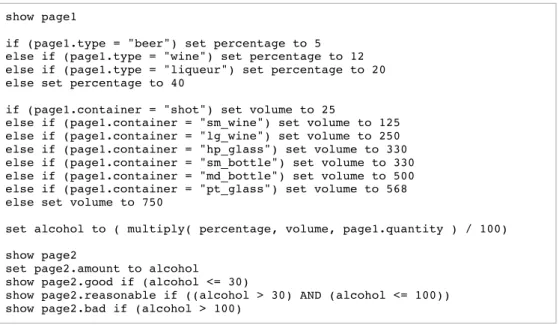
WYSIWYG editor that displays the pages exactly as they will appear in the users web‐browser. Figure 1 illustrates the user‐interface of the authoring tool in page‐editing mode, and shows the level of graphic design achievable with the tool. The logic that determines the adaptive features of the intervention is expressed in a simple scripting language inspired by xTalk family of languages. The programming language allows users to simply express complex logic for controlling the movement between pages, and other factors such as adaptive feedback. A sample snippet of the LifeGuide scripting language is illustrated in Figure 2. Behind the scenes in the authoring tool, a compiler process is run to translate the logic expressed in the script written by the user into a valid QTI assessmentTest document. The graphical authoring component creates QTI assessmentItem and style files directly, however the compiler also augments these with extra information. Any errors during the compilation process are shown to the user, and the software attempts to illustrate to the user exactly where any problems with the script occurred. When the user is happy with their intervention they can export it to a content package file, which can be uploaded to the web‐based LifeGuide Manager for trialling and deployment. 2.3 Intervention Manager
The LifeGuide manager software allows researchers to deploy, manage and query interventions. Once a researcher has created an intervention they can enter the intervention manager portal and upload their intervention content package. The researcher has the option of setting start and expiry dates for the intervention as well as providing a name that will form part of the public URL to the intervention. Once the intervention is uploaded, subject to any date constraints, it becomes available for use in the intervention player.
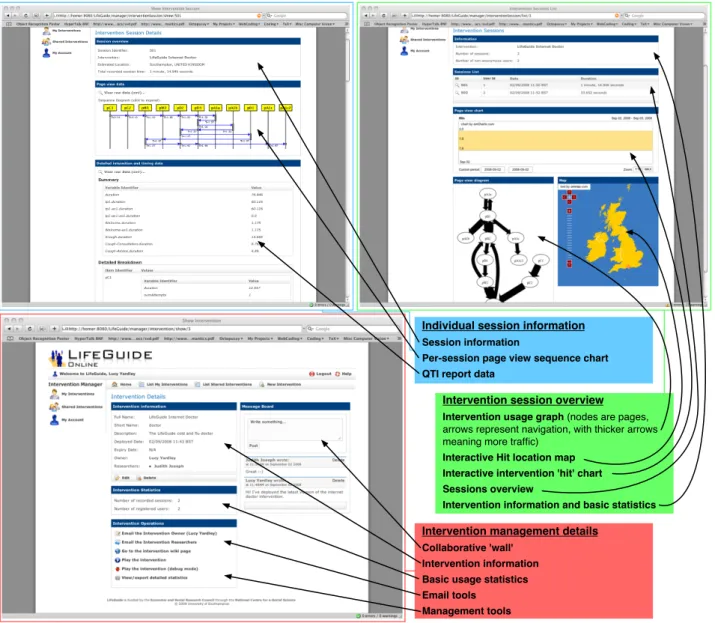
In addition to providing the ability to deploy an intervention, the manager software also provides support for the intervention during its online lifecycle. In particular, the manager is responsible for collating data from the player about the usage of each deployed intervention. The data provided by the player and recorded by the manager consists of two main parts; session information and report information. The session information contains information such as a users IP address (from which a geo‐location is derived), the time the session started (when the user first went to the site) and the actual order of pages viewed. The report data is in fact a QTI report generated according to the specification; in particular, the report contains information about the users’ responses to questions and how long the user spent on each part of the intervention. Some of these features are illustrated in Figure 3.
The manager software is capable of graphically displaying to a researcher how many people used a particular intervention in a given time period, and how the users were geographically located. Researchers are also able to drill down to the level of a particular user of an intervention and view data, such as the QTI report, and information about the ordering of pages viewed by the user. In a future update, the manager software will also be capable of generating and exporting reports from the recorded data over groups of many users or sessions for further analysis in external software.
One final feature of the manager software is its support for collaboration. The software allows owners of an intervention to share recorded data amongst other researchers, and provides collaborative tools including group emailing and a Facebook style ‘wall’ for writing notes and messages to collaborators.
show page1
if (page1.type = "beer") set percentage to 5 else if (page1.type = "wine") set percentage to 12 else if (page1.type = "liqueur") set percentage to 20 else set percentage to 40
if (page1.container = "shot") set volume to 25
else if (page1.container = "sm_wine") set volume to 125 else if (page1.container = "lg_wine") set volume to 250 else if (page1.container = "hp_glass") set volume to 330 else if (page1.container = "sm_bottle") set volume to 330 else if (page1.container = "md_bottle") set volume to 500 else if (page1.container = "pt_glass") set volume to 568 else set volume to 750
set alcohol to ( multiply( percentage, volume, page1.quantity ) / 100) show page2
set page2.amount to alcohol show page2.good if (alcohol <= 30)
show page2.reasonable if ((alcohol > 30) AND (alcohol <= 100)) show page2.bad if (alcohol > 100)
Figure 2: The LifeGuide scripting language. This example shows some of the logic for an intervention that provides advice about drinking too much.
2.4 Intervention Player The LifeGuide player component is in essence a generic adaptive hypertext system, augmented with the ability to record specialised usage and timing information. From perspective of the end user, a web‐based intervention is accessed through a browser and appears as a series of web pages with questions and tailored advice. As previously described, the QTI specification is used to store the intervention as a series of XML files. The QTI item files are rendered as XHTML in a web browser by simply transforming them using an XSL transform (XSLT). It should be noted that the same XSLTs are used in the authoring tool to support the WYSIWYG editor. The actual rendering process is slightly more complicated because internal state often needs to be included in the rendering. Figure 4 illustrates the process taken by the player to render an intervention; all of the internal logic state (of the intervention session) is encapsulated within the JQTI library within the player.
3. Discussion
The development process taken by the LifeGuide team has been very rapid. The aim has been to try and get early release tools into the hands of real users in order to allow iterative feedback throughout the remainder of the project. Within the first 9 months we have completed the construction of the player software, and the first release of the manager component has been deployed to users. A number of beta releases of the authoring tool have been released, with each one adding more features requested by users, in addition to fixing problems. Two interactive workshops have also been run, in which participants have used the complete suite of tools to author, test and deploy a simple four‐page intervention. In total, over 50 researchers have had hands‐on experience using the tools.
Session information
Per-session page view sequence chart QTI report data
Individual session information
Interactive Hit location map
Intervention usage graph (nodes are pages, arrows represent navigation, with thicker arrows meaning more traffic)
Interactive intervention 'hit' chart Sessions overview
Intervention information and basic statistics
Intervention session overview
Intervention information Basic usage statistics Collaborative 'wall'
Email tools Management tools
Intervention management details
The first complete intervention developed for the LifeGuide platform, a health intervention designed to advise users on dealing with cold and flu symptoms, was released for user acceptance testing and qualitative piloting around month six of the project. The initial version of this intervention was created by handcrafting the QTI XML documents, however, subsequent versions are moving to using the LifeGuide authoring tool. Quantitative piloting of the intervention, using all of the data recording facilities of the player software and reporting facilities of the manager software is currently underway. Following this round of piloting, it is planned to have another round on an updated version of the intervention in the autumn. Currently, we also have a small group of researchers using the tools to create a range of real interventions for various purposes.
4. Conclusions and Future Work
The LifeGuide project has developed a platform for the creation of online internet‐based behavioural interventions. The toolset allows professionals and researchers to manage the complete lifecycle of their own interventions from initial authoring on the desktop to final deployment on the web. Once deployed, LifeGuide interventions can potentially be reached by thousands of users over the Internet. For researchers in particular, the LifeGuide software allows in‐depth data capture of exactly how a user is using a given intervention, down to the level of how long they spend on a page and what responses they give for every interaction.
Looking ahead, in the longer term we intend to investigate how the LifeGuide toolset can be applied to domains other than behavioural interventions. In particular, we intend to investigate the use of the tools in the e‐ assessment/e‐learning domain, which is an obvious candidate given the nature of the QTI basis of the tools. Another possible use for the tools is for developing online questionnaires that require adaptivity or wider varieties of interaction than current tools can provide. With respect to behavioural interventions, one future aim is to further develop the LifeGuide tools into supporting a “population laboratory” which will enable the quantitative results from multiple interventions to be shared and analysed together.
Acknowledgements.
The development of the LifeGuide platform is supported by the Economic and Social Research Council (ESRC) through the UK National Centre for e‐Social Science (NCeSS). LifeGuide is one of the seven NCeSS research nodes.References.
[1] Danaher, B. G., Boles, S. M., Akers, L., Gordon, J. S., & Severson, H. H. (2006). Defining participant exposure measures in Web‐based health behavior change programs. Journal of Medical Internet Research, 8, e15. [2] Stevens, V. J., Funk, K. L., Brantley, P. J., Erlinger, T. P., Myers, V. H., Champagne, C. M. et al. (2008). Design and implementation of an interactive website to support long‐term maintenance of weight loss. Journal of Medical Internet Research, 10. [3] Portnoy, D. B., Scott‐Sheldon, L. A. J., Johnson, B. T., & Carey, M. P. (2008). Computer‐delivered interventions for health promotion and behavioral risk reduction: a meat‐analysis of 75 randomized controlled trials, 1988‐ 2007. Preventive Medicine, 47, 3‐16. [4] IMS Global Learning Consortium, Inc. IMS Question and Test Interoperability Version 2.1 Public Draft Specification. http://www.imsglobal.org/question/index.html, accessed 19 February 2009. [5] Wills, G., Hare, J., Kajaba, J., Argles, D., Gilbert, L. and Millard, D. (2008) A Delivery Engine for QTI Assessments. International Journal of Emerging Technologies in Learning (iJET), 3 . ISSN 1863‐0383 LifeGuide InterventionQTI Test
JQTI
QTI
Items
Test XSL
Item XSL
XHTML
Page
QTI XML XHTML XHTML QTI XML JQTI Internal State JQTI Internal State LifeGuide PlayerResponse
Handler
Updated State (responses)User