Western University Western University
Scholarship@Western
Scholarship@Western
Electronic Thesis and Dissertation Repository
12-11-2012 12:00 AM
Multi-Sensor Calibration and Validation of the UWO-PCL Water
Multi-Sensor Calibration and Validation of the UWO-PCL Water
Vapour Lidar
Vapour Lidar
Robin Wing
The University of Western Ontario Supervisor
Dr. R.J. Sica
The University of Western Ontario Graduate Program in Physics
A thesis submitted in partial fulfillment of the requirements for the degree in Master of Science © Robin Wing 2012
Follow this and additional works at: https://ir.lib.uwo.ca/etd
Part of the Atmospheric Sciences Commons, Climate Commons, and the Optics Commons
Recommended Citation Recommended Citation
Wing, Robin, "Multi-Sensor Calibration and Validation of the UWO-PCL Water Vapour Lidar" (2012). Electronic Thesis and Dissertation Repository. 981.
https://ir.lib.uwo.ca/etd/981
This Dissertation/Thesis is brought to you for free and open access by Scholarship@Western. It has been accepted for inclusion in Electronic Thesis and Dissertation Repository by an authorized administrator of
MULTI-SENSOR CALIBRATION AND VALIDATION OF THE UWO-PCL
WATER VAPOUR LIDAR
(Spine title: Calibration of the PCL Water Vapour Lidar)
(Thesis format: Monograph)
by
Robin Wing
Graduate Program in Physics and Astronomy
A thesis submitted in partial fulfillment
of the requirements for the degree of
Masters of Science
The School of Graduate and Postdoctoral Studies
The University of Western Ontario
London, Ontario, Canada
c
THE UNIVERSITY OF WESTERN ONTARIO
School of Graduate and Postdoctoral Studies
CERTIFICATE OF EXAMINATION
Supervisor:
. . . . Dr. R. J. Sica
Supervisory Committee:
. . . . Dr. P. G. Brown
. . . . Dr. M. Zinke-Allmang
Examiners:
. . . . Dr. M. Houde
. . . . Dr. P. Barmby
. . . . Dr. J. Voogt
The thesis by
Robin Wing
entitled:
Multi-sensor Calibration and Validation of the UWO-PCL Water Vapour Lidar
is accepted in partial fulfillment of the requirements for the degree of
Masters of Science
. . . . Date
. . . .
Chair of the Thesis Examination Board
Acknowlegements
I would like to thank Dr. R.J. Sica for his support, guidance and understanding over the past few years. I truely appreciate the experiences I have had and the lessons I have learned while working in the PCL lab. I would also like to thank Dr. P.S. Argall for his support in the lab and Dr. D.N. Whiteman for organising the PCL water vapour calibration campaign. I would like to acknowledge the tremendous support I have recieved from the departmental staff; my advisory committee members, Dr. P.G. Brown and Dr. M. Zinke-Allmang; B. Stonehouse at UWO Facilities Management; P. Duenk and C. Rasenberg at the Environmental Science Western Field Station; the NASA campaign team; and all the workstudy students who have helped our lab to record hundereds of hours of observations. Finally, I would like to thank my group members, past and present, E. McCullough, B. Iserhienrhien, F. Olofsson, J. Khanna, J. Bandoro, P. Argall, and A. Jalali.
Abstract
The Purple Crow Lidar (PCL) has recently participated in a water vapour validation cam-paign with the NASA/GSFC Atmospheric Laboratory for Validation/Interagency Collaboration and Education (ALVICE) Lidar. The purpose of this calibration campaign is to ensure that PCL water vapour measurements are of sufficient quality for use in scientific investigations of atmo-spheric change and to be included in the Network for the Detection of Atmoatmo-spheric Climate Change (NDACC) data base. The detection of long term changes in water vapour concen-tration, particularly in the upper troposphere and lower stratosphere (UTLS), is an issue of pressing scientific, ecological and societal concern.
The field campaign took place at the University of Western Ontario Environmental Re-search Field Station near London Ontario Canada, from May 23rd to June 10th 2012 and resulted in 57 hours of measurements taken over 12 clear nights. On each night a minimum of one RS92 radiosonde was launched. In addition, 3 cryogenic frost-point hygrometer (CFH) sondes were launched on clear nights over the course of the campaign. Measurements were obtained from near the surface up to∼20 km by both lidar systems, the radiosondes, and the CFH balloons. These measurements were used to calibrate profiles of water vapour mixing ratio by the newly relocated PCL.
Comparisons between measurements of water vapour mass mixing ratio taken by RS92 ra-diosondes, Cryogenic Frostpoint Hygometers, and the ALVICE and PCL lidars has resulted in the derivation of a system calibration factor ofξsys=0.7545. The application of this calibration
factor to PCL retrievals has allowed for the validation of PCL water vapour mass mixing ratio profiles to within±5% between the altitudes of 2 km and 9 km.
Keywords: Raman-scatter lidar, UTLS water vapour, multi-instrument calibration, ra-diosonde, crygenic frost point hygrometer
Contents
Certificate of Examination ii
Abstract iv
List of Figures viii
List of Tables xii
List of Appendices xiii
1 A Review of Some Atmospheric Concepts 1
1.1 Introduction . . . 1
1.2 Atmosphere Pressure for an Isothermal Atmosphere . . . 2
1.3 Atmospheric Composition . . . 3
1.4 Temperature Structure . . . 5
1.5 Troposphere . . . 5
1.6 Stratosphere . . . 8
1.7 Water Vapour in the Atmosphere . . . 8
1.7.1 Qualitative Discussion . . . 9
1.7.2 Quantitative Discussion . . . 11
1.7.3 Saturation Vapour Pressure as Applied to the Atmosphere . . . 13
1.8 Atmospheric Scattering . . . 16
1.8.1 Mie Scattering . . . 17
1.8.2 Rayleigh Scattering . . . 17
1.8.3 Raman Scattering . . . 19
2 Lidar Instrumentation 24 2.1 Introduction . . . 24
2.2 The Purple Crow Lidar History . . . 24
2.3 PCL Sub-systems . . . 26
2.3.1 The Transmitter . . . 26
The Laser head . . . 26
The Laser Power Supply and Cooling . . . 28
The Beam Expander . . . 32
The Optical Path . . . 34
2.3.2 The Receiver . . . 35
The Liquid Mercury Telescope . . . 35
The Air Bearing and Breaking System . . . 38
The Dish . . . 39
The Detector Box . . . 40
3 LIDAR Data Acquisition and Processing 42 3.1 Introduction . . . 42
3.2 The LIDAR Equation . . . 42
3.3 The Water Vapour Mixing Ratio Equation . . . 44
Atmospheric Terms . . . 45
System-specific Terms . . . 46
Calibration and Correction Terms . . . 47
4 Purple Crow Lidar Calibration 48 4.1 Introduction . . . 48
4.2 NDACC Requirements . . . 48
4.3 PCL-ALVICE Calibration Campaign . . . 49
4.4 Radiosondes . . . 49
4.5 Saturation Vapour Pressure Models . . . 52
4.5.1 Uncertainties . . . 52
4.5.2 Saturation Vapour Pressure over Water and Ice . . . 54
4.5.3 Quantifying the RS92 Uncertainties . . . 57
Temperature Uncertainty . . . 58
Relative Humidity Uncertainty . . . 58
Creating an Uncertainty Envelope for the SVP Models . . . 59
4.6 Cryogenic Frost Point Hygrometers . . . 60
4.6.1 Past Lidar-CFH Comparisons . . . 62
5 Results and Discussion 65 5.1 Summary . . . 65
5.2 The Calibration Fitting Factor Results . . . 65
5.3 Testing the Calibration Fitting Factor . . . 68
5.3.1 Difference Profiles . . . 70
5.4 Applying the Calibration Fitting Factor . . . 70
5.5 Case Study: June 8th Cirrus Cloud Event . . . 74
6 Conclusions and Future Directions 80 6.1 Conclusion . . . 80
6.2 Future Work . . . 80
6.2.1 Instrumentation . . . 80
6.2.2 Software . . . 82
6.2.3 Calibration . . . 82
Bibliography 83
A Campaign Data 91
A.1 May 24th 2012 . . . 91
A.2 May 25th 2012 . . . 96
A.3 May 26th 2012 . . . 98
A.4 May 28th 2012 . . . 100
A.5 May 29th 2012 . . . 102
A.6 June 4th 2012 . . . 104
A.7 June 6th 2012 . . . 107
A.8 June 7th 2012 . . . 110
A.9 June 8th 2012 . . . 112
A.10 June 10th 2012 . . . 116
B Sample Code 118 B.1 Call PCL Water Code . . . 118
B.2 RS92 data . . . 118
B.3 Generating Water Vapour Mixing Profile from RS92 . . . 119
B.4 Call the ALVICE Data . . . 119
B.5 Determine the Fitting Factor for Each Night . . . 120
B.6 Generating a Reduced Chi-Squared Metric . . . 121
B.7 Saturation Vapour Pressure Model Analysis . . . 121
Curriculum Vitae 124
List of Figures
1.1 An atmospheric pressure profile calculated using the Barometric Formula. . . . 4
1.2 An atmospheric temperature profile based on the US Standard Atmosphere val-ues. [26] . . . 6
1.3 A phase transition diagram for water. . . 7
1.4 Enthalpy of fusion and vapourization of water. [61] . . . 9
1.5 Atmospheric absorption bands for water. [24] . . . 10
1.6 Infinite pool of water below a vacuum. [59] . . . 13
1.7 Stokes and anti-Stokes shifts with respect to Rayleigh scatter. PCL water vapour measurements rely on Stokes, or red-shifted Raman scatter from 532 nm. . . 20
1.8 Energy transitions for vibrational and rotational Raman scattering. [3] . . . 21
1.9 Raman scatter showing the O-branch, Q-branch, and S-branch. . . 22
1.10 Water filter transmission at 293 K. [53] . . . 22
1.11 Water filter transmission at 213 K.[53] . . . 23
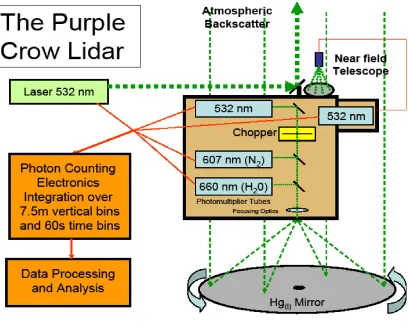
2.1 PCL schematic diagram containing Hg telescope and receiver system. . . 25
2.2 Schematic of the Litron LPY-7000 laser head. . . 26
2.3 Effect of doubler crystal temperature on laser output power. . . 28
2.4 Effect of room temperature on laser output power. . . 29
2.5 The output power of the laser can be modulated by varying the delay between triggering of the Oscillator (blue), Pre-amplifier (magenta), and Amplifier (yel-low). The time delay of the emitted pulse is shown in green. [31] . . . 31
2.6 Schematic of beam expander. [60] . . . 33
2.7 Depiction of far field divergence from a laser aperture or terminal optic. . . 34
2.8 Original blueprint for the PCL optical transmission path. . . 35
2.9 Confirming the focal length of the liquid mercury telescope is 5.175 m. The red line represents measurements of the height in meters above the surface of the mirror. The blue curve is a fit to the count rates measured by the detector system while the mirror is rotating slowly. The green points are the count rates measured by the detector system while the mirror is rotating quickly. The mirror is unstable between the blue and green curves. . . 37
2.10 Schematic of the liquid mercury telescope from Borra et al. (1992). [8] . . . 37
2.11 A plot which describes the leveling of the surface of the telescope dish. Green squares represent shims placed under the base of the mirror, red triangles rep-resent lead weights hung from the rim of the mirror, blue diamonds are mirror surface height measurements made from a mounted engineer’s clock. The mir-ror is leveled to better than 1:5000. . . 40 2.12 A schematic of the reworked PCL detector box. Adapted from [10] . . . 41
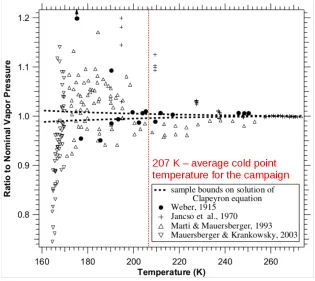
4.1 Experimental data measuring SVP over ice. Text in red indicates the average cold point temperature for the PCL calibration campaign. Taken and modified from Murphy and Koop 2005 [38] . . . 53 4.2 Model outputs measuring SVP over ice with respect to the Goff-Gratch
equa-tion. Taken and modified from Holger V¨omel [64] . . . 54 4.3 Variations in SVP with temperature over water (red) and between water and ice
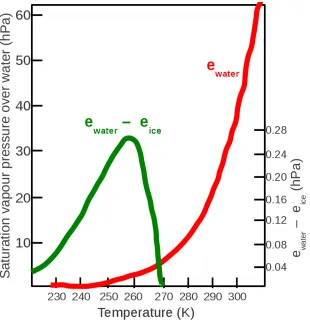
(green). Adapted from [68] . . . 55 4.4 Variation between SVP models between 14 and 20 km for radiosonde data
taken May 24 at 3:39 UTC. There is a factor of approximately two between calculations of the SVP according to the Tsonis and Murphy-Koop models. . . 56 4.5 Ratios of SVP models for water and ice as a function of temperature. . . 56 4.6 Ratios of SVP models to Wexler 1976. . . 57 4.7 Percent difference of mass mixing ratios generated from Wexler minus
Murphy-Koop model outputs from RS92 data taken during the PCL calibration cam-paign. The Wexler model has a wet bias with respect to the Murphy-Koop model between 8 km and 14 km. . . 58 4.8 Uncertainty in RS92 temperature retrievals. Blue is measurement uncertainty,
black is uncertainty due to solar heating, and red is total uncertainty. [22] . . . . 59 4.9 Percentile difference profile between RS92 RH profiles and CFH RH profiles.
[35] . . . 60 4.10 Percent difference between Murphy-Koop 2005 and Tsonis 2002 at altitudes
from 275 m to 30 km. . . 61 4.11 Schematic of the cryogenic frost point hygrometer (CFH). Shown is the
cryo-gen tank which holds the carbon tetraflouride, the heater coil, the mirror, and the optical frost layer detection system Taken from [62] . . . 62 4.12 Initial CFH-lidar comparison contaminated by fluorescence. Taken from [28] . 63 4.13 CFH-lidar comparison up to 18 km . Taken from [33] . . . 64
5.1 The scale factor is only generated from measurements between 3 and 8 km. . . 67 5.2 Percent difference between each RS92 MMR profile and the hourly profile from
PCL. . . 69 5.3 Percent difference between the ensemble of RS92 and PCL profiles of MMR
with RMS errors. . . 69 5.4 Comparison of the percent difference plots between RS92&PCL and RS92&CFH.
[35] . . . 71 5.5 Percent difference with height for PCL and ALVICE MMR profiles. . . 72
5.6 Example of a scaled tropospheric PCL lidar profile compared to an RS92 pro-file and an ALVICE propro-file accompanied by a percent difference plot between
each of the CFH, RS92 and ALVICE with PCL. . . 73
5.7 Percent difference between the ensemble of ALVICE and PCL profiles of MMR with RMS errors. . . 73
5.8 PCL and ALVICE stratospheric water vapour returns. . . 74
5.9 Unexpected drop in CFH VMR compared to both lidars. . . 75
5.10 Unexplained deviations between the CFH and the lidars above 10.5 km. . . 75
5.11 Approximation for the flight path for the June 8th CFH. . . 76
5.12 Standard CFH and iMet plot for June 8th. CFH (purple), RS92 radiosonde (red), iMEt radiosonde (yellow), and SVP curve (black dots). 100% RH is occuring near 10 km. . . 78
5.13 PCL and ALVICE stratospheric water vapour returns. . . 79
6.1 Ground loop contaminating PCL returns below∼3 km. . . 81
A.1 PCL nightly colour plot of tropospheric water for May 24th. . . 92
A.2 PCL, ALVICE, and RS92 mass mixing ratio profiles for May 24th at 3:39 UTC. 92 A.3 PCL, ALVICE, RS92, and CFH mass mixing ratio profiles for May 24th at 6:59 UTC. . . 93
A.4 PCL and ALVICE volume mixing ratio profiles for May 24th at 3:39 UTC. . . . 93
A.5 PCL, ALVICE, and CFH volume mixing ratio profiles for May 24th at 6:59 UTC. 94 A.6 RS92 profiles for temperature (red) and RH (black) on May 24th at 3:39 UTC. . 94
A.7 RS92 profiles for temperature (red) and RH (black) on May 24th at 6:59 UTC. . 94
A.8 CFH profile for temperature on May 24th at 4:02 UTC. . . 95
A.9 PCL nightly colour plot of tropospheric water for May 25th. . . 96
A.10 PCL,ALVICE, and RS92 mass mixing ratio profiles for May 25th at 3:57 UTC. 96 A.11 PCL and ALVICE volume mixing ratio profiles for May 25th at 3:57 UTC. . . . 97
A.12 RS92 profiles for temperature (red) and RH (black) on May 25th at 3:57 UTC. . 97
A.13 PCL nightly colour plot of tropospheric water for May 26th. . . 98
A.14 PCL,ALVICE, and RS92 mass mixing ratio profiles for May 26th at 3:39 UTC. 98 A.15 PCL and ALVICE volume mixing ratio profiles for May 26th at 3:39 UTC. . . . 99
A.16 RS92 profiles for temperature (red) and RH (black) on May 26th at 3:40 UTC. . 99
A.17 PCL nightly colour plot of tropospheric water for May 28th. . . 100
A.18 PCL,ALVICE, and RS92 mass mixing ratio profiles for May 28th at 3:31 UTC. 100 A.19 PCL and ALVICE volume mixing ratio profiles for May 28th at 3:31 UTC. . . . 101
A.20 RS92 profiles for temperature (red) and RH (black) on May 28th at 3:31 UTC. . 101
A.21 PCL nightly colour plot of tropospheric water for May 29th. . . 102
A.22 PCL,ALVICE, and RS92 mass mixing ratio profiles for May 29th at 3:31 UTC. 102 A.23 PCL and ALVICE volume mixing ratio profiles for May 29th at 3:31 UTC. . . . 103
A.24 RS92 profiles for temperature (red) and RH (black) on May 29th at 3:38 UTC. . 103
A.25 PCL nightly colour plot of tropospheric water for June 4th. . . 104
A.26 PCL,ALVICE, and RS92 mass mixing ratio profiles for June 4th at 3:22 UTC. . 104
A.27 PCL,ALVICE, and RS92 mass mixing ratio profiles for June 4th at 5:40 UTC. . 105
A.28 PCL and ALVICE volume mixing ratio profiles for June 4th at 3:22 UTC. . . . 105
A.29 PCL and ALVICE volume mixing ratio profiles for June 4th at 5:40 UTC. . . . 105 A.30 RS92 profiles for temperature (red) and RH (black) on June 4th at 3:22 UTC. . 106 A.31 RS92 profiles for temperature (red) and RH (black) on June 4th at 5:40 UTC. . 106 A.32 PCL nightly colour plot of tropospheric water for June 6th. . . 107 A.33 PCL,ALVICE, and RS92 mass mixing ratio profiles for June 6th at 3:12 UTC. . 107 A.34 PCL,ALVICE, and RS92 mass mixing ratio profiles for June 6th at 5:29 UTC. . 108 A.35 PCL and ALVICE volume mixing ratio profiles for June 6th at 3:12 UTC. . . . 108 A.36 PCL and ALVICE volume mixing ratio profiles for June 6th at 5:29 UTC. . . . 109 A.37 RS92 profiles for temperature (red) and RH (black) on June 6th at 3:11 UTC. . 109 A.38 RS92 profiles for temperature (red) and RH (black) on June 6th at 5:29 UTC. . 109 A.39 PCL nightly colour plot of tropospheric water for June 7th. . . 110 A.40 PCL and RS92 mass mixing ratio profiles for June 7th at 3:45 UTC. . . 110 A.41 PCL volume mixing ratio profiles for June 6th at 3:45 UTC. . . 111 A.42 RS92 profiles for temperature (red) and RH (black) on June 7th at 3:45 UTC. . 111 A.43 PCL nightly colour plot of tropospheric water for June 8th. . . 112 A.44 PCL,ALVICE, and RS92 mass mixing ratio profiles for June 8th at 3:53 UTC. . 112 A.45 PCL,ALVICE, RS92, and CFH mass mixing ratio profiles for June 8th at 6:51
UTC. . . 113 A.46 PCL, ALVICE, and CFH volume mixing ratio profiles for June 8th at 3:53 UTC. 113 A.47 PCL and ALVICE volume mixing ratio profiles for June 8th at 6:51 UTC. . . . 114 A.48 RS92 profiles for temperature (red) and RH (black) on June 8th at 3:53 UTC. . 114 A.49 RS92 profiles for temperature (red) and RH (black) on June 8th at 6:51 UTC. . 114 A.50 CFH profile for temperature on June 8th at 2:51 UTC. . . 115 A.51 PCL nightly colour plot of tropospheric water for June 10th. . . 116 A.52 PCL,ALVICE, and RS92, mass mixing ratio profiles for June 10th at 4:02 UTC. 116 A.53 PCL and ALVICE volume mixing ratio profiles for June 10th at 4:02 UTC. . . . 117 A.54 RS92 profiles for temperature (red) and RH (black) on June 10th at 4:02 UTC. . 117
List of Tables
1.1 Fractional concentration of gasses in Earth’s atmosphere. [68] . . . 4
2.1 Optical specifications for the liquid mercury telescope. . . 36
3.1 Water vapour mixing ratio equation atmospheric parameters. . . 45
3.2 Reflectivity of PCL detector box optics. . . 46
4.1 PCL-ALVICE field campaign log. . . 50
5.1 Table of derived lidar fitting factors and reduced chi-squared values for each night of good data during the campaign. . . 66
5.2 Table of the average percent difference between MMR values measured by PCL and ALVICE lidars for each night of good data during the campaign. Poor fits have percent differences greater than 10%, acceptable fits have differences between 5% and 10%, and excellent fits have differences less than 5%. . . 71
List of Appendices
Appendix A . . . 91 Appendix B . . . 118
Chapter 1
A Review of Some Atmospheric Concepts
1.1
Introduction
The atmosphere makes life on Earth possible. It shields us from harmful extplanetary
ra-diation; it moderates the surface temperature of the planet and insulates us from the diurnal
solar cycle; it allows for a common, well mixed reservoir of gasses from which organisms can
cycle necessary chemical compounds; and it provides a medium for the long range transport
and circulation of water.
The presence of water vapour in the atmosphere is a very important, but imperfectly
un-derstood, variable in the global atmospheric radiation balance. It is expected that in the
tro-posphere water vapour acts as a greenhouse gas and warms the atmosphere by absorbing and
remitting long wave infrared radiation. As the temperature of the atmosphere warms, it is
ex-pected that an increase in the concentration of water vapour in the air will occur. This process
in turn will cause more heating and act as a positive feedback mechanism.
However, as the concentration of water molecules increases in the lower atmosphere, it is
expected that more clouds will be formed as more moist air is lifted and cooled. Clouds are a
key component in reflecting incoming solar rays, preventing higher frequency light from being
absorbed and re-emitted from the surface. If this effect is dominant, it would act to cool the
lower atmosphere, limiting water-driven heating, which in turn limits cloud formation. This
effect is known as cloud feedback and is a sensitive negative feedback loop parameter in most
2 Chapter1. A Review ofSomeAtmosphericConcepts
global climate models.
The above mechanisms are well understood and are a part of the many complexities in
attempting to make model forecasts of global atmospheric change. A more full description of
these phenomena can be found in the IPCC 2007 report [25]. One of the major issues with
properly incorporating the effects of increased water vapour in both the troposphere and the
lower stratosphere is the absence of a long term, reliable, well calibrated measurements [25].
Currently, water vapour mixing ratio can be measured by various kinds of satellites such as
the Atmospheric Chemistry Experiment (ACE), through measurements from humidity sensors
mounted on commercial and research aircraft, by dropsonde and radiosonde campaigns, and
by Raman Lidar techniques [36]. Each instrument type has observational strengths and
weak-nesses and lidar is a no exception. The lidar technique provides excellent spatial and temporal
resolution measurements of water vapour mixing ratio but has limited geographic coverage,
requires extensive expertise for construction, maintenance and operation, and requires
calibra-tion and routine checks on data consistency. This thesis will focus on the calibracalibra-tion of Raman
lidar measurements of water vapour in the upper troposphere and lower stratosphere (UTLS).
1.2
Atmosphere Pressure for an Isothermal Atmosphere
The homogeneous, neutral atmosphere is a relatively well mixed, stably stratified fluid
extend-ing from the planet’s surface to the turbopause, a region which is nominally located between
95 and 115 km in altitude. The gravitational attraction between Earth and its atmosphere gives
rise to an exponential decrease in pressure with height, as lower layers of gas are compressed
under the weight of layers at higher altitudes. By invoking the equation of state for an ideal gas,
(1.1) wherePis the gas pressure (Pa),ρis the gas density in mkg3,Ris the universal gas constant
1.3. AtmosphericComposition 3
which balances the pressure gradient force with gravity can be derived.
P= ρRT (1.1)
This condition, known as the Hydrostatic Equilibrium Equation, (1.2),
dP
dz +ρg=0 (1.2)
where g(z) is the gravitational acceleration and the surface value is 9.80665 sm2, allows us to
characterize ane-folding height for the density curve of the atmosphere (1.4), wherekis
Boltz-mann’s Constant 1.3806488×10²³ JK, andMis the molar mass of air, which can be calculated
from a periodic table, is 0.0289644 molkg. A typical value of the e-folding, or scale height, in
the region of Earth’s atmosphere is approximately 8 km. A curve representing this exponential
drop in pressure with altitude can be calculated using the Barometric Formula(1.3),
P= P0·exp
"
−g· M·z R·T0
#
(1.3)
whereT0 andP0 are the respective temperatures and pressures at the surface, and can be seen
in Figure 1.1.
H = kT
Mg(z) (1.4)
1.3
Atmospheric Composition
Within this well mixed region, the composition of the atmosphere is uniform. Table 1.1 details
the fractional concentration by volume for the most abundant gasses in Earth’s atmosphere.
Taken together, molecular nitrogen and molecular oxygen compose approximately 99.03% of
the air with the trace gasses comprising the remaining fraction of a percent in the dry
4 Chapter1. A Review ofSomeAtmosphericConcepts
Figure 1.1: An atmospheric pressure profile calculated using the Barometric Formula.
Constituent Molecular Weight Fractional Concentration by Volume
Nitrogen (N2) 28.013 78.08%
Oxygen (O2) 32.000 20.95%
Argon (Ar) 39.95 0.93%
Water Vapour (H2O) 18.02 0-5%
Carbon dioxide (CO2) 44.01 380 ppm
Neon (Ne) 20.18 18 ppm
Helium (He) 4.00 5 ppm
Methane (CH4) 16.04 1.75 ppm
Krypton (Kr) 83.80 1 ppm
Hydrogen (H2) 2.02 0.5 ppm
Nitrous oxide (N2O) 56.03 0.3 ppm
Ozone (O3) 48.00 0-0.1 ppm
1.4. TemperatureStructure 5
values possible and is extremely variable in both space and time. This uncertainty in the
con-centration of water vapour can be intuitively to understood as the variation in the humidity of
our environment with temperature changes. The summer air is hot and humid, while the winter
air tends to be cold and dry. A more formal exploration of how moisture in the atmosphere
cycles and which physical parameters are important in its description are presented later in the
chapter.
1.4
Temperature Structure
Temperature variations are important parameters in characterizing and understanding the
at-mosphere. The atmosphere can be divided into four regions, each of which is marked by a
temperature gradient which is calculated from the hydrostatic balance equation (1.2) and a
for-mulation of the first law of thermodynamics (1.5) whereUis the internal energy of the system,
δQis an infinitesimal amount of heat supplied to the system by its surroundings, anddV is a
change in the volume of the system. The four regions of the atmosphere are the troposphere,
stratosphere, mesosphere, and thermosphere. For the purposes of this work only the lowest two
regions will be considered; the dynamicas and chemistry of water vapour in the mesosphere
and thermosphere will be ignored.
dU = δQ−PdV (1.5)
1.5
Troposphere
The troposphere is the lowest region extending from the surface of the planet up to nominally
10 km altitude and it is characterized by a negative lapse rate, convective and turbulent mixing,
6 Chapter1. A Review ofSomeAtmosphericConcepts
Figure 1.2: An atmospheric temperature profile based on the US Standard Atmosphere values. [26]
our day-to-day weather phenomena. Using an appropriate value for the specific heat capacity
at constant pressure,cp=29.07molJ·K, and the assumption of an adiabatically rising parcel of air
we can derive equation (1.6) the Dry Adiabatic Lapse Rate (DALR) which is equal to 9.8 kmK.
Γd =−dT
dz =
g cp
≈9.8 K
km (1.6)
Given that water is a condensable gas and has easily accessible liquid, solid, and vapour states
over a normal range of atmospheric pressures, the contributions of water to the thermodynamics
of the atmosphere must be considered. Figure 1.3, shows the phase transition curves for water
and have been sketched based on values listed in the CRC [30].
As water evaporates and condenses in Earth’s atmosphere there is a flux of enthalpy into the
surrounding air. If we assume that the atmosphere is completely saturated with water vapour,
then the DALR must be modified to accommodate the enthalpy associated with the water which
results in a Moist Adiabatic Lapse Rate (MALR). The MALR is typically around 5 kmK and is
given by (1.7)
Γm = g
cp
1+ Lqs
RT
1+ 0.62L2qs
cpRH2OT2 (1.7)
1.5. Troposphere 7
Figure 1.3: A phase transition diagram for water.
mixing ratio which will be defined later. The MALR is derived in a similar fashion to the
DALR accounting for the enthalpy of the water contained in the air [20].
As can be seen from (1.6) and (1.7) the presence of water vapour in the atmosphere plays a
crucial role in the temperature profile. If we imagine a parcel of dry air, composed of molecular
nitrogen and molecular oxygen, having an average molar mass of approximately 29 molg [30]
then we know that by adding moisture to the air parcel we make it lighter as the molar mass of
water approximately 18 molg [30]. Using the ideal gas law equation (1.1) we can see that the gas
constant for dry air, R, needs to be slightly altered to RH2O, taking into account the moisture
contained within the air parcel.
Above the troposphere is an intermediate region known as the tropopause. The tropopause
is a region where the lapse rate fluctuates about zero and can be thought of as an isotherm.
8 Chapter1. A Review ofSomeAtmosphericConcepts
in atmospheric temperature. Values colder than 210 K are not uncommon. The significance
of this region of the atmosphere is that it acts as a partial barrier to the convective mixing of
moist, tropospheric air and the drier non-convecting stratosphere directly above it. However,
the transport of air across this region, known as stratosphere-troposphere exchange, can be
driven by localized and transient dynamical, chemical and radiative coupling processes [21].
These processes are essential for the water vapour inventory of the stratosphere [42].
1.6
Stratosphere
The stratosphere is the region directly above the tropopause and extends to roughly 50 km
altitude. The region gets its name from the stably stratified nature of the temperature profile.
Whereas the troposphere features a negative lapse rate, the stratospheric temperature profile
increases with increasing altitude due to the presence of ozone. This temperature inversion
suppresses convection and damps out the vertical motions of injected tropospheric air. The
ozone molecule, O3, absorbs incoming ultraviolet solar radiation and redistributes a portion of
the energy as increased temperature.
Accurately measuring stratospheric water vapour is of particular interest to climate
scien-tists as existing global climate models do not simulate temperature trends in the lower
strato-sphere very accurately and stratospheric chemistry-climate models cannot produce temperature
profiles which match observations [23]. Well calibrated measurements of stratospheric water
vapour are essential for calculating the radiative forcing on the stratosphere and for integration
into prognostic climate models.
1.7
Water Vapour in the Atmosphere
As was discussed in section 1.3, water vapour is a very important, poorly understood and
highly variable chemical species in the atmosphere. Its most critical role is manifested as a
1.7. WaterVapour in theAtmosphere 9
the planet’s atmospheric energy balance.
The following subsection will lay out a few qualitative points, summarized from [46],
ex-plaining why water vapour is such a potent atmospheric constituent and why it requires study.
Following the qualitative summary a few useful metrics for the quantization of water vapour
and saturation vapour pressure equations will be derived. Both of these ideas are of central
importance to the calibration effort in this thesis.
1.7.1
Qualitative Discussion
Water vapour has a very large ’latent heat’, hereafter properly referred to as enthalpy, associated
with all of its phase transitions. Figure 1.4 gives an indication of the magnitudes of these
enthalpies for the processes of vapourization and fusion [12]. As a result, the vapour pressure
of water, at equilibrium, has a very strong dependence on temperature. The two most important
consequences of this close connection between temperature and the phase state of water are:
i)Water vapour abundance varies strongly with season, altitude, and latitude.
10 Chapter1. A Review ofSomeAtmosphericConcepts
ii)The local abundance of water vapour may be perturbed by large scale atmospheric
cir-culation patterns and convection, drawing it into regions where it is out of equilibrium with the
temperature of the environment.
Due to the associated enthalpies associated with changes in state, water can act as a vector
for the transport of significant amounts of energy throughout the atmosphere. For example, as
water undergoes vapourization at the surface it requires energy and decreases the temperature
of its surroundings. When that water vapour is then lifted convectively to an altitude where
it becomes energetically favourable to condense, the water molecules release energy into their
new environment and precipitate out of solution. From start to finish, this example transports
heat from the surface aloft and greatly changes the radiative balance of the local atmosphere.
The H2O molecule has a very complex set of absorption bands as can be seen in Figure
1.5. These absorption bands are interspersed with windows which transmit easily through the
moist lower layers of the atmosphere. Looking at Figure 1.5 it can be seen that the light which
Figure 1.5: Atmospheric absorption bands for water. [24]
the Sun emits in the visible portion of the spectrum is weakly absorbed by water vapour, and
1.7. WaterVapour in theAtmosphere 11
based on its black-body temperature, the IR radiation is strongly absorbed and re-emitted in
several absorption bands which are associated with water vapour. This ”trapping” of long wave,
outgoing radiation, is the basic idea behind the ”greenhouse effect”, thus making water vapour
a prominent greenhouse gas. Further, the concentration of this gas is closely linked to the long
term warming trend of the troposphere as water is known to participate in a positive feedback
loop where warmer temperatures promote a higher atmospheric water vapour concentration
[23].
When water vapour condenses to form clouds of liquid or ice particles its optical properties
also change. As can be observed, clouds are often opaque in the visible portion of the spectrum,
and where once solar radiation passed freely through the atmosphere to the Earth’s surface, now
is reflected or absorbed by cloud layers. The clouds reflect incoming visible light and lower the
planets albedo, or reflection coefficient. With less light reaching the surface the planet should
cool. As was mentioned in the introduction to this thesis, the fundamental question: Does
increasing Earth’s water vapour budget heat or cool the planet? is still open for exploration.
1.7.2
Quantitative Discussion
There are several common methods for quantifying the amount of water vapour in the
atmo-sphere. The most basic measure is absolute humidity which is simply the number or mass
density of water molecules over the number or mass density of molecules of ”dry air” within
a given volume. From the mass density we can express the ’partial pressure’ of water vapour
relative to the total pressure of the gas mixture. We can invoke a slightly modified form of the
ideal gas law, equation (1.1), and define a partial pressure for water vapour, e, where ρvapour
is the mass density of water vapour, Rvapour is the gas constant for water vapour, andT is the
temperature of the gas mixture [68].
12 Chapter1. A Review ofSomeAtmosphericConcepts
Carrying forward with the ideas of partial pressure and vapour mass density, two more metrics
can be defined:
a. The humidity mixing ratio,w
b. The absolute humidity,r
w= ρvapour
ρdry
(1.9)
r= w
wsaturation
(1.10)
where ρdry is the mass density of dry air and wsaturation is the saturation vapour mixing ratio
which will be elaborated on in the next section [68]. Relating the mixing ratio,w, to the partial
pressure of water vapour,e, using equation (1.11)
w Rdry
Rvapour
e
P−e =0.622
e
P−e (1.11)
WherePis the total pressure of the gas andRdryis the gas constant for air. The last (and most
useful for this thesis) metric is called relative humidityRH and is properly defined in equation
(1.12) [68].
RH = w
ws = e
es
P−es
P−e (1.12)
Many texts and papers neglect the second half of the equation and approximateRH by ee s.
One of the lessons learned from the MOHAVE campaign, which will be discussed in a later
chapter, is that the contribution of the P−es
P−e is essential when determining RH in very cold, dry
environments like the lower stratosphere [29]. RH is seen to depend on pressure, which is a
function of temperature, e, which was shown earlier to be a function of temperature, and on
es, the saturation vapour pressure, which will be discussed in the next section and is also a
1.7. WaterVapour in theAtmosphere 13
1.7.3
Saturation Vapour Pressure as Applied to the Atmosphere
Saturation vapour pressure (SVP) is a nuanced concept and some time will be taken to lay out
a precise description. The framework for the following derivation comes from [5] but more
detailed expressions from [38], [70], and [65] will be inserted where required.
Imagine an infinitely large and infinitely deep, flat, pool of water at constant temperature,T
depicted in Figure 1.6. Above this pool there is only vacuum and we assume that any walls or
surfaces are infinitely far away. The speed of water molecules depends upon the temperature of
the liquid. There should be an expectation speed for the molecules,<v>, which is proportional
to the square root of temperature, and the distribution of the speeds from the expectation value
should follow the Boltzmann distribution in a liquid.
Figure 1.6: Infinite pool of water below a vacuum. [59]
14 Chapter1. A Review ofSomeAtmosphericConcepts
over come the inter-molecular cohesion of the liquid it can escape into the vacuum. This
process is evaporation,E, and it is only dependant on the temperature of the liquid. Again, we
are assuming that our infinite pool is sufficiently large that the enthalpy of vapourization of the
escaped molecule does not lower the temperature of the liquid.
Now we have some water vapour above the pool and it has some mass density, mvapour,
temperature,Tvapour(does not need to be the same as the liquid), and a distribution of molecular
speeds about< vvapour >. We should expect some of the molecules in the vapour to have low
kinetic energies and to collide with the surface of the liquid. When this happens the molecule
may be seized by the cohesive forces and condensed,C, back into the liquid state. We should
also expect that the number of condensation events is some function of the temperature of the
vapour and the number of vaporized molecules. Equation (1.13) summarizes the preceding two
paragraphs.
With these ideas about total evaporation and condensation we can define a net flux of water
molecules between the liquid and gaseous states, equation (1.14). It is important to note that
Fnetis the quantity that our instruments measure, notFup.
d(mvapour)
dt = E(Tliquid)C(Tvapour,mvapour) (1.13)
Fnet = Fup−Fdown (1.14)
In the previous section we defined the absolute humidity, w, as a vapour density ratio.
Fluxes are really just the rate of change in time of number densities. If we setTliquid =Tvapour =
Ttotalwe should be able to use equation ([?]) to work out the saturation mixing ratio,ws.
Fup
Fdown
=w< v(T)> /ws <v(T)> (1.15)
E
C =
w ws
(1.16)
temper-1.7. WaterVapour in theAtmosphere 15
ature andRH; however, we have not given a functional form. SVP is a very difficult quantity
to determine. It is very difficult to accurately measure the fluxes associated with an infinite flat
pool as the introduction of an instrument or a surface alters the rate of condensation, especially
at low temperatures [32]. Modelling the SVP also involves difficulties [38]. However, we can
begin to sketch out the generalized form that an SVP model should take.
Begining with the Clausius-Clapeyron equation (1.17) as given in [70].
d(es)
dt =
L
T(V −i) (1.17)
where Lis the enthalpy of condensation or sublimation, V is the specific volume of the
satu-ration vapour pressure for water vapour, andi is the specific volume of the saturation vapour
pressure over ice.
Next we need an equation of state to describe the gasses being modelled. We will use
a modified version of the ideal gas law (1.18) where Z is a measured compressibility factor
instead of a mass or a density.
PV =ZRT (1.18)
Combining equation (1.1) into equation (1.17) and separating like terms we arrive at
Equa-tion 1.19.
dP
P =
L
ZRT2(1+ i
v)dT
(1.19)
Now we need to select a temperature range (and appropriately mapped pressure range)
over which the equation will be valid. This is limited by the range over which measurements
or models ofLare available.
Z P2
P1
dlnP=
Z T2
T1
dT L
ZRT21+ i
V
16 Chapter1. A Review ofSomeAtmosphericConcepts
Until this point in the derivation we have not had to make any approximations or rely on
measurements or modelling. Unfortunately, we now need an expression for both the enthalpy
of ice,Lice, and the enthalpy of water,Lwater, which are accurate over the temperature range of
interest. Much like with the lab experiments for measuring the SVP curve directly,
experimen-tal measurements of the enthalpy curves, such as the work done by Marti and Mauersberger
(1993) [32], are technically challenging and do not produce sufficiently reliable results for our
work.
The other approach for determining enthalpies at low temperatures is to write series
ex-pansions of the enthalpy terms, fit the terms with a polynomial and then extrapolate to low
temperatures. Unfortunately, there are a multitude of models to choose from, all of which
suffer from the typical blights of truncation, rounding, choice of fitting function, order, etc.
with large variations existing between models by different authors. Murphy and Koop (2006)
[38] wrote a review paper of the most prominent SVP models and came to the conclusion that
there is very little basis for any of the models or measurements within the temperature regime
of interest for this thesis. In chapter 4 a comparison of model outputs will be shown and the
reasoning behind the choice of model choice for this work will be discussed.
1.8
Atmospheric Scattering
The scattering of light off particles in the atmosphere is an everyday phenomenon; we see
bright, clear blue skies, white, grey and black clouds, red sunsets and sunrises, and at times
many other shades of pink, purple and green. All these different picture-perfect moments can
be described in terms of photons scattering offof atoms, molecules and aerosols.
In general, there are three major types of scattering which can occur: Mie, Rayleigh, and
1.8. AtmosphericScattering 17
1.8.1
Mie Scattering
Mie scattering happens when light scatterers offa particle with a radius much larger than the
wavelength of the incident photon. Surface effects, shape, and refractive index are all
impor-tant quantities to know when working with this kind of scattering. Mie scattering is typically
associated with lidar studies of aerosols and for the purposes of this thesis I will not consider
it.
1.8.2
Rayleigh Scattering
Rayleigh scattering is elastic scattering of a photon offa scattering target. Rayleigh scattering
is a central technique employed by PCL so it is important to examine its postulates, PCL’s data
acquisition, and address any discrepancies between the two.
Rayleigh scattering has five assumptions:
i) The scatterer must be smaller in size than the wavelength of the incident photon. The
PCL transmits at 532 nm and we assume that the bulk atmospheric scatterers are molecular
nitrogen and molecular oxygen typical cross sections for these molecules are estimated at 300
pm and 292 pm respectively [30]. Rayleigh scattering is valid for the majority of atmospheric
constituents. Care must be taken when larger particles such as aerosols are present in the
atmospheric sample.
ii) The scatterer must not be ionized. Most molecules below the ionosphere, altitudes
greater than approximately 90 km, are non-ionized. This work takes place in the lower and
middle atmosphere so we are safe in using Rayleigh techniques.
iii) The scatterers must have an internal index of refraction near unity. This condition
is required to prevent large phase changes in the photon wave fronts as they move into the
scatterer and out again. These phase changes can be conceptualized by recalling the definition
of the absolute index of refraction equation (1.21), wherecis the speed of light, vis the wave
18 Chapter1. A Review ofSomeAtmosphericConcepts
nc
v =
r µ
0µ0
(1.21)
The index of refraction for air is usually given asn=1.000293 [19]. However, it is
impor-tant to note that other atmospheric constituents, most imporimpor-tantly water vapour (n ≈ 1.33) do
not satisfy this criterion.
iv)The scatterers must be isotropic molecules which do not experience dipole oscillations
when interacting with a photon. Neither molecular nitrogen nor molecular oxygen satisfies this
criterion due to their diatomic structures. Fortunately, a correction for anisotropy was given
by Cabannes which separates out the elastic component of the signal from the inelastic side
lobes [49]. To be correct what PCL truly measures is called Rayleigh-Cabannes scattering as
it assumes a correction for molecular anisotropy.
v)The scatterers must not have resonant frequencies near the frequency of the incident
pho-ton. For example, when the laser frequency of a lidar transmitter approaches the absorption line
of an atmospheric constituent the scattering cross section is significantly enhanced [49]. This
resonant scattering phenomenon is what allows lidars to determine atmospheric temperature in
regions such as the sodium layer in the upper atmosphere.
When we consider a photon ’scattering’ off an atom or particle what we are actually
en-visioning is an absorption and re-emission process. Imagine a molecule of nitrogen; it has a
central nucleus and a cloud of electrons surrounding it. Each of these electrons has a defined
energy associated with it. When a photon interacts with one of the electrons associated with
the molecule it raises the energy level of the electron to a ’virtual state’. These virtual states are
unstable arrangements and the electron quickly decays back to a lower energy state and emits
a photon with the exact same wavelength at which it was stimulated.
It can be shown that the intensity of a scattered beam has both angular and wavelength
dependence [34]. If a given molecule has a scattering cross section given by equation (1.23),
1.8. AtmosphericScattering 19
per unit volume then we can define an expression equation (1.22) for the scattering intensity.
I(x)= I0e−σN x (1.22)
σ= 2k4
3πN2
1−n2 (1.23)
This form can approximately be expressed in terms of the scattering intensity of linearly
polar-ized light offa dielectric sphere as a function of scattering angle expressed in equation (1.24)
whereφis the scattering angle andE0is the magnitude of the incident electric field.
I(φ)≈ E029π20c
2N2λ4 sin 2φ (1.24)
1.8.3
Raman Scattering
In contrast to Rayleigh scattering, Raman scattering is an inelastic process where a ray of
monochromatic light scatters offa molecule at different wavelengths than the incident ray. This
frequency shifting of scattered light happens when energy is transferred between the incident
photon and the scatterer, in increments which are proportional to the quantized rotational and
vibrational energy levels of the atom or molecule. Said another way: the scattered photon
either gains energy from the interaction and shifts to a higher frequency, a process known as
Stokes shift, or the scattered photon loses energy from the interaction and shifts to a lower
frequency, a process known as anti-Stokes shift. Since our scattering targets of interest are
mostly diatomic molecules we expect that there will be energy shift due to both the vibrational
as well as rotational transitions. Figure 1.7 represents the Raman transitions with respect to the
virtual state and the energy of the incident photon.
To characterize the possible energy states it is best to introduce two quantum numbers J
andv. Beginning with the idea of Bohrs atom we imagine electron shells which have discrete
energy levels. Combining two atoms together the allowable energy states become more
20 Chapter1. A Review ofSomeAtmosphericConcepts
Figure 1.7: Stokes and anti-Stokes shifts with respect to Rayleigh scatter. PCL water vapour measurements rely on Stokes, or red-shifted Raman scatter from 532 nm.
sub-levels, v. For our purposes we will only allow∆J = 0,±2 and∆v = 0, ±1 which are the
allowable states of a diatomic molecule. A plot of three different Raman vibrational modes
with their attendant rotational wings is shown in Figure 1.8.
For a given Raman spectrum we can define a centralQ-branch transition where∆J =0 and
∆v= ±1. This spectral mode is associated with ”pure” vibrational scattering and is analogous
to the central Cabannnes line discussed in the previous section on Rayleigh scattering. When
∆J = +2 and v = 0 we enter a rotational side lobe known as the S-branch. The S-branch is
the ’blue-shifted’ or anti-Stokes wing of the spectrum. When∆J = −2 andv = 0 we enter
the other rotational side lobe known as the O-branch also known as the ’red-shifted’ or Stokes
wing of the spectrum. Figure 1.9 shows a diagram of this nomenclature scheme.
It is important to specify that PCL only seeks to make measurements of the Q-branch of
a Raman spectrum as these are pure vibrational lines. However, it is not possible to measure
an infinitely thin spectral width. Therefore, PCL also measures the O- and S- branches of
the desired spectra. Theoretically, this poses a problem as there is a temperature dependent
1.8. AtmosphericScattering 21
Figure 1.8: Energy transitions for vibrational and rotational Raman scattering. [3]
concluded that for the 1.11 nm filter in front of the PCL water channel there is a less than 5%
variation over the temperature range of 293 K to 213 K. His results are shown in Figures 1.10
and 1.11.
In Figures 1.10 and 1.11 the dashed line represents the filter bandwidth while the Raman
spectrum intensity is shown for two temperatures. At 293 K the filter fits the spectrum well
and there is minimal loss. At 213 K the sum of the product of the spectrum intensity and
transmission index is lower, indicating a poorer fit. Marcos Algara-Siller derived and applied
22 Chapter1. A Review ofSomeAtmosphericConcepts
Figure 1.9: Raman scatter showing the O-branch, Q-branch, and S-branch.
1.8. AtmosphericScattering 23
Chapter 2
Lidar Instrumentation
2.1
Introduction
LIDAR is an optical remote sensing technique, analogous in concept to the radar or sonar,
rely-ing on pulsed visible or near visible frequency light to determine range and surface information
for a target. The acronym LIDAR stands for LIght Detection And Ranging [15].
2.2
The Purple Crow Lidar History
The Purple Crow Lidar (PCL) was first constructed at Delaware Radio Observatory (42.52 N,
81.23 W, 225 m) in 1992 and was designed to measure temperature and dynamics in the middle
atmosphere [51]. In order to take measurements of temperature in the upper mesosphere and
lower thermosphere the PCL was designed as a high power-aperture Rayleigh lidar with a
com-plementary sodium resonance-fluorescence system (589 nm) for measuring the temperature of
the sodium layer [2].
In the late 1990s and early 2000s PCL started to focus on developing measurements of
wa-ter vapour mixing-ratio in the lower and middle atmosphere. Early work done in the Maswa-ter’s
theses of [10] and [53] allowed for the early calibration and validation of water vapour
mixing-ratio by vibmixing-rational Raman lidar measurements. An overview of the initial PCL calibmixing-ration for
2.2. ThePurpleCrowLidarHistory 25
Figure 2.1: PCL schematic diagram containing Hg telescope and receiver system.
both water vapour mixing ratio and Raman temperatures using radiosondes from Detroit and
Buffalo can be found in a paper by Argall et al. [1].
By the summer of 2010 the Delaware Observatory was no longer suitable for PCL and a
new, custom-built observatory was made ready at the Environmental Science Western Field
Station (43.07 N, 81.33 W, 275 m) (Ministry of Natural Resources 1983). The move provided
an opportunity to update and rework PCL and the system received a new, more powerful, laser;
new photomultiplier tubes; new, faster, counting electronics; new optics; an environmentally
friendly geothermal cooling loop for laser temperature stability; and a low dew-point, ultra
clean compressor which supplies air to the liquid mercury telescope. In addition to these
upgrades the new site also offers better seeing conditions and is much closer to campus which
allows for more routine observations. A schematic overview of the system can be found in
26 Chapter2. LidarInstrumentation
Figure 2.2: Schematic of the Litron LPY-7000 laser head.
2.3
PCL Sub-systems
The Purple Crow Lidar is a mono-static lidar system which was designed and assembled during
the summers of 2010 and 2011 and became fully operational in early 2012. In essence, the
PCL Observatory can be subdivided into three independent sub-systems which will be broadly
labled as: the Transmitter, the Receiver, and the Data Acquisition System. Each of these three
systems will be described separately and the work that has been done in their creation and
calibration will be detailed.
2.3.1
The Transmitter
The Laser head
The PCL uses the second harmonic of a Neodymium: Yttrium-Aluminium-Garnet (Nd:YAG)
solid state laser to produce light at 532 nm. The laser itself is an experimental prototype which
was designed and manufactured by a British company, Litron Lasers. An optical diagram is
shown in Figure 2.2 as a visual reference for the following discussion on the characteristics,
modifications, and operation of this device.
The unseeded, double rod, Gaussian oscillator outputs a 10 ns pulse of coherent 1064 nm
light at a repetition rate of 30 Hz. The measured beam diameter at this point is 8.0±0.5 mm
when run on a fixed Q (time delay) and slightly larger when triggered by an internal Q-switch.
2.3. PCL Sub-systems 27
with f-numbers ofF−500 andF+572, respectively, before entering the pre-amplifier.
The pre-amplifier contains two laser rods in a deionized water cooled cavity that is
sur-rounded by two flash lamps in a parallel circuit. Separating the flash lamps from the laser rod
cavity are broadband UV filters chosen to protect the laser rods from degradation caused by
UV light in the lamp spectrum.
The pre-amplifier is followed by another set of collimating lenses with f-numbers ofF−200
and F +250, and then by an amplifier which is an identical device to the pre-amplifier. At
this point, the laser beam is still at 1064nm but the laser pulse energy has been increased to
approximately 2500 mJ per pulse with a beam diameter approaching 10 mm. It is important to
note that the position of the oscillator, pre-amplifier, and amplifier are not perfectly co-linear
with the back trajectory of the beam path. The reason for this displaced layout is to introduce a
small angular offset so that any back reflected laser light does not re-enter the previous stage of
the laser and cause damage. To visualize this offset, imagine a very slight, almost indiscernible
by the eye, lightning bolt-shape to the beam path.
After leaving the collimating lenses of the amplifier, the beam travels into the doubler. The
doubler is an oven, in its original design heated to 40◦C which contains a crystal of Potassium
titanyl phosphate (KTiOPO4). The doubling crystal is a solid state non-linear optic which
converts incoming photons at 1064 nm into outgoing 532 nm photons.
Significant work was done, post installation, to modify the oven temperature in an effort to
maintain a constant laser output. The work involved very slowly changing the temperature of
the oven and correcting the phase of the crystal to compensate for thermal drift. This
exper-iment was carried out over 72 hours and required shifts with fellow graduate students Emily
McCullough and Jaya Khana. A new oven temperature of 50◦C was selected which allowed
the laser power to plateau at a stable value. A summary of the results is given in Figure 2.3.
Since running the crystal at such a high temperature is not a good long term solution, Litron
Lasers redesigned and installed a more sophisticated oven which aided in uniform and
28 Chapter2. LidarInstrumentation
Figure 2.3: Effect of doubler crystal temperature on laser output power.
When the beam exits the doubler chamber the frequency of the light has been changed to
532 nm, the pulse length has been shortened to 8.0 ns, and the new beam diameter is 11±1
mm. Power measurements of the laser output at this point yielded an average pulse energy of
970±50 mJ, an energy density per pulse of∼ 100MWcm2 and a specified divergence of 0.5 mrad.
The Laser Power Supply and Cooling
Due to the experimental nature of this laser, extensive testing and redesign work was required
for the power supply and coolant systems. The laser assembly was measured to require a 40 A
draw on a 240 V line, a significant amount of power. Given that most lasers have a less than 1%
efficiency in the conversion of electrical energy to light [52] (calculated to be approximately
3% for our system) there is a significant amount of waste heat produced. This heat, calculated
to be approximately 9600 W, must be efficiently removed from the laser head as variations in
the temperature of many optical components like the laser rods and the doubling crystal affect
their lensing properties. The system is designed to operate most efficiently between 18◦C and
2.3. PCL Sub-systems 29
Figure 2.4: Effect of room temperature on laser output power.
Unfortunately, the initial design of both the laser and the PCL Observatory were not able
to dissipate the heat produced in the system at a sufficient rate and the system overheated
after about 30 minutes of use. It was decide that the laser required both a set of cooling fans
mounted into the casing, which would draw air across the outside of the flash lamp casing, and
a geothermal cooling system which couples with the laser’s cooling system and dissipates the
heat in 200 m underground loops. We worked out that the geothermal system was required to
supply 8 L/minute at 30 PSI to the laser power supply which runs a cross-current circulation
into a de-ionized water (DI) loop.
After addressing the concerns regarding the doubler crystal oven temperature, the laser
output power stability, the electrical supply, and the heat dissipation, the laser manifested a
tendency to produce irregular beam shapes. A normal beam shape is a tight Airy diffraction
pattern with an energy density distribution related to the Fourier transform of the aperture. For
a circular aperture of radius, R, equation (2.1) is the transform whereJ1(x) is a Bessel function
30 Chapter2. LidarInstrumentation
I(θ)= I0
2J1(x)
x2 (2.1)
x=kRsin(θ) (2.2)
This pattern is expected in cases of Fraunhofer, or far field, diffraction. When a beam shape
becomes irregular (in our case the asymmetry begins in the oscillator) there is a tendency to
focus portions of the beam very near to the aperture, or Fresnel diffraction (less than 10 m).
When this process occurs in the laser it develops what are called hot spots which are regions in
the beam where the energy density spikes up due to intra-beam focusing.
When these hot spots occur over optics in the beam path they act to deposit energy into
the material at a rate which is faster than the optic coating or underlying glass can thermally
dissipate. At this point, chemistry becomes an issue as the specialized coatings on the optics
oxidizes, rendering the component useless. As a relative measure of the intensity of the hot
spots, the average central energy fluence of the laser is 110±10 MWcm2 and the hot spot was able
to burn through optical coating rated at 500 MWcm2.
The beam hot spots in our system burned through several of the internal optics in the laser
head, scorched the ends of the laser rods, burned the coatings offof the PCL beam expander
(discussed in the next section), and made holes in a few of our old 532 nm laser line mirrors.
After replacing all the damaged components, the laser technicians from Litron and I developed
a procedure to damp out the hot spots by deliberately misaligning the laser and reducing the
overall output power.
There are two main ways to modulate laser power: the first and most simple way is to
change the voltage that the system puts across the flash lamps. Thinking back to the laser
chamber, we see a simple system where the potential across the lamps induce a greater
re-sponse, which pumps more energy into the laser rods, which in turn increases the total laser
2.3. PCL Sub-systems 31
Figure 2.5: The output power of the laser can be modulated by varying the delay between triggering of the Oscillator (blue), Pre-amplifier (magenta), and Amplifier (yellow). The time delay of the emitted pulse is shown in green. [31]
maintaining a consistent flash as the bulbs degrade and discolour over time.
The second part of the method for modulating the laser output is to adjust the pulse delay
across the laser head. Referring back to Figure 2.2, we see that each of the three pumping
chambers (the oscillator, pre-amplifier, and amplifier) and the Q-switch are precisely positioned
in the laser head. Given that light travels at the speed of light,c, and that the laser must output
30 pulses per second, it is important that each of the pumping chambers and the Q-switch are
properly synchronized. When a pulse originates in the oscillator and then travels to the
pre-amplifier the delay on the pre-pre-amplifier must be set so that it adds energy to the pulse in phase.
The same must hold with the pulses coming to the amplifier and Q-switch. Figure 2.5 is from
the laser manual and gives an illustrative picture of this delay between pulse generation and
pulse output across the system [31]. By introducing an offset in the pulse delay between the
Q-switch and the outgoing pulse, the energy of the system is damped and the change in the
lasing temperature of the rods helps to minimize the hot spots. To compensate for changing the
32 Chapter2. LidarInstrumentation
of the doubling crystal. Dr. Steve Argall built a small switch controlled potentiometer which
allows me to change the delay in real time while the system is operational. Without this device
it would be too dangerous to conduct this procedure. Balancing the timing delay, voltage, and
crystal angle has allowed me to maintain a relatively constant output of 600 mJ per pulse on the
system. This reduced, but stable, output was sufficient for PCL to participate in a calibration
experiment with NASA GFSCs ALVICE lidar (described in Chapter 4). It is important to note
that this quick fix has a number of problems which must be addressed:
1) The hot spots are only minimized, not eliminated. They will likely continue to degrade
the internal optics of the laser over time.
2) The procedure to balance the pulse delay, voltage and crystal phase is a very delicate and
non-trivial procedure where experience with this particular laser and intuition are valuable.
When the potential or pulse delay is changed the local heating on the laser rods also changes
which alters their lensing properties. If care is not taken in this procedure the flash lamps can
explode, the beam shape can become distorted, or the doubler crystal can burn.
3) There is a finite length of time that this method can be employed before the corrections
to the pulse delay become of the order of the pulse separation. Fortunately, the laser has gone
back to the Litron factory for a redesign and rebuild of the oscillator which should hopefully
correct the beam defect.
The Beam Expander
After the beam leaves the laser head, it passes through a pair of lenses to expand the beam
in an effort to minimize the beam divergence of 0.5 mrad. The original beam expander was
designed by Dr. Argall and was composed of a pair of lenses mounted in a set of optical stands.
Unfortunately, these optics were destroyed by hot spots in the beam. Upon closer examination
of the outgoing laser beam it was discovered that the beam divergence was larger than specified
by the manufacturer.
2.3. PCL Sub-systems 33
Figure 2.6: Schematic of beam expander. [60]
was purchased from Special Optics the specifications of which are given in figure 2.6. This
new set up expands the beam from a diameter of 12 mm with a divergence greater than 0.5
mrad to a 600 mm beam with a divergence less than 87 µrad. An ´etalon was used to ensure
proper collimation of the outgoing laser beam.
Beam expanders work to reduce the beam divergence in the far field by increasing the final
aperture size of the terminal optic. Assume a setup as shown in figure 2.7 whereD0is the optic
aperture or beam waist,θis the beam divergence,xis a suitably far distance from the aperture
such that near field optical effects are no longer dominant, andD(x) is the diameter of the beam
at distance x. Diffraction is the spreading of light which is emitted from a finite source and it
makes beam collimation impossible. As the laser beam exits the aperture secondary waves
arise from the characteristics of the edges of the optic. These secondary waves interfere with
34 Chapter2. LidarInstrumentation
Figure 2.7: Depiction of far field divergence from a laser aperture or terminal optic.
The spreading of the beam can be expressed by equation (2.3) where
D(x)= D0
s
1+ λx πS20
!2
(2.3)
S(x)≈ λx
πS0
. (2.4)
θ= S(x)
x ≈
λ πS0
(2.5)
λis the laser wave length. If πλSx2 0
>>1, which is the case for the far field where xcan be large,
then equation (2.3) can be approximated by equation (2.4). Then using some trigonometry,
the divergence angle θ can be approximated by equation (2.5). As can be seen, there is an
inverse relationship between the beam width and the far field divergence, therefore expanding
the Gaussian laser beam through a Galilean telescope acts to tighten the beam. [18] Having a
small beam size is important for lidar studies and will be discussed later in this chapter.
The Optical Path
The collimated beam travels through 13.418 m and reflects offthree 2.5 inch laser line mirrors
2.3. PCL Sub-systems 35
Figure 2.8: Original blueprint for the PCL optical transmission path.
on top of the detector box, is a commercial motorized mirror mount. This mount is computer
controlled to tilt the laser beam in the sky for optimal alignment.
2.3.2
The Receiver
The Liquid Mercury Telescope
The primary receiving optic for the PCL is a mirror made from a rotating dish of liquid mercury.
The initial design of the liquid mercury telescope was done by Prof. Ermanno Borra and
colleagues at the Universit´e Laval [7] and [8] and it was built with the expertise of Prof. P.
Hickson (UBC). The advantage to using a liquid mirror telescope in lidar studies is that it
allows for a relatively large, relatively inexpensive, alternative to a glass mirror. An added
![Figure 1.6: Infinite pool of water below a vacuum. [59]](https://thumb-us.123doks.com/thumbv2/123dok_us/7753350.1271378/27.612.156.473.322.661/figure-innite-pool-water-vacuum.webp)

![Figure 1.8: Energy transitions for vibrational and rotational Raman scattering. [3]](https://thumb-us.123doks.com/thumbv2/123dok_us/7753350.1271378/35.612.113.522.70.301/figure-energy-transitions-vibrational-rotational-raman-scattering.webp)
![Figure 1.11: Water filter transmission at 213 K.[53]](https://thumb-us.123doks.com/thumbv2/123dok_us/7753350.1271378/37.612.157.470.255.511/figure-water-lter-transmission-at-k.webp)
![Figure 2.6: Schematic of beam expander. [60]](https://thumb-us.123doks.com/thumbv2/123dok_us/7753350.1271378/47.612.116.515.73.379/figure-schematic-of-beam-expander.webp)
![Figure 2.12: A schematic of the reworked PCL detector box. Adapted from [10]](https://thumb-us.123doks.com/thumbv2/123dok_us/7753350.1271378/55.612.111.517.256.506/figure-schematic-reworked-pcl-detector-box-adapted.webp)
![Figure 4.2: Model outputs measuring SVP over ice with respect to the Goff-Gratch equation.Taken and modified from Holger V¨omel [64]](https://thumb-us.123doks.com/thumbv2/123dok_us/7753350.1271378/68.612.138.454.97.369/figure-outputs-measuring-respect-gratch-equation-modied-holger.webp)