DOI 10.1007/s11416-008-0084-2 O R I G I NA L PA P E R
Code obfuscation techniques for metamorphic viruses
Jean-Marie Borello· Ludovic MéReceived: 15 June 2007 / Revised: 27 October 2007 / Accepted: 29 January 2008 © Springer-Verlag France 2008
Abstract This paper deals with metamorphic viruses. More precisely, it examines the use of advanced code obfuscation techniques with respect to metamorphic viruses. Our objec-tive is to evaluate the difficulty of a reliable static detection of viruses that use such obfuscation techniques. Here we extend Spinellis’ result (IEEE Trans. Inform. Theory, 49(1), 280– 284, 2003) on the detection complexity of bounded-length polymorphic viruses to metamorphic viruses. In particular, we prove that reliable static detection of a particular category of metamorphic viruses is anN P-complete problem. Then we empirically illustrate our result by constructing a practi-cal obfuscator which could be used by metamorphic viruses in the future to evade detection.
1 Introduction
Cohen’s seminal work [10] defines computer viruses as self-reproducing programs. Since then, viral techniques have not stopped evolving and progressing, mainly to bypass detection algorithms and software. This evolution has given birth to more and more complex viruses, on which one of the most sophisticated form is metamorphism.
By metamorphic virus, we consider only viruses able to modify their own codes in order to produce viral copies that are as syntactically different as possible from their parents. J.-M. Borello (
B
)CELAR, BP 7419, 35174 Bruz Cedex, France e-mail: [email protected] J.-M. Borello
ESAT, Laboratoire de Virologie et de cryptologie, BP 18, 35998 Rennes, France
L. Mé
SUPELEC, SSIR (EA 4039), Rennes, France
Consequently, each binary offspring of a metamorphic virus aims to differ from its original form. We consider meta-morphism as the self-reproduction technique used by such viruses. Metamorphism operates in two different steps: firstly, the viral program extracts the semantics of its own code in order to have its model at one’s disposal. Secondly, the viral program applies obfuscation transformations to this model in order to produce a code as different as possible from its parent code, while keeping the same behavior.
As metamorphic variants of a virus aim to look different, pattern matching does not appear to be a reliable detection technique. Based on the assessment that a metamorphic virus is able to model itself before self-reproducing, a number of works on antiviral detection put forward the hypothesis that another program (e.g. an antivirus software) should also be able to model such a virus for detection purposes [4,5,18,27]. Our aim is to study the validity of this hypothesis with respect to the two existing detection techniques: static-based and dynamic (or behavior-based) detection.
In this paper, the first part of our research work will only address static detection. Here, static analysis is conceived as a process whose goal is to extract the semantics of a given pro-gram without any help of code execution. The global analy-sis of the reproduction cycle of a metamorphic virus would clearly exceed the scope of a single paper. That is the rea-son why the present paper will only consider obfuscation transformations. In other words, we will focus exclusively on the obfuscation techniques that could be envisaged by metamorphic viruses in the future. In particular, we will try to determine the possible, practical consequences of the use of such techniques in terms of antiviral detection capabilities. The paper is organized as follows. Section 2deals with obfuscation techniques and metamorphic virus detection. In Sect.3, which is more formal, we expose the theoretical lim-itations that a detection algorithm is bound to be confronted
Table 1 Obfuscation
techniques used in known metamorphic codes
Evol ZMist ZPerm Regswap MetaPHOR
(2000) (2001) (2000) (2000) (2001)
Instruction substitution ✓
Instruction permutation ✓ ✓ ✓
Variable substitution ✓ ✓ ✓ ✓
Dead code insertion ✓ ✓ ✓
Changing the control flow ✓ ✓ ✓
with. Finally, in Sect.4, we present a practical obfuscation approach which is likely to be used by metamorphic viruses in the future. This approach which aims to bypass static detec-tion takes into account most of the limitadetec-tions presented in the previous section.
2 Code obfuscation techniques and metamorphic virus detection
This first section presents code obfuscation techniques used by existing metamorphic viruses. It subsequently presents the main developments in obfuscation. Finally, this section addresses the detection of such viruses.
2.1 Code obfuscation techniques used by metamorphic viruses
From a practical point of view, code obfuscation consists in making a program as “unintelligible” as possible. This practice has essentially grown with the widespread use of high-level programming languages such as .net and java. Indeed, as far as high-level programming languages are con-cerned, the byte code format which is produced at the time of compilation, still contains the whole program informa-tion. Consequently, it is possible to go back to the program source and then to the underlying algorithms themselves. Code obfuscation tries to thwart decompilation in order to protect source codes.
It is worth mentioning that code obfuscation operates on both the program data and control flow. A detailed taxon-omy of obfuscation techniques can be found in [11]. Below are the obfuscation techniques that are particularly used by metamorphic viruses:
– data flow obfuscation (instruction substitution, instruc-tion permutainstruc-tion, dead code or garbage code inserinstruc-tion, variable substitution…);
– control flow obfuscation (changing the control flow).
Table1summarizes the main viruses which make use of these obfuscation techniques.
We briefly present the first three basic techniques of Table1 which are well-documented [14,22,25].
– Instruction substitution consists in replacing a given instruction block with another instruction block while keeping the same code semantics.
– Instruction permutation consists in modifying the instruction execution order in a program while keeping the same semantics.
– Variable substitution consists, at the binary code level, in either exchanging the used registers or in modifying the scope of the variables by using local or global vari-ables instead of registers.
Dead code insertion and control flow obfuscation are more interesting techniques. We illustrate these two techniques on which we base our obfuscation approach in Sect.4.
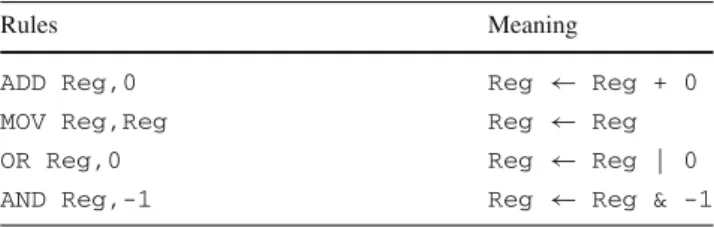
– Dead code insertion consists in introducing useless codes into the program. In a similar way, it can be com-posed of more complex instructions that are never exe-cuted. Table2gives some examples of “dead codes”. The left column lists useless instructions which are semanti-cally equivalent to theNOP(No Operation) instruction. The exact meaning of each instruction is given in the right column. The first line corresponds to adding the value0 to theRegregister. In the second line, theRegregister self-affects with its own value. The third line performs a logical “OR” on aRegregister with the null integer. While the last line applies a logical “AND” on theReg register with the -1 value.
– Changing the control flow consists in modifying the execution flow of a program by introducing conditional
Table 2 Examples of “dead code”
Rules Meaning
ADD Reg,0 Reg ← Reg + 0
MOV Reg,Reg Reg ← Reg
OR Reg,0 Reg ← Reg | 0
Fig. 1 Examples of control
flow modification
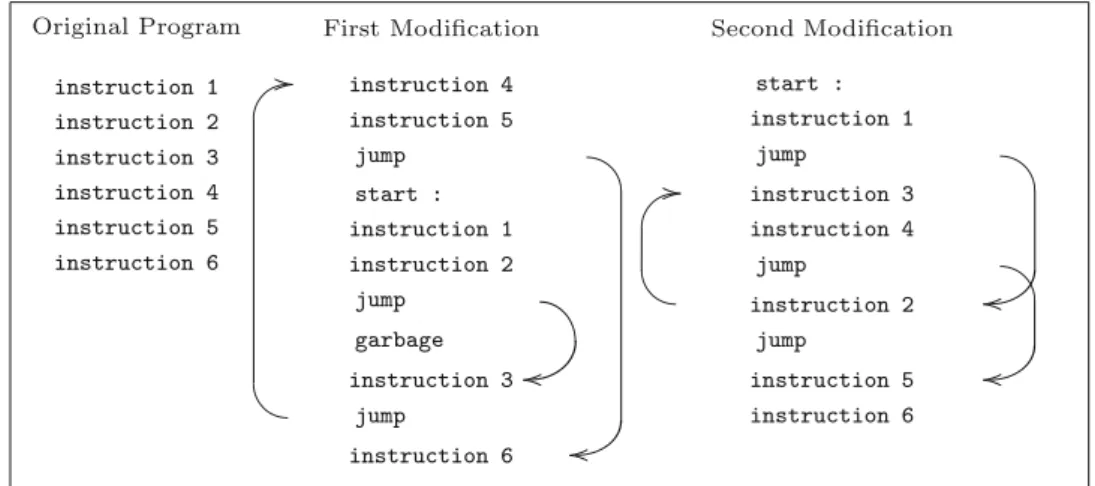
or unconditional branching instructions, while preserving the program result. Figure1gives an example of such control flow modification by inserting unconditional branching instructions. An original code made of sequen-tial instructions can be replaced by the two other codes whose execution flow has been modified so as to no longer be sequential (first and second alterations). In both cases, the same sequence of instructions is executed.
2.2 Main developments in obfuscation
Instead of presenting all the main contributions in the field of obfuscation schemes, we use Collberg’s work [11] as refer-ence. Our goal is to present only the notions useful in obfus-cating a metamorphic virus. First, the authors define a metric commonly used to evaluate the efficiency of obfuscators. We sum them up as follows:
– the potential which evaluates the understanding com-plexity of an obfuscated code during human-driven analysis;
– the resilience which measures the complexity of the inverse operation (deobfuscation) by means of automatic tools (software);
– the cost, which defines the price we have to pay in terms of computing time and memory space required for the analysis.
It is easy to see that in the case of a virus the main inter-esting criteria is the resilience. In fact, resilience can infor-mally be viewed as the difficulty to detect a metamorphic virus. According to this criterion, we are interested in control flow transformation as developed in [12]. This study presents the use of opaque predicates to increase the resilience of an obfuscated program. Broadly speaking, a predicate P is said to be opaque if it has a property q known to the obfuscator but which is hard for a deobfuscator to deduce. Our goal is to
transpose such control-altering transformations from general purpose to metamorphic viruses in order to try to evaluate the detection difficulty (resilience). This idea was inspired by the contrast between obfuscations used in well-known viruses as presented in Sect.2.1and by advanced control flow transfor-mations based on Collberg’s work.
2.3 Detection techniques of metamorphic viruses
We will now address the issue of metamorphic virus detection and the techniques used by the existing antivirus software. Very few technical details are published on the existing tools. However, some works dealing with the reliability of detect-ing known viruses have pinpointed the severe limitations of existing antivirus software [8,9]. In fact, the tested tools have proved to still be inefficient at detecting even the most trivial obfuscation techniques, such as dead code insertion or instruction substitutions. These results show that simple detection pattern matching—looking for a fixed byte pattern which represents the virus signature—remains the main tech-niques used nowadays. This has been recently confirmed by more recent works [15,16].
However, it is a very well-known fact that perfect obfus-cation is impossible to achieve. That is, the semantics of a program cannot be perfectly hidden [2,3]. In other words, given a fixed obfuscated program, its semantics can always be recovered. Nevertheless, the semantics extraction cannot be automated (Rice theorem [21]). For that purpose, some detection prototypes aim at building an optimized model of the program by using code compiling optimizations [1]. As shown in [7,13], the same techniques can be directly used to model binary codes. Such a modeling process is performed in two steps:
1. In the first step, a control flow graph of the program is built. This graph in fact is a model of the possible program execution flows.
2. In the subsequent step, the data flow is analyzed and simplified. It is thus possible to use this feedback on the control flow graph in order to further simplify it.
The optimized control flow graph represents a model for the program under analysis. Detecting a metamorphic virus can be viewed as checking whether or not the model we obtain corresponds to this virus. The construction of such a model is detailed in C. Cifuentes’ thesis [7]. Many approaches have been proposed [5,8,24] to detect the state of the art viruses. The following section demonstrate the difficulty of reliable detection and especially in the case of a particular category of metamorphic viruses.
3 Limitations of reliable static detection of metamorphic codes
3.1 Impossibility of perfect static detection
In this section, we address the issue of evaluating the dif-ficulty of perfect detection of metamorphic viruses, at the theoretical level. For that purpose, we will give some useful notations and definitions.
Notations: We consider two programs (algorithms) A and B which are respectively defined on the domainsDAandDB respectively. A and B are said to be functionally equivalent, and we note A≡B, if and only if they output the same result on the same inputs, in other words:
DA=DB,
∀x∈DA, A(x)=B(x).
We give a first definition of perfect detection in terms of functional equivalence as follows:
Definition 1 The program DV perfectly detects a metamor-phic virus V if and only if for any program P,
DV(P)returns “tr ue” if P ≡V, DV(P)returns “ f alse” otherwise.
Proposition 1 There exists no algorithm which is able to determine for two given non null programs P and Pwhether P≡P.
This Proposition1is just a particular instance of the Rice’s theorem [21]. The direct consequence of Proposition 1 is that the perfect detection of a metamorphic virus as defined in Definition1is an undecidable problem.
3.2 Limitations of reliable static detection of a particular category of metamorphic codes
Let us suppose that all the (graph) paths with respect to a program P are potentially executable. Despite the fact that
it is not systematically valid, this hypothesis is frequently assumed during static analysis [1]. Even under this hypothe-sis, the problem of functional equivalence remains an unde-cidable one. That is the reason why, we will consider a more restrictive category of metamorphic virus obtained when modifying the program control flow.
This paragraph starts with the presentation of a code trans-formation. Then, we prove that the problem of determining if a program is obtained by another program transformation is anN P-complete problem. Finally, we deduce from this result the difficulty of detecting a particular category of meta-morphic viruses.
Build of a program transformationT
Definition 2 Let P be a program composed of n consecutive instructions I1I2. . .In. We define a transformationT of the program P as follows:
– P is split into k blocks denoted Pi. Each block contains a random non null number of consecutive instructions and ends up with a sequential instruction (different from a conditional branching instruction).
– We consider a permutationσ on the set[1,k]. For each block Pi, we define a new block Pσ( i)as follows: each block Pσ( i)contains exactly the same instructions as the corresponding block Piand ends up with two conditional branching instructions toward two other blocks Pj and Pl. This transformation produces a program Pfrom an original program P. We denote P=T(P).
We then define a set of obfuscators (k-obfuscators) denoted Okas follows: a transformationT is a k-obfuscator, denoted
T ∈ Ok if and only if∀i ∈ [1,k]during its execution, the last output of Pσ( i) is Pσ( i+1). By last output, we mean the destination of the conditional branching in block Pσ( i). It is worth noting that ifT ∈Ok thenT(P)≡ P and thus
T is indeed an obfuscator.
Determining if P=T(P)isN P-complet
Proposition 2 Under the assumption that each program path is potentially executable, for any pair of programs P and P, determining whether there existsT ∈ Ok such that P =
T(P)is anN P-complete problem.
The proof given hereafter relies on a polynomial time reduction inspired from Landi’s work [17]. More precisely, it relates to proof given in [19,26].
Proof 1. The problem is inN P. Indeed, for every given pair of programs P and P, a non deterministic algo-rithm can check in polynomial time whether there is a
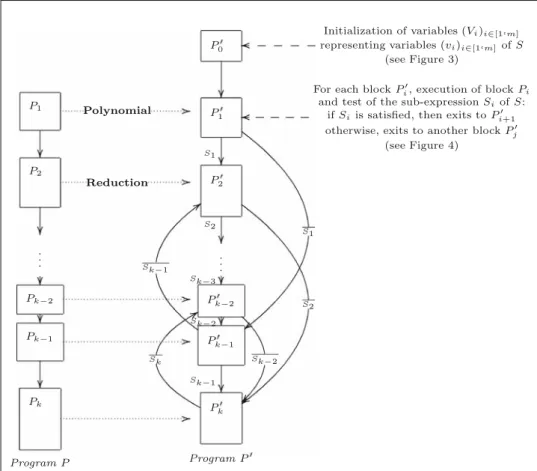
Fig. 2 Construction scheme of
the obfuscated program P (right) from the program P (left)
transformationT which complies with Definition2such that P=T(P). Then this algorithm can also verify in polynomial time, whether there exists an output from every block P(i)such thatT ∈Ok.
2. Let S be an instance of the N P-complete problem 3-SAT, and P a program. We are going to prove that it is possible to build in polynomial time with respect to the size of S, a program P(P=T(P)) such that S is satisfiable if and only ifT ∈ Ok. An instance S of the 3-SAT problem has the following form:
S=ni=1(li,1∨li,2∨li,3), ⎧ ⎪ ⎨ ⎪ ⎩
{v1, v2, . . . , vm}a set of Boolean variables ∀(i,j)∈ [1,n] × [1,3],∃k∈ [1,m], li,j =vkor li,j =vk We build the family of ui, denoted(ui)i∈[1,k]such that it is a partition of consecutive elements of the set[1,n]. (1, 2,3 u1 ,4, 5, . . . ,8 u2 , . . . ,n −1,n uk ) We have: S = ki=1Si with Si = max(ui) j=min(ui)(lj,1∨ lj,2∨lj,3)
Let T be a transformation as defined in Definition 2 in order to build the program Pin a polynomial time. The program Pis made up of the family of(Pi)i∈[0,k] obtained from the program P. Figure2illustrates such a reduction.
Since as each path is assumed to be executable, we do not care about the logical conditions with respect to the branching instructions:if (-) {code1} else {code2}. Figure3presents the pseudo-code contained in block P0. This code is used to initialize the pro-gram P. Every variable Vi and its negation Vi are first declared as pointers of function pointers. Each of these variables may point to true or false(declared in line 2 as function pointers). Every Vi and Vi describe a Boolean variable in S and its negated form respec-tively. Thus, settingvi to “tr ue” for S, corresponds to set *Vi=truefor P. An execution path in block P0 (lines 4 to 6) thus initializes every variable Vi and Vi, which is equivalent to fix the values of Boolean vari-ablesvi in the equation S. There are two cases: either the setting of thevi satisfies S, or it does not.
Figure4defines for every i ranging from 1 to k−1, block Pifrom block Pi. The pointerfalseis initialized with the address of block Pi+1. The second line represents the insertion of the code contained within block Pi in such a way that executing block Piresults in executing block Pias well. Notation li,jin expressions∗li,j=&Pg(lines 3 and 4) is an abstract one. This symbol stands for the variable Vkor its negation Vk(as in the formulation of S). Lines 3 and 4 enable us to modify the destination of the pointer falseaccording to the values of the
Fig. 3 Pseudo-code of block P0
variables Vi and Vi which have been initialized in P0 (see hereafter). Finally, the functionfalseis called at line 5. Block Pk slightly differs from the other blocks Pi,i ∈ [1,k−1]), for program termination purposes. Throughout the rest of the paper, unless differently men-tioned, we will always refer to Fig.4. Moreover, let us denote the output of block Pias one of the two possible destinations: Pi+1or Pg. We will now prove the equiv-alence between our problem as defined in Proposition2 and the 3-SAT problem.
(a) First case: S is satisfiable. This means that∀i ∈ [1,k], Si is satisfiable. Si satisfiable corresponds at the pseudo-code level to lj,1, lj,2or lj,3points toward the true variable ∀j∈ [min(ui),max (ui)]. Since at least one literal of the form lj,t, t ∈ [1,3]is pointing towards the variabletrue, then there exists at least one path in the graph for which the pointer destinationtrueis assigned to the Pgaddress. With this property being valid for every lines from 3 to 4, consequently there exists a path starting from block Pifor which thetrue variable has only been re-allocated to block Pg address, in line 5 and thus for which thefalse variable has never been redefined. In the present case, the output of block Pi is block Pi+1. This property being valid for every block Pi, subse-quently we haveT ∈ Ok. Consequently, if S is
satisfiable thenT ∈Ok.
(b) Second case:T ∈Ok. This implies that for every i , the output of block Pi is block Pi+1. In other
words for every block Pi, the false variable points towards block Pi+1 in line 5. Now the falsevariable points towards block Pi+1 only if, for the path with respect to block Pi in ques-tion, every literal of the form lj,t point towards the variabletrue. Indeed, if for this particular path, a single literal would point towardsfalse, then the address of block Pg would be allocated tofalsein lines 3 or 4, and thus the latter would point towards a block different from block Pi+1 in line 5. This result for block Piimplies that Si is satisfiable. Since this predicate must be valid for every i (ranging from 1 to k), S is satisfiable, hence the result we were looking for: ifT ∈ Ok
then S is satisfiable.
Finally, we proved the equivalence between our problem and the 3-SAT problem.
Consequences in terms of detecting a specific category of metamorphic viruses
Definition 3 Let us consider a metamorphic virus V whose new instance V is defined by V = T(V) where T ∈ Ok. Under the assumption that all paths are potentially exe-cutable, we define a reliable detection as follows: A program DV detects the metamorphic virus V if and only if, for any program P,
⎧ ⎨ ⎩
DV(P)r et ur ns “tr ue” i f t her e exi stsT ∈Ok such t hat P=T(V)
DV(P)r et ur ns “ f alse” ot herwi se.
We can then deduce that for such a category of metamor-phic viruses (Definition3), a reliable static detection is an N P-complete problem. This result can be viewed as a com-plement of the one of Spinellis [23] about the complexity of bounded-length polymorphic code detection. Indeed, we extend his result over metamorphic code. Even if this formal result seems far from detection in reality where false positives are acceptable, we believe that it could give birth to complex viruses able to thwart recent detection strategies like [4,20]. We will illustrate our metamorphic code obfuscator approach in Sect.4.
Fig. 4 Pseudo-code of P
4 Metamorphic code obfuscator making static analysis more complex
This section presents a possible design approach for obfusca-tors that could be used by sophisticated metamorphic codes. This practical obfuscator rests on the proof of Proposition2.
4.1 Obfuscation approach for the control flow
Our approach consists in modifying the control flow of a program P in order to produce an obfuscated program P. It is close to the approach presented in [6] by means of finite state automata and that is presented in [19] which uses func-tion pointers. However our own technique has two specific features:
1. Our proposed obfuscator works directly at the assembly source. This enables to apply all the obfuscation tech-niques presented in Sect.2, independently of the control flow modifications. The transformations we use are kept during the code assembling process. It is worth mention-ing that it is not always the case when considermention-ing higher level language source code. Indeed the compiling step generally performs some optimizations that can invert obfuscation transformations and thus lessen the obfus-cation efficiency.
2. The obfuscation proposed hereafter is designed with severe constraints since it should enable the virus to model itself while making sure that the static detection of its own code is as complex as possible. This particular point will be addressed in the next subsection but is not exhaustively presented in this paper.
The global approach for building the obfuscated program P can be summarized as follows:
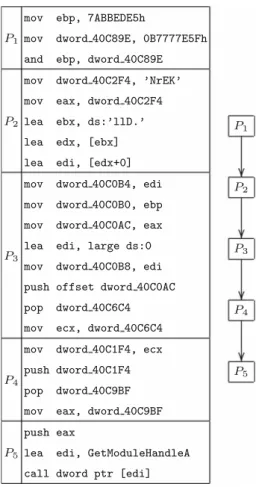
1. As we did in the proof of Proposition2, we split the program P—which contains a suite of n instructions (Ij)j∈[1,n]—into k sets of random non null size, with each of them containing consecutive instructions. We thus get blocks(Pi)i∈[1,k]. This program scissoring is performed in such a way that each block Pi does not end up with an unconditional jump (goto) or a routine exit (ret). This restriction is required otherwise the con-nection condition from block Pito block Pi+1would be useless. Figure5presents an example of assembly code scissoring which corresponds to the first basic block in the WIN32.MetaPHOR virus control flow graph. The detailed explanation of this code is not required for the understanding of the next part. The reader just needs to know that this basic block corresponds to the following call: GetModuleHandle("Kernel32.dll"). The block chaining here is linear (P1,P2, . . . ,P5).
Fig. 5 Example of program splitting into blocks(Pi)for a bootstrap input program of the Win32.MetaPHOR virus
2. From a practical point of view, we build a family of meaningful instruction sequences(Gi)i∈[1,p]in order to complicate the analysis. Each sequence has a non null random size. By meaningful, we mean that the instruc-tion sequence comes from a real program and not from random instructions. This family describes dead code blocks. The purpose of these blocks is to increase the difficulty of the static detection of program Ponly. In the following, we will use dead code blocks as illustrated in Fig.6.
3. We now build the obfuscated program P from blocks (P
i)i∈[0,k+p]as follows:
(a) P(0)is the starting block in the obfuscated pro-gram. It initializes a variable K which describes the unique switchpoint at the exit of each block Pi, in such a way that P ≡ P. This variable K represent a key element for the obfuscator. We call it the obfuscation parameter.
(b) ∀i ∈ [1,k+p], two choices have to be considered for building block Pi:
– either Pi is a legitimate block, that is to say that∃!s∈[1,k]such that Picontains the code of Ps. In this case, we define a legitimate exit
Fig. 6 Example of dead code blocks(Gi)
towards block Pi+1and another random exit to the other blocks.
– or Piis an illegitimate block (dead code), that is to say that∃!t∈[1,p]such that Picontains the code of Gt. In this case, we define two random exits.
In any case, block exits are conditioned by K in such a way that the execution of program P is corresponding to that of P.
Initializing the obfuscation parameter K
Since K is a critical component for statically reconstructing the program P from P, we have to explain how to make the retrieval of this information more complex. We consider two different approaches:
1. The first one rests on mathematical complexity as pre-sented in [11].
– With respect to this approach, using some mathe-matical conjectures can dramathe-matically increase the complexity of static analysis. For example, let us consider the Syracuse suite(un)n∈Ndefined by:
⎧ ⎨ ⎩ u0∈N ∀n∈N∗,un+1= un 2 if unis even, 3un+1 otherwise.
The Syracuse conjecture claims that for every start-ing element u0, the suite(un)n∈Nalways ends up with the cycle 4, 2, 1. The obfuscation parameter K could then depend upon the smallest integer i which verify ui =1 (K = f(i)).
– It is also possible to consider algebraic expressions which are complex to verify [19]. For example, the bit initialization ki of K could be obtained by the following piece of code:
if (a*(a+1)%2==0) {ki=1;} else
{ki=0;} whereadescribes any integer. In this case, whatever the value of a, the previous predicate is always true. From a general point of view, resolv-ing such a condition requires the use of complex algorithms as formal computing does.
2. Some difficulties induced by static analysis which can-not consider the program in an execution context. From a static point of view, the result of any external call (other programs, API…) remains unknown and
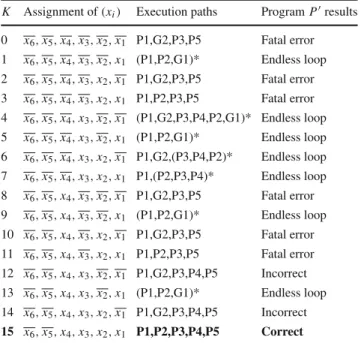
can-Fig. 7 Example of possible obfuscation for the program P Table 3 Results of program Pexecution for different values of K K Assignment of(xi) Execution paths Program Presults 0 x6,x5,x4,x3,x2,x1 P1,G2,P3,P5 Fatal error 1 x6,x5,x4,x3,x2,x1 (P1,P2,G1)* Endless loop 2 x6,x5,x4,x3,x2,x1 P1,G2,P3,P5 Fatal error 3 x6,x5,x4,x3,x2,x1 P1,P2,P3,P5 Fatal error 4 x6,x5,x4,x3,x2,x1 (P1,G2,P3,P4,P2,G1)* Endless loop 5 x6,x5,x4,x3,x2,x1 (P1,P2,G1)* Endless loop 6 x6,x5,x4,x3,x2,x1 P1,G2,(P3,P4,P2)* Endless loop 7 x6,x5,x4,x3,x2,x1 P1,(P2,P3,P4)* Endless loop 8 x6,x5,x4,x3,x2,x1 P1,G2,P3,P5 Fatal error 9 x6,x5,x4,x3,x2,x1 (P1,P2,G1)* Endless loop 10 x6,x5,x4,x3,x2,x1 P1,G2,P3,P5 Fatal error 11 x6,x5,x4,x3,x2,x1 P1,P2,P3,P5 Fatal error 12 x6,x5,x4,x3,x2,x1 P1,G2,P3,P4,P5 Incorrect 13 x6,x5,x4,x3,x2,x1 (P1,P2,G1)* Endless loop 14 x6,x5,x4,x3,x2,x1 P1,G2,P3,P4,P5 Incorrect 15 x6,x5,x4,x3,x2,x1 P1,P2,P3,P4,P5 Correct
not be solved unless running the program. The same is true for static analysis of results produced by iterative or recursive computing. For example, the use of hash functions or of encryption primitives can increase the complexity of the analysis. Let us suppose that K = (xm,xm−1, . . . ,x2,x1)is defined by∀i ∈ [1,m],∃j ∈ [1,m], xi =H(Pj)whereHis any hash function out-putting a single bit. Guessing a xi needs to execute the functionHwhich is a complex process in static analysis. Example of static analysis complexity with respect to an obfuscated program
We will now try to illustrate the difficulty of deobfuscation through the example given in the following Fig. 7 which presents an obfuscated program Pobtained from an original program P.
Block P0initializes the Boolean variables(xi)i∈[1,6]which conditioned the exit of every block. For example, for block P1, if x1 =1 then the next block to be executed is P2 oth-erwise G2. In order to make the execution of program P
correspond to program P, we must keep the sequence of blocks as shown in Fig.5. In this case, it corresponds to ∀i ∈ [1,4], xi =1. Without knowledge of the value of K ,
the number of possible execution paths is equal to 2k+p−1. Variables x5and x6conditioned the output of dead code blocks G1 and G2 only. These blocks are never executed whenever P ≡ P. Table3thus presents the first 16 values of K only, by assuming that x5and x6are null. Instead of developing static analysis optimizations for the 16 possible (xi)i∈[1,4] settings, we consider the execution result of the obfuscated program Pas shown in Table3. This is relevant in this particular case since detecting this basic block (see Fig.5) is equivalent to checking whether it comes to execut-ing the GetModuleHandle("Kernel32.dll") call as previously noted. Table3 presents four types of results which are summarized as follows:
– seven cases (K =1,4,5,6,7,9,13) which correspond to an endless loop for which thecallinstruction is never reached;
– six cases (K =0,2,3,8,10,11) in which an error occurs during the WIN32GetModuleHandlecall. This error comes from an incorrect parameter (invalid pointer); – two cases (K = 12,14) exit 0 after the call. Here, the
pointer given as parameter is valid indeed but it does not correspond to the awaited string ("Kernel32.dll"); – a single case (K =15) which corresponds to the awaited call according to the value of K which has been used for building P.
This example clearly shows the concrete impact of the the-oretical result on a static analysis whenever the obfuscation parameter K is unknown.
5 Conclusion
In this paper, we have proved that a reliable static analy-sis of a particular category of metamorphic viruses is an N P-complete problem. As a practical application, we have presented an obfuscating approach whose resilience should be high enough to defeat static analysis tools. This approach operates by modifying the program control flow and has been designed to be applied to metamorphic viruses in order to prevent an efficient static analysis. Indeed, it rests on the fact that a metamorphic virus can, during its execution, solve problems which are considered as complex in static analy-sis. We emphasize that our result is close to perfect detection. However, we believe that this approach could present a prob-lem for the state of the art detection tools. Fortunately, the obfuscation technique presented here cannot be applied to existing viruses: the metamorphic replication process oper-ates by obfuscating the code after a modeling step. To use our
approach directly, the virus should first be able to invert this transformation during its own execution in order to model itself. This modeling step, as well as the modifications it implies are not addressed in this paper. Our future work will consider this aspect in order to study the whole replication process: virus modeling then code obfuscation step.
Acknowledgments The authors would like to thank Guillaume Bonfante (LORIA) for his valuable comments on the first version of this paper.
References
1. Aho, A.V., Sethi, R., Ullman, J.D.: Compilers: Principles, Tech-niques and, Tools. Addison-Wesley, Reading, MA (1986) 2. Beaucamps, P., Filiol, E.: On the possibility of practically
obfus-cating programs—towards a unifed perspective of code protection. J. Comput. Virol. (WTCV’06 Special Issue, Bonfante, G., Marion, J.-Y. eds), 2(4) (2006)
3. Barak, B., Goldreich, O., Impagliazzo, R., Rudich, S., Sahai, A., Vadhan, S., Yang, K.: On the (im)possibility of obfuscating pro-grams. In: Crypto ’01, LNCS No.2139, pp. 1–18 (2001) 4. Bruschi, D., Martignoni, L., Monga, M. : Detecting self-mutating
malware using control-flow graph matching. In: Büschkes, R., Laskov, P. (eds.) Detection of Intrusions and Malware & Vulnera-bility Assessment, volume 4064 of LNCS, pp. 129–143. Springer, Berlin (2006)
5. Bruschi, D., Martignoni, L., Monga, M.: Using code normaliza-tion for fighting self-mutating malware. In: Proceedings of the International Symposium of Secure Software Engineering. IEEE Computer Society, Arlington (2006)
6. Chow, S., Gu, Y., Johnson, H., Zakharov, V.A.: An approach to the obfuscation of control-flow of sequential computer programs. In: ISC ’01: Proceedings of the 4th International Conference on Information Security, pp. 144–155. Springer, London (2001) 7. Cifuentes, C.: Reverse Compilation Techniques. Ph.D. thesis,
Queensland University of Technology, School of Computing Sci-ence (1994)
8. Christodorescu, M., Jha, S.: Static analysis of executables to detect malicious patterns. In: In Proceedings of the 12th USENIX Secu-rity Symposium, pp. 169–186 (2003)
9. Christodorescu, M., Jha, S.: Testing malware detectors. In ISSTA ’04: Proceedings of the 2004 ACM SIGSOFT international sym-posium on Software testing and analysis, pp. 34–44. ACM Press, New York (2004)
10. Cohen, F.: Computational aspects of computer viruses. Rogue pro-grams: viruses, worms and Trojan horses, pp. 324–355 (1990) 11. Collberg, C., Thomborson, C., Low, D.: A taxonomy of
obfuscat-ing transformations. Technical Report 148, Univerity of Auckland, New Zealand (1997)
12. Collberg, C., Thomborson, C., Low, D.: Manufacturing cheap, resilient, and stealthy opaque constructs. In: Principles of Pro-gramming Languages 1998, POPL’98, pp. 184–196 (1998) 13. Debray, S.K., Evans, W., Muth, R., De Sutter, B.: Compiler
tech-niques for code compaction. ACM Trans. Program. Languages Syst. 22(2), 378–415 (2000)
14. Filiol, E.: Advanced Viral Techniques: Mathematical and Algo-rithmic Aspects. Springer, Berlin (2006)
15. Filiol, E.: Malware pattern scanning schemes secure against black-box analysis. J. Comput. Virol. (EICAR 2006 Special Issue, Broucek, V., Tuner, P. eds), 2(1) (2006)
16. Jacob, G., Filiol, E., Le Liard, M.: Evaluation methodology and theoretical model for antiviral behavioural detection strategies. J. Comput. Virol. (TCV 2006 Special Issue, Bonfante, G., Marion, J.-Y. eds), 3(1) (2007)
17. Landi, W.A.: Interprocedural Aliasing in the Presence of Pointers. Ph.D. thesis, New Brunswick, New Jersey, USA (1992) 18. Lakhotia, A., Kapoor, A., Kumar, E.U.: Are metamorphic viruses
really invincible? Virus Bull. (2004)
19. Ogiso, T., Sakabe, Y., Soshi, M., Miyaji, A.: Softwate tamper resi-tance based on the difficulty of interprocdeural analysis. In: The Third International Workshop on Information Security Applica-tions, pp. 437–452 (2002)
20. Preda, M.D., Christodorescu, M., Jha, S., Debray, S.: A semantics-based approach to malware detection. In: Proceedings of the 34th Annual ACM SIGPLAN-SIGACT Symposium on Princi-ples of Programming Languages (POPL’07), pp. 377–388, January 17–19, 2007. ACM Press, New York (2007)
21. Rice, H.G.: Classes of recurively enumerable sets and their deci-sion problems. Transactions of the American Mathematical Soci-ety, pp. 358–366 (1953)
22. Szor, P., Ferrie, P.: Hunting for metamorphic. In: Virus Bulletin Conférence, September 2001
23. Spinellis, D.: Reliable identification of bounded-length viruses is np-complete. IEEE Trans. Inform. Theory 49(1), 280–284 (2003) 24. Sung, A.H., Xu, J., Chavez, P., Mukkamala, S.: Static analyzer of vicious executables(save). In: Proceedings of the 20th Annual Computer Security Applications Conference (ACSAC’04). IEEE (2004)
25. Szor, P.: The Art of Computer Virus Research and Defense. Addison-Wesley, Reading, MA (2005)
26. Wang, C., Hill, J., Knight, J., Davidson, J.: Software tamper resis-tance: Obstructing static analysis of programs. Technical Report CS-2000-12, University of Virginia (2000)
27. Walenstein, A., Mathur, R., Chouchane, M.R., Lakhotia, A.: Normalizing metamorphic malware using term rewriting. SCAM 2006: The 6th IEEE Workshop Source Code Analysis and Manip-ulation, pp. 75–84 (2006)