Evolution and technical efficiency of land tenure systems in
Ethiopia
Socio-economics and Policy Research Working paper 39
M. M. Ahmed, S.K. Ehui, Berhanu Gebremedhin, S. Benin and Amare Teklu
International Livestock Research Institute P.O. Box 30709, Nairobi, Kenya
Working Papers Editorial Committee Mohammad A. Jabbar (Editor)
Simeon K. Ehui Steven J. Staal
LPAP working papers contain results of research done by ILRI scientists, consultants and collaborators. The author(s) alone is (are) responsible for the contents.
Authors’ affiliations
Mohamed M. Ahmed, agricultural economist, Livestock Policy Analysis Programme, International Livestock Research Institute (ILRI), Addis Ababa, Ethiopia
Simeon K. Ehui, agricultural economist and Co-ordinator, Livestock Policy Analysis Programme, ILRI, Addis Ababa, Ethiopia
Berhanu Gebremedhin, agricultural economist, Livestock Policy Analysis Programme, ILRI, Addis Ababa, Ethiopia
Samuel Benin, agricultural economist, Livestock Policy Analysis Programme, ILRI, Addis Ababa, Ethiopia
Amare Teklu, graduate student, Department of Agricultural Economics, Cornell University, USA
Send correspondence to Simeon Ehui at: [email protected]
ã 2002 ILRI (International Livestock Research Institute)
All rights reserved. Parts of this publication may be reproduced for non-commercial use provided that such reproduction shall be subject to acknowledgment of ILRI as holder of copyright.
ISBN 92–9146–117–2
Correct citation: Ahmed M.M., Ehui S., Berhanu Gebremedhin, Benin S. and Amare Teklu. 2002. Evolution and technical efficiency of land tenure systems in Ethiopia. Socio-economics and Policy Research Working Paper 39. ILRI (International Livestock Research Institute), Nairobi, Kenya. 41 pp.
Table of Contents
Abstract
Summary
2 Tenancy contracts, efficiency and imperfect factor markets
3 Evolution of land market in Ethiopia
3.1 The pre-1975 period
3.2 The Derg period (1975–91)
3.3 The post-1991 period
4 Prevailing land contracts in Arsi
4.1 Common types of land contracts
5 Measurement of technical efficiency
5.1 Empirical model
5.2 Variables in the frontier production function
5.3 Variables in the technical efficiency model
6 Results and discussion
6.1 Descriptive statistics
6.2 The stochastic frontier function
6.3 Inefficiency effects
6.4 Efficiency effect of land tenure contracts
6.5 Other determinants of inefficiency
7 Conclusion
References
Appendix I. Ordinary Least Squares (OLS) estimates of coefficients and collinearity statistics of variables in the production frontier and inefficiency model
Abstract
The degree to which prevailing land tenure arrangements in sub-Saharan Africa constrain efficiency and agricultural productivity are still not determined. This paper examines the sources of economic efficiency (inefficiency) of alternative land tenure arrangements in
Ethiopia using stochastic frontier production function. The results show that sharecropped and borrowed land are technically less efficient than owner-cultivated or fixed rental land due to restrictions imposed on them by landowners and the interactions of land market with other imperfect and absent input markets. Thus, a policy has to be drawn to facilitate more efficient transactions of land between farmers and to minimise inefficiencies associated with these tenure systems.
Summary
The effect of alternative land tenure arrangement on agricultural productivity is still not determined. While some researchers (e.g. Hayami and Otsuka 1993) argue that tenancy arrangements such as sharecropping result in inefficient allocation of resources, others (e.g. Cohen 1980; Boserup 1981; Place and Hazell 1993) contend that various factors other than the system of land tenure are important determinants of agricultural productivity. Hence, whether or not alternative tenure arrangements constrain agricultural productivity remains an empirical question, which depends on the specific economic and policy environments under which farm households operate.
This paper attempts to investigate the technical efficiency of alternative land tenure
arrangements in Ethiopia, a country where land markets and land policy are critical issues for agricultural development due to the high pressure on land. Prior to 1974, land tenure in Ethiopia was predominantly based on a feudal system. Where land is privately owned, of which the majority was in the hands of the nobility and the church. After the revolution of 1974, land was nationalised, declared collective property of the people and distributed to tillers. Land transaction was banned and all forms of tenancy relationships were prohibited. Since 1991, land lease has been allowed, but rural land still remains state property. Different forms of tenancy (sharecropping, fixed rental, and borrowed/ gifted) are now being practised throughout the country, providing an ideal context to study the efficiency of alternative tenure
arrangements.
Results are based on data generated through a survey of 161 households operating 477 plots in the Arsi zone of Oromiya Region in 1994. While 115 households had of their own land (received land from the government through redistribution), the rest were operating leased land. Data were collected on inputs and output, plot characteristics, wealth status and demographic characteristics of the household as well as input and output prices.
The average value of output per hectare was Ethiopian Birr 2478 (about US$ 310), and the highest return was obtained from owner-operated land. Average returns from gift plots were significantly lower than those from owned and rented plots. Average re- turns from
sharecropped plots and gift plots were not significantly different from each other.
Plots under the different tenure forms received significantly different amounts of planting and weeding labour, whereas rented and sharecropped plots received less than half of the labour input on owner operated plots. However, the use of seed, inorganic fertiliser and herbicides did not change with variations in land tenure systems. There was no significant difference in land quality by tenure. Rented and sharecropped plots are mainly planted with wheat, a principal cereal crop in the area.
Farmers covered by the study have attained a 71% efficiency rate on average; indicating that an improvement in the technical efficiency of farmers can result in an increase in crop income of 30%. We thus find that the type of land tenure affects the technical efficiency of agriculture significantly. Sharecropped, and gifted/borrowed plots are significantly less efficient than owner-operated plots. However, there was no significant difference in efficiency between owner-operated and fixed rental plots. Moreover, there was no significant difference in efficiency between sharecropped and fixed rental, and between sharecropped and gifted/borrowed plots. Fixed rental plots were more efficient than gifted/borrowed plots.
1 Introduction
In most of sub-Saharan Africa (SSA), agricultural land is the fundamental base of livelihood for the rural population. Due to its economic importance, land markets and land tenure security issues in SSA have received considerable public attention. Most of the debate centres on the effect of indigenous land rights on land productivity, resource allocation and investment demand (Dorner 1977; Harrison 1987; Place and Hazell 1993; Besley 1995; Gavian and Fafchamps 1996; Sjaastad and Bromley 1997). While some argue that indigenous land rights lead to inefficient resource allocation justifying governments intervention in land administration to remove the associated inefficiencies (Johnson 1972; World Bank 1974; Dorner 1977); others have challenged this view (Bales 1986; Besley 1995); others argue that inefficiencies arise because indigenous land rights are ambiguous, communal, and afforded insufficient legal protection, resulting in tenure insecurity (Sjaastad and Bromley 1997). Furthermore, others such as Cohen (1980) and Boserup (1981) argue that indigenous tenure arrangements are dynamic and evolve in response to factor price changes.
While the analytical focus has been on indigenous land rights, communal control under these systems is diminishing and African tenure systems are evolving towards individualisation of land rights in response to population pressure, agricultural commercialisation, changing political structure and technological changes (Migot-Adholla et al. 1991). Despite the
considerable analysis of indigenous land rights in African agriculture, the efficiency of these evolving land rights and land markets have received little attention.
Evidences from different parts of Africa confirm instances of privatisation of land rights (Migot-Adholla et al. 1991). In Ethiopia, contracts between farmers who received
government-allocated land and landless tenants including sharecropping, fixed rentals, lending and gifting dominate the current land market. Ethiopia presents an ideal context for studying both the evolution of land tenure institutions and their impact on technical efficiency. Elements of the traditional systems of land tenure, dramatically affected by the 1975 land reform measures, appear to be re-emerging. In particular, land leases and sharecropping that existed before 1975 dominate the current land market. Land market and land policy continue to be critical issues for the Ethiopian development strategy given the high pressure on land by a
predominantly agricultural population. An import- ant policy issue is whether the government intervenes in land market through redistribution and restriction of land transactions. Moreover, the land market in Ethiopia is dominated by evolving institutions in the form of land contracts, so that the analysis of the efficiency of these evolving institutions provides significant guidance for effective policy formulation. This paper analyses the development of land markets and the efficiency of current land contracts and its implications on land policy in Ethiopia.
In the analysis of land market evolution, we examine the impact of political changes and other economic and institutional factors on existing land tenure arrangements. We argue that the evolution of these institutions is a result of the combination of political economy, government intervention in land and rural labour markets, and population pressure. For example, the sharecropping system has its roots in the land tenure system of feudal Ethiopia, while land lending and gifting re-emerged when land and farm labour transactions were prohibited during the socialist system of public ownership.
The efficiency of the current land tenure arrangements is then examined using a stochastic frontier production function. It is hypothesised that the different types of land contracts vary substantially in their technical efficiency, which refers to the ability of the farmer to obtain
maximal output from a given set of inputs on a given plot of land, controlling for other factors that affect input use and productivity. It is argued here that unobservable component of inputs (e.g. effort in the case of labour, that will differ on contracted plots), and differences in such unobservable inputs lead to differences in technical inefficiency. If the hypothesis is true, given the notion that land contracts are evolving, land policy should be directed towards encouraging the more efficient land transactions.
The next section of this paper reviews the theoretical literature on tenancy contracts, efficiency and imperfect factor markets. The evolution of land contracts in Ethiopia is analysed in Section 3. In Section 4, the land tenure survey conducted in the Arsi zone is described and then the current land tenure arrangements are examined. This is followed by examining the efficiency of current land contractual forms in Section 5, using data from the Arsi survey. Here, the analytical and empirical framework of the efficiency of the prevailing land contracts are first described and then the results of the econometric analysis are presented. Conclusions and policy implications are presented in Section 6.
2 Tenancy contracts, efficiency and imperfect factor markets
Despite the large body of literature on tenancy contracts and agrarian organisations (Otsuka and Hayami 1988; Singh 1989; Otsuka et al. 1992), the rationale and relative efficiency of agricultural land contracts is still much debated. In an extensive review, Otsuka et al. (1992) claim that the reason behind the theoretical confusion and inconclusive empirical results is the separate analysis of land and labour contracts. Accordingly, land tenancy, labour employment and owner cultivation need to be considered together.
Underlying the efficiency of alternative land lease contracts is the incentive system that each contract system provides to the contract holder. Under the assumptions of perfect markets and no risk, an efficient incentive system requires that the contract holder be the residual claimant to the output (Varian 1993). Such an arrangement would induce the contract holder to produce the optimal level of output where the marginal product of the worker's extra effort equals the marginal cost of putting that effort. Given these assumptions, owner-cultivated and fixed-rental tenancy should thus result in an efficient resource allocation.
Following the assumptions of perfect market and no risk, Mill (1848) and Marshal (1890) and numerous others have concluded that share-tenancy results in an inefficient resource
allocation, since the share tenant receives, as marginal revenue, only a fraction of the value of his or her marginal product of labour, thus limiting the tenant's incentive to supply labour or other inputs at the optimum level. On the other hand, Johnson (1950) and Cheung (1969) have argued that if effort is costlessly enforceable, sharecropping arrangement can be as efficient as owner-cultivated and fixed-rent tenancy. However, whether costs of monitoring and enforcement are low enough to result in efficient sharecropping remains an empirical question. The tenant's labour input may not be fully observable due to the spatial nature of agricultural production, i.e. the landowner may not be able to ascertain whether a low yield in the tenant field was due to low labour input, unfavourable weather conditions or any other stochastic factors.
Risk and market imperfections can be important in the agriculture of developing countries. Tenancy may not at all be necessary if there are no market imperfections other than imperfect land markets (Pender and Fafchamps 2001). If markets for all factors other than land are perfect, landowners can rely on those markets to allocate resources optimally. In the presence of production risk and missing insurance markets, risk pooling may be an important
consideration in tenancy contracts. Cheung (1969) thus argues that risk pooling may be the motive for sharecropping.
Asymmetric assumptions about the enforceability of land and labour contracts have created considerable confusion in the literature on agrarian institutions (Otsuka et al. 1992). If tenants have less work incentive under sharecropping than under fixed rental, because the share tenant claims only a fraction of his/her marginal product, it follows that labour hired under fixed wage rate should even have weaker work incentives, and enforcement of their work effort should be more costly than in the case of share tenancy. In line with this, another argument for the existence of sharecropping is the difficulty of monitoring labour effort. Stiglitz (1974)
argues that if labour effort is unobservable, sharecropping may dominate wage labour due to its incentive advantages, and fixed- rental because of its risk pooling advantage.
There have been several attempts to establish a rationale for the existence of share- cropping arrangements under certainty. For example, self-selection model developed by Hallagan (1978) considers share tenancy as one of the land contract arrangements from which tenants
can choose to best utilise their entrepreneurial ability. Otsuka and Hayami (1988), however, show that when the landlord's optimisation behaviour is neglected (i.e. when there is no information about the tenant's work ability), then either the fixed-rent contract or wage employment will be chosen. On the other hand, if the landlord's optimisation behaviour is incorporated and the amount of land is sufficiently restricted, as done by Allen (1985), then both share and fixed-rent tenancy can achieve similar resource allocations.
However, Otsuka and Hayami (1988) argue that even in the case of enforceable contracts under certainty, there is no positive reason for sharecropping arrangement to exist if the optimisation behaviours of both the tenant and landlord are considered, since an infinite number of optimum combinations of share and fixed rents exists, with no single combination being preferred to the other. Under the condition of uncertainty, however, the existence of sharecropping arrangements can be justified based on its role in risk sharing, with or without enforceable contract as long as both tenant and landlord are risk averse.
Available evidence, mostly from studies conducted in the 1970s and early 1980s in South and South-East Asia, on the efficiency of alternative land tenure contracts, Otsuka and Hayami (1988) do not find significant inefficiency of share tenancy reported by most of those studies. However, they argue that lack of significant inefficiency may not mean that there is no problem of contract enforcement but rather sharecropping is adopted where the landlord's cost of enforcing the tenant's work effort is less. Otherwise, landlords with relatively high enforcement costs would prefer fixed-rent contracts even at the expense of a reduced rent that
compensates tenants for greater exposure to risk. Therefore, in the absence of institutional restrictions on the scope of contract choice and assuming that landlords select contracts on the basis of their comparative advantage in monitoring tenants' work effort, there should be no significant inefficiency associated with share tenancy, compared to other tenancy forms
(Otsuka et al. 1992). However, as it is difficult to assess the enforceability of the contract, the relative efficiency of the land contracts, for example owner-operated versus fixed rented or sharecropped tenures, becomes an empirical issue, while controlling for other factors that affect input use and productivity (e.g. land quality and farmer's ability). A recent study by Gavian and Ehui (1998) found that total factor productivity was lower on contracted land (either cash rented, sharecropped, gifted or borrowed) than owner-operated land, although the differences could not be attributed to differences in inputs.
3 Evolution of land market in Ethiopia
3.1 The pre-1975 period 3.2 The Derg period (1975–91) 3.3 The post-1991 period
Since the beginning of the twentieth century, three land tenure regimes have existed under three distinct political regimes. These were: (1) the feudal system of the pre-1975 period; (2) the state ownership of the socialist system in the 1975–91 period; and (3) the semi-liberal and market-oriented system since 1991. Even though land tenure institutions continuously evolved in response to the political environment, rural demographic dynamics, expansion of markets, natural resource conditions (particularly soil erosion), and social and physical infrastructures, these three periods marked important pivotal points in the development of the prevailing land tenure system in the country. Thus, the process of the evolution of land contracts is better understood when it is analysed in light of the land tenure systems during these three periods.
3.1 The pre-1975 period
The land tenure system in pre-1975 Ethiopia was one of the most complex and intricate systems. It represented the issue of power and governance in Ethiopia, as land was the major source of income and livelihood in this predominantly agrarian economy. The land tenure system varied from region to region due to the diverse geographical and cultural settings and the different socio-political events that occurred in different parts of the country. These different land tenure arrangements, in general, can be categorised into usufructuary tenures and private tenures (Dessalegn 1984). The usufructuary tenure systems include the rist,
semon and maderia or yemengist forms that differ principally in the type of institution holding the ultimate reversionary rights over the land.
The rist system was one of the oldest and most common forms of usufructuary tenures that characterised the land tenure system of northern Ethiopia where the community held the ultimate reversionary rights over land. Rist was a right, which a holder could claim a portion of lands from his or her ancestors who originally held the land. Village chiefs, who were usually appointed by the district's governors, administered the rist-related land rights. These hereditary rights were subject to payment of taxes and provision of other services to the local
administration or gult (Hoben 1973). Holders of the rist could bequeath their holdings but could not sell, mortgage or exchange it in any form. This land tenure system featured communal characteristics and provided somewhat an assured access to land to all members of the rist. The security of individual holdings was also protected in this system through honouring of hereditary rights and denying access to 'outsiders'. Nevertheless, the possibility of a claim at any time to a part of the land that was protected by rist subjected rist holders to varying degrees of insecurity. Farmers used to spend significant time in land-related court cases, sometimes even between close relatives (Hoben 1973).
With respect to access to land, this type of usufructuary tenure system is very similar to other indigenous tenure systems of sub-Saharan Africa. The main difference lies in the way rights are traced. Unlike other hereditary rights that are either matrilineal or patrilineal, rist rights could be traced through any relative, even through one's spouse (Hoben 1973). Therefore, a
person could potentially claim rist rights to a host of land tracts than the person actually fawned and/or farmed. Consequently, the numerous claims of rist rights and subsequent litigation over land parcels severely diminished security and incentives to invest in farmland. Furthermore, the tradition of subdivision of holdings to heirs led to a continuing fragmentation of holdings in the densely populated northern highlands of Ethiopia.
The semon, a system where the church held the primary reversionary rights, arose when the Crown granted rural land to the Ethiopian Orthodox Church to generate financial and material support for its services. The church during this period owned a substantial share of tax-free rural lands. As the church itself was not directly involved in farming, it leased out its lands to local farmers under sharecropping arrangements and collected the rents as well as land taxes (tributes) that would have otherwise gone to the government treasury.
Maderia or yemengist lands were originally unoccupied lands that were declared state property, most of which were located in the south. When the imperial government conquered the south, south-west and eastern parts of the country, all unoccupied (unsettled) rural land were declared state property and given to officials and loyalists of the Crown (Dessalegn 1984). During the military advance by the emperor, militiamen were among those who
received land in these regions. This constituted what was called the gebbar system, which is a form of freehold tenure. Holders of such rights had the privilege to transfer the land through sale, mortgage or exchange subject to payment of land tax to the government treasury. As most of the lands were granted to the powerful officials and loyalists of the Crown, the local populations in these areas became landless and entered into tenancy relationships with landlords.
All the rist, semon and maderia or yemengist tenures were similar in providing use rights to the holder while institutions held the ultimate reversionary rights over individual holdings were different. The nature of tenure arrangement and security of tenure on individual holdings was highly dependent on the holder's relationship with the institution governing access to land. During this period, the prevalence and characteristics of land rental markets was dictated by the type of land tenure system as well as by the political environment. The traditional rist
system in the north reduced the need for land market development compared to that in the south where freehold tenure dominated. For example, between 1967 and 1970, only 7–16% of the rural population were renters in the northern provinces as compared to 37–73% in the south (Cohen and Weintraub 1975). The rist system, by assuring access to all members of the community, equalised land endowments and so there were very few landless peasants. Landlessness, however, was common among traders, potters, weavers, and tanners who were not allowed to own land (Mesfin 1991), as most of these activities were carried out by immigrants from other places and, thus, were considered 'outsiders'. Thus, most of the farmers in the north were owner cultivators, and tenancy was primarily restricted to those forbidden to own land. Tenants who owned land were those with excess labour and oxen and wanted to increase their holdings, and sharecropping was the dominant form (Cohen and Weintraub 1975). Most of the landowners were farmers themselves and so their ability to monitor and enforce contracts was diminished. Furthermore, failing rains and recurrent drought made agriculture a risky enterprise. Because rist land was more likely to be claimed and taken away by another person, the farther away one lived from one's land, absentee landlordism was virtually non-existent (Hoben 1973).
In the south, however, land was distributed to only a few people who were allowed to buy and sell land. As a result, most of the farmers were tenants, with sharecropping and fixed rents being the dominant forms of land contract. Even though absentee landlordism was prevalent, sharecropping was sustained because landlords could hire supervisors who lived in the same communities with tenants to enforce the contracts. Even without supervision, landlords used threats of eviction and political power to enforce contracts, and usually determined the
sharecropping arrangement.
Resource pooling may have played a critical role in the south for the existence of
sharecropping especially for the less powerful landowners that resided in the same community as their tenants and farmed part of their land. Landowners provided credit to their tenants (Dessalegn 1984), who supplied their labour and animal power. Fixed rents, on the other hand, most likely resulted from absentee landlordism and inability to enforce contracts. In both the north and south, there existed three major forms of sharecropping arrangements classified according to the share of harvest paid to the landowner as rent. In siso (one-third) arrangement, the tenant supplied all the inputs, mainly seed, oxen and labour, and paid one-third of the harvest to the landowner as rent. Since the tenant paid one-tenth of the harvest as land tax, known locally as asrat, before sharing the harvest with the landowner, the tenant effectively retained 60% of the harvest. In irbo ( quarter), the rental payment was one-fourth of the harvest after deducting the asrat, and so the tenant effectively retained two-thirds of the total harvest. In equl (equal) arrangements, the landowner sometimes supplied some of the inputs, especially oxen and seed, and after paying the asrat, the harvest was divided on a 50:50 basis (Cohen and Weintraub 1975).
Of the three forms of sharecropping arrangements, siso was dominant. A study in Arsi, central Ethiopia, indicated that of all the tenancy in the study area, 60% were under siso, 30% under
equl, and 10% were hired farm labourers (Cohen and Weintraub 1975). Most of the
sharecropping agreements were verbal and the terms were based on customary practices of each area. Upon termination of the agreement, the tenant was not compensated for any improvements he or she made on the land (Dessalegn 1984).
In the early and mid-1960's, the country's economy was heading in a capitalistic direction. Financial institutions and industries increased, markets expanded, and modern administration systems and physical infrastructure extended into remote parts of the country. Land rental markets thrived with the expansion of commercial agriculture and introduction of
mechanisation and modern agricultural inputs since the early 1960's. These same
developments seem to have affected sharecropping arrangements, as the improvement in agricultural productivity coupled with population growth raised sharecropping rental rates. Irbo
arrangement became rare and siso gradually shifted to equl (Cohen and Weintraub 1975). With the growing recognition of the land tenure system as a fundamental restraining factor to the country's agricultural development effort, and as an underlying cause of land degradation and unequal income distribution, the need for land reform became the key issue of the time. Scholars, development planners, and policy makers expressed the need to institutionalise formal and legal procedures for land markets. The regime's third five-year plan emphasised this need and proposed protection of tenants from arbitrary eviction, establishment of fixed rent system and ending of sharecropping system, institution of land leasing arrangements and compensation of tenants for land improvements, registration of land rights, and adjudication procedure. Speaking on the occasion of the submission of a draft legislation to parliament to reform some features of the land tenure system, the Emperor expressed the need to replace the customary land tenure system with a modern and formal land tenure institution:
The intent of the draft legislation is to define the rights, duties and responsibilities of tenants and landlords, to ensure a fair and equitable share of returns for both parties, to provide the required governmental assistance if and when both parties wish to have a written agreement of document specifying their obligation, and to provide an incentive for sustained increase in the income of both parties by establishing on a legal basis the traditional and customary system (cited in Cohen and Weintraub 1975, p. 96).
3.2 The Derg period (1975–91)
The landlord-tenant relationship and the rist system continued to be the dominant land tenure institution in most parts of the country until the military took over power in 1974, to begin what is known as the Derg regime. The Derg launched a radical land reform programme that covered all parts of the country. The March 1975 decree ended all forms of customary land tenure and landlordism. All rural lands were declared state property and redistributed to the tillers, primarily based on family size and quality of the land in an attempt to create equity and fairness in land acquisition. The same decree also banned all kinds of land transactions and wage labour in rural areas to ensure that the tillers remained the beneficiaries of the land. Accordingly, farmers could neither sell, mortgage, lease out, and transfer the land allocated to them, nor use hired labour. Land rental and farm labour markets legally ceased to exist. The power and responsibility to allocate and administer land was given to the local Peasant Associations (PAs), the lowest administrative unit of the regime. Following this major agrarian reform, rural farmlands in Ethiopia have belonged to the 'people' but controlled by the
government. The only formal way of obtaining access to land was through membership in the PA and periodic redistribution of existing crop and pasture lands among households based on family size and land quality. Subsequent measures of land redistribution, collectivisation, villagisation, and resettlement programmes were undertaken.
The demand for land by the rapidly growing farmer population in rural areas could not be met through land redistribution. Although tenancy and use of hired labour were banned by law, farmers gradually started to informally lease out their lands to close relatives and friends and temporarily give out part of their holding as gift to their newly married relatives, due to
population pressure and increasing landlessness.1 The practice of lending and gifting land, with the freeze on land and rural labour transactions, suggest an altruistic motive on the part of landowners to support the incomes of their relatives and friends. However, as we shall later see, lending and gifting of land continued even when the freeze on land and rural labour transactions were lifted. A rural household survey conducted by the Addis Ababa University and the Centre for the Study of African Economies in 1994 indicates the existence of such informal land markets during this period.2 Out of the total of 1281 sampled households that held at least one plot of cropland, 27 (2%) of them reported that they had obtained some plots from other farmers some time between 1975 and 1990 (Amare 1998). Except for one
household that held the plot under fixed rental, the other 26 held their plots under
sharecropping arrangements. One-half of these households were in the Amhara region, where sharecropping was an older institution. In Ankober and Debre Berhan (Amhara Region) alone, about 7 and 11%, respectively, of the sampled farmers were cultivating at least one plot contracted-in during the time of the survey. Given the short-term nature of informal land contracts, other farmers, too, might have imported and used such lands and returned it before 1994 when the survey was conducted. Thus, it is likely that the number of farmers who
participated in such informal land market could be higher than the study revealed. 1. The practice of land lending and land parcel gift probably existed before the Derg regime as in many other African countries as an extremely common form of advanced inheritance. The practice during the Derg regime, however, was temporary (e.g. until the next land redistribution) as farmers cannot give away government land and perhaps is given for older children and relatives for exchange of labour or oxen power.
2. The survey was conducted through collaboration of the Addis Ababa University (AAU), the Centre for the Study of African Economics, Oxford University (CSAE) and the International Food Policy Research Institute (IFPRI). The sample comprised two woredas in Tigray(Geblen and Atsibi), four in Amhara (Debre Berhan, Ankober, Bugna and Yetmen), four in Oromiya (Adaa, Korodegaga, Adele Keke and Shashemanne) and five in Southern regions of Ethiopia (Bule, Bolosa, Doma, Indibir, and Azedeboa).
In 1990, the Derg regime issued the so-called 'mixed economic programme' that liberalised some of the highly centralised system of economic management. The reform conferred a transferable and life-long lease to holders of rural lands. With this reform, the ban on
temporary land lease was lifted and farmer-to-farmer land contracts became official. Thus, the government intervened only to formalise an on-going process. The reform, however, did not establish legal procedures and institutional mechanism to allow the development of formal land markets. Nevertheless, more and more farmers started to engage in various kinds of informal land markets.
Thus, the land market during this regime continued to evolve. In contrast to the sharecropping and fixed-rent arrangements that were dominant under the feudal system, lending and gifting were practised as a result of population pressure and increasing landlessness. These forms of land transactions implicitly responded to the ban on rural labour market, as lending and gifting of land were associated with the tenant providing some of his labour to the landowner's
farmland in exchange for land.
3.3 The post-1991 period
After the fall of the Derg in May 1991, the new government reaffirmed what the previous regime had established by constitutionalising state ownership of all rural lands. Article 40(3) of the constitution states that:
The right of ownership of rural land and urban land, as well as of all natural
resources, is exclusively vested in the state and the peoples of Ethiopia. Land is a common property of the nations, nationalities and peoples of Ethiopia and shall not be subject to sale or to other means of transfer.
The new constitution, which was adopted in 1994, allows temporary leases. The constitution guarantees the rights of peasants and pastoralists of free access to land and the right of individuals to claim compensation for improvements they make on land including the right to bequeath, transfer or remove such improvements when the right to use the land expires. Now, farmers have the right to use the land indefinitely, lease it out temporarily to other farmers, and transfer it to their children but cannot sell it permanently or mortgage it. Although the constitution has resolved some issues, it seems to create other ambiguities and does not address some important issues (Fitsum et al. 1999). For example, given the scarcity of land, it is not clear how peasants' rights of free access to land can be assured in practice, and how much land peasants are entitled to. Those issues have been left to the regional governments to resolve and there have been significant differences across the regions with respect to development of a regional land policy.
In Tigray Region, for example, the land policy issued in 1997 states that there will be no further redistribution of land except where major infrastructure investments such as irrigation necessitates redistribution. So far, that policy is holding and no redistribution of land has taken place in the region since 1991. Consistently, with the constitution and practices, the policy also allows leasing of land for up to 10 years if the lessee uses 'modern technology' and for only two years if the lessee uses 'traditional technology'. However, the policy fails to define what constitutes modern and traditional technology (Fitsum et al. 1999). The regional government in Tigray also issues land registration certificates to landholders. The policy also allows for inheritance with some restrictions to discourage land fragmentation among family members. Some of the issues being considered in Amhara Region are allowing consolidation of fields through exchanges and issuing land certificates. While a major land redistribution was undertaken in Amhara in 1997 and 1998, there has been none in Oromiya Region for more than ten years (Bezuayehu et al. 2000); although no official statement has been given by the
regional government for abandoning redistribution. In an effort to rehabilitate degraded areas and reduce landlessness, however, the Tigray and Amhara regional governments issued directives in 1999 to distribute wasteland on hillsides to individuals and groups for private tree planting and agroforestry (Fitsum et al. 1999; Lakew et al. 2000). These directives, however, seem to have been prompted by the success of the practice in Tigray since 1992 and in the Wello area of Amhara Region since 1997.
As the constitution permits, short-term leases such as rental and sharecropping are practised all over the country, in response to land scarcity in all regions. However, there is still no institutional mechanism and legal procedure to protect temporary land contracts and arbiter conflicts. Currently, such disputes are handled in a court run by peasant associations (PAs). With uncertainties surrounding land ownership, land rental and sharecropping arrangements re-emerged as superior forms of land contracts in the rural areas besides land lending and gifting, which were the dominant forms of land transaction during the Derg regime.
The next section examines these land contractual forms. Hypotheses and evidence about their existence and dominance from different parts of Ethiopia are compared and contrasted, based on data from a survey undertaken by the International Livestock Research Institute (ILRI) in the Arsi zone of Oromiya Region in 1994, in addition to other surveys and case studies. Then, in Section 5, the efficiency and determinants of inefficiency of the land contract forms are examined, using the stochastic production frontier approach and data from the ILRI survey.
4 Prevailing land contracts in Arsi
4.1 Common types of land contracts
Data used in this paper is obtained from a survey in Arsi zone of Oromiya Region conducted in 1994 to identify factors influencing evolution of land tenure institutions and to determine the effects of land tenure on investment, productivity and efficiency in crop–livestock systems in the highlands of Ethiopia.3 The study area is one of the most productive areas of Ethiopia. Four peasant associations (PAs), the lowest level of administration consisting usually of 3–4 villages, were selected for their varying altitudes and, thus, mix of crop and livestock activities. A census carried out in 1994 provided a sampling framework for classifying households based on their access to state lands. Households were classified as either PA members if they have received at least one plot from the government or as landless if they had not acquired either crop or pasture land from the government. Out of the total farming population of 1671 households, 83% were PA members (Gavian and Ehui 1998). A random sample of 161 households of which 115 were PA members was selected from the census list.
3. Highlands are those areas predominantly above 1500 masl.
The selected households controlled 477 separate plots, defined as a distinct management unit due to the farmer's choice to plant a specific crop and variety and apply specific quantities of production inputs. Plot area was measured. Data on all inputs including labour time by source, field operations, amount of animal traction, seeds, fertiliser, pesticides and herbicides used were collected from all sampled plots during the main 1994 cropping season. Information was collected twice weekly by asking the farmer to recall his or her activities on particular plots during the previous three days. Quantities of cereals, pulses and residues produced on each plot were weighed after threshing and winnowing at the end of the season.
In a separate survey, the prices of all crops and residues were collected twice per month in each of two major rural markets frequently visited by the farmers in the study area. Average prices were used to value total output of each plot. In addition, demographic data on each sampled household was collected. These include family size, age, sex and education of the head of the household, number of ploughing oxen owned, and number and types of livestock owned by the household, converted to tropical livestock units (TLUs).
4.1 Common types of land contracts
The ILRI survey shows that 16% of all cultivated plots were contracted, with 31% being fixed rentals, 25% being sharecropped, and the remaining 44% were borrowed or gifted (Table 1). This shows the slight dominance of fixed rentals compared to sharecropping. Credit constraint and resource pooling by resource poor farmers appears to be the main motive for
sharecropping. In contrast to the pre-1975 period of landlord-tenant relationship, share-cropping now involves multi-way factor exchange between two farmers with different factor endowments and within the same social class. This is supported by the increasing contribution of farm inputs by landowners to tenanted fields. For example, the ILRI survey shows that landowners contributed between 2 and 31% of the total oxen draft, fertiliser, pesticides and seed inputs on sharecropped fields, while in the AAU/CSAE/IFPRI survey, 13–40% of tenants responded that their landowners had contributed to supply of seed, oxen, fertiliser and labour inputs. Underlying this contribution by landowners is the removal of fertiliser and other
subsidies, and lack of draft oxen.
Table 1. Nature of contracts for crop lands in Arsi zone, Ethiopia.
PA-allocated
Contracted
Rented Shared Borrowed
Share of contracts for cropped fields (%) 83 5 4 7
Users
PA-member households (number) 100 18 76 64
Landless households (number) 0 83 24 36
No. of years field used by current farmer 8 2 3 3
Duration of current contract (%)
One year 0 91 63 16
Two years 0 6 7 2
Three or more years 0 0 7 0
Permanent/indefinite 100 3 23 81
Proof of contract (% fields)
None required 0 27 77 96
Witnesses required 100 8 0 0
Written contract 0 65 23 4
Share of fields for which user holds the following right (%):
Unrestricted crop choice 100 100 100 97
Fallow for 1 year 96 87 33 16
Fallow for more than 1 year 95 64 8 13
Plant trees 92 75 12 19
Install a well or pump 77 75 12 19
Build stone bunds 79 82 37 35
Build fence from natural materials 93 89 34 55
Build fence from stone/metal 79 68 14 32
Share out 98 64 53 6
Rent out 97 62 44 6
Lend out 96 61 45 6
Bequeath 99 68 34 6
Notes: Borrowed plot includes gifted. 'Permanent', in the case of duration of current contract, means that the two parties will honour the agreement until the government intervenes with another distribution. Source: Gavian and Ehui (1998).
Although the traditional sharecropping is evolving towards cost and input sharing as shown above, the traditional siso (one-third share of output to landowner) and equl (equal share) arrangements are persisting. ILRI's survey in Arsi shows that 61% of sharecropped plots were held under equl arrangements and the rest under siso. Lexander's observation in the same region three decades ago, however, shows the reverse with siso arrangements dominating (Lexander 1970). This indicates that land tenure institutions are dynamic and respond to changing market, population and technological conditions. The resulting dynamics, however, are not uniform in all parts of the country. For example, according to the results of the
AAU/CSAE/IFPRI survey, equl share-cropping is dominant (80–100%) in all the regions except in Amhara, where siso (52%) is more than equl (32%). The cause for this difference
seems to be differences in landlessness. For example, with the exception of the Amhara Region, the policy of land redistribution has not been affected for more than eight years and so landlessness and consequent market demand for farmland and rent will tend to be higher. On the other hand, in those areas where redistribution has not been carried out for a long time, farmers may feel more tenure security and, therefore, more inspired to invest in land improvement and soil fertility, which will raise land prices.
4. Besides differences in the extend of social interactions and transaction costs, productivity of the land, and access to credit or savings may also lead to different contract choices. We owe this important point to John Pender who reviewed this manuscript.
Another reason for the prevalence of equl in comparison to siso arrangement is the extent of resource pooling, credit, and risk sharing involved. The ILRI survey shows that landowners bear more of the total cost of inputs under the equl arrangement (19–32%) than the siso
arrangement (4–14%). Inputs shared in equl are mostly fertiliser, pesticides, seed and weeding, and harvesting labour. Siso, on the other hand, involved sharing the cost of only fertiliser, oxen and seed. On average, sharecropping rents constitute 60% of total production costs, and after paying rents in the form of share of output, a siso sharecropper gets a net return of 1012 Ethiopian Birr (EB)5 per hectare or about twice the amount received by the equl
sharecropper (Gavian and Amare 1996). Thus, despite the fact that siso is a more 'profitable' rental contract, more farmers are engaged in the less profitable equl arrangements. This suggests that farmers are taking advantage of the factor exchanges and higher risk sharing or credit involved under the equl arrangement.6 Under land scarcity conditions, however,
landowners may have more control on deciding the contractual share.
5. At the time of the survey, the official exchange rate of US $ 1 was EB 6.329. As at March 2000, the exchange rate was US$ 1=EB 8.13.
6. The actual relative profitability has to be judged after subtracting the tenant's share of cost of inputs under the two alternatives, since the siso sharecropper may contribute more inputs/hectare than the equl sharecropper.
Fixed rental is an emerging and growing form of land institution in the highlands. According to the ILRI survey in Arsi, rented fields made up 31% of the total area of contracted fields (Table 1), but less than 10% according to the AAU/CSAE/IFPRI survey. Land rent is much lower than the implicit cost of sharecropping. The average cost for renting a field in the survey area was EB 352/ha in 1994 (US$ 56/ha) compared to EB 935/ha (US$ 148/ha) for sharecropping. This high differential indicates that the severity of credit and capital constraints (inputs and draft animals) among the landless.
Borrowed and gifted lands are usually given by the landholder to the user 'free of charge'. Borrowed lands are given for a definite period, whereas gifted fields are usually given for a longer, but indefinite period (i.e. commonly until the next land redistribution). Both types of lands are mostly given by relatives, usually, parents to their newly-married family members. As offspring or relatives of the landowner, many of these recipient farmers contribute labour to the landowner's fields and so there is an implicit cost. Therefore, given these farm labour
contributions, the altruistic motive of landowners for giving land to their relatives and friends in order to support their incomes during the Derg regime when land and rural labour transactions were prohibited, is reduced, if not eliminated. Since these contributions were difficult to
monitor and have not been valued here, the hypothesis cannot be tested. Borrowed and gift arrangements are fairly common, making up 44% of all contracted plots in the ILRI survey. The prevailing three types of land contract (fixed rent, sharecrop, and gift or borrowing) differ substantially in their duration and the range of rights offered to the tenant (Table 1). The contracted fields were originally allocated directly by the government through the PA and involve some restrictions such as on growing of trees on usufruct rights. Hence, the contract
between the PA-landowner and the tenant cannot offer more rights to the tenant than those offered by the government.
Most farmers on PA-allocated fields (or owner cultivators) are able to exercise most of the usufruct rights shown in Table 1. About one-fifth of farmers felt they could not build wells, stone bunds, or permanent fences of metal or stone. However, these responses may reflect more their desire rather than their right, since the distinction between rights and desire or practice is difficult to make to farmers, the concept of rights being rather abstract. In contrast, farmers on the contracted fields were substantially more restricted in all activities except for the right to choose the crop they plant. Undertaking structural changes, fallowing the land, and subcontracting out the land were usually not possible for farmers with land contracts. As on all contracted fields, the range of use and modification rights is more restricted than on PA-allocated fields. However, fixed-fee renters have the broadest range of rights among users of contracted fields. They also are the most likely to have a written contract.
Of the contracted fields, fixed rental fields have the shortest leases. Ninety-one percent operated under a one-year agreement and was less often extended compared to agreements established by borrowers or sharecroppers, as indicated by the number of years the field had actually been used. Sharecropped fields are held longer than fixed rental fields, with 23% under long-term agreements and an average holding time of three years. The reverse is true in terms of rights. The considerably more restricted range of rights on sharecropped than fixed-rent fields reflect the lack of autonomy for the share-tenant in this partnership.
Surprisingly, almost one-half of the sharecroppers revealed that they could share out (53%), rent out (44%), or lend out (45%) of their plots. This highlights our earlier concern about the difficulty of farmers distinguishing rights from desires. On the other hand, since some
sharecroppers also owned land, they may have been referring to their rights on their own land rather than the sharecropped land.
The average duration of the borrowed and gifted lands comes closest of all the land contracts to the PA-allocated fields, with 81% of the users operating under an indefinite period.
Furthermore, the arrangement rarely requires a written contract (Table 1). Even though they attract the longest contracts, their range of rights is very restricted, more restrictive than rented fields and much more restrictive than PA-allocated fields.
In the next section, the relative efficiency and determinants of inefficiency of the fixed rent, sharecrop, and gift or lending land tenure arrangements (versus PA-allocated or owner cultivated tenure) are examined, using the stochastic production frontier approach and data from the ILRI survey.
5 Measurement of technical efficiency
5.1 Empirical model
5.2 Variables in the frontier production function 5.3 Variables in the technical efficiency model
There are two common approaches in the literature for estimating technical efficiency. One approach is based on non-parametric, non-stochastic, and linear programming (data
envelopment analysis). This suffers from the criticism that it takes no account of the possible influence of measurement error and other noise in the data (Coelli 1995). The second
approach uses econometrics to estimate a stochastic frontier function, and estimate the inefficiency component of the error term. The disadvantage of this approach is that it imposes an explicit and possibly restrictive functional form on the technology. However, this approach is chosen here because it permits the estimation of the determinants of inefficiency of the producing unit, which is the main focus of this paper.
Farrell (1957) suggested a deterministic method of measuring the technical efficiency of a firm in an industry by estimating a frontier production function. Several extensions of Farrell's model have been made, the most recent being the stochastic frontier models developed by Aigner, Lovel and Schmidt (1977) and Meeusen and van den Broeck (1977), which have been used extensively (Coelli 1995).
The stochastic frontier model assumes an error term with two additive components-asymmetric component that accounts for pure random factors (vi), and a one-sided
component, which captures the effects of inefficiency relative to the stochastic frontier (ui). The random factor (v) is independently and identically distributed with N(0,δv2) while the technical inefficiency effects, (u), is often assumed to have a half normal7 distribution |N(0,δv2)|. The model is expressed as:
Yi=xiβ+(vi–ui) (1)
TE=exp–ui=ziδ (2)
where xi is vector of input quantities of the ith firm, zi is the vector of firm-specific factors determining inefficiency. The β and δ are unknown parameters to be estimated together with the variance parameters expressed as σ2 = σ2v+ σ2u and y = (σ2u/(σ2v +σ2u ). The
parameter, y, has a value between zero and one, such that the value of zero is associated with the traditional response function, for which the non-negative random variable, ui, is absent from the model. Technical efficiency is defined as TEi = exp(–ui). It is predicted using the conditional expectation of exp(–ui), given the composed error term in equation 1. In this specification, the parameters, β, σ, σu, σv and g can be estimated by method of maximum
program also computes estimates of efficiency.
7. Although other assumptions about the distribution of the inefficiency effect (u) such as the truncated normal and exponential distribution are available, the half normal distribution has become a fairly standard choice for the one-sided distribution in the literature. An additional advantage of assuming half normal here is that it allows us to use FRONTIER program for estimating the parameters of the frontier functions and inefficiency effects.
5.1 Empirical model
Data on the sample of 477 plots in the land tenure survey in Arsi is used to estimate a Cobb-Douglas stochastic production frontier.8 A single equation model is justified, since input allocations and output are observed, implying the general input allocation case where
technological relationships can be estimated directly without explicit assumptions that restrict either behaviour or technology (Just et al. 1983).
8. A translog production frontier was attempted. However, the Cobb-Douglas function was preferred due to the severe multi-colleanearity introduced by the interaction terms in the translog.
5.2 Variables in the frontier production function
Output of a plot depends in general on labour, traction, purchased inputs such as seed, fertiliser and pesticides, plot area, soil quality of the plot and the type of crop grown. In the estimation, including plot area in the model introduces severe multicollinearity as detected by variance inflation factor greater than 5. As such, plot output and inputs are normalised by plot area. The dependent variable in the model is the value of output of the plot per hectare
including both grains and straw.
Only labour for land preparation and crop establishment (establishment labour) and seeding, weeding, and fertiliser and pesticide application (seeding and weeding labour) are included in the model as explanatory variables. Labour used for harvesting, threshing and transport of produce is usually proportional to yield and should not affect the frontier. Hence, only animal traction input for land preparation is included.
Purchased inputs including seed, fertiliser and pesticides are valued to compute total costs of inputs per hectare. It would be desirable to have different coefficients (effects) for these individual inputs because they are very likely to have different influences on crop production. However, there are significant proportions of the sample plots that have zero values for these inputs.
In addition to the traditional inputs, plot productivity is influenced by the quality of the plot land. Due to its substantial variation, land quality is hypothesised to be an important determinant of output. We constructed the land quality measure as an index based on farmers' perceptions of the quality of their plots with respect to the extent to which i) soil infertility, ii) damage from animals, iii) damage from pests, rats and mice, and iv) water logging are problems. Soil infertility is the most frequent problem reported to be moderate or severe problem on more than one-third of the plots. Each of these problems was rated by farmers as either not a major problem, moderate or severe problem. A score of 1 to 3 was assigned to the severity of the problem i.e. 1 to severe problem, 2 for moderate problem, and 3 when the problem is not a major one on the plot. The index for the ith plot relative to the score of best land is computed as: qi=∑ jsij/12 where sij is the severity score of the jth problem on the ith plot. The score of land quality, theoretically, ranges from 0.33 (the worst quality) to 1 (best land) but the computed score ranges from 0.426 to 1.
Farmers in this area grow a wide range of crops but the major crops include wheat, barley and horse beans. We hypothesise that the intercept of the production frontier is influenced by crop choice on the plot. The choice of the crop is categorised as wheat, barley, other cereals
(including maize and teff), pulses (horse beans and field peas), and other crops mainly garden crops such as onion and garlic. The coefficients of the dummy variables (excluding wheat), therefore, compare the production frontier of barley, other cereals, pulses and other crops to that of wheat.
Finally, the frontier model includes location dummies. The sample farmers were selected from four different locations, namely Abichu, Bilalo, Ketar Genet and Mecro Chebote. Since some variations in altitude, common soil types, crop and livestock mix, and degree of landlessness may exist, we hypothesise that the frontier may shift by location.
5.3 Variables in the technical efficiency model
Beside the type of land contract, many household socio-economic and farm characteristics may affect the technical efficiency of the plot. To measure technical inefficiency of land tenures relative to land cultivated by owner, commonly known as PA-land, three dummy variables denoting the type of land contract (rental, sharing and borrowing) are included. According to our hypotheses about the effect of tenure contracts, we expect positive coefficients on rented, shared and gift plots. Beside whether the land tenure contracts are statistically different from zero, it is necessary to test whether their respective coefficients are equal. These hypotheses can be tested using t-tests.
Resource base of the household is hypothesised to affect technical efficiency through their effect on input use. The total land area cultivated, and the number of oxen owned by the household is introduced as the most important indicators of the household resource base. In addition, the ratio of household supplied hours in total labour use and the ratio of hours supplied by adult male labour in total labour use are included to test the relative efficiency of household labour and male labour since these factors may affect the unobserved quality of labour. Among the most important socio-economic variables in the technical efficiency model are age, sex and education of the head of the house- hold, wealth and ethnic group of the household. These variables are likely to influence farmer's perception and willingness to adopt new innovations as well as their effect on the unobserved labour quality and management skills and therefore may affect technical inefficiency.
6 Results and discussion
6.1 Descriptive statistics
6.2 The stochastic frontier function 6.3 Inefficiency effects
6.4 Efficiency effect of land tenure contracts 6.5 Other determinants of inefficiency
6.1 Descriptive statistics
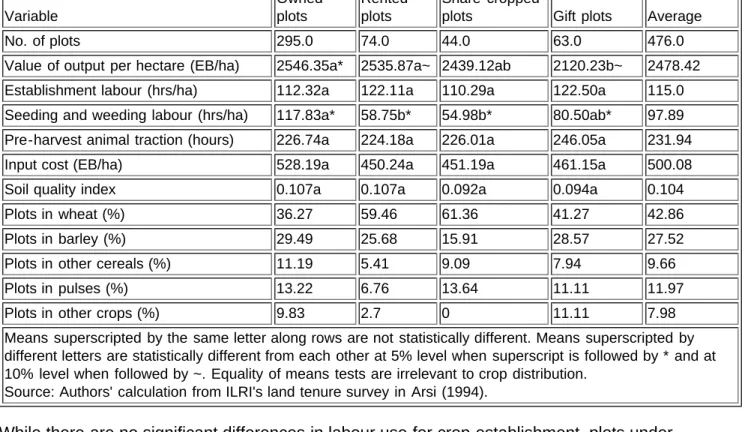
Descriptive statistics of the variables in the stochastic frontier (efficiency) and inefficiency models are presented in Tables 2 and 3. Value of output per hectare averages Ethiopian Birr (EB) 2478 with the highest returns obtained on land cultivated by owners. Statistically, average returns from gift plots are significantly lower than those from owned and rented plots but
average returns of share-cropped and gift plots are not significantly different from each other. Table 2. Average value of output per hectare, input use per hectare and soil quality on plots with alternative land tenure contracts in Arsi, Ethiopia.
Variable Owned plots Rented plots Share-cropped
plots Gift plots Average
No. of plots 295.0 74.0 44.0 63.0 476.0
Value of output per hectare (EB/ha) 2546.35a* 2535.87a~ 2439.12ab 2120.23b~ 2478.42 Establishment labour (hrs/ha) 112.32a 122.11a 110.29a 122.50a 115.0 Seeding and weeding labour (hrs/ha) 117.83a* 58.75b* 54.98b* 80.50ab* 97.89 Pre-harvest animal traction (hours) 226.74a 224.18a 226.01a 246.05a 231.94 Input cost (EB/ha) 528.19a 450.24a 451.19a 461.15a 500.08
Soil quality index 0.107a 0.107a 0.092a 0.094a 0.104
Plots in wheat (%) 36.27 59.46 61.36 41.27 42.86
Plots in barley (%) 29.49 25.68 15.91 28.57 27.52
Plots in other cereals (%) 11.19 5.41 9.09 7.94 9.66
Plots in pulses (%) 13.22 6.76 13.64 11.11 11.97
Plots in other crops (%) 9.83 2.7 0 11.11 7.98
Means superscripted by the same letter along rows are not statistically different. Means superscripted by different letters are statistically different from each other at 5% level when superscript is followed by * and at 10% level when followed by ~. Equality of means tests are irrelevant to crop distribution.
Source: Authors' calculation from ILRI's land tenure survey in Arsi (1994).
While there are no significant differences in labour use for crop establishment, plots under different land tenure arrangements receive significantly different quantities of labour for seeding and weeding, a period of high demand for labour. Rented and sharecropped plots receive less than half of the labour input on plots cultivated by owners during these operations.
Animal traction averages 231.94 hours per hectare with no statistically significant difference between land tenure systems.
Average cost of seed, inorganic fertiliser and herbicides is EB 500/ha with no significant difference between land tenure contracts. However, input cost on owner-cultivated plots is 17% higher than those on rented and sharecropped plots. This difference may be attributed to the varying crop requirements on these plots. Similarly, there is no statistically significant difference in land quality between plots of different contracts. Regardless of the tenure
arrangement of the plot, wheat, a principal cereal crop in the area, is produced on most of the plots (36–61%). Rented and sharecropped plots are mainly allocated to wheat (Table 2). The age of the head of the household in the sample varies from 17 to 87 years and averaged 35.3 years (Table 3). Older farmers reflect longer farming experience but are likely to have received less formal education and tend to be conservative with respect to adoption of new technology.
Table 3.Socio-economic characteristics of the study sample farmers in the highlands of Ethiopia.
Variable
Average age of the head of the household (years) 35.26
Average family size (persons) 4.32
Average dependency ratioa 0.55
Average ratio of females in the household 0.36 Average number of work oxen owned (oxen) 1.63
Average cultivated area (ha) 1.55
Gender distribution of household heads (%)
Households with male heads 92.5
Households with female heads 7.5
Wealth status of the household (%)
Poor 29.8
Medium wealth 57.1
Rich 13.0
Education status of the head of the household (%)
Illiterate 31.06
Minimum literacy (just read and write) 14.29
Formal education 54.65
Primary occupation of the head of the household (%)
Farmer 97.5
Others 2.5
Ethnic group of the head of household (%)
Oromo 75.8
Other ethnic groups 24.2
a. Dependency ratio is defined as the ratio of the number of dependents (age below 15 and above 60) to number of adults (age above 15 years and below 60).
Among the sample households, 31% are illiterate and 14.3% can read and write in some language with the majority of household heads (55%) having received a formal education of up to high school level. Almost 30% of the households can be classified as relatively poor based on their land and livestock resources and 13% are relatively rich. The primary occupation of 97.5% of the heads of the households is farming with few traders, livestock herders and salary employment. About 76% of the heads of the households are Oromo, the principal ethnic group in this area. The rest are mainly immigrant and as such tend to be landless.
Plot sizes are small with average area of 0.37 ha. However, households usually control multiple plots with average farm holding of 1.55 ha. Livestock is an important enterprise in this farming system. Average holding of livestock is 6.67 TLUs of which 1.63 heads (1.35 TLUs) are draft oxen.
It is fundamental that all explanatory variables in the model be exogenous to the production structure, so that none of the covariates in the second stage inefficiency analysis is correlated with the variables in the frontier model resulting in multicollinearity or approximate linear relationship among some of the regressors (Kennedy 1985). The inverse of the correlation matrix is often used in detecting multicollinearity. The diagonal elements of this matrix are the variance inflation factors (VIFi) given by (1-Ri2)-1 where Ri2 is the R2 from regressing the ith independent variable on all the other independent variables. A high VIF indicates an Ri2 near unity and hence suggests collinearity. As a rule of thumb, for standardised data a VIFi > 10 indicates harmful collinearity (Kennedy 1985). In this study, an Ordinary Least Squares (OLS) regression equation is estimated with all the independent variables used in the frontier
production function and inefficiency model and their VIFi were computed. Maximum VIF in this data set is 2.76 and most of the values are smaller than 2 (Appendix I). We concluded that multicollinearity is not a serious problem here.
6.2 The stochastic frontier function
The maximum likelihood estimates for the parameters in the stochastic frontier and inefficiency model are presented in Table 4. All the coefficients, with the exception of the type of crop cultivated and location-specific dummy variables, are interpreted as the elasticities of output value with respect to inputs. The elasticity of output with respect to purchased input (seed, fertiliser and pesticides) is highly significant with a value of 0.33. An additional investment of EB 1 in these inputs yields EB 0.63 in profit (EB 1.63 of revenues) at the mean output and purchased inputs. This represents high returns to application of purchased inputs in this system. One factor contributing to this high level of returns is probably the favourable climatic conditions, mainly rainfall, where production response to fertilisation and improved seed technology is expected to be high. The regression results support the hypothesis that the quality of the plot is an important determinant of the slope of the production frontier. The
estimated elasticity with respect to land quality is 0.44. This indicates high returns to improving land quality. All the problems reducing the quality of land, as measured here, can be reversed through adoption of improved technologies such as inorganic fertiliser application, soil
conservation and drainage.
Table 4.Maximum likelihood estimates of the stochastic production frontier and technical inefficiency model.
Variable Coefficient Estimate t-ratio
Intercept
β
0 6.373 21.0798Purchased inputsa (Birr)
β
1 0.3255 8.643 aLand quality index (Birr)
β
2 0.4392 2.7512Crop establishment laboura (hrs)
β
3 0.0219 0.4142Seeding and weedinga (hrs)
β
4 0.0333 2.5627Pre-harvest animal traction (hrs)a
β
5 –0.0342 –0.9990Crop type (dummies)
Other cereals
β
7 –0.3024 –4.4948 Barleyβ
8 –0.3829 –5.6603 Pulsesβ
9 –0.1235 –1.9511 Other cropsβ
10 0.0544 0.6164 Location dummies Abichu (dummy)β
11 –0.1852 –3.4877 Bilalo (dummy)β
12 –0.0114 –0.1463 K. Genet (dummy)β
13 –0.2167 –2.1958a. Variables defined in natural logarithm.
Dependent variable is log of value of output per hectare.
While crop establishment labour is statistically insignificant, weeding and seeding labour is significantly different from zero with a coefficient of 0.03. The coefficient of pre-harvesting animal traction is negative but is statistically insignificant. This is unexpected. However, animal labour for land preparation varies principally with the slope of the land. Steep plots require more time in ploughing, usually subject to water erosion and likely to be of lower productivity. As such, this variable may capture the negative effect of land slope on crop yields.9
9. Slope of the plot is not included in computing the land quality index presented earlier for lack of data.
The production frontier of barley, pulses and other cereals differs significantly from that of wheat. The coefficients (intercept shifters) on these variables are negative and significant. This means the production frontier for these crops are distinctly below that of other crops. This result explains the dominance of wheat in the crop mix of farmers in this area.
Although located in the same agro-ecological zone, the four locations of this study appear to differ significantly with respect to the intercept of the production frontier. The coefficients on two of the three location dummies are negative and statistically significantly different from zero, i.e. the fourth location.
6.3 Inefficiency effects
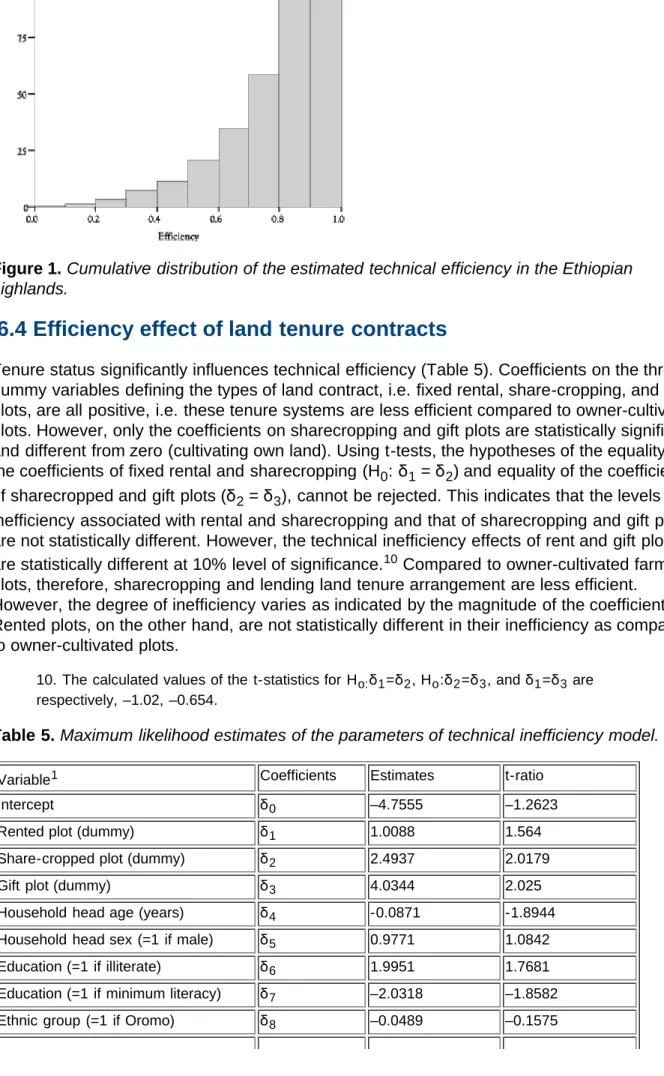
The efficiency estimates of the sample range from as low as 4% to as high as 94% and averages 71%. The implication of this is quite significant as farmers can increase their crop incomes by as high as 40% on average, by improving their technical efficiency. The frequency distribution of the estimated efficiency is shown in Figure 1. One-quarter of the plots has an estimated efficiency of 0.6 or less while 50% of the plots have estimated efficiency of 0.7 or less. The estimated y (overall measure of inefficiency) is very high (0.97: Table 4) reflecting the presence of significant technical inefficiency in the data set.