Office Locations Study
Advantage West Midlands
CONTENTS
EXECUTIVE SUMMARY... 1
2. POLICY REVIEW... 8
3. LITERATURE REVIEW ... 27
4. REGIONAL MARKETS - BIRMINGHAM ... 42
5. REGIONAL MARKETS – THE BLACK COUNTRY ... 53
6. REGIONAL MARKETS - COVENTRY ... 63
7. REGIONAL MARKETS - WARWICK... 69
8. REGIONAL MARKETS - WORCESTER... 73
9. REGIONAL MARKETS - STAFFORD ... 79
10. REGIONAL MARKETS - TELFORD AND WREKIN ... 83
11. REGIONAL MARKETS – STOKE-ON-TRENT ... 85
12. OCCUPIER SEARCH PATTERNS ... 88
13. REGIONAL MARKETS - CONCLUSIONS ... 94
14. DEVELOPER THOUGHTS... 97
15. INWARD INVESTMENT ... 101
16. CONCLUSIONS... 103
Appendix A – Organisations Consulted & References
Appendix B - Current National and West Midlands Planning and Economic Policy Appendix C - Other Regions’ Policies
EXECUTIVE SUMMARY
The Office Locations Study was commissioned in order to better understand the drivers which influence the West Midlands Office Market, both in and out of centres. Past, present and potential future policies illustrate key questions in the debate about the centres first approach:
• Do some office users have a different set of needs giving rise to a separate market for out
of centre space?
• Should policy recognise that need, and if so, how can it be measured, tested and
influenced?
• How can out of centre sites meet sustainable economic development goals with the need
to be sustainable? and
• What can be done to promote and develop the market for in centre development?
In order to evaluate these questions, this study has looked at historical, current and future planning policy, recent literature on office market trends and location preferences, evaluated regional markets and has considered recent transactions by office occupiers. Office occupier and developer case study interviews were conducted and inward investment market drivers analysed.
Policy
Policies which have historically created and encouraged an out of centre office market are now being challenged. Emerging national policy is supporting the centre based approach to development, with proposed amendments to PPS6 focusing very much on town centre locations.
In the West Midlands, existing policies are not seen to be negatively impacting on development; in fact, developers indicated that they seem comfortable with the sequential test and generally do not see the West Midlands as a less favourable place to work than any other Region. The review of all RSS in England illustrates that all regions have published a policy in line with PPS6. The key issue for the West Midlands is the delivery and implementation of this policy in seeking to compete with other regions to attract new inward investment and promote sustainable economic development.
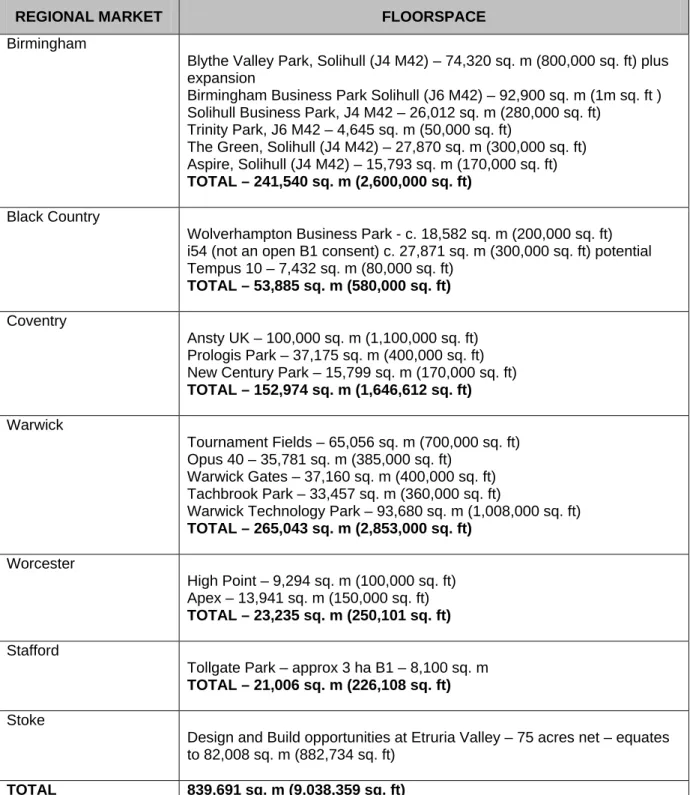
office floorspace completed in the last three years being in town centre locations.1 Additionally, there is approximately 839,691 sq. m (9,038,359 sq. ft) of out of centre developments with planning consent that are not yet built.
Capacity
The West Midlands Regional Centre Study acknowledges town centres have limited ability to absorb predicted growth in the office sector and highlights additional obstacles to office development in town and City Centres. These include lower occupation costs for out of centre locations, and difficulties of land assembly in centres.
As the economic centre of the West Midlands, Birmingham City Centre it is a noticeable exception with record numbers of office developments coming forward. The Annual Monitoring report data illustrated this point; 95% of space under construction in centres and 82% of committed supply in centres was in Birmingham City Centre.
The lack of quality, suitable space within some of the smaller centres specifically, has led to the justification for out of centre development. This development has, importantly, helped attract inward investment to the West Midlands, most notably from telecoms, construction, IT, medical and financial firms as well as some public sector bodies.
Many centres are now beginning to address the key issues that would help to bring occupiers back to the centre;
• Improvements in infrastructure and public transportation;
• Land assembly to develop newer high quality office accommodation; and
• Promoting mixed used developments in the centres.
Sub-Regional Assessment
The West Midlands has a series of office sub markets, the development of which has been influenced by past and current policy. Typically, these are characterised by centres often having a lack of available new, high quality space and an out of centre market having developed in order to fill the gap in some instances, and to meet wider regional and regeneration needs. As a result, most smaller centres have not developed an office market beyond what has existed in the past 10 – 20 years.
1 (RSS Feb 2007 Annual Monitoring Report).
Within the West Midlands, the key markets for office development are outlined below:
1. Birmingham/Solihull - seen as the leading centre with a growing amount of speculative office development indicating the strength of the City Centre market;
2. The Black Country - promoting the regions strongest centre first policy via the RSS Phase 1 Review. Although there are a number of schemes in the pipeline, it does not currently have the strong in centre office accommodation to balance the strength of developments such as the Waterfront2 and Wolverhampton Business Park;
3. Coventry - a relatively strong centre, albeit with little new development as yet, and an out of centre market;
4. Warwick - has the benefit of a strong central location with good connectivity to London but has a constrained centre;
5. Worcester - in recent years little or no in centre development (also due to physical constraints) compared to a stronger out of centre market along the M5;
6. Stafford - little or no in centre development in recent years compared to stronger out of centre development;
7. Telford - as new town located on a Motorway junction, it does not have an entirely separate centre/out of centre difference but the market overall has suffered from an oversupply of available office space with limited demand; and
8. Stoke-on-Trent. - has struggled as an office location although in recent years demand has increased due to occupational cost economies and a readily available workforce. However, out of centre development has attracted the majority of large scale multinational occupiers.
The assessment of sub-regional markets presents a mixed picture. In some locations (particularly the north-west of the region), inward investment is generally weak and out of town space appears to have had a more direct and negative impact on centres. However in the south and east of the region many out of centre locations have been particularly adroit in attracting inward investment (Warwick and Worcester out of town locations as examples).
It will be important that the Region continues to make sites available for inward investment in order to strengthen the economy of the West Midlands and help it compete with other regions. It should be noted, however, that demand for one sub-region is not easily shifted to another.
Influences on Decision Making
Influences on office location decision making continue to be:
• cost of accommodation;
• a good environment (including access to a range of services);
• access to qualified labour;
• good transportation links;
• the right type of available space in terms of quality and floorplate;
• parking; and
• a good image.
Whilst the evidence from the literature review is not conclusive, it appears that professional and financial services remain strongly focused upon centres where a premium is placed upon attracting employees and an interaction and trading with clients and other firms in the sector. In Birmingham in particular, the need to attract and retain young staff pulls firms to the City Centre. The telecoms and IT sectors appear to have focused outside centres although there is no clear indication that this is a deliberate locational preference, or a lack of suitable town centre stock.
The desire for large amounts of car parking is now balanced by recognition of the importance of general accessibility by all modes of travel. Increasingly influential is the ‘green’ agenda on both the future of buildings (including eco-friendly buildings) and on a corporate focus on increasing sustainability.
Conclusions
It is evident that a high quality product provided in centres can attract investment that would otherwise have located out of centre. It is important to recognise that centres have many facets which can, if addressed, make them desirable locations for office occupiers; these include:
• quality of buildings;
• the environment and cleanliness of the centre;
• cultural and entertainment facilities; and most importantly
• accessibility.
One key challenge for the region will be to create the conditions to help increase supply in town centres. Many centres are constrained either by geography, heritage or the age of existing stock. Until these constraints are addressed (if indeed they can be), out of centre developments will continue to perform an important economic function by filling the gap in supply within the identified sub-market. The public sector can play a key role in site assembly, promotion, infrastructure and policy which will help to bring more sites forward in the market. Transport improvements to centres would also help to attract inward investment and increase development in Centres.
Where centres are constrained, it may be possible to consider peripheral locations, slightly further from the centre, but with physical proximity derived by pedestrian links and/or public transport. In order for peripheral development to work, it must capture the advantage of being near to the centre, allowing employees access to the retail, cultural, leisure and transport infrastructure that this offers.
There will always remain a group of users, dependent on the extent to which they need mobility, which will need to be located near to motorway junctions. In contrast, there are users such as financial and business services which prefer to locate within centres. In general ‘technology-orientated’, cultural and creative industries also tend to focus on city locations. These businesses are more reliant on so called ‘urban economies’ where creativity and innovation are strengthened and enriched when key functions are located close together and in locations with high sectoral diversity. Office based functions seeking to locate near vibrant centres will progressively develop and upgrade the so called ‘urban fringe’, reducing any sharp distinctions between the town centre and out of centre office locations. Again, Local Authorities should prioritise making the appropriate sites available to encourage their
In order to strengthen the region’s economy and help it compete in the global market place, it will also be important that the right sites can continue to be made available for inward investment purposes to ensure investors/occupiers have the choice of location and quality of accommodation to meet their individual needs. This will require a range of options including town/city centre options as well as out of town sites.
The regional market assessments identified a pipelineof out of town development sites with planning consent. Whilst there is a large variability in the quality of these sites and their attractiveness to the market, there is still a quantum of office floorspace available in out of centre locations.
INTRODUCTION
1.1 The key issue identified in the client brief is:
“Phase Two of the partial revision of the RSS provides the opportunity to clarify the position with regard to the development of a quality office product needed to diversify the regional economy towards business services”.
1.2 Therefore this study looks at historical, current and future planning policy which concerns the location of office development in the West Midlands Region and beyond. The study reviews recent literature on office market trends and location preferences. It considers recent transactions by office occupiers in the regional markets and details policies on specific sites.
1.3 Office occupier and developer case study interviews were conducted and inward investment market drivers analysed.
1.4 Following this introduction, the rest of this report is set out as follows:
• Chapter 2 – Policy Review
• Chapter 3 – Literature Review
• Chapters 4 -13 - Regional Market Descriptions, Occupier Search Patterns and
Conclusions
• Chapter 14 - Developer Perspectives
• Chapter 15 – Inward Investment Drivers
2. POLICY
REVIEW
2.1 This section outlines historical planning decisions in the West Midlands Region, the impact of which is still felt today. It also considers current planning and economic policy driving office market locations in the West Midlands and other Regions. This section then goes on to look at potential future changes in policy and new market trends.
Planning History
Timeline of Employment Regional Policy since the 1980’s
Pre 1980’s
2.2 The key policy driver of office and industrial locations prior to 1980 was regional policy and the development of new towns. Regional policy had a significant potential impact particularly through the use of industrial and office development certificates which still applied in the West Midlands into the late 1970’s. In terms of new towns nationally these were promoted as locations for investment including offices. In a West Midlands context Redditch and Telford were promoted as locations for investment through various agencies into the 1990’s and in Telford’s case to the present day.
The 1980’s
2.3 The latter 1970’s saw the introduction of the Government White Paper – Policy for Inner Cities. This was the initial point for the beginning of economic regeneration of the urban areas that had taken place as a direct result of the decentralisation of the past. The White Paper resulted in the introduction of Urban Development Corporations (UDCs) and the expansion of the urban programme.
2.4 The West Midlands began to, along with other parts of the country, see the development of urban regeneration and economic development policies and the first move towards regional planning policy with the introduction of Planning Policy Guidance Note 10 (PPG10) – Strategic guidance for the West Midlands in 1988. In terms of employment PPG10 sought to identify and release sites located just outside the larger urban areas, otherwise known as the conurbations. This type of regional planning concentrated on developing local economies through innovation, thereby attracting high technology employment and other such services. This policy was a direct response to the collapse of
2.5 Sites that were to be brought forward for these new opportunities were to be located where the potential of the site could be best utilised. In other words sites were to be accessible by transport infrastructures (i.e. motorways, and rail etc), be located in attractive and appealing locations and the sites were required to be preferably over 40 hectares in size. These sites took on the notion of being peripheral development, as they looked to revive old manufacturing areas, later becoming Premium Employment Sites (PES).
2.6 The PPG10 PES policy identified Birmingham Business Park (within Solihull) as the first site to be released, following the approval by the Secretary of State in 1986. Birmingham Business Park was seen as an established landscaped park for high quality office and development. Further sites to be brought forward through this policy were
• Blythe Valley Park, Solihull
• Wolverhampton Business Park, Wolverhampton
• Wobaston Road, Wolverhampton
• Pendeford Office Park, Wolverhampton
• Hilton Cross, South Staffordshire
• Trentham Lakes, Stoke on Trent
• Blythe Bridge, Staffordshire Moorlands
2.7 These sites formed a network of peripheral sites surrounding the major conurbations of the West Midlands. Whilst Trentham Lakes was brownfield all of the others were greenfield.
2.8 In response to regional guidance, many of the local authorities began preparing development plans to include peripheral development sites. The development of the Local Plan for local authorities was positioned towards policies that improved the range of employment sites so that the diversity of the local economy in both urban and rural areas could be improved. For example the Birmingham, Dudley and Wolverhampton UDP’s specified a four tier classification very similar to one another (PES, best urban good, urban and other urban). The Birmingham UDP also acknowledged peripheral sites in the form of Woodgate and Bassetts Pole.
2.9 During the late 1980’s, the introduction of the Business Use Class (B1), saw the merging of light industrial and office use, within the B1 use class. This was a key change in that it allowed much greater flexibility to change the uses between, light industry, office, and
research land uses. Its resulting effect at the local level, was that it presented the opportunity for development plans to provide positively for enterprise and investment in particular areas of the region. The merger of the two sectors into the B1 use class relaxed the planning systems control, therefore allowing office space to be pursued on what was previously considered light industrial sites in the cities and major peripheral sites as seen above.
2.10 Smaller local authorities such as Warwick and Rugby tended to focus much of their employment to the peripheral locations, within the former established manufacturing areas. By focusing employment to these specific locations, retention of existing employment sites was supported. This resulted in brownfield sites coming forward for development over new greenfield sites.
2.11 The introduction of the Government White Paper in 1989 “The Future of Development Plans” by the Department of Environment acknowledged the fact that there was a need and requirement to consider planning guidance on a wider regional scale, although the Government has previously attempted to force some counties and district local authorities to participate within a Regional Conference so that regional policy guidance could be formulated. However, when the publication of the Planning Policy Guidance 15 (PPG15) titled “Regional Planning Guidance, Structure Plans and the Content of Development Plans” was published in 1990, it was seen as a firm commitment for the production of Regional Planning Guidance. Paragraph 2.7 of PPG 15 states:
“The primary function of such guidance is to provide the necessary framework for the preparation of structure plans....Once regional guidance has been issued, county and district councils are expected to take the guidance into account in preparing their plans. Structure plan alterations are required to be consistent with national and regional policies. A structure plan which takes full account of up-to-date regional guidance will raise fewer major policy issues..."
2.12 The momentum reached its height in Circular 14/85 ‘Development and Employment,’ (now cancelled). It saw the first outline guide in planning legislation for employment uses. This emphasised ensuring that sufficient land was available for industrial use, which was seen within government as a key priority to be pursued through the planning system.
The 1990’s
2.13 Regional governance began to take shape within the mid 1990’s with the emergence of Government Offices for the Regions. The West Midlands has seen the emergence of three key institutions as a result, which have become the heart of regional governance. These were the Government Office for the West Midlands, the Regional Development Agency (Advantage West Midlands) and the West Midlands Regional Assembly.
2.14 The early 1990’s saw the adoption of the revised Planning Policy Guidance Note 4 (PPG4) in 1992. Paragraphs 11-14 replaced the existing 1988 PPG4. The fundamental difference was the introduction of locational policies into local development plans. It was envisaged that development was encouraged in areas better served by transport networks (i.e. the larger urban areas). As a result extensive well planned out of town employment business parks were offered as proposals that would offer better economies of scale and consequent benefits to consumers and businesses.
2.15 Regional Planning Guidance (RPG11), published in 1998, continued the role of its predecessor PPG10, by focusing appropriate amounts of development towards the existing built up areas. RPG11 referred to employment sites being situated within the existing urban areas and that they should vary in quality and quantity so that they could accommodate future growth within the service industries. It was intended that RPG11 would guide development plans for the period up to 2011.
2.16 RPG11 established the importance of providing land to meet the needs of the Black Country and Birmingham/Solihull in terms of Premium Peripheral Sites. It recognised that 25 hectares of land had been granted planning permission at Greenfield lane (Wolverhampton/South Staffordshire) and Hilton Cross (South Staffordshire) close to the Black Country.
2.17 The 1998 version of the RPG sought to accommodate out-migration of housing and employment from the metropolitan area to towns within the surrounding zone, referred to as the ‘Central Crescent’, and including the towns of Warwick/Leamington, Stratford, Worcester, Kidderminster/ Stourport, Bridgnorth, Telford, Stafford, Lichfield and Tamworth. This previous approach underperformed in relation to the regeneration of the major urban areas (MUAs) and remoter rural areas, in relation to promoting development in the north and west of the Region. In particular, there was a growing concern that the continuing decentralisation of population from the West Midlands, North Staffordshire and Coventry conurbations was threatening the economic, social and physical environment of the Region.
The 2000’s
2.18 Since the Planning and Compulsory Purchase Act 2004, the former system of unitary, local and structure plans have been replaced by the Regional Spatial Strategies (RSS) and Local Development Documents, to be prepared by local authorities. RSS (The West Midlands Regional Spatial Strategy) sets out to enable all parts of the region to sustainably meet their own requirements. The rationale behind this policy is being able to achieve urban renaissance in the four Major Urban Areas (MUAs) of Birmingham/Solihull, the Black Country, Coventry and North Staffordshire conurbation. The MUAs are the major economic driver and source of employment opportunities for the Region, containing over half its population. The central aim of the RSS is to reverse decentralisation from these areas to the more rural parts of the Region.
2.19 As a result the RSS looks to significant strategic sites, both regionally and sub-regionally, which have cross boundary implications.
2.20 Planning Policy Statement 6 states that large scale office developments (B1a) should be located within the network of strategic towns and City Centres. The RSS also looks to the MUAs for providing Regional Investment Sites and Major Investment Site (MIS).
2.21 Office development policy is further developed in RSS through policy PA11 ‘the Network of Town and City Centres’. Town and City Centres are viewed as the drivers of the regional economy and are crucial for the future of the Region’s economic and social well-being. Centres should be the key focus for regeneration work, thereby encouraging the reversal of the decentralisation of the past. The policy requires that large scale office developments in excess of 5,000 sq. m (54,000 sq. ft) should be located within the strategic network of the towns and cities.
Current Policy
2.22 A detailed description of current policy affecting office developments is included at Appendix A. This section provides a summary of the key implications of this policy followed by a discussion of the current debates.
Sequential Approach
2.23 Planning Policy Statement 6 (PPS6) – Planning for Town Centres focuses growth and development in existing town and City Centres, encouraging a wide range of services, in a good environment, accessible to all.
2.24 Paragraph 2.44 of PPS6 sets out the sequential approach to site selection which states that all options in the centre (including, where necessary, the extension of the centre) should be thoroughly assessed before less central sites are considered for development for main town centre uses.
2.25 The sequential approach therefore impacts where office developments can be located, however this policy also states that the physical capacity of centres to accommodate new office development and the town centre’s role in the hierarchy should also be relevant to planning for new office development.
West Midlands Regional Spatial Strategy (RSS) (formerly Regional Planning
Guidance 11) - June 2004
2.26 Current policy in the West Midlands RSS is focused on locating economic growth in the four Major Urban Areas (MUA) of Birmingham/Solihull, the Black Country, Coventry and the North Staffordshire conurbation.
2.27 ‘Prosperity for All’ policy PA11 focuses large scale B1a office developments (those of 5,000 sq. m (54,000 sq. ft) or more gross floorspace) in a network of 25 town and City Centres identified as strategic centres. Centres should be a key focus for future regeneration activities as well as investment in public transport. The policy draws support from Planning Policy Statement 6.
2.28 Policy PA7 deals with Regional Investment Sites (RIS) and states that two should be provided. The need for further sites is under review.
2.29 Regional Investment Sites are generally between 25-50 hectares; high-quality sites attractive to national and international investors; served or capable of being served by multi-modal transport facilities and broadband IT infrastructure; well related to the motorway and trunk road network; located within, or close to, the areas of greatest need; and accessible to effective education and training opportunities to ensure that the employment benefits are available to the local workforce. Regional Investment Sites can include a substantial element of office development.
2.30 The implications of the RSS are that local authorities should take a proactive approach through their town centre strategies to identifying potential sites and premises for development within these centres, including, where necessary and appropriate, the wider use of compulsory purchase powers. Priority should be given to encouraging balanced development of a wide range of town centre uses and thereby avoiding the vulnerability associated with excessive reliance on a single function.
RSS Review Phase One – The Black Country
2.31 The draft Phase One Revision: the Black Country Study, focuses on town centre development with policy UR1A proposing that B1a development should mainly be located in the four strategic centres of Wolverhampton, Walsall, West Bromwich and Brierley Hill/Merry Hill.
2.32 It also states that no offices should be located outside centres except commitments.
2.33 It notes that the challenge of accommodating the required scale of office development may include reversing the market trend towards business parks on greenfield sites, and overcoming the current lack of interest from the market for most town centre locations.
West Midlands Regional Centres Study (March 2006)
2.34 Roger Tym and Partners conducted technical work for Phase Two RSS Partial Review called the West Midlands Regional Centres Study. This identified that office users have different needs some of which cannot be met by centre-based locations. The Study’s ‘Baseline’ forecast envisages 36% of office needs being met by the network of PA11 centres, plus Brierley Hill/Merry Hill. Scenarios two, three and four increase the proportion accounted for by the network of PA11 centres to 40-44%.
RSS Monitoring Report
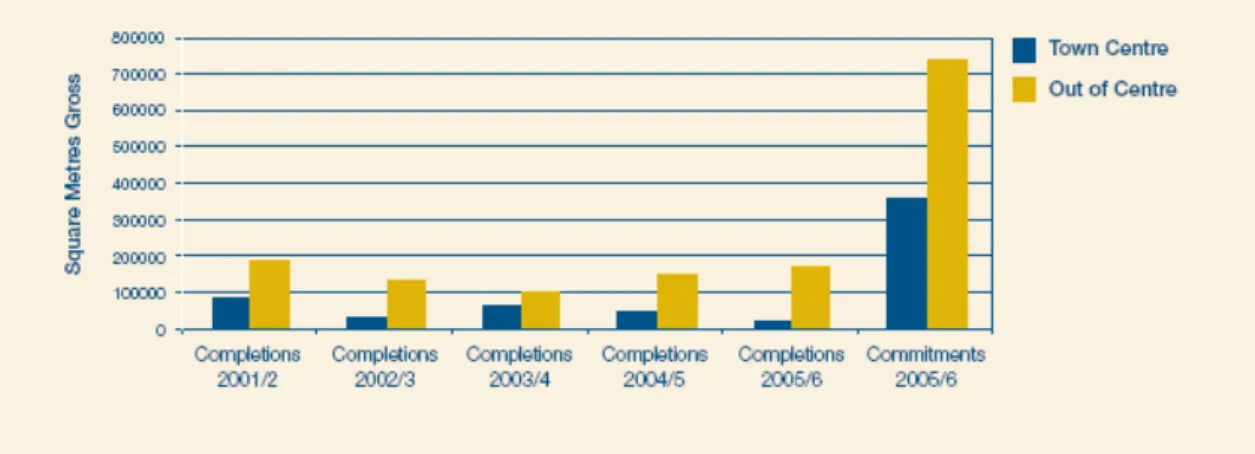
2.35 The West Midlands RSS Annual Monitoring Report (AMR) 2004 (published February 2005) states that in the West Midlands Region only 31% of office floorspace completed in the last three years has been in town centre locations. In 2004/05 24% of office completions were in centre, mainly in Birmingham and Warwick. The 2006 AMR published February 2007 states that this reduced to 10%. Apart from Birmingham City Centre and to a lesser extent Coventry City Centre and Solihull town centre, most new office development in the Region has been concentrated in out-of-centre locations.
2.36 The 2004 report stated that only 28% which was under construction, or with planning permission was located in the Region’s town centres, however this had increased to 32% in February 2007.
2.37 Figure 2.1 below shows the completions in centre and out of centre from 2001/02 to 2005/06 (reported in the February 2007 AMR). This shows how the proportion in centre from 2003/04 to 2005/06 has decreased. Figure PA10 also shows this in terms of the
Figure 2.1 Office completions and commitments 2001-2005
Source: RSS Annual Monitoring Report 2007.
2.38 Figure 2.2 reflects the extent of centre and out of centre completions with the MUA’s and none MUA areas.
Figure 2.2 Office completions and commitments within and outside the MUA’s 2001-2005.
2.39 The February 2007 Monitoring Report states that office development in 2005/2006 had reduced by 9% over the previous year. Rugby accounted for (29%) of the 181,365 sq. m. (1,952,197 sq. ft) of office development in this year. Elsewhere, 9% of development was in Solihull with significant levels of development also taking place at Birmingham, Nuneaton and Bedworth and Stoke-on-Trent.
2.40 The proportion of development in centres had reduced to 10%. 19% of this in centre development took place in Coventry (Coventry University Technology Park) with a further 16% each in Sandwell and Telford and Wrekin. Survey returns have provided more details of development outside centres. 15% of all development was on the edge of centre, particularly in Warwick District (Tatchbrook Road), and 49% on out of centre Business Parks.
2.41 Office developments in the pipeline, under construction and with planning permission, continue to show a significant in centre element (32%) albeit 68% is outside of centre. 34% of all office development in the pipeline is in Birmingham with significant other locations being Solihull and Rugby. 36% of office development under construction is in Birmingham and 27% in Solihull with 95% of in centre development under construction in Birmingham (reflecting how much the town centre market is focused upon Birmingham) and 42% of out of centre development under construction in Solihull.
2.42 Birmingham continues to dominate with 82% of in centre development with planning permission being within the city centre, including Priory Queensway and Snow Hill Station. The only other centre with permitted development of 10,000 sq. m. (107,639 sq. ft) or above is Telford (Hadley Park). Out of centre permitted development of 10,000 sq. m. (107,639 sq. ft) or more exists at Solihull(Solihull Business Park, Blythe Valley, The Green Shirley and Monkspath), Stratford (Gaydon Proving Ground), Bromsgrove (Whithall Green Business Park), Stafford (Prime Point), Telford and Rugby (Ansty)3.
West Midlands Regional Economic Strategy, Consultation Draft (May 2007)
2.43 The consultation draft West Midlands Economic Strategy notes the growth in servicesector industries, creative industries and research and development.
2.44 The Strategy sets out three primary areas for spatial focus – (1) Areas of multiple market failure; (2) Concentrations of knowledge assets; and (3) the regional centre in Birmingham.
2.45 The strategy also identifies other areas for more limited investment to support sustainable communities which are growth areas and strategic centres, and market towns.
“A Study into the Future of Employment Land Provision in the West Midlands”,
GVA Grimley (March 2001)
2.46 This study contains conclusions on the role of greenfield sites and business parks in attracting office development. The key points are –
2.47 B1 users have largely occupied greenfield developments, close to the conurbation. As far as the main urban areas are concerned, there is evidence to contradict the accepted view that greenfield office based sites compete with activities in city and town centres. Property agents confirm that a distinct and separate market has become established. This fact should be recognised in regional planning policy.
2.48 The need for a quality environment has emerged as a key locational driver in terms of the expanding knowledge based economy (for example Westwood Business Park and Blythe Valley Park). They are also the preferred location for some types of mobile inward investment.
Other Regions
2.49 A key part of this study is to identify whether specific West Midlands policies are having an impact on the location of office developments in the Region. Therefore it is important to compare and contrast the West Midlands Region with the other English Region’s policies to highlight whether the West Midlands policies are unique.
2.50 A full review of the other English Region’s Regional Spatial Strategies are included in Appendix B. A summary of the key points is included below:
• East Midlands – The RSS promotes B1 and B2 uses especially. Policy 20 states that there should be an adequate supply of good quality land for office uses in sustainable locations.
• Yorkshire and the Humber – Focus on Major Urban Areas, and minimise the need for greenfield development. Focus on regeneration priority areas. Policy E1 and E2 focus business services and office development in town and City Centres.
• North East – Major office and employment uses should be located in the two City Regions, in particular the core areas of the conurbations. Renewal and reuse of
previously developed land and buildings will also be key and development at Prestige Employment Sites (Policies 12 and 24).
• North West – Focus on Major Urban Areas. Policy W3 focuses upon allocations for B1, B2 and B8 within the three City Regions of Manchester, Liverpool and Central Lancashire. Generally economic development is prioritised within City Centres and inner city areas, however specific key locations in the north, south east and west of the cities, set the Region’s specific requirements for economic development, for example, in the vicinity of Manchester airport.
• East of England – Policy TG/SE2 focuses major retail, leisure and office developments in town and district centres. Norwich City Centre will provide a focus particularly for media and creative industries, finance and insurance, and ICT.
• South East – Policy TC1 states that a network of town centres will be the focal point for commercial development.
• South West – Policy TC1 encourages office development within town and City Centres in order to enhance their vitality and viability. However, recent development has been in out of centre locations, therefore a major challenge is to make town centre locations sufficiently more attractive to occupiers, particularly with regard to accessibility.
2.51 Generally speaking, the policies of other Regions are similar to those of the West Midlands, promoting office development in and around towns and centres. Clearly, urban regeneration benefits from office development in town and City Centres, and promoting development in the centre is essential to enhancing vitality and viability. Sustainability and the town centre first policy are strong messages coming from national policy, however it is important that all Regions are implementing this policy, as differing levels of enforcement may potentially draw office development away from some regions to others.
Forthcoming Policy Changes
West Midlands RSS Phase Two Revision Spatial Options (January-March
2007)
2.52 Phase Two Spatial Options on Employment asks whether in the revision of RSS, there should be more clarity on the type of uses to be located on Regional Investment Sites (RIS), and asks whether there is a need to change the policy on the control of uses on RIS. Currently PA7 restricts development to high quality uses within B1 and in some parts of the Region high quality B2 uses are also permitted.
2.53 On Major Investment Sites the current policy restricts occupation to a single user, therefore the Spatial Options consider introducing more flexibility to this policy.
2.54 In terms of the Regional Centres Study, the Spatial Options give the opportunity for this evidence base to be subject to practical and policy consideration, in particular incorporating employment need.
2.55 The Spatial Options ask if the sequential approach to out-of-centre office development is the best approach, whether the RSS should set out maximum percentages for out-of-centre office development or if criteria should be set for out-of-out-of-centre office development.
2.56 In AWM’s Representations to the RSS Issues and Options Consultation the sequential approach was supported. There was limited support for the percentage policy for out-of-centre development, and while there was a greater level of support for the criteria based option, the sequential approach is still generally preferred.
2.57 Those that did support the criteria based approach stated that it would offer flexibility and support sustainable development The suggested criteria for determining suitable office locations includes:
• Accessibility by public transport, walking, cycling;
• Sequential test and capacity of nearest strategic centres;
• Proximity to labour markets;
• Sustainable development led criteria (design, energy, landscape, nature conservation);
• Opportunities for co-location with other uses;
• Demonstrate exceptional circumstances; and
• Availability of parking provision.
2.58 Whilst some respondents consider such development to be detrimental to the regeneration objectives of the WMRSS, others are of the view that a flexible approach to out-of centre locations has greater merit in terms of sustainability. For example, out-of-centre developments may be sustainable in instances where it reduces car journeys to major urban areas. There is also concern that if out-of-centre office developments are restricted by thresholds, investment by out-of-centre occupiers could relocate to other Regions. Office developments should be focused in town centre locations to prevent need for greenfield take up.
Planning White Paper
2.59 The Planning White Paper was published on 21 May 2007, by The Department for Communities and Local Government, Department for the Environment, Food and Rural Affairs, Department of Trade and Industry and Department for Transport. This paper proposes to streamline the planning system.
2.60 An article in Property Week (15/06/2007) states that the release of the planning white paper “has put issues of sustainability, carbon emissions and energy saving at the heart of government policy, by declaring war on out-of-town developments. “
Amendments to PPS6 – Planning for Town Centres
2.61 Chapter 7 of the Planning White Paper is “A Positive Framework for Delivering Sustainable Development”. It describes how the town and country planning system will be reformed to improve the effectiveness of the town centre planning policy by:
• ‘Replacing the need and impact tests with a new test which has a strong focus on our
town centre first policy, and which promotes competition and improves consumer choice, avoiding the unintended effects of the current need test’.
2.62 The report states that in 1994 only a quarter of new development was in or around town centres. By 2004 it was up to 41%. Local authorities need ‘robust, evidence-based plans and strategies that are up to date and which set out a clear and proactive vision for town centres, based on a sound understanding of both the need and demand for new facilities. Where development outside the town centre would not impact detrimentally on the town centre, and it is otherwise acceptable in planning terms, both plans and planning decisions should reflect this’.
2.63 It notes that the “need test” has been a blunt instrument in some cases and can have the unintended effect of restricting competition and limiting consumer choice. Kate Barker’s Review of Land Use Planning (December 2006) called for the test to be removed, because of fears it prevented proper retail competition.
2.64 An article in Regeneration and Renewal (11/05/07) says DCLG are considering a broader test that will consider social as well as market factors.
2.65 Proposals in the White Paper will be consulted on in Summer 2007 and new guidance developed by working with the industry and other important stakeholders. Changes will be finalised by Spring 2008.
PPS4 – Economic Development
2.66 Another key recommendation of Barker’s was to update national policy on planning for economic development (PPS4), to ensure that the benefits of development are fully taken into account in plan-making and decision-taking, with a more explicit role for market and price signals.
2.67 Recommendation 3 in Appendix B of the Planning White Paper is for a new PPS4 – Economic Development to replace PPG4 – Industrial, Commercial Development and Small Firms, by the end of 2007.
2.68 This should include:
• ‘Emphasising the critical role economic development often plays in support of wider social
and environmental goals, such as regeneration;
• Strengthening the consideration given to economic factors in planning policy, so that the
range of direct and indirect benefits of development are fully factored into plan-making and decision-making alongside consideration of any potential costs.
• Emphasising the role that market signals, including price-signals, can play in ensuring an
efficient use of land both in plan-making and in development management;
• Requiring a positive approach to applications for changes to use class where there is no
likelihood of demonstrable harm, to provide greater flexibility of use in the context of rapid changes in market conditions;
• Making clear that where a Core Strategy is in place, decisions on commercial development should not be delayed simply on the basis of prematurity;
• Ensuring that development in rural communities is not unduly restrained and allows for a
wide range of economic activity; and
• Ensuring that in general a more positive approach is taken to applications for tall buildings where they are of very high design quality and appropriately located, and where there is the transport infrastructure to support them’.
2.69 The Government propose to consult on the new planning policy statement in Summer 2007.
Planning for Economic Development Report for RDAs
2.70 The Regional Development Agencies (RDAs) commissioned Nathaniel Lichfield and Partners to establish the effectiveness of the current national planning policy framework
for enabling economic development schemes and comments on whether the policies allow for a responsive approach to economic development. This report was submitted to Barker in 2006.
2.71 The RDAs want economic development to be afforded the same weighting as other land uses within the national planning policy framework.
2.72 The RDAs would welcome a new PPS4 which promotes the need for up to date employment land reviews; sets criteria to safeguard high quality or economically important land from other uses; stresses the need for alignment between the Regional Economic and Regional Spatial Strategies; and allows local flexibility.
2.73 A comprehensive national statement on economic development is required to ensure that B use classes and other employment generating uses are balanced alongside other land uses to achieve sustainable development.
2.74 The RDAs set out the following key recommendations to inform the content of a new PPS on economic development –
• ‘Provide a clear and succinct PPS4 that stresses the need to provide the right type and
quality of land in locations which meets the needs of businesses both now and in the future including clusters, knowledge sector, livework, SMEs, mixed use, and creative industries. PPS4 should plug current policy gaps and signpost applicants and LPAs to existing policy and guidance notes that relate to the economy, but at the same time enable and encourage flexibility at a local level. This can be achieved through accompanying guidance notes and examples of best practice.
• Promote the importance of undertaking and maintaining up to date employment land
reviews which should be considered alongside housing and retail needs assessments to inform the allocation of land for employment uses and policies for economic development.
• Provide clarity on how to maintain a balance of uses and what material considerations
should be considered when allocating sites and formulating policies for economic development i.e. regeneration, strategic employment sites.
• Provide clarity on the application of the sequential approach for office development.
• Set out criteria to protect land that has been identified within employment land reviews as
• By signposting to existing guidance stress the need for alignment between the Regional Economic Strategy and Regional Spatial Strategy and how this should be achieved, via using a common evidence base, testing economic scenarios and balancing aspirations with planning for economic growth’.
Sustainability Checklist (Launched 14
thJune 2007)
2.75 The Sustainability Checklist is a new, easy-to-use online tool that has been developed by West Midlands Regional Assembly, AWM and BRE. Devised specifically to guide the design of new developments by making sense of current policy, the Checklist highlights best practice, complementing Ecohomes and the new Code for Sustainable Homes.
2.76 The Checklist covers regionally specific sustainability and planning issues, emphasising those of higher priority. It can also be adapted to reflect locally significant concerns.
2.77 Ecohomes/BREEAM and the Code for Sustainable Homes assess the sustainability of designs for individual new homes and buildings. The Checklist complements these by looking at issues relevant to the overall development scale, helping developers, local authorities and other interested parties to deliver sustainable communities.
2.78 The tool identifies a range of sustainability issues covered in the Regional Spatial Strategy for the West Midlands enabling users to assess to what extent a design proposal will deliver on each issue.
2.79 The Regional Assembly commends the use of the sustainability checklist as a useful tool for developers particularly for major applications where an SEA/SA is not required.
2.80 The web based checklist will be aimed at large mixed use schemes (in line with the Sustainable Communities Agenda), but will be versatile enough to be used to assess single use schemes. Trials on regional flagship developments such Longbridge and the i54 site have shown that the standards are achievable without any significant additional cost.
2.81 Prior to outline or full planning application, a Developer can check whether the design meets their own and their client’s sustainability requirements. They can then reassess the design if required. Strengths and weaknesses relating to regional policy will also be apparent prior to the planning application.
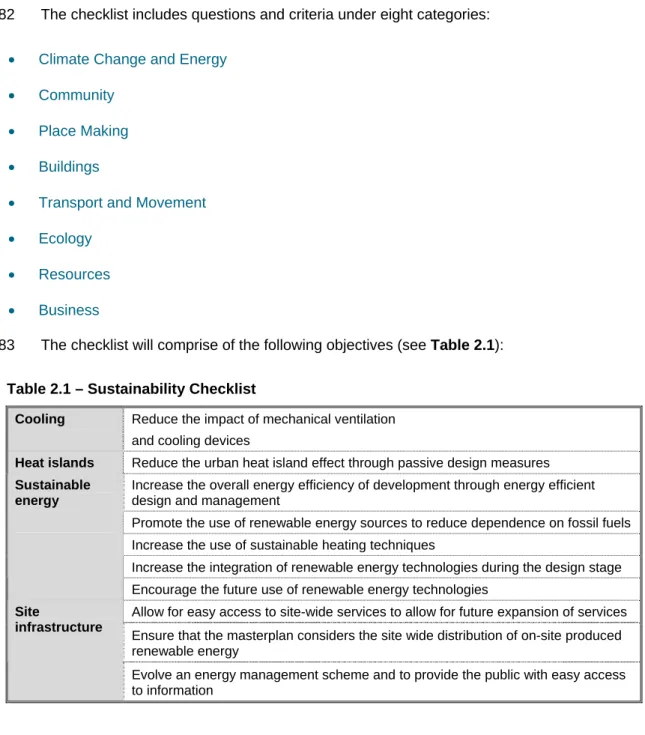
2.82 The checklist includes questions and criteria under eight categories:
• Climate Change and Energy
• Community • Place Making • Buildings
• Transport and Movement
• Ecology • Resources • Business
2.83 The checklist will comprise of the following objectives (see Table 2.1):
Table 2.1 – Sustainability Checklist
Cooling Reduce the impact of mechanical ventilation
and cooling devices
Heat islands Reduce the urban heat island effect through passive design measures Increase the overall energy efficiency of development through energy efficient design and management
Promote the use of renewable energy sources to reduce dependence on fossil fuels Increase the use of sustainable heating techniques
Increase the integration of renewable energy technologies during the design stage
Sustainable energy
Encourage the future use of renewable energy technologies
Allow for easy access to site-wide services to allow for future expansion of services Ensure that the masterplan considers the site wide distribution of on-site produced renewable energy
Site
infrastructure
Evolve an energy management scheme and to provide the public with easy access to information
2.84 There is an increasing focus on the importance of sustainability in development which will impact upon developers. Town Centre developments are likely to better connected to existing infrastructure, more able to support the community and to contribute to Place Making. One challenge of Centre developments will be to modernise existing
Conclusions
2.85 Policies which have historically created and encouraged an out of centre office market, have now been challenged and emerging national policy is further highlighting the importance of sustainability and the town centre first approach. This is evidenced in PPS6 and the West Midlands RSS Policy PA11 which both focus growth in a network of centres, to enhance their vitality and viability.
2.86 The Black Country takes this policy further and states that a centres focused office strategy relies heavily on a regional consensus to restrict greenfield office development within and beyond the Black Country itself, and overcoming the current lack of interest from the market for most town centre locations.
2.87 However, the Regional Centres Study acknowledges that town centres may have limited ability to absorb predicted growth in the office sector. The Study highlights additional obstacles to office development in town and City Centres. Including:
• ‘The existence of major land allocations for B1, B2 and B8 uses in out-of-centre locations;
• The lower occupation costs for out-of-centre accommodation;
• The difficulties of land assembly in town and City Centres because of multiple land
ownerships and lack of expertise in the CPO process; and
• The competition within town and City Centres from higher value land uses’.
2.88 The RSS Phase Two Revision of Spatial Options gives the opportunity to subject this evidence base to practical and policy considerations, in particular incorporating employment need.
2.89 National policy is giving every indication of supporting the town centre based approach to development, with proposed amendments to PPS6, focusing very much on town centre locations, and replacing the need test which may help to encourage town and City Centre developments.
2.90 The intended introduction of PPS4 will help focus local authorities and decision makers on economic development and ensure that ‘B’ use classes and other employment generating uses are balanced alongside other land uses to achieve sustainable development.
2.91 Past, present and potential future policies illustrate what are key questions in the debate about the centres first approach: Do some office users have a different set of needs
which give rise to a separate market for out of centre space, should policy recognise that need, and if so, how can it be measured, tested and influenced? How do we balance out of centre developments with the need to be sustainable? And finally, what can Government do to promote and develop the market for in centre development?
3. LITERATURE
REVIEW
3.1 This section reviews recent literature on trends in office markets and highlights key factors, which influence office occupiers, investors and developers in their choice of development location.
Market Trends
West Midlands Regional Centres Study (March 2006)
3.2 The Regional Centres Study sets out national office market trends as follows:
3.3 ‘Occupier requirements for office space are becoming more sophisticated in terms of the accessibility, efficiency and sustainability of buildings and locations. This consequently impacts on the location and specification of new office development.
3.4 At present, the main ways in which the requirements of town/City Centre and out-of town users differ is that out-of-town users attach greater importance to on-site car parking and security and motorway accessibility, while town/City Centre occupiers may require a high-profile location and attach more importance to proximity to public transport nodes and access to amenities. Users requiring town/City Centre and out-of town accommodation will generally share a need for a good IT infrastructure (typically requiring raised floors) and comfort cooling or air conditioning.
3.5 Access to appropriate labour has become increasingly important, reflecting widespread labour and skill shortages at a UK-wide level. Indeed, for firms in the financial and business services sector, the cost of staff and Directors’ salaries will typically amount to around 70% of total costs. For this sector property costs (rent, rates, and maintenance) will typically account for only around 10% of total costs, but property costs will often be the second largest cost element for such businesses. Furthermore, the quality of property occupied will become an increasingly important factor in enabling businesses to recruit and retain staff.
3.6 Occupiers are increasingly demanding enhanced levels of broadband connectivity, reflecting the greater use of electronic data – email, video, voice and so on. Moreover, the impact of IT in the office is changing working practices and creating a more flexible working environment. Practices such as hot-desking (for example, eight desks for every
with the expected outcome of more efficient use of office space. However this view – which suggests that employment densities are rising for all sectors – is not supported by statistical evidence thus far. The literature around this issue is piecemeal and very few studies have been undertaken that provide hard evidence on this issue’.
3.7 A survey conducted by DTZ Pieda for SEERA in May 2004 concludes that employment densities have not changed significantly since 1997. New working practices are expected to generate demand for more communal areas such as break-out rooms, meeting rooms etc. Therefore, it is unlikely that flexible working practices will impact significantly on demand for office space. Whilst it is possible that the average office density will increase, of more significance is the likelihood of increased demand for high quality workspace and the greater level of investment that will be required in the office product.
3.8 The current trend to outsource UK call centre activity overseas is potentially a threat to this sub-sector of the UK office market. A number of high-profile UK closures have occurred as companies, in particular major financial services and mobile communication organisations, move call centre activity overseas, typically to India, where both property and labour costs are significantly cheaper. However, research undertaken by the DTI found that it was difficult to quantify the impact of outsourcing (or offshoring) overseas and that the scale of the UK call centre market meant that the critical mass may exist to maintain the industry. In addition, one of the key recommendations of the Lyons Review of public sector relocation is that there is no justifiable reason why over 60 public sector call centres are based within the London and South East Regions and that they should be relocated to lower cost locations, which could potentially be within the West Midlands Region.
Sustainability – Towards Sustainable Offices, GVA Grimley (Spring 2007)
3.9 This report highlights the increasing importance of the Sustainability Agenda for offices.Sustainable offices are not just good for the environment. The legislative pressures, combined with an increasing awareness of Corporate Social Responsibility (CSR) in business practices, are rapidly making an economic case for sustainable offices beyond simply a moral one. Sustainable office development and refurbishment makes financial sense, for occupiers and investors alike. Academics have traditionally cited the ‘circle of blame’ between key players in the industry as a barrier to more sustainable commercial properties, but GVA Grimley Research indicates this will be overcome by a combination of increased knowledge, legislation and policy changes.
3.10 Demand for environmentally friendly offices is increasing among occupiers, particularly in light of higher energy costs and a growing commitment to the notion of Corporate Social Responsibility and socially responsible investment.
3.11 The build cost premiums associated with sustainable offices, such as achieving the BREEAM ‘excellent’ standard, can be minimal (and will fall). The small additional capital investment also brings longer term financial benefits to occupiers, which should justify a higher rent / capital value compared to a less sustainable building.
3.12 The tightening of legislative regulation and policy developments will have asset value implications, as environmentally inefficient buildings will experience increased obsolescence. Investors are also using their portfolios to demonstrate their own commitments to Corporate Social Responsibility through Socially Responsible Investment.
“Office Futures?” – Savills and BCO (March 2004)
3.13 This report reviews past predicted trends in office markets and then attempts to predict future trends in office markets.
3.14 In terms of the future they set out the following conclusions:
• The location of the office will become an increasingly powerful factor in attraction and
retention of staff as well as being influenced by government policy. Both CBD and out of town office markets will evolve to suit certain types of companies. For example science related companies prefer rural locations, often in cheaper redundant agricultural buildings, in proximity to universities.
• It will be increasingly important for business parks to provide a full range of services to
suit their occupiers – this will suit larger parks which have the critical mass to allow the provision of leisure and retail services. Smaller parks will tend to cluster around the fringes of towns and cities where they can capitalise on the existing infrastructure as well as transport links.
• The type of office space found within the CBD is still likely to be larger scale and involve
taller buildings than those found on traditional business parks.
• Transport accessibility will become increasingly important, favouring public transport
nodes and refocusing many office based businesses in or close to the city cores.
• Technology – increasing home working, ‘distributed working’. The study sees the needs of workers, demanding increased flexibility in the office environment and their working life as key to shaping the location and usage of the office over the next 20 years.
• There may be a change in the quantum of office space required, though not the collapse
in demand predicted in the 1970s. As businesses and management structures continue to evolve to cope with an increasingly ideas based environment so will the size of companies. There could be an increase in sole traders and small businesses that form and reform on a project-by-project basis. These ‘virtual companies’ will need highly flexible office space, with a heavy focus on interactive areas, for short periods of time. This trend will benefit the serviced office sector in the next 20 years.
• The report predicts the future workplace will contain a mix of places for solo and group
working, though the balance is likely to change towards the latter.
• Environment – more tenants will want green buildings.
• The report states that it is not unreasonable to suggest for some locations that some
CBDs will become the location for back office functions where mass transit allows lower paid employees easier access into work. Areas with an oversupply of lower quality, lower rented office accommodation may become more attractive to large office occupiers.
• It also says that the issue of rent differential between the CBD and out of town markets
may become less relevant as traditional theories of cost distance from CBD are increasingly dismissed.
“Faulty Towers: Is the British Office Sustainable?” (2006)
3.15 This study by Gensler considers whether poor commercial property is damaging the UK economy. Key points are:
• Increasing energy costs will increase firms’ operating costs, and they believe this will
force developers to commission more energy efficient buildings.
• More than half of property Directors consider energy efficiency and emissions when
planning their property portfolio for the next 25 years.
• Cost cutting rather than environmental responsibility is the key driver for energy efficiency.
• Business is picking up the bill for badly designed, inefficient buildings and the office stock
• 78% of property Directors believe that sustainable, energy efficient buildings can command higher rent.
• 67% of developers believe legislation, regulation and penalties are the factors most likely
to make them consider energy efficiency, but developers may only go as far as legislation demands.
• Regulating the energy performance of buildings will have little impact if the enforcement
lacks teeth and 51% of developers believe the Government has unrealistic expectations of efficiency and sustainability in construction.
• 75% of developers believe that poor energy efficiency will have a negative impact on the
value and transferability of commercial property in the future.
“These Four Walls - The Real British Office” (2005)
3.16 This Gensler study is similar to “Faulty Towers” above. It states that poorly designed offices could be costing British business up to £135 billion every year. A better working environment could increase employee productivity by 19% according to professionals surveyed.
3.17 58% of respondents do not believe their office has been designed to support their company’s business and their own job function. A big factor in this is minimising office costs.
3.18 Open plan is the dominant office layout, with just 1% of respondents choosing to hot desk.
3.19 Flexible working options are growing in popularity, with 16% opting for flexible working as their preferred option.
Location Drivers of Office Markets
3.20 Many different factors determine where and why businesses locate in different areas including locational, space, infrastructure and cost requirements. For example in the case of Westwood Business Park and Blythe Valley Park a quality environment was the key influencing factor. Also some locations may be preferred for mobile inward investment.
3.21 Lambert Smith Hampton’s Location Drivers report identifies staff costs, access/transport, availability of premises and the increasing problem of congestion as key factors determining choice of location.
“Office Occupier’s Survey” - BCO and MORI (July 2005)
3.22 Key findings from this survey are that environmental concerns among office occupiers are coming to the fore, and the focus on sustainability in offices is expected to grow. 94% say that they think sustainability will be important to their organisation in the future and 67% say it will be very important. 62% are willing to pay a premium for more environmentally sustainable building solutions (84% of government organisations).
3.23 95% of occupiers state that the office environment is key in retaining staff.
Department for Transport – “The Importance of Transport in Business’
Location Decisions” – February 2004
• There is a wide body of literature on the theory of business location, stretching back to before the start of the 20th Century. Examples of models or approaches include: neo-classical; institutional; behavioural; economic base; location; cumulative causation; core-periphery; industrial district; innovative milieu and competitive advantage.
• Early neo-classical theories place importance on the need to minimise transportation costs to and from markets or inputs.
• The attractiveness of a region to business is influenced by factors such as: infrastructure quality; factor cost and supply (e.g. labour cost and quality); market demand; good communications; international links; stable political situation; entrepreneurial culture; technological development; and the nature of competition between firms. Attractive business locations are likely to score highly on a number of these measures.
• Empirical research in the UK has highlighted the access to markets and availability of skilled labour, sufficient business accommodation and transport links as key drivers of business location. Access to markets and skilled labour are generally the most important factors, especially for higher value adding firms, although transport can help this by improving local accessibility to a workforce.
• Porter's model of competitiveness highlights the interdependence of conditions necessary to attract and sustain competitive businesses, noting that the quality of the business environment, including transport infrastructure, is of high importance.
• Competitiveness theory also argues that transport provision in an area increases the effective market size of an area and therefore increases competition, thus attracting more businesses, and also increases competition.
• Transport can affect business location through: goods transport financial costs; relative time costs and savings; certainty/reliability of travel time; the need to physically meet customers and suppliers; and staff and customer travel costs.
• Empirical evidence from the UK suggests that perceived accessibility can be as important as actual accessibility.
• Empirical research shows that road infrastructure investment can increase commercial development.
• Other research highlights the limitations of transport in influencing location: • labour quality issues can often outweigh the impact of transport;
• transactions costs of relocation can be too high to make a move economically viable;
• transport infrastructure primarily reduces variable costs, which can be small relative to fixed transport costs (e.g. vehicle depreciation).
• In summary, although transport factors are often less important than some other factors, they may still be of some significance in influencing location. Often both transport and non-transport factors are necessary to attract business to an area.
3.25 The study concludes that transport is a necessary, but not sufficient condition in determining business location. Other factors such as a skilled and/or cost of workforce, the quality of the local environment and cost of premises have been shown to be equally, if not more important when considered in isolation. Research has also shown that climate, business environment and government assistance may be magnets for business location.
3.26 When combined with other measures, such as up-skilling, and integrated into part of a business development programme, transport can help to influence location.
3.27 The evidence for road transport alone to attract business is mixed, however. Road investment is unlikely to compensate for poor quality labour and some research suggests road building can have negative effects in certain circumstances.
“Analysis of Office Letting Activity in Parks and Town Centres”, Estates
Gazette (November 2005)
3.28 This article included results from a survey of office movers over the past 6 years in the Reading area. This found that nearly all the out of centre movers were within the telecoms, media and technology sectors. None of the town centre movers were in these sectors, thus reinforcing the point that TMT firms, in this area, do not as a rule select town centre locations.
3.29 The majority of movers into town centre properties were in the financial, professional or public sector. Nine of the movers were companies new to Reading. Only 3 of these moved into town centre locations, one was an acquisition of a business already in the town centre; another moved close to an established parent company's town centre operation. The town centre movers were nearly all already in the town centre or had some specific connection with it.
3.30 For town centre companies, already in town centre locations prior to the move, established travel patterns of existing staff, built around a good rail link carried more weight than any inconvenience for those commuting in by car or doing business by car. In contrast, 8 of the 12 out of centre movers identified town centre traffic, poor town centre car access and car parking constraints as reasons for their decision to chose an out of centre location. Only 3 firms mentioned prior association with the out of centre location as a reason.
3.31 The survey also enquired about the attitude of movers in both locations to ascertain what would have persuaded them to consider an alternative location, either in the town centre,