E-Payment System on E-Commerce in India
Karamjeet Kaur
1, Dr. Ashutosh Pathak
21 M.Phil in Computer Application (Research Scholar), University College of Computer Applications, Guru Kashi University, Talwandi Sabo, Punjab, India
2Assistant Professor, University College of Computer Applications, Guru Kashi University,Talwandi Sabo, Punjab, India
ABSTRACT
E-commerce provides the capability of buying and selling products, information and services on the Internet and other online environments. In an e-commerce environment, payments take the form of money exchange in an electronic form, and are therefore called Electronic Payment. E-Payment system is secure there should be no threat to the user credit card number, smart card or other personal detail, payment can be carried out without involvement of third party, It makes E payment at any time through the internet directly to the transfer settlement and form E-business environment. Studied have been carried out on E-Payment system .E-Payment system an integral part of electronic commerce.An efficient payments system reduces the cost of exchanging goods and services, and is indispensable to the functioning of the interbank, money, and capital markets. Questions are related to E-Payment system in which given options are Agree, Disagree, Strongly disagree, Strongly agree, Neutral. After analysis and comparison of various modes of electronic payment systems, it is revealed that it is quite difficult, if not impossible, to suggest that which payment system is best. Some systems are quite similar, and differ only in some minor details. Thus there are number of factors which affect the usage of e-commerce payment systems. Among all these user base is most important success of e-commerce payment systems also depends on consumer preferences, ease of use, cost, industry agreement, authorization, security, authentication, non-refutability, accessibility and reliability and anonymity and public policy
Keywords
-Credit card, Debit card, Digital Wallet, E-cheque, Smart CardI.
INTRODUCTION
1.1 E-commerce and Electronic Payment
Systems:-
The most popular definition of E-Commerce is based on the online perspective of the conducted business. E-commerce provides the capability of buying and selling products, information and services on the Internet and other online environments. As for any trading activity, the issue of safe and reliable money exchange between transacting parties is essential. In an e-commerce environment, payments take the form of money exchange in an electronic form, and are therefore called Electronic Payment (Abrazhevich D & Markopoulos,2009).[1]
The merchant sell the goods to customer and customer pay the price with the help of E-Payment system .In offline world the payment are made with cash or through cheque .In online sales accepting payment is a curial aspect of the transaction (Kaur M,2012).[2]\
The spread of e-payment usage vary unevenly between countries partly due to differences in factors such as quality of regulatory framework and readiness of telecommunication infrastructure. New payment services based on the Internet and mobile phones proliferate in the advanced economies.( Izhar A, khan A,Sikandar M[3]
E-Payment system is secure .There should be no threat to the user credit card number, smart card or other personal detail, payment can be carried out without involvement of third party, It makes E payment at any time through the internet directly to the transfer settlement and form E-business environment(Hossein B,2002).[4]
The following steps are carried out for
payments during online procedures:-
1. The payment procedure is initiated by the applicant. The applicant selects a bank.
2. A payment request is sent to the bank that
contains an XML message with a redirection URL that points to the government application.
In response, the bank opens a session and forwards the user to the given URL.
3. The authority’s application forwards the applicant on to the online banking application of his . bank. After he has been authenticated, the payment transaction is carried out.
4. Before the transaction is carried out, the bank checks if there is still a connection open between the bank and the authority.
5. After the connection is confirmed by the authority, the bank carries out the money transfer.
6. A confirmation message is sent to the authority stating whether the payment was successful or not.
7. The authority responds with an acknowledgement message.
8. The payment process is finalized and the applicant is referred back to the authorities application.
1.2 Types of E-payment system:- 1) Credit cards:-
A Credit card is a piece of plastic, 3-1/8inches by 2-1/8 inches in size, that carries information that allow you to make purchase now pay for them later . (Kaur M,2012).[2]Credit cards from visa maser card or any other network allow you to pay for purchase or services by borrowing from the credit card company. To purchase goods from merchant who accept credit card such as merchant has credit card reader to purchase the payment transaction to withdraw cash from ATM. You then repay by making monthly payment toward the amount borrowed ,that is you don’t have to repay the whole borrowed amount in fill at one go. (Joseph P.T & S.J,2008; Kumaga D, 2010).[5,6]
2) Debit Card:-
Debit card is a prepaid card and also known as ATM card. An individual has to open an account with the issuing bank which gives debit card with a personal id number, when he makes a purchase he enter his pin number on shop pin pad. When the card is slurped through the electronic terminal it dial the acquire a banking system either master card or visa card that validate the pin and finds out from the issuing bank whether to accept or decline the transaction the customer can never overspend because the system reject any transaction which exceeds the balance in his account the bank never face a default because the amount spent is debited immediately from the customer account With almost every bank account you are issued a debit card. (Kaur M,2012; Joseph P.T& S.J,2008; Kumaga D,2010).[2,5,6]
3) Smart card:-
Smart card was first introduce in Europe most of these method are known as stored value card .A smart card is about the size of a credit card, made of a plastic with an embedded microprocessor chip that holds important financial and personal information. The microprocessor chip is loaded with the relevant information and periodically recharged. In addition to these pieces of information, systems have been developed to store cash onto the chip. The money on the card is saved in an encrypted form and is protected by a password to ensure the security of the smart card solution. In order to pay via smart credit is
necessary to introduce the card into a hardware terminal. The device requires a special key from the issuing bank to start a money transfer in either direction. Smart cards can be disposable or rechargeable. (Kaur Manjot,2012; Joseph P.T & S.J,2008; Kumaga D, 2010).[2,5,6]
4) Digital Wallet (Electronic wallet):-
Electronic wallets being very useful for frequent online shoppers are commercially available for pocket, palm-sized, handheld, and desktop PCs. They offer a secure, convenient, and portable tool for online shopping. They store personal and financial information such as credit cards, passwords, PINs, and much more(Kaur M ,2012) .To facilitate the credit-card order process, many companies are introducing electronic wallet services.E-wallets allow you to keep track of your billing and shipping information so that it can be entered with one click at participating merchants' sites. E-wallets can also store e checks, e-cash and your credit-card information for multiple cards (Joseph P.T& S.J,2008; J yang,2009). [5,6,7]
5) Electronic Cheque:-
Electronic cheque is messages that contain all the information that is found on an ordinary Cheque but it uses digital signature for signing and endorsing and has digital certificate to authenticate bank account. There are many websites that accept Electronic Cheque.An electronic payment process that resembles the function of paper cheques but offers great security and more feature. Electronic checks are typically used in orders processed online and are governed by the same laws that apply to paper checks. Electronic checks offer protective measures such as aunthentification and digital signatures to safeguard digital transactions.(Kaur
M,2012; Joseph P.T & S.J,2008; J yang,2009). [5,2,7] 6) Electronic cash:-
Similar to regular cash, e-cash enables transactions between customers without the need for banks or other third parties. When used, e-cash is transferred directly and immediately to the participating merchants and vending machines. Electronic cashes a secure and convenient alternative to bills and coins. E-cash usually operates on a smartcard, which includes an embedded microprocessor chip. The microprocessor chip stores cash value and the security features that make electronic transactions secure. when e cash created by one bank is accepted by other reconciliation must occur without any problem cash must be storable and receivable. Most E-cash is transferred directly from the customer's desktop to the merchant's site. Therefore, e-cash transactions usually require no remote authorization or personal identification
number (PIN) codes at the point of sale. (Kaur M,2012; Joseph P.T & S.J,2008; J yang ,2009; Kalkota R,1997). [2,6,8.]
1.3 Limitations of traditional Payment Systems in the context of online Payments:- several limitation of traditional payment system in the context of e commerce can be outlined.
a) Lack of usability
b) Lack of security
c) Lack of eligibility
d) High usage costs for customers and
merchants
e) Lack of efficiency
f) Lack of consistency
1.4 Digital payment requirement:-
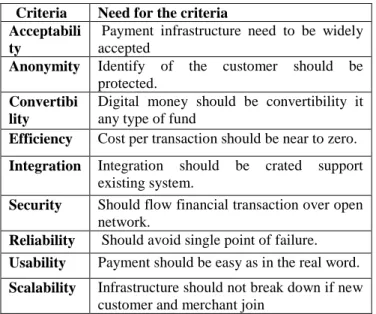
For any digital payment system to succeed. The criteria given in table ought to be satisfied.
Table 1.4
Criteria Need for the criteria
Acceptabili ty
Payment infrastructure need to be widely accepted
Anonymity Identify of the customer should be
protected. Convertibi
lity
Digital money should be convertibility it any type of fund
Efficiency Cost per transaction should be near to zero.
Integration Integration should be crated support
existing system.
Security Should flow financial transaction over open
network.
Reliability Should avoid single point of failure.
Usability Payment should be easy as in the real word.
Scalability Infrastructure should not break down if new customer and merchant join
1.5 Component of effective electronic payment system:-
1. Consumer and browser:-
A consumer interact with the online commerce system through a web browser typically a consumer first accessing a shopping mall and then uses the hyperlink from the mall to access the merchant home page.
2. Shopping mall:-
A shopping mall is where most consumer first visit for a shipping free there will be several shopping malls and it may pay to enlist with one or more well known mall.
3. Merchant systems:-
It consists of the home page and related software to manage the business.
4. Banking network:-
it consist of several components there is bank that processes the online financial transaction for the given merchant the bank maintain the account for the merchant authorize and processes the payment the merchant bank also maintain a link with the consumer bank for verifying the trans actions
1.6 Comparisons of E-Payment System:-
Comparisons of Credit Card, E-Cash ,ECheque, Smart card and Debit Card given below:-
feature Credit Card E-Cash E-Cheque Smart card Debit card
Actual payment time
Paid later Prepaid Paid later Prepaid Prepaid
Online and offline transactions Online transactions Online transactions Offline transfers
Offline transfers Offline transfer
Bank account involvement
Credit card account makes the payment
No
involvement
account makes the payment
account makes the payment
account makes the payment
Users Any legitimate
credit card users
Anyone Anyone with a bank account
Anyone with a bank or credit card account
Anyone with a bank or credit card account
Party to which
payment is
made out
Distributing Bank Store Store Store Store
Small payments
Transaction costs are high. Not suitable for small payments
Transaction costs are low, suitable for small payments Allows stores to accumulate debts until it reaches a limit before paying for it. Suitable for small payments
Transaction costs are low. Allows stores to accumulate debts until it reaches a limit before paying for it. Therefore, it is suitable for small payments
Transaction costs are low. Allows stores to accumulate debts until it reaches a limit before paying for it. Therefore, it is suitable for small payments
Transaction information face value
Can be signed and issued freely in compliance with the limit
Face value is often set, and cannot be changed Can be signed and issued freely in compliance with the limit
Can be deducted freely in compliance with the limit Can be deducted freely in compliance with the limit
Limit on
transfer
Depends on the limit of the credit card
Depends on how much is prepaid
No limit Depends on how much money is saved
Depends on how much money is saved
Mobility Yes No No Yes Yes
1.7 Objectives of E-Payment system:-
a) To identify the area of quality customer service with personal attention.
b) To establish strong relationship between bank and customer.
c) It identify how online payment system work. d) Understand different payment technology. e) To fulfill the economical requirements of the
business.
II.
PROBLEM FORMULATION
The study involves a survey on the attitude of people for not using E-Payment system even though it is easy to access, quicker mode of transaction and so on the following points on have been taken into fray while carrying out the study :-
Innovative
Reliable technology Effective business practice smart marketing
promotion good usability
carefully integration designs
E-Payments are growing at a highest rate ever. Having card has been become the need of every person. Nowadays everybody wants to use these services. The need of the study is to find out Which type of e payment most suitable? Present study covers pursuing an interesting and daring task: user acceptance of e-payment that their acceptance by end users will be maximized, and the number of joined users will justify the system’s rollout and its
further development. Without ignoring the importance of marketing, business and technological factors, this research focuses on user acceptance e-payment system(EPSs).The study to know the factors which are supporting and which are opposing while implementing a particular e-payment in India. To analyze the emerging trends of e-payment. This study is also carried out the future outlook of e-payment in India.
III.
RESEARCH METHODOLOGY
This studied have been carried out on E-Payment System. Data used in this study collected basically from the secondary sources. Primary data also collected through personal interview method conducting the person who is supposed to have knowledge about the topic. Secondary data have been collected from various sources including websites, newspapers, various published and unpublished article about pre-primary education etc. 3.1) Survey Instrument
Questionnaire sent to the person concerned with request to answer the questions and return the questionnaire. The questionnaire is sent to respondent who expected to read and understand the question and write down the reply in the space meant for the purpose in questionnaire itself. A questionnaire consists of a number of questions printed or typed in a definite order on a form or set of forms. The respondent to have answered the questions on their own. Objective type questions have been designed in survey .Some responses have
been collected from people. Like ( student ,Professional and others). The result of survey shown in graphs. The questionnaire designed on E-Payment System .Five points like Agree, Disagree, Strongly disagree, Strongly agree, Neutral.
A survey Questionnaire is enclosed in table 3.2) Data Analysis
The data collected were analyzed for the entire sample.
3.3) Result
This is a descriptive research which has studied the present conditions. The relevant data was
collected based on payment system and which e-payment type of most suitable.
IV.
DATA INTERPRETATION
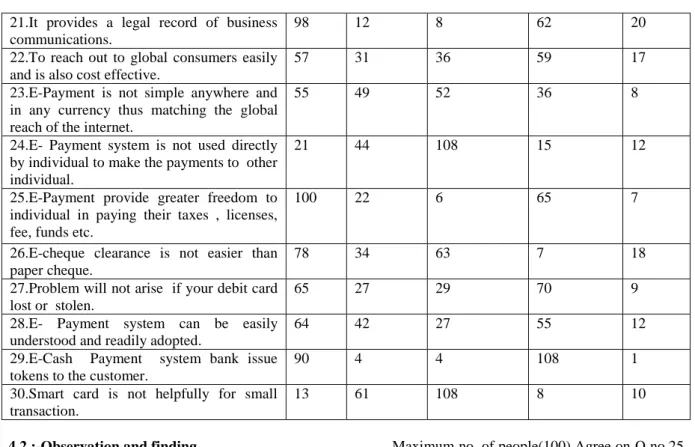
Studied have been carried out on E-Payment system Questions are related to E-Payment system in which given options are Agree, Disagree, Strongly disagree, Strongly agree, Neutral.
4.1 Overall Analysis of E-Payment System on the basis of Survey Total Respondents:200
Questions Agree Disagree Strongly
disagree
Strongly agree
Neutral 1.E-Payment System saves your time and
money.
78 30 15 68 9
2.E-Payment system is better than offline payment system.
60 69 15 38 18
3.E-Payment system open 24 hours a day. 68 32 27 50 23 4.Exchange money from one location to
another location.
70 43 11 64 12
5.Large no. of user satisfied in this. 52 50 21 52 25 6.Get quick response in this. 54 30 22 74 20
7.Reduce paper work. 97 20 14 63 6
8.It is reliable service. 73 47 49 23 8 9.Hacker can access to digitized information
and record of E-payment.
95 7 6 73 10
10.Customer has to be alert, he must deal with secure site in which using E-Payment system.
83 6 4 106 1
11.Need internet and E-Payment system use experience.
85 56 15 37 7
12.Gateway play important role in E-payment system.
70 8 3 112 7
13.Chance of making mistakes. 93 43 14 32 18 14.A greater choice for consumer and
merchant in the way they send and receive payment.
94 26 20 37 23
15.The trend is buying goods and services over the internet from online shop.
93 19 4 68 16
16.Consumer can transfer money easily without having to visit a bank.
92 12 18 42 36
17.The debit card had slow started and there growth only took off in last three year.
78 14 3 77 28
18.Consumers and suppliers can be directly approached over the Internet.
68 33 6 78 15
19.Customer can easily used only payment syste12m convenient and immediate access to fund deposit via debit card.
56 52 36 40 16
21.It provides a legal record of business communications.
98 12 8 62 20
22.To reach out to global consumers easily and is also cost effective.
57 31 36 59 17
23.E-Payment is not simple anywhere and in any currency thus matching the global reach of the internet.
55 49 52 36 8
24.E- Payment system is not used directly by individual to make the payments to other individual.
21 44 108 15 12
25.E-Payment provide greater freedom to individual in paying their taxes , licenses, fee, funds etc.
100 22 6 65 7
26.E-cheque clearance is not easier than paper cheque.
78 34 63 7 18
27.Problem will not arise if your debit card lost or stolen.
65 27 29 70 9
28.E- Payment system can be easily understood and readily adopted.
64 42 27 55 12
29.E-Cash Payment system bank issue tokens to the customer.
90 4 4 108 1
30.Smart card is not helpfully for small transaction.
13 61 108 8 10
4.2 :-Observation and finding
Fig.4.2.1:-Overall analysis of E-Payment System on the basis of survey
Fig no.1:-Overall analysis
The given graph reveals the five options i.e.(Agree, Disagree, Strongly agree, Strongly disagree, Neutral).
Fig.4.2.2.-Graph represented the number of people agreed is shown-:
Fig no.2:-Agree
Maximum no. of people(100) Agree on Q no.25 E-Payment provide greater freedom to individual in paying their taxes , licenses, fee, funds etc.Mostly people agree on time saving ,24 hour open, get quick response. Minimum no. of people (13) Agree on Q no.30 Smart card is not helpful for carrying out small transaction. Lesser number of people are satisfied with e-payment mode of transaction. Fig 4.2.3.-Graph represented the number of people Disagreed is shown-:
Fig no.3:-Disagree
Maximum no. of people (69) Disagree on Q no.2 E-Payment system is better than offline payment system. Mostly people disagree on transaction cost hidden, satisfaction of user, smart card helpfully for small transaction. Minimum no. of people(4) Disagree on Q no.29In E-Cash Payment system bank issue tokens to the customer. Less no. of people disagree on legal record of business communication. Many people think that e payment system is not reliable, in which many mistakes can occur.
Fig 4.2.4.-Graph represented the number of people Strongly disagreed is shown-:
Fig no.4:-Strongly disagree
Maximum no. of people (108,108) Strongly disagree on Q no.24 &Qno. 30. Payment system is not used directly by individual to make the payments to other individual. Smart card is not helpfully for small transaction mostly people strongly disagree on cheque clearance easier than paper cheque. Minimum no. of people (3)Strongly disagree on Q no.17 The debit card had slow started and there growth only took off in last three year .less no of people strongly disagree on easily understood, . Security is the big issue in e payment system, hacker can access account
Information.
Fig 4.2.5.-Graph represented the number of people Strongly agreed is shown-:
Fig no.5:-Strongly agree
Maximum no. of people(113) Strongly agree on Q no.12Gateway play important role in E-payment system. Mostly people strongly agree on save time, reduce paper work, exchange money etc .Minimum no. of people(7) Strongly agree on Q no.26E-cheque clearance is not easier than paper cheque. Lesser no of people strongly agree on e-payment system is not safe.
Fig 4.2.6.-Graph represented the number of people Neutral is shown-:
Fig no.6:-Neutral
Maximum no. of people Neutral on Q no.25 E-Payment provide greater freedom to individual in paying their taxes , licenses, fee, funds etc. Mostly people are Neutral on adoption easily, lost or stolen card .Minimum no. of people Neutral on Q no.29 and 10 In E-Cash Payment system bank issue tokens to the customer. Customer has to be alert, he must deal with secure site in which using E-Payment system. Lesser no. of people neutral on experience of using payment system need internet and pc experience.
Fig 4.2.7.-Overall analysis on Credit Card, Debit card, Smart Card,E-Cash, E-Cheque given below:-
Fig no.7:-Overall analysis
On the basis of present study, first remark is that despite the existence of variety of e-commerce payment systems, credit cards are the most dominant payment system. This is consequences of advantageous characteristics, most importantly the long established networks and very wide users‟
base. Second, alternative e-commerce payment systems on debit cards. In fact, like many other studies, present study also reveals that the smart card based e-commerce payment system is best and it is expected that in the future smart cards will eventually replace the other electronic payment systems. Fourth , given the limited users bases, e-cash is not a feasible payment option. Fifth E-Cheque are quite cost effective for companies that have to deal with huge volume of cheques Thus, there are number of factors which affect the usage of e-commerce payment systems. Among all these user base is most important. Make it difficult to choose an appropriate payment system. On the basis of analysis it is concluded that, smart cards based electronic payment system is best. It has numerous advantages over the other electronic payment systems.
V.
CONCLUSIONS & FUTURE
SCOPE
5.1 Conclusion
Technology has arguably made our lives easier. One of the technological innovations in banking,
finance and commerce is the Electronic Payments. Electronic Payments (e-payments) refers to the technological breakthrough that enables us to perform financial transactions electronically, thus avoiding long lines and other hassles. Electronic Payments provides greater freedom to individuals in paying their taxes, licenses, fees, fines and purchases at unconventional locations and at whichever time of the day, 365 days of the year. After analysis and comparison of various modes of electronic payment systems, it is revealed that it is quite difficult, if not impossible, to suggest that which payment system is best. Some systems are quite similar, and differ only in some minor details. Thus there are number of factors which affect the usage of e-commerce payment systems. Among all these user base is most important. Added to this, success of e-commerce payment systems also depends on consumer preferences, ease of use, cost, industry agreement, authorization, security, authentication, non-refutability, accessibility and reliability and anonymity and public policy. The Reliable and Cashless payment system offers immunity against theft of paper and e-money, and adopting e-payment solutions or systems for different reasons. In addition to cost reduction, reference was made to a number of other benefits, including improved customer service, improved working capital, increased operational efficiencies and cycle times, processing efficiencies and enhanced compliance to organizational policies and procedures .This opportunities e-payment operation increases different levels of risks for marketing. More than ten Years of Internet marketing research have yielded a set of important findings. Based on our review of these findings, it is clear that the Internet is playing a more and more important role in the field of e-payment .peoples are becoming aware of the need to measure the collaborative effects of e-payment The study reveals that the peoples were not aware and educated. They have not any knowledge of e-payment. The study is based on survey .The respondent have to answer the questions on their own. Some people satisfy with our views. But some peoples are not satisfies with us. This study states that Online e-payment provides greater reach to customers. Feedback can be obtained easily as internet is virtual in nature. Customer loyalty can be gain. Personal attention can be given by bank to customer also quality service can be served.
we came to know various strengths of e-payment System such as quality customer service, greater reach, time saving customer loyalty, easy access to information, 24 hours access, reduce paper work ,no need to carry cash easy online applications etc.
5.2 Future Scope
Throughout our experience researching online payment systems we have learned about many recent trends and new technologies involving these systems, such as using PayPal, or using Safety Pay’s Online Cash Payment Platform. You ask yourself, what are some future trends of online payment systems? We have researched and discovered that credit and debit cards will become obsolete, because we see the increasing development of mobile technology and the internet industry. We see the development of new online mobile payment technologies, which will help make your mobile device extremely flexible, because you will be able to store credit and debit card information on your SIM card. How will a consumer be able to use this technology to purchase from a certain website? When you reach the payment page on the website, your mobile device recognizes it and suggests a type a payment. After you pick your payment choice, authorization of the transaction is done by fingerprint recognition software on your mobile device, and a few security questions, which will help prevent someone from stealing your banking or personal information if your device was lost or stolen. Why would using your mobile device make transaction easier? By having your credit or debit card information already stored on your Smartphone, it will save many steps in the purchasing process on any website you choose to purchase from. Also, at the same time everyone is very comfortable with their mobile device, and by having the choice to purchase a product from your smart phone, helps the company finish the sale. Most customers want to go with the transaction process that has the least amount of steps, and by having your banking information programmed into your SIM card and it only taking a press on the “Buy Now” button, this takes away many of the steps that customers have to go through now to purchase something online. Future direction of research could be to formulate a system with similar features that supports person to person settlement as well.
REFERENCE
[1] Denis Abrazhevich.” “Electronic Payment Systems:a User-Centered Perspective and Interaction Design”, Proefschrift. -ISBN 90-386-1948-0NUR 788, 2004.
[2] Kaur Manjot, E-Commerce, Kalyani Publcation, New Delhi(2012).
[3] Ailya Izhar, Aihab khan, Malik Sikandar Hayat Khiyal, 4Wajeeh Javed and Shiraz Baig“, Designing and implementation of Electronic Payment gateway for developing countries”, journal of Theoretical and
applied information technology, vol, 26 No. 230 April 2011.
[4] Hossein Bidgoli (2002).Electronic commerce. Acadmic press. Ed. California: USA
[5] Joseph P.T, S.J (2008) An Indian perspective, 3rd edition, E-Commerce, by PHI learning private limited.
[6] Delali Kumaga Dec 2010 The challenges of implementing Electronic Payment Systems – The Case of Ghana’s E-zwich Payment System
[7] Yang Jing,” “On-line Payment and Security of E-commerce”.Proceedings of the 2009
International Symposium on Web Information Systems and Applications (WISA’09)Nanchang, P. R. China, May 22-24, 2009, pp. 046-050
[8] Kalkota Ravi, Electronic Commerce, Pubished by arrangement with Pearson Education ,Lnc and Dorling Kindersley Publishing lnc(1997).