RESEARCH PAPER
Classification of remote sensed data using Artificial
Bee Colony algorithm
J. Jayanth
a,*, Shivaprakash Koliwad
b, Ashok Kumar T.
ca
Department of Electronics & Communication, GSSSIETW, Mysore, Karnataka State 570016, India bDepartment of Electronics & Communication, VCET, Puttur, Karnataka State 57053, India c
PESITM, Shivamogga, Karnataka State 570026, India
Received 2 October 2014; revised 5 February 2015; accepted 9 March 2015 Available online 7 April 2015
KEYWORDS
Artificial Bee Colony; Classification onlooker bees; MLC;
Remote sensing data
Abstract The present study employs the traditional swarm intelligence technique in the classifica-tion of satellite data since the tradiclassifica-tional statistical classificaclassifica-tion technique shows limited success in classifying remote sensing data. The traditional statistical classifiers examine only the spectral vari-ance ignoring the spatial distribution of the pixels corresponding to the land cover classes and correlation between various bands. The Artificial Bee Colony (ABC) algorithm based upon swarm intelligence which is used to characterise spatial variations within imagery as a means of extracting information forms the basis of object recognition and classification in several domains avoiding the issues related to band correlation. The results indicate that ABC algorithm shows an improvement of 5% overall classification accuracy at 6 classes over the traditional Maximum Likelihood Classifier (MLC) and Artificial Neural Network (ANN) and 3% against support vector machine.
2015 National Authority for Remote Sensing and Space Sciences. Production and hosting by Elsevier B.V. This is an open access article under the CC BY-NC-ND license (http://creativecommons.org/licenses/ by-nc-nd/4.0/).
1. Introduction
Remote sensing (RS) data with its ability for a synoptic view observe the area of interest over the earth at different res-olutions. Extraction of land cover map information from remote sensing images is a very important and challenging task in RS data analysis. Hence, in the above context, accurate image classification results are a pre-requisite. Remote sensing
imagery with high resolution data (spatial, spectral, radiometric and temporal) have made analysts to constantly explore the image processing and data mining techniques to exploit their potential in extracting the desired information efficiently from the RS data to improve classification accuracy. Moreover, obtaining satisfactory classification accuracy over urban/semi urban land use/land cover (LU/LC) classes, particularly in high spatial resolution images, is a present day challenge. Because it is intuitive from the simple visual observation that urban/semi urban areas comprise of roof tops made of reinforced concrete slabs, clay tiles, corrugated plastic, fibre and asbestos sheets, parking lots, highways, interior tar roads, vegetation, lawn, gar-den, tree crowns, water bodies, soil, construction sites, etc. and they show abundant sub-classes within classes (Mondal et al., 2014). Apart from the above, tall trees and buildings casting
* Corresponding author.
E-mail addresses: [email protected] (J. Jayanth), [email protected](S. Koliwad),[email protected]
(T. Ashok Kumar).
Peer review under responsibility of National Authority for Remote Sensing and Space Sciences.
H O S T E D BY
National Authority for Remote Sensing and Space Sciences
The Egyptian Journal of Remote Sensing and Space
Sciences
www.elsevier.com/locate/ejrs
www.sciencedirect.com
http://dx.doi.org/10.1016/j.ejrs.2015.03.001
1110-98232015 National Authority for Remote Sensing and Space Sciences. Production and hosting by Elsevier B.V. This is an open access article under the CC BY-NC-ND license (http://creativecommons.org/licenses/by-nc-nd/4.0/).
shadows on the adjacent classes, the orientation and geometry of the roof tops, and various man-made structures made of same materials but having different colours stand spectrally dis-tinct even though they belong to the same class (Sylla et al., 2012). Also, the urban landscapes composed of features that are smaller than the spatial resolution of the sensors lead to mixed pixel problem.
Based on the training process, the classifiers are grouped into supervised and unsupervised classifiers; based on their theoretical modelling considering the type of distribution of data the classifiers are also categorised into parametric (sta-tistical) and non-parametric (non-statistical) classifiers (Voisin et al., 2013); soft and hard classifiers examine only the spectral variance ignoring the spatial distribution of the pixels belonging to the classes and other artificial intelligence methods still have limitations because of the complexities of remote sensing classification (Singh et al., 2014). The paramet-ric algorithms evolved so far are parametparamet-ric in nature and can be summarised as ISODATA, parallelepiped, minimum dis-tance-to-means, Maximum Likelihood Classifier, Bayesian classifier, etc. The limitation of parametric classifiers is that they show limited success on spectrally overlapping features (Voisin et al., 2013). The non-parametric classifiers include decision tree, Artificial Neural Network (ANN), support vec-tor machines, fuzzy and neuro-fuzzy classifiers, etc. (Baraldi and Parmiggiani, 1995; Chen, 1999; Lee et al., 1999). The clas-sification rules generated in the decision tree classifier are easy to understand and the classification process is analogues to human reasoning (Rawat et al., 2013). Moreover, decision tree exhibits higher classification accuracy over MLC but the num-ber of rules generated (tree size) increases with the increase in the training data set and the number of classes (Ashok Kumar, 2011). Further, the practical employability of Artificial Neural Network and support vector machines is not encouraging since both are very slow in training and learning phase and slowly covering optimal solution.
Genetic Algorithm (GA), gives better results for classifica-tion of medium resoluclassifica-tion images but it is prone to overfitting the training set and derived rule set due to mutation crossover and are difficult to interpret the classes which are spatially homogeneous, i.e., barren land, degraded land etc.
(Bandyopadhyay and Maulik, 2002). Particle Swarm
Optimisation (PSO), produces higher classification accuracy for coarse resolution image and it identifies the urban area cor-rectly but it fails to update the velocity of each particle when there is a spectral overlapping between two classes such as urban and sand has same reflectance value in LISS III data (Yang and Deb, 2010). Further, the cuckoo search method is capable of searching each proportion of every individual class within a single pixel by un-mixing all available land class infor-mation in a pixel and assigning the pixel to multiple classes. But the major drawback of the cuckoo search is that it is very unstable when feature space and training areas are changed (Yang and Deb, 2010). The Ant Colony Optimisation (ACO) method uses a sequential covering algorithm and produces bet-ter accuracy compared with traditional statistical methods, ACO has number of advantages. First, ACO algorithm is dis-tribution free, which does not require training data to follow a normal distribution. Second, ACO is a rule induction algo-rithm, which is more explicit and comprehensible than mathe-matical equations. Finally, ACO requires minimum understanding of the problem domain. In fact, XOR is a
difficult problem in rule induction algorithms. ACO uses sequential covering algorithm to identify each class, so the rules are ordered. This makes it difficult to interpret the rules at the end of the list, due to spectrally homogenous class such as land with/without scrubs, sandy area etc., which makes rule in the list to be dependent on all the previous rules. Finally, this ACO takes a much longer time to discover rules than the non-parametric methods (Liu et al., 2008).
Artificial Bee Colony (ABC), relatively a new member used for classification of data, was proposed by Tereshko, 2000. Intelligent behaviour on the swarm has provided a new tech-nique for classifying the remote sensing data efficiently (Cuevas et al., 2011). Based on the motivation of many nature inspired algorithms, classification of data can be a mimic beha-viour of insects for searching best food source, building of optimal nest structure, etc. Waggle dance is one of the mecha-nisms to share the located food source which indicates a good candidate for developing new intelligent search for distributed computing, local heuristics and knowledge from past experi-ence (Zhang et al., 2010).
It has been demonstrated that Artificial Bee Colony clas-sifier produces satisfactory results in multi-objective environ-mental/economic dispatch, data clustering and medical image classification (Pan et al., 2010; Sabat et al., 2010; Stathakis and Vasilakos, 2008). However, they have better search of signature classes with better attribute compared to other clas-sification algorithm such as MLC.Banerjee et al. (2012) com-pared ABC with other algorithms and the study demonstrates that ABC produces better classification accu-racy on LISS III data of 23 m resolution data. Also, when compared with the traditional statistical classifiers, ABC requires minimum understanding of the problem domain and does not require complex training data to follow a nor-mal distribution of data. The ABC recruit bees to update itself to cope better with attribute correlation and updating is directly based on performance of classification class from the knowledge of waggle dance (Xu et al., 2010; Dorigo and Stu¨tzle, 2005). Therefore, it is ascertained that these types of procedures have a greater potential in improving classification accuracy.
The main objective of this work is to utilise the bee commu-nication and food search method of information exchange to achieve maximum classification accuracy.
Hence, in this work ABC algorithm has been selected for classification of high resolution data as compared to other swarm intelligence techniques due to following reasons.
Bees are very optimal well defined workers
Distribute the work load among themselves which does not misclassify the data which is spectrally homogeneous and spectral overlapping.
The dancing behaviour helps in optimal design.
All the above points are taken care of in the ABC algo-rithm. Hence, in the RS data classification, the searching ele-ment is not known initially. However, just like a random walker like ant, PSO, cuckoo search, etc., the search will be initiated, but at each iteration, the new values derived values help in reaching towards the final classified data without mis-classifying the land cover classes. Hence the ABC is one of the promising techniques over other proven classification techniques.
2. Data
2.1. Data products
Table 1provides the specification of the image data products being used in this study. The multi-spectral data (5.6 m) are of LISS-IV (Linear Imaging and Self Scanning) sensor of IRS P-6 (Indian Remote Sensing Satellite) and panchromatic image (2.5 m) is of IRS P-5 satellites launched and maintained by the Indian Space Research Organisation (ISRO). The satel-lite data were procured from the National Remote Sensing Centre (NRSC), Hyderabad, and Karnataka State Remote Sensing Agency (KSRAC), Bangalore, India.
2.2. Study area
The study area considered for this work is the Coastal region of Mangalore, Karnataka; its geographical co-ordinates are between 12510 3200–12 570 4400 N latitude and 74 510 3000–
74 480 0100 E longitudes with an elevation of approximately
0.0 m above mean sea level (AMSL). The image dimension of the study area is 1664·2065 pixels in MS data and 2593·4616 pixels in pan-sharpened data. The data comprise forest plantation, crop plantation, urban area, wetlands and water body (Fig. 1). The climate of the study area is relatively mild and humid in winter and dry and hot in summer. The interactions such as extensive agricultural activities, conversion of marshy land to build up land and tourism activities have resulted in a considerable change in the study area. Therefore the above area has been considered as an ideal test-bed site for the study of change detection technique.
2.3. Image registration
The images were geometrically corrected and geo-coded to the UTM with a minimum of 3 GCPs required for registration. To increase accuracy in the ROI, 10 ground control points have been selected and re-sampled with cubic-convolution. The accuracy of image registration was accurate within one pixel with an RMS error of 0.2 pixels.
2.4. Image fusion
Data of higher spatial resolution bring out better discrim-ination between shapes, features and structures for an accurate identification of land use and land cover classes, whereas finer spectral resolution allows a better discrimination between
various classes in spectral space in the remotely sensed data. By fusing the data of higher spatial resolution and multi-spec-tral data it is possible to derive composite fused data which exhibit the features of both data. The commonly employed data fusion techniques are Intensity-hue-saturation (IHS) transform, Principal component analysis (PCA), Brovey trans-form (BT), Multiplicative technique (MT), Wavelet transtrans-form (WT) and WT+IHS. This study has employed WT+IHS data fusion technique as it exhibits satisfactory results in the evalua-tion of change detecevalua-tion over coastal land cover classes. The cubic convolution algorithm has been employed for re-sam-pling of fused data.
Table 1 Details of the data products used in our research work.
Sl. No. Satellite and data type Date of acquisition Spectral resolution Spatial resolution 1. IRS P-6 26th Dec 2008 Green (0.52–0.59lm); 5.8 m
(Resourcesat 1) Red (0.62–0.68lm); Multi-spectral (2) Infrared (0.77–0.86lm)
2. IRS P-5 7th Jan 2008 0.55–0.99lm 2.5 m (Cartosat-1)
Panchromatic (2)
3. Artificial Bee Colony (ABC)
The ABC algorithm is based on bee’s behaviour in finding the food source positions without the benefit of visual information (Karaboga and Ozturk, 2011). The information exchange from bees is integrated knowledge about which path to follow and quality of food through a waggle dance. Bees calculate their food source using probabilistic selection and abounding source by sharing their information through eagle dance and food source with less probability of producing new food source in neighbourhood of old source in relation to their profitability. The ABC has three necessary components: food source, employed bee, scout bee and onlooker bee, and the behaviours are: selection and rejection of the food source.
Employed Bee: The employed bees store the food source information which includes the distance, the direction and share with others according to a certain probability and shares with other bees waiting in the hive, richness and extraction of energy, nectar taste and fitness of the solution.
Onlooker Bee:It takes the information from selected num-bers of employed bee and decides the probability of higher nectar amount information of the food source are selected according to profitability of food source.
Scout Bee: If the position of food source is not improved through maximum number of cycles, food source will be removed from the population; employed bee becomes a scout bee and elects a new random food source. Based on the per-formance of fitness value, if the elected new food source is better than rejected one then scout bee becomes employee bee. This process is repeated until the maximum number of cycles to determine the optimal solution of food source.
The main steps can be described as follows:
(1). Bees are initialised in a colony asXi= {xi1,xi2,. . .,xiN},
where i represents the food source in the colony, n
denotes population size. FitnessFiis calculated for each
employed bee xi which is proportional to the nectar
amount of the food source and records maximum nectar amount in the positioni.
(2). Employed bees will identify new food positionviin the
neighbourhood of the old one in its memory by
vi¼xiþ ðxixkÞ /kf1;2;. . .;Ng; ð1Þ
wherekis an integer number but it is different fromi,/is a random real number in [1, 1]. Fitness values of xiis
com-pared with the value ofvi, ifviis better thanxi,viis replaced
with xi, otherwise fitness value of xi is retained, these types
of mechanism are done by greedy selection.
(1). After the search of neighbourhood task completed by employed bees, each onlooker bee chooses a food source depending on the fitnessFiofxi, the probability value of
Pi chosen by onlooker bee is calculated according to
Eqs.(2) and (3). Pi¼ fiti PSN n¼1fitn ð2Þ fiti¼ 1=1þfi 1þabsðfiÞ ð3Þ
If onlooker bee has selected one food source depending on the probabilityPi, modification ofPiis done according to Eq. (1) where fitness strategy is done using roulette selection to check whether there are some abandoned solutions or not in
xiand will be replaced by the food source if it has better nectar
amount compared to previous valuexi. If the position of one
employed bee cannot be improved through a predetermined number of cycles, the employed bee will become a scout bee and produce a food source randomly according to Eq. (4), a new solution is generated.
xi¼minþ ðmaxminÞ / ð4Þ
3.1. ABC for remote sensing classification
Main component of the proposed ABC algorithm is to select classes by a bee. Selection of classes corresponds to Digital Number (DN) values of images. Bees are represented by pixels of images, Food sources are land cover features, employed bees are simulated by pixels belonging to classified dataset which con-tains the function values (nectar quality) of the solution, are cal-culated using euclidean distance (Karaboga and Basturk, 2008). The following main components in this proposed algorithm are shown inFig. 2.
Initialisation:Bees select the classes depending on various parameters such as position, pattern, location and associa-tion of classes depending on its Digital Number (DN) value. Each employed bee selects the classes on the dataset depending on attributes of dataset. Each class has its lower range of DN values and upper range of DN values for selec-tion of classes within cover percentage.
To evaluate the performance of the data, selection of points from datasets is stored in the UCI datasets for training and sig-natures are controlled by the size of a colony (land cover classes), by limiting the count of maximum cycle of a bee for a determining the weight of a class and its bound value lim-itation. In each training period, the classes are divided into
Kclasses. For each time, a single subset of employed bee is used to update the weight of bee to new weight and remaining
Ksubsets are retained with old weight to compare with each new weight for the validation of class.
Classification strategy:Classifications are done based on the upper and lower bound of DN values, which can identify the specific class from different groups. The procedure is defined in Eq.(5)and Eq.(6)as below:
Lower bound¼fk1 ðFmaxFminÞ ð5Þ
Upper bound¼fþk2 ðFmaxFminÞ ð6Þ
Maximum DN values of a class are represented byFmaxand Fminis the minimum values.Frepresents the original DN value of class.k1andk2are random variables [0 1].
Fitness function:Fitness values are evaluated depending on the land cover class and maximum cycle of an employed bee and scout bee to cover the class depending on their weights.
If the class is in between the lower and upper range it pre-dicts the class depending on their evaluated record of employed bee and calculate the fitness and proves this has an predictive record. Its representation is as below:
Fitness Value¼TN=TNþFPTP=TPþFN ð7Þ
(I). True Negative (TN):Classes that are not covered by
fea-ture and that do not have class in the predictive class. (II). True Positive (TP):Classes that are in the features and
covered by predictive class.
(III). False Positive (FP):Number of bees (pixel) covered by
class, but the class is not covered by predictive class. (IV). False Negative (FN):Number of bees (pixel) not covered
by the class, but the class is covered by predictive class.
To avoid overfitting when learning algorithm induces a classifier that classifies all instances in the training set, includ-ing the noisy ones, correctly. To avoid this pessimistic pruninclud-ing approach is used to remove redundant feature limitations, it is repeated till all the classes are evaluated.
Search and prediction strategy: Employed bee starts to search the location of class depending on the DN values and the weights of each class. When an employed bee does not meet the requirement or reach the maximum cycle num-ber it calculates and updates new weight of a class.
Vij¼Xij ð8Þ
whereVij represents the position of the new food source and
Xij stands for neighbour of food source, here represented by
euclidean distance between food source and particular bee. In addition to theseiandKare between 1 and 0, butKis dif-ferent value fromiandjrepresents the dimension. In our work dimension is equal to the number of class in the dataset.Prediction strategy will determine which class should be predicted when there are mixed classes or when pruned rule is applied when the classes are unknown. Three main steps are as follows.
(a) Calculate the weight for each class and predict new weight for each class which covers the test data record when maximum cycles are not reached for a given class. (b) Classes are predicted depending on the upper and lower
bound weight according to different possible classes. (c) Select class which has the highest prediction class as the
final class.
Prediction is defined as below prediction¼ ðarule fitness valueÞþ
ðbrule cover percentageÞ ð9Þ
where a and b are two weighted parameters, a€[0,1] and
b= (1a).
Cover percentage¼TP=N ð10Þ Selection: The proposed phases are highlighted. In these phases, 10% of all possible solutions, which have the lowest fitness value, are to be updated. Hence, the proposed phase only updates poor possible solutions. The poor possible solutions are mutated around thegbestfood source, in this phase. The equation for this phase is:
Vij¼ybest;jþuijðXpjxkjÞ ð11Þ
whereVijis the candidate solution of new food sources,ybest,j
is the global best food source withj-th dimension,xpjis the
p-th food sources of j-th dimension and ykjis the k-th food
sources ofj-th dimension.pandkare randomly chosen food sources and they are mutually exclusive. Meanwhile the parameteruij is a control parameter that represents random
numbers within [1, 1]. As poor possible solutions are mutated
DWT+IHS Fused Image
Initialize Solution belonging to feature class
Training Set and Testing Solution
Initialize of Bee colony & selecting one class each
Calculate Distance of Pixel selecting one pixel each time[P] Calculate the fitness value for a class (f)
P<f
Remove limitation from rule
Neighbour Exhaustive
Go to next neighbourhood solution
Select Solution with Max Probability
Explore for neighbour of selected food source assigned to onlooker bees
Apply 10% of all possible solutions that has mixed class
Update the poor food source (Class) around global best class
Replace the abound using scoutt bee
No instance belongs to class All Pixels classified END yes NO yes NO NO NO yes yes
around thegbestpossible solution, the modified poor possible solutions would be fitter. This way, the number of fit possible solutions increases with increasing generation. Now, there exists a higher probability that a selected possible solution will be mutated with a fit possible solution during employed and onlooker bee phases, as fitness of every possible solution is higher in the proposed algorithm. Hence, the produced candi-date solution will be fitter than the existing possible solution.
4. Implementation and results
The image classification and evaluation were performed for six classes using MLC, SVM, ANN and ABC algorithm on panchromatic fused LISS-IV data of 2.5 m spatial resolution. Selection of training samples is directly related to the DN value of class and it is the initial step for Artificial Bee Colony clas-sification. A total of 3090 samples are used to identify the LC classes i.e., 1090 samples as the training data set (Employed bee), and the remaining 2000 samples for validating the classes. The ABC classification was accomplished using the MATLAB software, the supervised classification based on MLC algo-rithm, Support Vector Machine (SVM), Artificial Neural Network (ANN) and validation were carried out in the
ENVI RS image processing software. The accuracy of each class is determined by using OCA (Overall classification accu-racy), PA (Producer’s accuracy) and UA (User’s accuracy).
For the implementation of the SVM classifier, we kept con-stant: the gamma parameter in the kernel function (value: 0.167) the penalty parameter (value: 100) and the pyramid lay-ers (value: 0); and we tested different kernel types (functions): polynomial (1st–6th order), sigmoid and radial basis functions concerning their accuracy results with a 4th order polynomial function (El-Asmar et al. 2013).
For the implementation of the Feed-Forward ANN, we kept constant: the training threshold contribution (value: 0.167), the training rate (value: 0.2), the training momentum (value: 0.9) and the number of training interactions (value: 1000) but we tested different number of hidden layers (one and two) and different activation functions (hyperbolic and
logistic). The Feed-Forward, one hidden layered ANN with logistic function.
This Artificial Bee Colony algorithm requires the speci-fication of the following parameters.
(1) No of bees:This is the maximum number of bees for a specified class constructed during iteration.
(2) Minimum number of training samples per class:This is the minimum number of training samples that each class must cover to help avoiding pruning.
(3) Maximum number of uncovered training samples in the training set: The process of calculating the weights for each class until the number of uncovered training sam-ples is smaller than this threshold and updates itself to new weight.
(4) Maximum number of cycles: The program stops when the number of iterations is larger than this threshold.
The parameter settings of ABC are as follows: No. of bees = 220 (Employed bees = 60 and Onlookers bee = 160); Minimum training samples = 20, Maximum uncovered train-ing samples = 12; and maximum iterations for onlookers bee = 220. The sensitivity of selecting two parameters such as selection of number of bees and minimum training samples are shown inFig. 3. Classification result stabilises when num-ber of bees reaches 60 and the relationship changes when maxi-mum number of cycles reaches above 200. Results are compared with MLC, SVM, ANN and ABC through three cri-teria namely, the same training data (1090 samples) are used for the classification, and the same test data (2000 samples) were used for validation, the overall classification accuracy, and the Kappa coefficient. Total time taken by the ABC is 5 min to complete the identifying of each class by using the training data.
The classification result of the MLC, SVM, ANN and ABC is shown inFig. 4. The comparison between them shows that ABC algorithm performs better than MLC, SVM and ANN. Area ‘A’ in Fig. 4 is actually land covered with scrubs, degraded scrubs, fallow land and build up areas, which
MLC and SVM misclassified as degraded scrub whereas ANN correctly classified the degraded scrub area and land area as scrub but it was unable to separate fallow land and urban land. However, ABC classified all the classes correctly in Area A. Further, area B is a mixture of land with scrubs and degraded land. But MLC has misclassified this land area as land with scrubs and ANN as fallow land while SVM and ABC classified the area correctly as land with scrubs and degraded land. Another land cover area ‘C’ which contains only land with scrub has been classified as degraded land by MLC and
SVM, fallow lands by ANN but correctly classified by the pro-posed technique. However, the one more area under inves-tigation containing water body ‘D’ has been misclassified as fallow land in the ABC classified image (Fig. 4A–D).
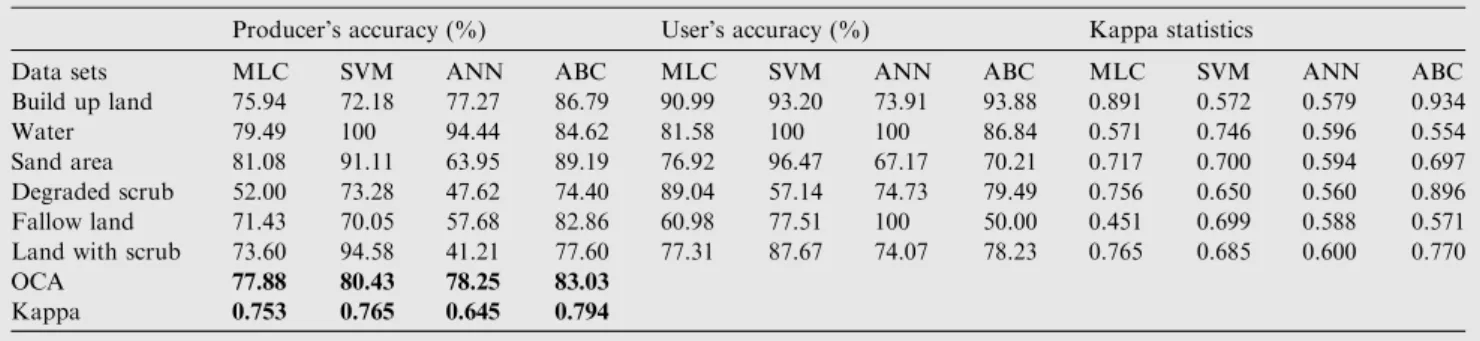
From Table 2, it is intuitive that the highest OCA of 83.03% is obtained in the ABC technique for the training data-set size of 3090 pixels, whereas the OCA in MLC for the same training set size at 6 classes is 77.88%. The SVM and ANN classifiers produced OCA of 80.43% and 78.25%, respectively. Further ABC shows the highest Kappa coefficient of 0.794,
(A) MLC (B) ABC
(c) ANN (D) SVM
Build up land water sand area Fallow land Degraded Scrub Land with scrub
Figure 4 Land cover classification in the area of Mangalore coast: (A) MLC; (B) ABC; (C) ANN; (D) SVM.
Table 2 Behavioural study of ABC for 6 classes: comparison of classwise accuracy of MLC, SVM, ANN and ABC.
Producer’s accuracy (%) User’s accuracy (%) Kappa statistics
Data sets MLC SVM ANN ABC MLC SVM ANN ABC MLC SVM ANN ABC Build up land 75.94 72.18 77.27 86.79 90.99 93.20 73.91 93.88 0.891 0.572 0.579 0.934 Water 79.49 100 94.44 84.62 81.58 100 100 86.84 0.571 0.746 0.596 0.554 Sand area 81.08 91.11 63.95 89.19 76.92 96.47 67.17 70.21 0.717 0.700 0.594 0.697 Degraded scrub 52.00 73.28 47.62 74.40 89.04 57.14 74.73 79.49 0.756 0.650 0.560 0.896 Fallow land 71.43 70.05 57.68 82.86 60.98 77.51 100 50.00 0.451 0.699 0.588 0.571 Land with scrub 73.60 94.58 41.21 77.60 77.31 87.67 74.07 78.23 0.765 0.685 0.600 0.770
OCA 77.88 80.43 78.25 83.03
and the other techniques stand in the descending order like, SVM (0.765), MLC (0.753) and ANN with the lowest kappa value of 0.645. Taking into consideration the qualitative and quantitative comparisons, it is evident that the Artificial Bee Colony method out performs Support Vector Machine, Maximum Likelihood Classifier and Artificial Neural Network based classifiers and exhibited higher overall classifi-cation accuracy.
5. Conclusion
The performance of RS data classification using swarm intelli-gence can overcome the limitation in constructing proper clas-sifier, when the study area is complex and spectral signature of the classes overlap. This work has presented a new method for classifying RS data using Artificial Bee Colony algorithm. ABC is a multi-agent system with a simple intelligence which can complete the task through cooperation. ABC is based on waggle dance which updates the distance of class values (Nectar amount) and can be represented without using com-plex equation. As a result, ABC is capable of providing better classification results. This method has been applied in classifi-cation of RS images of Mangalore coastal area, India. The comparison of classification results is carried out between the ABC, MLC, SVM and ANN methods. The overall accuracy obtained in the ABC method is 83.03% with a Kappa coeffi-cient of 0.7949. When compared to MLC, SVM and ANN, the ABC method is found to be more effective in the classifica-tion of RS data.
However, there is a limitation in using this method in identifying classes. The classes identified by scoot bees have larger number of boxes (classes) in feature space. This is because some of the scout bees become an onlooker’s bee if the threshold reaches maximum iteration. In future research classification rule can be applied using XOR condition to iden-tify the classes.
Acknowledgment
The authors graciously thank Dr. V.P Lakshmikanth, Karnataka State Remote Sensing Application Center (KSRSAC), Bangalore, for providing the data products for this study. Thanks also go to Dr. Dwarakish, Associate Professor, NITK, Surathkal, DR. K.S. Shreedhara, UBDTCE, Davangere and the staff at KSRSAC, Mysore, for their assistance and help rendered during field work.
References
Ashok Kumar, T., 2011. Advanced Image Processing Techniques for Land Feature Classification. Lambert Academic Publishing AG & CO-KG (Dec-2011).
Bandyopadhyay, S., Maulik, U., 2002. Genetic clustering for automatic evolution of clusters and application to image classifica-tion. IEEE Pattern Recognit. 35, 1197–1208.
Banerjee, Srideepa, Bharadwaj, Akanksha, Gupta, Daya, Panchal, V.K., 2012. Remote sensing image classification using artificial bee colony algorithm. Int. J. Comp. Sci. Inf. 2 (3), 67–71.
Baraldi, A., Parmiggiani, F., 1995. A neural network for unsupervised categorization of multivalued input pattern: an application to satellite image clustering. IEEE Trans. Geosci. Remote Sens. 33 (2), 305–316.
Chen, C., 1999. Fuzzy training data for fuzzy supervised classification of remotely sensed images. In: Proceedings of 20th Asian Conference on Remote Sensing (ACRS 1999): 460–465.
Cuevas, E., Seccio´n-echauri, F., Zaldivar, D., Pe´rez-cisneros, M., 2011. Multi-circle detection on images using artificial bee colony (ABC) optimization. Soft Comput. 22, 15–26.
Dorigo, M., Stu¨tzle, T., 2005. Ant Colony Optimization. Prentice Hall of India Private Limited, New Delhi, India.
El-Asmar, Hesham M., Hereher, Mohamed E., El Kafrawy, Sameh B., 2013. Surface area change detection of the Burullus Lagoon, North of the Nile Delta, Egypt, using water indices: a remote sensing approach. Egypt. J. Remote Sens. Space Sci. 16 (2), 119–123.
Karaboga, D., Basturk, B., 2008. On the performance of artificial bee colony (ABC) algorithm. Appl. Soft Comput. 8, 687–697.
Karaboga, D., Ozturk, C., 2011. A novel clustering approach: artificial bee colony (ABC) algorithm. Appl. Soft Comput. 11, 652–657.
Lee, S., Han, J., Chi, K., Suh, J., Lee, H., Miyazaki, M., Akizuki, K., 1999. A neuro-fuzzy classifier for land cover classification. Proc. IEEE Int. Conf. Fuzzy Syst. 20, 1063–1068.
Liu, Xiaoping, Li, Xia, Liu, Lin, He, Jinqiang, Ai, Bin, 2008. An innovative method to classify remote-sensing images using ant colony optimization. IEEE Trans. Geosci. Remote Sens. 46 (12), 4198–4208.
Mondal, Saptarshi, Jeganathan, C., Sinha, Nitish Kumar, Rajan, Harshit, Roy, Tanmoy, Kumar, Praveen, 2014. Extracting seasonal cropping patterns using multi-temporal vegetation indices from IRS LISS-III data in Muzaffarpur District of Bihar, India. Egypt. J. Remote Sens. Space Sci. 17 (2), 111–121.
Pan, Q.K., Fatih-tasgetiren, M., Suganthan, P.N., Chua, T.J., 2010. A discrete artificial bee colony algorithm for the lot-streaming flow shop scheduling problem. Inf. Sci. 26, 65–78.
Rawat, J.S., Biswas, Vivekanand, Kumar, Manish, 2013. Changes in land use/cover using geospatial techniques: a case study of Ramnagar town area, district Nainital, Uttarakhand, India. Egypt. J. Remote Sens. Space Sci. 16 (1), 111–117.
Sabat, S.L., Udgata, S.K., Abraham, A., 2010. Artificial bee colony algorithm for small signal model parameter extraction of MESFET. Eng. Appl. Artif. Intell. 23, 689–694.
Singh, Prafull, Gupta, Ankit, Singh, Madhulika, 2014. Hydrological inferences from watershed analysis for water resource management using remote sensing and GIS techniques. Egypt. J. Remote Sens. Space Sci. 17 (2), 111–121.
Stathakis, D., Vasilakos, A., 2008. Comparison of computational intelligence based classification techniques for remotely sensed optical image classification. IEEE Trans. Geosci. Remote Sens. 44 (8), 2305–2318.
Sylla, L., Xiong, D., Zhang, H.Y., Bangoura, S.T., 2012. A GIS technology and method to assess environmental problems from land use/cover changes: Conakry, Coyah and Dubreka region case study. Egypt. J. Remote Sens. Space Sci. 15 (2), 31–38.
Tereshko, V., 2000. Reaction diffusion model of a honeybee colony’s foraging behavior. In: Schoenauer, M. (Ed.), Parallel Problem Solving from Nature VI, Lecture Notes in Computer Science. Springer-Verlag, Berlin, pp. 17–19.
Voisin, Aurelie, Krylov, Vladimir A., Moser, Gabriele, 2013. Supervised classification of multi-sensor and multi-resolution remote sensing images with a hierarchical copula-based approach. IEEE Trans. Geosci. Remote Sens. 20, 1–18.
Xu, C., Duan, H., Liu, F., 2010. Chaotic artificial bee colony approach to uninhabited combat air vehicle (UCAV) path planning. Aerosp. Sci. Technol. 14, 535–541.
Yang, X.-S., Deb, S., 2010. Engineering optimisation by cuckoo search. Int. J. Math. Model. Numer. Optim. 1 (4), 330–343.
Zhang, C., Ouyang, D., Ning, J., 2010. An artificial bee colony approach for clustering. Expert Syst. Appl. 37, 4761–4767.