O P T I C S 2016 © The Authors, some rights reserved; exclusive licensee American Association for the Advancement of Science. Distributed under a Creative Commons Attribution NonCommercial License 4.0 (CC BY-NC). 10.1126/sciadv.1501748
There are many ways to spin a photon:
Half-quantization of a total optical
angular momentum
Kyle E. Ballantine,* John F. Donegan, Paul R. Eastham†
The angular momentum of light plays an important role in many areas, from optical trapping to quantum information. In the usual three-dimensional setting, the angular momentum quantum numbers of the photon are integers, in units of the Planck constantħ. We show that, in reduced dimensions, photons can have a half-integer total angular momentum. We identify a new form of total angular momentum, carried by beams of light, comprising an unequal mixture of spin and orbital contributions. We demonstrate the half-integer quantization of this total angular momentum using noise measure-ments. We conclude that for light, as is known for electrons, reduced dimensionality allows new forms of quantization.
INTRODUCTION
Effects due to the angular momentum of light have been studied since the first measurements of the torques exerted on wave plates (1). Versions of these optomechanical effects now appear in experiments on optical trapping and manipulation (2) and enable the remote detection of ro-tation (3). Angular momentum effects are also emerging in the radio-frequency domain, for applications in astronomy and communications (4). Fundamental interest focuses on optical angular momentum in the quantum regime (5). The angular momentum of single photons has been measured (6), and entanglement (7) and Einstein, Podolsky and Rosen correlations (8) have been studied. This unique degree of free-dom provides a basis for quantum information applications, with high-dimensional entanglement (9), quantum dense coding (10), and efficient object identification (11) recently demonstrated.
Central to these developments is the quantization of the angular mo-menta of the photon, which forms a discrete state space (12). The rele-vant quantum numbers are the eigenvalues of the spin and orbital angular momentum operators,SzandLz, in units of the reduced Planck
constantħ. The spin quantum number describes the circular polarization of light and takes values of ±1. The orbital quantum number appears in twisted beams, with phase-winding factorseilq, where
qis the azimuthal angle, and takes integer valuesl(13). Thus, the quantum numbers for the total angular momentum,Jz=Lz+ Sz, are the integers.
However, a general feature of two-dimensional systems is that angular momentum need not be quantized in the usual way. The orbital angular momentum of an electron orbiting in two dimensions around a magnetic flux need not be an integer, but can include an arbitrary fractional offset (14). The same mechanism introduces a phase factor in the exchange of particle-flux composites, implying that such particles have generalized or fractional statistics (15) as well as fractional spin. These concepts have played an important role in understanding the quantum Hall effect, where the low-lying quasiparticles have fractional statistics that are related to their fractional charge (16).
Here we show, in analogy to the theory of fractional spin particles (14), that an unexpected half-integer total angular momentum can arise for light. To do this, we note that the formJz =Lz+ Sz for the total
angular momentum of light follows from the rotational symmetry of Maxwell’s equations (17,18). However, experiments involve beams of light propagating in a particular direction; thus, this full rotational symmetry is not present. The only potential symmetries, which determine the form of the angular momentum operators according to Noether’s theorem, are rotations of the two-dimensional cross section of the beam around the propagation direction. We will show that this restricted symmetry leads to a new form of total angular momentum, which has a half-integer, that is, fermionic, spectrum. We will experimentally dem-onstrate this quantization by showing that the noise in the total angular momentum current corresponds to the fractional quantumħ/2.
RESULTS
Forms of total angular momentum
We begin by establishing the possible forms of total angular momentum operator for photons in a beam of light. We consider the case of a par-axial beam, which is well approximated in experiments, and where the separation of spin and orbital angular momenta is well established (19). Such a beam is specified by a two-component complex vector fieldE (Jones vector), whose components give the amplitudes of each polar-ization across the beam. We take circularly polarized states as the basis and use polar coordinates (r,q) across the beam. The angular momentum operators are the generators of rotations that act on this field. In the par-axial limit, they include the third Pauli matrixSz=ħs3, which rotates the polarization direction homogeneously across the beam, and the usual orbital formLz=−iħ(d/dq), which rotates the beam profile (image) but
leaves polarization unchanged (20). The eigenstates ofSzcorrespond to
uniform, circularly polarized beams, and those ofLzcorrespond to
uniformly polarized beams, such as Gauss-Laguerre beams, where the amplitude varies aseilq.
For a general three-dimensional field, Sz andLz are not valid as
independent angular momenta because they do not preserve the trans-versality of the electromagnetic field (17,21). They appear in the usual combinationJz =Lz+ Sz for the total angular momentum, which is
uniquely determined by the rotational invariance of Maxwell’s equations in three space dimensions (18,21). However, in a beam of light, both polarization and image rotations, around the beam axis, keep the fields transverse, such that both spin and orbital angular momenta are valid School of Physics and CRANN, Trinity College Dublin, Dublin 2, Ireland.
*Present address: Scottish Universities Physics Alliance, School of Physics and Astron-omy, University of St Andrews, St Andrews KY16 9SS, UK.
†Corresponding author. Email: [email protected]
on August 18, 2016
http://advances.sciencemag.org/
and independent (13,22). Thus, we may consider the possibility of a total angular momentum that is a general linear combination,Jz,g= Lz+gSz.
The operatorJz,ggenerates simultaneous rotations of the polariza-tion and image, in general, through different angles. As discussed below, it is related to measurements using devices that couple the spin and orbital degrees of freedom and can be defined for arbitraryg. However, it cor-responds to an angular momentum of the photon only if the field can be expanded in terms of its eigenfunctions. Thus, we seek those eigenfunc-tions, that is, the beams that are invariant, up to a phase factor, under the associated rotation. The solutions of the eigenvalue equation
ðLþgSÞE¼jgE ð1Þ
are of the form
E¼a1eil1qe
Rþa2eil2qeL ð2Þ
whereeR/Lare right and left circularly polarized basis vectors, and the
ir-relevant radial dependence of the eigenmode is omitted. These modes are superpositions of two states with definite spin and orbital angular momen-ta. The quantum number,jg, of the conserved total angular momentum is given by
g¼ ðl2l1Þ=2
jg¼ ðl2þl1Þ=2
Equation 1 holds for any values ofl1andl2. However, the field should be unchanged by a complete rotation, implying thatl1andl2must be in-tegers. Beams with fractionallhave been considered, but are not angular momentum eigenstates because they contain discontinuities that destroy rotational symmetry (23,24). On demanding integerl, we find thatgand
jgare either both integers or both half-integers. Thus, we find two families of angular momentum operators. One family includes the existing forms
L,S, andL+S, among others, where we now drop thezsubscript. These have the expected bosonic spectrum with integer eigenvalues. The other family, typified byL+S/2, however, has a fermionic spectrum, comprising half-integer eigenvalues.
This half-integer total angular momentum is a quantized property of the photon. To see this, we note that the quantum theory is constructed by expanding the field in a complete set of transverse modes, with cir-cularly polarized Laguerre-Gauss modes being the natural choice in the context of optical angular momentum (25). The eigenfunctions ofJg, however, lead to other representations. For eachg, we find that there is an associated second-quantized angular momentum operator, which is the sum over modes of the number of photons in each, multiplied by the eigenvalue
^Jg¼^Lþg^S¼
∑
jg^a†l^alThe mechanism behind this unexpected spectrum is analogous to that of an electron orbiting a fractional quantum of magnetic flux. For the elec-tron, there is a fractional offset in the spectrum arising from the Aharonov-Bohm phase accumulated over a complete orbit around the flux line (14). For photons, a similar offset can be generated by choosing a non–
uniformly polarized basis. The Berry phase (26) associated with the var-iation of polarization around a closed orbit then provides a synthetic gauge field, which shifts the angular momentum spectrum.
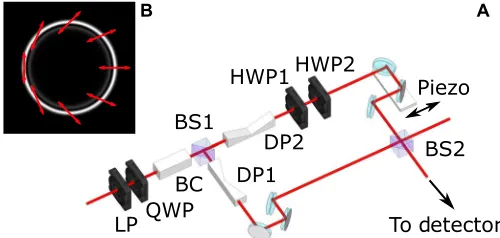
Measurement of generalized total angular momentum These new forms of total angular momentum differ from the standard one, but nonetheless have the physical properties we expect. The established method for measuring an optical angular momentum, be itL,S, orJ1= L+S, involves rotating the beams traversing a Mach-Zehnder inter-ferometer (6). This measurement exploits the fact that eigenstates pick up a phase factoreijfwhen rotated, wherejis the quantum number of the measured angular momentum andfis the rotation angle. We can gen-eralize this technique to measureJ1/2, as shown in Fig. 1, by choosing wave plates and prisms, such that the image rotates by twice as much as the polarization, that is, by implementing the rotation corresponding toJ1/2.
We argue that the operatorJ1/2is an angular momentum because it is a generator of rotations and because it can be measured by inter-ferometric techniques analogous to those previously used (6). It also has the required mechanical effects, as we now show. As with spin and orbital angular momenta, the torque exerted on an object depends on how it couples to the field. A half–wave plate, for example, reverses the sign of the spin quantum numbers= ±1 but leaves orbital angular momentum unchanged, and hence experiences a torque 2ħsper photon (1). The inversion of orbital angular momentum, which is achieved by an ideal polarization-preserving Dove prism, implies a torque 2ħlper photon (27). For the total angular momentumJg, the quantum number is reversed on transmission through a polarization-preserving Dove prism followed by two half–wave plates, one with a constant fast axis and the other with a fast axis at an anglegqwhere the azimuthal angle isq[that is, aqplate (28) with chargeq=g]. We calculate that the torque exerted on such an element by a beam with quantum numberjgis 2ħjgper photon. Thus,
[image:2.594.304.554.417.536.2]A B
Fig. 1. The generalized total angular momentum of light.(A) Experi-mental arrangement to study the generalized total angular momentum of lightJ1/2. Photons in a variable superposition of two angular momentum ei-genstates |j= ±1/2〉can be generated from the Gaussian input beam using a linear polarizer (LP), a quarter–wave plate (QWP), and a biaxial crystal (BC). The angular momentum currents can then be measured using an interfer-ometer, introducing rotations in the optical paths to sort the beam according to angular momentum. MeasuringJ1/2entails rotating the image and polar-ization by different angles, in this case using two polarpolar-ization-preserving Dove prisms (DP1 and DP2) to rotate the image by 180° and two half–wave plates (HWP1 and HWP2) to rotate the polarization by 90°. BS1 and BS2 are beam splitters used to separate and recombine the optical paths; DP1 and DP2 are at 90° to one another, and HWP1 and HWP2 are at 45°. The piezo delay is tuned such that each eigenstate interferes constructively at one output and destructively at the other. (B) Calculated intensity (grayscale) and polarization (red arrows) for the |j= 1/2〉component of the input beam.
on August 18, 2016
http://advances.sciencemag.org/
the change in the eigenvalue ofJgis related to a torque as it should be, confirming on mechanical grounds that it represents a form of angular momentum. Becausej1/2has a half-integer spectrum, the minimum torque exerted when this quantum number reverses isħ, whereas for the standard quantum numbersl,s, andj, the corresponding value is 2ħ.
We have used this interferometer to measure the angular momentum J1/2of photons in beams formed from two of its eigenstates, |j1/2= ±1/2〉. These beams are generated by the conical refraction (29) of the light from a helium-neon laser. As shown in Fig. 1, the light is first elliptically po-larized before passing through a biaxial crystal, leading to a superposition of angular momentum eigenstates. The amplitudes in the superposition are controlled by the angle of the QWP,qqwp, with the beam varying from purely |j1/2= 1/2〉to purely |j1/2=−1/2〉as the QWP rotates by 90°. This beam then enters a Mach-Zehnder interferometer, where two polarization-preserving Dove prisms at 90° and two half–wave plates at 45° rotate the beam to impart a relative phase ofpbetween the components |j1/2= ±1/2〉. The path lengths are tuned such that each component interferes constructively at one output port and destructively at the other, and the signal is detected with a photodiode. The angular momentum current is thus related to the rates of photon arrivalsP1,P2at the two outputs and the corresponding photocurrentsI1,I2by
〈M^1=2〉¼ℏ
2ðP1P2Þ ¼
ℏ
2eðI1I2Þ ð3Þ
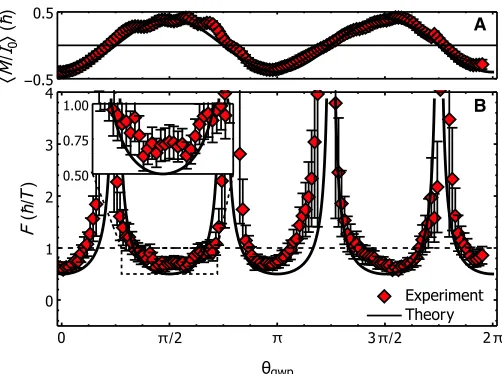
[the quantum efficiency of the detector will be irrelevant for the following because we have Poissonian intensity statistics (30), and so is taken as one]. The average angular momentum per photon is obtained by dividing by the total flux or photocurrent. The result is shown in Fig. 2A and confirms that the average angular momentum per photon varies be-tween +ħ/2 and−ħ/2.
Noise in angular momentum currents
To establish the quantization of angular momentum, we have studied its fluctuations, in particular the noise in the angular momentum current. Electrical current noise is known to reveal the discreteness of charge and has been used particularly to demonstrate the fractional charge of quasi-particles in quantum Hall states (31–33). This suggests that angular mo-mentum current noise could, analogously, reveal the discreteness of optical angular momentum.
To establish the possibilities of such diagnostics, we first calculate the noise properties of the angular momentum currents. We consider mea-surements involving a finite response timeT, such that the operator for the angular momentum current isM^gð Þ ¼T T1∫ttþTdt′^Jg, and use wave
packet quantization to calculate the moments ofM^g. For a single pho-ton in an eigenstate ofJ1/2, we obtain〈M1^ =2〉¼ℏj1=2=T, as expected; we also find that the variance of the current operatorM^1=2,s21=2¼〈M^
2 1=2〉 〈M^1=2〉2, is zero. This is consistent with the assertion that each photon carries an exact amount of this total angular momentum. In contrast, for this state, we obtain a nonzero variance for the orbital and spin current operators, M^L andM^S. Physically, a measurement of orbital
or spin angular momentum projects onto the components of the super-position in Eq. 2, introducing quantum noise in these currents.
Alternatively, we can consider the angular momentum currents in the semiclassical limit, that is, for the coherent states originating from the laser in our experiment. In this limit, in general, quantization of current carriers appears as shot noise (30), with power spectral density
2qI, whereqis the charge andIis the current. The discrete chargeq can thus be obtained from the Fano factor, that is, the ratio between current noise and current. To elucidate this, we calculate the mean and variance of the angular momentum currents for coherent states. For a spatial mode that is an eigenstate ofJg, we find
〈M^g〉¼ℏ Tjg
s2g¼ℏjg
T 〈M^g〉
which is the expected result for shot noise with quantized charge
ħjg. To calculate the noise for a general beam, we note that any beam is a superposition of Laguerre-Gauss modes with amplitudes
cl,sand writeâ=∑l,scl,sâl,s. In this way, we find that the Fano factor
in a general coherent state is
Fg¼
s2
g
j〈M^g〉j¼
ℏ∑ðlþgsÞ2cl;s2 Tj∑ðlþgsÞjcl;sj2j≥
ℏ
2T ð4Þ
Thus, the minimum noise of an angular momentum current in the semiclassical limit corresponds to the quantum ħ/2 and is achieved in measurements of J1/2on beams that are eigenstates thereof. This noise is solely the shot noise associated with the dis-creteness of angular momentum. Note that for any angular momen-tum operator, Eq. 4 implies that the minimum noise is achieved in the corresponding eigenstate, specifically that with the lowest-magnitude nonzero eigenvalue. This shot noise limit is, thus, minimized for
A
[image:3.594.305.556.68.255.2]B
Fig. 2. Experimental results.(A) Average of the total angular momentum J1/2per photon, in beams comprising a variable superposition of its eigen-states |j= 1/2〉and |j=−1/2〉. The solid line is the predicted result, corrected for the measured visibility of the interferometer. (B) Measured fluctuations in the angular momentum current quantified by its Fano factor. At the minima, the noise is predominantly shot noise reflecting the discreteness of angular momentum. The corresponding charge goes belowħand approaches the expected value ofħ/2, showing that the quantized angular momentum of the photon is a fraction ofħ. The solid lines show the predicted result in the ideal case, with full visibility and no classical noise.
on August 18, 2016
http://advances.sciencemag.org/
operators with half-integer spectra. Moreover, we see that for beams that are not eigenstates, the noise is larger, as a result of the uncertainty in the angular momentum of each photon.
Experimental demonstration of half-quantization
To experimentally demonstrate the half-integer quantization, we have measured the Fano factorF1/2for the same input beams discussed above. We amplify and digitize the photocurrent at one output of our interferometer, and extract the noise power at 3 MHz. This allows us to compute the noise power in the angular momentum current: From Eq. 3, we find
s21=2¼ℏ
2
4 s
2 P1þs
2 P2
¼4ℏ2
e2 s
2 I1 þs
2 I2
ð5Þ
using the fact that our input beams are, to a good approximation, coherent states, such that photodetections at each output are independent. We measure the photocurrent and noise at one port as a function ofqqwp, which allows us to deduce the corresponding quantities for the other port by symmetry, because increasingqqwpby 90° is equivalent to exchanging the two outputs. In practice, vibrations and drift of the interferometer during the rotation of the QWP cause slight differences between these quantities, which are accounted for in our error estimates.
The Fano factor, divided by 1/T= 2Df, whereDfis the frequency res-olution, is plotted in Fig. 2B, again as the beam varies between |j1/2= 1/2〉 and |j1/2=−1/2〉. The noise is minimized when the beam is in one of these two eigenstates and is bounded from below byħ/2. The Fano factor, in units ofħ/T, clearly goes below one and approaches the limit of one-half at each minima, as predicted by Eq. 4. This demonstrates that each photon carries a total angular momentumJ1/2that is a fraction ofħ. Note that the ideal theoretical value ofħ/2 is a lower bound on the result; con-tributions from classical noise and limitations on the visibility of the in-terferometer mean that this lower bound is not necessarily achieved.
DISCUSSION
Here, we have considered beams close to the paraxial limit and have shown how the independence of spin and orbital angular momenta allows for a new definition of total angular momentum. However, it has recently been shown that independent spin and orbital angular momenta can be defined beyond this limit (19,34,35). This immediately provides the nonparaxial generalization of the total angular momentum componentJg, on replacing the paraxial forms for spin and orbital angular momenta, assumed here, with the nonparaxial ones. The non-paraxial spin and orbital angular momenta are independently conserved; hence, this would be a conserved quantity as well. They are modified forms of the rotation operators, specifically the transverse parts of those that rotate the field vectors (spin) and image (orbital) around the speci-fied axis. The corresponding total angular momentumJggenerates these modified rotations simultaneously, in a fixed ratiog.
The new form of total angular momentum we have identified gives an alternative representation of the state space in terms of beams with nonuniform polarization, leading to a new understanding of the effects of optical angular momentum. Its half-integer spectrum shows that for light, as is already known for electronic systems, reduced dimension-ality allows for new forms of quantization. The half-integer
quantiza-tion, which we demonstrate through noise measurements, implies fermionic exchange statistics, and an important extension of our work will be to identify the measurable consequences of such photonic fermionization.
MATERIALS AND METHODS
Theory of the interferometer
We show how the interferometer shown in Fig. 1 can be used to mea-sure the quantum statistics of the angular momentumJ1/2, as quanti-fied by the moments of its current distribution. Operationally, it is a Mach-Zehnder interferometer in which the beam is rotated by angle
f0in one arm, whereas a phase shiftdis introduced in the other. The beam splitter formalism gives the field operators at the two output ports to be
^
a1¼i
2 e
idþU
^ a
^
a2¼1
2 eidU
^ a
whereâis the input field. We omit the operators for the second input port, which act on the vacuum, because they would not contribute to the expectation values of normal-ordered operators considered here. The operatorUacts on the spatial and spin coordinates to rotate the field, and for the rotation generated by the angular momentum operator, Jgis eif0Jg. In the eigenbasis of orbital and spin angular momenta, the operators have indiceslands=±1 acted on by the angular momentum operators asLzâl,s=lâl,sandJgâl,s= (l+gs)âl,s.
We were concerned with the case whereg= 1/2 and with the sub-space wherej= ±1/2. This subspace involves operatorsâ0,1,â1,−1with j= 1/2 andâ−1,1,â0,−1with j =−1/2. Choosingd=p/2 andf0=p givesâ1=−âl,s,â2= 0 for the first class andâ1= 0,â2=iâl,sfor the second class, showing that the interferometer will sort the beam according to the eigenvalue ofJ1/2. Because any linear combination of fields withj= 1/2 will be transmitted to the first port and any com-bination withj=−1/2 will be transmitted to the second port, we have
^
M ¼
∑
l;sðlþ
s=2Þ^a†l;s^al;s
¼12^a†0;1^a0;1þ
1 2^a
†
1;1^a1;1
1 2^a
†
0;1^a0;1
1 2^a
†
1;1^a1;1
¼12^a†1^a1^a†2^a2
when the angular momentum current operator is restricted to the sub-space in question. Because this combination of the output intensity op-erators is the same as the angular momentum current operator, restricted to a particular subspace, its mean and higher moments will all be identical, provided the input beam is contained wholly in that subspace. This result generalizes in the expected manner to higher-dimensional subspaces, where the beam could be sorted using a cascade of interferometers (6).
Details of the input beams
The structured beams analyzed by our interferometer were generated by a combination of polarization optics (the LP and the QWP in
on August 18, 2016
http://advances.sciencemag.org/
Fig. 1) and a BC, with the BC acting as a partial spin angular momentum– to–orbital angular momentum converter. The beam following the LP was a linearly polarized Gaussian, which was then incident on the QWP, with a fast axis at angleqqwp+p/4 to the polarization (the offset sim-plifies the following results). This led to a variable superposition of right and left circularly polarized Gaussian beams, with amplitudes
AR¼eiðqqwpþp=4ÞcosðqqwpÞ
AL¼eiðqqwpþp=4ÞsinðqqwpÞ ð6Þ
These two circularly polarized components, withl= 0 and helicity s= ±1, underwent conical refraction in the BC to become (29)
l;s
j i ¼ j0;1i→ 1ffiffiffi 2
p jð1;1i þ j0;1〉Þ≡jj¼1=2i
0;1
j i→ 1ffiffiffi 2
p j ð 1;1i þ j0;1〉Þ≡jj¼ 1=2i
that is, eigenstates of the mixed angular momentumJ1/2with eigen-values ±1/2, as indicated. The polarization and intensity profile (29) of one of these components, in the focal image plane of the BC, are shown in Fig. 1B. The orbital angular momentum and polarization of a con-ically refracted beam are well understood and have been measured pre-viously (36). Thus, the generated beam was a superposition of |j= ± 1/2〉, with amplitudes given by Eq. 6 as functions of the QWP angle.
Experimental details
As shown in Fig. 1, light from a helium-neon laser was passed through a Glan-Thompson polarizer and a wavelength-specific QWP to create a combination of circular polarizations. This combination was passed through a BC and a lens pair (not shown) to create a collimated conical beam, with the focal image plane at infinity, containing a superposition of the modes |j= ±1/2〉. This input beam was then incident on a 50:50 nonpolarizing beam splitter that separated it into the two arms of a Mach-Zehnder interferometer. Within this interferometer, the two images were rotated relative to one another by 180° and the two polarization directions were rotated by 90°. The image rotation was achieved using a pair of Dove prisms, and the polarization rotation was achieved using a pair of half–wave plates. For space reasons, the image rotation was achieved with one prism in each arm of the interferometer. The prisms were not of the conventional form, because that would lead to an angle-dependent effect on the polarization, in addition to the sired transformation of the image. We instead used the previously de-scribed structure (6), which inverted the image and acted as a QWP. In our case, these effective QWPs did not affect the operation of the interferometer and did not need to be compensated for. The top arm had a pair of mirrors, acting as a delay line, on a piezo translation stage. This stage could be varied with a resolution≈10 nm, leading to a resolution in the path length of≈20 nm. There was a similar delay line element in the second arm, on a manual translation stage, allowing for roughly equal path lengths (this was necessary as the beam had some spatial evolution; the interferometer did not need to be at the zero-order fringe).
The two paths recombined at a second beam splitter, and the beams exited the interferometer from one of two output ports. The output of one port was focused onto a photodiode, which was used to measure both the intensity and its noise. The current from the photodiode was
converted to a voltage using a low-noise transimpedance amplifier, and this voltage was sampled with an oscilloscope. The voltages for each port were, thus, related to the photocurrents byV1,2=GI1,2, with transimpedanceG= 2.55 kilohm. Equations 3 and 5 allowed us to extract the Fano factor for the angular momentum from the voltages and their fluctuations
F1=2¼ ℏ
2eG
s2V
1þs
2 V2
V1V2 ¼
ℏ
2eG
s2V
1ðqÞ þs 2
V1ðqp=2Þ
2V1V0
In the second equality, we used the fact that rotating the QWP by p/2 is equivalent to exchanging the ports, allowing only one to be measured, and also thatV1+V2=V0is constant.
Error analysis
The dominant contribution to the error bars in Fig. 2B was the in-stability and vibration of the interferometer. Because the output of the second port at a given time was calculated as the output of the first port at a different time, these fluctuations meant that the sum of the voltages V1+V2departed from the constantV0. We displayed this as an uncer-tainty in the measured Fano factor obtained from the unceruncer-tainty inV0. The error in the measured noise gave a smaller contribution, because this was obtained as an average over 1000 periodograms, yielding a frac-tional error of the order 1=pffiffiffiffiffiffiffiffiffi1000≈3%:
For us to realize the shot noise limit for the angular momentum current, we had to use shot noise limited light. This behavior, as well as the calibration ofG, was confirmed using the relation between the measured voltage noise and voltage (37). The noise
s2¼s20þaVþbV2þr ð7Þ
comprises a background contribution, shot noise that depends lin-early on the signal, classical noise that depends quadratically on the signal, and a random error proportional to the true noise. The linear term has a coefficient
a¼2eDfG ð8Þ
Figure S1 shows the measured noise, along with a fit to Eq. 7 using Eq. 8 with the nominalG= 2.55 kilohm. The agreement confirms this value and, furthermore, that we were operating in the shot noise limited regime. The SD of the residuals is 90 V2/A, consistent with the relative error on the noise estimated above.
Calculations of the current statistics
The calculations of the angular momentum statistics reported in Results concern the time-averaged current operator
^ Mgð Þ ¼t
1
T
∫
tþT t dt′
∑
s;lℏ lþ
gs
ð Þ^a†l;sð Þ^t0 al;sð Þt0 ð9Þ
whereT is the response time of the detector. This is equal to the angular momentum in each mode multiplied by the number current of photons in that mode, summed over all modes and averaged over the response time. A nonperfect efficiency is not included because it
on August 18, 2016
http://advances.sciencemag.org/
would merely add some excess shot noise (30). The time dependence of the beam was encoded by using the wave packet states
^
ax;l;s¼
∫
dtxðtÞ^al;sðtÞwhich can also be combined into superpositions of modes
^
ax¼
∑
l;sal;s^ax;l;s
The functionx(t) controls the time dependence of the photon number current but does not affect the angular momentum per photon. The states examined consist of single-photon states
1
j i ¼^a†xj0i ð10Þ
and coherent states
c
j i ¼ expð^a†x^axÞj0i ð11Þ
The expectation value of the angular momentum current operator and its higher powers can now be calculated. The operator in Eq. 9 or its higher powers can be placed between the states given by Eqs. 10 and 11. The commutation relations (30)
½^al;sðtÞ;^a†l′;s′ðt′Þ ¼dl;l′ds;s′dðtt′Þ
½^a†l;sðtÞ;^a†l′;s′ðt′Þ ¼ ½^al;sðtÞ;^al′;s′ðt′Þ ¼0
were used to evaluate the angular momentum current expectation value or variance in terms of the time-dependent classical current, which is proportional to∫dt|x(t)|2.
Torques due to a mixed angular momentum
In Results, we stated that the eigenvalue ofJgwas reversed by a polarization-preserving Dove prism followed by two half–wave plates, one with a constant fast axis and the other with a fast axis that makes an angle
gqto thexaxis when the polar angle isq. To show this, we note that the effect of the Dove prism on the field is to send the polar angleq→ −q, whereas the half–wave plates have a combined Jones matrix, in the basis of circular polarizations
0 e2igq
e2igq 0
0 1 1 0
¼ e02igq e20igq
Thus, the effect on an eigenstate of the form given in Eq. 2 is
a1eil1q a2eil2q
→
DP a1eil1q a2eil2q
→
HWPs a1eil2q a2eil1q
≡ a1eil
′ 1q a2eil2′q
where we have usedg=(l2−l1)/2. The resulting field has g′¼
ðl′
2l1Þ=′ 2¼g, but the eigenvalue is reversedjg′ ¼ ðl2′þl1Þ=′ 2¼ jg. For the case where the device was rotated as a whole by anglea, we found the same output field, but with an additional phase factore2ijga.
The change in angular momentum of the beam implies a torque, which we calculated following the argument previously given for the orbital case (27). If the device was spinning with an angular velocityW, thena=Wtand the phase factore2ijgabecomes a rotational Doppler shift (27,38) by the angular frequency 2jgW. This implies a change in energyEof each photon crossing the device, exerting a torquet=dE/
dW= 2ħjg.
SUPPLEMENTARY MATERIALS
[image:6.594.301.562.248.703.2]Supplementary material for this article is available at http://advances.sciencemag.org/cgi/ content/full/2/4/e1501748/DC1
fig. S1. Calibration of the noise measurement.
REFERENCES AND NOTES
1. R. A. Beth, Mechanical detection and measurement of the angular momentum of light.
Phys. Rev.50, 115–125 (1936).
2. M. Padgett, R. Bowman, Tweezers with a twist.Nat. Photonics5, 343–348 (2011). 3. M. P. J. Lavery, F. C. Speirits, S. M. Barnett, M. J. Padgett, Detection of a spinning object
using light’s orbital angular momentum.Science341, 537–540 (2013).
4. B. Thidé, H. Then, J. Sjöholm, K. Palmer, J. Bergman, T. D. Carozzi, Y. N. Istomin, N. H. Ibragimov, R. Khamitova, Utilization of photon orbital angular momentum in the low-frequency radio domain.Phys. Rev. Lett.99, 087701 (2007).
5. G. Molina-Terriza, J. P. Torres, L. Torner, Twisted photons.Nat. Phys.3, 305–310 (2007). 6. J. Leach, J. Courtial, K. Skeldon, S. M. Barnett, S. Franke-Arnold, M. J. Padgett, Interferometric
methods to measure orbital and spin, or the total angular momentum of a single photon.
Phys. Rev. Lett.92, 013601 (2004).
7. A. Mair, A. Vaziri, G. Weihs, A. Zeilinger, Entanglement of the orbital angular momentum states of photons.Nature412, 313–316 (2001).
8. J. Leach, B. Jack, J. Romero, A. K. Jha, A. M. Yao, S. Franke-Arnold, D. G. Ireland, R. W. Boyd, S. M. Barnett, M. J. Padgett, Quantum correlations in optical angle–orbital angular momentum variables.Science329, 662–665 (2010).
9. J. Romero, D. Giovannini, S. Franke-Arnold, S. M. Barnett, M. J. Padgett, Increasing the dimension in high-dimensional two-photon orbital angular momentum entanglement.
Phys. Rev. A86, 012334 (2012).
10. J. T. Barreiro, T.-C. Wei, P. G. Kwiat, Beating the channel capacity limit for linear photonic superdense coding.Nat. Phys.4, 282–286 (2008).
11. N. Uribe-Patarroyo, A. Fraine, D. S. Simon, O. Minaeva, A. V. Sergienko, Object identification using correlated orbital angular momentum states.Phys. Rev. Lett.110, 043601 (2013). 12. N. K. Langford, R. B. Dalton, M. D. Harvey, J. L. O’Brien, G. J. Pryde, A. Gilchrist, S. D. Bartlett,
A. G. White, Measuring entangled qutrits and their use for quantum bit commitment.Phys. Rev. Lett.93, 053601 (2004).
13. L. Allen, M. W. Beijersbergen, R. J. C. Spreeuw, J. P. Woerdman, Orbital angular momentum of light and the transformation of Laguerre-Gaussian laser modes.Phys. Rev. A45, 8185–8189 (1992). 14. F. Wilczek, Magnetic flux, angular momentum, and statistics.Phys. Rev. Lett.48, 1144–1146
(1982).
15. F. Wilczek, Quantum mechanics of fractional-spin particles.Phys. Rev. Lett.49, 957–959 (1982). 16. D. Arovas, J. R. Schrieffer, F. Wilczek, Fractional statistics and the quantum Hall effect.Phys.
Rev. Lett.53, 722–723 (1984).
17. S. J. van Enk, G. Nienhuis, Spin and orbital angular momentum of photons.Europhys. Lett.
25, 497–501 (1994).
18. L. Allen, S. Barnett, M. Padgett, Eds.,Optical Angular Momentum(Institute of Physics, Bristol, UK, 2003).
19. K. Y. Bliokh, J. Dressel, F. Nori, Conservation of the spin and orbital angular momenta in electromagnetism.New J. Phys.16, 093037 (2014).
20. M. V. Berry, Paraxial beams of spinning light, inProc. SPIE 3487, International Conference on Singular Optics, Partenit, Crimea, Ukraine, 5 October 1997 (SPIE, Bellingham, WA, 1998). 21. C. Cohen-Tannoudji, J. Dupont-Roc, G. Grynberg,Photons and Atoms: Introduction to Quantum
Electrodynamics(Wiley, New York, 1997), 486 pp.
22. S. M. Barnett, Optical angular-momentum flux.J. Opt. B Quantum Semiclassical Opt.4, S7–S16 (2002).
23. M. V. Berry, Optical vortices evolving from helicoidal integer and fractional phase steps.
J. Opt. A Pure Appl. Opt.6, 259–268 (2004).
24. J. B. Götte, S. Franke-Arnold, R. Zambrini, S. M. Barnett, Quantum formulation of fractional orbital angular momentum.J. Mod. Opt.54, 1723–1738 (2007).
on August 18, 2016
http://advances.sciencemag.org/
25. G. F. Calvo, A. Picón, E. Bagan, Quantum field theory of photons with orbital angular momentum.
Phys. Rev. A73, 013805 (2006).
26. M. V. Berry. Quantal phase factors accompanying adiabatic changes,Proc. R. Soc. London Ser. A.392, 45–57 (1984).
27. G. Nienhuis. Doppler effect induced by rotating lenses,Opt. Commun.132, 8–14 (1996). 28. L. Marrucci, C. Manzo, D. Paparo, Optical spin-to-orbital angular momentum conversion in
inhomogeneous anisotropic media.Phys. Rev. Lett.96, 163905 (2006).
29. M. V. Berry, M. R. Jeffrey, M. Mansuripur, Orbital and spin angular momentum in conical diffraction.J. Opt. A Pure Appl. Opt.7, 685–690 (2005).
30. R. Loudon,The Quantum Theory of Light(Oxford Univ. Press, Oxford, 1983).
31. C. L. Kane, M. P. A. Fisher, Nonequilibrium noise and fractional charge in the quantum Hall effect.Phys. Rev. Lett.72, 724–727 (1994).
32. R. de-Picciotto, M. Reznikov, M. Heiblum, V. Umansky, G. Bunin, D. Mahalu, Direct observation of a fractional charge.Nature389, 162–164 (1997).
33. M. Dolev, M. Heiblum, V. Umansky, A. Stern, D. Mahalu, Observation of a quarter of an electron charge at thev= 5/2 quantum Hall state.Nature452, 829–834 (2008). 34. R. P. Cameron, F. C. Speirits, C. R. Gilson, L. Allen, S. M. Barnett, The azimuthal component of
Poynting’s vector and the angular momentum of light.J. Opt.17, 125610 (2015). 35. A. Aiello, M. V. Berry, Note on the helicity decomposition of spin and orbital optical currents.
J. Opt.17, 062001 (2015).
36. D. P. O’Dwyer, C. F. Phelan, Y. P. Rakovich, P. R. Eastham, J. G. Lunney, J. F. Donegan, The creation and annihilation of optical vortices using cascade conical diffraction.Opt. Express
19, 2580–2588 (2011).
37. H.-A. Bachor, T. C. Ralph,A Guide to Experiments in Quantum Optics(Wiley-VCH, Weinheim, Germany, 2004), 434 pp.
38. R. Simon, H. J. Kimble, E. C. G. Sudarshan, Evolving geometric phase and its dynamical manifestation as a frequency shift: An optical experiment.Phys. Rev. Lett.61, 19–22 (1988).
Acknowledgments:We thank M. Padgett, S. Barnett, and J. Lunney for helpful discussions; N. Carroll for technical support; and M. Padgett and P. Stamenov for lending us equipment. Funding:This work was supported by the Higher Education Authority of Ireland under PRTLI (Programme for Research in Third-Level Institutions) funding cycle 5 and by Science Foundation Ireland (09/SIRG/I1592, 12/RC/2278).Author contributions:K.E.B. performed the calculations and experiments and analyzed the data. P.R.E. devised and supervised the project. J.F.D. co-supervised the experimental work. All authors discussed the results and contributed to the writing of the manuscript.Competing interests:The authors declare that they have no competing interests. Data and materials availability:All data needed to evaluate the conclusions in the paper are present in the paper and/or the Supplementary Materials. Additional data related to this paper may be requested from P.R.E. ([email protected]).
Submitted 2 December 2015 Accepted 30 March 2016 Published 29 April 2016 10.1126/sciadv.1501748
Citation:K. E. Ballantine, J. F. Donegan, P. R. Eastham, There are many ways to spin a photon: Half-quantization of a total optical angular momentum.Sci. Adv.2, e1501748 (2016).
on August 18, 2016
http://advances.sciencemag.org/
doi: 10.1126/sciadv.1501748 2016, 2:.
Sci Adv
29, 2016)
Kyle E. Ballantine, John F. Donegan and Paul R. Eastham (April
this article is published is noted on the first page.
This article is publisher under a Creative Commons license. The specific license under which
article, including for commercial purposes, provided you give proper attribution.
licenses, you may freely distribute, adapt, or reuse the CC BY
For articles published under
. here
Association for the Advancement of Science (AAAS). You may request permission by clicking for non-commerical purposes. Commercial use requires prior permission from the American
licenses, you may distribute, adapt, or reuse the article CC BY-NC
For articles published under
http://advances.sciencemag.org. (This information is current as of August 18, 2016): The following resources related to this article are available online at
http://advances.sciencemag.org/content/2/4/e1501748.full online version of this article at:
including high-resolution figures, can be found in the Updated information and services,
http://advances.sciencemag.org/content/suppl/2016/04/26/2.4.e1501748.DC1 can be found at:
Supporting Online Material
http://advances.sciencemag.org/content/2/4/e1501748#BIBL 3 of which you can access for free at: cites 33 articles,
This article
trademark of AAAS
otherwise. AAAS is the exclusive licensee. The title Science Advances is a registered York Avenue NW, Washington, DC 20005. Copyright is held by the Authors unless stated published by the American Association for the Advancement of Science (AAAS), 1200 New
(ISSN 2375-2548) publishes new articles weekly. The journal is
Science Advances
on August 18, 2016
http://advances.sciencemag.org/