Training in Libyan Hotels: A case study analysis
Ramdan Mohamed Bayoud
Thesis submitted to the University of Gloucestershire in partial
fulfilment of the requirements for the degree of Doctor of Philosophy
in the Business School
BA, MSc. (Al-Jabal A1-Gharbi University,Gharian: Libya)
i Abstract
This study explores through a mixed methods qualitative-oriented case study investigation the training policies, plans, and practices of the public sector Social Security Fund Investments Company (SSFIC), which owns the major hotels in several Libyan cities. The Only internationally owned hotel in the country when the research commenced in 2007, the Corinthia Bab Africa Hotel (CBAH), provides a private sector comparison. It is the first such review of training activities within a country aiming to become an internationally competitive tourism destination.
A case study approach using different data sources is well adapted to situations where previous theoretical studies are few and field experience is still limited (Yin, 2003). During three field trips to Libya a) documents including training policies and plans were collected; b) Three different surveys were distributed to three target groups in the two hotel businesses compared: trainees, training managers, and trainers; c) Semi-structured interviews were conducted with managers responsible for training to obtain clarifying comments and operational observations; d) On-site personal observations were noted.
The questionnaire design and overall analysis was based on an operational framework that followed the pre-training, during- training and post-training stages of the systematic training cycle. The supporting theoretical framework was derived from the ADDIE model but with greater focus being given to transfer of training. Cultural considerations within Libya and the Arab world, as well as findings from other studies within the sector, were also taken into account when interpreting the data and drawing conclusions. Cultural aspects include: the influence of Islamic values; the poor image of work in hotels, especially for women; and the role of wasta on decision-making.
ii
Despite the majority of SSFIC staff attending training courses over the period of the study, major issues are identified, many of which also face the whole Libyan hotel sector. Sector-based issues include: skills shortages; lack of qualified local trainers; low employee salaries and lack of cooperation between public, private and governmental sectors. SSFIC training specific issues include: insufficient training needs analysis; absence of review of course relevance to trainees; inadequate practical training; lack of post-course training incentives;. To overcome these difficulties, the study proposes a number of focused recommendations. In conclusion the study draws upon the evidence collected to suggest the Libyan approach to National Human Resource Development (NHRD). It corroborates most of the findings of a recent parallel study done into the Libyan banking sector and provides additional categories to support the conclusion that Libya is moving towards a centralised-transitional approach.
iii Declaration
I declare that this thesis has been prepared in accordance with the regulations of the University of Gloucestershire. The thesis has not been submitted to any other educational institution in the United Kingdom, in Libya or elsewhere in the world.
Signed: ……….. Date: ………..
iv Dedication
I dedicate this thesis to the biggest love in my life: my mother and son who passed away before the completion of this work, and my father who sacrificed and suffered to support my educational journey.
v
Acknowledgement
All thanks to the Almighty Allah, who guided me and lit up the way in my life, especially in the stages of completion of this thesis.
I am indebted to the many individuals who gave their time, support and cooperation to complete this research journey. At the outset, I would like to express my special gratitude and deepest thanks to my supervisors, Professor John Walton and Mr. Mike Deakin, for their guidance and constructive comments throughout this study.
Special thanks to:
- all staff in the University of Gloucestershire (Business School) for their cooperation and support.
- my mother, whose love and compassion guided me to this stage in my life, but who
unfortunately passed away before the completion of this work.
- my father, who sacrificed and suffered to support my education which started 36 years ago and has reached this stage today.
- my brother and sisters for their deep love for me, especially in my childhood.
- my wife for her patience and encouragement to me during the years of study, and my
children: Yosef, Tasnim & Salsabela, who were deprived of my time for fun and play.
- all the staff in the Social Security Fund Investments Company and its hotels,
especially those who are responsible for training for their help in the process of data collection during the field study.
- all the participants from different hotels for their cooperation in completing the
questionnaire and making valuable comments and remarks about the training courses that they had attended.
vi
List of Abbreviations
ADDIE Analysis, Design, Development, Implementation and Evaluation
APEC Asia Pacific Economic Cooperation
ASTD American Society for Training and Development
BHA British Hospitality Association
BMI Business Monitor International
CBAH Corinthia Bab Africa Hotel
CBI Confederation of British Industry
CHI Corinthia Hotels International
CIA Central Intelligence Agency
CPHCL Corinthia Palace Hotel Company Limited
DLVT Department of Labour and Vocational Training
DNH Department of National Heritage
GDP Gross Domestic Product
GBTTI General Board of Tourism and Traditional Industries
GPC General People’s Committee
GSP General Strategic Plan
EU European Union
HAA The Head of Administrative Affairs
HCITB Hotel and Catering Industry Training Board
HDHR The Head of Department of Human Resources
HDTD The Head of Department of Training and Development
HR Human Resources
HRM Human Resources Management
HRD Human Resources Development
HTA The Head of Training Academy
JTV Jansour Tour Village
IHI International Hotel Investments
ILO International Labour Organisation
IVTB Industrial and Vocational Training Board
vii
LD Libyan Dinar
LIPB Libyan Investment Promotion Board
LTFs Libya Tourism Forums
LTMP Libyan Tourism Master Plan
ODIT Office for the Development of Tourism and Investment
OECD Organisation for Economic Cooperation and Development
OPS Office of Planning and Studies
MTD Management Training Development
NIPA National Institute of Public Administration
SMEs Small and Medium Enterprises
SPSS Statistical Package for the Social Sciences
SSFIC Social Security Fund Investments Company
TIPB Tourism Investment and Promotion Board
T&D Training and Development
UAE United Arab Emirates
UK United Kingdom
UN United Nations
UNDP United Nations Development Programme
UNWTO United Nations World Tourism Organisation
USA United States of America
WERS Workplace Employment Relations Survey
WTO World Tourism Organisation
viii
Structure and Content
Statement Page Abstract i Declaration iii Dedication iv Acknowledgement v List of abbreviations vi Contents viii
List of tables xiv
List of figures xvi
List of appendices xvii
Chapter One: Introduction
1.1 Overview 1
1.2 Research Aim, Objectives and Questions 1
1.3 Rationale 3
1.4 Case study background 8
1.5 Personal interests 9
1.6 Organisation of the thesis 10
1.7 Chapter summary 13
Chapter Two: Tourism and the hospitality industry
2.1 Introduction 14
2.2 Definitions of tourism and tourist 15
2.3 The significance of tourism 19
2.4 The hospitality industry 24
2.4.1 Definitions of hospitality 24
2.4.2 The importance of hospitality 26
2.5 Background to the Libyan tourism and hotel industry 28
2.5.1 A brief introduction to Libya 28
2.5.2 The emergence and development of tourism and hotel industry in Libya 32 2.5.3 Local organisations responsible for the hotel and tourism industry in Libya 35 2.5.4 Overview of the Libyan Tourism Master Plan (LTMP) (2009-2025) 37
2.5.4.1 Introduction 37
2.5.4.2 The goals of LTMP 2009-2025 38
2.5.4.3 The prospects for tourism in Libya 38
2.5.4.4 Workforce requirements 42
2.5.4.5 Income of tourism activity 42
2.6 Difficulties faced by the Libyan tourism and hotel industry 43
2.7 Chapter summary 45
Chapter Three: Training within the hotel sector
3.1 Introduction 47
3.2 General background 48
3.2.1 The concept of T&D 51
3.3 T&D as investment 53
3.4 The importance of T&D 55
ix
3.5.1 The objectives of T&D 57
3.5.2 The benefits of T&D 58
3.6 Types of training 61
3.6.1 On-the-job training 61
3.6.2 Off-the-job training 63
3.7 Transfer of training 64
3.8 Systematic training approach 67
3.8.1.Phases of ADDIE model 68
3.8.2 Characteristics of ADDIE model 69
3.9 Identification of training needs 70
3.10 Planning, designing and delivering training 72
3.10.1 Training methods 76
3.11 Evaluation of training 80
3.11.1 Methods of evaluation 84
3.12 Research context 86
3.12.1 Training in the hotel industry globally 87 3.12.2 Training in the hotel sector in developing countries 90
3.12.3 Training in Arab countries 93
3.12.3.1 General overview 93
3.12.3.2 Hospitality sector training in Arabic countries 94 3.13 Women’s participation in the hospitality industry 95
3.14 The Theoretical Framework 97
3.14.1 Overview 97
3.14.2 Importance of the theoretical framework 97 3.14.3 The proposed theoretical and operating framework 98
3.15 Chapter summary 101
Chapter Four: Overview of training in Libya
4.1 Introduction 104
4.2 Local organisations responsible for training in Libya 104 4.3 Overview on structure and characteristics of Libyan society 109 4.4 National Human Resource Development (NHRD) systems 114
4.5 Training in the Libyan hotel sector 123
4.6 The need of T&D in the Libyan hotel sector 125 4.7 Educational and training institutions in the Libyan tourism and hotel industry 125 4.8 The key difficulties faced by the training in the Libyan hotel sector 127
4.9 Chapter summary 129
Chapter Five: Case study organisations background
5.1 Introduction 131
5.2 Profile of the SSFIC 132
5.2.1 Foundation and legal status 132
5.2.2 Organisational structure of the SSFIC 134
5.3 The workforce within the SSFIC and its hotels in February 2009 135
5.4 Strategic Plan of the SSFIC 136
5.4.1 The SSFIC Vision 137
x
5.4.3 The SSFIC Values 138
5.4.4 General Policies 138
5.4.5 General Strategies 138
5.4.6 Strategic Goals 139
5.5 The structure of the training function 140
5.5.1 Human Resources and Training 140
5.5.2 Training Centre of the SSFIC 141
5.5.3 Training courses 142
5.6 The challenges faced by the SSFIC in the area of HR 143 5.7 The financial performance of the hotels of the SSFIC 144
5.8 Competition 145
5.8.1 The current market share of the SSFIC’s hotels in Tripoli region 146 5.8.2 The market share of the company’s hotels in Tripoli region in 2011 147 5.8.3 What are the strategic objectives achieved by the SSFIC since its establishment, taking
into account the challenges inherited from hotel companies merger?
147
5.9 Investment Projects 148
5.9.1 Challenges facing the SSFIC in the completion of new projects 148 5.9.2 Challenges facing the SSFIC in hotel investment 148
5.10 Profile of the CBAH 149
5.10.1 Foundation and legal status 149
5.10.2 International Hotel Investments (IHI) 150
5.10.3 Hotel Management 151
5.10.4 Industrial operations 152
5.10.5 Corinthia Finance 152
5.11 Corinthia Bab Africa Hotel (CBAH) in Tripoli 152
5.11.1 CBAH Training Academy 153
5.11.2 Training programmes 154
5.12 Chapter summary 155
Chapter Six: Research Methodology
6.1 Introduction 156
6.2 Research Philosophy 157
6.3 Research methodology: Types of research 161
6.4 Research methodology: case study design 163
6.5 Research methodology: Qualitative and quantitative research 165
6.6 Research methods 166
6.6.1 Methods of data collection 166
6.6.1.1 Site visits 166
6.6.1.2 Observations and field notes 168
6.6.1.3 Survey through questionnaires 169
6.6.2 Sample population and response rate to questionnaires 172 6.6.3 Questionnaires design, distribution and collection 173
6.6.3.1 Questionnaires’ design 173
6.6.3.2 Questionnaires distribution and collection 178
6.7 Why three groups? 180
xi
6.9 Interviews 183
6.10 Archival data 186
6.11 Research ethics 189
6.12 Analysis data 191
6.12.1 Analysis of annual training reports (archival data) 191
6.12.2 Data analysis of questionnaires 192
6.12.3 Data analysis of interviews 194
6.13 Difficulties which emerged during the field study 195
6.14 Chapter summary 196
Chapter Seven: Case studies Analysis and Findings
7.1 Introduction 198
7.2 Analysis of archival data (training reports) 198 7.2.1 SSFIC Training courses from November 2007 to the end of 2009 199
7.2.2 Analysis of training reports 204
7.3 Analysis of the questionnaires’ and training managers’ interview findings 213
7.3.1 Findings of trainees’ survey 213
7.3.1.1 Characteristics of respondents 214
7.3.1.2 Training courses 217
7.3.1.3 The degree of trainees’ satisfaction of the training courses provided 221
7.3.1.4 Training Phases 221
7.3.1.4.1 The first phase: Pre- training 222
7.3.1.4.1.1 Employee nomination to training courses 222
7.3.1.4.1.2 Timing and details of courses 223
7.3.1.4.1.3The number of participants on the training courses 224
7.3.1.3.1.4Duration of training courses 225
7.3.1.4.2 The second phase: During Training 226 7.3.1.4.2.1 The benefits achieved through the attendance of training courses 226 7.3.1.4.2.2The relevance of the content of training courses 228 7.3.1.4.2.3 Training methods, techniques and facilities used during training 232 7.3.1.4.2.3.1 Training methods and their appropriateness 232 7.3.1.4.2.3.2Facilities and location of the training courses 233 7.3.1.4.2.4 Competence and effectiveness of trainer 235
7.3.1.4.3The third phase: Post- Training 239
7.3.1.4.3.1 Evaluation of the policy and plan of training 239 7.3.1.4.3.2 The ability to apply training benefits (Transfer of training) 241 7.3.1.4.3.3 Difficulties in applying the knowledge and skills 242
7.3.1.4.3.4 Training incentives 243
7.3.1.4.3.5 General assessment of training programmes provided 244
7.3.1.4.3.7 Trainee comments 246
7.3.1.4.3.7.1 Analysis of trainees’ comments in SSFIC 246 7.3.1.4.3.7.2 Analysis of participants’ comments in CBAH 248 7.3.2 The findings of training managers’ survey and interviews 249
7.3.2.1 Introduction 249
7.3.2.2 Training phases 250
xii
7.3.2.2.1.1 The policy, plan, and objectives of training 250
7.3.2.2.1.2 Duration of training plan 251
7.3.2.2.1.3 The main objectives that the two cases usually look to achieve through the training courses
251
7.3.2.2.1.4 Training course locations 252
7.3.2.2.2The second phase: During training 252
7.3.2.2.2.1Training methods 252
7.3.2.2.3 The third phase: post-training 253
7.3.2.2.3.1Evaluation of the training policies and plans 253 7.3.2.2.3.2Achievement of training objectives 254 7.3.2.2.3.3The methods and objectives of training evaluation 255 7.3.2.2.3.4Communication and cooperation between departments on the evaluation of
training
258 7.3.2.2.3.5Timing of training course evaluation 260 7.3.2.2.3.6 Training managers view of training incentives 260
7.3.2.2.3.7 Difficulties of training 261
7.3.3 The finding of trainers’ survey 262
7.3.3.1 Introduction 262
7.3.3.1 Training phases 263
7.3.3.1.1 The first phase: Per-training 263
7.3.3.1.1.1Training course objectives and evaluation 263
7.3.3.1.1.2 Training evaluation methods 264
7.3.3.2.2 The second phase: During training 265
7.3.3.2.2.1Training course methods 265
7.3.3.2.2.2 Evaluation of the relevance of the content of training courses 266
7.3.3.2.3The third phase: Post-training 269
7.3.3.2.3.1 Evaluation of the training policy and plan 269 7.3.3.2.3.2 Timing of training course evaluation 269 7.3.3.2.3.3 Difficulties of training and its evaluation 270
7.3.3.2.3.4 The trainers’ comments 271
7.4 Chapter summary 272
Chapter Eight: Analysis the findings and discussion
8.1 Introduction 273
8.2 Characteristics of respondents 273
8.2.1 Gender and nationality 273
8.2.2 Length of service, staff turnover and pay levels 276 8.3 Discussion of the findings of training reports analysis 278 8.3.1 General discussion of the training courses 278
8.3.2 English courses 279
8.3.3 Overseas training 279
8.3.4 Reasons for the existence of multiple training programmes 280 8.4 Discussion the study’s findings in accordance with the third phases of training,
pre-training, during pre-training, and post-training.
282 8.4.1 Discussion of the first phase: Pre-training 282 8.4.1.1 Identification of training needs and employee nomination to training courses 282
xiii
8.4.1.2 Types of training 285
8.4.2 Discussion the second phase: During training 286
8.4.2.1 The location and timing 286
8.4.2.2 Training methods 287
8.4.2.3 Evaluation of the relevance of the content of training courses, and knowledge, skills and new behaviour acquired
289
8.4.2.4 Trainers 290
8.4.2.5 The benefits achieved through the attendance of training courses 291 8.4.3 Discussion the third phase: Post-training 292
8.4.3.1 Training policies and plans 292
8.4.3.2 Achievement of training objectives 294
8.4.3.3 Evaluation of training and its methods 295 8.4.3.3.1 Other studies in this area 298 8.4.3.4 Ability to apply training benefits 299 8.4.3.4.1 Difficulties in applying the knowledge and skills 300 8.4.3.5 The assessment process of training courses 303 8.4.3.6 Training incentives 304 8.4.3.7 General assessment of training courses by trainees 305 8.5 Chapter summary 306 Chapter Nine: Conclusions, Research Contributions, Recommendations, and Further Research 9.1 Introduction 309 9.2 Specific conclusions 311 9.2.1 The First Research Question 311 9.2.1.1 Growth in investment and numbers of trainees 311 9.2.1.2 Organisation 313
9.2.1.3 Location and type of training 314
9.2.1.4 Language skills 315
9.2.1.5 Comparison with CBAH 316
9.2.1.6 Training methods 317
9.2.2 The Second Research Question 318 9.2.3 The Third Research Question 322 9.2.4 The Fourth Research Question 330 9.2.4.1 The influence of national and organisational culture 332 9.2.5 The Fifth Research Question 337 9.2.5.1 General recommendations for the Libyan Government 340 9.2.5.2 General recommendations for the Libyan hotel sector 340 9.2.5.3 The key recommendations for the SSFIC 341 9.3 Recommendations for Further Research 345 9.4 Contributions of the research 347
9.5 Limitations of the study 358
9.6 Conclusion 360
9.7 Personal reflection 361
References 363
xiv List of Tables
Statement Page
Table 2.1: Total estimated visitor expenditure for the years 2013 and 2018 23 Table 2.2: The estimated contribution of Libyan tourism to GDP in 2013 and 2018 24 Table 2.3: Distribution requirements of accommodation in accordance with tourism circles in Libya during the period between 2009 and 2025
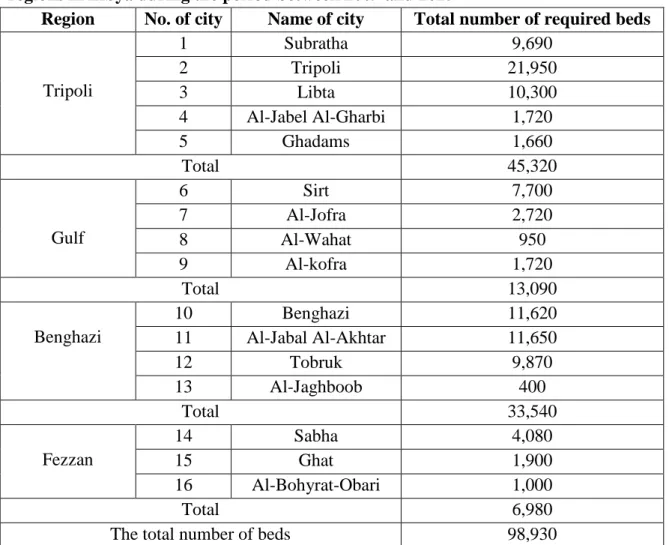
40 Table 2.4: The number of hotels in the main four regions in Libya 41 Table 2.5: Comparison between the number of beds in 2008 and the expected number between 2009 and 2025
42 Table 2.6: Growth in the number of tourists and their expenditure during the period from 2008 to 2025
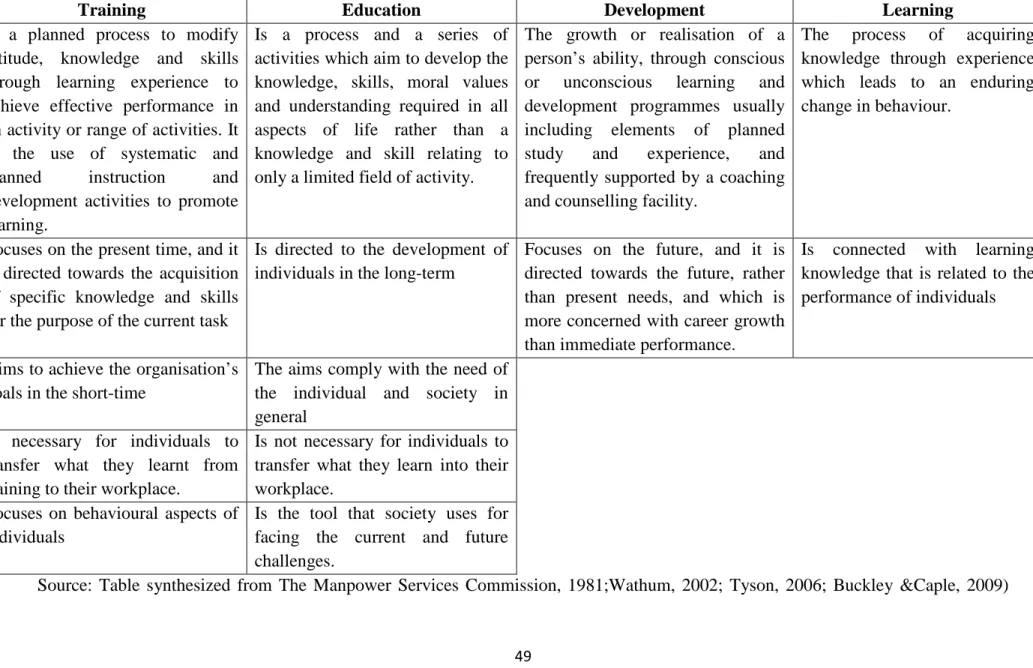
43 Table 3.1: The differences and commonalities between training, development, education and learning
49 Table 3.2: Training methods - Advantages and disadvantages 78
Table 3.3: Evaluation methods 84
Table 3.4: The gendering of employment in accommodation and catering 96 Table 4.1: Four Levels of Harbison and Myers (1964) 116 Table 4.2: The five models of NHRD and their core characteristics 117
Table 4.3: The emerging Libyan model of NHRD 120
Table 4.4: Omani students studying abroad for 2003/2004 124 Table 4.5: Institutions of Hospitality Education and Training in Libya 126 Table 4.6: Number of tourism and hospitality institutes in Libyan cities and able to grant degrees 126 Table 5.1: The workforce in the SSFIC and its hotels 135 Table 5.2: Training courses for 2007-2009, and the number of trainees at each session 143 Table 5.3: The financial performance of the SSFIC’s hotels in three regions 144 Table 5.4: Corinthia Hotels Group in different countries 151 Table 6.1: Comparison between the Positivist and Phenomenological Paradigms 158 Table 6.2: The goals of exploratory, descriptive and explanatory research 162 Table 6.3: The second visit to Libya (1/04/2009 – 21/05/2009) 167
Table 6.4: Hotels of the SSFIC 172
Table 6.5: The structure of the questionnaire 176
Table 6.6: Themes covered by the questions 177
Table 6.7: Questionnaires were completed and returned by trainees 183 Table 6.8: Number of the trainer participants from different training centres 183 Table 6.9: The schedule of interviews with training managers in the SSFIC 186 Table 6.10: Documents and reports referred to in thesis 189 Table 7.1: Training courses implemented from November 2007 to December 2008 with number
of trainees
199 Table 7.2: Training courses in 2009 with number of trainees 201 Table 7.3: Classification of internal courses by numbers and provider 204 Table 7.4: Division of training programmes according to their type 205 Table 7.5: Number of candidates to internal and external training courses conducted from November 2007 to end 2008
207 Table 7.6: The location of overseas training courses, and the number of candidates 207
xv
Table 7.7: Comparison between the number of trainees in Al-Mahari Hotel and other hotels 208 Table 7.8: Expenditures of training in the SSFIC and its hotel chain 210 Table 7.9: Cost of training courses from July 2008 to 30 April 2009 210 Table 7.10: Questionnaires completed and returned by trainees 214 Table 7.11: The work department of trainees 214 Table 7.12: Length of service of respondents 215
Table 7.13: The gender of respondents 217
Table 7.14: The nationality of respondents 217
Table 7.15: Title of courses, location and date in the SSFIC 217 Table 7.16: Title of courses attended, location and date in the CBAH 219 Table 7.17: Training courses take place outside the hotel 219 Table 7.18: Satisfaction of trainees of the training courses provided 221 Table 7.19: Nomination of the employees to training courses 222 Table 7.20: Details before commencing courses 224 Table 7.21: Training courses take place outside the hotel 224 Table 7.22: The number of participants on the training courses 225
Table 7.23: Duration of training courses 226
Table 7.24: The benefits achieved through the attendance of training courses 227 Table 7.25: Evaluation of the relevance of the content of training courses 228
Table 7.6: Methods of training courses 232
Table 7.27: The appropriateness of training methods to training needs of trainees 232 Table 7.28: Facilities and location of the training courses 233
Table 7.29: Competence of trainers 235
Table 7.30: The effectiveness of trainers 237
Table 7.31: Rating the policy and plan of training 239 Table 7.32: Ability to apply training benefits 241 Table 7.33: Difficulties facing trainees in applying the knowledge and skills gained from the training courses
242 Table 7.34: Personal benefits as a result of attending training courses 243 Table 7.35: The assessment of trainees of training courses that have been targeted at the hotel 244 Table 7.36: Trainees’ comments on training courses (SSFIC) 246 Table 7.37: Trainees’ comments on training courses (CBAH) 248 Table 7.38: The positions and departments of the manager respondents in both cases 249
Table 7.39: Training policies and plans 250
Table 7.40: Training programme objectives 250
Table 7.41: Duration of training plan 251
Table 7.42: The main objectives that hotels are usually looking to achieve through training programmes
251 Table 7.43: Training courses conducted outside the hotel 252
Table 7.44: Methods of training courses 253
Table 7.45: Rating the training policy and plan 254 Table 7.46: The extent of the company’s achievement of its training objectives 254
Table 7.47: Method of training evaluation 255
Table 7.48: Objectives for conducting evaluation process 257 Table 7.49: Source of information used when implementing methods of training evaluation for 258
xvi
trainees
Table 7.50: Means of communication on the evaluation of training between departments of the company and its hotels
258 Table 7.51: Cooperation between different departments about evaluation process 259 Table 7.52: Timing of training course evaluation 260
Table 7.53: Training incentives 261
Table 7.54: Difficulties of training 261
Table 7.55: Number of the trainer participants from different training centres 262
Table 7.56: Training programme objectives 263
Table 7.57: Specific objectives for conducting the evaluation process 264
Table 7.58: Training evaluation methods 264
Table 7.59: Training course methods 265
Table 7.60: Evaluation of the relevance of the content of training courses 266 Table 7.61: Evaluation of the training policy and plan 269 Table 7.62: Timing of training course evaluation 270 Table 7.63: Difficulties of training and its evaluation 270
Table 7.64: Analysis the trainers’ comments 271
Table 9.1: Approaches to training in both organisations 317
Table 9.2: The effectiveness of trainers 329
Table 9.3: Differences between the Libyan context and Western countries when conducting training programmes
331 Table 9.4: List of previous studies related to T&D in the hospitality industry 351
Table 9.5: The emerging Libyan model of NHRD 352
Table 9.6: The proposed Libyan model of National HRD 353
List of figures
Statement Page
Figure 1.1: The overall framework for the study 11
Figure 1.2: The temporal plan of the study 12
Figure 2.1: International tourist arrivals from 1950-2020 21 Figure 2.2: Map of geographic location of Libya 29 Figure 2.3: A pictorial view of hotels in Tripoli by 2015 40 Figure 2.4: The number of required beds in different Libyan regions between 2009 and 2025 41 Figure 3.1: The objectives and benefits of T&D in the hotel industry 60
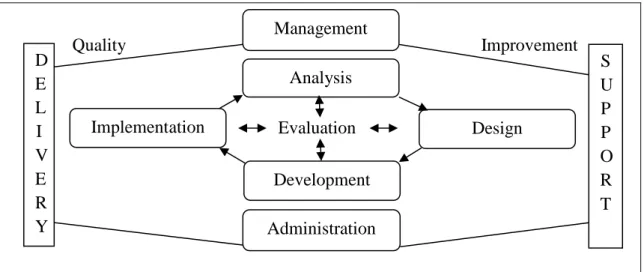
Figure 3.2: Revised ADDIE model 68
Figure 3.3: The key elements of designing and delivering of training 75 Figure 3.4: Revised ADDIE model – (Allen’s model, 2006) 99 Figure 3.5: Revised ADDIE model in the current study (ADITE) 100 Figure 3.6: The proposed framework to conduct the fieldwork in the selected cases 101
Figure 5.1: Field work & Data collection 131
Figure 5.2: Organisational structure of the SSFIC 134 Figure 5.3: Organisational structure of the SSFIC’s hotels 134
Figure 5.4: Strategic Plan of the SSFIC 137
Figure 5.5: The parties responsible for training in the SSFIC 140 Figure 5.6: The financial performance of the SSFIC‘s hotels 145
xvii
Figure 5.7: Relative distribution of the number of rooms in Tripoli area 146 Figure 5.8: Distribution of the likely number of rooms in Tripoli area in 2011 147 Figure 5.9: Location of the Corinthia Bab Africa Hotel in Tripoli 153
Figure 6.1: Research approach 156
Figure 6.2: Multiple sources of evidence in case studies 164 Figure 7.1: Classification of internal courses by trainee numbers and providers 204
Figure 7.2: Division of internal courses 206
Figure 7.3: The location of overseas training programmes 208
Figure 7.4: Comparison between the number of trainees in Al-Mahari Hotel and other hotels
209 Figure 9.1: Revised ADDIE model – (Allen’s model, 2006) 356 Figure 9.2: Revised ADDIE model in the current study (ADITE model) 356
List of Appendices
No. of Appendix Statement Page
1 Survey questionnaire (English Version) 400
2 Form for identifying training needs (SSFIC) 408
3 Form for evaluating an external training courses (SSFIC) 409
4 Form for evaluating an internal training courses (SSFIC) 410
5 Forms for evaluating training courses (Tunisia) – (SSFIC) 411
6 Questionnaires of the Al-Mahari Hotel (SSFIC) 417
7 Report of Arab Union of Technical Education 419
8 Investment Projects of SSFIC 424
9 Examples of training courses (internal/external) for 2008 -2009 428
10 Summarising the field visits to Libya 433
1 CHAPTER ONE: INTRODUCTION 1.1 Overview
The thesis is a case study investigation conducted between the years 2007 and 2010 into the approach adopted towards training in the hotel sector in Libya. It is primarily based on a large public sector organisation called the Social Security Investments Company (SSFIC), with additional research carried out with the Corinthia Bab Africa Hotel (CBAH), which is part of a privately owned international chain. This introductory chapter:
1. Outlines the research aim, objectives and associated research questions.
2. Provides a rationale for choosing to investigate training issues in the hotel sector in Libya, and for selecting SSFIC and CBAH as case study examples.
3. Indicates the structure of the thesis, providing brief information regarding each chapter.
1.2 Research Aim, Objectives and Questions
The aim of the study is to investigate training and development practices in the Libyan public hotel sector between 2007 and 2010, with special focus on evaluating the training programmes within the SSFIC.
To achieve this aim the following objectives have been identified:
• To provide a deeper and wider understanding of training programmes
2
• To identify the key difficulties and barriers to training practices faced by the SSFIC.
• To contrast and compare the training practices between the state run organisation, that is SSFIC, and the new entrant to the Libyan Hotel business, CBAH.
• To establish the differences between the two and to identify where difficulties and barriers exist whether these be because of management, operational or cultural approaches.
• To highlight the key differences between training in Libya, Western countries and elsewhere.
• To contribute to, and fill a gap in, the hospitality literature on training in the Libyan context in particular.
• To identify improvements and recommendations as to the effectiveness of training and development practices in the SSFIC hotel organisation.
This study aims to illuminate key practices by answering questions relating to two primary research areas.
• What training is carried out within the public hotel sector in Libya and why?
o How is it currently organised and conducted?
o How does this differ from the private sector?
o What has changed over the course of the study?
3
• What are the methods currently used to evaluate existing training programme
effectiveness in the same sector, and why are they adopted?
Building upon the data obtained for each of these two primary research areas, the following corollary questions are addressed.
• What training-related problems are faced by the public hotel sector in Libya and how significant are they?
• What are the core differences between the training and development practices and programmes currently being implemented within Libya, Western countries and elsewhere?
• In the light of recommended good practice from the literature and the particular contingencies revealed through the empirical study, how appropriate are the approaches adopted? What might be done differently?
1.3Rationale
It is undeniable that “tourism and hospitality” is one of the largest labour intensive industry sectors in the world (Spillane, 2001). This leads to major people management and development challenges, of which training is one.
The case for training has been well rehearsed in the literature over the years. Attention has been drawn to its role in equipping employees with new skills and knowledge that are required to improve the performance of their jobs; and its contribution to achieving the organisation’s goals effectively. Organisations that are successful take the training of their staff very seriously (Wills, 1994, Hansson 2007). The major aim of training is to
4
help an organisation to achieve its goals by adding value to its key resources(Armstrong, 2001). If the training programmes are well managed and conducted, they can be a source of competitive advantage (Pfeffer &Veiga, 1999). Although training can be an effective means to enhance knowledgeable and skilful staff, it is by no means an automatic solution (Prior, 1994, Bunch, 2007).Training quality depends heavily on the decision makers formulating an appropriate training policy (Herschbach, 1997, Sels, 2002).
Training is a crucial element for service industries because organisations such as hotels depend heavily on employees’ knowledge, skills and initiative to identify problems and to resolve them to ensure higher standards of customer care (Lowry, Simon and Kimberley, 2002).This, in addition to increased competition globally, has led to the need to get the right people, with the right skills, in the right place, at the right time. Boella (2000) contextualises much of the above for the hospitality sector, where he contends that the need for training has become an essential issue in each individual’s work life in order to acquire new knowledge and skills; and learn how to cope with constant changes. According to Putra, (2003, p. 49), as “hospitality becomes more widespread .... one of the biggest human resource (HR) roles in the hotel sector is to ensure success with training programmes provided for employees particularly in the area of training transfer to the workplace”. Training is considered a key factor that cannot be neglected to develop and enhance service quality in the hotel sector, as customers’ expectations are heightened as a result of greater familiarity with global travel. This thesis will demonstrate that Libya is no exception in this respect.
Libya has significant tourist potential, but tourism in general, and the hotel sector in particular, still suffers from alack of qualified and skilled personnel. Some researchers
5
(e.g. Danis, 2006;Abukhabta&Alzawie, 2006)state that the Libyan government must satisfy the immediate manpower training needs in order to be competitive in both Arab and international tourism. According to recent studies, training programmes in the tourism sector and particularly in the hotel sector in Libya are very limited and still remain insufficient and overdue, because the Libyan government has only recently begun to focus on this area (Salih, 2005; Danis, 2006;Abuharris, 2007; Naama, Havan-Tang & Jones, 2008).
Since UN sanctions were lifted in 2004, the country has made considerable progress, such as its return to the international arena and the openness of its economy in various areas, including the hotel sector. It is also attracting and encouraging local and foreign investors to contribute in developing this sector. Thus, the tourism and hotel sector has become one of the key development priorities. Therefore, this study is timely because Libya has witnessed rapid progress in its economy and management reforms, and a more open approach to international markets, especially in the hotel industry. In other words, there is a drive to diversify the Libyan economy away from oil, and tourism is considered the second most promising source after oil. The study focuses particularly on exploring the nature of training in the public hotel sector in Libya. The topic of this study was selected for the following reasons:
• The first reason lies in the importance of human resources for business success in any field, a subject which deserves continued research (Yang, 2007), the importance of human resources is particularly significant in a ‘people focused’ industry, such as hospitality (Yang & Fu, 2009). Among many authors, Richard and Johnson (2001) argue that HR strategy is the most important factor in
6
improving any organisation’s overall effectiveness and that effective utilisation of human resources can give a competitive advantage to the organisation. This is an issue that is becoming increasingly significant in Libya as it moves towards greater economic openness. Training is an essential component in effective workforce utilisation. There is a further need to identify the nature of HR policies and practices that are relevant for developing countries, as reported by Budhwar and Debrah (2001). Thus, the study of HR activities, including how people are trained in different sectors, is viewed as one of the key factors in the national economy in general, and in developing countries in particular.
• The second reason for selecting this topic is that the majority of HRM/ HRD
research undertaken does not include the hospitality sector (Furunes, 2005). Despite the crucial importance of work skills in the service sector, especially in the hospitality industry and hotels, there are very few studies on this subject in the hospitality field. Lucas and Deery (2004) point out that the number of academics interested in the hospitality industry is relatively small compared with other industries. Therefore, this issue needs further attention because of the ongoing changes and developments in the business environment today, including technology, employment, training and education, in both developing and developed countries (Baum, 2002).
• The third reason follows on from the recommendation of Agnaia (1996) that
training given should have a vital role in improving the knowledge, skills and attitudes of both staff and managers in Libya. Libya should make further efforts to
7
deal with all aspects of training programmes, through the implementation of further research and studies into this activity, so that the country’s organisations and employees become more aware of the significance of this activity to them.
• The fourth reason is that research on progress into the volume, nature and
effectiveness of training provision is still inadequate in the Libyan hotel sector. According to the literature, training & HRD programmes are crucial for Libya, and other Arab and developing countries. There have been many studies related to this topic conducted in the western countries but at the time of writing this thesis there are no doctorate studies about training in Libyan hotels, apart from one recent study conducted by Naama in 2007, which was about workforce analysis from a stakeholder perspective. Moreover, nationally, a search of the Electronic Theses and Dissertation System in the available Libraries in Libya revealed no thesis on training in this sector. A British library search revealed no theses which study the training issue in Libyan hotels and only one thesis related to the subject of the current study, which focused on HRM in the hotel industry in Libya. The relative lack of contemporary research in this area makes it an attractive study to undertake, as a foundation contribution to highlighting employee training in the Libyan hotel sector.
• The hotel sector was selected for this study, because Libya is a relative newcomer to tourism and the hotel industry is still in its infancy. The current and potential future investments in the hotel sector are in a growth trajectory. Libya is in the transitional stage from a centralised economy to a free market economy. This
8
policy has attracted many foreign investors to the country to implement several projects (Porter & Yergin, 2006), which include investment in the hotel sector. The Department of Trade and Industry in the UK, strongly supports the idea of companies investing in Libya, and it is generally perceived that Libya is a good investment opportunity for those companies, for example, UK Trade & Investment (UKTI, 2009) showed that UK exports to Libya were up by14% in 2007, increased by 21% in 2008 and 51% in 2009.This movement towards a free market economy has led to a need for more research in the field of training in various sectors (El-Arbi, 2007), particularly in the hotel sector.
Finally, since the late 1960s to the beginning of 2000, the hotel sector was neglected by the Libyan government, which depended heavily on oil as the main income source. As a result of this, the hotel sector has not received sufficient research attention, in training in particular. This neglect led to a lack of progress in the hotel industry and in the programmes related to HRM and HRD practices. This research attempts to fill this gap by comparing the training practices in a sample of the SSFIC hotel chain and CBAH in Libya. Moreover, as argued by Lashley and Watson (1999), hospitality researchers should pay more attention to wider management debates based on hospitality industry needs in order to shape the generic literature in the longer term. This research is one of the initial attempts to do so.
1.4 Case study background
In accordance with the objectives of the current research, a case study approach is appropriate, affording an opportunity to gain an in-depth understanding of the
9
phenomenon of training in a real world context (Paulin, Coffy& Spaulding, 1982). Many writers, for example Easterby-Smith, Thorpe and Lowe(2002) and Collis &Husse (2003), point to the importance of the use of different data collection techniques that allow such research to be conducted. These techniques include archival records, documents, interviews, observation, and survey-based questionnaires. All these methods were used to collect data for the current research, and will be discussed in greater detail in Chapter 6.
Due to the limitations of time and cost, it was not possible to investigate all the Libyan hotels in the public hotel sector in Libya. The study therefore focused on the public hotel sector, and the SSFIC was selected as the principal case study because it owns the majority of chain hotels in the country. Information was also obtained from the foreign owned CBAH, which was selected as a small case to compare the training practices with the SSFIC’s hotels. When the research commenced in 2007 it was the only private sector hotel owned by a foreign investor in existence in the country. The outcome is an exploratory study that evaluates their respective training programmes and the basis on which they were framed in order to provide a comparison and draw conclusions between state-owned and privately owned foreign hotels about training issues.
1.5 Personal interests
Maxwell (2005) contends that when choosing a research topic, the researcher’s prior experience acts as a motivator; furthermore lack of motivation causes many students to never finish their dissertations. The researcher has a good experience and background about HR issues, and training in particular, because his Master degree was about the determination of training needs and its role in improving training efficiency – an empirical study on the Public Company of Electricity in Libya (Bayoud, 2000). In
10
addition, the researcher was one of the academic staff at the Faculty of Accounting in Gharian, in the Department of Management from 2003 until 2006. He has taught the subject of HRM in different educational institutions and universities in Libya. This research is an important step for the researcher to build his career as an academic.
1.6 Organisation of the thesis
This section outlines the structure of the thesis which is divided into nine chapters. Chapter One provides a brief introduction, a statement of the problem, methodology, research aim, objectives and research questions. An overview of the structure of the thesis is presented at the end. Chapter Two provides a general background of tourism and the hospitality industry. Chapter Three deals with a review of the research literature related to training and development within the hotel sector. Chapter Four gives an overview of training and development in Libya. Chapter Five provides a general background to the case study organisations (SSFIC and CBAH). Chapter Six describes the methodology used for the study, the research philosophy, population and sample, data collection procedures, method used for the data analysis, research ethics, and the key difficulties encountered by the researcher during fieldwork. Chapter Seven reviews the documentary data collected regarding the training programmes for the case study organisations followed by a themed data analysis of the returned questionnaires and interviews conducted. Chapter Eight follows the themes presented in Chapter Seven and draws broader conclusions about training practices in the case study organisations. Chapter Nine summarises the main findings of the study and offers a number of contributions and recommendations based on these findings.
11 Figure 1.1:The overall framework for the study
Theoretical framework
Field work & Data collection
Data Analysis & Conclusion Public Sector Literature Review Research Methodology Site visits, observations& field notes Semi-structured interviews with training managers Documents, reports
& archival records
Case Studies Questionnaire for training managers Questionnaire for trainees Questionnaire for trainers Findings Data Analysis& discussion Introduction Tourism Industry Conclusion
12 Figure 1.2: The temporal plan of the study
Development of research proposal and submission to the RD1
06/2007 – 05/2008
Exploratory Literature Reading& initial writing up 05/2008 – 11/2008
Visiting Libya to collect data
Multi-sources used in this stage (see case studies in the previous figure)
First visit: 07/2008 – 09/2008 Second visit: 01/04/2009 – 21/05/2009
Third visit: 31/03/2010 – 10/04/2010
Data Interpretation & Findings
6/2009 - 2/2010 Data Analysis & Conclusion
Submission the first draft of the thesis to the supervisors
09/03/2010
Submission of the final version to the University
13 1.7 Chapter summary
This introductory chapter has provided an insight about the purpose of the research, and a statement of its contents. It presents a brief justification of the selection of the topic of this research, i.e. to justify the time and effort that was spent to achieve this thesis. The research questions and objectives have been reviewed. It summarises the content of the nine chapters that constitute the thesis. Finally, it shows the structure of the research through the division of this thesis into several chapters in line with the purpose of this study. As indicated in this section, the next chapter will introduce an overview of tourism and the hospitality industry.
14
CHAPTER TWO: TOURISM AND THE HOSPITALITY INDUSTRY 2.1 Introduction
It is undeniable that tourism and hospitality is now considered one of the largest industry sectors in the world (Spillane, 2001). Tourism has become the economic lifeblood of many countries in the world. Liu and Wall (2006) says that tourism also has emerged as a catalyst for socio-economic change. Likewise Baum and Szivas (2008) assert that tourism is a significant area of economic activities within many countries in both the developed and developing worlds. In 2007, the World Tourism Organisation indicated that tourism has contributed extensively to world prosperity, through economic growth and employment creation. This has made tourism a major focus for most countries, particularly developing ones (WTO, 2007).
Richter (1985) describes some of the benefits of a tourism industry. It creates a rapid increase in employment, generates foreign exchange, encourages handicraft and export industries, and subsidises the development of infrastructure. According to Elliott (1997), tourism plays a key role in the growth of urbanization, industrialization, standards of education, and the desire of people to visit different tourist attraction destinations inside and outside their country. Despite the changes that have taken place in the world, tourism since 1950 has been a highly competitive industry, and is still the fastest growing sector and a major power in the global economy (Cooper, Fletcher, Fyall, Gilbert, &Wanhill, 2008). On the other side, the hospitality industry is significant to most service businesses, but especially hotels, restaurants, resorts, private clubs and air travel. Hospitality is basically a relationship between a host and a guest.
15 2.2 Definitions of tourism and tourist
Tourism is not a recent phenomenon, and it is considered as a complex phenomenon because it includes multi-industry activities, multi-disciplinary subjects and different industrial sectors, such as accommodation, attractions, the travel trade and transport. Jenkins (1997) states that tourism activity cuts across conventional sectors in the economy, requiring inputs of an economic, social, cultural and environmental nature. According to Elliott (1997), tourism has become more than an industry and an economic activity; it is a global dynamic social phenomenon which has affected most countries and people of the world. It can be defined in more than one way and according to several different sciences, such as sociology, geography, psychology or economics. It can be defined as one industry or a series of industrial sectors such as hotels, restaurants and transport, which all provide services for tourists.
In fact, in terms of defining tourism, this is not nearly as easy as it may appear, and, thus, there are several definitions that will be presented. In 1942, there was one of the first attempts to define tourism by Hunziker and Krapf of Berne University. They pointed out that tourism should be defined as “the sum of the phenomena and relationships arising from the travel and stay of non-residents, in so far as they do not lead to permanent residence and are not connected to any earning activity” (as cited in Holloway and Taylor, 2006, p.5). The Tourism Society of England defined tourism in 1976 as “the temporary, short-term movement of people to destinations outside the places where they normally live and work and their activities during the stay at each destination” (as cited in Holloway & Taylor, p.2). Pearce (1987, ascited in Putra, 2003, p.11-12) states that:
16
Tourism is essentially about people and places, the places one group of people leave, visit and pass through, the other groups who make their trip possible and those they encounter along the way. In a more technical sense, tourism may be thought of as the relationships and phenomena arising out of the journey and temporary stays of people travelling primarily for leisure or recreational purposes.
In Libya, the General Board of Tourism and Traditional Industries (GBTTI) states that “tourism means movement of people, whether citizens or foreigners, as individuals, or groups, from one place to another, and the resulting or necessary services and various relations” (GBTTI, 2009). Lowery (1994) sees that tourism is a service industry that focuses on visitors and tourists when they are away from home. Angelo and Vladimir (1996) reveal that when the United States Senate created the National Tourism Policy Act of 1981 to encourage the growth of tourism, it used the following definition of the travel and tourism industry: “An interrelated amalgamation of those business and agencies which totally or in part provide the means of transport, goods, services, and other facilities for travel outside of the home community for any purpose not related to day-to-day activity” (Angelo & Vladimir, 1996, p.6). The World Tourism Organisation devised the definition of tourism which was provided at the International Conference on Travel and Tourism Statistics in Ottawa, Canada in 1991. It has now been accepted worldwide:
Tourism comprises the activities of persons travelling to and staying in places outside their usual environment for not more than one consecutive year for
17
leisure, business and other purposes not related to the exercise of an activity remunerated from within the place visited (Holloway, 2001, p.3).
Even with the general acceptance of the definition above, different writers (e.g. Burkat&Medlik, 1981; Youell, 1998; Wall & Mathieson, 2006) have produced different analysis and conclusions regarding the character of tourism. Burkat&Medlik (1981) inferred that there were two main advantages of tourism: Journey, which is a temporary and short-term; and Stay, with distinct activities. On the other side,Wall and Mathieson (2006, p.14) says that the persons referred to in the definition of tourism are termed ‘visitors’, a visitor being defined as “Any person travelling to a place other than of his/her usual environment for less than twelve months and whose main purpose of trip as other than the exercise of an activity remunerated from within the place visited”.
International tourists are defined as people who travel across an international border and stay away from home for at least a whole day, whereas domestic tourists include individuals travelling within their own country but who stay away from home for not less than twenty-four hours. Youell (1998) deduced from this that tourists can be categorised as people who are:
• “Away from their normal place of residence, although they will be returning
home at some point in the future.
• On a visit that is temporary and short-term, but is not greater than 12 months in duration.
18
• Not necessarily staying away overnight, but sometimes merely on a day visit
(excursion).
• Not always away from home for holiday purposes, but may be from home on
business” (p.9).
According to Page and Connell (2006, p.13), the important classifications of tourism developed by the WTO are:
• International tourism: Consists of inbound tourism, visits to a country by non-residents, and outbound tourism, residents of a country visiting another country.
• Internal tourism: Residents of a country visiting their own country.
• Domestic tourism: Internal tourism plus inbound tourism (the tourism market of accommodation facilities and attractions within a country).
• National tourism: Internal tourism plus outbound tourism (the resident tourism market for travel agents and airlines).
Jwaili (2006) refers to Gunn (1994), who describes tourism as “encompasses all travel with the exception of commuting” (p.98). He goes on to say that it is also more than just a service industry, it is a multi-faceted activity. Consequently it has been defined in different ways, but it might be thought of in terms of relationships and phenomena ensuing from journeys and temporary accommodation for people travelling for leisure or recreational purposes. The definitions which are mentioned above have been quoted at length because they explain how broadly the concept of tourism has to be defined in order to encompass all forms of the phenomenon. However, it can be argued that regardless of the several definitions of tourism, what needs to be highlighted is that these activities can substantially enhance the quality of life for all participating countries in
19
different ways, for example, job creation, growth of exports, national income and return on investment.
Accordingly, the tourism industry is basically an economic concept based upon the actuality that travellers spend money at the destinations visited. The tourism industry can provide an external injection of wealth and substantial revenue through visitor arrivals. Moreover, tourism may be the best industry among all business to directly provide goods and/or services and/or to provide business and leisure activities in participating nations.
2.3 The significance of tourism
Travel and tourism have been a characteristic of all human society since the beginning of civilization. In an introductory chapter such as this, it is important to stress at the outset the key role of tourism in the growth and development of economic activities. In 2003, the World Travel and Tourism Council described tourism at the start of the twenty-first century as “a great force capable of dramatically developing economic and social well-being throughout the world, waiting to be unleashed” (WTTC, 2003, p.5). It has also become an industry of global significance, one which impacts upon entire countries and influences all economic activities. Consequently, it is one of the major social and economic phenomena of modern times (Singh, 1997; Sharpley&Telfer, 2002). More recently, tourism has been recognised as making a decisive contribution to employment, investment and regional development in many countries, particularly in developing countries, including Libya.
20
The World Tourism Organisation (WTO, 2007) states also that tourism has contributed extensively to world prosperity, through economic growth and employment creation. This has made tourism a major focus for most countries, particularly developing ones.
The World Tourism Organisation (WTO) suggests that tourism provided for over 234.3 million jobs or 8.2 per cent of total world employment in 2007 compared to 230 million jobs in 2006 (WTO, 2008). In 1997, a study was conducted in Hungary by Cleveland, Barnes-Farrell and Ratz, showing that tourism is one of the most rapid developing industries. It described that in Hungary the industry employs around 250,000–300,000 people, and therefore seems to be an effective industry in creating new jobs and reducing unemployment. In 2005, Moore stated that “the UK hospitality industry is a £43 billion industry, employing over 7% of the UK workforce and creating one in every five new jobs” (p.197). The UK has been referred to here and subsequently because it has one of the longest, if not the longest, established examples of a well-developed hospitality industries with a comprehensive range of component businesses. As such it makes for a suitable comparison for a less developed country with a largely closed economy such as that of Libya. According to Elliott (1997), tourism plays a key role in the growth of urbanization, industrialization, standards of education, and the desire of people to visit different tourist attraction destinations inside and outside the country. Despite the changes that have taken place in the world, tourism since 1950 has been a highly competitive industry, and is still the fastest growing sector and a major power in the global economy (Cooper et al., 2008). Given the expectation that the number of international tourists will increase, the tourism industry can make great contributions to a national economy and the global economy. For example, in the United Kingdom the
21
number of air travellers is expected to increase from 180 million in 2004 to almost 475 million by 2030 (Page, 2007). Jwaili (2006) likewise describes tourism as being widely recognised as the largest industry in the world. It has created rapid growth in various fields, such as economic, social and environmental, which require detailed understanding and measuring to manage. In 2002, the WTO disclosed that the number of international tourist arrivals was 25 million global international arrivalsin 1950, whereas by 2007, this figure reached nearly 900 million this generated 10.3 percent of the global Gross Domestic Product (GDP), providing 234.3 million jobs or 8.2 percent of total world employment. The WTO also reports that receipts from international tourism in 1980 were US$287 billion, and rose to US$564 billion in 1995. In 2000, they reached US$702 billion and by 2010 they are expected to exceed US$1 trillion.
Figure 2.1: International tourist arrivals from 1950-2020
22
The data in (Figure 2.1) shows that tourism is a major element of development and growth universally. Furthermore, Page (2007) reports that the World Travel and Tourism Council (WTTC) identifies that travel and tourism as economic activities generated around US$6201 billion in 2005, which is estimated to grow to US$10678.5 billion by 2015. Page also clarifies several reasons why tourism assumes a significant role not only in our lives but also globally:
• Tourism is a discretionary activity (people are not required to undertake it as a basic need to survive, unlike consuming food and water).
• Tourism is of growing economic significance on a global scale, with growth rates in excess of the rate of economic growth for many countries.
• Many governments see tourism as offering new employment opportunities in a
growing sector that is focused on service industries and may assist in developing and modernizing the economy.
In recent years, international tourism has grown rapidly compared with other sectors. It has become a significant industry for both developed and developing countries because it has become an appropriate source of economic revenue, which could replace dependency on oil revenues. For example, Libya has been heavily dependent on oil revenues for the last four decades. The LTMP (1999-2018) has proposed to help reduce the country’s over-dependence on oil as oil is a non-permanent source and is therefore vulnerable in the longer term. Libya now expects tourism to be the second industrial sector after oil, as Libya is regarded as one of the more attractive tourist destinations (LTMP, 2009-2025) (see section 2.5.4.3).
23
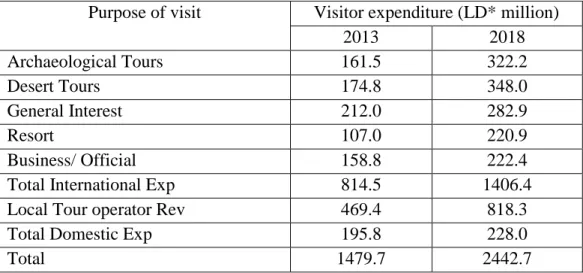
It is clear that increasing the number of international tourists will lead to an increase in tourist expenditure to every Libyantourist destination. Putra (2003) states that an average of almost 4.4 million tourists visit different destinations in Australia annually and they spend on average US$65 per day per person. In Libya, the total number of tourists in 2007 was 105,997, and each one spent an average of around US$85 per day. The LTMP (1999-2018) has estimated that visitor expenditure in 2013 could total LD 1479.7 million, and it will reach LD 2442.7 million by 2018 (LTMP, 1999-2018).
Table 2.1: Total estimated visitor expenditure for the years 2013 and 2018
Purpose of visit Visitor expenditure (LD* million)
2013 2018 Archaeological Tours 161.5 322.2 Desert Tours 174.8 348.0 General Interest 212.0 282.9 Resort 107.0 220.9 Business/ Official 158.8 222.4
Total International Exp 814.5 1406.4
Local Tour operator Rev 469.4 818.3
Total Domestic Exp 195.8 228.0
Total 1479.7 2442.7
Source: LTMP, 1999-2018. *LD: Libyan Dinar.
According to the World Tourism Organisation (2007), tourism has contributed significantlyto world prosperity, through economic growth and employment creation. This has made tourism a major focus for most countries, particularly developing ones. In the light of this, tourism is considered one of the world’s largest growth industry and Danis (2006) states that there are no indications of any slowing down in the 21st century. It is easy to be aware of the global importance of tourism as the following statistics suggest:
24
International tourist arrivals were estimated by the World Travel and Tourism Council in 2002 to reach one billion by 2010, and 1.6 billion by 2020. By 2010, the tourism economy contribution is calculated to grow to 12 per cent of global GDP, and will create approximately 250 million jobs. 328 million people worldwide will be employed in the field of travel and tourism by 2020, because of increased demand. This impact will rise by 46% over the following decade.
In the light of these statements there is no controversy or doubt that tourism has become an important sector compared to other industries for most countries due to its active role in the growth and evolution of economic activity as a whole, particularly growth in GDP. The Libyan Tourism Master Plan (LTMP) of 1999 has estimated a key contribution of the tourism industry toGDP, as table 2.2 shows.
Table 2.2: The estimated contribution of Libyan tourism to GDP in 2013 and 2018
Years 2013 2018
Contribution to GDP 5,920 (LD million) 9,590
Source: LTMP, 2003-2018.
2.4 The hospitality industry 2.4.1 Definitions of hospitality
The word “hospitality” is often used to describe the rather broad field that incorporates lodging, food service, leisure, conventions, travel, and attraction (Ottenbacher, Harrington &Parsa, 2009).
Chell, Carmouche and Pittaway (1998, p.411) stated that: “the hospitality industry is a ‘people’ industry, is often characterised as heterogeneous due to the large number of consumers directly involved in the production and service process, and is predominantly
25
labour intensive”.The definition of the hospitality industry as providing food, drink, accommodation and leisure facilities has persisted throughout its long history. According to Page (2007), the hospitality industry is the very essence of tourism, including the consumption of food, drink and accommodation in an environment away from the places where people normally live and work. In addition, Angelo and Vladimir (1996) states that although usually the hospitality industry is viewed as including mainly lodging and food service business, some view the hospitality industry as involving four sectors: lodging, food, entertainment, and travel.
Cassee and Reuland, cited in Bright and Johnson (1985), define hospitality as “a harmonious mixture of food, beverage and/or shelter, a physical environment and the behaviour and attitude of people. Hospitality produces a feeling of being at home, an ‘at ease’ feeling” (Bright and Johnson, 1985, p.27).
Mullins (1995, 1999) asserts that the hospitality industry has become increasingly important as an all-embracing nomenclature for a larger number of organisations and therefore the hospitality industry can be interpreted in a number of ways. For example, the Hotel and Catering Training Company (1995) cited by Mullins (1995,1999), states that the hospitality includes “hotels, motels, guesthouses, bed and breakfast, restaurants, holiday parks, restaurants, fast food outlets, cafes, departmental sector catering, sector, clubs, hospital, industrial catering, institutional catering, and the related area of tourism and leisure”. From a survey of the literature for the historical and sociological bases of hospitality, King (1995) describes hospitality in general as having four attributes:
26
• A relationship which may be commercial or private ;
• The keys to successful hospitality in both the commercial and private spheres
which include knowledge of what would evoke pleasure in the guest; and
• Hospitality as a process that includes arrival and welcoming, providing comfort and fulfilment of the guest’s wishes, and departure.
Guerrier (1999) describes the provision of hospitality as:
• Providing basic human needs for food, drink and somewhere to sleep for people
who are not regular members of the family;
• Rewarding hosts by enhanced prestige in the community if they provide lavish
hospitality to guests; and
• An exchange for the mutual benefit of the host and the guest.
Furthermore,Guerrier (1999) states that the provision of hospitality is an exchange designed to enhance the well-being of both the host and the guest. She quotes Telfer’s 1996 definition of hospitality as providing food, drink and convenient lodging for people who are strangers to the household. In sum, a wider understanding of hospitality, therefore, suggests that hospitality is basically a mutual relationship between the guest and the host.
2.4.2 The importance of hospitality
Tourism and hospitality are considered two of the largest industries in the world (Spillane, 2001). Moreover, many researchers (e.g.Esichaikul& Baum, 1998; Guerrier, 1999; Putra, 2003; Jwaili, 2006, Danis, 2006; Naama et al. 2008) argue that tourism and the hospitality industry are two labour-intensive industries and employ a large percentage