94
International Journal of Academic Research and DevelopmentISSN: 2455-4197, Impact Factor: RJIF 5.22 www.academicsjournal.com
Volume 2; Issue 1; January 2017; Page No. 94-99
CSS-Tutor: An intelligent tutoring system for CSS and HTML
Mariam W Alawar, Samy S Abu Naser
Department of Information Technology, Faculty of Engineering & Information Technology, Al-Azhar University, Gaza
Abstract
In this paper we show how a student can learn the basics of the system databases using (W3school CSS) which was built as intelligent tutoring educational system by using the authoring tool called (ITSB). The learning material contains CSS and HTML. We divided the material in a group of lessons for novice learner which combines relational system and lessons in the process of learning. The student can learn using example of CSS, and types of CSS color. Furthermore, the intelligent tutoring system supports not only lessons; but exercises of different difficult levels for each lesson. When a student finish successfully the first difficulty level in a lesson, the student is allowed to move to the next difficulty level of the exercises of the lesson.
Keywords: intelligent tutoring system, HTML, CSS, W3school
1. Introduction
Tutoring systems square measure represented as having 2 loops. The outer one executes once for every task, wherever a task typically consists of solving a fancy, multi-step problem. The inner loop executes once for every step taken by the student within the resolution of a task. The inner loop will provide feedback and hints on every step. The inner loop may assess the student’s evolving ability and update a student model that is employed by the outer loop to pick out a next task that's acceptable for the student. For those that understand ve ry little concerning tutoring systems, this description is supposed as a demystifying introduction.
For tutoring system consultants, this description illustrates that though tutoring systems take issue widely in their task domains, user interfaces, softwa re package structures, data bases, etc., their behaviors are in reality quite similar. Human tutoring is widely believed to be the foremost effective style of instruction on the world, and experimental work confirms that professional human tutors will manufacture very massive learning gains [22,
33].
Ever since computers were fictional, they appeared capable of turning into hardworking and economical alternatives to professional human tutors. This dream has evidenced troublesome to attain, however vital pr ogress has been created. This focuses totally on intelligent tutoring systems (ITS), a very effective instructional technology that began within the late Nineteen Sixties and is simply currently rising from laboratories into the sector. Though ITS tutors emphasized their structure (i.e., the software package modules and data sources) [33].
Our intelligent tutoring system uses an authoring tool called ITSB to model the domain knowledge and generate student models rules. The research presented in this paper is significant because we show that ITS can be used to support students learning design tasks. The paper describes the system's architecture and functionality. The system observes students' actions and adapts to their knowledge and learning abilities. ITS system has been
evaluated in the context of genuine teaching activities. We present the results of two evaluation studies with students taking CSS courses, which show that ITS is an effective system. The students have interest in the system's adaptability and found it a valuable asset to their learning [33].
CSS is a language that designates the style of an HTML manuscript; CSS defines how HTML elements should be presented. This intelligent tutoring system will teach students CSS from basic to advanced [1, 2].
2. Literature Review
There are many Intelligent Tutoring Systems (ITS) that were designed and developed for many areas such as: a comparative study between Animated Intelligent Tutoring Systems (AITS) and Video-based Intelligent Tutoring Systems (VITS) [26], ADO-Tutor: leaning ADO.NET [16],
C# Language [6], Computer Networks [10], CPP-Tutor for
C++ Programming Language [30], effectiveness of
e-learning [4, 32, 34], effectiveness of the CPP-Tutor [23],
e-learning system [24], Health problems related to addiction
of video game playing [7], Java Expression Evaluation [1],
Linear Programming [28, 31], learning Computer Theory [13], Learning Java Objects [3], Mathematics Intelligent
Tutoring System [2], Oracle Intelligent Tutoring System
(OITS) [8], parameter passing in Java programming [27],
Photoshop (CS6) Intelligent Tutoring System [36],
predicting learners performance using NT and ITS [30],
stomach disease Intelligent Tutoring System [11], teaching
advanced topics in information security [23], teaching AI
searching algorithms [35], teaching database [29], teaching
DES information security algorithm[17], teaching grammar
English tenses [9], teaching Mongo Database [20], teaching
the 7 Characteristics for Living Things [19], teaching the
right letter pronunciation in reciting the Holy Quran [5],
and Diabetes Intelligent Tutoring System [12].
3. ITS architecture
Existing ITSs vary immensely in architecture. Actually, it is almost a rarity to find two ITSs based on the same
95
architecture. These results from the experimental nature of the work in the area: there is yet no straightforward general architecture for such systems. Before, there was significant agreement in the literature that ITSs contain the four basic modules [33]:
The knowledge module. The student module. The tutoring module. The user interface module.
Figure 1 exemplifies the overall form of and ITS architecture, which will serve as a basis for our current ITS. The knowledge module includes the facts and rules of the specific domain to be transported to the student, i.e. the knowledge of the experts. It has already been mentioned that in traditional CAI, the expertise to be communicated is contained in pre-stored presentation material called lessons, which are planned by the teacher and simply presented to the student under given situations.
The tutoring module works as control engine. The student module provides the system with all required information so it can adapt itself to the student. The user interfaces module has two interfaces: one for the student and the other for the teacher as shown in Fig 1[33].
Fig 1: CSS-Tutor architecture
3.1 Knowledge Module
This module deals with the chapters/lessons in the course of designed for Software Professionals or students who are keen to learn CSS and HTML in simple and easy way. It will toss light on CSS-Tutor conceptions and after completing this course one will be at an intermediate level of expertise, from where one can take it at higher
level of expertise.
CSS-Tutor provides great performance, availability, and easy scalability. CSS-Tutor works on concept of design all attribute for any web application or mobile. System offers a series of lessons from one to twenty ones knowledge about CSS and html so the student become able to understand and accommodate the databases in a clever way and access to the stage where the student can work for the deployment and use of data sitting with a programming languages [1, 4].
3.2 Student Model
A new student account should be made to have a profile where it permits the student to learn course materials and answer questions. The profile consists of information related to the student such as last session date, student number, student name, current score, overall score, level difficulty, and problem number during the each session. The current student score denotes student score for each difficulty level within a lesson. The overall student score represents student score for all levels in a lesson.
3.3 Tutoring Module
Tutoring module or Expert module works as a director that panels the functionality of the entire system. Through this module, a student can answer questions on the first level of difficulty and if he/she gets 75% score or more, he/she is permitted move to the second level of difficulty. But if he/she fails to get the ma rks, he/she must repeats to the questions at the same level of difficulty.
3.4 User Interface Module
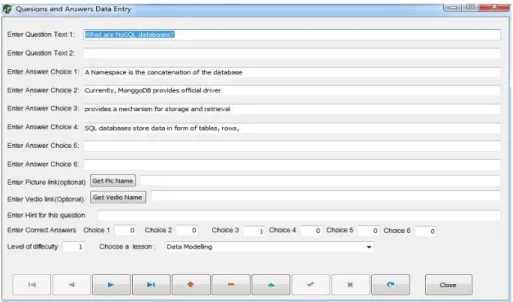
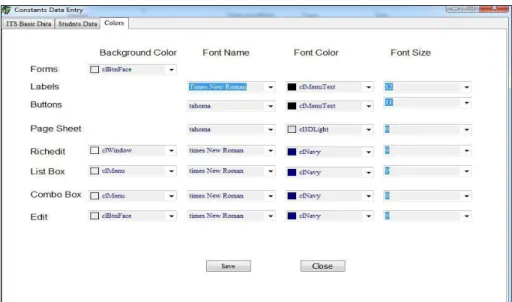
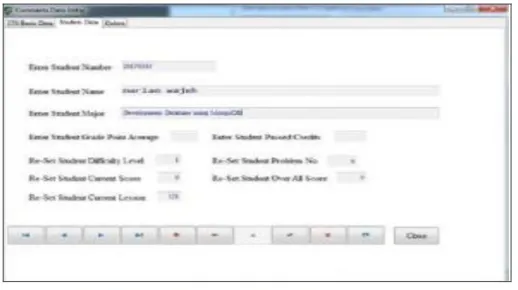
This tool supports two types of users: students and teachers. When the teacher logs in the system, the teacher can add lessons, exercises, answers of exercises, initial ITS basic information, initial information about the student, configure and adjust the color, font name, and size of all buttons, menus, combo boxes. This interface provides the system with the required enthusiasm and springiness. A screenshot of the teacher interface is shown in Fig 2, Fig 3, Fig 4, Fig 5 and Fig 6.
96
Fig. 3: Form for adding Lessons and Examples
Fig. 4: Form for adjusting Fonts of all screens of the system
97
Fig. 6: Form for adding initial students' information
When the student logs into the system, he/she will be able to understand the lessons, examples and questions. The lessons are located in the rectangle with the name “lessons area” and the examples for each lesson are located in the rectangle with the name “example area”. When the student ticks on Exercises button then "new
problem" button is enabled and the student can click on it to be given a new problem to solve.
The student must click on the "check button" to check his id it is correct or not. When the student wants to see his/her performance should click on "stats" button. See Fig 7 and Fig 8.
Fig. 7: Student lessons and examples form
98
4. EvaluationWe have evaluated the CSS-Tutor for teaching Development of CSS and HTML by presenting it to a group of teachers who specializes in CSS and HTML and a group of students in Al-Azhar University taken the course. We asked both groups to assess the CSS-Tutor. Then we asked them to fill questionnaire about the CSS -Tutor. The questionnaire consisted of questions concerning benefit of ITS, comprehensiveness of the material, quality of CSS-Tutor design. The result of the evaluation by teachers and students were as anticipated.
5. Conclusion
In this paper, we have designed an Intelligent Tutoring System called CSS-Tutor for teaching Development CSS and HTML by using ITSB authoring tool. The system was designed to facilitate the study of teaching CSS and HTML lessons to students and overcome the difficulties they face. CSS-Tutor architecture and requirements of each part in the system have been clarified. We conducted an evaluation of the CSS-Tutor by teachers and students and the results were more than good.
6. References
1. Abu Naser, S. (2008). JEE-Tutor: An Intelligent Tutoring System for Java Expression Evaluation. Information Technology Journal, Scialert, 7(3):528-532.
2. AbuEloun NN, Abu Naser SS. Mathematics Intelligent Tutoring System. International Journal of Advanced Scientific Research,2017, 2(1).
3. Abu-Naser S, Ahmed A, Al-Masri N, Deeb A, Moshtaha E, Abu Lamdy M. et al An Intelligent Tutoring System for Learning Java Objects. International Journal of Artificial Intelligence and Applications (IJAIA).2011, 2(2). 4. Abu-Naser S, Al-Masri A, Sultan YA, Zaqout I. A
prototype decision support system for optimizing the effectiveness of elearning in educational institutions. International Journal of Data Mining & Knowledge Management Process (IJDKP) 2011, 1:1-13.
5. Akkila AN, Abu Naser SS. Teaching the Right Letter Pronunciation in Reciting the Holy Quran Using Intelligent Tutoring System. International Journal of Advanced Research and Development. 2017, 2(1). 6. Al-Bastami BH, Abu Naser, SS. Design and
Development of an Intelligent Tutoring System for C# Language, European Academic Research, 2017, 4(10).
7. Al-Bayed1 MH, Abu Naser SS. An Intelligent Tutoring System for Health Problems Related To Addiction of Video Game Playing. International Journal of Advanced Scientific Research. 2017 2(1). 8. Aldahdooh R, Abu Naser SS. Development and
Evaluation of the Oracle Intelligent Tutoring System (OITS). European Academic Research, 2017, 4(10). 9. Alhabbash M I, Mahdi AO, Abu Naser SS. An
Intelligent Tutoring System for Teaching Grammar English Tenses. European Advanced Research. 2016; 4(9):7743-7757.
10. Al-Hanjori MM, Shaath MZ, Abu Naser SS. Learning Computer Networks Using Intelligent Tutoring System. International Journal of Advanced Research and Development 2017, 2(1).
11. Almurshidi SH, Abu Naser SS. Stomach Disease Intelligent Tutoring System. International Journal of Advanced Research and Development, 2017, 2(1). 12. Almurshidi SH, Naser SSA. Design and Development
of Diabetes Intelligent Tutoring System. European Academic Research, 2017; 4(9):8117-8128.
13. Al-Nakhal MA, Abu Naser SS. An Intelligent Tutoring System for learning Computer Theory. European Academic Research, 2017, 4(10).
14. Beverly Park Woolf, Building Intelligent Interactive Tutors Student-centered strategies for revolutionizing e-learning, Morgan Kaufmann Publishers, 2009. 15. Craig Grannell, The Essential Guide to CSS and
HTML Web Design (Essentials), Apress; 1st Corrected ed., Corr. 3rd printing edition, 2007. 16. El Haddad IA, Abu Naser SS. ADO-Tutor: Intelligent
Tutoring System for leaning ADO.NET. European Academic Research, 2017, 4(10).
17. Elnajjar AA, Abu Naser SS. DSE-Tutor: An Intelligent Tutoring System for Teaching DES Information Security Algorithm. International Journal of Advanced Research and Development, 2017, 2(1).
18. Eric Meyer, Smashing CSS: Professional Techniques for Modern Layout, Wiley; 1 edition, 2010.
19. Hamed MA, Abu Naser SS. An Intelligent Tutoring System for Teaching the 7 Characteristics for Living Things. International Journal of Advanced Research and Development, 2017, 2(1).
20. Hilles MM, Abu Naser SS. Knowledge-based Intelligent Tutoring System for Teaching Mongo Database. European Academic Research. 2017, 4(10). 21. Jennifer Niederst Robbins, Learning Web Design: A Beginner’s Guide To Html, CSS, Javascript, And Web Graphics, O'Reilly Media; 4th edition, 2012. 22. Jon Duckett, HTML and CSS: Design and Build
Websites 1st Edition, John Wiley & Sons, 2011. 23. Mahdi AO, Alhabbash MI, Abu Naser SS. An
intelligent tutoring system for teaching advanced topics in information security. World Wide Journal of Multidisciplinary Research and Development, 2016, 2(12), 1-9.
24. Mahmoud AY, Barakat MS, Ajjour MJ. Design and
Development of ELearning University System (Journal of Multidisciplinary Engineering Science Studies (JMESS), 2016; 2(5):498-504.
25. Naser, S. evaluating the effectiveness of the CPP-Tutor an intelligent tutoring system for students learning to program in C++. Journal of Applied
Sciences Research;
www.aensiweb.com/JASR/, 2009; 5(1):109-114. 26. Naser SA. A comparative study between Animated
Intelligent Tutoring Systems (AITS) and Video -based Intelligent Tutoring Systems (VITS). Al-Aqsa University Journal. 2001; 5(1):1.
27. Naser SA. An Agent Based Intelligent Tutoring System For Parameter Passing In Java
99
Programming. Journal of Theoretical & Applied Information Technology. 2008; 4(7).
28. Naser SA, Ahmed A, Al-Masri N, Sultan YA. Human Computer Interaction Design of the LP-ITS: Linear Programming Intelligent Tutoring Systems. International Journal of Artificial Intelligence & Applications (IJAIA), 2011; 2(3):60-70.
29. Naser SSA. Intelligent tutoring system for teaching database to sophomore students in Gaza and its effect on their performance. Information Technology Journal;Sci. alert. 2006; 5(5):916-922.
30. Naser SSA. Developing an intelligent tutoring system for students learning to program in C++. Information Technology Journal; Sci. alert. 2008; 7(7):1055-1060.
31. Naser SSA. A Qualitative Study of LP-ITS: Linear Programming Intelligent Tutoring System. International Journal of Computer Science & Information Technology, 2012; 4(1):209-220. 32. Naser SSA. Predicting learners performance using
artificial neural networks in linear programming intelligent tutoring system. International Journal of Artificial Intelligence & Applications. 2012; 3(2):65-73.
33. Naser SSA. ITSB: An Intelligent Tutoring System Authoring Tool. Journal of Scientific and Engineering Research, 2016; 3(5):63-71.
34. Naser SSA, Sulisel O. The effect of using computer aided instruction on performance of 10th grade biology in Gaza. Journal of the College of Education, 2000; 4:9-37.
35. Naser SSA. Developing visualization tool for teaching AI searching algorithms, Information Technology Journal, Scialert. 2008; 7(2):350-355. 36. Shaath MZ, Al-hanjouri M, Abu Naser SS,
ALdahdooh R. Photoshop (CS6) Intelligent Tutoring System. International Journal of Academic Research and Development. 2017,2(1).