Exploring the Factors Affecting On-Time Program Completion
Among Baccalaureate Nursing Students at the College of Nursing
–Jeddah
Houaida Helal 1,2* Wafaa El Arousy 1,2 Hend Al Najjar2 1. Faculty of Nursing, Alexandria University, Egypt
2. College of Nursing, King Saud bin Abdul Aziz University, Saudi Arabia Abstract
Background
With the amalgamation of nursing education into universities, there have been many questions have been the basis for various studies, related to the completion of nursing programs which researchers have conducted in the effort of understanding the components that influence the on-time program completion among Baccalaureate nursing students.
Method
The study was conducted in the college of Nursing, KSAU-HS, Jeddah, KSA. A mixed method approach was used. Data was collected using a convenience sampling method, a retrospective audit of student records and a questionnaire using 114 and 44 faculties. In-depth interview was also conducted with three faculties. Data analysis included descriptive and inferential statistics and content analysis.
Findings
For the quantitative findings: Student records revealed that 56.2% of students completed the program on time while 20.9% were delayed and 22.9% withdrawn during the period from the Academic year 2006-2007 till the Academic year 2015- 2016. The prevalence per stream revealed that 61.6% of students from stream 1 and 48.2% from stream 2 completed their program on time while 21.1% from stream 1 and 20.7% from stream 2 were delayed. Students scored marriage as the highest environmental barrier (M= 3.45 stream I and M=3.69 stream II) and difficult course the highest academic barrier (M= 3.76 stream I and M=3.26 stream II). Faculty score birth of a child as the highest environmental barrier (M= 4.45 and English language difficulty as the highest academic barrier (M= 4.34). For the qualitative findings the themes and subthemes that emerged included: affective factors were: honoring parents; means of escape; ownership of decisions; outside surrounding factors: the image of nursing and job security; psychological outcomes; feeling inferior, tainted personal image; academic factors; poor selection and academic overload.
Conclusion
Nursing students are challenged by various internal and external factors that impact on their ability to complete the nursing degree on time. Therefore, unfortunate as it is, the ability of nursing students to complete the nursing qualification on time may continue to be a problem of the future and might still be an area of debate in future. Keywords: Academic lagging; on time program completion; undergraduate student retention
1. Introduction
Nursing Education is essential for the growth of any nation. As a result, many states have allocated a significant proportion of their budget towards improving the nursing education sector. This situation is not unique to the rest of the world, but also in the Middle East. The government alongside the private sector has invested in the provision of good healthcare (Dale, Leyland & Dale, 2001). Saudi Arabia is one of the many countries in the world that is struggling with the problem of nursing shortages. The World Health Organization in 2004 showed that there were only 40 nurses in every 10, 000 people in Saudi Arabia (Lamadah & Sayed, 2014). In 2010, it was noted that the continuous shortage of nurses in the country had increased by 30% compared to the 2004 statistics. The shortage of nurses is attributed to the migration of people and nurses themselves. Currently, only about 40% of the nurses are citizens of Saudi Arabia as the others expatriates (Lamadah and Sayed, 2014).
There have been numerous issues in contemporary society, which the amalgamation of nursing education into universities has raised questions about nursing studies. These questions have been the basis for various studies, related to the completion of nursing programs which researchers have conducted in the effort of understanding the components that influence the on-time program completion among Baccalaureate nursing students, from both the student and faculty perspectives (Conner & Thielemann, 2013).
In the United States, individuals who drop out of high school or college are termed as “dropout factory”. While some may decide to drop out of college due to drug abuse and negative peer influence, others do it because some institutions in the recent years have increased their tuition fees. Although the United States is a developed nation, there are families that are poor and for that reason, they may not be able to fund their children and these results in them not finishing their nursing courses on time. Alden, (2006), explains that some fail to
finish their courses because they are orphans and do not have stable jobs that guarantee good pay which, in turn, would enable them to pay the fees for their course. This results in the student seeking odd jobs with pay minimal wages. Hence, students cannot afford to pay fees and attend their classes consistently. For those students who are focused and consistent regarding performance, it takes only three years for them to finish their undergraduate program. In a study carried out by Lee (2010), it was noted that 56% of students completed their college education in 6 years. In addition, only a total of 29% of the students finished their undergraduate program in the stipulated three years of study (Lee, 2010).
In addition, in the United States, the high cost of affording a quality education is the reason students fail to complete their courses on time. However, research also reveals a high rate of alcohol and substance abuse in Britain, which Alden, (2006) emphasizes on as another reason for nursing students’ failure to accomplish their courses and even entirely leads to numerous dropouts. Both Kern, (2014) and Jeffrey’s (2015) explains that good performance directly translates to the achievement of quality grades hence timely completion of the nursing course. A proper socio-economic background could be critical in determining the grade a student is expected to get. Though this school of thought does not apply to every individual, students from a background where parents or guardians are not only well educated and rich, tend to feel they are obliged to pass. They, therefore, put extra effort to ensure they follow their parents’ suite. A student coming from a background where most of the people are underachievers is likely to relax in their course because they feel, even if they failed, they are a step ahead of those they that live and interact within society.
Understanding the background and standards of education in the Arabian Gulf is critical in explaining the reasons why some students take longer to complete their respective courses (Tenbergen, 2010). The personal choice to study a respective course is viewed as a calling. For better performance, allowing a student to choose a nursing course by them means they have, not only the passion for their course but also the ability to take it (Hemlet & Stange, (2014) This works to their advantage because they are learning what they feel suits them best. However, in cases where parents play a critical role in deciding the course a student takes, to some extent the individual may have coveted another course but because of pressure, they are forced to undertake courses they never had a passion for from the beginning. This, according to Kern, (2014) results in the lack of self-motivation and only learning for the sake of pleasing the parents and significant others.
Conceptual model
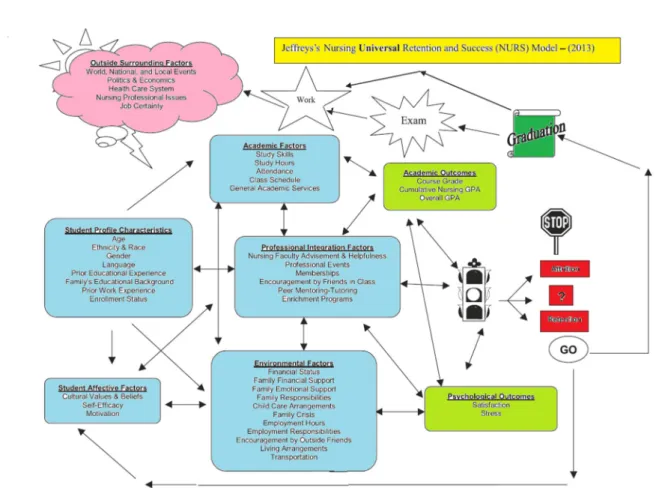
Jeffreys's (2015& 2013) Nursing Universal Retention and Success (NURS) model guided this study. This model exams multidimensional factors, that affect undergraduate nursing student retention and success. The model highlights that student profile characteristics, student affective factors, academic factors, environmental factors, academic outcomes, psychological outcomes, outside surrounding factors, and professional integration factors impacts on retention decisions and optimal outcomes. (Figure 1) .This model was utilized in other several studies worldwide in America (Veal, 2012), Kenya (Appiagyei, Etal 2014) and United Arab Emirates (Devadas, 2016).
Problem statement
Student failure to finish college on time not only wastes time but also studying is sometimes extended over a longer period of time, and some students are academically dismissed, while others withdraw from the program based on quality unit reports, from the college of Nursing –Jeddah. Many nursing students are unable to complete the nursing program on time, hence the aim of this study was to explore the factors affecting on-time program completion among Baccalaureate nursing students.
Failure to complete nursing programme on time is not a new area of research. There are various studies that have opted to explore this phenomenon, within the international arena, however, within the context of Saudi Arabia, this phenomenon is still under research. Hence, it is within this backdrop that this research was completed.
Aim of study
The study aimed to explore the factors affecting on-time program completion among baccalaureate nursing students at the College of Nursing- Jeddah.
The objectives of the study were to:
1. Assess the prevalence of delay in the completion of a nursing program from the academic Records, at the College of Nursing- Jeddah.
2. Describe the perceptions of nursing students regarding the factors affecting on-time program completion among Baccalaureate nursing students at the College of Nursing Jeddah.
Figure 1: Fig. 1. Jeffreys's Nursing Universal Retention and Success (NURS) Model - (2015, 2013). Methods
Research paradigm
This study used a pragmatic paradigm. The researchers chose this approach as it is believed that exploring the phenomenon of delay in the completion of nursing programs cannot be confined to either a quantitative or qualitative approach exclusively.
Research design
A mixed method approach was used. The researchers chose the mixed methods to approach for this study because the quantitative data will provide a general picture of the research problem, while qualitative data will explore in depth the participants’ views. Further to this, as recognized by Collins et al (2007), the mixed methods approach provides for participant enrichment; the selected participants are appropriate for the study, instrument fidelity; assess the appropriateness and utility of existing instruments, integrity and significance enhancement; facilitate thickness and richness of data.
Study setting
The College of Nursing, Jeddah, at the King Saud bin Abdul-Aziz University, was the setting for this study. The College offers two undergraduate (Baccalaureate) Programs in Nursing Science: the first is known as Stream I, catering for high school graduates. The second is known as Stream II, catering for university graduates who wish to join Nursing as a second career. The two programs are followed by an internship program of one year. Even though the duration of the program spans over eight semesters for stream I and five semesters for stream II, the throughput rate of the students to graduation is not always within these time frames.
Population, sampling and sample size
The study included all students and faculty in the college during the time of data collection. There were 165 registered students and 66 faculties within the college context during the time of data collection. 114 students and 44 faculties participated in the study using convenience sampling technique. For the qualitative aspect of the study, the researcher included three faculties.
Data collection tool and process
Data collection started after approval from the Research Unit at the College of Nursing- Jeddah. Once permission was obtained from the necessary authorities, the researchers set up a convenient time for data collection. Once this was established, the researchers only included students and faculty that were willing to partake in the study. Data was collected in the following stages:
The first stage was an analysis of the data in student records. The dataset (college records) from Fall 2006-2007 till Spring 2016 was provided by the college’s Office of Academic Affairs. This dataset included the student admission and graduation semesters, and their GPA for each semester.
The second stage of data collection was the completion of a questionnaire. Questionnaires were handed to all students and faculty available at the time of data collection. This stage should take approximately three weeks. Once students were invited to and agreed to participate in the study and sign the consent form, they were asked to fill the study questionnaires. The researchers distributed the research surveys to the students and gave them the essential instructions to complete it.
The study questionnaire was distributed to the faculty and teaching assistants in their offices after filling out the written consent. The questionnaire was collected by the researchers at the end of the same day of dissemination.
The data collection tool was developed by the researchers after reviewing of relevant literature. The tool for the students composed of two sections. Section A: socio-demographic characteristics for students including age, level, marital status, living condition. For faculty socio-demographic factors including years of experience, teaching courses. Section B: factors leading to on-time or delay in completion of the program. The Questionnaire was validated and reliability was .893 for faculty and .975 for students using the Cronbach’s Alpha test.
The third stage included in-depth individual interviews with the faculty, that was audio recorded. For the qualitative aspect of the study, academic rigor was maintained by ensuring trustworthiness: using the criteria of credibility, transferability, dependability, and confirmability (Guba & Lincoln, 1985).
Results
Sociodemographic details of respondents.
One hundred and fourteen students participated in the study, with the minimum age of students being 19 years, the maximum age of 29 years (Mean age of 21.83). The 85, 1% (n=97) of students were single with only 14, 9% (n=17) married. Only 7 (n=6.1%) of students had children. The educational level of all students’ parents indicated that the majority of parents had an educational level below university (50% for fathers and 42.1% for mothers). 50% (n=57) of father’s educational level was below university level with 42, 1% (n=48) of mothers educational level below university educational level. In addition, it was noted that more mothers, 38.6% (n=44) were uneducated as compared to fathers, 34, 2% (n=39). Most students 84, 2 % (n= 96) were from stream 1, and 15.8 % (n=18) students were from stream 2. From the 84.2% of stream 1 students, most students were from level 4 (27.2%) and level 5 (24, 6%). Stream 1, level 7 students (9%) were least number of students that participated in this study. From the 18% (stream 2 students) level 4 (7%) students were the majority who participated followed by level 3 (5.3%) of students.
Forty-four faculties participated in the study, with 31.8 (n=14) in the position of Assistant Professor, with Lecturers 20.5% (n=9), and Clinical Teaching Assistants 47, 7% (n=21). 84.1% (n=37) of faculty were non-Saudi and 15.9% (n=7) were non-Saudi. Most faculty (81.8%) were involved in teaching clinical courses, while the rest 18.2% were involved in nonclinical courses. The minimum years of experience amongst faculty were less than 1 year and a maximum number of years of experience was 26 years, with a mean of 10.06 years of experience.
Graph 1: Prevalence of lagging amongst students
Student records revealed that 56.2% of students completed the program on time while 20.9% were delayed and 22.9% withdrawn during the period from the Academic year 2006-2007 till the Academic year 2015- 2016. The prevalence per stream revealed that 61.6% of students from stream 1 and 48.2% from stream 2 completed their program on time while 21.1% from stream 1 and 20.7% from stream 2 were delayed.
These findings also highlight that almost one-fifth of the student population was delayed in the completion of the program within the set time frame of four years from Fall 2006-2007 till Spring 2016.
The above table highlights that delay in completion of training was most prevalent in the academic years 2007/2008 and 2010/2011.
In addition, delays were more common in stream 1 than stream 2 during these years. A slight difference was noted in the delay between streams in the academic year 2007/2008 where 19.4% of stream 1 students as opposed to 19% of stream 2 students.
However, the difference between the prevalence per stream increased in stream 1 (20, 9%) as opposed to stream 2 (16, 2%) for the academic year 2010/2011. Graph 1 above highlights significant differences between both streams.
Table2: Prevalence of lagging according to the academic year of admission
Delay per academic year Total
On-time delay
number % number % number %
Admission year 2006/2007 80 16.4% 18 14.0% 98 15.9% 2007/2008 92 18.9% 25 19.4% 117 19.0% 2008/2009 69 14.2% 11 8.5% 80 13.0% 2009/2010 36 7.4% 24 18.6% 60 9.7% 2010/2011 73 15.0% 27 20.9% 100 16.2% 2011/2012 58 11.9% 21 16.3% 79 12.8% 2012/2013 79 16.2% 3 2.3% 82 13.3% Total 487 79.06 129 20.94 616 0.00% 20.00% 40.00% 60.00% 80.00% 100.00%
Stream I Stream II Total
61.60% 48.20% 56.20% 21.10% 20.70% 20.90% 17.3% 31.1% 22.9% On time Delayed
withdraw and others
Graph 1: Distribution of students according to their completion of the program
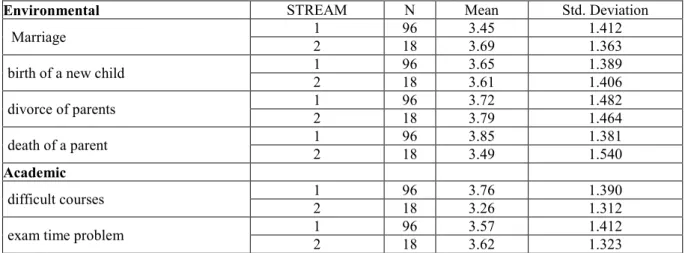
Table 1: Students’ perceptions of the most important factors affecting on-time program completion by a stream
Environmental STREAM N Mean Std. Deviation
Marriage 1 2 96 18 3.45 3.69 1.412 1.363
birth of a new child 1 2 96 18 3.65 3.61 1.389 1.406
divorce of parents 1 2 96 18 3.72 3.79 1.482 1.464
death of a parent 1 2 96 18 3.85 3.49 1.381 1.540
Academic
difficult courses 1 2 96 18 3.76 3.26 1.390 1.312
exam time problem 1 2 96 18 3.57 3.62 1.412 1.323
Table 1 highlights the students’ perceptions of the most important factors affecting on-time program completion by the stream. The highest mean was for family related issues as an environmental barrier with a mean of 3.79 for the divorce of the parent (stream 1) and mean of 3.85 for the death of a parent (stream 1). As regards academic factors, the highest mean was 3.76 for difficulty of courses (stream 1) and 3.62 for exam time problems (stream 2) .
Table: (2) The differences between perceptions of regular and lagger students on factors affecting on-time completion of the nursing program
Factor Mean Std. Deviation
REGULAR ENVIRONMENTAL Divorce of parents 3.68 1.5
Death of parent 3.6 1.48
Birth of a new child 3.59 1.29
Marriage 3.35 1.49
Problems with the husband 3.23 1.41
ACADEMIC Difficult courses 3.58 1.4
Exam time problem 3.33 1.36
Problems with a teaching assistant 3.28 1.34 English language difficulty 3.17 1.4
Attendance problems 3.16 1.54
LAGGER ENVIRONMENTAL Death of parent 4.21 1.34
Divorce of parents 3.85 1.48
Not living with the family 3.84 1.22
Marriage 3.82 1.29
Birth of a new child 3.76 1.41
ACADEMIC Exam time problem 4.11 1.13
Poor secondary GPA 3.89 1.23
English language difficulty 3.85 1.28
Attendance problems 3.74 1.1
Problems with a teaching assistant 3.67 1.36 Table 2 illustrates the differences between perceptions of regular and lagger students on factors affecting on-time completion of the nursing programme. The highest means of environmental barriers as perceived by students were for divorce of parents, death of parent and birth of new child with a mean of 3.68, 3.6 and 3.59 respectively for regular students compared with death of a parent, divorce of parent and not living with the family with a mean of 4.21, 3.85 and 3.84 respectively for lagger students. Furthermore, the highest mean of academic barriers as perceived by students were for difficult courses and exam time problem with a mean of 3.58, 3.33 respectively for regular students compared with exam time problem, poor secondary school GPA, English language difficulty and attendance problem with mean of 4.11, 3.89 and 3.85 and 3.74 respectively for lagger students
Table (3) Faculties’ perception of the most important factors affecting on-time program completion Descriptive Statistics
N Minimum Maximum Mean Std. Deviation Environmental
Birth of a new child 44 3.00 5.00 4.45 0.72
Death of parent 44 2.00 5.00 4.27 0.94
Marriage 44 3.00 5.00 4.20 0.79
Refusal from the family to work as a nurse 44 1.00 5.00 4.15 1.11 Academic
English language difficulty 44 1.00 5.00 4.34 0.93
Not interest in nursing 44 1.00 5.00 4.25 1.05
Faculty’s’ perception of the most important factors affecting on-time program completion is presented in table 3. The most commonly perceived environmental barriers by faculty affecting on-time completion of the nursing program were the birth of a child followed by the death of a parent with a mean of 4.45and 4.27 respectively. While English language difficulty and not interested in nursing were perceived as an academic barrier with a mean of 4.34 and 4.25 respectively.
Regarding the difference in perception of the three groups (assistant professors, lecturer, and teaching assistants, the most common barriers were categorized into environmental and academic barriers. Table 4 shows that the most commonly perceived environmental barriers by Assistant Professors as affecting on-time completion of the nursing program was the birth of a child (M= 4.64), followed by marriage (M= 4.42). Regarding the most common academic barriers to on-time completion as not interested in nursing (M=4.07), English language difficulty (M=4.07) and attendance problems (M=3.64).
Amongst lecturers, the most common environmental barriers identified affecting on-time completion of the nursing programme was the death of a parent (M=4.44), followed by birth of a child (M=4.22) and marriage (M=4.00). Lecturers identified the most common academic barriers to on-time completion as not interested in nursing (M=4.22), English language difficulty (M=4, 22) and attendance problems (M=3.88).
Clinical Teaching Assistants perceived death of a parent as the most common environmental barrier affecting completion of the programme (M=4.52); the birth of a child (M=4.42) followed by transportation problems (M=4.33). In addition, the highest academic barriers amongst Clinical Teaching Assistants were English language difficulty (M=4.57); not interested in nursing
(M=4.38) and attendance problems (M=4.09). Differences in barriers in the different category of staff reveal significant differences noted in the environmental barriers were: transportation problems; moving from the city; not living with the family and academic barriers: lack of peer support; exam time problem; class schedule problems.
Table (4) the difference in perception about the most common barriers of the three groups (Assistant Professors, Lecturer, and Teaching Assistants).
Assistant Professors
Environmental factors N Minimum Maximum Mean Std. Deviation
Birth of new child 14 3.00 5.00 4.6429 .74495
Marriage 14 3.00 5.00 4.4286 .64621
Refuse from the family to work as a nurse 14 1.00 5.00 4.2143 1.18831 Academic factors
Not interested in nursing 14 .00 5.00 4.0714 1.43925
English language difficulty 14 2.00 5.00 4.0714 1.07161
Difficult courses 14 1.00 5.00 3.6429 1.08182
Lecturers
Environmental factors
Death of parent 9 3.00 5.00 4.4444 .88192
Birth of new child 9 3.00 5.00 4.2222 .83333
Marriage 9 3.00 5.00 4.0000 .86603
Academic factor
Not interested in nursing 9 3.00 5.00 4.2222 .97183
English language difficulty 9 1.00 5.00 4.2222 1.30171
Clinical Teaching Assistants Environmental factors
Death of parent 21 3.00 5.00 4.5238 .81358
Birth of new child 21 3.00 5.00 4.4286 .67612
Transportation problems 21 3.00 5.00 4.3333 .85635
Academic factors
English language difficulty 21 3.00 5.00 4.5714 .59761
Not interested in nursing 21 3.00 5.00 4.3810 .80475
Attendance problems 21 1.00 5.00 4.0952 .99523
Findings- Qualitative
The findings from the in-depth interviews after content analysis are presented in the following table and are guided by the conceptual framework of Jeffrey (2015, 2013).
Themes Subthemes
Student affective factors Honoring parents Ownership of decision Means of escape Outside surrounding factors Image of nursing
Job security
Psychological outcomes Feeling inferior
Tainted personal image
Academic factors Poor selection
Academic overload Theme 1: student affective factors
In keeping with the conceptual framework, the subthemes that emerged under the theme student affective factors were: honoring parents; means of escape; ownership of decisions.
Subtheme 1.1: Honoring Parents
Many participants expressed that students sought nursing as a profession as it is related to cultural obligations. Cultural obligations in this context meant that within the Arab culture, honoring the parents is a practice that is widely encouraged. In the context of this study “honoring parents” referred to honoring the decision of parents regarding the choice those parents have made for their daughters to study nursing. Participants verbalized that many students in their attempt to honor the decisions parents have made for their daughters to study nursing will
“From the beginning, in this culture, their parents can decide for them what to study. So, starting from that if my parents will decide for me what to study and then culturally I really would go along with what they suggest for me because in our culture we really respect our parents’ decision” ( Participant 1).
Subtheme 1.2: Ownership of decision
Participants verbalized that seeing decisions to study nursing was decisions made by a family head or parents, some students did not feel motivated or obligated to the decision and completion of the programme thereof: “The culture of decision making is not really owned by the students. Decisions are made by the head of the family. So, if a student does not make the decision to do nursing, they don’t take ownership of that decision and what ends up happening is that they are not committed to it” ( Participant 2)
“Of course, once you try to take part in the decision, you will fight for it. So, at least in front of yourself, you can say that …I made a decision and now I have to show others, I did it, I want it and I want to succeed, so nobody will say oh she made the decision wrong, … and inside your mind, you think in the back of your mind that I choose it, I want to do it, so you feel more promoted and more motivated for it” (Participant 1)
Subtheme 1.3: Means of escape
Participants shared that students get into nursing as it is a way of escaping being at home. Attending college provides a means of socialization with other students as culturally there are restrictions for socialization: “So I think… the other thing for them to be outside the home and coming to university will give them the social environment and talk with others. They find themselves out of the home, I mean in this culture in particular, so that entertains, the feeling that they are liked by others. They can eat and go back and forth that maybe they will not do at home” (Participant 1).
“The other thing … was parents do not like the students to come out of the home, like doing nursing you got to come to the university. University is an environment where you will have to socialize with other people” (*Participant 2)
Theme 2: Outside surrounding factors
Outside surrounding factors refers to factors that the student personal environment or academic setting has no control over. The subthemes that emerging under this theme include the image of nursing.
Subtheme 2.1: the image of nursing
Participants expressed that many students do not complete the programme on time as a result of the fact the nursing profession has a poor image as compared to medicine. Some students where not comfortable sharing information around that actual studies undertaken as the image of nursing is negative:
I… because really when I myself see some shows on TV, movies and so on; they all will show the negative part (especially Arabic shows) about nursing. The nurses always in the background. She is running in the hospital. She just looks like and she is not really professional, so I think people will be affected by the image and it is internationally known, it is more for us because we have a more closed culture. (Participant 1).
“One part of this might be because of the fact that the nursing is not really one of the so-called prestigious professional choices here “(Participant 3)
Subtheme 2.2.: Job security
One respondent stated that some students come into nursing as they are confident that they will secure employment after their studies as nursing in Saudi Arabia depends largely on expatriate nurses:
“I have one student. She graduated from microbiology and she did not get any job and she joined us in program … I asked her why she joined nursing. She said that by joining microbiology she did not have any job, so her parents told her to join the nursing, so that for sure she will get job after she is qualified” …(Participant 2) “They come with their engineering degree, but they don’t find job, so they do it until they finish and they said with the nursing degree, they find better job when they go for nursing, even though they have other profession, other degree already.. and then they leave us when they find other jobs” (Participant 1)
Theme 3: Psychological outcome
The subtheme that emerges under this theme was: feeling inferior; and tainted reputation. Subtheme 3.1: Feeling Inferior
Some respondents expressed that many nursing students felt nursing was an inferior course as compared to other courses. In some instances, nursing students will not feel comfortable divulging that they are studying nursing but with rather state that they are undertaking other studies:
here … they almost compare themselves with that, even economy students or any other, so they feel they are less than more inferior to the other colleagues and that makes them feel like this. Even sometimes they will not say that they are a nursing student, they will say I study in health science” (Participant 1).
In some instances participants verbalized that students have expressed that their parents will also feel inferior about nursing as a choice of study:
“Not nursing… and even families, as some students will say that even my parents will not tell the neighbor that I am studying nursing. They say I go to the university and I am studying health… and maybe they connect it with some negative image” (Participant 1).
Subtheme 3.1: Tainted personal image
One respondent verbalized that within this cultural context social interaction of single males with females is not allowed. Within the nursing programme, clinical work within the hospital environment is compulsory hence there will be communication between male and female staff. Some students might feel the pressure of this norm and hence feel that people may not be respectful to them as they are aware that nursing students are interacting with other male colleagues:
I will just first say that. But what impacts more is the customs, the traditions, which is different from the religion, so in that culture … it is not really a well-respected profession, but here more because of some issues they are talking about mixing, because here (especially here) separating male and female issue, so they all will think of negative things when there is nursing and there is clinical and then there is hospital. They will mix, nurses, physicians, doctors (male and female) and then there is night shift, so the perception is more negative… but still they are not sure about their status and how people will look at them and how they will respect them and if they will respect them (Participant 2)
Theme 4: Academic factors:
The subthemes that emerged under this theme were poor selection and overload. Subtheme 4.1 Poor selection:
Participants stated that the reason many nursing students do not complete their training on time can be related to the selection of process of students. One participant questioned the assessment criteria used for selection of students into the nursing programme:
“Of course the other thing is that students as you said about how we select them. In terms of knowledge and in terms of intellectual ability, we do not have any kind of assessment for that. I do not think that we assess their level, IQ and all that” (Participant 1).
Another participant mentioned that there is a possibility that during admission into the programme, the process does not gauge that nursing is a profession that requires a passion for the course:
“I am not aware … and if they are like reaching well to pre-professionals and delivering the message and trying to gauge the passion” (Participant 3).
Subtheme 4.2: Academic overload:
Participants felt that one possibility for students not completing their training on time is due to that fact that students have academic overload. This particular participant explained that having too many courses concurrently creates a huge workload that students cannot cope with:
“They have three clinical and one course; adult, pediatric or pediatric and maternity and psych….. impossible because they cannot work three courses, three different expectations, three different perspectives (discipline) at the same time…if I was the student I would not be able to manage” (Participant 1).
Discussion
Student records revealed that 56.2% of students completed the program on time while 20.9% were delayed and 22.9% withdrew during the period from the Academic year 2006-2007 till the Academic year 2015- 2016. The highest mean was for family related issues as an environmental barrier with a mean of 3.79 for the divorce of the parent (stream 1) and mean of 3.85 for the death of a parent (stream 1). With regards to academic factors, the highest mean was 3.76 for the difficulty of courses (stream 1).
The Kingdom of Saudi Arabia faces a shortage of nurses as evidenced by the ratio of nurses to patients (36 nurses per 10,000 populations) compared with other countries worldwide such as Canada (100/10,000), and the UK (101/10,000). In addition, only 34% of the nursing workforce is Saudi nationals (AlYami & Watson 2014). There is a priority of applying policies of Saudization of all professions including the nursing profession, hence nursing colleges and universities should expand enrolment levels to overcome the shortage and to achieve the
policymakers in institutions of higher education to support nursing students to complete the program on time and to decrease the attrition rate.
The results of the current study revealed that 56.2% completed the program within the set time frame during the period from the Academic year 2006-2007 till the Academic year 2015- 2016. This is very low and lower than the percent (80% or higher) that is recognized by the National League for Nursing Accrediting Commission (NLNAC, 2008) for successful nursing programs. At the same time, it is lower than the results of the study by Herrera. (2013) which was 93.8%, conducted in the College of Nursing and Health Innovation at Arizona State University.
Student retention is influenced by the interaction of multiple factors. The Nursing Universal Retention and Success (NURS) model describes the multidimensional factors that affect undergraduate nursing student retention and success. It includes students’ characteristics, academic factors and environmental factors (Jeffrey’s, 2015) and Jeffreys, 2012). Jeffreys (2007) ranked the factors, from most supportive as friend support, institutional interaction and facilities followed by personal academic factors, and environmental factors were the least supportive. The results of the current study revealed that nursing students either regular or laggers perceived family issues as death of parent, divorce of parents, not living with the family, marriage and birth of child (with mean of 4.21, 3.85, 3.84, 3.82, 3.76 respectively) as environmental barriers that affect their studying and completion of the program on time. This is in line with the results of Jeffreys (2007) and Ezeala-Harrison. (2014), who found that 59 % of female students indicated that personal problems and /or family problems is either important or very important in their college retention. In addition, Kern (2014) reported that family crises, family responsibilities, and children’s activities, prevent students from being able to concentrate on academic responsibilities (Kern, 2014).
For academic barriers, laggers students perceived poor secondary GPA with the mean of 3.89. However, the setting of the current study (KSAU-HS) has a single admission requirement which is based on a weighted score of student's high school grade point average (GPA), aptitude grade and achievement grade; the last two items are conducted by the National Centre for Assessment in Higher Education. According to Elkins (2015), the pre-program admission criteria in addition to passing the first have been shown to be a strong predictor for completing the program (Elkins 2015). Furthermore, pre-admissions tests has been shown to effectively help identify students that are likely to be successful and persist in nursing schools based on their level of academic preparedness (Ascend Learning, (2012). In addition, Schmidi & MacWilliams (2011) did a systematic review of the admission criteria for the undergraduate nursing program and reported that interviews decreased the attrition rate.
Although six English courses with 20 credit hours out of 140 are included in the program in the first academic year, English language difficulty with the mean of 3.85 is perceived by laggers students to be one of the academic barriers for completing the program on time. This may be attributed to the fact that all college courses are in English and they have lack of English courses during secondary school years. Within the current study, it was also noted that the English language was the most significant barrier noted by Clinical Teaching Assistants. This can be attributed to the fact the Clinical Teaching Assistants are in close regular contact with students and have the opportunity through their interactions with students to assess for any difficulties related to the English language. Further to this, all Clinical Teaching Assistants within the college is non-Arabic speaking as opposed to some faculty who are Arabic speaking. Hence faculty members may not have the opportunity to identify this as the most prevalent barrier.
Furthermore, attendance problem with the mean of 3.74 and problems with Clinical Teaching Assistants with the mean of 3.67 are perceived as academic barriers. Within our college, Clinical Teaching Assistants are in interacting with students on a regular basis as opposed to faculty who are usually in contact with students predominantly during lecture times. Hence, it is for this reason that Clinical Teaching Assistants might have identified transportation as an environmental barrier for students, which could impact on attendance. Having close regular contact could possible mean that students are more comfortable with Clinical Teaching Assistants and are able to verbalize to them these issues around transportation. Furthermore, in our college, Clinical Teaching Assistants are responsible for students’ evaluation either in the college clinical nursing lab or during clinical training in the hospital using clinical evaluation rubrics. Students have poor attitudes toward the Clinical Teaching Assistants when they receive poor marks. For instance, the literature suggests positive relationships between nursing students and faculty are crucial to student retention and success in nursing programs (Ascend Learning, 2012). In addition, Ezeala-Harrison (2014) who found that 83% of female students indicated that faculty interaction is either moderately or highly important in their college retention (Ezeala-Harrison. (2014). Further, Beauvais et al (2014) added that improving students/ faculty deeper conversation for students to discuss their concerns in addition to establishment of a Student Faculty Advisory Committee in which students and faculty meet on a regular basis and address student concerns and issues are beneficial (Beauvais et al 2014). So, providing professional development that encourages Clinical Teaching Assistants to establish a positive relationship with their students should be considered when developing an action plan to improve student’s
retention and completion of the program on time. One should take steps to ensure that course scheduling is done to a practical degree possible to overcome attendance problems. Orientation sessions and schedule flexibilty are also supported by Robertson et al (2010) to enhance retention. Moreover, McLain, (2017) reported that poor attendance is one of the risk factors for poor academic performance.
Although Ezeala-Harrison. (2014) found that 96% of the females’ students responded that financial concerns are either moderately important or very important in their decision not to complete the program; students within our context do not have this problem as tertiary education is for free. In addition, the university provides a monthly stipend to all students as per the Ministry of Higher Education rules and regulation. The results of the current study revealed that college teaching staff Clinical Teaching Assistants, Lecturers or Assistant Professors perceived the same barriers as students and they added “not interested” in nursing as one of the barriers for completion of the program on time. Motivation of students and encouraging them to attend nursing activties and events within the community in addition to peer support should be considered.
One of the major subthemes that emerged from the study was that of “honoring parents”. Participants felt the decision to enroll in nursing were decisions made by parents or the head of the household which students felt that they needed to respect. Hence the decision to study was not owned by student which could lead to students dropping out of the programme or not completing on time. According to Boyd and McKenrdy (2012), many nursing students were guided by their own decision to become a nurse. In this study when students considered withdrawal, they remembered their commitment to the course and academic achievement was based on a love of caring, and a desire to become a registered nurse. Further, Boyd and McKenrdy (2012) highlighted that students remembered the importance of nursing as an aspiration in choosing their area of study/ profession, but also of the pivotal role it played in maintaining momentum and motivation when they had considered withdrawal. In addition, Tinto (1993) expressed the “longitudinal process of student persistence in college (p.94) is important that college students separate themselves from their old communities in order to allow for new norms and behaviors to be adopted. In the case of the student that does not own the decision to undertake nursing as a profession, there is a possibility that this may not happen as the student does not have internal motivation to remain in nursing as a profession. This is reiterated by Martinez (1995) who reported that, students who withdraw were more likely to be dissatisfied with the ‘the intrinsic interest of their course’, (1995: 3).
Another major finding within this study was the poor image of nursing that resulted in students not completing on time. In addition, students felt that if nursing was chosen, their images would be tainted as a resulting of social interactions of single male and females which is prohibited in this culture. According to Mansour et al (2016), nursing is still considered an undesirable job in Saudi Arabia especially as it requires work in an open setting where there is communication with different people from both genders. In addition, many participants verbalized that nursing student feeling inferior in relation to health related courses are less likely to complete on time. According to Furegato (2008), a decreased self-esteem was directly related to the drop out of nursing students.
Recommendations
Creating a peer mentoring and friendship support group is advised. Also, providing students with sufficient information regarding the program language is needed. Lastly, providing professional development that encourages Clinical Teaching Assistants to establish a positive relationship with their students should be considered.
Limitations
The study only included one college within the Saudi Arabia. In addition a small sample size of participants was included in the study.
Acknowledgment:
The authors appreciate the great effort of Dr Jennifer De Beer in completion of this study and the analysis of the qualitative part of this study.
5. Conclusion
This study was conducted based on the College Quality Unit’s recommendations and based on the results; an action plan will be developed and proposed to support students to complete their program on time. The findings of this mixed methods study confirmed the results of previous studies on nursing students’ inability to complete the nursing program on time. Nursing students are challenged by various internal and external factors that impact on their ability to complete the nursing degree on time. Therefore, unfortunate as it is, the ability of nursing students to complete the nursing qualification on time may continue to be a problem of the future and might still
References
Alden, K. R. (2006). Predictors of early academic success and program completion among baccalaureate nursing students. http://www.lib.ncsu.edu/resolver/1840.16/4090
AlYami MS, Watson R. (2014) An overview of nursing in Saudi Arabia. J Health Spec ;2:10-2. Retreived from: http://www.thejhs.org/text.asp?2014/2/1/10/126058
Appiagyei AA., Kiriinya R N, Gross J M.,David N Wambua D.N., Oywer E.O, Kamenju A.K, Higgins M.K, Riley LP and Rogers MF (2014)Informing the scale-up of Kenya’s nursing workforce: a mixed methods study of factors affecting pre-service training capacity and production Human Resources for Health12:47 DOI: 10.1186/1478-4491-12-47
Ascend Learning, LLC. (2012). Student attrition: Consequences, contributing factors, and remedies. Retrived from https://www.atitesting.com/Libraries/pdf/Attrition_whitepaper_ATI_2.sflb.ashx
Beauvais, A., Stewart J., DeNisco, S., Beauvai, J. (2014) "Factors Related to Academic Success Among Nursing Students: A Descriptive Correlational Research Study." Nurse Education Today 34.6 : 918-23.
Collins, K. M. T., Onwuegbuzie, A. J., & Jiao, Q. G. (2007). A mixed methods investigation of mixed methods sampling designs in social and health science research. Journal of Mixed Methods Research, 1(3), 267-294. Conner NE, Thielemann PA. 2013, RN-BSN completion programs: Equipping nurses for the future. Nursing
Outlook;61(6): 458-465.
DALE, B., LELAND, A., & DALE, J. G. (2013). What Factors Facilitate Good Learning Experiences in Clinical Studies in Nursing: Bachelor Students’ Perceptions. ISRN Nursing. 2013, 1-7.
Devadas, B. R. (2016). Emirati Student Profile within Nursing Education. J. Middle East North Afr. sci, 2(3), 50- 60. (p-ISSN 2412- 9763) - (e-ISSN 2412-8937). http://www.jomenas.org.
Du Plessis, L., & Gerber, D. (2012). Academic preparedness of students - an exploratory study. TD : The Journal for Transdisciplinary Research in Southern Africa. 8, 81-94.
Elkins N. (2015 ) Predictors of Retention and Passing the National Council Licensure Examination for Registered Nurses, Open Journal of Nursing, 5, 218-225
Ezeala-Harrison F. (2014), Male-female student retention in HBCUs: A comparative analysis of sample data across five colleges, Research in Higher Education Journal Volume 26 retrieved from
Furegato, A. R. F., Santos, J. L. F., & Silva, E. C. D. (2008). Depression among nursing students associated to their self-esteem, health perception and interest in mental health. Revista latino-americana de enfermagem, 16(2),198-204.
Guba E. Lincoln Y. 1985. Naturalistic inquiry, Newbury Park, California, Sage.
Hemelt, S. W., & Stange, K. M. (2014). Marginal pricing and student investment in higher education.
Herrera Ch., (2013) Quantitative analysis of variables affecting nursing program completion at Arizona State University, Research in Higher Education Journal, retrieved from http://www.aabri.com/manuscripts/131607.pdf
Jeffreys M. (2015) Jeffreys’s Nursing Universal Retention and Success model: Overview and action ideas for optimizing outcomes A–Z , Nurse Education Today 35: 425–431
Jeffreys, M. (2012) Nursing student retention : understanding the process and making a difference , 2nd ed. NEW-York : Springer Publishing Company, LLC.
Jeffreys, M.R (2013).. Nursing Student Retention: Understanding the Process and Making a Difference (2nd Ed.), New York, NY: Springe
Jeffreys, M.R. (2007) Nontraditional Students’ Perceptions of Variables Influencing Retention: A Multisite Study. Nurse Educator, 32, 161-167.
Jeffreys, M.R. (2015). Jeffreys's Nursing Universal Retention and Success model: Overview and action ideas for optimizing outcomes A–Z. Nurse Education Today. 35:425–431.
Kern, B. (2014) Factors That Restrict or Support Retention among RN-to-BSN Nursing Students: A Replication Study. Open Journal of Nursing, 4, 296-302.
Kern, B. (2014) Factors That Restrict or Support Retention among RN-to-BSN Nursing Students: A Replication Study. Open Journal of Nursing, 4, 296-302.
Kern, B. (2014). Factors That Restrict or Support Retention among RN-to-BSN Nursing Students: A Replication Study. Open Journal of Nursing. 04, 296-302.
Lamadah, S. and Sayed, H. (2014). Journal of Biology, Agriculture and Healthcare. Challenges Facing Nursing Profession in Saudi Arabia, 4(7), pp.20-25.
Lee, G. (2010). Determinants of baccalaureate degree completion and time-to-degree for high school graduates in 1992.
Mansour AA. Nursing in Saudi Arabia as perceived by university students and their parents. J Nurs Educ 1992;31:45-6.
Martinez, P.(1995), Student retention in further and adult education: the evidence. Mendip Papers, Bristol, FEDA.
Mckendry, S., & Boyd, V. (2012). Defining the" Independent Learner" in UK Higher Education: Staff and Students' Understanding of the Concept. International Journal of Teaching and Learning in Higher Education, 24(2), 209-220.
McLain, Rh., Fifolt, M., Dawson, M., Wei Su, F., Milligan, G., Davis, S., Hites, L. (2017). Student Success Survey Supporting Academic Success for At-Risk Nursing Students Through Early Intervention. Nurse Educator Vol. 42 (1) 33- 37
Robertson, S., Canary, C.W., Orr, M., Herberg, P. and Rutledge, D.N. (2010) Factors Related to Progression and Gradation Rates for RN-to-Bachelor of Science in Nursing Programs: Searching for Realistic Benchmarks. Journal of Professional Nursing, 26, 99-107.
Schmidi B & MacWilliams B (2011). Admission criteria for undergraduate nursing programs: a systematic review Vol 36 (4) : 171- 174.
Tenbergen, K.-G. (2010). How course articulation agreements facilitate the transfer and completion of a bachelor's degree: a comparison of native and transfer students. Tinto, V. (1993). Building community. Liberal Education, 79(4), 16-21.
Veal J.L. (2012)"Academic Success Factors Influencing Linguistically Diverse and Native English Speaking Associate Degree Nursing Students". Dissertations (2009 -). Paper 242. http://epublications.marquette.edu/dissertations_mu/242
West, L. H. T. (1987). Students withdrawing from full-time higher education. Clayton, Vic, Higher Education Advisory and Research Unit, Monash University for the Research and Statistics Branch, Commonwealth Dept. of Education.