Geometric Inference in Bayesian Hierarchical Models with
Applications to Topic Modeling
by
Mikhail Yurochkin
A dissertation submitted in partial fulfillment of the requirements for the degree of
Doctor of Philosophy (Statistics)
in the University of Michigan 2018
Doctoral Committee:
Associate Professor Long Nguyen, Chair Associate Professor Qiaozhu Mei
Assistant Professor Yuekai Sun Associate Professor Ambuj Tewari Assistant Professor Shuheng Zhou
Mikhail Yurochkin [email protected] ORCID iD: 0000-0003-0153-6811
A C K N O W L E D G M E N T S
My PhD journey is coming to an end. These five years let me discover something that truly interests and motivates me — research in Statistics and Machine Learning. This, of course, would not have been possible without many people that I had a pleasure to work with and interact throughout my graduate school years.
First and foremost I want to say thank you to my adviser Long Nguyen. He was always there to inspire, teach and give fair criticism to help me think deeper. His level of under-standing, broad knowledge and passion for research always fascinated me - let alone our email communication until 6AM. I am also very thankful for all the freedom Long gave me in pursuing different ideas and his thoughtful advice no matter what I was bringing to our meetings.
I would like to thank my internship mentors Nikolaos Vasiloglou and Hung Bui for the advice, interesting problems and freedom to pursue research ideas in the industrial setup. I am also grateful for their continued support after the internships and help in the job search process.
I am thankful to my thesis committee members, Professors Qiaozhu Mei, Ambuj Tewari, Shuheng Zhou and Yuekai Sun, for their helpful suggestions after my preliminary exami-nation and in my final year, and to Professors Liza Levina and Ambuj Tewari for their help in navigating my first year of graduate school.
It was my pleasure to meet many wonderful and talented people throughout this journey. I have actively worked with and continue collaborating with Aritra Guha and Nhat Ho, my internship colleagues Zhiwei Fan and Dung Thai. Some of our joint work will appear in this thesis. I have had exciting research conversations and fun times with my friends and colleagues Elizabeth Hou, Jesus Arroyo, Liza Rebrova, Alexander Giessing, Abhinav Jain, Frank Cheng, Joanna Chiang, Kazem Shirani, Hossein Keshavarz, Jennifer Chu, Can Le, Naveen Narisetty, Ruofei Zhao, Tim NeCamp, Yumeng Li, Ai Rene Ong, Rui Shu, Tum Chaturapruek, Blake Wulfe and Uranzaya Batsaikhan. Thank you to Judy McDonald and David Clark for their great help with the paperwork matters and cheerful conversations we had.
Finally, this thesis is dedicated to my family, for their endless support, encouragement and love.
TABLE OF CONTENTS
Dedication . . . ii
Acknowledgments . . . iii
List of Figures . . . vii
List of Tables . . . ix
List of Algorithms . . . x
Abstract. . . xi
Chapter 1 Introduction . . . 1
1.1 Latent Dirichlet Allocation . . . 3
1.1.1 Model . . . 3
1.1.2 Inference . . . 5
1.2 Geometry in Machine Learning . . . 6
1.2.1 Geometry of the Latent Dirichlet Allocation . . . 6
1.2.2 Geometry in other problems . . . 6
1.3 Key ideas in our framework . . . 7
1.4 Main problems and contributions . . . 10
1.4.1 Geometric analysis of the LDA and Geometric Dirichlet Means algorithm for topic inference . . . 10
1.4.2 Conic Scan-and-Cover algorithms for nonparametric topic mod-eling . . . 11
1.4.3 Streaming dynamic and distributed inference of latent geometric structures . . . 11
1.4.4 Multi-way Interacting Regression via Factorization Machines . . 13
1.5 Thesis organization . . . 14
Appendix 1.A Collapsed Gibbs Sampling . . . 16
Appendix 1.B Variational Inference . . . 16
2 Geometric Dirichlet Means algorithm for topic inference . . . 18
2.1 Introduction . . . 18
2.2 Background on topic models . . . 20
2.3.1 Geometric surrogate loss to the likelihood . . . 21
2.3.2 Geometric Dirichlet Means algorithm . . . 23
2.3.3 Consistency of Geometric Dirichlet Means . . . 24
2.3.4 nGDM: nonparametric geometric inference of topics . . . 26
2.4 Performance evaluation . . . 27
2.5 Discussion . . . 30
Appendix 2.A Proof of Proposition 2.1 . . . 32
Appendix 2.B Connection between our geometric loss function and other ob-jectives which arise in subspace learning and k-means clustering problems. 32 Appendix 2.C Proofs of technical lemmas . . . 34
Appendix 2.D Proof of Theorem 2.1 . . . 35
Appendix 2.E Tuned GDM . . . 36
Appendix 2.F Additional experiments . . . 37
2.F.1 Nonparametric analysis with nGDM . . . 37
2.F.2 Documents of varying size . . . 38
2.F.3 Effect of the document topic proportions prior . . . 38
2.F.4 Projection estimate analysis . . . 38
3 Conic Scan-and-Cover algorithms for nonparametric topic modeling . . . 41
3.1 Introduction . . . 41
3.2 Geometric topic modeling. . . 42
3.3 Geometric estimation of the topic simplex . . . 44
3.3.1 Coverage of the topic simplex . . . 44
3.3.2 CoSAC: Conic Scan-and-Cover algorithm . . . 46
3.4 Document Conic Scan-and-Cover algorithm . . . 47
3.5 Experimental results. . . 50
3.5.1 Simulation experiments . . . 50
3.5.2 Real data analysis . . . 53
3.6 Discussion . . . 53
Appendix 3.A Proofs of main theorems . . . 55
3.A.1 Coverage of the topic simplex . . . 55
3.A.2 Consistency of the Conic Scan-and-Cover algorithm . . . 58
3.A.3 Variance argument for multinomial setup . . . 59
Appendix 3.B Spherical k-means for topic modeling . . . 60
3.B.1 Topic directions as solutions to weighted spherical k-means . . . 60
3.B.2 Role of the spherical k-means in CoSAC algorithm for documents 60 Appendix 3.C Additional experiments . . . 61
3.C.1 Perplexity comparison . . . 61
3.C.2 Varying vocabulary sizeV . . . 62
3.C.3 Impact ofα . . . 62
Appendix 3.D Implementation details . . . 63
4 Streaming dynamic and distributed inference of latent geometric structures . 65 4.1 Introduction . . . 65
4.3 Hierarchical Bayesian modeling for one or multiple topic polytopes . . . 70
4.3.1 Dynamic model for single topic polytope . . . 70
4.3.2 Hierarchical Beta process for multiple topic polytopes . . . 73
4.3.3 Dynamic hierarchical Beta process . . . 74
4.4 Streaming dynamic distributed inference . . . 75
4.5 Experiments . . . 77
4.5.1 Early Journal Content . . . 77
4.5.2 Streaming Wiki corpus . . . 79
4.6 Discussion . . . 79
4.6.1 Related literature . . . 80
4.6.2 Geometric inference beyond topic modeling. . . 80
Appendix 4.A Experiments details . . . 81
Appendix 4.B Datasets . . . 81
4.B.1 Early Journal Content . . . 81
4.B.2 Wiki . . . 82
5 Multi-way Interacting Regression via Factorization Machines . . . 84
5.1 Introduction . . . 84
5.2 Background and related work . . . 86
5.2.1 Factorization Machines. . . 87
5.3 MiFM: Multi-way Factorization Machine . . . 87
5.3.1 Modeling hypergraph of interactions. . . 87
5.3.2 Modeling regression with multi-way interactions . . . 88
5.3.3 MiFM for Categorical Variables . . . 89
5.3.4 Posterior Consistency of the MiFM . . . 89
5.4 Prior constructions for interactions: FFM revisited and extended . . . 91
5.5 Experimental Results . . . 93
5.5.1 Simulation Studies . . . 93
5.5.2 Real world applications . . . 95
5.6 Discussion . . . 96
Appendix 5.A Proof of the Consistency Theorem 5.1. . . 97
Appendix 5.B Analyzing FFMα . . . 100
5.B.1 Model definition and exchangeability . . . 100
5.B.2 Gibbs sampling for FFMα and distribution of interaction depths MD . . . 101
5.B.3 Mean Behavior of the FFMα . . . 102
Appendix 5.C Gibbs Sampler for the MiFM . . . 102
6 Conclusions and suggestions . . . 106
6.1 Going beyond discrete data . . . 106
6.2 Geometric Inference as a general approach . . . 108
6.3 Modeling geometry . . . 110
6.4 Inference of dynamic latent geometric structures . . . 111
6.5 Visualization, inference and modeling of the interactions . . . 112
LIST OF FIGURES
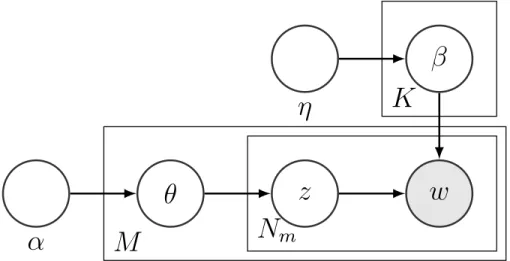
1.1 Latent Dirichlet Allocation graphical model representation.. . . 4
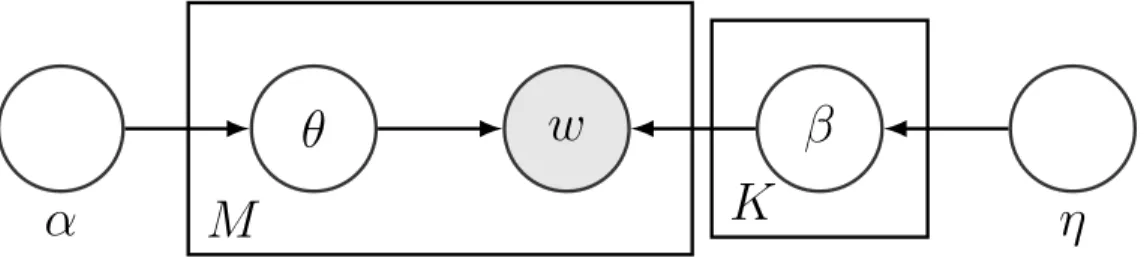
1.2 Latent Dirichlet Allocation with integrated topic labels.. . . 7
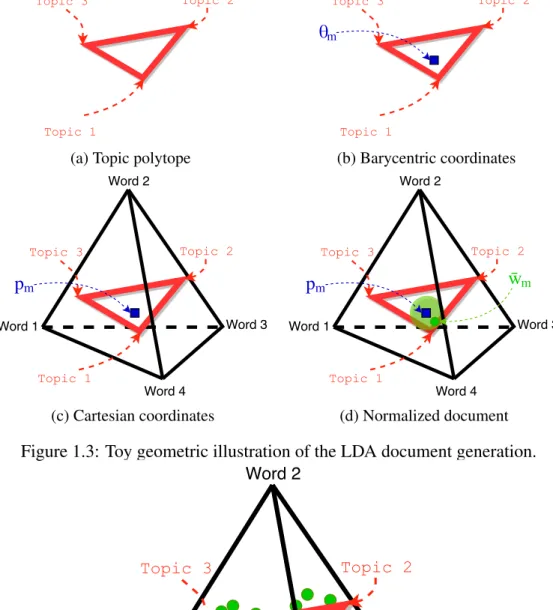
1.3 Toy geometric illustration of the LDA document generation. . . 8
1.4 Toy geometric illustration of topic polytope and document collection. . . 8
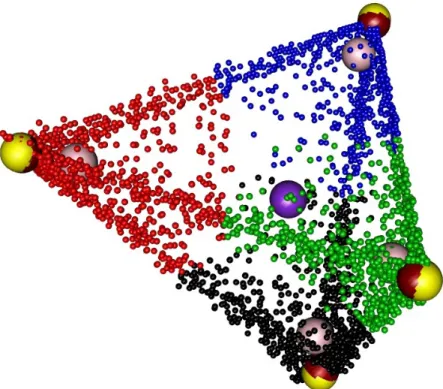
2.1 Visualization of GDM: Black, green, red and blue are cluster assignments; purple is the center, pink are cluster centroids, dark red are estimated topics and yellow are the true topics. . . 25
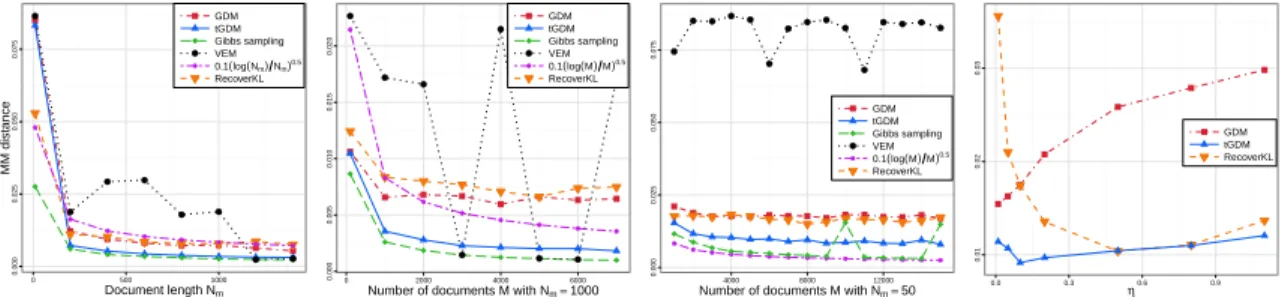
2.2 Minimum-matching Euclidean distance: increasing Nm, M = 1000 (a); in-creasing M, Nm = 1000 (b); increasing M, Nm = 50 (c); increasing η, Nm = 50,M = 5000(d).. . . 28
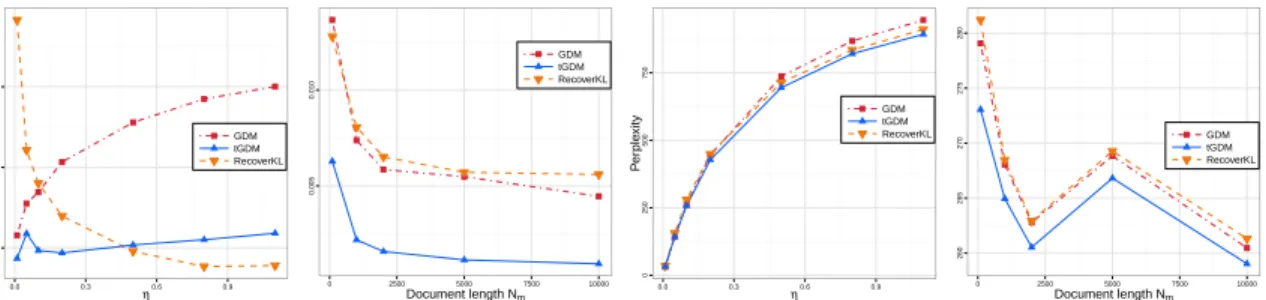
2.3 Perplexity of the held-out data: increasing Nm, M = 1000 (a); increasing M, Nm = 1000(b); increasing M, Nm = 50 (c); increasing η, Nm = 50, M = 5000(d). . . 28
2.4 MM distance and Perplexity for varyingη,Nm = 50with anchors (a,c); vary-ingNm (b,d). . . 29
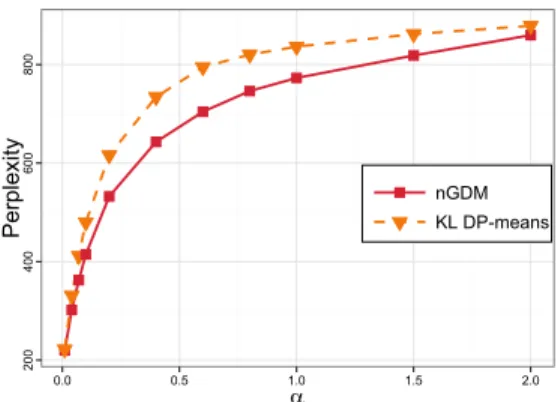
2.F.1 Perplexity for varyingα . . . 37
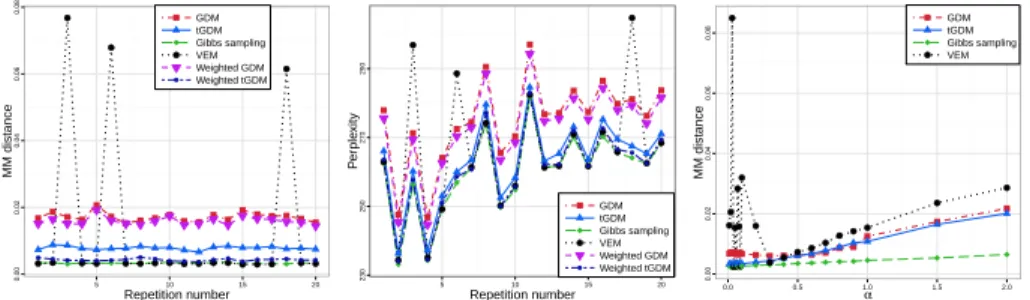
2.F.2 Minimum-matching Euclidean distance: varyingNm(left); increasingα(right). Perplexity for varyingNm (center). . . 38
2.F.3 Projection method: increasing Nm, M = 1000 (left); increasing M, Nm = 1000(center); increasingM,Nm = 50(right). . . 39
3.1 Complete coverage of topic simplex by cones and a spherical ball forK = 3, V = 3. . . 44
3.2 Iterations 1, 26, 29, 30 of the Algorithm 3.1. Red are the documents in the coneSω(vk); blue are the documents in the active setAk+1 for next iteration. Yellow are documentskp˜mk2 <R. . . 50
3.3 Minimum matching Euclidean distance for (a) varying corpora size, (b) vary-ing length of documents; (c) Runnvary-ing times for varyvary-ing corpora size; (d) Esti-mation of number of topics. . . 50
3.4 Gibbs sampler convergence analysis for (a) Minimum matching Euclidean dis-tance for corpora sizes 1000 and 5000; (b) Perplexity for corpora sizes 1000 and 5000; (c) Perplexity for NYTimes data. . . 50
3.A.1C : kth vertex point,A : point where the adjacent side to the vertex has been cut off by the sphere,Rk: distance tokth vertex from incenter, R: radius of sphere,B: incenter . . . 56
3.B.1 Minimum matching Euclidean distance for (a) varying corpora size, (b) vary-ing length of documents. Perplexity for (c) varyvary-ing corpora sizes, (d) varyvary-ing
length of documents. . . 61
3.C.1 Perplexity for (a) varying corpora size, (b) varying length of documents, (c) varying vocabulary size; (d) Minimum matching Euclidean distance for vary-ing vocabulary size.. . . 63
3.C.2 Varyingα (a) Minimum matching Euclidean distance, (b) Perplexity, (c) Es-timation of number of topics; (d) EsEs-timation of number of topics for varying vocabulary size.. . . 63
4.1 Invertible transformation between unit sphere and a standard simplex . . . 69
4.2 Topic dynamics . . . 69
4.3 Epidemics: evolution of top 15 words . . . 79
5.1 D= 30,γ1 = 0.2,γ2 = 1(a) Probability of increasing interaction depth; (b-f) FFMαMD distributions with differentα. . . 93
5.2 RMSE for experiments: (a) interactions depths; (b) data with different ratio of continuous to categorical variables; (c) quality of the MiFM1 and MiFM0.7 coefficients; (d) MiFMαexact recovery of the interactions with differentαand data scenarios . . . 94
5.3 MiFM1 store - month - year interaction: (a) store in Merignac; (b) store in Perols; MiFM0 city - store - day of week - week of year interaction: (c) store in Merignac; (d) store in Perols. . . 96
LIST OF TABLES
1.1 New York Times topics . . . 3
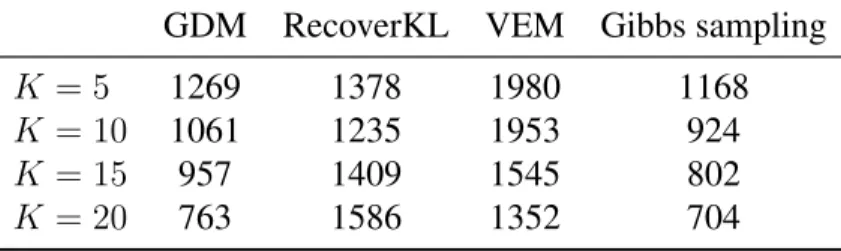
2.1 Perplexities of the 4 topic modeling algorithms trained on the NIPS dataset. . . 30
2.F.1 Top 10 words (columns) of each of the 10 learned topics of NIPS dataset . . . 40
3.1 Modeling topics of NYTimes articles . . . 53
3.2 CoSAC NYTimes topics sample . . . 54
4.1 Modeling topics of EJC . . . 78
4.2 Modeling Wikipedia articles . . . 79
LIST OF ALGORITHMS
2.1 Geometric Dirichlet Means (GDM) . . . 24
3.1 Conic Scan-and-Cover (CoSAC) . . . 49
3.2 CoSAC for documents . . . 51
ABSTRACT
Unstructured data is available in abundance with the rapidly growing size of digital infor-mation. Labeling such data is expensive and impractical, making unsupervised learning an increasingly important field. Big data collections often have rich latent structure that statistical modeler is challenged to uncover. Bayesian hierarchical modeling is a particu-larly suitable approach for complex latent patterns. Graphical model formalism has been prominent in developing various procedures for inference in Bayesian models, however the corresponding computational limits often fall behind the demands of the modern data sizes. In this thesis we develop new approaches for scalable approximate Bayesian inference. In particular, our approaches are driven by the analysis of latent geometric structures induced by the models.
Our specific contributions include the following. We develop full geometric recipe of the Latent Dirichlet Allocation topic model. Next, we study several approaches for exploit-ing the latent geometry to first arrive at a fast weighted clusterexploit-ing procedure augmented with geometric corrections for topic inference, and then a nonparametric approach based on the analysis of the concentration of mass and angular geometry of the topic simplex, a convex polytope constructed by taking the convex hull of vertices representing the la-tent topics. Estimates produced by our methods are shown to be statistically consisla-tent under some conditions. Finally, we develop a series of models for temporal dynamics of the latent geometric structures where inference can be performed in online and distributed fashion. All our algorithms are evaluated with extensive experiments on simulated and real datasets, culminating at a method several orders of magnitude faster than existing state-of-the-art topic modeling approaches, as demonstrated by experiments working with several million documents in a dozen minutes.
CHAPTER 1
Introduction
Bayesian hierarchical models are prominent tools for unsupervised learning of patterns in data. Unlabeled data is often available in vast amount - images, news articles, tweets, query logs, scientific articles, etc. Ghahramani(2004) provides an overview of unsupervised models such as Factor Analysis (Roweis & Ghahramani, 1999), probabilistic Principal Component Analysis (Roweis,1998;Roweis & Ghahramani,1999), Independent Compo-nent Analysis (Hyvärinen et al.,2004), mixture models (McLachlan & Peel,2004), Hidden Markov Models (HMM) (Rabiner & Juang,1986), State Space Models (SSM) (Kitagawa,
1996), which by now are over a decade old. Other important models from the same time period are admixtures (Pritchard et al.,2000), Latent Dirichlet Allocation (LDA) (Blei
et al.,2003), Finite Feature Model (FFM) (Ghahramani & Griffiths,2005); nonparametric
models such as Dirichlet Process (DP) (Ferguson,1973), DP mixtures (Antoniak,1974) and Beta Processes (Hjort,1990). Larger data often has more structure like time stamps, location or publisher, hence requiring more sophisticated models to take into account all the information, and nonparametric approaches, as specifying number of patterns of interest apriori is very challenging and it is desirable to infer this quantity from the data instead. In the recent decades many complex Bayesian hierarchical and nonparametric models have been developed, where classical unsupervised models may play a role of building blocks. Hierarchical Dirichlet Process (HDP) (Teh et al.,2006) for nonparametric topic modeling, its extension for topics changing over time (Ahmed & Xing,2012); document clustering and topic modeling with context (Nguyen et al.,2014b) utilizing HDP and Nested Dirichlet Process (Rodriguez et al.,2008); Indian Buffet Process (IBP) (Griffiths & Ghahramani,
2011) and Hierarchical Beta-Bernoulli process (Thibaux & Jordan,2007), its extensions combining IBP and HMM for time series data (Fox et al.,2009); nonparametric clustering of functional data (Nguyen & Gelfand,2011) to name a few.
Unfortunately the data size and modeling are at crossroads — training sophisticated models on large data is often infeasible. Moreover, the problem remains acute for simpler models such as mixtures or Latent Dirichlet Allocation. Exact inference of the posterior
distribution or even Maximum Aposteriori estimation (MAP) is intractable and approximate inference techniques were developed. Markov Chain Monte Carlo (MCMC) (e.g., Gibbs sampler for LDA byGriffiths & Steyvers(2004)) and mean field variational inference (VI)
(Jordan et al.,1999;Blei et al.,2017) are among the most common approaches. Variational
inference historically was advocated as a faster alternative to sampling methods (e.g., comparison for the Boltzmann Machines byAnderson & Peterson(1987)). Nonetheless, classic versions of neither VI nor MCMC can efficiently handle modern data sizes of millions of observations.
Scalable approximate Bayesian inference is an active research area in the recent years and many approaches were proposed: divide-and-conquer and subsampling based MCMC
(see Bardenet et al. (2017) for an overview), stochastic gradient MCMC (see Ma et al.
(2015) for classification of some of the algorithms,Betancourt(2017) for introduction to Hamiltonian Monte Carlo,Mandt et al.(2017) for connection to stochastic gradient descent), stochastic variational inference (Hoffman et al.,2013).
It is evident that scalable inference even for simpler models remains an important problem up-to-date. Over the past couple decades MCMC and VI evolved a lot and became sophisticated approximate inference techniques applicable to many problems, however conceptually both approaches are rooted in the same fundamental concept of graphical models(Jordan et al.,2004). Graphical models formalism is based on graph theory and probability theory, where graph induced by the model is utilized to deduce various inference procedures. Such inference procedures, including Gibbs sampler and variational inference, belong to the family ofmessage-passingalgorithms (e.g., see review papers byJordan et al.
(1999);Ghahramani(2004);Wainwright et al.(2008)).
In this thesis we depart from the graphical models formalism and make first steps in developing a new way of approaching inference in Bayesian hierarchical models. Instead of a graph, our approach is based on the analysis of thegeometryinduced by the model. Specifically, we analyze geometric relationships among latent variables and data arising from the Latent Dirichlet Allocation model (Blei et al.,2003), which leads us to propose new inference algorithms for the latent geometry of the LDA, including nonparametric inference and inference for some of the LDA extensions. Key advantage of our algorithms is orders of magnitude speed ups comparative to graphical models based approaches.
In Section 1.1 we give an overview of the Latent Dirichlet Allocation, some of its extensions and estimation procedures. In Section 1.2we review role of geometry in the LDA and some other Machine Learning problems. Key ingredients of our work are outlined in Section1.3. Main problems and contributions are summarized in Section1.4.
1.1
Latent Dirichlet Allocation
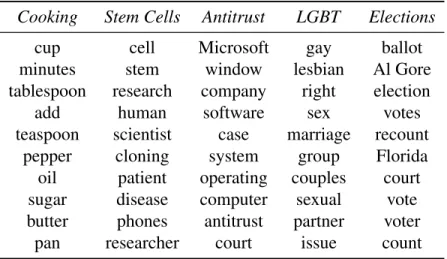
With the rapidly growing size of digital information it is important to be able to explore, organize and summarize it. Internet is full of news, blogs, Web pages, scientific articles and other text, image, audio or video types of data. We focus our attention on the class of algorithms called Topic Models. The goal of such algorithms is to summarize collections of data (e.g., text data) by finding topics in it, which are essentially distributions over words. One of the pioneering works in this field is a probabilistic topic model - Latent Dirichlet Allocation by Blei et al.(2003). Examples of topics learned from the New York Times articles are demonstrated in Table1.1. In this section we review Latent Dirichlet Allocation, its graphical representation, some of its predecessors and extensions and common inference approaches.
Table 1.1: New York Times topics
Cooking Stem Cells Antitrust LGBT Elections
cup cell Microsoft gay ballot
minutes stem window lesbian Al Gore
tablespoon research company right election
add human software sex votes
teaspoon scientist case marriage recount pepper cloning system group Florida oil patient operating couples court sugar disease computer sexual vote butter phones antitrust partner voter
pan researcher court issue count
1.1.1
Model
First we summarize the data generative process of the Latent Dirichlet Allocation. Let
α ∈ RK+ and η ∈ RV+ be hyperparameters, where V denotes the number of words in a vocabulary, andK the number of topics. TheKtopics are represented as distributions on words:
βk|η ∼ DirV(η), fork = 1, . . . , K.
Each of the M documents can be generated as follows. First, draw the document topic proportions:
Next, for each of theNm words in documentm, pick a topic labelzand then sample a word
dfrom the chosen topic:
znm|θm ∼ Categorical(θm); dnm|znm, β1...K ∼ Categorical(βznm).
Each of the resulting documents is a vector of lengthNm with entriesdnm ∈ {1, . . . , V},
wherenm = 1, . . . , Nm. Because these words are exchangeable by the modeling, they are
equivalently represented as a vector of word countswm ∈ NV. Corresponding graphical model representation is shown in Figure1.1. From the model construction it follows that each document can exhibit multiple topics to a different extent. This property, encoded in correspondingθm, distinguishes LDA from mixture models and makes it more suitable for
modeling text data, where single topic may not be sufficient to describe a document.
α
θ
z
w
β
η
M
K
N
mFigure 1.1: Latent Dirichlet Allocation graphical model representation.
Latent Semantic Analysis (Deerwester et al.,1990) is a precursor of the LDA model casting topics as basis vectors of low dimensional latent subspace. Hofmann(1999) added probabilistic component to it. Admixture (Pritchard et al.,2000) is an equivalent to LDA model widely used in the field of population genetics.
LDA is a fundamental building block for many more sophisticated topic models. It is a parametric model, meaning that we need to provide number of topics as an input, which could be challenging in practice. Nonparametric version, based on the Dirichlet process
(Ferguson,1973) is known as Hierarchical Dirichlet Process (Teh et al.,2006). Apriori topics
are assumed independent, Correlated Topic model (Blei & Lafferty,2006a) relaxes this assumption by using logistic-normal distribution instead of Dirichlet to model latent topic proportions of a document. Similar idea is used to allow time changing topics - Dynamic Topic Models (Blei & Lafferty,2006b) and a nonparametric version byAhmed & Xing
(2012). Nested Chinese Restaurant Process (Blei et al.,2010) allows for topic hierarchies. Supervised LDA (Mcauliffe & Blei,2008) incorporates prediction in the model, allowing for documents with labels. Multilevel Clustering with Context (Nguyen et al.,2014b) allows to use context information (like authors, time and location stamps) and cluster documents by combining Hierarchical and Nested Dirichlet Processes.
1.1.2
Inference
Graphical model formalism leads to the two most common approaches for inference of the LDA topics — Gibbs sampling (Griffiths & Steyvers,2004) based on the Multinomial-Dirichlet conjugacy and mean field variational inference (Blei et al.,2003) minimizing the Kullback-Leibler divergence between posterior and factorized posterior. Brief summary of these methods is given in theSupplement.
Neither Gibbs sampling nor variational inference in their respective original formulations scale well to large corpora of millions of documents. Training time gets off practical limits for more complex and nonparametric LDA extensions. In the past decade significant research efforts have been made to address this concern. Online (Hoffman et al.,2010), distributed
(Newman et al.,2008) and both online and distributed (Broderick et al.,2013) algorithms
have been developed. Online algorithms for Hierarchical Dirichlet Process (HDP) (Teh
et al.,2006), a nonparametric counterpart of LDA, have also been proposed (Wang et al.,
2011;Bryant & Sudderth,2012). Both classes of inference algorithms (i.e. sampling and
variational inference), their virtues notwithstanding, are known to exhibit certain deficiencies, which also propagate through their modern extensions. The problem can be traced back to the need for approximating or sampling from the posterior distributions of the latent variables representing the topic labels. Since these latent variables are not geometrically intrinsic — any permutation of the labels yields the same likelihood — the manipulation of these redundant quantities tend to slow down the computation, and compromise with the learning accuracy.
Another fruitful perspective on topic modeling can be obtained by partially stripping away the distributional properties of the probabilistic model and turning the estimation problem into a form of matrix factorization (Deerwester et al., 1990; Xu et al., 2003;
Anandkumar et al.,2012;Arora et al.,2013). We call this the linear subspace viewpoint.
For instance, the Latent Semantic Analysis approach (Deerwester et al.,1990) looks to find a latent subspace via singular-value decomposition, but has no topic structure. Notably, the RecoverKL byArora et al. (2013) is one of the recent fast algorithms with provable guarantees coming from the linear subspace perspective.
1.2
Geometry in Machine Learning
In this section we summarize prior work concerning the geometry of the Latent Dirichlet Allocation. Then we give some examples of geometry arising in other Machine Learning problems.
1.2.1
Geometry of the Latent Dirichlet Allocation
The key idea underlining the geometric viewpoint of the Latent Dirichlet Allocation is that latent topics induce a convex set to be called atopic polytope. Observed documents then correspond to points randomly drawn inside this topic polytope. Probabilistic Latent Semantic Analysis (Hofmann,1999) contains early hints of this viewpoint, however it does not explore the distribution of the documents inside the topic polytope. One of the key Latent Dirichlet Allocation (Blei et al.,2003) ideas is to place a Dirichlet prior on the inside of the topic polytope. Figure 4 ofBlei et al.(2003) summarizes this idea. Geometric viewpoint had laid dormant for quite some time, until studied in depth in the work ofNguyen(2015), who demonstrated theoretically that posterior distribution of the LDA topics contracts towards the true latent topic polytope. The contraction behavior was also verified in practice (Tang et al.,
2014). In this thesis we complete geometric interpretation ofallof the LDA latent variables (i.e., topics and topic proportions) and use it to develop a series of efficient algorithms directly targeting estimation of the latent topic polytope.
1.2.2
Geometry in other problems
Geometry has always played an important role in Machine Learning. Support Vector Machines (Vapnik,2006) is among famous classification algorithms with intuitive geometric motivation. Principal Component Analysis can be interpreted geometrically; k-means clustering is tightly related to a geometric problem of Centroidal Voronoi Tessellation (Du
et al.,1999). Many problems go beyond Euclidean geometry — topological data analysis
(Wasserman, 2016), manifold learning (Belkin et al., 2006), some of the deep learning
(Bronstein et al.,2017).
Another important problem, related to Topic Modeling through the linear subspace perspective, is the Nonnegative Matrix Factorization (NMF) (Lee & Seung,1999). Although NMF is a NP-hard problem in general (Vavasis,2009), it may be solved provably when separabilityis assumed (Arora et al.,2012). Under this assumption NMF problem has an elegant geometric interpretation — some (unknown) rows of the data matrix form a polytope containing rest of the data. Damle & Sun(2017) utilized this geometric treatment of NMF
to propose scalable estimation algorithms. In topic modeling separability assumption is usually called ananchor wordassumption — each topic is assumed to contain a word absent in all other topics. RecoverKL byArora et al.(2013) is one of the recent fast algorithms utilizing the anchor word assumption. We will show that one of our geometric algorithms can be used to improve RecoverKL and make it nonparametric.
1.3
Key ideas in our framework
In this section we shall present the full geometric recipe of the Latent Dirichlet Allocation and outline some of the concepts we will use for the algorithms and models development.
In Section1.1.2we noted that the root of the inefficiency of sampling and variational inference methods can be traced to the need for approximating the posterior distributions of the latent variables representing the topic labels — these are not geometrically intrinsic as any permutation of the labels yields the same likelihood. By integrating out the latent variables that represent the topic labels, we obtain a geometric formulation of the LDA. Indeed, integratingz’s out yields that, form= 1, . . . , M,
wm|θm, β1...K, Nm ∼ Multinomial(pm1, . . . , pmV, Nm),
wherepmidenotes probability of observing thei-th word from the vocabulary in them-th
document, and is given by
pmi =
K
X
k=1
θmkβki fori= 1, . . . , V; m= 1, . . . , M.
Resulting graphical model representation is given in Fig. 1.2. The crucial geometric observation is that the exact same form ofpmwould arise if we interpreted topic proportions
θm as barycentric coordinates of document m with respect to the topic polytope B =
Conv(β1, . . . , βK)andpm as the corresponding Cartesian coordinates.
α
θ
w
β
η
M
K
(a) Topic polytope (b) Barycentric coordinates
(c) Cartesian coordinates (d) Normalized document
Figure 1.3: Toy geometric illustration of the LDA document generation.
Figure 1.4: Toy geometric illustration of topic polytope and document collection.
Let us now restate the generative process of the LDA with each layer of the model accompanied by a toy graphical illustration from Fig. 1.3.
GenerateKtopics — extreme points of the topic polytope (Fig. 1.3a):
βk|η ∼ DirV(η), fork = 1, . . . , K.
For each of theM documents sample a vector of barycentric coordinates (Fig.1.3b):
θm|α ∼ DirK(α).
Translate into Cartesian coordinate system (Fig. 1.3c):
pm =
X
k
θmkβk.
Generate and normalize document (Fig. 1.3d):
wm ∼ Multinomial(pm, Nm),w¯m =wm/Nm.
Resulting normalized documentw¯m is a noisy estimate ofpm. The whole (normalized)
corpora can be viewed as a cloud of points around the latent topic polytope (Fig.1.4). In this thesis we consider a variety of approaches targeting topic polytope estimation. We shall establish a geometric objective function, its connection to the LDA likelihood and subspace learning. To arrive at scalable geometric inference algorithms we analyze the concentration of mass inside the topic polytope. First, by investigating the Centroidal Voronoi Tessellation (Du et al.,1999) of the topic polytope, and then, by covering the topic polytope with suitable cones and spherical balls.
Given efficient nonparametric procedure for topic estimation, it is natural to ask if our geometric framework can be extended to more sophisticated topic modeling scenarios. To answer this question we build a series of models directly targeting the latent geometry. Specifically, we develop a nonparametric model for the temporal dynamics of the topic polytope. We shall utilize an isometric embedding of the unit sphere in the word simplex, so that the evolution of topic polytopes may be modeled by a collection of (random) trajectories of points residing on the unit sphere. Instead of worrying about mix-matching vertices in an ad hoc fashion, we appeal to the Bayesian nonparametric modeling framework that allow the number of topic vertices to be random and vary across time. The mix-matching between topic variables shall be guided by the assumption on the smoothness of the collection of global trajectories on the sphere using Von Mises-Fisher dynamics (Mardia & Jupp,2009). The selection of active topics at each time point will be guided by a nonparametric prior on the random binary matrices via the (hierarchical) Beta-Bernoulli process (Thibaux & Jordan,
2007). For the inference part, we demonstrate connection between MAP estimation in the Beta-Bernoulli process and the Hungarian matching algorithm (Kuhn,1955).
1.4
Main problems and contributions
In this section we provide an extended summary of the problems considered in this thesis and our contributions in regard to these problems.
• Geometric formulation of the Latent Dirichlet Allocation.
• Geometric procedure for estimating topic proportions given a topic simplex.
• Fast parametric geometric algorithm based on the analysis of Centroidal Voronoi Tessellation of a topic polytope.
• Fast nonparametric geometric algorithm based on the analysis of the concentration of mass inside the topic simplex and its coverage with suitable cones and spheres. • New model for temporal dynamics of the topic polytope and corresponding online
and distributed inference algorithm.
• Novel Bayesian hierarchical model for supervised adaptive selection of interactions of arbitrary order among predictor variables.
At a high level, we uncover and exploit geometry induced by the Latent Dirichlet Allocation model to develop several algorithms that are much faster and as accurate as their graphical models inspired counterparts. Being able to efficiently infer the latent geometry, we propose new models to allow for dynamically evolving latent geometry, where inference can be done in online and distributed fashion allowing for topic estimation from several millions of documents in a dozen of minutes.
1.4.1
Geometric analysis of the LDA and Geometric Dirichlet Means
algorithm for topic inference
In Chapter2we further elaborate on the geometric viewpoint of the LDA outlined in Section 1.3. We develop and analyze a new class of algorithms for topic inference, which exploits both the convex geometry of topic models and the distributional properties they carry. The main contributions in Chapter 2 are the following: (i) we investigate a geometric loss function to be optimized, which can be viewed as a surrogate to the LDA’s likelihood;
this leads to a novel estimation and inference algorithm — the Geometric Dirichlet Means (GDM) algorithm, which builds upon a weighted k-means clustering procedure and is augmented with a geometric correction for obtaining polytope estimates; (ii) we prove that the GDM algorithm is consistent, under conditions on the Dirichlet distribution and the geometry of the topic polytope; (iii) we propose a nonparametric extension of GDM and discuss geometric treatments for some of the LDA extensions; (v) finally we provide a thorough evaluation of our method against a Gibbs sampler, a variational algorithm, and the RecoverKL algorithm. Our method is shown to be comparable to a Gibbs sampler in terms of estimation accuracy, but much more efficient in runtime. It outperforms RecoverKL
(Arora et al.,2013) algorithm in terms of accuracy, in some realistic settings of simulations
and in real data.
1.4.2
Conic Scan-and-Cover algorithms for nonparametric topic
mod-eling
In Chapter3we shall continue to amplify the geometric viewpoint to addressnonparametric topic modeling, a setting in which the number of topics is unknown, as is the distribution inside the topic polytope (in some situations). We will propose algorithms for topic esti-mation by explicitly accounting for the concentration of mass and angular geometry of the topic polytope, typically a simplex in topic modeling applications. The geometric intuition is fairly clear: each vertex of the topic simplex can be identified by a ray emanating from its center (to be defined formally), while the concentration of mass can be quantified for the cones hinging on the apex positioned at the center. Such cones can be rotated around the center to scan for high density regions inside the topic simplex — under mild conditions such cones can be constructed efficiently to recover both the number of vertices and their estimates. We will also extend RecoverKL (Arora et al.,2013) to a nonparametric setting and show that the anchor word assumption appears to limit the number of topics one can efficiently learn.
1.4.3
Streaming dynamic and distributed inference of latent
geomet-ric structures
When data and the associated modeling are indexed by time dimension, it is of interest to study the temporal dynamics of the latent geometric structure that arises. In Chapter4 we focus on the modeling and algorithm for analyzing the temporal dynamics of atopic polytope. A number of authors have extended the basic topic modeling framework to analyze
how topics evolve over time. The Dynamic Topic Models (DTM) (Blei & Lafferty,2006b) demonstrated the importance of accounting for non-exchangeability between document groups, particularly when the time information is provided. Another approach is to fix the topics and only consider evolving topic popularity (Wang & McCallum,2006). Hong et al.
(2011) extended such an approach to multiple corpora. Ahmed & Xing(2012) proposed an interesting nonparametric construction extending DTM where topics can appear or eventually die out. The evolution of the latent geometric structure arising from the model (the topic polytope) is implicitly present in all these works, however it was not explicitly considered and analyzed.
Directly confronting the modeling and inference of the temporal dynamics of the topic polytope offers several opportunities and challenges. To start, what is the suitable space that we may consider the topic polytope to be represented? As topics evolve over time, so are the number of topics that may become active and dormant again, raising interesting choices about modeling of this evolution. Interesting issues arise in the inference, too. For instance, what is the principled way of mix-matching the vertices of a polytope to its reincarnation in the next time point? These challenges also open the door for directly modeling the geometric structure in a way that facilitates efficient inference.
To this end, we construct a sequence of Bayesian nonparametric models in increasing levels of complexity: the simpler model captures the temporal dynamics of a sequence of topic polytopes, while the full model describes the temporal dynamics of a collection of topic polytopes as they arise from multiple corpora. The semantic of topics that arise from our models can be interpreted as follows: there is a latent collection of global topics of unknown cardinality that evolve over time (e.g. topics in science or social topics in Twitter) and each year (or day) a subset of the global topics is elucidated by the community (i.e. some topics may be dormant at a given time point). The nature of each global topic may change smoothly (via varying word frequencies). Additionally, different subsets of global topics are associated with different groups (e.g. journals or Twitter location stamps), some become active and inactive over time.
It is interesting to note that our model construction leads to a suite of approximate inference algorithm that scales well in an online and distributed setting. In particular, the online MAP update of the latent topic polytope can be viewed as solving an optimal matching problem for which a fast Hungarian matching algorithm (Kuhn,1955) can be applied. Our approach is able to perform dynamic nonparametric topic inference on 3 million documents in 12 minutes, which is significantly faster than prior static online and/or distributed topic modeling algorithms (Newman et al.,2008;Hoffman et al.,2010;Wang et al.,2011;Bryant
1.4.4
Multi-way Interacting Regression via Factorization Machines
A fundamental challenge in supervised learning, particularly in regression, is the need for learning functions which produce accurate prediction of the response, while retaining the explanatory power for the role of the predictor variables in the model. The standard linear regression method is favored for the latter requirement, but it fails the former when there are complex interactions among the predictor variables in determining the response. The challenge becomes even more pronounced in a high-dimensional setting – there are exponentially many potential interactions among the predictors, for which it is simply not computationally feasible to resort to standard variable selection techniques (cf.Fan & Lv(2010)).
There are numerous examples where accounting for the predictors’ interactions is of interest, including problems of identifying epistasis (gene-gene) and gene-environment interactions in genetics (Cordell,2009), modeling problems in political science (Brambor
et al.,2006) and economics (Ai & Norton,2003). In the business analytics of retail demand
forecasting, a strong prediction model that also accurately accounts for the interactions of relevant predictors such as seasons, product types, geography, promotions, etc. plays a critical role in the decision making of marketing design.
A simple way to address the aforementioned issue in the regression problem is to simply restrict our attention to lower order interactions (i.e. 2- or 3-way) among predictor variables. This can be achieved, for instance, via a support vector machine (SVM) using polynomial kernels (Cristianini & Shawe-Taylor,2000), which pre-determine the maximum order of predictor interactions. In practice, for computational reasons the degree of the polynomial kernel tends to be small. Factorization machines (Rendle, 2010) can be viewed as an extension of SVM to sparse settings where most interactions are observed only infrequently, subject to a constraint that the interaction order (a.k.a. interaction depth) is given. Neither SVM nor FM can perform any selection of predictor interactions, but several authors have extended the SVM by combining it with`1 penalty for the purpose of feature selection (Zhu
et al.,2004) and gradient boosting for FM (Cheng et al.,2014) to select interacting features.
It is also an option to perform linear regression on as many interactions as we can and combine it with regularization procedures for selection (e.g. LASSO (Tibshirani,1996) or Elastic net (Zou & Hastie,2005)). It is noted that such methods are still not computationally feasible for accounting for interactions that involve a large number of predictor variables.
In Chapter 5we propose a regression method capable of adaptive selection of multi-way interactions of arbitrary order (MiFM for short), while avoiding the combinatorial complexity growth encountered by the methods described above. MiFM extends the basic factorization mechanism for representing the regression coefficients of interactions among
the predictors, while the interaction selection is guided by a prior distribution on random hypergraphs. The prior, which does not insist on the upper bound on the order of interactions among the predictor variables, is motivated from but also generalizes Finite Feature Model, a parametric form of the well-known Indian Buffet process (IBP) (Ghahramani & Griffiths,
2005). We introduce a notion of the hypergraph of interactions and show how a parametric distribution over binary matrices can be utilized to express interactions of unbounded order. In addition, our generalized construction allows us to exert extra control on the tail behavior of the interaction order. IBP was initially used for infinite latent feature modeling and later utilized in the modeling of a variety of domains (see a review paper byGriffiths &
Ghahramani(2011)).
In developing MiFM, our contributions are the following: (i) we introduce a Bayesian multi-linear regression model, which aims to account for the multi-way interactions among predictor variables; part of our model construction includes a prior specification on the hypergraph of interactions — in particular we show how our prior can be used to model the incidence matrix of interactions in several ways; (ii) we propose a procedure to estimate coefficients of arbitrary interactions structure; (iii) we establish posterior consistency of the resulting MiFM model, i.e., the property that the posterior distribution on the true regression function represented by the MiFM model contracts toward the truth under some conditions, without requiring an upper bound on the order of the predictor interactions; and (iv) we present a comprehensive simulation study of our model and analyze its performance for retail demand forecasting and case-control genetics datasets with epistasis. The unique strength of the MiFM method is the ability to recover meaningful interactions among the predictors while maintaining a competitive prediction quality compared to existing methods that target prediction only.
1.5
Thesis organization
The reminder of this thesis proceeds as follows:
Chapter2: Geometric Dirichlet Means algorithm for topic inference
This chapter develops geometric viewpoint of the LDA, defines corresponding geometric loss functions and proposes new geometrically inspired topic polytope estimation algorithm.
Chapter3: Conic Scan-and-Cover algorithms for nonparametric topic modeling This chapter continues with the geometric viewpoint of Chapter2to investigate concen-tration of mass inside the topic polytope and to propose a fast nonparametric topic estimation algorithm.
struc-tures
This chapter develops a model of temporal dynamics of the topic polytope and introduces an online and distributed estimation algorithm based on Chapter3.
Chapter5: Multi-way Interacting Regression via Factorization Machines
This chapter proposes a notion of hypergraph of interactions and develops a correspond-ing Bayesian hierarchical model for uncovercorrespond-ing high-order interactions in the regression setting.
Chapter6: Conclusions and suggestions
This chapter summarizes contributions of this thesis and discusses ideas for the future work.
Each chapter is sufficiently self-contained covering all relevant background knowledge and literature. Chapter2initiates the geometric journey taking off from a more classical likelihood perspective. Chapter3culminates the geometric exploration. Chapter4uses al-gorithmic results of Chapter3, although it could be read independently. Chapter5addresses a problem in the supervised learning domain and can be read without the background in the previous chapters.
Appendix
1.A
Collapsed Gibbs Sampling
Here we briefly summarize Collapsed Gibbs sampler ofGriffiths & Steyvers(2004). Due to the conjugacy of Categorical and Dirichlet distributions we can integrate outθandβ to be left only with latent variablesz, for which closed form full conditional is available:
P(zmi =k|z−mi, W)∝ n(wmi) −i,k +γ n(−·)i,k +V γ n(−mi,k) +α n(−mi,)·+Kα .
First ratio gives probability of wordwmiin topic k. n
(wmi)
k is the number of times word
wmihas been assigned to topic k. −i index means excluding current assignment ofzmi.
Second ratio gives probability of topic k in documentm. n(km) is the number of times a word from documentmhas been assigned to topick. Markov Chain Monte Carlo algorithm is then to start with some initial state and sample topic assignments for each word in each document until chain approaches target posterior distribution. Estimates for topics and topic proportions are: βkv = n(kv)+γ n(k·)+V γ. θmk = n(km)+α n(·m)+Kα .
This algorithm converges asymptotically, but as in any MCMC it is hard to assess rate and it is quite slow. Also we have to do sampling for every word, which is one of the inefficiencies we are addressing in our work. Moreover it is problematic to estimateθof unseen document, since we have to sample topic assignments to obtain posterior for the document.
1.B
Variational Inference
Variational inference (Blei et al.,2003) is based on decoupling latent variables, and min-imizing KL divergence between factorized posterior with unknown parameters and true posterior. Resulting objective is non-convex, therefore it is only guaranteed to converge to local optima. Next we give a short description of how VI works.
Let for a probabilistic graphical model z be latent variables and x - data. We are interested in the posteriorp(z|x), which is often intractable, as in the LDA case. We want to
approximate the true posterior with some easier-to-compute distributionq(z)by minimizing KL(q||p) =Eq log q(z) p(z|x) =Eq[logq(z)]−Eq[logp(z|x)] =− Eq[logp(z, x)]−Eq[logq(z)] | {z } ELBO +Eq[logp(x)].
Evidence Lower Bound (ELBO) is a lower bound of the log-likelihood of the data and could be derived via Jensen’s inequality. Last termEq[logp(x)]does not depend onq(z),
therefore minimizing KL is equivalent to maximizing ELBO. For LDA we takeq(z) as factorized (decoupling latent variables) posterior (Blei et al.,2003):
q(β, θ, z|λ, γ, φ) = " K Y k=1 q(βk|λk) # · " M Y m=1 q(θm|γm) # · " M Y m=1 Nm Y n=1 q(zmn|φmwmn) # , where
q(βk|λk) =DirV(βk|λk), q(θm|γm) =DirK(θm|γm),and
q(zmn|φmwmn) =CategoricalK(zmn|φmwmn).
We minimize ELBO over parameters(λki),(γmk),(φmik)withk ∈ {1, ..., K},i∈ {1, ..., V},
m∈ {1, ..., M}. Common approach is to do coordinate ascent, but there are more modern
CHAPTER 2
Geometric Dirichlet Means algorithm for topic
inference
We propose a geometric algorithm for topic learning and inference that is built on the convex geometry of topics arising from the Latent Dirichlet Allocation (LDA) model and its nonparametric extensions. To this end we study the optimization of a geometric loss function, which is a surrogate to the LDA’s likelihood. Our method involves a fast optimization based weighted clustering procedure augmented with geometric corrections, which overcomes the computational and statistical inefficiencies encountered by other techniques based on Gibbs sampling and variational inference, while achieving the accuracy comparable to that of a Gibbs sampler.1 The topic estimates produced by our method are shown to be statistically consistent under some conditions. The algorithm is evaluated with extensive experiments on simulated and real data.2
2.1
Introduction
Most learning and inference algorithms in the probabilistic topic modeling literature can be delineated along two major lines: the variational approximation popularized in the seminal paper ofBlei et al.(2003), and the sampling based approach studied byPritchard et al.(2000) and other authors. Both classes of inference algorithms, their virtues notwithstanding, are known to exhibit certain deficiencies, which can be traced back to the need for approximating or sampling from the posterior distributions of the latent variables representing the topic labels. Since these latent variables are not geometrically intrinsic — any permutation of the labels yields the same likelihood — the manipulation of these redundant quantities tend to slow down the computation, and compromise with the learning accuracy.
1Code is available athttps://github.com/moonfolk/Geometric-Topic-Modeling.
In this chapter we take a convex geometric perspective of the Latent Dirichlet Allocation, which may be obtained by integrating out the latent topic label variables. As a result, topic learning and inference may be formulated as a convex geometric problem: the observed documents correspond to points randomly drawn from atopic polytope, a convex set whose vertices represent the topics to be inferred. The original paper ofBlei et al.(2003) (see also
Hofmann(1999)) contains early hints about a convex geometric viewpoint, which is left
unexplored. This viewpoint had laid dormant for quite some time, until studied in depth in the work of Nguyen and co-workers, who investigated posterior contraction behaviors for the LDA both theoretically and practically (Nguyen,2015;Tang et al.,2014).
Another fruitful perspective on topic modeling can be obtained by partially stripping away the distributional properties of the probabilistic model and turning the estimation problem into a form of matrix factorization (Deerwester et al., 1990; Xu et al., 2003;
Anandkumar et al.,2012;Arora et al.,2013). We call this the linear subspace viewpoint. For
instance, the Latent Semantic Analysis approach (Deerwester et al.,1990), which can be viewed as a precursor of the LDA model, looks to find a latent subspace via singular-value decomposition, but has no topic structure. Notably, the RecoverKL byArora et al.(2013) is one of the recent fast algorithms with provable guarantees coming from the linear subspace perspective.
The geometric perspective continues to be the main force driving this work. We develop and analyze a new class of algorithms for topic inference, which exploits both the convex geometry of topic models and the distributional properties they carry. The main contributions in this chapter are the following: (i) we investigate a geometric loss function to be optimized, which can be viewed as a surrogate to the LDA’s likelihood; this leads to a novel estimation and inference algorithm — the Geometric Dirichlet Means algorithm, which builds upon a weighted k-means clustering procedure and is augmented with a geometric correction for obtaining polytope estimates; (ii) we prove that the GDM algorithm is consistent, under conditions on the Dirichlet distribution and the geometry of the topic polytope; (iii) we propose a nonparametric extension of GDM and discuss geometric treatments for some of the LDA extensions; (v) finally we provide a thorough evaluation of our method against a Gibbs sampler, a variational algorithm, and the RecoverKL algorithm. Our method is shown to be comparable to a Gibbs sampler in terms of estimation accuracy, but much more efficient in runtime. It outperforms RecoverKL algorithm in terms of accuracy, in some realistic settings of simulations and in real data.
The chapter proceeds as follows. Section2.2provides a brief background of the LDA and its convex geometric formulation. Section2.3carries out the contributions outlined above. Section2.4presents experiments results. We conclude with a discussion in Section
2.5.
2.2
Background on topic models
In this section we give an overview of the well-known Latent Dirichlet Allocation model for topic modeling (Blei et al.,2003), and the geometry it entails. Letα∈RK+ andη∈RV+ be hyperparameters, where V denotes the number of words in a vocabulary, and K the number of topics. TheK topics are represented as distributions on words:βk|η ∼ DirV(η),
fork = 1, . . . , K. Each of theM documents can be generated as follows. First, draw the
document topic proportions: θm|α ∼ DirK(α), form = 1, . . . , M. Next, for each of the
Nm words in documentm, pick a topic labelz and then sample a worddfrom the chosen
topic:
znm|θm ∼ Categorical(θm); dnm|znm, β1...K ∼ Categorical(βznm). (2.1)
Each of the resulting documents is a vector of lengthNm with entriesdnm ∈ {1, . . . , V},
wherenm = 1, . . . , Nm. Because these words are exchangeable by the modeling, they are
equivalently represented as a vector of word countswm ∈ NV. In practice, the Dirichlet
distributions are often simplified to be symmetric Dirichlet, in which case hyperparameters
α, η∈R+and we will proceed with this setting.
Two most common approaches for inference with the LDA are Gibbs sampling (Griffiths
& Steyvers,2004), based on the Multinomial-Dirichlet conjugacy, and mean-field inference
(Blei et al., 2003). The former approach produces more accurate estimates but is less
computationally efficient than the latter. The inefficiency of both techniques can be traced to the need for sampling or estimating the (redundant) topic labels. These labels are not intrinsic — any permutation of the topic labels yield the same likelihood function.
Convex geometry of topics. By integrating out the latent variables that represent the topic labels, we obtain a geometric formulation of the LDA. Indeed, integratingz’s out yields that,
form = 1, . . . , M,
wherepmidenotes probability of observing thei-th word from the vocabulary in them-th
document, and is given by
pmi =
K
X
k=1
θmkβki fori= 1, . . . , V; m= 1, . . . , M. (2.2)
The model’s geometry becomes clear. Each topic is represented by a pointβklying in the
V −1dimensional probability simplex∆V−1. LetB := Conv(β
1, . . . , βK)be the convex
hull of theK topicsβk, then each document corresponds to a pointpm := (pm1, . . . , pmV)
lying inside the polytope B. This point of view has been proposed before (Hofmann,
1999), although topic proportionsθ were not given any geometric meaning. The following treatment of θ lets us relate to the LDA’s Dirichlet prior assumption and complete the geometric perspective of the problem. The Dirichlet distribution generates probability vectorsθm, which can be viewed as the (random)barycentric coordinatesof the document
mwith respect to the polytopeB. Eachpm =
P
kθmkβkis a vector of Cartesian coordinates
of them-th document’s multinomial probabilities. Givenpm, documentmis generated by
takingwm ∼ Multinomial(pm, Nm). In Section2.4we will show how this interpretation of
topic proportions can be utilized by other topic modeling approaches, including for example the RecoverKL algorithm of Arora et al.(2013). In the following the model geometry is exploited to derive fast and effective geometric algorithm for inference and parameter estimation.
2.3
Geometric inference of topics
We shall introduce a geometric loss function that can be viewed as a surrogate to the LDA’s likelihood. To begin, letβ denote theK×V topic matrix with rowsβk,θ be aM ×K
document topic proportions matrix with rowsθm, andW beM×V normalized word counts
matrix with rowsw¯m =wm/Nm.
2.3.1
Geometric surrogate loss to the likelihood
Unlike the original LDA formulation, here the Dirichlet distribution onθcan be viewed as a prior on parametersθ. The log-likelihood of the observed corpora ofM documents is
L(θ,β) = M X m=1 V X i=1 wmilog K X k=1 θmkβki ! ,
where the parametersβandθ are subject to constraintsP
iβki = 1for eachk = 1, . . . , K,
andP
kθmk= 1for eachm= 1, . . . , M. Partially relaxing these constraints and keeping
only the one that the sum of all entries for each row of the matrix productθβ is 1, yields the upper bound thatL(θ,β)≤L(W), where functionL(W)is given by
L(W) = X
m
X
i
wmilog ¯wmi.
We can establish a tighter bound, which will prove useful (the proof of this and other technical results are in theSupplement):
Proposition 2.1. Given a fixed topic polytopeBandθ. LetUm be the set of words present
in documentm, and assume thatpmi>0∀i∈Um, then
L(W)−1 2 M X m=1 Nm X i∈Um ( ¯wmi−pmi)2 ≥L(θ,β)≥L(W)− M X m=1 Nm X i∈Um 1 pmi ( ¯wmi−pmi)2.
SinceL(W)is constant, the proposition above shows that maximizing the likelihood has the effect of minimizing the following quantity with respect to bothθandβ:
X m Nm X i ( ¯wmi−pmi)2.
For each fixedβ(and thusB), minimizing first with respect toθleads to the following
G(B) := min θ X m Nm X i ( ¯wmi−pmi)2 = M X m=1 Nm min x:x∈Bkx−w¯mk 2 2, (2.3)
where the second equality in the above display is duepm =Pkθmkβk ∈B.
The proposition suggests a strategy for parameter estimation: β(andB) can be estimated by minimizing the geometric loss functionG:
min B G(B) = minB M X m=1 Nm min x:x∈Bkx−w¯mk 2 2. (2.4)
In words, we aim to find a convex polytopeB ∈∆V−1, which is closest to the normalized word countsw¯mof the observed documents. It is interesting to note the presence of document
lengthNm, which provides the weight for the squared`2 error for each document. Thus, our loss function adapts to the varying length of documents in the collection. Without the weights, our objective is similar to the sum of squared errors of the Nonnegative
Matrix Factorization(NMF).Ding et al.(2006) studied the relation between the likelihood function of interest and NMF, but with a different objective of the NMF problem and without geometric considerations. OnceBˆis solved,θˆcan be obtained as the barycentric coordinates of the projection ofw¯montoBˆfor each documentm= 1, . . . , M (cf. Eq (2.3)). We note
that if K ≤ V, then B is a simplex and β1, . . . , βk in general positions are the extreme
points of B, and the barycentric coordinates are unique. (IfK > V, the uniqueness no longer holds).
Finally, pˆm = ˆθTmβˆ gives the Cartesian coordinates of a point in B that minimizes
Euclidean distance to the maximum likelihood estimate: pˆm = argmin x∈B k
x−w¯mk2. This
projection is not available in the closed form, but a fast algorithm is available (Golubitsky
et al.,2012), which can easily be extended to find the corresponding distance and to evaluate
our geometric objective.
2.3.2
Geometric Dirichlet Means algorithm
We proceed to devise a procedure for approximately solving the topic polytope B via Eq. (2.4): first, obtain an estimate of the underlying subspace based on weighted k-means clustering and then, estimate the vertices of the polytope that lie on the subspace just obtained via a geometric correction technique. Please refer to theSupplementfor a clarification of the concrete connection between our geometric loss function and other objectives which arise in subspace learning and weighted k-means clustering literature, the connection that motivates the first step of our algorithm.
Geometric Dirichlet Means (GDM) algorithm estimates a topic polytopeB based on the training documents (see Algorithm2.1).
The algorithm is conceptually simple, and consists of two main steps: First, we perform a (weighted) k-means clustering on the M pointsw¯1, . . . ,w¯M to obtain theK centroids
µ1, . . . , µK, and second, construct a ray emanating from a (weighted) center of the polytope
and extending through each of the centroidsµk until it intersects with a sphere of radius
Rk or with the simplex∆V−1 (whichever comes first). The intersection point will be our
estimate for vertices βk,k = 1, . . . , K of the polytopeB. The centerC of the sphere is
given in step 1 of the algorithm, whileRk = max
1≤m≤MkC−w¯mk2, where the maximum is
taken over those documentsmthat are clustered with labelk.
To see the intuition behind the algorithm, let us consider a simple simulation experiment. We use the LDA data generative model withα= 0.1,η= 0.1,V = 5,K = 4,M = 5000,
Algorithm 2.1Geometric Dirichlet Means (GDM) Input: documentsw1, . . . , wM,K,
extension scalar parametersm1, . . . , mK
Output: topicsβ1, . . . , βK
1: C = M1 P
mw¯m {find center of the data}
2: µ1, . . . , µK = weighted k-means( ¯w1, . . . ,w¯M, K){find centers ofK clusters}.
3: for allk = 1, . . . , K do
4: βk =C+mk(µk−C).
5: ifanyβki<0then{threshold topic if it is outside vocabulary simplex∆V−1}
6: for alli= 1, . . . , V do 7: βki = βik1βki>0 P iβki1βki>0. 8: end for 9: end if 10: end for 11: β1, . . . , βK.
Multidimensional scaling is used for visualization (Fig. 2.1). We observe that the k-means centroids (pink) do not represent the topics very well, but our geometric modification finds extreme points of the tetrahedron: red and yellow spheres overlap, meaning we found the true topics. In this example, we have used a very small vocabulary size, but in practice
V is much higher and the cluster centroids are often on the boundary of the vocabulary simplex, therefore we have to threshold the betas at 0. Extending length untilRk is our
default choice for the extension parameters:
mk =
Rk
kC−µkk2
fork = 1, . . . , K, (2.5)
but we will see in our experiments that a careful tuning of the extension parameters based on optimizing the geometric objective (2.4) over a small range ofmkhelps to improve the
performance considerably. We call thistGDMalgorithm (tuning details are presented in theSupplement). The connection between extension parameters and the thresholding is the following: if the cluster centroid assigns probability to a word smaller than the whole data does on average, this word will be excluded from topick with large enoughmk. Therefore,
the extension parameters can as well be used to control for the sparsity of the inferred topics.
2.3.3
Consistency of Geometric Dirichlet Means
We shall present a theorem which provides a theoretical justification for the Geometric Dirichlet Means algorithm. In particular, we will show that the algorithm can achieve consistent estimates of the topic polytope, under conditions on the parameters of the Dirichlet
Figure 2.1: Visualization of GDM: Black, green, red and blue are cluster assignments; purple is the center, pink are cluster centroids, dark red are estimated topics and yellow are the true topics.
distribution of the topic proportion vectorθm, along with conditions on the geometry of
the convex polytopeB. The problem of estimating vertices of a convex polytope given data drawn from the interior of the polytope has long been a subject of convex geometry — the usual setting in this literature is to assume the uniform distribution for the data sample. Our setting is somewhat more general — the distribution of the points inside the polytope will be driven by a symmetric Dirichlet distribution setting, i.e.,θm
iid
∼DirK(α).
(Ifα = 1this results in the uniform distribution onB.) Letn =K−1. Assume that the document multinomial parametersp1, . . . , pM (given in Eq. (2.2)) are the actual data. Now
we formulate a geometric problem linking the population version of k-means and polytope estimation:
Problem 2.1. Given a convex polytopeA∈Rn, a continuous probability density function
f(x)supported byA, find aK-partitionA=
K F k=1 Akthat minimizes: K
X
k Z Ak kµk−xk22f(x)dx,whereµkis the center of mass ofAk:µk:= R 1
Akf(x)dx
R
Akxf(x)dx.
This problem is closely related to the Centroidal Voronoi Tessellations (Du et al.,1999). This connection can be exploited to show that
Lemma 2.1. Problem2.1has a unique global minimizer.
In the following lemma, a median of a simplex is a line segment joining a vertex of a simplex with the centroid of the opposite face.
Lemma 2.2. IfA∈Rnis an equilateral simplex with symmetric Dirichlet densityf
param-eterized byα, then the optimal centers of mass of the Problem2.1lie on the corresponding medians ofA.
Based upon these two lemmas, consistency is established under two distinct asymptotic regimes.
Theorem 2.1. Let B = Conv(β1, . . . , βK) be the true convex polytope from which the
M-samplep1, . . . , pM ∈ ∆V−1 are drawn via Eq. (2.2), where θm iid
∼ DirK(α) for m =
1, . . . , M.
(a) IfBis also an equilateral simplex, then topic estimates obtained by the GDM algo-rithm using the extension parameters given in Eq. (2.5) converge to the vertices ofB
in probability, asαis fixed andM → ∞.
(b) If M is fixed, while α → 0 then the topic estimates obtained by the GDM also converge to the vertices ofB in probability.
2.3.4
nGDM: nonparametric geometric inference of topics
In practice, the number of topicsK may be unknown, necessitating a nonparametric proba-bilistic approach such as the well-known Hierarchical Dirichlet Process (HDP) (Teh et al.,
2006). Our geometric approach can be easily extended to this situation. The objective (2.4) is now given by min B G(B) = minB M X m=1 Nmmin x∈Bkx−w¯mk 2 2+λ|B|, (2.6)
where|B|denotes the number of extreme points of convex polytopeB = Conv(β1, . . . , βK).
Accordingly, our nGDM algorithm now consists of two steps: (i) solve a penalized and weightedk-means clustering to obtain the cluster centroids (e.g. using DP-means (Kulis
& Jordan,2012)); (ii) apply geometric correction for recovering the extreme points, which proceeds as before.
Our theoretical analysis can be also extended to this nonparametric framework. We note that the penalty term is reminiscent of the DP-means algorithm ofKulis & Jordan
(2012), which was derived under a small-variance asymptotics regime. For the HDP this corresponds to α → 0 — the regime in part (b) of Theorem 2.1. This is an unrealistic assumption in practice. Our geometric correction arguably enables the accounting of the non-vanishing variance in data. We perform a simulation experiment for varying values ofα
and show that nGDM outperforms the KL version of DP-means (Jiang et al.,2012) in terms of perplexity. This result is reported in theSupplement.
2.4
Performance evaluation
Simulation experiments We use the LDA model to simulate data and focus our attention on the perplexity of held-out data and minimum-matching Euclidean distance between the true and estimated topics (Tang et al.,2014). We explore settings with varying document lengths (Nm increasing from 10 to 1400 - Fig. 2.2(a) and Fig. 2.3(a)), different number
of documents (M increasing from 100 to 7000 - Fig. 2.2(b) and Fig. 2.3(b)) and when lengths of documents are small, while number of documents is large (Nm = 50,M ranging
from 1000 to 15000 - Fig.2.2(c) and Fig.2.3(c)). This last setting is of particular interest, since it is the most challenging for our algorithm, which in theory works well given long documents, but this is not always the case in practice. We compare two versions of the Geometric Dirichlet Means algorithm: with tuned extension parameters (tGDM) and the default one (GDM) (cf. Eq. (2.5)) against thevariational EM(VEM) algorithm (Blei et al.,
2003) (with tuned hyperparameters), collapsed Gibbs sampling (Griffiths & Steyvers,
2004) (with true data generating hyperparameters), andRecoverKL(Arora et al.,2013) and verify the theoretical upper bounds for topic polytope estimation (i.e. either(logM/M)0.5
or (logNm/Nm)0.5) - cf. Tang et al. (2014) and Nguyen(2015). We are also interested
in estimating each document’s topic proportion via the projection technique. RecoverKL produced only a topic matrix, which is combined with our projection based estimates to compute the perplexity (Fig. 2.3). Unless otherwise specified, we setη = 0.1,α = 0.1,
V = 1200,M = 1000,K = 5;Nm = 1000for eachm; the number of held-out documents
is 100; results are averaged over 5 repetitions. Since finding exact solution to the k-means objective is NP hard, we use the algorithm ofHartigan & Wong(1979) with 10 restarts and the k-means++ initialization.