sentiment analysis
Natalia Ponomareva
A thesis submitted in partial fulfilment of the requirements of the University of Wolverhampton for the degree of Doctor of Philosophy
2014
This work or any part thereof has not previously been presented in any form to the University or to any other body whether for the purposes of assessment, publication or for any other purpose (unless otherwise indicated). Save for any express acknowledgements, references and/or bibliographies cited in the work, I confirm that the intellectual content of the work is the result of my own efforts and of no other person.
The right of Natalia Ponomareva to be identified as author of this work is asserted in accordance with ss.77 and 78 of the Copyright, Designs and Patents Act 1988. At this date copyright is owned by the author.
Signature: . . . . Date: . . . .
Dedicated to my beloved mamulechka
The rapid development of Internet technologies has resulted in a sharp increase in the number of Internet users who create content online. User-generated content often represents people’s opinions, thoughts, speculations and sentiments and is a valuable source of information for companies, organisations and individual users. This has led to the emergence of the field of sentiment analysis, which deals with the automatic extraction and classification of sentiments expressed in texts. Sentiment analysis has been intensively researched over the last ten years, but there are still many issues to be addressed. One of the main problems is the lack of labelled data necessary to carry out precise supervised sentiment classification. In response, research has moved towards developing semi-supervised and cross-domain techniques. Semi-supervised approaches still need some labelled data and their effectiveness is largely determined by the amount of these data, whereas cross-domain approaches usually perform poorly if training data are very different from test data. The majority of research on sentiment classification deals with the binary classification problem, although for many practical applications this rather coarse sentiment scale is not sufficient. Therefore, it is crucial to design methods which are able to perform accurate multiclass sentiment classification.
of data in sentiment analysis and to advance research in semi-supervised and cross-domain approaches for sentiment classification, considering both binary and multiclass sentiment scales. We adopt graph-based learning as our main method and explore the most popular and widely used graph-based algorithm, label propagation. We investigate various ways of designing sentiment graphs and propose a new similarity measure which is unsupervised, easy to compute, does not require deep linguistic analysis and, most importantly, provides a good estimate for sentiment similarity as proved by intrinsic and extrinsic evaluations.
The main contribution of this thesis is the development and evaluation of a graph-based sentiment analysis system that a) can cope with the challenges of limited data availability by using semi-supervised and cross-domain approaches b) is able to perform multiclass classification and c) achieves highly accurate results which are superior to those of most state-of-the-art semi-supervised and cross-domain systems. We systematically analyse and compare semi-supervised and cross-domain approaches in the graph-based framework and propose recommendations for selecting the most pertinent learning approach given the data available. Our recommendations are based on two domain characteristics, domain similarity and domain complexity, which were shown to have a significant impact on semi-supervised and cross-domain performance.
My PhD journey was quite long as it started away back in 2006 when I left Moscow to do a PhD at the Technical University of Valencia. Since then many things happened: I moved to the UK to work at the University of Wolverhampton, I changed the topic of my research, I left my studies in Valencia and started a new PhD in Wolverhampton, my dad passed away, I met my husband... Looking back at all these years I think that another valuable outcome of my thesis (apart from its significant research impact I hope :-)) is meeting during this journey many new friends who changed me in a better way and were always here to help and cheer me up. Thank you my dear friends and please excuse me if I do not mention you explicitly here, you are in my heart.
First of all, I would like to say a huge thank you to my supervisory team: Prof Mike Thelwall, Dr Mikhail Alexandrov and Dr Kevan Buckley. I feel lucky being supervised by Mike because he is not only a fantastic researcher but also one of the kindest and big-hearted people I have met in my life. Thank you Mike for giving me the opportunity to do a PhD under your supervision and for your valuable help and encouragements during all these years. I am very grateful to Mikhail Aronovich who motivated me to start a PhD in Spain and put a lot of effort to make it possible. He helped me
researcher. I also want to thank him for being very supportive during hard personal times and caring about me and my family.
My studies in Valencia were marked by getting familiar with NLP and machine learning, meeting friends for life and lots of sun which I did not see much due to working all day. My passion for machine learning mostly started that time thanks to very informative lectures and seminars I attended there. For that I would like to say a big thank you to all professors at DSIC especially to Dr Paolo Rosso, Dr Ferran Pla, Dr Antonio Molina and Prof Francisco Casacuberta. I had a great time in Spain but it would not be the same without my lovely friends I met there: Jose Manuel, Chris and Jin.
Wolverhampton does not look like an exciting city to live but the place is all about people you meet there and I was very fortunate in that respect. In the first place, I would like to thank Alison and Fereshteh for being such great friends for me, for their love and care. I am grateful to my friends and colleagues at the University of Wolverhampton for making the PhD journey more pleasant and easier. I will not mention you all here, but you know that you are in my thoughts. A special thank you to my friends from the Russian Orthodox Church in Birmingham, and especially to father Mikhail, Alena and Irina, who encouraged me a lot during the last stages of my PhD. I am very grateful to Dr Laura Hasler for being very thorough and fast when proofreading my thesis and for her support and understanding during the last weeks before submission. I would like to thank my friends and colleagues from
silence.
It would not be possible for me to complete this work without love and support of my family and especially two most important and beloved people in my life: my mum and my husband. Thank you mumulechka and Dinel for being with me! I will not say more because there are no words to express how much gratitude and love I feel towards you! I also want to thank my sister Tanya, Dashulya, Irisha, aunt Tamara and aunt Tanya. Unfortunately my dad did not live to see me a doctor but he believed in me so much when I started. I hope he would have been proud of me!
List of Tables xiv
List of Figures xviii
Abbreviations xxiv
1 Introduction 1
1.1 Problem definition and learning
approaches . . . 3
1.2 Graph-based learning . . . 6
1.3 Aims and goals . . . 8
1.4 Structure of the thesis . . . 10
2 Overview of research on sentiment classification 13 2.1 Features . . . 16
2.2 Genres . . . 20
2.3 Approaches . . . 21
2.3.1 Lexical approaches . . . 22
2.3.2 Supervised classification . . . 25
2.3.3 Semi-supervised and unsupervised approaches . . . 30
2.3.4 Cross-domain learning . . . 36
2.4 Remarks on multiclass classification . . . 41
2.5 Summary . . . 42 ix
3.1 Data . . . 44 3.2 Preprocessing . . . 46 3.3 Evaluation metrics . . . 50 3.4 Feature selection . . . 54 3.4.1 Related research . . . 55 3.4.2 Binary classification . . . 59 3.4.3 Multiclass classification . . . 66 3.4.4 Discussion . . . 71 3.5 Baselines . . . 73 3.5.1 Semi-supervised baselines . . . 73 3.5.2 Cross-domain baselines . . . 76 3.6 Summary . . . 80 4 Graph-based learning 81 4.1 Notation and problem setting . . . 82
4.2 Sentiment graph construction . . . 85
4.2.1 Graph connectivity . . . 85
4.2.2 Sentiment similarity . . . 86
4.2.2.1 Document feature-based representation . . . . 88
4.2.2.2 Document unit-based representation . . . 88
4.2.2.3 Adapting SO-CAL to review data . . . 90
4.2.2.4 Evaluation of similarity metrics . . . 94
4.3 Label Propagation . . . 97 x
4.5.1 LPγ: Weighting labelled and unlabelled neighbours . . 102
4.5.2 LPαβ: Incorporating external classifiers . . . 104
4.6 The design of the classification module . . . 107
4.7 Summary . . . 108
5 Study of data characteristics 109 5.1 Domain complexity . . . 111
5.2 Domain similarity . . . 114
5.3 Human annotation experiment . . . 119
5.3.1 Experiment description . . . 120
5.3.2 Evaluation . . . 122
5.3.2.1 Task complexity . . . 123
5.3.2.2 Human performance . . . 125
5.3.2.3 Inconsistency in review ratings . . . 127
5.4 Summary . . . 128
6 Semi-supervised experiments 131 6.1 Experimental setup . . . 132
6.2 LPand its modifications in the basic configuration . . . 134
6.3 The impact of normalisation and the hierarchical probability combination rule . . . 136
6.3.1 The binary case . . . 137
6.3.2 The multiclass case . . . 140 xi
6.4 Sensitivity to parameter variations . . . 146
6.5 Extrinsic evaluation of similarity metrics . . . 153
6.5.1 The binary case . . . 154
6.5.2 The multiclass case . . . 156
6.6 The effect of the adapted SO-CAL dictionaries . . . 159
6.7 Comparison with other semi-supervised approaches . . . 161
6.8 Summary . . . 164
7 Cross-domain experiments 169 7.1 Experimental setup . . . 171
7.2 The impact of normalisation and the hierarchical probability combination rule . . . 172
7.2.1 The binary case . . . 172
7.2.2 The multiclass case . . . 177
7.3 Sensitivity to parameter variations . . . 184
7.4 Analysis of the similarity measures . . . 187
7.5 Comparison with other cross-domain approaches . . . 189
7.6 Summary . . . 194
7.7 Semi-supervised vs. cross-domain graph-based learning . . . . 197
8 Conclusions and future work 203 8.1 Goals revisited . . . 203
8.2 Original contributions . . . 212
8.3 Directions for future research . . . 213 xii
B Amazon Review Coding Instructions 243
B.1 Introduction . . . 243
B.2 Filling in the annotation form . . . 244
B.3 Rating judgements . . . 244
C Previously published work 247
2.1 Values of the parameters with which sentiment classification
studies are categorised. . . 14
2.2 Research studies on sentiment classification. . . 15
3.1 Review corpora statistics. . . 47
3.2 Confusion table for the classCk . . . 50
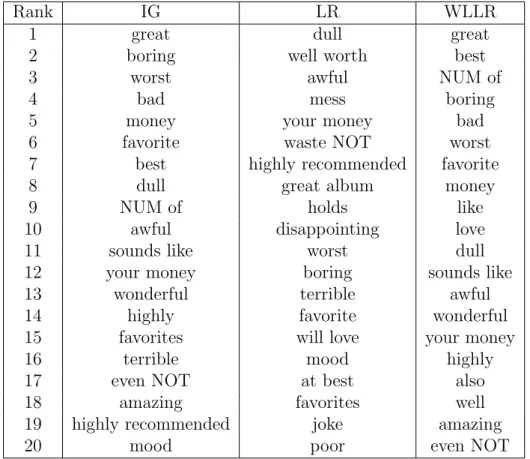
3.3 20 most discriminative features from the music domain according to three feature ranking functions: IG, LR and WLLR. 59 3.4 Performance upper bounds for the binary and multiclass tasks. 73 3.5 20 discriminative positive features ranked by likelihood. . . 78
3.6 20 discriminative negative features ranked by likelihood. . . . 79
4.1 Distribution of the new sentiment markers over domains . . . 92
4.2 Evaluation of the similarity metrics based on different document representations (“+” adds the corresponding component to all those above it; the best combination is highlighted). . . 96
and in-domain accuracies given by SVM and VP. The data comprises the seven domains of different sizes: 25%, 50%, 75% and 100% of the whole amount of data in a domain, resulting in 28 data points altogether. . . 113
5.2 Correlation between various domain similarity measures and the cross-domain accuracies of SVM and VP calculated on 42 source-target domain pairs.. . . 118
5.3 Distribution of the coder judgements over the 5* scale. . . 122
5.4 κ coefficients between coders C1,C2, C3. . . 124
5.5 κcoefficients between codersC1,C2,C3, gold standardC∗ and
reviewers U. . . 126
5.6 Percentage agreements between coders C1, C2, C3, gold
standard C∗ and reviewers U. . . 126
5.7 Examples of label mismatches in product reviews. . . 128
6.1 Variations of ¯F1 for LPγ, LPαβ and RAN K, different sizes
of labelled data (100, 300 and 700 examples) and parameter ranges: α=200, β ∈ {0.2,0.5,1,2,5}, ku ∈ {5,10,20,50,100}
and ∆l ∈ {0.05,0.1,0.2,0.3,0.4,0.5} (minimum values that
surpass the B-line are highlighted, minimum values that surpass the U-bound are underlined). . . 148
6.3 Document frequency of the new sentiment words and their average percentage out of all sentiment words in documents. . 161
6.4 Comparison of the results (accuracies) given by the feature-based and hybrid LPγ+LB algorithms and four
state-of-the-art semi-supervised approaches (the graph-based accuracies outperforming the best state-of-the-art results with a significance level of 0.05 are highlighted). . . 163
7.1 Optimal parameter values for LPγ+HIER+LB and
RAN K+HIER. . . 185
3.1 Class distribution for the multiclass datasets.. . . 45
3.2 Preprocessing steps . . . 48
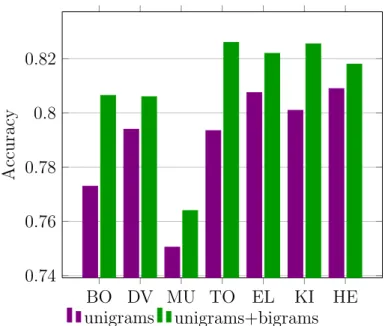
3.3 In-domain accuracies for the unigram and unigram+bigram vector model (binary case).. . . 60
3.4 Feature weight impact on the in-domain accuracies (binary case)1. . . 61
3.5 Word form impact on the in-domain accuracies (binary case). 62
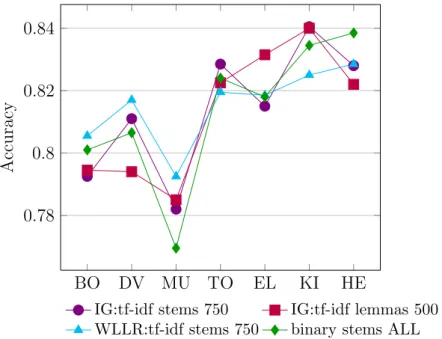
3.6 IG feature selection (binary case). . . 64
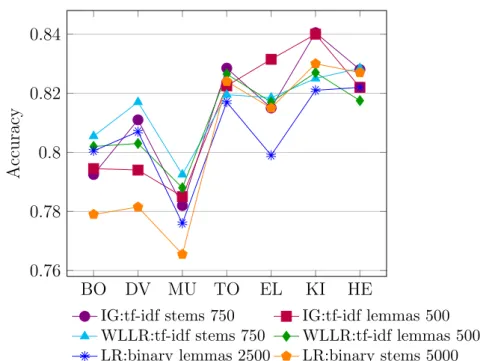
3.7 Comparison of feature selection techniques: IG, WLLR and LR (binary case). . . 66
3.8 Comparison of the feature selection with the full feature set results (binary case). . . 67
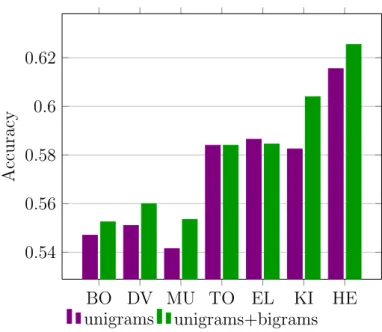
3.9 In-domain accuracies based on unigram and unigram+bigram vector representation (multiclass case). . . 68
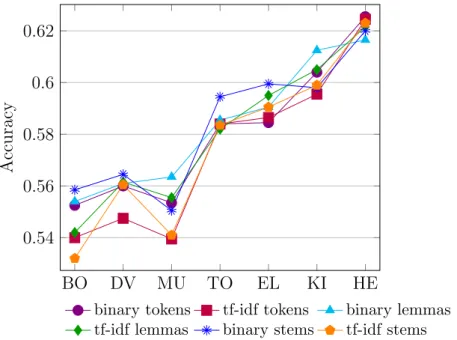
3.10 Feature weight and word form impact on the in-domain accuracies (multiclass case). . . 69
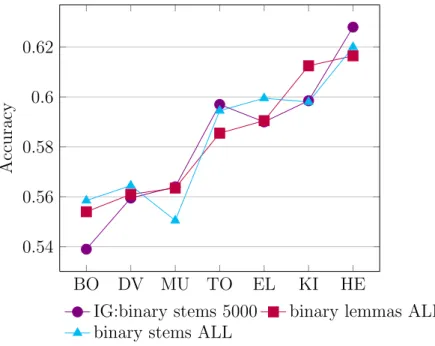
3.11 IG feature selection (multiclass case). . . 70
3.12 Comparison of the feature selection with the full feature set results (multiclass case). . . 71
3.14 Semi-supervised baseline accuracies (multiclass case). . . 74
3.15 Semi-supervised baselinemacroF1 values (multiclass case). . . 75
3.16 Cross-domain accuracy baselines where each curve corresponds to the same target dataset (binary case). . . 76
3.17 Cross-domain accuracy baselines where each curve corresponds to the same target dataset (multiclass case). . . . 77
3.18 Cross-domain macroF1 baselines where each curve
corresponds to the same target dataset (multiclass case). . . . 77
4.1 Graph structure for LP . . . 97
4.2 LP modifications: A Different weight for labelled and unlabelled neighbours (LPγ); B Incorporating external
predictions (LPαβ). . . 103
4.3 The main stages of the classification module. . . 107
5.1 The relationship between complexity measures and in-domain accuracies given by SVM and VP. . . 114
5.2 The relationship between −DJ S values and the cross-domain
accuracies of SVM and VP, calculated on 42 source-target domain pairs. . . 118
6.1 Best accuracy averaged by domain for LP, LPγ and LPαβ
(binary case). . . 134 xx
6.3 Best accuracy averaged over domains for different algorithms and different normalisation techniques (binary case). . . 138
6.4 Best accuracy averaged over domains for the most successful algorithms and normalisation techniques (binary case). . . 139
6.5 Accuracy and MSE obtained withLPγ+LB for each domain
(binary case). . . 139
6.6 Accuracy andmacroF1 averaged over domains for LPγ, LPαβ
and RAN K in different configurations (multiclass case). . . . 141
6.7 Best F¯1 averaged over domains for the most successful
algorithms, normalisation techniques and probability combination rules (multiclass case). . . 142
6.8 Accuracy, macroF1 and MSE obtained with LPγ+LB and
RAN K+HIER for each domain (multiclass case). . . 143
6.9 Sensitivity ofLPγ+LB,LPαβ+HIER+LBandRAN K+HIER
to variations of their parameters. The results are given for different sizes of labelled data: 100, 300 and 700 examples. . . 150
6.10 Sensitivity of LPαβ+HIER+LB to variations of the
parameter α. The results are given for 300 and 700 labelled examples. . . 152
6.11 The effect of different document representation components on the accuracy of LPγ+LB (binary case). . . 157
on the ¯F1 of LPγ+LB (multiclass case). . . 158
6.13 Percentage point differences between results with initial and adapted SO-CAL dictionaries. . . 160
7.1 Accuracy averaged over source domains with target domains fixed, for different algorithms and their configurations (binary case). . . 173
7.2 Accuracy averaged over source domains with target domains fixed, for the most successful algorithms and normalisation techniques (binary case). . . 174
7.3 Accuracy and MSE obtained with LPγ+LB and RAN K
for each source-target domain pair. X-axes contain source domains, graphs correspond to target domains (binary case). . 176
7.4 Accuracy obtained withLPγ+LBandRAN Kfor each
source-target domain pair. X-axes contain source-target domains, graphs correspond to source domains (binary case). . . 177
7.5 F¯1 averaged over source domains with target domains fixed, for
different algorithms and their configurations (multiclass case). 178
7.6 Accuracy and macroF1 averaged over source domains with
target domains fixed for different configurations of LPγ and
RAN K (multiclass case).. . . 179 xxii
axes contain source domains, graphs correspond to target domains (multiclass case). . . 182
7.8 Accuracy,macroF1and MSE obtained withLPγ+HIER+LB
and RAN K+HIER for each source-target domain pair. X-axes contain target domains, graphs correspond to source domains (multiclass case). . . 183
7.9 Sensitivity of LPγ+HIER+LB, and RAN K+HIER to
variations of their parameters. The results are presented for groups of domains, compiled by their complexity. . . 186
7.10 The effect of different document representation components on the cross-domain results (multiclass case). . . 191
7.11 Comparison of the two best graph-based algorithms, LPγ+LB
and RAN K, with state-of-the-art methods (accuracies). . . . 192
7.12 Comparison of the semi-supervised and cross-domain approaches (binary case).. . . 199
7.13 Comparison of the semi-supervised and cross-domain approaches (multiclass case). . . 200
ADN Active Deep Networks 32
B-line Baseline 134
BO BOok reviews 44
BOW Bag Of Words 16
CMN Class Mass Normalisation 100
DV movie reviews on DVDs 44
EL reviews on ELectronic devices 44
GI General Inquirer 24
HE reviews on HEalth products 44
HIER HIERarchical probability combination rule 99
IADN Information Active Deep Networks 32
IG Information Gain 17
JST Joint Sentiment-Topic 35
KI reviews on KItchen appliances 44
LB Label Bidding 101
LDA Latent Dirichlet Allocation 35
LP Label Propagation 7
LR Likelihood Ratio 57
maxP maximum Probability combination rule 99
MSE Mean Square Error 52
MU reviews on MUsic 44
NB Naive Bayes 25
NLP Natural Language Processing 3
OR Odds Ratio 56
PMI Pointwise Mutual Information 22
PoS Parts of Speech 16
PSP Positive Sentence Percentage 33
PWP Positive Word Percentage 89
RANK graph RANKing 104
SCL Structural Correspondence Learning 37
SFA Spectral Feature Alignment 38
SVM Support Vector Machine 17
SVR Support Vector machine Regression 41
TitlePWP Positive Word Percentage in Titles 89
TO reviews on TOyes 44
TTR Type/Token Ratio 46
U-bound Upper bound 134
VP Voted Perceptron 113
WLLR Weighted Log-Likelihood Ratio 57
Introduction
Sentiment analysis (Pang and Lee, 2008; Liu, 2012) has received lots of attention from the research community and industry for the last decade. This period was distinguished by the extremely fast development of Internet technologies, which led to their easy availability and mass exploitation. These factors enabled an immense growth of Internet users who create a vast amount of data each day. User generated content is a very valuable source of information, as it contains people’s opinions and judgments on different topics and its automatic mining can be beneficial for companies, organisations and individual users.
Sentiment classification is one of the tasks within the sentiment analysis research field which is concerned with automatic identification of the sentiment strength or valence of texts (Pang et al., 2002; Turney, 2002; Gamon, 2004; Prabowo and Thelwall, 2009; Thelwall et al., 2010; Taboada et al., 2011; Bai, 2011). In spite of the research that has been carried out in this area recently, there still exist many issues that need to be addressed. One of the principal problems in sentiment analysis is the lack of labeled data to be able to conduct highly precise supervised classification. This
and cross-domain techniques. However, semi-supervised approaches still need some labelled data and their effectiveness is largely determined by the amount of these data, while cross-domain approaches can produce poor results if training data are very different from test data. Usually researchers prefer one of these approaches and therefore there is a lack of studies on which approach is more beneficial for given data.
The majority of research on sentiment classification deals with the binary classification problem, when only positive and negative classes are being identified. Yet, for many practical applications (for example, for analysing customer satisfaction or the decision-making process when purchasing products or services) this rather coarse sentiment scale is not sufficient. A recent study discovered that consumers are “willing to pay from 20% to 99% more for a 5-star-rated item than a 4-star-rated item” (Pang and Lee, 2008, page 1). Therefore, it is crucial to design methods which are able to tackle the multiclass sentiment classification problem.
This thesis addresses the problem of sentiment classification of documents by filling in these two gaps identified in the field of sentiment classification. The next two sections define the problem tackled in this research and introduce approaches used to solve it.
approaches
First, we define the setting of the problem which will be tackled in this thesis. We assume the availability of several document collections or datasets, which are relatively large and contain comparable numbers of documents. All available datasets except one are labelled, where labels state the sentiment scores. Depending on whether the sentiment classification task is binary or multiclass, sentiments can be either binary (for example, positive or negative) or correspond to document ratings (for example, 1* to 5*). The remaining dataset is unlabelled and, moreover, represents our data of interest which we aim to classify. No labelled documents belonging to the data of interest are available, although the possibility of annotating a small subset, if necessary, is not excluded.
The datasets are assumed to belong to different domains. By domain we mean a collection of documents with the same genre (e.g., product reviews) and about the same topic (e.g., electronics). If the word distributions of two document collections are dissimilar enough they are referred to as different domains. This implies that domains can differ by topic, by genre or by both.
The problem described is characterised by the lack or absence of labelled data available from the domain of interest. Such a limited availability of data is a common issue for many natural language processing (NLP) tasks. Fully supervised machine learning techniques usually work best but they need a
substantial amount of labelled data. When a limited amount of labelled data is available, semi-supervised or cross-domain learning approaches are commonly used instead.
Semi-supervised learning relies on a small amount of labelled data and a large number of unlabelled examples from the same domain. It is based on the premise that plentiful unlabelled data can help with learning the model. However, unlabelled data are not always beneficial as the effectiveness of semi-supervised techniques depends partly on the modelling assumptions used (Zhu, 2008). If they are not correct and the amount of labelled data is small, unlabelled data may degrade the performance (Cozman et al., 2003). The most prominent semi-supervised techniques include self-training (Yarowsky, 1995), co-training (Blum and Mitchell, 1998), mixture models with Expectation Maximisation (Nigam et al., 2000), transductive support vector machines (Vapnik,1998) and graph-based methods (Blum and Chawla, 2001; Zhu and Ghahramani, 2002; Zhu et al., 2003a; Belkin et al., 2006; Talukdar and Crammer, 2009; Subramanya and Bilmes, 2011). The effectiveness of semi-supervised approaches is assessed both by the accuracy achieved and the amount of labelled data used and, thus, the best classifier is the one that has the best trade-off between these values.
Cross-domain approaches (also called domain adaptation) are concerned with the problem of adapting statistical classifiers learned on domains where annotated data are available to new domains. According to the domain adaptation terminology, a domain to which a classifier is adapted, is called
data). Domains used for learning the model are calledsourcedomains (source domain data are also referred to as out-of-domain data). Generally, cross-domain approaches consider some labelled and plentiful unlabelled in-cross-domain data; however, in this thesis we assume that no labelled in-domain data are available. Therefore, by domain adaptation we mean unsupervised domain adaptation (Jiang,2008).
The motivation to use cross-domain approaches is based on two premises. On one hand, the acquisition of labelled data tailored for a specific domain is a labour-expensive process, and on the other, there are plentiful labelled data available on the Internet. For instance, in sentiment analysis, a good example is product reviews, whose ratings are already provided by their authors. In contrast, other genres of user-generated content, for example, blogs, forums and social networks, are usually short of labelled data as they have to be annotated manually by human experts. Therefore, a classifier that can be trained on one domain and applied to another may solve the limited labelled data problem. However, supervised techniques are based on the assumption that training and test data are driven from the same underlying probability distribution and, as a result, the straightforward application of machine learning algorithms may lead to poor results if the source and target domains are not alike. The most common ways to tackle the domain adaptation problem are ensembles of classifiers (Aue and Gamon, 2005; Li and Zong, 2008) and various feature transformation algorithms (Blitzer et al., 2006,
2007; Pan et al., 2010, 2011; Glorot et al., 2011). In addition, as cross-domain and semi-supervised techniques share certain similarities, several semi-supervised approaches have been adapted to the cross-domain task, for example, co-training (Yang et al.,2012) and graph-based algorithms (Wu et al., 2009).
In contrast to semi-supervised approaches, cross-domain learning does not require any manual effort, but its results largely depend on the similarity of source and target domains. If there are plentiful labelled data available from other domains, it is crucial to explore what the best strategy would be: the use of existing datasets or the manual annotation of small amounts of target data. Answering this question could help to achieve the highest accuracy using as little human annotation effort as possible.
1.2
Graph-based learning
We adopt graph-based learning as our main method for semi-supervised and cross-domain sentiment classification. This method was chosen for two reasons. First, it can be used in both semi-supervised and cross-domain settings, and second, it can handle multiclass classification. Moreover, graph-based learning has been intensively researched in the last ten years (Zhu et al., 2003a; Joachims, 2003; Talukdar and Crammer, 2009; Subramanya and Bilmes, 2011) and has been proved to be effective for many NLP tasks. In the field of sentiment analysis, graph-based models have been successfully employed for sentiment classification (Pang and Lee,2004;Goldberg and Zhu,
Radev,2010;Xu et al.,2010), cross-lingual sentiment analysis (Scheible et al., 2010) and social media analysis (Speriosu et al.,2011).
Graph-based algorithms deal with data that can be represented as a weighted graph, with the vertices being data instances and the edge weights corresponding to the similarity between instances. They assume a “manifold structure” of the data, which means that strongly connected instances tend to belong to the same class. If data do not naturally form a graph, the problem of graph construction should be addressed. Graph construction implies finding a similarity function that accurately estimates the similarity between graph vertices and is recognised to be key for the successful performance of graph-based algorithms (Zhu, 2008; Bilmes and Subramanya, 2011).
This thesis explores the most popular and widely used graph-based algorithm, label propagation (LP) (Zhu and Ghahramani, 2002). We also examine and compare severalLP modifications which attempt to improve the graph structure used. Although there are two studies which also appliedLP to semi-supervised (Goldberg and Zhu, 2006) and cross-domain (Wu et al., 2009) sentiment classification, they do not address some important questions. First, they use certain LP modifications without analysing how different graph structures influence the results. Second,Wu et al.(2009) lacks a study of similarity measures, while Goldberg and Zhu (2006) proposes similarity functions which require additional resources and can only be applied to data from the same domain. Third, Wu et al. (2009) does not suggest any
factors that could impact the results of cross-domain classification. Finally, both studies exploit graph-based learning in certain learning settings and, therefore, there is no comparison between semi-supervised and cross-domain approaches.
1.3
Aims and goals
The aims of the thesis are to address the problem of limited availability of data in sentiment analysis and to advance research in semi-supervised and cross-domain approaches for sentiment classification, considering binary as well as multiclass sentiment scales.
To achieve these aims, the following goals need to be met:
The first goal is to investigate various ways of constructing sentiment graphs, which accurately estimate the similarity function and, at the same time, are easy to build, do not require deep linguistic analysis and do not involve manual annotation effort.
The second goal is to develop and evaluate a graph-based sentiment analysis system which is able to tackle both binary and multiclass classification and can be used in semi-supervised and cross-domain settings. This implies implementation of several graph-based algorithms and their evaluation in both settings. Evaluation includes establishing optimal parameter values for the algorithms that deliver the best performance, examining the impact of different graph structures and post-processing techniques on the final results to establish the most successful LP
variations, and finally a comparison of graph-based results against the fully supervised classification performance and against state-of-the-art results (where applicable).
The third goal is to draw a comparison between semi-supervised and cross-domain approaches to develop recommendations for choosing the most pertinent approach given the data available. In particular, this involves the identification of data characteristics which impact the results of semi-supervised and cross-domain sentiment classification.
The scope of the thesis is limited to the methods and datasets exploited in the study. First, our methodology adopts only graph-based algorithms, which, in turn, are limited to LP (and its modifications) as the most well known and widely used graph-based approach. Second, our data consist of user reviews of different products, which imposes specific style characteristics, such as relatively long texts, a relatively high level of grammatical correctness and a scarcity of Internet slang, emoticons and abbreviations compared, for example, to social network data. The data sizes of all datasets are comparable and the distribution of sentiment classes is similar. Therefore, the effect of these factors on the results of semi-supervised and cross-domain graph-based learning is not studied. As reviews belong to the same genre, we consider domain adaptation only across topics; the possible challenges of domain adaptation across genres are outside the scope of this thesis.
Thus, throughout the thesis, the notions of “domain” and “topic” are interchangeable.
1.4
Structure of the thesis
The thesis comprises eight chapters: introduction, conclusions and six main chapters. The main chapters can be grouped into three parts. The first part, represented by Chapter 2, gives the necessary background information about ongoing research in sentiment classification. The second part, comprising Chapters 3, 4 and 5, describes the initial settings and discusses the methodological aspects of the thesis. Chapters6and7form the experimental part, where the main contributions of the thesis are presented. Chapter 2 contains a study of previous work in the field of sentiment classification. All relevant papers are categorised according to four parameters: features, genres, learning approaches and the number of classes. Due to the focus of the thesis, special attention is paid to the studies exploiting semi-supervised and cross-domain approaches.
Chapter 3 introduces the parameters that are essential for the research conducted in the thesis: data, evaluation metrics and baselines. This chapter starts with a description of the data used in our experiments. Then we give an overview of the main preprocessing steps implemented as part of our sentiment classification system, followed by the evaluation metrics used for assessing the experimental results in Chapters 3,6and7. An important part of the chapter is the discussion of feature selection, which aims to establish
supervised classification results are then used as upper bounds for comparison with supervised and cross-domain results. Finally, we provide semi-supervised and cross-domain baselines for the binary and multiclass cases.
Chapter 4 focuses on the core of our sentiment classification system, the graph-based learning approach. First, we provide arguments to support the choice of graph-based learning as our main method. Then we address the problem of graph construction, proposing and evaluating various sentiment similarity measures. The rest of the chapter describes several LP-based inference methods and discusses the post-processing techniques to improve the output values.
Chapter 5 introduces domain complexity and domain similarity, two data characteristics which influence semi-supervised and cross-domain classification results. These characteristics are used in the evaluation conducted in the two subsequent chapters. This chapter also describes a human annotation experiment which estimates the complexity of multiclass sentiment classification for humans and assesses the conformity of review texts with their ratings.
Chapters 6 and 7 presents the evaluation of our graph-based sentiment analysis system in semi-supervised and cross-domain settings. The experiments are carried out for both binary and multiclass classification tasks. Chapter7 concludes with providing the recommendations which help to choose the best learning setup given the data available.
Chapter 8 revisits the goals established at the beginning of the thesis and presents the original contributions made by this study. To conclude, we define directions for future research.
Overview of research on sentiment
classification
This chapter gives an overview of the research undertaken in the field of sentiment classification. Due to the scope of the thesis, it focuses on semi-supervised and cross-domain studies applied to document-level sentiment classification. Existing research methods and approaches are categorised on the basis of the following four parameters:
• features- which reflect the way documents are represented;
• learning approaches - which include lexical, supervised, semi-supervised, unsupervised and cross-domain approaches;
• genres- which refer to different sources used for testing a method;
• number of classes - which include binary and multiclass cases1.
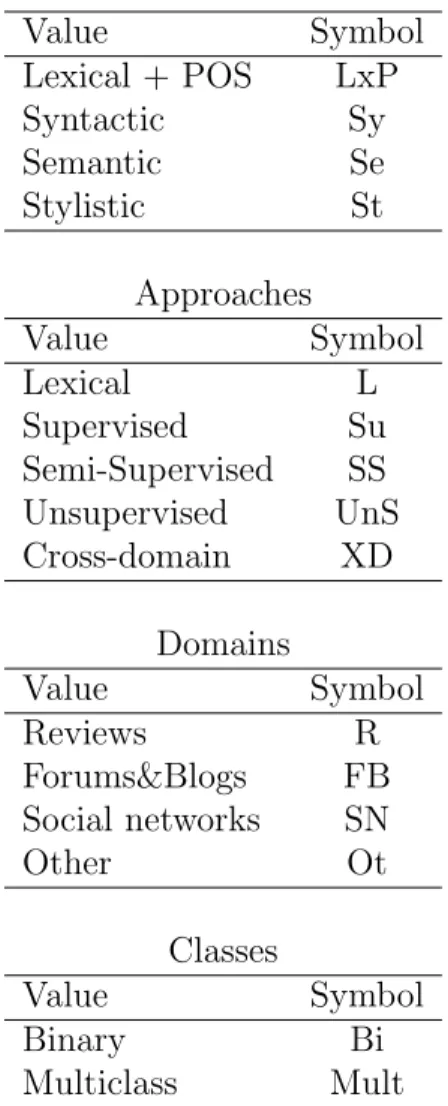
In Table 2.1, values of the above parameters together with their abbreviations are listed. The most prominent studies on sentiment classification with values of the above parameters used are presented in Table
2.2.
1This is done on the basis of the method implementation discussed in the paper and it
Lexical + POS LxP Syntactic Sy Semantic Se Stylistic St Approaches Value Symbol Lexical L Supervised Su Semi-Supervised SS Unsupervised UnS Cross-domain XD Domains Value Symbol Reviews R Forums&Blogs FB Social networks SN Other Ot Classes Value Symbol Binary Bi Multiclass Mult
Table 2.1: Values of the parameters with which sentiment classification studies are categorised.
The remainder of the chapter is organised as follows: Section2.1 reviews common features used for sentiment classification. Section 2.2 gives a brief overview of social media sources which are most exploited in the field of sentiment analysis. Section 2.3 presents important sentiment classification studies grouped according to the learning approach used: lexical, supervised, semi-supervised and cross-domain. Finally, Section2.4 discusses the existing
Study Features Approaches Genres Classes
Pang et al. (2002) LxP Su R Bi
Turney (2002) Se L, UnS R Mult
Gamon (2004) LxP,Sy,St Su Ot Bi
Aue and Gamon (2005) LxP SS,XD R Bi
Pang and Lee (2005) LxP Su R Mult
Read (2005) LxP SS,XD R,Ot Bi
Whitelaw et al. (2005) LxP,Se Su R Bi Goldberg and Zhu (2006) LxP SS R Mult Riloff et al. (2006) LxP,Sy Su R,Ot Bi
Blitzer et al. (2007) LxP XD R Bi
McDonald et al. (2007) LxP Su R Bi Abbasi et al. (2008) LxP,St Su R,FB Bi Dasgupta and Ng (2009) LxP SS R Bi
Wu et al. (2009) LxP XD R Bi
Lin and He (2009) LxP,Se UnS R Bi
Li et al. (2010a) LxP SS R Bi
Thelwall et al. (2010) Se L,SS SN Mult Paltoglou and Thelwall (2010) LxP Su R,FB Bi
Pan et al. (2010) LxP XD R Bi
Bai (2011) LxP Su R,Ot Mult
Bollegala et al. (2011) LxP XD R Bi Taboada et al. (2011) Se L R,FB,SN Bi
He et al. (2011) LxP,Se XD R Bi
Glorot et al. (2011) LxP XD R Bi
Paltoglou and Thelwall (2012) LxP,Se Su FB Mult Mejova and Srinivasan (2012) LxP XD R,FB,SN Bi
Li et al. (2012) LxP,Sy XD R Bi
Zhou et al. (2013) LxP SS R Bi
Table 2.2: Research studies on sentiment classification.
classification methods which are able to perform multiclass sentiment classification.
2.1
Features
The selection of informative features which best reflect the differences between classes has always been an important issue in classification. This seems harder for sentiment classification due to subtle ways of conveying sentiments, the presence of irony and humour, as well as the risk to misinterpret written language because it is less expressive and more ambiguous than face-to-face interaction. Despite the elusive nature of sentiment, early studies on feature selection showed a reasonably good performance of bag of words (BOW) representations (Pang et al., 2002; Dave et al., 2003). Pang et al. (2002) examined the impact of different lexical features unigrams, bigrams, adjectives and parts of speech (PoS) -on the results of sentiment classificati-on for movie reviews. They drew the interesting conclusion that simple unigrams with binary weights provide the highest accuracy, outperforming bigrams. In contrast to Pang et al. (2002), Ng et al. (2006) obtained a significant gain in accuracy on the same data by enriching unigram-based BOW representations with bigrams and trigrams. However, they exploited only the most discriminative bigrams and trigrams according to the weighted log-likelihood ratio (Nigam et al., 2000), to avoid high dimensionality problems.
Gamon (2004) analysed three feature sets: n-grams, n-grams + PoS + deep syntactic features (context free phrase structure patterns, transitivity of predicates, tense information, etc.) and PoS + deep syntactic features only.
They concluded that although syntactic features alone led to a substantial drop in accuracy, their contribution is significant when they are used together with n-grams. Riloff et al.(2006) also argued that syntactic information can be beneficial for sentiment analysis as it allows the representation of complex subjective expressions that have non-compositional meanings. The authors merged n-grams and lexico-syntactic patterns on the basis of a specially designed subsumption hierarchy. The idea of the subsumption hierarchy is to identify specific and complex features which bring a substantial gain to the separability of positive and negative classes, and to discard features that perform equal to or worse than more general features subsuming them in the hierarchy. Feature quality was assessed using information gain (IG). The experiments confirmed the effectiveness of both complex features and feature filtering by IG.
Instead of incorporating complex features,Paltoglou and Thelwall(2010) proposed using more accurate weighting functions which they adopted from information retrieval. A Support Vector Machine (SVM) classifier based on the refined feature weights significantly outperformed all known state-of-the-art methods on the movie review dataset.
There are numerous studies that explore the ability of different parts of speech to convey sentiment. Adjectives have been considered good indicators of sentiment since the earliest research on sentiment analysis (Hatzivassiloglou and McKeown,1997), although they do not usually perform well when used alone (Mullen and Collier, 2004; Whitelaw et al., 2005).
Chesley et al. (2006) analysed verbs in addition to adjectives for the classification of blogs. Their study revealed that positive adjectives are good predictors of neutral and positive blogs, whereas asserting and approving2 verbs can be used to identify positive blog posts.
Mullen and Collier (2004) evaluated the importance of semantic information, exploiting Osgood’s Theory of Semantic Differentiation (Osgood et al., 1957). The authors expanded a simple vector space model based on lemmas by adding adjectives scored with values for potency, activity and an evaluative factor using the method of Kamps and Marx (2002). Although the hybrid model outperformed simple models based on lemmas and word unigrams, the differences between them were not statistically significant. Another attempt to engage semantic knowledge was made byWhitelaw et al. (2005), who adopted Martin and White’s Appraisal Theory (Martin and White,2005) and semi-automatically constructed a lexicon of adjectives and modifiers with values of attributes from the Appraisal Theory taxonomy. Instead of single adjectives, the authors considered adjectival appraisal groups, which are headed by an appraising adjective and optionally modified by a list of modifiers. They reported a reasonable accuracy for appraisal groups alone, taking into account the low coverage of the constructed lexicon, although the BOW approach significantly outperformed them. However,
2 These are verb classes in Semantex, which is an automatic text analytics platform
appraisal groups gave a substantial improvement in accuracy when used together with the BOW features.
Abbasi et al. (2008) questioned whether stylistic features could give better insights into differences across sentiment classes when analysing web forums. They exploited the following stylistic features: frequency of letters, character n-grams, vocabulary richness measures and frequency of function words, among others. The experiments demonstrated that stylistic features, when complementing lexical and syntactic features, yield a significant gain in accuracy. In general, an increased informality of language inevitably attaches more importance to stylistic features. For example, such features as emoticons, letter repetitions and exclamation mark repetitions are helpful for the sentiment classification of MySpace comments (Thelwall et al.,2010). Feature reduction is a common technique for many classification tasks as it decreases the dimensionality of a feature space by removing poor or irrelevant features, improving generalisation and diminishing the time needed for training. It has not been thoroughly explored by sentiment analysis researchers, although some existing works indicate its importance for sentiment classification. For example, Gamon (2004) achieved a substantial increase in performance by applying the likelihood ratio (Dunning, 1993) to select the most discriminative attributes from noisy user feedback. Abbasi et al.(2008) demonstrated the effectiveness of genetic algorithms for feature selection, whose combination with IG weights outperformed IG- and SVM-feature selection. In contrast, the results of several widely-exploited machine
learning techniques given in Bai (2011) mostly show a substantial decrease in performance when IG feature reduction is applied.
2.2
Genres
The majority of research in sentiment classification focusses on product reviews. Indeed, they are convenient data for research purposes, as in many environments the reviews are already rated by their authors. As an example, Pang et al.(2002);Mullen and Collier(2004);Pang and Lee(2004);Whitelaw et al. (2005); Riloff et al. (2006); Ng et al. (2006); Abbasi et al. (2008); Paltoglou and Thelwall (2010) and Bai (2011) have all dealt with the same movie review dataset3. Their efforts to raise accuracy resulted in an increase from 82.9% to 95.5%.
The social web domain, represented by blogs, forums and social networks is an even more important and necessary source of information due to the rising popularity of social media technologies. Many of these technologies offer a handy interface when accessed from smartphones and other portable devices and are perfect for short notes, sharing ideas and interests, and expressing opinions. Social web data are challenging due to the lack of proper grammar and punctuation, misspellings, made-up words and acronyms. At the same time, they are extremely valuable and timely, as they contain immediate user responses to events and situations, as well as user predictions and speculation about future events. Several studies have
analysed the correlation between real world events and blog discussions, and found it possible to make accurate predictions, for example, about movie sales (Mishne and Glance, 2006; Sadikov et al., 2009; Asur and Huberman, 2010). Many research studies in sentiment analysis deal with Twitter, the most popular microblogging website (Go et al., 2009; Davidov et al., 2010; Barbosa and Feng, 2010; Kouloumpis et al., 2011; Mejova and Srinivasan, 2012). Another substantial part of research focuses on opinion analysis of news articles and editorials (Devitt and Ahmad, 2007; Wilson et al., 2009; Balahur et al.,2010;Park et al.,2011;Bal,2014) using, in particular, MPQA (Wiebe and Riloff,2005;Wilson,2008) and NTCIR MOAT (Seki et al.,2008) datasets. Other genres include, but are not limited to, legal blogs (Conrad and Schilder,2007), user feedback (Gamon,2004) and email (Liu et al.,2003). Thelwall et al. (2012) carried out sentiment strength detection on six social web datasets at once: Youtube, Twitter, a sports forum, MySpace, Digg.com news and BBC forums.
2.3
Approaches
The majority of approaches to sentiment classification fall into one of two groups: lexical or statistical. Lexical approaches are based on either predefined rules or lexicons of sentiment words, which are used to compute the overall sentiment of texts. The lexicons and rules represent expert knowledge about the task and determine the effectiveness of this approach. In contrast, statistical approaches learn a function by matching input texts
and output sentiments from a sample of training data containing both input examples and output values. In this section, the most important representatives of lexical and statistical approaches are described.
2.3.1
Lexical approaches
Lexical approaches are concerned with the use of sentiment lexicons, where each word is assigned to a given sentiment. The final sentiment of a text is normally calculated by applying some scoring function to sentiment-bearing words occurred in the text.
There is a vast amount of research regarding the automatic building of sentiment lexicons. Hatzivassiloglou and McKeown (1997) pioneered this direction, exploiting the idea that conjunctions between adjectives indicate whether they have the same or opposite polarity. In contrast, instead of using syntactic relations, the method of Turney and Littman (2003) was based on semantic association. The authors assumed that words with similar orientations tend to appear together and used Pointwise Mutual Information (PMI) to measure the semantic association of words with a small set of positive and negative seed words. PMI scores were computed using the AltaVista web search engine and semantic association was estimated by the number of pages containing both a given word and a seed word. The method of Turney and Littman (2003) is further referred to as the SO-PMI method. Gamon and Aue(2005) suggested a modified version of this approach, which as well as the co-occurrence hypothesis uses the hypothesis that sentiment
words of opposite orientations tend not to co-occur in the same context. The authors argued that this modification allows a more reliable extraction of sentiment-bearing words, and proved it both qualitatively and quantitatively. A number of studies exploit WordNet (Miller, 1995), whose explicit semantic relations can help to deduce the polarity of words (Kamps et al., 2004; Kim and Hovy, 2004, 2006; Andreevskaia and Bergler, 2006; Esuli and Sebastiani, 2006a,b; Hassan and Radev, 2010). For example, Kamps et al. (2004) suggested measuring word polarity using synonymy relations from WordNet, connecting two words if they occur in the same synset. The polarity of a given word was computed on the basis of the minimal path-length between WordNet synsets of the word and the synsets of two words with opposite meanings: “good” and “bad”. Kim and Hovy (2006) also used synonymyrelations but, in contrast to Kamps et al.(2004), only direct synonyms were considered. Their method requires a relatively large set of predefined positive, negative and neutral words for learning new sentiment words.
In contrast to Kim and Hovy (2006) and Kamps and Marx (2002), who did not take into account the problem of multiple senses,Esuli and Sebastiani (2006a,b) worked at the level of synsets, automatically assigning them three values: level of positivity, level of negativity and level of objectivity. The underlying idea was based on the assumption that synsets with similar orientations tend to have similar glosses. The algorithm required a small set of seed words, representing positive, negative and neutral synsets, which
was further automatically expanded through lexical relations (synonymy, antonymy, hypernymy, etc.). The synsets obtained were then represented as vector models of their glosses and a supervised learning technique trained on the augmented seed set was applied to the remaining WordNet synsets. This method was used to build a well-known linguistic resource, SentiWordNet4. Another extension of WordNet was produced by Strapparava and Valitutti (2004), which resulted in the development of WordNet-Affect.
Hassan and Radev(2010) used a Markov random walk model on a graph of related words, where two words were considered related when connected through synonymy, hypernymy and similar to relations. The algorithm was based on the observation that a random walk starting at a given word is likely to reach another word with the same polarity before reaching a word with different polarity. Although the random walk method had a performance comparable to that of the SO-PMI method (Turney and Littman, 2003), it is faster and does not require a large corpus. An interesting and completely unsupervised method was proposed by Zagibalov and Carroll (2008), who searched for negation to identify sentiment-bearing words in Chinese.
Some linguistic sentiment resources were constructed manually: General Inquirer (GI) (Stone et al., 1966), the SO-CAL dictionaries (Taboada et al., 2011), the SentiStrength lexicons (Thelwall et al., 2010) and the MPQA subjectivity lexicon (Wilson et al., 2005), among others. It is worth noting that SentiStrength allows the optimisation of the sentiment strengths of its
lexicons using annotated data. This quality is relevant when adapting the sentiment classification engine to different domains.
2.3.2
Supervised classification
Supervised classification requires a corpus of texts labelled with their polarity or sentiment strength. According to numerous studies, when the amount of labelled data is sufficient, this learning approach normally yields the best performance (Pang and Lee, 2008). A pioneering study in supervised sentiment classification (Pang et al.,2002) compared three techniques: naive Bayes (NB), maximum entropy (ME) and SVMs and the results showed a moderate advantage for SVMs over the other methods. In another study, SVMs and ME demonstrated comparable results for the classification of heterogeneous information on the Web (Boiy and Moens, 2009).
Research on supervised methods for sentiment classification has investigated several directions for improving classification results. One popular direction concerns exploring a set of features yielding the best results (Gamon, 2004; Mullen and Collier, 2004; Whitelaw et al., 2005; Kennedy and Inkpen, 2006; Abbasi et al., 2008; Paltoglou and Thelwall, 2010). The main studies in this group were discussed in Section2.1. Another direction comprises methods which use a combination of classifiers to reduce classification errors given by individual learners (Kennedy and Inkpen,2006; Prabowo and Thelwall, 2009). For example, Kennedy and Inkpen (2006) combined a lexical approach and SVMs using weighted voting. Their lexical
approach exploited different sentiment lexicons (including GI and a list of positive and negative adjectives (Taboada and Grienve, 2004)), enriched by marking the presence of negatives and intensifiers. Though the lexical approach alone was poor, its combination with SVMs slightly outperformed SVMs on their own.
Similar to Kennedy and Inkpen (2006), Prabowo and Thelwall (2009) hypothesised that the use of multiple classifiers in a hybrid manner can help to improve sentiment classification. However, the classifiers were combined in a sequence rather than in an ensemble. The authors proposed three rule-based methods. The first method used General Inquirer, while the second exploited proper nouns for constructing rules, which were assumed to convey the same sentiment as the whole document. Finally, the last method, called the statistics-based classifier, established a set of rules using sentiment-bearing words automatically rated similar to the SO-PMI method (Turney and Littman, 2003). The hybrid approach, which combines the three rule-based classifiers with SVMs showed a significant advantage over SVMs alone for small datasets. The comparison was not carried out for larger datasets due to a high computational cost of the statistics-based classifier.
A third direction unites papers that represent documents by more fine-grained elements, for example, sentences, and address both coarse-and fine-grained classification problems (Pang coarse-and Lee, 2004; McDonald et al., 2007; Zaidan et al., 2007; Li et al., 2010b; Yessenalina et al., 2010; Carrillo de Albornoz et al., 2011). Pang and Lee (2004), when dealing with
movie reviews, hypothesised that objective sentences degrade the sentiment classification of full texts. To filter out objective sentences, a graph min-cut algorithm that takes into account both proximity between sentences in a text and the classification results given by the SVM and NB classifiers was applied. The SVM and NB polarity classifiers trained on filtered texts were compared with those trained on the full documents. As a result, the extraction of subjective sentences was shown to be beneficial only for NB, while SVMs performed marginally better with full documents.
McDonald et al.(2007) assumed that the joint classification of documents and sentences can improve the accuracy of sentiment classification at both levels. The authors suggested an undirected graphical model, where the label of each sentence depends on its neighbouring sentences and the label of the document. In general, inference in undirected graphical models is intractable, but if the document label is fixed the introduced model converts into a chain and the problem can be solved using Viterbi’s algorithm. The method slightly outperformed two cascaded classifiers, where one classifies sentences using only a sentence-structured model, and then passes the labels obtained to a document classifier, while the other acts vice-versa.
Zaidan et al. (2007) argued that document annotations enriched with “annotator rationales” can be more effective for sentiment classification than providing a classifier with additional labelled examples. By “annotator rationales”, the authors mean the most important words and phrases of a document that indicate its polarity. For each original document, a set of
contrastive examples was constructed by removing one or more annotator rationales. The contrastive examples were used to put additional constraints on the SVM classifier to ensure that the contrastive documents were classified less confidently than the original documents. The results demonstrated a substantial improvement over the baseline SVMs trained only on original documents. Interestingly, training SVMs on annotator rationales only yielded a poor accuracy significantly lower than the baseline. Following the idea of Zaidan et al. (2007), Yessenalina et al. (2010) proposed an unsupervised method for extracting annotator rationales using either OpinionFinder5 or manually constructed polarity lexicons. Their evaluation showed that automatically constructed rationales are as effective as manually-produced rationales.
The last group of approaches presented here attempt to improve sentiment classification by stepping outside a simple BOW representation (Li et al., 2010b; Bai, 2011). Bai (2011) employed Bayesian networks, which are able to model dependencies among words, proposing an algorithm for learning the Markov Blanket for a sentiment variable. The sentiment variable can have multiple values corresponding to the sentiment expressed in a document. At the first stage, the algorithm establishes a parsimonious vocabulary of words that are expressive enough to capture the overall sentiment of a document. At the second stage, a dependency structure between the words in the vocabulary and sentiment variables is learnt. The experiments showed that
only several dozen highly predictive words are enough to obtain accurate classification results which are comparable or superior to those of state-of-the-art classifiers trained on BOW representations. Interestingly, the words found important by the algorithm for predicting sentiments are not always sentiment-bearing, for example, “also”, “again”, “but” and “as”, among others. According to the authors, such “results suggest that words that occur often, along with their conditional dependencies and a few strong adjectives, constitute most of the vocabulary needed to express sentiments and perform reasonable predictions” (Bai, 2011, page 741).
Li et al. (2010b) argued that a simple BOW representation is unable to model such complex linguistic phenomena as negation structures, contrast transition, modals and presuppositional structures, which can substantially shift or even invert sentence polarity (Polanyi and Zaenen,2006). Therefore, the first stage of their algorithm consisted of the automatic detection of sentences with polarity-shifting structures (polarity-shifted sentences). At the second stage three classifiers trained on polarity-shifted sentences, polarity-unshifted sentences and all sentences are trained. Experiments proved the importance of polarity-shifted sentences for correct sentiment classification. Moreover, the final classifier combining three learning models by stacking (Dzeroski and Zenko, 2004) significantly outperformed each of the individual classifiers.
2.3.3
Semi-supervised and unsupervised approaches
Due to the problem of limited data availability, the use of supervised methods is not always possible. Semi-supervised and unsupervised methods attempt to overcome this problem by taking advantage of a plentiful amount of unlabelled data. In this section, several important semi-supervised and unsupervised studies are described.
Dasgupta and Ng(2009) assumed that some texts are easier for sentiment classification to deal with than others and proposed the combination of two techniques to acquire and exploit both easy-to-classify and hard-to-classify data. First, spectral clustering (Ng et al., 2001) was applied to find unambiguous and easy-to-classify reviews. These documents were then used in active learning (Cohn et al., 1994), which attempted to acquire the most ambiguous documents and annotate them manually. Finally, an ensemble of classifiers trained on the same set of ambiguous reviews and different sets of unambiguous reviews was constructed and compared against several baselines. The evaluation verified the effectiveness of each of the suggested steps.
Li et al.(2010a) applied a co-training approach (Blum and Mitchell,1998) for semi-supervised classification of product reviews. They considered the data from two perspectives: personal and impersonal views. Personal views were defined as those conveyed by personal sentences where the subject is a person, for example, “I am happy with the product”. In turn, impersonal
views were those represented by impersonal sentences where the subject is not a person, for example, “The product is really good”. First, a simple heuristic was applied to classify sentences as personal or impersonal, on the basis of which three datasets were composed: reviews with personal sentences, reviews with impersonal sentences and full texts. Then, three ME classifiers trained on these datasets were fused in the co-training procedure. Evaluation showed the significance of each of the proposed steps. First, a random division of sentences yielded a substantial decrease in accuracy compared to the two view division. Second, an ensemble of the three classifiers performed much worse than the co-training approach. Finally, co-training was proved to be better than self-training on the individual classifiers.
Haimovitch et al. (2012) argued that augmenting the amount of unlabelled data can reduce the error rate given by semi-supervised approaches. They conducted large-scale experiments with up to 15 million unlabelled Amazon product reviews employing a bootstrapping approach called AROW (Adaptive Regularisation of Weight vectors) (Crammer et al., 2009). The results demonstrated that the unlabelled data size affects the effectiveness of their approach. For example, increasing unlabelled data from 50K to 1.6M examples reduced the error rate for book reviews by ≈2%. Another interesting outcome of their study is concerned with the amount of labelled data needed for high performance. While increasing the amount of labelled data from 100 to 1000 examples yielded a significant decrease in
the error rate (from 15.2% to 8.4% for book reviews), further growth of the labelled data size did not improve the results much.
Zhou et al. (2013) proposed using deep learning for training semi-supervised sentiment classification models. They introduced a novel approach, called active deep networks (ADN), which combines deep belief networks (Hinton and Salakhutdinov, 2006) with active learning. First, the deep architecture exploiting all unlabelled data and some initial labelled examples is constructed. Then an active learner is applied to identify the most uncertain unlabelled examples and use them for training the networks. To improve the active learning stage by taking into account not only the uncertainty of an example but also the density of the area in which it is found, a modified version of ADN, called information ADN (IADN), was proposed. This helps to choose the most representative examples. The experimental results demonstrated the effectiveness of ADN and IADN compared to previous semi-supervised methods, such as transductive SVMs and the method of Dasgupta and Ng(2009) described above.
An important group of algorithms within the semi-supervised learning approach is graph-based algorithms (Zhu et al., 2003a), which model data as a weighted graph of instances with the edges corresponding to similarity between instances. For document-level sentiment classification, instances are documents and the similarity function reflects the closeness of sentiment between documents. The first attempt to apply graph-based learning to sentiment classification was by Goldberg and Zhu (2006), who proposed
a modified label propagation algorithm (Zhu and Ghahramani, 2002) for multiclass classification of movie reviews. To estimate sentiment similarity between a pair of documents, several similarity measures were tested. The measure that performed best was based on the percentage of positive sentences (PSP) in a document, previously introduced by Pang and Lee (2005). For computing PSP scores, review sentences were classified as either positive or negative using a binary classifier trained on an external “snippet” dataset. The snippet dataset comprised 10 662 short texts taken from the movie reviews on rottentomatoes.com, where the ratings for snippets were assigned on the basis of the ratings of their original reviews. Using the PSP scores, each document was represented as a vector (PSP, 1-PSP) and the similarity between two documents was measured as the cosine similarity between the corresponding vectors. For relatively small amounts of labelled data (less than 200 documents), the graph-based results demonstrated a considerable improvement over the accuracies given by supervised SVM regression. In contrast, for larger amounts of labelled data, supervised SVM regression generally performed better. The method of Goldberg and Zhu (2006) is implemented as part of our graph-based sentiment analysis system and, therefore, a more detailed description of the algorithm can be found in Chapter 4.
Turney(2002) was the first to tackle the sentiment classification problem in an unsupervised manner. He assumed that lexical association of two words and their similarity are related, i.e., words with similar orientation
tend to co-occur. Instead of considering isolated words, he extracted two-word phrases which contain adjectives and adverbs and satisfy a set of specific linguistic patterns, for example, JJ NN or RB JJ. Phrases were preferred to isolated words for introducing some context which could help to disambiguate domain-dependent and context-dependent sentiment words, for example, “unpredictable plot” and “unpredictable steering”. The semantic orientation of phrases was measured using the SO-PMI method as explained in Section 2.3.1. The sentiment of documents was computed by averaging the semantic orientations of their phrases. This approach gave reasonable results taking into consideration its being completely unsupervised.
Read and Carroll (2009) extended the SO-PMI method by exploring three types of similarity measures: lexical association measures as inTurney and Littman (2003) and two second-order similarity measures - semantic spaces and distributional similarity. The overall sentiment of a document was computed on the basis of the sentiments of its features, which in turn were represented as a sum of similarity scores between a feature and a set of predefined prototypical words. Seven positive and seven negative words were selected as polarity prototypes. The evaluation of the proposed word similarity method showed that its performance is independent of domains, topics and time-periods. In addition, a comparison with supervised techniques suggested that the word similarity method can be more beneficial than supervised techniques when the task involves multi-domain datasets.
manner which exploits the idea that emoticons and their contexts convey similar sentiments. The author collected data from Usenet newsgroups and extracted pieces of text close to emoticons using different context windows. Unfortunately, the results were not very good: the best classifier trained on 20 000 articles could only achieve 70.1% accuracy. The author explained the low accuracy by the high level of noise present in the automatically acquired labelled data. This unsupervised labelled data acquisition approach was adopted in several subsequent studies (Go et al., 2009; Pak and Paroubek, 2010) for sentiment analysis on Twitter.
Another unsupervised method developed by Zagibalov (2010) exploits a small number of sentiment-bearing seed words and a bootstrapping strategy. First, all documents are classified according to the seed words and all lexical units are weighted on the basis of their frequency in positive and negative documents. Then, the procedure is repeated, which leads to new document labels and updated weights of lexical units. This process iterates until convergence is achieved.
Lin and He (2009) proposed a joint sentiment-topic (JST) model as another unsupervised approach to sentiment classification. Their model extends Latent Dirichlet Allocation (LDA) (Blei et al., 2003) by adding a sentiment layer, which simultaneously allows the extraction of mixture of topics and the detection of their sentiments. To refine the model, some prior knowledge about sentiment-bearing and opinionated words was incorporated, which in fact added some supervision to the method. The authors used the