Kamil KAMIÑSKI*, W³adys³aw KAMIÑSKI, Jerzy PETERA and Elwira TOMCZAK
AIR VELOCITY AND POLLUTANT PROFILES IN KRAKOW
WITH REFERENCE TO MODEL SCALE CHANGES
PROFILE PRÊDKOŒCI POWIETRZA I ZANIECZYSZCZEÑ W KRAKOWIE Z UWZGLÊDNIENIEM ZMIANY SKALI MODELU
Summary:A numerical grid model based on the finite element method, which enables a computer simulation of air mass flow and pollutant propagation over Krakow was presented. To construct a calculation domain the information from a digital map was used, which allowed us to include an active surface layout into the model.
A method for implementation of velocity fields from a mesoscale meteorological pre-processor as a boundary condition for the urban scale model was developed. Air velocity profiles over Krakow, calculated from the MM5 meteorological model data are presented. Additionally, the evolution of a concentration field for a hypothetical tracer release in the city was simulated.
Keywords:urban scale model, wind field modelling, accidental relase, finite element method
A key issue in modelling pollutant propagation over highly urbanised areas is to reflect the effect of local factors on a velocity field formation. A wind field over the city is characterised by a significant spatial differentiation, which in turn determines the processes of transport and dispersion in lower layers of the atmosphere [1]. It is also important to include time variability of the velocity field, particularly when meteoro-logical conditions over the studied area change.
Data from the MM5 mesoscale model (Penn State University/National Centre for Atmospheric Research’s Mesoscale Model), used in the calculations, was obtained from contractors of the ‘Krakow Integrated Project – from toxic emissions to health effects’, co-ordinated by the European Commission’s Joint Research Centre (JRC Ispra) [2].
Vol. 15, No. 3 2008
* Faculty of Process and Environmental Engineering, Lodz University of Technology, ul. Wólczañska 215, 90–924 £ódŸ, tel. 042 631 37 90, fax 042 636 56 63, email: [email protected]
Construction of a calculation domain
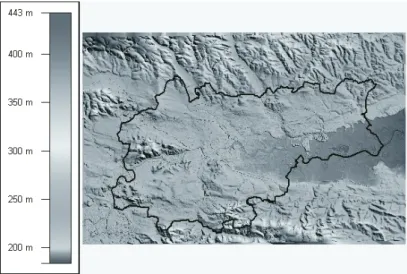
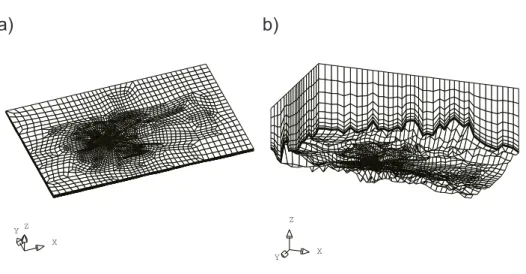
To determine precisely the construction of a calculation domain a numerical map of the surface layout of Krakow and its nearest surrounding area of 36.1 km × 23.6 km was used. Additionally, based on the digital map of the city transport and communication system, representations of main arterial roads which can play the role of ventilating ducts for Krakow were considered. A 3D calculation domain contains the space from the surface of the ground or buildings (depending on the surface character) up to the height of 700 m above sea level.
Fig. 1. Surface layout in Krakow and region
N
W E
S Fig. 2. Two categories of arterial roads in Krakow reflected in the model
Mathematical description of the model
To describe air flow over Krakow, the continuity equation under the assumption of fluid incompressibility and Navier-Stokes equations for three directions were used.
Ñ × =u 0 (1)
Ñ ×é + Ñ + Ñ
ë
ê(m mt) ( u ( u) )T ú-Ñ -ûù p rg=0 (2)
A turbulence model [3] (the so-called K-model) was included to the equations of motion, and turbulent viscosity coefficient mt was introduced. According to the Prandtl–Kolmogorov concept, the coefficient was expressed by means of kinetic energy of velocity fluctuations K. Ñ × æ + è ç ö ø ÷ Ñ é ë ê m sm ùûú+m g -r = m t K t D K C K l 2 3 2 0 / (3) mt =rC Km 1 2/ lm (4) lm =kd (5)
At the second stage, the equations of pollutant transport by advection and diffusion were solved using the velocity field determined previously.
a)
b)
Fig. 3. 3D mesh of calculation domain: a) real dimensions; b) vertical dimension extended for better visualisation
dc dt D D c Q t = Ñ ×é + Ñ ë ê( ) ùûú+ (6)
A molecular diffusion coefficient included in the pollutant transport equation is considered in the model for formal reasons and does not have significant influence on the pollutant propagation process. More important is the atmospheric turbulence diffusion coefficient which is determined as proportional directly to the value of turbulent viscosity [4]. D Sc t t =rm (7)
In the numerical calculations, both for velocity fields and concentration fields, an algorithm using a Lagrangian framework constructed along trajectories of fluid particles was applied [5].
Fig. 4. Velocity profiles for boundary conditions obtained from MM5 on 28 Feb. 2006: a) 12:00 GMT + 1h; b) 12:00 GMT + 5h
a)
Simulation results
A methodology which enables to consider time variability of the wind field in the proposed model was developed to achieve compromise between accuracy and the time consumption. This required preparation in advance some characteristic velocity fields each obtained by simulation after implementing boundary conditions from the meteoro-logical model of lower resolution. The working velocity fields were interpolated at each time instant from those pre-processed velocity fields.
N W E S
a)
b)
c)
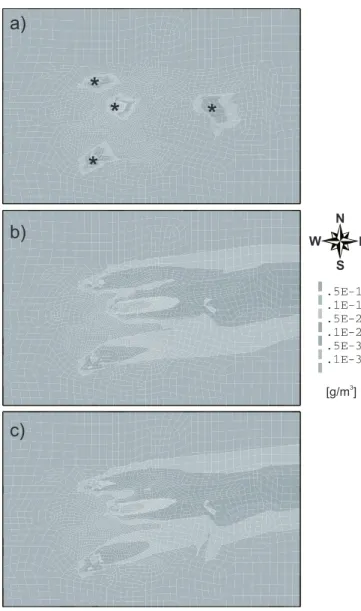
[g/m ]3Fig. 5. Concentration fields of a tracer emitted in points denoted by symbol of an asterisk, on the level of buildings: a) 10 min after the incident; b) 12:00 GMT + 2h; c) 12:00 GMT + 5h
In the presented simulation results, we used mean hourly velocity fields of 28 Feb. 2006, generated by the MM5 meteorological pre-processor, interpolated to the height of 700 m above sea level. Since data from the MM5 model referred to the mesh with grid size of 6 km × 6 km, it was also necessary to use interpolation to the urban scale model resolution. In the developed interpolation procedure the finite element technique [6] was applied.
As a result of numerical calculations velocity fields of air flow over Krakow were obtained in the entire 3D calculation domain. Obviously, the results show a significant impact of the Krakow active surface on the shape of simulated velocity fields. The formed wind fields enabled a simulation of the propagation of a tracer released,eg as a result of an industrial accident in the city, taking into account changing meteorological conditions which refer to wind strength and direction. In the Krakow case the substantial influence of the Vistula Valley can be noticed. The preliminary results for the tracer dispersion indicates that the presented mathematical model can become a universal tool for modelling concentration fields of any non-reactive pollutant over industrialized area.
Concluding remarks
1. The presented 3D numerical model is a compromise between mesoscale models, which do not take into account the impact of local factors on the formation of velocity fields and pollutant transport processes, and the microscale models, whose application for the whole city would require considerable computation power.
2. Using the so-called nesting in the meteorological model of lower resolution (MM5), a method which considers time variability of the velocity field in the city scale model was proposed.
3. Reliability of predictions of the proposed model depends to a large extent on the quality of data generated by the meteorological pre-processor.
4. Results of the simulation can be useful for preparing scenarios of accidental releases of hazardous substances on urbanised areas. Pollutant released into the atmosphere can be located in any point in the city.
Acknowledgements
The research project no. 3 T09C 031 29 was financed from the Polish funds for science in the years 2005/2006. Nomenclature g – gravitational acceleration [m/s2] p – pressure [Pa] u – velocity [m/s] r – fluid density [kg/m3]
h – fluid viscosity [Pa ×s]
d – distance to the nearest wall [m]
k – von Karman constant
sk – turbulent Prandtl number CD, Cm – empirical coefficients
D – molecular diffusion coefficient [m2/s]
Dt – atmospheric turbulence diffusion coefficient [m2/s] Sc – Schmidt number
Q – pollutant release rate [kg/s]
References
[1] Lewiñska J. (ed.): Klimat miasta – Vademecum urbanisty, IGPiK, Kraków 1991.
[2] Cuvelier C., Muntean M., Thunis P., Kaminski J., Lobocki L., Struzewska J. Kaminski K., Kaminski W., Petera J., Pi¹tek R., G³odek A., Laupsa H., Wyrwa A. and Burzynski J.: The Krakow Modelling intercomparison, Outcome of the Krakow Integrated Project – Particulate Matter: From Emission to Health Effects, Krakow, 15–16 May 2006.
[3] Axell L.B. and Liungman O.: Environ. Fluid Mechanics, 2001,1, 71–106. [4] FLUENT 6.1 Documentation, Fluent Inc., 2003.
[5] Petera J. and Nassehi V.: Int. J. Numer. Methods Engng, 1996,39, 4159–4182.
[6] Zienkiewicz O.C. and Taylor R.L.: The finite element method, vol. 3, 5th ed., Butterworth–Heinemann, Oxford 2000.
PROFILE PRÊDKOŒCI POWIETRZA I ZANIECZYSZCZEÑ W KRAKOWIE Z UWZGLÊDNIENIEM ZMIANY SKALI MODELU
S t r e s z c z e n i e
Przedstawiono siatkowy model numeryczny, korzystaj¹cy z metody elementu skoñczonego, pozwalaj¹cy na komputerow¹ symulacjê przep³ywu mas powietrza oraz rozprzestrzeniania siê zanieczyszczeñ nad Krakowem. Do budowy dziedziny obliczeniowej wykorzystano informacje z mapy cyfrowej, co pozwoli³o na uwzglêdnienie ukszta³towania powierzchni czynnej w modelu.
Opracowano metodykê pozwalaj¹c¹ na zaimplementowanie pól prêdkoœci z mezoskalowego preprocesora meteorologicznego jako warunku brzegowego dla modelu w skali miasta. Zaprezentowano profile prêdkoœci powietrza nad Krakowem, utworzone na podstawie danych z modelu meteorologicznego MM5. Dodatkowo, przedstawiono symulacjê ewolucji pola stê¿eñ dla hipotetycznego uwolnienia substancji znacznikowej na terenie miasta.
S³owa kluczowe:model w skali miasta, modelowanie pola wiatru, uwolnienia awaryjne, metoda elementu skoñczonego