Feature-Enriched Character-Level Convolutions for Text Regression
Gustavo Henrique Paetzold and Lucia Specia Department of Computer Science
University of Sheffield, UK
{g.h.paetzold,l.specia}@sheffield.ac.uk
Abstract
We present a new model for text re-gression that seamlessly combine engi-neered features and character-level infor-mation through deep parallel convolution stacks, layer perceptrons and multi-task learning. We use these models to create the SHEF/CNN systems for the sentence-level Quality Estimation task of WMT 2017 and Emotion Intensity Analy-sis task of WASSA 2017. Our experiments reveal that combining character-level clues and engineered features offers notice-able performance improvements over us-ing only one of these sources of informa-tion in isolainforma-tion.
1 Introduction
Text regression consists in estimating a numeric label based on information available from the text. The label can represent any abstract property of said text: its appropriateness, sentiment, fluency, simplicity, quality, etc. Due to their wide ap-plicability in both research and industry, some of these tasks have been gaining a lot of atten-tion. These include Quality Estimation and Emo-tion Intensity Analysis, which are the subjects of shared tasks held at the WMT 2017 conference1
and WASSA 2017 workshop2 (Mohammad and
Bravo-Marquez,2017), respectively.
In Quality Estimation (QE), one attempts to es-timate the quality of a machine translated text based on the information that can be extracted from the original sentence and its translation. The task has many variants, given that the quality of a translation can be estimated at word, phrase,
1http://www.statmt.org/wmt17 2http://optima.jrc.it/wassa2017
sentence or even document level. Quality esti-mates can be incorporated in Machine Transla-tion (MT) decoding or used for re-ranking of top candidates, for example, allowing for a more in-telligently guided translation process (Avramidis, 2012), or they can be used to help human transla-tors decide which automatic translations are worth post-editing, and which should be re-translated from scratch (Turchi et al.,2015). Sentence-level QE is the most popular variant, mostly due the fact that most modern statistical and neural MT systems translate one sentence at a time. In this task, the input is the original-translated sentence pair and the output is some numeric label that rep-resents quality. The most commonly used label is HTER, which measures the human post-editing effort required to fix the translation in question (Snover et al.,2006).
As shown in (Bojar et al., 2016), the perfor-mance of QE approaches submitted to the WMT shared tasks have steadily improved in recent years. However, the nature of these approaches have not changed much: most of the top rank-ing systems employ well-known regression meth-ods and extensive feature engineering. Some of the most notable examples are the RTM systems of WMT 2014 and 15, which managed to reach the top of the ranks by employing Referential Translation Machines trained with SVMs for re-gression (Bicici, 2016). The LORIA (Langlois, 2015) and YSDA (Kozlova et al.,2016) systems of WMT 2015 and 2016, respectively, achieved sim-ilar performance by also pairing SVMs with many resource-heavy features.
Neural Networks for sentence-level QE were introduced in WMT 2016 with the SimpleNets (Paetzold and Specia,2016) and POSTECH (Kim and Lee, 2016) systems. While the SimpleNets system uses sequence-to-label LSTMs to predict the quality of a translation’s n-grams and then
combines them, the POSTECH system learns quality labels at word-level using a sequence-to-sequence model, and then combines them with a sequence-to-label model to predict quality at sentence-level. Though very interesting and dis-tinct strategies, neither of them managed to out-perform the best scoring SVM-based approach of WMT 2016.
In the task of Emotion Intensity Analysis (EIA), Neural Networks have not yet been successfully employed. Unlike typical Sentiment Analysis tasks, which are set up as either binary or multi-class multi-classification problems that require one to determine the opinion or sentiment in a given text, EIA aims at quantifying a certain emotion in a text, such as fear, anger, joy, sadness, etc. In the Emo-tion Intensity shared task of SemEval 2016 ( Kir-itchenko et al.,2016), which is the first of its kind, none of the five systems submitted employ neural regressors. We were also unable to find any other contributions outside the SemEval 2016 task that explore neural approaches to EIA.
Given the volume of opportunities available when it comes to neural solutions for text re-gression, we introduce a new neural approach for the task. We innovate by using deep convolu-tional networks and multi-task learning to com-bine character-level information from the texts at hand with engineered features. Using this ap-proach, we create the SHEF/CNN systems for the sentence-level QE task of WMT 2017 and the Emotion Intensity Analysis task of WASSA 2017. In what follows, we describe our approach in de-tail.
2 Overview of Tasks
As previously mentioned, we address two text re-gression tasks in this paper: the sentence-level Quality Estimation task of WMT 2017 and Emo-tion Intensity Analysis task of WASSA 2017. The next Sections describe each of those tasks.
2.1 Quality Estimation at WMT 2017
In the sentence-level QE task of WMT 2017 par-ticipants were asked to create systems that pre-dict the human post-editing effort required to cor-rect an automatically translated sentence. Train-ing, development and test sets were provided for two language pairs: English-German and German-English. The training and development sets for both language pairs are composed of
23,000/25,000 and 1,000/1,000 instances, respec-tively. Each instance is composed of a source (original) and target (translated) sentence pair, as well as the target’s manually post-edited version and an HTER label between 0 and 1 calculated based on the post-edit. The test set is composed of 2,000 instances without post-edits nor HTER labels. For training, development and test sets the organizers made available a set of 17 baseline fea-tures.
The task is divided in two sub-tasks: scoring and ranking. In the scoring task, systems had to estimate HTER scores and were evaluated through Pearson correlation. In the ranking task, sys-tems had to rank the translations in the test set from highest to lowest quality, and were evaluated through Spearman correlation. The main differ-ence between the data provided for the WMT 2017 QE tasks and the data of previous editions is that, for the first time, the tasks of all QE levels (sen-tence, word and phrase) contain annotations for the same set of translations. Because of that, one can very intuitively employ any variety of multi-task learning approaches.
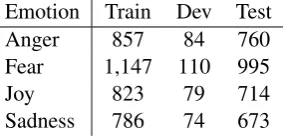
2.2 Emotion Intensity at WASSA 2017 Systems submitted to the Emotion Intensity Anal-ysis task of WASSA 2017 were asked to estimate the intensity of various emotions felt by authors while writing tweets. Training, development and test sets were made available containing four emo-tions: anger, fear, joy and sadness. The size of the datasets is illustrated in Table1.
Emotion Train Dev Test
Anger 857 84 760
Fear 1,147 110 995
Joy 823 79 714
[image:2.595.347.489.521.589.2]Sadness 786 74 673
Table 1: Dataset sizes for the Emotion Intensity Analysis task of WASSA 2017
Each instance is composed of a tweet and an in-tensity label between 0 and 1 of the emotion in question. Labels were collected through crowd-sourcing. Systems were evaluated through Pear-son correlation.
3 Model Architecture
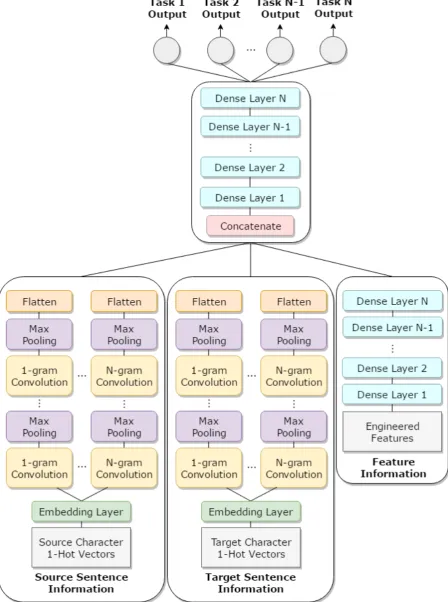
WMT 2017. As it can be noticed, the model takes as input a one-hot character-level representation of the source and target, as well as a set of engineered features. As output, our model produces the nu-meric labels desired.
The model is divided in three main sections: a pair of deep convolution layer stacks for the source (original) and target (translated) sentences, a multi-layer perceptron for the engineered fea-tures, and a final multi-layer perceptron to com-bine all this information. The model used for the EIA task of WASSA 2017 is identical, except that it only has one set of convolution stacks for the tweet being analysed.
3.1 Extracting Character-Level Clues
In order to exploit the information at character-level from the text, we use a convolution archi-tecture similar to the one introduced by (Kim et al.,2016), who successfully employ character-level information for language modelling. First we transform the one-hot character-level represen-tation of the sentence into a sequence of charac-ter embeddings. We then feed them to a series of parallel one-dimensional convolutions of dif-ferent window sizes. Each of these convolutions captures the information of character n-grams of a given length: a convolution of window size one addresses unigrams, one with size two addresses bigrams, and so on. Finally, the resulting values produced by the convolution filters are passed on to a one-dimensional max-pooling layer.
In order to capture information at different ab-straction levels, we stack various convolution and max-pooling layers for each window size, thus creating a deep architecture. This deep architec-ture differs from the one used by (Kim et al.,2016) in the sense that they apply only one stack of convolution/max-pooling layers for each window size. The values produced by the last max-pooling layer of each window size are then flattened so that they can be easily concatenated.
The intuition behind using such an architecture lies in the assumption that sequences of charac-ters hold important clues with respect to the text’s properties, such as quality and emotion. In QE, these clues could be sequences containing mor-phological errors in words from the source or tar-get sentences, or sequences in-between tokens of the target that suggest an ungrammatical segment, for example. In EIA, these clues can be
emo-tionally charged emojis, curse words, exclamation marks, etc.
3.2 Incorporating Engineered Features We complement character-level information with engineered features, given that the most effective QE and EIA methods in previous work heavily ex-ploit them (Kim and Lee, 2016; Kozlova et al., 2016;Refaee and Rieser,2016;Wang et al.,2016). To do so, we apply a simple multi-layer percep-tron (MLP) over a set of input engineered fea-tures. This allows to capture abstract relations be-tween the features provided. The output of the outermost layer is then concatenated with the flat-tened character-level information provided by the remainder of the network.
Finally, we pass the concatenated features and character-level information to another MLP in or-der for our model to be able to capture any re-lations between them. At the very edge of our model, we include output nodes for as many tasks as we wish to train our model over.
4 SHEF/CNN Model for QE
As illustrated in Figure1, the sentence-level QE model employs one convolution stack for each of the source and target sides of the translation pair. We configure the model as follows:
• Embedding size: We train character embed-dings with 50 dimensions.
• Window range: We use 4 parallel stacks of convolutions with window sizes from 1 to 4.
• Convolution depth: Each stack contains 4 pairs of convolution/max-pooling layers with 50 convolution filters each and a pool length of 4.
• Feature MLP depth: We stack 2 dense layers with 50 hidden units over engineered features.
• Final MLP depth: The MLP that combines convolutions and features is composed of 2 stacked dense layers with 50 hidden units each.
• Engineered feature set:We use the 17 baseline features provided by the task organizers.
This architecture was selected through experi-mentation. The output nodes of our multi-task QE setup predict three values:
• The number of BAD labels from the word-level dataset; and
• The number of BAD labels from the phrase-level dataset.
Note that the data from the word and phrase-level datasets are used as a mere complement to HTER prediction. It is important to mention that we also tried predicting the full label sequences for word and phrase-level, but the results obtained were not as promising. We train our model until convergence with Stochastic Gradient Descent and Mean Squared Error over all outputs jointly.
5 SHEF/CNN Model for EIA
The model used for the EIA task of WASSA 2017 applies only one convolution stack over the tweet being analysed, given that the task is not charac-terized by a sentence pair. The window range, convolution depth, as well as feature and final MLP depths are identical to the model used for the WMT 2017 task. We train one model for each emotion targeted in the shared task: anger, fear, joy and sadness.
Since the organizers did not provide a set of baseline features, we produced our own features using the Stanford Sentiment Treebank (Socher et al., 2013), which is composed of 239,232 text segments annotated with respect to their positiv-ity probabilpositiv-ity i.e. how likely they are to convey a positive emotion. The positivity values range from 0.0 (absolutely negative) to 1.0 (absolutely positive). Using this data, we extract nine features from each tweet:
• Minimum, maximum and average positivity of single words in the tweet;
• Minimum, maximum and average positivity of bigrams in the tweet; and
• Minimum, maximum and average positivity of trigrams in the tweet.
Our multi-task learning setup is composed of two output layers that predict:
• The tweets’ emotion intensity; and
• The tweets’ positivity value.
We first train our models over the sentiment positivity values from the Stanford Sentiment
Treebank until convergence, then train them over the emotion intensity training sets of WASSA 2017 until convergence. The training algorithm and metric used are Stochastic Gradient Descent and Mean Squared Error, respectively.
6 WMT 2017 Results
We evaluate the performance of four variants of the SHEF/CNN model:
• SHEF/CNN-F:Uses only the MLP over the en-gineered features trained over HTER.
• SHEF/CNN-C: Uses only the character-level convolution stacks trained over HTER.
• SHEF/CNN-C+F: Uses both engineered fea-tures and character-level information trained over HTER.
• SHEF/CNN-C+F+M: Uses the same archi-tecture of SHEF/CNN-C+F, but the model is trained through multi-task learning over the val-ues listed in Section4.
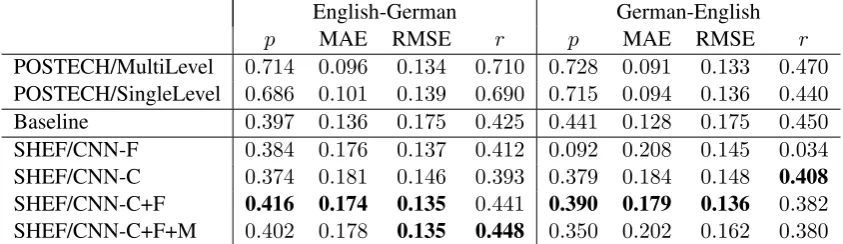
Table 2 illustrates the Pearson, Root Mean Squared Error (RMSE) and Mean Absolute Er-ror (MAE) scores for the scoring task, and Spear-man correlation scores for the ranking task of each language pair. Boldface values represent the best scores obtained across SHEF/CNN models. We also include the results from the official baseline and from the top performing team (POSTECH).
The results reveal that, although we outper-form the task baseline for English-German, the SHEF/CNN models do not offer competitive per-formance to state-of-the-art QE systems that rely on resource-heavy strategies. Nonetheless, some valuable observations can be drawn from the results. Combining engineered features with character-level clues yields a more reliable model than simply using either of them alone, which suggests that character-level clues can be a valu-able source of complementary information to en-gineered features. Our multi-task learning setup did not improve on the results of our model. We hypothesize that the secondary output labels could not offer a significant volume of complementary information to the model.
7 WASSA 2017 Results
English-German German-English
p MAE RMSE r p MAE RMSE r
POSTECH/MultiLevel 0.714 0.096 0.134 0.710 0.728 0.091 0.133 0.470 POSTECH/SingleLevel 0.686 0.101 0.139 0.690 0.715 0.094 0.136 0.440
Baseline 0.397 0.136 0.175 0.425 0.441 0.128 0.175 0.450
SHEF/CNN-F 0.384 0.176 0.137 0.412 0.092 0.208 0.145 0.034
SHEF/CNN-C 0.374 0.181 0.146 0.393 0.379 0.184 0.148 0.408
SHEF/CNN-C+F 0.416 0.174 0.135 0.441 0.390 0.179 0.136 0.382
[image:6.595.88.510.63.185.2]SHEF/CNN-C+F+M 0.402 0.178 0.135 0.448 0.350 0.202 0.162 0.380
Table 2: Results for the sentence-level QE task of WMT 2017
Fear Joy Anger Sadness
p r p r p r p r
Prayas 0.732 0.729 0.732 0.710 0.762 0.743 0.765 0.761
Emkay 0.690 0.690 0.705 0.692 0.726 0.703 0.767 0.764
venkatesh-1729 0.728 0.728 0.678 0.654 0.705 0.684 0.749 0.744 Baseline 0.652 0.635 0.654 0.662 0.639 0.615 0.648 0.651 SHEF/CNN-F 0.166 0.153 0.271 0.313 0.222 0.212 0.241 0.240 SHEF/CNN-C 0.217 0.221 0.328 0.302 0.120 0.142 0.259 0.253
SHEF/CNN-C+F 0.293 0.284 0.517 0.510 0.279 0.260 0.323 0.326
SHEF/CNN-C+F+M 0.109 0.096 0.407 0.392 0.311 0.276 0.233 0.228
Table 3: Results for the EIA task of WASSA 2017
performance of all SHEF/CNN variants described in the previous sections and also include the offi-cial task baseline and the three top performing ap-proaches in the EIA task: the Prayas, Emkay and venkatesh-1729 systems.
The SHEF/CNN models are outperformed by a noticeable margin by strategies that heavily em-ploy engineered features and external resources, such as large databases of emotion intensity la-bels. Nonetheless, our results reveal the same phe-nomenon highlighted in our experiments with QE: for all emotions, combining engineered features with character-level information yields better per-formance scores than using only one of these in-formation sources. This serves as further evidence that character-level convolutions can be effectively used as a complement to engineered features.
Our multi-task learning approach only managed to obtain performance improvements for anger. We believe this is due to fact that the positivity val-ues present in the Stanford Sentiment Treebank, which is used in our multi-task setup, accurately quantify only the degree with which the reviewer is pleased, and hence happy, or displeased, and hence angry. Because the other emotions in the WASSA 2017 task do not commonly permeate the act of writing a product review, the multi-task
setup was not able to help the model trained for them.
8 Conclusions
We introduced a text regression model that uses deep convolution neural networks and multi-layer perceptrons to combine the character-level infor-mation present in texts with the inforinfor-mation from engineered features.
We tested several variants of our model in two text regression shared tasks: the sentence-level Quality Estimation task of WMT 2017 and the Emotion Intensity Analysis task of WASSA 2017. We found that, although our model is not able to outperform classic resource-heavy strategies, combining character-level data with engineered features results in noticeable performance gains for both tasks. We also found that, although multi-task learning can in principle help our model, the setup must be carefully crafted, otherwise it com-promises its performance.
Acknowledgments
This work was supported by the QT21 project (H2020 No. 645452).
References
Eleftherios Avramidis. 2012. Comparative quality esti-mation: Automatic sentence-level ranking of mul-tiple machine translation outputs. In Proceedings of 24th COLING. The COLING 2012 Organizing Committee, pages 115–132.
Ergun Bicici. 2016. Referential translation machines for predicting translation performance. In Proceed-ings of the First Conference on Machine Translation. Association for Computational Linguistics, Berlin, Germany, pages 777–781.
Ondˇrej Bojar, Rajen Chatterjee, Christian Federmann, Yvette Graham, Barry Haddow, Matthias Huck, Antonio Jimeno Yepes, Philipp Koehn, Varvara Logacheva, Christof Monz, Matteo Negri, Aure-lie Neveol, Mariana Neves, Martin Popel, Matt Post, Raphael Rubino, Carolina Scarton, Lucia Spe-cia, Marco Turchi, Karin Verspoor, and Marcos Zampieri. 2016. Findings of the 2016 conference on machine translation. In Proceedings of the 1st WMT. Association for Computational Linguistics, Berlin, Germany, pages 131–198.
Hyun Kim and Jong-Hyeok Lee. 2016. Recurrent neural network based translation quality estimation. In Proceedings of the First Conference on Ma-chine Translation. Association for Computational Linguistics, Berlin, Germany, pages 787–792.
Yoon Kim, Yacine Jernite, David Sontag, and Alexan-der M. Rush. 2016. Character-aware neural lan-guage models. In Proceedings of the 13th AAAI. AAAI Press, AAAI’16, pages 2741–2749.
Svetlana Kiritchenko, Saif Mohammad, and Moham-mad Salameh. 2016. Semeval-2016 task 7: De-termining sentiment intensity of english and arabic phrases. In Proceedings of the 10th SemEval. As-sociation for Computational Linguistics, San Diego, California, pages 42–51.
Anna Kozlova, Mariya Shmatova, and Anton Frolov. 2016. Ysda participation in the wmt’16 quality es-timation shared task. In Proceedings of the First Conference on Machine Translation. Association for Computational Linguistics, Berlin, Germany, pages 793–799.
David Langlois. 2015. Loria system for the wmt15 quality estimation shared task. In Proceedings of the 10th WMT. Association for Computational Lin-guistics, Lisbon, Portugal, pages 323–329.
Saif M. Mohammad and Felipe Bravo-Marquez. 2017. Emotion intensities in tweets. InProceedings of the 6th *Sem. Vancouver, Canada.
Gustavo Paetzold and Lucia Specia. 2016. Simplenets: Quality estimation with resource-light neural net-works. In Proceedings of the First Conference on Machine Translation. Association for Computa-tional Linguistics, Berlin, Germany, pages 812–818. Eshrag Refaee and Verena Rieser. 2016. ilab-edinburgh at semeval-2016 task 7: A hybrid ap-proach for determining sentiment intensity of ara-bic twitter phrases. InProceedings of the 10th Se-mEval. Association for Computational Linguistics, San Diego, California, pages 474–480.
Matthew Snover, Bonnie Dorr, Richard Schwartz, Lin-nea Micciulla, and John Makhoul. 2006. A study of translation edit rate with targeted human annota-tion. In In Proceedings of the 2006 AMTA. pages 223–231.
Richard Socher, Alex Perelygin, Jean Wu, Jason Chuang, Christopher D. Manning, Andrew Ng, and Christopher Potts. 2013. Recursive deep models for semantic compositionality over a sentiment tree-bank. InProceedings of the 2013 EMNLP. Associ-ation for ComputAssoci-ational Linguistics, Seattle, Wash-ington, USA, pages 1631–1642.
Marco Turchi, Matteo Negri, and Marcello Federico. 2015. MT quality estimation for computer-assisted translation: Does it really help? In Proceedings of the 53rd Annual Meeting of the Association for Computational Linguistics and the 7th International Joint Conference on Natural Language Processing (Volume 2: Short Papers). Association for Compu-tational Linguistics, Beijing, China, pages 530–535.