CRESCENT HEIGHTS
PRINCIPAL’S MESSAGE
Crescent Heights High School is a diverse student-centered community. A long tradition of excellence is nurtured through the emphasis on academic rigor, character, citizenship, and life-long learning. A wide-ranging extracurricular program of athletics, clubs, and other activities is offered to all students as an extension to their learning experiences. Students are encouraged to 'get involved' and enjoy the school community by participating in the many opportunities provided.
The programs of choice currently offered at Crescent Heights are designed to meet the diverse learning needs of our students. Programming selections include: Advanced Placement, Knowledge and Employability, Fine Arts, Career and Technology,
International Students, and English Language Learners.
Our facility is a wireless Internet building that includes seven computer learning centres, two modern gymnasiums, an updated fitness centre, technical shops for metal, cabinet, photography and automotives centers, a multi-functional theatre, band and choral centres, well-equipped science labs, a food studies lab, fashion and design studies rooms, and a two story Learning Commons. The Student Centre/Cafeteria is the hub of our school where students gather to study and socialize.
J. Chapman-Brown
School Motto: Crescit Eundo—”We Progress As We Grow” School Slogan: “Building on Tradition, Working for the Future.”
School Colours: Navy and White with Red Trim School Mascot: Cowboy Sam
TABLE OF CONTENTS
Principal’s Message ... i
Welcome to Crescent Heights ... 1
Program Diversity ... 2
School Services ... 8
Student Activities and Athletics ... 11
Planning Your High School Program ... 12
Basic Information about High School ... 13
Alberta High School Diploma Requirements ... 15
Grade 10:Planning for Your Success ... 16
Course Descriptions: • English ... 18
• English Language Learning ... 20
• Mathematics ... 21 • Science ... 25 • Social Studies ... 30 • Physical Education ... 34 Sports Performance ... 35 • CALM ... 35
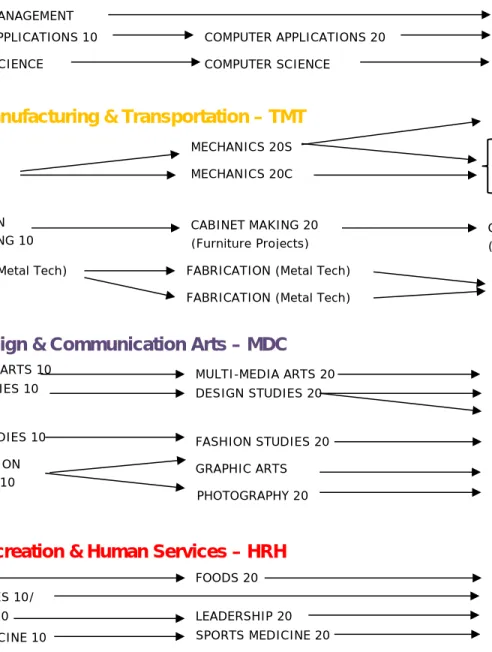
• Career & Technology Studies (CTS) ... 36
Business, Administration, Finance and information Technology – BIT Flow Chart ... 37
Off Campus Courses (WE & RAP) ... 39
Financial Management ... 40 Computer Applications ... 40 Computer Science ... 42 Leadership ... 43 Foods ... 44 Legal Studies ... 45 Sports Medicine ... 45 Multi-Media ... 46 Photography ... 47 Graphic Arts ... 48 Design Studies ... 49 Fashion ... 50 Construction – Cabinetmaking... 51
Fabrication - Metal Technology ... 52
• Career & Technology Centre Course Guide ... 57
• Fine Arts Professional Development in the Arts, Art ... 63
Advanced Drawing/Painting/Sculpture, and Ceramics ... 64
Choral Music and Choir ... 65
Dance ... 65
Drama ... 66
Technical Theatre ... 66
Film Studies ... 67
Instrumental Music ... 67
Band, Instrumental Jazz ... 68
• French and International Languages Chinese ... 69
French ... 70
German ... 71
Spanish ... 72
• Additional Complementary Courses Aboriginal Studies ... 73
Journalism ... 73
Psychology ... 73
• Program Planning Guides with Course Lists Alberta High School Diploma ... 74
WELCOME TO CRESCENT HEIGHTS HIGH SCHOOL
OUR SCHOOL
Crescent Heights is truly a school of choice for our population of over 2000 students. A tradition of excellence and a student-centred learning environment draw students from across the city to enjoy the urban, educational experience.
Crescent is a school where every student is provided with the support necessary for them to experience success. Although the school was built in the 1920s, it has been renovated several times. It is now a 21st Century school that boasts seven, fully-networked computer-learning centres, two modern gymnasiums, a fitness centre, well-equipped technical shops, a multi-functional theatre, an extensive band centre, a large two storey Learning Commons, updated science labs, a food studies lab, fashion and design studies’ rooms, and many historical architectural features throughout the school. A cafeteria and student centre is the focal area at the school's main entrance. Crescent Heights has a code of conduct based around the word PRIDE (Be positive, respectful, involved, dedicated, and enthusiastic).
SCHOOL PHILOSOPHY
The Crescent Heights High School community is dedicated to the belief that all students, provided with a supportive inclusive environment, will strive for excellence and experience success both as learners and citizens. We acknowledge our students must be prepared for the world they live in today and the world they will encounter in their future. CHHS, as an effective school, grounds its work on the principles of rigor, relevance, and relationships.1
1. Rigor: all students need to be challenged academically.
2. Relevance: courses and tasks must relate to student interests and the real world.
3. Relationships: all students need adult advocates who will mentor, guide, and challenge them to reach their potential. Students are encouraged to use the information contained in the Registration Guide to assist them in making informed
decisions about their high school education. Students should also consider, when making course selections, their intentions after high school is completed.
What is Advanced Placement?
The College Board’s AP courses are university-level classes from a wide variety of subjects that students can take while still in high school. AP offers students challenging course work and a taste of what university-level classes are like. If students score a 4 or 5 out of 5 on the AP exam, students may receive credit for an equivalent first year university course. Students in the AP program may choose to take 1 to 5 AP courses depending on their strengths and future goals.
The AP courses are offered as a full year course. Students will take the diploma course (30 level) concurrently with the college level course (AP - 35 level) from September to June. The Advanced Placement exam will be written in May and the Diploma will be written in June of that academic year.
What is the Enriched Program?
The Enriched Program consists of Grade 10 and 11 courses that offer enrichment of the Alberta curriculum in preparation for the Advanced Placement (first year university) courses. These courses offer challenging work that is designed to develop good academic habits: analytical reasoning skills and disciplined study. However, these are not AP (35 level) courses and no
university credits can be achieved through the enriched program. Achievement of 4 or 5 out of 5 on AP exams is required in order to receive university credits.
How are students assessed?
AP and enriched students’ work is benchmarked to the Alberta Education Programs of Studies. Common unit and final exams are written by all Crescent Heights students regardless of the program.
Benefits of the AP program
• Students will study a subject in greater depth.
• AP prepares students for university-level work which may result in providing a smoother transition from high school to post-secondary.
• Students may be more eligible for scholarships • Exam fee vs. $700+/university course.
• Earning credit in AP classes may lead to having the time to take a double major in university or completing an undergraduate degree in less time.
• Students will be in classes with like-minded peers.
• Visit: http://www.collegeboard.com/student/testing/ap/intad.html
PROGRAM DIVERSITY
3 ACCESS
The ACCESS (Attitude, Community Competence, Elements of Academics, Social Skills) Program at Crescent Heights Senior High opened its doors for the first time to students in September 2000.
Motto: “Be not afraid of growing slowly, be afraid of standing still.”
Program Goals and Learning Outcomes
• Students will reach their maximum potential in academic and personal growth. • To provide learning opportunities in an integrated environment.
• To provide a dynamic community based program. Become good citizens.
• Provide opportunities for students to participate in all aspects of school life (social, clubs, sport teams, student council, extra- curricular, etc.)
• To provide opportunities for integration.
• To provide opportunities to develop, improve and enhance student independence and social conduct competencies. •Strive to empower students to develop skills, competencies and attitudes for future success in the adulthood.
Program Dimensions
The program is based on the Alberta Education guide “Essential and Supportive Skills for Students with Developmental Disabilities” and the Individual Program Plan (IPP) for each student.
• Functional Academics – reading, writing, printing, communication, math, literacy, money skills, etc.
• Life Skills – Domestic and Family Life, Personal and Social Development, Leisure/Recreation/Arts, Citizenship and Community Involvement, Career Development.
• Motor Development – fine motor, coordination, and gross motor skills development.
PROGRAM DIVERSITY
PROGRAM DIVERSITY
CAREER DEVELOPMENT AT CRESCENT HEIGHTS
“
Career Pathways is all about finding something in
life you love so much that you'd do it for free, but you
learn to do it so well you get paid for it.” - Student
The purpose of Career Development at Crescent Heights is to develop
the full potential of each and every student, through their curriculum
course work, career guidance, and integrated work-based experiences
while preparing them for work and for life. The following chart outlines
the opportunities that students have at Crescent to identify and to
develop skills that are necessary to be successful when they leave high
school.
Curriculum Course Work Career Development Work Based Learning
• integration of Learning Pathways into course subjects
• Career Centre
• Subject specific career presentations
• Career Seminar (All Grades) • CALM + portfolio/job readiness • Career Fair (Grades 10 - 12) • Career Centre • Work Experience • RAP • Career Centre • Job Shadowing • Summer Internship • Volunteer Corps
Be Positive
• promote peace and harmony • like yourself and others
• express yourself in a positive tone • advocate for others
• co-operate with others
Be Respectful
• treat others as you would like to be treated • be tolerant and understanding
• appreciate differences
• respect the individual and his/her rights • listen to others' point of view
• promote a safe, secure, wholesome, clean environment
• avoid gossip, insults, profanity, and name-calling • honour school expectations
Be Involved
• contribute to your learning community • attend school regularly and punctually • be accountable
Be Dedicated
• diligently pursue your "job" • be the best you can be
• help build the Crescent Legacy
Be Enthusiastic
• have an enthusiastic outlook • be actively engaged
• spread school sprit
Crescent Pride Initiative Committee ~ 1999
CRESCENT PRIDE
Crescent PRIDE is a 3-year program complementing various aspects of the high school program. There is special emphasis on personal growth, development of the
individual student and character education. This program focuses on personal goal-setting, mentoring, relationships with fellow community members, developing leadership skills, program planning and examining opportunities beyond high school.
PRIDE classes meet every Friday for 30 minutes.
PROGRAM DIVERSITY
ENGLISH LANGUAGE LEARNERS (ELL) AND INTERNATIONAL STUDENTS
Crescent Heights offers a comprehensive English Language Bridging program for students who arrive from other countries and do not have the academic language competency needed to be successful in mainstream classes.
Students who are landed immigrants, Canadian-born but educated in non-English classrooms, or who have Study Visas are tested for speaking, listening, reading and writing competency. As well, testing may take place in Math and across the science spectrums to ensure as accurate a placement as possible for individuals accorting to the capabilities. ELL courses will allow students to develop their academic-language proficiency and also to help them make a successful transition to Alberta's educational system, whose teaching and learning practices may be unfamiliar. At the same time, these students will have the opportunity to complete mathematics, science, social studies and option courses while working towards completing an Alberta High School Diploma.
KNOWLEDGE AND EMPLOYABILITY COURSES
Knowledge and Employability courses are intended to provide students with opportunities to experience success and become prepared for employment, citizenship and lifelong learning after high school.
These courses help the students to develop:
• essential skills and attitudes in preparation for success in the workplace and in the community • a sense of success and achievement through learning experiences
• practical applications and connections to the workplace and the community • skills related to exploring and preparing for chosen careers
• interpersonal skills to ensure respect, support, and cooperation with others. These courses are designed for students with specific needs and goals who:
• have demonstrated and expressed a desire to enter directly into the workplace after completing the Alberta Certificate of High School Achievement.
• intend to use school as a place to better prepare for immediate transition into the workplace • achieve success through experiential learning
Knowledge and Employability courses differ from regular courses in that:
• the content in each course emphasizes basic skills that are essential to function in the community and in the workplace. • instruction in any skill begins with applications to real-life situations.
• an emphasis is placed on differentiated learning experiences that suit the unique needs of the learner. • resources are selected on the basis of the needs, interests and skill development of the learner.
Can students in K and E courses also qualify for an Alberta High School Diploma?
Please note that the Certificate of Achievement is not a High School Diploma. After students have fulfilled the requirement for the Certificate of Achievement, it is possible to work towards a High School Diploma. This may require a commitment to an additional year of high school. Students in K and E courses can transfer from the Certificate of Achievement route to the Diploma route—this program planning should be made in consultation with a guidance counsellor.
ALBERTA HIGH SCHOOL CERTIFICATE OF ACHIEVEMENT REQUIREMENTS
The requirements indicated in this chart are the minimum requirements for a student to attain a Certificate of Achievement. The requirements for entry into post-secondary institutions and workplaces may require additional and specific courses. The requirements for this certificate can be found in the Guide to Education: ECS to Grade 12 and the Information Manual for Knowledge and Employability Courses Grade 8-12. A minimum of eighty credits is required for an Alberta Certificate of High School Achievement, and must include the following courses:
ACADEMIC COURSES
K & E or CTS COURSES
WORK EXPERIENCE
• English 20-2 or 30-4 • Math 10-3 or 20-4 • Science 14 or 20-4 • Social Studies 10-2 or 20-4 • Physical Education 10 • CALM AND 5 credits in
• a 30 level Knowledge and
Employability Occupational course
• or
• a 30 level Career and Technology
• Studies (CTS) course
• or
• a 30 level Locally Developed course with an occupational focus
AND
5 credits in
• 30 level Knowledge and Employability Workplace practicum
or
• a 30 level Work Experience course or
• a 30 level Registered Apprenticeship Program (RAP) course
SCHOOL SERVICES
STUDENT SERVICES: GUIDANCE & COUNSELLING
Crescent Height's Student Services Team welcomes the opportunity to assist students in any way. Students can seek assistance in selecting appropriate courses, acquiring career, post-secondary and scholarship information, developing new learning strategies, or coping with a broad variety of personal or social concerns. Appointments to see your guidance counsellor can be made in the Guidance Office. A student may wish to see a guidance counsellor or other professional staff in the student services team to discuss any or all of the following:
1) Confidential personal counselling is available to students who are experiencing personal difficulties which can interfere with academic, social, and family life.
2) Educational counselling is available to students to select courses that will enhance their prospects for success in high school, and to plan for post-secondary education, as well as to provide information regarding application, admission, and registration procedures for college and university.
3) The Career Centre is a library/classroom facility designed to assist our diverse population in understanding the transition from school to work or to post-secondary education. It is located near Student Services in Room 141. The main
objective of the Career Centre is to help students develop “self awareness.” It is an avenue for students to assess their strengths, values, and interests, and integrate this self knowledge into preparation for the world of work and the changing labour market. Another objective is to provide knowledge of the opportunities and skills for success. This will be done through exploration of careers, interviewing and job seeking skills, resume writing, knowledge of market trends, post-secondary training, employer's expectations, job shadowing, work study and volunteer work in the community. The Career Centre is available to all students and the larger school community and we encourage its use.
4) Information and referral services are available in the Guidance Office and Career Centre. Extensive career and post-secondary resources, and information on financial assistance, student loans, scholarships and bursaries are available. Referrals, mentorships and liaison with social agencies, educational institutions, government agencies, and the business community can also be made.
THE LEARNING CENTRE
The Learning Centre is a supportive learning environment which serves the entire Crescent Heights High School
community. Learning Centre personnel offer accommodation services to those students who qualify, provide assistance to students enrolled in online courses, offer Learning Strategies 15/25 courses and enable students to write tests they have missed in a quiet, structured setting.
Prerequisite: Registration into the Learning Centre, Learning Strategies 15 & 25 is through recommendations by junior or senior high school teacher, resource teacher, counsellor or by administration.
Study skills, test writing and academic coaching is readily available. Students are provided with strategies, tips and resources to improve their learning and self-advocacy skills to optimize their learning potential.
LEARNING COMMONS
The Learning Commons balances existing books, resources and other technologies in order to enhance digital citizenship and information literacy among students by emphasizing collaboration and sharing. Online resources are available 24-7. ID cards are required to use in-house resources.
Alberta’s Collaborative Online Resource Environment (CORE) is a place where students and teachers can search for and share knowledge, inspire innovation or be inspired, and contribute to a collective community. Log in with CBE username and
password. https://www.albertacore.ca/access/home.do
Hours of operation are: 8:30 am to 4:00 pm, Monday – Thursday. 8:30 am to 2:15 pm on Friday.
PUBLIC HEALTH NURSE
A public health nurse is regularly available to the school. The nurse strives to promote the physical, emotional, and social wellbeing of the school community through a variety of preventative and protective health programs. The following services are offered within the school community:
• control of communicable disease
• referral and consultation regarding health issues • health education and promotion
Students, parents, and school personnel can access the above services. The school nurse is available in Student Services one half days per week. Please drop in!
SCHOOL FAMILY LIAISON WORKER
Our School Family Liaison (SFL) worker uses a solution focused approach with students and their families to address non-academic concerns that may be impacting a student’s success at school. A range of issues are addressed by the SFL including parent-teen conflict, peer issues, anxiety, skill building, poverty, communication and truancy.
Support offered by the SFL to address these concerns includes one-on-one support to students, consultation with parents, home visits, advocacy and referrals and support in accessing community services.
SCHOOL RESOURCE OFFICER
A member of the Calgary Police Service is assigned to assist students in a variety of ways. These services can include legal advice, classroom presentations on numerous topics, and personal one-on-one counselling. Rather than an enforcement agent, the officer's role is to assist students and to improve police and school communications. Students wishing to meet with the school resource officer can ask for the officer at the Main Office.
ARTS
Anime Art Society Choir Dance Society Drama SocietyInstrumental Jazz Ensemble Photography
Pottery to End Poverty
SPORTS
Badminton Basketball Cross Country Cricket Field Hockey Football
Rugby Soccer Swimming Track & Field
Volleyball Wrestling Intramurals Weight Training
STUDENT LEADERSHIP
Student Council TEAM Leadership Youth Volunteer Corps
ACADEMIC
Diversity Club Math Contests Model UN Science Olympics School Newspaper & YearbookSpeech and Debate
We are proud of the many activities you can be involved in!
In Academics
You’ll be a part of our challenging academic program which provides opportunities at a variety of levels including Advanced Placement and Knowledge and Employability courses. You can enrich your program with complementary courses and clubs related to CTS, Fine Arts, and International Languages.
In Arts
Focus on your passion for the arts with our full spectrum of courses in art, dance, drama, literary arts and music. Extracurricular programs are offered in all areas of Fine Arts for all students.
In Athletics
Get involved in our outstanding athletics program! Over 400 students competed on one of our 23 school teams. Another 100 students were very active in support roles for the teams including scorekeepers, managers and our ever-present trainers. Some teams have limited spaces while many are open to all who show commitment to being part of a team.
High School Credits
Each course is assigned a credit value determined by the
number of hours of instruction. Students will be awarded 5 credits for each full
course they pass.
A CTS class consists of single credit courses, with students able to complete 5 credits in
one class.
Students typically complete 4 courses each semester, and
therefore earn 20 credits per semester
With assistance from parents, teachers and counsellors, you will create a high school plan by selecting from the wide variety of courses offered at Crescent Heights. This plan should reflect diploma requirements as well as your interests and future plans. In grade 10, students must be registered in a minimum of 40 credits; grade 11 students are required to register in a full program; and grade 12 students are expected to enrol in a minimum of 30 credits. This expectation ensures all students have the opportunity to graduate from high school in three years and enjoy an enriched program which includes a full complement of elective courses.
Step 1— Know the rules governing awarding of credits
To earn the credits attached to high school courses, you must achieve at least 50% in the course. Students achieving between 40% and 49% in a course may, instead of repeating a course, take a course in an alternative sequence. Students who successfully complete the next grade level course in the alternative sequence will then be granted credit in the
prerequisite course.
Step 2—Know the requirements of a high school diploma
Knowing the courses to take and the credits needed for a high school diploma is important! However, a diploma does not necessarily grant admission to post-secondary schools. You should be aware that there are a variety of entrance requirements for colleges and universities. Plan your
program accordingly. Again, check with a guidance counsellor for current entrance requirements.
Step 3—Know your needs and aspirations
It is your responsibility to know and select courses required for your post-secondary education or occupational goal. If you are unsure and require advice in this area, please contact Student Services. Our knowledgeable counsellors and up-to-date Career Centre will be a great help!
Step 4—Selection of Courses
Select those courses that are compulsory to your present program. These courses are determined by your current marks. You will receive a course verification notice after Spring break. If there are
changes in your academic marks after you register, changes in your requests can be accommodated before school starts. Select complementary courses to enrich your program. (See Planning for Success on Page 21.) Please make your requests carefully. Final course offerings are dependent on the number of students requesting the course. Teacher assignments and course offerings are determined by student requests. There is very little room for change after school has started.
THE SEMESTER SYSTEM
The school year is divided into 2 semesters, each one five months in length. Semester One runs from September to January; Semester Two is February to June.
While a few courses are a full year in length, courses are completed in one semester. Students are encouraged to take a balanced course load of academics and options each semester.
COURSE NAMES, NUMBERS AND SEQUENCES
Courses numbered 10-1, 20-1, 30-1, or 31 are primarily designed for students planning on entering a university or specific programs in colleges and technical schools.
Courses numbered 10-2, 20-2, or 30-2 are primarily designed for students planning on entering programs in colleges, polytechnic schools, or entering the workforce. (Please note, there are some 30-2 courses that are accepted for University entrance. Please refer to the website of the post secondary you are wishing to apply to or see your Guidance Counsellor)
Courses numbered 10-3, 14, 20-3 or 24 are primarily designed for students whose success in math and science has been limited. Students taking these courses may be eligible for non-technical and apprenticeship programs at post-secondary institutions.
Courses numbered 15, 25, or 35 are locally developed or locally acquired courses and may not be offered at all high schools Courses numbered 10-4, 20-4, or 30-4 are primarily designed for students entering the workforce upon completion of an Alberta Certificate of High School Achievement.
A student does not need to select all courses from the same series. For instance, depending upon a student's aptitude in each subject, a student may choose ELA 10-1, Math 10-3, and
Social Studies 10-2.
BASIC INFORMATION ABOUT HIGH SCHOOL PROGRAMMING
COURSE PREREQUISITES
Program sequences require that prerequisite courses be passed with a minimum mark of 50% before registration in the next course in that particular course sequence. For instance, a student must pass Social Studies 10-1 with a minimum mark of 50% before he or she can take Social Studies 20-1.
ATTENDANCE POLICY
Regular attendance and punctuality are essential to success. Parents are notified via telephone of all
unexcused absences. The School Act of Alberta requires students to regularly attend school up to the age of sixteen. On-going, chronic non-attendance or truancy will negatively affect student achievement and will be responded to by the school's administration
STUDENT EVALUATION AND FINAL GRADES
In all courses at Crescent Heights, student learning and achievement are assessed and evaluated in a variety of ways. Students are provided with a course outline for each course that includes learner outcomes, course objectives, approximate timelines, the method of assessment and the weighting of various course components, including the final examination.
In grade 12 core courses, students' final marks are determined by a blend of the teacher-awarded mark (50%) and the score achieved on a Diploma Examination (50%). Diploma examinations are written in ELA 30-1 and ELA 30-2, Social Studies 30-1 and Social Studies 30-2, Math 30-1 and Math 30-2, Science 30, Chemistry 30, Physics 30, and Biology 30.
INELIGIBLE TO PROCEED
Students who do not achieve at least 50% in a course may, with the recommendation of the principal, move to an alternative course sequence. These students will, upon successful completion of the next course in the alternative course sequence, receive retroactive credits for the preceding course in the alternative course sequence.
A minimum of 100 credits is required to receive an Alberta high school diploma. Most full semester courses have a value of five (5) credits. Credits are granted only if the final mark is 50% or higher. This mark makes the student eligible to proceed to the next course in the sequence. Students must take the following compulsory courses:
GRADE 10
GRADE 11
GRADE 12
English Language Arts 10-1 or 10-2 English Language Arts 20-1 or 20-2 English 30-1 or 30-2
Social Studies 10-1 or 10-2 Social Studies 20-1 or 20-2 Social Studies 30-1 or 30-2 Math 10C or Math 10-3 Math 20-1 or Math 20-2 or Math 20-3 10 additional Grade 12 credits Science 10 or Science 14 A Grade 11 Science: Science 20,
Chemistry 20, Biology 20, Physics 20 or Science 24
Physical Education 10
Any Grade: ten optional credits CALM (3 credits)
• the 10 additional grade 12 (30 level) credits can be academic or option courses.
• the 10 optional credits at any grade must come from CTS, Fine Arts, Phys. Ed. 20/30, RAP or Second Language course • the remaining credits can come from a variety of options and other academic courses.
Students in grade 12 (30 level) academic courses must write a provincial diploma examination worth 50% of the final course mark.
ALBERTA EDUCATION: http://www.learning.gov.ab.ca/k_12/curriculum/parent.asp
This web site provides information for parents regarding what their children learn in senior high school. It also includes information on selecting a school, school schedules, and information on how parents can become part of the educational team.
GRADE 10: PLANNING FOR YOUR SUCCESS
Wherever you are headed with your education,
Crescent Heights has a plan for you!
Crescent offers a variety of courses that will help prepare for future success.
Our courses will meet education requirements for college, university, technical schools , apprenticeship,
other post-secondary options or for entering the work force.
When planning your program, make sure you have included appropriate second language, arts or
technology studies courses to build on.
A full program (40 credits per year) provides ample room to include these courses in your program.
Entrance into English, Math, Science and Social Studies is based on final marks from the previous course. Complementary courses do not have prerequisites at the Grade 10 level.
PLEASE CONSIDER THE RECOMMENDED MARKS CAREFULLY WHEN SELECTING COURSES!
If you are uncertain about which course is the appropriate one for you, your current teacher’s recommendation is critical! Speak to one of our Guidance Counsellors when they visit your school for registration.
Our goal is for each student to be successful
and appropriately challenged, and to fulfill the
requirements of the Alberta High School Diploma or Certificate of Achievement
upon the completion of three years at Crescent Heights.
There are many routes to the final goal!
Be sure that
you select the best one for your interests
and your learning needs.
GRADE 10: PLANNING FOR YOUR SUCCESS
COURSE SELECTION
If your grade 9 mark in Language Arts is then take
less than 65% English 10-2
more than 65% English 10-1
more than 80% English 10-1 Enriched
If your grade 9 mark in Math less than 60% Math 10-3
more than 65% Math 10C
more than 80% Math 10 C Enriched
If your grade 9 mark in Science less than 50% Science 14
more than 50% Science 10*
more than 80% Science 10 Enriched
If your grade 9 mark in Social Studies less than 65% Social 10-2
more than 65% Social 10-1
Placement in K & E courses (10-4) is made in consultation with junior high teachers and requires written consent from you and your parents.
* Science 10 is the prerequisite for the following sequences: Biology 20 & 30
Chemistry 20 & 30 Physics 20 & 30 Science 20 & 30
>65% >65% >65%
70% Recommended 70% Recommended 70% Recommended
70% Recommended 70% Recommended 70% Recommended
50%
50% 50%
50%
80% 80%
COURSE DESCRIPTIONS: ENGLISH
English Language Arts at Crescent Heights focuses on the development of thoughtful interpretation, clear communication and engaged interest in literature, human questions, self-reflection and the world. Students will demonstrate increasing competence and confidence in their use and understanding of language.
The Alberta English Language Arts Program of Studies requires the following five general outcomes in all ELA program sequences:
• Students will explore thoughts, ideas, feelings and experiences.
• Students will comprehend literature and other texts in oral, print, visual, multimedia forms, and respond critically and creatively.
• Students will manage ideas and information.
• Students will create oral, print, visual and multimedia texts, and enhance the clarity and artistry of communication. • Students will respect, support and collaborate with others.
All course sequences do the following:
• Feature the six language arts strands- listening, speaking, reading, writing, viewing and representing • Encourage meta-cognition, student self-assessment, and student collaboration and teamwork
• Emphasize correct and effective communication in a variety of formats, including communication for pragmatic purposes • Have a minimum requirement of Canadian content
• Connect with some of the information and communication technology outcomes • Emphasize career development directions
• Emphasize a definition of “text” that includes oral, print, visual and multimedia forms
Grade 9
Language Arts
English 10-1
Enriched English 30-1 /35AP
Literature English 10-2 English 10-1 English 20-1 Enriched English 20-1 English 30-1 English 20-2 English 30-2
English 10-4 English 20-4 English 30-4 Grade 9 K & E
Language Arts Teacher
ENGLISH LANGUAGE ARTS 10-1, 20-1, 30-1 (5 credits each)
This stream is designed for students who have demonstrated strengths in their use of language, and their understanding of print and non-print texts. Emphasis will be placed on preparing students to respond critically to texts. The ability to read and write well, to think critically and analytically, and to reason abstractly is a definite asset for these courses. English 30-1 students will be required to write the 30-1 diploma examination. Students who have achieved 65% and above in Gr. 9 Language Arts, and who wish to pursue further academic studies at the university level are advised to register in this course sequence.
English Language Arts 10-1 and 20-1 Enriched (5 credits each)
80% in the prerequisite courseELA 10-1 and 20-1 enriched courses are designed for students with a strong interest in English Language Arts. These courses challenge students beyond the established English Language Arts program. Through close reading of selected texts, students will deepen their understanding of the style, themes, and use of figurative language, imagery, and tone. Students who plan to take 30-1/35 Advanced Placement should enroll in these courses.
ENGLISH 30-1/ENGLISH 35 Advanced Placement Literature and Composition (8 credits)
Recommend >80% in the prerequisite courseAdvanced Placement English is designed to challenge interested and capable students beyond the established English Language Arts program. Emphasis is placed on engaging students in the careful reading and critical analysis of imaginative literature. Through the close reading of selected texts, students should deepen their understanding of the ways writers use language to both provide meaning and pleasure for their readers. As they read, students will consider a work's structure, style, and themes, as well as such smaller-scale elements as the use of figurative language, imagery, symbolism, and tone. This course
accentuates American, British, and Canadian literary writing and thinking of the early 16th through 20th centuries. The
Advanced Placement Literature and Composition Exam is written in May; the Alberta Education Diploma Exam for English 30-1 is written in June.
ENGLISH LANGUAGE ARTS 10-2, 20-2, 30-2 (5 credits each)
This stream is designed to concentrate on the development and improvement of skills in English Language Arts. It includes the study of literature as well as emphasizing successful interpretation of informational, persuasive and visual texts. The aim of this course is to maximize opportunities for success in English Language Arts. Students in English 2 are required to write the 30-2 diploma examination. Students with achievement of 40%-64% in Gr. 9 Language Arts and who are looking for opportunities for skill development are advised to register in this course sequence. This course sequence is not designed to prepare students for entrance to university.
ENGLISH LANGUAGE ARTS 10-4, 20-4, 30-4 (5 credits each)
This stream is designed to provide students with knowledge and employability skills in English Language Arts in order to experience success and become well prepared for employment, further studies, citizenship and lifelong learning.
Students enrolled in K & E Gr. 9 Language Arts, or who have difficulty achieving success in Gr.9 Language Arts classes and are looking for opportunities for skill development are advised to register for this course.
Successful completion of English 10-4, 20-4 and 30-4 meets the English requirement of the a Certificate of High School Achievement. This course sequence will not qualify a student to receive an Alberta high school diploma.
ENGLISH LANGUAGE LEARNERS
The English Language Learners (ELL) program is designed to introduce and develop strategies and skills to achieve academic success for students learning to speak, read and write English. Based on English-language proficiency assessments, students are placed in ELL1, ELL 2, ELL 3, ELL 4, or the regular English class programming that is grade appropriate.
The following factors are considered when placing a student in any academic or complementary course:
• Kingsland assessment
• Crescent Heights HS assessments
• Course history and achievement in a student’s previous school • Current grade placement and age
Students requiring ELL support are eligible for extra time on tests if required and requested. ELL students regularly requiring extra time may qualify for this accommodation on diploma exams.
The ELL Senior High School Guide to Implementation from Alberta Education states: It is expected most students would have sufficient fluency in English to access regular programming after three years, although some students may require additional time. Funding is provided for a maximum of five years for eligible ELL funded Students.
>75% >75% 50% 50% 50% 50% >75% >75% >80% >80% 70% 70%
COURSE DESCRIPTIONS: MATHEMATICS
**The arrows in the above diagram indicate the possibilities of movement between Mathematics course streams; indicating options following successful completion of each course.For a complete listing of course objectives, you can visit:
www.education.alberta.ca/media/823110/math10to12_ind.pdf
PRE-CALCULUS SEQUENCE (-1)
Mathematics-1 if I want to study mathematics or sciences at a university, college, or technical institute and go on to a related career.
Mathematics-1 is for students who plan to enter post-secondary programs such as engineering, mathematics, sciences, some business studies, or other programs that require advanced math skills. The sequence is a co-requisite for Mathematics 31 and may be required for post-secondary calculus courses.
Mathematics-1 includes topics such as algebra, quadratics and linear functions, trigonometry, permutations, combinations, and binomial theorem.
Principles of Mathematics Sequence (-2)
Mathematics-2 if I want to attend a university, college, or technical institute after high school, but do not need calculus skills. Mathematics-2 is for students wishing to study at the post-secondary level in diverse fields, including arts programs, civil engineering technology, medical technologies, and some apprenticeship programs. This path will fulfill most students' needs. Mathematics-2 is designed with a great deal of flexibility, so that the student can switch sequences in Grade 11 or Grade 12 if his or her interests change.
Mathematics 10C Enriched Mathematics 30-1/35AP Mathematics 10C Mathematics 20-1 Enriched Mathematics 20-1 Mathematics 30-1 Mathematics 20-2 Mathematics 30-2
Mathematics 10-3 Mathematics 20-3 Mathematics 30-3
Mathematics 10-4 Mathematics 20-4
Mathematics 31
NOTE: It is possible to transfer to an Enriched from 10C or Advanced Placement from a 20-1 course. A mark of 80% is recommended
Mathematics
9
Apprenticeship and Workplace Sequence (-3)
Mathematics-3 if I am interested in learning the mathematics needed to enter most trades or if I want to enter the workforce after high school.
Mathematics-3 is for students who want to apprentice to a trade or enter the workforce directly after high school. It is designed to meet the entrance requirements for apprentices in most trades programs, specifically levels one to three. Mathematics-3 includes topics such as finance, geometry, statistics, and probability.
What do Grade 10 students and parents need to understand about the new Alberta Learning
Mathematics program?
Students who pass Math 10C must decide which mathematics stream they are going to follow for Math 20 (Grade 11 Math).
As indicated on the previous page, the Pre-Calculus (or -1) stream is designed for students whose post-secondary plans are to study in the Math / Sciences areas. The mathematics in this stream is rigorous, and for students to be successful they should have:
1. a solid understanding of both the Algebra and Coordinate Geometry units from Math 10C, and the connections between these two concepts;
2. strong personal work habits (as the amount of homework will increase); 3. an interest in the subject.
The Crescent Heights High School Math Department believes that for students to have success:
1. Students should choose their High School Mathematics courses / programs to suit both their interests, their abilities, and post-secondary plans.
2. Students must understand the jump from Math 10C to Pre-Calculus 11 (Math 20-1) is significant, both in the amount of required course content and level of difficulty. This is the reason we strongly recommend that a student have a minimum final course grade of 70% from Math 10C, to successfully proceed directly into Math 20-1.
3. As there is alternatively a direct route from Math 20-2 to 20-1, we would prefer to see a student who lacks the 70% in Math 10C build their foundation of understanding in Math 20-2 before proceeding to 20-1. The goal here is to increase student knowledge, and improve student achievement.
MATH 10C (5 credits)
Prerequisite: 50% in Math 9,
however a mark of 65% or higher is recommended.This course is designed for the highly motivated math student intending to take the –1or –2 sequence at the grade 11 and 12 levels. Students entering into this stream should possess excellent algebraic skills and should also have demonstrated the ability to work with problem analysis, synthesis and abstract reasoning. Units covered include Roots and Powers, Measurement (SI and Imperial), Trigonometry, Polynomial Factoring and Operations, Systems of Equations, and Linear Relations & Functions.
MATH 10C Enriched (5 credits)
Prerequisite: 80% or higher in Mathematics 9
This course is an extension to the Math 10C curriculum and topics are enriched. As such, the course has a much faster and more challenging pace.
MATH 10-3 (5 credits)
Prerequisite: less than 50
% in, or for students experiencing difficulty with grade 9 Math. Units include Measurement (SI and Imperial), Geometry (angles, 2D & 3D shapes), Finance (earning an income) and Logical & Proportional Reasoning.MATH 20-1: (5 credits)
Prerequisite:
successful completion of Math 10C,70% or higher is dept.
recommendation
Units of study include quadratic Functions and Equations, Radical and Rational Expressions and Equations, Trigonometry, Systems of Equations, and Sequences and Series.
MATH 20-1 Enriched (5 credits)
Prerequisite: 80% or higher
in Math 10C or Math 10C Enriched Units in the Math 20-1 curriculum are enriched. As such, the course has a much faster and more challenging pace.MATH 20-2:
Prerequisite: successful completion of Math 10C.
Units of study include Measurement, Trigonometry, Inductive and Deductive Reasoning, Radical Expressions and Equations, Quadratic Functions and Equations, Statistical Reasoning, and Proportional Reasoning.
MATH
20-3 (5 credits)
Prerequisite: successful completion of Math 10-3
, or students experiencing difficulty in Math 10CUnits covered include Measurement (SI and Imperial), Geometry, Finance, Numerical, Algebraic and Proportional Reasoning and Statistics.
MATH
30-1 (5 credits)
Prerequisite: successful completion of Math 20-1 (70% is dept.
recommendation)
This is a pre-calculus course. Units covered include Trigonometry, Relations and Functions, Permutations, Combinations and Binomial Theorem.
MATH 30-2 (5 credits)
Prerequisite: successful completion of Math 20-2, or for those experiencing difficulty in Math 20-1 Units include Logical Reasoning, Probability, Relations and Functions, and a mathematics research project.MATH 30-3 (5 credits)
Prerequisite: successful completion of Math 20-3, or for those experiencing difficulty with Math 20-2 Units include Measurement, Geometry, Numbers, Algebra, Statistics and Probability.MATH 31 (5 credits)
Prerequisite: successful completion of Math 30-1 with a minimum of 70% - dept. rec. Math 31 is the first course in calculus. It is designed for highly motivated academic students who have a strong interest in and aptitude for mathematics. It will provide the background necessary to pursue mathematics intensive programs such asengineering in post secondary studies. The following policy is in effect to enhance the transition to Math 31: a school-based mark of 65% is recommended, Math 30-1 and Math 31 cannot be taken in the same semester. In exceptional circumstances, the above policy can be appealed to the Mathematics Learning Leader
MATH 30-1/MATH 31 Advanced Placement Calculus AB (8 credits)
Prerequisite: Math 20-1 Enriched or 80% or higher in Math 20-1The Mathematics 30-1/31 AP program may cover the regular Mathematics 30-1 course by the middle of December. Students will begin Calculus (Mathematics 31) in December or January. The regular Math 30 –1/ Math 31 curriculum will be covered and additional material added to prepare the students to write the Advanced Placement calculus exam. Students enrolled in this course must take the A.P. calculus exam in May and the Mathematics 30-1 Alberta Education Diploma Exam in June.
MATH 10-4, 20-4 (5 credits each)
The focus of this stream is life skills math and math in the workplace. Successful completion of Math 10-4 & 20-4 meets the Mathematics requirement of the a Certificate of High School Achievement. This course sequence will not qualify a student to receive an Alberta High School Diploma.
65%
Teacher recommendation Teacher recommendation
80%
SCIENCE 10 (5 credits)
Prerequisite: 50% or higher in Science 9
Science 10 is a prerequisite for Science 20, Biology 20, Chemistry 20, and Physics 20, and is the course recommended for most grade 10 students. Units: Energy and Matter Changes in Chemical Systems, Energy Flow in Technological Systems, Cycling of Matter in Living Systems, Energy Flow in Global Systems.
COURSE DESCRIPTIONS: SCIENCE
Science 10 Enriched Biology 20 Enriched Chemistry 20 Enriched Science 10 Biology 30/35 AP Chemistry 30/35 Physics 30/35 AP Physics 30 (Rec. 65% in Physics 20 & credits in Math 20-1)
Chemistry 30 (Rec. 65% in Chem 20 & credits in Math 20-1 or 20-2)
Biology 30 (Rec. 65% in Bio 20 & credits in Chem 20) Physics 20* Biology 20 Physics 20 Enriched* Science 14 Science 10-4 Science 20 Science 20-4 Science 24 Science 30 Chemistry 20 SCIENCE 9
SCIENCE 10 Enriched (5 credits) P
rerequisite: 80% Science 9The diverse learning experiences within the Science 10 enriched program will provide students with opportunities to explore, analyze, and appreciate the interrelationships among science, technology, society and the environment. The curriculum is identical to the regular science 10 courses, however each unit will be further explored in greater depth, thus preparing students for the higher level enriched science courses. Although more material will be covered, enriched students will be tested on standard science 10 curriculum.
BIOLOGY 20 (5 credits)
Prerequisite: Science 10 (65% recommended) Focus: biological principles in ecology and human physiologyUnits: Energy and Matter Exchange in the Biosphere, Ecosystem and Population Changes, Photosynthesis and Cellular Respiration, Human Body Systems
BIOLOGY 20 Enriched (5 Credits)
Prerequisite: Science 10 (> 80% recommended)The Biology 20 Enriched course allows students the opportunity to participate in enrichment activities and to study core units in greater depth than in Biology 20.
BIOLOGY 30 (5 credits)
Prerequisite: Biology 20 (65% recommended and credits in Chemistry 20) Focus: human physiology, genetics, and molecular biologyUnits: Systems Regulating Change in Human Organisms, Reproduction and Development of Cells, Chromosomes and DNA, Changes in Population and Communities.
BIOLOGY 30/BIOLOGY 35 AP (8 Credits)
Prerequisite: Biology 20 Enriched or >80% in Biology 20; students not enrolled in the Enriched/AP course sequence should have credit in Chemistry 20 as well.)Biology 30/35 AP is intended for those students having an interest and demonstrated ability in Biology. The program is for those students planning to pursue post-secondary education in Science. It will include the curriculum content of Biology 30 and Biology 35 Advanced Placement, the equivalent of first year university Biology. There are 2 final exams for this course: Students must take the AP Biology exam in May and the Alberta Education Biology 30 Diploma Exam in June.
CHEMISTRY 20 (5 credits)
Prerequisite: Science 10 (65% recommended) Focus: chemical principles behind natural events and the technology used in daily lifeUnits: The Diversity of Matter and Chemical Bonding, Forms of Matter: Gases, Matter as Solutions, Acids and Bases, Quantitative Relationships in Chemical Changes
CHEMISTRY 20 Enriched (5 Credits)
Prerequisite: Science 10 (> 80% recommended)The Chemistry 20 Enriched course allows students the opportunity to participate in enrichment activities and to study core units in more depth than in Chemistry 20.
CHEMISTRY 30 (5 credits)
Prerequisite: Chemistry 20 (65% & credits in Math 20-1 or 20-2 recommended)
Strong skills from Chemistry 20 are highly recommendedUnits: Organic Chemistry, Thermochemical Changes, Electrochemical Changes, Changes in Acid, Base and Equilibrium Systems
CHEMISTRY 30/CHEMISTRY 35 Advanced Placement (8 Credits)
Prerequisite: Chemistry 20 Enriched or >80% recommended in Chemistry 20Chemistry 30/35 AP is intended for those students having an interest and demonstrating ability in Chemistry. This program is for those students planning to pursue post-secondary education in Science or Engineering. It will include the curriculum content of Chemistry 30 and Chemistry 35 Advanced Placement, the equivalent of first-year university Chemistry course. There are 2 final exams for this course: students must take the Chemistry Advanced Placement exam in May, and the Alberta Education Chemistry 30 Diploma Exam in June.
PHYSICS 20 (5 credits)
Prerequisite: Science 10 (65% recommended)
Strong Math skills are highly recommended (credits in Math 10C and Math 20-1 are strongly recommended) Focus: scientific principles behind natural events and the technology used in daily life
Units: Kinematics, Dynamics, Periodic Motion, Conservation of Energy
PHYSICS 20 Enriched (5 Credits)
Prerequisite: > 80% in Science 10 & Pre-AP Math 10C or > 80% in Math
10C
The Physics 20 Enriched course allows students the opportunity to participate in enrichment activities and to study core units in greater depth than in Physics 20.
PHYSICS 30 (5 credits)
Prerequisite: Physics 20 (65% & credits in Math 20-1 recommended)
Strong Math Skills and prerequisite skills from Physics 20 are highly recommendedUnits: Momentum and Impulse, Electric and Magnetic Forces and Fields, Electromagnetic Radiation, including wave and photon models of light, Atomic and Nuclear Physics.
PHYSICS 30/35 Advanced Placement Physics B (8 Credits)
Prerequisite: Physics 20 Enriched or >80% in Physics 20
Physics 30/35 is intended for those students having an interest and demonstrating ability in Physics. This program is for those students planning to pursue post-secondary education in Science or Engineering. It will include the curriculum content of Physics 30 and
Physics 35 Advanced Placement, the equivalent of a first-year university Physics course.
There are 2 final exams for this course: students must take the Physics Advanced Placement exam in May, and the Alberta Education Physics 30 Diploma Exam in June.
SCIENCE 14, 24 (5 credits each)
Prerequisite: Science 9
This course is intended for students who experience great difficulty with science and/or who failed Science 9.
Science 14 Units: Investigating properties of matter; understanding energy transfer and technologies; investigating matter and energy in living systems; investigating matter & energy in environment
Science 24 Units: Application of matter and chemical change, understanding common energy conversion systems, disease defense and human health, and motion, change, and transportations safety.
SCIENCE 10-4, 20-4 (5 credits each)
Enrollment in Knowledge and Employability Science courses is done in consultation with teachers, parents and the student. The emphasize is on career and life skills, teamwork, communication skills, thinking processes and the application of science skills, knowledge and attitudes for successful living at home, at the workplace and in the community.
Science 10-4 Units: Investigating Properties of Matter, Understanding Energy Transfer Technologies, Investigating Matter and Energy in Living Systems, and Energy in Environmental Systems. Science 20-4 Units: Applications of Matter and Chemical Change, Understanding Common Energy Conversion Systems, Disease Defense and Human Health & Motion, Change and Transportation Safety
Successful completion of Science 10-4 & 20-4 meets the Science requirement of the a Certificate of High School Achievement. This course sequence will not qualify a student to receive an Alberta High School Diploma.
SCIENCE 20 (5 credits)
Prerequisite: Science 10
This course is intended for students who achieve 50-60% in Science 10 and/or who are certain that they will not be going on to a post-secondary program requiring chemistry, physics or biology.
Focus: to give a good overall understanding of science
Units: Chemical Changes, Changes in Motion, The Changing Earth, Changes in Living Systems.
SCIENCE 30 (5 credits)
Prerequisite: Science 20, Biology 20, Chemistry 20, or Physics 20
The themes of systems and energy run through all four units of Science 30: Living Systems Respond to their Environment, Chemistry in the Environment, Electromagnetic Energy, and Energy and the Environment. This course is recommended for student who wish to pursue a non-science based post-secondary program or for students that should improve their basic science skills before taking other 30 level courses. This general science course develops science literacy skills.
COURSE DESCRIPTIONS: SOCIAL STUDIES
SOCIAL STUDIES 10-1 (5 credits)
Prerequisite: > 65% recommended in Social Studies 9Students will explore the origins of globalization and the local, national and international impacts of globalization on lands, cultures, economies, human rights and quality of life. A focus on multiple perspectives will allow students to address the concept of globalization from many historic and contemporary viewpoints, including Aboriginal and Francophone communities. Students will be expected to assess and respond to the complexities of the issue, often in written format.
SOCIAL STUDIES 10-1 Enriched (5 Credits)
Prerequisite: >80% recommended in Social Studies 9
Social Studies 10-1 Enriched is for students with a strong interest in Social Studies. A variety of approaches will provide opportunities to explore concepts in great depth and expand on issues prescribed in the Alberta curriculum for Social Studies 10-1. Class discussions and group work as well as self-directed learning and/or online learning will be major components of the course. Unlike the regular stream of Social Studies 10-1, the enriched course will explore historiography to a great extent. There is a significant correlation between a sophisticated vocabulary level, along with strong reading comprehension skills, and success in Social Studies 10–1, particularly at the enriched level.
Social 10-1 Enriched Social 30-1 /35AP Social 10-4 Social 20-4 >65% 65% 65% 65% 50% 50% 50% Grade 9 Social Studies Grade 9 K & E Social Studies 80% Recommended Social 10-1 Social 20-1 Enriched 65% Social 20-1 Social 20-2 75% Recommended Social 30-2 Social 10-2 Social 30-1
SOCIAL STUDIES 10-2 (5 credits)
Prerequisite: < 65% in Social Studies 9
This course is designed for students who have experienced difficulty in previous Social Studies courses. Students will examine the issues related to living in a globalized world, and explore the historical aspects of globalization and its effects on lands, cultures, human rights and quality of life. A focus on multiple perspectives will allow students to address the concept of globalization from many historical and contemporary viewpoints, including Aboriginal and Francophone communities.
Students will develop skills to respond to issues emerging in an increasingly globalized world.
SOCIAL STUDIES 10-4 (5 credits)
No prerequisite.
Students will examine globalization, the process by which the world is becoming increasingly connected and interdependent. Historical and contemporary aspects of globalization will be discussed. A focus on multiple perspectives will allow students to address the concept of globalization from many historical and contemporary viewpoints, including Aboriginal and Francophone communities. Students will develop skills to respond to issues emerging in a globalized world, with an emphasis on local environments and situations.
Successful completion of Social Studies 10-4 counts towards the Social Studies requirement of the Certificate of High School Achievement. This course sequence will not qualify a student to receive an Alberta High School Diploma.
SOCIAL STUDIES 20-1 (5 credits)
Prerequisite: >65% recommended in Social Studies 10
Grade 11 Social Studies explores the complexities of nationalism in Canadian and international contexts and includes study of the origins of nationalism and the influence of nationalism on regional, international and global relations.
SOCIAL STUDIES 20-1 Enriched (5 Credits)
Prerequisite: Social Studies 10-1 Enriched or > 80% in Social
Studies 10-1
Social Studies 20-1 Enriched is for students with a strong interest in history. The course will include approaches that will further hone the study of the processes by which historical knowledge is obtained and transmitted. Students, drawing upon such elements such as authorship, sourcing, interpretation, style, bias, and audience, will construct historical meaning.
There is a significant correlation between a sophisticated vocabulary level, along with strong reading comprehension skills, and success in Social Studies 20–1, particularly at the enriched level.
SOCIAL STUDIES 20-2 (5 credits)
Prerequisite: 50% or higher in Social Studies 10-1 or 10-2
Social Studies 20–2 focuses on nationalism, both in Canada and around the world, including the study of how nationalism began and how nationalism affects regional, international and global relations.
SOCIAL STUDIES 20-4 (5 credits)
Students will examine various forms of nationalism, applying their perceptions to their own identity and sense of citizenship. They will investigate the influence of nationalism on historical and contemporary events. Students will explore the impacts of nationalism and efforts to promote internationalism. Examples will be drawn from the study of Aboriginal experiences, Québécois nationalism, Canadian nationalism, international institutions and current events.
Successful completion of Social Studies 10-4 & 20-4 meets the Social Studies requirement of the Certificate of High School Achievement. This course sequence will not qualify a student to receive an Alberta High School Diploma.
SOCIAL STUDIES 30-1 (5 credits)
Prerequisite: > 65% is recommended in Social Studies 20-1 or >75% in
Social Studies 30-2
Students will explore the origins and complexities of ideologies and examine multiple perspectives regarding the principles of classical and modern liberalism. An analysis of various political and economic systems will allow students to assess the viability of the principles of liberalism. Developing understandings of the roles and responsibilities associated with citizenship will encourage students to respond to emergent global issues.
The final exam in Social Studies 30-1 is worth 50% of a student's overall mark and includes significant reading (multiple choice) and written portion.
SOCIAL STUDIES 30-1/35 Advanced Placement European History (8 Credits)
Prerequisite: Social Studies 20-1 Enriched or >80% recommended in Social Studies 20-1)
Social Studies 30-1/Western World History 30 AP is for students with a strong interest in history. In addition to the in-depth study of the Social Studies 30-1 Curriculum, students will also study for, and prepare to write the Advanced Placement European History exam. Students enrolled in this course must take the Advanced Placement European History exam in May and the Alberta Education Social Studies 30-1 Diploma Exam in June.
SOCIAL STUDIES 30-2 (5 credits)
Prerequisite: > 50% in Social Studies 20-1 or 20-2.Students will learn about ideologies and examine multiple perspectives regarding principles of classical and modern liberalism. A study of various political and economic systems will allow students to make judgments about the principles of liberalism. Developing understandings of the roles and responsibilities of citizens will encourage students to respond to global issues.
The final exam in Social Studies 30-2 is worth 50% of a student's overall mark. This course is not recognized as an “academic” course for university admission; it can be used as an “option” course for admission purposes.
Physical Education 10 (5 credits)
Physical Education 10 is a compulsory course for all students wishing to graduate with a high school diploma. The program consists of approximately ten modules, each lasting between 7 to 9 periods. Students will be given the opportunity to choose their modules, with the exception of Social Dance, ACT-CPR, and Intro to Fitness. Other module options consist of team and individual sports in school as well as off campus lifetime leisure activities. The cost of the course will depend on the activities chosen as it is a user pay program, however the minimum fee will be $15. Some of the module blocks include football, soccer, basketball, bowling, ultimate, racquetball, wall climbing, floor hockey, golf, badminton, curling, yoga, racquet sports, weight training and volleyball. These activities may change from year to year.
Students will be expected to wear appropriate attire for this class (both indoor and outdoor runners as well as athletic clothing are required; PE shirts will be provided). Those wishing to move on to PE 20 must attain a 50% in PE 10 as well as a completed outcome in the areas of dance, cpr and fitness. While this is the minimum requirements to enroll in PE 20, we recommend a mark of 80% or higher in PE 10 to ensure success in PE 20.
Physical Education 20 (5 credits)
Students successfully achieving a pass in the PE 10 may enroll in PE 20. PE 20 runs in conjunction with the PE 10
program. Students will choose activities based on their interests, and must include a completed outcome in swimming, dance, and self-defense. The minimum PE fee for this option is $80.00. This option provides an excellent opportunity to experience a wide variety of individual and team activities both on campus and off. Students will be expected to wear appropriate attire for this class (both indoor and outdoor runners as well as athletic clothing are required; PE shirts will be provided).
Physical Education 30 (5 credits)
The PE 30 option is for the highly motivated PE student who is very active and interested in further enrichment in Physical Education. PE 30 requires a larger demand of the student’s personal time due to off campus trips and activities outside the regular school hours. Due to this we recommend a mark of at least 80% at the PE 20 level. This class is a stand-alone class that has more of a emphasis on lifetime activities and outdoor pursuits. The fee for PE 30 is $200.00
Sports Performance 15 (5 credits)
With the increasing demands on sport today, this course will focus on the development of an individual’s fitness and fitness knowledge in relation to becoming a better athlete. This course is a CTS based option and students if successful will receive a total of 5 CTS credits. Students will learn about training techniques and implement them to improve their personal fitness for all sports and/or athletic activities. This is and will be a ph