real-time systems on ccNUMA architecture
systems
Seyeon Kim
Doctor of Philosophy
University of York
Department of Computer Science
Since the 1960s, most operating systems and programming languages have been able to use dynamic memory allocation and deallocation. Although memory allocation has always required explicit interaction with an allocator, deallocation can be either explicit or implicit. Surprisingly, even though memory allocation/deallocation algo-rithms have been studied extensively over the last five decades, limited attention has been focused on the real-time properties. Most algorithms are general-purpose and do not satisfy the requirements of real-time systems. Furthermore, the few allocators supporting real-time systems do not scale well on multiprocessors. The increasing demand for high-performance computational processing has resulted in the trend of having many cores. ccNUMA architecture systems are part of this trend and provide a systematic scalable design. This thesis contends that current memory allocators for Operating Systems that support cc-NUMA architecture are not appropriate for real-time applications. We further contend that those real-time allocators that have been proposed in the literature are not cc-NUMA aware. The thesis proposes and implements (a prototype of) a new NUMA-aware dynamic memory allocation algo-rithm for use in soft real-time systems. We study the behaviour of our new allocation algorithm in comparison with related allocators both theoretically and practically.
Abstract iii
List of figures vi
List of tables viii
Acknowledgements xiii Declaration xv 1 Introduction 1 1.1 Motivation . . . 2 1.2 Hypothesis . . . 4 1.3 Thesis Objectives . . . 4
1.4 Organisation of the Thesis . . . 6
2 Dynamic Memory Managements 9 2.1 Introduction . . . 9
2.2 Fundamental Issues . . . 16
2.3 Memory Management Algorithms . . . 24
2.4 Summary . . . 44
3 nMART: A ccNUMA-aware Dynamic Storage Allocation Algorithm 45 3.1 Design Principles . . . 46
3.2 An Overview of nMART . . . 51
3.3 Kernel-level Node-based Memory Management . . . 52 3.4 User-Level Memory Management Algorithms and their Implementation 64
3.5 Summary . . . 93
4 Evaluation 95 4.1 Experimental Environment . . . 95
4.2 Workload Models . . . 97
4.3 Temporal Behaviour Analysis . . . 111
4.4 Summary . . . 160
5 Conclusions And Future Work 163 5.1 Contributions . . . 165
5.2 The Hypothesis Revisited . . . 166
5.3 Future Work . . . 167
Appendices 169 A Additional Evaluation of Spatial and Cache Behaviour of memory Allocators 169 A.1 Spatial Behaviour Analysis . . . 169
A.2 Cache Behaviour Analysis . . . 181
B Additional Evaluation of the Revised Node Distance Tables 189 B.1 Implementation of Node Distance tables in Linux . . . 189
B.2 Measuring Node Distances . . . 192
B.3 Evaluation On The Real Node Distance . . . 198
C Further Evaluation of the Synthetic Models 205 D Supporting Implementations 219 D.1 Supplemental Applications . . . 219
D.2 Examples Of Conventional Allocators . . . 231
Abbreviations 235
2.1 Overview of Sequential Fit algorithms . . . 25
2.2 Logical view of Buddy system . . . 32
2.3 Structure of DLmalloc . . . 36
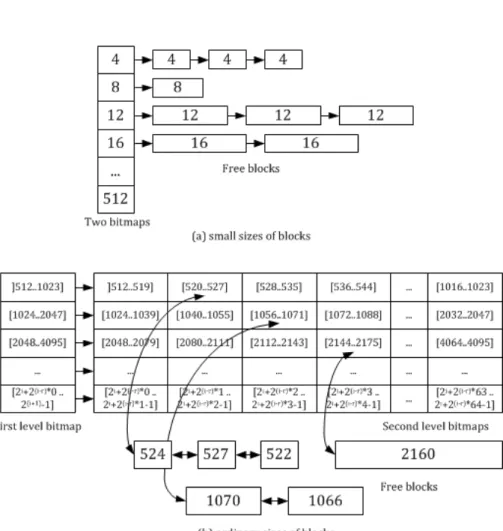
2.4 Structure of Half-fit . . . 37
2.5 Structure of TLSF . . . 39
2.6 Structure of tcmalloc . . . 41
2.7 Structure of Hoard . . . 43
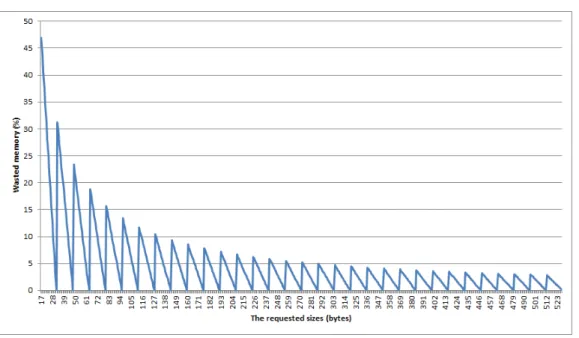
3.1 The wasted memory of TLSF in small sizes of blocks . . . 48
3.2 The structure of nMART . . . 51
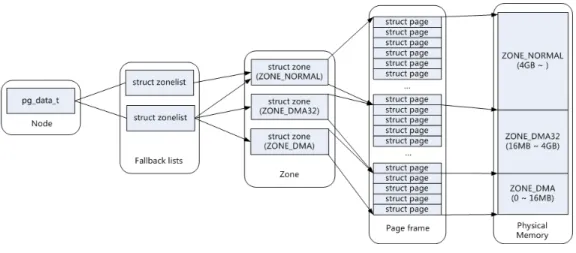
3.3 The relationship between nodes, zones and pages on x64 architecture system . . . 57
3.4 The default zones lists for our experimental hardware . . . 61
3.5 The sorted zone lists for our experimental hardware . . . 62
3.6 The thread-based private heap on the first layer . . . 67
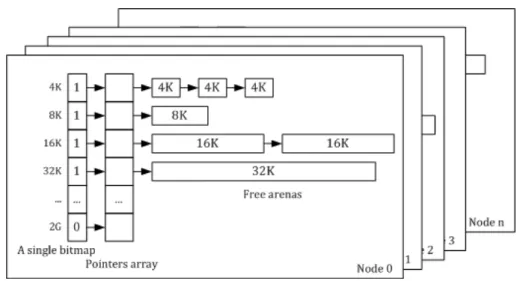
3.7 The node-based free arena management on the second layer . . . 69
3.8 The structure of an nMART control block . . . 71
3.9 The header of an arena list . . . 71
3.10 The structure of a thread control block . . . 72
3.11 The header of an arena . . . 73
3.12 The header of normal blocks . . . 74
3.13 A block of small blocks . . . 74
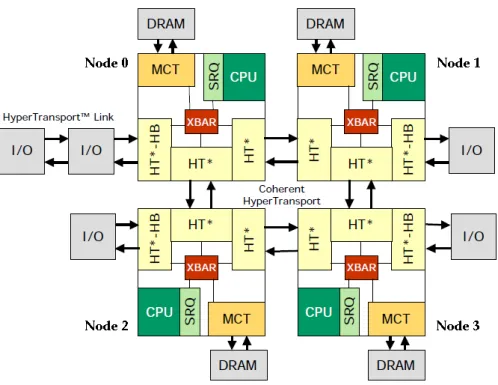
4.1 A four node-based ccNUMA architecture system . . . 96
2.1 Worst-case time complexity of algorithms . . . 44
3.1 SLIT of the experimental machine . . . 55
4.1 Real workload characteristics of test set 1 . . . 102
4.2 Real workload characteristics of test set 2 . . . 102
4.3 Real workload characteristics of test set 3 . . . 103
4.4 Real workload characteristics of test set 4 . . . 103
4.5 The number of malloc() and free() calls bycfrac . . . 104
4.6 The number of malloc() and free() calls byespresso . . . 105
4.7 The number of malloc() and free() calls bygawk . . . 105
4.8 The number of malloc() and free() calls byp2c . . . 106
4.9 The MEAN of BS, BIT and BHT generated . . . 110
4.10 The CDF model of BS, BIT and BHT generated . . . 111
4.11 The averagemalloc()/free() time of Set 1 of cfrac . . . 115
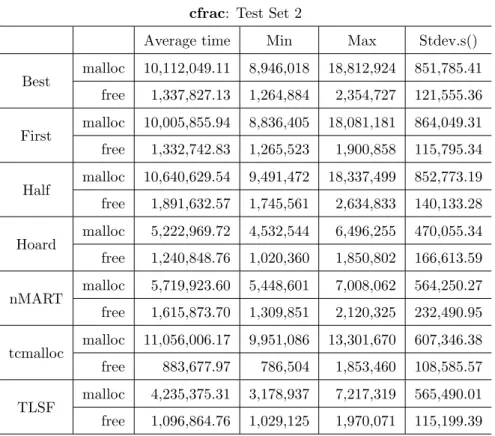
4.12 The averagemalloc()/free() time of Set 2 of cfrac . . . 116
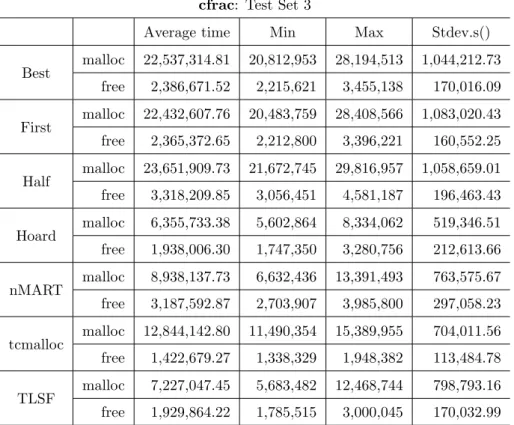
4.13 The averagemalloc()/free() time of Set 3 of cfrac . . . 116
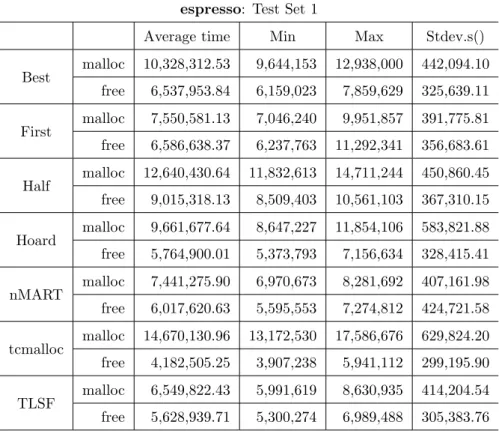
4.14 The averagemalloc()/free() time of Set 1 of espresso . . . 119
4.15 The averagemalloc()/free() time of Set 2 of espresso . . . 120
4.16 The averagemalloc()/free() time of Set 3 of espresso . . . 120
4.17 The averagemalloc()/free() time of Set 1 of gawk . . . 123
4.18 The averagemalloc()/free() time of Set 2 of gawk . . . 124
4.19 The averagemalloc()/free() time of Set 3 of gawk . . . 124
4.20 The averagemalloc()/free() time of Set 1 of p2c . . . 127
4.22 The averagemalloc()/free() time of Set 3 of p2c . . . 128
4.23 The average of total malloc()/free() time for cfrac test set 1 . . . 132
4.24 The average of total malloc()/free() time for cfrac test set 2 . . . 132
4.25 The average of total malloc()/free() time for cfrac test set 3 . . . 133
4.26 The average of total malloc()/free() time for espresso test set 1 . . . 136
4.27 The average of total malloc()/free() time for espresso test set 2 . . . 136
4.28 The average of total malloc()/free() time for espresso test set 3 . . . 137
4.29 The average of total malloc()/free() time for gawk test set 1 . . . 140
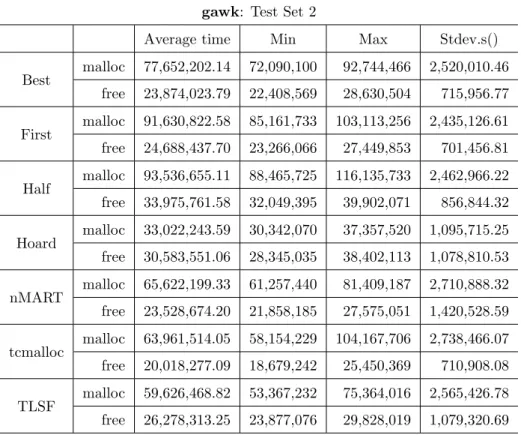
4.30 The average of total malloc()/free() time for gawk test set 2 . . . 140
4.31 The average of total malloc()/free() time for gawk test set 3 . . . 141
4.32 The average of total malloc()/free() time for p2c test set 1 . . . 144
4.33 The average of total malloc()/free() time for p2c test set 2 . . . 144
4.34 The average of total malloc()/free() time for p2c test set 3 . . . 145
4.35 The execution time of MEAN-Value model with two threads . . . 147
4.36 The execution time of MEAN-Value model with four threads . . . 148
4.37 The execution time of MEAN-Value model with eight threads . . . . 149
4.38 The execution time of MEAN-Value model with sixteen threads . . . 150
4.39 The execution time of MEAN-Value model with thirty-two threads . 151 4.40 The execution time of MEAN-Value model with sixty-four threads . . 152
4.41 The execution time of CDF model with two threads . . . 155
4.42 The execution time of CDF model with four threads . . . 156
4.43 The execution time of CDF model with eight threads . . . 157
4.44 The execution time of CDF model with sixteen threads . . . 158
4.45 The execution time of CDF model with thirty-two threads . . . 159
4.46 The execution time of CDF model with sixty-four threads . . . 160
A.1 The total block sizes requested/provided by cfrac . . . 171
A.2 The total block sizes requested/provided by espresso . . . 171
A.3 The total block sizes requested/provided by gawk . . . 172
A.4 The total block sizes requested/provided by p2c . . . 174
A.5 The size of virtual memory provided for test set 1 . . . 176
A.7 The size of virtual memory provided for test set 3 . . . 179
A.8 The size of virtual memory provided for test set 4 . . . 181
A.9 The states of event counters forcache-scratch in test set 4 . . . 183
A.10 The states of event counters forcache-thrash in test set 4 . . . 184
A.11 The states of event counters forlarson in test set 4 . . . 186
A.12 The states of event counters forshbench in test set 4 . . . 187
B.1 Measured Node Distances . . . 194
B.2 The SLIT of more complex architecture system . . . 194
B.3 The measured results for more complex system . . . 197
B.4 The new node distance of more complex architecture system . . . 198
B.5 The measured actual time taken on a four nodes-based ccNUMA system199 B.6 Allocation timing statistics based on node 0 . . . 200
B.7 Allocation timing statistics based on node 1 . . . 200
B.8 Allocation timing statistics based on node 2 . . . 201
B.9 Allocation timing statistics based on node 3 . . . 202
C.1 The mean of all test sets of applications . . . 206
C.2 The cumulative percentage and frequency of cfrac test set 1 . . . 207
C.3 The cumulative percentage and frequency of of cfrac test set 2 . . . . 208
C.4 The cumulative percentage and frequency of cfrac test set 3 . . . 209
C.5 The cumulative percentage and frequency of espresso test set 1 . . . . 210
C.6 The cumulative percentage and frequency of espresso test set 2 . . . . 211
C.7 The cumulative percentage and frequency of espresso test set 3 . . . . 212
C.8 The cumulative percentage and frequency of gawk test set 1 . . . 213
C.9 The cumulative percentage and frequency of gawk test set 2 . . . 214
C.10 The cumulative percentage and frequency of gawk test set 3 . . . 215
C.11 The cumulative percentage and frequency of p2c test set 1 . . . 216
C.12 The cumulative percentage and frequency of p2c test set 2 . . . 217
Firstly and very respectfully, I would like to appreciate my supervisor, Professor Andy Wellings. This thesis would not have been possible without his great mind, guidance and support. His endless support, understanding, and patience shaped my coarse-grained idea into this final thesis.
I would also like to thank my assessor, Professor Alan Burns, for his great support and invaluable advice regarding my work. An encouraging, cooperative and truly interested advisor is something that every Ph.D. student wants, whereof I am one of the privileged. Especially, I would like to thank all my friends, Abdul Haseeb Malik, Usman Khan, and Shiyao Lin for giving me strength, self-belief and all the enjoyable moments. My sincere appreciation goes to my best friends, Sungki Kang, Youngbo Kim, and Dinesh Manadhar; without their love and support, it would not have been possible to complete this course.
My family has been supportive of me throughout my Ph.D. I would like to thank my wife, Jumi Kim, and my little angels, Noori and Arie Kim, for their patience, sacrifices and support. I also thank my younger brother with his wife, Jaeyeon Kim and Youngeun Song, for encouraging me throughout my work. Last but not least, my sincere appreciation goes to my father for guiding and supporting me in every possible way.
I declare that the research described in this thesis is original work, which I undertook at the University of York during 2008 - 2013. Except where referenced, all of the work contained within this thesis represents the original contribution of the author.
Introduction
Recent years have seen an explosion in the development and use of modern com-puting technologies from small embedded devices like smart phones and tablets to large industrial machineries such as auto-mobiles and aircraft. For example, a huge number of people use the Internet to perform searches and for the provision of services. This is possible because innumerable machines run these searches and services behind the Internet. The key force providing the diversity of services is high-performance computing technologies such as parallel and distributed comput-ing. Single processor systems are not able to meet the required demand.
Many high performance services are supported by computers that have ccNUMA architectures. ccNUMA architecture systems are multiprocessor systems that have distributed shared memory. They are more scalable and flexible compared to other multiprocessor architecture such as SMP (symmetric multiprocessor systems). cc-NUMA systems provide a single address space, and are globally cache-coherent in hardware. In order to execute on ccNUMA systems, an application that executes on SMP systems does not require any changes. This is an important consideration when existing applications are to be migrated to the new architectures. However, the ccNUMA memory hierarchy does affect the application performance. In such systems, there are considerable benefits to be had by allocating related threads and data close to each other.
Real-time systems have also been increasing in size and complexity and their processing demands can no longer be met by single processor systems, and they are
likely soon to outpace the computation power of SMPs. Furthermore, it is extremely likely that a real-time application can be sharing the system’s resources with other real-time applications concurrently. This exacerbates the problem of meeting the computational demands of the applications. Hence, in the near future, real-time systems will require processors that have ccNUMA architectures as these offer more extensible computing platforms. However, it is difficult to do the global timing analysis of large systems. Accordingly, architectural complexity and tight timing constraints make the development of real-time systems on multiprocessor ccNUMA architectures extremely difficult [Wellings et al., 2010].
In general, a real-time system can be defined in many ways; a real-time system often refers to one that has the ability to perform many computations extremely fast. The powerful computation ability can minimize average response times, but it does not guarantee predictability, as is required in the real-time domain. The faster computation is a necessary condition, but it is not sufficient in the domain.
Burns and Wellings [Burns and Wellings, 2001] give the following definition of a real-time system: “The correctness of a real-time system depends not only on the logical result of the computation, but also on the time at which the results are produced.” Real-time systems are often classified as hard or soft. Hard real-time systems are those that must provide absolute guarantees that tasks will meet their deadlines. In soft real-time systems, deadlines are important but there is no strict guarantee requirement. Tasks which complete late, still can provide value to the system. This thesis is concerned with the implementation ofsoft real-time systems on ccNUMA architectures.
1.1
Motivation
Memory is one of the significant concerns when developing real-time applications as its management costs are expensive. Consequently, worst-case latencies and memory utilization are the primary concerns of real-time developers; a cost-effective real-time system must also exhibit good average-case performance [Nilsen and Gao, 1995]. As a result of the unpredictable allocation and de-allocation of memory blocks, many
real-time systems use static memory allocation; this refers to the process of allocat-ing memory at compile-time and durallocat-ing program initialization before the application enters into it main real-time phase of execution. They do not use dynamic memory allocation and all physical memory is available as one contiguous block that can be used as and when required. As there is no automatic memory management, a problem arises concerning unnecessary memory space consumption. Memory that is required for the storing of temporary objects cannot easily be reused. Program-mers have to implement and manage their own memory pools to reduce unnecessary memory space consumption and reuse space. As has been noted earlier, real-time systems have been increasing in size and complexity with the explosion of multipro-cessor and multi-core architecture systems. This requires, among other things, more flexible use of the available resources including memory. The burden of static mem-ory and memmem-ory pool management becomes unacceptable. From the developer’s view, in the future, the development of real-time applications will increasingly use dynamic memory management1 to achieve the expected flexibility and performance. Dynamic storage allocation (DSA) has been one of the most important funda-mental part in the general-purpose software domain due to being more efficient and flexible than static memory allocation. With its importance and popularity, the research area of DSA algorithms has been studied for over fifty years. In the past, much scholarly work has been done on the topic of good average response time of DSA algorithms, with respect to how fast and efficiently they allocate or de-allocate memory blocks, and how to reduce memory fragmentation. Although large numbers of faster and more efficient DSA algorithms exist in general-purpose domains, such as
DLmalloc[Lea, 1996],TCmalloc [Sanjay Ghemawat, 2010] andHoard [Berger et al., 2000], and are used widely, surprisingly, the worst-case execution time (WCET) of DSA algorithms, which can be high, has has not been studied in detail. There have been only a few general studies on the dynamic storage allocator in real-time system’s domain. Due to the lack of studies, most application developers of real-time systems generally avoid using dynamic storage allocation algorithms. This is
1Dynamic memory management is also called dynamic storage allocation, memory management,
because they are concerned that the worst-case execution time of DSA routines is not bounded or is bounded with an excessive bound [Puaut, 2002]. As well as the WCET of the DSA algorithm, space efficiency should be considered, as the lifetime of a real-time application is usually longer than a general-purpose application’s one. During a long lifetime, dynamic memory allocation can leave holes in memory, which cannot be reused due to their small size, and these holes lead to slow unacceptable response time or to miss deadlines. This is known as memory fragmentation.
In addition to the above concerns, ccNUMA architectures introduce another problem for DSAs. To maximize performance, memory allocated to the application must be local to the hardware node that is performing the memory access.
1.2
Hypothesis
The current existing dynamic storage allocation algorithms for real-time systems do not have any appropriate functionality to support multi-processors, multiple threads, and ccNUMA architecture systems. This thesis is concerned with how a dynamic storage allocation algorithm, supporting ccNUMA architecture systems, can be bounded with a small bound to satisfy the timing constraints of soft real-time systems. The hypothesis of this thesis is defined by the following statement:
The ability of a dynamic storage allocation algorithm can be enhanced to meet the requirements of soft real-time systems with a small bounded execution-time on ccNUMA architecture systems.
In order to avoid ambiguity, the term wasted memory in this thesis refers to those parts of memory which are free but cannot be allocated to the application. It is also called memory fragmentation, which can be divided into two parts: internal
and external.
1.3
Thesis Objectives
This thesis is mainly concerned with dynamic storage allocation algorithms on a ccNUMA architecture system and its efficient implementation on Linux. The major
aim of the research is to enhance memory allocation algorithms to support ccNUMA architecture systems, enabling programmers to maximize exploitation of the sys-tem’s characteristics without significant effort, and to offers better efficiency with bounded execution times for the allocation/de-allocation of memory.
In order to prove the hypothesis, this thesis provides six objectives. These are:
1. A detailed investigation into the limitation of why the existing dynamic storage allocation algorithms to allocate/de-allocate memory on ccNUMA architecture systems introduce unexpected large space and time overheads.
2. An approach for automatically re-sorting the node order, which minimizes accessing the farthest node on the system and automatically maximize ac-cessing the closer node for memory allocation requests. As one of the main parts of the thesis hypothesis, this approach gives better performance. Also it releases real-time application developers from the responsibility of memory management.
3. Temporal and spatial guarantees to real-time applications to ensure they meet their timing and space requirements in order to eliminate the non-determinism caused by the memory distribution in ccNUMA architecture systems.
4. To support transparency of the underlying architectures to applications. Mem-ory requests are satisfied under this algorithm independently of the underlying architectures.
5. A synthetic model to analyze dynamic storage algorithms on ccNUMA archi-tecture systems to check for improvements in the performance and predictabil-ity.
6. An overview of the implementation of: (a) the physical memory management on a modified Linux kernel, and (b) the proposed dynamic allocation algo-rithm.
Meeting these objectives forms the main contributions of this thesis. Achieving these goals will facilitate the development of efficient and configurable applications
under an enhanced Linux kernel on ccNUMA architecture systems. In summary, the thesis aims to define a more efficient dynamic storage allocation algorithm and enhance the current Linux kernel to enable applications to be more deterministic and portable in their use of memory allocation and deallocation.
1.4
Organisation of the Thesis
The remaining chapters of this thesis are organized with five chapters in accordance with the motivations and objectives of the research. Briefly, the descriptions of the remaining chapters are given below:
Chapter 2. Dynamic Memory Managements: This chapter explores the dynamic storage algorithm models provided by general-purpose and real-time systems, including their policies and mechanisms. Furthermore, conventional memory management algorithms are investigated, with particular emphasis on managing memory blocks. This chapter also highlights hybrid memory management algorithms, which perform better on multiprocessor architecture systems compared to conventional DSA algorithms.
Chapter 3. nMART: A ccNUMA-aware Dynamic Storage Allocation Al-gorithm: This chapter concentrates on providing and implementing a more efficient and predictable memory management algorithm that is especially de-signed for use in real-time systems. This is to achieve the primary inten-tion of an algorithm which is bounded with small bounds. It is designed to allocate/de-allocate memory blocks with the “closest node-orientated al-location” policy. Also, the chapter discusses the current methods of modern operating systems for the management of the physical memory in ccNUMA architecture systems, particularly Linux, and how our model performed better in terms of the physical memory management.
Chapter 4. Evaluation: This chapter suggests an evaluation method, particu-larly in terms of remote memory access, for the performance of DSA algorithms on the target architecture systems. Also, a set of experiments is performed to
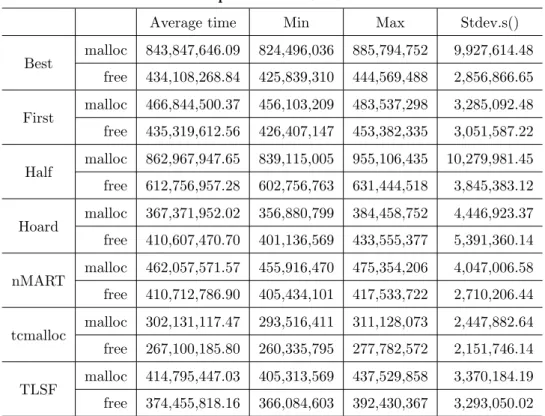
evaluate the performance of DSA algorithms. This chapter also compares the results with other schemes such as First-Fit, Best-Fit, Half-Fit,Hoard, tcmal-loc, and TLSF. Note that spatial and cache behaviour analysis of algorithms are discussed in Appendix A.
Chapter 5. Conclusions And Future Work: The final conclusions from the research results are given in this chapter. Additionally, some directions for further research are also presented.
Dynamic Memory Managements
2.1
Introduction
Dynamic memory management is one of the most important techniques in modern software engineering to manage objects created at runtime using high-level languages likeC,C++ and Java. It manages free or in-use memory blocks which have shorter lifetimes than their owner tasks or processes. In general, it is extremely difficult to satisfy the timing constraint of real-time applications with dynamic memory management. This is because it is necessary to predict the worst-case execution time of dynamic memory management offline. In addition, finding the optimal place to allocate a block of memory is NP-hard when some blocks are already allocated [Robson, 1980]; also, fragmentation can occur where it is not possible to satisfy a request, even if the total size of available memory exceeds the requested memory size.
When using dynamic memory management on multiprocessor environments, new problems, such as false sharing, unbounded growing heaps, and synchronization between threads are introduced. This is because the requirements of applications running on multiprocessors differ from those of applications running in uniprocessor environments.
In this chapter, we will discuss the issue described above, in particular, we will review memory management details related to this thesis. In the first section, the objectives of memory management and some of the terminology of memory
man-agements are discussed. Section 2.2 introduces some fundamental issues of memory management. In Section 2.3, a diversity of conventional memory management algo-rithms and hybrid algoalgo-rithms are discussed. Lastly, a summary will be drawn.
2.1.1
Objectives of Memory Management
The research in dynamic memory management for real-time systems is one of the still unconquered areas primarily because real-time applications impose different require-ments on memory allocators from general-purpose applications. For instance, one of the most important main requirements in real-time systems is that schedulability analysis should be performed to determine whether application response times can be bounded to satisfy the run-time timing constraints. The analysis should consider the impact of multiprocessor environments such as the high levels of concurrency, lock contention, heap contention, cache misses, and traffic on the bus. Considering all these issues with our target ccNUMA architecture systems, the requirements of real-time applications related to dynamic memory management can be summarised as follows:
Minimize memory fragmentation: The lifetime of real-time applications is generally longer than those of general-purpose applications, and can be as long as a day, a month or even years. In a long lifetime, the application may free memory blocks of any size arbitrarily. This can lead to the creation of holes in the memory, which cannot be reused because they are too small. Consequently, minimizing memory fragmentation needs to be considered as an important key requirement.
Minimize false sharing: False sharing introduces much of the unnecessary traffic on the bus in order to maintain cache coherency. It occurs when multiple processors attempt to read/write different data objects within the same cache line or page. Even if the processors do not actually share data, there are overheads due to coherency operations manipulating cache lines [Bolosky and Scott, 1993] [Jeremiassen and Eggers, 1995]. Consequently, false sharing can be a critical cause in degrading applications’ performance on shared memory
multiprocessor environments.
Maximize node-oriented data locality: As ccNUMA architecture systems are one of the distributed shared memory systems, their processors are able to access remote memory but with higher latencies than with local memory ac-cesses. Remote memory accesses, therefore, lead to degrading the system performance. Consequently, node-based data locality, which encourages ac-cessing its local memory, is considered as an important key requirement for improving the performance of the system. Also, allocating memory blocks, which are usually used together and near each other, lead to minimizing page and cache misses at runtime.
Minimize memory access to the farther nodes: Application developers need to consider remote memory access latencies and fully understand the spec-ification of the underlying hardware. However, nobody can ensure that all developers fully understand the characteristics. For this reason, DSAs need to provide transparency to developers so that latencies can be reduced thus minimizing the memory accesses to the farthest away nodes.
Bounded execution time: As has been discussed, applications on real-time sys-tems should satisfy their timing constraints. In order to satisfy their deadlines, the dynamic memory management operations should be bounded with a small bound at run time.
Minimize lock contentions: Applications running in ccNUMA and multi-threaded environments must be concerned with high-level concurrency and scalability issues. In particular, lock contentions lead to limiting systems’ scalability and add complexity, thereby, degrading system performance. As a result, minimiz-ing lock contentions in the memory management software is also needed. Minimize consumed space: Dynamic memory management attempts to
con-sume space conservatively. It needs to use as little memory as possible to keep track of the maintenance information needed during of the memory manage-ment of the system.
2.1.2
Terminology
Despite over thirty years of research in dynamic memory management, a precise definition and quantification of the terms had proven to be elusive before Wilson’s paper [Wilson et al., 1995b]. In this paper, Wilson provides some of the terminol-ogy which is now frequently used in the memory allocation area. For clarity, this terminology will be used in this thesis. The main terms are defined below.
Strategy: A strategy is the basic approach used to design a memory allocator. It takes into account patterns in program behaviour, and determines a range of acceptable policies for placing dynamically allocated memory blocks. The objectives of an allocator may be considered as being equivalent in meaning to the allocator’s strategy, for example, “minimizing lock contentions for each allocation” or “maximizing data locality to encourage accessing local nodes”. These strategies are achieved by policies.
Policy: A policy is an implementable decision procedure for placing memory blocks dynamically. It determines exactly where an allocating block will be extracted from the memory or where a freed block will be inserted into the memory. For instance, a given policy says: “always attempt to find the smallest block that is large enough to satisfy the request”. These chosen policies are implemented by a collection of mechanisms. Policies can be separated into the following:
Exact-Fit, Best-Fit, Good-Fit, First-Fit,Next-Fit and Worst-Fit. Some of the most important policies will be discussed in Section 2.3.
Mechanism: A mechanism is a collection of algorithms and data structures that implement a policy. It may be simply equivalent in meaning to an algorithm. An example of a mechanism is to “use a doubly linked list, and search for the position of the free block list from where the last search was satisfied; freed blocks are inserted at the front of the list”. Typically, the mechanism can be divided into the following: Sequential Fit, Segregated Fit, Buddy Systems,
Indexed Fit and Bitmapped Fit. Some of the most important mechanisms will be discussed in Section 2.3.
The above set of definitions is important for understanding and designing a dynamic memory management system in detail. For example, given a strategy, different policies may lead to different secondary effects. If some policies introduce good locality with high fragmentation, an application developer may need to choose another policy under the same strategy, which produces low fragmentation. A policy can be implemented by a diversity of mechanisms. If a given policy performs well, but its implementation is not efficient, developers can implement the policy by choosing a different mechanism.
Theoretically, keeping fragmentation under control is one of the major function-alities of dynamic memory management achieved by the placement policy. The placement policy is the choice of where to put a requested memory block in free memory. It is achieved by two techniques: splitting and coalescing.
Splitting: This splits large blocks into smaller blocks, and uses large divided blocks to satisfy a given request. Typically, the remainding blocks are tracked as smaller free blocks, and used to satisfy future requests.
Coalescing: Coalescing occurs when applications free up used memory blocks. In general, when applications free blocks of memory, the memory manager checks to see whether the neighbouring blocks are free or not, merging them into a single larger block if they are freed. This is more desirable because a larger block is more likely to be useful than two smaller blocks.
Coalescing can be separated into two different categories. Firstly, immediate coalescing attempts to merge freed blocks immediately whenever a block is freed. This will typically be expensive because freed blocks will be coalesced together by repeatedly and frequently combining adjacent free blocks. In contrast, deferred coalescing simply marks a freed block as “unused” or “freed” without merging. This is because many applications repeatedly create short-lived objects of the same size. Such allocators keep blocks of a given size on a simple free or unused list, reusing them without coalescing and splitting so that if an application requests the same-size memory block soon after one is released, the request can be satisfied by simple
operations in a constant time. This may optimize if some sizes are very commonly allocated and de-allocated.
However, [Johnstone and Wilson, 1998] provided an analysis of deferred coalesc-ing, reporting that memory fragmentation problems come into effect for the most common applications, and that deferred coalescing leads to unbounded execution time. For this reason, allocators in real-time systems have used immediate coalesc-ing.
2.1.3
Analysis Methodology
There have been many analysis methodologies used to evaluate dynamic memory management. In many methodologies, two different approaches are generally used. To evaluate fragmentation and worst-case execution time, scenarios are constructed using synthetic workloads; while to compare average execution time, real workloads are used.
• Synthetic trace analysis: In the past, this has been one of the most widely used approaches. It consists of a few traces with artificial workloads of allo-cations and de-alloallo-cations. Of course the initial condition is needed as well; the methodology can offer highly precise simulations of what allocators will do because allocators usually provide responses in the order of given requests. The specific workloads can change the size of requested memory blocks distri-bution and the lifetime distridistri-bution of memory blocks to evaluate the affect on fragmentation.
For example, a simple function (e.g. sizes increased by a power of two) can be used to change the size, or select the size and lifetime according to the values from the function, or to use statistics of the size and lifetime collected from real applications.
• Real trace analysis: Another approach is to trace memory operations from real applications, rather than randomly generated requests of the size and the lifetime. This uses a number of memory-oriented applications which consume a large amount of memory and time processing memory operations, most of
which were described by [Grunwald et al., 1993], such as espresso, gs, gawk
and make. The real trace evaluates the memory allocator performance in both space and time using these real applications.
In [Wilson et al., 1995a], Wilson found that the synthetic trace discards almost all major information relevant to estimating real fragmentation. Furthermore, in [Zorn and Grunwald, 1994], Zorn concluded that synthetic trace analyses are not sufficient to reflect an allocator’s performance accurately. In addition, the paper shows that the likelihood between the fragmentation of the real trace and the fragmentation of the synthetic trace is only 0.5, thus meaning that most of the fragmentation corresponding with the original trace cannot be reflected by the synthetic trace. They concluded that both size and lifetime of synthetic traces are insufficient to fully predict allocator performance for real workloads. After these papers, most research used a combination of both real and synthetic trace analysis.
There is a correlation between the amount of memory fragmentation and the be-haviours of real applications. [Wilson et al., 1995b] defined three patterns of memory usage over time, which have been observed in a variety of applications, as follows:
• Ramp: A variety of applications build up specific-purpose data steadily over time, such as stacking event logs. This pattern is called the ramp pattern. • Peak: the Peak pattern is similar to the ramp pattern but it is over a short
period of time. Some of the applications use lots of memory intensely in a short time to build up large data structures. In general, after using data structures, most of the data will be freed.
• Plateau: Some applications gather data structures rapidly and use them for long periods, even the whole duration of the application. This situation is called the plateau pattern.
In the paper, they concluded that the fragmentation at the peak is more impor-tant than the average fragmentation. This is because the most imporimpor-tant periods are those when the most memory is used. Scattered holes in the memory may not be a problem in the earlier phase if the holes are filled in the later phase but most
applications never reach a truly steady state as applications usually show memory usage patterns with ramps and/or peaks patterns.
2.2
Fundamental Issues
In general, designing a memory allocator is a trade-off between time efficiency and space efficiency. Without making a compromise between them, it is rarely possible to design a memory allocator that is extremely fast with minimum fragmentation for most applications. For instance, Kingsley’s memory allocator [Kingsley, 1982] is an example of simple segregated storage algorithms, which is used in 4.2 BSD Unix distribution. The memory allocator rounds memory block request sizes up to powers of two minus a constant. The principle of allocation and deallocation is very simple inasmuch as popping off from and pushing onto an array of segregated lists in size classes. The performance of its implementation is very fast because its algorithm is so simple, e.g. no attempt is made to coalesce memory blocks. Contrary to the time efficiency, it wastes a significant amount of space, potentially an average of 50% of the memory can be wasted due to internal fragmentation. Therefore, the balancing between the time efficiency and the space efficiency is one of the most important aspects of designing a memory allocator.
A number of memory allocators employ either a single heap or several private heaps for uniprocessor environments; however, most of the modern memory alloca-tors have started to consider more complex environments for the emerging multi-core multiprocessor architecture systems. A more complex architecture system brings new and different problems, such as heap contentions, false sharing, unbounded growing heap problems as well as the traditional fragmentation problem. The sub-sections below will discuss these fundamental problems.
2.2.1
Fragmentation
One of the significant problems of a memory allocator is memory fragmentation. In [Randell, 1969], Randell classified fragmentation as External and Internal, both of which are caused by splitting and coalescing free blocks.
External fragmentation arises when a requested memory block cannot be satis-fied, even if the total amount of free memory is larger than the size of the request. During allocation and deallocation processing, this fragmentation is generally caused when a small number of free blocks are created called ‘holes’. The small number of free blocks are not adjacent so cannot be merged, and are too small to satisfy any request.
Unlike external fragmentation, internal fragmentation arises when an allocator returns a larger free block to satisfy the request, rather than the actual requested size with the remainder being simply wasted. This is the reason why this situ-ation is called internal fragmentsitu-ation. Formally, the remainder is just inside an allocated block. Arguably, internal fragmentation is only caused by poor implemen-tation of the allocator policy [Johnstone and Wilson, 1998] [Masmano et al., 2008a]. However, in some allocators, internal fragmentation is often accepted for increased performance or simplicity. For instance, many of the segregated fit allocators allo-cate larger free blocks to avoid creating memory blocks that are non-aligned or too small a size. In binary buddy systems (discussed in Section 2.3.3) and Half-fit cases (discussed in Section 2.3.5.2), the sizes of allocated blocks are always rounded to powers of two by the policy because those allocators cannot divide blocks into differ-ent sizes from those preset by the policy; the algorithm pre-defines a set of discrete sizes of the data structure. Unlike external fragmentation, internal fragmentation is unique to each implementation of an algorithm and it must be studied case by case. This is why it is hard to find a general study of internal fragmentation in the literature.
Numerous publications address numerous experimental approaches for control-ling fragmentations. Usually, the results depend on three variables: M is the max-imum amount of heap memory that the allocator can use, n is the maximum of the block size that the application can request, and C is a constant. In [Rob-son, 1971], Robson showed that the amount of memory needed by any strategy is bounded below by a function,Mlog2n·C, which rises logarithmically with the size of blocks used. Robson addressed upper and lower bounds on the worst-case frag-mentation of the optimal allocation algorithm. The paper showed that the upper
bound of a worst-case optimal strategy would be between 0.5Mlog2n and about 0.84Mlog2n. Another of Robson’s papers [Robson, 1977] showed that the upper bounds of address-ordered first-fit policy are about Mlog2n, whereas the best-fit policy needs a store of at least (M−4n+ 11)(n−2), and the pessimistic asymptotic bound is around M·n. In [Knuth, 1997](first edition 1973), Knuth proved that the upper bound of fragmentation in a binary buddy systems could be calculated as 2·M·log2(n). Confessore [Confessore et al., 2001] addressed a periodic allocation problem in which allocation and deallocation time of each item are periodically re-peated and is equivalent to the interval colouring problem on circular arc graphs. They provided a 2-approximation algorithm, and also showed that the solution value is equivalent to the length of the longest weighed path of the oriented graph.
The dynamic memory allocation problem, storing all objects in the minimum-size memory block, is known to be NP-hard in the strong common sense [Garey and Johnson, 1979]. In [Gergov, 1996], Gergov achieved an approximation result for this problem with a performance ratio of 5. In another paper [Gergov, 1999], Gergov had achieved a 3-approximation algorithm for memory allocation. Luby [Luby et al., 1994] introduced a new parameter called k, which denotes the maximum number of occupied memory blocks, for analyzing algorithms, and improved on Robson’s previous research [Robson, 1977]. This proved that the first-fit policy needs a store of at leastO(Mmin{logn,logk}) words.
Given the above theoretical analysis, the situation seems rather pessimistic. For instance, assuming that an allocator uses a single heap of M = 1M bytes with a first-fit algorithm, with the maximum block size being n = 4K bytes, the allocator needs at least 220·(1 + log2(212)) bytes; a total of 13M bytes is needed to ensure that the allocator never fails because of external fragmentation. In the case of the best-fit policy, it is even larger. With the same condition above, it needs at least 220·212 = 4G bytes to ensure the best-fit policy always satisfies all requests. In
contrast, experimental results are much more encouraging.
Hirschberg [Hirschberg, 1973] compared a binary buddy system with a Fibonacci buddy system. The paper showed that the fragmentation of Fibonacci buddy can increase memory usage by about 25% in contrast to binary buddy’s 38%. In [Shen
and Peterson, 1974], Shen showed that a weight-buddy system using FIFO-order with a uniform size distribution wastes more memory than a binary buddy system - around 7% - due to fragmentation. With an exponential distribution, the weight buddy system using FIFO-order gives an improvement of around 7% over binary buddy. In contrast to FIFOorder, memory usage had been worse around 3% -with LIFO-order. Shore [Shore, 1975] compared best-fit, address-ordered first-fit, worst-fit, and combined best-fit and first-fit as a hybrid policy. The results showed that best-fit and first-fit policies roughly outperformed the others in fragmentation, and the maximum difference between them was less than 3%.
Bohra [Bohra and Gabber, 2001] found that the behaviour of a long-running application with a memory allocator is fairly different from the typical patterns for which memory allocators are optimized. In their experiment, the best opti-mized algorithm caused 30.5% fragmentation with a long-running application called Hummingbird, and another called GNU Emacs caused 2.69%, but the worst case had predicted 101.5% fragmentation. Real applications are designed to solve ac-tual problems, which affect their pattern of memory usage, so that applications do not behave randomly by the chosen methods used to solve the original problems. Unfortunately, application behaviours have a wide variety of implications for frag-mentation so that in order to understand fragfrag-mentation, it is necessary to discuss application behaviours as seen in [Bohra and Gabber, 2001]. For instance, the size distributions of requested memory blocks determine memory fragmentation. The lifetimes distribution of memory blocks determines which memory blocks are occu-pied or free over time.
In [Johnstone and Wilson, 1998], Johnstone investigated the fragmentation pro-duced by a group of policies includingfirst-fit,best-fit,next-fit,address-ordered first-fit, address-ordered best-fit, address-ordered next-fit, DLmalloc, etc. with a set of real traces. They concluded that the fragmentation problem is produced by a poor allocator implementation, and well-known polices did not suffered from almost any genuine fragmentation.
Barret [Barrett and Zorn, 1993] introduced an interesting approach to avoiding fragmentation by predicting the lifetimes of short-lived objects when they are
allo-cated. They showed that their scheme would predict that a large fraction (18% to 99%) of all allocated bytes are short-lived.
Consequently, it can be concluded that some dynamic storage allocation algo-rithms have pessimistic fragmentation; however, in many studies, many allocator algorithms show low fragmentation in memory usage with well-designed policies.
The Measure of Fragmentation
To compare allocators, a metric is needed. In general, the time cost and the space cost are the most commonly used measurements; in particular, the time cost denotes speed, and the space cost indicates fragmentation.
Memory fragmentations can be defined in many different ways. For instance, assume that there are 10 free blocks of size 4K bytes and 50 free blocks of size 1K bytes in memory at some point in time, and an application will request 5 free blocks of size 4K and 40 free blocks of size 1K in the near future. In this case, was cannot say there is high fragmentation because the requests can be satisfied. With the same condition above, if the allocation will request 10 free blocks of size 8K, there will be a problem and we can say that this is due to high fragmentation. Johnstone [Johnstone and Wilson, 1998] suggested four metrics to describe the amount of fragmentation, which are now widely used. They used both metric 3 and 4 in the paper.
Metric 1: The measured fragmentation is the amount of memory used by the mem-ory manager, which is normally called the heap, over the amount of memmem-ory requested by the application, averaged at all points through time. This met-ric of fragmentation measure is simple, but a problem with this approach is that it hides the spikes in memory utilization, with these spikes being where fragmentation can become a problem.
Metric 2: The fragmentation is the amount of memory used by the memory man-ager over the maximum amount of memory required by the application at the point of maximum memory utilization. The problem of this metric is that the point of maximum memory utilization cannot normally be considered the most important point of the application at runtime.
Metric 3: The fragmentation is equal to the maximum amount of memory used by the memory manager over the amount of memory required by the application at the point of maximum memory usage by the memory manager. The draw-back corresponding with this measure of fragmentation is that it will lead to high fragmentation, even if the applications uses slightly more memory than the size of needed memory.
Metric 4: The fragmentation is the maximum amount of memory used by the memory manager over the maximum amount of memory used by the applica-tion. The disadvantage of this measure is that it can report low fragmentation when the point of maximum memory usage is a point where a small amount of memory is used by the application.
All the metrics described above are available to measure the fragmentation caused by application behaviours; however, a problem with these metrics is that they do not distinguish between unused memory and memory used by the memory allocator for its own data for management, such as keeping free blocks. In our exper-iment, we will consider the actual amount of internal and external fragmentation, with space consumed by data structures being maintained. Therefore, we will use the following equation to calculate the amount of fragmentation (f):
f = h−a
h (2.1)
In this equation,hdenotes the actual amount of memory provided by the alloca-tor, andapoints out the amount of allocated memory requested by the application.
2.2.2
False Sharing
Writing multi-threaded applications is a challenge for many well-known reasons, such as debugging, avoiding race conditions, a variety of contentions, and deadlocks. With the emergence of multiprocessor architecture systems, memory allocators need be more concerned with the potential pitfalls resulted from parallel executions of threads requesting memory. In the remaining sub-sections, we will discuss some issues arising in multiprocessor environments.
Most multi-threaded applications share system resources between threads. In this case, contention arises when threads try to read or write a shared resource. However, the contention can sometimes happen when multiple threads access differ-ent objects. This is because multiple objects happen to be close enough in memory, wherein they reside on the same cache line.
For instance, a thread updates object obj1, whereas another thread updates another object obj2. Assume that both objects reside on the same cache line and both threads are running on different processors, the cache-coherency protocol will make the entire cache line an invalidated state when one of them is modified. The cache line will “Ping-Pong” between the processor caches. Therefore, it leads to degrading the application performance [Hyde and Fleisch, 1996].
This situation is called false sharing. Recently, with the popularity of using multi-core architecture systems, the trend towards increasing cache line sizes makes false sharing increasingly common [Liu and Berger, 2011]. It is rarely possible to eliminate false sharing automatically. One representative approach is that either ap-plication developers deal with this problem by adjusting the data structure layouts, i.e. alignment and padding, or compilers schedule a parallel loop [Jeremiassen and Eggers, 1995]. These approaches can reduce the correlation between false sharing and data objects; however, these strategies cannot avoid it completely because of the effects on array-based data structures. Nevertheless, a well-designed strategy can reduce and eliminate the possibility of false sharing in practice [Berger et al., 2000].
2.2.3
Single and Multiple Heaps
Despite the increasing popularity of concurrent application on both multi-core and multiprocessor architecture systems, there have been few studies on concurrent memory managers. The most representative paper on the dynamic storage alloca-tion [Wilson et al., 1995b] was surprisingly limited to investigating non-concurrent memory managers. Typically, in the uniprocessor environments, two approaches can be used by a memory manager to deal with multiple threaded applications: aserial single heap and a concurrent single heap.
However, those heaps naturally suffer contention when multiple threads access the same heap. The problem with the single heap is that the greater number of threads accessing the heap, the more heap contention is likely to arises. As a result, a variety of concurrent memory managers started to use multiple heaps. There are many mechanisms to assign threads to heaps, such as the allocators mapping threads onto heaps by assigning one heap to every thread, by using an unused heap from a group of heaps, by assigning heaps in a round-robin fashion, or by using a mapping function to assign threads to a group of heaps [Berger et al., 2000]. Berger has classified these heap usage approaches as follows:
• A serial single heap: The allocator which uses a serial single heap is normally fast and can likely keep low fragmentation in practice. However, the heap is protected by a global lock, and naturally it introduces the serialization of memory accesses and significant lock contention.
• A concurrent single heap: This heap is helpful to reduce the serialization and the heap contention. It is normally implemented using a concurrent data structure, like a B-tree or a free list with locks. However, its cost of memory access is relatively high, since it usually employs many fine-grained locks or atomic operations on each free block. Furthermore, false sharing still remains likely.
• Pure private heaps: A pure private heap indicates that a separate heap is allocated to each thread and these are completely isolated from other threads so that each thread cannot access any other private heap for any memory operation except its own heap. As a result, an allocator with multiple heaps can reduce most of the lock contentions on the private heap, and expect to be scalable. Unfortunately, it is likely to cause a private heap to grow with-out bounds. For instance, assume that threads are in a producer-consumer relationship, if a producer thread T1 allocates memory M1 and a consumer thread T2 releasesM1, the memory M1 will be added intoT2’s heap.
• Private heaps with ownership: Unlike the allocators using pure private heaps, the allocators with ownership return free blocks to the heap where the
target block came from. However, in a producer-consumer model applications, which exhibit round-robin behaviour, the allocators can eliminate allocator-induced false sharing but it still induces unbounded memory consumption. • Private heaps with thresholds: The allocator employs a hierarchy of heaps,
and some heaps can be shared by multiple threads, except the private heaps. The shared heap can exhibit some heap contentions, but rarely is there con-tention on the private heaps. Therefore, the allocators can be efficient and scalable. When the number of private heaps exceeds the threshold, a portion of free memory will be moved to the shared heap, with fully empty heaps be-ing returned to the underlybe-ing OS in bounded heap increments. However, the memory management cost, particularly the time cost, can be high because it needs multiple memory operations.
Since using multiple heaps, many memory managers have suffered from un-bounded heap increments, wherein memory consumption cannot be unun-bounded by a policy even if the required memory is fixed. Berger [Berger et al., 2000] called this phenomenonblowup. Some follow-on studies have used the terminology, so we will use it as well even though it is not common. The blowup phenomenon results from two types of memory consumption patterns. The first type is from the use of pure private heaps in the allocators used in the C++ Standard Template Library [SGI, 2004]. The second is based on the private heaps with ownership used in Ptmal-loc [Gloger, 2001] and LKmalPtmal-loc [Larson and Krishnan, 1998], where the pattern of memory consumption linearly increases with the number of processors. Some allocators, Hoard [Berger et al., 2000] and Vee and Hsu [Vee and Hsu, 1999], exhibit bounded memory consumption as they support the private heaps with thresholds policy.
2.3
Memory Management Algorithms
It is appropriate to review the most well-known policies of memory allocation, even if they are derived from the 1960s, because most modern memory allocators are
variants of these allocation algorithms. Also, the original allocation algorithms are simple and easy to use in small devices. There are two approaches to analyze the WCET of memory management algorithms: static WCET analysis, or worst-case complexity analysis. However, it is impossible to use the static WCET analysis with-out knowledge of the history of the allocation/deallocation requests in the lifetime of application using the allocation algorithms [Puaut, 2002]. Consequently, worst-case complexity analysis will be used to obtain the worst-case allocation/de-allocation time in this thesis.
In this section, we will discuss sequential fit, segregated fit, buddy systems, indexed fit, and modern hybrid memory allocation algorithms in this order.
2.3.1
Sequential Fit
Typically, sequential fit algorithms can be classified into four types: Best-Fit, First-Fit,Next-Fit andWorst-Fit. Figure 2.1 illustrates the differences between sequential fit algorithms. In particular, it contains five free blocks of different sizes as well as six used blocks. The block sizes are given in the header of each block, which contains pointers comprising doubly links.
Figure 2.1: Overview of Sequential Fit algorithms
return the 2K bytes free block, and First-fit, Next-fit and Worst-fit will return the 3K bytes, the 3K bytes, and the 5K bytes in that order, as seen in the figure.
• Best-fit
The Best-fit allocation algorithm is one of the most well-known and simplest algorithms. As indicated by its name, the algorithms always attempts to find the smallest free block that is large enough to satisfy the application’s request. The policy tends to minimize the wasted space to ensure fragmentation that is as small as possible; however, the algorithm performs an exhaustive search of the data structure in order to find the best-fitting block similar to the requested size. In the worst case,
Best-fit can be achieved in a time complexity ofO(n) for finding the first block using a doubly linked list array.
The algorithm is typically implemented using either a doubly linked list or cir-cularly linked list, but its data structure may not only be a single linear list of all free blocks of memory, but also more complex, such as arrays of multiple size classes like the segregated fit mechanism or a self-balancing binary tree to implement the same policy with a better time response.
Typically, the Best-fit policy can be implemented by the address-order, FIFO and LIFO mechanism. Although those algorithms are based on exhaustive searching algorithms, they shows fairly good memory usage in practice with either real or synthetic workloads; however, they tend to accumulate small fragmentation [Knuth, 1997], but this does not seem to be a significant problem. This is because it does not appear to happen in practice with either real or synthetic workloads [Bays, 1977] [Wilson et al., 1995b].
The Best-fit algorithms can be summarised as follows: firstly, the allocators search for a free block that is large enough to satisfy the request iteratively from the head of the free block list until it encounters a suitable block. If the allocators find a block, searching will be terminated and they will return the block. If the allocators find multiple suitable blocks, the choice of the block depends on the implementation of the algorithm. If the size of the found block is larger than the requested size, the block will be split and the remaining one will be inserted into the list. Otherwise the
allocators have failed and will return with a failure. In terms of the deallocation, free blocks are merged with adjacent blocks if they are freed already. They are extracted from the list and merged with the newly freed block to create a larger-size block.
• First-fit
First-fit allocation algorithms [Brent, 1989] [Knuth, 1997] are also one of the most common sequential fit mechanisms. They attempt to find the first free block that is large enough to satisfy the memory allocation request. The algorithms can be implemented with a address-ordered, LIFO or FIFO mechanisms. In the worst case,First-fit allocation can be achieved with a time complexity of O(n) for finding the first block with a doubly linked list array.
The First-fit algorithms can be summarised as follows: firstly, the algorithms search for a free block from the head of free lists iteratively until finding the target. If there is no acceptable block, they will return with a failure. If the found block is larger than the requested size, it will be split and the remaining block will be inserted into the list. Corresponding with the deallocation case, the free block will be merged with the adjacent blocks if they are free. If they are free, they will first be extracted from the list, and merged with the free block to create a larger-size block. The new larger block will be inserted into the free list.
In general, a problem with First-fit is that frequent splitting occurs near the head of the free list which results in the accumulation of lots of small blocks near the head of the list. Those small blocks increase searching time because searching needs to pass through them each time, and it causes high fragmentation. Conse-quently, the conventional First-fit is not suitable for an application that allocates and deallocates many different sizes of blocks frequently. However, as withBest-fit, it can be more applicable if implemented using more sophisticated data structures. In practice, First-fit algorithms using either address-ordered or FIFO exhibit lower fragmentation than First-fit based on LIFO [Wilson et al., 1995a].
• Next-fit
Next-fit allocation algorithms are one of the variants on First-fit algorithm that employ a roving pointer for allocation [Knuth, 1997]. The algorithms keep track of
the pointer, which records the position of where the last search was satisfied, and they will be used as the beginning point for the next search. The algorithms can also be implemented with: address-ordered, FIFO and LIFO mechanisms, like the other convenient mechanisms.
Theoretically, Next-fit reduces the average search time under a single linear list; however, it tends to get worse locality because it always searches each free block before examining the same block again due to the roving pointer.
Furthermore, the roving pointer cycles through the free block lists regularly, and is likely to accumulate objects in memory with different sizes and lifetimes from different phases of the application’s execution. Consequently, it has been shown to cause more fragmentation than other sequential fit allocation algorithms. In partic-ular,Next-fit with LIFO mechanism allocators has significantly worse fragmentation than address-ordered Next-fit algorithms [Wilson et al., 1995a]. However, Next-fit
is the best solution to minimizing the mean response time in a shared memory sym-metric multiprocessor for hard real-time system applications [Ban´us et al., 2002].
In terms of allocation and deallocation procedures,Next-fit allocation algorithm originals are almost equivalent to First-fit algorithms, except for the starting point of search.
In summary, sequential fit algorithms are implemented using a single linear list, which consists of doubly-linked or circularly-linked lists with very different policies in practice, such as address-ordered, FIFO or LIFO policies. First-fit and Best-fit
are based on either an address-ordered or FIFO policy and they seems to work well. However, a problem with sequential fit algorithms is that they are not scalable because as the number of free blocks grows the search cost linearly increases.
Sequential fit algorithms can be combined with other mechanisms, such as optimal-fit,half-fit orworst-fit. In particular,worst-fit mechanisms search for the largest free block that is large enough to satisfy the request of memory allocation because it at-tempts to make the free block as large as possible in order not to accumulate small fragmentations; however, in practice, this algorithm seems to work badly.
Overall, the algorithms allocate memory blocks inO(n) in the worst-case, where
real-time systems even though the sequential fit mechanisms are implemented using various types of data structures rather than linear lists in order to improve scalability.
2.3.2
Segregated Free Lists
Most of the modern memory allocation algorithms, such as DLmalloc, tcmalloc,
TLSF, Hoard, employ segregated free list mechanisms which use an array of free block lists. This is because their use reduces search time, although it does cause small internal fragmentations. The algorithm generally uses sizes that are to the power of two apart so that each size class holds free blocks of a particular size.
Typically, the algorithms rounds the requested size up to the closer size class or nearest size class if that is empty. After that, the memory algorithms search for a free block of the requested size that is large enough to satisfy the request in a certain size class or for any slightly smaller size that is still larger than any smaller size class.
In terms of the deallocation, the allocators insert a free block into the free list for the given size when the used block is freed.
Wilson [Wilson et al., 1995b] indicates that algorithms that employ segregated free lists can be divided into two categories: simple segregated storageandsegregated fit.
• Simple Segregated Storage
Simple segregated storage is one of the simplest allocators that uses an array of free lists. No splitting and no coalescing of free blocks are required. These char-acteristics distinguish simple segregated storage mechanisms from buddy systems. An advantage of this approach is that no headers are required. This can decrease memory consumption as the headers introduce overheads – the headers usually in-crease memory consumption by 10% to 20% [Zorn and Grunwald, 1992] – which is particularly important when the average requested size is very small.
As there is no required splitting or coalescing of blocks and maintaining of head-ers, the algorithms are usually fairly fast; especially when the blocks of a given size
are requested in a short time repeatedly. As a simple policy, it achieves a time complexity of O(1).
However, a problem with the algorithm is that it induces large external frag-mentation, which is proportional to the maximum amount of memory used by the allocator times the maximum of the block size requested by the application. It also suffer from internal fragmentation.
• Segregated Fit
Segregated fit algorithms use arrays of free lists. Each array holds free blocks within a certain size class. The allocator is faster than a single free list for most cases, as it searches the free list for the appropriate size class when the application requests memory. After choosing a certain array within a size class, it searches for a free block in the array by a sequential fit search. If there is no free block, the algorithms attempt to search for a larger block in the closest array repeatedly until finding a larger block, with the larger block then being split and the remainder being inserted into a particular array. Such algorithms can be categorised as follows: Exact Lists, Strict Size Classes with Rounding and Size Classes with Range Lists.
Exact Lists In order to support this algorithm, the allocator needs to have a huge number of free lists to have each possible block size. In practice the allocators only use the exact lists within small size classes to reduce a very large number of free lists.
Strict Size Classes with Rounding This mechanism rounds the request size up to the closer sizes in the size class sets, even though it wastes some space as internal fragmentation. One advantage of this algorithm is that it can maintain all blocks on a size list that are of the same size exactly.
Size Classes with Range Lists This is one of the most widely used mechanisms, which allows free lists to hold blocks of slightly different sizes.
In summary, segregated free lists are used with other mechanisms such as First-fit orBest-fit to search for a certain free list. If the allocator finds a particular size
list, it searches for a freed block in the list based on those mechanisms. Regarding the optimization, the algorithms employs boundary tags [Knuth, 1997] [Standish, 1980] to support faster splitting and coalescing of free blocks.
Consequently, the algorithms can be achieved a time complexity ofO(1) in the worst-case. However, these algorithms are not suitable for real-time system due to large external fragmentation.
2.3.3
Buddy Systems
Buddy systems are particular variants of segregated lists using size classes with rounding. In the system, the whole heap area is theoretically divided into two areas, with these areas being further divided into two smaller areas, and so on in a simple buddy case. The standard algorithm of (binary) buddy system can be achieved in a time complexity of O(log2n) in the worst case, where n is the maximum size of the heap.
One advantage of this algorithm is that it contains all blocks on a size list that are of exactly the same size. For instance, if a size of a free list is 4K bytes, all blocks contained in the list are a size of 4K bytes. The only difference between this algorithm and other segregated lists algorithms is the support of limited splitting and coalescing of free blocks using a certain function, e.g. a power of two function, as followa:
i=⌊log2(r)⌋ (2.2)
In this case, r is used to calculate a certain index which represents a particular free list within the size class to be used for either inserting a free block or searching for a free block.
In terms of allocation in a simple buddy, it searches for a free block within a particular array obtained by function 2.2. If there is no free block, the algorithms try to find a larger block in the closest array iteratively until finding a larger block. If a block has been found in some higher array, the block will be extracted from the list and recursively split into the size power of two logarithmically to be smaller, but the size of the block is still large enough to satisfy the request. The remaining