Trading Signal Generation Using A Combination of Chart
Patterns and Indicators
Chalothon Chootong and Ohm Sornil
Department of Computer Science, National Institute of Development Administration Bangkok, Thailand
Abstract
Chart patterns and indicators are popular technical tools for making investment decisions. This article presents a trading strategy combining price movement patterns, candlestick chart patterns, and trading indicators, including Moving Average, Exponential Moving Average, Bollinger Bands, On Balance Volume, Relative Strength Index, Moving Average Convergence Divergence, and Stochastic Oscillator, with the aim to increase the return on investment. A neural network ensemble is employed to determine buy and sell signals on the next trading day. Experimental results, using stocks from five different industries in Stock Exchange of Thailand, show that the proposed strategy yields higher returns than do traditional technical trading methods
Keywords: Stock Trading Signals, Chart Patterns, Candlestick Charts, Indicators, Neural Network Ensemble
1. Introduction
An investment decision may increase or decrease the return on investment. Information and investors’ experiences are significant factors to successful stock trading. Fundamental analysis and technical analysis are two main approaches which form the basis of most traders’ decisions. Fundamental analysis involves economic, political and detailed studies of companies’ financial positions. Traders apply this approach to price predictions over a long period of time. Technical analysis [10] focuses on price and volume movements of stocks. Typically, traders use indicators, such as Moving Average, Bollinger Band, Relative Strength Index, Moving Average Convergence Divergence, and Stochastic Oscillator, to determine buy and sell signals. In addition, they may use chart patterns, such as price movement patterns and candlestick chart patterns, to analyze the past trading data and predict future prices and trends.
Artificial Intelligence has been used in finance and investment and supported decisions by analyzing large amount of data [14], such as managing portfolios for optimal resource allocations [5], predicting prices and trends, and determining trading signals which is the focus of this article. Abraham et al. [1] proposed a hybrid
intelligent system based on an artificial neural network trained by scaled conjugate algorithm and a neuro-fuzzy system for stock market analysis. Wen [13] proposed an intelligent trading system based on oscillation box prediction by combining stock box theory and support vector machine algorithm. The paper consists of two parts: one part is to predict the future trend or price, and the other is to construct a decision support system which can give certain buy/sell signals.
A neural network is an interconnected set of elements which can learn a nonlinear relationship between input features and the output, from a set of training patterns [2]. It has a number of applications in financial decision makings, such as predicting market trends, and is considered to give higher accuracy than many modeling techniques [15]. Zhang and Coggins [8] evaluate a financial time-series forecasting strategy using multi-resolution properties of the wavelet transform and a neural network model, trained using Bayesian techniques. Kumar et al. [12] use neuro fuzzy based techniques to predict stock trends.
Stock chart patterns are major tools for stock market technical analysis. Chart pattern analysis can help investors improve trading profits in both short-term and long-term investments [16]. Two popular types of chart patterns are line (or price movement) chart patterns and candlestick chart patterns. Examples of price patterns are the head-and-shoulder pattern which suggests the fall of price, and the double top pattern which describes the risk of a stock [4]. Chart patterns provide hints for investors to make buy or sell decisions.
Candlestick chart patterns have been recognized as good indications of stock price. They can be used to create trading rules. Izumi et al. [11] propose a new approach to develop stock trading strategies using Genetic Network Programming (GNP) and candlestick charts. GNP consists of several judgment nodes and processing nodes. In a GNP, judgment nodes check candlestick chart patterns, and processing nodes suggest buying or selling stocks. A chain of judgment nodes, and the following processing nodes express the buying/selling strategy.
This article presents a novel strategy that provides trading signals using a neural network ensemble to combine technical indicators, price movement patterns, and candlestick chart patterns. The method is evaluated using actual data from the Stock Exchange of Thailand.
In the rest of the article, Section 2 provides backgrounds of price movement patterns, candlestick chart patterns, and technical trading indicators. Section 3 describes the strategy to combine features from both chart patterns and indicators. Section 4 describes experiments and results. Section 5 provides concluding remarks of the research.
2. Chart Patterns and Trading Indicators
2.1 Price Movement Patterns
Price movement patterns can be used to identify past relationships from historical data and applied them to predict future prices [21]. In stock trading, price movement studies play an important role in technical analysis. They show reversal or continuation of price and put all buying and selling into perspective by consolidating forces of supply and demand into a concise picture. Examples of price movement patterns are shown in Fig. 1.
(a) Double top pattern
(b) Head and shoulders pattern
Fig. 1 Examples of price movement patterns
2.2 Candlestick Chart Patterns
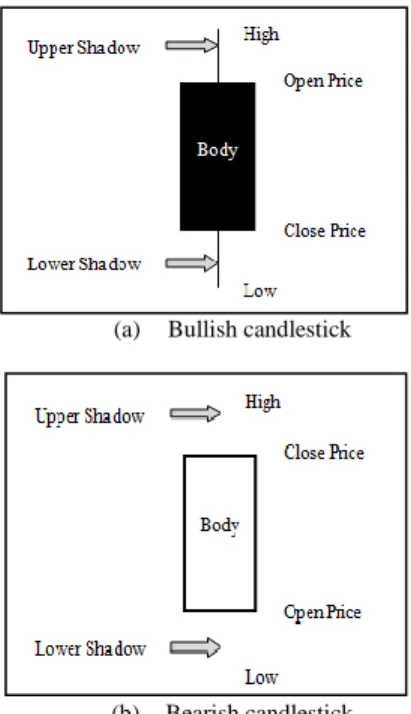
Candlestick charts display open, close, high and low prices, of a time frame, and also show upward or downward of prices and the range of time frame. A candlestick consists of three main parts: upper shadow, real body, and lower shadow, as shown in Fig.2. Fig.2 (a) shows a bullish
candlestick, which is a reversal pattern that shows up after a pullback, and Fig.2 (b) shows a bearish candlestick which is opposite to the bullish pattern. If it is not a bullish or bearish candlestick, it is considered a neutral candlestick.
There are many candlestick chart patterns normally used in trading. This research divides candlestick chart patterns into three main types as follows: Bullish candlestick patterns, which are reversal patterns that show up a after a pullback, i.e., the closing price is higher than the opening price. Bearish candlestick patterns which are opposite to the bullish pattern, i.e., the opening price is higher than the closing price. These patterns come after a rally and signify a possible reversal just like the bullish patterns. If it is not a bullish or a bearish candlestick, it is a Neutral candlestick pattern. Each pattern type is divided further into three subtypes which are high reliability, medium reliability, and low reliability.
(a) Bullish candlestick
(b) Bearish candlestick
Fig. 2 Candlestick charts
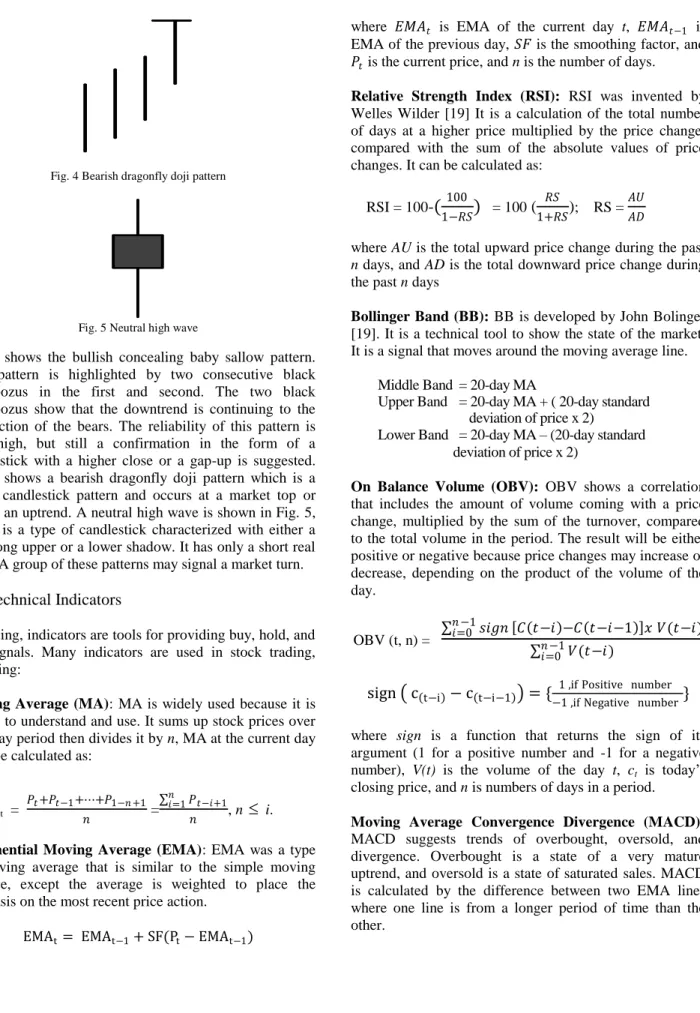
Fig. 4 Bearish dragonfly doji pattern
Fig. 5 Neutral high wave
Fig. 3 shows the bullish concealing baby sallow pattern. This pattern is highlighted by two consecutive black Marubozus in the first and second. The two black Marubozus show that the downtrend is continuing to the satisfaction of the bears. The reliability of this pattern is very high, but still a confirmation in the form of a candlestick with a higher close or a gap-up is suggested. Fig. 4 shows a bearish dragonfly doji pattern which is a single candlestick pattern and occurs at a market top or during an uptrend. A neutral high wave is shown in Fig. 5, which is a type of candlestick characterized with either a very long upper or a lower shadow. It has only a short real body. A group of these patterns may signal a market turn.
2.3 Technical Indicators
In trading, indicators are tools for providing buy, hold, and sell signals. Many indicators are used in stock trading, including:
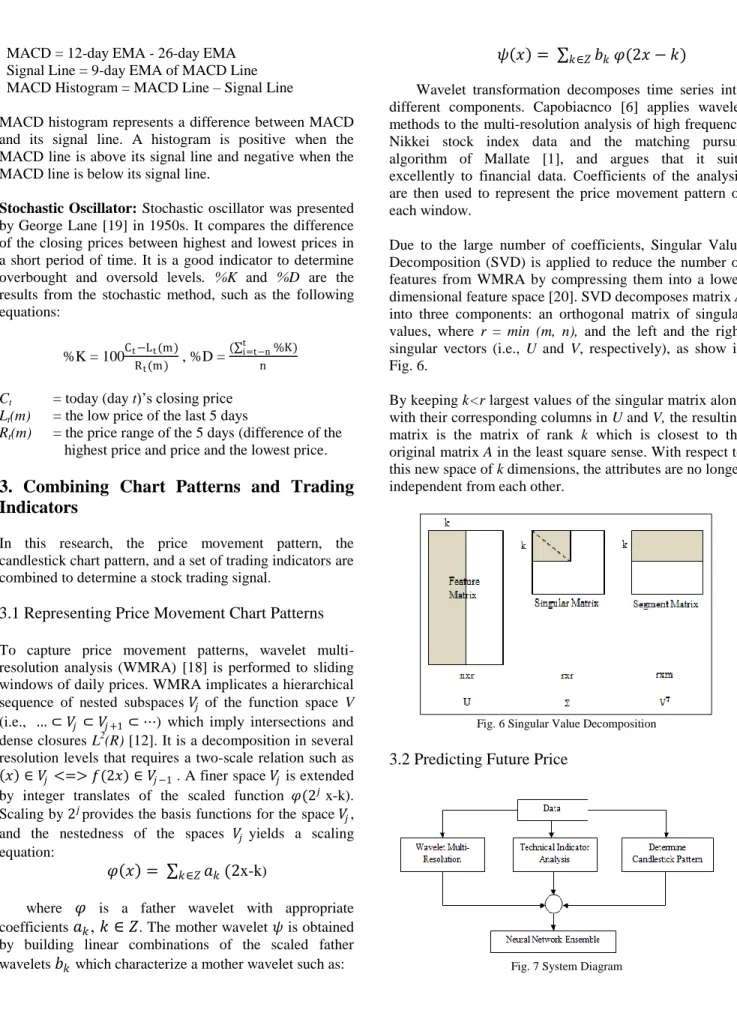
Moving Average (MA): MA is widely used because it is simple to understand and use. It sums up stock prices over an n-day period then divides it by n, MA at the current day
t can be calculated as:
MAt = 𝑃𝑡+𝑃𝑡−1+⋯+𝑃1−𝑛 +1 𝑛 = 𝑃𝑡−𝑖+1 𝑛 𝑖=1 𝑛 , n
i. Exponential Moving Average (EMA): EMA was a type of moving average that is similar to the simple moving average, except the average is weighted to place the emphasis on the most recent price action.EMAt= EMAt−1+ SF(Pt− EMAt−1)
where 𝐸𝑀𝐴𝑡 is EMA of the current day t, 𝐸𝑀𝐴𝑡−1 is
EMA of the previous day, 𝑆𝐹 is the smoothing factor, and 𝑃𝑡 is the current price, and n is the number of days. Relative Strength Index (RSI): RSI was invented by Welles Wilder [19] It is a calculation of the total number of days at a higher price multiplied by the price change, compared with the sum of the absolute values of price changes. It can be calculated as:
RSI = 100
-
(
100 1−𝑅𝑆)
= 100(
𝑅𝑆 1+𝑅𝑆)
; RS = 𝐴𝑈 𝐴𝐷where AU is the total upward price change during the past
n days, and AD is the total downward price change during the past n days
Bollinger Band (BB): BB is developed by John Bolinger [19]. It is a technical tool to show the state of the market. It is a signal that moves around the moving average line.
Middle Band = 20-day MA
Upper Band = 20-day MA + ( 20-day standard deviation of price x 2)
Lower Band = 20-day MA – (20-day standard deviation of price x 2)
On Balance Volume (OBV): OBV shows a correlation that includes the amount of volume coming with a price change, multiplied by the sum of the turnover, compared to the total volume in the period. The result will be either positive or negative because price changes may increase or decrease, depending on the product of the volume of the day. OBV (t, n) = 𝑠𝑖𝑔𝑛 𝐶 𝑡−𝑖 −𝐶 𝑡−𝑖−1 𝑥 𝑉(𝑡−𝑖) 𝑛 −1 𝑖=0 𝑉(𝑡−𝑖) 𝑛 −1 𝑖=0
sign c
t−i− c
t−i−1= {
1 ,if Positive number−1 ,if Negative number
}
where sign is a function that returns the sign of its argument (1 for a positive number and -1 for a negative number), V(t) is the volume of the day t, ct is today’s
closing price, and n is numbers of days in a period.
Moving Average Convergence Divergence (MACD):
MACD suggests trends of overbought, oversold, and divergence. Overbought is a state of a very mature uptrend, and oversold is a state of saturated sales. MACD is calculated by the difference between two EMA lines where one line is from a longer period of time than the other.
MACD = 12-day EMA - 26-day EMA
Signal Line = 9-day EMA of MACD Line MACD Histogram = MACD Line – Signal Line MACD histogram represents a difference between MACD and its signal line. A histogram is positive when the MACD line is above its signal line and negative when the MACD line is below its signal line.
Stochastic Oscillator: Stochastic oscillator was presented by George Lane [19] in 1950s. It compares the difference of the closing prices between highest and lowest prices in a short period of time. It is a good indicator to determine overbought and oversold levels. %K and %D are the results from the stochastic method, such as the following equations:
%K = 100Ct−Lt(m)
Rt(m) , %D =
( ti=t−n%K) n
Ct = today (day t)’s closing price
Lt(m) = the low price of the last 5 days
Rt(m) = the price range of the 5 days (difference of the
highest price and price and the lowest price.
3. Combining Chart Patterns and Trading
Indicators
In this research, the price movement pattern, the candlestick chart pattern, and a set of trading indicators are combined to determine a stock trading signal.
3.1 Representing Price Movement Chart Patterns
To capture price movement patterns, wavelet multi-resolution analysis (WMRA) [18] is performed to sliding windows of daily prices. WMRA implicates a hierarchical sequence of nested subspaces 𝑉𝑗 of the function space V
(i.e., … ⊂ 𝑉𝑗 ⊂ 𝑉𝑗 +1⊂ ⋯) which imply intersections and
dense closures L2(R) [12]. It is a decomposition in several resolution levels that requires a two-scale relation such as 𝑥 ∈ 𝑉𝑗 <=> 𝑓(2𝑥) ∈ 𝑉𝑗 −1 . A finer space 𝑉𝑗 is extended
by integer translates of the scaled function 𝜑(2𝑗x-k). Scaling by 2𝑗provides the basis functions for the space 𝑉
𝑗,
and the nestedness of the spaces 𝑉𝑗 yields a scaling
equation:
𝜑 𝑥 =
𝑘∈𝑍𝑎
𝑘(2
x-k
)
where
𝜑
is a father wavelet with appropriate coefficients𝑎
𝑘,
𝑘 ∈ 𝑍
. The mother wavelet 𝜓 is obtained by building linear combinations of the scaled father wavelets𝑏
𝑘 which characterize a mother wavelet such as:𝜓 𝑥 =
𝑘∈𝑍𝑏
𝑘𝜑(2𝑥 − 𝑘)
Wavelet transformation decomposes time series into different components. Capobiacnco [6] applies wavelet methods to the multi-resolution analysis of high frequency Nikkei stock index data and the matching pursuit algorithm of Mallate [1], and argues that it suits excellently to financial data. Coefficients of the analysis are then used to represent the price movement pattern of each window.
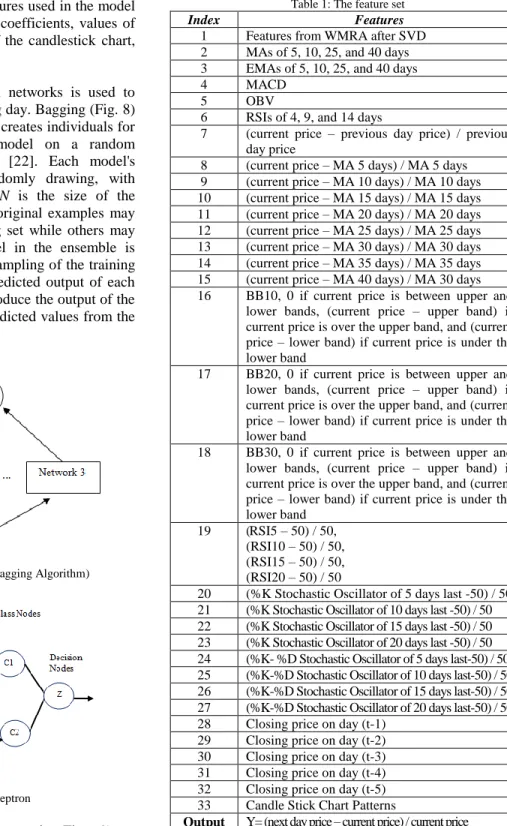
Due to the large number of coefficients, Singular Value Decomposition (SVD) is applied to reduce the number of features from WMRA by compressing them into a lower dimensional feature space [20]. SVD decomposes matrix A
into three components: an orthogonal matrix of singular values, where r = min (m, n), and the left and the right singular vectors (i.e., U and V, respectively), as show in Fig. 6.
By keeping k<r largest values of the singular matrix along with their corresponding columns in U and V, the resulting matrix is the matrix of rank k which is closest to the original matrix A in the least square sense. With respect to this new space of k dimensions, the attributes are no longer independent from each other.
Fig. 6 Singular Value Decomposition
3.2 Predicting Future Price
The process is shown in Fig. 7. Features used in the model consist of Wavelet multi-resolution coefficients, values of technical indicators, and patterns of the candlestick chart, as shown in Table 1.
A bagging ensemble of ten neural networks is used to predict the return on the next trading day. Bagging (Fig. 8) is a bootstrap ensemble method that creates individuals for its ensemble by training each model on a random redistribution of the training set [22]. Each model's training set is generated by randomly drawing, with replacement, N examples (where N is the size of the original training set). Many of the original examples may be repeated in the resulting training set while others may be left out. Each individual model in the ensemble is generated with a different random sampling of the training set. Then, for each example, the predicted output of each of these networks is combined to produce the output of the ensemble, using the mean of the predicted values from the base models.
Fig. 8 Neural Network Ensemble (Bagging Algorithm)
Fig. 9 A multilayer perceptron
A multilayer perceptron [2] (shown in Fig. 9), a mathematical model for information processing, is used as a base model. Thirty percent of the training data is held as the validation set to prevent over fitting.
Table 1: The feature set
Index Features
1 Features from WMRA after SVD 2 MAs of 5, 10, 25, and 40 days 3 EMAs of 5, 10, 25, and 40 days
4 MACD
5 OBV
6 RSIs of 4, 9, and 14 days
7 (current price – previous day price) / previous day price
8 (current price – MA 5 days) / MA 5 days 9 (current price – MA 10 days) / MA 10 days 10 (current price – MA 15 days) / MA 15 days 11 (current price – MA 20 days) / MA 20 days 12 (current price – MA 25 days) / MA 25 days 13 (current price – MA 30 days) / MA 30 days 14 (current price – MA 35 days) / MA 35 days 15 (current price – MA 40 days) / MA 30 days 16 BB10, 0 if current price is between upper and
lower bands, (current price – upper band) if current price is over the upper band, and (current price – lower band) if current price is under the lower band
17 BB20, 0 if current price is between upper and lower bands, (current price – upper band) if current price is over the upper band, and (current price – lower band) if current price is under the lower band
18 BB30, 0 if current price is between upper and lower bands, (current price – upper band) if current price is over the upper band, and (current price – lower band) if current price is under the lower band
19 (RSI5 – 50) / 50, (RSI10 – 50) / 50, (RSI15 – 50) / 50, (RSI20 – 50) / 50
20 (%K Stochastic Oscillator of 5 days last -50) / 50 21 (%K Stochastic Oscillator of 10 days last -50) / 50 22 (%K Stochastic Oscillator of 15 days last -50) / 50 23 (%K Stochastic Oscillator of 20 days last -50) / 50 24 (%K- %D Stochastic Oscillator of 5 days last-50) / 50 25 (%K-%D Stochastic Oscillator of 10 days last-50) / 50 26 (%K-%D Stochastic Oscillator of 15 days last-50) / 50 27 (%K-%D Stochastic Oscillator of 20 days last-50) / 50 28 Closing price on day (t-1)
29 Closing price on day (t-2) 30 Closing price on day (t-3) 31 Closing price on day (t-4) 32 Closing price on day (t-5) 33 Candle Stick Chart Patterns
Output Y= (next day price – current price) / current price
4. Experimental Results
The data used in the experiments is the historical data of 5 individual stocks (shown in Table 2) from different industries in Stock Exchange of Thailand, between 2002 and 2011, which consist of Charoen Pokphand Foods
(CPF), Land and Houses Public Company Limited (LH), Petroleum Authority of Thailand (PTT), Siam Commercial Bank (SCB), and The Siam Cement Public Company Limited (SCC). Each stock data is divided into training and testing data, as shown in Table 3.
Table 2: The stocks used in the experiments
Stock Industry
Charoen Pokphand Foods (CP F)
Food and Beverage Land and Houses Public Company
Limited (LH)
Property Development Petroleum Authority of Thailand
(PTT)
Energy and Utilities Siam Commercial Bank (SCB) Banking
Siam Cement Public Company Limited (SCC)
Construction Materials
Table 3: Training and testing data
Training Data Testing Data
2003-2007 2008
2004-2008 2009
2005-2009 2010
2006-2010 2011
For trading simulation, we begin with cash of 10,000 Baths. A buy signal is generated when the predicted return
(Y) is greater than 0.2%, and a sell signal is generated when the predicted return is less than 0%. With a buy signal, all available cash is used to buy the stock at the opening price of the next trading day. With a sell signal, all stocks in position are sold at the opening price of the next trading day. At the end of a simulation period, all stocks are sold, the cash from selling is combined with the cash in hand to calculate the final profit or loss.
Table 4: Profit rates of CPF
Trading Method 2008 2009 2010 2011 Proposed method 33.06 271.72 184.03 41.92 Combination of indicators -12.95 67.86 90.20 33.91 B/H -32.8 256.25 119.34 31.48 MA5 1.79 116.19 61.01 11.74 MA15 7.84 253.01 48.12 30.11 MACD 0.00 100.26 30.52 25.75 BB10 -31.30 -0.67 72.78 16.61 BB20 -29.20 8.00 5.21 21.09
Table 5: Profit rates of LH
Trading Method 2008 2009 2010 2011 Proposed method -3.08 81.70 24.95 -12.87 Combination of indicators -53.20 44.42 1.83 5.32 B/H -49.59 70.57 2.38 -5.38 MA5 -9.02 18.19 -2.97 6.91 MA15 -26.11 79.35 -3.84 -1.43 MACD -31.21 44.77 12.67 9.08 BB10 -23.17 48.66 23.76 14.89 BB20 -32.31 0.43 -7.62 33.15
Table 6: Profit rates of PTT
Trading Method 2008 2009 2010 2011 Proposed method -13.14 38.70 34.24 16.04 Combination of indicators -29.18 5.96 13.33 11.73 B/H -52.52 37.40 29.20 -2.10 MA5 -17.07 -5.12 20.48 -14.21 MA15 -20.38 15.46 24.86 -5.41 MACD -29.96 20.52 9.40 -11.06 BB10 -48.84 9.93 6.05 -1.20 BB20 -30.42 1.96 34.20 3.68
Table 7: Profit rates of SCB
Trading Method 2008 2009 2010 2011 Proposed method 32.44 32.85 25.78 18.83 Combination of indicators 22.83 24.19 5.62 6.11 B/H -43.03 73.73 22.91 10.45 MA5 -25.65 38.04 -8.76 -8.18 MA15 -27.75 -5.54 -10.07 3.37 MACD -20.04 -14.13 2.39 5.17 BB10 -23.55 3.60 12.75 6.09 BB20 -4.11 7.81 8.56 16.10
Table 8: Profit rates of SCC
Trading Method 2008 2009 2010 2011 Proposed method -4.74 173.59 41.96 21.91 Combination of indicators -38.98 34.08 32.41 24.61 B/H -55.47 127.30 44.94 -8.41 MA5 -20.86 125.02 -0.58 8.67 MA15 -7.79 68.61 14.13 19.31 MACD -44.59 30.6 10.74 18.10 BB10 -51.64 58.96 42.88 9.27 BB20 -50.85 21.04 31.74 4.05
The proposed technique is compared with 7 other trading methods. Six methods consist of: Buy-and-hold (B/H), Moving average of 5 past days (MA5), Moving average of 15 past 15 days (MA15), Moving average convergence
divergence (MACD), Bollinger band of 10 days (BB_10), Bollinger band of 20 days (BB_20). The combination of indicators method, which is similar the proposed method, but only indicators are used as features, is included to study the effectiveness of chart patterns in the prediction. The results are shown in Table 4 to 8. Results of CPF (Table 4) show that in the proposed technique outperform all other method, including in the year 2009 where the stock price of CPF increases abnormally from 3.2 Baht at the beginning to 10.8 Baht at the end of the year.
The results of LH (Table 5) show that the proposed method performs better than do the rest of the techniques in 3 out of 4 periods. However, in 2011 it yields less profit than do all other methods.
The results of PTT (Table 6) show that the proposed method performs better than the rest of the techniques in every period.
The results of SCB (Table 7) show that the proposed method performs better than other methods in 3 out of 4 periods. In 2009, the technique gives less profit than does B/H, and slightly less profit than does MA5.
The results of SCC (Table 8) show that the proposed technique performs better than other methods in 3 out of 4 periods. In 2010, the technique yields 2.98% less than does B/H.
In general, we can see that the proposed technique performs well in comparison with other trading methods, across multiple stocks and trading periods. In addition, the fact that the proposed method perform better than the combination of only indicators suggests that chart patterns help improve the performance from using indicators alone.
5. Summary
Investing in the stock market is highly challenging. Using the right tools to assist trading is very important for successful technical trading. In this article, price movement patterns, candlestick chart patterns, and popular technical trading indicators are combined to determine stock buying and selling signals. A neural network ensemble is used to combine all evidences and generate predicted return on the next trading day which will then be used to signal buying or selling of stocks. Experimental results on five stocks from different industries show that the proposed technique of combining chart patterns and indicators generally outperforms the use of traditional trading methods based on indicators, across multiple stocks and time periods.
References
[1] A. Ajith, N. Baikunth, and P. Mahanti K., “Hybrid Intelligent System for Stock Market Analysis”, Springer-Verlag Berlin Heidelberg 2001, LNCS 2074, 2001, pp 337-345.
[2] A. Hojjat, and J. Xiaomo, “Dynamic Fuzzy Wavelet Neural Network Model for Structural System Identification”, Journal of Structural Engineering, 2006.
[3] B. Feng, K. Raymond W.M., and L. James N.K., “Chart Patterns Recognition and Forecast Using Wavelet and Radial Basis Function Network”, 2004, pp. 564-571. [4] B. Thomas N., Encyclopedia of Chart Patterns, John Wiley
& Sons, 2000.
[5] C. Bernard K.-S., C. Man-Chung, T. Gordon Y.-N., and W. Chi-Cheong, W.F. Tse, “Artificial Intelligence in Portfolio Management”, Lecture Notes in Computer Science, Vol 2412, 2002, pp 403-409.
[6] C. Enrico, Multiscale analysis of stock index return volatility, Computational Ecnomics 23, 2004, pp 219-237 [7] C. Ian, and S. Andrew, “Neural Networks Financial Trading
and the Efficient Markets Hypothesis”, Twenty-Fifth Australasian Computer Science Conference, Vol. 4, pp. 241-249.
[8] C. Richard, D. Dominik, F. Barry, J. Marwan A., and Z. Bai-Ling, “Multiresolution Forecasting for Futures Trading Using Wavelet Decompositions”, IEEE Transaction on neural networks, 2001.
[9] C. Ruqing, and Y. Jinshou, “An Improveed Bagging Neural Network Ensemble Algorithm and Its Application”, Third International Conference on Natural Computation (ICNC 2007), IEEE, 2007
[10]F. Gavin, T. Clarence, and V. Bruce J., “Applying Fundamental Analysis and Neural network in the Australian Stock market”, International conference on Artificial Intelligence in Science and Technology, 2004.
[11]H. Jingle, H. Kotaro, I. Yoshihiro, M. Shingo, and Y. Tokiyo, “Trading Rules on the Stock Markets using Genetic Network Programming with Candlestick Chart”, 2006 IEEE Congress on Evolution Computation, Canada, 2006. [12]H. Kumar P., K.B. Prashanth, T. Nirmala, and S.Basavaraj
patil, Neuro Fuzzy based Techniques for Predicting Stock Trends, IJCSI International Journal of Computer Science Issue, Vol.9, Issue 4, No 3, July 2012.
[13]J. Peifa, S. Yixu, W. Qinghua, and Y. Zehong, “Automatic Stock Decision Support System Based On Box Theory and SVM Algorithm”, Expert Systems with Applications 37 (2010), 2010.
[14]L. Jae K, and T. Robert R., Artificial Intelligence in Finance and Investing: State-of-the-Art Technologies for Securities Selection and Portfolio Management, Mcgraw-Hill, New York 1995.
[15]L. Ramon, “Using Neural Networks to Forecast Stock Market Prices”, Department of Computer Science, University of Manitoba, 1997.
[16]M. Kevin, Chart Patterns Trader Supplement Understanding and Trading Classic Chart Patterns, 2012, pp 48.
[17]M. Stephane, A Wavelet Tour of Signal Processing, Academic Press, 1999.
[18]M. Yves, Wavelets and operators, Cambridge University, Cambridge, 1992.
[19]S. Alex J., and S. Bernhard, A Tutorial on support vector regression, Kluwer Academic Publishers, 2004.
[20]S. Ohm, and G. Kornnika, “An Automatic Text Summarization Approach using Content-Based and Graph-Based Characteristics”, IEEE, 2006.
[21]S. Sameer, “Pattern Modeling in Time-Series Forecasting”, Cybernetics and Systems-An International Journal, Vol. 31, No. 1, 2000.
[22]Z. Zhi-Hua, W.Jianxin, and T.Wei, “Ensembling Neural Networks: Many Could Be Better than All”, Artificial Intelligence, Elsevier, Vol. 137, 2002, pp.239-263.
Chalothon Chootong is an instructor at the Department of Computer Science, Kasetsart University, Thailand. She holds an M.S. in Computer Science from National Institute of Development Administration (NIDA) and a B.S. in Computer Science from Kasetsart University. Her main research interests include data mining, information retrieval, mobile application, and relate areas.
Ohm Sornil is an Assistant Professor at the Department of
Computer Science, National Institute of Development
Administration, Thailand. He holds a Ph.D. in Computer Science from Virginia Tech, an M.S. in Computer Science from Syracuse University, an M.B.A. in Finance from Mahidol University, and a B.Eng. in Electrical Engineering from Kasetsart University. His main research interests include computer and network security, artificial intelligence, information retrieval, data mining, and related areas.