107406-3535 IJECS-IJENS © December 2010 IJENS
Developing a Reputation Model for Electronic Markets
Nagwa E. Elgohary
1, Ahmed A.Elfetouh
2, Shereif I.Barakat
31[email protected] , 2[email protected], 3[email protected] Mansoura University, Faculty of Computer Science & Information Systems, Egypt
Abstract
-
In multiagent electronic markets buyer agents would benefit by modeling the reputation of seller agents, in order to make effective decisions about which agents to trust. A major weakness of electronic markets is the raised level of risk associated with the loss of the notions of trust and reputation. In this paper we develop a trustworthy model of selling agents in multi-agent based electronic marketplaces (buyers and sellers), first allowing a buyer to model the private and public reputation of an mentor (other buyers have previous experience with sellers and put reputation rates about them, the buyer use their rates as an advice ) based on their ratings for sellers then flexibly weight the private and public reputation into one combined measure of the trustworthy of the mentor; all buyers can play the role of mentors to other buyers, mentors provide ratings only when a transaction occurs. We assume a marketplace where sellers are offering similar kinds of goods. Experimental results show that the approach can effectively model trustworthy of buyers.Index Term-- Trust, Reputation, Buyer/Seller agents, Trustworthy, E-Markets, Multiagent, Mentor, Unfaithful.
1. INTRODUCTION
As the institutions of electronic commerce become increasingly popular, worldwide, important challenge that arises is to ensure that organizations participating in e-commerce have sufficient trust in order to bring their businesses on line.
In the Electronic Markets (E-Markets), intelligent agents that are reactive, proactive and social, will become the major players. These intelligent agents will search for good deals, evaluate the trustworthy of the trading partners, negotiate with potential business partners and eventually provide advice on, or even make decisions on, transactions for their human principals. This will dramatically reduce their human principals’ online shopping burden. Trust and Reputation (T&R) systems are developed to evaluate the credibility of the participants in order to predict their trustworthy in future actions.
In this paper, we discuss a problem that occurs when buyer agents put opinions about seller agents from other buyer agents in the market. In an agent based electronic markets, they interact to achieve their goals. Sellers sell products to buyers and try to maximize their profit. An agent must decide how best to act so as to achieve its goals. He determines if a buyer should put his trust on a seller to perform a given task. Buyers try to acquire the highest quality product at the lowest
price possible. The utility for the buyers is defined as: Ubuyer= quality/price [1].
A trust and reputation technique provides important control in e-markets. They represent a significant trend in decision support for Internet mediated service provision. The basic idea is to let parties rate each other. Agents assessment each other's reputation according to those ratings and choose the most reputable ones to interact with. However, a reputation system may be fooled by unfair ratings for an agent's personal gain.
Dellarocas [2] divided dishonest ratings as dishonest high/low ratings. Dishonest high ratings may be used to increase provider (buyer/seller) agents’ reputations. Dishonest low ratings of a provider may be provided by consumer agents who cooperate with other provider agents to drive them out of the system. The eBay system only allows agents to provide ratings after their transactions have succeeded it also add a cost for each transaction. However, this approach still cannot stop fraudulent attempts [3].
BRS [3] uses the beta probability density function to aggregate the ratings of the seller provided by the buyer and many mentor agents.
The Bayesian network model [7] updates a Bayesian network of the seller's trustworthy based on the buyer's direct dealing with the seller and opinions provided by mentors that have previous knowledge with the seller.
The TRAVOS model [6] provides a method for estimating the trustworthy of the seller based on the buyer's personal experience with the seller and a method for estimating the reputation of the seller by aggregating mentors' advice.
We develop an approach that addresses unfaith ratings with more flexibility for buyers to weight the value of their private and public knowledge of mentors.
Experiments carried out to explain the effective value of the model in adjusting mentor agents’ trustworthy based on the percentages of unfaith ratings they provided, also show how buyers can effectively model trustworthy of sellers, making use of mentors’ models created through the model.
2. RELATED WORK
Trust helps in reducing uncertainty in interactions in open distributed systems. Ramchurn et. al. [20] examines the role of trust in multi agent systems. They conceptualize trust in two ways; system level and individual level trust.
Gehao et. al. [17] review the benefits of introducing trust and reputation into multi-agent system include (trust can eliminate much of unnecessary communications, an agent can make decision easier based upon the evaluation of the trustworthy of another agent, Trust is a kind of soft security) .Different models have been developed for filtering unfaithful ratings [2, 3,5,6,7 and 8] those are used in different reputation systems (centralized and decentralized). These models are mathematically based on algebraic summation and obvious statistical conclusions through counting the success or failure of transactions toward the base agents which called computational trust.
Jǿsang et. al.[9] categorized trust and reputation models in two dimensions:
Public versus Private When a buyer agent lacks personal knowledge with a seller agent, it cans assessment the reputation of the seller agent based on collected ratings of the seller agent provided by mentor agents. A model of filtering dishonest ratings is private if the consumer agent assessments the trustworthy of a mentor agent based on only its personal knowledge with previous ratings provided by the mentor agent.
Global versus Local the model is local if it removed dishonest reputation based on only the ratings for the current seller agent. The model of filtering dishonest reputations is considered as global if it assessments the trustworthy of a mentor agent based on ratings for all the seller agents that the mentor agent has rated.
There are four capabilities that any effective model should have which reviewed in [1, 18]:
Majority: coping with unfaithful ratings even when the majority of the ratings of a seller are unfaithful.
Flooding : the situation where mentors may provide a large number of ratings within a short period of time.
Lack (of Experience): any model should still be effective even when buyers do not have much experience with sellers.
Varying : dealing with the changes of selling agents' behavior, so; buying agents may provide different ratings for the same seller.
In the following section we present a development model that filtering unfaith ratings provided by buyers by computing trustworthy of both buyers and sellers.
We assume that all buyers can play the role of mentors to other buyers, and provide ratings only when a transaction occurs, we also assume a marketplace where sellers are offering similar kinds of goods.
3. THE DEVELOPMENT MODEL
The models used in centralized reputation systems, such as Iterated Filtering, Cluster Filtering and GM-GC, did’nt consider buyer agents' personal experience with advice provided by mentors [1]. However, it is very important for estimating trustworthy of mentors because agents tend to trust their own experience more than others' opinions.
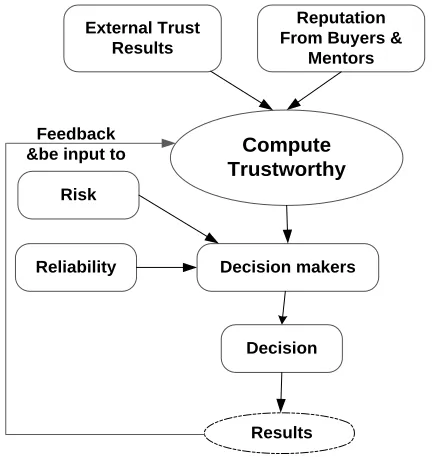
Risk and trust are two tools for making decisions in an uncertain environment ,these two indicators only have semantics in the context of a decision that an agent (buyer agent) is taking [16].The probability success of transactions is used as a measure of trust which called reliability trust. The decision surface which defines an agent’s risk attitude is then taken into account in order to derive a more complete definition of trust; the decision trust .Fig (1)illustrates how the decision of trustworthy is made under the concerns from trust/reputation, reliability and risk.
Compute Trustworthy
Results
Reputation From Buyers &
Mentors External Trust
Results
Risk
Reliability Decision makers
Decision Feedback
&be input to
Fig. 1. decisions using trustworthy models
Fig (1) represents how trust and reputation model used in taking buying decisions, where first agents carry out external results, trust from reputation buyers and mentors and results of decisions. Those trusts lead to the generation, increasing or decreasing of trustworthy. Next agents use to take decisions. The decision making process combines the previous trustworthy, risk and reliability evaluation. The output decisions will become the input of next trustworthy process.
107406-3535 IJECS-IJENS © December 2010 IJENS The buyer’s goal is to purchase from a seller who will maximize
its valuation of the product, and avoid interactions with dishonest or poor quality sellers in the market.
Each buyer has a file to record his ratings for each seller it has rated. It allows a buyer to assessment the reputation (private reputation) of a mentor based on their ratings for commonly rated sellers. If a mentor agents trustworthy and has similar preferences with the buyer agent, the buyer and mentor will likely have many ratings in common.
Figure (2) represents the buying and selling processes, and the communications between buyers, sellers and the central server. Seller agents join the market by registering with the Central server (provider); informing it of the products they are offering and their prices. They also notify him before exiting the market by un-registering. The provider sends each buyer a fixed number of other buyers have previous interaction with the sellers (mentors), which the buyer can trust and ask advice about sellers’ trustworthy.
A buyer that wants to purchase product sends a request to the provider, the seller answer buyer if he isn’t a member to register, then the buyer receive from the provider a list of sellers interested in selling, the buyer acquire seller’s participation, The provider sends each buyer a fixed number of other buyers have previous interaction with the sellers ( called mentors), which the buyer can trust and ask advice about sellers’ trustworthy .While evaluating sellers for purchase decisions, a buyer sends ask messages to mentors requesting for seller information. Mentors respond via tell messages containing information about sellers, we model the buyer trust value of another buyers (mentors) then model the seller trustworthy which discussed next.
The seller allowed to bid, and the buyer put his reputation depending on the mentors advice, then the seller deliver product (or not), finally the buyer rating registered.
Seller Buyer Central Server
Request for a product
Forward the Request Register to
Participate
Sellers allowed to bid
Allow to bid
Submit a bid
Deliver product (or not)
Acquire Seller’s Ratings
Acquire Buyer’s Ratings
Register a rating
Buyer
Ask /
Tell Ask /
Tell
Ask / Order/ Deliver Mentor
Fig. 2. Buying and Selling Processes
The Buyers trustworthy Model:
The buyer model allows a buyer to assessment the private reputation (based on the buyer's own experience with the mentor's advice, and is not shared with the public), When the buyer has limited knowledge of the seller, the public reputation of the mentor will also be considered (called public reputation because it is based on the public's opinions about the mentor's advice, and it is shared by all of the public [10].
We define the rating pair (rm,si; rb,si) as a positive rating pair if rm,si is the same value as rb,si. We assume that rb,si is provided within the time window Tb and rm,si is within the time window Tm. We define Rsi as the sum of the weights of all rating pairs
for si. The sum of weights Rsum of all rating pairs for sellers
rated by both the buyer and the mentor will then be calculated as follows:
Rsum =
n
i1
Rsi (1)
We define Rp as the sum of the weights of all positive rating pairs for all rated sellers, the number of negative pairs will be
Rn = Rsum - Rp
then calculate the weight of the rating pair, as follows:
Q= λTm-Tb
Where λ is a forgetting factor and (0 ≤ λ ≤ 1); (a concept used by BRS [3]).
According to (BRS [3] and TRAVOS [6]), the private reputation of mentor m can be calculated as follows:
Reppri (m) = E(Pro(m))
=
where
+
= Rp + 1 ,
= Rn + 1 (2)Where Pro (m) is the probability that m will provide faithful ratings to buyer b, and E (Pro (m)) is the expected value of the probability. When there are not enough rating pairs, the buyer b will also consider the mentor m’s public reputation. This may happen in large marketplaces where buyers and mentors may not have had experience with the same sellers.
The public reputation of m is estimated based on its ratings and ratings from other buyers for the same sellers rated by m. Each time mentor m provides a rating rm,s for any seller s, the rating will be judged as a consistent or inconsistent rating. Suppose that the mentor m provides Rsumm ratings in total. If
there are Rc consistent ratings, the number of inconsistent ratings provided by mentor m will be
Ric =
m sum
R - Rc.
In a similar way as estimating the private reputation, the public reputation of the mentor m is estimated as the probability that mentor m will provide consistent ratings. It can be calculated as follows:
Reppub(m) =
mwhere
m+
m
m = Rc + 1 ,
m = Ric + 1 (3)It’s clearly that the greater the percentage of consistent ratings mentor m provides, the more reputable will be considered.
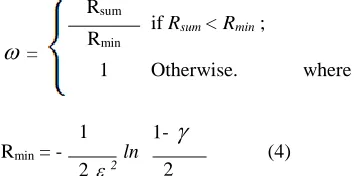
To compute the trustworthy of mentor m, we combine the private and public reputation values, the private and public reputation values are assigned different weights. The weights are determined by the reliability of the estimated private reputation value as follow:
=Rsum
if Rsum < Rmin ;
Rmin
1 Otherwise. where
Rmin = - 1
ln 1-
(4)
2 2 2
Rmin: is the minimum number of rating pairs needed for buyer
b to be confident about the private reputation value of mentor m (Based on the Chernoff Bound theorem [12]),
: is the maximal level of error that will be accepted by b and
: is the level of trust buyer b would like to attain where
Є (0, 1) and
Є (0, 1)The trust value of mentor m will be calculated by combining the weighted private reputation and public reputation values as in [18]; as following:
Trust (mi) =
* Reppri(mi) + (1-
) * Reppub(mi) (5)When
= 1, the buyer relies only on private reputation, this can be used as well if the majority rating is suspect and when
=0 the buyer will depends only on public reputation .107406-3535 IJECS-IJENS © December 2010 IJENS
Set Rsun= 0;
Set Rp= 0
si in {s1,
s2,….,sm}
comparing ratings for commonly rated sellers R b,si ,R m,si:
rating r b,si
in R b,si
r m,si
corresponds
to r b,si
Checking time windows
Rsum= Rsum+ Q
r m,si = r
b,si
Rp = Rp + Q;
Calculate
Equ 2), Calculate w (Equ 4)
Set = 0; Set Rc = 0
sj in {s1,
s2,….,sn}
: mentor m 's ratings for seller sj
estimate public reputation estimate private reputation
rating r b,si
in R b,si
= + 1
r m,sj is
consistent
Rc = Rc + 1;
Calculate (Equ 3), Calculate w (Equ 4)
Trustworthy = weighted combination of
private and public reputation (Equ 5)
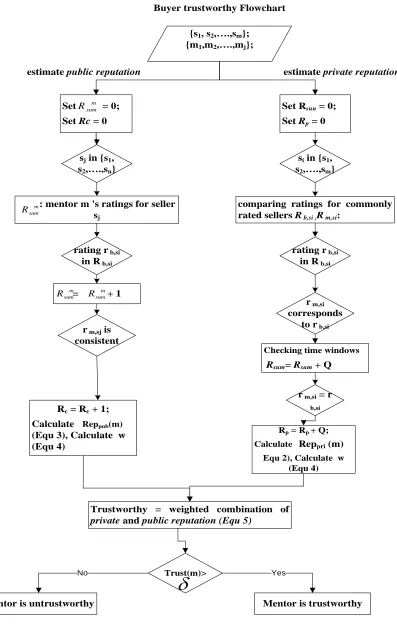
Buyer trustworthy Flowchart {s1, s2,….,sm};
{m1,m2,….,mj};
m sum
R
m sum
R
m sum
R m
sum
R
Reppub(m)
Reppri (m)
Trust(m)>
Mentor is trustworthy Mentor is untrustworthy
Yes No
The mentor will be considered trustee or not as follow:
Mentor trustworthy if Trust (m)>
; Mentoruntrustworthy
Otherwise where
Where
is a threshold value determined by the buyer (6)After determining the reputable mentors, the buyer takes their
advice about the sellers who trust and take the buying
decisions, then sending it to the central server to complete the
purchase process.
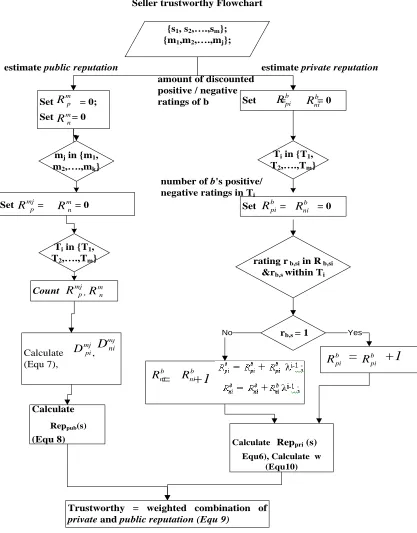
The Seller trustworthy model:
Trustworthy of a seller based on the buyer’s experience with the seller, for a new buyer or a buyer without any experience with the seller, evaluation of the seller’s trustworthy is often determined by examining the ratings for the seller from other buyers. The problem of unfaithful ratings may then arise.
We allow the buying agent to model the private reputation of a seller based on the buyer's own ratings for the seller. If the buyer does not want to rely fully on its personal experience with the seller, it will ask for mentors' ratings of the seller. It then can derive a public reputation of the seller from these ratings. The trustworthy of the seller will be modeled by combining the weighted private and public reputation values.
Suppose that buyer b has the rating vector Rb,s , which contains all the ratings provided by b for the seller s.
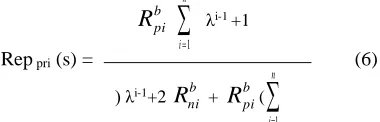
Private reputation of the seller s can be estimated through the beta family of probability density functions as follows:
(s) = pri Rep
+1 1 -i λ
n
i1
b pi
R
(6)
n
i1 (
b pi
R
+b ni
R
+2 1 -i ) λWhere
R
bpi is the number of positive ratings andR
nib is thenumber of negative ratings in each time window Ti.
Suppose that the mentor mj has provided Rm jpipositive
ratings and Rm jninegative ratings within the time window Ti , so Rmp and
m n
R are amount of all discounted positive
/negative ratings of mentors. These ratings will be discounted based on the trustworthy of the mentor according to Jǿsang [19] as follow:
(7) 2* Trust(m j)Rm jpi
mj pi
D
=(1- Trust(m j )) (Rm jni+ m j pi
R ) + 2
2* Trust(m j)Rm jni
mj ni
D
=(1- Trust(m j )) (Rm jni+ Rm jpi) + 2
Where Trust (m j) is the trustworthy of the mentor mj .
Then the public reputation of the seller s can be calculated as follows:
(8)
[
k
j n
i mj pi
D
1 1
λi-1 ]+1 Reppub(s) =
[
k
j n
i 1 1
(
D
mjpi+D
mjni) λi-1 ] +2The trustworthy of the seller s is estimated as follow:
Trust (s) =
'
* Reppri (s) + (1-
'
) * Reppub (s) (9) The weight
'
is determined as follow:'
=
b sum
R
if b sum
R < Rmin
(10) Rmin
1 Otherwise.
Where b sum
R is the sum of discocunted ratings of buyer b.
107406-3535 IJECS-IJENS © December 2010 IJENS
Set = = 0
Ti in {T1,
T2,….,Tm}
rating r b,si in R b,si
&rb,s within Ti
rb,s = 1
=
+1
Calculate
Equ6), Calculate w (Equ10)
Set = 0; Set = 0
mj in {m1,
m2,….,mk}
Set = = 0
estimate public reputation estimate private reputation
Count ,
Calculate
(Equ 8)
Trustworthy = weighted combination of
private and public reputation (Equ 9)
Seller trustworthy Flowchart {s1, s2,….,sm};
{m1,m2,….,mj};
Reppub(s)
Reppri (s)
b pi
R
bni
R
amount of discounted positive / negative ratings of b
Set = = 0
R
bpiR
nibnumber of b's positive/ negative ratings in Ti
b pi
R
b pi
R
Yes
=
+1
No
b ni
R
b niR
mp
R
m n
R
m n
R
mjp
R
Ti in {T1,
T2,….,Tm}
mj p
R
mn
R
Calculate , (Equ 7),
mj pi
D
mj ni
D
Fig. 4. seller trustworthy flowchart
Now we do our experiments (using the results -of the implemented java program-of the buyer trustworthy model) using excel spreadsheets.
4. IMPLEMENTATION
4.1. Buyer model
Experiment 1
{T1, T2, T3, and T4}. Table (I, II) lists the ratings provided by mentors and buyer bx respectively for the sellers.
Table I
Ratings of Sellers Provided by Mentors
mj m1 m2 m3
T T1 T2 T3 T4 T1 T2 T3 T4 T1 T2 T3 T4
S1 1 1 1 1 1 1 1 0 0 0 0 0
S2 1 1 1 1 1 0 1 0 0 0 0 0
S3 1 1 1 1 1 1 0 1 0 0 0 0
S4 1 1 1 1 1 0 0 1 0 0 0 0
Table II Ratings provided by buyer bx
T T1 T2 T3 T4
S1 1 1 1 1
S2 1 1 1 0
S3 1 1 0 0
S4 1 0 0 0
First we set λ to be 0, so we compare only the ratings provided by buyer bx and mentors that are within the same time windows, and set
= 0.2 ,
=0.7 which means that the trust value should be no less than 0.7 in order for the buyer to be trustee with the private reputation values of mentors. Figure (5) represents the private and public reputation of mentors, it is clear that the mentor m1 provide most consistent and therefore fair ratings, and the mentor m3 provide inconsistent ratings.Then we input different acceptable levels of errors (0.1, 0.15, 0.2), then
will be (0.17, 0.38, 0.67); according to that the trust value will be changed.figure (6) illustrate that the more errors the buyer can accept, the more confident it is with the private reputation values of mentors(
increased) , which means that the more weight the buyer will put on the private reputation values.0 0.2 0.4 0.6 0.8 1
re
puta
ti
on
v
a
lue
m1 m2 m3
Reppri (mi) Reppub (mi)
Fig. 5. private and public reputation of mentors
0 0.2 0.4 0.6 0.8 1
re
puta
ti
on
v
a
lue
e =
0.1 e =0.15 e =0.2
Trust(m1) Trust(m2) Trust(m3) w
Fig. 6. trustworthy of mentor with different ε
Experiment2
To demonstrate how the trust values of different buyers with the same mentors may vary (the private reputation changed), we consider another buyer by, which also needs to make a decision on whether to trust the information provided by a seller, the ratings provided by another buyer for the same sellers are listed in Table III, he mentors’ private reputation will be (0.9, 0.8, 0.1) respectively, the we input ε = 0.2 and γ = 0.7 and λ=0 as the first experiment so the public reputation not changed ,the results are in figure (7).
Table III Ratings provided by buyer by
T T1 T2 T3 T4
S1 1 0 1 1
S2 1 0 1 0
S3 0 1 0 1
107406-3535 IJECS-IJENS © December 2010 IJENS
0 0.2 0.4 0.6 0.8 1
re
puta
ti
on
v
a
lue
m1 m2 m3
Reppri(mi) Reppub(mi) Trust(mi)
Fig. 7. reputation values of mentors for buyer by
0 0.2 0.4 0.6 0.8 1
re
puta
ti
on
v
a
lue
m1 m2 m3
Trust(mi)By Trust (mi)Bx
Fig. 8. comparison between mentors trust values of two different buyers
It is clear from figure (8) that the trust value changed if the buyer changes his rating of the seller or if we change the seller with the same mentors.
Experiment3
To demonstrate how the forgetting factor is beneficial for buyers. In this experiment, we have one buyer B and one mentor M both have provided some ratings for the sellers Sx and Sy, as listed in Table IV We can see that the buyer B and the mentor M do not have ratings in the same time windows.
Table IV
Ratings of Sx, Sy provided by B and M
Sx Sy
T T1 T2 T3 T4 T1 T2 T3 T4
M 0 1 1 0 0 0 0 1
B 1 0 0 1 1 1 1 0
In figure (8) we set
to be 0.3and
to be 0.6, we can see that there are no ratings to be compared if we set λ to be 0 ,the Rsum will become 0 so
will be 0 ,then in trust combination there’s no dependence on private reputation . By setting λ to be higher, the buyer can be sensible about the mentor, and therefore rely more on its private knowledge of the mentor.First Rmin will be 8.9 and Tm-Tb will equal to 1, the results are represented in table V and figure (9).
Table V
Reputation values of mentor M with different values of λ
λ 0 0.5 1
Rsum 0 1.5 3
0 0.16 0.33Reppri (M) 0.5 0.8 0.875
Reppub(M) 0.8 0.8 0.8
Trust (M) 0.8 0.8 0.824
Fig. 9. Private Reputation of mentor M with different λ values
Experiment4
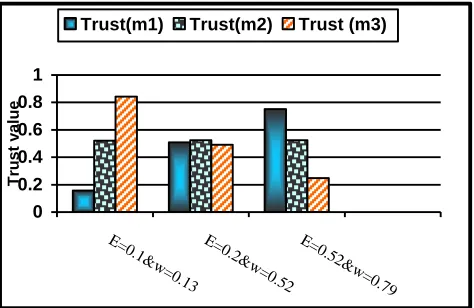
In the next case the most ratings provided by mentors are unfair with the last rating from buyer. This demonstrated on figure (10) where λ =0 and
=0.7 .0 0.2 0.4 0.6 0.8 1
E= 0.1&
w= 0.13
E= 0.2&
w= 0.52
E= 0.52&w
=0.79
Trust
v
a
lue
Trust(m1) Trust(m2) Trust (m3)
Fig. 10. trust values of mentors when majority of ratings are unfair
Experiment5
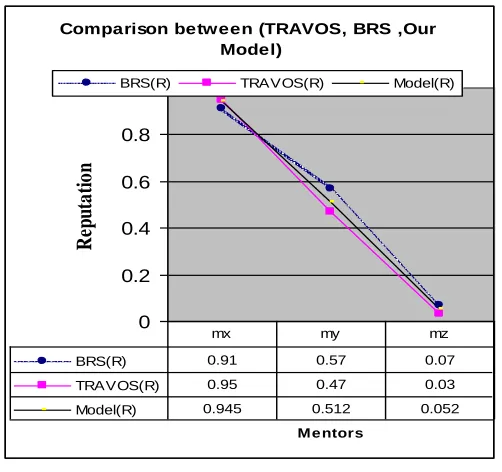
them; demonstrate that the result of our model stays between them, so it’s the best.
Comparison between (TRAVOS, BRS ,Our Model)
0 0.2 0.4 0.6 0.8 1
Me ntors
R
ep
u
ta
ti
o
n
BRS(R) TRAVOS(R) Model(R)
BRS(R) 0.91 0.57 0.07
TRAVOS(R) 0.95 0.47 0.03
Model(R) 0.945 0.512 0.052
mx my mz
Seller model
Experiment
We consider one seller in the market,
buyer b has not any experience with the seller s. so, the private reputation of scan be calculated using Equation (6) as follows:
Reppri(s) =0 + 1/((0 + 0) + 2) = 0.5
The buyer b then asks advice from mentors m1 ,m2 and m3. the previous examples show that the trust values that b has from mentors m1 ,m2 and m3 are 0.92, 0.7 and 0.074, respectively, when
= 0.2. Because m3 has a low trust value, we assume that the buyer b will consider advice from only the mentors m1 and m2.The ratings of the seller sprovided by mentors m1 and m2 represented in table VI.
Table VI
Ratings of sprovided by m1 and m2.
Ti T1 T2 T3 T4 T5
m1 0 0 0 1 1
m2 1 1 1 1 1
We set λ =0.9, then the discounted positive /negative ratings of mentors are represented in table VII
Table VII
discounted positive /negative ratings of m1 and m2
Ti T1 T2 T3 T4 T5
1 m
pi
D
1
m ni
D
0
0.927 0
0.927 0
0.927
0.927
0
0.927
0
2
m pi
D
2
m
ni
D
0.406
0
0.406
0
0.406
0
0.406
0
0.406
0
The public reputation of the seller can be calculated as
follows:
Reppub(s) = ∑5
i=1 0.92*0.9i-1 +∑5i=1 0.406*0.9i-1+1
= 0.609 ∑5
i=1 0.927*0.9i-1 +∑5i=1 0.7*0.9i-1+2
The trustworthy of the seller s calculated using Equation (9)
as follows:
Trust(s) = 0 * 0.5 + (1 - 0) * 0.609= 0.609
More experiments will done in the future work on the seller
model to represent its effectiveness and compare it with the
previous models
5. CONCLUSION
We develop an approach that addresses unfaithful ratings with more flexibility for buyers to weight the value of their private and public knowledge of mentors and sellers. Also simulate a decentralized electronic market, agents representing sellers’ offer products, also agents representing buyers purchase the products, and where the quality of the product can be found only after receiving it from a seller so the buyer must trust the seller.
Experimental results demonstrate the effectiveness of the computational trustworthy buyer model by using the combination of both private and public reputation after filtering unfaith rating; the model allow any number of sellers (with same products) ,any number of mentors with different experience. Finally, the buyer can make effective purchasing decisions, according to the most trustworthy seller under the concerns from trust/reputation, reliability and risk. In the future work more experiments will done on the seller model
107406-3535 IJECS-IJENS © December 2010 IJENS REFERENCES
[1] Wang Y., Zhang J., Vassileva J., "Super-Agent Based Reputation Management with a Practical Reward Mechanism in Decentralized Systems". Proceedings of the IFIP WG 11.11 International Conference on Trust Management, 2010.
[2] Dellarocas, C. "Immunizing online reputation reporting systems against unfair ratings and discriminatory behavior". In Proceedings of the 2nd ACM Conference onElectronic Commerce, 2000.
[3] Audun Jøsang and Roslan Ismail. The beta reputation system. In Proceedings of the Fifteenth Bled Electronic Commerce Conference, pages 324-337, 2002.
[4] A. Whitby, A. Jøsang, and J. Indulska. "Filtering out unfair ratings in bayesian reputation systems". The Icfain Journal of Management Research, pages 48{64, February 2005.
[5] M. Chen and J. P. Singh. "Computing and using reputations for internet ratings". In Proceedings of the 2nd ACM Conference on Electronic Commerce, 2001.
[6] W. T. L. Teacy, J. Patel, N. R. Jennings, and M. Luck. "Coping with inaccurate reputation sources: Experimental analysis of a probabilistic trust model". In Proceedings of 4th International AutonomousAgents and Multi Agent Systems (AAMAS 2005), 2005.
[7] Y. Wang, J. Vassileva, Bayesian network-based trust model in peer-to-peer networks, in: Proceedings of the Sixth International Workshop on Trust, Privacy, Deception and Fraud in Agent Systems, 2003, pp. 23–34. [8] S. Buchegger, J.-Y.L. Boudec, A robust reputation system for mobile ad-hoc networks, Technical Report, IC/2003/50, EPFL-IC-LCA, 2003. [9] Audun Jǿsang, Roslan Ismail, and Colin Boyd. A survey of trust and
reputation sysems for online service provision. Decision Support Systems, 43(2):618-644, 2007.
[10] J. Sabater, “Trust and Reputation for Agent Societies”, Phd Thesis, Universitat Autnoma de Barcelona, 2003.
[11] Lik Mui, Mojdeh Mohtashemi, and Ari Halberstadt. A computational model of trust and reputation. In Proceedings of the Thirty Fifth Hawaii International Conference on System Science (HICSS), pages 2431{2439, 2002.
[12] Audun Jǿsang. A logic for uncertain probabilities. International Journal of Uncertainty, Fuzziness and Knowledge-Based Systems, 9(3):279{311, 2001.
[13] Audun Jǿsang and Roslan Ismail. The beta reputation system. In Proceedings of the Fifteenth Bled Electronic Commerce Conference, pages 324-337, 2002.
[14] Bin Yu and Munindar P. Singh. Detecting deception in reputation management. In Proceedings of International Autonomous Agents and Multi Agent Systems (AAMAS), pages 73-80, 2003.
[15] Audun Jøsang , St´ephane Lo Presti .Analysing the Relationship between Risk and Trust. In Proceedings of the 2nd International Conference on Trust Management, 2004
[16] Gehao Lu, Joan Lu, Shaowen Yao and Jim Yip. A Review on Computational Trust Models for Multi-agent Systems. The Open Information Science Journal, 2009, 2, 18-25.
[17] Yao Wang ,”Trust and Reputation Management in Decentralized Systems”, Phd Thesis, University of Saskatchewan , Saskatoon,2010. [18] Audun Jǿsang. A logic for uncertain probabilities. International Journal of
Uncertainty, Fuzziness and Knowledge-Based Systems, 9(3):279-311, 2001.