Information Communication Technology as
Pedagogy for Teaching in
Some Selected Secondary Schools in Edo State, Nigeria
Osaheni Oni (CLN)1, Zainab Haruna (CLN)2 and Jane Elera Amugo3
1,2Auchi Polytechnic Library, Auchi, Edo State, Nigeria. 3
Department of Library and Information Science, Port Harcourt Polytechnic, Rumuola, Port Harcourt, Rivers State, Nigeria.
Article Received: 24 August 2017 Article Accepted: 06 September 2017 Article Published: 12 September 2017
ABSTRACT
This study attempts to assess information communication technology as pedagogy for teaching in some selected secondary schools in Edo State, Nigeria. The study employed a descriptive survey method and questionnaire was the instrument used for data collection. The total population for the study is one hundred and twenty nine (129) secondary school teachers in four selected secondary schools in Etsako west local government area of Edo state. The population of this study is not too large and as such the entire population was taken as representative sample using purposeful sampling technique. It was revealed from the study that ICT is not employed as pedagogy for teaching by majority of the teachers in the secondary schools studied, most teachers have negative attitude towards the use of ICT, a majority of the secondary school teachers studied have positive perception of perceived ease of teaching and learning with ICT and Lack of ICT facilities in secondary schools, lack of commitment from government and school management, lack of motivation and training, lack of ICT policies in secondary schools, lack of technical support from government and private sector, lack of qualified teachers to teach ICT and Teachers’ anxiety over being replaced by technology are the major factors militating against teachers readiness and effective use of ICT in secondary schools in Etsako West Local Government Area of Edo state. The study recommends that Government should be committed to full implementation of ICT in secondary schools by way of formulating policies and implementing the existing one if any with all sincerity.
Key words: Etsako, ICT, Pedagogy, Secondary schools, Teachers, Teaching, Edo state, Nigeria.
INTRODUCTION
The use of technology and how technology can support teaching and learning in secondary
schools in Nigeria have become essential in today’s world. The functions of teachers in
education process is of paramount interest especially when considering teaching and learning
process as the acquisition of knowledge and skills by individuals to enable him become useful
member of the society (Adebayo, 2008). The effective implementation of ICT in Schools is a
multifaceted complex process that does not involve only providing the technology to schools but
restructuring (Zaman, Shamim & Clement, 2011). Teachers are primary agents of educational
innovation; therefore, ICT skill among secondary school teachers should be seen as an invaluable
prerequisite that would facilitate the rapid teaching and learning procedure in this modern age of
information explosion. Abolade and Yusuf (2005) describes ICT as essential tools in any
educational system ICT have potentials of being used to meet the learning needs of individual
students, promote equality of educational opportunities, offer high quality learning material,
increase self-efficacy and independence and improve teachers professional development. Mselle
(2012) noted that, teachers are however not aware of the potentials that ICT offers in pedagogy.
Satharasinghe (2003) posited that, the use of ICT can revolutionize teaching and learning and
could bring advancement that would improve education dramatically. While Jegede (2008)
opined that ICT is now recognized as an essential ingredient for creating 21st century learning
environment.
The use of modern technological tools and devices such as computer and internet is still in its
infancy stage in most developing and emerging nations in Africa, Nigeria inclusive. However,
across Africa, many countries have started investing considerable amount of resources and
designing new policies aimed at influencing teachers to embrace the use of ICT in schools;
notwithstanding that some challenges like poor proficiency in the use of ICT was a factor
(Zaman, Shamim & Clement, 2011). The above situation is underscored by Lau and Sim (2008)
that reported that despite the benefits accrue to the use of ICT for educational purpose, many
teachers are still not fully ICT compliance. Studies have also revealed that secondary school
teachers lack proficiency skill in use of ICT as a pedagogy tools in teaching and learning
understanding, problems solving and team working skills. Realizing its importance, policy
maker and government have device many reforms and strategies to effectively implementation of
ICT in secondary schools in Nigeria and other Africa countries (Manduku, Kosgey & Sang,
2012). Despite all their effort, the implementation of ICT in schools is still not effectively
adopted to support learning and teaching as intended. Jimoyiannis and Komis (2007) observed
that most of the reforms and strategies in schools fail due to their top down approach that fails to
take into consideration teachers’ interest and skills as well as existing knowledge. Goshit (2006)
observed that, most schools both private and government, do not offer ICT training Victoria
(2013) who emphasizes that Teachers’ anxiety over being replaced by technology is a major
hindrance affecting teachers’ readiness in the use of ICT in secondary schools. Martin (2013)
argues that, the demand for ICT learning has been tremendous and the number of teachers who
are trained to teach ICT cannot meet the demand. Olulube (2006) posits that slow access to basic
ICT equipment; low internet connectivity and computers are barriers to the effective and
professional development of teachers. Oyebisi (2003) argue that the information and
communication technology in Nigeria has not attained the required height which is affecting the
use of information and communication technology in education system of the country. However,
it was observed that some studies that have been conducted on the uses of ICT by teachers were
carried out in develop countries like United Kingdom, United State of American and some Asian
countries where the use of ICTs has come of age, and where there are resource and materials to
maintain them. (Tella, Adeyinka, Adedeji, Adika & Toyobo, 2007). However, only few studies
have been carried out by scholars on information communication technology proficiency of
STATEMENT OF THE PROBLEM
Information and communication technologies (ICTs) have become key tools and had a
revolutionary impact on how we see the world and how we live in it. Etejere and Ogundele
(2008) observed that electronic information system enables the teachers, researchers, school
administrators and students to acquire, process, store and disseminate vocal, pictorial, textual and
numerical information by electronic based system. Yelland (2001) posits that, traditional
educational environments do not seem to be suitable for preparing learners to function or be
productive in the work places of today’s society. The scholar emphasized that educational
institutions that does not incorporate the use of new technologies in schools cannot seriously
claim to prepare their students for life in the twenty-first century.
It possible to bring learning beyond the boundaries of classroom by exploring the potentials ICT
is offering. One of the basic requirements for education in this era of information explosion is to
prepare learners for participation in a networked information society. Despite the numerous
benefits ICT offers educational system, Nigeria and most other developing countries are yet to
fully come to terms with the use of ICT as teaching tools in secondary schools. It is against the
background that this study attempts to assess information communication technology as
pedagogy for teaching in some selected secondary schools in Edo State, Nigeria.
OBJECTIVES OF THE STUDY
a. To examine the extent of usage of ICT as pedagogy for teaching by teacher
b. To assess teachers attitude towards the use of ICT for teaching in secondary
c. To examine teachers perception on the perceived ease of teaching and learning
with ICT.
d. To ascertain the challenges hindering teachers effective use of ICT in secondary school.
RESEARCH QUESTIONS
a. To what extent do teachers use ICT as pedagogy for teaching in secondary
schools?
b. What are teacher’s attitudes toward the use of ICT for teaching in secondary
schools?
c. What are teachers’ perception on the perceived ease of teaching and learning with
ICT in secondary schools?
d. What are the factors hindering teachers’ effective use of ICT in secondary school?
RESEARCH METHODOLOGY
This study employed descriptive survey research design to investigate information
communicationtechnology as pedagogy for teaching in some selected secondary schools in Edo
State, Nigeria.The population of this study consists of all the teachers in four selected secondary
schools in Etsako west local government area of Edo state. The total population for the study is
one hundred and twenty nine (129). The population of this study is not too large and as such the
entire population was taken as representative sample using purposive sampling techniques.
According to Patton (2002), the entire population of a study can be chosen because of size and
the particular characteristics. This study employed the questionnaire as instrument for data
collection. The questionnaire was constructed by the researchers. The questionnaire entitled
Secondary Schools in Edo State, Nigeria (ICTPTSSSQ) was used in this study. The data
obtained from the copies of questionnaire using simple descriptive analysis of frequency counts
and percentage.
RESULTS AND DISCUSSION
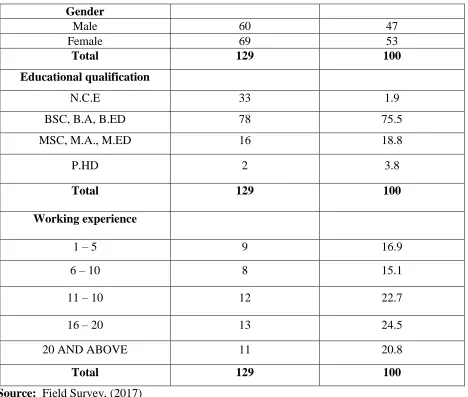
Table 1: Respondents Demographic Characteristics
Gender
Male 60 47
Female 69 53
Total 129 100
Educational qualification
N.C.E 33 1.9
BSC, B.A, B.ED 78 75.5
MSC, M.A., M.ED 16 18.8
P.HD 2 3.8
Total 129 100
Working experience
1 – 5 9 16.9
6 – 10 8 15.1
11 – 10 12 22.7
16 – 20 13 24.5
20 AND ABOVE 11 20.8
Total 129 100
Source: Field Survey, (2017)
Table shows the gender distribution of the respondents with female 33 (62.3%) and male
Secondary School, Auchi than male. The table also reveals the educational qualification of the
respondents. The majority of the respondents with 40 (75.5%) have B.Sc, B.A, Bed. This is
followed by M.Sc, M.A, M. Ed with 10 (18.5%), Ph.D. 2 (3.8%) and N.C.E 1 (1.9%). It is
obvious from the study that a majority of the teachers in the Secondary Schools studied have
commendable higher qualifications. The table also shows the working experience of the
respondents. Thus, between 16 – 20 years 13 (24.%) was rated high. This is followed by
respondents between 11- 15 with 12 (22.1%). Respondents between 20 years and above came
third with 11 (20.8%), while 9 and 8 with 16.9%) and (15.1%) was rated low. It is clear from the
table that a majority of the respondents have between 16 – 20, 11- 15 and 20 and above working
experience. This study clearly shows that the respondents studied have appreciable working
experience.
RESEARCH QUESTION ANALYSIS
Research Question one
To what extent do teachers use ICT as pedagogy for teaching in secondary schools?
Table 2: Using ICT as pedagogy for teaching in secondary school
ICT as Pedagogy No of respondents Percentage (%)
Yes
No
9
120
7
93
TOTAL 129 100
Table 2 indicate that respondents with 120 (93%) do not use ICT as pedagogy for teaching, while
16 (7%) use ICT as pedagogy for teaching in their respective secondary Schools. This findings
studied. This implies that the chalkboard and textbook continue to dominate classroom activities
in most Nigeria secondary schools.
Research Question two
What are teacher’s attitudes toward the use of ICT for teaching in secondary schools?
Table 3: Teachers’ Attitudes towards the use of ICT for Teaching in Secondary Schools
Attitude No of respondents Percentage (%)
Positive attitude 35 27
Negative attitude 69 54
Neutral 18 14
Undecided 7 5
TOTAL 129 100
Table 3 reveals that a majority of the respondents have negative attitude towards the use of ICT
for teaching with 69 (54%), 35 (27%) have positive attitude while 18 (14%) and 7(5%) for
neutral and undecided respectively. This study simply revealed that most teachers have negative
attitude towards the use of ICT hence they do not use it as pedagogy for teaching in secondary
schools.
Research Question three
What are teachers’ perception on the perceived ease of teaching and learning with ICT in
secondary schools?
Table 4: Teachers’ Perception on the Perceived ease of Teaching and Learning with ICT in
Secondary Schools
Perceptions
N
A
D
Using ICT makes it more easier to control the class activities
129 54 42 75 58
Using ICT will put more work
off the shoulders of teachers 129 87 67 42 33
ICT is a powerful tools for
teaching and learning 129 106 82 23 18
ICT will enhance the quality of
education 129 115 89 14 11
ICT will improve the
operations in the school 129 121 94 8 6
Using ICT tools in secondary school will be beneficial in teaching and learning all subjects
129
67
52
62
48Average responses and percentage of agreed is 92(71%)
Table 4 reveals teachers perception of ICT. The opinion of the respondents varies with 121(94%)
indicated ICT will improve the operations in the school. Other major perceptions of teachers
with regards to ICT are: ICT will enhance the quality of education with 115(89%), ICT is a
powerful tools for teaching and learning with 106(82%) , Using ICT will put more work off the
shoulders of teachers with 87(67%) and Using ICT tools in secondary school will be beneficial
in teaching and learning all subjects with 67(62%). It obvious from the study that ICT will
improve the operations in the school, ICT will enhance the quality of education, ICT is a
powerful tools for teaching and learning, Using ICT will put more work off the shoulders of
teachers and Using ICT tools in secondary school will be beneficial in teaching and learning all
subjects are Teachers’ perceptions of perceived ease of teaching and learning with ICT in
Secondary Schools in Etsako West Local Government Area of Edo state. The Average responses
and percentage of agreed is 92(71%). This simply implies that the secondary school teachers
studied have positive perception of the perceived ease of teaching and learning with ICT even
The findings are in agreement with Victoria (2013) that the uses of ICT in different educational
setting over the year invariably identify some hindrances to the success and the inability of
teachers to understand why they should use ICT and how exactly they can use ICT to help them
teach better.
Research Question four
What are the factors hindering teachers ‘readiness and effective use of ICT in secondary school?
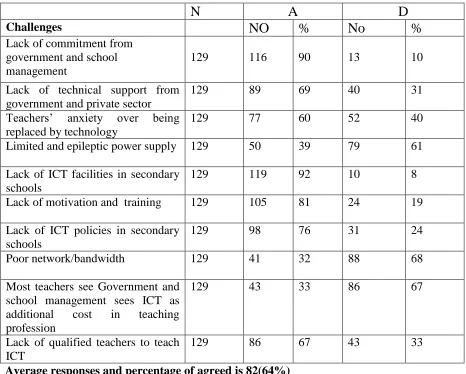
Table 4.7: Factors hindering teachers’ readiness and effective use of ICT
N
A
D
Challenges
NO
%
No
%
Lack of commitment from government and school management
129 116 90 13 10
Lack of technical support from government and private sector
129 89 69 40 31
Teachers’ anxiety over being replaced by technology
129 77 60 52 40
Limited and epileptic power supply 129 50 39 79 61
Lack of ICT facilities in secondary schools
129 119 92 10 8
Lack of motivation and training 129 105 81 24 19
Lack of ICT policies in secondary schools
129 98 76 31 24
Poor network/bandwidth 129 41 32 88 68
Most teachers see Government and school management sees ICT as additional cost in teaching profession
129 43 33 86 67
Lack of qualified teachers to teach ICT
129 86 67 43 33
Average responses and percentage of agreed is 82(64%)
Table5 reveals the factors hindering teachers’ readiness and effective use of ICT in secondary
includes Lack of ICT facilities in secondary schools with that 119 (92%), Lack of commitment
from government and school management 115 (90%), Lack of motivation and training105
(81%). Others are Lack of ICT policies in secondary schools 98(76%), Lack of technical support
from government and private sector 89(69%), Lack of qualified teachers to teach ICT 86 (67%)
and Teachers’ anxiety over being replaced by technology 77(60%). The Average responses and
percentage of agreed is 82(64%).
This an indication that Lack of ICT facilities in secondary schools, Lack of commitment from
government and school management, Lack of motivation and training, Lack of ICT policies in
secondary schools, Lack of technical support from government and private sector, Lack of
qualified teachers to teach ICT and Teachers’ anxiety over being replaced by technology are the
major factors militating against teachers readiness and effective use of ICT in secondary schools
in Etsako West Local Government Area of Edo state. These findings are in conformity with the
study of Victoria (2013) who emphasizes that Teachers’ anxiety over being replaced by
technology is a major hindrance affecting teachers’ readiness in the use of ICT in secondary
schools.
This study corroborate the study of Martin (2013) who argued that, the demand for ICT learning
has been tremendous and the number of teachers who are trained to teach ICT cannot meet the
demand. In a related development, Olulube (2006) avers that slow access to basic ICT
equipment; low internet connectivity and computers are barriers to the effective and professional
development of teachers. Goshit (2006) also observed that, most schools both private and
SUMMARY OF THE FINDINGS
Based on the result arising from the data analysis the following findings were summarized in the
study.
i. The study reveals that ICT is not employed for teaching by majority of the teachers in the
secondary schools studied.
ii. The study revealed that most teachers in the secondary schools studied have negative
attitude towards the use of ICT
iii. ICT will improve the operations in the school, ICT will enhance the quality of education,
ICT is a powerful tools for teaching and learning, Using ICT will put more work off the
shoulders of teachers and Using ICT tools in secondary school will be beneficial in
teaching and learning all subjects are Teachers’ perceptions of perceived ease of teaching
and learning with ICT in Secondary Schools in Etsako West Local Government Area of
Edo state.
iv. Lack of ICT facilities in secondary schools, Lack of commitment from government and
school management, Lack of motivation and training, Lack of ICT policies in secondary
schools, Lack of technical support from government and private sector, Lack of qualified
teachers to teach ICT and Teachers’ anxiety over being replaced by technology are the
major factors militating against teachers readiness and effective use of ICT in secondary
schools in Etsako West Local Government Area of Edo state.
CONCLUSION
The rapid advancement of Information and Communication Technology (ICT) has brought a
revolutionary change in every spheres of human endeavour including the educational sectors.
employed ICT for teaching. Their attitude towards ICT is poor. The perceptions of Teachers
about ICT is positive because they believe that ICT will improve the operations in the school,
ICT will enhance the quality of education, ICT is a powerful tools for teaching and learning,
using ICT will put more work off the shoulders of teachers and using ICT tools in secondary
school will be beneficial in teaching and learning all subjects. However, teachers express their
concern on some factors that militate against their readiness and effective use of ICT. These
factors are lack of ICT facilities in secondary schools, lack of commitment from government and
school management, lack of motivation and training, lack of ICT policies in secondary schools,
lack of technical support from government and private sector, lack of qualified teachers to teach
ICT and Teachers’ anxiety over being replaced by technology. There is no gainsaying that ICT
have the potential to change the template of teaching and learning in secondary schools in Edo
state if only all these militating challenges are effectively address.
RECOMMENDATIONS
a. Government and school authority should ensure the provision of basic and
adequate ICT facilities in secondary schools.
b. Government should be committed to full implementation of ICT in secondary
schools by way formulating policies and implementing the existing one if any
with all sincerity.
c.
The school management should deem it necessary to always organize training andretraining programme for their teachers in order to expose them to the use of
d. Teachers should try as much as possible to improve on their information and
communication technology usage by embarking on personal development in order
to overcome the negative effect of technology
e. The school management should ensure that an ICT skill is a sine-qua-non for
recruitment of teachers in secondary schools.
REFERENCES
Abolade, A. O. & Yusuf, M. O. (2005); Information and Communication Technologies (ICTs) and the Nigeria Teacher Education Program. African Journal of Educational Studies, 3(1), 1-9.
Adebayo, F. O. (2008); Usage and Challenges of Information Technology (ICT) in Teaching and Learning in Nigerian Universities.Asian Journal of Information Technology 7 (7): 290 – 295 Etejere, P. A. O. & Ogundele, M. O. (2008).Information and Communication Technology and Administrative Effectiveness of Nigeria Distance Education. Journal of National association of Education Administration and Planning 8(2), 135 – 144.
Goshit, T. (2006) Nigeria’s Need for ICT: SP. 259 Technology and Policy in Africa.
Jegede, P. O. (2008) ICT attitudinal Characteristics and use level of Nigeria Teachers Issues in Information Science and Information Technology. Institute of Education, Obafemi Awolowo University Ile – Ife, Nigeria. 5.
Jimoyiannis, A. & Komirs, V. (2007) Examining teachers beliefs about ICT in Education: Implications of a teacher Preparation Program, teacher Development. An International Journal
of Teachers Professional Development, 11 (2) 149 – 173.
Lau, B. T & Sim, C. H (2008). Exploring the Extent of ICT Adoption among secondary school
teachers in Malaysia. International Journal of Computing and Research, 2 (2)
Manduku, J. Kosgey, A & Sang, H. (2011); Adoption and Use of ICT in Enhancing Management of Public Secondary School: A Survey of Kesses Zone secondary school in Wareng District of Wasin Gishu Country, Kenya.
Martin, M. (2013). Expertise Insustainable ICTs for the Developing World: 12 Challenges Facing Computer Education. Kenya.
Nihuka, K. A. & Voogt, J. (2011). Instructors’ and Students Competence, rceptions and Access to E-learning Technologies: Implications for E-learning Implementation at the Open University of Tanzania. International Journal on E. learning, 10(1), 63 – 85.
Ololube, N. P. (2006). Teacher Education, School Effectiveness and Improvement: A Study of Academic and Professional Qualification on Teachers’ Job Effectiveness in Nigerian Secondary Schools. Doctoral Dissertation, December 2006. University of Helsinki, Faculty of Behavioural Sciences, Department of Applied Sciences of Education. Helsinki: University of Helsinki Press.
Patton, M. Q. (2002) Quantitative Research and Education Methods. Amazor Books.
Satharasinghe, A (2003) Computer Literacy of Teachers. Retrieved from http.//www.statistics.gov.ik/education/article/pdf.
Sekaran, U. (2007) Research Methods for Business and Skill Building Approach. Willey India.
Tella, A. Adeyinka, A. A., Tella, A. Toyobo, O. M, & Adika, L. O. (2007).An assessment of Secondary School Teachers uses of ICT: Implications for further Development of ICT use in Nigerian Secondary Schools. The Turkish online Journal of Education Technology, 6(3).
Victoria, E. O. (2013) The Challenges of Using ICT in Secondary School. London: Pitman Publishing.
Zaman, M. Shamim, R & Clement, K (2011) Trends and Issues to Integrate ICT in Teaching and Learning for the Future World Education, International Journal of Engineering and Technology