Energy Optimizing Hybrid Genetic Algorithm During VM
Migrations in Data Center
1
Inderjit Singh Dhanoa,
2Dr. Sawtantar Singh Khurmi
1Dept. of Computer Sciences, Desh Bhagat University, Mandi Gobindgarh, Punjab, India 2Professor, Dept. of Computer Sciences, Desh Bhagat University, Mandi Gobindgarh, Punjab, India
Abstract
Energy Consumption is the crucial factor in Cloud Data centers that leads to acquire high cost of running budget. As demand for resources increases in cloud computing, energy consumption of data centers also becomes high. In today’s era, virtualization has become one of the most essential solutions in minimization of energy consumption. Virtual Machine Placement on hosts is the main concept which carried out during Virtual Machine migrations in data centers. Virtual Machine migration helps to utilize hardware resources of hosts, but leads to extra energy overhead in Data centers. The main objective of this work is to optimize energy consumption in the context of energy overhead during VM Live Migration. Our proposed hybrid algorithm provisions various VMs to hosts in a way that to minimize energy consumption, while delivering approved Quality of Service with minimum migration overhead. Results demonstrate that proposed EOHGA algorithm minimized energy consumption and migration overhead
with defined test problems as compare to base VM Placement
method.
Keywords
Data center, Virtualization, VM Placement, Energy Consumption, Virtual Machines (VMs), Genetic Algorithm
I. Introduction
Cloud computing is gaining importance day-by-day. The large number enterprises and individuals are shifting and opting for cloud computing services. Thousands of servers have been employed worldwide to cater the needs of customers for computing services by big organizations like Amazon, Microsoft, IBM and Google. The round-the-clock reliable computational services, fault tolerance and information security are the main issues to be addressed while providing services to geographically spread customer sites [1]. Cloud computing, also known as “pay as you-go” utility model is economy driven. It becomes necessary for the service provider to ensure load balance and reliable computing services to its clients round the clock worldwide and keeping services ON means consuming power all the time to use resources [2].
To reduce power consumption of Data centers is an important issue because of large amount of electricity consumption. Mekinsey &
Company a consulting firm analyzed and stated that on an average
only 6 to 8 percentage of total datacenter electricity power is used by their servers to perform computations [3].Thus; it is desirable to minimize energy consumption in data centers to reduce overall cost.
Virtualization technology helps to consolidate multiple VMs to lesser number of hosts and improves utilization of resources to reduce energy consumption. VM consolidation can provide
significant benefits to cloud computing by facilitating better use
of the available data center resources. Server consolidation using virtualization technology has become an important technology for
improving the energy efficiency of data centers [4]. The basic idea
behind the server consolidation technology is to perform migration
of Virtual Machines (VMs) to as few energy efficient physical
machines (PMs) as possible, and then switch off all the other PMs. The underlying computational problem of the server consolidation is basically a VM selection and placement problem, which has been elaborated in previous study [5]. In the past few years, many approaches to the VM consolidation problem have been proposed [6-10]. However, existing VM consolidation approaches do not consider the energy overhead during VM migration from one host to other.
In recent research studies, we have reviewed various papers [5] and analyzed the impact of VM size, migration time and network bandwidth parameters on energy consumption of subsystems [11].
A. Beloglazov et al. [10] presented the Modified Best-Fit Decreasing (MBFD) algorithm and Minimization of Migrations
(MM), which is best-fit decreasing heuristic, for Power-aware VM
allocation and adaptive threshold-based migration algorithms to dynamic consolidation of VM resource partitions.
The remaining paper is organized as follows: Section II presents literature review of recent studies. Section III formulates the new research problem; Section IV details the Energy Optimizing Hybrid Genetic Algorithm (EOHGA); Section V evaluates the
performance of proposed genetic algorithm and finally Section
VI concludes with discussion and talk about our future work.
II. Literature Review
In the past few years, many approaches to the VM consolidation problem have been proposed [6-10]. However; exiting VM placement methods do not consider energy consumption parameter optimization during migrations using genetic Algorithms. Maolin Tang et al. [12] proposed a genetic algorithm for new VM placement problem that considers the energy consumption in both the servers and communication networks in the data centers as preliminary research. Further this study was extended to improve
the performance and efficiency of genetic algorithm. Heena
Kaushar et al. [13] aimed to analyze various VM consolidation algorithms based on various heuristics on legitimate host. Authors also presented a comparative study of various existing energy
efficient VM consolidation algorithms using real world workload
traces from more than a one thousand VMs using CloudSim
toolkit. Anton Beloglazov et al. [14] presented a survey of research in energy-efficient computing. The architectural principles for energy-efficient management of Clouds, energy-efficient resource
allocation policies and scheduling algorithms considering QoS expectations, power usage characteristics of the devices, and a number of open research challenges are addressed. This work substantially contributes to both resource providers and consumers. The approach is validated by conducting a performance evaluation
study using the CloudSim [15-16] toolkit showing significant cost
savings and demonstrates high potential for the improvement
of energy efficiency under dynamic workload scenarios. Bandi
Madhusudhan et al. [17] designed a genetic algorithm which uses previous history and current demand of Virtual Machines
algorithm to schedule the workload of a set of virtual machines (VMs) to a set of physical machines (PMs) in a datacenter. The goal was to minimize total energy consumption by considering the
conflicts between processor and disk utilizations and the costs of migrating VMs. To identify the conflicts, authors presented four
models, namely the target system model, the application model, the energy model, and the migration model. Simulative results of
proposed algorithm showed 24.9% power savings compared to other methods. Fabio Lopez Pirez et al. [19] presented an extensive
up- to-date most relevant VM consolidation literature review in order to identify research directions.
So, reducing power consumption is important and designing
energy-efficient data centers has recently received considerable
attention of research community. Energy consumption in data centers consists of two parts, including power consumed by the ICT (Information and Communications Technology) systems i.e. servers, storage and networking, and power consumed by infrastructure i.e. heating, ventilation and Air-Conditioning. Although many researchers have designed various algorithms to minimize energy consumption, but incorporation of the migration energy overhead during VM live migration with VM placement policies is very rare. Migrations through VM Placements still have enough potential to overcome the problem of energy consumption.
In this paper, we proposed Energy Optimizing Hybrid Genetic Algorithm (EOHGA) to optimize energy consumption during VM placement and VM migrations to cater extra energy overhead during migrations. Proposed Genetic Algorithm was evaluated and validated using statistical parameters.
III. Research Problem
Description of variables is given as follows: |V|=a set of Virtual Machines
|P|=a set of Physical Machines
=CPU requirement of Virtual Machines,
=CPU capacity of Physical Machine,
=CPU usage of Physical Machine,
=set of Virtual Machines allocated to
=Rate of CPU Utilization of PM,
=CPU utilization lower bound of PM,
=CPU utilization upper bound of PM,
Utilization rate of CPU is written as follows:
= (1)
As per energy consumption model given in [10], then the energy consumption of physical Machine when its CPU utilization is is given as follows:
(2)
Where k is the fraction of energy consumed when is idle; is the energy consumed when is fully utilized and is the CPU utilization rate.
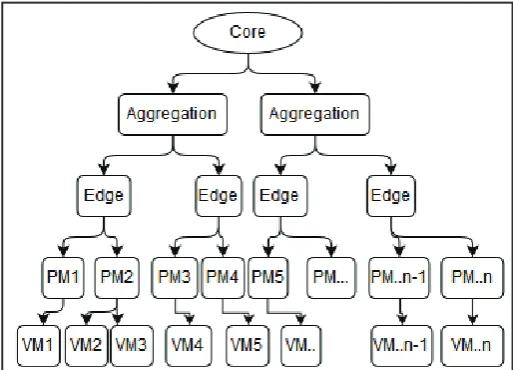
It is assumed that the communication network topology in data centers is a typical three-tier tree as shown in Fig. 1 [20]. The VMs in a data center can communicate with each other through communication devices, such as switches, with different bandwidth capacities and data, which also consume a non-trivial amount of energy. It has been shown that the energy consumption of the communication network is largely dependent on bandwidth of concerned link and data transfer [11, 21]. Thus, we use the following method to approximate the energy consumption in the communication network in the data center.
We categorize the communication between a pair of VMs into four
types. The first communication type is the communication between
a pair of VMs on the same PM. The communication between vm2
and vm3 in Fig. 1 is an instance of the first type.
Fig. 1: Communication Network of Physical Machines and Virtual Machines
The second communication type is the communication between a pair of VMs that are placed on two different PMs, but under the same edge. The communication between vm1 and vm3 in Fig. 1 is an example of the second type. The third communication type is the communication between a pair of VMs that are placed on two different PMs under different edges, but under the same
aggregation. The communication between vm3 and vm4 in Fig. 1
is an example of the third type. The fourth communication type is the communication between a pair of VMs that are placed on two different PMs under different aggregations. The communication between vm5 and vm placed on PM5 in Fig. 1 is an example of the fourth type.
Communication through these links varied with network bandwidth and size of data transferred. Therefore, the energy consumption incurred by these four types of communication links is different, as energy consumption of underlying systems varies with network bandwidth and VM size [11].
Let B1, B2, B3 and B4 be the various bandwidths defined on various communication links, Let S1, S2, S3 and S4 be the various
data sizes sent on links between VM pairs. Communication type
exits in VM pairs belong to the first, second, third and fourth,
respectively, and let
B=B1 B2 B3 B4 (3)
S=S1 S2 S3 S4 (4)
Energy consumption for transferring data through these links is
e (b,s)= (5)
Let be the power consumed by underlying systems with data transfer s amount of data with bandwidth b during live migration, be the power consumed by underlying systems with data transfer s amount of data with bandwidth b before start of live migration.
Then, the energy consumption for transferring s units of data through bandwidth b on various links is given below:
(6)
is the live migration time duration from source machine to destination machine through various links. Then, Virtual Machine Placement problem to assign VMs to physical Machines with minimized energy consumption and migrations is formulated as follows:
+ (7)
subject to the constraints
(8)
(9)
(10)
IV. Energy Optimizing Hybrid Genetic Algorithm
It is assumed that every physical machine can host any virtual machine, and its power consumption model is proportional to resource utilization, e.g. power consumption has a linear relationship with resource utilization (e.g. CPU utilization) [10, 22-23].
The objective of study is to optimize energy consumption of underlying systems during VM live migrations and placement of VMs on hosts with lesser number of migrations to overcome the energy overhead. To achieve the objective of study, Genetic
Algorithm theory [24] was used to design solution of the formulated
problem. This section discusses in detail Encoding scheme, genetic
operators and fitness function of Genetic Algorithm along with
description of proposed Hybrid Genetic Algorithm. Then, results of proposed algorithm were compared with latest algorithm [10] named as Base Algorithm.
A. Encoding Scheme
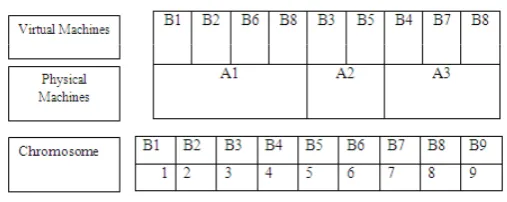
Genetic Algorithm consists of various numbers of chromosomes and each chromosome has various genes that can be represented as |B| that denotes to the Virtual Machine. If a gene has positive integer value between 1 and |A| where |A| denotes the Physical Machines on which VMs are to be allocated. Following Figure shows the placement of Virtual Machines in accordance with each chromosome.
Fig. 2: Virtual Machine Allocation and its Chromosomes
B. Crossover Operator
Since the length of chromosome is potentially long, linkage is a potential problem that should be considered. Because of this consideration, the Genetic Algorithm adopts a biased uniform crossover operator, which is described in Algorithm 1.
Algorithm 1: Uniform Crossover
Input: Parent Chromosomes,
Output: Single Child,
1: 2:
3: for s=1 to n do
4: Generate a number from 0 to 1, t
5: if then
6:
7: Else
8:
9: End
10: End loop 11: Output
C. Mutation Operator
Mutation operator work by arbitrarily collecting a gene from the collection of chromosomes and then reverse its value. Below algorithm 2 shows the mutation working:
Algorithm 2:Mutation
Input: Chromosomes, P Output: Mutated , 1:
2: Generate randomly VM , 3: Generate randomly PM ,
4: Exchange
5: Output
D. Fitness Function
Fitness Function can be represented as below: Fitness Function =
Where Fs, Ft, Rs, Rp, Crp, Crex are parameters for optimization
and e is the total energy consumption. The fitness function insures that fitness value of infeasible solution is less than that of any feasible solution. Then greater fitness value leads to minimization
E. Hybrid Genetic Algorithm
Energy Optimizing Hybrid Genetic Algorithm (EOHGA) is a method to optimize energy consumption and to minimize VM migrations that leads to reduce migration energy cost.
First initialize the VMs and define its parameters to describe the
performance of VM Live migration for power consumption. At the same time initialize hosts to accept VMs after migration to accommodate the extra workload. Virtual Machines are sorted in decreasing order as per their utilization to provide services.
One Allocation table of VMs is generated against each defined
host. Then for each VM and host in VM allocation table initialize
Genetic Algorithm [24] to improve the allocations and remove
faulty VMs for proper utilizations. VMs with optimum threshold
value or who are producing optimum value for all the defined
parameters are accepted and placed on corresponding hosts as per allocation table.
Then fitness function is applied with various defined parameters
and allocation of VMs accepted/rejected on basis of threshold value of target host. Algorithm 3 presents the high level description of Energy Optimizing Hybrid Genetic Algorithm:
Algorithm 3: EOHGA
1: Input: Hosts and VMs with energy utilization 2: Output: VM Allocation and VM Migration List 3: Generate a population of individuals, Pop
4: Select the best individual, P in Pop
5: 6:
7: Call Fitness Function 8:
9:
10: Call Selection based on Utilization to pair 11:
12:
13: Call Uniform crossover
14:
15:
16: Call Mutation function 17:
18: Find the best candidate in Pop
19:
20: 21: 22:
23: =VM Allocation and VM Migration List
V. Performance Evaluation
The EOHGA was implemented in MATLAB [25]. Randomly generated test problems were managed to test and validate Genetic Algorithm because there is no benchmark available for the VM Placement Problem.
Set of experiments were conducted to evaluate proposed genetic Algorithm with respect to energy optimization and migration overhead. Characteristics of the randomly generated test problems are shown in Table 1:
Table 1: Characteristics of Test Problems
Test Problem No. VMs PMs Test Problem No. VMs PMs
1 80 20 7 120 16
2 90 20 8 120 24
3 100 20 9 120 28
4 110 20 10 120 32
5 120 20 11 120 36
6 130 20 12 120 40
In the experiments, the population size for EOHGA algorithm
varied from 80 to 130 for VMs, 16 to 40 for hosts, the probabilities
for crossover and mutation were non linear and 0.10, respectively, and the termination condition was ‘no improvement’ in the best solution for 10 generations. The various statistical parameters
were used to validate the significance of results drawn after set
of experiments.
Considering the stochastic nature of the Genetic Algorithm, experiments were repeated 10 times and recorded the solutions. The mean values and variance for all experiments were computed to draw the expected results in comparison with Base Algorithm (BA).
Fig. 3: VM Migrations in BA and EOHGA
P value for VM migrations is 0.0158 < 0.05, which means that there is statistical difference between two measures for all the
characteristics. It has been shown in fig. 3 graph that few VM
migrations were taken place using EOHGA as compare to Base Algorithm. Statistical results obtained from this experiment proved our earlier claim of fewer migrations with HVMA [26].
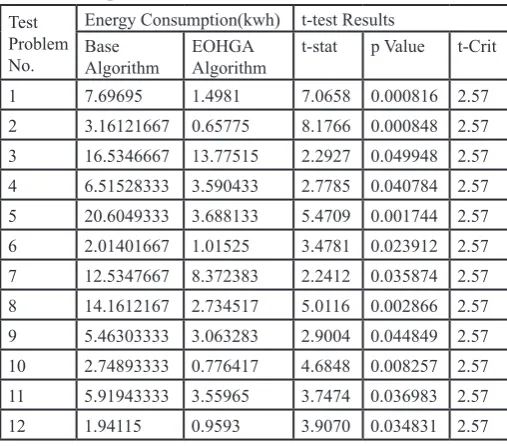
Table 2: Comparison of BA and EOHGA
Test Problem No.
Energy Consumption(kwh) t-test Results Base
Algorithm EOHGAAlgorithm t-stat p Value t-Crit
1 7.69695 1.4981 7.0658 0.000816 2.57
2 3.16121667 0.65775 8.1766 0.000848 2.57
3 16.5346667 13.77515 2.2927 0.049948 2.57
4 6.51528333 3.590433 2.7785 0.040784 2.57
5 20.6049333 3.688133 5.4709 0.001744 2.57
6 2.01401667 1.01525 3.4781 0.023912 2.57
7 12.5347667 8.372383 2.2412 0.035874 2.57
8 14.1612167 2.734517 5.0116 0.002866 2.57
9 5.46303333 3.063283 2.9004 0.044849 2.57
10 2.74893333 0.776417 4.6848 0.008257 2.57
11 5.91943333 3.55965 3.7474 0.036983 2.57
It is proved from the t- test result statistics in Table 2 that the EOHGA
is significantly outperforms than the applied Base algorithm. The
mean total energy consumption of the EOHGA Algorithm for the
12 different test problems of the same configurations is 33.20%-77.19% less than that of the applied Base Algorithm.
In order to prove the significance of the statistics in Table 2, we
conducted a Paired two samples one tailed t-Test with different
variance for each set of experiments. The confidence level of the t-Test was 95%. The null hypothesis and alternate hypothesis are
given as follows:
Null Hypothesis
Alternate Hypothesis
Where represents energy consumption by Base Algorithm and represents energy consumption by EOHGA algorithm for various characteristics of test problems. Since for all the t-Tests
performed on various set of problems, the p value is significantly
less than the value, which is 0.05, and the t-stat is greater than the t-critical value mostly for all set of problems, then null hypothesis was rejected and alternate hypothesis was accepted, which means, the difference between the two set of samples of
energy consumption for 12 test problems is significant.
Which depicts that proposed EOHGA algorithm is a potential candidate for energy optimization in data centers during VM migrations.
VI. Conclusion
This paper has presented EOHGA algorithm to optimize energy consumption of VM placement problem and to cater extra energy overhead during VM migrations to different hosts. Statistical parameters were determined to evaluate the performance of
EOHGA algorithm compared with the defined base algorithm for
various set of problems. The results of the EOHGA algorithm have been found to be good enough in comparison to the base algorithm in terms of energy optimization and VM migrations. Results have been proved with statistical paired two samples one tailed t-Test with different variance values. On average the solutions produced
by the EOHGA algorithm are 33.20%-77.19% better than those
produced by the applied Base Algorithm.
In future research, we would extend this research to optimize some more performance parameters during VM Live migrations
with different scenario and within defined Quality of Service
constraints.
References
[1] Buyya, Rajkumar, et al.,"Cloud computing and emerging IT platforms: Vision, hype, and reality for delivering computing as the 5th utility", Future Generation computer systems 25.6
(2009): pp. 599-616.
[2] Pedram, Massoud,"Energy-efficient datacenters."
Computer-Aided Design of Integrated Circuits and Systems, IEEE
Transactions on 31.10 (2012): pp. 1465-1484.
[3] Glanz, James,"Power, pollution and the internet." The New York Times 22 (2012).
[4] Meng, X., Pappas, V., Zhang, L. (2010, March),"Improving the scalability of data center networks with traffic-aware
virtual machine placement", In INFOCOM, 2010 Proceedings
IEEE (pp. 1-9).
[5] Dhanoa, Inderjit Singh, Dr Sawtantar Singh Khurmi,
"Energy-efficient virtual machine live migration in cloud data centers",
International Journal of Computer Science and Technology
(IJCST) 5.1 (2014), pp. 43-47.
[6] Verma, Akshat, Puneet Ahuja, Anindya Neogi,"pMapper: power and migration cost aware application placement in virtualized systems," Middleware 2008. Springer Berlin
Heidelberg, 2008. pp. 243-264.
[7] Hermenier, F., Lorca, X., Menaud, J. M., Muller, G., Lawall, J. (2009, March). Entropy: a consolidation manager for clusters. In Proceedings of the 2009 ACM SIGPLAN/SIGOPS
International conference on Virtual execution environments
(pp. 41-50).
[8] Xu, J., Fortes, J. A. (2010, December),"Multi-objective virtual
machine placement in virtualized data center environments", In Green Computing and Communications (GreenCom), 2010 IEEE/ACM Int'l Conference on Cyber, Physical and
Social Computing (CPSCom) (pp. 179-188).
[9] Stillwell, Mark, et al.,"Resource allocation algorithms for
virtualized service hosting platforms," Journal of Parallel
and distributed Computing 70.9 (2010), pp. 962-974.
[10] Beloglazov, Anton, Jemal Abawajy, Rajkumar Buyya,
"Energy-aware resource allocation heuristics for efficient
management of data centers for cloud computing," Future generation computer systems 28.5 (2012), pp. 755-768. [11] Dhanoa, I. S., Khurmi, S. S. (2015),"Analyzing Energy
Consumption during VM Live Migration. Published in IEEE International Conference on Computing, Communication
and Automation (ICCCA2015), (pp. 584-588).
[12] Tang, Maolin, Shenchen Pan,"A hybrid genetic algorithm
for the energy-efficient virtual machine placement problem in data centers." Neural Processing Letters 41.2 (2014), pp.
211-221.
[13] Kaushar, Heena, Pankaj Ricchariya, and Anand Motwani.
"Comparison of SLA based Energy Efficient Dynamic Virtual
Machine Consolidation Algorithms." International Journal
of Computer Applications 102.16 (2014).
[14] Buyya, Rajkumar, Anton Beloglazov, and Jemal Abawajy. "Energy-efficient management of data center resources for
cloud computing: a vision, architectural elements, and open
challenges." arXiv preprint arXiv: 1006.0308 (2010).
[15] Beloglazov, Anton, and Rajkumar Buyya. "Optimal online deterministic algorithms and adaptive heuristics for energy and performance efficient dynamic consolidation of virtual machines in cloud data centers." Concurrency and
Computation: Practice and Experience 24.13 (2012): 1397-1420.
[16] Beloglazov, A., & Buyya, R. (2010, May). Energy efficient
allocation of virtual machines in cloud data centers. In Cluster, Cloud and Grid Computing (CCGrid), 2010 10th IEEE/ACM International Conference on (pp. 577-578). [17] Madhusudan, B. & Sekaran, K. (2013). A Genetic Algorithm
Approach for Virtual Machine Placement in Cloud. Published in the proceeding of International Conference on Emerging Research in Computing, Information, Communication and Applications (ERCICA2013).
[18] Sharifi, Mohsen, Hadi Salimi, and Mahsa Najafzadeh. "Power-efficient distributed scheduling of virtual machines using
workload-aware consolidation techniques." The Journal of
Supercomputing 61.1 (2012): 46-66.
[20] Benson, Theophilus, Aditya Akella, and David A. Maltz.
"Network traffic characteristics of data centers in the wild."
Proceedings of the 10th ACM SIGCOMM conference on Internet measurement. ACM, 2010.
[21] Mahadevan, Priya, et al. "Energy aware network operations."
INFOCOM Workshops 2009, IEEE, 2009.
[22] Fan, Xiaobo, Wolf-Dietrich Weber, and Luiz Andre Barroso.
"Power provisioning for a warehouse-sized computer." ACM SIGARCH Computer Architecture News. Vol. 35. No. 2. ACM, 2007.
[23] Barroso, Luiz André, and Urs Hölzle. "The case for energy-proportional computing." Computer 12 (2007): 33-37.
[24] Popov, A. (2005). Genetic algorithms for optimization. User
Manual, Hamburg, 2013.
[25] Grace, A. (1990). Optimization Toolbox: For Use with
MATLAB: User's Guide. M. Works (Ed.). Math works.
[26] Inderjit Singh and Sawtantar Singh Khurmi. “Power Efficient
Hybrid VM Allocation Algorithm.” International Journal of
Computer Applications 127.17(2015): 39-43. DOI: 10.5120/ ijca2015906722.
Inderjit Singh Dhanoa is a Ph.D. scholar at Department of Computer Science and Applications of Desh Bhagat University, MandiGobindgarh (Punjab).He has completed his MCA and M.Tech (IT) from Punjab Technical University, Jalandhar with
first division. Under his Ph.D studies,