Hunting Serial Predators
A Multivariate Classification Approach
to Profiling Violent Behavior
Grover Maurice Godwin, Ph.D.
Godwin Investigative Consultancy Group
Adjunct Professor at Vermont College of Norwich University
COVER PHOTO: Helen Groves Godwin
Library of Congress Cataloging-in-Publication Data
Godwin, Grover Maurice
Hunting Serial Predators: a multivariate classification approach to profiling violent behavior/ Grover Maurice Godwin
p. cm.
Includes bibliographical references and index. ISBN 0-8493-1398-8 (alk. paper)
1. Serial murderers--United States--Psychology. 2. Criminals--United States--Classification. 3. Criminal behavior--United States. 4. Criminal behavior, Prediction of--United States.I. Title.
HV6529.G58 1999
364.15’23--dc21 99-31298
CIP
This book contains information obtained from authentic and highly regarded sources. Reprinted material is quoted with permission, and sources are indicated. A wide variety of references are listed. Reasonable efforts have been made to publish reliable data and information, but the author and the publisher cannot assume responsibility for the validity of all materials or for the consequences of their use. Neither this book nor any part may be reproduced or transmitted in any form or by any means, electronic or mechanical, including photocopying, microfilming, and recording, or by any information storage or retrieval system, without prior permission in writing from the publisher.
The consent of CRC Press LLC does not extend to copying for general distribution, for promotion, for creating new works, or for resale. Specific permission must be obtained in writing from CRC Press LLC for such copying.
Direct all inquiries to CRC Press LLC, 2000 Corporate Blvd., N.W., Boca Raton, Florida 33431.
Trademark Notice: Product or corporate names may be trademarks or registered trademarks, and are only used for identification and explanation, without intent to infringe.
© 2000 by CRC Press LLC
No claim to original U.S. Government works International Standard Book Number 0-8493-1398-8 Library of Congress Card Number 99-31298
Printed in the United States of America 1 2 3 4 5 6 7 8 9 0 Printed on acid-free paper
iii
Prologue
Since the Hunting Serial Predators manuscript was completed, there has been a relatively large debate as to the definition of deductive and inductive rea-soning as the terms relate to offender profiling. As a result of the vexing opinions concerning exactly what deductive and inductive profiling entails, I felt that it was necessary to address some important issues surrounding the use of these terms.
Deductive reasoning was first developed by Thales, Pyuthagoras, Aristotle, and other Greeks of the Classical Period (600–300 B.C.). However, anyone who has read the Sherlock Holmes stories by Sir Arthur Conan Doyle is aware that Sherlock Holmes used a form of deductive reasoning. Holmes, for example, would observe that Watson’s clothes were dry in spite of the fact that it had been raining all day. From this Holmes would guess or deduce that Watson had spent the day at his club — of course, Watson could have spent the day at some other location.
Profiles constructed by the FBI profilers, clinical psychologists, criminol-ogists, and the police routinely drawn inferences about, for example, serial murderers and their behaviors based solely on work experience, gut feelings, and the motivation of the offender. This form of deductive profiling is where the profiler assumes one or more facts as self-evident about a crime or offender and then, following work experience and hunches, arrives at other facts commonly called conclusions. Hence, the FBI profiles are deductive rather than inductive. However, some argue that the FBI profiling method is inductive.
Broadly, the argument put forth for the FBI method being inductive is, since the FBI relies on data collected from interviews with serial murderers, as a foundation for developing their profiles, then their reasoning must be induc-tive. The basis for this argument is flawed, because the data collected by the FBI has never been empirically analyzed, or it has been properly organized in a systematic manner so that profilers could refer to it in future. Rather, the information has been passed down over the years based on memories of past experiences and inferences gleaned from the interviews in order to arrive at conclusions about a particular case. To be sure, deductive reasoning is from the general (passed down information) to the specific (case).
iv
The “truth” of the conclusions reached by deductive profiling is a con-tingent truth; that is, it depends upon the truth, or the basis for the truth, for theories formed when the investigator first arrives on scene or during interviews. These statements or beliefs are taken as starting points for the argument. Deductive profiling processes available information by applica-tion of personal experiences as opposed to theoretically driven inductive profiling based on all available instances of a crime. The guarantee of the deductive profiling method is that IF the premises are true and IF the hypoth-eses are valid, then the conclusions are also true. However, this could hardly be the case, since rarely is a profiler’s deductive opinions about what may have occurred at a crime empirically or theoretically driven by research and hypothesis testing. Drawing deductive inferences about crime scene behavior produces truths and conclusions out of thin air. Consequently, for deductive profiling to be robust there must be truths that are known a priori, which can only be achieved through empirical research.
It is further argued that there are a number of factors that interfere with adequate empirical evaluation into the variables that contribute to the success or failure of a profile, and what is needed is more of a systematic and empirical approach to offender profiling than currently exists. Contrary to deductive profiling where generalizations guide the profiles, inductive profiling is an empirically based approach where conclusions are derived from scientific analysis. Inductive reasoning is from the specific to the general. For example, inductive profiling derives general principles about the behavior of serial murderers by empirically examining and testing particular facts or instances of a large number of solved cases. Briefly, not including information on unsolved cases in the inductive analysis would not be helpful, because no background information on the offender is available. In contrast to the deductive process, which starts with assumptions about behavior, inductive profiling relies on data gathered from the crime scenes, police reports, psy-chological evaluations, method examiners’ reports and victimology reports in order to be empirically analyzed and subsequently to support a theory. In all instances the internal validity of the data is confirmed.
An important step in the inductive profiling method is to formalize operational definitions (hypotheses) for testing. Once this step has been completed, the next step involves coding the data for statistical analysis in which the results are supported with theories. The important item that makes inductive profiling more robust than deductive profiling is, through research, observable patterns in the data can be found that lead to new theories. Rather than being stagnated with held views of behavior, inductive profiling is like
v
a revolving door — researchers are always striving to look for emerging patterns in crime data, which leads to new ways to assist investigators.
If, for example, a profiler or an investigator in a serial murder investi-gation deduced from specific knowledge that serial murderers were prefer-ential about selecting particular victims, they may decide only to include cases for consideration where the victim targeting is similar. However, pro-filers and investigators should not make such an assumption and cases should only be excluded where there is inductive reasoning for exclusion or there is alternative information which can exclude the cases. As previously men-tioned, current profiling decisions are made deductively on the basis of experience of the individual decision makers. However, this book argues that such expertise must be validated through the development of theories and statistical models of criminal behaviors, which are based on empirical data relationships. That is, decision-making in criminal investigations should move from deductive to inductive. Adopting this approach would help to minimize the biasing effect of individual experience upon decisions which are based on all the circumstances of any particular case available to the individual making the decision.
vii
Preface
Serial murder. This topic has received attention from both the academic community and the entertainment world since the FBI first published accounts of its profiling principles. The topic was made popular by the novel and Oscar-winning film Silence of the Lambs, with recent follow-ups such as
Seven, Copycat, and The X-Files making the headlines. However, beyond the victims’ pin pictures that help create the sensationalism in these movies and books, until now there have been few, if any, reliable empirical studies about serial murderers.
The idea of psychologically classifying serial murderers is premised on the assumption that to understand crimes of this nature, we need to consider the range of psychological issues relevant to behavior in general; for example, the offender’s perception and interpretation of his actions and their likely consequences, and the emotional framework within which the person oper-ates. Crime scene behavior, like any other behavior, is assumed to be a function of the whole personality of the individual. Equally important, it is assumed that human behavior does not take place in a vacuum but always occurs in a concrete social situation. Hence, the specific circumstances of a set of actions need to be understood in order to give a useful account of any related serial murderer’s behavior.
The extrapolation of behavioral characteristics of serial murderers from information about their crimes as an aid to police investigations has been the thrust of most psychological profiling. However, in order for the classi-fication of serial murderers to be more than educated guesswork, conclusions must be based on empirical research of consistencies in criminal behavior, and the relationship those actions have to aspects of an offender available to the police in an investigation. The present book represents a subsample of American serial killers who traveled throughout the U.S. to abduct and murder three or more victims, on different dates, and in different geograph-ical locations. The data sample does not represent a subsample of sexually sadistic serial murderers nor a subsample of offenders found exclusively in any one particular database. On the contrary, offenders in this book were
viii
drawn from 40 states and displayed a broad range of crime scene actions and background characteristics.
To that end, in the present book the crime scene actions of 107 U.S. serial murderers, who killed a total of 728 victims, were examined in relation to their first, middle, and last offenses, in order to test three hypotheses: that serial murderers will have some structure in their actions within a series that are common to those offenses; that there will be certain thematic behavior underlying any murder committed by a sample of serial murderers that is more typical than any other committing serial murders; and there will be consistency across the three offense series for the offender samples. A two-faceted behavioral organization and attachment model was hypothesized, with four thematic classifications. Multivariate statistical analysis using Smallest Space Analysis (SSA) supports the faceted, four thematic classification model. The empirically derived Facet Model of Serial Murder found that serial murderers’ crime scene actions were similarly structured across their first, middle, and last offenses. Important information that is currently not found in the literature on serial murder was revealed by the analysis. For example, the SSA found a distinct subgroup of affective-type serial murderers who viewed their victims as vehicles that targeted, attacked, and murdered victims in their residences. Also, cognitive serial murderers, who viewed their victims as objects, tended to show organization at their crime scenes and hid the victims’ bodies. Broadly, the results found that serial murderers who were sadistic were highly organized in their behavior. The analysis also found that serial murderers’ behavior became refined and consistent over time.
Using Partial Order Scalogram Analysis (POSA), several relationships between offenders’ crime scene behavior, criminal, sexual, and personal histories were revealed. For example, serial murderers with affective crime scenes and who viewed their victims as vehicles were more likely to have a violent criminal history for murder, rape, and kidnaping. However, cog-nitive serial murderers who viewed their victims as objects were more likely to have a history of fondling and sexual crimes, such as cunnilingus and fellatio. Generally, there was little difference in whether the offenders’ behavior was affective or cognitive, with no bearing on their educational and employment histories. However, there was some indication that affective serial murderers were more likely to be employed than cognitive type mur-derers, and that cognitive serial murderers with sadistic crime scenes were likely to be better educated.
The three primary goals of this book, therefore, were: 1) to develop an empirical model of serial murderers’ crime scene behaviors; 2) to find out if offenders remained consistent in their behavior over a number of
ix
offenses; and 3) to link crime scene behavior to the background character-istics of the offender.
These considerations give rise to four questions: 1) Do serial murderers who commit a series of homicides display behavioral actions within the series that are common to their offenses? 2) Are there unique signature behaviors committed by a sample of serial murderers that are more typical of them than any others committing serial murders; 3) Will these relate to background characteristics? Finally, 4) is there consistency across behavioral actions and offenders over time?
The book is divided into seven parts: An introductory section; a data acquisition and methodology section; a descriptive section; an empirical research section; an applicability section; and a concluding section. A summary of each chapter of these six sections is outlined below.
The introduction presents a review of the literature relevant to the three research questions outlined above.
Chapter 1is a general overview of the different ways in which motives for murder have been classified. Topics of discussion include various ways in which offenders’ aggression have been classified.
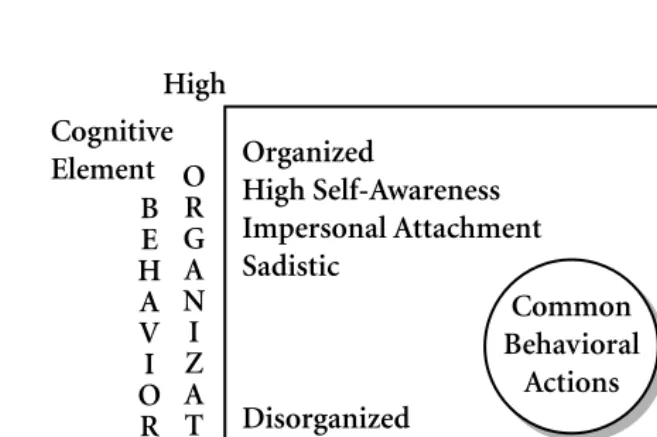
Chapter 2 presents a discussion of the extant typologies used to classify serial murderers, including a review of the FBI’s organized and disorganized serial murder typology. It is concluded that most classifications of serial murderers are inherently flawed due to weak operational definitions, and unsubstantiated assumptions made about offender actions and characteris-tics. As an alternative to the rigid classification models, it is suggested that a Facet Theory approach to modeling the crime scene actions of serial mur-derers may be more robust and valid.
Chapter 3 describes a possible Facet Model of Serial Murder. Two facets, behavioral organization and attachment, are proposed as describing the type of aggression exhibited by the killers and the cognitive significance that the offenders placed on their victims. The behavioral facet consists of two elements — affective and cognitive — while the attachment facet also has two elements: victim as vehicle and victim as object.
Chapter 4 outlines the book’s research objectives.
Chapter 5 describes the data acquisition and content analysis of the crime information data used in the book.
Chapter 6 discusses the book’s research design and methodology, including a rationale for the use of non-metric multidimensional scaling procedures.
Chapter 7 describes the characteristics of 728 serial murder victims. This chapter outlines descriptive statistics with the background
x
istics of the murdered victims. For example, the victims’ ages, races, and genders are covered.
Chapter 8 provides an examination of 107 American serial murderers, of whom 11 are a part of a team. Examined are the possible characteristics that make up the serial murder sample with reference to characteristics such as the offenders’ ages, races, and genders, and background history relating to criminality, sexuality, employment, and education.
Chapter 9 provides a descriptive overview of the murderers’ crime scene behaviors.
Chapter 10 describes the first analysis of the book. Using 65 crime scene actions in the analysis, the SSA supports the two proposed facet elements, affective and cognitive; and the attachment elements, victim as vehicle and object. The four facet elements were thus used to classify the crime scene actions of serial murderers into four thematic regions: 1) Affective — Vehicle (AV); 2) Affective — Object (AO); 3) Cognitive — Vehicle (CV); and 4) Cognitive — Object (CO), describing modes of offender-victim interac-tion. Subsequent SSA tests found that the structure of the SSA appears to remain consistent across the killers’ first, middle, and last offenses.
Chapter 11 analyzes 38 mid-frequency crime scene actions from the SSA analysis, using POSA analysis in order to better understand the possible interplay between the facets, behavioral and attachment, and the four the-matic classifications highlighted in Chapter 10.
Chapter 12 describes a final analysis carried out on a more limited sample of 38 crime scene actions, using SSA to model serial murderers’ crime scene behaviors. The chapter also describes how more conventional statistics, such as Kendall’s coefficient of concordance (W), Cochran’s Q
analysis, and Spearman’s rho, were used to test the hypothesis that serial murderers were consistent in their crime scene behaviors across their first, middle, and last offenses.
Chapter 13 describes the use of POSA and conventional statistics to model elements of crime scene behavior and background characteristics. Each of the four thematic classifications were compared with background character-istics describing the killers’ criminal, sexual, personal history, and age data.
Chapter 14 describes the application of the Facet Model of serial murder to real-life solved serial murder cases.
Chapter 15 describes how the methodology used in the book was applied in developing a psychological profile of the serial murderer John Williams, Jr., in addition to the summary and conclusions.
The present book is the result of intensive research carried out by this author over a period of four years. The implications of the research
xi
propounded in this book have a number of practical consequences for police investigations and, if the results are replicated with other data sets, could form the basis of a powerful investigative decision support tool.
Grover Maurice Godwin, Ph.D. Raleigh, North Carolina — 1998
xiii
Acknowledgements
First, I would like to take this opportunity to express my sincere thanks to my Ph.D. supervisor Dr. Graham Wagstaff, for his consistently excellent supervision throughout my doctorate studies at The University of Liverpool. Secondly, I would like to thank the many other people without whom I would never have been able to complete this book. These include my mother and father; Priscilla McKinnie and Halford Godwin; and Dr. Robert Keppel and the entire staff at the Homicide Investigation Tracking System Unit (HITS) in Seattle, Washington for giving me the unique opportunity to visit their office and collect my research data. I would also like to thank Thomas J. Long of Vance-Granville Community College, Henderson, N. C. for his con-tinued support over the past 12 years. My appreciation also goes to Mr. Timothy McKinnie. Finally, I would like to express my gratitude to all those at CRC Press who helped make this book possible, and especially to my editor, Becky McEldowney.
xv
About the Author
Dr. Maurice Godwin is an adjunct professor at Vermont College of Norwich University in their distance learning MA Degree program, with a concentra-tion in criminal investigative psychology. He is a former police officer in the State of North Carolina. Dr. Godwin was one of the first project coordinators for a National Institute of Justice grant for implementing community policing in a rural area. Dr. Godwin is also the author of journal articles on psycho-logical and geographical profiling. He has worked as a consultant to police and others in developing psychological and geographical profiles. He has lectured in the U.S. and Europe on serial murder, cyber stalking, and criminal investigative analysis. Dr. Godwin received his undergraduate degree from Trevecca Nazarene University; his Master's Degree from Indiana State Uni-versity, and his doctorate from The University of Liverpool, England.
Web Site: http://www.investigativepsych.com
xvii
Introduction
Classifications of serial murderers that are empirically formulated are nec-essary in order to make logical decisions about how to detect, apprehend, and eventually access their dangerousness. Similarly, without meaningful classifications, predications about aspects of crime scene behavior and how those actions relate to background characteristics can only be, at best, vague and limited to general factors. Until there is a classification model of serial murderers’ crime scene actions that is built from the ground up, based on empirical and repeatable studies, then it will not be possible to make significant advances in any of these three areas: police investigations, aeti-ology, and treatment. The difficulty, of course, is in finding the distinct behaviors and characteristics which will classify serial murderers into meaningful groups.
A reliable and robust classification scheme should meet three broad criteria. First, classifications must be reliable. When different people use it, they must come up with the same results. Schemes that seem intuitively obvious to those devising the classification often fall apart when others use them. For instance, one offender’s necessary aggression may be another person’s sadism. Secondly, the classification must be practical and straight-forward to interpret and use. If it requires years of dynamic psychological study before it produces results, chances are that it will not be very widely applied. Thirdly, the classification model must be valid for the task it is developed to fulfill. It must either lead to meaningful predictions or create facets of behavior to further our understanding of serial murderers.
How well do existing attempts at classifying serial murderers meet these criteria? Most fail, and outside of criminologist Eric Hickey’s attempt, researchers do not even try. Many classification models of serial murderers tend to hone in on psychological motivation as if it is a given. These classi-fications provide explanatory models that are never tested to see whether they can be applied to actual serial murder cases. On the whole, current attempts to classify the behavior of serial murderers have been failures. The models are embedded with demographic statistics, offender self-reports, and
xviii
offense descriptions mixed in an intuitive manner to create groups that conform to the researcher’s preconceptions. For instance, the FBI’s classifi-cation model of serial murderers is a good example of this.
The FBI profilers divide serial murderers into two types, according to the interplay of aggression and sex. The first serial murderer type is one who struggles against his impulses. His crimes are posited to be disorganized, and he often leaves his crime scenes in disarray. His driving motive is sexual gratification. The disorganized serial murderer has an aggressive aim and is called a displaced anger murderer. Such men seek to hurt, humiliate, and defile their victims, and sex is in the service of an aggressive impulse. In other words, sexual and aggressive impulses are not well differentiated, but do feed off each other. The second serial murderer type is labeled a sociopath. He is driven by sadistic urges, seeking to humiliate his victims. However, his crimes are organized, have a degree of planning involved, and he rarely leaves any forensic clues. The organized serial murder is one where violence is only instrumental in achieving a sexual end. This type of offender is often referred to as a serial sex murderer. Other research also points out that sex is an integral part of the serial murderer’s attack.
In light of the FBI’s classifications of serial murderers, other researchers argue that it is not aggression and sex that drives the serial murderer, but power and control. For example, some researchers suggest that sex in the crime of serial murder is pseudo-sexual, not a sexual act. In this theory, the serial murderer has inherent doubts about his general adequacy, including sexual inadequacy, and seeks to control his victims through intimidation. To alleviate these feelings of sexual inadequacy, the individual seeks revenge on women for wrongs believed to have been done to himself in past experiences. The serial murderer then uses violence in a sadistic way to take back control over women.
All these classifications have a certain logic to them. However, they tend to mix the sexual serial murderer in with killers who act on emotional impulses by suggesting that sex is behind all serial murders. In reality, though, there is no real reason why one should be preferred to another; nor is it clear how to decide which type befits a particular serial murderer. For example, is the serial murderer who commits a blitz-style attack, leaves the victim fully clothed, shows no forensic awareness, and steals the victim’s car a sadistic serial murderer? None of the literature on serial murder classification schemes have tested those for reliability or validity; when others have done so to some degree, it has been found that they do not produce reproducible results when different researchers test the same pop-ulation. The need, then, is for a classification system of serial murderers
xix
based on clear rules and verifiable data. However, important questions must be asked before any attempt is made to classify serial murderers.
The development of a classification model of serial murder requires that questions need to be answered by research, rather than relying solely on the work experiences and hunches of a few selected investigators. Given that any classification system of serial murderers must draw upon knowl-edge of the relationships between offense behavior and offender character-istics, the development of a classification model of serial murder requires establishing increasingly precise relationships between these two sets of variables. This then raises the question of whether those variables do relate to each other. With regard to behaviors of the offender, this is the question of whether the variation among offenders is so great that no systematic model can be developed.
Classifications can take on many different forms from clusters, regions, or sequential causal path analysis. However, some of these approaches to offense interpretation make strong assumptions about the type of framework that will emerge — others, less strong. It is argued in this book that a general but empirical framework, which makes minimum assumptions and can incorporate stronger models when appropriate, is the Facet Theory. Facet Theory works well with qualitative categories and builds up models of the underlying structure of the data from those categories, such as information contained in police files.
The ultimate purpose of any offender classification system is to aid police in identifying potential suspects and select between them. But which behaviors and characteristics can be specified with any consistency; and of those, which are the most useful in helping police identify the perpetrator? The impetus of this book is to provide empirical support for answering these questions.
The book introduces an “inductive” rather than a “deductive” approach to classifying the crime scene behavior of serial killers. The main difference between the present book and other literature on serial murder: Hunting Serial Predators is empirically and theoretically supported by solid research, data, and analysis. The other books involve no analysis and are mainly semi-autobiographical accounts of serial murder cases that draw unsub-stantiated conclusions. Also, the other books rely solely on anecdotal accounts of serial murder cases, and do not provide any useful investigative decision-making strategies.
To that end, the majority of the available published accounts of serial murderers are not in scholarly or technical publications. Indeed, even such few academic reviews as do exist typically commence with reference to
xx
fictional accounts, such as The X Files or Millennium. It is therefore not surprising that a robust profile of the serial murderer, as described in current serial murder books, is far from clear or precise. Therefore, what makes this book unique is the fact that it does not cloud the topic with fictional and semi-autobiographical accounts based on particular experi-ences or hunches of the writer. Each chapter is clearly written, explaining in detail how to psychologically research and interpret the crime scene actions of serial killers. The book provides the reader with an Empirical Facet Model of the crime scene actions of serial murderers, based on infor-mation available to a police inquiry.
Serial murder is a controversial subject, full of potent myth. The object of this book is to provide an empirical overview of the related scientific knowledge, introduce a new method to classify the serial predator, and present accounts of the process and difficulties of profiling the serial mur-derer. It will be useful and interesting to most scientists and professionals in the fields of criminology, psychology, criminal justice, and police studies. It is the applied side of the book which will make it a standard reference for detectives and police officers, now and in many years to come.
xxi
Dedication
This book is dedicated to my wife, Helen, who has graciously endured my long working hours during the project, and whose encouragement,
help and support has sustained me throughout.
For the known and unknown victims.
All the scientists in the world could not bring a criminal investigation to a successful conclusion without the involvement of artists, the detectives who link the components of a case into a complete package.
Larry Ragle
Blood will tell: Crime scene investigations (1995) Detection is, or ought to be, an exact science and should be treated in the same cold and unemotional manner.
Sir Arthur Conan Doyle
The Sign of Four
xxiii
Contents
1
Motives For Murder: What Differentiates Kille
rs
1.1 Sociogenic Motives for Murder 1.2 Culture Motives for Murder 1.3 Biogenic Motives for Murder 1.4 Psychogenic Motives for Murder 1.5 Murder Typologies
1.6 Theories on Instrumental and Reactive Aggression 1.7 The Distinction Between Instrumental and Expressive
Behavior in Murder
1.8 Classifying Aggression in Serial Murderers
2
Reliability, Validity, and Utility of Extan
t
Serial Murderer Classifications
2.1 The Origins of the FBI Serial Murder Project 2.1.1 The Organized Serial Murderer 2.1.2 The Disorganized Serial Murderer 2.2 Discrepancies in the Organized and Disorganized
Dichotomy
2.2.1 Reliability of the FBI Serial Murderer Sample 2.2.2 Inferring Behavior from Fantasy in the
FBI Model
2.3 Validity of the FBI Serial Murder Model
2.3.1 Lack of Empirical Operational Definitions 2.3.2 False Dichotomization of Variables 2.4 Utility of the FBI Serial Murder Model 2.5 The Personality to Behavior Confusion
2.6 Other Perspectives on Classifying Serial Murderers 2.6.1 Sewell’s Approach
2.6.2 The Holmes Approach 2.6.3 Hickey’s Approach 2.6.4 The Dietz Approach
xxiv
2.7 Investigative Process Management (IPM) 24
2.7.1 Induction as Systematization 24
2.8 Deriving Inductive Profiles from Deductive
Experiences 25
2.9 A Move Towards a Facet Classification of
Serial Murderers 26
3
A Thematic Facet Model of Serial Murder 29
3.1 The Facet Approach 29
3.1.1 Facet Structures 30
3.1.2 Constituents of Facets 30
3.2 Narrative Themes 30
3.2.1 Criminal Narratives 31
3.3 Rationale for the Facet Model of Serial Murder 32
3.3.1 The Behavioral Organizational Facet 32
3.3.2 Affective Element 33
3.4 The Cognitive Element 36
3.4.1 Consistency in the Cognitive Element 37
3.5 The Attachment Facet 38
3.5.1 Victim as Vehicle Element 40
3.5.2 Victim as Object Element 40
3.6 Common Behavioral Actions 42
3.7 Summary 42
3.7.1 The Facet Model of Serial Murder 42
4
Research Objectives 45
4.1 General Hypotheses 46
4.2 Research Conditions 47
4.3 Identifying Background Characteristics 48
5
Data Acquisition and Content Analysis 49
5.1 Data Acquisition 49
5.1.1 Homicide Investigative Tracking System (HITS) 49
5.2 Type of Variables Identified 51
5.2.1 Content Categories 51
5.3 Reliability 51
xxv
6
Research Design and Methodology 53
6.1 Coding the Data Matrix 53
6.2 The Initial Preparatory Stage 55
6.3 MappingSentence 55
6.3.1 Structuples in a Mapping Sentence 56
6.3.2 Elements of the Facet 57
6.4 Nonmetric Multivariate Analysis 58
6.4.1 Smallest Space Analysis (SSA-I) 58
6.4.2 Regions and Dimension Interpretation of SSA 58
6.4.3 Partial Order Scalogram Analysis (POSA) 59
6.5 Summary 60
7
Descriptive Statistics of Victims 61
7.1 Characteristics of Serial Murder Victims’ Ages 61
7.2 Characteristics of Victims’ Gender 62
7.3 Characteristics of Victims’ Ethnicity 63
7.4 Characteristics of Victim-Offender Relationships 64
7.4.1 Stranger-to-Stranger 65
7.4.2 Victim Worked as a Prostitute 66
7.5 Victim — Killer Relationships in Relation
to Victims’ Ages 66
7.6 Summary 68
8
Descriptive Statistics of Offenders 69
8.1 Characteristics of Offenders’ Ages 69
8.2 Characteristics of Killers’ Age and Victim
-Offender Relationship 70
8.3 Characteristics of Serial Murderers’ Gender 71
8.4 Characteristics of Serial Murderers’ Ethnicity 72
8.5 Serial Killers’ Employment History 73
8.6 Serial Killers’ Marital Status 74
8.7 Serial Killers’ Educational Status 74
8.8 Serial Killers’ Mental History 76
8.9 Serial Killers’ Sexual History 77
8.9.1 Offenders’Sexuality 77
8.9.2 Pornography 77
8.9.3 Bizarre Sexual Activities 78
xxvi
8.10 Characteristics of Serial Killers’ Criminal History 79
8.10.1 Burglary Offenses 79
8.10.2 Violent Offenses 79
8.10.3 Sex Offenses 80
8.10.4 Drug Offenses 80
8.10.5 Fraud Offenses 80
8.10.6 Domestic Offenses 80
8.10.7 Offenders on Parole or Probation 81
8.10.8 Juvenile Criminal History 81
8.11 Miscellaneous Characteristics of Serial Killers’
Background Histories 81
8.11.1 Military Record 81
8.11.2 Emotional Setback 82
8.11.3 Offender Attempted or Committed Suicide 82
8.11.4 Prior Work in Law Enforcement 83
8.12 Summary 83
9
Elements of Crime Scene Behavior 85
9.1 Elements of Killers’ Method of Gaining Access
to the Victim 85
9.1.1 Blitz, Cons, and Ploys 85
9.1.2 Solicited for Sex 85
9.1.3 Forced Entered Victims’ Homes at Night 86
9.1.4 Aliases 86
9.1.5 Victim was Stalked 86
9.2 Elements of Killers’ Method of Controlling the Victim 87
9.2.1 Victims Bound with Rope 87
9.2.2 VictimsGagged 87
9.2.3 Victims Bound with Tape 88
9.2.4 Victims Bound with Handcuffs 88
9.2.5 Victims Bound with Own Clothing 88
9.2.6 Victims Bound with Electrical Cord 88
9.2.7 Blindfold and Covering the Victim’s Face 89
9.3 Elements of Killers’ Cognitive Planning 89
9.3.1 Weapon and Restraint Selection 89
9.3.2 Crime Kit 89
9.3.3 VictimDrugged 90
9.4 Killers’ Methods of Death 90
9.4.1 Method of Death: Knife 90
9.4.2 Method of Death: Ligature Strangulation 91
xxvii
9.4.3 Method of Death: Firearm 91
9.4.4 Method of Death: Bludgeon 92
9.5 Methods of Killers’ Sexual Degradation of the Victim 92
9.5.1 Vaginal Penetration 93
9.5.2 Anal Penetration 93
9.5.3 Sex Organs Assaulted and Foreign Objects 93
9.5.4 Male SexualAssault 93
9.5.5 Postmortem SexualActivities 94
9.6 Elements of Killers’ Sadistic Behavior 94
9.6.1 TorturedVictims 94
9.6.2 DismembermentPostmortem 94
9.6.3 RitualisticActs 95
9.6.4 Piqueurism 95
9.6.5 Victim’s Body Posed 96
9.6.6 Anthropophagy 96
9.7 Actions Indicating Killers’ Psychological Reflection 96
9.7.1 Offender Retained Trophies 96
9.7.2 Photos 97
9.7.3 Kept Diary of Crimes 97
9.7.4 Offender Interjected Himself Into
the Investigation 98
9.8 Actions Indicating Killers’ Forensic Disorganization 98
9.8.1 Semen Found at Crime Scene 98
9.8.2 Restraint Found at Crime Scene 98
9.8.3 Body Openly Displayed 98
9.8.4 Weapon Found at the Crime Scene 99
9.8.5 Ransacked Victim’sProperty 99
9.8.6 Bite Marks on Victim 99
9.8.7 Victim’s VehicleStolen 100
9.9 Actions Indicating Killers’ Forensic Organization 100
9.9.1 Body Hidden 100
9.9.2 Body Transported 101
9.9.3 Clothing Hidden 101
9.9.4 Offender Destroyed Evidence 101
9.9.5 Victim’s Body Disfigured 102
9.9.6 Victim’s Body Buried 102
9.9.7 Body Parts Scattered 102
9.9.8 Property at Crime Scene Undisturbed 102
9.10 Summary 103
xxviii
10
Smallest Space Analysis (SSA-I)
of Crime Scene Behaviors 105
10.1 Modeling the Crime Scene Actions of Serial Murderers 105 10.2 Explanation of the Smallest Space Analysis Procedure 106
10.2.1 Preparing the Data for the SSA 107
10.3 Procedure Rationale 108
10.4 Smallest Space Analysis SSA-I: Results 109
10.4.1 Interpretation of SSA Configurations 109
10.5 SSA Results for the First Offense Series 111
10.5.1 Focal Aspects of Serial Murder 111
10.6 Facets of Behavior in Serial Murder 114
10.6.1 Affective Element 114
10.6.2 Cognitive Element 116
10.7 Attachment to Victim Facet 117
10.7.1 Victim as Vehicle Element 117
10.7.2 Victim as Object Element 117
10.8 Regional Themes in Serial Murder 119
10.9 Cronbach Alpha Analysis 119
10.10 Classifying Crime Scene Actions into Themes 121
10.10.1 Affective-Vehicle (AV) Theme 121
10.10.2 Affective-Object (AO) Theme 124
10.10.3 Cognitive-Vehicle (CV) Theme 126
10.10.4 Cognitive-Object (CO) Theme 128
10.11 Confirmatory SSA Results 130
10.12 Summary 131
11
Partial Order Scalogram Analysis
of Crime Scene Behaviors 137
11.1 Selecting Behaviors for Partial Order Scalogram
Analysis (POSA) 137
11.2 Linear Structure Between Variables in the
Affective-Vehicle Behavioral Theme 138
11.3 Linear Structure Between Variables in the
Affective-Object Behavioral Theme 139
11.4 Linear Structure Between Variables in the
Cognitive-Vehicle Behavioral Theme 140
11.5 Linear Structure Between Variables in the
Cognitive-Object Behavioral Theme 141
xxix
11.6 Scaling to Order the Crime Scene Behavior
of Serial Murderers 143
11.7 Individual Item Diagrams Partitioning 145
11.8 Coding the Data for POSA 147
11.9 POSA Results for the Affective-Vehicle Theme 147
11.9.1 Interpreting the POSA Individual Item Plots
for the Affective-Vehicle Theme 150
11.10 POSA Results for the Affective-Object Theme 158
11.10.1 Interpreting Individual POSA Item Plots
for the Affective-Object Theme 159
11.11 POSA Results for the Cognitive-Vehicle Theme 165
11.11.1 Interpreting the POSA Individual Item Plots
for the Cognitive-Vehicle Theme 167
11.12 POSA Results for the Cognitive-Object Theme 173
11.12.1 Interpreting the Individual POSA Item Plots
for the Cognitive-Object Theme 174
11.13 Summary 181
12
Consistency in Serial Murderers
and Their Crime Scene Behaviors 183
12.1 Consistency in Serial Murderers’ Crime
Scene Behaviors 183
12.2 Faceted SSA Model of Crime Scene Behaviors 186
12.3 Assigning Serial Murderers to Themes 188
12.4 Searching for Consistency Between Crime
Scene Behaviors Using Cochran’s Q Analysis 189
12.5 Consistency of Serial Murderers Across their First,
Middle, and Last Offense Series 191
12.6 Summary 192
13
Modeling Crime Scene Behavior and
Background Characteristics 193
13.1 The Challenge of Linking Crime Scene Actions
to Background Characteristics 193
13.2 Point-Biserial Analysis of Crime Scene Behavior
and Background Characteristics 194
13.2.1 Results of the Point-Biserial Analysis 195
13.3 Initial Preparation of the Data 195
xxx
13.4 Elements of Crime Scene Behavior
and Criminal History 197
13.4.1 Interpreting POSA Main Item Plots for Crime
Scene Actions and Criminal History 197
13.5 Affective-Vehicle Theme and Criminal History 197
13.5.1 POSA Individual Item Plots for the AV Theme
and Criminal History 197
13.6 Affective-Object Theme and Criminal History 200
13.6.1 POSA Individual Item Plots for the AO Theme
and Criminal History 200
13.7 Cognitive-Vehicle Theme and Criminal History 202
13.7.1 POSA Individual Item Plots for the CV Theme
and Criminal History 202
13.8 Cognitive-Object Theme and Criminal History 204
13.8.1 POSA Individual Item Plots for the CO Theme
and Criminal History 204
13.9 Summary 206
13.10 Serial Murderers, Crime Scene Behavior, and Sex 207 13.11 Elements of Crime Scene Behavior and Sexual History 208
13.11.1 Interpreting the POSA Main Item Plots for Crime
Scene Behavior and Sexual History 208
13.12 Affective-Vehicle Theme and Sexual History 209
13.12.1 POSA Individual Item Plots for the AV Theme
and Sexual History 209
13.13 Affective-Object Theme and Sexual History 211
13.13.1 POSA Individual Item Plots for the AO Theme
and Sexual History 211
13.14 Cognitive-Vehicle Theme and Sexual History 213
13.14.1 POSA Individual Item Plots for the CV Theme
and Sexual History 213
13.15 Cognitive-Object Theme and Sexual History 213
13.15.1 POSA Individual Item Plots for the CO Theme
and Sexual History 213
13.16 Summary 216
13.17 Elements of Crime Scene Behavior and
Personal History 216
13.17.1 Interpreting the POSA Main Item Plots
for Personal History 216
xxxi
13.18 Affective-Vehicle Theme and Personal History 217
13.18.1 POSA Individual Item Plots for the AV Theme
and Personal History 217
13.19 Affective-Object Theme and Personal History 219
13.19.1 POSA Individual Item Plots for the AO Theme
and Personal History 219
13.20 Cognitive-Vehicle Theme and Personal History 219
13.20.1 POSA Individual Item Plots for the CV Theme
and Personal History 219
13.21 Cognitive-Object Theme and Personal History 220
13.21.1 POSA Individual Item Plots for the CO Theme
and Personal History 220
13.22 Elements of Crime Scene Behavior and Age 222
13.23 Age and Thematic Classifications 223
13.24 Difference Between Offenders’ Ages Across
the Four Themes 223
13.24.1 ANOVA Results 224
13.25 Elements of Crime Scene Behavior, Personal History,
and Age 224
13.25.1 Results of the Point-Biserial Correlation Between Age, Crime Scene Behavior, and
Background Characteristics 224
13.26 Summary 225
14
Applications To Police Investigations 227
14.1 Case Study Research 227
14.1.1 Presentation of Case Studies 228
14.2 Inner Themes — Outer Behaviors of an Affective
-Vehicle (AV) Serial Murderer 229
14.2.1 Walker’s Victims 230
14.2.2 Walker’s Background History 231
14.2.3 Summary of Walker 232
14.3 Inner Themes — Outer Behaviors of an Affective
-Object (AO) Serial Murderer 232
14.3.1 Carpenter’s Victims 234
14.3.2 Carpenter’s Murders 235
14.3.3 Carpenter’s Background History 236
xxxii
14.4 Inner Themes — Outer Behaviors of a Cognitive
-Vehicle (CV) Serial Murderer 238
14.4.1 Kraft’s Victims 240
14.4.2 Kraft’s Background History 241
14.4.3 Summary of Kraft 244
14.5 Inner Themes — Outer Behavior of a Cognitive
-Object (CO) Serial Murderer 244
14.5.1 Berdella’s Victims 246
14.5.2 Berdella’s Background History 246
14.5.3 Summary of Berdella 249
14.6 The Representation of Crime Information 249
14.7 Profiling a Serial Murderer and his Offenses:
Linking Crimes Using the Facet Model 251
14.8 The Victims 252
14.9 Linking Behaviors Using Jaccard’s Coefficients 254
14.9.1 Co-occurrence of Behaviors Across a Series
of Murders 254
14.9.2 Preparing the Data for SSA-I Analysis 254
14.10 SSA Results of Raleigh Murders 255
14.11 Original Psychological Profile Offered in the Five
Unsolved Murders in Raleigh, North Carolina 259
14.12 Discussion of Offender Profile 261
14.13 Summary 262
15
General Discussion and Conclusions
265
Appendix A: Crime Scene Variables 267
Appendix B: Victim and Offender
Background Characteristics 279
References 287
Motives For Murder:
What Differentiates Killers?
Motives for serial murder have typically been classified within one of four broad explanatory frameworks. First, there is the sociogenic approach, which assumes criminal behavior develops out of societal processes. This explana-tion would lead to a classificaexplana-tion of offenders on the basis of variaexplana-tions in their social backgrounds. Examples can be found in sociological theories such as social structural theory and social process theory.
1.1 Sociogenic Motives for Murder
Social structure theory suggests that individuals commit murder because they are stifled in their low socioeconomic standing. Similarly, social process theories contend that criminal behavior is a function of a socialization pro-cess, whereby the offender interacts with institutions and social organiza-tions. Individuals may turn to crime as a result of family difficulties, failures in school, or peer group pressure. For example, Storr suggests that human cruelty, such as sadistic acts often committed by serial murderers, is a phe-nomenon which can only be understood if we take into account the fact that many people suffer from persistent feelings of powerlessness and helplessness which date back to early childhood experiences.1 It is further suggested by Egger that as a result of this powerlessness, often formed as a result of some traumatic childhood event, individuals develop rage and intense hatred which is eventually taken out on targeted victims.2 For example, in a separate study that looked at the case histories of murderers, Ellis and Gullo found that whenever sufficient material is given on a murderer’s background, it is consistently found that: 1) his upbringing, particularly in relation to being treated kindly by his parents and his being emotionally close to them and to
2 Hunting Serial Predators
his other family members, was often negative; and 2) from an early age, he acted peculiarly, especially in his interpersonal relationships with others — and began to get into trouble both in social relationships and at school.3 However, the sociogenic approach is just one emphasis for murder; it does not directly examine the behavioral differences in serial murderers. Moreover, as Hickey points out, sociogenic theories offer compelling explanations for many types of crimes; however, they are inappropriate for serial murder.4
1.2 Culture Motives for Murder
Culture motives for serial murder are a relatively recent addition to the serial murder literature. For example, Leyton views serial murder as a consequence of social class conflict and frustration. From this culture conflict perspective, the offender perceives the outcomes of his or her social interaction to be below desired levels.5 Consequently, the offender seeks out alternatives. The individual may choose to isolate himself from the disturbing environment in order to resolve the conflict, or to rebel against the perceived source(s) of conflict. However, the suggestion that violent criminal behavior is caused by a culture that alienates individuals, by making them feel entrapped and not allowing them to succeed in life, fails to explain why some individuals are exposed to these social forces and do not become violent criminals.
Another culture motive propounded by feminists is that serial murderers are basically misogynistic males who are acting out society’s gender attitudes in an extreme form.6 However, Leyton takes a position against the feminists’ claims and points out that this motive fails to consider that it is males who are the majority of homicidal victims in every civilization in the world, not women.7
1.3 Biogenic Motives for Murder
Motives For Murder: What Differentiates Killers? 3
arguing that serial murderers have not been found to have episodic dyscon-trol, but that serial murderers often plan and stalk their victims prior to killing them.11–12 Restak also points out that the current state about knowl-edge of the brain of serial murderers is at a very elementary level.
1.4 Psychogenic Motives for Murder
Finally, there is the interpretation based on clinical and psychiatric analysis that murder is a product of the person’s psychological characteristics.13 For example, some see serial murder developing from unresolved psychological conflicts, or inappropriately learned behavior.14–15 Such classifications of criminals can also be seen in the work of Cleckley’s concept of psychopaths, and the FBI’s moti-vational classification model of serial murder proposed by Ressler et al. and Burgess et al.16–18 For example, Cleckley identifies several attributes of those he terms psychopaths that are not understood in terms of mental deficiency or psychosis. In a later study, Cleckley outlines 16 characteristics describing the makeup of a psychopath.19 These attributes include pathological lying, poor judgment, egocentricity, and impulsiveness, along with charismatic, intelligent, hedonistic, narcissistic and antisocial behavior. Since serial murderers are gen-erally viewed as possessing all these types of behaviors, researchers and the public alike often refer to all serial murderers aspsychopaths.
1.5 Murder Typologies
There exist several problems in classifying serial murderers as psychopaths. First, not all psychopaths can be considered violent. Another problem with the term is that researchers and clinicians alike have yet to arrive at a con-sensus as to the accepted definition of the term psychopath.20 However, beyond these issues, researchers who apply psychopathological concepts to profile serial murderers have yet to develop a set of empirically related behav-iors common to serial murderers.
One of the earliest researchers to construct a psychological typology of different motives for murder was Jesse.21 She provides six individual motives for murder:
1. Gain 2. Revenge 3. Elimination 4. Jealousy
4 Hunting Serial Predators
The first four of these motives are self-explanatory. The fifth and sixth motive types, however, describe the lust murderer. Jesse divided five and six into lust-murders, where the satisfaction is the actual killing, without any sexual connection with the victim; and lust-murders committed at the same time or directly after the sexual act as part of the sexual gratification. Jesse’s typology is one of the first-ever homicide models that actually draws a distinction between expressive and instrumental aggression. In this one respect, Jesse’s motive typol-ogy for murder is useful; however, the typoltypol-ogy does not provide any informa-tion on the different emphases between offenders within each motive category.
Later, Willie proposed these ten motives for murder:22
1. Depressive 2. Psychotic
3. Affiliated with organic brain disorder 4. Psychopathic
5. Passive aggressive 6. Alcoholic
7. Hysterical 8. Juvenile
9. Mentally retarded 10. Sex murderers
Motives For Murder: What Differentiates Killers? 5
Willie’s murder typology describes a broad range of explanations for murder ranging from sociogenic, biogenic, and psychogenic drives. However, similar shortcomings that are evident in Jesse’s typology can also be found in Willie’s ten motive categories. First, all offenders are lumped into rigid types, none of which focus on the fact that there may be offenders within each type who have different reasons for murder. Secondly, it is possible that hybrids exist within each motive type; therefore, offenders’ behaviors are most likely to overlap; hence, the categories may not be mutually exclusive. Also, while sociogenic, biogenic, and psychogenic explanations divide murderers into various subclasses based on different aetiological emphases, this is little help to those who hunt serial murderers. So, for example, just by looking at these three types of explanations we cannot tell exactly how we might expect behavior to be manifested. To fill this obvious gap in the literature, researchers began merging sociogenic, biogenic, and psychogenic explanations of crime with theories of aggression to distinguish between an offender’s level of aggression.24–28
1.6 Theories on Instrumental and Reactive Aggression
One influential theory on aggression is propounded by Wolfgang and Fer-racuti.25 Based on an empirical study, Wolfgang and Ferracuti concluded that there are three basic types of criminals: 1) violent subculture; 2) psycho-pathological; and 3) dominant culture members. The first type, violent sub-culture, have internalized violent norms and values. Violent values prescribe the use of violent action and proscribe the use of nonviolent action when one has been provoked in some way. Violent values operate hand in hand with the norms. The second type, the psychopathological criminal, is posited to suffer from a severe mental disorder which makes him or her aggressive. The individual has internalized non-violent norms and values, and these are unleashed when the person is provoked. The violent action is a result of some perceived threat. The final criminal type describes members of the dominant culture; they have internalized nonviolent norms and values. They are similar to the psychopathological criminal, except they neither suffer from severe mental disorder nor engage in violent actions under any circumstances not authorized by their governments. The members of the dominant culture are presumably spread across all the classes.
6 Hunting Serial Predators
Thus, Wolfgang and Ferracuit suggest that members of the subculture of violence neither continuously engage in violence nor seek out violent situa-tions, and they mention nothing about repeated violence beyond making these obvious points.30
Another theory used to classify aggression is Megargee’s under- and over-controlled personality.31–32 Megargee constructed his theory primarily from the results of psychological tests given by him and others to violent offenders. According to Megargee, there are two basic types of violent criminals: the under-controlled and the overcontrolled. The under-controlled individual is outwardly aggressive and has a very low threshold for frustration. The under-controlled person suffers from a lack of inhibitions against the expression of aggression, so that when he or she experiences frustration, there is nothing to prevent his or her subsequent drive to aggression from expressing itself in violent action. The overcontrolled person is outwardly nonaggressive and usually has a very high threshold for frustration.32 However, overcontrolled individuals often suffer from excessive inhibitions against the expression of aggression, so that when they become frustrated, their subsequent drive to aggression is usually prevented from immediately expressing itself in violent action or even in some less severe form of overt aggression. Consequently, the drive to aggression in the overcontrolled person is not discharged, but is stored up until it finally reaches the point where it overcomes the excessively high degree of self-control. Once the individual reaches this extreme point, any event can trigger the rage. Therefore, overcontrolled individuals have a high probability of engaging in extremely violent behavior when they finally do become aggressive. The under-controlled persons can also engage in extremely violent behavior if they too become extremely frustrated.
In a later study, Megargee classified aggressive acts into those character-ized by instrumental or extrinsic motivation, in which extrinsic aggression is goal oriented, and intrinsic aggression is the injury to the victim as an end in itself.33 However, the major difference between Megargee’s violent types is their level of control during the crime and not the degree of the violent behavior which they display. The distinction between Megargee’s under-controlled and overunder-controlled violent types become obfuscated when it is used to interpret crime scene behavior of serial murderers. Indeed, the major shortcoming of the Megargee violent type is that he mentions nothing at all about violent situations. Megargee suggests that all that is necessary for an under- or overcontrolled person to engage in violence is a frustrating stimulus of sufficient strength.34 But as Bartol points out, the Megargee typology ultimately does not explain the various types of violence displayed.35
Motives For Murder: What Differentiates Killers? 7
integrity, manliness, or worth. He uses violence as a means of getting revenge for perceived slights to his self-conception. The second violent type is the catharter. This is a person for whom violence is associated with relief and peace of mind. When the individual’s emotions become all pent up, he explodes into a rage. Since violence is merely a means of emotional release, virtually any victim will do. The catharter in Toch’s classification is similar to the aggression in Felson’s theory; he proposes that aggression is a means of impression man-agement, which restores one’s threatened identity.36 However, Toch seems to treat violent situations as only the settings for the expression of a particular dysfunctional ego. As a consequence, he does not provide any analysis of the nature of the immediate situations in which people become violent. Addition-ally, he seems to exclude the victim’s role in the crime completely.
1.7 The Distinction Between Instrumental and Expressive
Behavior in Murder
Other researchers have attempted to look more specifically at the offenders’ ability to regulate their aggression in a crime. For example, Berkowitz reviewed evidence in support of a distinction between reactive (emotional), unregulated aggression, elicited in response to frustration; and instrumental aggression, which is more purposeful and goal directed.37 Berkowitz con-cluded that reactive aggression conforms to the classic frustration-aggression model, whereas instrumental aggression can be understood from a social learning perspective. However, Berkowitz cautioned that individuals can exhibit both reactive and instrumental aggression, which raises the possibility of relatively more specific types of instrumental and reactive violent offend-ers. Some studies have examined the instrumental-reactive distinction in youthful offenders. For example, Hartup distinguished instrumentally aggressive children who pushed and shoved to obtain some object, such as a toy, apart from hostile aggressors whose intent was to harm their peer.38 The idea of dividing offenders into different types based on the instrumental reactive destination has a long history.39–42
8 Hunting Serial Predators
spouse, often reported no immediate provocation by the victim and denied a state of angry arousal at the time of the offense. In contrast, though, they found instrumental offenders often claimed they acted impulsively in a state of anger. Overall, the findings concluded that instrumental and reactive aggression are not mutually exclusive.
When the instrumental and expressive dichotomy is applied to lust or sadistic murders, the distinction becomes blurred.44 For example, De River defines lust-murder as when death has occurred through torture brought about to relieve sexual tension.45De River points out that lust-murderers only gain sexual gratification through physical injury or torture of the victim where the offender enjoys acts of perversion such as vampirism, cannibalism, and necrophilia. Research by Nettler concurs with De River, and refers to killers who perform perversions as intentional lust or sadistic murderers.46 Nettler goes on to point out that sadistic murderers commit butcher murders without being legally insane. However, Revitch and Schlesinger define lust-murders more generally as compulsive homicides that are stimulated through a combination of social pressures, resulting in weakening of authority and controls.47 Within such definitions, the distinction between murder as a means to an end, and as a reaction to a stimulus situation, is not at all obvious. Additional problems can occur when looking at instrumental and expres-sive aggression. One is that many offenders may have a history of both types of aggression. For example, an offender committing an otherwise instrumen-tal offense, robbery for instance may become angry at the victim and engage in reactive aggression, such as shooting the victim. To try and avoid the obvious conflict in this approach to classifying aggression, several researchers have attempted to distinguish between offenders in terms of psychopathy.43–48 However, within such models, the emphasis is mainly on pathology rather than actual behavior. Classifying offenders based on elements of pathology also has built-in selective legal biases — plea bargaining, arrest, and referral for psychiatric examination, among others — thus incarcerated criminal populations may not be representative of criminals at large or groups of criminals selected by type of offense. Banay notes that the reasons given for the act of murder by killers can be misleading since the true cause is masked by other logically understandable explanations.49 In seems, therefore, that the traditional classification of instrumental and expressive aggression lacks strong empirical support.30
1.8 Classifying Aggression in Serial Murderers
Motives For Murder: What Differentiates Killers? 9
assumption that there are only two types of people: the violent and nonvi-olent. This is due in part to the fact that, historically, traditional studies on aggression in murder have used single homicides as case studies, without any exploration of murderers.
Nevertheless, a number of studies have classified the actions of serial murderers for a variety of etiological reasons. Most published accounts of variations in serial murderers have tended to classify levels of aggression in an offense with some form of motivational drive and inferred offender char-acteristics.4,13,17,50–52 These published studies traditionally classify serial mur-derers by how the offender’s aggression is channelled and controlled during the crime, and how it is accommodated and regulated by internal mecha-nisms. Those who research serial murder typically borrow from traditional studies on aggression, such as those mentioned above, to classify serial mur-derers or their crime scene behaviors.
Reliability, Validity, and
Utility of Extant Serial
Murderer Classifications
The FBI’s initial project on serial murder began in 1978.17,55 The impetus for the project was to conduct personal interviews with serial murderers about their crimes in order to find out how they were successful at avoiding cap-ture.55 The FBI serial murder project was given added attention in Washing-ton, D.C. in the early 1980s due to public outcry of the murder of a six-year-old boy in Florida by a serial murderer.17 Therefore, due to public pressure, the FBI serial murder project was brought to the forefront and given the necessary U.S. government funding, which eventually lead to a unit being established in Quantico, Virginia called the Behavioral Science Unit (BSU). In 1995, a restructuring phase combined the Behavioral Science Unit, Violent Criminal Apprehension Program (VICAP) , and the National Center for the Analysis of Violent Crime into one unit, calling it the Critical Incident Response Group (CIRG).56
2.1 The Origins of the FBI Serial Murder Project
The primary purpose of the serial murder project was to use interviews with convicted killers as a basis for constructing future classifications, which then could be used to aid police investigations. A series of interviews with 36 incarcerated offenders, of whom 25 were defined as serial murderers (i.e., the killing of three or more individuals over time), took place between 1979 and 1983 in the U.S. The interviews were guided by an unstructured checklist of questions. Prior to the interviews, data sources on each offender and their crimes were obtained by reviewing crime scene photos, physical evidence, court transcripts, victim reports, autopsy reports, prison records, and
12 Hunting Serial Predators
psychiatric reports. However, no detailed analysis of this material has ever been presented. Instead, a simple dichotomy was claimed to emerge from the project, by which offenders were classified either as organized or disor-ganized. The assignment of the offenders to either the organized or disorga-nized category was based on the appearance of the victim’s attire or nudity, the exposure of victim’s sexual parts, the insertion of foreign objects in body cavities, or evidence of sexual intercourse.
The FBI posits in the literature that the organized and disorganized scheme was developed to classify a subgroup of serial murderers; that is, sex-related murderers, where motive was often lacking.17 This also can be inter-preted like so: where the murderer is emotional and no organization can be deciphered from his actions at the crime scene, there is no motive. Because of the apparent lack of motive, FBI profilers decided to look for evidence of planning, irrationality, or some form of discord at the crime scene in order to determine whether the offender was organized or disorganized. The orga-nized and disorgaorga-nized typology is then used to classify the murderer’s per-sonality, depending on which category the crime scene falls into.
There are weaknesses in the organized and disorganized dichotomy. For example, there is no one single explanation in the literature of the differences between the organized and disorganized serial murderer. Rather, what the organized and disorganized dichotomy actually seems to describe is the dif-ferent levels of aggression in serial murderers, although no literature source acknowledges this. The differences in the organized and disorganized crime scenes are usually explained in the form of a psycho-dynamic drive. The dynamic drives are: 1) revenge; and 2) sadism.17,52 The focus of these drives is seen in terms of lasting urges, formed through early life experiences. These experiences are organized especially around conflict, such as defenses, con-science, and reality at times arrayed against the drives.
The differences between the two types therefore appear to originate from several traditional theories of aggression and personality disorders. For exam-ple, it is alleged that the organized offender has the ability to maintain some control over his aggressive behavior, while the disorganized offender is unable to maintain control. There is, however, a third type: the mixed offender, which is rarely discussed in the literature. The mixed type was added to accommodate offenders who did not fit into either the organized or disorganized category.57
2.1.1 The Organized Serial Murderer
Reliability of Extant Serial Murderer Classifications 13
example, the FBI profilers claim that crime scenes tend to echo this aspect through the condition of the body, the body’s state of dress, selection of restraints and weapons, body disposal sites, and method of approach.4,59
The organized serial murderer is described as one who is positively anti-social but often more gregarious, quite normal on the outside, maintaining normal relationships. He will be more forensically aware, mobile, creative, and adaptive; he often has a preferential victim, a certain type. Although victims’ bodies are normally concealed, he will tease the police by leaving some bodies open to view. The FBI profilers suggest that the organized type serial murderer is out to shock and offend the community and taunt the police because he feels so much more powerful than them.59 The offender will likely be a police buff and usually collects items relating to law enforcement.17,59
In the FBI study, imprisoned serial murderers classified as organized were assumed to have had an angry frame of mind at the time of the murder, but their behavior was calm and relaxed during the commission of the crime. For example, the organized crime scene is described as having a “semblance of order existing prior to, during, and after the murder.” 17 It is suggested that the murder is planned, and the offender is likely to use a con or ploy to lure his victims to their deaths. For example, the individual may strike up a conversation or pseudo-relationship with his victims. For organized killers who consciously plan their murders, selection of the victim is believed to be a first step in acting out their fantasy; victims are thought to be chosen because of their symbolic similarity to someone in the killer’s life or because of meanings the offender assigned to particular actions, such as hitching. However, the FBI provides no empirical research supporting the theory that serial murderers target specific victims for psychological reasons.
The organized offender is seen as one who usually remembers his thoughts prior to each murder and improves on his planning with each subsequent killing. The offenders’ planning and control over their victims is noted by the use of restraints: ropes, chains, handcuffs, belts, clothing, etc. The offender is most likely to bring a weapon to the crime scene and take it with him when he leaves. The organized serial murderer is also forensically aware and rarely leaves incriminating evidence behind. The FBI suggests that the organized serial murderer is more likely to rape and torture victims prior to death, while the disorganized types are more likely to mutilate and to perform post-mortem sexual acts. Howev