Comparative Analysis of Routing Technologies in
Next Generation Converged IP Network
*Ibikunle Ayoleke F., **Sarumi Jerry A., ***Shonibare Emmanuel O
.
*Covenant University, Ota, Nigeria, ** LASPOTECH, Ikd., Lagos, ***University of Glamorgan, UK,
Abstract
--
Next Generation Network (NGN) services is a phenomena innovation that brought to maturity the market for high speed Internet and general integration of communication services. This has led to affordable services that offer end-users considerable savings in their expenditure for such services. The demand for these applications and services shows the failings of the currently used network technologies. NGN are internet technologies-based, with respect to Internet Protocol (IP) and Multi-Protocol Label Switching (MPLS). This technology had made service providers to have been under increasing pressure to deliver various services to their customers with a great deal of high speed, scalability, Quality of Service (QoS), Traffic engineering, and at low cost. This paper by computer modelling and simulations compares the routing technologies (i.e., IP, MPLS and ATM) in a converged IP network in terms of their routing capabilities based on different metrics.Index Term
--
NGN, IP, MPLS, ATM, VPN, Routing1. INTRODUCTION
The quest for technological advancement has brought us into what is known as a ubiquitous community. This type of community is one that is safe and encourages peace of mind. It is a place where any service can be access anytime and anywhere. Such community is brought to us by the arrival of Next Generation Converged Network. The convergence process comprises Service convergence (which enables providers to use a single network to provide multiple services), Network convergence (which allows services to travel over any combination of networks), and corporate convergence (which allows firms to merge or collaborate across sectors). According to the background analysis of the network convergence, NGN is expected to completely reshape the present structure of communication systems and access to the Internet and could deliver the best result of power savings and a new way of deploying IT infrastructure with sufficient flexibility [1]. In particular, some of the key focus areas include network heterogeneity, scalability, virtualization, services and applications, security, manageability, dependability and performance predictability. Moreover, the Next-generation wireless networks are introducing even more niche problems in
mobility management, content distribution, and self-organization.
The utilization of the term “convergence” represents the shift from the traditional “vertical” architecture, i.e. a situation in which different services were provided through separate networks (such as mobile, fixed, CATV, IP), to a situation in which communication services will be accessed and used seamlessly across different networks and provided over multiple platforms, in an interactive way. At the same time, the migration from traditional voice traffic and Asynchronous Transfer Mode (ATM) data traffic to IP traffic networks has already become a prevailing trend in telecommunication network development [2]. The process of convergence has been facilitated by the opening up of telecommunication markets to competition. Although large telecommunication operators have played a role in the process of convergence, new market players have moved rapidly, and often in an unpredictable way, adopting different market models from traditional telecommunication firms. Voice-over-IP (VoIP) is a clear example of such services, disrupting traditional markets, pushing towards adoption of next generation networks and facilitating convergence. Internet service providers started offering VoIP as a cheaper way to communicate over the Internet. Services were offered on a “best-effort” basis by third parties, over any Internet connection. Today the market for VoIP services is varied, with network access operators providing VoIP as a replacement for Public Switched Telephone Network (PSTN) voice telephony, often guaranteeing access to emergency services, or a certain QoS.
Private Networks as a secure way in offering such services over a public network was also analyzed and presented.
2. OVERVIEW OF NEXT GENERATION NETWORK The NGN is a broad concept covering a variety of network types from wired to wireless, and from telecommunication to computer. It was designed to use a common network protocol to carry all data/service/application which may be carried by different data/service/application- specified networks currently over a common and open network infrastructure. There is a speed of change in the Telecommunication marketplace that was inconceivable some years back. Liberalization has lead to an increase in competition and various new business opportunities for numerous players. Societal changes and work habits imposed on people the requirement to be practically “always connected”. New technologies offer more capacity and flexibility for faster and cheaper implementations of new features. The introduction and deployment of various new services in the network must be carried out at the speed required by the market. It is therefore apparent that the new network architecture must be an evolution of today’s networks with stepwise approach to introducing the new technologies. Those NGN promised services include a variety of types, such as data services and real-time services. Each type of service may consist of a variety of media types, such as image, voice and video. Intellectualized bandwidth allocation is emphasized in an NGN to assign various but appropriate network bandwidths according to demands of different NGN services and/or customers in an economic manner. In this respect, the NGN technology shall not only provide a single solution for various types of network integration, but must also answer globally on behalf of all communication technologies it embraces (fixed, mobile, wireless) the problems of providing service “ubiquity” and “seamlessness”, dealing with issues such as zero service disruption for moving, roaming, handover and QoS guarantee among different technology networks with diverse QoS capabilities.
Furthermore, in order to deliver those services to the end-users effectively and efficiently, a variety of broadband (last mile) technologies are supported by NGN as well. An NGN offers possibilities for customers to customize their services in a flexible way. In addition to the above, NGN is capable of generalizing mobility and converging services between mobile and stationary devices, retain compatibility with legacy systems, and allow users to select service providers unrestrictedly. As the PSTN gives way to NGNs, Internet Protocol provides suitable building blocks for NGN, applications and services. Prior to the complete replacement of the PSTN by an all-IP NGN, there will be a need to
transport voice calls between the PSTN and the NGN. Media gateways
Fig. 1. Next Generation Functional Architecture [3]
under the control of Media Gateway Controller, or soft switch will perform the conversion between circuit-based and packet-based voice [4]. The NGN architecture as shown in Figure 1 defines a Network-Network Interface (NNI) which is the intercommunications between two sub-networks, User-Network Interface (UNI) which is the connection with customer networks or terminals, and an Application Network Interface (ANI). In addition, similar to other layered network architectures, such as OSI seven-layer model and TCP/IP five-layer model, the NGN dictates a simplified two-layer hierarchical model consisting of a transport layer and a service layer as shown in Figure 2. The reduced number of network layers represents the industry’s efforts in reducing network overhead and system complexity and it is also one of the most significant updates by the NGN.
The NGN Service Stratum- provides the user functions that transfer service related data and the functions that control and manage service resource and network service to enable user services and applications. User services may be implemented by a recursion of multiple service layers within the service stratum. The NGN service stratum is concerned with the application and its services is to be operated between peer entities [11]. In the service stratum, Application Support Functions and Service Support Functions are used to achieve service/application provisioning under the control from related Service Control Functions. Similar to NNI/UNI, Application-to-Network Interface (ANI) plays an important role in service provisioning. ANI is used as a reference point in an NGN to deliver enhanced services/applications to NGN users in the service stratum. In the service stratum, Service User Profile is used to store users’ profile information co-operating with Transport User Profile in the transport stratum (ITU-T, 2004). On the application layer several trends are visible, pertaining to the different segments of the market. Intelligent network (IN) still plays an important role for well specified services, especially mass market services requiring high capacity and good management control. Examples of this are number portability and prepaid services. A lot of future services require more flexibility and small scale economics in their introduction. Dedicated services and stand alone nodes already offer these capabilities for many new services today, especially within the wireless networks [9]
The NGN Transport Stratum- provides IP connectivity services to NGN users under the control of Transport control functions, including the Resource and Admission Control Functions (RACF) and Network Attachment Control Functions (NACF). The RACF act as the arbitrator between Service Control Functions and Transport Functions for Quality of Service (ITU-T Rec. Y.1291) related transport resource control within access and core networks. The RACF takes into account the capabilities of transport networks and associated transport subscription information for subscribers in support of the transport resource control. The RACF interacts with Network Attachment Control Functions, including network access registration, authentication and authorization, parameters configuration etc, for checking transport subscription information. For delivering of those services across multiple providers or operators, Service Control Functions (SCF), RACF and Transport Functions can interact with the corresponding functions in other NGNs [10]. The NACF provides registration at the access level and initialization of end-user functions for accessing NGN services. These functions provide transport layer level identification/ authentication,
manage the IP address space of the access network, and authenticate access sessions. NACF includes Transport user profile which takes the form of a functional database representing the combination of a user’s information and other control data into a single “user profile” function in the transport layer. This functional database may be specified and implemented as a set of cooperating databases with functionalities residing in any part of the NGN.
2.1 Next Generation Enabling Technologies
The development of telecommunication technologies has grown over the years, bringing possibilities for rich context communications with multimedia content to satisfy most of users’ demands about “always on”, rich-content communication ways, with high degree of versatility (i.e., conferencing, application interactivity). These set of enabling technologies allows NGN to render service providers of any type; including those providing Internet services, voice and multimedia content to deliver their services to end users in a network and terminal agnostic way, using any device connected to any access network. In other words, service providers have now the chance of becoming decoupled from the network infrastructure, which is now conceived as a “homogenized” heterogeneous platform and thus make use of access and core transport network infrastructure in a liberated way, with the aim of delivering their services to end users with the desirable QoS. Multimedia over Internet protocol services is available over the Internet today. These services are typically offered by deploying a server that manages the session establishment between two end-points. The media flows are routed directly between the end user terminals with protocols like- RTP/RTCP, RSVP and IGMP used for routing and synchronizing the media streams [10]
2.1.1 IP Network and Routing
solution. IP network convergence provides a foundation for greater collaboration, opening new ways to work and interact, simplifying network management and reducing operating costs [8]. IP is a connectionless protocol and does not require circuit setup prior to transmission. IP routing is a robust process of sending data from a host on one network to a remote host on another network through routers which provides the physical connection between networks. Routers are referred to as gateways which have to be configured with some type of routing mechanism (static or dynamic) to enable communication between hosts go beyond their local segments. Basically, routers define paths for the packets through internetwork and forward data packets based on their predefined paths. These tasks are easily achieved by routers with the help of what is known as routing table. In this case, local routing tables are built and maintained by static or dynamic routing protocols and these routing tables represent the physical network infrastructure identifying paths to networks and sub networks. Routers use the routing tables to determine the best path between source and destination after the destination address has been identified. The Internet protocol has taken a complete different approach from the translation between different network protocols and technologies, by introducing a common connectionless protocol in which data is carried by packets across different network technologies [13]
2.1.2 Multi-Protocol Label Switching (MPLS)
MPLS and its subsequent development (Generalized Multi-Protocol Label Switching (GMPLS) are virtual circuit switching protocols, and were designed to carry data for both circuit switching nodes and packet switching nodes. MPLS is an important element enabling NGN services by providing IP based networks with basic traffic engineering ability such as CoS (Class of Service) and packet priority [14]. It is noted that MPLS has to work in conjunction with IP within an NGN environment. Though, there are a number of different technologies e.g. Asynchronous transfer mode and Frame Relay, that were deployed to meet up with such demands but a newer technology called Multiprotocol Label Switching is now gradually replacing them because of some problems imminent with those older technologies and some of such problems include Speed, Scalability, Traffic Engineering and Quality of Service management.
Fig.3. Converged IP/MPLS Architecture [13].
MPLS thus addresses these problems and has also been positioned to align with current and future technology needs but it can exist over existing ATM and FR, therefore not completely replacing them. MPLS is an evolving technology that enables service providers to offer additional services for their customers by scaling their current offerings and exercising more control over their growing networks by using its traffic engineering capabilities and therefore most network operators have considered it as the best technology to converge all of their backbone transport, while still delivering the quality of service required by multiple traffic types. MPLS will play a vital role in the routing, switching and forwarding of packets through the next generation networks so as to meet increasing service demands of the network users. MPLS has a primary goal of integrating label swapping forwarding paradigm with network layer routing and this label swapping is expected to improve the price and performance of network layer routing, improve the scalability of the network layer and provide greater flexibility in the delivery of newer routing services by allowing new routing services to be added without a change to the forwarding paradigm. MPLS has proven to be a technology that combines both the good attributes of the circuit-switched and packet-switched networks, thereby making it have diverse functionalities, but it is independent of the layer 2 and layer 3 protocols while exercising its functions. It also has wide range of applications in service provider and enterprise networks backbone [11, 12].
2.1.3 Virtual Private Networks (VPN)
efficiency and manageability. A VPN uses factual connections routed through the internet from the company’s private network to the remote site. It is important to know that it’s possible to transport VPN traffic over non-private networking substructure but has to be over standard protocols or over a service provider’s private network with a pre-defined service level agreement. VPNs using the internet have the potential to solve many of today’s business networking problems e.g. businesses today are finding that past solutions to wide area networking between the main corporate network and branch offices such as dedicated leased lines or frame relay circuits do not provide the flexibility required to quickly create new partner links or support project teams in the field. VPNs therefore allow many network managers to connect remote branch offices and project teams to the main corporate network economically and provide remote access to employees while also reducing the internal requirements for equipment and support. VPNs also offer direct cost savings over other communications methods such as leased lines and long distance calls. Other advantages of the VPN include: indirect cost savings as a result of reduced training requirements and equipment, increased flexibility and scalability [15]. The aforementioned features give a well interpretation of what a well planned VPN should be in order to achieve its purpose such as: Security, Scalability, Policy management, network management and reliability. In addition, VPNs are not limited to corporate and branch offices, but it rather has an advantage of providing secure connectivity for mobile workers [7].
3. METHODOLOGY AND APPROACH
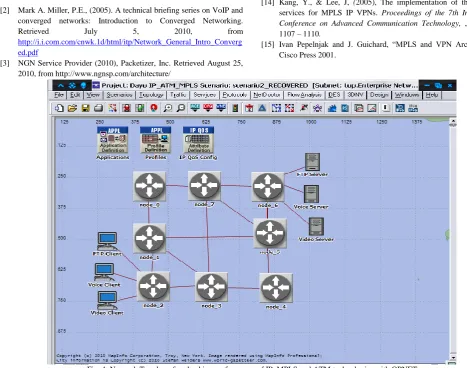
The performance comparison of the protocols was carried out by considering a hypothetical network of IP, ATM, and MPLS technologies and defining the routers to be used for transporting data in order to examine their effect on the network performance. IP is the oldest and highly used in network cores and a lot has been done and still research is going on it for further improvement. In order to enhance IP performance, various modifications to the routing techniques were proposed. In this approach, a careful strategy about delay and efficient use of available bandwidth were taken into consideration with respect to three types of traffic (FTP, Voice, and Video). Figures 4 and 5 below consist of the network elements for ATM, IP and MPLS for each single scenario:
Routers
Servers (FTP, Voice, Video)
Client ( FTP, Voice, Video)
Link ( 10Mbps)
In sending a message and receiving it in any communication system, one important parameter to be taken into consideration is the transmission time delay and it is by which the throughput rate can be calculated. Therefore in ATM network, IP traffic causes a notable overhead due to the small and fixed size of ATM cell. An ATM cell has 53 bytes, where 48 bytes is for usable data and 5 bytes for the header. The following expression gives insight to calculating transmission time delay in ATM:
Bit Rate =
Where TTD =
The efficiency (η) is given as:
Efficiency (η) = 90.566%
Unlike IP, ATM is a connection-oriented technology in which path creation between the endpoints is necessary before the start of data transfer. ATM provides prioritization to definite set of data such as voice, video etc., and also warrants QoS to real-time traffic. By considering different applications, the average size for an IP datagram ranges from 100 bytes to 1500 bytes. In the case of VoIP application, the datagram is around 100 bytes. However, file transfer applications most times have the utmost size possible, e.g. 1500 bytes. Let a medium value of 500 bytes for a Maximum Transmit Unit (MTU) is chosen, then the efficiency will give:
Then, the aggregate efficiency will be:
Epvc= 0.9056 * 0.9467 = 0.8573 ≈ 85%
Basically, this value depends on the MTU size and it range between 80% and 90%.
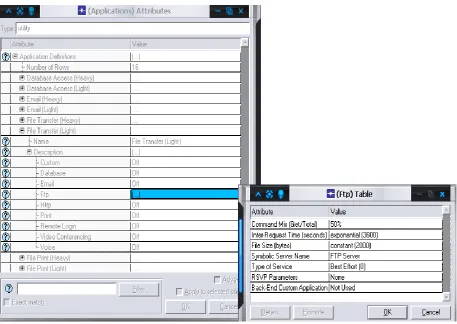
attributes used to model three applications (FTP, Video, and Voice). Low resolution video starting at 10fps (frame per second) arrival rate was used while frame size information in bytes is 128 X 120 pixels. The Type of Service (ToS) is set as Streaming Multimedia. On the other hand, the voice traffic is set to have encoder scheme of G.729, the Silent Length and the Talk Spurt Length is set as exponentially distributed, while the ToS is an Interactive Voice. The overall end-to-end delays consist basically of five types of delay which are: packetization, forwarding, serialization, queuing, and propagation delays. For VoIP application, it is required that end-to-end packet delay should not go beyond 150ms in order to maintain its quality. However, the network delay is the sum of the delays given from propagation, transmission and queuing delay in the network. Forwarding delay happened to be technology dependent which is measured in tens or hundreds of seconds. Serialization delay can be defined as the time it takes to place the bits of a packet onto the link when a router transmits a packet which is packet size and link speed dependent. The queuing delay, depending on how congested the links is, can be described as the time a packet has to wait in a queue and the time it takes to transmit other packets that are queued in front.
4. SIMULATION RESULTS AND DISCUSSION
i) Delay: Internet Protocols happened to give a larger delay when compared with ATM due to the absence of private virtual circuits (PVCs) [14]. PVCs will require that every packet be routed in each node of any IP network. This process will lead to increase in the propagation time that packet will be routed according to PVC definitions and not according to the network topology. This incident eventually cause the quality of real time traffic, especially voice data to be impaired with a high value of delay as depicted in Figure 6 below.
Fig. 6. Average End-to-End Delay of the Network
ii) Throughput:
Data throughput mostly depends on
link speed and characteristic of the technology being
used to transmit the data.
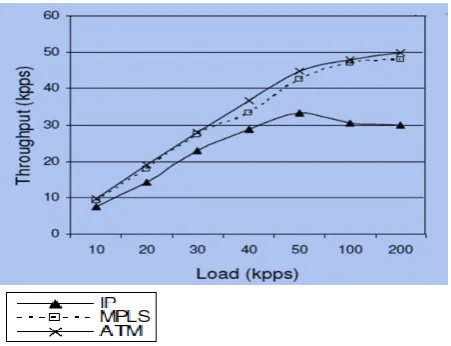
Fig. 7. Throughput of the Network
ATM and MPLS happened to give more data throughput compared to IP. This is due to congestion leading to heavy packet drop and also, to the connectionless feature that IP possess. However, there is a virtual path specified for each packet in ATM and MPLS cores networks that is responsible for the improvement of the overall network throughput performance as shown in Figure 7.
iii. Utilization: This weighs how efficient the technology makes use of the available resources such as bandwidth etc. The general trend of best utilization of resources is for the load to increase linearly till a point of saturation is reached. Although IP produces lower throughput and efficient utilization of the available bandwidth due to the fact that the number of packets is larger in case of IP compared to ATM and MPLS. This is as a result of absence of path before transmission. However it will take IP more bandwidth to tell the best obtainable path.
iv. FTP Download Response Time: Due to non-virtual circuit in IP which causes random path detection, its FTP download response time behavior is poor. Basically ATM is observed to have better response for real time traffic with respect to delay due to the fact that packets can be transmitted at relatively the same time, mindless of when each arrives at the transmission queue because cells from each packet are interleaved.
Fig. 9. FTP Download Response Time for IP, ATM and MPLS
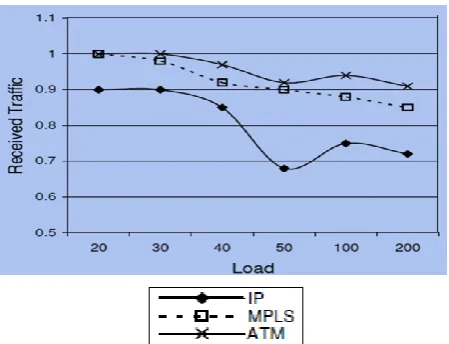
v. Normalized Traffic Received: The connectionless feature of IP turned to be a great deal for a normalized traffic received because there will be more packet drop at the time of congestion. However, IP device tries to avoid congestion by running congestion avoidance mechanism which most of the time works efficiently. In the case of heavy load there will be a progressive reduction in the received traffic due to capacity limit or poor performance at the physical layer as shown in Figure 10.
Fig. 10. Normalized Received Traffic Comparison of IP, MPLS and ATM technologies
From the evaluations above, when IPv4 was considered along side with ATM and MPLS, there is a prior path establishment in ATM and MPLS which has a lot of preferences and this has made the two technologies to outstand typical IP technology. However, one of the reasons why ATM is rarely used for Internet cores is because of the difficulty to replace the existing IP infrastructure which is widely spread all over the Internet. MPLS allows service providers to converge their network into a single infrastructure while offering the service they currently support. MPLS enable new services and simplify services provisioning. It natively supports the rapid growth in IP applications and services allow the integration of the emulated service management into common network strategy and positioned to support integration of packet technologies and optical core. ATM is optimized for voice transport and MPLS is optimized for packet transport. Traffic streams that use small packets need ATM's inherent packet interleaving to keep response time low, even though overall bandwidth efficiency may be lower on a packet network. Streams using larger packets such as file transfers don't need ATM's cell interleaving and consequently are not as affected by cell overhead. Cells are simply fixed length packets and can be carried unchanged across an MPLS network. Packets are not cells and must be adapted to be carried across ATM. So the bottom line is that MPLS offers operational efficiency and major advantages when is used for IP traffic. A transition from ATM to MPLS could give some significant benefits for service providers and for the users.
CONCLUSION
choice of MPLS. Finally, the work found out that network capacity, QoS issues and network security concerns might affect NGN development negatively. But, the choice of MPLS support have eliminated and have provided the service providers with several gains which includes: improved packet forwarding performance in the network, support of Quality-and Class-of-Services for service differentiation and support of network scalability. Other benefits of MPLS include better performance, lower total cost of ownership, greater flexibility to accommodate new technologies, better security and survivability; “Future-proof” the architecture of your network so it can respond rapidly to changing business needs (e.g., new services, latency sensitive traffic, bandwidth intensive traffic, VoIP, video); Lower packet loss which translate to faster response for many applications.
REFERENCE
[1] Ministerial Background Report DSTI/ICCP/CISP (2007) 2/FINAL. Convergence and NGNs: Future of the Internet Economy. from http://www.oecd.org/dataoecd/25/11/761101.pdf
[2] Mark A. Miller, P.E., (2005). A technical briefing series on VoIP and converged networks: Introduction to Converged Networking.
Retrieved July 5, 2010, from
http://i.i.com.com/cnwk.1d/html/itp/Network_General_Intro_Converg ed.pdf
[3] NGN Service Provider (2010), Packetizer, Inc. Retrieved August 25, 2010, from http://www.ngnsp.com/architecture/
[4] Kenneth J. Turner, Evan H. Magill, David J. Marples (2004). Service Provision: Technologies for Next Generation Comms.
[5] Robert Wood: Next Generation Network Services. Cisco Press (2006).
[6] Cisco Assurance Services for IP NGN Data Sheet. Retrieved July 20,
2010, from
http://www.cisco.com/en/US/services/ps6889/Cisco_Assurance_Servi ces_for_IP_NGN_DS.pdf
[7] Spyros L. Tompros (Keletron Ltd) (2007), White Paper: Enabling Convergence of IP Multimedia Services over NGNs Technology. http://www.istvital.eu/related_publications/Vital_white_paper_on_N GN&IMS.pdf
[8] I. Pepelnjak and J. Guichard, “MPLS and VPN Architectures”, Cisco Press (2001).
[9] IXIA White paper, (2004), “Multi-Protocol Label Switching (MPLS), Conformance and Performance Testing”, Retrieved from www.ixiacom.com
[10] Iftekhar Hussain (2005): Understanding High Availability of IP and MPLS Networks. Cisco Press. Retrieved 3rd September, 2010, from http://www.ciscopress.com/articles/article.asp?
[11] M. Laubach: “RFC 1577 - Classical IP and ARP over ATM” (1994). [12] Morrow, M. (2005). NGN and MPLS. Cisco
Press.fromhttp://www.mpls.jp/2005/presentations/051122_01.pdf. [13] Zhili Sun, (2005), Satellite Networking: Principle and Protocols,
ISBN-13: 978-0-470.
[14] Kang, Y., & Lee, J, (2005), The implementation of the premium services for MPLS IP VPNs. Proceedings of the 7th International
Conference on Advanced Communication Technology, , Vol 2, pp
1107 – 1110.
[15] Ivan Pepelnjak and J. Guichard, “MPLS and VPN Architectures”, Cisco Press 2001.
Table I
Summary of Comparison between the Routing Technologies in Converged IP Network
Features IP ATM MPLS
Delay Absence of a virtual
connection makes delay in an IP based network larger
Presence of a virtual connection makes delay in an ATM network lower.
Lower delay due to the path
establishment which makes MPLS a connection -oriented.
Throughput Low data throughput due to its connectionless nature and the heavy packet drops because of congestion
Constant data throughput in ATM network due to virtual path specified for each packet in the core network.
High data throughput in an MPLS network
Utilization IP makes use of available bandwidth but requires extra bandwidth in order to run routing algorithm to predict the best path.
Relatively less utilization in ATM network but it does not imply less efficiency, instead it will benefit during periods of congestion in the network.
MPLS also has a relatively less utilization which will serve as a benefit to the network during periods of network congestion.
FTP Download Response Time
Poor response time due to non-virtual circuit that causes random path detection
Better FTP download response time
Better FTP download response time
Normalized Traffic Received
The connectionless feature of IP is responsible for packets drop during network congestio
ATM is connection-oriented and thus reduces the amount of packet dropped during congestion.
MPLS is also a connection-oriented network and thus reduces traffic dropped during network congestion. Encapsulation
Methods
The encapsulation method used in IP is TCP/IP
Packets must be segmented, transported and re-assembled using adaptation layer which makes it more complex
It adds only a label to the head of each packet and transmits it on the network.
Connections It is bidirectional, allowing packet flow in both directions.
It is bidirectional, allowing packets to flow in both ways over the same path.
Unidirectional, allow packets to flow in only one direction between two endpoints.
Compatibility With IP
Works hand in hand with MPLS.
ATM ‘s incompatibility with IP requires complex adaptation, making it comparatively less suitable for today’s IP networks
Modern routers are able to support both MPLS and IP across a common interface allowing network operators great flexibility in network design. Communicatio
n Type
IP is a connectionless communication type.
Provides connection oriented service for transporting data across computer networks.
Provide connection oriented service for transporting data across computer networks
VOLUME/ No. 0f Bytes
100 bytes to 1,500 bytes ATM transports fixed-length (53 bytes) cells.
MPLS is able to work with variable length packets.
Switching Method
IP uses packet switching since it is connectionless
Uses circuit switching as a result of its connection-oriented mode
![Fig. 2. OSI Model and NGN strata View [10]](https://thumb-us.123doks.com/thumbv2/123dok_us/1388334.1649877/2.595.311.537.114.322/fig-osi-model-and-ngn-strata-view.webp)