Abstract
The Mobile market in India is very robust and is the second largest mobile telecom market in the world, adding nearly 20million subscribers every month. This rapid growth in the mobile segment has been driven by an enabling policy framework and intense competition. With up to 12 competing operators in a circle, the tariffs in India are the lowest as compared to global benchmarks. Even though the literature on customer satisfaction is normally related to customer loyalty, a formal model explaining the steps between customer satisfaction and customer loyalty is missing. It has been mentioned that customer satisfaction is necessary, but not a sufficient condition for improving customer loyalty. There are evidences that despite favorable customer satisfaction, companies are losing important buyers of their products and services every day. If there is no straight forward relationship between customer satisfaction and customer loyalty, then what is there in the middle? How can we explain that customer satisfaction does not always lead to customer loyalty? The present study will address these primary problems by establishing relationship between customer satisfaction, switching costs and brand loyalty.
Keywords: Brand Loyalty, Customer Satisfaction, Service Providers, Switching Costs, Telecom Industry.
Introduction
The service sector is growing at a faster rate than any other sector of the economies in both developed and developing countries. The most marked change in the twentieth century, particularly in the later half, has been the economic transformation from the manufacturing sector to the service sector in almost all the countries in the world. India is not exception to this change. Liberalization of Indian economy, during the 1990s, has
* Associate Professor & Head, MBA Department, Annamacharya Institute of Technology and Sciences, Venkatapuram Village, Karakambadi Road, Tirupati, A.P.
** Asst Professor, MBA Department, Annamacharya Institute of Technology and Sciences, Venkatapuram Village, Karakambadi Road, Tirupati, A.P.
Switching Costs, Customer Satisfaction and Brand
Loyalty: An Empirical Study on Airtel Cellular
Services in Chittor District
given momentum to the service sector. While, during the previous decades, the three main sectors of economic activity- agriculture, industry and service- have roughly equal contribution to the gross domestic product (GDP) of India. According to the statistics of Central Statistical organization (CSO) data for 1999-2000, the service sector accounts for more than 53 percent of Indian GDP. From 2001 onwards it has been increased gradually. Contribution of service sector to the Indian GDP reached 86.5 percent by the end of the financial year 20012-13.
Among the various service sub-segments, the main growth driver of the sector is telecommunication services, apart from Information Technology (IT), Information Technology-Enabled Services (ITES), and tourism. Since 1990s, the telecommunications sector has been a key area for the economic advancement of developed as well as developing countries. This is the result of enormous technological development in the telecom field in general and cellular mobile telephone services (CMTS) in particular. In addition to this, the changing economic conditions, changing needs of customers and competition among the telecom companies have made the field, a dynamic service sub-sector for economic development. So marketing orientation has become main strategy of telecommunication services firms in India.
Because of heavy competition in Indian cellular services market, Airtel cellular services, the market leader is facing the threat of losing subscriber base. Though Airtel has nation-wide network, the performance of the company with regard to service provision is not on par with other service providers in few areas.
The general purpose of this study is to reconceptualise a traditional model of consumer loyalty in the mobile services context. The importance of consumer loyalty in the services industry cannot be overstated. As consumer's controlling power over the market increases, the marketing effort is shifting from satisfying customers to retaining customers.
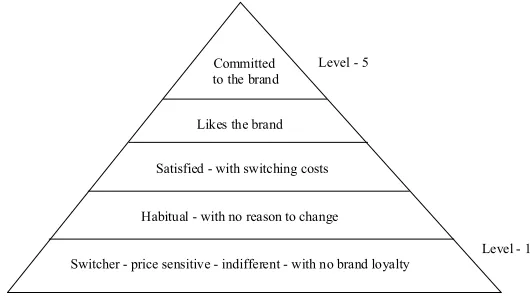
Committed to the brand
Likes the brand
Satisfied - with switching costs
Habitual - with no reason to change
Switcher - price sensitive - indifferent - with no brand loyalty Level - 5
Level - 1
a) The first level represents non loyal buyers, who are completely indifferent to brands, each brand being perceived to be adequate if the price is accepted.
b) The second level includes not dissatisfied buyers with no dimension of dissatisfaction sufficient enough to stimulate a change, but vulnerable to competitors that can create a perceived benefit in the case of switching.
c) The third level consists of satisfied customers with switching costs (loss of time, money, or acquired loyalty advantages, performance risks associated with switching, etc). Switching incentives from competitors must compensate with switch costs.
d) The fourth level contains customers who truly like the brand and have an emotional attachment to the brand, based upon associations such as a symbol, a set of use experiences, or a high perceived quality. The emotional attachment's reason is sometimes just the fact that there has already been a long-term relationship. e) The fifth level represents committed customers, proud to have discovered and
used the brand, and to whom the brand is very important both functionally as an expression of their personality.
Dick and Basu argue that loyalty is determined by the strength of the relationship between relative attitude and repeat patronage. On the basis of attitude-behaviour relationship, they propose four types of brand loyalty (Fig.2.2). The "spurious loyalty" and "no loyalty" categories occur under low relative attitude that might be indicative of a recent introduction and /or an inability to communicate distinct advantages, or when most competing brands are seen as similar.
Company Profile: An Overview
Bharti Airtel Limited formerly known as Bharti Tele-Ventures LTD (BTVL) is an Indian company offering telecommunication services in 18 countries. It is the largest cellular service provider in India, with more than 197 million subscriptions as of April 2013. Bharti Airtel is the world's third largest, single-country mobile operator and fifth largest telecom operator in the world in terms of subscriber base. It also offers fixed line services and broadband services. It offers its telecom services under the Airtel brand and is headed by Sunil Bharti Mittal. The company also provides telephone services and broadband Internet access (DSL) in over 89 cities in India. It also acts as a carrier for national and international long distance communication services.
Brand Airtel was born free, a force unleashed into the market with a relentless and unwavering determination to succeed. A spirit charged with energy, creativity and a team driven to seize the day, with an ambition to become the most globally admired telecom service.The Enterprise business provides end-to-end telecom solutions to corporate customers and national and international long distance services to telcos through its nationwide fiber optic backbone, last mile connectivity in fixed-line and mobile circles, VSATs, ISP and international bandwidth access through the gateways and landing stations.
Review of Literature
According to Churchill and Surprenant (1982), "customer satisfaction is an output, resulting from the customer's pre-purchase comparison of expected performance with perceived actual performance and incurred cost. There have been many studies on customer satisfaction over the years. However, Parasuraman et al., (1994) have put forward the simple and clear definition for satisfaction. They suggest that satisfaction is influenced by service quality, product quality and price. They have conducted research on satisfaction on a transaction level, implying that overall satisfaction is a function of transaction.
Wang and Lo (2002) paid attention to the measurement model of service quality in China's mobile phone market. It was based on the well-known SERVQUAL model, but with modification on the basis of focus group discussions and expert opinions to reflect the specific industry attributes and the special culture of China. Emphasis was then paid to the study of the dynamic relationships among service quality, customer value, customer satisfaction and their influences on future behaviours. They have also studied about key drivers of customer value and customer satisfaction.
Abod Ali Khatibi (2008) analyzed the factors that contribute to customer satisfaction and loyalty in telecom industry. SERVQUAL instrument was used to measure the current level of service quality and satisfaction. The results indicate that a high degree of customer satisfaction does not always translate into loyalty. Among the sixteen factors, channel of ordering, operating hours, fault reporting center, response time and restoration time indicate high correlation with customer loyalty as compared to other variables. In addition, improvement of overall service quality will have some positive impact on customer loyalty. In this study switching costs were not taken into consideration.
The study showed that the switching cost, service quality and customer satisfaction have positive association with customer loyalty. However, they found that the customer satisfaction was the best predictor of customer loyalty.
Amzad Iqbal and Sazid Bashir (2010) studied about antecedents and outcomes of customer satisfaction in using prepaid cellular service in Pakistan. Their study focused on estimating and comparing the perceived expectation and the actual satisfaction level of prepaid cellular service users in Pakistan. In their study 235 prepaid cellular service users were investigated randomly. Perceived quality, perceived value and perceived expectations are leading variables for customer satisfaction: while purchase likelihood, customer complaints and price tolerance are dependent on actual satisfaction. Findings suggest that customers have high expectations that are fulfilled by the cellular service providers to some extent.
Statement of the Problem
Mobile market in India is very robust and is the second largest mobile telecom market in the world, adding nearly 20million subscribers every month. This rapid growth in the mobile segment has been driven by an enabling policy framework and intense competition. With up to 12 competing operators in a circle, the tariffs in India are the lowest as compared to global benchmarks.
Despite this new emphasis on customer retention and the acceptance that managers need to understand and know how customer retention can be achieved, marketing researchers did not have advanced studies on the antecedents of customer retention in telecommunication services. Some authors of marketing textbooks have linked customer retention to customer satisfaction (Kotler (1997), Kurtz and Clow (1998), Rust, Zahorik and Keiningham (1996), Zeithmal and Bitner (1996) under the assumption that a satisfied customer may be prone to repeat purchases, whereas an unsatisfied customer may tend to defect. Similarly, some marketing researchers have underscored the direct relationship between customer loyalty and customer satisfaction (Hallowel (1996), Heskett (1994)). Even though the literature on customer satisfaction is normally related to customer loyalty, a formal model explaining the steps between customer satisfaction and customer loyalty is missing. It has been mentioned that customer satisfaction is necessary, but not a sufficient condition for improving customer loyalty. There are evidences that despite favorable customer satisfaction, companies are losing important buyers of their products and services every day.
Objectives of the Study
In order to get answers to the above questions, the present research is designed to achieve the following objectives:
• To find out the relationship between the Switching Costs (SC), Customer Satisfaction (CS) and Brand Loyalty (BL) of the customers of Airtel cellular services.
• To know the impact of Switching Costs and Customer Satisfaction on Brand Loyalty.
Hypotheses of the Study
On the basis of the theoretical framework and review of literature, the following hypotheses were developed.
H1: There is no significant correlation between Customer Satisfaction and Brand Loyalty.
H2: There is no significant correlation between Switching Costs and Brand Loyalty.
H3: There is no significant correlation between Switching Costs and Customer Satisfaction.
Research Methodology
The research methodology is the science of dealing with the principles of procedure in research study. It deals with the definition of the research problem, research design, and method of data collection, selection of sampling, statistical tools employed and interpretation of collected data.
(i) Research Design
The research design is descriptive as it provides the inventory of feelings regarding switching Costs, Customer Satisfaction and Customer Loyalty intentions of customers towards Airtel cellular service providers.
The subscriber respondents were chosen from the Airtel subscribers in Chittoor district, Andhra Pradesh.
(ii) Scope of the Study
(iii) Period of Study
The study of this type requires at least a decade period to observe the trend and draw valid conclusions from the analysis. Now, the present study covers a period of 10 years starting from 2002-2003 to 2011-2012.
(iv) Sources of Data
The data sources required for the study include both primary and secondary. The primary data sources were the subscribers of Airtel cellular mobile telephone services in Chittoor district, Andhra Pradesh.
The secondary data sources were: relevant websites, national and international refereed journals, business magazines and news papers, working papers and monographs relevant to the area of research.
(v) Sampling Methodology
Sampling frame comprised of the subscribers of cellular mobile services of Airtel, in Chittoor district of Andhra Pradesh. Non-Probability Quota sampling technique was used.
The total number of Airtel customers in Chittor District is 8, 68,823 as on August 2010. Since customers are spread geographically, may be because of their mobility, it is found to be very difficult to meet them for data collection if probability sampling technique is adopted.
A total of 500 customers were contacted over a 3 months period (Aug-Oct 2010) via a structured questionnaire.
(vi) Data Analysis Methods
The data collected from the field survey was analyzed using SPSS (Statistical package for social sciences) software package.
In order to test the proposed hypotheses through data analysis, several univariate and multi vitiate statistical techniques were employed. These techniques included simple percentages, standard deviation, analysis of variance (ANOVA), correlation, regression.
(vii) Limitations of the Study
The study has the following limitations:
levels etc. Drawing sample from a single company limits the generalisability of the study.
Analysis
Descriptive Statistics for CS
The overall rating for CS is 3.84. The mean values for the two dimensions of customer satisfaction are as follows : I am completely satisfied with the services delivered by Airtel (3.98). I feel absolutely delighted (3.71).
Table 1: Mean, Std.Dev and Variance for the dimensions of CS (N = 500)
S.No Items Mean Std.Dev Variance
Overall 3.84 .51 .26
1 I am completely satisfied with the services delivered by Airtel.
3.98 .59 .35
2 I feel absolutely delighted. 3.71 .64 .42
5 point scale: Strongly disagree (=1) to Strongly Agree (=5).
Descriptive Statistics for SC
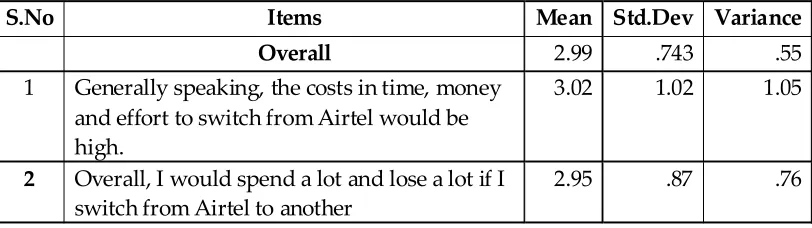
The mean, standard deviation and variance for switching costs is given in the table 4.10.The mean value for overall switching costs is 2.99. Generally speaking, the costs in time, money and effort to switch from Airtel would be high (3.02). Overall, I would spend a lot and lose a lot if I switch from Airtel to another (2.95).
Table 2: Mean, Std.Dev and Variance for the dimensions of SC
S.No Items Mean Std.Dev Variance
Overall 2.99 .743 .55
1 Generally speaking, the costs in time, money and effort to switch from Airtel would be high.
3.02 1.02 1.05
2 Overall, I would spend a lot and lose a lot if I switch from Airtel to another
2.95 .87 .76
Brand Loyalty
Brand Loyalty of a customer is studied under four dimensions in the present study (word of mouth, purchase intentions, price sensitivity and complaining behavior). The descriptive statistics for the four dimensions are presented in the Tables 4.24 to 4.28.
There is no significant correlation between CS and Brand Loyalty.
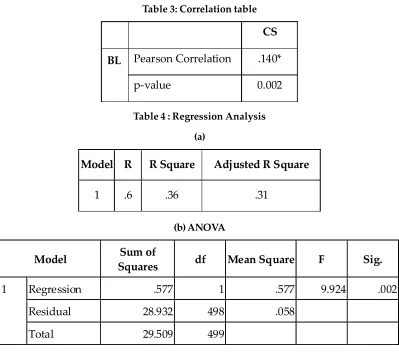
From the tables 3 and 4, it has been observed that there is significant positive correlation between customer satisfaction and customer loyalty. The corresponding correlation coefficient is significant at 5% level. The R2 value reveals that both the variables contribute to 31% of the explained variance. We can conclude that customer satisfaction and Brand Loyalty are strongly related. Hence there is significant relationship between CS and BL.
Table 3: Correlation table
CS
BL Pearson Correlation .140*
p-value 0.002
Table 4 : Regression Analysis (a)
Model R R Square Adjusted R Square
1 .6 .36 .31
(b) ANOVA
Model Sum of
Squares df Mean Square F Sig.
1 Regression .577 1 .577 9.924 .002
Residual 28.932 498 .058
(c) Coefficients
Model
Unstandardized Coefficients
Standardized
Coefficients t Sig.
B Std. Error Beta
1 (Constant) 3.101 .081 38.087 .000
CS .066 .021 .140 3.150 .002
H2: There is no significant correlation between Switching Costs and Brand Loyalty.
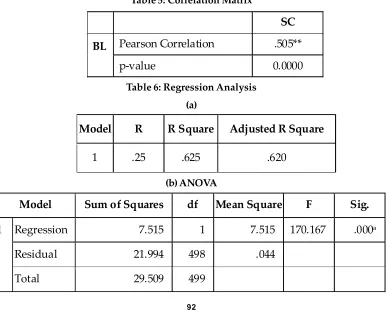
The results of correlation and Regression analysis (Tables 5 and 6) reveal that there is strong significant relationship between Switching Costs and Brand Loyalty. The correlation coefficient is 0.505, which indicates high association between the variables. From the table 6 (a), the adjusted R2 value offer noteworthy insight on the overall ability of Switching costs to explain the variation in score on Brand Loyalty. Hence the relationship between SC and BL is highly significant.
Table 5: Correlation Matrix
SC
BL Pearson Correlation .505**
p-value 0.0000
Table 6: Regression Analysis (a)
Model R R Square Adjusted R Square
1 .25 .625 .620
(b) ANOVA
Model Sum of Squares df Mean Square F Sig.
1 Regression 7.515 1 7.515 170.167 .000a
Residual 21.994 498 .044
(c) Coefficients
Model
Unstandardized Coefficients
Standardized Coefficients
T Sig.
B Std. Error Beta
1 (Constant) 2.861 .039 73.394 .000
Switching_Cost .165 .013 .505 13.045 .000
H3: There is no significant correlation between switching costs and customer satisfaction.
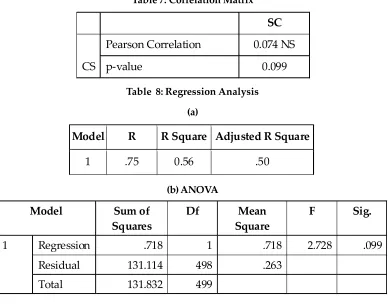
The Table 7 concludes that there is insignificant correlation between Switching Costs and Customer Satisfaction. Also the results of the regression analysis (Table 8) reveal that there is no significant relationship between Switching Costs and Customer Satisfaction. P-value is greater than 0.05, hence the relationship between SC and CS is not significant.
Table 7: Correlation Matrix
SC
CS
Pearson Correlation 0.074 NS
p-value 0.099
Table 8: Regression Analysis (a)
Model R R Square Adjusted R Square
1 .75 0.56 .50
(b) ANOVA
Model Sum of
Squares
Df Mean
Square
F Sig.
1 Regression .718 1 .718 2.728 .099
Residual 131.114 498 .263
(c) Coefficients
Model Unstandardized
Coefficients
Standardized Coefficients
t Sig.
B Std. Error Beta
1 (Constant) 3.691 .095 38.780 .000
Switching_Cost .051 .031 .074 1.652 .099
Findings
The hypotheses of the model were tested and the findings corroborate with the view that mobile service quality, customer satisfaction and customer loyalty are related.
• The overall Satisfaction of Customers towards Airtel cellular Services is above average.
• The overall switching costs to switch from Airtel to another are high.
• There is significant relationship between CS and Brand Loyalty.
• There is significant relationship between SC and Brand Loyalty.
• There is no significant relationship between SC and CS.
Recommendations
• Airtel can have tie-ups with cell phone manufacturers and can provide the handsets at subsidized rates. Once it is purchased, the phone will be locked. Customer cannot use another sim in the same handset. This creates switching costs for the customers and hence they remain loyal to the brand.
• Loyalty programs play an important role in retaining the existing customers. We can develop loyalty programs, an offer where an operator gets free minutes, when their customers reach a certain level of usage. Airtel can also use internal scoring system to identify their high value customers and offer them on a discretionary basis, rebates, specific membership clubs and gift certificates, or free goods when they renew their subscriptions.
Conclusion
that there is a positive relationship between and customer satisfaction and brand loyalty and is concluded that, customer satisfaction and customer loyalty are related. And also there is significant relationship between SC and Brand Loyalty. But there is no significant relationship between SC and CS.
References
1. RBI, Macroeconomic and Monetary developments in 2010-11, issued with the Annual policy statement for 2010-11.
2. Gordon and Gupta (2004), understanding India's service revolution, IMF working paper WP/04/171, available at www.imf.org and Banga, Rashmi and Goldar (2004), "contribution of services to output growth productivity in Indian Manufacturing: Pre and Post Reforms", ICRIER Working Paper, No.139, August.
3. Banga, Rashmi (2006), Critical issues in India's service-led growth, INRM Policy Brief No.2, Asian Development Bank.
4. Dorothy, I.Riddle (1986), Service-Led Growth, Praeger, New York, p.27.
5. Cellular services in India confirm to the second-generation (2G) digital global system for mobile communications (GSM) standard (900 MHz spectrum).
6. The licenses for cellular services are for a period of 20 years, further extendable by 10 years at one time.