Volume 7, Issue 6 [Jun 2018] PP: 01-15
www.ijeijournal.com Page | 1
Analysis of Data on Intellectual Property Rights and Indigenous
Knowledge Transfer In Selected States In Nigeria
Engr. Nwosa, Joseph Ukweh Lucky
1, Tobinson. A. Briggs
21METI, Faculty of Engineering, University of Port Harcourt, Rivers State, 2
Department of Mechatronic Engineering, University of Port Harcourt, Nigeria Corresponding Author: Engr. Nwosa
Abstract :
This study is to find out the relationship between the hereditarily acquired Indigenous Knowledge and the contemporary knowledge management systems in Nigeria. The population considered, consisted of 3,141 knowledge workers and 1,571 indigenous knowledge practitioners for the qualitative data while population for the quantitative data consisted of 20,576 public servants, all in the six geo-political zones in Nigeria. Using the purposive and proportionate sampling technique, 324 knowledge workers, 175 indigenous knowledge practitioners and 2,182 public servants were drawn. Three research questions and null hypotheses guided the study. A data collection instrument, “the Indigenous Knowledge and Intellectual Property Rights Management Questionnaire (IKIPRQ – A&B)” was developed for the purpose. This instrument was preliminarily tested for reliability with a reliability coefficient of 0.73 before administration. The instrument was considered adequate and therefore used for data collection. To analyze collected data, inferential analyses were conducted such as logistic regression analysis for the quantitative data at 95% level of significance (the general decision rule for inferential statistical significance is considered at 95% confidence level or P <.05), while Deductive Approach was used to analyze the qualitative data. Results of the analysis carried out show that oral transmission and the operational methods of practitioners negatively influence the transfer and management of Indigenous Knowledge. It was also found that factors that hinder the formal processes of Intellectual Property Management interface with Indigenous knowledge practice are significantly influenced by the different regions in Nigeria.Keywords:
Indigenous Knowledge, IP management, knowledge based practitioners, traditional practitioners,
qualitative data and quantitative data, intellectual property policies--- Date of Submission: 31-05-2018 Date of acceptance: 15-06-2018 --- ---
I. INTRODUCTION
With increasing emphasis on sustainability, the study of indigenous knowledge forms and the management of the associated intellectual property have taken on renewed significance for economic growth and social development of hitherto classified third world countries. Exploitation of intellectual property for development and emancipation has remained a mirage in developing countries. In the case study country, the apparent ineffectiveness of contrived systems of innovation to energise and sustain the required levels of development for economic and social emancipation has remained a major concern. The study explores the interactions between the components of the systems of innovation and their impact on the commercialization and exploitation of indigenous knowledge.
1.1 Design/Methodology/Approach – The research made use of multiple, primary data sources from survey questionnaires, structured and unstructured interviews, archival records, policy documents and examples. Data collection was based on the segmentation of the case study country along geo-political zones.
1.2 Research Limitations – The preponderance of indigenous knowledge in tacit, non-explicit forms in association with prevailing cultural norms imposed a remarkable level of subjectivity.
1.3 Findings - Extant reviewed literature suggests that there may be very little or no connection between indigenous knowledge capacities, formal intellectual property policies and contrived components of systems of innovation in the case study country.
1.4 Research Questions
To facilitate the research, the following research questions and hypothesis are drawn up for the study I. Does oral transmission significantly influence the transfer of Indigenous Knowledge?
Knowledge practice according to the regions? Hypotheses
The following hypotheses were formulated and tested:
HO1: Oral transmission does not significantly influence the transfer of Indigenous Knowledge.
HO2: The operational methods of the custodians of Indigenous Knowledge do not have significant influence on its management.
HO3: Factors that hinder the formal processes of Intellectual Property Management interface with Indigenous Knowledge practice are not significantly influenced by the different regions in Nigeria.
II. GENERAL RESULTS OF ANALYSIS (QUANTITATIVE) 2.1. Channels of Indigenous Knowledge Transfer and Communication
This section deals with presentation of the results of data analyses as well as the focused group discussions. The results and discussions are presented accordingly from the general results of analysis which consists of the description of the sample characteristics and response rates to the research questions and hypotheses.
2.2. Sample Characteristics and Response Rate
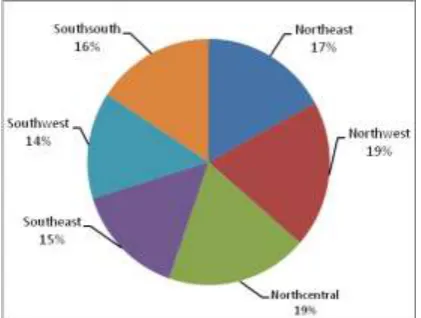
A total of 3,438 questionnaires were administered, out of which 2,182 valid questionnaires were retrieved and analysed in this study. The distributed questionnaires analysed, (See Figure 1) indicated that largest proportion 19% was received from Northwest and North central respectively. The overall response rate of 63% attained in this study was generally considered satisfactory Baruch and Holtom(2008) for the survey approach adopted in this study. The response rate allows for the assessment of the influence of methodological approach on the responses, and in this study, the hand-to-hand delivery and collection of responses could be attributed to this favourable result recorded. Generally the response rates from the Southern zones are lower than the Northern zones by about 13%.
Figure 0 Distribution of questionnaires analysed by zones
Table 1 Questionnaire Response Rate and Sample Characteristics
Zones University/Ministry Questionnaires Distributed
Questionnaire s Returned
Response rate
(%) Cumulative
NORTH EAST ATBU Bauchi 382 181 47%
FMA&RD, Abuja 191 190 99% 73%
NORTH WEST ABU Zaria 382 260 68%
AFIT Zaria 191 163 85% 77%
NORTH CENTRAL Nassarawa State University 382 222 58%
FMST, Abuja 191 190 99% 79%
SOUTH EAST Abia State University 382 168 44%
Min. of S & T, Abia 191 158 83% 63%
SOUTH WEST UNILAG 382 171 45%
General Hospital Lagos Island 191 135 71% 58%
SOUTH UNIPORT 382 158 41%
SOUTH FMWRD 191 186 97% 69%
Total 3,438 2,182 63%
2.3. Sample Adequacy and Reliability
www.ijeijournal.com Page | 3 response data. KMO values < 0.5 was unacceptable Anastasiadou(2011). For this study, inferential statistics technique was applied. It is a technique that allows us to use these samples to make generalizations about the populations from which the samples were drawn. The methods of inferential statistics used in this work are the estimation of parameters and testing of statistical hypotheses.
The overall reliability of the response data in this study, as expressed by the Cronbach‟s Alpha coefficient (α) value of α = 0.887 suggests an appropriate level of internal consistency. Cronbach‟s coefficient < 0.5 is generally considered not suitable Anastasiadou (2011). The item-to-dimensions or sub-sections α-values obtained in this study revealed a generally appropriate internal consistency for all the items in the IKIPRQ – A questionnaire: CIKTC (α = 0.67), EOMUIKP (α = 0.77) and IIPMIKP (α = 0.82).
2.4. Factors and Development of Factors:
In view of the volume of data to be processed from the returned instrument, factor loadings, also called component loadings were employed in the analysis. These factors are correlation coefficients between the cases (rows) and factors (columns). Analogous to Pearson's r, the squared factor loading is the percent of variance in that indicator variable explained by the factor. The factors each represent a set of values of a parameter for which a differential equation has a nonzero solution (an Eigen-function) under given conditions or any number such that a given matrix minus that number, times the identity matrix has a zero determinant. Furthermore the generated factors are plotted in a screen plot of factor loadings of items in each subsection.
2.5. Eigen-values and Screen Plots mathworld.wolfram.com
From mathworld.wolfram.com, “Eigen-values are a special set of scalars associated with a linear system of equations (i.e., a matrix equation) that are sometimes also known as characteristic roots, characteristic values (Hoffman and Kunze 1971), proper values, or latent roots (Marcus and Minc 1988, p. 144)”.
A scree plot displays the eigen-values associated with a component or factor in descending order versus the number of the component or factor. The scree plots are used in principal components analysis and factor analysis to visually assess which components or factors explain most of the variability in the data.
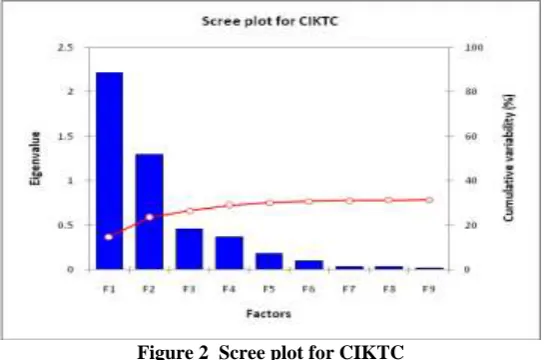
Figure 2 shows the scree plot of factor loadings of ITEMs in the subsection CIKTC of the IKIPRQ – A.. It displays the result of factor analysis and the eigenvalues associated with the factors in descending order versus the number of the factors. For CIKTC, the first two factors explain most of the variability in the data, while the remaining factors explain a very small proportion of the variability and are likely unimportant. Figure 2 shows that the first two factors have eigen-values above 1.00. Traditionally, only variables with eigenvalues of 1.00 or higher are considered worth analyzing. (Zhu and Ghodsi (2006). Up to 4 of those factors may be considered as explainable for the variations as they contribute to the so called “non-trivial amounts of variance” (Gorsuch (1983), and may be utilized to fit the logical theory for these data, even though their eigenvalues are below the acceptable 1.00 from the scree plot for CIKTC.
Figure 2 Scree plot for CIKTC
Thus Figure 2 further illustrates the coordinates of factor loadings of the 14 items in the CIKTC subsection of the IKIPRQ which shows that the first factor explains most of the variations (F1 = 14.78%) in the
responses for the ITEMS. Accordingly, the following factors, F2 = 8.63%, F3 = 3.06% (factor loading and F4 =
2.46% relatively explains the variation in the ITEM responses that loaded on Factors 2, 3 and 4 respectively. (See table 2 below). This indicates that the F1 with 14.78% really to a large extent provides the likelihood of a
Table 2 Eigenvalues
F1 F2 F3 F4 F5 F6 F7 F8 F9
Eigenvalue 2.217 1.295 0.459 0.369 0.180 0.103 0.037 0.035 0.019
Variability (%) 14.780 8.631 3.063 2.459 1.203 0.688 0.248 0.235 0.125
Cumulative % 14.780 23.411 26.473 28.932 30.135 30.823 31.070 31.306 31.431
The cumulative loadings of F1 and F2 is 23.41%, which suggests that about 23% of variances in the
CIKTC subsection of the IKIPRQ model were contributed by the ITEMS that loaded on the first two factors. This means that questions 1 and 2 provides to a reasonable extent, the answers to research question.
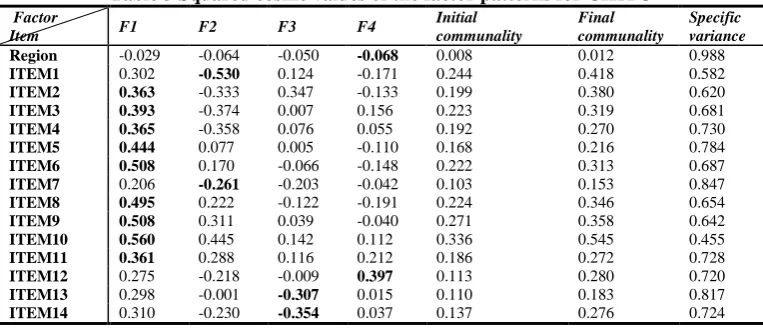
These ITEMS can be better appreciated when plotted on the coordinate plot, and include ITEMS 10, 9, 6, 8, 5, 3, 4, 2and 11 that loaded strongly on F1, and ITEMS 1 and 7 that loaded strongly on F2.Their squared
cosine values of the factor patterns presented on Table 3.
The implication of this finding infer that ITEMS loading on a factor supports convergent validity, while each of the other ITEMS that load most heavily on a different factor supports divergent validity Gorsuch(1983). In other words, the IKIPRQ instrument construct with CIKTC subsection could be split into further subsections according to the loadings or that ITEMS loaded on the F1 and F2 (since Eigenvalues ≥ 1)
should only be considered for analyzing the context of CIKTC. In other words, the IKIPRQ instrument construct with CIKTC subsection could be split into further subsections according to the loadings. As stated earlier above, the other items of the instrument can be used to analyze other parameters of Indigenous knowledge and Intellectual property management issues such as the economic implications of knowledge transfer since in such other circumstances, their eigenvalues ≥ 1.
For instance, ITEMS 12, 13 and 14 loads on F3 and F4 suggest divergent validity with ITEMS that
loaded on F1 and F2 of the construct with CIKTC subsection. However, a closer consideration of these ITEMS
loaded on F3and F4 indicates that they (the items) relate to the economic implications of knowledge transfer. In
other words, these items statistically, will give more credible results on the economic implications of knowledge transfer rather than Indigenous Knowledge Transfer and Communication.
The coordinate plot also indicate that ITEMS 9and 10 that loaded most strongly on F1, correlate (r = .42) most
strongly than other pairs. This suggests that while customs and tradition are effective communication tools for transfer of indigenous knowledge, it is mainly effective for the handpicked individuals as deducted from the responses from the questionnaire.
This therefore answers Research Question 1: What are the channels of Indigenous Knowledge transfer and communication? Customs and tradition are the channels of transfer of indigenous knowledge.
Table 3 Squared cosine values of the factor patterns for CIKTC Factor
Item F1 F2 F3 F4
Initial communality
Final communality
Specific variance
Region -0.029 -0.064 -0.050 -0.068 0.008 0.012 0.988
ITEM1 0.302 -0.530 0.124 -0.171 0.244 0.418 0.582
ITEM2 0.363 -0.333 0.347 -0.133 0.199 0.380 0.620
ITEM3 0.393 -0.374 0.007 0.156 0.223 0.319 0.681
ITEM4 0.365 -0.358 0.076 0.055 0.192 0.270 0.730
ITEM5 0.444 0.077 0.005 -0.110 0.168 0.216 0.784
ITEM6 0.508 0.170 -0.066 -0.148 0.222 0.313 0.687
ITEM7 0.206 -0.261 -0.203 -0.042 0.103 0.153 0.847
ITEM8 0.495 0.222 -0.122 -0.191 0.224 0.346 0.654
ITEM9 0.508 0.311 0.039 -0.040 0.271 0.358 0.642
ITEM10 0.560 0.445 0.142 0.112 0.336 0.545 0.455
ITEM11 0.361 0.288 0.116 0.212 0.186 0.272 0.728
ITEM12 0.275 -0.218 -0.009 0.397 0.113 0.280 0.720
ITEM13 0.298 -0.001 -0.307 0.015 0.110 0.183 0.817
ITEM14 0.310 -0.230 -0.354 0.037 0.137 0.276 0.724
www.ijeijournal.com Page | 5 However, the responses for ITEM1 was highest suggesting that 94% of the respondents “Agree” that Indigenous Knowledge is transferable, but this strong affirmation varies across the geopolitical zones, as indicative of the result on Table 4 which present p-values of each ITEM in Section B. The CIKTC, following the Logit Model indicate that although the overall (2 Log (Likelihood) P <.05) is significant, this was generally influenced by responses from the Northwest (P = .003), Southwest (P = .026) and South-south (P = .002). In other words, of the six zones, these three most significantly affirm that Indigenous Knowledge is transferable.
ITEMS 7, 8 and 9 generally with significance (P<.05) indicate that the transfer of indigenous knowledge is usually influenced by the customs and traditions of the people. Customs and tradition are a very strong method of communication in indigenous knowledge activities indicating that customs and tradition, as communication tools, are effective in the transfer of Indigenous knowledge. Hypothesis 1: From the analysis carried out, it is clear that “Customs and traditions significantly influence the transfer of Indigenous Knowledge.” Customs and traditions do significantly influence Indigenous Knowledge transfer.
Figure 3 Distribution (%) of “Agree” responses in Section B: CIKTC.
Table 4 Results of Logit Model showing p-values of Section B: CIKTC
CIKTC Intercept 2 Log(Likelihood) p-value North east North west North central South East South West South South
ITEM1 0.000 0.000 0.565 0.003 0.572 0.871 0.026 0.002
ITEM2 0.000 0.018 0.458 0.242 0.025 0.965 0.971 0.011
ITEM3 0.000 0.783 0.998 0.633 0.268 0.654 0.346 0.188
ITEM4 0.000 0.224 1.613 0.883 0.153 0.340 0.615 0.165
ITEM5 0.000 0.000 0.000 0.966 0.000 0.836 0.505 0.022
ITEM6 0.000 0.000 1.063 0.532 0.001 0.741 0.520 0.085
ITEM7 0.000 0.038 1.251 0.626 0.000 0.826 0.246 0.092
ITEM8 0.000 0.000 1.251 0.626 0.000 0.826 0.246 0.092
ITEM9 0.000 0.000 0.323 0.162 0.000 0.395 0.781 0.144
ITEM10 0.195 0.000 0.302 0.000 0.303 0.333 0.690 0.291
ITEM11 0.133 0.000 0.000 0.998 0.000 0.642 0.802 0.018
ITEM12 0.000 0.008 1.077 0.547 0.016 0.799 0.206 0.572
ITEM13 0.000 0.094 1.291 0.663 0.051 0.901 0.233 0.982
ITEM14 0.000 0.194 0.157 0.247 0.338 0.273 0.853 0.735
Significant p-values (<.05)
III. ESTABLISHED OPERATIONAL METHODS UNIQUE TO INDIGENOUS KNOWLEDGE PRACTICE (EOMUIKP)
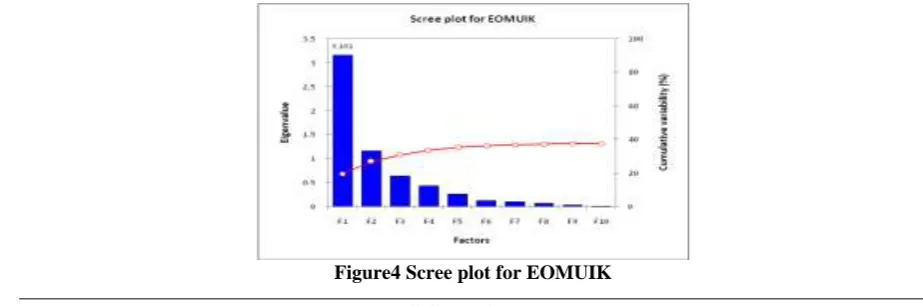
Figure 4 below, shows the scree plot of factor loadings of the 15 ITEMS in the subsection EOMUIKP of IKIPRQ – A. Although similar to CIKTC, the first two factors explain most of the variability in the data with an eigenvalue ≥ 1, this scree plot shows that the first factor has eigenvalue = 3.16, which is very high and suggest a significant ITEM loadings on the F1.
The factor loadings of the ITEMS in the EOMUIK subsection of the IKIPRQ and shows that the first factor explains most of the variations (F1 = 19.76%) in the responses for the ITEMS. Accordingly, the following
factors, F2 = 7.28%, F3 = 3.98%, and F4 = 2.76% comparatively explains the variation in the ITEM responses
that loaded on Factors 2, 3 and 4 respectively.
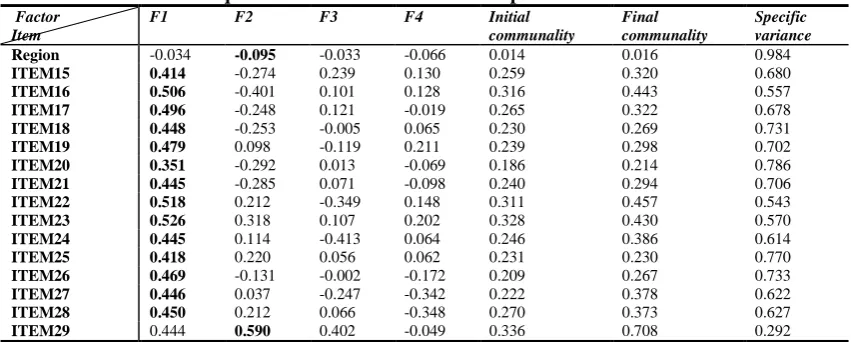
As indicated earlier, F1 loads most of the ITEMS due to the high eigenvalue, the squared cosine values of the
factor patterns for EOMUIKP as presented on Table 5 revealed that all ITEMS actually loaded on F1,with
exception of ITEM 29 that loads on F2. Therefore variations due to F3 and F4 are only hypothetical
Gorsuch(1983).
The coordinate plot also indicate that ITEM 24 and ITEM 18 correlate (r = .43) more strongly than other pairs. ITEMS 24 and 18 concern the fact that operational methods may hinder economic development as well as the availability of equipment and/or machinery - instruments/items/symbols easily sourced locally.
Table 5 Squared cosine values of the factor patterns for EOMUIKP Factor
Item
F1 F2 F3 F4 Initial
communality
Final communality
Specific variance
Region -0.034 -0.095 -0.033 -0.066 0.014 0.016 0.984
ITEM15 0.414 -0.274 0.239 0.130 0.259 0.320 0.680
ITEM16 0.506 -0.401 0.101 0.128 0.316 0.443 0.557
ITEM17 0.496 -0.248 0.121 -0.019 0.265 0.322 0.678
ITEM18 0.448 -0.253 -0.005 0.065 0.230 0.269 0.731
ITEM19 0.479 0.098 -0.119 0.211 0.239 0.298 0.702
ITEM20 0.351 -0.292 0.013 -0.069 0.186 0.214 0.786
ITEM21 0.445 -0.285 0.071 -0.098 0.240 0.294 0.706
ITEM22 0.518 0.212 -0.349 0.148 0.311 0.457 0.543
ITEM23 0.526 0.318 0.107 0.202 0.328 0.430 0.570
ITEM24 0.445 0.114 -0.413 0.064 0.246 0.386 0.614
ITEM25 0.418 0.220 0.056 0.062 0.231 0.230 0.770
ITEM26 0.469 -0.131 -0.002 -0.172 0.209 0.267 0.733
ITEM27 0.446 0.037 -0.247 -0.342 0.222 0.378 0.622
ITEM28 0.450 0.212 0.066 -0.348 0.270 0.373 0.627
ITEM29 0.444 0.590 0.402 -0.049 0.336 0.708 0.292
Values in bold correspond for each variable to the factor for which the squared cosine is the largest
Another moderately strong correlation (r = .40) is between ITEM 23 and ITEM 28, relates to the fact that the methods serve primarily as protective measures for the indigenous knowledge rather than economic growth, meaning that economic growth cannot be maximized if indigenous knowledge remains in the custody of a select few who are familiar with the operational methods of practice.
Figure 5 shows the percentage distribution of “Agree” responses in Section C: EOMUIKP of the IKIPRQ and indicate that generally, only ITEMS 19, 22 and 28 were responses in agreement (“Agree”) that fell below 50%. This is because; these questions are phrased in the reverse order and have low agreements such as:
the greater part of the respondents feel that methods are not crude, economic growth cannot be maximized if knowledge remains in the custody of a select few who are familiar with the operational methods of practice.
And that the tendencies that these operational methods may be discouraging the younger generation from being interested in indigenous knowledge practice.
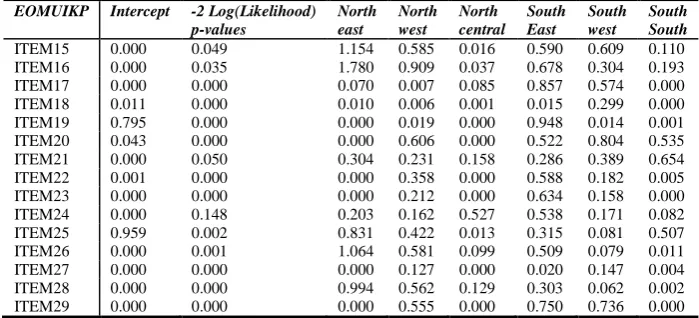
However, responses to ITEM 28 was highest suggesting that 83% “Agree” that the nation cannot maximize economic growth from Indigenous knowledge if knowledge remains in the custody of a select few who are familiar with the operational methods of practice, but this strong affirmation may not be even across all geopolitical zones, hence the result on Table 4, which present p-values of each ITEM in Section B. EOMUIKP following the Logit Model indicate that although the overall (2 Log (Likelihood) P <.05) is significant, this was generally influenced by responses from the Northwest (P = .003), Southwest (P = .026) and South-south (P = .002). In other words, of the six zones, these three most significantly affirm that Indigenous Knowledge is transferable.
www.ijeijournal.com Page | 7 Next to ITEM 28 as the most remarkable, is ITEM 17(80% Agree) that expresses the fact that these operational methods may involve unique equipment and/or machineries such as instruments/items/symbols/etc.
Figure 5 Distribution (%) of “Agree” responses in Section C: EOMUIKP
Table 6 Results of Logit Model showing p-values of Section C: EOMUIKP EOMUIKP Intercept -2 Log(Likelihood)
p-values
North east
North west
North central
South East
South west
South South
ITEM15 0.000 0.049 1.154 0.585 0.016 0.590 0.609 0.110
ITEM16 0.000 0.035 1.780 0.909 0.037 0.678 0.304 0.193
ITEM17 0.000 0.000 0.070 0.007 0.085 0.857 0.574 0.000
ITEM18 0.011 0.000 0.010 0.006 0.001 0.015 0.299 0.000
ITEM19 0.795 0.000 0.000 0.019 0.000 0.948 0.014 0.001
ITEM20 0.043 0.000 0.000 0.606 0.000 0.522 0.804 0.535
ITEM21 0.000 0.050 0.304 0.231 0.158 0.286 0.389 0.654
ITEM22 0.001 0.000 0.000 0.358 0.000 0.588 0.182 0.005
ITEM23 0.000 0.000 0.000 0.212 0.000 0.634 0.158 0.000
ITEM24 0.000 0.148 0.203 0.162 0.527 0.538 0.171 0.082
ITEM25 0.959 0.002 0.831 0.422 0.013 0.315 0.081 0.507
ITEM26 0.000 0.001 1.064 0.581 0.099 0.509 0.079 0.011
ITEM27 0.000 0.000 0.000 0.127 0.000 0.020 0.147 0.004
ITEM28 0.000 0.000 0.994 0.562 0.129 0.303 0.062 0.002
ITEM29 0.000 0.000 0.000 0.555 0.000 0.750 0.736 0.000
Significant p-values (<.05)
ITEMS 21 and 24 with (P>.05) suggests that despite their uniqueness, these operational methods cannot be said to be altogether positive, and that although the position of the operational methods may not be a hindrance to economic development significantly, the test for Hypothesis 2: The unique operational methods of Indigenous Knowledge do not have significant influence on the economic development of the Nation is hereby accepted and the alternative rejected.
IV. INTERFACE BETWEEN INTELLECTUAL PROPERTY MANAGEMENT AND INDIGENOUS KNOWLEDGE PRACTICE (IIPMIKP)
The scree plot of factor loadings of ITEMs in this subsection IIPMIKP of the IKIPRQ – A is shown in Figure 6. Similar to the previous subsections, the first two factors explain most of the variability in the data, while the remaining factors explain a very small proportion of the variability and are likely less important.
Figure 6 Scree plot for IIPMIKP
Further illustration of the coordinates of factor loadings of the 19 items in the IIPMIKP subsection of the IKIPRQ shows that the first factor explains most of the variations (F1 = 20.86%) in the responses for these
ITEMS. Accordingly, the following factors, F2 = 6.79% (from factor loading), F3 = 2.40% (from factor loading)
and F4 = 6.79% (from factor loading) relatively explains the variation in the ITEM responses that loaded on
Factors 2, 3 and 4 respectively.
The cumulative loadings of F1 and F2 = 27.66%, suggesting that about 28% of variances in the
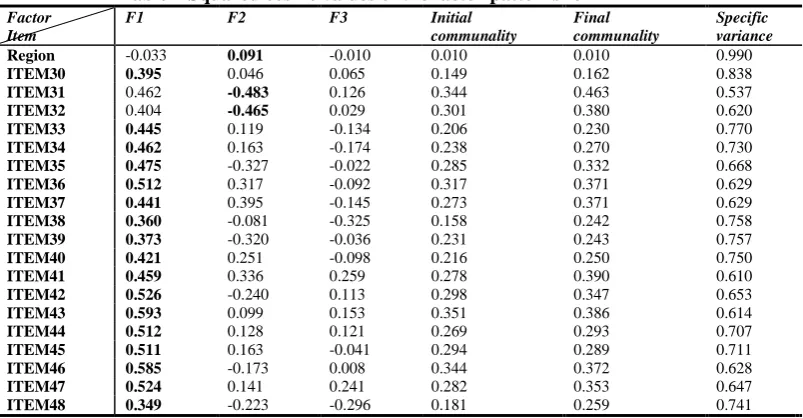
IIPMIKP subsection of the IKIPRQ model were contributed by the ITEMS that loaded on the first two factors. These ITEMS can be appreciated on the coordinate plot, and include all other ITEMS with the exception of ITEMS 31and 32 that loaded strongly on F2 as shown by their squared cosine values of the factor patterns
presented on Table 7.
The ITEMS 31and 32 are the most strongly correlated (r = .43) than other pairs of items, indicating that the perception of contemporary Intellectual Property Rights management systems being evolved from indigenous knowledge also go hand-in-hand with the fact that contemporary Intellectual Property Rights protection methods should be applied without any modification to indigenous knowledge. ITEMS 31 and 35 are also strongly correlated (r = .40) suggesting that while contemporary Intellectual Property Rights management systems evolved from indigenous knowledge, the transfer methods in indigenous knowledge are exclusive.
Table 7 Squared cosine values of the factor patterns for IIPMIKP Factor
Item
F1 F2 F3 Initial
communality
Final communality
Specific variance
Region -0.033 0.091 -0.010 0.010 0.010 0.990
ITEM30 0.395 0.046 0.065 0.149 0.162 0.838
ITEM31 0.462 -0.483 0.126 0.344 0.463 0.537
ITEM32 0.404 -0.465 0.029 0.301 0.380 0.620
ITEM33 0.445 0.119 -0.134 0.206 0.230 0.770
ITEM34 0.462 0.163 -0.174 0.238 0.270 0.730
ITEM35 0.475 -0.327 -0.022 0.285 0.332 0.668
ITEM36 0.512 0.317 -0.092 0.317 0.371 0.629
ITEM37 0.441 0.395 -0.145 0.273 0.371 0.629
ITEM38 0.360 -0.081 -0.325 0.158 0.242 0.758
ITEM39 0.373 -0.320 -0.036 0.231 0.243 0.757
ITEM40 0.421 0.251 -0.098 0.216 0.250 0.750
ITEM41 0.459 0.336 0.259 0.278 0.390 0.610
ITEM42 0.526 -0.240 0.113 0.298 0.347 0.653
ITEM43 0.593 0.099 0.153 0.351 0.386 0.614
ITEM44 0.512 0.128 0.121 0.269 0.293 0.707
ITEM45 0.511 0.163 -0.041 0.294 0.289 0.711
ITEM46 0.585 -0.173 0.008 0.344 0.372 0.628
ITEM47 0.524 0.141 0.241 0.282 0.353 0.647
ITEM48 0.349 -0.223 -0.296 0.181 0.259 0.741
Values in bold correspond for each variable to the factor for which the squared cosine is the largest
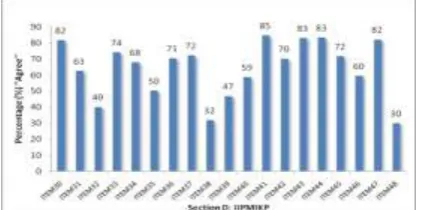
Figure 7 shows the percentage distribution of “Agree” responses in Section B: IIPMIKP of the IKIPRQ and indicate that generally, ITEMS 32, 38, 39 and 48 were responses in agreement (“Agree”) that fell below 50%.
www.ijeijournal.com Page | 9 Indigenous knowledge is too primitive to be managed alongside Contemporary intellectual property rights management system methods.
The foregoing provides answer to Research Question 3: What factors hinders the formal processes of Intellectual Property Management interface with Indigenous Knowledge practice?
In other words, the perception of modification of some sort to indigenous knowledge in order to be presentable in the contemporary Intellectual Property Rights protection system, the perception that Indigenous knowledge is thought to be unreligious and as such religious minded Christians/Muslims should not be interested in it, the perception that contemporary Intellectual Property Rights protection system is a complex system and may affect the value inherent in indigenous knowledge and the perception that indigenous knowledge is too primitive to be managed alongside Contemporary intellectual property rights management system methods are the major factors deduced in this study to hinder formal processes of Intellectual Property Management interface with Indigenous Knowledge practice.
Responses for ITEM 41 was highest suggesting that 85% “Agree” that Blending indigenous knowledge and Contemporary Intellectual Property Rights managements systems will enhance developmental growth in Nigeria. This strong affirmation may not be even across all geopolitical zones, hence the result on Table 1.4-2 which present p-values of each ITEM in Section B: IIPMIKP following the Logit Model and indicate that although the overall (2 Log (Likelihood) P <.05) is significant, this was influenced by responses mainly from the Southwest (P = .014).That is, in the south west, blending indigenous knowledge and Contemporary Intellectual Property Rights managements systems is significantly perceived to enhance developmental growth in Nigeria.
ITEMS 30, 32, 37, 43 and 44 generally indicate no significance (P>.05), suggesting that these responses are not influenced by the regions from which responses were obtained. However, out of the 4 ITEMS: 32, 38, 39 and 48 that are noted to influence interface between Intellectual Property Management and Indigenous Knowledge practice, 3 of the ITEMS: 38, 39 and 48 are observed to be significantly influenced by the region/zones of the respondents(Table 8).
Therefore Hypothesis 3 of this study which states that: Factors that hinder the formal processes of Intellectual Property Management interface with Indigenous Knowledge practice are not significantly influenced by the different regions in Nigeria, is rejected and the alternative accepted.
Figure 7 Distribution (%) of “Agree” responses in Section D: IIPMIKP
Table 8 Results of Logit Model showing p-values of Section D: IIPMIKP IIPMIKP Intercept -2 Log(Likelihood)
p-value
North East
North west
North central
South East
South West
South south
ITEM30 0.000 0.728 1.607 0.994 0.381 0.387 0.948 0.276
ITEM31 0.000 0.000 0.446 0.223 0.000 0.815 0.579 0.161
ITEM32 0.001 0.149 0.756 0.514 0.272 0.480 0.280 0.303
ITEM33 0.000 0.000 0.362 0.073 0.509 0.740 0.001 0.273
ITEM34 0.000 0.000 1.300 0.650 0.000 0.232 0.187 0.018
ITEM35 0.959 0.000 0.022 0.062 0.145 0.017 0.115 0.971
ITEM36 0.000 0.000 1.563 0.789 0.016 0.185 0.058 0.093
ITEM37 0.000 0.096 0.752 0.050 0.832 0.626 0.057 0.945
ITEM38 0.000 0.000 0.795 0.398 0.000 0.892 0.153 0.612
ITEM39 0.195 0.000 0.000 0.131 0.000 0.872 0.715 0.002
ITEM40 0.003 0.000 1.819 1.000 0.180 0.413 0.137 0.006
ITEM41 0.000 0.004 0.457 0.161 0.780 0.510 0.014 0.350
ITEM42 0.000 0.000 1.214 0.608 0.001 0.704 0.558 0.009
ITEM43 0.000 0.413 0.073 0.232 0.537 0.926 0.297 0.809
ITEM44 0.000 0.073 0.674 0.493 0.312 0.651 0.059 0.611
ITEM45 0.000 0.031 1.863 0.944 0.024 0.526 0.587 0.060
ITEM46 0.000 0.010 0.710 0.371 0.032 0.465 0.089 0.015
ITEM47 0.000 0.000 0.006 0.039 0.072 0.146 0.314 0.000
Results strongly indicate that though customs and tradition are communication tools for transfer of indigenous knowledge, it is mainly effective for the handpicked individuals. This is because of their direct hand-in-hand workings with the main custodians of knowledge. This result affirms with findings by Lwoga, Ngulube and Stilwell (2010) that most of indigenous knowledge was shared through oral traditions and that culture, trust and status influenced the sharing and distribution of indigenous knowledge. Knowledge here reflects the customs and traditions of the communities, therefore not relating to the nature of the knowledge itself, but to the way in which that knowledge is created, preserved and disseminated.
The study also found that the unique operational methods of Indigenous Knowledge do not have significant influence on the economic development on the nation. This confirms that transfer of knowledge is generally inclusive but mostly exclusive. The impulse to protect or safeguard theses operational methods is basically because they want to keep it within and draw from it continuously like a bank. Parajuli and Das (2013), corroborates this finding in their assertion that indigenous people are conserving the biodiversity in order to survive themselves. There are also fears of loss to tourists. Ofodile (2013) pointed out that there are costs and risks associated with any type of tourism. In particular, tourism poses a threat to indigenous people, to their environment, and to local cultures. One of the greatest threats is the loss of valuable cultural property through misappropriation by outsiders.
There is a general agreement that blending indigenous knowledge and Contemporary Intellectual Property Rights managements systems will enhance developmental growth in Nigeria. However, this strong affirmation did not come from across all the geopolitical zones. Predominantly responses from the Southwest (P = .014) brought about such influence. This is perhaps because of the strong presence of an existing blend of the two systems resulting in several SMEs in this zone (especially in the trado-medical section). This agrees with Arowole‟s (2011) findings that the creations representing African societies are protectable under copyright law. SMEs have evolved songs, dances and food from indigenous culture despite the fact most most of them do not value the relevance of patents. Yet Michie (1999) concludes that we need to become more fully aware of what culture means, not merely as song, dance and food but veritable tools for the evolution of viable resource based SMEs through the creation of more effective, comprehensive and operative interface between indigenous knowledge and intellectual property rights.
V. DISCUSSION OF FINDINGS (FOCUSED GROUP DISCUSSIONS)
The qualitative data was discussed under the themes generated from the transcribed data. Percentage scores were used to represent the responses of the respondents accordingly. The themes were Transferability of Indigenous knowledge, Knowledge Protection and Methods, Customs and Tradition, The Burden of Culture and Tradition as Communicative Tools, Operational Methods - Positive or Negative in Character/Content, The Efficacy of Operational Methods, Transfer of Operational Methods, Operational Tools of Indigenous Knowledge, Indigenous Knowledge and Intellectual Property Rights.
Data gathered from the interactions showed that 100% of the respondents agreed that indigenous knowledge can be transferred from one person to the other though transfer can be hindered by hoarding of the knowledge (particular knowledge) by the holder. However, when this transfer is made, it is to selected individuals, especially children and relatives, whom the holder thinks is dedicated enough to handle the information responsibly. This is in line with the position of all the respondents (100%) expressing that indigenous knowledge is not open knowledge though it may appear common place. In related literature, the Cultural Interface Theory (Nakata, 2002) cited two possible standpoints from which to view culture: the subjective standpoint of the participant in culture and the objective standpoint of the outside observer. The observer must immerse himself or herself fully in the culture being observed, and only when he or she has become really immersed will he or she truly understand the culture. As a matter of fact, interest is one of the features that the custodians count as a potential trait for transferability.
www.ijeijournal.com Page | 11 5.1. Knowledge Protection and Methods
Knowledge protection is a universal concept though it is practiced diversely according to different cultures and clans. Even in research institutes, researchers are seen to keep their work under one protective mechanism or another. Globally, indigenous people tend to secure their knowhow by keeping sealed lips especially if it is their source of survival. Findings by Michie (1999) reveal that indigenous peoples have expressed concerns about the loss of identity and culture in the modern world. Their traditional ecological knowledge is being more highly valued by scientists and environmentalists, yet it is being lost through loss of identity and the links with the land. In this regard, all the respondents (100%) agreed that the custodians of knowledge “may not understand protection in the form of Intellectual Property Rights and Patents but are very aware of what they have to do” to protect their indigenous knowledge. All the respondents (100%) agree that primarily, indigenous people protect indigenous knowledge for economic reasons – they render unique and specific services in exchange for monetary or other gains - and because it is naturally their heritage. It is also for prestige, status symbol and exercise of power amongst other people.
A number of techniques are employed by indigenous people to protect their knowhow. They include: i. The handpicking method of selecting the best candidate for the transfer.
ii. Indigenous people who are into healthcare/welfare, like traditional healers, rainmakers, midwives, bonesetters etc, tend to employ incantations as protective mechanisms. Herbs and other substances they use may be obvious to their patients but they mouth incomprehensible words alongside the delivery of their services. The impression is that the herbs/substances do not work in isolation. Though 100% of the respondents agree this is part of the operational techniques of the indigenous people, 63% thought it cannot be regarded as a standard process in knowledge transfer while 27% regard it as their protective mechanism which works for them.
iii. Non practitioners have insinuated that the non-documentation by practitioners of indigenous knowledge is a means of protection. Sixty two percent (62%) of the respondents pointed out that it is difficult to understand given that there are no documental backup. The sacredness and secrecy makes it difficult to document and lack of documentation makes the process a closed and protected source. However, Hansen and Van-Fleet (2003) cautioned that in a bid to document and database indigenous knowledge, it is important to acknowledge that we are screening it through a filter and standing the risk of losing the authenticity of indigenous knowledge.
iv. Knowledge workers also stated that indigenous knowledge practitioners often give partial or misleading information during their occasional encounters. While some will strongly refuse to interact, others will divulge only information they want you to have, keeping their secrets secret.
5.2 Customs and Tradition
Respondents (100%) agree that indigenous knowledge is the brainchild of customs and tradition and is therefore influenced by it. Respondents from the eastern part of Nigeria narrated that certain rituals are not performed on certain days of the traditional Igbo week while some herbs are found specifically in some villages and not others. This is because such herbs are attached to the custom/tradition of that particular village and is present in their indigenous knowledge system. As stated before, indigenous knowledge is defined by source meaning particular information is practiced differently in as many cultures as possible. Certain customs, like the role of the „Ada‟ (first daughter) in the family, are unique in Africa but that does not apply globally. However, it is only through culture and tradition that one can showcase traditional attributes globally and to that extent, custom/tradition is a communicative tool as supported by 100% of the respondents.
5.3. The Burden of Culture and Tradition as Communicative Tools
According to 59% of the respondents, customs and traditions, as communication tools, is a limited or ineffective means of knowledge transfer. This conclusion is drawn as a result of the following reasons:
i. In order to manage knowledge contemporarily one must disclose all information, but traditionally one cannot do that.
ii. Consequent to the above, knowledge is often within a limited geographical area because the tradition is in the way of spreading it.
iii. The handpicking method, a traditional method, is a hindrance to transfer whereby some people die with invaluable information because the right person is not available.
religion and refuse to carry on the mantle, abandon that knowledge thereby losing the benefits that knowledge would have brought to the family and the community at large.
On the other hand, 49% of the respondents opined that customs and tradition are seen as ineffective because knowledge workers are looking at it intellectually. They argued that effectiveness should be seen from the point of view of the person receiving the knowledge since they are in a position to cope, or not, with the pace and process of transfer. They insist that indigenous knowledge is valuable and effective and will boost economies if the practitioners come abreast with the global technology and measure up to them.
5.4. Operational Methods: Positive or Negative in Character/Content
Operational methods as practiced by an ethnic nationality are the heritage of that group of people. It becomes their identity or what they are known for. In the practice of indigenous knowledge, knowledge is often passed unconsciously and unceremoniously unlike the organized syllabus of a formal school. The operational methods are often characterized by the individual knowledge bearer, the knowledge itself, the cultural setting, location etc. though these practices may not be different from each other. In some cases these methodologies are not discernible to non-practitioners as asserted by 100% of the respondents.
During interaction, some practitioners of indigenous knowledge claim that what they do and how they do them contributes a great deal to their state of health and longevity. As a result of some of these mysteries, people tend to think that indigenous knowledge is negative.
Operational methods according to respondents are more spiritually inclined than physical because there are things the natural eyes cannot see. Emeagwali (2003) highlights this in her study pointing out that African Traditional Medicine (ATM) is holistic since it makes attempts to go beyond the boundaries of the physical body into the spiritual. There are some sicknesses that can be cured through a process that nobody can explain and when people do not understand it, they term it diabolical.
Three categories of respondents emerged concerning the status of the operational methods of indigenous knowledge:
1. The first category of respondents (23%) believes the operational methods of indigenous knowledge are positive because the methods and content are curative and have sustained them over the years.
2. The second category of respondents (6%) thinks operational methods of indigenous knowledge are negative because walking naked or backwards to pluck a particular leaf, as some indigenous practitioners do, is a puzzle for most non practitioners. It is seen as abnormal and negative. The witchcraft knowledge was also cited as negative.
3. Lastly, the third category (71%) posits that knowledge has dual nature – positive and negative – all depending on the user. Just as software can activate or detonate a bomb so witchcraft can be used for good or evil. They reiterated that it is especially affected by religion. Due to religious influence people tend to interpret the operational methods of indigenous knowledge as negative when they are not always so. It was however concluded that these methods may be negative in character (the manner of usage) but are positive in content.
5.4.1 The Efficacy of Operational Methods
The indigenous methods of operation is seen by both knowledge workers and indigenous knowledge practitioners as effective to the users. All respondents (100%) agree that operational methods are protective in nature because on one hand, non practitioners have difficulties breaking through and on the other hand they are used as moral principles. In Africa, elders often use myths and fables as methods of putting their children in check. This is in line with the assertion made by Eze and Mba (2013) that indigenous knowledge had a philosophical bearing in which parents sought to bring up their children for their own welfare and that of the wider community and this is done by socialization as opposed to individualization..
5.4.2 Transfer of Operational Methods
Operational methods of indigenous knowledge have been passed from one generation to another through observation. Here the recipient observes over a period of time while the custodian practices. A typical example is the herbalist, who has this individual go with him every morning to understudy him. When they get to the bush, he does not pluck the leaves at random; there are specific places, points and times. Even the leaves, there is a portion they pluck, may be the very fresh or very old ones. It may be from the roots or stem. He does not out rightly tell the individual to pluck this or that, the individual goes with him for a considerable length of time observing what he is doing. At another point he sends him to go and get a particular leaf at a particular place. As this progress, it represents the standard operational process of transfer for them.
www.ijeijournal.com Page | 13 blacksmithing, only those in the blacksmiths lineage can bend the iron easily. In farming too, there are those who have better and more robust yam barns than their neighbours because they have skilled operational methods. There are places you go to any time of the year and you get produce like cocoyam, fish etc. Season or out of season, they have these produce because of their unique operational methods.
Operational methods are also acquired through experiences born from continuous practice, trials and errors. The point here is that they have these operational methods of identifying these things. Scientifically they have not been able to document them but they exist.
5.4.3 Challenges of Operational Methods
Indigenous knowledge methods have been described as primitive and crude and 67% of the respondents agree, saying they do not have parameters of measurements and documentation like the western technology. This is in agreement with the opinions of Ellen and Harris (2000-page 54); Herbert (2000); Warren (1995) that indigenous knowledge is closed, parochial, un-intellectual, primitive and emotional. But 33% of the respondents think the methods are termed crude because they are looking at them comparatively; it is only a matter of perspective. In the same vein, Boas (cited by Moroe , 2009) and his followers saw each culture as radically distinct, where one should not generalize across cultures or say that a particular primitive culture represents an earlier stage in evolution from more technologically advanced cultures. However, in a study of forest management in Mexico, Klooster (2002) concludes that both bodies of knowledge, in their different ways, are really quite limited in their abilities to inform the social practice of environmental management.
Operational methods are also seen as difficult to understand by 62% of the respondents while 38% disagree. Despite the supposed difficulties involved, respondents asserted that the key to learning is interest. The exploitation of these ideas will bring about improvement of the private practice, capacity and industrial development, job creation, globalisation of our indigenous products and so on as agreed by all the respondents (100%).
5.4.4 Operational Tools of Indigenous Knowledge
These are items/instruments associated with indigenous knowledge dispensary. People who are initiated into the details of these knowledge pools are familiar with the items/instruments and their functions. Many of these items/instruments are easily operable according to 97% of the respondents while 3% disagree. In operation, one must know the rules, dos and don‟ts of the items/instruments in question. There are some places you cannot climb some trees; there are some other places you cannot survive in a river no matter your swimming prowess. You simply cannot operate there because of the cultural or spiritual implications but the indigenes know their whereabouts in that same locality. The availability of these items/instruments depends on the item in question. Some travel very far to get them.
5.4.5 Indigenous Knowledge and Intellectual Property Rights
In defining intellectual property rights, knowledge workers explained the concept as rights given to intellectual property owners to protect the work of their minds, like patents, trademark, copyrights, etc. Indigenous knowledge practitioners on the other hand are ignorant of what an intellectual property right is about and how it can revolutionize their careers. Hundred percent (100%) of the respondents say that these indigenous knowledge goods are functional for us just like the western indigenous knowledge work for them and therefore cannot be labelled primitive.
Managing indigenous knowledge on the intellectual property rights platform can bring about some benefits as enumerated by knowledge workers. They include:
1. Growth of National Innovation System. 2. Globalization of indigenous products.
3. Economic development of knowledge custodians and the nation. 4. Emancipation from restrictive aspects of tradition.
5. Scientific outlay from proper documentation. 6. Job creation capacity development.
VI. CONCLUSION
In conclusion, the analysis of the result has been able to answer the research questions and hypothesis as follows:
Research Question 1: What are the channels of Indigenous Knowledge transfer and communication? Answer: Customs and tradition are the channels of transfer of indigenous knowledge.
knowledge practice and standard process of Intellectual Property Rights?
Answer: The answer to the question is clearly that the nation cannot maximize economic benefits that can accelerate growth if indigenous knowledge remains in the custody of a select few who are familiar with the operational methods of practice.
Hypothesis 2: Therefore, the unique operational methods of Indigenous Knowledge do not have significant influence on the economic development of the Nation is hereby accepted and the alternative rejected.
Research Question 3: What factors hinder the formal processes of Intellectual Property Management interface with Indigenous Knowledge practice?
Factors that hinder the formal processes of intellectual Property Management interface with indigenous knowledge include:
The perception of modification of some sort to indigenous knowledge in order to be presentable in the contemporary Intellectual Property Rights protection system,
The perception that Indigenous knowledge is thought to be unreligious and as such religious minded Christians/Muslims should not be interested in it,
The perception that contemporary Intellectual Property Rights protection system is a complex system and may affect the value inherent in indigenous knowledge
The perception that indigenous knowledge is too primitive to be managed alongside Contemporary intellectual property rights management system methods are the major factors deduced in this study to hinder formal processes of Intellectual Property Management interface with Indigenous Knowledge practice.
Hypothesis 3 of this study which states that: Factors that hinder the formal processes of Intellectual Property Management interface with Indigenous Knowledge practice are not significantly influenced by the different regions in Nigeria, is rejected and the alternative accepted.
REFERENCES
[1]. Anastasiadou, S. D. (2011). Reliability and Validity Testing of a New Scale for Measuring Attitudes Toward Learning Statistics with Technology. Acta Didactica Napocensia, 4(1), 1–10.
[2]. Hoffman, Kunze. Linear Algebra (1971) ISBN-13: 978-0135367971, ISBN-10: 0135367972
[3]. Marcus and Minc Introduction to Linear Algebra Paperback – May 1, 1988, p. 144). Gorsuch (1983), Factor Analysis, 2nd Edition ISBN-13: 978-0898592023, ISBN-10: 089859202X
[4]. Lwoga, E. T., Ngulube, P., & Stilwell, C. (2010). Managing indigenous knowledge for sustainable agricultural development in developing countries: Knowledge management approaches in the social context. The International Information & Library Review, 42(3), 174-185.
[5]. Parajuli, D. R & Das, T. (2013). Indigenous Knowledge and Biodiversity: Interconnectedness for Sustainable Development. International Journal of Scientific & Technology Research Vol 2, (8) August 2013, issn 2277
[6]. Ofodile, E.U. (2013). Tourism, Cultural Heritage & Indigenous Knowledge: is effective legal protection possible? Business Day Newspaper September 19, 2013
[7]. Arowolo, A. L. (2011). Copyright Law and the Recognition of 'Folkloric Creations' and 'Folk Medicine' in Africa (January 1, 2011). Journal of Black and African Arts and Civilization, Vol. 5, No. 1, p. 33, 2011 Available at SSRN: http://ssrn.com/abstract=1858987
[8]. Nakata, M. (2002). Indigenous Knowledge And The Cultural Interface: Underlying Issues At The Intersection Of Knowledge And Information Systems. ifl.sagepub.com/content/28/5-6/281.refs
[9]. UNESCO & CIRAN (2003). Best Practices in Indigenous Knowledge. Retrieved 21st June, 2014 from http://www.unesco.org/most/bpindi.htm
[10]. UNESCO(2005) The Canoe is the People. Indigenous navigation in the Pacific. Interactive CD-ROM. UNESCO: Wellington
[11]. Suminguit, V. J. (2005) Indigenous Knowledge Systems and Intellectual Property Rights: an Enabling Tool for Development with Identity. http://www.ifad.org/english/indigenous/pub/documents/Indigeknowledge.pdf
[12]. Michie, M. (1999). Where are Indigenous peoples and their knowledge in the reforming of learning, curriculum and pedagogy? Paper presented at the Fifth UNESCO-ACEID International Conference "Reforming Learning, Curriculum and Pedagogy: Innovative Visions for the New Century", Bangkok, Thailand, 13-16 December 1999. [13]. Hansen &VanFleet, J. W. (2003).A Handbook on Issues and Options for Traditional Knowledge Holders in
Protecting their Intellectual Property and Maintaining Biological Diversity. New York, AAAS, p. 24
[14]. Emeagwali, G. 2003. African Indigenous Knowledge Systems (AIK): Implications for the Curriculum, in ToyinFalola (ed), Ghana in Africa and the World: Essays in Honor of AduBoahen. http://www.africahistory.net Retrieved on 08 May 2009.
[15]. Eze, U.T. and Mba, I.N. (2013). Integrating African Indigenous Knowledge in Nigeria‟s Formal Education System: It‟s Potential For Sustainable Development Journal of Education and Practice Vol.4, No.6, 2013
[16]. Ellen R & Harris H (2000) Introduction. In Ellen R, Parkes P and Bicker A (eds) Indigenous environmental knowledge and its transformations (Harwood Academic Publishers, Amsterdam), 1-33.
www.ijeijournal.com Page | 15 [18]. Warren D M (1995), Indigenous knowledge, biodiversity conservation and development. Keynote address at the
International Conference on Conservation of Biodiversity in Africa: Local Initiatives and Institutional Roles, Nairobi, Kenya.
[19]. Moore, J. D. (2009). "Franz Boas: Culture in Context". Visions of Culture: an Introduction to Anthropological Theories and Theorists. Walnut Creek, California: Altamira. pp. 33-46.
[20]. Eyong, C. T. (2007). Indigenous Knowledge and Sustainable Development in Africa: Case Study on Central Africa Kamla-Raj Enterprises 2007 Indigenous Knowledge Systems and Tribes and Tribals, Special Volume No. 1: 121-139 (2007