e-ISSN: 2278-7461, p-ISSN: 2319-6491
Volume 6, Issue 1 (Jan 2017) PP: 34-39
Fuzzy logic based Prediction on Thermal Conductivity of Natural
Fibre Reinforced polymer Composites
R.C. Mohapatra
1, M. Bathre
21Government College of Engineering, Keonjhar 758002, India
Abstract: Experimental and computational investigation on the thermal conductivity of pine wood dust filled epoxy composites have been studied in the present investigation. Composites of pine wood dust particles of 150μm size with varying volume fractions (6.5, 11.3, 26.8 and 35.9%) have been developed by hand layup technique The thermal conductivity of particulate(PWD) filled epoxy composite is found out experimentally using Lee’s apparatus. This study shows that the incorporation of wood dust results in reduction of conductivity of pine wood dust filled epoxy composites and there by improves its thermal insulation capability. Further the thermal conductivity of particle filled composites has been calculated computationally using fuzzy logic approach considering Triangular and Gaussian models. The value of effective thermal conductivity obtained for various composite models using Fuzzy logic are in reasonable agreement with the experimental values for a wide range of filler contents from about 6.5 Vol% to 35.9 Vol%. On comparison, it has been found that the errors associated with the computational values with respect to experimental ones lie in the range of 1.82 to 14.47 in case of Triangular, and 2.45 to 14.47 in case of Gaussian respectively.
Keywords: Epoxy-Wood dust composite, Thermal Conductivity, Lee’s apparatus, Fuzzy logic approach.
I.
INTRODUCTION
In recent years development of polymer composites filled with natural fibres are gaining importance because of their eco-friendliness and ease of recycling. Therefore in the present work the wood dust (Pine wood dust) has been considered as reinforced filler because of its low cost, easy availability in nature, insulating characteristic and eco friendliness. Since this work aims at developing some kind of a light, cheap and insulating material, epoxy emerged as the first choice for the matrix material. Epoxy is chosen primarily because it happens to be the most commonly used polymer and because of its insulating nature (low value of thermal conductivity about 0.363W/m-K). This work also reports the estimation of the equivalent thermal conductivity of particulate polymer composite system using fuzzy logic approach. It is important to measure the thermal conductivities of wood dust reinforced epoxy composite with different volume fraction of filler in order to determine the insulating properties of the composite.
II.
REVIEW OF LITERATURE
identification rules were taken from the data obtained from microcontroller in form of IF-THEN rules for fuzzy controller to form membership of the functions. The results of the fuzzy logic were shown to provide gas identification according to variation in different parameters such as gas concentrations, variation in sensor’s resistance and output volt of microcontroller at room temperatures.
III.
EXPERIMENTAL WORKS
3.1 Materials
The pine wood dust (collected from Jaylaxmi Saw Mill Limited. Kolkota) of 150µm mesh size measured through sieve shaker was considered as filler material in fabrication of the composite. Epoxy (LY 556 and Hardner HY 951 supplied by Hindustan Ceiba Geigy India Ltd) has been used as matrix material. A metallic mould has been developed in house to cast the composites for thermal conductivity testing. After mixing epoxy and pine wood dust in proper ratio the composite was cast by pouring into the split mould. The cast of each composite was cured under a load of about 50kg for 24hours before it was removed from the mould. Then this sample was post cured in air for another 24hours after removing out from the mould.
3.2 Experimental procedure
In the present paper Lee’s disc apparatus is used to measure the thermal conductivity of pine wood dust filled epoxy composites experimentally. Its schematic diagram is shown in Fig.1. The Nickel disc (N) is hung from the stand with the help of three strings. A heating chamber (H) with facility of passage of steam in and out is created. Metallic disc (M) is placed on the bottom of a heating chamber (H). Sample disc (S) is placed in between metal disc and nickel disc. Two holes are made in the nickel disc (N) and metallic disc (M) for insertion of thermometers to measure the temperature.
Fig.1. Schematic diagram of Lee’s disc Apparatus
In the present experiment the mass of nickel disc (N), the diameter and the thickness of the specimen were measured with the help of an electronic balance, Vernier caliper and a screw gauge respectively.
The heater (H) was then started by sending steam through the heating chamber. The temperatures T1 and T2 were recorded at regular interval of 5 minutes till steady state is reached.
After that, the supply of steam was cut off; the disc (N) and specimen (S) were removed. Heat was supplied to the nickel disc(N) along with the sample(S) with the help of Bunsen burner (shown in Fig.4.4) so that nickel disc along with sample is heated to a temperature 100 C above the steady state temperature T2. The nickel disc was allowed to cool. Temperature was noted in every half a minute until the temperature falls about 100 C from steady state temperature of T2.
Time of cooling vrs temperature was plotted as in Fig.2. A tangent is drawn at the steady state temperature T2. The slope of this tangent gives the rate of cooling T t at steady state temperature T2.
Fig.2.Temperature vs. Time for PWD during cooling
Since the slope of the temperature gradient is proportional to the thermal conductivity of the material, the thermal conductivity (K) of the composite samples was calculated when a steady state had reached. The calculations were doneusing the following equation:
) 1 ...( ...
) (
/ ) /
( 1 2
2 A T T L
t T ms
IV.
FUZZY LOGIC APPROACH
Fuzzy logic is one of the soft computing techniques that plays a significant role in input-output matrix relationship. It gives the concept of partial truth i.e the truth between completely true and completely false. It emulates the human decision making process in which not every decision is discrete. There is a certain amount of indecision, fuzziness in the decision and it deals with uncertainty. The basic elements of fuzzy logic are linguistic variables, fuzzy sets and fuzzy rules. The linguistic variables are words like very low, low, medium, high and very high.
4.1 Fuzzy Logic Modeling
Fuzzy logic is a mathematical theory of inexact reasoning that allows modeling of the reasoning process of humans in linguistic terms. It is very suitable in defining the relationship between system inputs and desired outputs. Hence it is used in many control, production and optimization processes. In this modeling all numeric values are replaced with linguistic values. The meaningful linguistic statements are selected for the variable and expressed by approximate fuzzy sets such as low, medium and high for fibre volume fraction. The objective of the study is to construct fuzzy knowledge-based models for the prediction of thermal conductivity of epoxy filled composites. The approach using fuzzy logic model involves three steps in which the approximation is done – Fuzzification, fuzzy rule inference and defuzzification.
4.2 The proposed model
In the proposed model, the input stages consist of two input variables i.e. particulate (PWD) and thermal conductivity. These two major factors are considered for the prediction of reduction in thermal conductivity which are shown in Fig. 3 and 4. For fuzzification of these factors, the linguistic variables Low, Medium, High and Very high are used for the input and output. With the fuzzy sets defined, it is possible to associate the fuzzy sets in the form of fuzzy rules.
Fig.3.The proposed Fuzzy logic model for Triangular function
Fig.4.The proposed Fuzzy logic model for Gaussian function 4.3 Membership function
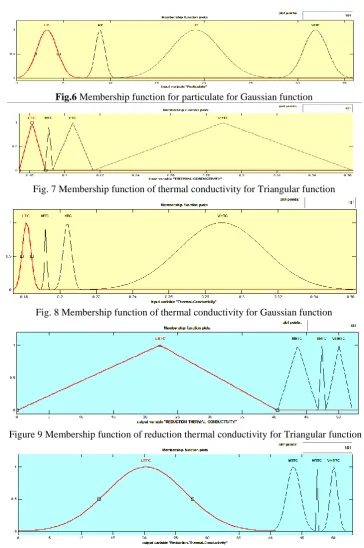
Fuzzy membership functions are the mapping functions for the fuzzy data containing linguistic terms. In the present work, Triangular as well as Gaussian functions are taken into consideration. Gaussian shape of membership function is used to describe the fuzzy set for input variables and triangular shape of membership function is for output variables. In this work, each input and output parameters have four membership functions like Low, Medium, High and Very high. Membership functions of fuzzy set input variables are shown in Fig. 5, 6, 7 and 8. Output variables are shown in Fig. 9 and 10.
Fig.6 Membership function for particulate for Gaussian function
Fig. 7 Membership function of thermal conductivity for Triangular function
Fig. 8 Membership function of thermal conductivity for Gaussian function
Figure 9 Membership function of reduction thermal conductivity for Triangular function
Figure 10 Membership function of reduction thermal conductivity for Triangular function
4.4 Rule-based Fuzzy relation
Fuzzy rules are the set of linguistic statements which establishes the relation between the input and the output in a fuzzy system. In this study, four study rules with two input variables are considered.
V.
RESULTS & DISCUSSION
conductivity increases, the reduction in thermal conductivity is decreased that helps in improving its insulation capability because thermal conductivity is a thermodynamic property that conduct heat.
Fig.11.Relation between particulate
Fig.12.Relationbetweenparticulateandreductioninthermalconductivity(Triangularreductionin and thermal conductivity (Gaussian)
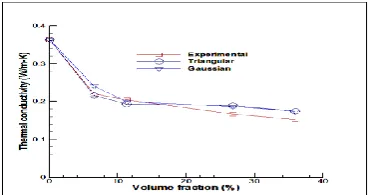
Fig.13 Relation between thermal conductivity Fig.14 Relation between thermal conductivity and reduction in thermal conductivity (Triangular) and reduction in thermal conductivity (Gaussian)Fig.15 shows a comparison between the experimental results and computational results using Fuzzy logic over a wide range of volume fraction of particulate (PWD) between 0 to 35.9%. From the figure it is found that the incorporation of particulate results in reduction of thermal conductivity of composites and the results obtained from fuzzy logic with Triangular and Gaussian functions are very close to the experimental ones. On comparison, it had been found that the errors associated with fuzzy logic with respect to the experimental ones lie in the range of 1.82 to 14.47 in case of Triangular, and 2.45 to 14.47 in case of Gaussian respectively. Table 2 presents the values of thermal conductivity and % of error associated with the experimental and Fuzzy logic method for individual composite i.e. epoxy and pine wood dust.
Fig. 15 Comparison of thermal conductivity values of Triangular and Gaussian model with experimental for PWD filler
Table 2.Thermal conductivity values of composites & % of errors obtained from different methods Sampl
e
Particula te
Effective thermal conductivities of composites (W/m-K)
(Vol.%) Triangula r
Gaussian Experimenta l
Triangula r
Gaussian
1 0 0.363 0.363 0.363 0 0
2 6.5 0.216 0.240 0.220 1.82 9.10
3 11.3 0.193 0.199 0.204 5.39 2.45
4 26.8 0.189 0.187 0.167 13.17 11.97
5 35.9 0.174 0.174 0.152 14.47 14.47
VI.
. CONCLUSION
Wood dust is an environment friendly waste product which can be gainfully utilized for preparation of composites. A successful fabrication of a wood dust filled epoxy composite with different types of wood is possible by hand lay- up technique.
REFERENCES
[1] Wollerdorfer, M.; Bader, H. “Influence of natural fibers on the mechanical properties of biodegradable polymers”. Ind. Crops Prod. Volume 8, 1998, pp. 105–112.
[2] Suleiman, B. M., Larfeldt, J., Leckner, B. and Gustavsson,M.,”Thermal Conductivity and Diffusivity of Wood,” Wood Sci. Technol. Vol. 33 (6), 1999, pp. 465-473.
[3] Mohanty. AK, Misra. M, Hinrichsen. G, “Biofibres, biodegradable polymers and biocomposites: an overview”, Journal of Macromolecular Materials and Engineering 2000, pp. 276: 1-24.
[4] Fu, S. Y. and Mai, Y.W., “ Thermal conductivity of Misaligned Short Fibre Reinforced Polymer Composites,” J. Appl. Polymer Sci., Vol.(88), 2003, pp. 1497-1505.
[5] Sweeting, R. D. and Liu, X. L, “Measurement of Thermal Conductivity for Fiber Reinforced Composites,” Composite A: Appl. Sci. Manuf., Vol. 35 (7), 2004, pp. 933-38.
[6] Idicula M., Boudenne A., Umadevi L., Ibos L,.Candau Y. and Thomas S., “Thermo Physical Properties of Natural Fibre Reinforced Polyester Composites,” Composite Sci. Tecnology, Vol. 66, 2006, pp. 2719-25. [7] Veiseh, S. and Sefidgar, M.. “Prediction of Effective Thermal Conductivity of Moistened Insulation
Materials by Neural Network,” Asian Journal of Civil Engineering (Building and Housing) Vol. 13 (3),2012, pp. 319-330.
[8] Nandi Arup Kumar, Deb Kalyanmoy, Dutta Shubhabrata, Orkas Juhani, “A Genetic Fuzzy Based Modeling of Effective Thermal Conductivity for Polymer Composites,” Journal of Intelligent & Fuzzy Systems: Applications in Engineering and Technology, Vol.25(2), 2013, pp. 259-270.