A Review on Cloud Security Challenges and its Future
Directions
Gagandeep Kaur, Sarpreet Singh
Abstract
Increasing population pushes forward the demands to meet their requirements. Every individual is familiar with internet and make use of it to store and retrieve their data and information. With the help of cloud computing people can access various applications through internet. Many applications which a part of every person’s daily routine includes instagram, whatsapp, facebook, snapchat, online shopping, business, online lectures etc. Cloud computing provides access to on-demand access to a shared pool of configurable computing resources. With the enormous benefits of cloud still it suffers from various limitations or challenges, among which security is the main concerning issue in cloud computing. There are various existing studies that have tried to overcome the issue but still some drawbacks exist that are needed to resolve. This paper deals with the survey of various security issues in cloud computing and also provides the future directions to overcome the challenges.
Keywords- Cloud computing, Internet, Technique.
1. Introduction
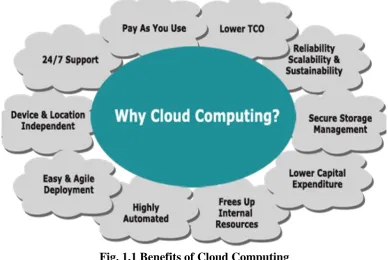
cloud networks to customers and organizations for domestic and commercial purposes. Fig. 1.1 shows various benefits of cloud computing as follows-
Fig. 1.1 Benefits of Cloud Computing
According to the American National Institute of Standards & Technology is an under:“Cloud Computing is a model for enabling ubiquitous, convenient, on-demand network access to a shared pool of configurable computing resources (example: networks, servers, storage applications and services) that can be rapidly provisional and released with minimal management effort or services provider interaction.”
Cloud computing offers a variety of services that includes-
• Infrastructure as a Service (IaaS): It provides cloud computing infrastructure for a customer that refers to on-demand providing of infrastructural resources.
• Platform as a Service (PaaS): It provides both IaaS and platform components that include operating system and software development frameworks.
• Software as a Service (SaaS): Provides on-demand application on the cloud computing platform.
As there are many advantages and utilization of cloud applications and services but still there exist some challenges that are needed to study deeply. This paper proposes a survey on various such techniques that are used to overcome the issues of security but still needs further improvement. The rest of the paper is organized as follows: The Section 1 demonstrates the Introduction to cloud computing, Section 2 provides the survey on existing study related to cloud computing security, Section 3 depicts the details of various techniques that can be used to overcome the security issues and Section 4 provides the conclusion.
2. Related Work on Cloud Computing Security
asymmetric algorithm includes RSA, DSA, Diffie-Hellman and El Gamal. The author discussed some problems related to existing security algorithms and there is need to implement a better version of DES, 3DES, AES, RSA, IDES, Blowfish. [1]
A novel biometric inspired homomorphic encryption algorithm (BIHEA) is proposed for secured data/files transmission over hybrid cloud environment. The proposed algorithm encrypts the user data at run-time by providing the authorized user biometric-feature-based one time password. Every time a user is authenticated by a totally different one time password. The BIHEA provides a good solution to commonly identified theft seen in cloud environment like phishing, shoulder surfing. The further work on replay attack can also be considered and prevented using Time Stamp in BIHEA. It is also foreseen to perform real test with distributed computing on existing cloud servers like Amazon, Salesforce.com, Hadoop along with MATLAB tool. [2]
A new scheme called FREDP (File Remotely keyed Encryption and Data Protection) is proposed. This scheme involves three-party interaction among a mobile terminal, private clouds and public clouds. The private clouds share the ciphertext file to the public clouds until the mobile terminal and the trusted third party, the private clouds; finish the encryption of the plaintext file using a remotely keyed encryption algorithm. To ensure security when a mobile terminal uses data, the private clouds as the third party regularly verify the integrity of the data in the public clouds. Finally, the mobile terminal and private clouds decrypt the ciphertext file to allow the user of the mobile terminal to use the data. In addition, we analyze the security of FREDP using BAN. The FREDP satisfies the security standard. But there is need to integrate the ABE method into the FREDP to expand the range of the decryption party. In this way, not only the file’s owner but also other authorized users can decrypt the file. Therefore, the advantage of the cloud can be further utilized. [3]
To overcome the limitation of cloud computing security encryption and decryption techniques are used which consists of authentication based AES and MD5 algorithms to secure data and login of user over cloud. But still there is need to use secure operating system so that attacks are easily not depict in cloud computing. [5] T-broker, a trust-aware service brokering system for efficient matching multiple cloud services to satisfy various user requests is proposed. Experimental results show that T-broker yields very good results in many typical cases, and the proposed mechanism is robust to deal with various number of service resources. In the future, the work can be extended to continue research from two aspects. First is how to accurately calculate the trust value of resources with only few monitored evidences reports and how to motivate more users to submit their feedback to the trust measurement engine. Implementing and evaluating the proposed mechanism in a large-scale multiple cloud system, such as distributed data sharing and remote computing, is another important direction for future research.[6]
with swapping numbers. Time taken for encrypting anddecrypting the message is less and the process isvery efficient because simple methods areemployed. Use of symmetric key insures verification and privacy. Algorithm absolutely satisfies the necessities of a high-quality encryption algorithm for providing secure communication. This proposed algorithmconverts the 8-bit original data into 16-bitencrypted – hamming coded data and 16-bitencrypted – hamming coded data into 8-bitoriginal data. This same method can be used formore number of input data bits.[8]
A framework on secure storage and authenticate user access in cloud is proposed. The proposed scheme provides two-factor protection mechanism to enhance the confidentiality of outsourced data. If a user wants to recover the outsourced data, this user is required to hold sufficient attribute secret keys with respect to the access policy and authorization key with regard to the outsourced data. In addition, the proposed scheme provides the user-level revocation for data owner in attribute-based data access control systems.[9] To secure the confidentiality of sensitive data during deduplication, the convergent encryption technique is used to encrypt the data before outsourcing. For better data protection, this paper talks about the issue of data deduplication authorization. There are several new deduplication implementations providing authorized deduplication verification in a hybrid cloud approach. [10]
The paper presents a comparative survey on various encryption and decryption algorithms. By comparing different parameters used in algorithm, AES is found to be faster compared to others in terms of execution time. DES algorithm consumes least encryption time but its execution time is longer. RSA consumes longest encryption time and memory size.it is not scalable. Secret sharing protocol provides high security for the data.it is used in military device initialization. Blowfish has least memory requirement. Blowfish is suitable for applications like communication link encryption where the key remains constant for a long time.[11]A new and efficient approach based on private key cryptography to secure information is proposed during communications. The main objective of the approach is to minimize the number of key which is a crucial issue for encryption and decryption. The number of keys is difficult to main and increase complexity of the algorithms. All previous approach is used select to encrypt and decrypt the text data. We implemented proposed approach and symmetric approach and compare using different parameter like data base size execution time and the memory required for encryption and decryption. From the analysis it is clear that the proposed approach perform well as compared to the symmetric approach. [12]
A brief overview and comparison of Cryptographic algorithms is presented, with an emphasis on Symmetric algorithms which should be used for Cloud based applications and services that require data and link encryption. A review is performed on Symmetric and Asymmetric algorithms with emphasis on Symmetric Algorithms for security consideration on which one should be used for Cloud based applications and services that require data and link encryption. The authors analyzed Symmetric algorithms for different encryption and encoding techniques, found AES to be a good candidate for key encryption and MD5 being faster when encoding.[13]
algorithm is less than the Blowfish algorithm. AES algorithm has a very high security level because the 128, 192 or 256-bit key are used in this algorithm. It shows resistance against a variety of attacks such as square attack, key attack, key recovery attack and differential attack. Therefore, AES algorithm is a highly secure encryption method. Data can also protect against future attacks such as smash attacks. AES encryption algorithm has minimal storage space and high performance without any weaknesses and limitations while other symmetric algorithms have some weaknesses and differences in performance and storage space.[14]
The issues of data deduplication are discussed in brief. There are several new deduplication implementations providing authorized deduplication verification in a hybrid cloud approach. As an issue verification of idea, the developed model of the proposed authorized duplicate copy check method and tested the model. That showed the authorized duplicate copy check method experience minimum overhead comparing convergent encryption and data transfer. [15] Strategies are presented followed include categorization of the data on the basis of their sensitivity and importance, followed by the various cryptography techniques such as the AES (a Symmetric Cryptography technique), SHA-1 (a Hashing technique), and ECC (Elliptic curve Cryptography (an Asymmetric Cryptography technique). Till date, most of the authors were using a single key for both encryption and decryption which is a weak target of various identified malicious attacks. Hence, in the designed hybrid algorithm, two separate keys are used for each encryption and decryption. The cloud user who wants to access cloud data, need to first register with CSP and cloud owner. After registration, user login id, password and OTP (One Time Password) sent to the user registered mobile number, are required to access the encrypted cloud data. There is need for an algorithm can be tested against the various security attacks practically, the concept can be checked for efficiency and work can be extended to minimize the required time for all processing, even the concept can be combined with biometric traits those can be used for generating keys for encryption and decryption processes to gain an edge in the field of cloud storage. [16]
A novel cloud-based authentication protocol suite is proposed that not only is aware of the internal DoS threats but is also capable of defending against external DoS attackers. The proposed solution uses a multilevel adaptive technique to dictate the efforts of the protocol participants. This technique is capable of identifying a legitimate user's requests and placing them at the front of the authentication process queue. The authentication process was designed in such a way that the cloud based servers become footprint-free and completely aware of the risks of any DoS attack. [17] A new security mechanism is introduced that will enforce cloud computing services against breaches and intrusions. Due to the relevance of cloud systems in gathering sensitive information in aerospace platforms, the techniques will also need to prevent common attacks through weak password recovery, retrieval, authentication and hardening systems; otherwise hackers will be able to compromise even the protected systems. In the case of security breaches, it would be advantageous to include the capabilities of the MIST algorithm (Alkadi). There is need to expended to be more applicable to existing cloud computing technologies in the aerospace industry. [18]
data. Blowfish algorithm has least memory requirement. DES algorithm consumes least encryption time. RSA consumes longest memory size and encryption time. The future scope of the work is to find out an efficient algorithm to make the data secure by combining homomorphic encryption and MD5 algorithm and use some compression algorithm to protect the data. [19] The paper presents a way to store data with confidentiality, integrity and authentication properties. Data is double encrypted before uploading to server storage, so data confidentiality will be achieved. [20]
The paper describe about cloud deployment models, service delivery models of cloud computing, characteristic of cloud, cloud computing adopting risks, technology, cloud computing security problem and data encryption using RSA, DES and AES. [21] The paper discussed the various encryption algorithms (symmetric, asymmetric) and issues involved in using cloud services such as the performance of encryption algorithms on a cloud environment for different input block data size, how the change in the size of the files after encryption is complete. The analysis is performed on importance of security tocloud. We compared seven algorithms, five algorithms forsymmetric algorithm and two for asymmetric algorithmfor data security in cloud. Moreover, we concluded thatthe algorithms implemented are more efficient on cloudenvironment. The work can be extended by evaluating more algorithms and their results can be analyzed with oneanother to produce the best implemented securityalgorithm in cloud environment for future use. [23]
Two efficient encryption algorithms are introduced that meet security demand in cloud. Probabilistic encryption, one of these algorithms may be used to produce randomness of text encryption. With this algorithm, if the same message is encrypted twice it should yield different secret coded texts on both calculations. Another crucial algorithm is homomorphic encryption, is a cryptographic method to define the sample system and to provide a software implementation. In order to maintain quality of service (QoS) and improve customer satisfaction, an efficient algorithm is proposed which combines the characteristics of both probabilistic and homomorphic encryption techniques, to provide high level of security. [22] A review on secure cloud storage is demonstrated in which cryptographic techniques have been used to their designs. A brief review on cloud storage, and subsequently review the existing secure cloud storage based on cryptographic techniques. Moreover, analyzation is performed and indicates what type of cryptographic techniques is mainly adopted in existing cloud storages and what role the cryptographic techniques play. The further work can be done on more cryptographic techniques that can be applied to cloud computing and more secure cloud storage systems can be proposed. [24]
using the AES algorithms and then encrypting the output from the first level using RSA algorithms then uploading it over the cloud storage.[25] There are various other approaches that can be followed for more better results.
3. Cloud Computing Security Techniques
As discussed in Section 2 there are various existing techniques, methods and algorithms that are used for good cloud security but still there many limitations that are needed to achieve better outcomes. Security techniques are classified into two approaches i.e., Symmetric approach and Asymmetric approach which is discussed in detail as follows- Asymmetric Algorithms
For performing change of plain content into cipher content, Asymmetric Algorithms are widely used which are comprised from a couple of related keys, one key that is used for encryption, called the Public key and an alternate yet bury related key for decryption called the Private key. For the purpose, wide range of asymmetric algorithms available such as ECC, Diffie-Hellman and RSA.
• RSA Algorithm is most appropriate for information making a trip to/from Web and Cloud based conditions. In working with Cloud Computing, the end client information is first scrambled and after that put away on the Cloud. At the point when the information is required, the end client basically needs to put a demand to the Cloud Service supplier for getting to the information. For this the Cloud specialist organization initially verifies the client to be the valid proprietor and afterward conveys the information to the requester utilizing RSA Asymmetric Algorithm. This calculation has bolstered from .NET Security Framework too. Here two keys included – first the Public Key which is known to all and the other Private Key which is known just to the end client. Information change from plain content to figure content is finished utilizing Public Key by the Cloud specialist organization and the figure content to plain content decoding is finished by the end client utilizing Private Key as the Cloud benefit buyer. Once the client information is scrambled with the Public Key; that figure information must be unscrambled with the relating Private Key as it were. In this Algorithm, prime numbers are utilized to produce people in general and private keys in view of numerical recipes and by increasing the numbers together. This uses the square size information in which plain content or the figure writings are whole numbers in the vicinity of 0 and 1 for some n esteems. Here is the handled plaintext is additionally scrambled in pieces and the paired estimation of each square should be not as much as the number (n). RSA being multiplicative homomorphic which basically implies that to discover the result of the plain content, increase the figure messages with the goal that the result of the outcome is the figure content of the item.
assault. This key trade isn't utilized for trading genuine huge information not at all like RSA.2.
Symmetric Algorithms
Symmetric Algorithms include a solitary shared mystery key to encode and also unscramble information and are fit for preparing expansive measure of information and from registering angle are not extremely control escalated, so has bring down overhead on the frameworks and have rapid for performing encryption and decoding. Symmetric calculations encode plaintexts as Stream figures a tiny bit at a time at any given moment or as Block figures on settled number of 64-bit units. There are however few problems with Symmetric Algorithms:
• Trade Shared Secret Key over unsecure web -Symmetric-key algorithms share secret keys required by the sender and receiver during encryption or decryption process. In case a third person gains access to the secure secret key, cipher text messages can easily be decrypted. The fact of having one single secret key algorithm is the most critical issue faced by Cloud service providers when dealing with end users who communicate over unsecure internet. The only option is to have that secret key be changed often or kept as secure as possible during the distribution phase.
• Problem confirming if the content is altered or actually sent by the claimed sender- If a hacker has the secret key, decrypting the cipher text, modifying the information being sent with that key and send to the receiver. Since a single key is involved during the crypto process, either side of the transactions can get compromised. Such data integrity and non-repudiation issues however need to involve the use of Digital signatures or Hashing functions like MD5.
• Tools for cracking Symmetric encryption- By use of Brute force [12] by running hacking tools that have the ability crack the combinations and keys to determine the plaintext message and perform Cryptanalysis where the attacks are focused on the characteristics of the algorithm to deduce a specific plaintext or the secret key. Then hackers are able to figure out the plaintext for messages that would use this compromised setup.
4. Conclusion
With the increasing demand of cloud services efficient utilization of energy and computing resources has become a matter of great concern. Effective use of cloud for every application focuses it towards better security scenario. Existing literature provides many security techniques which are discussed in detail in the paper but still there exist many challenges that are needed to overcome. Symmetric and asymmetric cryptographic techniques are mostly used for security of cloud computing. There is a need for hybrid technique or a new technique can be introduced for better security results. The paper presents various research directions that can be followed.
References
1. Kaur, R. and Kinger, S., 2014. Analysis of security algorithms in cloud computing. International Journal of Application or Innovation in Engineering and Management, 3(3), pp.171-6.
3. Yang, L., Han, Z., Huang, Z. and Ma, J., 2018. A remotely keyed file encryption scheme under mobile cloud computing. Journal of Network and Computer Applications.
4. Hoeppner, J.A., 2015. A Comparison of Cloud Computing Database Security Algorithms.
5. Ojha, S. and Rajput, V., 2017, February. AES and MD5 based secure authentication in cloud computing. In I-SMAC (IoT in Social, Mobile, Analytics and Cloud) (I-SMAC), 2017 International Conference on (pp. 856-860). IEEE.
6. Kanagasabapathy, J. and Paul, C.S., 2016. Secure and Trusted Information Brokering In Cloud Computing.International Journal of Scientific Research in Science and Technology, 2(2), pp. 210-217.
7. Zuo, C., Shao, J., Liu, J.K., Wei, G. and Ling, Y., 2018. Fine-Grained Two-Factor Protection Mechanism for Data Sharing in Cloud Storage. IEEE Transactions on Information Forensics and Security, 13(1), pp.186-196.
8. Noorbasha, F., Manasa, M., Gouthami, R.T., Sruthi, S., Priya, D.H., Prashanth, N. and Rahman, M.Z.U., 2017. FPGA Implementation Of Cryptographic Systems For Symmetric Encryption. Journal of Theoretical and Applied Information Technology, 95(9), pp.2038-2045.
9. Saraswathi, M. and Bhuvaneswari, T., 2017. A Secured Storage using AES Algorithm and Role Based Access in Cloud.International Journal of Scientific Research in Science, Engineering and Technology, 3(5), pp. 511-515.
10.Rao, K.S., 2016. A Survey on Authorized Deduplication Techniques in Cloud Computing. International Journal of Engineering Science, 6(3), pp. 2102-2105.
11.MU, N. and Sivakumar, T., 2017. A Comparative Survey of Algorithm used in Cloud Computing. International Journal of Computer Science and Engineering, 5(3), pp.1587-1592.
12.Satankar, N. and Verma, V.K., 2017. A SELFGENERATED PRIVATE KEY BASED CRYPTOGRAPHICALGORITHMS. International Journal of Recent Innovation in Engineering and Research, 2(03).
13.Bhardwaj, A., Subrahmanyam, G.V.B., Avasthi, V. and Sastry, H., 2016. Security algorithms for cloud computing. Procedia Computer Science, 85, pp.535-542.
14.Pancholi, V.R. and Patel, B.P., 2016. Enhancement of cloud computing security with secure data storage using AES. International Journal for Innovative Research in Science and Technology, 2(9), pp.18-21.
15.Rao, K.S., 2016. A Survey on Authorized Deduplication Techniques in Cloud Computing. International Journal of Engineering Science, 6(3), pp. 2102-2105
16.Goyal, V. and Kant, C., 2018. An Effective Hybrid Encryption Algorithm for Ensuring Cloud Data Security. In Big Data Analytics (pp. 195-210). Springer, Singapore.
17.Darwish, M., Ouda, A. and Capretz, L.F., 2015. A cloud-based secure authentication (CSA) protocol suite for defense against Denial of Service (DoS) attacks. Journal of Information Security and Applications, 20, pp.90-98.
18.Devkota, D., Ghimire, P., Burris, J. and Alkadi, I., 2015, March. Comparison of security algorithms in cloud computing. In Aerospace Conference, 2015 IEEE (pp. 1-7). IEEE.
20.Ulhe D. Miss.Snehalata., Security in Cloud Computing using Encryption. In Satellite Conference ICSTSD 2016 International Conference on Science and Technology for Sustainable Development, ISSN: 2348 – 8387, pp. 159-162.
21.Scholar, P.G., 2017. A Survey On Security Using Encryption Techniques In Cloud.International Journal of Engineering Development and Research, 5(2), pp. 326-331.
22.Jayapandian, N. and Rahman, A.M.Z., 2017. Secure and efficient online data storage and sharing over cloud environment using probabilistic with homomorphic encryption. Cluster Computing, 20(2), pp.1561-1573.
23.Jasim, O.K., Abbas, S., El-Horbaty, E.S.M. and Salem, A.B.M., 2013. Efficiency of modern encryption algorithms in cloud computing. International Journal of Emerging Trends & Technology in Computer Science (IJETTCS), 2(6), pp.270-274.
24.Yong, P.E.N.G., Wei, Z.H.A.O., Feng, X.I.E., DAI, Z.H., Yang, G.A.O. and CHEN, D.Q., 2012. Secure cloud storage based on cryptographic techniques. The Journal of China Universities of Posts and Telecommunications, 19, pp.182-189.
Optimized Mobility Management scheme for Intelligent
Transportation system in
IOT
Simranjot Kaur
Er. Mandeep Kaur
Abstract
Internet of Things (IOT) is an assort of "universal global visual network" in the cloud which links various things. The IoT is a intelligently unite devices and systems which composed of smart machines interfacing and communicating with other machines, environments, objects and infrastructures and sensor network technologies will extend to meet this new challenge. IoT applications draw great interests recently. Intelligent Transportation system (ITS) is one of the most engaging applications of IoT. It is vital to adequately regulating various mobility in IoT/ITS to contribute consistent Internet connectivity. Now a day, demand of adaptable transportation system has rises with the increase in its utilization for distinct application areas. Connectivity of Vehicles to make them smart is commonly called as Internet of Vehicles (IoV). As a result, massive amount of data are being originated, gathered and that data is being refined into convenient actions that can "command and control" the things to make our lives much easier and safer. IoV is developed from Vehicular Adhoc Networks (VANETs) to fulfill the ambition of ‘from smartphone to smartcar’. Mobility is the main concern in ITS. Mobility in wireless network basically relates to a node ie. Mobile node, shift its point of attachment to the network when its communication to the network remains steady and unbroken. The Existing mobility management protocols are needed to be expanded to sustain diverse mobility. These real-time services have a stringent necessity of mobility and scalability factors like end-to-end delay, jitter, congestion etc. to make certain, consistent and fair sign to the receivers. Therefore, the problem is often settled by smart optimization. Lately, some routing protocols BGP, EIGRP, OSPF etc have now been employed by the analysts to eradicate the multi-constrained scalable routing problem. Most current protocols that we use are designed for traditional networks without considering the asymmetric relationship between different types of nodes. A network-based mobility management scheme which supports group mobility to provide globally ubiquitous IOT/ITS services is needed. Firstly, some factors are decided which helps in the optimization of the protocol so that to design a more scalable protocol for the diverse transportation environment. The experiments has been done using Cisco Packet Tracer and Wireshark tool along with the help of data analysis toolbox. The experimental results has clearly shows that the proposed protocol outperforms over the available protocols
Keywords: IoT, ITS/IoV, OSPF, PMIPv6, 6Lowpan, Network-based mobility
I. Introduction
The Internet of Things is a recent trend change in IT arena. Numerous objects are now joined to the internet is increasing day by day. This has led to formalizing a new supposed of Internet, generally called Internet of Things. The IoT is abbreviated as “Internet of Things” that is derived from the two words i.e. “Internet” and “Things”. The "Internet" is being able to connect computer networks globally that based on stipulated protocols to deal with billions of users globally and the "Things" that can be any object (electronic devices, equipment’s, monuments, furniture etc.) or an individual which can be recognizable by the real world. So we can say things are true objects in this natural or materialistic world. Intelligent Transportation System is a structure within which interconnected systems work jointly to deliver transportation services. It determines how systems functionally operate and the linkage of information interchange that should take place between these systems to manage transportation services [14]. Intelligent Transportation system (ITS) is one of the most appealing applications of IOT. The existing mobility management proposals are needed to be extended to support diverse mobility [22].
Internet of Vehicles is a network of vehicles defined as a unification of three networks: an inter-vehicle network, an intra-vehicle network, and vehicular mobile network. Based on this concept of three networks merged into one, the Internet of Vehicles is interpreted as a huge distributed system for wireless communication and information interchange between vehicle, road, human and Internet, according to allowed communication protocols and data intercommunication standards[14].
Definition of Internet of Things (IOT)
“An open and generic network of intelligent objects that have the ability to auto-organize, share information, data and resources, reacting and acting in face of situations and changes in the environment” [2].
Fig 1 shows that with the internet of things, anything’s will able to communicate to the internet at any time from any place to provide any services by any network to anyone. This concept will create a new types of applications can include such as smart vehicle and the smart home, to offer many facilities such as notifications, security, energy saving, automation, communication, computers and entertainment [4].
Fig 1: Internet of Things Concept [3]
Internet of things is a popular technology covers broad-spectrum of applications ranging from smart homes to smart organization and smart grid to vehicular networking [5]. Intelligent Vehicles that can communicate with each other are the essential feature of vehicular networks. Even they have resources for that intelligence: CPU, transceiver,
Internet
of
Things
(IOT)
Any services Any places Any networks Anytimesensors and memory [6]. Among them, Intelligent Transportation System (ITS) is eager uses of IOT [7].
The OSPF (Open Shortest Path First) convention is one of a group of IP Routing conventions, and is an Interior Gateway Protocol (IGP) for the Internet, used to dispense IP directing data all through a solitary Autonomous System (AS) in an IP arrange. The OSPF convention is a connection state directing convention, which implies that the switches trade topology data with their closest neighbors. The topology data is overwhelmed all through the AS, so every switch inside the AS has an entire photo of the topology of the AS. This photo is then used to ascertain end-to-end ways through the AS, regularly utilizing a variation of the Dijkstra calculation. Along these lines, in a connection state steering convention, the following jump deliver to which information is sent is dictated by picking the best end-to-end way to the possible goal.
We start with the discussion on background and related works in Section II, followed by a brief analysis on Section III, Section IV explains the proposed mechanism while Section V presents the simulation setup. Section VI compares the proposed mechanism with earlier technique along with the analysis, Section VII provides discussion and performance evaluation of the proposed mechanism. Section VIII discusses some of the possible future direction of implementation and Section IX concludes the paper.
II. Background and Related Works
This section summarizes the studies which evaluated the technical feasibility of PMIpv6, 6Lowpan and 3G/4G cellular networks to support the vehicular networking applications in IoT.
To understand IoT and its basics aspects becoming the main requirement to understand its further concepts. Firstly, the authors examined about what IOT is, the means by which IOT empowers diverse advancements, about its engineering, qualities and applications, IOT utilitarian view and what are the difficulties for IOT[2]. Studies a system based versatility administration conspire which underpins worldwide gathering portability for IoT/ITS. As contrasted and a couple of understood conventions, the execution assessment shows that the proposed plan can enhance the handoff delay, flagging overhead, and power utilization in setting of IoT/ITS [3]. Further, the authors investigated handoff delay, signaling overhead, power consumption with number of packets and existing mobility conditions and proposed a network-based mobility management scheme which supports group mobility to provide globally ubiquitous IOT/ITS services [22]. Similarly, the authors in [12] exhibited that to plot in fact feasible correspondence engineering is having the capacity to help the stringent vitality and availability needs of the rising IoT. To this end, we have supported the network's view in the need of an institutionalized engineering which replaces restrictive methodologies by methods for a straightforward end-to-end design. Currently, distinct standardization parties and research consortium have revealed increasing interest in using LTE technology to support vehicular networking applications [21].In this study, authors presented the broadly classified framework of IoV as a new theme of research and developed form VANET. The ease of the design and development of IoV are underlined by conducting a qualitative comparison between IoV and VANETs. Finally, the challenges ahead for realizing IoV and future aspects of IoV are discussed [20].
Application Protocol (CoAP), Message Queuing Telemetry Transport (MQTT) and the Hypertext Transfer Protocol (HTTP)/REpresentational State Transfer (REST). They have used the cooja simulator for carrying out the simulation. They could make use of different topologies qand simulate the scenario according the requirement [8]. Even authors presented another TCP variation named XJTCP in view of a cross-layer approach, and it examines its execution in nearness of remote systems, contrasted and united TCP arrangements, for example, TCP Reno, JTCP, and VenoPlus. A few tests have been done, concentrating on goodput and decency parameters under irregular and burst misfortunes and diverse blockage designs. Execution correlation has additionally been done amongst JTCP and XJTCP as far as deferral, jitter, and parcel misfortunes [10]. Furthermore, the DLM was studied. As authors proposed a deferred area administration (DLM) plot where a MN puts off its coupling refresh until a pre-characterized clock T lapses. To advance the execution of DLM, we conceived a clock determination calculation and the ideal clock is adaptively set to a suitable esteem[11].Even, to fulfill task of low power consumption with large bandwidth in IoT, the authors proposed for low power operations that make it adequate for the requirements i.e. 6LoWPaN . This protocol is proposed to minimize the insurance consumption, energy consumption, and bandwidth and demand consumption. The lower layer of 6LowPAN uses the PHY layer and the MAC layer from the IEEE802.15.4 whereas the network layer proceeds to adjust with IPv6 protocol. The adaption layer introduction in the 6LowPAN will undoubtedly inject delays or failures in the transmission function and security for the powerful nodes [15]. As considered more about protocols, the authors presented various techniques and technologies based on networking used by Internet of Things. Also compare them with one another based on their speciality, parameters and protocols used [17].
Modest devices with bounded CPU, memory and energy assests are named as constrained devices even could form a network, becoming "constrained nodes". These kinds of nodes fulfill the requirement of IoT to make smart objects, smart vehicles, smart home etc. For constrained nodes, the authors proposed a lopsided transport convention (ATP) that regards the unbalanced idea of the conveying hubs. As vitality utilization by remote sensor hubs has been viewed as a key issue for Internet of Things (IOT) because of the attributes of compelled assets in the sensor hubs [6]. Further, the authors exhibited an awry transport layer convention to suit the attributes of asymmetry in IoT and attempted to decrease the vitality utilization of the asset compelled hub. Since the transmission and gathering of parcels is the primary driver of vitality utilization in the asset compelled hub, the convention was planned by lessening the quantity of bundles sent and gotten by the asset obliged hub while expanding some calculation to understand the objective of bringing down the vitality utilization [9].
The proposed mechanism used different parameters according to the traffic characteristics for better utilization of the available bandwidth. Simulation- based analysis shows the proposed scheme performed better as compare to traditional scheme[16]. Furthermore, the conception of hybrid networks for the vehicular networking has also been gauged to incorporate the prime form infrastructure-less and infrastructure-based approach domains. Zhao et al. [18] suggested 3G cellular-network- facilitated data transmission for vehicular ad hoc networks (VANETs). The approach influenced on a utility function that governs the interaction between data delivery ratio, delay, and 3G traffic budget. The validity of the proposed scheme is estimated through empirical study based on real trails. In [19], Busanelli et al. presented a heterogeneous network framework for smartphone-based information dispersion. The communication was shared between two two sort of vehicles, where primary vehicles acquire the role as a gateway of information from 3G/4G cellular network, while secondary vehicles interchange information by means of IEEE 802.11b-based ad hoc network.
III. Problem Statement
The problem which we have addressed in this paper is Intelligent Transportation System is used to improve the transportation system to make it more efficient and safer by use of information, communications and control technologies. But there arises some issues in IoT e.g. Energy consumption, delays, overheads, reliability, energy efficiency, latency, jitter which cause low performance of the system. Also, the widespread use of the Internet proposes great challenges for information security. Although there exist some protocols which work on these issues but existing transport protocols have some flaws related to multicast communication, overheads and power consumption and many more. So there is a great need to overcome these issues for betterment of this technology. Hence we have resolved some of these issues in our research. This research could be applied to future smart city projects which intend to implement Hybrid technology in their Intelligent Transportation System. In Smart City environment there exists lots of protocols like PMIPv6, 6LoWPAN, OSVFv3, TCP, VTP, etc. But still there is need to create new technology which removes the flaws of these existing protocols.
IV Proposed Solution
MNs to move within the same PMIPv6 domain. As a result, the system load and routing overhead had grown up into noticeable weight when the PMIP domain grows large. Hence, 6lowpan which is a low-power wireless mesh network where every node has its own IPv6 address allowing it to connect directly to the internet and considered as a wireless extension of the internet. This motivated to perform research work on this area and choose the specified problem as described in the problem statement in the previous section with the following aims to improve security and scalability that will clearly justify the need for the chosen approach. Due to many advantages, for scalability concern best protocol is OSPF.
V. Basic Design of Proposed Work
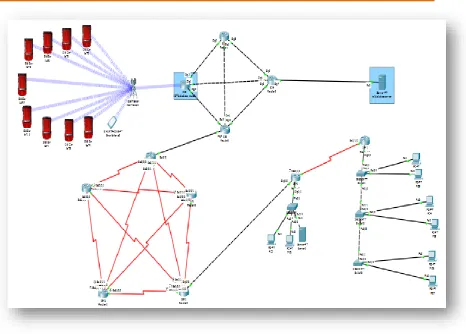
Fig 2: Proposed network architecture VI. Proposed Protocol Overview
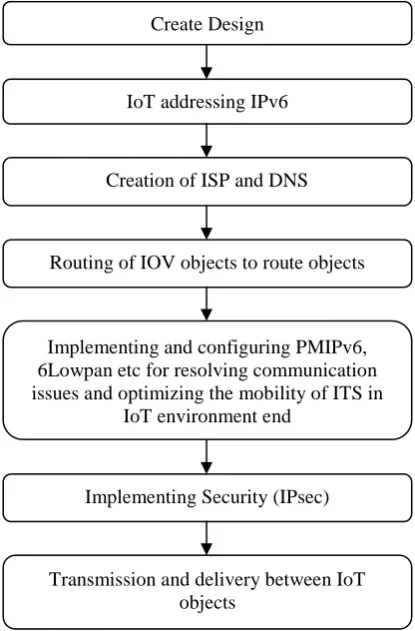
To achieve our goal we propose some modifications in PMIPv6, 6Lowpan. The steps of proposed protocol are listed below:
Step 1: Initially, in order to make topology for designing Cisco packet tracer7.1 has been used
Step 2: After that, next step is assigning IP address. There is IPv6 addressing on all the interfaces. First we create VLan on all router points. Virtual Lan: Virtual Lan (VLan) provide network segmentation but virtually
Fig 3: Flowchart of Framework
Step 4: Next step is Routing. To define the path Routing has been used that is the process used in different networks in wide area network. In framework static routing is used to create the route .With static routing, path define from source to destination is manually and it used the AD value is which is best value besides another routing. Routing with vlan is done with specific vlan name given to the router ends and without vlan, routing is directly done on interfaces.
Step 5: After that we implement the PMIPv6, Pagp, VTP, CDP protocol which runs at the backend when we apply OSPFv3 protocol.
Step 6: Now security is implemented on server so that any router can access only desired data from the server. IPsec is used because it helps to remove congestion.
Step 7: Now the data is transmitted and delivered between the desired nodes. After all the phases in this framework, last step is testing. In GNS-3 software, Wire-shark is the packet capturing tool is used for testing purpose in this tool there are many output taken of packets in graphs and packets.
VII. Test and Simulation Environment
The proposed Transportation method has been implemented using Cisco Packet Tracer7.1, Graphical Network Simulator-3 and Wireshark. Cisco packet Tracer 7.1 is an innovative and powerful networking simulation tool used for practise, discovery and troubleshooting. It has been released at the beginning of August on Cisco Netacad website. GNS-3 is a network simulator first released in 2008. This software allows the collaboration of virtual devices and Real devices. This GNS 3 used to simulate complex networks. It makes the use of Dynamips emulation software to simulate cisco inter operating system. Exxon,
Create Design
IoT addressing IPv6
Creation of ISP and DNS
Routing of IOV objects to route objects between them
Implementing and configuring PMIPv6, 6Lowpan etc for resolving communication issues and optimizing the mobility of ITS in
IoT environment end
Implementing Security (IPsec)
Walmart, AT&T and NASA, are big companies which used Graphic network GNS-3 software and is also popular for preparation of network professional certification exams. VIII. Numerical Analysis
In this analysis we emphasize mainly on four parameters. These parameters are end-to-end packet delivery delay, throughput, congestion, and scalability. Here we calculate how the above mentioned parameters are changed with an increasing time of network hierarchy for our proposed network architecture. We also compare the performance of our protocol with group mobility based NEMO scenario of PMIPv6 domain.
Fig 4: Delay Analysis
This figure depicts the x-axis as number of packets and y-axis as delay respectively. The blue line represents the existing protocol and the proposed solution is presented by the red line. The figure shows final results IoT transportation hybrid protocol. The graph shows the delay is decreased with the increase in number of packets.
Fig 5: Delay Analysis on increasing number of nodes
This figure depicts the x-axis as number of packets and y-axis as delay respectively. The blue line represents the delay in less number of nodes and the delay with n=14 are presented by the red line. The graph shows the decline in delay with the rise in number of packets.
0 2 4 6 8
2 4 6 8 10
En
d
-to
-E
n
d
d
e
lay
Number of packets
Proposed Hybrid
0 2 4 6 8
2 4 6 8 10 12 14
En
d
-to
-E
n
d
D
e
lay
Number of packets
Fig 6: Throughput Analysis
This figure depicts the x-axis as number of packets and y-axis as throughput respectively. The blue line represents the existing protocol and the proposed solution is presented by the red line. The figure shows final results IoT transportation hybrid protocol. The graph shows the throughput is increased with the increase in number of packets.
Fig 7: Throughput Analysis
The graph shows the throughput depends upon the number of packets passed during an interval i.e. throughput is increased with increase in packets transferred in less time.
Fig 8: Congestion Analysis
The graph is plotted between congestion and number of packets to compare existing protocol with the proposed protocol. The results show that proposed protocol gives less congestion than existing protocol. Proposed protocol gives the least sensitivity with milled variations with increasing number of packets.
0 5 10 15
2 4 6 8 9
A ve rag e Th ro u gh p u t
Number of Packets
Proposed Hybrid 0 2 4 6 8 10 12
2 4 6 8 10121416
A ve rag e Th ro u gh p u t
Number of packets
Proposed(n =14) Hybrid(n=1 4) 0 2 4 6 8
2 4 6 8 10
Co n ge sti o n
Number of packets
Fig 9: Congestion Analysis (n=14)
The graph is plotted between congestion and number of packets to compare congestion when n=14 and n=8. The results show that congestion decreases when delivery of number of packets increases. Proposed protocol with increasing number of nodes gives the least sensitivity with milled variations.
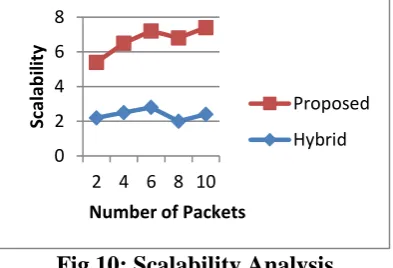
Fig 10: Scalability Analysis
The graph is plotted between scalability and number of packets to compare existing protocol with the proposed protocol. The results shows that Existing protocol produce scalability issues where as proposed protocol is more scalable.
Fig 11: Scalability analysis
The graph is plotted between scalability and number of packets to compare existing protocol with the proposed protocol. The results shows that Existing protocol produce scalability issues where as proposed protocol is more scalable. On increasing number of nodes scalability increases.
IX. Conclusion
Intelligent Transportation System is used to improve the transportation system to make it more efficient and safer by use of information, communications and control technologies.
0 2 4 6 8
2 4 6 8 101214
Co
n
ge
sti
o
n
Number of Packets
N=14 N=8
0 2 4 6 8
2 4 6 8 10
Sc
al
ab
ili
ty
Number of Packets
Proposed Hybrid
0 2 4 6 8
2 4 6 8 10 12
Sc
al
ab
ili
ty
Number of packets
With the help of authentication mechanism, the sender can send the data intended user and denied by other users. Various kinds of methods are available which help to protect the data and help to send it to intended receivers but still there are various issues due to which data delivery in transportation system suffers. The existing studies provide the detail description of various methods/protocols that lead to good packet delivery. Mobility policies are classified to generate transportation mechanisms at various levels. But still there is need to verify the encryption and decryption mechanisms against security of data. The above research study here deals with the data security and also with the performance enhancement mechanism to identify the issues to secure the data delivered among different nodes and store data on server. The protocol is tested against the various parameters practically; the concept is checked for scalability, congestion and also to minimize the required time for all processing i.e. Through put. The results demonstrate the scalability of the transportation mechanism. Through our effort in creating a Transportation network using GNS3 have allowed us to develop expertise and become technically competent with IPv6 technology in an academic environment. It can increase our knowledge towards the IPv4 to IPv6 transition and migration in transportation system. We have also been able to discover the basic of IPv6 technology and implementation of transition mechanisms. It also gave us the opportunity to test and understand the IPv6 technology with IOT before any real implementation time comes. This work could be applied to other organizational setting which intends to implement IPv6 in IOT object interconnections. The study will be any extended by considering low and high interval, security, ability. Try and scale back the congestion issue for higher delivery and communication interms of variety of packets delivered. So, we are able to compare it with different security techniques.
References
[1] L. Atzori, A. lara, G. Morabito “Understanding the Internet of Things: definition, potentials, and societal role of a fast evolving paradigm” in Ad Hoc Networks Volume 56, 1 March 2017, Pages 122-140
[2] K .K. Patel, S. M. Patel “Internet of Things-IOT: Definition, Characteristics, Architecture, Enabling Technologies, Application & Future Challenges” in International Journal of Engineering Science and Computing, Volume 6 Issue No. 5, 2016, pp. 6122-6131
[3] Y.W. Lin, Y.K. Hsiao, Z.S. Yeh, “A new mobility management scheme for Intelligent Transportation System” Wireless Personal Communications September 2017, Volume 96, Issue 2, pp 3081–3112
[4] W. Ejaz, M. Naeem, A. Shahid, A. Anpalagan and M. Jo, "Efficient Energy Management for the Internet of Things in Smart Cities," in IEEE Communications Magazine, vol. 55, no. 1, pp. 84-91, January 2017.
[5] O. Kaiwartya et al., "Internet of Vehicles: Motivation, Layered Architecture, Network Model, Challenges, and Future Aspects," in IEEE Access, vol. 4, pp. 5356-5373, 2016. [6] A. Rayes and S. Salam “The Internet in IoT—OSI, TCP/IP, IPv4, IPv6 and Internet
Routing” in Springer International Publishing Internet of Things From Hype to Reality, The Road to Digitization, 2017, pp. 35-56
[8] H. Chaudhary, N. Vaishnav and B. Tank "Comparative Analysis of Application Layer Internet of Things (IoT) Protocols" in Springer Information and Communication Technology for Sustainable Development, pp 173-180
[9] Y. Zhang, J. He, and M.S. Pathan “An Asymmetric Transport Protocol for Internet of Things” in Procedia Computer Science Volume 107, 2017, Pages 636-641
[10] A. Andreadis, S. Rizzuto, R. Zambon, “A croos-layer jitter-based TCP for wireless networks” in EURASIP Journal on Wireless Communications and Networking, December 2016, pp. 1-13
[11] H. Ko, S. pack, J-H Lee, A. Petrescu “DLM: Delayed location management in network mobility-based public transportation system” in Journal of Network and Computer Applications Volume 85, 1 May 2016, Pages 127-133
[12] M. R. Palattella et al., "Standardized Protocol Stack for the Internet of (Important) Things," in IEEE Communications Surveys & Tutorials, vol. 15, no. 3, pp. 1389-1406, Third Quarter 2013.
[13] G Aloi, G Caliciuri, G Fortino, R Gravina, P Pace, W Russo, C Savaglio, “Enabling IoT interoperability through opportunistic smartphone-based mobile gateways” in Journal of Network and Computer Applications Volume 81, 1 March 2016, Pp. 74-84 [14] H. Park, Z. Khattak, B. Smith "Glossary of Connected and Automated Vehicle Terms"
by University of Virginia Center for Transportation Studies for the Connected Vehicle Pooled Fund Study, Version 1.0, 2018, pp. 1-28
[15] S. Kaur, Dr. N. Sharma "Overview of Various Routing Protocols in Wireless Sensor Networks " in Journal of Network Communications and Emerging Technologies (JNCET) Volume 2, Issue 2, 2015, pp. 41-44
[16] Y. Javed, A. Baig and M. Maqbool "Enhanced quality of service support for Triple Play Services in IEEE 802.11 WLANs"in Springer EURASIP journal on Wireless communication doi: 10.1186/s13638-014-0233-x, 2015, pp. 1-14
[17] J. TAN, S. G. M. Koo "A survey of technologies in Internet of Things" in IEEE International Conference on Distributed Computing in Sensor Systems, doi: 10.1109, 2014, pp. 269-274
[18] Q Zhao, Y Zhu, C Chen, H Zhu, L Bo " When 3G meets VANET: 3G-assisted data delivery in VANETs" in IEEE SENSORS J. 13, 10, 2013
[19] S. Busanelli, F. Rebecchi, M. Picone, N. lotti, G. Ferrari "Cross- network information dissemination in vehicular ad hoc networks (VANETs): experimental results from a smartphone-based testbed". Future Internet 5(3), doi: 10.3390/fi5030398, 2013, pp. 398-428
[20] O. Kaiwartya, A. H. Abdullah, Y. Cao, A. Altameen, M. Prasad, C.T Lin, X. Liu "Internet of Vehicles: Motivation ,Layered architecture, Network Model, Challenges, and Future Aspects" in IEEE access, doi:10.1109/ACCESS.2016.2603219,2016, pp. 1-17
[21] G.Araniti, C. Campolo, M. Condoluci, A. Iera, A. Molinaro, "LTE for vehicular networking: a survey" in IEEE Commun. Mag. 51 (5), 2013, pp. 148-157
An OSPF Based Hybrid Encryption Algorithm for the Cloud
Data Security
Gagandeep Kaur
Sarpreet Singh
Abstract
Information security has reliably been a noteworthy issue in data innovation. In the cloud environment, it turns out to be especially serious on the grounds that the information is situated on various places over the world. Information security and security assurance are the two principle variables of client's worries about the cloud environment. The broad utilization of the Internet proposes incredible difficulties for data security. Secure routing is an important factor to guarantee security on the cloud. With loads of advantages of cloud still it experiences different constraints or difficulties, among which security is the fundamental concerning issue in distributed computing. There are different existing investigations that give cloud security system yet at the same time endure as far as effectiveness and furthermore various attacks on the information. The examination here manages an OSPF based hybrid encryption algorithm for the cloud information security. The algorithm is tried against the different security assaults essentially; the idea is checked for productivity and furthermore to limit the required time for processing. The outcomes exhibit the proficiency of the cloud security mechanism. Simulation results demonstrate that the proposed algorithm is more compelling and productive in terms of cloud security and different attacks.
Keywords: OSPF, routing protocol, attacks, hybrid encryption, data security.
I. Introduction
Over the recent couple of years, distributed computing has created from being a promising business thought to one of the rapidly growing segments of the IT business. Regardless, as continuously and more information on individuals and associations are set in the cloud, concerns are beginning to create about precisely how safe a domain it is. Despite of all the development including the cloud, customers are so far hesitant to send their business in the cloud. Security is one of the noteworthy issues which diminish the advancement of cloud computing and traps with data security and data affirmation continue building persistent inconvenience in the market [12].
Far reaching utilization of the Internet proposes extraordinary difficulties for data security. Routing protocols are utilized to disseminate organize topology data among routers. Routers locate the best course as indicated by the topology data, and understand the system information sending. Without revise router data, the system bundle transmission is wasteful or inconsistent, which may even reason network failed. Accordingly, secure routing protocol is an important factor to guarantee cloud security [7].
Student, Department of Computer Science and Engineering, SGGS World University, Fatehgarh Sahib, Punjab Assistant Professor, Department of Computer Science and Engineering, SGGS World University, Fatehgarh Sahib,
So, there is a need to design and create a hybrid cloud security routing protocol. On the other hand, efficiency has always been a key issue for cloud data storage for various Cloud service providers and end users. So, protocol should boost up the efficiency of system. The remaining portions of the paper are structured as: section II demonstrates the related work done by past decade researchers, section III talked about the proposed strategy, section IV shows the experiment results and discussion, and at the end section V concludes the paper and gives future directions to researchers in cloud data security field.
II. Related Work
A brief survey [1] on cloud computing shows that cloud computing has enormous amount of advantages such as it saves up the up-front cost, maintenance costs, scalability, availability etc. As each coin has two sides, so with the cloud. Security in cloud being the biggest question mark because it still suffers from various security breaches and it prevents cloud to be utilized at its golden level.
There are various surveys [2]-[6] presented by past decades researchers that signifies that the cloud data security is a noteworthy issue that must be addressed to take up the cloud benefits.
A hybrid encryption algorithm [7] that includes categorization of the data on the basis of their sensitivity and importance, followed by various cryptography techniques such as the AES, SHA-1, and ECC.The hybrid algorithm was designed and implemented for securing cloud data using three different security policies for three different types of sensitive data to maximize control of data owner on storing, processing and accessing on it. The proposed algorithm was found to be highly secure for all types of sensitive data cloud environment but still there is a requirement to utilize the hybrid algorithm to test various security attacks practically.
A survey [9] about various popular encryption algorithms such as RSA, DES, 3DES and AES found that AES algorithm is most efficient in terms of speed, time, and throughput and avalanche effect. The Security provided by these algorithms can be enhanced further, if more than one algorithm is applied to data. So, work can be done on the combinations (hybrid) of these algorithms to find more security in cloud.
Study here deals with the cloud security and also with the verification mechanism to identify the attacks to secure the data stored on cloud. The algorithm is tested against the various security attacks practically; the concept is checked for efficiency and also to minimize the required time for all processing. The results demonstrate the efficiency of the cloud security mechanisms.
III. Proposed Technique
A. Algorithm for proposed work
There are different steps that are used in the implementation and define the proposed technique.
Step 1: Registration of the user with CSP a) Enter User Particulars,
b) Choose USER_Name, PWD c) Enter M_Number
Step 2: if (USER_Name is valid) then
a) Generate a random key Rkey at CSP end and send it to user b) Generate an OTP at CSP end
d) Enter the User OTP received on user registered mobile e) if (Entered OTP ← CSPOTP) then
i. Message: New User is registered ii. go to step 3
else
i. Message: Unmatched OTP & registration is canceled ii. go to step 10
else
i. Message: Invalid USER_Name, Choose some other USER_Name ii. Go to step 2
Step 3: Selecting the category of the data. Based on the sensitivity of the data FPFID, categorize it into following categories:
i. NP (No Privacy) – Mainly Public Data so no encryption is required
ii. PTP (Privacy with Trusted Provider) –Data with little importance and the trusted CSP is allowed to store it into encrypted mode
iii. PNTP (Privacy with NON Trusted Provider) – Data with more sensitivity and importance and the encrypted data is sent to non trusted CSP which again store it into encrypted mode
Step 4: Uploading of user file to CSP
a) Select file FP in Plain text mode & assign a unique file ID FID b) δpc ←Privacy Category of file FPFID
Step 5: if δpc ← NP then
a) Send (FPFID, NP, USER_ID) to CSP via SSL
b) Store in CSP storage with replication factor 3 in plain text form. Step 6: if δpc ← PTP then
a) Send (FPFID, PTP, USER_ID) to CSP via SSL b) Generate a symmetric key CSPpub1 at CSP end c) CSP_FCFID Encrpt_AES (FPFID, FID, CSPpub1) d) Store CSPpub1 at CSP end database.
e) Store CSP_FCFID at CSP storage with replication factor 3 Step 7: if δpc= PNTP then
a) Generate an IPSec code for file
IPSec←IPSecCODE_SHA_1(OSPF,IPSec)
b) Generate a symmetric key USERPub for IPSec by AES algorithm c) Store IPSec and USERPub in User’s Database
d) Send (OSPF,IPSec) to CSP via SSL Step 8: User’s Authentication Request to CSP a) Enter USER_Name, PWD
b) if (USER_NAME is valid? && Password matched?) then i. Generate an OTP at CSP end
ii. UserOTP CSPOTP
iii. Enter the User OTP received on the user registered mobile iv. if (Entered OTP ← CSPOTP) then
i) Message: Cloud access is allowed ii) Send USER_ID to CSP
else
a. Message: Unmatched OTP & login is canceled b. Exit
else
a) Message: Invalid User Credentials, Re enter the correct credentials b) go to step 7
Step 9: Data retrieval and verification Process
a) CSP will list all users’ file against that USER_ID
b) The user will opt FC2FID with its privacy category δpc from the list c) if (δpc ==NP) then
(i) CSP will send the file (FPFID, USER_ID) to user via SSL d) if (δpc == PTP) then.
(i) At CSP end, the encypted file is decypted FPFID← Decrpt_AES
(CSP_FCFID, FID, CSPpub1)
(ii) CSP will send the file (FPFID, USER_ID) to user via SSL 1. Message: File is retrieved successflly
2. Send ACK to CSP 3. go to step 10 else
1. Message: File is Corrupt
2. Send NAK to CSP and start legal procedure 3. go to step 10
Step 10: EXIT
IV. Experiment Results and Discussion
A. Choice of Platform
The proposed method has been implemented using Graphical Network Simulator-3 is a network simulator first released in 2008. This software allows the collaboration of virtual devices and Real devices. This GNS 3 used to simulate complex networks. It makes the use of Dynamics emulation software to simulate cisco inter operating system. Exxon, Walmart, AT&T and NASA, are big companies which used Graphic network GNS-3 software and is also popular for preparation of network professional certification exams. Until 2015, the software was downloaded 11 million times. This software helps you build all the graphic models of computer networks scenario, and simulate networks of many different levels of complexity. Students can use this program to get various certifications, but also by network engineers and professionals in this field. It comes as an open-source solution that runs on all popular windows. GNS3 comes with a lot of detailed documentation regarding its features and tools, as well as their functionality.
TShark. Wireshark, and the other programs distributed with it such as TShark, are free software, released under the terms of the GNU General Public License.
B. Experimental Setup
Experimental setup describes the hardware and software requirement as follows:
a. Hardware Requirements
• Core i5 processor
• 1 GB RAM
• 80 GB HDD
b. Software Requirements • Window 8
• GNS
• Wireshark
• Packet Tracer 7.1
c. GNS3
GNS3 is utilized by a huge number of system engineers worldwide to copy, design, test and investigate virtual and genuine systems. GNS3 enables you to run a little topology comprising of just a couple of devices on your PC, to those that have numerous devices facilitated on different servers or even facilitated in the cloud.
GNS3 is open source software which you can download and use for free. The source code is available on GitHub if you are interested in taking a peek at the code. GNS3 provides an easy, cost effective way to new software such as management or SDN software. It allows you to test multi vendor interoperability using a virtual lab environment rather than requiring dedicated physical equipment.
An entire GNS3 topology can be created and run on a single laptop. This allows engineers to demonstrate topologies and software to clients and others on the road.
C. Results
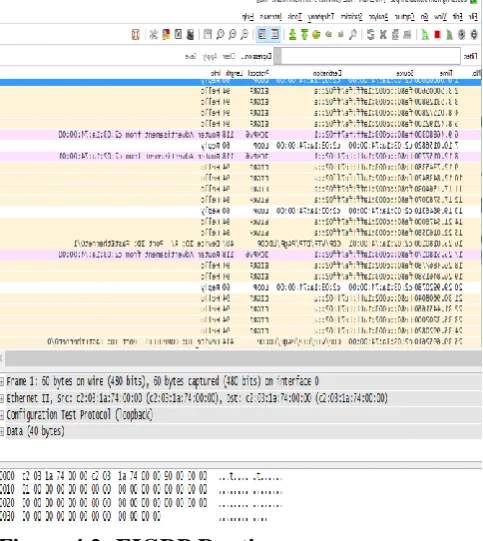
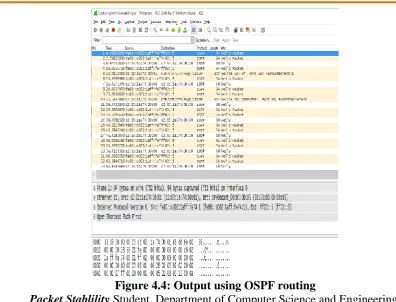
There is an output taken on graphic network simulator in which packets are sending and receiving from source and destination .When the packet is going to reach on destination then router send an advertisement to destination via network with the help of icmpv6 protocol which is internet control message protocol version 6 in IPv6 address. The link local address are also used in between source to destination and then router send reply of all the advertisement back and loopback address ::1 is used to set the connectivity between its own router and sending receiving updates. With this virtually one single link will give the best reliability because bandwidth is combined virtually with Port aggregation protocol (PAgP).
Eigrpv6 Route Exchange
In this graph, the hybrid protocol is used for routing purpose. The protocol is Enhanced Interior Gateway Routing Protocol is a Cisco Proprietary routing protocol. EIGRP sends packet from source and get reply from destination and also get advertisement from router. ICMPv6 is an integral part of IPv6 and performs error reporting and diagnostic functions (e.g., ping), and has a framework for extensions to implement future changes. EIGRP can exchange routes for IPv6 and it supports multiple protocols. Server receives packets from client side by EIGRP routing. When the server sends reply to source then the packet passes from three destinations CDP/VTP/DTP/PAgP. CDP is used to share information about other directly connected Cisco equipment, such as the operating system version and IP address. CDP can also be used for On-Demand Routing, which is a method of including routing information in CDP announcements so that dynamic routing protocols do not need to be used in simple networks. DTP aids with trunk port establishment. Neither protocol transmits the data frames that trunks carry. PAgP is used for the automated, logical aggregation of Ethernet switch ports, known as an EtherChannel.
Figure 4.2: EIGRP Routing
Packet Loss Transtitions

![Fig 2 , T] the backlogged quantity is governed by the following differential](https://thumb-us.123doks.com/thumbv2/123dok_us/1379985.1648579/76.595.86.529.120.331/fig-t-backlogged-quantity-governed-following-differential.webp)