S O F T W A R E
Open Access
Development and formative evaluation of the
e-Health Implementation Toolkit (e-HIT)
Elizabeth Murray
1*, Carl May
2, Frances Mair
3Abstract
Background:The use of Information and Communication Technology (ICT) or e-Health is seen as essential for a modern, cost-effective health service. However, there are well documented problems with implementation of e-Health initiatives, despite the existence of a great deal of research into how best to implement e-e-Health (an example of the gap between research and practice). This paper reports on the development and formative evaluation of an e-Health Implementation Toolkit (e-HIT) which aims to summarise and synthesise new and existing research on implementation of e-Health initiatives, and present it to senior managers in a user-friendly format.
Results:The content of the e-HIT was derived by combining data from a systematic review of reviews of barriers and facilitators to implementation of e-Health initiatives with qualitative data derived from interviews of
“implementers”, that is people who had been charged with implementing an e-Health initiative. These data were summarised, synthesised and combined with the constructs from the Normalisation Process Model. The software for the toolkit was developed by a commercial company (RocketScience). Formative evaluation was undertaken by obtaining user feedback.
There are three components to the toolkit - a section on background and instructions for use aimed at novice users; the toolkit itself; and the report generated by completing the toolkit. It is available to download from http:// www.ucl.ac.uk/pcph/research/ehealth/documents/e-HIT.xls
Conclusions:The e-HIT shows potential as a tool for enhancing future e-Health implementations. Further work is needed to make it fully web-enabled, and to determine its predictive potential for future implementations.
Background
E-health, or the use of information and communication technology in health care, is seen as essential for a mod-ern, cost-effective health service which is capable of addressing challenges such as improving equity of access and quality of care in a world facing an increasing bur-den of chronic disease [1]. There is an international commitment to e-Health, reflected in very considerable expenditure. The UK government has invested £12.4 bn over 10 years [2] and this is less than the US or many European countries [3]. However, despite the over-whelming political commitment and substantial invest-ment, there has been significant variability in the
success of different e-health implementations [4,5]. Many projects have been subject to delay [6], increasing budget overspends, and in some cases, severely negative impacts on the quality and effectiveness of care [7-9]. Although there is a considerable body of research on implementation of e-health [10,11], recent work has cri-ticised both the methodology used in many of the exist-ing reviews of this work, and the narrow focus on organisational issues related to implementation, with lit-tle attention paid to the impact of new technologies on workload, inter-professional relationships, and commu-nication between health professionals and patients [12].
There are many reasons for the difficulties encoun-tered with implementation of e-health. Some of these are likely to parallel those contributing to the gap between research findings and routine clinical care, including a perceived lack of relevance of research to practitioner needs [13]; managers, or other senior staff
* Correspondence: [email protected]
1E-Health Unit, Research Department of Primary Care and Population Health,
University College London, Upper Floor 3, Royal Free Hospital, Rowland Hill Street, London NW3 2PF, UK
Full list of author information is available at the end of the article
charged with e-Health implementations not having the time or inclination to read the large body of literature [14]; inadequacies in the existing research [12]; and the poor permeability of the managerial: research inter-face[15].
In this paper we describe the development and forma-tive evaluation of an e-Health Implementation Toolkit (e-HIT) (Additional file 1). The e-HIT was developed explicitly to bridge the managerial:research interface, by making the results of a large body of research into e-Health implementation accessible to senior managers in a simple, user-friendly format. Its development had been explicitly commissioned by the funding body (the National Institute of Health Research Service Delivery and Organisation programme) as part of an overall pro-gramme of work examining the barriers and facilitators to e-health implementation in the UK National Health Service. The aim of the e-HIT was to summarise and synthesise research evidence on factors that impede or facilitate implementation of e-Health initiatives and pre-sent this evidence in a format that could be easily digested and used by staff considering or planning an e-Health implementation. The aim of this paper is to describe the process of development and formative eva-luation, and describe the final toolkit, in line with recent calls for more detailed descriptions of the processes and content of complex interventions [16,17].
Implementation
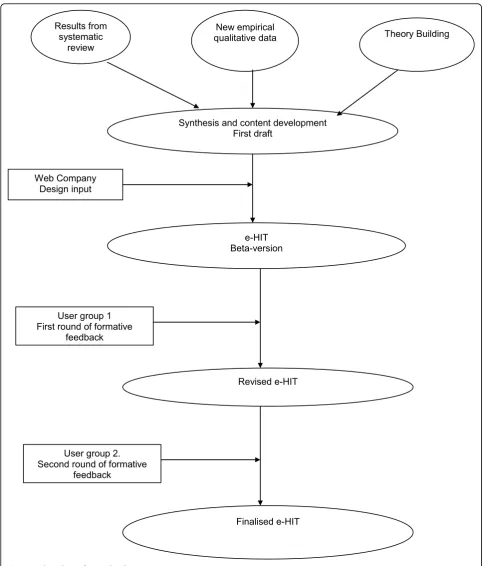
There were three phases to the development and forma-tive evaluation of the e-HIT (Figure 1):
1. Writing the content;
2. Developing the excel spreadsheet;
3. Obtaining and incorporating user feedback on the toolkit.
Writing the content
The content of the e-HIT was derived by combining a theoretical framework with a literature review and new empirical data.
The Normalisation Process Model
The theoretical framework was the Normalisation Pro-cess Model (NPM) which is a sociological model explaining why some new technologies become fully embedded in routine practice (normalised) and others do not. It was initially derived from an extensive series of qualitative studies of telemedicine initiatives [18], and subsequently refined and expanded to apply to the implementation of all complex interventions in health care. The NPM suggests that the degree of“ normalisa-tion”of a complex intervention, such as a new e-health technology, depends on the impact of the proposed intervention on four constructs[19]. These constructs
are known as interactional workability, relational inte-gration, skill set workability and contextual integration. Interactional workability (IW) refers to the degree to which the proposed technology enables (or impedes) interactions between health professionals and patients -e.g. a consultation. Relational integration (RI) refers to the way in which different professional groups relate to each other, and how well the proposed technology fits (integrates) with existing relationships, as well as the degree to which it promotes trust, accountability and responsibility in inter-group relationships. Skill set workability (SSW) refers to the degree to which the e-health initiative fits with existing working practices, skill sets, and perceived job role. Contextual integration (CI) refers to the degree to which the proposed e-health system fits (integrates) with the overall goals and struc-ture of the organization (context), as well as the capacity of the organization to undertake the implementation. The more positive the impact of the proposed new tech-nology on these four constructs, the more likely it is that it will normalise [19].
The literature review
The searches yielded 6,585 citations of which 6,439 could be excluded on the basis of the title or abstract. 146 full papers were retrieved, of which 19 met the cri-teria for inclusion. The thematic analysis found that the
existing literature focused on the following factors: con-ditions prior to implementation; costs of implementa-tion; importance of evaluation of the new technology prior to implementation; attitudes of users, particularly
Results from systematic
review
New empirical
qualitative data Theory Building
Synthesis and content development First draft
Web Company Design input
e-HIT Beta-version
User group 1 First round of formative
feedback
Revised e-HIT
User group 2. Second round of formative
feedback
Finalised e-HIT
health professionals; ease of use of the system; security, confidentiality and standards; education and training; technological issues; communication; and organisational issues. Conditions prior to the implementation had two components - those within the organisation under study, and the broader societal context. Examples per-taining to the specific organisation included pre-existing working relationships, morale, and previous experience of e-health implementations, while the broader societal context could include policy or economic drivers. Costs, including the costs of obtaining the system and the costs of implementation were seen as important, while some authors mentioned the costs of not implementing the system as also being relevant. Many authors com-mented on the importance of evaluation of systems prior to their implementation. Professional attitudes were often perceived as a barrier to implementation, which might or might not be overcome through educa-tion and training. System specific factors included ease of use, and whether concerns about confidentiality, security and standards had been adequately met. Tech-nological issues were important, in terms of fitness for purpose, as was maintaining good communication both within an organisation and between professionals and patients [12].
Empirical data
The third source for the content of the e-HIT was newly obtained qualitative data, derived from interviews with a range of “implementers” with responsibility for one or more e-health implementations. The methods and results of this study have also been described in detail elsewhere [12]. “Implementers” were defined as any person charged with assisting with the implementa-tion of an e-health system. We included chief executives of trusts, clinical directors, senior managers, ICT staff, and staff working for private companies contracted to supply, deliver or facilitate specific e-health implementa-tions. We selected three case studies, which between them covered a range of NHS contexts (primary, com-munity and secondary care), types of e-health technol-ogy and relationship with the main sponsor in this arena, namely Connecting for Health. The selected stu-dies were Choose and Book in one hospital trust and its main referring Primary Care Trust in inner London, Picture Archiving and Communication System in a hos-pital trust with several sites in South West England, and a Clinical Nurse Information System in a large urban health board in Scotland. In all cases the implementa-tion had happened between 12 and 36 months earlier. Interviewees were asked for their perceptions of barriers and facilitators to the implementation of the study tech-nology, and the degree to which the technology had normalised. Data were coded by two independent researchers, using the NPM as a coding framework. The
results suggested that the NPM provided a good expla-nation for the variable degrees of normalisation of the three study technologies. E-health initiatives that were perceived by respondents to have a positive impact on all four constructs were highly likely to normalise. Problems with any one construct should alert policy makers and senior managers to potential difficulties, which need careful consideration and planning. Difficul-ties across all four constructs suggest that the initiative is relatively unlikely to normalise, and some rethink may be needed [12].
Combining the data sources
In order to create the content of the e-HIT, the main themes that arose from the literature review and qualita-tive study were considered in depth, along with the con-structs of the NPM. The themes were synthesised to create a database of items which had theoretical and empirical validity. In order to make this collection of items accessible and comprehensible, they were grouped into three main categories: the context; the intervention; and the workforce. These categories emerged from the interview data from implementers, and were selected as resonating with the approach currently in use by imple-menters. The next task was to reduce the number of items in each group to the minimum compatible with adequately addressing all the issues which were judged important on the basis of the three data sources (litera-ture review, qualitative data and theoretical framework). This was done by reviewing all the items, deleting dupli-cates, and clarifying items which were ambiguous. Sub-sequently, each item was operationalised by a statement, which was anchored by extreme negative and extreme positive positions.
Developing the toolkit
We contracted a web design company (RocketScience) who had experience of building toolkits for the public and private sectors (including the NHS) to provide the software for the toolkit. We undertook an iterative pro-cess of discussion and design which culminated in a prototype toolkit, ready for user testing and feedback. Design issues considered in this phase included the number of points on the scale between anchor points for each statement, the number of items on each page, the number of pages, the use of colour, page layout, navigation, and the presentation of results once the toolkit had been completed. The web design company’s previous experience was invaluable at this stage.
about the implementation process, not a tickbox or scor-ecard approach which could replace careful thought.
Finally, we provided three illustrative case studies for users to look at, and compare with their own planned implementation. These case studies were those used in the qualitative study described above.
User feedback
A two stage formative evaluation of the e-HIT was undertaken. For the first stage, the prototype e-HIT was circulated to a group of e-Health experts. These experts included senior clinicians, managers and academics each of whom had extensive experience of e-health imple-mentations within the NHS (n = 13). These experts were asked to complete the e-HIT for an e-Health initiative they had personal experience of, and on the basis of this experience, to comment critically on the e-HIT. Specifically, respondents were asked whether they thought the e-HIT would be useful to senior managers considering, planning or undertaking an e-Health imple-mentation, what would make the e-HIT more useful, what were the positive features of the e-HIT, and what features needed modifying. Respondents were asked to suggest modifications which would improve the e-HIT, and for other general or specific comments not covered by the questions listed (Additional File 2).
All the experts contacted responded with comments and discussion. The overall response was overwhel-mingly positive, with comments including “fantastic” and“excellent piece of work”. Specifically, respondents thought that the non-prescriptive approach and empha-sis on the e-HIT as a sensitizing tool would appeal to senior managers. Respondents thought that the overall layout was clear, the language easily comprehensible, and that the main areas of importance were well cov-ered. They liked the sliding scales, space for explanatory text, and instant feedback. There were also specific sug-gestions for improvement about the navigation, layout and wording of individual components of the e-HIT, with requests for more information to help with com-pleting some of the questions, and clarification of indivi-dual questions. The experts raised two major concerns which we were unable to address within the constraints of the resources available within this research project: a) they judged that the e-HIT would be more useful if it was fully web-enabled, which would allow multiple users to compare their results, and hence share experience either between different professional groups or across multiple implementation sites; and b) there was a con-cern about how best to disseminate the toolkit.
This feedback led to a number of changes, including redesign of the introductory section, allowing experi-enced users to bypass this, provision of explanatory mouseovers to assist with completion of individual
questions, a more streamlined lay-out and a more detailed explanation of how to use the report section of the toolkit.
In the second stage of the formative evaluation, the revised toolkit was circulated by e-mail to the imple-menters who had been interviewed in the qualitative study (n = 23). The e-mail explained that the toolkit had been generated in part from their interview data, and that we were aiming to make the toolkit as helpful as possible to people like them. Participants were asked to comment on the likely usefulness of the e-HIT, make suggestions for improvement, and whether it adequately reflected their own experience (Additional file 3). This round of feedback elicited only minor suggestions from 5 respondents, e.g. further clarification of specific items.
Results
There are three components to the toolkit - a section on background and instructions for use aimed at novice users; the toolkit itself; and the report generated by completing the toolkit. The background and instructions section can be bypassed, but for those who wish to use it, it contains advice on how to use the toolkit, including what it is, who should use it, when it should be used, and how it should be used. This section emphasises that it is a sensitising tool to alert the user to potential pit-falls and allow pre-emptive planning. There is a short section on how the toolkit was derived, including links to further reading for those interested. This introductory section also contains links to the reports generated by the illustrative case studies, to give users an idea of what the report will look like, and how it compares with their own experience.
The toolkit itself has 6 pages: 3 pages on context, 1 on the intervention and 2 on workforce issues. Context includes organisational factors, national and local poli-cies, and other drivers of the implementation. Interven-tion items address the impact on professional - patient interactions, inter-professional relationships, and the effectiveness and cost-effectiveness of the intervention. Workforce items consider the impact of the intervention on workload, workflow, distribution of work between different user groups, the need for education and train-ing, and the impact on relationships between profes-sional groups. This grouping of items was intended solely to help organise and present the items as it was recognised that some items could be considered to belong in two or more categories.
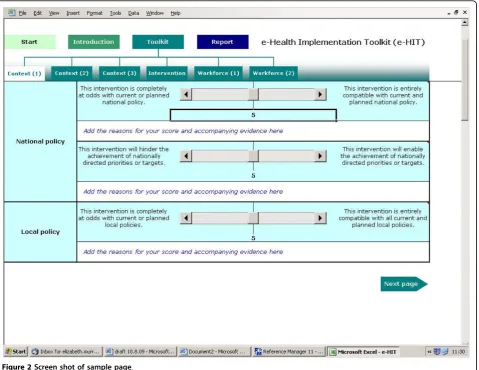
Each page contains three items with an extreme nega-tive and an extreme posinega-tive anchoring statement. The user is asked to rate their proposed e-health implemen-tation on a scale of 0 - 10 (Figure 2).
are four parts to the report: guidance on how to use the report; graphical displays of the responses for each item; a summary of the comments made by the user; and a problems and solutions page where the user can note potential areas of difficulty in the proposed implementa-tion and plans for addressing these. To see one of the illustrative case reports, please see: http://www.ucl.ac.uk/ pcph/research/ehealth/documents/case_study-PACS. xls#Scores!A4
Discussion
To the best of our knowledge, this is the first e-Health Implementation Toolkit to be developed in this rigor-ous way. The e-HIT has a number of strengths, includ-ing its theoretical underpinninclud-ing, in line with the call to improve the design of implementation interventions with the use of theory [22]. Undertaking a systematic review of reviews of the field of e-health implementa-tion allowed us to synthesise and summarise a very large body of literature in a reasonably efficient man-ner. In addition we obtained new qualitative data, from
a group who have been relatively understudied, namely implementers, or people charged with an e-health implementation. Including these data helped ensure that the toolkit incorporated the perceptions of the professional group the toolkit is aimed at. The toolkit was subjected to constructive criticism from a team of experts in the field. These strengths in its development may account for the very positive response obtained during the formative evaluation. However, there are a number of weaknesses, and it would be premature to advise widespread use of the e-HIT until research into its effectiveness has been undertaken. Weaknesses include the relatively small number of people who have used and commented on the e-HIT, and, as high-lighted during our formative evaluation, it would be more useful if fully web-enabled. It is also unclear how useful the e-HIT will be outside the UK National Health Service. The literature review reported experi-ence gained internationally, but the additional qualita-tive data obtained from implementers, and the case studies are UK-based.
We believe that the e-HIT has the potential to meet an unmet need in the NHS as previous toolkits tend to have either focused on readiness to implement research findings (e.g. those derived from the Promoting Action on Research Implementation in Health Services (PAR-iHS) framework [23,24])) or on supporting quality improvement interventions in health care [25]. Lilley and Navein developed “The Telemedicine Toolkit” in 2000 [26], but this focuses exclusively on telemedicine and is a workbook of 185 pages with exercises. We are seeking further funding to web-enable the toolkit, and subject it to further critical evaluation, including deter-mining its applicability in an international context.
Conclusions
The e-HIT is a new tool which has potential for enhan-cing and improving e-Health implementations. More work is needed to web-enable the toolkit, and to deter-mine its potential predictive power.
Availability and requirements
The e-HIT is available for downloading from http:// www.ucl.ac.uk/pcph/research/ehealth/documents/e-HIT. xls. There are no restrictions on use.
Additional material
Additional file 1: The e-HIT. http://www.ucl.ac.uk/pcph/research/ ehealth/documents/e-HIT.xls. Downloadable excel spread sheet of e-HIT.
Additional file 2: feedback questionnaire for Round 1.
Additional file 3: feedback questionnaire for Round 2.
Abbreviations
e-HIT: e-Health Implementation Toolkit
Acknowledgements
We gratefully acknowledge RocketScience for developing the software for the toolkit, Jo Burns and Trudi James for their assistance with the original project, the advisory group for their thoughtful critique of the e-HIT, and all the interviewees. This article presents independent research commissioned by the National Institute for Health Research (NIHR) Service Delivery and Organisation (SDO) Programme. The views expressed in this publication are those of the author(s) and not necessarily those of the NHS, the NIHR or the Department of Health. The NIHR SDO programme is funded by the Department of Health.
Author details
1
E-Health Unit, Research Department of Primary Care and Population Health, University College London, Upper Floor 3, Royal Free Hospital, Rowland Hill Street, London NW3 2PF, UK.2Faculty of Health Sciences, University of Southampton, University Road, Southampton, SO17 1BJ, UK.3Section of General Practice & Primary Care, Centre for Population and Health Sciences, University of Glasgow, 1 Horselethill Road, Glasgow G12 9LX, UK.
Authors’contributions
EM led on developing the e-HIT with support from CM and FM. EM wrote the first and final drafts of the manuscript with input from CM and FM. All authors have made substantial contributions to the concept and design of the study and to the drafting of the manuscript. All authors have read and agreed the final draft.
Competing interests
The authors declare that they have no competing interests.
Received: 17 June 2010 Accepted: 18 October 2010 Published: 18 October 2010
References
1. Department of Health:Delivering 21st Century IT Support for the NHS.
London 2002, 1-31.
2. NHS Connecting for Health:The cost of the National Programme for IT is spiralling.NHS Connecting for Health 2009, 5-5-0009.
3. House of Commons Health Committee:The Use of New Medical Technologies within the NHS. Fifth Report of Session 2004 - 05.London, The Stationery Office Limited 2005, 1-29.
4. National Audit Office:The National Programme for IT in the NHS.London, The Stationery Office 2006, 1-57.
5. DesRoches CM, Campbell EG, Rao SR, Donelan K, Ferris TG, Jha A,et al:
Electronic health records in ambulatory care–a national survey of physicians.N Engl J Med2008,359:50-60.
6. Hendy J, Fulop N, Reeves BC, Hutchings A, Collin S:Implementing the NHS information technology programme: qualitative study of progress in acute trusts.BMJ2007,334:1360.
7. Cross M:Computer says yes–and no.BMJ2007,334:1350-1351. 8. Sinclair J:Hospital boss hits out at new computer system.The
IndependentLondon, 13-2-2009.
9. Balfour DC, Evans S, Januska J, Lee HY, Lewis SJ, Nolan SR,et al:Health information technology–results from a roundtable discussion.J Manag Care Pharm2009,15:10-17.
10. Greenhalgh T, Robert G, Bate P, Kyriakidou O, Macfarlane F, Peacock R:How to Spread Good Ideas. A systematic review of the literature on diffusion, dissemination and sustainability of innovations in health service delivery and organisation.London, The NHS Service and Delivery Organisation Programme 2004, 1-424.
11. Gagnon MP, Legare F, Labrecque M, Fremont P, Pluye P, Gagnon J,et al:
Interventions for promoting information and communication technologies adoption in healthcare professionals.Cochrane Database Syst Rev2009, CD006093.
12. Mair F, May C, Murray E, Finch T, O’Donnell C, Anderson G,et al:
Understanding the implementation and integration of e-Health Services. Report for the NHS Service and Delivery R & D Organisation (NCCSDO).
London, SDO 2009 [http://www.sdo.nihr.ac.uk/files/project/135-final-report.pdf]. 13. Dobbins M, Jack S, Thomas H, Kothari A:Public health decision-makers’
informational needs and preferences for receiving research evidence. Worldviews Evid Based Nurs2007,4:156-163.
14. Thompson DS, O’Leary K, Jensen E, Scott-Findlay S, O’Brien-Pallas L, Estabrooks CA:The relationship between busyness and research utilization: it is about time.J Clin Nurs2008,17:539-548.
15. Petticrew M, Whitehead M, Macintyre SJ, Graham H, Egan M:Evidence for public health policy on inequalities: 1: the reality according to policymakers.J Epidemiol Community Health2004,58:811-816. 16. Campbell NC, Murray E, Darbyshire J, Emery J, Farmer A, Griffiths F,et al:
Designing and evaluating complex interventions to improve health care. BMJ2007,334:455-459.
17. Craig P, Dieppe P, Macintyre S, Michie S, Nazareth I, Petticrew M:
Developing and evaluating complex interventions: new guidance.
London, Medical Research Council 2008, 1-39.
18. May C, Mort M, Williams T, Mair F, Gask L:Health technology assessment in its local contexts: studies of telehealthcare.Soc Sci Med2003,
57:697-710.
19. May C:A rational model for assessing and evaluating complex interventions in health care.BMC Health Serv Res2006,6(86):86. 20. Oh H, Rizo C, Enkin M, Jadad A:What is eHealth (3): a systematic review
of published definitions.J Med Internet Res2005,7:e1. 21. Linton JD:Implementation research: state of the art and future
directions.Technovation2002,22:65-79.
22. Designing theoretically-informed implementation interventions. Implement Sci2006,1(4):4.
24. Kitson AL, Rycroft-Malone J, Harvey G, McCormack B, Seers K, Titchen A:
Evaluating the successful implementation of evidence into practice using the PARiHS framework: theoretical and practical challenges. Implement Sci2008,3(1):1.
25. Akl EA, Treweek S, Foy R, Francis J, Oxman AD:NorthStar, a support tool for the design and evaluation of quality improvement interventions in healthcare.Implement Sci2007,2(19):19.
26. Lilley R, Navein J:The Telemedicine Tool Kit. A Workbook for NHS Doctors, Nurses and Managers.Oxford: Radcliffe Medical Press 2000.
Pre-publication history
The pre-publication history for this paper can be accessed here: http://www.biomedcentral.com/1472-6947/10/61/prepub
doi:10.1186/1472-6947-10-61
Cite this article as:Murrayet al.:Development and formative evaluation of the e-Health Implementation Toolkit (e-HIT).BMC Medical Informatics and Decision Making201010:61.
Submit your next manuscript to BioMed Central and take full advantage of:
• Convenient online submission
• Thorough peer review
• No space constraints or color figure charges
• Immediate publication on acceptance
• Inclusion in PubMed, CAS, Scopus and Google Scholar
• Research which is freely available for redistribution