R E S E A R C H A R T I C L E
Open Access
Relationship between pulmonary function
and peripheral vascular function in older
Chinese: Guangzhou biobank cohort
study-CVD
Jing Pan
1, Lin Xu
2,3, Tai Hing Lam
1,3*, Chao Qiang Jiang
1*, Wei Sen Zhang
1, Feng Zhu
1, Ya Li Jin
1,
G. Neil Thomas
4, Kar Keung Cheng
4and Peymane Adab
4Abstract
Background:Findings describing the relationship between pulmonary function and peripheral vascular function have been inconclusive. We explored this relationship in Guangzhou Biobank Cohort Study-Cardiovascular Subcohort (GBCS-CVD).
Methods: Brachial-ankle pulse wave velocity (baPWV) and ankle brachial index (ABI) were measured by a waveform analyser, and pulmonary function by turbine flowmeter spirometry. Predicted forced expiratory volume in 1 s (FEV1) and forced vital capacity (FVC) were derived using equations for Chinese. Regression analyses were used to investigate the association.
Results:Of 1528 older Chinese, 980 (64.1%) had arterial stiffness (baPWV ≥1400 cm/s), but only 29 (1.9%) had peripheral arterial disease (PAD) (ABI < 0.9). The mean (±standard deviation, SD) baPWV was 1547 (±298) cm/s and mean (±SD) ABI 1.09 (±0.09). Before and after adjusting for potential confounders, baPWV was negatively associated with FEV1 and FVC % predicted (% predicted = observed/predicted × 100%) (adjusted β: −0.95 and −1.16 respectively, p< 0.05), and ABI was marginally non-significantly positively associated with FEV1% predicted (adjustedβ0.02,p= 0.32) and FVC% predicted (adjustedβ0.02,p= 0.18). Compared to participants in the highest tertile of pulmonary function, those in the lowest had higher risk of arterial stiffness (adjusted odds ratio (AOR) 1. 51, 95% CI 1.09–2.10 for FEV1and AOR 1.69, 95% CI 1.22–2.33 for FVC), but the higher risk of PAD was marginally non-significant (AOR 1.64, p= 0.42 for FEV1 and AOR 1.65, p= 0.24 for FVC).
Conclusion: In older relatively healthy normal weight Chinese, pulmonary function was inversely dose-dependently associated with arterial stiffness, while the association with PAD was much weaker.
Keywords:Pulmonary function, Arterial stiffness, Peripheral arterial disease (PAD), Vascular function
Background
Cardiovascular disease (CVD), a leading cause of disabil-ity and mortaldisabil-ity worldwide, has been increasing rapidly in China [1]. Poorer pulmonary function has been re-ported to be a risk factor for CVD mortality in general population [2], but the mechanisms are unclear. A pos-sible mechanism may be through increasing arterial stiff-ness, as indicated by elevated pulse wave velocity (PWV)
or vascular plaque formation, as indicated by reduced ankle brachial index (ABI). The prevalence of peripheral arterial disease (PAD) (ABI < 0.9) was higher in patients with chronic obstructive pulmonary disease (COPD) (n= 2088) than in age- and sex-matched control subjects without COPD (n= 4420) (8.8% vs. 1.8%) in the German COPD and Systemic Consequences-Comorbidities Net-work (COSYCONET) study [3]. Previous studies describ-ing the association between pulmonary function and vascular dysfunction were inconclusive. Many [4–10], but not all [11, 12], of the studies showed that reduced
* Correspondence:[email protected];[email protected] 1Guangzhou No.12 Hospital, Guangzhou, Guangdong, China
Full list of author information is available at the end of the article
pulmonary function was associated with a higher risk of vascular dysfunction. The discrepancy could be due to interaction, diffrences in study design and, study population (patients or relatively healthy subjects), sample size, and variation in confounding factors con-sidered [5, 7, 8, 10–16].
Peripheral vascular dysfunction has been reported to be influenced by many factors including adiposity [17], blood pressure [18], age [18], physical activity [19] and inflammatory biomarkers such as C-reactive protein [20], which are also associated with pulmon-ary function. Thus the association between vascular dysfunction and pulmonary function could be influ-enced by, or depend on these factors. Most of the studies adjusted for age, sex and body mass index (BMI) [4–6, 8, 10–14], but did not adjust for blood pressure, smoking status, physical activity, inflamma-tory biomarkers and lipids [4, 9, 10]. Although the association did not attenuate substantially after con-founder adjustment in most studies, two reported no association after adjusting for sex, age, BMI, total cholesterol/high-density lipoprotein-cholesterol ratio, hypertension, diabetes, drinking and smoking in 678 adult Japanese Americans [11], and after adjusting for sex, age, smoking, highly sensitive C-reactive protein, glucose concentrations, cholesterol-high-density lipo-protein ratio, pulse oximetry oxygen saturation and emphysema severity in 177 patients with chronic ob-structive pulmonary disease (COPD) [12]. Only three studies examined whether the association varied by smoking status [4, 21] or sex [14, 21].
Moreover, most of these studies were from Western populations. We found only three studies on the rela-tionship between pulmonary function and vascular func-tion in Asian populafunc-tions [4, 5, 22] and of them, one was a small hospital-based study (n= 155) in China showing a negative association between baPWV and forced expiratory volume in 1 s (FEV1) and FEV1/forced
vital capacity (FVC) ratio after adjusting for age, sex, BMI and smoking status [5]. The other 2 studies were in Japanese populations: a clinical study with only 45 hypertensive patients showing cardio-ankle vascular index (CAVI) was negatively associated with lung function [22], and the other a population-based study (n= 8790) which showed a negative association between airflow limitation and baPWV only in smokers [4]. We studied the association between pulmonary function and peripheral vascular function in older Chinese in the Guangzhou Biobank Cohort Study-CVD Sub-study.
Methods Subjects
The Guangzhou Biobank Cohort Study (GBCS), a three-way collaboration among the Guangzhou Number
12 Hospital, the Universities of Hong Kong and Birming-ham, recruited 30,518 older Chinese in Guangzhou at baseline from 2003 to 2008 [23]. The Cardiovascular Disease Sub-cohort (GBCS-CVD) included 1996 par-ticipants from phase 3 and details have been reported elsewhere [24]. Trained interviewers collected infor-mation on the demographic characteristics, family and personal disease and medication history and lifestyle, including smoking, alcohol drinking and physical ac-tivity according to the International Physical Acac-tivity Questionnaire (IPAQ) using a standardized computer-based questionnaire. Physical examination included height, weight, waist circumference and blood pressure. Blood glucose, lipids and high-sensitivity C-reactive protein (hs-CRP) were assayed after an overnight (> 8 h) fast. Hypertension was defined as systolic blood pressure (SBP) ≥140 mmHg, diastolic blood pressure (DBP) ≥90 mmHg, or self-reported use of antihypertensive medication. Diabetes mellitus (DM) was defined as fasting glucose ≥7.0 mmol/L and/or self-reported DM. Asthma was based on self report of whether a doctor had ever diagnosed them with asthma. Ethical approval was granted by the Guangzhou Medical Ethics Committee of the Chinese Medical Association. All participants gave written, informed consent before participating.
Exposure indicators
Spirometry was done by a turbine flowmeter (Cosmed microQuark, Rome, Italy), and details of the methods and results on other research questions have been re-ported elsewhere [25, 26]. Briefly, the pulmonary function test was conducted in a standing position following standard procedures, with at least three ma-neuvers, and the best measure of FEV1 and FVC were
recorded. Predicted values for FEV1 and FVC were
derived using the equations of Ip and colleagues for Chinese [27]. The cutoff points of the tertiles of the FEV1% predicted (% predicted = observed/predicted ×
100%) were as follows: tertile 1, > 103.4%; tertile 2, 90.5–103.4%; and tertile 3 < 90.5%. The cutoff points of the tertiles of FVC% predicted were as follows: tertile 1 > 102.2%; tertile 2, 89.9–102.2%; and tertile 3, < 89.9%. These cutoff points have been used in our previous paper [26]. We defined COPD based on the presence of airflow obstruction, using the GOLD definition of FEV1/FVC < 0.70. Restrictive pattern of lung disease was defined as FEV1/FVC ≥0.70, FVC% predicted < 0.80.
Study outcomes
5 min of rest using an automatic waveform analyser (BP-203RPE; Colin Medical Technology, Komaki, Japan), an automated recording device that calculated the time delay between 2 pulse waves recorded simul-taneously [24]. Data of the waveforms of both ankles and brachia were stored, the time interval between the wave front of the brachial waveforms and the waveforms of the ankles was automatically measured, which was defined as ΔT. The distance of each seg-ment (La−Lb) was automatically calculated based on the patient’s height. Afterward, baPWV was calculated using the following equation: baPWV (in centimetres per second) = (La−Lb)/ΔT. The mean of the left and right baPWV (average baPWV) was obtained from all subjects and used in the analysis, and the max of the left and right baPWV was also used for sensitivity analysis. Ankle SBP and brachial SBP were measured and ABI was calculated using the equation: ABI = ankle SBP/brachial SBP. The lowest value of the left and right ABI was used for analysis. Higher baPWV (indicating greater arterial stiffness) was defined as baPWV ≥1400 cm/s [30], and lower ABI (indicating peripheral arterial disease (PAD)) as ABI < 0.9 [31].
Statistical analysis
All data analysis was performed using Stata/SE V.12.0 (StataCorp LP, 4905 Lakeway Drive, College Station, TX77845 USA). Continuous variables were analysed using independent sample t-test and categorical vari-ables using χ2 test. Multivariable linear regression was used to calculate regression coefficient (β) and 95% confidence interval (CI) of pulmonary function indica-tors with vascular function. Multivariable logistic re-gression was used to calculate odds ratio (OR) of presence of arterial stiffness, and presence of PAD for (a) FEV1% predicted tertiles, and (b) FVC% predicted
tertiles with and without adjustment for following potential confounders: age (years), sex, waist circum-ference (cm), education (primary or below, middle school, college or above), smoking (never, former, current smokers (0–29 pack-years) and current smokers (> 30 pack-years)), IPAQ physical activity (physically ac-tive, moderate and inactive), diastolic blood pressure (mmHg), triglycerides, fasting plasma glucose (mmol/l), COPD, asthma and medications (aspirin and/or lipid low-ering medication).
We tested for interaction between pulmonary func-tion indicators and sex, and smoking status. As we found no evidence that the association of pulmonary function with vascular dysfunction (arterial stiffness or PAD) varied by sex (P values for interaction: 0.19– 0.99) or smoking status (P values for interaction: 0.15–0.69), we conducted all analysis pooling men and women together with adjustment for sex and
smoking. We also performed sensitivity analysis exam-ining the association of pulmonary function indicators with vascular dysfunction by sex and by smoking sta-tus. All significance tests were 2-tailed, with p< 0.05 as statistically significant.
Results
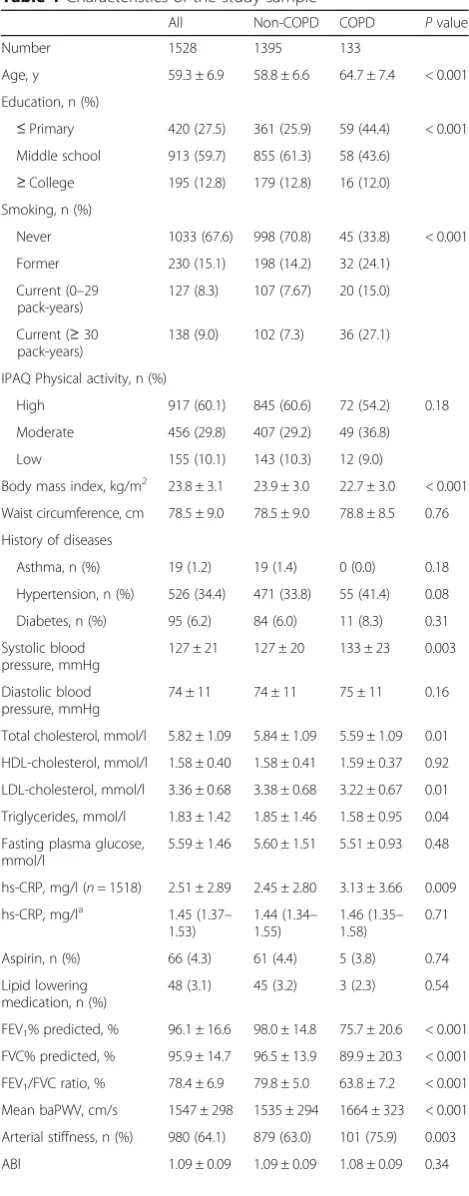
Of 1996 participants in GBCS-CVD, 1528 (76.6%) participants with valid data were included in this analysis. Their mean age was 59.3 years (standard deviation, 6.9). Half of the participants were women (50.7%), 64.1% had arterial stiffness, and 1.9% had PAD. 133 (9.2%) participants had obstructive COPD and 154 (10.1%) had restrictive respiratory pattern. Table 1 shows that compared with participants with-out COPD, those with COPD were older, had lower education and more smokers. They also had lower BMI, cholesterol and pulmonary function, higher blood pressure and baPWV, and higher prevalence of arterial stiffness and PAD, but the differences of his-tory of asthma (based on reporting a doctor diagno-sis of the condition), hypertension and diabetes, medication, physical activity level and ABI were non-significant.
Table 2 shows that baPWV was significantly inversely associated with all pulmonary function indicators (Crude βranged from −3.02 to −5.87,p< 0.001) in simple lin-ear regression models. After adjusting for age, sex, edu-cation, smoking, physical activity, waist circumference, diastolic blood pressure, triglycerides, fasting plasma glucose, COPD, asthma and medications (aspirin and/or lipid lowering medication), the inverse association of baPWV with FEV1% predicted (adjustedβ-0.95, 95% CI
-1.70 to −0.20) and FVC % predicted (adjusted β-1.16, 95% CI -1.98 to−0.35) remained significant, and that of FEV1 /FVC ratio became non-significant (p= 0.91). For
ABI, significantly positive association was found for FEV1% predicted (β= 0.03,p= 0.045) but not FVC%
pre-dicted (β= 0.03,p= 0.06) and FEV1/FVC ratio (β= 0.02,
p= 0.54). After similar adjustment, those associations became non-significant (adjusted β 0.02, 0.02 and− 0.005, allpvalues > 0.05).
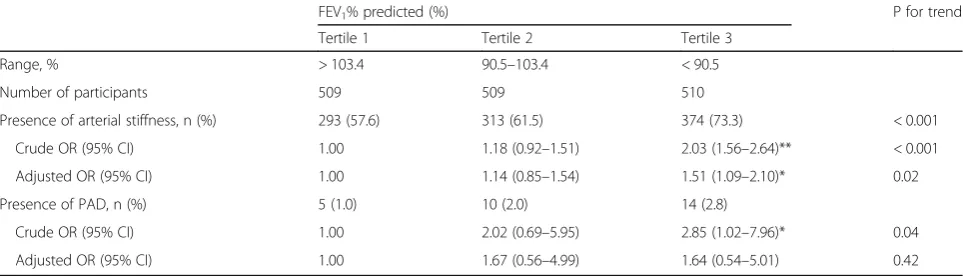
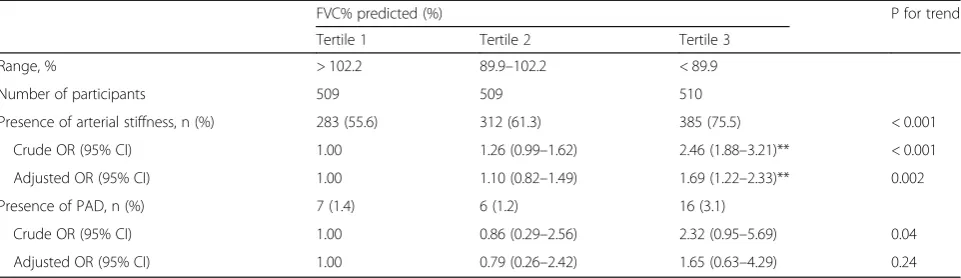
Compared with participants in the highest tertile, those in the lowest tertile of pulmonary function showed a higher risk of arterial stiffness (adjusted odd ratio (AOR) 1.51, 95% CI 1.09–2.10 for FEV1%
pre-dicted and AOR 1.69, 95% CI 1.22–2.33 for FVC% predicted) (Table 3 and Table 4). The AOR of lowest tertile of pulmonary function with higher risk of lower ABI was statistically non-significant (AOR 1.64, 95% CI 0.54–5.01 for FEV1% predicted and AOR 1.65,
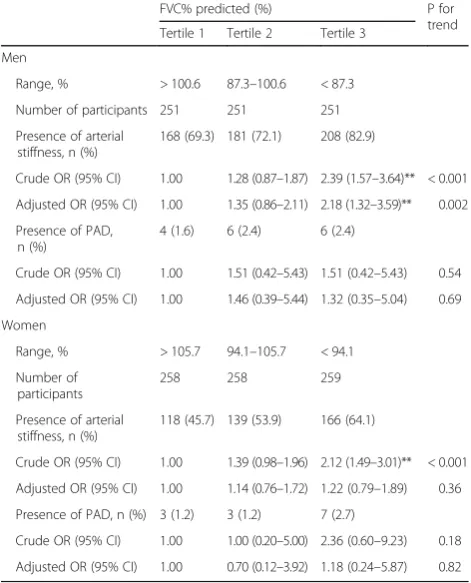
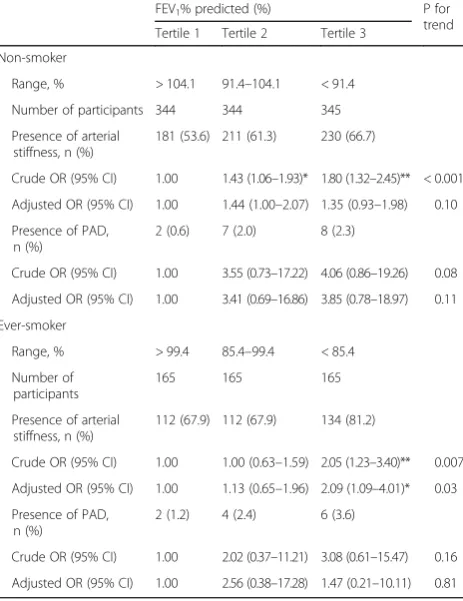
instead of PAD (P values for trend > 0.05). Stratified analysis by sex (Appendix 1 Table 5 and (Appendix 2 Table 6) and by smoking status (Appendix 3Table 7 and Appendix 4Table 8) showed similar tendencies. Sensi-tivity analysis of the relationship between pulmonary function and the maximal values of left and right baPWV showed similar results with the means of left and right baPWV (data not shown).
Discussion
Our study was the first population-based study on older rela-tively healthy and normal weight Chinese with comprehensive adjustment for many potential confounders showing that pul-monary function was inversely dose-dependently associated with arterial stiffness, while the association with PAD was much weaker. Furthermore, we found no evidence that the association varied by sex or smoking status.
Our study suggests reduced pulmonary function might in-crease risk of cardiovascular disease through actions on ar-terial stiffness in general population. Several hospital-based studies showed an inverse association between arterial stiff-ness and pulmonary function [5,6,12,13,22] despite small sample size (n< 250). The COSYCONET study found that 8.8% of patients with COPD had PAD, compared to only 1.8% in age- and sex-matched control subjects without COPD [3]. Our findings are consistent with a few earlier population-based studies, including the Atherosclerosis Risk in Communities (ARIC) Study (n= 14,000) [21], the Nagahama Study (n= 8790) [4], the Whitehall II Study (n= 5392) [8], the Copenhagen City Heart Study (n= 3374) [7], the Caerphilly Prospective Study (n= 827) [9], the“Men born in 1914”cohort (n= 207) [32] and the Burden of Lung Disease (BOLD) study (n= 108) [10], which were pre-dominantly conducted in Caucasian populations. PWV [4, 8–10], ABI [21, 32] and aortic augmentation index (AIx) [14] were used as indicators for vascular func-tion in these studies. ABI indicates PAD, while PWV indicates arterial stiffness. The combination of both should provide more comprehensive information of Table 1Characteristics of the study sample
All Non-COPD COPD Pvalue
Number 1528 1395 133
Age, y 59.3 ± 6.9 58.8 ± 6.6 64.7 ± 7.4 < 0.001
Education, n (%)
≤Primary 420 (27.5) 361 (25.9) 59 (44.4) < 0.001 Middle school 913 (59.7) 855 (61.3) 58 (43.6)
≥College 195 (12.8) 179 (12.8) 16 (12.0) Smoking, n (%)
Never 1033 (67.6) 998 (70.8) 45 (33.8) < 0.001
Former 230 (15.1) 198 (14.2) 32 (24.1)
Current (0–29 pack-years)
127 (8.3) 107 (7.67) 20 (15.0)
Current (≥30 pack-years)
138 (9.0) 102 (7.3) 36 (27.1)
IPAQ Physical activity, n (%)
High 917 (60.1) 845 (60.6) 72 (54.2) 0.18
Moderate 456 (29.8) 407 (29.2) 49 (36.8)
Low 155 (10.1) 143 (10.3) 12 (9.0)
Body mass index, kg/m2 23.8 ± 3.1 23.9 ± 3.0 22.7 ± 3.0 < 0.001
Waist circumference, cm 78.5 ± 9.0 78.5 ± 9.0 78.8 ± 8.5 0.76
History of diseases
Asthma, n (%) 19 (1.2) 19 (1.4) 0 (0.0) 0.18
Hypertension, n (%) 526 (34.4) 471 (33.8) 55 (41.4) 0.08
Diabetes, n (%) 95 (6.2) 84 (6.0) 11 (8.3) 0.31
Systolic blood pressure, mmHg
127 ± 21 127 ± 20 133 ± 23 0.003
Diastolic blood pressure, mmHg
74 ± 11 74 ± 11 75 ± 11 0.16
Total cholesterol, mmol/l 5.82 ± 1.09 5.84 ± 1.09 5.59 ± 1.09 0.01
HDL-cholesterol, mmol/l 1.58 ± 0.40 1.58 ± 0.41 1.59 ± 0.37 0.92
LDL-cholesterol, mmol/l 3.36 ± 0.68 3.38 ± 0.68 3.22 ± 0.67 0.01
Triglycerides, mmol/l 1.83 ± 1.42 1.85 ± 1.46 1.58 ± 0.95 0.04
Fasting plasma glucose, mmol/l
5.59 ± 1.46 5.60 ± 1.51 5.51 ± 0.93 0.48
hs-CRP, mg/l (n= 1518) 2.51 ± 2.89 2.45 ± 2.80 3.13 ± 3.66 0.009
hs-CRP, mg/la 1.45 (1.37– 1.53)
1.44 (1.34– 1.55)
1.46 (1.35– 1.58)
0.71
Aspirin, n (%) 66 (4.3) 61 (4.4) 5 (3.8) 0.74
Lipid lowering medication, n (%)
48 (3.1) 45 (3.2) 3 (2.3) 0.54
FEV1% predicted, % 96.1 ± 16.6 98.0 ± 14.8 75.7 ± 20.6 < 0.001
FVC% predicted, % 95.9 ± 14.7 96.5 ± 13.9 89.9 ± 20.3 < 0.001
FEV1/FVC ratio, % 78.4 ± 6.9 79.8 ± 5.0 63.8 ± 7.2 < 0.001
Mean baPWV, cm/s 1547 ± 298 1535 ± 294 1664 ± 323 < 0.001
Arterial stiffness, n (%) 980 (64.1) 879 (63.0) 101 (75.9) 0.003
ABI 1.09 ± 0.09 1.09 ± 0.09 1.08 ± 0.09 0.34
Table 1Characteristics of the study sample(Continued)
All Non-COPD COPD Pvalue
PAD, n (%) 29 (1.9) 23 (1.7) 6 (4.5) 0.02
Results shown as mean ± standard deviation or number (%)
aResults shown as geometric mean and 95% confidence interval
IPAQInternational Physical Activity Questionnaire,COPDchronic obstructive pulmonary disease,HDLhigh density lipoprotein,LDLlow density lipoprotein,hs-CRPhigh-sensitivity C-reactive protein,FEV1forced expiratory
volume in 1 s,FVCforced vital capacity,baPWVbrachial-ankle pulse wave velocity,ABI
ankle-brachial index,PADperipheral arterial disease; COPD: FEV1/FVC < 0.70
Asthma: self-reported doctor-diagnosed asthma
Hypertension: systolic blood pressure (SBP)≥140 mmHg, diastolic blood pressure≥90 mmHg, or self-reported use of antihypertensive medication Diabetes: fasting glucose≥7.0 mmol/L and/or self-reported DM Arterial stiffness: baPWV≥1400 cm/s
peripheral vascular function, but none of the former studies explored both indices. Hence our study is the first showing that poorer pulmonary function was as-sociated with arterial stiffness, while the association with PAD was much weaker. Our findings are in line with our former research based on the same partici-pants: pulmonary function was significantly associated with common carotid artery intima-media thickness (IMT), but the association between pulmonary function and carotid plaque was marginally non-significant [26].
The association may result from common risk factors, confounders, or mediators such as age, BMI, physical activ-ity, smoking, hyperglycemia, dyslipidemia and inflammation [4,8,11]. Some, such as age, sex, and BMI were adjusted for in most studies [4–6, 8, 10–14], whereas others such as blood pressure, smoking status, physical activity, inflamma-tion and lipids were not, probably because of the lack of data [4,9,10]. Most of the studies found that the association could not be explained by the confounding factors [5, 8]. However, in two studies [11, 12], after adjusting for
potential confounders, no difference in vascular dysfunction was found with pulmonary function, possibly due to the additional adjustment for blood pressure not performed by other studies, and the relatively small sample size (533 sub-jects with normal and 145 with abnormal PWV) [11].
Only a few studies conducted subgroup analysis by sex [14] or smoking status [4]. The Copenhagen City Heart Study showed that the association between AIx and FEV1
was significant in both men and women [14], which was in concordance with two other studies involving men only [7,9]. Elevated cardiovascular morbidity after menopause in women might be due to the decreased secretion of es-trogen which can protect cardiovascular system [33]. The risks of vascular disease were similar in both sexes in elder populations [34], so were the risks of vascular dysfunction in both sexes in our older Chinese cohort. This might be the explanation for the absence of sex interaction. Smok-ing was reported as an important risk factor for both vas-cular disease and poorer pulmonary function. In the Nagahama Study, airflow limitation was associated with Table 2Association (regression coefficientβ, 95% confidence interval) of pulmonary function with baPWV and ABI in all participants
Unadjustedβ (95% CI)
P Adjustedβ
(95% CI)
P
baPWV (dependent variable)
FEV1% predicted −3.02 (−3.91 to−2.13) < 0.001 −0.95 (−1.70 to−0.20) 0.01
FVC% predicted −4.34 (−5.34 to−3.35) < 0.001 −1.16 (−1.98 to−0.35) 0.005
FEV1/FVC ratio −5.87 (−8.02 to−3.71) < 0.001 0.53 (−1.27 to 2.33) 0.91
ABI (dependent variable)
FEV1% predicted 0.03 (0.001 to 0.05) 0.045 0.02 (−0.01 to 0.04) 0.32
FVC% predicted 0.03 (−0.002 to 0.06) 0.06 0.02 (−0.01 to 0.05) 0.18
FEV1/FVC ratio 0.02 (−0.04 to 0.08) 0.54 −0.005 (−0.10 to 0.09) 0.92
baPWVbrachial-ankle pulse wave velocity (greater variables indicate greater stiffness),ABIankle-brachial index (lower variables indicate greater stiffness),
FEV1forced expiratory volume in 1 s,FVCforced vital capacity
Adjusted for age, sex, education, smoking, physical activity, waist circumference, diastolic blood pressure, triglycerides, fasting plasma glucose, chronic obstructive pulmonary disease, asthma and medications (aspirin and/or lipid lowering medication)
Table 3Adjusted odds ratios (ORs) for the presence of peripheral vascular dysfunction by tertiles of FEV1% predicted
FEV1% predicted (%) P for trend
Tertile 1 Tertile 2 Tertile 3
Range, % > 103.4 90.5–103.4 < 90.5
Number of participants 509 509 510
Presence of arterial stiffness, n (%) 293 (57.6) 313 (61.5) 374 (73.3) < 0.001
Crude OR (95% CI) 1.00 1.18 (0.92–1.51) 2.03 (1.56–2.64)** < 0.001
Adjusted OR (95% CI) 1.00 1.14 (0.85–1.54) 1.51 (1.09–2.10)* 0.02
Presence of PAD, n (%) 5 (1.0) 10 (2.0) 14 (2.8)
Crude OR (95% CI) 1.00 2.02 (0.69–5.95) 2.85 (1.02–7.96)* 0.04
Adjusted OR (95% CI) 1.00 1.67 (0.56–4.99) 1.64 (0.54–5.01) 0.42
FEV1forced expiratory volume in 1 s,PADperipheral arterial disease
Adjusted for age, sex, education, smoking, physical activity, waist circumference, diastolic blood pressure, triglycerides, fasting plasma glucose, chronic obstructive pulmonary disease, asthma and medications (aspirin and/or lipid lowering medication)
Arterial stiffness: brachial-ankle pulse wave velocity (baPWV)≥1400 cm/s PAD: ankle-brachial index (ABI) < 0.9
baPWV in smokers, but not in non-smokers [4]. But in a relative healthy population, there might be some under-lying mechanisms (aging [35, 36], parallel physiological pathways for elastic changes [37] and inflammatory re-sponses [37]) which could have stronger impacts for the association between lower pulmonary function and per-ipheral vascular dysfunction than smoking. In summary, our results are consistent with the results elsewhere and can add to the literature by showing that poor pulmonary function is independently associated with a higher risk of peripheral vascular dysfunction regardless of sex and smoking in an older Chinese population.
The underlying mechanisms for the findings are not fully understood. There are some possible explanations. Aging is known to influence both vascular (due to the aging-related influence on the nonliving elastic fibers of the arterial wall) [35] and pulmonary function (due to the aging-related de-crease in the static elastic recoil of the lung and compliance of the chest wall, and in the strength of respiratory muscles) [36]. However, the present study found independent associ-ations after adjusting for multiple confounders including age. These findings indicate that other mechanisms instead of aging contributed to the associations. Parallel physio-logical pathways for elastic changes in the vasculature and lung parenchyma tissue might be the link of the parallel declines in arterial elasticity and lung function [12,37,38]. Matrix metalloprotease (MMP)-9 and tissue inhibitor of metalloproteinase-1 (TIMP-1) which were reported to be associated with arterial stiffness [39] were higher in patients with emphysema [40] and COPD [41]. Alteration in elas-tase or MMP due to genetic or proteolytic process might influence both the connective tissue of the alveoli and arter-ial wall, and reduce their elasticity [37]. Previous studies have shown that arterial stiffness is associated with severity of emphysema, independently of airflow obstruction [12, 38]. This is hypothesised to be due to a common
pathophysiological process, with elastin degradation affect-ing both alveolar and arterial walls [42]. In our cohort, al-though we were not able to assess emphysema using imaging or other measures, the participants with COPD were almost all lean, consistent with an emphysematous or
“pink puffer” phenotype. Another mechanism might be in-flammatory responses, which play important roles in both vascular and respiratory system [37]. However, the BOLD study analysed the association of pulmonary function with arterial stiffness and inflammatory biomarkers including C-reactive protein, interleukin 8, tumour necrosis factor alpha, MMP-9, and tissue inhibitor of metalloproteinase 1, but found no significant association even before adjust-ments of age, sex, height, ethnicity, BMI, smoking status and pack-years [10], suggesting inflammation could not fully explain the results.
There were several limitations in our study. First, because of the cross-sectional design, whether the associations be-tween pulmonary function and peripheral vascular dysfunc-tion are causal could not be ascertained. Second, we did not perform post-bronchodilator spirometry, although all earlier population-based studies were also based on pbronchodilator measurements only. In addition, we re-lied on airway obstruction to define COPD, with no de-tailed measurements (e.g. CT scan, body plethysmography and diffusion capacity of the lung for carbon monoxide) to differentiate phenotypes. We were therefore not able to examine whether any association differed by phenotype. However, if such measurements would reveal more lung abnormalities in subjects with better pulmonary function, the strength of our observed association between pulmon-ary function and peripheral vascular function could have been under-estimated. Fourth, some of the confounders could also be mediators, such as BMI and physical activity, and the multivariate adjustment could have led to an underestimation of the true effect size. However, it is Table 4Adjusted odds ratios (ORs) for the presence of peripheral vascular dysfunction by tertiles of FVC% predicted
FVC% predicted (%) P for trend
Tertile 1 Tertile 2 Tertile 3
Range, % > 102.2 89.9–102.2 < 89.9
Number of participants 509 509 510
Presence of arterial stiffness, n (%) 283 (55.6) 312 (61.3) 385 (75.5) < 0.001
Crude OR (95% CI) 1.00 1.26 (0.99–1.62) 2.46 (1.88–3.21)** < 0.001
Adjusted OR (95% CI) 1.00 1.10 (0.82–1.49) 1.69 (1.22–2.33)** 0.002
Presence of PAD, n (%) 7 (1.4) 6 (1.2) 16 (3.1)
Crude OR (95% CI) 1.00 0.86 (0.29–2.56) 2.32 (0.95–5.69) 0.04
Adjusted OR (95% CI) 1.00 0.79 (0.26–2.42) 1.65 (0.63–4.29) 0.24
FVCforced vital capacity,PADperipheral arterial disease
Adjusted for age, sex, education, smoking, physical activity, waist circumference, diastolic blood pressure, triglycerides, fasting plasma glucose, chronic obstructive pulmonary disease, asthma and medications (aspirin and/or lipid lowering medication)
Arterial stiffness: brachial-ankle pulse wave velocity (baPWV)≥1400 cm/s PAD: ankle-brachial index (ABI) < 0.9
impossible to completely distinguish mediating and con-founding effects in our analysis. Finally, our sample size might not be sufficient to detect small interaction effects.
Conclusions
Pulmonary function was inversely dose-dependently associ-ated with arterial stiffness in older relatively healthy and normal weight Chinese individuals after adjusting for mul-tiple potential confounders, while the association with PAD was much weaker. Furthermore, the association did not vary by sex and smoking. This paper might provide more information in the field of cardiovascular-pulmonary inter-actions. Further intervention studies examining the effect of improving pulmonary function on improving vas-cular function are warranted. Non-invasive measure-ments of vascular dysfunction in individuals with poor pulmonary function or vice versa might help to identify those with both conditions and who need special clinical management.
Appendix 1
Table 5Adjusted odds ratios (ORs) for the presence of peripheral vascular dysfunction by tertiles of FEV1% predicted and by sex
FEV1% predicted (%) P for trend Tertile 1 Tertile 2 Tertile 3
Men
Range, % > 101.5 87.0–101.5 < 87.0
Number of participants 251 251 251
Presence of arterial stiffness, n (%)
174 (69.3) 181 (72.1) 202 (80.5)
Crude OR (95% CI) 1.00 1.14 (0.78–1.68) 1.82 (1.21–2.75)** 0.005
Adjusted OR (95% CI) 1.00 1.20 (0.77–1.89) 1.75 (1.05–2.92)* 0.03
Presence of PAD, n (%) 4 (1.6) 5 (2.0) 7 (2.8)
Crude OR (95% CI) 1.00 1.26 (0.33–4.73) 1.77 (0.51–6.13) 0.36
Adjusted OR (95% CI) 1.00 1.18 (0.31–4.57) 1.61 (0.42–6.16) 0.48
Women
Range, % > 105.7 94.1–105.7 < 94.1
Number of participants 258 258 259
Presence of arterial stiffness, n (%)
120 (46.5) 150 (58.1) 153 (59.1)
Crude OR (95% CI) 1.00 1.60 (1.13–2.26)** 1.66 (1.17–2.35)** 0.004
Adjusted OR (95% CI) 1.00 1.50 (0.99–2.27) 1.28 (0.83–1.96) 0.25
Presence of PAD, n (%) 2 (0.8) 3 (1.2) 8 (3.1)
Crude OR (95% CI) 1.00 1.51 (0.25–9.09) 4.08 (0.86–19.40) 0.05
Adjusted OR (95% CI) 1.00 1.08 (0.17–7.12) 1.62 (0.27–9.67) 0.56
FEV1forced expiratory volume in 1 s,PADperipheral arterial disease Adjusted for age, education, smoking, physical activity, waist circumference, diastolic blood pressure, triglycerides, fasting plasma glucose, chronic obstructive pulmonary disease, asthma and medications (aspirin and/or lipid lowering medication)
Arterial stiffness: brachial-ankle pulse wave velocity (baPWV)≥1400 cm/s PAD: ankle-brachial index (ABI) < 0.9
P for sex interaction: (1) Arterial stiffness: 0.99; (2) PAD: 0.27 *:P< 0.05; **:P< 0.01
Appendix 2
Table 6Adjusted odds ratios (ORs) for the presence of peripheral vascular dysfunction by tertiles of FVC% predicted and by sex
FVC% predicted (%) P for trend Tertile 1 Tertile 2 Tertile 3
Men
Range, % > 100.6 87.3–100.6 < 87.3
Number of participants 251 251 251
Presence of arterial stiffness, n (%)
168 (69.3) 181 (72.1) 208 (82.9)
Crude OR (95% CI) 1.00 1.28 (0.87–1.87) 2.39 (1.57–3.64)** < 0.001
Adjusted OR (95% CI) 1.00 1.35 (0.86–2.11) 2.18 (1.32–3.59)** 0.002
Presence of PAD, n (%)
4 (1.6) 6 (2.4) 6 (2.4)
Crude OR (95% CI) 1.00 1.51 (0.42–5.43) 1.51 (0.42–5.43) 0.54
Adjusted OR (95% CI) 1.00 1.46 (0.39–5.44) 1.32 (0.35–5.04) 0.69
Women
Range, % > 105.7 94.1–105.7 < 94.1
Number of participants
258 258 259
Presence of arterial stiffness, n (%)
118 (45.7) 139 (53.9) 166 (64.1)
Crude OR (95% CI) 1.00 1.39 (0.98–1.96) 2.12 (1.49–3.01)** < 0.001
Adjusted OR (95% CI) 1.00 1.14 (0.76–1.72) 1.22 (0.79–1.89) 0.36
Presence of PAD, n (%) 3 (1.2) 3 (1.2) 7 (2.7)
Crude OR (95% CI) 1.00 1.00 (0.20–5.00) 2.36 (0.60–9.23) 0.18
Adjusted OR (95% CI) 1.00 0.70 (0.12–3.92) 1.18 (0.24–5.87) 0.82
FVCforced vital capacity,PADperipheral arterial disease
Adjusted for age, education, smoking, physical activity, waist circumference, diastolic blood pressure, triglycerides, fasting plasma glucose, chronic obstructive pulmonary disease, asthma and medications (aspirin and/or lipid lowering medication)
Arterial stiffness: brachial-ankle pulse wave velocity (baPWV)≥1400 cm/s PAD: ankle-brachial index (ABI) < 0.9
Abbreviations
ABI:Ankle brachial index; AIx: Aortic augmentation index; ARIC: Atherosclerosis Risk in Communities; baPWV: Brachial-ankle pulse wave velocity; BMI: Body mass index; BOLD: Burden of Lung Disease; CI: Confidence interval; COPD: Chronic obstructive pulmonary disease; COSYCONET: German COPD and Systemic Consequences-Comorbidities Network cohort; CVD: Cardiovascular Subcohort; DBP: Diastolic blood pressure; DM: Diabetes mellitus; FEV1: Forced expiratory volume in 1 s; FVC: Forced vital capacity; GBCS: Guangzhou Biobank Cohort Study; hs-CRP: High-sensitivity C-reactive protein; IPAQ: International Physical Activity Questionnaire; MMP: Matrix metalloprotease; OR: Odd ratio; PAD: Peripheral artery disease; SBP: Systolic blood pressure; TIMP-1: Tissue inhibitor of metalloproteinase-1
Acknowledgements
The authors would like to thank all the study volunteers for their contribution. We acknowledge all investigators of the GBCS-CVD group.
The Guangzhou Biobank Cohort Study-CVD investigators included: the Guangzhou No. 12 Hospital: JM Lin, XJ Yue, CQ Jiang (Co-PI); The University of Hong Kong: B Cheung, TH Lam; The Chinese University of Hong Kong: B Tomlinson, KS Wong; The University of Birmingham: GN Thomas (Co-PI).
Appendix 3
Table 7Adjusted odds ratios (ORs) for the presence of peripheral vascular dysfunction by tertiles of FEV1% predicted and by smoking
FEV1% predicted (%) P for trend Tertile 1 Tertile 2 Tertile 3
Non-smoker
Range, % > 104.1 91.4–104.1 < 91.4
Number of participants 344 344 345
Presence of arterial stiffness, n (%)
181 (53.6) 211 (61.3) 230 (66.7)
Crude OR (95% CI) 1.00 1.43 (1.06–1.93)* 1.80 (1.32–2.45)** < 0.001
Adjusted OR (95% CI) 1.00 1.44 (1.00–2.07) 1.35 (0.93–1.98) 0.10
Presence of PAD, n (%)
2 (0.6) 7 (2.0) 8 (2.3)
Crude OR (95% CI) 1.00 3.55 (0.73–17.22) 4.06 (0.86–19.26) 0.08
Adjusted OR (95% CI) 1.00 3.41 (0.69–16.86) 3.85 (0.78–18.97) 0.11
Ever-smoker
Range, % > 99.4 85.4–99.4 < 85.4
Number of participants
165 165 165
Presence of arterial stiffness, n (%)
112 (67.9) 112 (67.9) 134 (81.2)
Crude OR (95% CI) 1.00 1.00 (0.63–1.59) 2.05 (1.23–3.40)** 0.007
Adjusted OR (95% CI) 1.00 1.13 (0.65–1.96) 2.09 (1.09–4.01)* 0.03
Presence of PAD, n (%)
2 (1.2) 4 (2.4) 6 (3.6)
Crude OR (95% CI) 1.00 2.02 (0.37–11.21) 3.08 (0.61–15.47) 0.16
Adjusted OR (95% CI) 1.00 2.56 (0.38–17.28) 1.47 (0.21–10.11) 0.81
FEV1forced expiratory volume in 1 s,PADperipheral arterial disease Adjusted for age, sex, education, physical activity, waist circumference, diastolic blood pressure, triglycerides, fasting plasma glucose, chronic obstructive pulmonary disease, asthma and medications (aspirin and/or lipid lowering medication)
Arterial stiffness: brachial-ankle pulse wave velocity (baPWV)≥1400 cm/s PAD: ankle-brachial index (ABI) < 0.9
P for smoking interaction: (1) Arterial stiffness: 0.50; (2) PAD: 0.69 *:P< 0.05; **:P< 0.01
Appendix 4
Table 8Adjusted odds ratios (ORs) for the presence of peripheral vascular dysfunction by tertiles of FVC% predicted and by smoking
FVC% predicted (%) P for trend Tertile 1 Tertile 2 Tertile 3
Non-smoker
Range, % > 102.6 90.8–102.6 < 90.8
Number of participants 344 344 345
Presence of arterial stiffness, n (%)
176 (51.2) 204 (59.3) 242 (70.1)
Crude OR (95% CI) 1.00 1.39 (1.03–1.88)* 2.24 (1.64–3.07)** < 0.001
Adjusted OR (95% CI) 1.00 1.17 (0.82–1.68) 1.37 (0.94–2.01) 0.10
Presence of PAD, n (%)
4 (1.2) 4 (1.2) 9 (2.6)
Crude OR (95% CI) 1.00 1.00 (0.25–4.03) 2.23 (0.77–6.49) 0.14
Adjusted OR (95% CI) 1.00 0.91 (0.22–3.78) 2.09 (0.61–7.24) 0.20
Ever-smoker
Range, % > 100.0 87.0–100.0 < 87.0
Number of participants 165 165 165
Presence of arterial stiffness, n (%)
109 (66.1) 115 (69.7) 134 (81.2)
Crude OR (95% CI) 1.00 1.18 (0.74–1.88) 2.22 (1.34–3.68)* 0.002
Adjusted OR (95% CI) 1.00 1.07 (0.61–1.87) 1.98 (1.08–3.61)* 0.03
Presence of PAD, n (%)
3 (1.8) 3 (1.8) 6 (3.6)
Crude OR (95% CI) 1.00 1.00 (0.20–5.03) 2.04 (0.50–8.29) 0.29
Adjusted OR (95% CI) 1.00 1.19 (0.22–6.54) 1.10 (0.23–5.05) 0.91
FVCforced vital capacity,PADperipheral arterial disease
Adjusted for age, sex, education, physical activity, waist circumference, diastolic blood pressure, triglycerides, fasting plasma glucose, chronic obstructive pulmonary disease, asthma and medications (aspirin and/or lipid lowering medication)
Arterial stiffness: brachial-ankle pulse wave velocity (baPWV)≥1400 cm/s PAD: ankle-brachial index (ABI) < 0.9
Funding
This work was supported by the National Key R&D Program of China (2017YFC0907100), the Guangdong Provincial Medical Science Research Fundation, Guangdong, China (A2018141), the Guangdong Provincial Natural Science Foundation, Guangdong, China (2015A030313891). The Guangzhou Biobank Cohort Study (GBCS) Cardiovascular Disease Sub-study was funded by an NSFC/RGC (No. 30518001; HKU720/05) grant. The GBCS was funded by the University of Hong Kong Foundation for Educational Development and Research, Hong Kong; the Guangzhou Public Health Bureau and the Guangzhou Science and Technology Bureau, Guangzhou, China; and The University of Birmingham, UK.
Availability of data and materials
The datasets used and/or analysed during the current study available from the corresponding author on reasonable request.
Authors’contributions
JP performed the statistical analysis and drafted the manuscript. LX participated in the statistical analysis and helped to draft the manuscript. THL, CQJ, KKC, NT and PA conceived of the study, and participated in its design and coordination and helped to draft the manuscript. WSZ, FZ and YLJ carried out the data collection and quality control of the database, and helped to draft the manuscript. All authors read and approved the final manuscript.
Ethics approval and consent to participate
The Guangzhou Medical Ethics Committee of the Chinese Medical Association approved the study and all participants gave written, informed consent before participation.
Competing interests
The authors declare that they have no competing interests.
Publisher’s Note
Springer Nature remains neutral with regard to jurisdictional claims in published maps and institutional affiliations.
Author details
1Guangzhou No.12 Hospital, Guangzhou, Guangdong, China.2School of
Public Health, Sun Yat-sen University, Guangzhou, Guangdong, China.
3School of Public Health, The University of Hong Kong, Hong Kong, China. 4
Institute of Applied Health Research, University of Birmingham, Birmingham, UK.
Received: 5 March 2018 Accepted: 11 May 2018
References
1. Moran AE, Forouzanfar MH, Roth GA, Mensah GA, Ezzati M, Murray CJ, Naghavi M. Temporal trends in ischemic heart disease mortality in 21 world regions, 1980 to 2010: the global burden of disease 2010 study. Circulation. 2014;129(14):1483–92.
2. Schunemann HJ, Dorn J, Grant BJ, Winkelstein W Jr, Trevisan M. Pulmonary function is a long-term predictor of mortality in the general population: 29-year follow-up of the buffalo health study. Chest. 2000;118(3):656–64. 3. Houben-Wilke S, Jorres RA, Bals R, Franssen FM, Glaser S, Holle R, Karch A,
Koch A, Magnussen H, Obst A, et al. Peripheral artery disease and its clinical relevance in patients with chronic obstructive pulmonary disease in the COPD and systemic consequences-comorbidities network study. Am J Respir Crit Care Med. 2017;195(2):189–97.
4. Tabara Y, Muro S, Takahashi Y, Setoh K, Kawaguchi T, Terao C, Kosugi S, Sekine A, Yamada R, Nakayama T, et al. Airflow limitation in smokers is associated with arterial stiffness: the Nagahama study. Atherosclerosis. 2014;232(1):59–64.
5. Sun WX, Jin D, Li Y, Wang RT. Increased arterial stiffness in stable and severe asthma. Respir Med. 2014;108(1):57–62.
6. Sabit R, Bolton CE, Edwards PH, Pettit RJ, Evans WD, McEniery CM, Wilkinson IB, Cockcroft JR, Shale DJ. Arterial stiffness and osteoporosis in chronic obstructive pulmonary disease. Am J Respir Crit Care Med. 2007;175(12):1259–65.
7. Zureik M, Benetos A, Neukirch C, Courbon D, Bean K. Reduced pulmonary function is associated with central arterial stiffness in men. Am J Respir Crit Care Med. 2001;164:2181–5.
8. Brunner EJ, Shipley MJ, Witte DR, Singh-Manoux A, Britton AR, Tabak AG, McEniery CM, Wilkinson IB, Kivimaki M. Arterial stiffness, physical function, and functional limitation: the Whitehall II study. Hypertension. 2011;57(5): 1003–9.
9. Bolton CECJ, Sabit R, Munnery M, McEniery CM, Wilkinson IB. Lung function in mid-life compared with later life is a stronger redictor of arterial stiffness in men: the caerphilly prospective study. Int J Epidemiol. 2009;38(3):867–76. 10. Amaral AF, Patel J, Gnatiuc L, Jones M, Burney PG. Association of pulse wave
velocity with total lung capacity: a cross-sectional analysis of the BOLD London study. Respir Med. 2015;109(12):1569–75.
11. Taneda K, Namekata T, Hughes D, Suzuki K, Knopp R, Ozasa K. Association of lung function with atherosclerotic risk factors among Japanese Americans: Seattle Nikkei health study. Clin Exp Pharmacol Physiol. 2004;31(Suppl 2):S31–4. 12. McAllister DA, Maclay JD, Mills NL, Mair G, Miller J, Anderson D, Newby DE,
Murchison JT, Macnee W. Arterial stiffness is independently associated with emphysema severity in patients with chronic obstructive pulmonary disease. Am J Respir Crit Care Med. 2007;176(12):1208–14.
13. Tarnoki DL, Tarnoki AD, Lazar Z, Medda E, Littvay L, Cotichini R, Fagnani C, Stazi MA, Nistico L, Lucatelli P, et al. Genetic and environmental factors on the relation of lung function and arterial stiffness. Respir Med. 2013;107(6): 927–35.
14. Janner JH, McAllister DA, Godtfredsen NS, Prescott E, Vestbo J. Is chronic obstructive pulmonary disease associated with increased arterial stiffness? Respir Med. 2012;106(3):397–405.
15. Ayer JG, Belousova EG, Harmer JA, Toelle B, Celermajer DS, Marks GB. Lung function is associated with arterial stiffness in children. PLoS One. 2011;6(10): e26303.
16. Aykan AC, Gokdeniz T, Boyaci F, Gul I, Hatem E, Kalaycioglu E, Turan T, Bektas H, Cilingir MB, Aykan DA, et al. Assessment of arterial stiffness in chronic obstructive pulmonary disease by a novel method: cardio-ankle vascular index. Herz. 2014;39(7):822–7.
17. Anderson SG, Sanders TA, Cruickshank JK. Plasma fatty acid composition as a predictor of arterial stiffness and mortality. Hypertension. 2009;53(5):839–45. 18. Blann AD, Kuzniatsova N, Lip GY. Inflammation does not influence arterial
stiffness and pulse-wave velocity in patients with coronary artery disease. J Hum Hypertens. 2013;27(10):629–34.
19. Sirbu E, Buzas R, Mihaescu R, Suceava I, Lighezan D. Influence of exercise training and eating behavior on arterial stiffness in young healthy students. Wiener klinische Wochenschrift. 2015;127(13–14):555–60.
20. Woodard GA, Mehta VG, Mackey RH, Tepper P, Kelsey SF, Newman AB, Sutton-Tyrrell K. C-reactive protein is associated with aortic stiffness in a cohort of African American and white women transitioning through menopause. Menopause. 2011;18(12):1291–7.
21. Schroeder EB, Welch VL, Evans GW, Heiss G. Impaired lung function and subclinical atherosclerosis. The ARIC Study. Atherosclerosis. 2005;180(2):367–73. 22. Masugata H, Senda S, Okada H, Murao K, Inukai M, Himoto T, Hosomi N,
Murakami K, Noma T, Kohno M, et al. Association between arterial stiffness and pulmonary function in hypertensive patients. Hypertens Res. 2012;35(4): 388–92.
23. Jiang C, Thomas GN, Lam TH, Schooling CM, Zhang W, Lao X, Adab P, Liu B, Leung GM, Cheng KK. Cohort profile: the Guangzhou biobank cohort study, a Guangzhou-Hong Kong-Birmingham collaboration. Int J Epidemiol. 2006; 35(4):844–52.
24. Xu L, Jiang CQ, Lam TH, Lin JM, Yue XJ, Cheng KK, Liu B, Jin YL, Zhang WS, Thomas GN, et al. The metabolic syndrome is associated with subclinical atherosclerosis independent of insulin resistance: the Guangzhou biobank cohort study-CVD. Clin Endocrinol. 2010;73(2):181–8.
25. Lam KB, Jordan RE, Jiang CQ, Thomas GN, Miller MR, Zhang WS, Lam TH, Cheng KK, Adab P. Airflow obstruction and metabolic syndrome: the Guangzhou biobank cohort study. Eur Respir J. 2010;35(2):317–23. 26. Pan J, Xu L, Cai SX, Jiang CQ, Cheng KK, Zhao HJ, Zhang WS, Jin YL, Lin JM,
Thomas GN, et al. The association of pulmonary function with carotid atherosclerosis in older Chinese: Guangzhou biobank cohort study-CVD subcohort. Atherosclerosis. 2015;243(2):469–76.
28. Xu L, Jiang CQ, Lam TH, Yue XJ, Cheng KK, Liu B, Jin YL, Zhang WS, Thomas GN. Brachial-ankle pulse wave velocity and cardiovascular risk factors in the non-diabetic and newly diagnosed diabetic Chinese: Guangzhou biobank cohort study-CVD. Diabetes Metab Res Rev. 2010;26(2):133–9.
29. Xu L, Jiang CQ, Lam TH, Cheng KK, Yue XJ, Lin JM, Zhang WS, Thomas GN. Impact of impaired fasting glucose and impaired glucose tolerance on arterial stiffness in an older Chinese population: the Guangzhou biobank cohort study-CVD. Metab Clin Exp. 2010;59(3):367–72.
30. Yamashina A, Tomiyama H, Arai T, Hirose K, Koji Y, Hirayama Y, Yamamoto Y, Hori S. Brachial-ankle pulse wave velocity as a marker of atherosclerotic vascular damage and cardiovascular risk. Hypertens Res. 2003;26(8):615–22. 31. Rooke TW, Hirsch AT, Misra S, Sidawy AN, Beckman JA, Findeiss LK, Golzarian J,
Gornik HL, Halperin JL, Jaff MR, et al. 2011 ACCF/AHA focused update of the guideline for the Management of Patients with Peripheral Artery Disease (updating the 2005 guideline). J Am Coll Cardiol. 2011;58(19):2020–45. 32. Engstrom G, Hedblad B, Valind S, Janzon L. Asymptomatic leg and carotid atherosclerosis in smokers is related to degree of ventilatory capacity: longitudinal and cross-sectional results from 'Men born in 1914’, Sweden. Atherosclerosis. 2001;155(1):237–43.
33. Rosano GM, Vitale C, Marazzi G, Volterrani M. Menopause and cardiovascular disease: the evidence. Climacteric. 2007;10(sup1):19–24.
34. Mosca L, Barrett-Connor E, Wenger NK. Sex/gender differences in cardiovascular disease prevention: what a difference a decade makes. Circulation. 2011;124(19): 2145–54.
35. O'Rourke M. Arterial stiffness, systolic blood pressure, and logical treatment of arterial hypertension. Hypertension. 1990;15(4):339–47.
36. Teramoto S, Matsuse T, Ouchi Y. Physiological changes in respiratory function associated with ageing. Eur Respir J. 1999;13(1):197–205.
37. Duprez DA, Hearst MO, Lutsey PL, Herrington DM, Ouyang P, Barr RG, Bluemke DA, McAllister D, Carr JJ, Jacobs DR Jr. Associations among lung function, arterial elasticity, and circulating endothelial and inflammation markers: the multiethnic study of atherosclerosis. Hypertension. 2013;61(2):542–8. 38. Barr RG, Ahmed FS, Carr JJ, Hoffman EA, Jiang R, Kawut SM, Watson K. Subclinical atherosclerosis, airflow obstruction and emphysema: the MESA lung study. Eur Respir J. 2012;39(4):846.
39. Yasmin, McEniery CM, O'Shaughnessy KM, Harnett P, Arshad A, Wallace S, Maki-Petaja K, McDonnell B, Ashby MJ, Brown J et al: Variation in the human matrix metalloproteinase-9 gene is associated with arterial stiffness in healthy individuals. Arterioscler Thromb Vasc Biol 2006, 26(8):1799–1805.
40. Mao JT, Tashkin DP, Belloni PN, Baileyhealy I, Baratelli F, Roth MD. All-trans retinoic acid modulates the balance of matrix metalloproteinase-9 and tissue inhibitor of metalloproteinase-1 in patients with emphysema. Chest. 2003;124(5):1724–32.
41. Higashimoto Y, Yamagata Y, Iwata T, Okada M, Ishiguchi T, Sato H, Masuda M, Itoh H. Increased serum concentrations of tissue inhibitor of metalloproteinase-1 in COPD patients. Eur Respir J. 2005;25(5):885–90.