513
OPTIMAL TUNING OF PID POWER SYSTEM STABILIZER
FOR MULTI MACHINE POWER SYSTEM USING HARMONY
SEARCH ALGORITHM
1ABDUL HAMEEDKALIFULLAH, 2S.PALANI
1
Research Scholar, Department of EEE, Anna University, Chennai, INDIA
2
Director, Sudharsan Engg.College, Sathyamangalam, INDIA E-mail: 1
ABSTRACT
This paper presents a novel Meta heuristic Harmony Search Algorithm (HSA) to tune optimal gains of a Proportional Integral Derivative (PID) type multiple stabilizers for multi machine power system. The problem of robustly tuning of PID based multiple stabilizer design is formulated as an optimization problem according to the time domain-based objective function which is solved by Harmony Search Algorithm ( HSA) that has a strong ability to find the most optimistic results. To demonstrate the effectiveness and robustness of the proposed stabilizers, the design process takes a wide range of operating conditions and system configuration into account. The effectiveness of the proposed stabilizer is demonstrated through nonlinear simulation studies and some performance indices on a four- machine two areas power system in comparison with the Conventional Power System Stabilizers(CPSS) and PSO based optimized PID type stabilizers (PSO PSS). The results of these studies show that the proposed HSA based optimized PID type stabilizers have an excellent capability in damping power system inter-area oscillations and enhance greatly the dynamic stability of the power system for a wide range of loading conditions. The results obtained using the proposed method are much superior than those obtained by CPSS and PSOPSS based tuned stabilizers in terms of accuracy, convergence and computational effort.
Keywords: Harmony Search Algorithm, Power System Stabilizer, Power System Stability
1. INTRODUCTION
Large electric power systems are complex non-linear systems and often exhibit low frequency electromechanical oscillations due to insufficient damping caused by adverse operating conditions. These oscillations with small magnitude and low frequency often persist for a long period of time and in some cases they even present limitations on power transfer capability (Liu et al., 2005).In analyzing and controlling the power system’s stability, two distinct types of system oscillations are recognized. One is associated with generators at a generating station swinging with respect to the rest of the power system. Such oscillations are referred to as “intra-area mode” oscillations. The second type is associated with swinging of many machines in an area of the system against machines in other areas. This is referred to as “inter-area mode” oscillations. Power system stabilizers (PSS) are used to generate supplementary control signals for the excitation system in order to damp both types of oscillations (Liu et al., 2005). The widely used conventional power system stabilizers
(CPSS) are designed using the theory of phase compensation in the frequency domain and are introduced as a lead-lag compensator. The parameters of CPSS are determined based on the linearized model of the power system. Providing good damping over a wide operating range, the CPSS parameters should be fine tuned in response to both types of oscillations. Since power systems are highly non-linear systems, with configurations and parameters which change through time, the CPSS design based on the linearized model of the power system cannot guarantee its performance in a practical operating environment. Therefore, an adaptive PSS which considers the nonlinear nature of the plant and adapts to the changes in the environment is required for the power system (Liu et al., 2005).
514 [5], Particle Swarm Optimization (PSO) [6], Tabu search [7], Bacterial Foraging Algorithm [16] and simulated annealing (SA) [8] are attracting the attention in the field of PSS parameter optimization in recent times. But when the system has a highly
epistatic objective function (i.e., where the parameters
being optimized are highly correlated) and number of parameters to be optimized are large, GA has been reported to exhibit degraded efficiency [9].To overcome the drawbacks of conventional methods for PSS design, a new optimization scheme known as Harmony Search (HS) is used for the PSS parameter design [10]. This algorithm (HSA) appeared as a promising one for handling the optimization problems. It is a computational intelligence based technique that is not largely affected by the size and nonlinearity of the problem and can converge to the optimal solution in many cases where many analytical methods fail to converge. Considering the strength of this algorithm, it is employed in the present work for the optimal tuning the parameters of the PSS.
In this paper a new/improved HSA-based optimal determination of PID-PSS parameters is presented which overcomes the shortcomings of previous works. In order to design a robust PSS which guarantees stability of system in a wide range of operating conditions, the objective function is defined such that the resultant time response is restricted to lie within specific bounds as well as limiting the amount of overshooting of power system response when subjected to large disturbances. The performance of the HSAPSS is compared with those obtained with other techniques such as conventional and Particle Swarm Optimization (PSO) by plotting the time response curves for the fault
2. POWER SYSTEM MODEL STUDIED
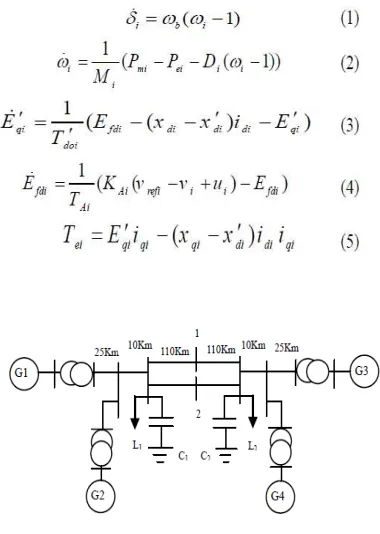
A four-machine, two-area study system, shown in Fig. 1, is considered for the damping controller design. Each area consists of two generator units. The rating of each generator is 900 MVA and 20 kV. Each of the units is connected through transformers to the 230 kV transmission line. There is a power transfer of 400 MW from Area 1 to Area 2. The detailed bus data, line data, and the dynamic characteristics for the machines, exciters, and loads are given in [18]. The loads are modeled as constant impedances. For the power system stability analysis a reasonably accurate mathematical model which takes into account the non linear ties in the system is highly essential. The two-axis model (fourth order) given in [18] is used for the time domain simulations study for each machine. The loads are modeled as constant impedances. A first order model of a static type automatic voltage
[image:2.595.330.520.159.426.2]regulator is used. Nonlinear dynamic equations of the each machine can be summarized as follows:
Figure 1. Single line diagram of two area system
3. PSS STRUCTURE
The operating function of a PID type PSS is to produce a proper torque on the rotor of the machine involved in such a way that the phase lag between the exciter input and the machine electrical torque is compensated. The supplementary stabilizing signal considered is one proportional to speed. A widely used speed based PID is considered throughout the study [16]. The transfer function of the ith PID type stabilizer is given by:
Where, TD<<1 and usually is considered as KD/100. Δωi is the speed deviation of the ith generator and Ui
515 range from 1 to 20 s. This paper attempts to optimize the parameters (Kp, Ki, Kd) of PID-PSS via a music-based metaheuristic optimization algorithm (HSA) inspired by the observation that the aim of music is to search for a perfect state of harmony.
4. PARTICLE SWARM OPTIMIZATION
Particle Swarm Optimization (PSO) is a population based stochastic optimization technique developed by Eberhart and Kennedy [13,14]. It shares many similarities with evolutionary computation techniques such as Genetic Algorithms (GA). The system is initialized with a population of random particles where each particle is a candidate solution. The particles fly through the problem space by following the current optimum particles and searches for optima by updating their positions. However, unlike GA, PSO has no evolution operators such as crossover and mutation. The advantages of PSO over GA are the ease of programming and fast convergence [8, 9]. In the PSO algorithm, each particle updates its velocity and position by the following relationships:
vi k+1=w Vi k+c1rand1 (pbesti - sik)+ c2rand2 (gbesti -sik) (7)
sik+1=sik+vik+1 (8)
where c1 and c2 are cognition and social parameters
respectively, rand1() and rand2() are constant numbers
in the range of [0,1], w is the inertia weight. Vi
represents the velocity of the ith particle and si is its
position, pbesti and gbesti are local best and global
best positions respectively. The velocity of particle in equation (3) depends on its previous velocity, its own thinking and social psychological adaptation of the population. The PSO algorithm starts with random initialization of population and velocity. The search for the optimum solution is continued unless one of the stopping criteria is reached. The stopping criteria are either the maximum iterations are reached or there is no further improvement in the optimal solution. The values of parameters for PSO used in this study are as follows:
No. of particles 20; No. of swarms 12 (Kpi, Kii,
Kdi);No. iteration= 500; Maximum particle velocity
(upper -lower bound) / No. iteration = 0.05;c1,c2 =2, 2; wmax, wmin= 0.9, 0.4.
5. HARMOY SEARCH ALGORITHM(HSA)
Harmony search is a music-based metaheuristic optimization algorithm. It was inspired by the observation that the aim of music is to search for a perfect state of harmony [13, 15]. This harmony in music is analogous to find the optimality in an optimization process. The search process in
optimization can be compared to a jazz musician’s improvisation process. When a musician is improvising, he or she has three possible choices: (1) play any famous piece of music (a series of pitches in harmony) exactly from his or her memory; (2) play something similar to a known piece (thus adjusting the pitch slightly); or (3) compose new or random notes. Zong Woo Geem et al. formalized these three options into quantitative optimization process in 2001, and the three corresponding components become: usage of harmony memory, pitch adjusting, and randomization [10, 13, 15].The usage of harmony memory is important, as it is similar to the choice of the best-fit individuals in genetic algorithms (GA). This will ensure that the best harmonies will be carried over to the new harmony memory. In order to use this memory more effectively, it is typically assigned as a parameter racceptÎ[0,1], called harmony memory
accepting or considering rate. If this rate is too low, only few best harmonies are selected and it may converge too slowly. If this rate is extremely high (near 1), almost all the harmonies are used in the harmony memory, then other harmonies are not explored well, leading to potentially wrong solutions. Therefore, typically, we use raccept=0.7 ~ 0.95.The
second component is the pitch adjustment determined by a pitch bandwidth brange and a pitch adjusting rate rpa [14]. Though in music, pitch adjustment means to change the frequencies, it corresponds to generate a slightly different solution in the Harmony Search algorithm [6]. In theory, the pitch can be adjusted linearly or nonlinearly, but in practice, linear adjustment is used. So we have
xnew= xold + brange* e
where xold is the existing pitch or solution from the
harmony memory, and xnew is the new pitch after the
516 a local search. The use of randomization can drive the system further to explore various diverse solutions so as to find the global optimality.
The three components in harmony search can be summarized as the pseudo code shown below. _____________________________________
Harmony Search
________________________________________
begin
Objective function f(x), x=(x1,x2, …,xd)T
Generate initial harmonics (real number arrays) Define pitch adjusting rate (rpa), pitch limits and bandwidth
Define harmony memory accepting rate (raccept)
while ( t<Max number of iterations )
Generate new harmonics by accepting best harmonics Adjust pitch to get new harmonics (solutions)
if (rand>raccept), choose an existing harmonic
randomly
else if (rand>rpa), adjust the pitch randomly within
limits
else generate new harmonics via randomization
end if
Accept the new harmonics (solutions) if better end while
Find the current best solutions end
________________________________________
In this pseudo code, we see that the probability of randomization is
P random =1−r accept
and the actual probability of adjusting pitches is
P pitch =raccept *rpa
By using the above pseudo code, dedicated software is developed in the MATLAB programming language for the above mentioned problem. The various parameters used in the software implementation of HSA in the present work are listed below:-
Number of decision variables (N):12, Harmony memory size (HMS): 48, Number of improvisations (NI): 500, Harmony Memory Consideration Rate (HMCR): 0.9.
6. HARMOY SEARCH ALGORITHM(HSA)
This section describes how the BFA algorithm is employed to tune the PID type PSS parameters for the two-area multi-machine power system which is shown in Fig. 1. Just like any other optimization problem, an objective function (performance index) needs to be formulated to determine
optimal parameters of multiple PSSs. The optimal values of these parameters depend upon the cost function used for optimization. Each individual in the initial harmony has an associated performance index (PI) value. The performance indices [14] used here are of the following form:
I. The integral of the square of the error criterion (ISE) which is given by
ISE= + )
(9)
II. The integral of time-multiplied absolute value of the error Criterion (ITAE). The criterion penalizes long-duration transients and is much more selective than the ISE. A system designed by use of this criterion exhibits small overshoot and well damped oscillations. It is given by
(10)
III. IAE integrates the absolute error over time. It doesn’t add weight to any of the errors in a systems response. It tends to produce slower response than ISE optimal systems, but usually with less sustained oscillations. It is given by
(11)
(12)
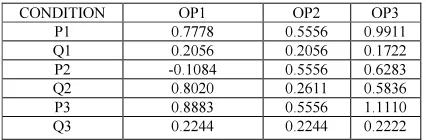
Where, , and ts are mean overshoot , mean settling time of four relative speed deviations. The optimal tuning of the PSS parameters is carried out by evaluating the fitness functions (F) as given in equations (9)-(12) for the operating conditions as given in Table 1 .A 6-cycle three-phase fault is applied at the middle of one of the trans-mission line between bus-7 and bus-8. The fault is cleared by permanent tripping of the faulted line. In this study, the BFA module works offline. For each PSS, the optimal setting of four parameters is determined by the BFA, i.e. 12 parameters are to be optimized.
7. SIMULATION RESULTS AND DISCUSSION
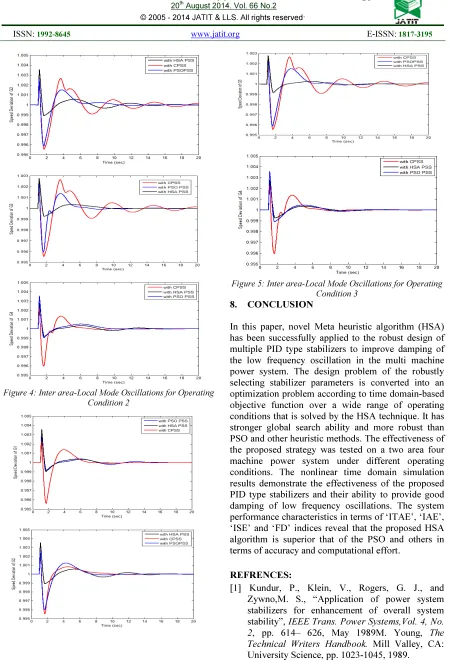
517 above stabilizers for deferent operating conditions [17] as given in Table I is shown in Figs. 3 to 5 respectively. The performance of the HSA based optimized multiple PID type stabilizer is quite prominent in comparison with the other PSSs and the overshoots and settling time are significantly improved with the proposed stabilizer.
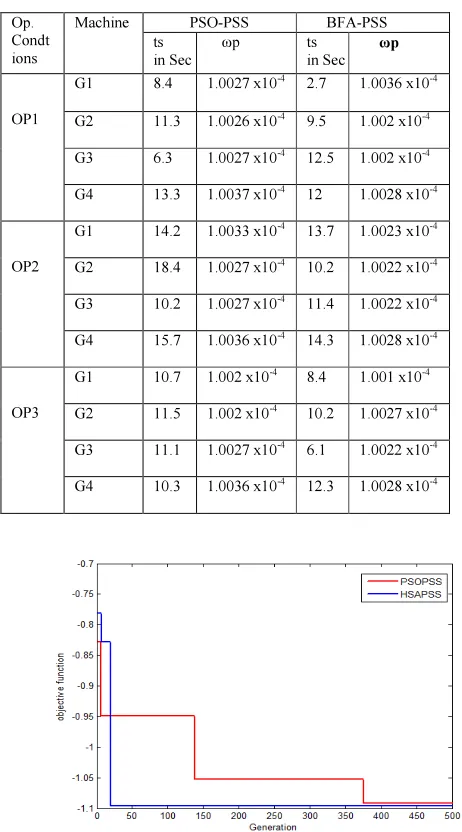
From Fig 3 to 5 and Table-II, it is observed that the performance of the PSS designed using HSA is far superior compared to the PSS designed using conventional as well as Particle Swarm Optimization (PSO).
[image:5.595.320.526.158.593.2]Fig.2.illustrates the convergence of the objective function with Particle Swarm Optimization (PSO) and HSA. From the convergence characteristics it is clear that HSA offers superior performance than PSO.
Table 1: Operating Conditions
CONDITION OP1 OP2 OP3
P1 0.7778 0.5556 0.9911
Q1 0.2056 0.2056 0.1722
P2 -0.1084 0.5556 0.6283
Q2 0.8020 0.2611 0.5836
P3 0.8883 0.5556 1.1110
Q3 0.2244 0.2244 0.2222
Table 2: Performance Indices under Different Operating Conditions
ALGORITHM OP1 OP2 OP3
ITAE IAE ISE
HSA 16.533 12.432 1.2532
26.432 25.561 2.3459
16.437 16.855 1.5671
PSO 20.562 11.349 2.2098
22.560 9.4590 3.4633
17.674 10.354 1.7733
Table 3: Optimal Parameters of PID PSS Under Different Operating Conditions
OPERATING
CONDITIONS PSOPSS HSAPSS
OP1 kp1 =56.7231
kp2 =70.5697 kp3 = 69.9105 kp4 =59.9096 ki1 =27.9889 ki2 =28.0689 ki3 = 15.6781 ki4 =34.4917 kd1 =45.7238 kd2 =34.4192 kd3 =56.5521 kd4 =46.525 kp1 =43.49898 kp2 =85.88287 kp3 = 52.27263 kp4 =49.85963 ki1 =71.75443 ki2 = 36.08533 ki3 =9.040921 ki4 =67.06363 kd1 =133.8218 kd2 =114.9234 kd3 =23.37183 kd4 =92.52788 OP2 kp1 =43.3946 kp2 =29.89948 kp3 =104.3237 kp4 =28.36145 ki1 =79.63496 ki2 =7.396793 ki3 = 15.6781 ki4 =5.43875 kd1 =125.742 kd2 =57.13324 kd3 =35.91021 kd4 =29.71308 kp1 =120.7615 kp2 =27.80057 kp3 = 15.54715 kp4 =96.80758 ki1 =75.88975 ki2 =44.43751 ki3 =64.16639 ki4 =92.11856 kd1 = 114.7058 kd2 =73.02848 kd3 =96.2953 kd4 =44.36207 OP3 kp1 =120.7615 kp2 =27.80057 kp3 =104.3237 kp4 =96.80758 ki1 =75.88975 ki2 =44.43751 ki3 = 64.16639 ki4 =44.36207 kd1 =114.7058 kd2 = 73.02848 kd3 =96.2953 kd4 =92.11856
kp1 =43.43277 kp2 =29.55834 kp3 = 99.83914 kp4 =25.71863 ki1 =79.18229 ki2 = 23.77429 ki3 =5.636135 ki4 =5.363027 kd1 =128.8646 kd2 =57.63613 kd3 =37.50805 kd4 =30.03774
It is merit mentioning that the lower the value of these indices is, the better the system response in terms of the time-domain characteristics. Numerical results of performance robustness for all system loading cases are shown in Table II with three PID type stabilizers by applying a three-phase fault of 100 ms duration at the middle of one of the transmission lines between bus-7 and bus-8.
[image:5.595.89.302.338.408.2]518 machines are greatly reduced with small overshoots, undershoots and shorter settling time. Further, it achieves good robust performance compared to that of stabilizers designed using the PSO and conventional methods.
[image:6.595.69.300.231.647.2]Table 4: Settling time (ts) Maximum Peak overshoots (ωp) Comparison
Figure 2: Convergence Comparison between PSO and HSA
Figure 3: Inter area-Local Mode Oscillations for Operating Condition 1
Op. Condt ions
Machine PSO-PSS BFA-PSS
ts in Sec
ωp ts
in Sec ωp
OP1
G1 8.4 1.0027 x10⁻⁴ 2.7 1.0036 x10⁻⁴
G2 11.3 1.0026 x10⁻⁴ 9.5 1.002 x10⁻⁴
G3 6.3 1.0027 x10⁻⁴ 12.5 1.002 x10⁻⁴
G4 13.3 1.0037 x10⁻⁴ 12 1.0028 x10⁻⁴
OP2
G1 14.2 1.0033 x10⁻⁴ 13.7 1.0023 x10⁻⁴
G2 18.4 1.0027 x10⁻⁴ 10.2 1.0022 x10⁻⁴
G3 10.2 1.0027 x10⁻⁴ 11.4 1.0022 x10⁻⁴
G4 15.7 1.0036 x10⁻⁴ 14.3 1.0028 x10⁻⁴
OP3
G1 10.7 1.002 x10⁻⁴ 8.4 1.001 x10⁻⁴
G2 11.5 1.002 x10⁻⁴ 10.2 1.0027 x10⁻⁴
G3 11.1 1.0027 x10⁻⁴ 6.1 1.0022 x10⁻⁴
519
[image:7.595.86.536.81.750.2]Figure 4: Inter area-Local Mode Oscillations for Operating Condition 2
Figure 5: Inter area-Local Mode Oscillations for Operating Condition 3
8. CONCLUSION
In this paper, novel Meta heuristic algorithm (HSA) has been successfully applied to the robust design of multiple PID type stabilizers to improve damping of the low frequency oscillation in the multi machine power system. The design problem of the robustly selecting stabilizer parameters is converted into an optimization problem according to time domain-based objective function over a wide range of operating conditions that is solved by the HSA technique. It has stronger global search ability and more robust than PSO and other heuristic methods. The effectiveness of the proposed strategy was tested on a two area four machine power system under different operating conditions. The nonlinear time domain simulation results demonstrate the effectiveness of the proposed PID type stabilizers and their ability to provide good damping of low frequency oscillations. The system performance characteristics in terms of ‘ITAE’, ‘IAE’, ‘ISE’ and ‘FD’ indices reveal that the proposed HSA algorithm is superior that of the PSO and others in terms of accuracy and computational effort.
REFRENCES:
[1] Kundur, P., Klein, V., Rogers, G. J., and Zywno,M. S., “Application of power system stabilizers for enhancement of overall system stability”, IEEE Trans. Power Systems,Vol. 4, No. 2, pp. 614– 626, May 1989M. Young, The
Technical Writers Handbook. Mill Valley, CA:
520 [2] Chang, C. L., Liu, C. S., and Ko, C. K.,
“Experience with power system stabilizers in a longitudinal power system”, IEEE Trans. Power
Syst., Vol. 10, No. 1, pp. 539–545, February 1989.
[3] Rogers, G. J., “The application of power system stabilizers to a multi-generator plant”, IEEE
Trans. Power Systems, Vol. 15, No. 1, pp. 350–
355, February 2000.
[4] Fleming, R. J., Mohan, M. A., and Parvatisam, K., “Selection of parameters of stabilizers in multi-machine power systems”, IEEE Trans. Power
App. Systems, Vol. PAS-100, No. 5, pp. 2329–
2333, May 1981
[5] Y.L.Abdel-Magid, M.A. Abido, S.AI-Baiyat, A.H. Mantawy, “Simultaneous Stabilization of Multimachine Power Systems Via Genetic Algorithms”, IEEE Transactions on Power
Systems, Vol. 14, No. 4, November 1999, pp
1428-1439
[6] Z. Rafiee, A. Fattahi. Meyabadi, “Optimal Design of Power System Stabilizer Using a New Cost
Function and PSO Al-gorithm,” International
Journal of Power and Energy Con-version, 2011.
[7] M.A.Abido, Y.L.Abdel-Magid, “ Eigenvalue Assignments in Multi-machine Power System using Tabu search Algorithm”, Computers and
Electrical Engineering, 28 (2002) 527-545
[8] M. A. Abido, “Robust Design of Multi-machine Power System Stabilizers Using Simulated Annealing”, IEEE Transactions on Energy
Conversion, Vol. 15, No. 3, September 2000, pp
297-304
[9] D.B. Fogel, Evolutionary Computation Towards a
New Philosophy of Machine Intelligence, IEEE,
NewYork, 1995.186
[10]Geem ZW, Kim JH and Loganathan GV (2001) A new heuristic optimization algorithm: Harmony
search. Simulation, 76:60-68
[11]Juan M Ramirez, Ruben Tapia O. Neural network control of the StatCom in multimachine power systems. WSEAS Transaction on PowerSystems,
volume 2, September 2007, ISSN: 1790-5060;
[12]S. Ghodratollah Seifossadat, Morteza Razzaz, Mahmood Moghaddsian, Mehdi monadi. Harmonic estimation in power systems using adaptive perceptrons based a genetic algorithm. WSEAS Transaction on Power Systems, volume 2,
November 2007, ISSN: 1790-5060
[13]Verma A, Panigrahi BK and Bijwe PR (2010) “Harmony search algorithm for transmission network expansion planning”. IET Generation,
Transmission & Distribution. Vol.4, pp.663–673
[14]Sayed Mojtaba Shirvani Boroujeni*, Babak Keyvani Boroujeni, Hamideh Delafkar, Elahe Behzadipour and Reza Hemmati,” Harmony search algorithm for power system stabilizer tuning” Indian Journal of science and technology,
Sep, 2011,Vol 4, No 9.
[15]Jiang P, Yan W and Weigu “PSS parameter optimization with Harmony Search algorithm.”,
DRPT 2008, Nanjing China. pp: 900-903.
[16]K.Abdul Hameed,S.Palani (2013) Robust Design of Power System Stabilizer using Bacterial Foraging Algorithm, Archives of Electrical
Engineering , March 2013,Vol.62, No.1,
pp-141-154.
[17] M.H.Moradi,S.M.Moosavi,A.R.Reisi “Tuning of Power System Stabilizers in a Multi Machine Power System using C-Catfish PSO”, World
Academy of Science and Engineering Technology,