On A Traffic Control Problem Using Cut-Set
of Graph
Niky Baruah
Department of Mathematics, Dibrugarh University, Dibrugarh : 786004, Assam, India E-mail : [email protected]
Arun Kumar Baruah
Department of Mathematics, Dibrugarh University, Dibrugarh : 786004, Assam, India E-mail : [email protected]
---ABSTRACT--- A traffic control problem at an intersection can be efficiently modeled as a graph. Cut-set of a graph can be used to study the most efficient route or the traffic control system to direct the traffic flow to its maximum capacity using the minimum number of edges. Let G = (V, E) be a graph and a cut-set F E(G) of G is called an edge control set of G if every flow of G is completely determined by F. An edge control set F is said to be minimum if Fis the least cardinality among all the edge control sets of G. This result has got application in traffic control problems at an arbitrary intersection so as to minimize the waiting time of the traffic participants and the cost of locating the sensors in order to collect traffic data.
Keywords: Edge Control Set, Intelligent Transportation System , Minimal Edge Control Set, Traffic Control, Sensors. Date of Submission : October 25, 2011 Date of Acceptance : December 04, 2011 --- 1. Introduction
O
ne of the main features of modern cities is the permanent growth of population and every year new road and highways are built in most of the urban areas to accommodate the growing number of vehicles [1], [2]. This increase in the number of vehicles in urban cities has led to the increase in time losses of traffic participants, the increase of environmental and noise pollution and also increases in the number of traffic accidents. Traffic congestion has become one of the major obstacles for the development of many urban areas, affecting millions of people. Constructing new roads may improve the situation, but it is very costly and in many cases it is impossible due to the existing structures. The only way to control the traffic flow in such a situation is to use the current road network more efficiently. Intelligent Transportation System (ITS) is used extensively in urban areas to control traffic at an intersection [3]. The traffic data in a particular region can be used to direct the traffic flow to improve traffic output without adding new roads. In order to collect accurate traffic data sensors have to be placed on the streets and roads, which will give information of the entire traffic system [4], [5]. In this paper we shall find the minimal edge control set of the graph at an intersection and show that controlling the minimal edge control set will lead to the optimal control of the traffic system at an intersection in terms of minimal waiting time and cost of collecting traffic information.2. Intelligent Transportation System (ITS) The term Intelligent Transportation System (ITS) refers to information and communication technology applied to transport infrastructure and vehicles, that improves transport outcomes such as transport safety, transport productivity, transport reliability, informed traveller choice, environmental performance etc. [6] , [7].
ITS mainly comes from the problems caused by traffic congestion and synergy of new information technology for simulation, real time control and communication networks. Traffic congestion has been increased world wide as a result of increased motorization, urbanization, population growth and changes in population density. Congestion reduces efficiency of transportation infrastructure and increases travel time, air pollution and fuel consumption.
Intelligent Transport Systems vary in technologies applied, from basic management system such as car navigation; traffic signal control systems; container management system; variable message sign; automatic number plate recognition or speed cameras to monitor applications; such as security CCTV systems; and to more advanced applications that integrate live data and feedback from a number of other sources, such as parking guidance and information systems; weather information etc. Additional predictive techniques are being developed to allow advanced modeling and comparison with historical data. The traffic flow predictions will be delivered to the drivers via different channels such as roadside billboards, radio stations, internet, and on vehicle GPS (Global Positioning Systems) systems. One of the components of an ITS is the live traffic data collection. To collect accurate traffic data sensors have to be placed on the roads and streets to measure the flow of traffic. Some of the constituent technologies implemented in ITS are namely, Wireless Communication, Computational technologies, Sensing technologies, Video Vehicle Detection etc. By sensing technologies which is our present interest, we mean briefly the following:
The technological advances in telecommunication and information technology, coupled with microchip, RFID ( Radio Frequency Identification), and inexpensive intelligent beacon sensing technologies, have enhanced the technical capabilities that will facilitate safety of the traffic participants for intelligent transportation system globally. Sensing systems for ITS are vehicle- and infrastructure based networked systems i.e. Intelligent vehicle technologies. Infrastructure sensors are such as in road reflector devices that are already installed or embedded in the road or surrounding the road e.g. on building, posts and signs, as required and may be manually disseminated during preventive road construction maintenance or by sensor injection machinery for rapid development [8].
3. Edge Control Set
To study the traffic control problem at an arbitrary intersection, it has to be modeled mathematically by using a simple graph for the traffic collection data problem. The set of edges of the underlying graph will represent the communication link between the set of nodes at an intersection. In the graph representing the traffic control problem, the traffic streams which can move simultaneously at an intersection without any conflict will be joined by an edge and the streams which cannot move together will not be connected by an edge. In order to define an edge control set of a graph , we consider the underlying graph G = (V, E) where V(G)
denotes the set of vertices of G and E(G) denotes the set of edges of G. A subset F E(G) is a cut-set of G if the removal of F from G disconnects G [9], [10]. Also it results in the increase in the number of components of
G by one. Thus we define :
Definition 3.1 Let G = (V, E) be a graph and E(G)
denotes the set of edges of G. A cut-set F of G is called an edge control set of G if every flow of G is completely determined by F.
Vehicles approaching an intersection prepare themselves to perform a certain maneuver i.e. to drive through, turn left, or turn right at an intersection. The vehicles that perform this maneuver represent a flow component. Such an arrival flow component is called a traffic stream [11]. Traffic streams on an intersection are represented as components of a vector
= ( ) where
are the individual traffic streams of an intersection.
The traffic sensors can be placed on each edge in an edge control set of the intersection and from the definition of an edge control set these sensors will provide complete traffic information for the control system. Thus optimal locations for the traffic sensors can be obtained by using edge control set.
4. Minimal Edge Control Set
Let G = (V, E) be a graph and E(G) denotes the set of edges of G. An edge control set F is said to be minimal if any proper subset of F is not an edge control set of the graph G. As the edge control set of a graph is not unique, therefore it is important to find the set with the minimum number of edges.
Definition 4.1 Let G = (V, E) be a graph, let H be a sub graph of G and e ∈ E(H). We define
CH ( e )
= {e} {d ∈ E(H) : d is a cut edge of H – {e} }
Then CH ( e ) is called the control of e in H.
Algorithm 4.2
Let G be a graph and a subset F E(G) is constructed by the following steps.
Step 1: Let F: = and H: = G
Step 2: While E(H) , select any edge e E(H)
F: = F {e} H: = H - CH (e).
Proof of the Algorithm
Let G be a graph. Then to prove that the set F
constructed using the algorithm is the minimal edge control set.
Let F = { be the edges
which are introduced to the set F in the same order as they are labelled and
E(G) = E(H) E( ) E( . . . E( ) = be the sequence of sub graphs as they are generated using the algorithm.
As the removal of the set F disconnects the graph, therefore F is an edge control set of G and we are to show that F is the minimal edge control set of the graph G.
Let us suppose that there exist a set
F which is also an edge control set of G.
Since F, an edge ∈ F which is not in . It implies that ∈E( ), which is the smallest sub graph of the sequence of sub graph generated using the algorithm.
Since , then there exists an edge of the sub graph E( ) which is connected to some vertices of the graph G and the removal of the set will not disconnect the graph G. Hence,
E(G) = E(H) E( ) E( . . . E( )≠ This implies that there exists at least one edge of G
which is connected to some vertices of the graph G. Therefore cannot be an edge control set of G which is a contradiction to F. Hence F is a minimal edge control set of G constructed by the algorithm. 5. An Example
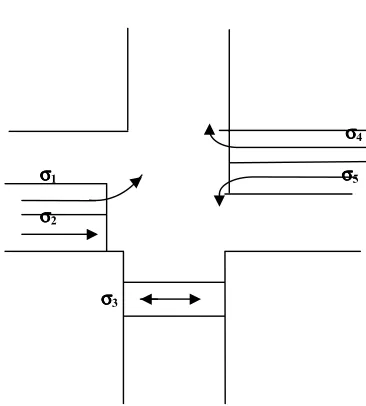
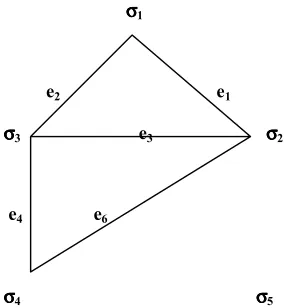
Let us consider a traffic control problem at a four leg intersection, with five streams as shown in Fig. 5.1 and the corresponding graph as shown in Fig. 5.2 below :
σσσσ4 σσσσ1 σσσσ5 σσσσ2
σσσσ3
Fig. 5.1 : An intersection with five traffic streams.
σσσσ1
e2 e1 σσσσ3 e3 σσσσ2 e5 e4 e6
σσσσ4 e7 σσσσ5 Fig. 5. 2 : A graph representing the above intersection.
To start with the Algorithm (4.2), we consider F : =
and H: = G . Now we select any edge such that ∈ E(H) i.e. E(H) ≠ . Thus we have,
= { } { } = { }, F: = F { } = { }, H : = H - = { },
σσσσ1 σσσσ3 σσσσ2 e4 e6
σσσσ4 e7 σσσσ5
Fig. 5. 3 : H is the first subgraph obtained applying the Algorithm (4.2)
Again since E(H) ≠ , let us select any edge ∈ E(H). Then we obtain
= { } { } = { },
F: = F { } = { } { } = { }, H: = H - = ,
where the second subgraph H is as shown in Fig. 5.4 below :
σσσσ1
σσσσ3 σσσσ2
σσσσ4 σσσσ5
Fig. 5. 4 : H is the second subgraph obtained applying the Algorithm (4.2)
The number of edges in H (Fig. 5.4) is zero i.e. E(H) = and H consists of all isolated vertices. Therefore
F = { is a minimal edge control set. The graph obtained after removing F from G is as shown in Fig. 5.5 below :
σσσσ1
e2 e1 σσσσ3 e3 σσσσ2
e4 e6
σσσσ4 σσσσ5
Fig. 5. 5 : Graph obtained after removing minimal edge control set
Finally, it is also clear from the above diagram that the above graph is disconnected having two components and no other set having less number of edges than F disconnect the graph, therefore F is a minimal edge control set of the graph G constructed using the algorithm. From the above discussion it is clear that sensors have to placed in the edges and , which will provide complete information and can be delivered to the traffic participants, regarding traffic flow, congestion etc.
6. Applications
The minimal edge control set has wide application in traffic control problems at an intersection. The edges of the minimal edge control set determines the exact location where the sensors have to be placed which minimizes the total cost and the complete data of the traffic problem can be obtain from the minimal edge control set.
The minimal edge control sets are of great importance in studying properties of communication and transportation networks, as it is necessary to know the maximum rate of flow that is possible from one node to another in the network. Edge control set or cut-set has its applications in many other networks such as network representing roads with traffic capacities, or link in a computer network with data transmission capacities, or currents in a electric network, there are also some application in industrial settings etc.
7. Conclusion
traffic information of the network. An example to find the minimal edge control set constructed using the algorithm is shown in this paper. Although comparatively less number of streams is considered in the example, the idea can be generalised and can be used to study traffic control problem at any intersection. 8. Acknowledgements
This Research work is funded by grants from the UGC, New Delhi, India as a Major Research Project awarded to Arun Kumar Baruah. Niky Baruah is associated with the project as a Project Fellow.
References
[1] D. C. Gazis, Traffic Science ( John Wiley & Sons, New York , 1970).
[2] D. C., Gazis, Traffic Theory (Kluwer Academic Publishers, London, 2002).
[3] W. Gu, X. Jia, On a Traffic Control Problem, 8th
International Symposium on Parallel Architectures, Algorithms and Networks (ISPAN’05), 2005.
[4] W. Gu, X. Jia, On a Traffic Sensing Problem,
Preprint, Texas State University, 2006.
[5] T. Riedel, Traffic Control using Graph Theory,
Verkehrs- Systeme AG, 2002.
[6] Torin. Monahan, “ War Rooms” of the street: Suveillance Practices in Transportation Control Centers.
The Communication Review10(4), 2007, 367-389. [7] World Road Association, Road NetworkOperation Handbook, 2002.
[8] Philip Tarnoff, Bullock John, M Darcy, Stanley E. Young et. al., Continuing Evolution of Travel Data Information Collection and Processing, Transportation Research Board Annual Meeting, 2009.
[9] R. J. Wilson, J. J. Watkins, Graph : AnIntroductory Approach (John Wiley & Sons, New York, 1989). [10] D. B. West, Introduction to Graph Theory (2nd
Edition Prentice Hall Inc., New Jersey, 2001).
[11] S. Guberinic, G. Senborn, B. Lazic, Optimal Traffic Control Urban Intersection ( CRC Press, 2008).
Authors Biography
Name : Ms. Niky Baruah
Qualification : M. Sc., M. Phil. Experience : 1 year teaching experience in DHSK College, Dibrugarh, Assam and 6 months research experience in UGC Research Project. Research interest : Graph Theory and Combinatorics.
Name : Dr. A. K. Baruah
Qualification : M. Sc., Ph. D. Experience : 20 years teaching and research experience in
Mathematics in Dibrugarh University, Assam . Research interest : Graph Theory and Combinatorics, Numerical Analysis and Differential