Original Research Article
Perceptions and practices about menstrual hygiene among women of
reproductive age group (15-49 years) attending out-patient department
of CIMS, Bilaspur Chhattisgarh
Bhavana Pandey
1*, Devesh Shukla
2INTRODUCTION
According to India's 2011 census, 89 percent of the nation's rural population lives in households that lack toilets. This absence of proper sanitation presents public health challenges and affects Indian women disproportionately. An estimated 355 million Indian women and girls must find ways to cope with monthly menstrual hygiene. Most of these women either have no
access to toilets or are faced with unclean lavatory facilities. Moreover, they usually wait until nighttime before using public toilets or fields, which exposes them to various forms of physical attacks. Swachh, a self-governing organization that provides waste management services to citizens of Pune in west India, recently brought attention to the issue of waste pickers' exposure to infections and other health hazards due to handling feminine hygiene discards.1
ABSTRACT
Background: Women suffer due to their ignorance on hygienic requirement during menstruation. Hygiene related practices of women during menstruation are of considerable importance, as it has a health impact in terms of increased vulnerability to RTI. Inthis paper our objectives is to detect the menstrual health problems and to assess menstrual hygiene practices among women of reproductive age group (15-49 years) attending OPD of CIMS Bilaspur Chhattisgarh (Obstretic and Gynaecology, OPD).
Methods: Females of reproductive age group (15-45 years) attending routine obstretics and gynaecology OPD during 1st May to 15th September 2015 were included in the study after taking their verbal consent at CIMS hospital. Pretested semi-structured questionnaire were used to take history regarding knowledge and practices related to menstrual hygiene. Statistical test like chi-square test were applied using Epi info 7 software.
Results: 36% of study population belonged to the 21-30 year age group. About 75% were married. Majority of women had primary education (43.3%) and 54.3% belonged to lower middle class. Majority of women 51.8% used cloth during menstruation; about 45.7% used the same cloth by washing and reusing every month.
Conclusions: Most women were found to follow unhygienic practices. Hence, efforts such as improving female literacy and health education regarding the various risk factors should be made by the policy makers to increase menstrual hygiene among rural population. Literacy status was found to be significant for awareness about menstruation and the use of sanitary pads.
Keywords: Reproductive tract infections, Menstrual hygienic
1
Department of Community Medicine, Chhattisgarh institute of medical Sciences Bilaspur, Chhattisgarh, India
2Jhargram District Hospital, West Bengal, India
Received: 23 April 2018
Revised: 31 May 2018
Accepted: 01 June 2018
*Correspondence:
Dr. Bhavana Pandey,
E-mail: [email protected]
Copyright: © the author(s), publisher and licensee Medip Academy. This is an open-access article distributed under the terms of the Creative Commons Attribution Non-Commercial License, which permits unrestricted non-commercial use, distribution, and reproduction in any medium, provided the original work is properly cited.
Menstrual Hygiene Day is an annual awareness day on May 28 to highlight the importance of good menstrual-hygiene management. It was initiated by the German-based NGO WASH United in 2014 and aims to benefit women and girls worldwide. The 28th was selected to acknowledge that 28 days is the average length of the menstrual cycle.1 In low-income countries, girls’ choices of menstrual hygiene materials are often limited by the costs, availability and social norms.2 Adequate sanitation facilities and access to menstrual hygiene products are one part of the solution. Creating a culture that welcomes discussion and makes adequate education for girls is of equal importance. Research has found that not having access to menstrual hygiene management products can keep girls home from school during their period each month.3In many parts of sub-Saharan Africa, girls can miss up to 5 days of school a month or drop out entirely due to insufficient access to water, sanitation and hygiene (WASH) facilities and menstrual hygiene products.4 Improving access to WASH facilities can actually increase girls attendance at school. A program for school sanitation in Bangladesh increased girls' enrollment at school by 11%.5
Menstrual waste is largely ignored in schools in developing countries, despite it being a significant problem. Girls' access to water and sanitation at school is only available at 47% and 46% of all schools globally.6 In the United States, girls who are unable to afford feminine hygiene products may miss school in order "to avoid the embarrassment of staining their clothes."7
Menstruation is a normal physiological process among females. Although menstruation is a normal process, it is often linked with myths and misconceptions. Hygienic practices during menstruation are of great importance, the lack of which increases the susceptibility of an individual to reproductive tract infections. Good knowledge and safe practices about menstruation leads to good reproductive health. Most of the adolescent girls in India have little knowledge about menstruation. Large numbers of rural and urban populations believe that menstruation contaminates the body and makes it unholy. As a consequence, the girl often sees herself as impure, unclean and dirty. According to the nutrition foundation of India, the average age of menarche is 13.4 years; yet 50% of girls aged 12-15 do not know about menstruation. This is true for rural as well as the urban poor. The lack of information can be attributed to a veil of secrecy that surrounds menarche.8
Menstruation is a normal physiological process but the onset of menstruation is a unique phenomenon for adolescent girls both physically and emotionally. In India it is considered unclean, and young girls are restricted from participating in household and religious activities during menstruation. These restrictions extend to eating certain foods like jaggery and papaya as well.9,10
Moreover, as the traditional Indian society considers talks on such topics as prohibited and discourages open discussion on these issues. Which in turn leads to intense mental stress and they seek health advice from quacks and persons who do not have adequate knowledge on the subject.11 Practices of hygiene related matter of menstruation are of considerable importance as it has health impact in terms of increased vulnerability to reproductive tract infections (RTI). The interplay of socioeconomic status, menstrual hygiene practices, and RTIs are noticeable. Today, millions of women are sufferers of RTI and its complications and often the infection is transmitted to offspring of the pregnant mother.12
This study was undertaken with the following objectives as to detect the menstrual health problems and to assess menstrual hygiene practices among women of reproductive age group (15-49 years) attending out-patient department of CIMS Bilaspur Chhattisgarh (Obstretic and Gynaecology OPD).
METHODS
It is an institution based cross-sectional study, conducted in Obstetrics and Gynecology OPD, hospital attach to Chhattisgarh Institute of Medical Sciences (CIMS), Bilaspur (Chhattisgarh) from 1st May 2015 to 15th September 2015. Females of reproductive age group (15-45 years) attending routine gynaecology OPD were included in the study after taking their verbal consent. After ensuring privacy data was collected from participating women regarding their perception about menstrual hygiene and practices adopted by them to maintain menstrual hygiene. Interview method was used for data collection. Statistical analysis was done using Epi info 7 for Windows.
Inclusion criteria
All the women in 15-49 yrs age group having sign and symptoms of reproductive tract infections and having menstrual problems attending the Obstetrics and Gynecology OPD, CIMS, Bilaspur (C.G.) during the study period.
Exclusion criteria
Women not willing to participate in the study and those below 15 or above 49 years of age.
Ethical consideration
Ethical clearance obtained from institutional ethical committee, Bilaspur, Chhattisgarh.
RESULTS
(19%). 68.5% women belongs to rural area and 31.5% belongs to urban area, about 84% were married. Majority of women had primary education (20.5%) followed by 18.5% illiterate, It was found that majority of women belong to lower and upper lower socio-economic class (28% and 27%) according to modified B.G. Prasad’s classification. Most of the women (55.5%) attained menarche at the age of 13-15 years, followed by 10-12 years (27%) (Table 1).
Table 1: Socio demographic variables (n=200).
Frequency Percentage (%)
Age (in years)
15-20 12 6.00
21-25 37 18.50
26-30 62 31.00
31-35 32 16.00
36-40 38 19.00
41-49 19 9.50
Total 200 100.00
Residence
Rural 137 68.50
Urban 63 31.50
Total 200 100.00
Marital status
Married 168 84.00
Unmarried 32 16.00
Total 200 100.00
Education of female
Illiterate 37 18.50 Primary school 41 20.50 Middle school 37 18.50 High school 27 13.50 Intermediate 30 15.00
Graduate 23 11.50
Profession degree 5 2.50
Total 200 100.00
Socio-economic status (Modified B.G. Prasad’s scale-May 2014)
1-(5571 Rs.
&above) 12 6.00 2-(2786 -5570 Rs.) 36 18.00 3-(1671-2785 Rs.) 42 21.00 4-(837-1670 Rs.) 54 27.00 5-(<836 Rs.) 56 28.00
Total 200 100.00
Age at menarche
<10-12 54 27.00
13-15 111 55.50
>16 35 17.50
Total 200 100.00
Table 2 shows that 54% participants had faced irregularity in menstruation, 29.5% participants were suffering from poly-menorrhea while 25% had problem of oligo-menorrhea (Table 2).
Table 2: Details of problem faced during menstruation (n=200).
Frequency Percentage (%)
Menstrual irregularity
Yes 108 54.00
No 92 46.00
Total 200 100.00
Interval between menstrual cycle
<21 days 50 25.00 21-35 days 91 45.50 >35 days 59 29.50
Total 200 100.00
Flow of bleeding
Heavy 21 10.50
Medium 142 71.00
less 37 18.50
Total 200 100.00
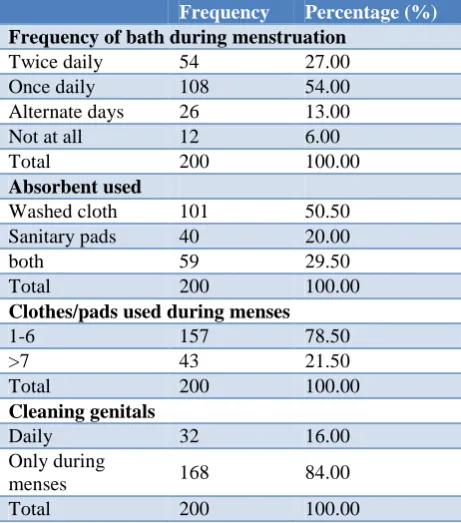
Table 3: Menstrual hygiene practices (n=200).
Frequency Percentage (%)
Frequency of bath during menstruation
Twice daily 54 27.00 Once daily 108 54.00 Alternate days 26 13.00 Not at all 12 6.00
Total 200 100.00
Absorbent used
Washed cloth 101 50.50 Sanitary pads 40 20.00
both 59 29.50
Total 200 100.00
Clothes/pads used during menses
1-6 157 78.50
>7 43 21.50
Total 200 100.00
Cleaning genitals
Daily 32 16.00
Only during
menses 168 84.00
Total 200 100.00
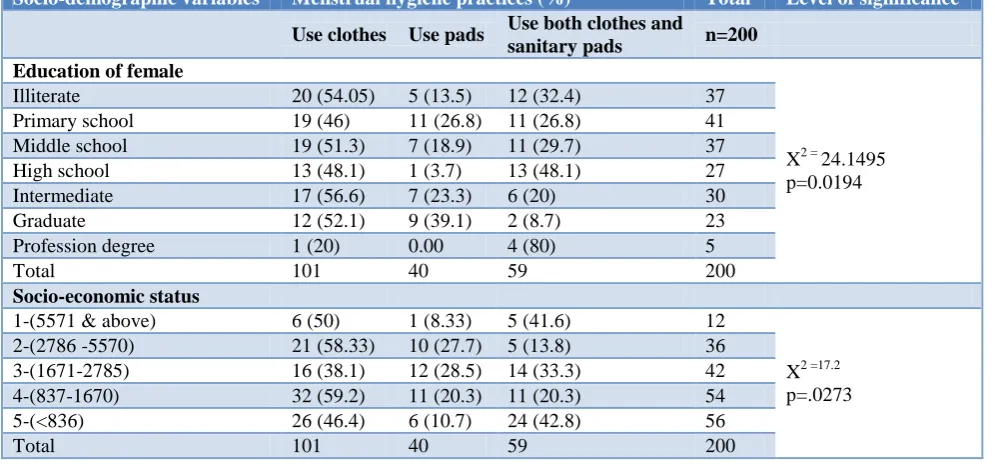
completed high school and professional degree, majority 48% and 80% use both cloths and sanitary pads during
menstruation, respectively. This difference was found to be statistically significant (p<0.01).
Table 4: Relationship between socio-demographic profile and practices of menstrual hygiene in study population (n=200).
Socio-demographic variables Menstrual hygiene practices (%) Total Level of significance
Use clothes Use pads Use both clothes and
sanitary pads n=200 Education of female
X2 = 24.1495 p=0.0194 Illiterate 20 (54.05) 5 (13.5) 12 (32.4) 37
Primary school 19 (46) 11 (26.8) 11 (26.8) 41 Middle school 19 (51.3) 7 (18.9) 11 (29.7) 37 High school 13 (48.1) 1 (3.7) 13 (48.1) 27 Intermediate 17 (56.6) 7 (23.3) 6 (20) 30 Graduate 12 (52.1) 9 (39.1) 2 (8.7) 23 Profession degree 1 (20) 0.00 4 (80) 5
Total 101 40 59 200
Socio-economic status
1-(5571 & above) 6 (50) 1 (8.33) 5 (41.6) 12
X2 =17.2 p=.0273 2-(2786 -5570) 21 (58.33) 10 (27.7) 5 (13.8) 36
3-(1671-2785) 16 (38.1) 12 (28.5) 14 (33.3) 42 4-(837-1670) 32 (59.2) 11 (20.3) 11 (20.3) 54 5-(<836) 26 (46.4) 6 (10.7) 24 (42.8) 56
Total 101 40 59 200
It was found that majority (59.2%) of upper lower (class-4) women used cloth during menstruation, while among those of class 2 and 3 use sanitary pads during menstruation (27.7% and 28.5%), This difference was found to be statistically significant (p<0.01) (Table 4).
DISCUSSION
This institution based cross-sectional study was conducted to know various health problems faced during the period of menstruation and to assess menstrual hygiene practices among women of reproductive age group (15-49 years). The present study was conducted in obstetrics and gynaecology OPD CIMS Bilaspur, comprising of 200 women of reproductive age group. In the present study, majority of women 55.5% attained menarche at the age of 13-15 years, followed by 27% at the age of 10-12 years and 17.5% at the age of 16 and above, similarly a study by Kamaljit et al found that the age of menstruating girls ranged from 10 to 15 years with maximum number of girls falling between 12 and 15 years of age, and the mean age of menarche of the respondents has been observed as 12.5 years.12 A similar study conducted by Deo et al reported that the age of menstruating girls ranged from 12 to 17 years, with maximum number of girls between 13 to 15 years of age, whereas in a study carried out in Rajasthan by Khanna et al the mean age at menarche was found to be 13.2 years.13,14 Our study shows that majority of the women preferred cloth pieces rather than sanitary pads as menstrual absorbent, only 20% women used sanitary pads
during menstruation. It was observed that the usual practice was to wash the cloth with soap after use and keep it at some secret place till the next menstrual period. To keep the cloth away from prying eyes, these are sometimes hidden in unhygienic places. Privacy for washing, changing, or cleaning purpose is something very important for proper menstrual hygiene. In a study conducted in Rajasthan by Khanna et al.14 Most of the women were using washed cloth 50.5%, 20% of the women were using sanitary pad and 29.5% of the women were using both sanitary pad and cloth, contrary to this study regarding menstrual hygiene practices by Kamaljit et al found that 68.7% girls used sanitary pads and 30 (10.0%) respondents practicing any cloth or rag/cotton during menstruation.12
CONCLUSION
It was found that education of women and socio-economic status significantly affects the menstrual hygienic practices of women. Menstrual hygiene, a very important risk factor for reproductive tract infections, is a vital aspect of health education for adolescent girls. Educational television programs, trained school nurses/health personnel, motivated school teachers, and knowledgeable parents can play a very important role in transmitting the vital message of correct menstrual hygiene to the adolescent girl of today. Efforts such as improving the female literacy and health education on the various risk factors should be made by the policy makers to increase menstrual hygiene among rural population. Adoption of high quality menstrual hygiene will play an important role in prevention of RTI and Cancer of cervix among the women population. Therefore, promoting positive attitudes towards management of menstruation and related problems among the adolescent girls is the need of the hour.
A separate National health policy concentrating on improvement of menstrual hygiene and use of sanitary napkin, there by prevention of reproductive tract infections, is needed along with continued health education to measure the success of interventions aimed at improving the menstrual hygiene practices among women. Establishment of a comprehensive school health education program with instruction in hygienic practices related to menstruation is the need of today. Universalized use of sanitary pads or absorbent material needs to be advocated to every reproductive age group female by making the easy availability through social marketing.
ACKNOWLEDGEMENTS
To the study subject and social workers of the institute working in this area for their full co-operation and help.
Funding: No funding sources Conflict of interest: None declared
Ethical approval: The study was approved by the Institutional Ethics Committee
REFERENCES
1. Menstrual Hygiene Day. Archived from the original on 3 July 2015.
2. UNESCO (2014). Puberty Education & Menstrual Hygiene Management - Good Policy and Practice in health Education - Booklet 9. United Nations
Educational, Scientific and Cultural Organization, Paris, France, 2014: 32.
3. Amme, Grace (28 May 2015). "Uganda Celebrates Menstrual Hygiene Day". Uganda Radio Network, 2015.
4. Bosco, Ijoo (29 May 2014). "E. Equatoria Marks Global Menstrual Hygiene Day". Sudan Tribune, 2015.
5. Domestos; Water Aid; WSSCC: A Report on Sanitation and Hygiene for Women and Girls (PDF). World Toilet Day.
6. Sommer M, Hirsch JS, Nathanson C, Parker RG. Comfortably, Safely, and Without Shame: Defining Menstrual Hygiene Management as a Public Health Issue. Am J Public Health. 2015;105(7):1302-11. 7. De Bode, Lisa. New York City Wants to Provide
Free Tampons to Address Menstruation Stigma. Al Jazeera America, 2015.
8. WHO Health needs of adolescents. Report of WHO Expert Committee, Technical Report series, 1999: 609-615.
9. UNICEF. The state of world’s children: adolescence, an age of opportunity. In: NICEF, eds. UNICEF Report. New York: UNICEF; 2011. 10. Drakshavani DK, Venkata RP. A study on
menstrual hygiene among rural adolescent Indian girls. Andhra Pradesh. Indian J Med. 1994;48(6):139-43.
11. Tarhane S, Kasulkar A. Awareness of adolescent girls regarding menstruation and practices during menstrual cycle. Panacea J Med Sci. 2015:5(1);29-32.
12. Kamaljit K, Arora B, Singh KG, Neki NS. Social beliefs and practices associated with menstrual hygiene among adolescent girls of Amritsar, Punjab, India. JIMSA. 2012;25:69‑70.
13. Deo DS, Chattargi Ch. Perceptions and practices regarding menstruation: A comparative study in urban and rural adolescent girls. Indian J Community Med. 2005;30:33‑4.
14. Khanna A, Goyal RS, Bhawsar R. Menstrual practices and reproductive problems: A study of adolescent girls in Rajasthan. J Health Managment. 2005;7(1):91-7.
Cite this article as: Pandey B, Shukla D.Perceptions and practices about menstrual hygiene among women of reproductive age group (15-49 years) attending out-patient department of CIMS, Bilaspur