Original Research Article
Assessment of the availability of infrastructure, manpower, materials
and knowledge of health care providers regarding child health care
services in the sub centers of a block of Dibrugarh district, Assam
Debarshi Paul*, Gourangie Gogoi, Rupali Baruah
INTRODUCTION
Most of the deaths of under-five children occur due to diseases which are easily treatable or preventable with proven, worthwhile interventions. If sustainable development goals (SDG) target on child survival by 2030 is achieved by all countries, an added 10 million lives of under-five children (half of them newborns) will be saved over the period 2017-2030.1 There is a considerable gap between maternal and neonatal mortality in developed and developing countries, due to the difference in health care quality.2
The SCs are under constant criticism for their inability to deliver quality services. The main reasons are the
non-availability of health workers, inadequate infrastructure and facilities, and insufficient supply of drugs.
Building on a conceptual framework proposed by Donabedian3, three major aspects of care can be evaluated: the structure or service input of care delivery system, the process by which care is delivered and outcome of care. Structure or input of the care delivery system includes material, human, financial and organizational structure. Using the conceptual framework proposed by Donabedian, the present study attempts to make rational observations and assess Indian Public Health Standards regarding service input for child healthcare services at sub-centers in a block of Dibrugarh district, Assam, with the following objectives:
ABSTRACT
Background: The SCs are under constant criticism for their inability to deliver quality services. Every year some 12
million children of developing countries die before they reach their fifth birthday. Around 90% of mortality rate can be prevented by the improvement of health care quality.
Methods: Cross-sectional study conducted among health care providers of sub-centers in a randomly selected block
of Dibrugarh district of Assam.
Results: All SCs had two health worker (female)/ANMs and a multipurpose health worker male (MPW Male). Only
20% SCs adhered to scheduled opening but 100% adhered to scheduled closing time of the health facilities. 100% of SCs were housed in government building.70% of the SCs had motorable roads. All the SCs had a regular and good supply of BCG, OPV, measles, TT, pentavalent (90% SCs) vaccines.
Conclusions: SCs play a crucial role to decrease the morbidity and mortality of under five children in the rural areas.
Full-fledged SCs with sufficient manpower, good infrastructure and good knowledge of delivery of child health care among health care providers would definitely improve the level of child health care provided to the community.
Keywords: Quality of child health care, Service input, Child health care, Sub center
Department of Community Medicine, Assam Medical College and Hospital, Dibrugarh, Assam, India
Received: 09 March 2019
Revised: 16 April 2019
Accepted: 17 April 2019
*Correspondence: Dr. Debarshi Paul,
E-mail: [email protected]
Copyright: © the author(s), publisher and licensee Medip Academy. This is an open-access article distributed under
the terms of the Creative Commons Attribution Non-Commercial License, which permits unrestricted non-commercial use, distribution, and reproduction in any medium, provided the original work is properly cited.
To assess the infrastructure, manpower and materials available for child health care services in sub-centers of a block of Dibrugarh district.
To assess the knowledge of child health care service among the health care providers.
METHODS
A cross-sectional study was conducted among health care providers of sub-centers in a block of Dibrugarh district of Assam, from September to November, 2017.
There are 6 blocks under Dibrugarh district. Out of these 6 blocks, 1 block was selected randomly for conducting the study. Panitola block was selected randomly. From the selected block, 50% of the total number of SCs was enlisted for the study. There are 20 SCs under the block. Thus 10 SCs were selected randomly. The selected sub-centers were visited and a predesigned and pretested proforma was used to interview the ANMs regarding the infrastructure, manpower and materials available for child health care services and their knowledge of child
health care service. In the case there were 2 ANMs in one sub center, the senior ANM was interviewed.
Data was computed and analyzed using proportions.
RESULTS
All SCs had two health worker (female) /ANMs and a multipurpose health worker male (MPW Male). But only 40% SCs had contractual Safai Karmacharis (Table 1). Only 20% SCs adhered to scheduled opening but 100% adhered to scheduled closing time of the health facilities. All ANMs were trained in RCH programme but none were trained in RMNCH+A (Table 2).
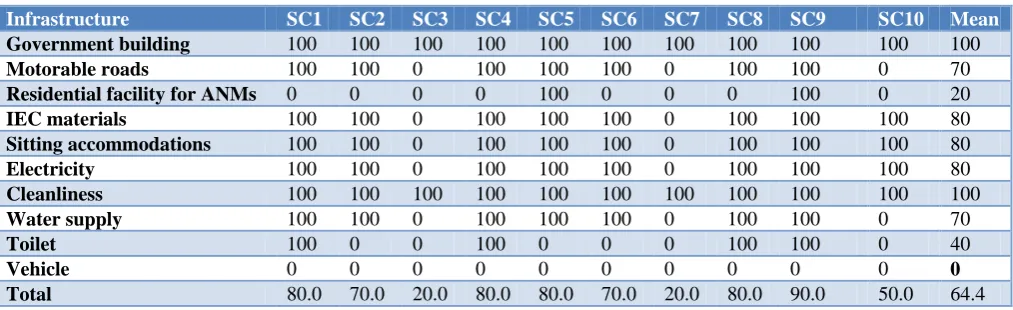
100% of SCs were housed in government building.70% of the SCs had motorable roads. Only 20% of SCs had residential facility for ANMs. 80% SCs had electricity connection, display of IEC materials and sitting accommodations. Cleanliness was observed in all the SCs (Table 3).
Table 1: Availability of manpower at subcentres of Panitola block (expressed as percentage).
Personnel SC1 SC2 SC3 SC4 SC5 SC6 SC7 SC8 SC9 SC10 Mean
Health worker (female)/ANM 100 100 100 100 100 100 100 100 100 100 100
Health worker (Male) 100 100 100 100 100 100 100 100 100 100 100
Contractual Safai
Karmachari 0 0 100 100 100 0 0 100 0 0 40
Total 66.6 66.6 100 100 100 66.6 66.6 100 66.6 66.6 80.0
Scoring pattern - Present/Absent= 1/0.
Table 2: Adherence to scheduled opening and closing time of the health facilities and in-service training of health care providers for child health care services (expressed as percentage).
Time SC1 SC2 SC3 SC4 SC5 SC6 SC7 SC8 SC9 SC10 Mean
Opening time 0 0 100 0 0 100 0 0 0 0 20
Closing time 100 100 100 100 100 100 100 100 100 100 100
RCH training 100 100 100 100 100 100 100 100 100 100 100
RMNCH+A training 0 0 0 0 0 0 0 0 0 0 0
Total 50.0 50.0 75.0 50.0 50.0 75.0 50.0 50.0 50.0 50.0 55.0
Scoring pattern– Opening and closing as per schedule (yes/no) – 1/0, Training received/not received = 1/0.
Table 3: Availability of infrastructure at subcentres of Panitola block (expressed as percentage).
Infrastructure SC1 SC2 SC3 SC4 SC5 SC6 SC7 SC8 SC9 SC10 Mean
Government building 100 100 100 100 100 100 100 100 100 100 100
Motorable roads 100 100 0 100 100 100 0 100 100 0 70
Residential facility for ANMs 0 0 0 0 100 0 0 0 100 0 20
IEC materials 100 100 0 100 100 100 0 100 100 100 80
Sitting accommodations 100 100 0 100 100 100 0 100 100 100 80
Electricity 100 100 0 100 100 100 0 100 100 100 80
Cleanliness 100 100 100 100 100 100 100 100 100 100 100
Water supply 100 100 0 100 100 100 0 100 100 0 70
Toilet 100 0 0 100 0 0 0 100 100 0 40
Vehicle 0 0 0 0 0 0 0 0 0 0 0
Total 80.0 70.0 20.0 80.0 80.0 70.0 20.0 80.0 90.0 50.0 64.4
Table 4: Availability of equipments and vaccines for immunization service in the subcentres of Panitola block (expressed as percentage).
Records/equipments SC1 SC2 SC3 SC4 SC5 SC6 SC7 SC8 SC9 SC10 Mean
Immunization card 100 100 100 100 100 100 100 100 100 100 100
Immunization register 100 100 100 100 100 100 100 100 100 100 100
Vaccine carrier 100 100 100 100 100 100 0 100 100 100 90
Ice packs 100 100 100 100 100 100 100 100 100 100 100
BCG 100 100 100 100 100 100 100 100 100 100 100
Pentavalent 100 100 100 100 100 100 0 100 100 100 90
OPV 100 100 100 100 100 100 100 100 100 100 100
Measles 100 100 100 100 100 100 100 100 100 100 100
TT 100 100 100 100 100 100 100 100 100 100 100
Diluents 100 100 100 100 100 100 100 100 100 100 100
Autodisable syringes 100 100 0 100 0 100 0 100 100 100 70
Disposable syringe and
needle 100 100 100 100 100 100 100 100 100 100 100
Total 100 100 91.7 100 91.7 100 75.0 100 100 100 95.8
Scoring pattern - Present/Absent = 1/0.
Table 5: Availability of drugs for management of ari and diarrhoea and vitamin a supplementation at subcentres of Panitola block (expressed as percentage).
Drugs SC1 SC2 SC3 SC4 SC5 SC6 SC7 SC8 SC9 SC10 Mean
Cotrimoxazole 100 100 100 100 100 100 100 100 100 100 100
Paracetamol suspension 100 100 0 100 100 100 0 100 100 100 80
ORS 100 100 100 100 100 100 100 100 100 100 100
Zinc sulphate tablets 100 100 0 100 100 100 0 100 100 100 80
Vitamin A solution 100 100 100 100 100 100 100 100 100 100 100
Total 100 100 60 100 100 100 60 100 100 100 92.0
Scoring pattern - Present/Absent = 1/0.
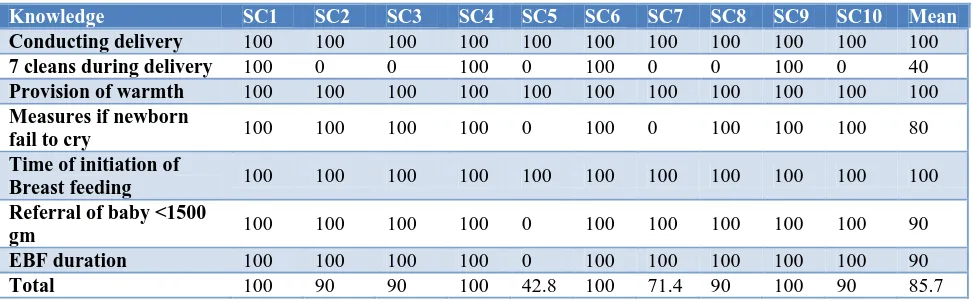
Table 6: Knowledge of health care providers for newborn care practice (expressed as percentage).
Knowledge SC1 SC2 SC3 SC4 SC5 SC6 SC7 SC8 SC9 SC10 Mean
Conducting delivery 100 100 100 100 100 100 100 100 100 100 100
7 cleans during delivery 100 0 0 100 0 100 0 0 100 0 40
Provision of warmth 100 100 100 100 100 100 100 100 100 100 100
Measures if newborn
fail to cry 100 100 100 100 0 100 0 100 100 100 80
Time of initiation of
Breast feeding 100 100 100 100 100 100 100 100 100 100 100
Referral of baby <1500
gm 100 100 100 100 0 100 100 100 100 100 90
EBF duration 100 100 100 100 0 100 100 100 100 100 90
Total 100 90 90 100 42.8 100 71.4 90 100 90 85.7
Scoring pattern – Knowledge Present/Absent = 1/0.
Immunization card and registers were maintained in all the SCs. All the SCs had a regular and good supply of BCG, OPV, measles, TT, pentavalent (90% SCs) vaccines (Table 4). All SCs had supply of Cotrimoxazole, ORS and vitamin A solution and 80% had zinc sulfate tablets and paracetamol suspension (Table 5). All ANMs (100%) were trained in conducting delivery and knew
Table 7: Knowledge of health care providers about management of ARI (in percentage).
Knowledge SC1 SC2 SC3 SC4 SC5 SC6 SC7 SC8 SC9 SC10 Mean
Meaning of ARI 100 100 100 100 100 100 100 100 100 100 100
Classification of
ARI 100 0 0 100 0 0 0 100 100 0 40
Treatment of ARI 100 100 100 100 100 100 100 100 100 100 100
Danger signs of
pneumonia 100 100 0 100 0 100 0 100 100 100 70
Prevention of
pneumonia 100 100 100 100 100 100 100 100 100 100 100
Total 100 80 60 100 60 80 60 100 100 80 82.0
Scoring pattern – Knowledge Present/Absent = 1/0.
Table 8: Knowledge of health care providers about management of diarrhoea (in percentage).
Knowledge SC1 SC2 SC3 SC4 SC5 SC6 SC7 SC8 SC9 SC10 Mean Definition of
diarrhoea 100 0 0 100 100 0 0 100 100 0 50
Classification of
dehydration 100 100 0 100 100 100 100 100 100 100 90
Treatment of
diarrhoea 100 100 100 100 100 100 100 100 100 100 100
Role of antibiotics 100 0 0 100 100 0 0 100 100 100 60
Feeding practice
during diarrhoea 100 100 100 100 100 100 100 100 100 100 100
ORS preparation 100 100 100 100 100 100 100 100 100 100 100
Prevention of
diarrhoea 100 100 100 100 100 100 100 100 100 100 100
Total 100 71.4 57.1 100 100 71.4 71.4 100 100 85.7 85.7
Scoring pattern – Knowledge Present/Absent = 1/0.
Table 9: Knowledge of health care providers for vitamin A supplementation service (in percentage).
Knowledge SC1 SC2 SC3 SC4 SC5 SC6 SC7 SC8 SC9 SC10 Mean
Importance of Vit. A 100 100 100 100 100 100 100 100 100 100 100
Supplementation with Measles immunization
100 100 100 100 100 100 100 100 100 100 100 Schedule of
subsequent doses 100 100 100 100 100 0 100 100 100 100 90
Symptoms of Vit. A
deficiency 100 0 100 100 100 0 100 100 100 100 80
Prevention of
deficiency 100 0 100 100 100 0 100 100 100 100 80
Total 100 60 100 100 100 40 100 100 100 100 90
Scoring pattern – Knowledge Present/Absent = 1/0.
DISCUSSION
All SCs had two health worker (female) /ANMs and a multipurpose health worker male (MPW Male). In a study by Reddy et al, all the SCs had at least one health worker (female).4 Two HW (F) and one MPW (M) were available in 16 (47.0%) and 11 (32.3%) SCs, respectively. In a study conducted by Nair et al in Kerala, they found that only 56.4 % of SCs had two HW(F).5
As per IPHS, the SCs should provide residential facility for auxiliary nurse midwives (ANMs); this study found that only 20% of SCs had residential facility for ANMs which is quite similar to the study by Reddy et al where 26.4% of SCs have residential facilities for ANMs.4 In similar studies conducted in Kerala, Mandla and facility survey India, it was found that only in 54.4%, 27.5%, and 30% of SCs had own building, out of these only 31.1%, 75.7%, and 30% female health workers were staying in SCs or in the SC village.5,9,10
Present study shows 70% of the SCs had motorable roads while in the study conducted by Reddy et al, all the SC buildings were located in easily accessible area within the village with motorable roads.4
In the study by Reddy et al, on the whole, none of the SCs had delivery kits and deliveries were not being conducted in any of the SCs which is similar to the present study.4
All the SCs had a regular good supply of BCG, OPV, measles, TT, pentavalent (90% SCs) vaccines while in the study by Reddy et al, all the SCs had good supply of OPV, DPT, DT, TT, and Hepatitis B vaccines from the PHC, but BCG and measles vaccines were regularly supplied to only 26 (76.4%) SCs.4
Regular water supply and electricity were present in 70% and 80% of all SCs respectively, whereas in a study conducted by Pal et al it was found to be 35% and 56% respectively.9
In facility survey of India, they found that 10–50% of the SCs conducted deliveries.10 In the present study, none of the SCs were conducting deliveries which is similar to study conducted by Reddy et al.4
All ANMs (100%) were trained in conducting delivery and knew about time of initiation of breast feeding. Whereas 90% knew about referral of baby <1500 gm and only 40% knew about 7 cleans during delivery. Similar results were obtained by Malhotra et aland Berhe et al regarding overall knowledge of newborn care practice.11,12 82% and 85.7% of the ANMs had an overall knowledge about management of ARI and management of diarrhoea respectively. 90% of the ANMs had knowledge about vitamin A supplementation service.
CONCLUSION
The present study was taken up to assess some useful inputs regarding the existing level of infrastructural, manpower and material facilities at SCs. SCs play a crucial role to decrease the morbidity and mortality of under five children in the rural areas. Sufficient manpower with a good knowledge of child health care services would definitely improve the level of child health care provided to the community. Full fledged SCs with all basic facilities will encourage workers to stay
there, and deliver their duties in away which could improve the services. The presence of ANM all 24 hours at the SCs is essential for the people to avail the health services round the clock.
ACKNOWLEDGEMENTS
We are indebted to the District Health Authority, Dibrugarh district, Assam, for giving us permission to conduct the study. We also thank all the study participants without whom the study would not be possible.
Funding: No funding sources Conflict of interest: None declared
Ethical approval: The study was approved by the Institutional Ethics Committee
REFERENCES
1. The UN Inter-agency Group for Child Mortality Estimation. Levels & Trends in Child Mortality. UNICEF, Unicef, WHO, World Bank Group, United Nations Population Division; 2017.
2. Austin A, Langer A, Salam RA, Lassi ZS, Das JK and Bhutta ZA. Approaches to improve the quality of maternal and newborn health care: an overview of the evidence. Reproductive Health. 2014;11(2). 3. Donabedian A. Evaluating the Quality the quality of
medical care. Milbank Memorial Fund. 2005;83:691-729.
4. Reddy NB, Prabhu GR, Sai TSR. Study on the Availability of Physical Infrastructure and Manpower Facilities in Sub-centers of Chittoor District of Andhra Pradesh. Indian Journal of Public Health. 2012;56(4)290-2.
5. Nair VM, Thankappan KR, Vasan RS, Sarma PS. Community Utilisation of Subcentres in Primary Health Care - An analysis of determinants in Kerala. Indian J Public Health 2004;48:17-20.
6. International Institute for Population Sciences. District Level Household and Facility Survey (DLHS-4): Assam. Mumbai: Government of India, Ministry of Health and Family Welfare; 2012-2013. 7. Jain S, Singh JV, Bhatnagar M, Garg SK, Chopra H,
Bajpai SK. Evaluation Of Physical Facilities Available At Subcentres In District Meerut. Indian J Community Med. 1999;24(1).
8. Patil SK, Shivaswamy MS. Assessment of sub-centres of Belagavi district according to Indian public health standards 2012 guidelines: a cross sectional study. IJCMPH. 2017;4(6):1938-42. 9. Pal DK, Tiwari R, Kasar PK, Sharma A, Verma S,
10. Ram F, Paswan B, Singh LL. District Level Household & Facility Survey (Under Reproductive and Child Health Project). Publication: National facility report DLHS II. Facility Survey 2003. 11. Malhotra S, Zodpey SP, Vidyasagaran AL, Sharma
K, Raj SS, Neogi SB, et al. Assessment of Essential Newborn Care Services in Secondary-level Facilities from Two Districts of India. J Health, Population Nutr. 2014;32(1):130–41.
12. Berhe AK, Tinsae F, Gebreegziabher G. Knowledge and practice of immediate newborn care among
health care providers in eastern zone public health facilities, Tigray, Ethiopia, 2016. BMC Pediatrics. 2017;17:157.
Cite this article as: Paul D, Gogoi G, Baruah R.