Original Research Article
Patient’s knowledge about HIV and willingness toward rapid HIV oral
testing in dental settings, Jodhpur, Rajasthan
Vibha Joshi
1, Nitin Kumar Joshi
2*, Komal Bajaj
3INTRODUCTION
Human immunodeficiency virus (HIV) is a virus which destroys specific cells in the immune system (CD4 +T cells) which in turn weakens immune system, thus causing more susceptible to other infections. Over time, HIV develops into acquired immunodefiency syndrome (AIDS). AIDS is a condition in which failure of immune system and makes human body more prone towards opportunistic infections.1 Globally, HIV/AIDS is major public health problem and has claimed more than 35
million lives so far. In 2016, 1.0 million people died from HIV-related causes globally.2
India has third highest number of HIV-infected people.3 As per UNAIDS, in 2016 around 2 million people were living with HIV/AIDS in India and among these people 49% (40%-61%) were on antiretroviral therapy (ART).4
According to National AIDS Control Organization (NACO) report 2015, national adult (15-49 years) HIV prevalence was estimated to be 0.26% (0.22%-0.32%) in ABSTRACT
Background: As various dental procedures can transmit HIV, rapid HIV oral testing facilities in dental settings could play a major role in prevention of HIV infection. Being most popular HIV testing methods worldwide, the rapid HIV oral test is not available in India and its level of acceptance in Indian dental settings is unexplored. This study conducted with the objective to assess patient’s knowledge about HIV and their willingness toward rapid HIV oral testing in dental settings.
Methods: This cross-sectional study was conducted in two dental clinics selected from two different largest mixed socioeconomic housing societies of Jodhpur respectively. A semi structured questionnaire consisting of demographics, respondent’s general knowledge towards AIDS/HIV infection, willingness towards HIV rapid oral test was developed for data collection. Standard descriptive statistics were calculated and comparisons between demographic data and willingness to get tested in dental setting, awareness for HIV etc. were analyzed.
Results: Total of 473 age-eligible patients were surveyed out of which 214 were males. The difference about the knowledge of HIV/AIDS between two groups of education levels (p<0.05) was statistically significant and almost 82% of these respondents were willing to have HIV oral rapid saliva testing as a part of regular dental appointment.
Conclusions: It can be concluded that dental patient generally are willing for HIV rapid oral testing, but additional studies are needed to explore relevant policy implications.
Keywords: HIV rapid test, Oral test, Awareness, Dental
1
Department of Public Health, Lachoo Memorial College, Jodhpur, Rajasthan, India
2
School of Public Health, AIIMS, Jodhpur Rajasthan, India
3
Sainath Hospital and Research Centre, Jodhpur, Rajasthan, India
Received: 24 September 2018
Revised: 06 November 2018
Accepted: 12 November 2018
*Correspondence:
Dr. Nitin Kumar Joshi,
E-mail: [email protected]
Copyright: © the author(s), publisher and licensee Medip Academy. This is an open-access article distributed under the terms of the Creative Commons Attribution Non-Commercial License, which permits unrestricted non-commercial use, distribution, and reproduction in any medium, provided the original work is properly cited.
2015 and estimated adult HIV prevalence of males and females were 0.30% and 0.22% respectively. India has 80,000 (62,000-1,00,000) new HIV-infected cases in 2016 and 62,000 (43,000- 91,000) AIDS related deaths.5
A report from Ministry of Health and Family Welfare in 2017 disclosed that HIV/AIDS-infected people in Rajasthan were estimated to be more than 1 lakh. In India, the total HIV/AIDS related deaths were 62,386 and out of which 3,838 deaths took place in Rajasthan.6 AIDS control society of India recently quoted that there has been a sudden spurt in newly diagnosed HIV cases during 2017 in U.P, Bihar, Gujarat and Rajasthan which were in low HIV- prone zoneand new pockets of infection have emerged in the highly-populated states of Gujarat, Bihar, Delhi, Chhattisgarh Rajasthan, Orissa, Uttar Pradesh and Jharkhand.4 Out of the 14 sites with more than 2% prevalence, five were in Bihar, Chhattisgarh, Orissa, Rajasthan and Uttar Pradesh, while one-third of the 56 sites with more than 1% prevalence were in Bihar, Chhattisgarh, Delhi, Gujarat, Jharkhand, Orissa, Rajasthan and Uttar Pradesh.7
Around one –quarter people living with HIV in India (23 percent) are unaware of their HIV status.8 HIV -infected people who are unaware of their HIV status are high risk groups and more prone for transmission. Early diagnosis of HIV can reduce the risk of transmission of virus. Earlier diagnosis and initiation of ART (antiretroviral therapy) in early stages of infection increases survival rate and reduces sexual risk behaviour thereby reduces transmission to others. Highly active antiretroviral treatment suppresses viremia, decreases the frequency of Opportunistic infections and improves the quality of life.9 Despite of availability of free antiretroviral treatment (initiated by NACO in 2004) uptake is low due to difficulty in assessing clinics which may be attributed to factors like migration, empowerment issue and stigma and discrimination.6 Raising knowledge and awareness among people is very essential for prevention of disease.
Dental settings can play important role in early diagnosis because oral lesions can identify by dentists that are present at early stages of HIV. Oral lesions are common including candidiasis, xerostomia, oral hairy leukoplakia, periodontal diseases such as Linear gingival erythema and Necrotizing ulcerative periodontitis, Kaposi sarcoma, herpes simplex.10 Dental professional can identify HIV positive patients and take effective precautions regarding oral health procedures involving blood and instrumentation.11
Dentists fall into the high-risk category for cross-contamination. Various dental procedures can transmit HIV and there is a major concern among dentists about the HIV cross-infection, i.e. from an infected patient to the dentist and further from the dentists to other patients.11
Detection of HIV infection provides an opportunity to health workers including dentists for transmission reduction and implementing proper treatment strategies. Conducting user friendly HIV rapid testing in non-traditional settings like dental clinics may strengthen efforts to expand HIV screening strategy by making testing more accessible.12
CDC 2006 guidelines recommend integration of HIV screening in all routine health care settings (age groups between 13-64 years). This strategy makes HIV testing more convenient and accessible.13 Rapid oral testing is simple, reliable and non-invasive, cost effective preliminary procedure. Rapid oral testing in dental settings can help individuals to learn their HIV status. OraQuick Advance is a FDA approved rapid oral testing which give results in 20 minutes. Dental professionals can perform this test routinely from patient’s oral fluid. In this procedure, pad is placed against the teeth and collects the oral fluid. It detects antibodies to HIV-1 and HIV-2 in oral fluid, finger stick whole blood, venipuncture whole and blood plasma. This test is accurate and safe for dentists with comparably sensitivities and specificities.14
Dental setting is important venue but there is less utilization of this opportunity for implementation of Rapid HIV oral testing in dental clinics.15 Pollack and colleagues study highlighted that potential opportunities were missed for identification of HIV-infected persons in dental setting who may not receive care in other healthcare settings where HIV tests are typically offered.16 Dental settings are largely unexploited place for identification of patients with undiagnosed HIV infection. If dentist not aware about patient’s HIV– positive status, it may lead unexpected drug interactions and inappropriate treatment outcomes.17 Rapid HIV oral testing in dental settings can helps in earlier diagnosis and increases awareness among people.18
consult a health-care provider for confirmatory results. This procedure takes about 20 minutes as compared to the standard blood test which takes about two weeks for results.20 Though it’s become one of the most popular HIV testing methods worldwide, the HIV oral sampling test is not available in India and its level of acceptance and perceptions in Indian dental settings is unexplored.21 This advocacy study for rapid HIV oral testing is conducted with the objective to assess patient’s knowledge about HIV and their willingness toward rapid HIV oral testing in dental settings.
METHODS
A cross–sectional study was conducted in two dental clinics selected from two different largest mixed socioeconomic housing societies (Chopasni housing board - Sainath hospital and Kudi-bhagtasni housing board- Shri IG hospital) of Jodhpur respectively. A semi structured questionnaire with 32 items was developed after extensive literature search. It consists of questions on demographics (e.g. age, sex, religion, caste, education, migration status, marital status, no. of children, nature of work, monthly income), respondent’s general knowledge towards AIDS/HIV infection (e.g. whether HIV and AIDS are same or not, there is cure or not, coughing and sneezing spread HIV, eating healthy food can keep away from HIV, ways to prevent HIV infection), to determine patient willingness towards HIV screening in the dental clinics. This study included participants aged 18 years and above who reported to the dental clinics during study period. Exclusion criteria comprised of those patients who declined to answer the survey. The option for participation in the study was given by the dental professionals to all eligible patients at the conclusion of the dental appointment as they exited the dental operatory. The participants were informed that the survey was voluntary and anonymous and would take less than 8 minutes to complete. They were also informed that participation in this study will not affect their current and future dental appointments. Permission was obtained from hospital authorities.
Data was collected for period of six months i.e. from June 2017 to November 2017. Total number of 473 patients was surveyed. Data was coded and entered in Microsoft excel. Data was analyzed using Epi info 7. Standard descriptive statistics were calculated and comparisons were between demographic data (e.g. age, gender, occupation, etc.) and willingness to get tested in dental setting, awareness about HIV etc. was analyzed. The data was evaluated using Chi-square test and p<0.05 was considered statistically significant.
RESULTS
Total of 473 age- eligible patients were surveyed, out of which 214 were males and 259 were females between ages of 20 and 75 years. Almost 82% of these respondents were willing to have HIV testing (by saliva)
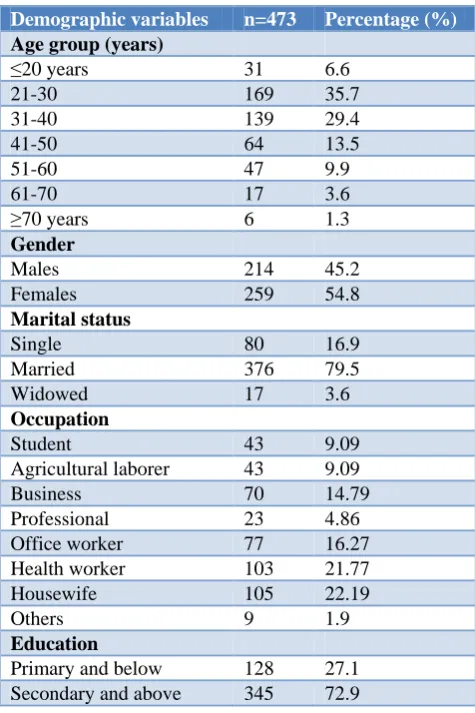
as a part of regular dental appointment while 73% (n=345) felt that they could afford the pay for these testing in dental settings. Out of those to agree for rapid HIV testing as a part of dental visit, 77.1% were males and 84.5% were females. When asked for their past HIV screening status, 40% (n=189) reported have been screened for at least once in their lifetime and 60 % were either did not had HIV testing in past or not knowing whether they had HIV screening. The demographic profile of study population is as shown in Table 1.
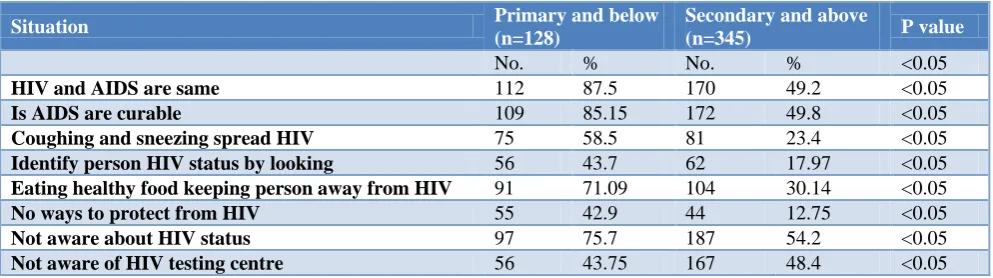
About 72.9% of study population had education of higher secondary and above. The awareness of study population is about the HIV/AIDS is displayed in Table 2. Only 40.4% (n=191) were aware the HIV and AIDS are different. It was notice that about 33% (n=156) incorrectly stated that HIV spreads through sneezing, cure available (59.4%) and eating healthy food can keep person away from getting HIV. When enquired whether HIV infection could be prevented about 79% (n=374) responded that it could be prevented. As HIV infection can be present without any disease manifestations in many healthy looking HIV positive individuals, the participants were asked, to what extend this information was clear to them. Most of the respondent (n=355) knew that HIV could be present in apparently healthy looking individual.
Table 1: Demographic profile of study population.
Demographic variables n=473 Percentage (%)
Age group (years)
≤20 years 31 6.6
21-30 169 35.7
31-40 139 29.4
41-50 64 13.5
51-60 47 9.9
61-70 17 3.6
≥70 years 6 1.3
Gender
Males 214 45.2
Females 259 54.8
Marital status
Single 80 16.9
Married 376 79.5
Widowed 17 3.6
Occupation
Student 43 9.09
Agricultural laborer 43 9.09 Business 70 14.79 Professional 23 4.86 Office worker 77 16.27 Health worker 103 21.77 Housewife 105 22.19
Others 9 1.9
Education
Table 2: Awareness and attitude of patients reporting at dental centre.
Situation Primary and below
(n=128)
Secondary and above
(n=345) P value
No. % No. % <0.05
HIV and AIDS are same 112 87.5 170 49.2 <0.05
Is AIDS are curable 109 85.15 172 49.8 <0.05
Coughing and sneezing spread HIV 75 58.5 81 23.4 <0.05
Identify person HIV status by looking 56 43.7 62 17.97 <0.05
Eating healthy food keeping person away from HIV 91 71.09 104 30.14 <0.05
No ways to protect from HIV 55 42.9 44 12.75 <0.05
Not aware about HIV status 97 75.7 187 54.2 <0.05
Not aware of HIV testing centre 56 43.75 167 48.4 <0.05
While comparing the awareness for difference between HIV and AIDS across the educational category, the difference was statistically significant about the knowledge of HIV and AIDS between two groups of education levels (p<0.05). The educational categories were defined as below secondary school and secondary and above.
It was found that there was no significant (p>0.05) difference between the two educational groups (primary, secondary) and their willingness to undergo HIV test as a part of dental visit.
DISCUSSION
This study revealed that out of 473 age-eligible patients who were offered the questionnaire, 390 were willing to have HIV testing (by saliva) as a part of regular dental appointment. Overall, participants viewed rapid HIV testing favourable as it is simple to administer and has a potential to be easily integrated into dental clinical practice. There are evidences that rapid HIV oral testing is preferred over finger prick testing22 and past studies have shown that people’s willingness to participate increases when time required for testing is reduced23. Studies from developed and developing countries (USA, Canada, UK, Australia, India and South Korea) have successfully demonstrated that oral rapid HIV testing method is more feasible when compared with routine serum-based testing. Rapid HIV oral testing reduces blood phobia of patients and does not requires full blood samples and also minimizing the risk of needle exposures.23 These finding and current study findings support the evidence that HIV rapid saliva screening test is promising for reaching a proportion of the population that is visiting their dental professionals more regularly than other health centers where HIV testing facilities are available. Dental healthcare workers are often the first to recognize symptoms of HIV and refer patients for testing HIV status. HIV testing prior to dental treatment and knowledge about patients’ infection state can allow dentist to confidently do their jobs with proper treatment planning. In developing country like India where only 23 percent of HIV positive people in India are unaware of
their HIV status and the current HIV testing policy which is blood-based may involve several challenges including phobia to blood withdrawal, need for high level laboratory skills, stringent waste disposal needs and painful sample collection. It is envisaged that introduction of a rapid, painless HIV oral fluid test as a potential alternative is likely to increase the number of people testing. This study revealed that 60 % participants either did not had HIV testing in past or not knowing whether they had HIV screening. This unawareness and misperception could lead to negative outcomes as early identification is essential for successful long-term treatment and survival with HIV. Moreover it also account for inaccuracies in surveys which rely on self perceptions and reporting.24 People living with HIV who know their HIV status is more likely to access care and treatment services that allow them to lead healthy, productive lives.6 Though this test become one of the most popular HIV testing methods worldwide, the HIV oral rapid test is not available in India. Considering advances in the medical management of HIV, it is time to adopt new dental public health strategy that incorporates the latest scientific advances like rapid oral-fluid–based diagnostics. As expected, level of education in this study was found to be closely associated with their knowledge of HIV /AIDS. Patients with education level of secondary school & above were having better awareness than those with primary or less education level. Misconceptions associated with HIV /AIDS were found to be more prevalent among lower education level patients. Dental workforce could play important role in educating patients with special focus on those with low education levels about HIV/AIDS, modes of transmission etc to reduce cross infections.
but additional studies are needed to explore relevant policy implications and ways how this testing can be incorporated into the oral healthcare setting.
ACKNOWLEDGEMENTS
We like to acknowledge all the patients who agreed to provide consent and participated in this study. We are also thankful to Sainath hospital & research centre and Shri IG hospital & research centre as this study would not have been possible without their support and assistance.
Funding: No funding sources Conflict of interest: None declared Ethical approval: Not required
REFERENCES
1. Centers for disease control and prevention (CDC). About HIV/AIDS, HIV Basics, Centers for disease control and prevention (CDC). Available at: https://www.cdc.gov/hiv/basics/whatishiv.htm. Accessed 10 March 2017.
2. World health Organization. HIV/AIDS, World Health Organization (WHO). Available at: www.who.int/news/factsheets. Accessed 1 February 2018.
3. HIV and AIDS in India. Available at: https://www.avert.org. Accessed 2 July 2017. 4. The Joint United Nations programme on HIV and
AIDS (UNAIDS). Available at: www.unaids.org/en/ regionscountries/countries/india. Accessed 5 July 2018.
5. National AIDS control society. Available at: www.naco.gov.in>hiv-facts-figures. Accessed 5 July 2018.
6. National AIDS Control Organization (2017), Sankalak: Status of National AIDS Response, New Delhi: NACO, Ministry of Health and Family Welfare, Government of India; Available at: goi/NACO/MES/Sankalak/011217. Accessed 10 July 2018.
7. National AIDS Control Organization (2017) HIV Sentinel Surveillance: Technical Brief, India 2016-2017, And New Delhi: NACO, Ministry of Health and Family welfare. Available at: www.tnsacs.in/pdf/HIV%20SENTINEL%20SURV EILLANCE% 202017.pdf Accessed 20 July 2018. 8. Joint United Nations Programme on HIV/AIDS
(UNAIDS). Available at: http:// www.unaids.org/sites/default/files/media_asset/201 7_ data book_en.pdf. Accessed 25 July 2018. 9. Perry A, Kasaie P, Dowdy DW, Shah M. What Will
It Take to Reduce HIV Incidence in the United States: A Mathematical Modelling Analysis. Open Forum Infect Dis. 2018;5(2):8.
10. Berberi A, Aoun G. Oral lesions associated with human immunodeficiency virus in 75 adult patients: a clinical study. J Korean Assoc Oral Maxillofac Surg. 2017;43(6):388-94.
11. Ibrahim NK, Alwafi HA, Sangoof SO, Turkistani AK, Alattas BM. Cross-infection and infection control in dentistry: Knowledge, attitude and practice of patients attended dental clinics in King Abdulaziz University Hospital, Jeddah, Saudi Arabia. J Infect Public Health. 2017;10(4):438-45. 12. Wang L, Santella AJ, Huang R, Kou L, You L,
Zhang X, et al. Knowledge of HIV and willingness to conduct oral rapid HIV testing among dentists in Xi'an China. PLoS One. 2015;10(3):e0119274. 13. Lyons MS, Lindsell CJ, Fichtenbaum CJ, Camargo
CA. Fichtenbaum, and Carlos A. Camargo, Jr. Interpreting and Implementing the 2006 CDC Recommendations for HIV Testing in Health-Care Settings. Pub Health Rep. 2007;122(5):579–83. 14. Vernillo AT, Caplan AL. Routine HIV testing in
dental practice: can we cross the Rubicon? J Dent Educ. 2007;71(12):1534-9.
15. Bradley ELP, Vidot DC, Gaul Z, Madeline Y. Sutton, Margaret Pereyra. Acceptability of oral rapid HIV testing at dental clinics in communities with high HIV prevalence in South Florida. Published. PLoS One. 2018;13(4):e0196323. 16. Pollack HA, Metsch LR, Abel S. Dental
examinations as an untapped opportunity to provide HIV testing for high-risk individuals. Am J Public Health. 2010;100:88–9.
17. Edelman EJ, Gordon KS, Glover J, McNicholl IR, Fiellin DA, Justice AC. The Next Therapeutic Challenge in HIV: Polypharmacy. Drugs Aging. 2013;30(8):613-28.
18. Abe EO, Kolude B, Adeyemi BF. HIV testing in dental practice: perception and attitude of dentists in southwestern Nigeria. Afr J Med Med Sci. 2014;43(1):201–8.
19. Pai NP, Balram, Shivkumar S, Martinez-Cajas, Christiane Claessens, Gilles Lambert, el at. Head-to-head comparison of accuracy of a rapid point-of-care HIV test with oral versus whole-blood specimens: a systematic review and meta-analysis. 2012;12(5):373–80.
20. John R, John P. New Delhi: Textbook of oral Medicine Jaypee Brothers Medical Publishers Ltd; 2014.
21. World Health Organization (WHO 2013) .HIV self-testing consolidated guidelines on the use of antiretroviral drugs for treating and preventing HIV infection. Available at: www.who.int/hiv/pub/ guidelines/arv2013/arv2013supplement_to_chapter0 5.pdf. Accessed 20 January 2018.
22. Martin IB, Williams V, Ferguson D, Read S. Performance of and preference for oral rapid HIV testing in The Bahamas. J Infect pub health. 2018;11(1):126–9.
24. Khakoo NM, Lindsell CJ, Hart KW, Ruffner AH, Wayne DB, Lyons MS. Patient Perception of Whether an HIV Test Was Provided during the Emergency Department Encounter. J Int Assoc Provid AIDS Care. 2014;13(6):506–10.