Journal of Engineering Sciences, Volume 5, Issue 2 (2018), pp. F 13–F 18 F 13 JOURNAL OF ENGINEERING SCIENCES
ЖУРНАЛ ІНЖЕНЕРНИХ НАУК
ЖУРНАЛ ИНЖЕНЕРНЫХ НАУК
Web site: http://jes.sumdu.edu.ua
DOI: 10.21272/jes.2018.5(2).f3 Volume 5, Issue 2 (2018)
UDC 66.074:661
Intensification of Foam Layered Apparatus by Foam Stabilization
Liaposhchenko O.1*, Khukhryanskiy О.1, 2, Moiseev V.3, Ochowiak M.4, Manoilo Е.3 1
Sumy State University, 2 Rymskogo-Korsakova St., 40007 Sumy, Ukraine;
2
PJSC “Ukrhimproekt”, 13 Illinska St., 40009 Sumy, Ukraine;
3 National Technical University “Kharkiv Polytechnic Institute”, 2 Kyrpychova St., 61002 Kharkiv, Ukraine; 4
Poznan University of Technology, 5 M. Sklodowska-Curie Sq., 60-965 Poznan, Poland
Article info: Paper received:
The final version of the paper received: Paper accepted online:
July 2, 2018 October 25, 2018 October 30, 2018
*
Corresponding Author’s Address:
[email protected]
Abstract. In this work the expanded models are studied for foaming apparatuses with gratings made of tubes for different diameters. The problem of intensification of foam devices using coarse-grating lattices is considered. The possibility of deep cleaning and practically complete cleaning of gases from ammonia and fluoride compounds with their separate absorption is noted. The series of experimental dependencies for the main parameters of the process are given. The possibility of effective mass-exchange processes in an intensive foam layer on counter-current coarse-grating lattices is confirmed. The controversial requirements for equipment have been given despite the large number of existing machines for mass transfer processes, as well as the development of new high-intensity and efficient equipment for environmental technologies in many industries is considered.
Keywords: industrial gas emissions, hydrodynamics, mass transfer; foam apparatus, foam layer, purification process, stabilization of foam layer, intensification of the process.
1
Introduction
In modern conditions of significant anthropogenic en-vironmental impact, it began the search for the most effi-cient and cost-effective methods of cleaning industrial emissions. Methods of cleaning and equipment that is being developed should take into account working possi-bilities in a wide range of working conditions.
In order to reduce energy consumption in systems for catching harmful and toxic substances, it is necessary to provide a reduction of hydraulic resistance while main-taining the high efficiency of gas streams cleaning.
Given the controversial requirements for equipment and despite the large number of existing machines for mass transfer processes, the development of new highly intensive and efficient equipment is of considerable inter-est to environmental protection technologies in many industries.
2
Literature Review
The most common method of purifying gas streams is methods for the absorption of harmful components from the released industrial gases. In this case, either the pro-cess of physical absorption occurs, or the absorbent enters
a chemical interaction with the absorbed component (the process of chemisorption).
Recently, the direction associated with conducting dif-fuse processes in intensive regimes with developed turbu-lence at high speeds of gas and liquid flows has become relevant. Actually turbolization of the gas-liquid system leads to an increase in the intensity of mass-exchange devices.
One of the methods of turbination of gas-liquid sys-tems is their transformation into mobile unstable foam due to the kinetic energy of gas.
Foam mode and foam devices of the "classical" type are described in and analyzed in the papers [1-4]. Intensi-fied apparatuses with foam layer stabilizer have been widely used for capturing dust from gases and for gas absorption in the chemical and related industries. Due to its high efficiency, high unit capacity, good operational qualities of their application, they can improve the stages of gas purification for technological and sanitary purpos-es, increase the efficiency of mass transfer and the relia-bility of gas-cleaning equipment.
F 14 CHEMICAL ENGINEERING: Processes in Machines and Devices
3
Research Methodology
Based on researching the semi-industrial models of foam machines with lattices, assembled from tubes of different diameters, a pilot sample of foam absorber with the productivity of 12 000 m3/h of gas was designed.
One of the research directions was the absorption of ammonia by water in intensive foam modes with a stabi-lized foam layer. Absorption of ammonia by water is a typical process in absorber research to detect their effec-tiveness.
The process of absorption of ammonia in foam mode on counterproductive gratings of the usual type is quite fully studied at gas velocities up to 2.5 m/s. In order to compare the technological parameters of ammonia ab-sorption in water under similar conditions, the work of the most common industrial counter processing grating with an area of free intersection of 0.18 m2/m2 and a di-ameter of holes of 5 mm was investigated.
The research of this grating was carried out both with the stabilizer, and without it. The research was due to the need to determine the degree of effect of the stabilization of the layer and comparison with the technological pa-rameters of the newly developed design foam apparatus, as well as the establishment of the general nature of de-pendencies and kinetic parameters of the absorption pro-cess (– efficiency of the contact stage (ECS); Ks – mass transfer coefficient) from the following basic parameters: Wg – gas velocity; L0 – irrigation density; Cn – initial concentration; S0 – area of the free intersection of the plate.
4
Results
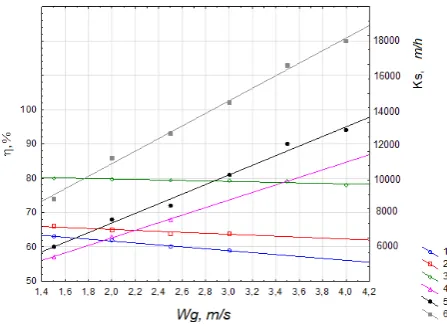
The gas velocity in the complete section of the device has a significant effect on the height of the gas-discharge and the initial layer. Accordingly, the gas velocity signif-icantly influences the mass transfer coefficient, and the nature of this dependence is determined by the solubility of the gas component in the fluid. The foregoing is con-firmed by the experimental data given in Figure 1, de-pendence 6.
When absorbing well-soluble gases (for example, am-monia), is required a low phase of contact to achieve a high degree of absorption. Reducing the contact time of phases with increasing gas velocity in foam mode is largely offset by the turbulence of the gas-liquid layer and increasing the contact of surface phases.
Previously, in studying the absorption of ammonia by water on ordinary gratings, it was found that in the gas torch the holes in the grid transmit from 50 to 90 % of the total mass of matter [5]. This determines the “input” ef-fect, that is, the most intense interaction between the gas and the liquid, which occurs at the time of forming a new contact surface. However, at a low altitude of the initial fluid layer on the grating of the usual type of apparatus it is possible to pass the gas without contact with the absor-bent fluid, and as a consequence, a decrease in the ab-sorption rate. This is especially true for industrial
ma-chines. As indicated, the stabilization of the foam layer makes its structure more uniform and excludes the proba-bility of such a state.
Investigations on new types of gratings with foam layer stabilization have shown that the efficiency of the appa-ratus during absorption of ammonia by water practically does not depend on the value of gas velocity (Figure 1). Moreover, ECS in the new design of the device is much higher than that of conventional gratings without stabili-zation and even when it is installed on ordinary type grat-ings.
Figure 1 – Efficiency of the contact stage (1–3) and mass transfer coefficient (4–6) dependences on the gas velocity for
the ammonia water system with L0 = 5 m3/(m2·h):
1, 4 –dЕ = 0.005 m, S0 = 0.18 m2/m2– without stabilizer;
2, 5 –dЕ = 0.005 m, S0 = 0.18 m 2
/m2– with stabilizer; 3, 6 –dЕ = 0.005 m, S0 = 0.20 m2/m2– with stabilizer
It should be noted that the difference between the val-ues of the efficiency of the contact stage and mass trans-fer coefficient, retrans-ferenced to the unit area of the grating, depending on the gas velocity in the complete section of the apparatus on the gratings with small holes with and without the stabilizer increases at high gas. This proves the high intensity of the process and confirms the expedi-ency of using a stabilized foam layer on large-hinged gratings for the purification of gases in the industry.
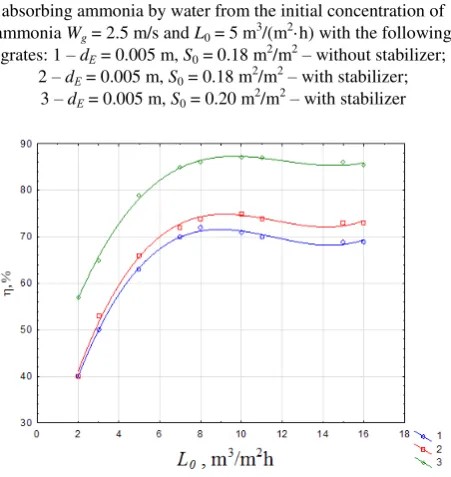
The dependence of the of the efficiency of the contact stage by absorption on the initial ammonia concentration of the comparable contact devices (Figure 2) fully con-firms the conclusions made about the effectiveness of new foaming apparatus. It is important to note that in the studied limits of variation of the initial concentration of ammonia (Cn 1 % vol.), the efficiency of the contact stage remains constant for other equal conditions. This allows using the known methods of calculating the re-quired number of steps to achieve the desired process efficiency.
Journal of Engineering Sciences, Volume 5, Issue 2 (2018), pp. F 13–F 18 F 15
Figure 2 – Efficiency of the contact stage dependence at absorbing ammonia by water from the initial concentration of ammonia Wg = 2.5 m/s and L0 = 5 m3/(m2·h) with the following
grates: 1 –dЕ = 0.005 m, S0 = 0.18 m2/m2– without stabilizer;
2 –dЕ = 0.005 m, S0 = 0.18 m2/m2– with stabilizer;
3 –dЕ = 0.005 m, S0 = 0.20 m2/m2– with stabilizer
Figure 3 – Efficiency of the contact stage dependence in absorbing ammonia by water from the irrigation density:
Wg = 2.5 m/s; Cn = 1–2 %. with the following grates:
1 –dЕ = 0.005 m, S0 = 0.18 m2/m2– without stabilizer;
2 –dЕ = 0.005 m, S0 = 0.18 m2/m2– with stabilizer;
3 –dЕ = 0.005 m, S0 = 0.20 m2/m2– with stabilizer
Increasing the area of the free segment leads to a de-crease in efficiency (Figure 4). This confirms the correct-ness of the conclusions drawn in the analysis of the rela-tionship of structural parameters.
An increase in the diameter of the grating holes 10 times when applied to the foam layer stabilization increases the efficiency of capturing ammonia by 20 % compared to conventional gratings without stabilizing the layer and by 15 % compared to conventional gratings with foam layer stabilization. It should be noted that the rate of gas processing in the investigated range from 2 to 5 m/s has virtually no effect on the magnitude of efficien-cy.
Figure 4 – Efficiency dependence at absorbing ammonia by water: Wg = 2.5 m/s; Cn = 1–2 %; L0 = 5 m3/(m2·h)
The character of change in the mass transfer coeffi-cient, referenced to the grating area, from the linear gas velocity is given in Figure 5, from which it is evident that Wg greatly affects Ks in the investigated boundaries Wg. Processing the experimental data was obtained the fol-lowing empirical equations for the calculation of Ks, m/h:
1,5 0,12 0,26 0,71
0 0
1659,8
s g Å
K W L d S
(1) To calculate the efficiency, %:
3 1,9 0,30 0,34 1,27 0
0, 713 10Wg L dÅ Ks
(2) Border for changing parameters:
3 2 0
2 2 0
2 4, 0 m/h, 1 20 m /m h;
0, 20 0, 40 m /m , 0, 02 0, 08 m. g
Å
W L
S d
The error of calculating by equations (1) and (2) is not more than 9 %.
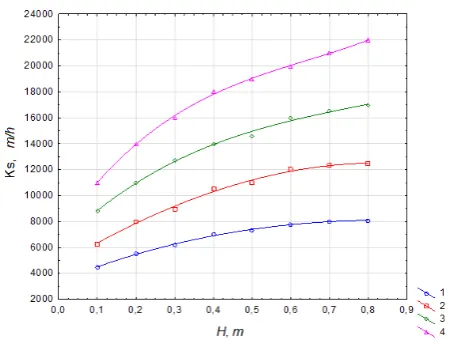
The influence of hydrodynamic parameters on the mass transfer coefficient at ammonia absorption by water is given in Fig. 6, which confirms the sufficient accuracy of the obtained equations, while the dependence of the mass transfer coefficient on the height of the foam layer is described by the following equation:
0,33
4742
s g
K W H (3)
Border for changing parameters: 3 2 0
2 2 0
2 4, 0 m/h, 1 20 m /m h;
0, 20 0, 4 m /m , 0, 02 0, 08 m.
g
Å
W L
S d
Equation (3) allows us to evaluate the mass transfer process under any hydrodynamic conditions, which is very important in the development and evaluation of technological schemes in industrial conditions with the use of new devices.
Experimental data confirmed the dependence obtained [1, 5] by Mukhlennov I. P.on the basis of theoretical con-sideration of the mass transfer in the foam layer for well-soluble gases, which is expressed by the equation:
33 , 0
nH
F 16 CHEMICAL ENGINEERING: Processes in Machines and Devices
Figure 5 – Dependence of mass transfer coefficient, referenced to the grading area from the height of the gas-liquid layer at different gas velocities: 1 –Wg = 2 m/s; 2 –Wg = 3 m/s;
3 –Wg = 4 m/s; 4 –Wg = 5 m/s
Figure 6 shows the dependence of the actual mass transfer coefficient on the linear gas velocity, which im-plies that an increase in speed leads to an increase in the mass transfer coefficient.
Figure 6 – Dependence of the actual mass transfer coefficient on the linear gas velocity (with stabilization) at absorbing ammonia
by water: 1 – grid S0 = 0.25 m 2
/m2; dЕ = 0.005 m,
L0 = 5 m3/(m2h); 2 – grid S0 = 0.18 m2/m2; dЕ = 0.005 m;
L0 = 5 m3/(m2h)
It should be noted that the value of the true mass trans-fer coefficient for apparatus with ordinary and coarse hinged gratings with stabilization of the foam layer is approximately the same.
This confirms that the contact surface of phases in the foam layer on coarse-grained grates is 1.5 times higher at a gas velocity of more than 3 m/s with an increase in the diameter of the grating holes 10 times, and confirms the possibility of efficient gas cleaning in the industry using foam machines.
5
Discussion
In order to verify the results obtained during bench tests in laboratory conditions, a cycle of pilot-industrial tests was conducted in which the main gas components were ammonia, fluoride compounds (mainly silicon tetra fluoride). In the system of purifying gases from the spray dryer, a reconstruction of the existing absorber was car-ried out (hollow scrubber with three tiers of nozzles). Instead of nozzles in the scrubber case, a contact step with coarse hole gratings (the holes are 0.0450.045 m and S0 = 0.28 m2/m2) and a foam layer stabilizer were installed (size 404060 mm).
Hydrodynamic tests were initially performed, which showed that the foam absorber has stable hydrodynamic characteristics when changing the gas velocity in the free intersection of the device from 3.5 to 5.5 m/s at
L0 = 8 m 3
/(m2·h). The highly developed gas-liquid layer on the grating is present even at speeds less than 2.2 m/s. Measurement of the gas height -liquid layer in industrial conditions was carried out by electro-sharpening method. It should be noted at the same time that the measurements also showed good convergence with bench tests in la-boratory conditions (Figure 7).
Figure 7 – Dependence of the foam layer height on the linear gas velocity of the apparatus (experimental and industrial tests):
gas-pulp system with = 1.22 kg/m3, L0 = 8 m3/(m2·h):
1 – experimental-industrial tests S0 = 0.28 m2/m2; dЕ = 0.048 m;
2 – bench tests S0 = 0.25 m 2
/m2; dЕ = 0.05 m
On this basis, for this technological scheme, optimal hydrodynamic mode of gas processing was determined which corresponded to the linear gas velocity from 3.0 to 4.9 m/s [6].
Journal of Engineering Sciences, Volume 5, Issue 2 (2018), pp. F 13–F 18 F 17
Figure 8 – Dependence of the NH3 final content and fluoride
compounds on the acidity of the irrigation solution: Wg = 4 m/s;
L0 = 8 m3/(m2·h); 1 – ammonia; 2 – fluoride compounds,
4
NH
С = 1.0 g/nm3, СHF= 0.1 g/nm3, grid: S0 = 28 %,
dЕ = 0.045 m
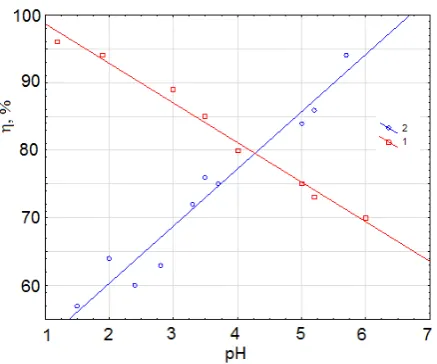
Figure 9 shows the dependence of the gas purification efficiency from ammonia and fluoride compounds from the acidity of the pulp, and it is evident that the degree of absorption of ammonia and fluoride compounds depends on the acidity of the irrigation solution. At pH of a solu-tion equal to 1.4, for ammonia, the degree of absorpsolu-tion is 98 %, and for fluoride compounds at pH = 5.7, the effi-ciency is 94 %.
6
Conclusions
The conducted studies indicate the possibility of deep cleaning and virtually complete removal of harmful com-ponents from gases in their separate absorption. Depend-ences of NH3 final content and fluorine in the gas after treatment from ammonium phosphate acidity are shown in Figure 9, from which it is evident that the optimal mode for the absorption of these components lies within the pH of the solution from 3 to 5. In this case, the maxi-mum permissible emission rates for ammonia are main-tained. This is confirmed by the high mass exchange characteristics of the developed foam device, allowing the process of joint and effective cleaning of these com-ponents in the range of pH irrigating solution from 3 to 5. As a result of experimental and industrial tests, it is
Figure 9 – Dependence of NH3 absorption rate and fluoride
compounds on the acidity of the irrigation solution:
L0 = 8 m3/(m2·h); 1 – ammonia; 2 – fluoride compounds, initial
concentration of ammonia 1.0 % vol.; Wg = 4 m/s;
grid S0 = 0.28 m2/m2, dЕ= 0.045 m
established the following: the efficiency of dust capture practically does not depend on the pH of the solution and also on the increase of the inlet dust to 4–6 g/nm3. In-creasing the density of the circulating pulp of ammonium phosphates does not affect the efficiency.
The conducted studies have experimentally confirmed the possibility of effective mass exchange processes in an intensive foam layer on counter currently coarse hinged gratings.
The application of new apparatus allows radically re-constructing, with minimal cost, technological schemes for gas cleaning in the chemical and other industries to provide them with better operational and technological characteristics, while simultaneously increasing the effi-ciency of working with concentrated solutions, their cir-culation and use in the main process [7].
7
Acknowledgements
F 18 CHEMICAL ENGINEERING: Processes in Machines and Devices
References
1. Muhlenova, I. P., & Tarata, E. Ya. (1977). Foam mode and foam devices. Moscow, Chemistry.
2. Tarat, E. Ya., Balabekov, O. S., & Bolgov, N. P. (1976). Intensive colony machines for handling gases with liquids. Saint-Petersburg State University.
3. Moiseev, V. F., Manoylo, E. V., Repko, K. Yu., & Davydov, D. V. (2017). Treatment of gas-discharge systems on tubular lat-tices with foam layer stabilizer. Bulletin of the National Technical University “Kharkiv Polytechnic Institure”, Series “New so-lutions in modern technologies”, No. 53, pp. 114–123, doi: 10.20998/2413-4295.2017.53.17.
4. Moiseev, V. F., Manoylo, Ye. V., Ponomareva, N. G., Repko, K. Yu., & Davydov, D. V. (2018). Methodology for calculation of regime-constructive and hydrodynamic parameters of foam devices for mass transfer processes. Bulletin of the National
Tech-nical University “Kharkiv Polytechnic Institure”, Series “New Solutions in Modern Technologies”, No. 16, pp. 165–176, doi: 10.20998/2413- 4295.2018.16.25.
5. Muhlenova, I. P., & Kovalev, O. S. (1987). Absorption and dust extraction in the production of mineral fertilizers. Moscow, Chemistry.
6. Moiseev, V. F., Manoylo, Ye. V., Lyaposhenko, O. O., Khukhryansky, O.M., & Ponomareva, N. G. (2018). Structure of foam layer on counteracting contact elements with stabilization. Bulletin of the National Technical University “Kharkiv Polytechnic
Institure”, Series “New solutions in modern technologies”, No. 26, pp. 83–92, doi: 10.20998/2413-4295.2018.26.37.
7. Perry, D. C., & Stevenson, P. (2015). Gas absorption and reaction in a wet pneumatic foam. Chemical Engineering Science, Vol. 126, pp. 177–185, doi: 10.1016/j.ces.2014.11.037.
Дослідження інтенсифікованих пінних апаратів із крупнодірчастими гратками
Liaposhchenko O.1*, Khukhryanskiy О.1, 2, Moiseev V.3, Ochowiak M.4, Manoilo Е.3 1 Сумський державний університет, вул. Римського
-Корсакова, 2, 40007, м. Суми, Україна;
2 ПАТ «Укрхімпроект»
, вул. Іллінська, 13, 40009, м. Суми, Україна;
3Національний технічний університет «Харківський політехнічний інститут»
,
вул. Кирпичова, 2, 61002, м. Харків, Україна;
4 Технологічний університет м. Познань, пл. М. Склодовської
-Кюрі, 5, 60-965, м. Познань, Польща
Анотація. У роботі досліджувалися укрупнені моделі пінних апаратів з гратками, зібраними з трубок
різного діаметра. Розглядаються питання інтенсифікації пінних апаратів із застосуванням крупнодірчастих граток. Відзначена можливість глибокого очищення і практично повного очищення газів від аміаку і фтористих з’єднань при їх роздільній абсорбції. Наведено ряд експериментальних залежностей основних параметрів процесу. Підтверджена можливість ефективного проведення масообміних процесів в інтенсивному пінному шарі на протитечійних крупнодірчастих гратках.
Ключові слова: викиди промислових газів, гідродинаміка, масообмін, пінний апарат, пінний шар, процес