http://www.ijcmph.com pISSN 2394-6032 | eISSN 2394-6040
Original Research Article
A study of vaccination delay among under-five attendees at an
immunisation clinic in a rural area of Goa
Elvira Noronha, Hemangini K. Shah*
INTRODUCTION
Immunisation is one of the most cost effective public health interventions against vaccine-preventable diseases, averting an estimated 2 to 3 million deaths every year globally.1 The recommended vaccination schedules (WHO) reduce the risk of the individual child contracting the disease under consideration whilst contributing to achieving the general herd immunity.2 In spite of Implementation of Universal Immunisation Programme,
since 1985 approximately 20% of the children are not immunised currently and 10% to 20% receive delayed immunisation.3
An estimated 19.4million infants worldwide are still missing out on basic vaccines.1 Therefore, poor or non-adherence to the schedules could potentially reverse the benefits of immunizations at individual and community level. These delays widen the critical period in which the child is most vulnerable to vaccine preventable diseases. Given the role, age-appropriate vaccination and coverage
ABSTRACT
Background: Vaccination has effectively shown to reduce mortality and morbidity due to vaccine-preventable
diseases. However, these diseases are still responsible for majority of childhood deaths worldwide especially in the developing countries. It should be realized that with hesitance or delaying vaccinations, the period that the child at risk increases. Hence, the following study was conducted.
Methods: A cross sectional study was carried out among 251 under-five immunization clinic attendees at an
immunization clinic conducted at the Rural Health and Training Centre in Goa for a period of two months. Parents of the under-five children were interviewed and vaccination dates were obtained from health cards and vaccination delay was assessed.
Results: Out of the total 251 study participants, 43.4% were males and 56.6% were females; 36.7% belonged to <2
years of age whereas 63.3% belonged to >2 years of age group. The education of the mothers and fathers of under five children, upto secondary education was 50.6% and 55.4% respectively and 31.5% of the study participants belonged to high socio-economic status. It was observed that 31% of the study participants (n=78) had a vaccination delay whereas 69% (n=173) of them were vaccinated on time. The reasons for delay in vaccination included unawareness, forgetfulness, sickness and migration. A statistically significant association was found between age, working status, socio-economic status and vaccination delay (p<0.05).
Conclusions: Strategies must be evolved to educate the parents in the study area to have greater awareness regarding
the immunization programmes.
Keywords: Vaccination delay, Immunization, Under-five children
Department of Preventive and Social Medicine, Goa Medical College, Bambolim, Goa, India
Received: 09 February 2018
Revised: 06 March 2018
Accepted: 07 March 2018
*Correspondence:
Dr. Hemangini K. Shah,
E-mail: [email protected]
Copyright: © the author(s), publisher and licensee Medip Academy. This is an open-access article distributed under
the terms of the Creative Commons Attribution Non-Commercial License, which permits unrestricted non-commercial use, distribution, and reproduction in any medium, provided the original work is properly cited.
have on the vaccine preventable diseases, this study was carried out with the following aims and objectives
1) To elicit the Immunization status among under five children attending Immunization clinic.
2) To determine the factors associated with delayed Immunization.
METHODS
The present study was conducted in Rural Health and Training Centre (RHTC) in a rural area setting that has Immunization Clinic being conducted once a week. The study population was constituted by the under-five children accompanied by their parents for immunization clinic at the RHTC. The study design was a cross- sectional study wherein the mothers of under five years of age children were interviewed using a semi-structured self-designed questionnaire for socio-demographic details like residence, parent’s level of education, socio-economic details, working status, type of family. Also health cards were assessed to obtain the birth weight of the child and other relevant information like vaccination dates. In addition, mothers of children with delayed vaccination schedules were probed to elicit reasons for the delays. Vaccination delay was defined as children with delay of 45 days for the scheduled immunization4. The total number of children who attended the immunization clinic for a period of two months (November 2017–December 2017) was considered for the study which resulted in a sample size of 251.
Institutional Ethics Committee approval and necessary permissions were taken before the start of the study. The study objectives were explained to the accompanying parent and those who gave consent were included in the study. Data analysis was done using SPSS 14 version.
RESULTS
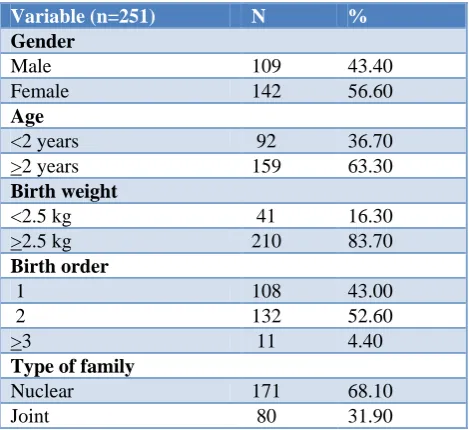
Of the total of 251 under-five children attending immunization clinic at the Rural Health and Training centre, 43.4% (n=109) were males and 56.6% (n=142) were females. Based on the age of the under-five children, 36.7% (n=92) of the study participants belonged to the age group of less than 2 years whereas 63.3% (n=159) belonged to the age group of >2 years. Categorization of the study participants according to birth weight revealed that 16.3% (n=41) of the study participants were born with a birth weight of <2.5 kg whereas 83.7% (n=210) were born with a birth weight of >2.5 kg. Based on the birth order of the study participants, 43% (n=103) of them were first born whereas 52.6% (n=132) were of 2nd birth order and 4.4% (n=11) belonged to the birth order of >3. According to the type of family, 68.1% (n=171) of the study participants belonged to nuclear family whereas 31.9% (n=80) were part of a joint family.
Table 1: Socio-demographic characteristics of the study participants.
Variable (n=251) N %
Gender
Male 109 43.40
Female 142 56.60
Age
<2 years 92 36.70
>2 years 159 63.30
Birth weight
<2.5 kg 41 16.30
>2.5 kg 210 83.70
Birth order
1 108 43.00
2 132 52.60
>3 11 4.40
Type of family
Nuclear 171 68.10
Joint 80 31.90
Table 2: Socio-demographic characteristics of the parents of the study participants.
Variables (n=251) N %
SE status
Class 1 79 31.50
Class 2 76 30.30
Class 3 76 30.30
Class 4 16 6.40
Class 5 4 1.60
Resident
Local 245 2.40
Migrant 6 97.60
Working status
Father working 240 95.60
Both parents working 11 4.40
Table 2 depicts the socio-demographic characteristics of the parents of the study participants. Out of the total 251 study participants, 31.5% (n=79), 30.3% (n=76), 6.4% (n=16) and 1.6% (n=4) belonged to socio-economic class I, II, III, IV and V respectively (using Modified BG Prasad classification). Based on the residence 97.6% (n=245) of the study participants were local whereas 2.4% (n=6) were migrant. Based on the working status of the parents, 95.6% (n=240) of the study participants had their father as the sole earner of the house whereas 4.4% (n=11) of the study participants had both their parents working.
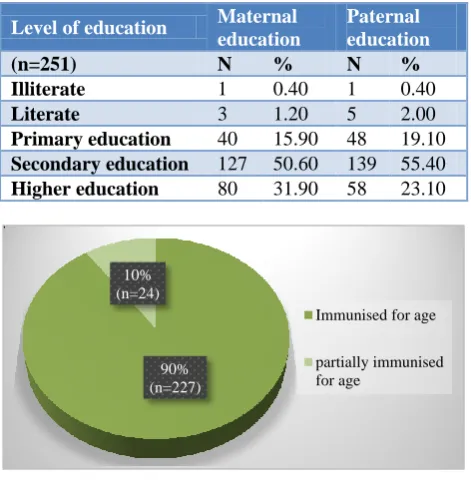
(n=48) upto primary education, 2% (n=5) were literate and 0.4% (n=1) were illiterate.
Table 3: Distribution of the study participants based on maternal and paternal education level.
Level of education Maternal education
Paternal education
(n=251) N % N %
Illiterate 1 0.40 1 0.40
Literate 3 1.20 5 2.00
Primary education 40 15.90 48 19.10
Secondary education 127 50.60 139 55.40
Higher education 80 31.90 58 23.10
Figure 1: Immunisation status among study participants.
Figure 2: Vaccination Delay among study participants.
Of the total 251 study participants, 10% (n=24) were partially immunized for age whereas 90% (n=24) were fully immunized for age (Figure 1). 31% (n=78) of the study participants had a vaccination delay as per schedule whereas 69% (n=173) of the participants were vaccinated at the scheduled time (Figure 2).
It was observed that the delay in vaccination was highest at 5th dose of vitamin A among the study participants and the delay increased progressively as the age of the child increased (Figure 3).
It was observed from the Figure 4 that 5% parents of the study participants were unaware about the immunization
schedule, 17% reported sickness of the study participants as the reason, 55% of the parents of the study participants forgot about the immunization schedule and 1% of the study participants migrated to other area at the time of scheduled immunization.
Figure 3: Vaccination delay with respect to immunization schedule among the study participants.
Figure 4: Reasons for the delay in routine Immunization schedule among the study participants.
It was observed from Table 4 that out of the 251 participants, the vaccination delay for BCG vaccine at birth was 1.6% (n=4); for OPV-O, Hepatitis-B-O at birth it was 0.4% (n=1); for OPV-1, Penta-1 vaccine at 6 weeks it was 1.2% (n=3), for IPV-1 vaccine at 6 weeks it was 0.8% (n=2) and for IPV-2 vaccine at 14 weeks it was 1.2% (n=3).
Among the total 249 study participants who received OPV-2, Penta-2 vaccine at 10 weeks, 2.4% (n=6) received delayed vaccination. Of the total 244 study participants who received OPV-3, Penta-3 vaccine at 14 weeks; 3.7% (n=9) received delayed vaccination.
Out of the total 229 study participants who received Measles and Japanese Encephalitis vaccine at 9 months, 7.4% (n=17) were delayed for the vaccination. Among the 200 study participants immunized for MMR, 19% (n= 38) had a vaccination delay whereas among the 179 study participants immunized for the booster at 18-24th month, a delay in vaccination was observed in 24.6% (n=44) of the study participants.
90% (n=227) 10% (n=24)
Immunised for age partially immunised for age
69% (n=173) 31%
(n=78)
Vaccination on time Vaccination Delayed
0.00% 10.00% 20.00% 30.00% 40.00% 50.00%
VACCINATION DELAY
Unaware Sickness Forgetfullness Migration
reasons for delay 5 17 55 1
5 17
55
1 0
Table 4: Vaccination delay with respect to the type of vaccine among the study participants.
Vaccine Not applicable On schedule Delay
N % N % N %
BCG (n=251) - - 247 98.4 4 1.6
OPV-0, Hep B-0 (n=251) - - 248 98.8 1 0.4
OPV-1, Penta-1 (n=251) - - 248 98.8 3 1.2
IPV-1 (n=251) 229 91.2 20 8.0 2 0.8
OPV-2, Penta-2 (n=249) - - 243 97.6 6 2.4
OPV-3, Penta-3 (n=244) - - 235 93.3 9 3.7
IPV-2 (n=244) 230 94.3 11 4.5 3 1.2
Measles, JE-1 (n=229) - - 212 92.6 17 7.4
MMR (n=200) - - 162 81.0 38 19.0
DPT booster, JE-2, OPV booster (n=179) - - 135 75.4 44 24.6
Table 5: Vaccination delay with respect to vitamin A among the study participants.
Vitamin A doses On schedule Delay Missed
N % N % N %
1st dose (n=229) 212 92.6 17 7.4
2nd dose (n=179) 135 75.4 44 24.6
3rd dose (n=159) 108 67.9 50 31.4 1 0.6
4th dose (n=140) 89 63.6 49 35.0 2 1.4
5th dose (n=119) 72 60.5 46 38.7 1 0.8
6th dose (n=93) 59 63.4 34 36.6
7th dose (n=57) 40 70.2 17 29.8
8th dose (n=38) 26 68.4 12 31.6
9th dose (n=7) 6 85.7 1 14.3
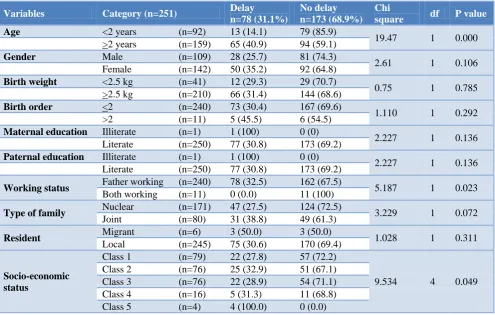
Table 6: Risk factors for vaccination delay among the study participants.
Variables Category (n=251) Delay
n=78 (31.1%)
No delay n=173 (68.9%)
Chi
square df P value
Age <2 years (n=92) 13 (14.1) 79 (85.9)
19.47 1 0.000
>2 years (n=159) 65 (40.9) 94 (59.1)
Gender Male (n=109) 28 (25.7) 81 (74.3)
2.61 1 0.106
Female (n=142) 50 (35.2) 92 (64.8)
Birth weight <2.5 kg (n=41) 12 (29.3) 29 (70.7)
0.75 1 0.785
>2.5 kg (n=210) 66 (31.4) 144 (68.6)
Birth order <2 (n=240) 73 (30.4) 167 (69.6)
1.110 1 0.292
>2 (n=11) 5 (45.5) 6 (54.5)
Maternaleducation Illiterate (n=1) 1 (100) 0 (0)
2.227 1 0.136
Literate (n=250) 77 (30.8) 173 (69.2)
Paternaleducation Illiterate (n=1) 1 (100) 0 (0)
2.227 1 0.136
Literate (n=250) 77 (30.8) 173 (69.2)
Working status Father working (n=240) 78 (32.5) 162 (67.5) 5.187 1 0.023
Both working (n=11) 0 (0.0) 11 (100)
Type of family Nuclear (n=171) 47 (27.5) 124 (72.5) 3.229 1 0.072
Joint (n=80) 31 (38.8) 49 (61.3)
Resident Migrant (n=6) 3 (50.0) 3 (50.0) 1.028 1 0.311
Local (n=245) 75 (30.6) 170 (69.4)
Socio-economic status
Class 1 (n=79) 22 (27.8) 57 (72.2)
9.534 4 0.049
Class 2 (n=76) 25 (32.9) 51 (67.1)
Class 3 (n=76) 22 (28.9) 54 (71.1)
Class 4 (n=16) 5 (31.3) 11 (68.8)
Class 5 (n=4) 4 (100.0) 0 (0.0)
It was observed from table 5 that the delay in receiving 1st dose of vitamin A was 7.4% (n=17 out of 229 participants) while for the 2nd dose it was 24.6% (n=44 out of 179 participants), 3rd dose it was 31.4% (n=50 out of 159 participants), 4th dose it was 35% (n=49 out of 140 participants), 5th dose, the delay was seen in 38.7% (n=46 out of 119 participants), 6th dose it was 36.6% (n=34 out of 93 participants), 7th dose it was 29.8% (n=17 out of 57 participants), 8th dose it was 31.6% (n=12 out of 38 participants) and for 9th dose of Vitamin A, the delay in vaccination was 14.3% (n=1 out of 7 participants).
Table 6 depicts the risk factors for vaccination delay among the study participants. It was observed that Age, working status and socio-economic status were found to be statistically significant with a p value of less than 0.05. Factors like gender, birth weight, birth order, maternal education, paternal education, type of family and residence did not show any association with delayed vaccination.
DISCUSSION
The present study was conducted among the under-five immunization attendees at an immunization clinic to assess the immunization status among them and to study the factors associated with delayed immunization. Immunization day was utilized for carrying out this assessment as it was cost-effective and no extra inputs or manpower were needed. In this study, the number of fully immunized children were 227 (90%) which was higher than the incompletely immunized (10%, n=24) under-five children. The above observation reveals a higher immunization coverage as also seen in other studies and rates which could be explained by high literacy and educational level.5 Lower immunization coverage is observed in states with low literacy rate as per the study conducted by Singh et al.6
Delayed vaccination leads to decreased levels of protection against disease. According to a study conducted by Ukey et al delayed immunization was observed in 12.8% children which is much lower than that observed in our study i.e. 31% (n=78).4 The most common causes for delay included forgetfulness. This is similar to as described by Rahman, Islam et al and also seen in other studies.5,7,8 The low recall of immunization schedule could be due to the fact that the parents forgot after completing the primary immunisation and also low knowledge itself among the community is the cause of forgetfulness.
Delayed vaccination was more commonly observed for secondary immunization and booster doses which is in contrast to findings in other studies. The female predominance of vaccination delay was reported in the present study which is similar to studies conducted by Tiwari et al and Ughade et al.3,9 But the gender difference was not statistically significant. The recommended age of the vaccines and carelessness on the part of the parents
were the main factors responsible for vaccination delay. The present study showed an association between age, working status, socio-economic status and vaccination delay, but no such association was found for gender, birth weight, birth order, maternal and paternal education, type of family and residence.
CONCLUSION
Delayed vaccination was seen in 31% of the participants and more in children more than 2 years of age. The factors associated with such delay which are found significant are the age more than 2 years, the working status and the higher socio-economic class. The vaccination delay varies as the gap between the immunisation dates increases over age. Strategies must be evolved to educate the parents in the study area to have greater awareness and compliance with regard to the
immunization programmes and implications of
vaccination delay.
Funding: No funding sources Conflict of interest: None declared
Ethical approval: The study was approved by the Institutional Ethics Committee of Goa Medical College, Bambolim Goa
REFERENCES
1. WHO. Immunization coverage. WHO. World
Health Organization; 2018. Available at:
http://www.who.int/mediacentre/factsheets/fs378/en /. Accessed 4 February 2018.
2. WHO recommendations for routine immunization.
Available at: http://www.who.int/immunization/ policy/immunization_schedules/en/. Accessed on 3 February 2018.
3. Tiwari RR, Kulkarni PNTiwari RR, Kulkarni PN. Delayed immunization against vaccine preventable diseases--factors responsible among children under 5 years of age. Indian J Med Sci. 1999;53:212–5. 4. Ukey UU, Dantu P, Chitre DS, Pusuluri S, Ukey
UU, Dantu P, et al. Factors related to Delayed Immunization among children below 5 years. Int J Biol Med Res Int J Biol Med Res. 2011;2:1171–2.
5. Sood RK, Sood A, Bharti OK, Ramachandran V,
Phull A, Sood RK, et al. High Immunization Coverage but Delayed Immunization Reflects Gaps in Health Management Information System (HMIS) in District Kangra, Himachal Pradesh, India—An Immunization Evaluation. World J Vaccines. 2015;5:69–78.
6. Singh JP, Gupta SB, Kariwal P, Singh AK, Imtiaz D, Singh JP, et al. Immunization Status of Under Two Years Children in Rural Bareilly. Sch J Appl Med Sci. 2014;2:826–9.
7. Rahman MM, Islam MA, Mahalanabis D, Rahman
Immunization Coverage of a Population with High Rate of Illiteracy. J Trop Pediatr. 1995;41:376–8. 8. Smith PJ, Humiston SG, Parnell T, Vannice KS,
Salmon DA, Smith PJ, et al. The Association
between Intentional Delay of Vaccine
Administration and Timely Childhood Vaccination Coverage. Public Health Rep. 2010;125:534–41.
9. Ughade SN, Zodpey SP, Deshpande SG, Jain
DUghade SN, Zodpey SP, Deshpande SG, et al. Factors responsible for delayed immunisation
among children under 5 years of age. J Indian Med Assoc. 2000;98:4–5.
Cite this article as: Noronha E, Shah HK.A study of